Quotulatiousness

June 19, 2026

Nobody voted for this kind of dystopian nightmare, Mr. Carney!

The Liberal Party, having engineered themselves a majority in the House of Commons, are on a speed-run to the kind of dystopian police state we used to read about in science fiction novels:

Millions of Canadians are beginning to see the similarities between communist regimes and the direction of current government policy.

The pattern is always the same.

It begins with noble promises: safety, equality, compassion, protection, the greater good.

It ends with censorship, coercion, surveillance, prisons, ruined lives, and a police state.

Always.

It comes wrapped in slogans, experts, committees, emergency powers, censorship, enemies of the people, and the belief that the state has the right to crush the individual for the greater good.

Consider…

C-2 – Strong Borders Act
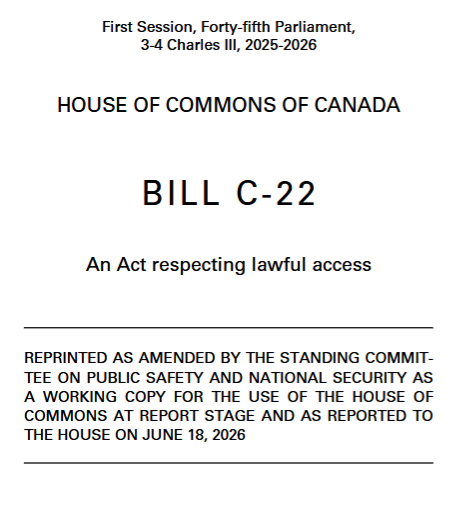
C-22 – Lawful Access Act
C-34 – Safe Social Media Act
C-36 – Protecting Privacy and Consumer Data Act
C-9 – Combatting Hate Act
C-25 – Strong and Free Elections Act
S-209 – Protecting Young Persons from Exposure to Pornography Act

All seven are live in the 45th Parliament right now. None has received royal assent yet.

Consider that good, law-abiding Canadians are being gradually and systematically disarmed.

This is not a warning about some distant future.

In 2022 the federal government invoked emergency powers it did not have, froze the bank accounts of citizens over their political views, and banned Canadians from funding a protest. Two levels of court have since ruled it unconstitutional — a violation of the very Charter rights every one of these bills now circles.

That was the trial run. It needed an emergency as the excuse.

The seven bills above are the permanent version — the same reach, made routine — so that next time, no emergency need be declared at all.

A free country is not lost in a single day. It is legislated away in pieces, each one introduced with a reassuring name and defended as necessary, while good people keep assuring themselves it could never happen here.

It already did. The only question is whether enough Canadians notice before it becomes permanent.

Read every bill. Watch every one of them. Because this is the stage where it can still be stopped … and perhaps our last chance.

The Justice Centre for Constitutional Freedoms is trying to get Canadians to pay attention to what just one of these bills will do:

Bill C-34 will affect every Canadian. Age verification. AI regulation. A new Digital Safety Commission. Most Canadians have never heard of it. Here’s what it will do.

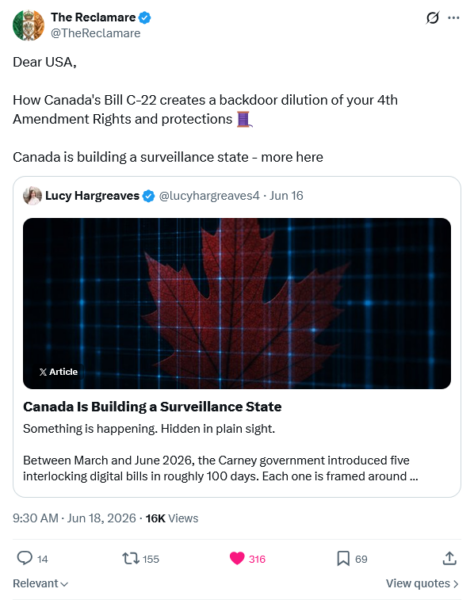
Michael Geist posts a Substack Note about bill C-22:

Bill C-22, the lawful access bill, has been reported back from committee and is headed toward passage. There are some amendments, but many concerns remain. The updated bill with changes is at

parl.ca/Content/Bills/4…

There are two changes to metadata retention. First, the maximum retention period the government can impose drops from 1 year to 6 months. Second, it can now mandate a category of metadata only if satisfied the category and all its elements are essential to investigations.

The committee rewrote the definition of systemic vulnerability. A “substantial risk” becomes a “credible risk, based on recognized international technical standards”. But it also added a carve-out: a flaw exposing only a target’s data is not “systemic”.

Added a new section on decryption that says nothing in the Act can be read to compel a provider to decrypt user-encrypted data, unless the provider supplied the encryption and holds the key. Borrowed from US law, but doesn’t fit the same way.

Compliance with ministerial orders is now expressly subject to the systemic vulnerability exception. That addresses a contradiction in the original text, where the duty to comply appeared to be unconditional.

The original bill set no maximum duration on these ministerial orders. This now changes to a two-year cap without the open-ended review-and-extend mechanism.

The amendments will rightly leave many still concerned. Companies considering exiting Canada due to Bill C-22 are unlikely to conclude that it fully addresses their issues. Yet the government is likely to push it through the House today.

US history is unique, it does not map onto the histories of other nations

Filed under: History, India, USA — Tags: , , , , , — Nicholas @ 03:00

I’ve noticed this pattern myself, but I hadn’t considered that a lot of Americans don’t just use the patterns of their national history when looking at other western nations:

“Political Map of the Indian Empire, 1893” from Constable’s Hand Atlas of India, London: Archibald Constable and Sons, 1893. (via Wikimedia Commons)

Not every place in the world can be examined through the historical template of the United States.

One of the reasons conversations about India are so difficult for folks in the West to untangle is that many of the frameworks Americans use to understand power, intergroup dynamics, identity, and historical injustice do not map onto India. Not at all.

For Americans who have adopted a critical lens, the template derived from American history is fixed. A dominant demographic majority group seeks to preserve power while marginalized demographic minorities fight for recognition and inclusion. Because this template is so fixed in the imagination, there is a tendency to view and interpret dynamics and events in other countries in exactly the same way. I have seen it myself. “We’ve all seen how this works”, someone will say, and proceed to apply the American template to a different place.

And the history of the Americas (both North and South) is dominated by European (white) Christian colonization. As a result, Americans are familiar with the legacies of European empire and Christian missionary expansion. By contrast, the history of Islamic conquest and rule, which shaped large parts of Asia, Africa, and Europe for centuries, occupies far less space in the American imagination. So too does the contemporary influence of petrodollar-funded religious institutions, transnational Islamist movements, and the global circulation of Islamist narratives.

This does not mean these forces explain everything. It does mean that many Americans have little historical or conceptual framework for understanding how they might shape politics, memory, education, or intergroup relations in places like India.

India’s history is not the same as that of the Americas.

For centuries, India experienced successive waves of colonization. The first came through a series of Muslim invasions and dynasties, culminating in the Mughal Empire. The second came through British colonial rule, predated by British mercantile and missionary efforts. Yet unlike many colonized societies, the civilizational majority was never fully displaced, converted, or absorbed. Hindu traditions, practices, languages, stories, temples, and collective memories survived.

This is perhaps the single hardest aspect of India for many Americans to grasp because it has no real analogue in American history: the Hindu demographic majority is also the historically colonized population.

For many Western observers, this creates immediate suspicion because it violates the assumptions embedded within our familiar frameworks. The expectation is that majorities defend power while minorities challenge it.

As a result, contemporary debates about textbooks, public memory, historical figures, temples, and national identity are often seen and interpreted by folks in the West through frameworks that retrofit Indian history into contemporary American critical analysis through the reductive binaries of majority/minority, right/left, which are memeable and digestible, but obscure much more than they reveal about power, history, equity, policy, foreign influence, etc.

When Hindus argue that violent and painful aspects of Mughal conquest have been whitewashed in public education, they are frequently accused of attempting to rewrite history to justify the alleged “Hindu right wing” suppression of a minority group today. (Please do read my analysis of religious-based violence in India. It’s not what you think it is. Link.)

Yet Americans themselves are familiar with the process of revisiting historical narratives to advance truth and reconciliation. We have debated how slavery is taught, how Indigenous history is taught, how immigration is taught, and how women and minority groups have been represented in textbooks and in classrooms. We generally accept that historical narratives evolve as new evidence emerges and as previously marginalized perspectives are taken seriously.

What makes India different is that the group seeking rigorous reconsideration of historical narratives is often the majority population. For many Western observers, this creates immediate suspicion. The assumption is that majorities seek dominance while minorities seek justice.

But history does not always work that way.

The result is that efforts by Hindus to recover historical memory are often denounced as nationalism (which is falsely equated with white or Christian nationalism in the United States) before they are examined on their own terms. Questions about historical representation become questions about political motives. Efforts to revisit narratives become “evidence of extremism” or, even more bizarre, “anti-intellectualism”. And figures who have occupied a central place in Hindu memory for centuries are presented as newly invented symbols of contemporary political power.

The result is that the Indian voices most readily amplified in Western media are often those whose analyses are already legible within familiar Western frameworks. Their arguments are immediately understandable, which lends them “credibility”. Perspectives that do not fit those frameworks are frequently dismissed as “Hindu nationalist” before they are seriously considered.

One need not agree with every argument made in these debates to recognize that they are, in fact, debates. The question is not whether history should be examined. The question is whether everyone is permitted to participate in that examination without having their motives presumed in advance.

Sparta vs Athens – 2(a): Two Greek Worlds (Citizens, Helots, Power)

Filed under: Greece, History — Tags: , , , , , , — Nicholas @ 02:00

seangabb
Published 8 Feb 2026

Greece: A Brief History, c.700 BC – 500 AD

In this lecture segment I set out the fundamental contrast between Sparta and Athens as social and political systems. Sparta was a permanent military state built on coerced labour and internal discipline. Athens was a quarrelsome democracy that relied on participation, persuasion, and a wider civic culture of debate.

We begin with the basic structures: who counted, who did the work, and how each society organised its citizen body. This is not moral theatre. It is institutional reality. By the end, the students should see why Sparta could produce cohesion and battlefield reliability, while Athens produced instability, argument, and a public life that made intellectual achievement possible.

QotD: The Prince is a … satire?

Filed under: Books, Education, Government, History, Italy, Quotations — Tags: , , , — Nicholas @ 01:00

When I was a lad, I was told that Machiavelli’s The Prince is a satire. I don’t believe it, personally — I know a few things about Renaissance Italy, and I think he meant every word — but I learned something important from the people who insist it’s a satire: They’re wishcasting.

Let me back up. The occasion where I first heard the “it’s a satire” thesis was an “advanced placement” History class back in high school. They probably don’t have those anymore as part of the regular curriculum — dat be rayciss — so in case you’ve never endured one, it’s a bunch of mega-nerds who only care about pleasing Teacher trying to do History. For our unit on “The Renaissance”, we had to read both The Prince and More’s Utopia, and do our term paper on one or the other.

Naturally I picked The Prince, and since you all know the kind of kids who were in that kind of class, naturally everyone else picked Utopia. I might’ve been the only kid who ever did his paper on Machiavelli; certainly the teacher acted like she’d never seen one before. We didn’t have the phrase “trigger warning” back then, but that’s what it amounted to — Teacher hastened to inform everyone in the class that The Prince was really a satire, and so of course I was just kidding too, ha ha, because otherwise we were in the presence of very, very, very bad thought …

“Yes, kidding, ha ha ha,” I muttered, because while I obviously wasn’t the quickest on the uptake back then — I should’ve just done the stupid paper on goddamn Utopia like the rest of the sheep — even I could figure out that I was gonna get sent to the school counselor if I didn’t get with the program …

… and that’s when I learned the aforementioned lesson. Kidding? You think Machiavelli’s kidding? Didn’t we just do this whole unit on the Renaissance? Your main man Thomas More was burning people at the stake, for fuck’s sake! And as for the Italians, they were straight whacking people out in church, with the active connivance of the fucking Pope himself. Satire, fuhgetaboudit, that’s Godfather shit, Machiavelli’s as serious as cancer. You just don’t want to believe that people are actually the way they so obviously are, so you’ll tell yourselves he’s kidding … and Teacher will back you up on it, because she doesn’t want to believe it either.

(Meanwhile, I’ll get an A for my excellent “satire”, in exchange for which I will never ever bring it up again or I’ll fail the rest of the semester).

Severian, “End States and Inverted Incentives”, Founding Questions, 2022-06-22.

June 18, 2026

Unexpected increase in legal gun ownership in Canada

Filed under: Cancon, Government, Law, Liberty, Weapons — Tags: , , — Nicholas @ 05:00

The federal government has been doing everything it can to curtail Canadians’ access to firearms since 2015, most recently imposing bans on literally thousands of different gun models and almost completely restricting purchase, sale, or transfer of legal handguns. Under these circumstances, you’d expect that interest in legal gun ownership would be on a pretty steep decline. But that’s emphatically not the case:

Here is something the government does not talk about.

Canada’s handgun freeze took effect on October 21, 2022. Since that date, very few people who have exemptions have been able to buy, sell, gift, or inherit a handgun. The market for new restricted handguns is effectively closed.

So you might expect the number of Canadians holding a Restricted PAL (the licence required to own handguns and other restricted firearms) to be flat or declining. Why bother completing the restricted component of the Canadian Firearm Safety Course if you can’t use it to buy a handgun?

The data says otherwise.

According to the RCMP Commissioner of Firearms Reports, the number of RPAL holders has grown every year since the freeze:

2022: 716,348
2023: 752,002 (up 5.0%)
2024: 775,266 (up 3.1%)
2025: 794,768 (up 2.5%)

That is a net gain of 78,420 restricted firearm licence holders in three years, a 10.9% increase, all during a period when the primary reason most people get the restricted designation on their PAL (to buy a handgun) was legislated away.

Canadians are still taking the safety course, submitting to the background checks, and getting licensed. The freeze did not stop the demand for restricted licences. It just stopped the legal market from serving the people who hold them.

Source: RCMP Commissioner of Firearms Reports, 2022, 2023, 2024, and 2025.

The Rape Gang Inquiry Report

At The Bugscuffle Gazette, Ian expresses his disgust and contempt at the British government which has categorically failed to protect a quarter of a million girls and young women from sexual predators imported by that government, which then actively covered up the crimes. It’s impossible to put into words just how cowardly every politician, every police officer, and every “social worker” has been for decades in allowing these crimes to flourish:

Click the image to open the report PDF

I was not expecting to learn that the grooming gangs have been operating since 1955. Seventy-one years. At least two generations of British children have been savagely sacrificed on the altar of multiculturalism, willingly helped and encouraged by not only the State, but by our “Journalistic Betters”.

I was not expecting to learn that the victims number a quarter of a million. At minimum.

The least job of a society — the very minimal function expected — is the protection of the innocent and the defence of those who cannot protect themselves.

The Government of Great Britain — from the least to the highest — not only failed in this most minor of duties, but actively aided and abetted the destruction of the innocent and the depredation of the defenceless — with the enthusiastic assistance of “professional” “journalists”.

Seventy-one (71) years. Two-hundred and fifty-thousand (250,000) children raped. Trafficked. Tortured.

I don’t ever bloody well want to hear any English person tell me I don’t need guns again. “The police will protect you” you say, with that supercilious smirk. Read that report again — especially the part about the police failing to protect children, CHILDREN for God’s sake — and then get sodding bent.

I am furious. I don’t want apologies — I want officers executed. I want politicians hung in the public square, their possessions seized. I want journalistic edifices chained shut and set on fire.

I want the bloodshed and retribution visited upon those responsible, those who enabled, and those who willingly ignored to be of a level that will snarl softly to British people for ages to come:

“Do. Not. Fail. Again.”

Bastards.

On the social media site formerly known as Twitter, X Freeze summarizes some of the findings from the report:

Perpetrators:
~87% of convicted group-based CSE offenders had Muslim names. Estimates put the real figure at ~95% Muslim. Networks were almost entirely Muslim men — overwhelmingly Pakistani. Massively disproportionate to population share.

Enabled by honour-shame clan culture and Islamic doctrines that treat non-Muslim girls as available property: Muslim superiority over kuffar, al-walāwa-l-barā‘ enmity to non-Muslims, no fixed age of consent, and rules allowing sexual use of captives.

How the grooming worked:

Girls as young as 11 were befriended by young Muslim men who treated them like adults, supplied alcohol, drugs and cigarettes. They were collected in taxis from school gates, care homes and streets, taken to houses, flats, restaurants and hotels, then raped repeatedly by groups of men, passed between perpetrators, tortured, filmed, and told they were “white trash” or “kuffar” who deserved punishment. Many became pregnant while still children. Some were trafficked to the Middle East for Islamic marriage.

failure & cover-up

Every pillar of the state failed catastrophically for decades:

  • Police ignored reports, criminalised victims instead of perpetrators, destroyed evidence and bailed known rapists.
  • Social services placed children in trafficking hubs inside children’s homes, closed cases despite clear signs, and retaliated against whistleblowers.
  • NHS recorded genital injuries, multiple STIs in children as young as 13, and rape pregnancies — then discharged victims back to their abusers.
  • Schools saw older men collecting girls at the gates and heard disclosures, yet often excluded the victims rather than protecting them.
  • Politicians (especially Labour-controlled councils and the party nationally) denied knowledge, blocked or watered down inquiries, suppressed ethnicity data, and prioritised electoral support from Muslim voting blocs and “community cohesion” over child protection. Fear of being called “racist” paralysed action. Sadiq Khan repeatedly insisted there were no grooming gangs in London, despite the Metropolitan Police holding reports of girls being raped by groups of men in hotels and other locations across the capital.

On her Substack, Celina identifies the specific state failures that perpetuated what started as isolated, local crimes:

The central thesis of the Rape Gang Inquiry Report is unequivocal: the estimated 250,000 victims were the victims of a deliberate collapse of the British state’s safeguarding architecture. Across every crucial sector, the state chose institutional convenience over the lives of children.

The Police: Criminalisation and Complicity

The Inquiry documents how officers frequently arrived hours late to missing persons reports, actively discouraged parents from filing complaints, and routinely closed cases without conducting basic forensic or digital examinations.

The most pervasive failure was the ideological decision to view the victims as willing participants in their own destruction. Children like Chloe, found highly intoxicated in the cars of adult men, were labelled “prostitutes” making “lifestyle choices”. By framing the organised rape of children as consensual sex work, the police absolved themselves of the legal requirement to launch resource-heavy investigations into organised crime syndicates.

When victims or their families did provide actionable evidence, it was routinely mishandled, ignored, or actively destroyed. Ross, the father of a survivor named Phoebe, testified that vital digital evidence handed over to the police was inexplicably deleted from the device while in police custody. When Grace’s abusers repeatedly breached their bail conditions and stalked her family, the police took no action, rendering protective non-molestation orders entirely meaningless.

The bureaucratic responses were often farcical. In some instances, the only formal action taken by police was issuing “harbouring notices” to the men, pieces of paper warning them not to associate with the child. When the men inevitably ignored these notices, no further enforcement followed. Furthermore, the Inquiry uncovered a deeply entrenched “two-tier” policing system. While forces surrendered to the fear of disorder from certain communities, they aggressively targeted the victims and their families. Chloe was arrested in her pyjamas after her mother called the police for help, kept in a cell until 2:00 AM, and released onto the streets without transportation, leading directly to her being picked up by a gang member and trafficked nationwide.

Most disturbingly, the report highlights allegations of direct police complicity, referencing whistleblower accounts of “cop nights” where officers were allegedly active participants in the trafficking and abuse of girls using police vehicles. The revelation that an abuser could be legally accepted as an “appropriate adult” for Michelle during police questioning underscores a force either dangerously incompetent or wilfully blind to the dynamics of coercive control.

Social Services: Abandonment and Retaliation

If the police failed to enforce the law, social services failed to enforce basic humanity. Across multiple districts, social care systems identified the precise markers of severe exploitation, truancy, self-harm, sudden wealth, STIs, missing episodes and consistently chose to look away.

The Inquiry demonstrates that social workers frequently undermined protective parents, isolating children from their families and placing them in residential care homes and semi-independent units that functioned as drive-through delivery systems for the gangs. Children were centralised, making them easier targets.

Jane, a victim placed in semi-independent living at 16, was trafficked directly from her state-provided accommodation. When she disclosed the abuse and the exchange of money to the staff, she was told it did not constitute trafficking because she was over 16. The staff then blackmailed her, threatening to blame her for the exploitation if she complained further. Following a psychiatric hospitalisation, Jane discovered that all statutory care records from her placement had been mysteriously “lost or destroyed,” legally obstructing any path to future accountability.

When internal whistleblowers attempted to expose the ongoing grooming, trafficking, and financial abuse of children in these units, they were met with severe retaliation. An unnamed social worker who acted as an Interim Co-Manager testified that after raising concerns about untreated exploitation risks and unlawful housing practices, she faced sudden suspensions, the removal of payments, fabricated allegations, and career-ending professional isolation orchestrated by senior leadership to protect the council’s reputation. Social services actively punished those who tried to protect children.

Schools:

Teachers and school administrators observed older men waiting at the school gates to collect young girls in taxis. They noted sudden drops in attendance, drastic changes in behaviour, and physical exhaustion.

Instead of recognising these as textbook indicators of exploitation, schools responded with punitive measures that pushed the children further to the margins. When Chloe’s trauma manifested as truancy, the school repeatedly placed her in isolation, compounding her emotional distress and alienation. When Jen was bullied to the point of wetting herself because a teacher refused her access to the toilet, the school ignored her subsequent self-harm and suicidal ideation, failing to initiate any safeguarding response.

In the most tragic instances, schools actively protected the abusers to avoid scandal. When Rachel’s autistic daughter disclosed that she had been orally raped by a peer, the school failed to effectively safeguard her, allowing the alleged perpetrator to remain on the premises. She was subjected to relentless physical and online bullying by students linked to the abuser, which was filmed and shared online. The intimidation escalated until the twelve-year-old took a fatal overdose of colchicine, stating she “just wanted everything to stop”.

Rupert Lowe explains his next steps after the publication of the inquiry report:

Rules for you young plebs, but not rules for us

The generation that defined itself as “the youth generation”, “the hippies”, etc., are now nailing down every possible way to have fun so that youngsters can’t do what they loudly and proudly did at the same age:

Part of the crowd on the first day of the Woodstock Festival, 15 August, 1969.
Photo by Derek Redmond and Paul Campbell via Wikimedia Commons.

We’re banning raves, because we don’t want you having fun where we can’t watch you. By the way let me tell you about Woodstock.

We’re cracking down on underage drinking. It’s bad for you. Yeah of course we hit up the pubs at your age it was great.

We’re banning smoking, but just for you — the smoking age will go up one year every year. Oh yes of course, we used to be able to smoke inside everywhere, it was great really.

We’re banning flavored vapes. We don’t have any evidence they’re bad for you, you just like them too much.

We’re banning dodgeball during recess, someone might get hurt. Yeah we really enjoyed dodgeball too.

We’re banning flirting, because it might make the girls uncomfortable.

We’re locking you in your room for the next two years. Yes we know you’re in no danger from the virus, but we’re worried that you’ll get us sick. By the way you have to take this needle if you want to leave your room again. Yes, twice. Well there will be boosters too. No, we aren’t worried about side effects, that doesn’t effect us at all.

We’re closing the frat houses, because we don’t want you having fun without our permission. Please join these officially sanctioned university clubs instead.

We’re bringing in labor from the third world to work the service jobs, so you can’t have a summer job.

You need to go to university to get a good job. By the way we’re raising the price of tuition. Oh look we’re raising it again. Don’t worry there are loans. At interest.

Actually we’re giving the good jobs to the foreigners we just imported, to make up for our racist past. We are very good people. No of course we aren’t sacrificing anything. You just have to take one for the team.

Also, we’re giving the foreigners the houses. We needed to increase real estate prices. For our pensions, you see. Sadly no, you’ll probably never be able to afford one yourself. By the way don’t forget to pay your taxes. Need to support those pensions somehow! Eh? No, we’re giving ourselves tax breaks of course. Seniors discount you know.

Oh by the way, that one thing you still have, now that we’ve banned joy and kicked every ladder out from under you? That social media stuff you kids like? You guessed it! We’re banning that too! Just for you though, we’re still going to watch AI videos on Facebook. It’s for your safety, you see. We’ve noticed that you’re all getting rather irate, and we think it would be better for your mental health if you shut up for a while. Why don’t you just go outside?

Eh? No of course we aren’t going to stop Ahmed and his twelve illiterate cousins from raping your sister, that would be culturally insensitive, which would make us feel very bad, and we can’t have that.

Update: Added missing URL.

Ross 1912 Cadet: Straight Pull .22 Rimfire Training Rifle

Filed under: Cancon, History, Military, Weapons, WW1 — Tags: , , , , , — Nicholas @ 02:00

Forgotten Weapons
Published 28 Jan 2026

The Ross model 1912 Cadet rifle was introduced in 1912 as a diminutive rimfire companion to the 1905 and 1910 military Ross rifles. It was a single-shot straight pull rifle, with a somewhat unusual locking bolt system. Somewhere between 13,000 and 17,000 appear to have been made, for civilian commercial sale, Cadet Corps, and Militia use. Production ended in March 1917, when the Ross company collapsed. Today these are quite rare rifles.
(more…)

QotD: James K. Polk – a dark horse?

Filed under: History, Politics, Quotations, USA — Tags: , , , , — Nicholas @ 01:00

“Who is James K. Polk?” the Nashville Republican Banner asked in a headline after news of Polk’s nomination as the 1844 Democratic Party standard-bearer reached the Tennessee capital. The question was meant to be derisive, and it struck so shrill a chord that the Whigs adopted it as their national campaign taunt.

The truth is that Polk’s political opponents knew very well who James K. Polk was — and why they should fear him. Yet almost two centuries later, despite solid standing in modern presidential polls and a portrait that currently graces the Oval Office, Polk’s legacy is entwined in mischaracterizations.

The Myth of the Dark Horse

Many will tell you that Polk was a dark horse. No, he was not.

Born in North Carolina in 1795, Polk aspired to the presidency at least from his first election to the Tennessee House of Representatives at the age of twenty-eight. He always had what every budding politician craves: the unqualified support of the era’s greatest hero. Although some vilified Andrew Jackson, Old Hickory was a political force that could not be denied. With Jackson’s encouragement, Polk entered politics and then married Sarah Childress, whom Andrew and Rachel Jackson treated as a daughter.

Prior to his nomination, Polk had served seven terms in Congress, including two as Speaker of the House; he had been governor of Tennessee; and he had tried to unseat the sitting vice president to become President Martin Van Buren’s running mate in 1840. To be sure, there were defeats along the way. Polk lost his first try for the Speakership and two gubernatorial campaigns in Tennessee, a state as bitterly divided as any between Jackson’s Democrats and emerging Whig forces.

But Polk never lost sight of the prize. Even in defeat, he continued to correspond with Democratic leaders across the country. His presidential nomination in 1844 at a convention divided over the annexation of Texas may well have been — as one of his most ardent supporters advised — four years ahead of schedule. After all, former president Van Buren, who had lost his reelection campaign in 1840, again sought the nomination in 1844. But Polk was not a dark horse suddenly surging from the back of the field. He was in the arena and one of the most astute and well-connected politicians of his day.

Walter R. Borneman, “James K. Polk and the 5,106 Votes That Changed America”, Coolidge Review, 2026-02-20.

June 17, 2026

Why California’s high speed train system will probably never be finished

This is an older post from March, but nothing in it has significantly changed … the legal and regulatory structure of Californian governance will ensure that what work gets done on the high speed rail infrastructure will only be done at the slowest speed yet at the highest possible costs:

The California high-speed rail authority, literally owns thousands of parcels of land that are in various stages continued litigation, tenant improvements, eviction, and constant maintenance.

For example, there are many homes and apartment complexes in the plant path that have been purchased years ahead of construction. Removing those tenants is a slow and expensive process. (let’s ignore the extra stress on housing that all of these destroyed properties are causing)

In some cases, these are low rent apartments with a lengthy eviction process. During that process, the state of California is the landlord and has to maintain the property codes the same as any other landlord. This means repairs, adding smoke detectors, fixing roofs, vegetation management, landscaping, paying off tenants to leave early, boarding up Windows, constant trash cleanups, towing vehicles etc.

But the High Speed Rail Authority doesn’t just have to maintain these properties at normal cost. Every single bit of that work has to be done at California prevailing wage rates. The work can only be done through qualified contractors that have passed through a long series of idiotic mazes to qualify to perform the work.

An average rate per hour (charge rate) for a worker to perform any service on these properties is approximately $200 an hour for labor only. The cost go up for specialized work, like electricians, plumbers, or machine operators.

Properties that are literally worthless are being maintained at huge expense just so the next round of homeless transients can break into the property and cause more damage. For reasons I can’t explain, the process to finally demo and remove the structures takes years.

I’m only mentioning the tip of the iceberg regarding my firsthand knowledge.

Completely separate from those outlandish costs are the inflation caused by the construction. The prevailing word on the street is that nothing is getting done. The truth is that a lot is getting done and none of it efficiently.

The amount of concrete being poured daily and monthly to build gigantic overpasses for both the rail and roadways is not understood. In these work areas, every concrete mixing company is fully scheduled out and cannot offer building materials for other basic services such as building a house often times for weeks when the average lead time for many of these services used to be one day. And that’s just the schedule, never mind the huge cost increases from straining the supply chain and labor pool.

The amount of concrete and steel that has gone into the structures so far is massive.

Dozens and dozens of new water wells have been dug just for dust control. Thousands upon thousands of acres of highly productive tree fruits and nuts have been torn up and shredded.

Utility scale solar fields have been uprooted and sometimes relocated at extravagant costs.

Every type of business you can imagine has gone through either a closure, relocation, or a long-term tenant agreement with the rail authority. In some cases, it’s just a buyout where the business closes its doors forever. The owners get something all of the workers get nothing.

Don’t get me started on how thick the layers of bureaucracy are for these minute tasks that occur on all of these properties.

The inefficiency is far beyond your wildest dreams. In many cases, this is not related to fraud in any way it’s just absolute ignorance, red tape, and failed leadership.

The Korean War Week 104 – Order Restored at Koje-do – June 16, 1952

Filed under: China, History, Military, USA — Tags: , , , , , , — Nicholas @ 04:00

The Korean War by Indy Neidell
Published 16 Jun 2026

The saga of Koje-Do POW camp comes to its end this week after Bull Boatner’s troops crack down hard and finally take full control there. Operation Counter continues with fighting for Hill Eerie, and South Korean President Syngman Rhee is stirring up so much trouble that the US is considering intervening in South Korean politics to stop him.

00:00 Intro
00:40 Recap
01:11 Operation Counter
03:31 The Chinese Account
05:22 Koje-Do
10:46 Rhee Again
12:50 US Presidential Election
15:58 Summary
16:25 Conclusion
18:13 Call to Action

Canada’s new civic religion, with the “land acknowledgement” as the daily rite

Filed under: Cancon, History, Media, Politics — Tags: , , , — Nicholas @ 03:00

L. Wayne Mathison shows how cultural boundaries changed radically over relatively short periods of time in what is now Manitoba, rather discrediting the fairy tale we tell our children about pre-contact First Nations living in peace and harmony:

Canada’s institutional obsession with land acknowledgements and historical guilt has officially jumped the shark.

Every university lecture, corporate meeting, school event, and government memo now seems to begin with the same rehearsed confession about whose land we are supposedly standing on. It has become a civic ritual, complete with liturgy, original sin, and mandatory public piety.

Strip away the administrative sermonizing and the whole thing rests on a very shaky version of history.

We are expected to pretend pre-contact North America was a peaceful, static, eco-friendly paradise where distinct peoples lived in permanent harmony until Europeans arrived and ruined everything.

That is not history. That is mythology.

Worse, it is patronizing. It strips Indigenous peoples of their full humanity by pretending they were somehow immune to the normal forces that shaped every other society on earth: ambition, conflict, trade, migration, alliance, conquest, revenge, and expansion.

The actual history of this continent was not a postcard. It was dynamic, complex, and often brutal.

The Haudenosaunee expansion during the Beaver Wars reshaped huge parts of what is now Southern Ontario. The Huron-Wendat, Neutral, and Erie peoples were devastated, displaced, or absorbed through war and political domination.

On the plains, the Blackfoot Confederacy, the Iron Confederacy, and others fought long struggles over territory, trade, horses, resources, and survival. Peoples moved. Borders shifted. Alliances formed and collapsed. Some groups conquered. Some retreated. Some disappeared into larger political orders.

History did not begin when Cartier sailed up the St. Lawrence.

This land was already a theatre of power, movement, conflict, diplomacy, and displacement long before Europeans arrived.

The modern Canadian narrative treats European colonisation as a unique cosmic crime, as if conquest and territorial displacement were invented in 1492. They were not. Europeans arrived as a technologically dominant global power and did what powerful groups had done across human history, including on this continent.

That does not make the suffering harmless. It does not erase broken treaties, residential schools, forced relocations, or government abuse. Those things happened, and they matter.

But a serious country cannot build its future on a childish version of the past.

Every habitable part of the world has been taken, lost, fought over, inherited, traded, defended, and taken again. The people Europeans encountered were not frozen in moral perfection. They were human beings living inside history, not outside it.

The guilt industry does not repair the past. It often paralyzes the present.

Canada cannot move forward by treating itself as a permanent crime scene or by dividing citizens into inherited moral categories of “settler” and “Indigenous”.

We can tell the truth about cruelty, conquest, broken promises, and injustice without pretending history had a correct stopping point right before European ships appeared.

A mature country does not need ritual guilt.

It needs honesty, equal citizenship, legal clarity, and the courage to build a future instead of endlessly prosecuting the past.

Brewing 3,000 Year-Old Ancient Mesopotamian Beer

Filed under: Food, History, Middle East — Tags: , , , , — Nicholas @ 02:00

Tasting History with Max Miller
Published 23 Dec 2025

Cloudy pomegranate beer made with honey and dates

City/Region: Assyria
Time Period: 9th Century BCE

Ashurnasirpal II was an Assyrian king who built an empire in a rather ruthless manner. While he’s remembered for razing cities and killing and/or maiming their inhabitants, he’s also remembered for throwing one heck of a party. When he unveiled his new palace, he invited nearly 70,000 guests to a 10 day feast, and they even wrote down the menu. He provided 10,000 jars of beer for the feast, and while some were basic beer, there were also specialty brews like this much fancier version made with pomegranates, dates, and honey.

While flat, this cloudy beer is surprisingly tasty. The flavor of the honey and pomegranate come through, but with none of the sweetness, and they combine for an oddly modern taste.

Because there are no hops to preserve the beer, it’ll only keep for up to 1 week. As with any vague ancient recipe, feel free to change the amounts of the ingredients to suit your taste.
(more…)

QotD: The artillery

Filed under: Britain, Humour, Military, Quotations — Tags: , — Nicholas @ 01:00

The Artillery, aka Gunners. As the science of war evolved, it was determined that you could stand a long way away from your opponent & shoot them to bits with bigger longer ranged guns. This was only defeated by the cavalry charging or the infantry appearing nearby, killing the enemy and stealing their guns. In modern times they produce devastating fire aimed at high value targets but spend most of their time hiding or moving as the enemy artillery or air forces are targetting them. Their tattoos are mostly spelt correctly, their officers dress like colour blind cavalry officers and their soldiers fight each other most nights.

Combat Boot, “So, ‘capbadges’, what’s that all about then?”, combatboot.co.uk, 2020-11-13.

June 16, 2026

Piketty’s bid for another fifteen minutes

Filed under: Economics, France, Media, Politics — Tags: , , , , — Nicholas @ 05:00

I’m not an economist, so my personal opinion on Thomas Piketty’s work is based purely on the reports of others … you could say I’m not a fan. In the National Post, J.D. Tuccille discusses Piketty’s latest push to impoverish the rich nations for the noble cause of “global justice”:

Piketty’s 2021 paean to socialism and central panning.

Celebrity economist Thomas Piketty won fame with a claim that, in market economies, capital accumulates in the hands of the already wealthy, leading to increased inequality. The message found a receptive audience among people eager to believe economic success isn’t earned. Canada’s Prime Minister Mark Carney cited Piketty in his own 2021 book-length argument that economic activity should be managed by people like Carney.

And now Piketty is back seeking new fans with a scheme for top-down central planning of the world’s economy. He is the co-director of the new Global Justice Report from the World Inequality Lab.

Introducing the project, Piketty posted on X, “The world today is characterized by large-scale inequalities. And a climate crisis is looming over us. We urgently need a new vision for global progress in the 21st Century. One that grounds human development and equality in planetary habitability.”

Piketty shoehorns an impressive number of buzz phrases into a few lines. He includes concerns about equality and inequality, climate change and progress that should send thrills through college campuses. But Piketty has a talent for tapping into the moment. In this case, at a time when Freedom House’s annual report finds that “Global freedom declined for the 20th consecutive year in 2025,” the economist and his colleagues propose authoritarian policies for shaping the entire planet to their liking.

In his post, Piketty asks, “What would it take to achieve high prosperity and equality while remaining within planetary boundaries?” He answers that “energy transition” (meaning moving away from power sources that produce carbon) is necessary, as well as “labour hour reductions, growth caps in rich countries, less material consumption, and changes in food habits.”

The report itself asserts, “The compression of global inequality is not only compatible with deep decarbonization; it is a necessary condition for shared prosperity on a finite planet.”

To fight climate change and battle inequality, Piketty and company want “full income convergence across countries by 2100.” This requires, in part, limiting growth to “around 0-0.5% in today’s richest regions (North America/Oceania, Europe).” They argue that near-zero growth in rich countries “does not mean that their living standards stagnate” because people will benefit from flattened incomes.

On his Substack, Tim Worstall says that the latest Piketty emission disproves the “we need a global wealth tax” case of fellow French economist Gabriel Zucman:

So Tommy Piketty has released his big report self-pleasuring over how a few Frogs are going to run the global economy forever. The Guardian, of course, thinks there’s merit in it:

    One of the report’s key aims is to bring every country to today’s rich-country level of €5,000 per person per month in purchasing-power terms. The figure for sub-Saharan Africa is €290. The report proposes a new global fiscal and monetary architecture: taxes on the very rich would build the public realm, while a Keynesian “clearing union” and new international currency would ease the external constraints that limit poorer countries’ state spending.

Super, eh?

But the plan doesn’t just try to get the poor up to our standard of living — an excellent goal in and of itself, obviously. It also insists that we don’t increase our standard of living. For a century. Which is, you know, going to be a little more difficult.

So, how is this to be achieved? Well, this is Piketty — Frogs, eh? — so it’s going to be truly swingeing taxation of anyone who puts their head up above the parapet. The global 1% in fact.

And, well, this isn’t wholly true but it’s a useful rule of thumb, the top 1% globally is about the top 10% of the UK. -Ish, you know? Somewhere just above £50k a year for an individual in the UK. £150k for a two adult w/children household perhaps. That’s the level at which the 90% income tax swinges into action.

Oh, and, lovely wealth taxes on top too.

The effect of this is to kill economic growth. That’s what it’s designed to do too. You’ve enough, you rich bourgeois bastard, you, so that’s all you’re going to get and we’re going to use punitive taxation to make sure that’s true.

Well, OK, it’s a plan, right?

« Newer PostsOlder Posts »

Powered by WordPress