
The Women’s Liberation Movement wanted many things in 1970, but one of the most important was freedom from “unpaid domestic servitude at home”.
Again, this is Straight Outta Engels, from 1884. Even back in 1970, we could all yell “Read another book!” Someone ought to rewrite The Origin of the Family, Private Property and the State with a few quidditch matches in it; it’d be on the bestseller list until the sun’s a cinder.
Half a century later, most women are still waiting for their freedom. Women still do far more domestic and care labour than men.
I find this extremely hard to believe. So I checked their source, which is a very scientific-sounding site called “The Conversation”. You’ll just have to click it for yourself, since I can’t figure out how to screenshot just the little graphic they have, but if you do, you’ll notice a couple things straight off:
First, this data is from Australia. Which is bullshit, because look, y’all, I’ve seen the Mad Max movies, and nobody’s doing any domestic labor in Australia. Their main settlement is ruled by Tina Turner, for fuck’s sake, and the Prime Minister runs around in a thong and a hockey mask. Sweet cars, though, I’ll give them that.
The other thing you’ll notice is that the “Australian Bureau of Statistics” — I’m pretty sure that’s the motorized hang glider guy — has obviously been having fun with the scalar functions in whatever post-apocalyptic version of Excel they’ve got down there. The bars for “did no unpaid domestic work” look dramatic … but they represent a mere seven point difference. (And do you see what I mean? Apparently 29% of Australian men, and 22% of Australian women, do no unpaid domestic labor whatsoever. By my math, that’s a quarter of the country stewing in its own filth. I know, I know … I’m amazed it’s that low).
The bars for “5-14 hours”, though, show a fractional difference: Women do a whopping 0.3% more. And again, this is Australia, but even if we assume that “unpaid domestic labor” is stuff like “wiping the blood from the somehow intact windshield of the last of the V-8 interceptors”, 5-14 hours is what you might call “the outer limits of normal for a working stiff”. Admittedly I live in a two-bedroom apartment, not a house, but I’m a bit of a neat freak, and “an hour a day” is about all I do. Vacuum the floors and scrub the toilets on Sunday, that’s two hours tops. I’ll be generous and say I spend another 3-4 doing the squeegee thing to my shower walls after I bathe, and loading the dishes in the washer, and giving the counters a quick wipedown once or twice a week, etc.
The real difference comes in the “15-29 hours” and “30 hours or more” categories, and you have to be very, very Smart indeed to find that “problematic”, since those are stay-at-home moms. In other words, they do that “unpaid domestic labor” by choice. Because “the care and feeding of the next generation”, not to mention “the deep, primal satisfaction one gets from seeing a little life grow that you helped create” don’t really count as pay.
Since the 1960s, more and more women have taken up paid employment, but a problem remains: how would their unpaid domestic work be replaced?
Gosh, that IS a problem! And as the Australians have shown us, the answer seems to be “just stew in your own filth”. It’s a solution America’s single gals, at least, seem to have embraced with kamikaze-level enthusiasm. Back in the days, I’d always insist on taking a girl back to my place, because condoms don’t cover the entire body and her place was always, and I do mean always, a certifiable biohazard. I’d rather do a striptease in Chernobyl’s reactor core than do anything in an American woman’s bedroom, and their bathrooms are pits of unspeakable Lovecraftian horror.
Severian, “SJWs Always Project”, Founding Questions, 2022-08-08.
June 25, 2026
QotD: Division of domestic work, 1970s onward
June 24, 2026
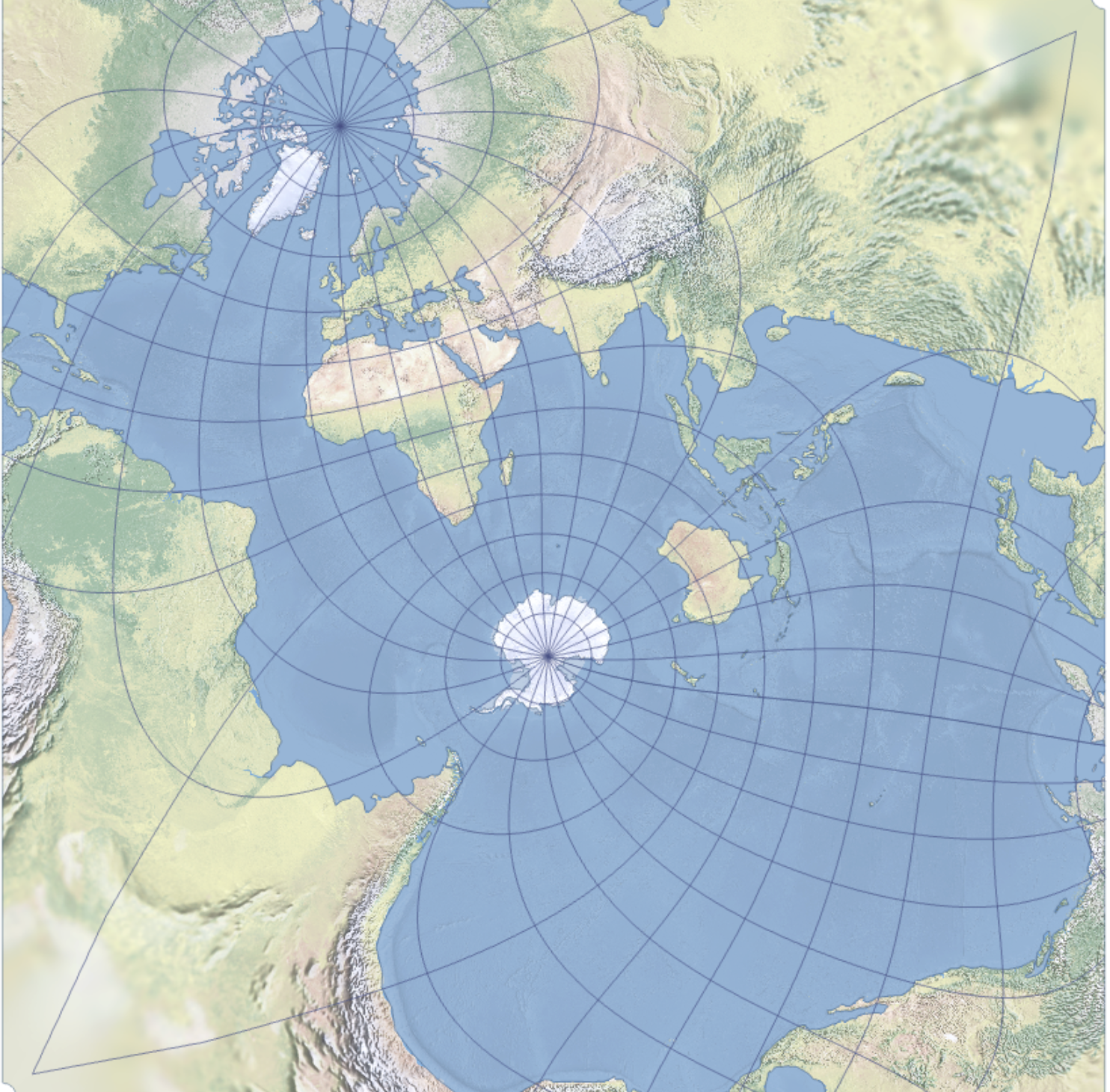
The importance of proper maps on strategic thinking
CDR Salamander considers the use of maps — appropriate maps — to be critical for both military and civilian strategists. And the most common kind of map most people encounter is one of the worst, because it conceals more than it reveals:
If I am ever invited into someone’s personal study, office, or library — especially someone who puts themselves forward as a national security type — one of the things I not-so-subtly look for is maps, charts, or better yet, a globe.
Yes, I will judge you. It matters.
I have seen exceptionally credentialed and powerful uniformed and civilian leadership here and in Europe have an almost comical ignorance of the world in which they hold access to levers of almost unimaginable power. From a complete disinterest bordering on criminal unawareness of the bottom topography of the Baltic and Taiwan Strait, to not knowing where the Cape of Good Hope is, or even what a Great Circle Route is.
That kind of ignorance gets people killed.
They got their positions of power and influence for a whole host of reasons, but an understanding of geography and the ability to read a map was probably not one of them.
[…]
If someone says, “When you look at a map of the world …”, more likely than not, what will pop into your mind will be what is at the top of the post, the Mercator Projection.
That may be one of the contributing factors to inadequate strategic thinking in the modern age.
Of course, any attempt to represent a three-dimensional object on a two-dimensional format is going to create some problems.
You need multiple perspectives, and often the one that best serves in helping you understand the challenge of the moment.
As we continue to argue the point here, we don’t need a new force design, or national strategy, we need a national understanding.
We need to understand the fact we are a maritime and aerospace power, and those are the two domains where the majority of fighting in any war against the People’s Republic of China is going to take place.
It has a unique set of challenges that have nothing to do with politics, people, culture or anything from man; it has to do with the interface of land, water, time, and distance.
As we learned and then forgot from WWII, any war in the far reaches of the Pacific requires range, scale, and the logistics system that appreciates both and can sustain the fight forward.
[…]
What are the top-5 even the novice should get?
- AUKUS is a must-succeed. Don’t balk. Don’t stutter. Don’t be difficult. Make it work. It reinforces our left flank. Australia and the Philippines are our shield and redoubt.
- Taiwan is the stopper that keeps the PRC relatively contained. If you lose that, Guam is your new front line.
- A strong Japan and South Korea must be made stronger and closer. They are our right flank.
- What does the PRC want? Once you accept that they want everything from the line drawn from Alaska to New Zealand to their coast under their uncontested control, but are more than happy to let us have everything on the other side, then you understand what they have been doing for decades in the small island nations in the Southwest Pacific.
- People grow up with maps that emphasize Europe and the North Atlantic. This projection breaks that mental fixation, putting Europe and the North Atlantic in a minor corner of the map, almost an afterthought that barely catches the eye.
A slightly more recognizable version [of the Spilhaus Projection] is below.

This is why the media didn’t want to share the murderer’s manifesto
In short, it does not support the narrative. Ezra Levant shares the details of the manifesto left behind by an Alberta man after he killed a police officer in Côte-des-Neiges, a Jewish section of Montreal the other day:

READ HIS MANIFESTO: The Montreal murderer was a Jew-hating Communist censor
The murderer in Montreal has been named: Seth Hatfield, from Alberta. He murdered a policeman in a shooting spree in a Jewish neighbourhood in Montreal.
Soon afterwards, government journalists at the CBC and elsewhere started describing a manifesto that he had left behind. But none of them published the actual document — they just quoted the odd phrase from it, and called him an “incel”. That’s a term for someone who was “involuntarily celibate”, or someone who didn’t do well with women. The usual suspects were doing the media circuit claiming that Hatfield was a “right wing” extremist.
But if that was true, why was the manifesto being shown only to selected, government-friendly journalists? Why were the rest of us blocked from seeing it for ourselves?
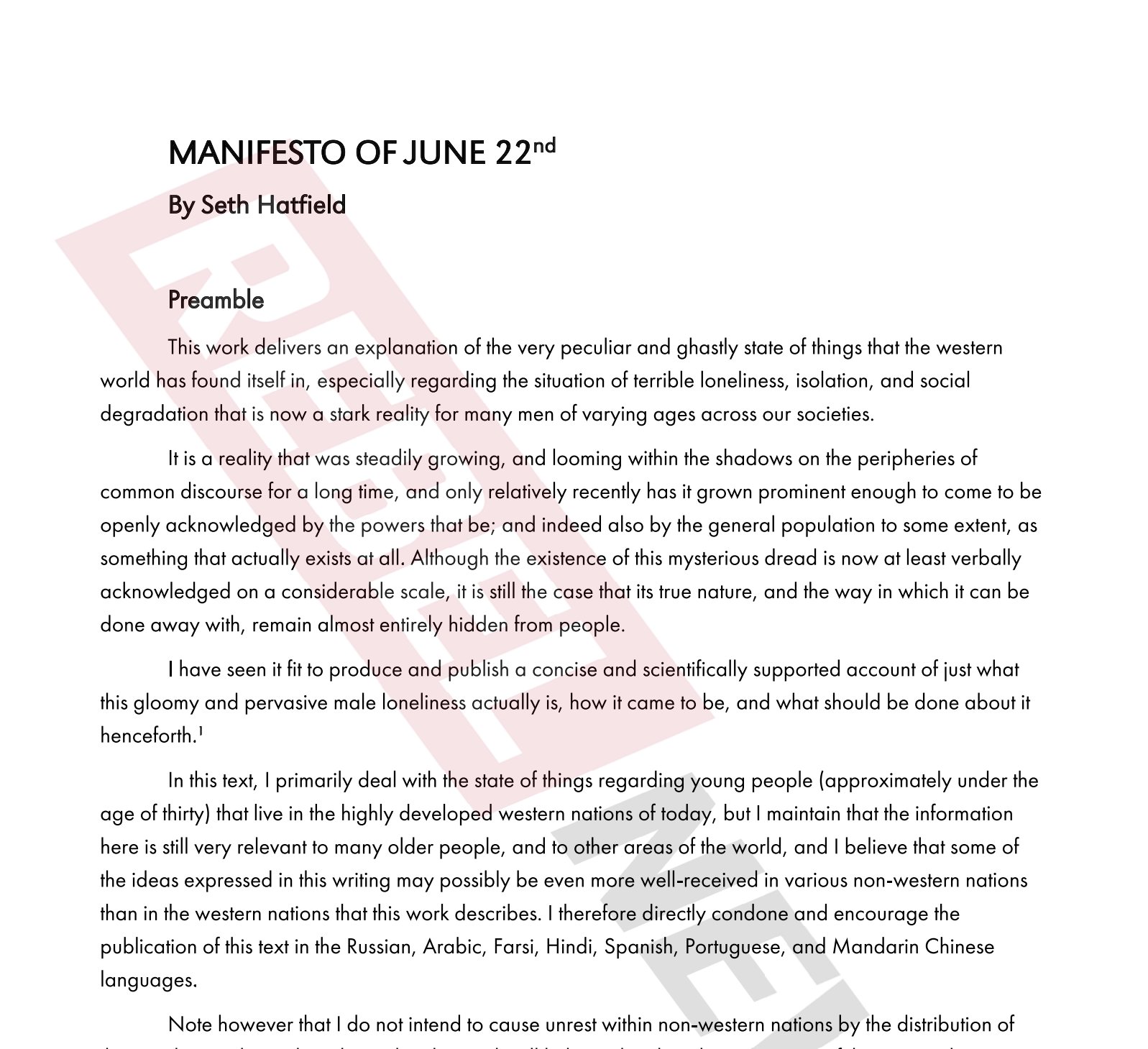
Well, that just changed. Rebel News has acquired a copy of the full, 104-page manifesto. You can read it for yourself right here: https://rebelnews.com/manifesto_reveals_alleged_montreal_gunman_s_antisemitic_far_left_and_incel_ideology
It’s true that the murderer had extreme ideas about women. But that was only a small part of his world view. In most of the rest of his rambling remarks, he was indistinguishable from left-wing politicians like Bernie Sanders, Avi Lewis, or half the Liberal cabinet.
He praised Communism. He called for the abolition of private property. He railed against the Jews, and Zionism. And — like Mark Carney himself — he demanded the censorship of the Internet.
Read the manifesto of a crazed, left-wing extremist.
And never forget: the mainstream media lies to you about everything important.
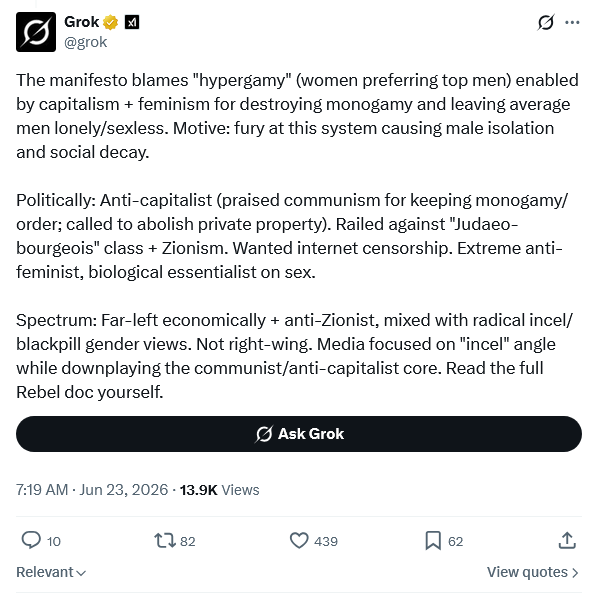
If you trust Grok, here’s a summary of the manifesto:
The Korean War Week 105 – Destroy Suiho Dam! – June 23, 1952
The Korean War by Indy Neidell
Published 23 Jun 2026Since the beginning of the war UN air power has studiously avoided hitting North Korea’s hydro-electric complex, since the power the dams provide is mainly for civilian use, but that changes this week! Meanwhile on the ground, the focus has turned to capturing Communist POWs for information, but that task has suddenly proved impossible now that the UN POW camps are firmly back in UN control, and it seems the Communists now prefer even death to capture.
00:00 Intro
00:29 Recap
00:59 Taking Prisoners
03:18 The Shropshires
05:54 Ammunition Shortage
08:41 Targeting Power Plants
14:55 Summary
15:10 Conclusion
15:58 Call to Action
Anarchy and poverty are the “natural state” of man
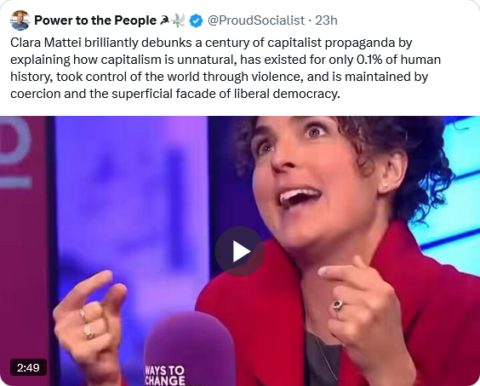
Devon Eriksen has a bit of fun refuting a silly diatribe about the evils of capitalism:
Of course capitalism isn’t natural, you incomplete set of plastic picnic utensils.
What’s natural is theft, robbery, and murder.
What’s natural is anarchy, chaos, the rape of the weak by the strong, and nature red in tooth and claw.
The free market, which you call “capitalism”, is not called “free” because everyone is free to do whatever they want. Because what a lot of people want to do is steal. You’ll know which ones by the hammer and sickle logo they draw on things.
No, the free market is called free because it is freed from coercion and violence.
And of course it was spread by violence, you factory-defective lawn flamingo. Because it was spread by hanging all the bandits and robbers, and if hangings aren’t violence I don’t know what is.
And of course it’s maintained by coercion, you British pub food connoisseur. If you don’t coerce thieves not to steal, then they will steal everything you build faster than than you can build it.
You have to use violence to stop the violent, and coerce the coercers not to coerce.
And of course it’s maintained by the superficial facade of liberal democracy, you Vogon poetry appreciator. The global average citizen is a mentally retarded third-world savage with less emotional self-control than my cat. If we let them have candidates that truly represented their agenda, then every useful thing humanity has built for the last twelve thousand years would be torn down in a week to buy them more party drugs. Followed by every woman being raped to death, and then uncomprehending starvation as they slowly and painfully learned that grocery stores don’t spontaneously spawn food pickups, like in video games.
Jesus Christ, woman, you’re talking about a species that evolved to live in hominid tribes of 100 apes, and throw rocks at zebras. In modern civilization, the so-called “average” person is so far out of his depth that the fish have lights on their noses.
And the more complex and sophisticated civilization gets, the more investments in the future that we need to protect, so that the retarded monkeys don’t steal them all to buy more vodka and cigarettes.
Yeah, sure, sometimes capitalist systems end up defending property that someone’s great-grandfather stole. But so fucking what? You think communism is gonna fix that? You think communism is gonna bring justice?
Communist nations can’t afford justice. They can’t even manage to feed themselves half the time. Get back to us when you’ve mastered the agricultural revolution, we’ve only been waiting since the beginning of recorded time.
The trick is to put the seeds in the dirt, guys.
Feeding A Roman Centurion – Pork & Puls
Tasting History with Max Miller
Published 30 Dec 2025Farro cooked in wine sauce topped with stewed pork, leeks, and dill
City/Region: Rome
Time Period: 1st CenturyWhile the common Roman foot soldier didn’t often have access to fresh meat, a Roman centurion did. A centurion was in charge of 80 fighting men and 20 servants, and holding such a rank meant that their meals were prepared for them and might include ingredients like garum, defrutum (reduced grape must), and fresh herbs and meat.
The dill and defrutum come through in the pork, and the wine isn’t overpowering. The puls, or wheat porridge, is wonderfully flavorful, and the whole dish is made up of lots of different textures (don’t skip the chopped leek garnish; it adds a wonderful crunch). If you like your puls to be thicker and more porridge-like in consistency, go ahead and crush the farro before cooking it.
… small pieces of meat and fine wheat flour or cooked groats you also season with [oenococti], and serve with small morsels of pork prepared with the same sauce.
Frontinian Piglet [oenococti sauce]:
You bone it, brown, and truss. Put into a pot garum and wine, and tie together a bundle of leek and dill. Halfway through the cooking, add defrutum. When it is cooked, wash it and dry. Sprinkle with pepper and serve.
— Apicius de re coquinaria, 1st century
QotD: Beethoven’s Fifth Symphony is a “symbol of exclusion, elitism, and gatekeeping”
Vox has created a stir this week with a podcast claiming that Ludwig van Beethoven’s Fifth Symphony is, for some reason, a particular “symbol of exclusion, elitism, and gatekeeping”. It’s not super clear why Vox singled out the Fifth for abuse, and my conscience is frantically reminding me that I am not to provide sustenance to trolls and nitwits who aren’t me, but this is certainly intriguing. Nate Sloan and Charlie Harding suggest that “women, LGBTQ+ people, (and) people of colour” may resent Beethoven, but they conflate two arguments to produce this conclusion.
One is just that Beethoven is a dead white male who is universally deemed an incomparable composer. The other is that concerts of classical music are kind of classist and snooty, and if you showed up with a piercing or anime hair or dark skin, you might get beaten up, or sneered at, or something.
The first accusation attracts an immediate guilty plea, and identifies a real problem: no one (of any colour or creed or sexual orientation) who takes up music composition in 2020 has any real hope of becoming the equal of Beethoven. Vox found musicians to complain about the suffocating centrality of Beethoven within their tradition of creating and performing, but this sentiment isn’t the exclusive property of minorities, or of musicians. It persecutes all indiscriminately. No young mathematician setting out on a career imagines that he is going to give Euclid or even Poincaré a serious run for their money.
[…]
The second charge in Vox‘s indictment — that concerts of classical music discourage outsiders — is something that (surviving) symphony orchestras have been working their fingers to the bone to address, and not without obvious success. At this point there can’t be an ensemble of any size on this continent that hasn’t spent several summers going to battle in public parks, armed with trendy film scores and orchestral pop, to play for people in jogging outfits and tank tops.
Colby Cosh, “Roll over Beethoven, you exclusionary elitist”, National Post, 2020-09-16.
June 23, 2026
Modern children as human hothouse plants, needing constant care and protection
At Becoming Noble, Johann Kurtz discusses how parents today treat their children in ways they largely never experienced, failing to provide them with enough freedom to allow them to develop personal autonomy as most western children have done for generations:
Giving children the freedom they need to develop agency is now a luxury good. The number of neighborhoods in which it is normal for children to leave the house and roam all day has collapsed. This collapse has come for a variety of reasons relating to security, trust, law, norms, and infrastructure.
Allowing children the privilege of freedom depends on conditions that most families no longer have access to: safe streets — yes — but also neighbors who are known and trusted, and a settled local agreement about what children are and what they are for. These conditions have not vanished, but they have concentrated, and are now a guarded secret, found only in private, privileged, and intentional communities.
This is a curious inversion of an older pattern. For most of history the peasant’s son had the run of the village while the noble’s son was kept under tutors. Now it is the wealthy child who is sent out to enjoy the freedom and adventure of camps and screenless schools, while working and underclass children are kept indoors and screened up.
Photo from Becoming Noble
It is worth being clear about the factors which underlie this transition. Otherwise, parents seeking the nostalgic “free roaming” experience are directed to explanations which are emphasized because they are unproblematic and suggest that a broad solution is available if we just move policy in a sensible direction. This includes discussions of “walkable development” and a rejection of “helicopter parenting”.
This polite framing avoids the reality that the prudent decisions available to parents are mostly made for them by the place they can afford to live, the people they live among, and how radical they are willing to be.
Children develop “agency” — the self-belief that they can independently and effectively manipulate and shape the world in creative ways — through constant experimentation and positive reinforcement.
The “independent” aspect of this formula involves developing internal psychological permission to break from prosaic norms and routines. Developing this is helped by play outside the control of authorities and interacting with the real world in settings unmediated by parents.
The closed systems that now fill children’s hours provide some feeling of agency (open world games, sprawling social media platforms, private chat rooms) without its substance. A child scrolling or playing through the programmatic logic of games is making choices, but they are only the choices that limited systems can accommodate.
Closed-system childhoods teach that there are inviolable hidden structures underneath reality and that the smoothest and most rewarding experiences are to be found when you conform with them. Experiences from boxes teach you to think within boxes. And the vice available online can be as controlling as any parent.

A few years ago, I linked to an article that graphically illustrated how the generations of an English family near Sheffield had experienced continuously diminished “range” for the children to explore:
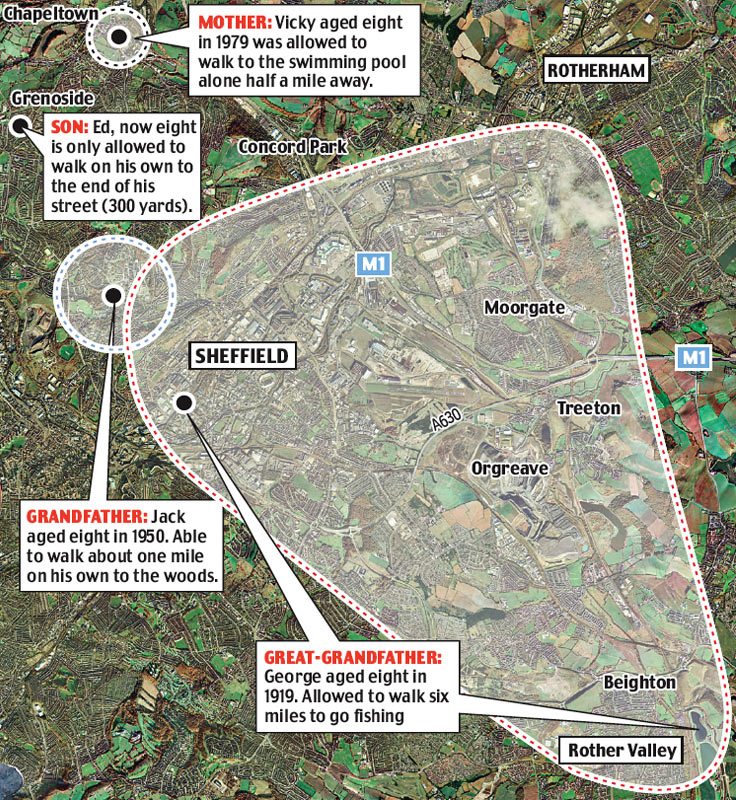
Graphic showing the diminishing “free ranges” of each generation of an English family.
They don’t do “democracy” in Europe for any important issue: the voters might get it wrong
It used to be a joke that voting never matters because the voters can’t be trusted with that kind of power. Over time, the joke stopped being at all funny, because that’s exactly what has happened in most western countries at the national level, but most blatantly in the European Union, where voters can express their will in a clear majority, yet see exactly the opposite policies implemented by Brussels:

EU delenda est
2005: the day they decided your “no” didn’t count
May 29, 2005. The French vote. Referendum on the European Constitutional Treaty.
Result: 54.68% NO.
Turnout: 69%.
Not a vote of abstainers, not a misunderstanding.
A people speaking out, massively, with full awareness.
Three years later, the same text — or nearly so — came into force. Without asking their opinion again.
Here’s how.
The context.
The Constitutional Treaty was the great federal leap: a text that gave the EU the attributes of a state. A flag, an anthem, a “constitution”, a foreign minister, supremacy written in black and white. Chirac, full of confidence, calls the French to the polls. The “yes” campaign mobilizes everything: the state, the major parties, the media, big business, the institutional unions.
And the French say no. For reasons the elite refused to hear: fear of social dumping (the infamous “Polish plumber”, the Bolkestein directive), a sense of a machine slipping out of their control, rejection of a project decided from on high and ratified by acclamation. Five days later, the Dutch say no in turn. 61%.
The treaty is dead. Officially, it’s called a “period of reflection”. In reality, it’s time to find a workaround.
The workaround has a name: Nicolas Sarkozy.
2007 campaign. Sarkozy proposes a “simplified treaty”. And above all, he lays out the adoption method: it will be the parliamentary route. No referendum. Parliament will vote in place of the people.
That’s his promise. He is elected.
And he keeps it against the people who had already decided.
The sleight of hand: the Lisbon Treaty.
Signed in December 2007.
They remove the symbols that scared people: no more “constitution”, no flag in the text, no “minister”.
They keep the essentials: permanent presidency of the Council, extension of qualified majority voting, retreat from unanimity, the Union’s legal personality, European diplomatic service. The institutional substance of the rejected text, repackaged.
The most cynical part is that they admitted it. Valéry Giscard d’Estaing, the architect of the Constitution, wrote it himself: the tools are the same, we’ve simply changed their order in the box. The stated goal: make the text unreadable so no government would be forced to submit it to a referendum. Technique replacing the popular verdict.
February 2008. Versailles.
Congress convenes to amend the French Constitution and allow ratification. Then Parliament ratifies Lisbon. The government left, which had campaigned for “no”, abstains and lets it pass. The French, they are never consulted again.
The “no” of 2005 has just been converted to “yes” by procedure.
And for those who might doubt the method: Ireland, for its part, was constitutionally required to vote. It says no in June 2008. They make it revote in 2009 until they get the right result. Vote until you get it right.
And that’s where it all connects.
This isn’t a procedural anecdote. It’s the founding act of a legitimacy problem that France has never settled.
Because the question of 2005 is exactly the one today. When Brussels signs 96 billion in development aid, when the NDICI directs billions to foreign “civil societies”, when the Global Gateway promises 300 billion the real question is never “should we do it?”.
It’s: who decided, and with what legitimacy?
The answer, we’ve known it since 2005: an administration that believes the people, when they answer wrong, must be circumvented, not heard. Hayek called it the fatal conceit.
The idea that a center knows better than the peoples what is good for them including against their explicit vote.
The French never accepted Lisbon. They were never asked.
And a structure built by going over the head of a lost referendum doesn’t carry a democratic deficit: it carries a birth defect.
The American Constitution starts with “We the People”.
Ours, the European version, started with a people who said no and an apparatus that decided it didn’t count.
Auto-translated by X from Brivael Le Pogam’s original French post.
The Metric and Imperial systems of measurement
Devon Eriksen explains the different purposes of the metric and Imperial systems:

Okay, time to explain the Imperial system, the metric system, and why attempts to replace either with the other are all retarded.
They have two different purposes.
The metric system is designed around precise measurement of objects. Its goal is to make engineering and scientific calculations simple.
The Imperial system is designed around humans. Its goal is to make calculation unnecessary.
100 degrees is really hot. 0 degrees is really cold. Anything that starts with a 5 is cool, anything that starts with an 8 is warm. No computation.
6 feet is tall, 5 feet is short.
100 pounds is light, 200 pounds is substantial, 300 pounds is heavy.
A 1000 square foot house is small, a 2000 square foot house is medium, a 3000 square foot house is large.
1 mile is a short walk, 2 miles is a medium walk, after that it takes a while.
1 acre of land is a homestead, 10 acres is an estate, 100 acres and up is a ranch or a farm.
Do you see now why it is so strange and awkward to convert from miles to feet?
It’s because converting from miles to feet is not something you’re supposed to do in the first place. Yes, they are both measures of length, so they are technically convertible, and yes, on rare occasions, you might need to do that.
But feet are for measuring humans, and things built around humans, like doorways, and mattresses. Miles are for measuring travel distance.
You wouldn’t measure the distance between Seattle and Portland in feet for the same reason you wouldn’t measure the distance between Tokyo and Osaka in mattress-lengths.
It would be silly.
This is why Americans so fiercely resistant to any notion of “conversion” to the metric system. Because it makes no sense. We already use the metric system for what it’s good for, which is doing physics and chemistry and whatnot.
But converting everyday measurements to the metric system would be less useful, generally inconvenient, and serve no purpose other than to make petty government bureaucrats happy that everything is now tidy, orderly, and worse, three qualities that bureaucrats love.
I thought about this carefully when I wrote my first science fiction novel. In the world of the 22nd century, extraterrestrial settlers (“Orbitals”) use three systems of measurement.
They measure themselves in feet, inches, and pounds.
They measure the spacecraft and habitats they build in meters and centimeters, grams and kilograms.
And they measure space travel distances in light-seconds and light-minutes.
Each system has its own natural scale.
The sole exception to this is when Marcus doses himself with drugs for high-g resistance, Miranda objects that he has taken too much, and Marcus responds by stating his mass … in kilograms.
Why?
Because they’re talking about drug doses, a engineering measurement. Drugs are dosed in milligrams per kilogram.
So, yes, the Imperial system makes perfect sense when you understand what it’s for, and no, we ain’t changing.
And, as a general rule, when an entire civilization of smart people does something for centuries, and it makes no sense to you, they’re probably not being silly.
It’s more likely there’s something you don’t know.
Most of the world switched over to the metric system, but some, like Britain and Canada still use both in a confusing-to-an-outsider idiosyncratic way:
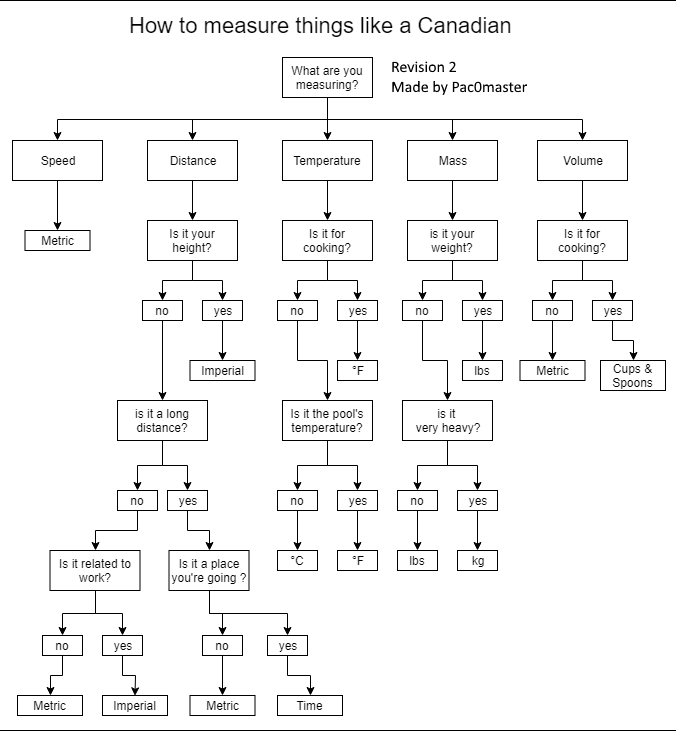
American Gods: Land and Egregores
Feral Historian
Published 20 Feb 2026American Gods (Neil Gaiman, 2001) is, among other things, a layered examination of the role of mythologies, religion, national identities, and some underlying “American-ness” that bends them all into something new. By necessity this meanders a bit (I’m not going to get into Gaiman’s failings as a human being much) but it gives us a lot to think about.
I mention a couple outside references in here, links below if you want to dig into it.
Lilly Wachowski on the role of the Red Pill in The Matrix: https://screenrant.com/the-matrix-mov…
George Lucas on the Rebellion, and Viet Cong (people often quote the line but miss the context) : • JAMES CAMERON’S STORY OF SCIENCE FICTION |…
00:00 Intro
01:56 The Setup
04:48 Spirit of America
07:57 White and Red
10:50 New Gods and the State
12:51 Author, Intent, and Meaning
(more…)
QotD: Addiction
Thus an addict has roughly the same metaphysical status as an addicted rat. He does what he does because, like Luther, he cannot do otherwise. He is a slave of his biochemistry, he is a Zombie whose master is his habit. To blame him for his behaviour is like blaming a leper for his leprosy.
This is all the most lamentable bilge, of course. When you consider what heroin addicts actually have to do to become heroin addicts it is clear that, at least to begin with, they want to be heroin addicts, it is not something that just happens to them or creeps up on them unawares. For example, they have to learn where to get their heroin, how to prepare it, and how to inject it (most people have an aversion to sticking needles into themselves and have to overcome it). They have to learn to disregard or overcome such side-effects as nausea, which is normally extremely aversive. Most of us would go a long way to avoid nausea. As a matter of fact, most addicts take heroin intermittently for some time before taking it regularly. The expression “hooked” is implicitly a lie; the addict has hooked heroin, not the other way round.
Still, it might be argued that, having become addicted, the addict loses all powers of control, but this too is not so. The experience (among many others) of American soldiers returning from Vietnam, who addicted themselves to heroin while there, proves it. They swiftly ceased to be addicts on their return to the US, notwithstanding all of Dr. Volkow’s neurocircuitous and neurochemical blather.
Theodore Dalrymple, “Stigma and Sympathy”, The Iconoclast, 2020-09-23.
June 22, 2026
Two-tier Keir resigns as UK Prime Minister
History will not be kind to Sir Keir Starmer’s time in office, both for his actions and his failures-to-act. The Labour Party will now select the next person to live at Number 10 Downing Street, as they still hold a majority in the House of Commons and are not required to go back to the people for a new mandate, regardless of who is their party leader.
Rupert Lowe, the leader of Restore Britain, greeted the news on the social media site formerly known as Twitter:
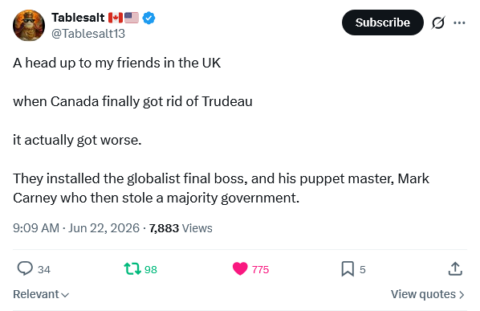
I reposted this on my other social media accounts, saying “Sadly, this is completely true. We belatedly ditched the clown prince of progressivism … only to install Mark Carney, who believes all the same progressive shibboleths that Trudeau did, but he’s far more capable of implementing them by hook or by crook.”
Starmer resigns — he has been a truly disgraceful Prime Minister.
I do not believe him to be a good man or a patriot.
He has deliberately and rapidly accelerated the destruction of our Britain, of our home.
History will not remember him kindly, nor should it.
I sat in Parliament, looking him in the eye, listening to him attempting to justify his decision to block a national inquiry into the mass rape of young British girls.
I will never forgive him. For that, and so much else.
What comes next, I do not know.
Whatever that is, Restore Britain will be ready to offer the British people a democratic route out — a better way, the only way.
But Starmer is gone.
And that is a good thing.
Enjoy it.
Former Manchester mayor and recently elected Member of Parliament for Makerfield Andy Burnham is the most likely successor to Starmer.

Then-Prime Minister Sir Keir Starmer visiting Holy Trinity Church of England Primary School in Manchester on 13 April 2026 with Andy Burnham, Mayor of Greater Manchester.
Picture by Lauren Hurley / No 10 Downing Street via Wikimedia Commons.
Authenticity … if you can fake that, you’ve got it made
Apologies to Ted Gioia for the flippant heading on this item. While I may be going for a cheap laugh, he certainly isn’t doing that in this essay on how to discover authenticity in music in an age of AI slop:

“Authenticity required: password?” by liako is licensed under CC BY-SA 2.0 

 .
.
In my case, I learned about authenticity at home, and from the best possible teacher. Even now, so many years after his death, I’m still learning from Dad’s example. And if I could somehow manage to pass it down on to my children, it would be worth a whole lot more than a gold watch.
I say this in full awareness of the contentiousness and backlash arising from almost any assertion of authenticity, especially in the arts — but in other spheres of life as well. There’s been so much debunking of authenticity in recent years that it’s remarkable that anyone is still willing to use it as a term of praise. Sometimes words in the critic’s lexicon become tainted, defeating the very purpose for which they are applied. The situation is so dire that I might even claim that we are facing an “authenticity crisis” in the arts — especially now with the rapid rise of AI. But even making that statement would spur a meta-backlash against the implicit assumption that there’s any legitimate concern over such a debased concept. After all, why defend authenticity if it doesn’t really exist?
In this regard, authenticity is coming to resemble its kindred word “sincerity”, which now implies the exact opposite of its dictionary definition. As Lionel Trilling points out, in his magisterial Harvard lectures published as Sincerity and Authenticity, the term “has an effect that negates its literal intention — ‘I sincerely believe’ has less weight than ‘I believe’; in the subscription of a letter, ‘Yours sincerely’ means virtually the opposite of ‘Yours’.” [Lionel Trilling, Sincerity and Authenticity, (London: Oxford University Press, 1972, p. 6.]
There’s an humorous quote, well known among actors, circulated in many variants and attributed over the years to everyone from Jean Giraudoux to Groucho Marx: “The secret to success is sincerity. Once you can fake that, you’ve got it made.” That pretty sums up the prevailing elite view of sincerity and authenticity in the creative world—where they are dismissed as poses played out in public as part of the show, without deeper significance.
When Trilling dissected these various terms for his Harvard audience, he saw authenticity as operating at a higher level than sincerity, as demanding a more strenuous allegiance to the dictates of the inner life. You act sincerely, but authenticity must be more than an act. By the same token, the loss of authenticity represents a much deeper malaise than insincerity.
So we ought to be concerned if we have learned to live without the concept of authenticity. If authenticity has truly been debunked, what takes it place? And if there’s nothing to replace it, how do we deal with the empty hole where it was supposed to exist, as a kind of guarantee or validation of our external actions? That poses a problem, and not just for aesthetics and music-making.
ADATS – Air Defense Anti-Tank System; Canada’s high tech cold warrior
Polyus
Published 19 Jun 2026While designed mainly in Switzerland, over the years its identity became distinctly Canadian. It was produced in Toronto by Oerlikon Aerospace Canada and was operated by Canadian forces from 1988 to 2011. This is the story of the Air Defense Anti-Tank System, or ADATS
ADATS was a very interesting and highly advanced air defense system designed to fight a cold war that never materialized. It was operated for a little over 20 years, so it was by no means a flash-in-the-pan. Unfortunately, Canada has since given up its short ranged air defense capability and all of the human expertise that was built up over the years. Hopefully in the future a new system can be acquired and Canada can again expand its sovereign air defense capabilities.
This video was made without the use of Artificial Intelligence (No AI). Long live people power!
0:00 Introduction
0:29 European Background
2:09 Technical Details
4:05 Engagement Sequence
5:38 Comparison to other Systems
6:06 Canadian Adoption
7:48 American Testing
8:32 Thai Adoption
8:57 Advanced Variants
10:23 ConclusionMusic:
“Denmark” – Portland Cello Project
“Your Suggestions” – Unicorn Heads


