
World War Two and Spartacus Olsson
Published 7 May 2026Early in World War II, German U-boats came dangerously close to starving Britain into submission. The Type VII submarine — especially the VIIC — became the backbone of the Kriegsmarine‘s Atlantic campaign, sinking thousands of Allied ships and threatening to win the Battle of the Atlantic.
But despite its devastating effectiveness, the U-boat war ultimately failed — and not just because of Allied countermeasures.
In this documentary, Spartacus Olsson breaks down how Adolf Hitler’s strategic miscalculations, competing naval doctrines, and direct interference undermined Germany’s most effective naval weapon. From the clandestine development of submarines after the Treaty of Versailles, through Admiral Karl Dönitz’s vision of a tonnage war, to the catastrophic losses of German submariners, this episode examines how Nazi rearmament translated into wartime reality — and failure.
Featuring detailed analysis of Type VII design, production, deployment, and combat performance, this video reveals how industrial limitations, political priorities, and technological shifts turned a war-winning weapon into a death trap.
This standalone episode complements the Death of Democracy series by showing what Hitler actually did with Germany’s rearmament- and why it fell short.
May 8, 2026
How Hitler Wasted Germany’s Deadliest Weapon – Nazi Rearmament 01 – U-Boat Type VIIC
“… without Western Civilization, we’d all still be whacking at the dirt with sticks and dying of intestinal parasites”
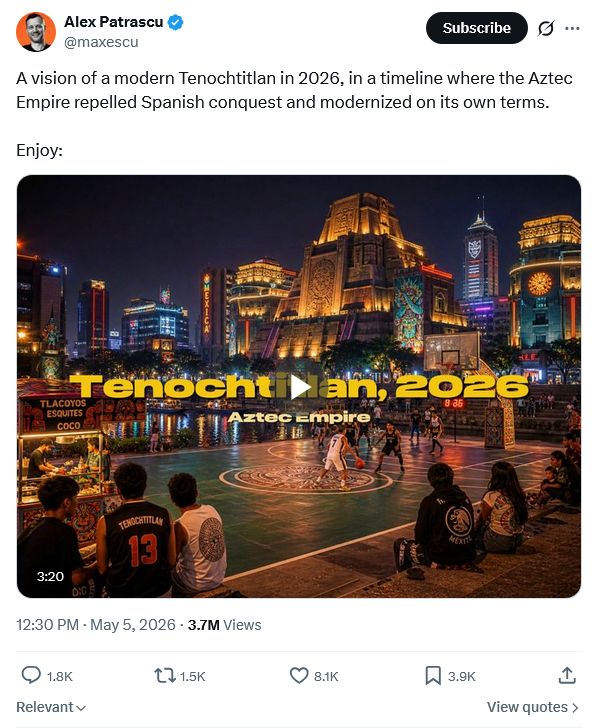
Devon Eriksen responds to someone who had a clanker generate an imaginary Aztec capital today if the Aztecs had managed to defeat Cortes and his conquistadors:
Guitars. Suits and ties. Western architecture. English and Spanish text.
What’s easy to miss is that the generative AI is making its own, separate, political statement here. Not because it intended to, but because it had no choice.
Even human creativity consists mostly of rearranging things, but AI generation is entirely that and nothing else.
So when you ask it for “modern”, it gives you “western”, because in its eyes, there is no distinction between the two. “Western” is the only “modern” that actually exists for it to draw from.
Even cultures that were capable of building an alternative version of modern, because they weren’t skinning and eating each other, and had invented the wheel, still borrowed heavily from the West, not because they couldn’t do otherwise, but because the West moved faster, and had already done the work.
So, ask an AI for “modern Aztec”, and you get English-speaking Tokyo/Venice, with browner people, pyramid reskins on skyscrapers, and some out-of-place Mayan stuff, all set to Peruvian flute music.
This is the same reason that a lot of people, most of whom really aren’t much more than LLMs themselves, say silly things like “there is no White culture” … because, like the very simple art machine, they cannot conceive of any alternative version of modernity.
So nothing is Western to them, it’s all just “modern”.
But of course it really is Western, because without Western Civilization, we’d all still be whacking at the dirt with sticks and dying of intestinal parasites.
That AI is Western, too.
The Strugatskys’ The Doomed City and the Soviet Experiment
Feral Historian
Published 12 Dec 2025While The Doomed City isn’t the last book Boris and Arkady Strugatsky wrote, it is arguably the end of their journey from idealism to cynicism with regards to the whole Soviet project and serves as an almost spiritual history of the period. Let’s meander through it to look at some things not covered in a literary review.
00:00 Intro
03:12 New Jobs
04:45 Aside – Facts and Theory
05:42 Laws and Mentors
09:36 The Experiment
10:50 Regime Change
13:25 Aside – Maps
15:45 Status and Power
18:22 The Ground Beneath Our Feet
(more…)
QotD: North Vietnamese intelligence failures in the Tet Offensive
Finally, a real intelligence failure on the NVA‘s part contributed to the US failure. The main reason US analysts were sure the North Vietnamese lacked the forces was because the NVA did, in fact, lack the forces. They called Tet the “general uprising”, and they were counting on widespread popular support — including, it seems, entire ARVN units defecting. That’s the only way they’d have sufficient force to knock ARVN out of the war …
… and it didn’t happen, because they, the North Vietnamese, had faulty intel.
The Americans suffered from the “intel to order” problem too, of course, which we in the civilian world call “telling the boss what he wants to hear”. But the NVA had it much worse, since that’s a much greater structural problem among Commies. Indeed, the Americans got at least one high-level defector during Tet — a lieutenant colonel I think — who only defected because the units he was supposed to command in the “general uprising” didn’t exist. They were purely paper fantasies, straight out of some commissar’s head.
And that’s what made [US Army military analyst Joseph] Hovey’s report so easy to dismiss. Hovey himself said it — it looks like they’re planning to do X, Y, and Z, but that would only make sense if they’re making a big mistake about the balance of forces. The US had pretty good intel on the ARVN and the political mood of South Vietnam. But they for some reason assumed that the NVA had basically the same information, so all of the NVA’s calls for a general uprising — which the NVA absolutely meant, and indeed were counting on — were easy for US analysts to dismiss as mere propaganda.
Severian, “Book Rec: Tet, Intelligence Failure”, Founding Questions, 2022-06-30.
May 7, 2026
Great success! Honda “postpones” their Ontario EV project
As part of their mindless fanboyism for anything remotely related to “Net Zero”, the federal government and the Ontario provincial government have been serving up subsidies for electric vehicles and hastening the “inevitable transition” away from internal combustion vehicles. Through legislation and regulation, they’ve been doing everything they can to close down the traditional car and truck manufacturing sector and replace them with zero emission vehicles. The various governments have handed out subsidies amounting to billions, and yet one after another after another the much ballyhoo’d EV factories, battery plants, and other futuristic projects fall by the wayside, leaving very little in exchange for those billions:
There was a time, not very long ago, when Liberal politicians treated EV battery announcements like moon landings.
Hard hats. Safety glasses. Giant ceremonial cheques. Breathless speeches about “the future”. Every battery plant was “historic”. Every subsidy package was “transformational”. Every corporate press conference looked like a motivational seminar for people who think buzzwords are infrastructure.
All we were missing was a fog machine and Bono.
Meanwhile ordinary Canadians were standing in grocery aisles doing mental math over bacon prices, delaying dental work, and wondering whether they could survive another winter utility bill without sacrificing whatever scraps remained of their savings.
But while Canadians were trying to keep their heads above water, Ottawa was busy launching one of the most expensive industrial subsidy experiments in modern Canadian history.
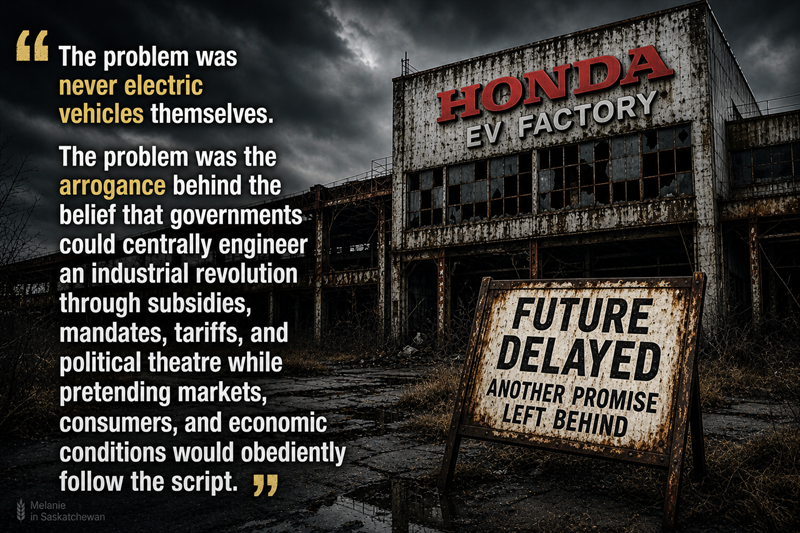
AI-generated image from Melanie in Saskatchewan
The Honda EV project in Ontario was supposed to be one of the crown jewels of this brave new green economy. Politicians lined up in hard hats and safety glasses like a traveling theatre troupe performing The Future Is Here. Canadians were assured this was proof the country was becoming an EV superpower.
Turns out it may have been more of a very expensive PowerPoint presentation with taxpayer financing attached.
[…]
In March 2020, Prime Minister Justin Trudeau appointed Mark Carney as an informal economic adviser during the COVID recovery period. Over the following years, Carney increasingly promoted “green transition” investment frameworks, climate-linked financial systems, ESG-focused economic planning, and massive public-private investment partnerships tied to decarbonization strategies.
Which is important context now, because the EV subsidy era did not emerge out of thin air. It grew out of a broader worldview that treated government-directed green investment as both economic policy and moral mission. The assumption underneath all of this was breathtakingly simple:
“If government wants it badly enough, reality will cooperate.”
That is usually where things begin going sideways.
Canadians were told the EV transition was inevitable. Questions about affordability, charging infrastructure, winter range, electrical grid capacity, or consumer demand were often brushed aside like annoying little details raised by peasants who simply lacked sufficient enlightenment.
Then came the subsidy gold rush.
[…]
Corporations are not charities. They are not loyal patriots. They are not emotionally attached to government slogans.
They follow incentives. They chase profitability. They change direction when conditions change.
That is exactly what Honda did.
Meanwhile Canadians are left holding the bill for another “historic transformation” that produced:
- endless announcements
- glossy photo ops
- consultant buzzwords
- government self-congratulation
- escalating subsidy exposure
- and corporate renegotiations every time market conditions shifted
- while producing no completed Honda EV manufacturing hub and no fleet of Canadian-built EVs rolling proudly off Ontario assembly lines.
What remains instead is a stalled megaproject, a confused tariff policy, a government spinning contradictory narratives depending on the week, and taxpayers once again discovering they were voluntold into becoming venture capitalists for political vanity projects.
Apparently this is what “economic leadership” looks like now.
Hard hats. Press releases. Fifty-plus billion dollars in EV-related exposure. And a factory plan slowly evaporating into the mist while Chinese EVs roll through the front gate anyway.
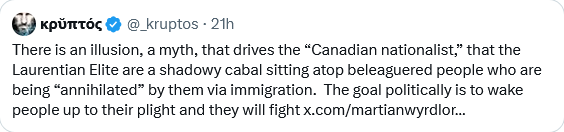
Pay no attention to the Laurentian Elite behind the curtain!
Canada before Confederation was largely run by the Family Compact, an informal oligarchy of wealthy and influential families who had a virtual monopoly on social advancement, political appointments, and the justice system. As kids we were all told in school that this all withered away and now we live in a wonderfully meritocratic society (that’s also a genocidal racist, sexist, homophobic, transphobic dystopia, but those are later lessons after the land acknowledgements). They didn’t fade away, of course, and the behind-the-scenes power brokers are still there, still wielding informal but widespread control over the government and the economy. We just call them the Laurentian Elite, so that’s totally different than the bad old Family Compact, eh?
The Laurentians very effectively keep themselves out of the public eye. Most Canadians don’t even know this class exists. So, they are in that sense a shadowy cabal.
Of course Canadians want prosperity and whatever. Everyone does. Of course they think this is the purpose of the government. Of course the government’s messaging is largely around economics.
The government’s actual activities, however, are immensely economically destructive. This is because of their religious fanaticism. Canadians believe in “peace, order, and good government”. The Laurentians believe in multiculturalism, mass immigration, gender woo, and climate change. They just lie about these things being good for the economy. It’s now obvious that they are very bad for the economy, and yet, they continue, so.
The gimmigration restrictions are a joke. The government is continuing to hand out PRs and passports like Halloween candy, and turd worlders are continuing to grab them like the black kids who think the whole basket is all just for them. It is allowing TFWs to flood the asylum system, which it uses as a back door to keep them in the country. The numbers they publish are a bullshit accounting game, but even if they’re to be believed, letting in hundreds of thousands of new PRs every year isn’t a reduction from anything but the truly insane spike in 2022-24.
The housing market is fucked, yes, but I’m skeptical this is because immigration has been “reduced”. It’s more likely that a decade of zero economic growth, rapid inflation, even more rapid asset inflation, shit jobs, and high taxes means that no one can afford the overpriced housing, so no one buys it. The shoebox condos they threw up all over Toronto are a contributing factor: no one wants to spend $500,000 on a 500 square foot condo, so no one does. Investors can’t afford to sell for less, so they sit on them. Developers look at tens of thousands of units of unsold inventory, and refuse to start new projects. Whole system is seized up because of many years of malinvestment, not because the government has meaningfully reduced the invasion.
You say that Canadians will go back to Laurentian rule once the excesses are curbed. That presumes Laurentian rule slackened for even a moment, and that the Laurentians have any intention of curbing their excesses. Neither of these are true. They are doubling down on everything. Destroying Canada — as one element in the destruction of Western civilization — is a religious imperative for them. Nor was their power ever threatened, because it is propped up by brainwashed parasitic client groups — boomers, women, immigrants — that now comprise the bulk of the country.
The “pivot” was about two weeks of campaign rhetoric, during which a fast-talking globalist banker gave the boomers a reach-around about “British and French heritage”, which dazzled the affection-starved senile coots because it was the first time they’d heard something nice about themselves in a generation. Since then there’s been no rollback in DEI. No rollback in gender woo. No rollback in net zero. No rollback in Internet censorship. To the contrary, it has been full steam ahead on every single one of their hateful programs.
No revolution? You’re probably right, although the Freedom Convoy suggests that there are possibilities. Nevertheless the most likely scenario is that Canada devolves into Argentina Del Norte, its bones picked by vultures posing as patriots, kept in power by the most mind-raped boomers on planet Earth.
I do not think this is a good thing, obviously. I love my country very much. I suppose the reason for my vehemence on this matter is that I do not see any future for Canada with the Laurentians remaining in charge. We cannot work with them. They aren’t going to change. They aren’t going to slow down. They need to be removed, prosecuted for high treason, their assets seized, their oligopolies nationalized, and many of them sent to the gallows. Absent this, Canada is doomed.
Tu-144 Concordeski – Speed, Spies and Failure
HardThrasher
Published 4 May 2026In great secrecy, in 1963 the USSR set about making aviation history with the world’s first Supersonic Transport (SST). In 1968, five months before Concorde, the Tu-144 became the first passenger jet to break the sound barrier. But it was a white elephant that crashed on multiple occasions, killed hundreds and flew for just a matter of months after over a decade of development. It was, perhaps the first of a string of failures that brought down the Soviet Union.
00:00 – 11:06 – Introduction and Background
11:07 – 23:10 – The Decision is made to build
23:10 – 35:31 – And then it got worse — how everything fell apart
35:32 – 39:10 – The En Crashening — From First Flight to Constant Crashes
39:11 – 48:49 – Enter the KGB — What role did spies play
49:22 – End – Like, Subscribe, Join the Patreon
(more…)
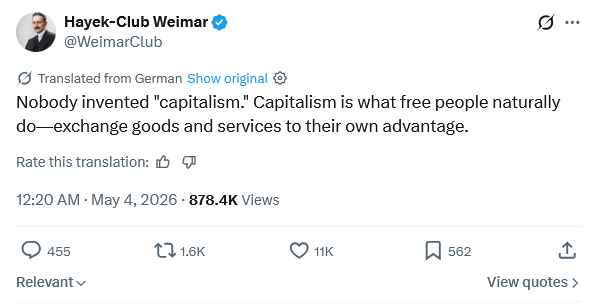
“Nobody invented capitalism”
On the social media site formerly known as Twitter, Anish Moonka responds to an auto-translated-from-German post by Hayek-Club Weimar:
There’s a clay tablet with the founding charter of a 12-partner company on it. Twelve merchants pooled 33 pounds of gold to start the firm. The contract has the partner names, the starting capital, the profit split, and the penalty for cashing out early.
The tablet is nearly 4,000 years old. It was found at a site called Kanesh, in central Turkey. Archaeologists have dug up 23,500 of these clay records there, most of them business documents: receipts, loan contracts, shipping orders, lawsuits. The houses they were stored in eventually burned. The fire baked the clay solid and preserved every record.
The merchants came from Assur, in modern-day Iraq. They loaded donkeys with tin and cloth and walked them 1,000 kilometers across mountain passes to Kanesh, roughly the distance from New York to Atlanta. Each donkey carried about 180 pounds and the trip took two to three months. They came home with silver and gold.
The company ran for twelve years under a merchant named Amur Ishtar. A third of the profits went back to the investors. Pull your share out early and the firm gave you four kilos of silver per kilo of gold, half the normal rate. Locked-up money was meant to stay locked up.
That one company was just a tiny piece. The tablets show a complete economy with partners suing each other in commercial court, husbands writing home about prices, and wives writing back complaining the husband had been gone too long. A woman named Ahatum quietly lent silver to four different men over nine years. People bought up other people’s loan documents and used them as collateral for new loans, the same thing Wall Street does today with mortgage-backed securities. One merchant got caught smuggling tin in his underwear to dodge a 10% import tax.
In 2019, four economists from Harvard, Sciences Po, Chicago, and Virginia ran the tablet numbers through a gravity model, the math economists use today to predict how much two countries will trade based on size and distance. The Bronze Age numbers matched modern trade numbers almost exactly. Trade fell off with distance at nearly the same rate it does between countries today. The paper ran in the Quarterly Journal of Economics.
There was no economic theory yet. The idea didn’t even have a name. The word “capitalism” wouldn’t be coined for another 3,800 years, and Adam Smith was 3,700 years away from writing a sentence about markets. Just a guy named Pushu-ken writing a clay tablet to his business partner about a shipment of cloth, and a woman in Assur recording who owed her how much silver. Capitalism was already there, doing its full job, almost four thousand years before anyone wrote down a theory of how it worked.
Does the REAL Odyssey Survive From the Ancient World?
MoAn Inc.
Published 17 Dec 2025This video was filmed in July of 2025. I wasn’t going to upload it due to the weird not-really-focused-but-also-kinda-focused-thing my phone camera was clearly going through, but decided I didn’t care that much because the content itself was fine x
(more…)
QotD: The loss of male spaces led to today’s epidemic of male loneliness
Places where men showed up without an agenda. Where conversation happened sideways, not face-to-face. Where no one asked men to perform vulnerability, explain themselves, or justify their presence.
Those places didn’t disappear because men rejected connection. They disappeared because our culture decided male-only spaces were no longer acceptable. And once they were gone, men were told that their resulting loneliness was a personal failure.
There has been a noticeable shift in recent months. A growing number of articles now
acknowledge male loneliness and even gesture toward men’s emotional needs. On the surface, this looks like progress — and in one narrow sense, it is. For decades, male loneliness was either ignored or mocked.But many of these pieces commit the same quiet betrayal.
After briefly acknowledging that men are lonely, many articles abandon subtlety altogether and place responsibility squarely on men themselves. Men don’t open up enough. Men don’t try hard enough. Men don’t build friendships properly. Men resist emotional growth.
What is missing is the most obvious factor of all: our culture systematically dismantled the spaces where men and boys once formed friendships.
Men Did Not “Forget” How to Connect, They Lost the Places Where Connection Happened
Male friendships have never primarily formed through structured emotional disclosure. They formed through shoulder to shoulder shared activity, regular presence, and low-pressure companionship. Men bonded by working alongside one another, not by facing one another across a table and “processing”.
For generations, this happened naturally in male-only spaces:
- Service clubs
- Fraternal organizations
- Trade guilds and apprenticeships
- Male sports leagues
- Scout troops
- Men’s religious groups
- Informal gathering places like barbershops and workshops
These environments weren’t about exclusion. They were containers — places where boys learned how to be men from men, and where adult men maintained connection without self-consciousness or surveillance.
Now consider what has happened.
- Barbershops are co-ed and transactional.
- Service clubs are now largely co-ed, and the informal freedoms that supported male bonding in male-only environments have largely disappeared.
- Community sports are co-ed or heavily regulated.
- Even the Boy Scouts are co-ed.
One by one, male spaces disappeared — not because men abandoned them, but because our culture increasingly viewed male-only environments as suspicious, outdated, or morally problematic.
The Asymmetry No One Wants to Name
At the same time male spaces were dismantled, female-only spaces proliferated.
- Women-only gyms are accepted.
- Women-only scholarships are celebrated.
- Women-only commissions exist at every level of government.
- Women-only networking events, parking, subway cars, retreats, and support groups are commonplace.
“Women-only” is understood as necessary, protective, and empowering.
“Men-only”, by contrast, is treated as exclusionary at best and dangerous at worst.
The result is an unspoken rule that everyone knows but few admit:
Women may gather without men. Men may not gather without women.
This is not equality. It is a double standard — and it has consequences.
Tom Golden, “The Quiet Lie Behind Male Loneliness”, Men Are Good, 2026-01-05.
May 6, 2026
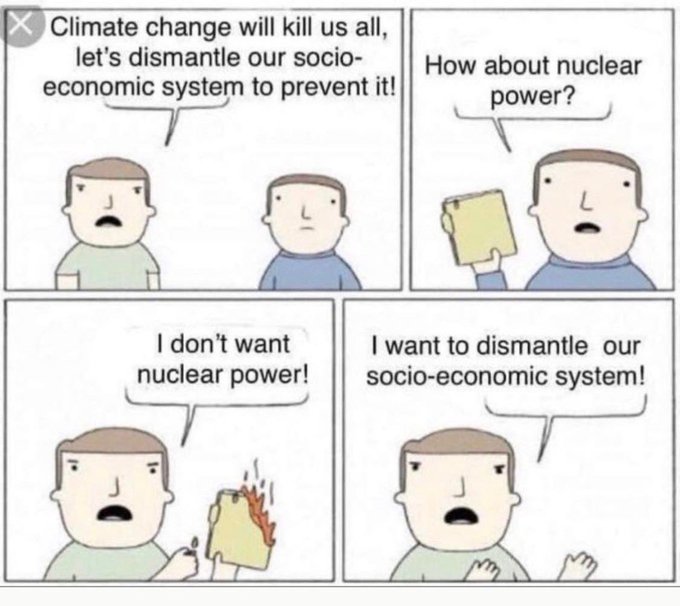
“I don’t want a solution, I want to dismantle our socio-economic system!”
On his Substack, Christopher Snowden explains how “public health” is just another of the many, many anti-capitalist branches of progressive belief:
Some people don’t really want to solve problems. They want to change the world for other reasons. That was the argument I made in Not Invented Here last year, a multi-author IEA publication that essentially elaborated on this meme …
One example is obesity, which we are told can only be tackled by fundamentally changing the food environment, banning advertising, taxing more products and demonising “Big Food”. None of this has ever actually worked anywhere. We do, however, now have GLP-1 drugs that work wonders for many people.
Plenty of “public health” academics are notably resistant to “fat jabs” because what they really want is to fundamentally change the food environment, ban advertising, tax more products and demonise “Big Food”.
Take this article from three self-described “public health scholars” in JAMA Health Forum, for example. They object to obesity being framed as a “a disease requiring individual treatment” because, they say, it undermines public support for government action. They even complain that “medical societies consistently argue that we do need to both prevent and treat obesity” because treatment — i.e. losing weight — is something that individuals can do for themselves. Moreover, studies have shown that when the public hear about people losing weight on their own initiative, they are less likely to support population-wide policies such as food taxation.
Broadcasting a “we need to do both” message, it turns out, is a counterproductive communications strategy for addressing the obesity epidemic. Studies message-testing obesity narratives find that public support for government action is highest when obesity is framed as the result of food industry manipulation and addresses toxic food environments.
The authors don’t seem particularly interested in whether this narrative is true. The main thing is that it can “build support for addressing upstream drivers of the obesity epidemic”. They conclude that medical professionals should stop talking about GLP-1 drugs in public and bang on about “BiG fOoD” instead.
While we acknowledge that public and media discourse often expect clinicians to comment on treatment efficacy and emergent therapies, in an ideal world, the medical community would move discussions about GLP-1 drugs targeting causes of individual cases in-house, while using its credibility and authority publicly to amplify much needed political discussions about the root causes of increasing obesity incidence.
This messaging should include concrete policy proposals targeting unhealthy food environments shifting the debate toward the structural causes of the obesity epidemic, such as World Health Organization–recommended sugar taxes and other policies that would effectively reverse the rise in ultraprocessed food production, marketing, and consumption and, importantly, the corporate power that has so far prevented governments from enacting these policies.
You can see why they are worried about fat jabs. The drugs work by giving people artificial willpower and prove that if obese people simply eat less food they will stop being obese. It has nothing to do with advertising, price, availability or “corporate power”.
From the perspective of the authors, these drugs are a threat, but what exactly is their perspective? The first author, Luc Hagenaars, has written a lot about sugar taxes which he compiled for his PhD thesis. He also worked at the Dutch Ministry of Health in the early 2020s when the Netherlands was undergoing its anti-liberal counter-revolution. Last year, he wrote an article titled “The Ozempic Era Could Shift Blame for Obesity From Individuals to Commercial Food Systems” which made exactly the opposite argument to the one he is making here.
Update, 8 May: Welcome, Instapundit readers! Have a look around at some of my other posts you may find of interest. I send out a daily summary of posts here through my Substack – https://substack.com/@nicholasrusson that you can subscribe to if you’d like to be informed of new posts in the future.
The Korean War Week 98: No Peace at Panmunjom – May 5, 1952
The Korean War by Indy Neidell
Published 5 May 2026At the end of last week the UN presented a peace package proposal to the Communists at the peace talks, but that package has been rejected. The only issue still left to clear up is that of POW repatriation, but that seems insurmountable, at least for the time being. In the field, there are ambushes, skirmishes, and night patrols, but still no larger scale actions, and the temperature at Koje-Do POW camp continues to rise and rise, perhaps nearing a boiling point.
00:00 Intro
01:34 Recap
02:09 The Package Rejected
03:58 Night Patrols
08:32 The Fighting
14:13 Koje-Do
15:58 Summary
16:15 Conclusion
Carney panders to the Euro elites and his TDS-afflicted base
On the social media site formerly known as Twitter, Ben Woodfinden explains Prime Minister Mark Carney’s constant pandering on the international stage:
The average voter won’t care, but the more Carney lays out his worldview the more the contradictions and incongruences in his thinking (or lack of sincerity) become apparent.
In his famous Davos speech he said “we actively take on the world as it is, not wait around for a world we wish to be”. But the way he talks about and sees Europe does not fit this, and this statement is bizarre.
We should absolutely be pursuing closer ties to Europe, but it is delusional if he actually believes the new international order will be “rebuilt out of Europe”.
Europe for all its grand aspirations cannot even defend Ukraine by itself and without American help. Europe would need something like 300,000 additional troops and €250 billion a year in extra defence spending just to deter Russia without the Americans.
NATO’s own Secretary General told the European Parliament in January that Europe “cannot at the moment provide nearly enough of what Ukraine needs to defend itself today, and to deter tomorrow”, and that without American weapons “we cannot keep Ukraine in the fight. Literally not.” Rutte told European lawmakers that anyone who thinks Europe can defend itself without the US should “keep on dreaming”. Four years into the most serious land war on the continent since 1945 and this is where we are. That is not a continent about to anchor a new international order.
The world order is quickly is reorganising, yes. But around a US-China axis, not Brussels. The eurozone is forecast to grow 0.9% this year. China at 4.5%. China accounts for roughly 30% of global growth, Europe’s share of global GDP keeps shrinking. Europe is just one of many players. Again if you take Carney seriously here, it’s silly. Build closer ties with Europe yes but do not believe this is the next superpower.
But I suspect this is actually just another sign that Carney is good at politics — he knows exactly what the Davos crowd, his boomer base and media admirers want to hear and he is very good at giving it to them. Flattery has done him enormous favours in European capitals. But telling European elites the future runs through them is not realism, it is the opposite of realism. It is telling people what they want to hear, not the truth.
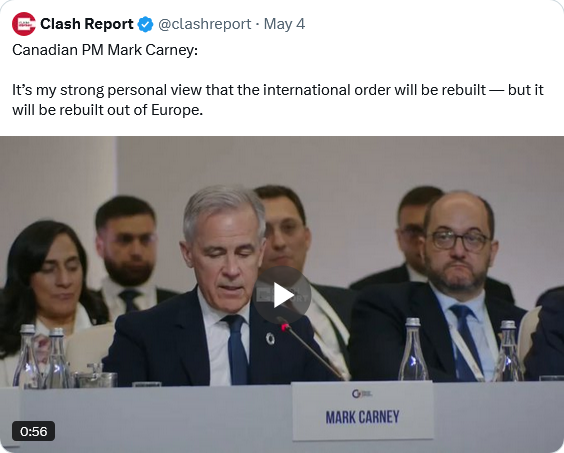
L. Wayne Mathison also comments on Carney’s profound europhiliac positions:
Europe is not the model. It is the warning label.
High regulation. Weak growth. Expensive energy. Soft defence. Endless bureaucracy.
America built. Europe managed. America innovated. Europe regulated.
And Carney wants Canada rebuilt “out of Europe”?
No thanks. Canada needs strength, productivity, energy, defence, and sovereignty, not Brussels-style decline with better catering.
PSS: Russia’s Silent Captive-Piston Handgun
Forgotten Weapons
Published 13 Dec 2025The PSS is a semiautomatic pistol using captive piston ammunition to achieve a comparable level of sound suppression to a .22 pistol with a good normal suppressor. It was developed to replace a couple multi-barrel derringer style captive piston pistols in Soviet use, with the semiautomatic action and (6-round) detachable magazines making it suitable for a wider variety of missions than the previous guns.
It was given the GRU catalog designation 6P28 and entered service in 1983. It fires a cylindrical steel projectile weighing 155 grains at about 620 fps, with a noise of 122 dB (1m left of the muzzle) as measured by silencer legend Phil Dater. Mechanically, the design takes its fire control system from the Makarov but uses a floating chamber system to cycle reliably with the unique ammunition. After the fall of the Soviet Union, the pistols were available for commercial export by Russian state-run export companies, although that ended in 2018. In Russian service, the PSS was replaced with the much improved PSS-2 in 2011.
(more…)
QotD: Deskilling society through AI
Just like in the first one, we’ve figured out how to use machines to do a broad swathe of things people used to do, swapping energy and capital in for human labor. And just like in the first one, the output isn’t necessarily better (in fact, it’s often worse), but it’s so much cheaper in terms of human time and thought and effort that the quality almost doesn’t matter. Sometimes that’s wonderful: if you desperately need to put a roof for your barn right this moment, it’s a blessing to be able to slap on some corrugated tin instead of going to the effort of thatching. When you have to write your seventeenth letter to the insurance company explaining that no, they really ought to be covering this, it’s a relief to hand the composition off to Claude instead. But do that too much and you forget how to do it yourself — or more plausibly, you never learn.
The greatest risk of AI is probably “we all get turned into paperclips”, or maybe “someone uses it to design a novel and incredibly fatal pathogen”, but the most certain risk — the one that’s already here, at least on the edges — is a great deskilling. Just as the mechanization of physical labor lost us all those traditional skills that Langlands describes, the ability to automate cognitive tasks undermines their acquisition in the first place. Why pay any attention at all to word choice and metaphor and prosody when ChatGPT can churn out that essay in a few seconds? Why worry about drafting a convincing email when you’re pretty sure your recipient is just going to ask Grok for a summary?1 Why learn to code when a machine can do it faster?
I was recently informed that someone — “not anyone you know, Mom, someone at another school” — used ChatGPT to write his essay about the causes of the Civil War. This was obviously deeply upsetting to the congenital rule-follower who reported it to me, on account of THAT’S CHEATING (you must imagine this in the whiniest she-touched-my-stuff voice possible), but it was a good teachable moment — for me, if not for the history teacher at another school. What’s the point of an essay about the causes of the Civil War, anyway? It can’t be that the teacher wants to know the answer: she can find a dozen books on the topic if she cares to look, each more cogent and thorough than anything a middle-schooler is likely to produce.2 Heck, even the Wikipedia article will probably give her a better understanding. And if it’s not for the teacher’s benefit, it’s certainly not for the benefit of any other audience, since as soon as the essay is marked and graded it’ll probably be crumpled up and tossed into the recycling bin. No, it’s for the kid.
The point of writing an essay about the causes of the Civil War is not to have an essay about the causes of the Civil War, it’s to undergo the internal changes effected by the process of thinking through, planning, drafting, and editing the darn thing. Writing forces you to put your thoughts in order, to shape whatever mass of inchoate ideas is bouncing around in your head into something clear and reasoned you can pin to the page. The thinking is the hard part; putting words to it is simple by comparison. (This book review began life as about seven hundred words of stream-of-consciousness riffing, with only the vaguest kind of structure. When I experimentally pasted it into an LLM and asked for an essay, the result was terrible.) But even the putting of words is a valuable skill: what’s the right tone here? What’s the right word? Do I want to say “writing forces you to” or “when you write you have to”? How do they feel different? Asking a machine to do this for you is like bringing a forklift to the gym.
Of course, that kid who had ChatGPT write his essay was almost certainly thinking of the assignment not as one small step in the alchemical process of self-transformation that is education but as basically equivalent to an appeal letter to the insurance company: just another dumb hoop you have to jump through in your interactions with a vast impersonal machine that doesn’t particularly want to grind you to dust but wouldn’t mind it either. And since this was at another school, he might not even be wrong. Maybe the teacher was just pasting the rubric and the essays back into ChatGPT and asking it to assign a grade.3
But there’s an even bigger problem than lying about who (or what) has done the work, which is lying about whether the work has been done at all. LLMs make lying very easy indeed. Yes, yes, sometimes they hallucinate and tell you things that are patently untrue, and that’s a bigger danger for students and other people who don’t have the background to notice when something seems off — this is all true, but it’s not what I mean.
LLMs, when working exactly as intended, enable human falsehood — because our society relies on written records as proof of work. Until recently that was fine, because writing down lies actually used to be pretty hard: putting together a convincing false report from scratch — maintenance records for the airplane you’re about to board, say, or a radiologist’s report on your brain scan — was almost as time-consuming as actually checking the things that were supposed to checked and then documenting them, and the liar had to spend the whole time aware of their own dishonesty. (Not that this stops everyone, of course.) But now that it takes about two clicks to generate an inspector’s report for the house you’re considering buying, or the pathologist’s findings in your biopsy, how much are you going to trust that they actually looked?
LLMs can be useful tools,4 but all tools change what we make and how we make it. It’s often a good tradeoff! Sure, each individual example of simplification and automation in the name of efficiency is a tiny bit of alienation, removing the maker from the making, but it’s also a gift of time we can spend on other things: I couldn’t write this if I also had to sew my family’s clothes and wash our laundry by hand. And yet those bits pile up, and once it becomes possible to exist in the world without really needing to come into contact with it, once you can get by without ever really needing to make anything, some people just won’t. And that’s terrible! Being entirely without cræft — never bringing mind-body-soul into harmony with one another and then using them to master the world — means missing out on something deeply human.
Jane Psmith, “REVIEW: Cræft, by Alexander Langlands”, Mr. and Mrs. Psmith’s Bookshelf, 2025-03-24.
- All the “AI written/AI read” communication begins to resemble Slavoj Zizek’s perfect date:
“So my idea of a perfect date is the following one. We met. Then I put, she puts her plastic penis dildo into my … “stimulating training unit” is the name of this product. Into my plastic vagina. We plug them in and the machines are doing it for us. They’re buzzing in the background and I’m free to do whatever I want and she. We have a nice talk; we have tea; we talk about movies. What can be — we paid our superego full tribute. Machines are doing — now where would have been here a true romance. Let’s say I talk with a lady, with the lady because we really like each other. And, you know, when I’m pouring her tea or she to me quite by chance our hands touch. We go on touching. Maybe we even end up in bed. But it’s not the usual oppressive sex where you worry about performance. No, all that is taken care of by the stupid machines. That would be ideal sex for me today.”
- Well, okay, most of them.
- See footnote one again.
- Personally I’ve found them useful in three cases: (1) when I’m blanking on how to begin an email I will occasionally ask for a draft, which inevitably makes me so mad about how bad it is that I immediately rewrite it in a way that doesn’t suck; (2) when it’s Sunday night and I need a picture of a Japanese man in a business suit and a samurai helmet for a book review going up in the morning; and (3) when I can’t figure out the right search term for my question. (Turns out it was “sigmatic aorist”. Thanks, Claude.)


