
Adrian Goldsworthy. Historian and Novelist
Published 19 Nov 2025Today I try to answer several questions about the confrontation between Rome and the Hellenistic Kingdoms of the Eastern Mediterranean — espcially the Macedonians and Seleucids. In contrast to the monumental struggle between Rome and Carthage, where Hannibal in particular inflicted very costly defeats on the Romans, the wars with the “sophisticated” military powers of the east seem much more one sided — brief and decided by a single pitched battle. How fair is the sense that these conflicts were “easier” for the Romans to win, and if they were — why was this?
May 14, 2026
Why did the Romans defeat the Macedonians and Seleucids so easily?
Comments Off on Why did the Romans defeat the Macedonians and Seleucids so easily?
QotD: Marx was right about “alienation”
So, too, with alienation. Marx was talking about physical commodities — the guys who work in the widget factories can’t afford the widgets they make. Indeed, they never even see the finished widget as it rolls off the line — they are just a small cog in a big machine. But alienation is so much more profound than that, and more pervasive. Again, consider the laptop class. What are they connected to, other than their tiny social media bubbles? They have no real relationship even to their own physical body — just look at them, for pete’s sake. They’ve never done anything with their hands but type. And as for social relations, they’re so disconnected from other people that they will text people who are in the same room.
No shit, I’ve seen it happen. And it’s even worse than that, because they think they’re being socially savvy. “Oh, Jayden is in the middle of a conversation with Brayden; I’ll just text him, so as not to interrupt.” But since people under forty are physically incapable of not checking their phone the minute it beeps at them, it’s not just an interruption, it’s an especially obnoxious one … and they have no idea. What we used to call the “soft skills” — the ability to come up to Jayden and Brayden, assess where the conversation’s going, and steer it in such a way as to get Jayden the info he needs organically — are totally gone.
You can test this for yourself. Just don’t answer the phone. Or a text. Seriously, try it. It’s tough, isn’t it? No matter where you are, the fucking thing dings, and you immediately grab for it. It takes real physical effort not to. It’s much, much easier to simply turn it off, and while I’m all for that — indeed, I’m for dropping it overboard in the Marianas Trench, or shooting it into deep space — try leaving it on, and only checking your text messages at a set time. It’ll keep until 3pm (your designated “check message” time), I promise. Or if it won’t — if it’s the wife asking you to pick up a gallon of milk on the way home — then you’ll learn a different lesson, the one about how we use crutches for some reason when we’ve got perfectly good legs.
That’s alienation, in the broadest and most significant sense. Since you are constantly available — since your time is now a commodity, that you’re constantly selling to the lowest bidder — your personal worth is zilch. You’re a message-answerer and milk-fetcher and all-purpose Guy Friday, to everyone, all the time. Even to — make that especially to — the people who supposedly love you, and respect you. Because who cares what you’re doing right now? The important thing is that milk, no?
Severian, “On Losing the Cold War”, Founding Questions, 2022-07-02.
May 13, 2026
A quick look at the race to be the next governor of California
Chris Bray somehow seems to find the election coverage by a multi-decade veteran Los Angeles Times political reporter to be, dare I say, lacking just a little objectivity and honest analysis:

Robin Abcarian has been a professional journalist for four decades, mostly at the Los Angeles Times. She’s spent her adult life writing about politics. So go read her column about the last gubernatorial debate in California. Here’s how it opens:
What am I looking for in a new California governor?
Like a big chunk of the state’s voters, I’m not exactly sure.
You can already tell you’re in the hands of an experienced professional. There aren’t really any big issues or anything in California right now, so how would you zero in on something you would want from someone who wants to lead the state’s executive branch, right? It’s all just a shrug and a guess.
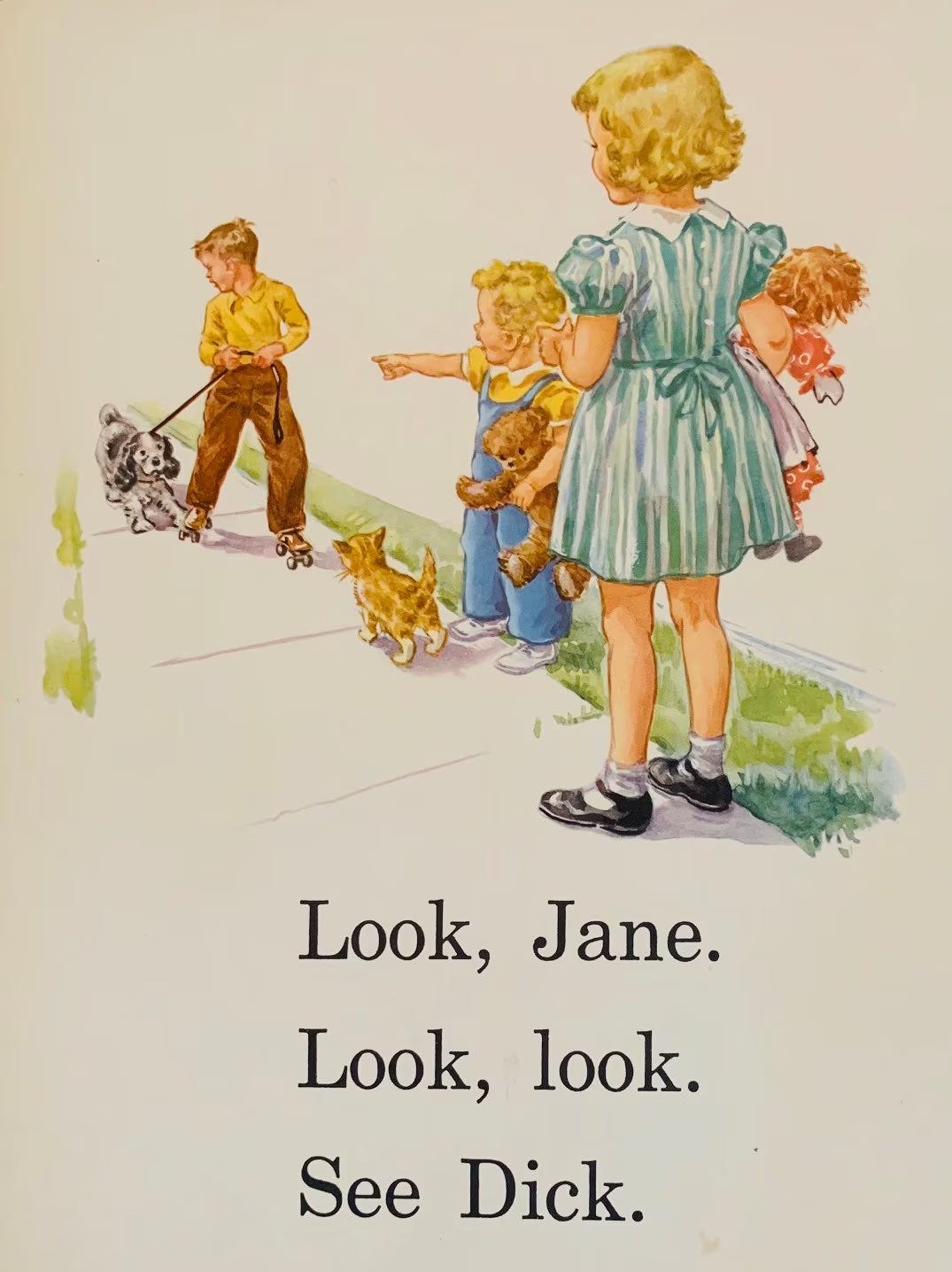
Then she recites: This candidate said X, and this other candidate said Y. And she tells you which of the recited things she likes: I like X. I do not like Y. She doesn’t analyze or argue or contextualize: she just says I like that one and I do not like that one. The effect is that you’re watching someone wander barefoot through a field of statements and either make “ooooh, pretty” sounds or “ick, yucky” sounds with a kind of vibration from her brain stem. Billy likes blue balloons, they are pretty. Becky loves pink balloons, they are even prettier! She can’t explain any of it, though she attempts some explainy noises, and then it gets worse:
I know who I don’t like, though.
Every time I see Republican Riverside County Sheriff Chad Bianco, with his Tom Selleck mustache, I can’t help thinking he should play a lawman on TV.
- Should Chad Bianco become the governor of California?
- He has a mustache
CHAD BIANCO WISHES TO BE THE GOVERNOR BUT ACTUALLY HE APPEARS TO BE VERY MASCULINE THINK ABOUT IT
Have I mentioned that Robin Abcarian has a graduate degree in journalism? You can see how her education sharpened her mind.
She adds that Bianco has said some deeply disturbing and disqualifying things, and then she gives an example: “A lack of affordable housing has nothing to do with homelessness, Bianco has said repeatedly”. Gasp!
Instead, outrageously, he claims that homelessness has something to do with “drugs and mental illness”.
It is very bad to say this. Why is it very bad to say this? She doesn’t explain, but it’s very bad to say it. Homeless people are all just fine, and they would immediately be okay if you just gave them a house, because the whole crisis is just affordability. Drugs and homelessness!?!? In CALIFORNIA!?!?!? What are you even talking about!?!?
This woman is a journalist in Los Angeles, where you can experience psychotic episodes in the street next to an encampment by driving to lunch.
By the way, this video of homeless people on Skid Row smoking fentanyl right next to the LAPD’s Central Division station? I drove over there this afternoon, and yes. Open drug dealing, drug overdoses, ambulances running day and night, bodies in the street, police station.
Let’s have a look at Abcarian’s analysis of Katie Porter, whose marriage quite notoriously ended with her husband accusing her of once expressing an (apparently frequent) rage by dumping a boiled pot of mashed potatoes on his head, part of a pattern of what he described as an abusive relationship. Abcarian:
“I’ve always liked Porter and her famous white board. I don’t believe snapping at your staff or a reporter is disqualifying, and I’m glad she’s been able to joke about the leaked video that damaged her campaign.”
I like Katie Porter. She is nice. People say she yells a lot, but that is okay. She makes jokes about when she yells at people who work for her. That is funny! She is funny and nice.
Decades on the payroll of a major American newspaper. Will a candidate be an effective governor? “I’ve always liked Porter.” Thanks for your analysis, Robin.
And then finally, big finish, watch how aggressively obtuse this person is. Just watch. It’s a gold medal performance.
First she discusses the attacks on Democratic frontrunner Xavier Becerra. The other candidates are criticizing him because “on his watch at HHS, the Office of Refugee Resettlement lost track of 85,000 migrant children”. Abcarian acknowledges what happened next, when “many of the minors, mostly teenage boys, were exploited by sponsors, who illegally put them to work in various factories, food processing plants and as roofers”. So she has explicitly discussed migration as a source of human trafficking and exploitation.
Then she says that Tom Steyer won her heart by promising to shut down ICE and prosecute ICE agents. Here’s Abcarian’s complete discussion of the way she feels about Steyer promising not to enforce immigration laws: “Could it be I’m falling in love?”
- Unmanaged migration across borders is human trafficking and exploitation, often of children
- My uterus is a little gushy over this candidate who says he’ll block the enforcement of immigration laws and shut down the agency that enforces immigration laws
Does she notice that she did this? Does she notice the one-two punch of talking about tens of thousands of minors trafficked across the border to be exploited and then the immediate wine aunt pivot to this ooh-he’s-so-cute swooning about Dreamy Tom Steyer promising to not let anyone enforce immigration laws?
My position regarding the high-cultural-status AWFL and biologically male pseudo-AWFL, in media and politics and academia and NGOs, is that none of them notice themselves at all. They have noises that they’re been trained to make, and they make the noises. Warm and wonderful unhoused neighbors. Warm and wonderful trans kids. Warm and wonderful immigrants. They have categories that they purr about, because one purrs about those categories or else one is a Trump person who belongs in a trailer park. It’s been purely automatic for years and years.
Comments Off on A quick look at the race to be the next governor of California
“Electoral authoritarian” regimes
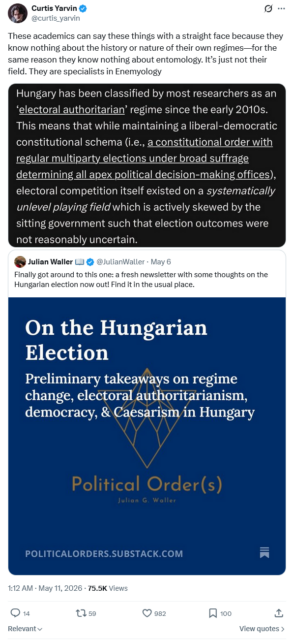
eugyppius points out that the reflexive descriptions of the former Hungarian prime minister Viktor Orbán’s government as “electoral authoritarian” fail to note just how authoritarian the rest of the EU’s national governments have become:
this description of an “electoral authoritarian” regime applies far more aptly to Germany than to Hungary. What did Orbán do, defund a few NGOs? meanwhile our police, intelligence agencies & state media have all collaborated for years to keep the opposition out of power.
And after some harumphing from the cheap seats, he followed up with:
Various people are clapping back at this, so let me tell you what is happen in liberal democratic non-authoritarian Germany:
– Getting raided by police, charged with speech crimes, etc. because you post online is a professional risk, I personally know various people to whom this has happened and I live my life with a bunch of opsec annoyances for the day it happens to me.
– State media coordinates with intelligence agencies to smear and harass not only the political opposition but their prominent supporters, for example by doxxing them, getting them fired, subjecting them to harassment.
– The state funds a vast “civil society” network of violent street thugs to intimidate the political opposition and also anybody identified by state-sanctioned ops like those detailed in the above item. Opposition party congresses, other events routinely disrupted by coordinated civil society protests, where the local population is sympathetic (as in many east German venues) they bus in protesters from the west and the big cities to create the necessary atmosphere.
– Domestic intelligence agencies use espionage methods to surveil and compromise the political opposition; among other things they pay informants, tap telephones, read emails, and so on. We’ve had various indications that materials gathered in these operations are then used for state media smear campaigns.
– Yes, domestic intelligence openly coordinates with state media and certain private media elements too. Various aspects of political coverage in Germany are staged by secretive unelected bureaucrats.
– Procedural rules, other laws are routinely changed in ad hoc ways to disadvantage political opposition, though we haven’t had any outright gerrymandering like in the US so that means Our Democracy is safe. 👍
And:
I’m sure I’m forgetting some things. I’ve spent years documenting this shit on my blog and literally none of the present Hungary hyperventilators have ever given the slightest shit. Orbán was a guy who observed the Euro freak show as it is manifested in countries like Germany and tried in a kind of inept half-hearted way to imitate this machine from the right, the results were ridiculous and transparent and like 25% as effective as what the German state gets up to but nevertheless all these clowns confronted with a hint of their own methods started shrieking about FaSciSm.
Comments Off on “Electoral authoritarian” regimes
The Korean War Week 99: The War’s Most Humiliating Crisis – May 12, 1952
The Korean War by Indy Neidell
Published 12 May 2026The world turns it’s eyes to the UN POW camp at Koje-Do island when the Communist POWs in one of the compounds kidnap the Camp Commandant, an American General no less, and issue demands that they say must be met before his release. Can this be settled diplomatically, or is the army going in in force?
00:00 Intro
00:54 General Dodd Kidnapped
04:09 Koje-Do Phase Two
07:04 Dodd on Trial
13:18 The POWs Demands
18:30 Summary
19:03 Conclusion
19:54 Call to Action
Comments Off on The Korean War Week 99: The War’s Most Humiliating Crisis – May 12, 1952
“The dark genius of bureaucracy”
Auto-translation on the social media site formerly known as Twitter has brought some posts from Brivael Le Pogam to my attention, like this one:
The Invisible Cemetery
Milton Friedman said a phrase that should haunt every European legislator for the rest of their life. On the FDA, he said this: there is overwhelming evidence that they have caused more deaths through delayed approvals than they have saved through early approvals.
Read it twice. More deaths from excessive caution than lives saved by caution.
And no one sees it. That’s the dark genius of bureaucracy.
Bastiat theorized the principle 175 years ago. “What is seen and what is not seen.” The economist, he said, is not distinguished from the bad economist by the ability to see the immediate effect of a decision. Everyone sees that. He is distinguished by the ability to see the invisible effects, the delayed ones, the ones diffused across the entire population.
The self-driving car is the perfect example. And it’s playing out right before our eyes.
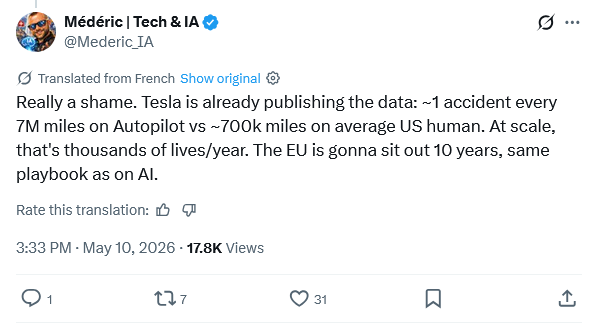
Tesla publishes the numbers. One accident every 7 million miles in Autopilot. One accident every 700,000 miles in the average American human. Autopilot is, at this stage, ten times safer than a human. And it’s only getting better, with every release.
Now France. 3,200 deaths on the roads in 2024. 91% involve human error. Speed, alcohol, fatigue, distraction. If we deployed a self-driving car ten times safer tomorrow, we’d divide the carnage by ten. We’re talking about 2,800 lives a year. Over ten years, 28,000 people. The equivalent of an average French town that disappears, because no one pressed the right button in Brussels.
You’ll never see them. No newspaper will headline: “Today, 8 people died because the self-driving car is banned in Europe”. No parliamentary commission will investigate. No bureaucrat will be fired. Those deaths will go in the “road fatality” box. We’ll run moving campaigns with their photos on 4×3 billboards. We’ll say it’s sad, that’s life.
Meanwhile, the first accident of a self-driving car will be front-page news in every paper for three weeks. The regulator will summon the manufacturers. NGOs will call for preventive bans. Deputies will write op-eds. The minister will decree a moratorium.
Five visible deaths will outweigh, in the media and political balance, five thousand invisible deaths. That’s the iron law of bureaucracy. The bureaucrat who authorizes something that goes wrong loses their career. The bureaucrat who bans something that would have saved thousands of lives is never troubled. No one holds them accountable for the deaths they could have prevented. They don’t exist in their statistics. They don’t exist in their trial.
Friedman had identified the exact mechanism: when a regulator errs on the side of laxity, their victims have names, faces, families, lawyers. When they err on the side of caution, their victims are anonymous, scattered, statistical, ghosts. The structure of incentives makes over-regulation rationally inevitable. And the invisible cemetery grows, generation after generation.
Europe is going to sit out 10 years on the self-driving car, just as it sat out on AI, as it sat out on genetic engineering, as it sat out on fourth-generation nuclear. Every time, the same playbook. Precaution, moratorium, ethics committee, white paper, directive, transposition. And every time, behind the curtain of words, deaths that appear in no official statistics.
These are deaths. Not opportunity costs. Not “economic losses”. Human beings who were alive and who died because an innovation that could have saved them was delayed by people whose literal job it is.
That’s what needs to be built, and it’s probably the most important political project of the century that’s opening. A system for accounting for invisible deaths. A registry of the cemetery that no one sees.
For every regulation, every moratorium, every preventive ban, we should be able to produce a signed, dated, quantified estimate of the human cost in lives of the decision. Not direct effects. Delayed effects, indirect ones, statistical ones. How many deaths per year caused by banning a technology that works elsewhere.
Imagine. On the desk of the European commissioner about to sign a moratorium on the self-driving car, a document: “Central estimate, 2,800 deaths per year for the duration of the moratorium. High-end range, 4,100. Low-end range, 1,900. Source: comparative analysis Tesla Autopilot vs. human average, NHTSA and ONISR data, public and audited method.”
On the desk of the European deputy who will vote on the AI Act: “Central estimate, 38 billion euros in lost GDP, 240,000 jobs not created, X deaths per year due to delays in AI medical diagnostics, Y deaths per year due to delays in deploying autonomous drones for medical delivery in rural areas.”
Today, we sign blindly. We sign without cost. We sign with a clear conscience because the deaths we cause are anonymous and the lives we protect have faces. That’s what needs to be broken.
A bureaucracy is an institution that operates without being held accountable for the invisible consequences of its decisions. As long as invisible deaths are not counted, bureaucracy is mechanically, structurally, inevitably a machine for producing deaths it will never see.
Europe isn’t losing a technological battle. It’s filling a cemetery. Year after year. And no one wears mourning. No one lays flowers. No one knows they’re there.
Friedman saw them before everyone else. Bastiat before him. Williams after him. And each posed the same question, which echoes like an accusation through the centuries: who weeps for the deaths we didn’t see coming?
That’s the work ahead of us. Making the invisible cemetery visible. Accounting for it. Auditing it. Publishing it. Confronting every bureaucrat, every day, with the exact list of lives that their signature takes with it.
Before the list becomes ours.
Comments Off on “The dark genius of bureaucracy”
Between SMG and PDW: Sweden’s CBJ-MS
Forgotten Weapons
Published 20 Dec 2025The CBJ-MS is a submachine gun designed by Swedish arms developed Carl Bertil Johansson, perhaps better known for his remarkable armor-piercing 6.5x25mm CBJ cartridge. He developed the gun at about the same time as the cartridge, on his own time while working at the Carl Gustafs factory in Eskilstuna. While it bears a lot of visual similarities to the Uzi, and it is an open-bolt simple blowback action, it has a unique and clever fire control system — and several other creative features as well.
(more…)
Comments Off on Between SMG and PDW: Sweden’s CBJ-MS
QotD: The advertising business
That’s what makes the ads a useful window into the black soul of our rulers. The ad makers are all from the ruling class. Look at the team photo of an ad agency and it looks like the faculty of an Ivy League college. There may be a little color in there for show, but otherwise it is all men with small hats and people who still write “Episcopalian” when asked about their religion. The advertising agencies that produce these ads are the special forces of the Judeo-Puritan ruling class.
The Z Man, “Turn Off, Tune Out and Drop Out”, The Z Blog, 2020-09-04.
Comments Off on QotD: The advertising business
May 12, 2026
First One Nation party MP elected in Australian by-election
After the surge in support for populist Reform Party candidates in the British local elections, Australia’s populist One Nation party achieved their first member of the House of Representatives in a by-election in Farrer, with David Farley receiving 57% of the votes:

Australia’s One Nation party has won its first lower-house seat in a moment that’s been described as a political earthquake. As with Reform’s success in the council elections here, its significance is already being argued over.
The fact remains that One Nation candidate David Farley won over 57 per cent of the tally in Farrer, a vast regional constituency in New South Wales, a weathervane election that was triggered by the resignation of Sussan Ley after she was ousted as leader of the opposition conservative Liberal Party.
Saturday’s poll was the first federal test of One Nation’s support after the party recorded the second-highest number of votes out of any political party in the South Australian state election in March and, importantly, since the change of leadership of the Liberal Coalition opposition. With it, as I predicted a week or two ago, Pauline Hanson’s One Nation Party broke through Australia’s political glass ceiling.
Why and how? Well, for one significant reason. In response to her rise in the Australian polls, for the first time Ms Hanson and her party were endorsed by the opposition Liberal and Country (National) Party coalition. Blessed with two new leaders – two men prepared to defy the woke establishment and media – they “preferenced” the One Party candidate ensuring One Nation won the seat. Don’t forget Pauline Hanson has been far more of a persona non grata to the Australian establishment elite than Nigel Farage has to ours. I can’t see him having the chutzpah to turn up to Parliament wearing a full burqa!
Far better than anything I can write to capture the significance of the moment is David Flint’s account in Spectator Australia, titled “The Farrer earthquake: how the commentariat got it wrong“.
It is so good that I feel sure that Editor Rowan Dean will forgive me for quoting big chunks from it:
The political establishment is in a state of shock … When Sky News Australia took the unprecedented step of calling the Farrer by-election for One Nation at an extraordinarily early hour, it wasn’t just calling a seat; it was announcing the end of an era. For the first time in Australian history, One Nation has captured a House of Representatives seat at an election, and if the current opinion polls are any indication, it is merely the first of many.
And that is the point. He goes on:
The “commentariat” – that insulated class of pundits and pollsters – has spent years repeating the tired myth that One Nation is a party of complaint but not of policy …
Farrer has proven that the commentariat’s “no-policies” narrative was a delusion. Australians are not merely “protesting”; they are voting for a platform of common sense, consistently put forward by Pauline Hanson and Senator Malcolm Roberts – one that the major parties have long since abandoned.
Flint argues that it presages the death of the major party monopoly: “The result reflects a deep-seated exhaustion with the status quo. Labor is no longer the party of the worker; it has become the party of the inner-city elite. The Greens, far from being environmentalists, seem content to see our landscape ruined by industrial ‘renewables’ to enrich foreign interests – propping up what Donald Trump rightly called the ‘world’s biggest fraud’. In contrast, voters have responded to a leader who tells the simple truth.”
Comments Off on First One Nation party MP elected in Australian by-election
Something something hoist, something something petard
The Liberal party, both federally and provincially, have been massive fans of immigration for decades. Any kind of restriction on foreigners being allowed into the country was seen as tantamount to treason, in Liberal eyes. This resulted in a lot of votes for Liberal candidates in election after election, as most immigrants associated their welcome in Canada with the party most associated with pro-immigration policies. On the weekend, this happy little virtuous circle suddenly broke in the Toronto-area provincial riding of Scarborough Southwest, and the party is left wondering what is going on:
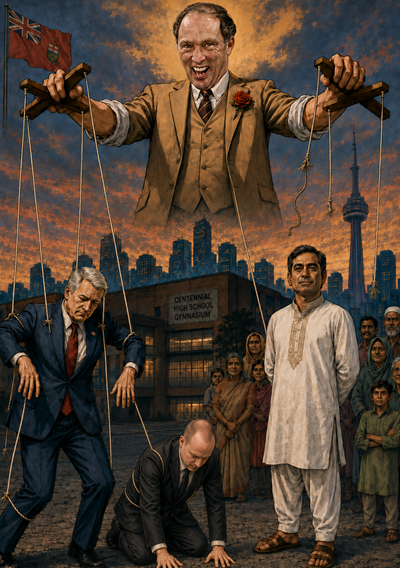
AI-generated image from Upper Canadian Cavalier
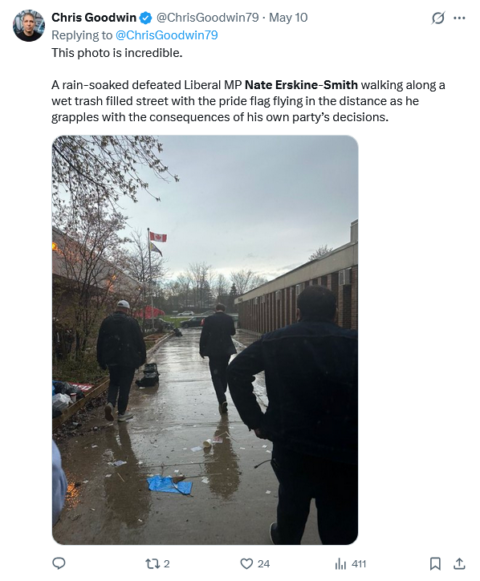
There is a particular flavour of humiliation reserved for the courtier who discovers, too late, that the rules he wrote for everyone else now apply to him. On Saturday afternoon in Scarborough Southwest, Nathaniel Erskine-Smith tasted it. The former federal Minister of Housing, the man Mark Carney himself had blessed to retain his Beaches–East York seat while parachuting into a provincial nomination as a launchpad for the Ontario Liberal leadership, lost. He lost to a man named Ahsanul Hafiz, a Bangladeshi immigrant who had arrived as an international student two decades ago, who had been forced during the campaign to answer for old social media posts of himself posing with firearms and calling for the death penalty of a Bangladeshi politician. Hafiz won not because he was a more accomplished man, not because he had a deeper grasp of public policy, not because he carried the gravitas of a former Crown minister of the Dominion. He won because he could deliver more bodies to a high school gymnasium on a Saturday afternoon than the Oxford-trained lawyer with the cabinet pedigree could.
This is the open secret of Liberal politics in Canada in the year 2026. The white Liberal cannot win his own nomination battles anymore. Not on the merits. Not on the organisation. Not on the strength of his name or the depth of his rolodex. He can only win when the party machinery he himself built bends the rules in his favour, locks the gate behind him, and quietly disqualifies the rivals who would otherwise eat him alive. When the machinery fails, as it failed in Scarborough Southwest, the result is what we saw on the weekend: the dauphin of the Carney court, the heir presumptive, sent home with a participation ribbon and a press release about how concerned he is of the democratic process.
The democratic process. We shall return to that phrase, because it has done a great deal of work for the Liberal Party of Canada these past sixty years, and it deserves the close inspection of an honest mind.
The Scarborough Lesson
Consider the bare arithmetic of what happened. Erskine-Smith is, by every measure the Laurentian establishment recognises, the kind of man the Liberal Party manufactures for leadership. Queen’s University, then Oxford for the BCL. A successful federal MP since 2015. A cabinet minister under both Trudeau and Carney. The blessing of the Prime Minister himself to remain a sitting federal MP while contesting a provincial nomination, an arrangement of breathtaking entitlement that would have been denied to anyone of lesser standing. He had every advantage the system can confer on a chosen son.
And yet the Bangladeshi grocer down the street had more votes.
Three thousand five hundred members were on the final voting list. The Bangladeshi community of Scarborough Southwest, organised through its mosques, its community associations, its weekly newspaper the Weekly Bangla Mail, its television station NRB TV, had decided some time ago that this riding belonged to them. Doly Begum, the former NDP MPP turned federal Liberal, had won the by-election three weeks earlier as the first Bangladeshi-Canadian elected to Parliament. The provincial nomination was the next obvious prize. Three of the four candidates running were of Bangladeshi origin. The fourth was Erskine-Smith.
You can imagine the scene at the high school. The folding tables, the volunteer scrutineers, families arriving in groups of six and eight, elderly grandmothers helped to their seats by grandsons. And against this, the dispersed and atomised liberal professionals of the riding, the kind of people who attend brunches in the Beaches and write earnest letters to the Toronto Star about housing policy. There was no contest. The grandmothers won. They will always win. They were always going to win. Anyone who has spent five minutes thinking honestly about what mass non-European immigration into a Westminster system actually means could have told you so.
This is not a scandal, it is not foreign interference. It is not even when properly understood, a failure of the Liberal Party. It is what democracy looks like when you transplant a foreign communal politics into a parliamentary system that was built for atomised individuals voting their conscience as Englishmen. The system the Liberals constructed across two generations, the system of mass importation without integration, of multiculturalism as official ideology, of the ethnic vote as the quiet hydraulic engine of every Liberal majority, has finally arrived at its terminal stage. The body has now grown larger than the head, and the head has noticed.

At Without Diminishment, Dakota Jeffery-Petts, who once worked as a volunteer on Erskine-Smith’s 2015 campaign, writes:
In Canada, the nomination process remains a glaring national security loophole. These contests are treated as private club matters rather than public democratic exercises. They lack the oversight of a neutral authority. This creates a low-cost, and at times entirely cost-free, environment providing a high-reward entry point for foreign interference.
All you need to do is speak sweet lies to members and constituents. In doing so, you create a motivated interest group that can effectively hand-pick a representative in a safe seat, bypassing the general electorate entirely.
When 3,580 memberships appear overnight in a single riding, we must ask: whose interests are being served? Are they Canadian interests, or diaspora interests?
The primary duty of an elected official, after all, is to the national and public interest. But when a candidate’s mandate is derived from a narrow, diaspora-specific recruitment drive, often centred on grievances or political movements from the old country, that candidate becomes a delegate for a foreign interest rather than a representative of Ontario and the Ontarians in that riding.
The result illustrates the danger of fragmented national and local loyalties.
Multiculturalism, when left without a strong framework of national identity, allows for the importation of foreign conflicts into our legislative halls. We are seeing the rise of a political class that views a seat in a Canadian legislature as a platform for foreign advocacy, rather than a tool for national or provincial governance.
This capture of our nomination process by diaspora activism is the ultimate sign of a hollowed-out democracy. If the gates to our legislatures are guarded by whoever can mobilise the largest bloc of unintegrated interests, then the concept of a Canadian mandate becomes meaningless.
We are effectively outsourcing our leadership selection to the highest bidder, or to the most aggressive foreign-aligned organiser. The decision by the Ontario Liberal Party to allow this surge, and the subsequent defeat of one of the more prominent politicians in the province, shows a party that has lost its way.
By prioritising raw numbers over the quality and loyalty of its candidates, the Ontario Liberals have signalled that they are comfortable being a vessel for proxies acting on behalf of foreign interests, despite the hardships facing so many Ontarians.
Comments Off on Something something hoist, something something petard
What happened to the people who took Joe Biden’s advice and learned to code?
It was only a few years ago that snooty media personalities were constantly echoing President Joe Biden’s advice to unemployed workers: “Learn to code”. Then, of course, the media hit hard times and the advice was then being snarkily offered to newly unemployed media folks. But what about the (few) who actually did “learn to code”, only to be swept away again as the clankers surged in to eliminate a lot of basic coding jobs?

How to Understand What AI Just Did to People Who Took Joe Biden’s Advice and Learned to Code.
A simple, concrete example.
Oddly enough, I have a bachelor’s degree in Computer Science. This means I know 7 algorithms for sorting a list into alphabetical order. I understand the tradeoffs between their execution time, code complexity, and memory demand. I learned the specialized lingo for describing execution time.
The algorithms are surprisingly complex and subtle. I spent months learning to code them.
Now that hard-won knowledge has been replaced by, “Claude, write a module to sort this list. Optimize for execution time.”
Millions of good people just lost their professions and must now invest in a new one.
Right now, knowing how to sort a list probably gives me a small advantage when I code with AI. But I will soon lose even that tiny return on my investment, as AI improves.
Certainly AI will create some new opportunities, probably a lot of them.
But count your blessings, if you did not spend years learning to code like I did.
And:
Here is the counterpoint: Learning to code gave coders an advantage when relearning to code with AI.
That advantage is their ticket to a seat in the new AI world.
The big question now is how many seats exist.
To which ESR responded:
Your position is reasonable, but wrong.
Having learned to code is still valuable in the new world of AI, not because you’re wrong about coding itself having become disposable, but because of the capabilities and mindset you developed while learning to code, some of which are difficult to learn in any other way.
You didn’t become a professional programmer. But I’m willing to bet that your intuition about how to design software is far better because you wrestled with code. And that is *not* a skill that LLMs are replacing — ignore the noisy hype about this.
I’m also willing to bet that some of what you learned as a programmer in training translated into problem-decomposition skills that have served you well as an economist.
If one is not a complete dullard (and you are certainly not a complete dullard) learning to code teaches not just craft skills but a mindset — a set of heuristics for carving reality at its joints. There are other ways to get this — I think for example of Richard Feynman who got there by thinking very hard about physics. And it is not guaranteed that every programmer will develop this right mindset.
But many of us do. And most of the other ways to develop it seem also to produce it only as a side effect, but less reliably than learning to code does.
So don’t write off learning to code. Maybe someday we’ll develop educational methods that can teach those higher-level skills more directly. That would be an excellent thing, if it’s possible. But until it gets here, learning to code will still have value that is not easy to duplicate in any other way.
Comments Off on What happened to the people who took Joe Biden’s advice and learned to code?
Indian Pudding – America’s Forgotten Dessert
Tasting History with Max Miller
Published 18 Nov 2025Rather unattractive, but delicious, molasses and cornmeal baked pudding with whipped cream
City/Region: United States of America
Time Period: 1829Indian pudding, a perfect marriage of new world and old world cooking, resulted from British colonists making familiar foods with the ingredients that were available to them in America. Without access to wheat flour, they used cornmeal to make their beloved boiled puddings, and by the time this recipe came around in 1829, there were baked versions as well.
While an admittedly unattractive dish, it is absolutely delicious. The molasses really comes through, but it has none of the bitterness, leaving an almost caramelly flavor.
This dish has fallen out of favor and can usually only be found in New England, but I think it should make a comeback. If you’re planning on serving it for Thanksgiving (which I plan on doing), then I recommend presenting it dressed up with whipped cream to make it, if not pretty, then more palatable-looking.
(more…)
Comments Off on Indian Pudding – America’s Forgotten Dessert
QotD: “… this pattern will be immune to all but the most draconian interventions, such as legally-imposed quotas”
[…] the achievement of social status and some degree of success in culturally-important domains are more strongly related to men’s than women’s reproductive prospects and success. The sex difference here is found in hunter-gatherer, pastoral, and agricultural societies, as well as in early empires, developing nations, and the modern world. One result is that men have an evolved motivation to increase their social status and to attempt to gain control of culturally-important resources, whether these resources are cows or cash. Women of course also benefit from improved status and resource control, but the evolutionary costs and benefits differ for each sex and have resulted in stronger status-related motivations and behaviors (e.g., long work hours) in men than women.
The expression of men’s status striving strongly contributes to the sex difference in occupational attainment that continually frustrates gender activists and thwarts policy edicts aimed at equality of outcomes. […] sex differences in status striving manifest in modern contexts and […] these are entirely consistent with broader patterns found across human cultures, human history, and in most species.
David C. Geary, “Sex Differences in Occupational Attainment are Here to Stay”, Quillette, 2020-11-02.
Comments Off on QotD: “… this pattern will be immune to all but the most draconian interventions, such as legally-imposed quotas”
May 11, 2026
Were the Nazis socialists?
If you’re ever bored and want to kick off an argument online, you can take either side of this statement and watch the signal-to-noise ratio drop precipitously. The NSDAP, the Nazis, began as one of the many, many groups of angry young Germans in the days after the end of the First World War. The full name of the party — the National Socialist German Worker’s Party — indicates who the original party founders thought would be the engine of their political rise. They were explicitly anti-communist, as the spectre of the Russian Revolution terrified many Germans, but German socialism was still within the Overton Window of political debate.
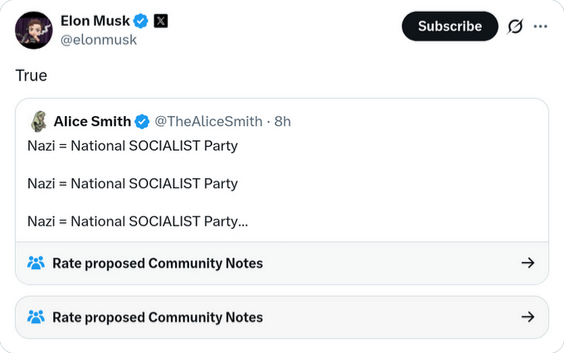
Lots of arguments about this one.
Many people assume Nazis could not have been socialists, despite all the time and energy they devoted to jumping up and down screaming “We are socialists!”, because they were “right-wing” and socialism is supposed to be “left-wing”.
Except “right-wing” and “left-wing” don’t have rigid definitions outside the context of the French revolution. In any other context, they’re just a metaphor.
So why did the NATIONAL Socialist German Workers’ Party and the INTERNATIONAL Marxist-Leninist Socialist Workers’ Movement hate each other so much?
It’s pretty obvious when you look at the names.
National.
International.
To Nazis, the race and culture of a people are everything. They are what the state is supposed to represent. Ein Volk, as they would say. The purpose of Nazi socialism is to control capital assets, subordinating them to the will and welfare of the ethnostate.
But Marxist-Leninists seek to abolish all ethnostates. They are a globalist movement, seeking to place all capital assets under the control of a universal proletariat in theory, which is in practice represented by one world government.
Thus, Nazis sought to use socialist policies for the welfare of the German people and Marxist-Leninists seek to abolish “German” as a meaningful distinction, along with all other cultures.
The antipathy between Nazis and communists was a sectarian struggle within socialism. Same methods, but different sacred groups.
Since the defeat of National Socialism by International Socialism in WW2, all modern socialism is pretty much of the international variety.
This does, however, suggest that there is a contrast between National Capitalism and International Capitalism as well.
Which is the source of the current sectarian struggle between elements of the American right wing.
Update, 12 May: Welcome, Instapundit readers! Have a look around at some of my other posts you may find of interest. I send out a daily summary of posts here through my Substack – https://substack.com/@nicholasrusson that you can subscribe to if you’d like to be informed of new posts in the future.
“We’ve entered the pre-violence rhetorical phase of the classic communist cycle”
You have to have noticed that progressives all seem to have recently decide en masse that we need to liquidate eliminate expropriate the billionaire class. It’s been done in the past, and modern progressives seem to be unable to spot the pattern, even as they work hard to bring it back to life by constantly scapegoating the wealthy (machine translated from Brivael Le Pogam’s original French post):
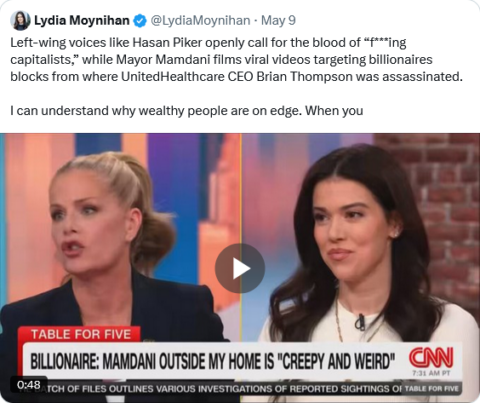
Lydia is putting her finger on something that no one wants to name clearly: we’ve entered the pre-violence rhetorical phase of the classic communist cycle.
The script is documented, archived, and it repeats itself identically for a century. Before every mass massacre carried out in the name of Marxism, there are always 5 to 15 years of public designation of a category of people as “the enemy to be taken down”. Not a debate on public policies. Not a critique of inequalities. A methodical dehumanization of an entire class.
In the USSR in the 1920s, it was the kulaks. Lenin wrote as early as 1918 that it was necessary to “exterminate the kulaks as a class”, an expression repeated word for word by Stalin ten years later. Result: 4 million peasants deported, several million dead in the Holodomor.
In Maoist China, it was the landlords and “class enemies”. Mao orchestrates public “struggle sessions” where neighbors, children, former employees are forced to denounce, humiliate, and beat. Tally from the land reform alone: 1 to 2 million executions, not counting what follows.
In Cambodia, it was the “new people”: city dwellers, intellectuals, people wearing glasses. Khmer Rouge propaganda designated them for years as parasites before massacring them. 1.7 million dead in 4 years.
Now look at what’s happening in the United States in 2026.
Hasan Piker, who reaches millions of young men on Twitch, speaks openly of the “blood of f***ing capitalists”. Not in 1968 in a Trotskyist cell, in 2026 on the platform most watched by 18-25 year olds.
Zohran Mamdani, elected mayor of New York, films viral videos in front of billionaires’ buildings, exactly where Brian Thompson, CEO of UnitedHealthcare, was assassinated last year by Luigi Mangione. The latter was turned into a pop icon by a part of the American left in less than 48 hours. T-shirts, fan art, romanticization of the murderer.
This isn’t “political passion”. It’s phase 1 of the protocol. The public designation of a category of humans as legitimately hateable, followed by the valorization of those who take action.
The “normal” reaction of a healthy democracy should be the immediate social and professional isolation of these voices. What’s happening: they top podcast charts, they’re elected officials, and they get favorable media coverage.
History doesn’t stutter. It copy-pastes. And the first victims are always surprised to discover, too late, that the speech they found “a bit excessive but oh well” was actually the clear warning that a pit was being dug for them.
Lydia is right to say it. And she’ll be even more right in five years when we reread these tweets.
And more:
And if you’re reading this thinking, “This doesn’t concern me, I’m not a billionaire”, stop for two seconds and really think about it.
Because that’s exactly what the Russian peasants told themselves in 1918 when people started talking about the “bourgeois”. They applauded, or they looked the other way. It wasn’t their problem. They weren’t rich.
Ten years later, they were called kulaks. And “kulak“, in Stalinist practice, meant any peasant who owned one more cow than his neighbor, who had dared to hire a seasonal worker, who had a slightly better-kept barn. 4 million deported. Several million dead.
That’s exactly what the small Chinese shopkeepers told themselves in 1949, when Mao went after the “great landowners”. Not their problem. They just ran a little store. Five years later, they too were classified as “class enemies”, stripped of everything, publicly humiliated, sometimes beaten to death by their own neighbors.
That’s exactly what the Cambodian schoolteachers told themselves in 1970, when the Khmer Rouge talked about “urban exploiters”. Not their problem. They barely earned enough to live on. In 1975, knowing how to read was enough to sign your death warrant.
The communist mechanism NEVER stops at the ultra-rich. Never. It’s a historical law as solid as gravity.
Why? Because fundamentally, the communist doesn’t hate wealth. He hates individual emancipation. He hates the very idea that a man can build something that belongs to him, decide his own life, refuse the collective. Private property isn’t an economic detail to him — it’s the metaphysical enemy. Because someone who owns something is someone who can say no.
So if you have an apartment you spent 15 years paying off, you’re concerned. If you have a small business, a shop, a sole proprietorship, you’re concerned. If you have a savings plan, a bank book, stocks, you’re concerned. If you have a family home in the provinces, you’re concerned. If you work hard to pass something on to your kids, you’re at the top of the next lists.
Billionaires are just the first course. Always. Because there are few of them and they’re easy to point out. They’re the appetizers for the machine. The main course, historically, is you.
And meanwhile, a lot of people read threads like this, nod their heads, and don’t share. Don’t comment. Don’t take a stand. Out of fear of being labeled “right-wing”, “reactionary”, “too political on LinkedIn”. Out of comfort. Out of social cowardice.
Know that this silence has a precise historical cost. Every time a society has tipped into this madness, it did so because the reasonable majority stayed silent too long, thinking it would all blow over on its own.
It never blows over on its own.
Comments Off on “We’ve entered the pre-violence rhetorical phase of the classic communist cycle”


