Invicta
Published 13 Mar 2020Support the channel by downloading Rise of Kingdoms: http://patron.me/Invicta, New users can use the code
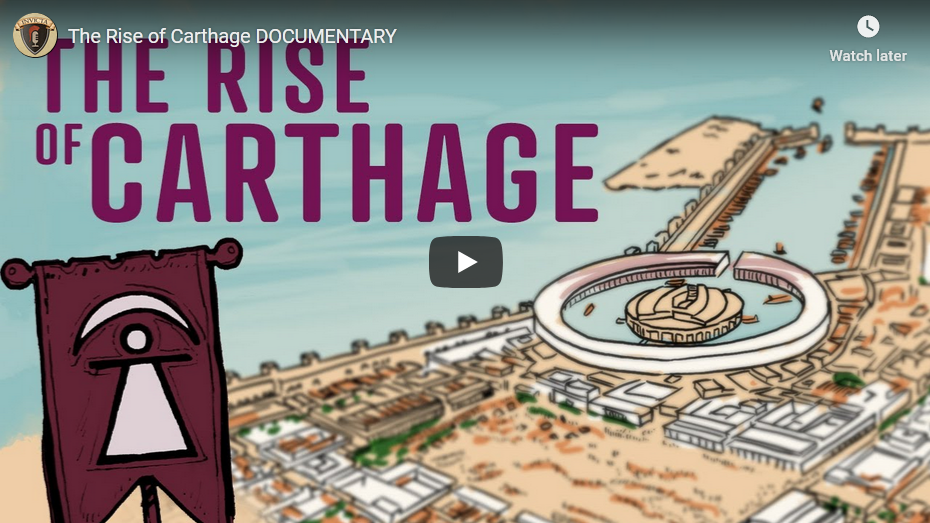
seyfpw6fxuand claim these prizes: GEM 200, Silver Key x2, 50000 Food x2, 50000 Wood x2Today Carthage is remembered only in the context of its dramatic fall at the end of the Punic Wars between Rome and Carthage. We all know about Hannibal and the Battle of Cannae but how about the daily life of Carthage. There is much more to this ancient civilization than the dust and ashes left to us by history. Today we will be exploring the Rise of Carthage and dive into the fascinating details of their civilization.
The history documentary begins by covering the ancient Phoenicians who planted colonies across the Mediterranean. Carthage emerged from this trade network to become the leader of the Phoenicians in the west and eventually come to forge an empire when its mother colony Tyre declined. The history documentary then turns to cover the government, economy, culture, and military of ancient Carthage.
Sources and Suggested Reading:
Carthage: A History by Serge Lancel
The Carthaginians by Dexter Hoyos
Carthage’s Other Wars by Dexter Hoyos
Carthage Must be Destroyed by Richard Miles#History
#Documentary
#Carthage
August 10, 2020
The Rise of Carthage
Russia in Asia (for now)
Ted Campbell looks at some long-frozen geopolitical forces that may become more active in coming years:
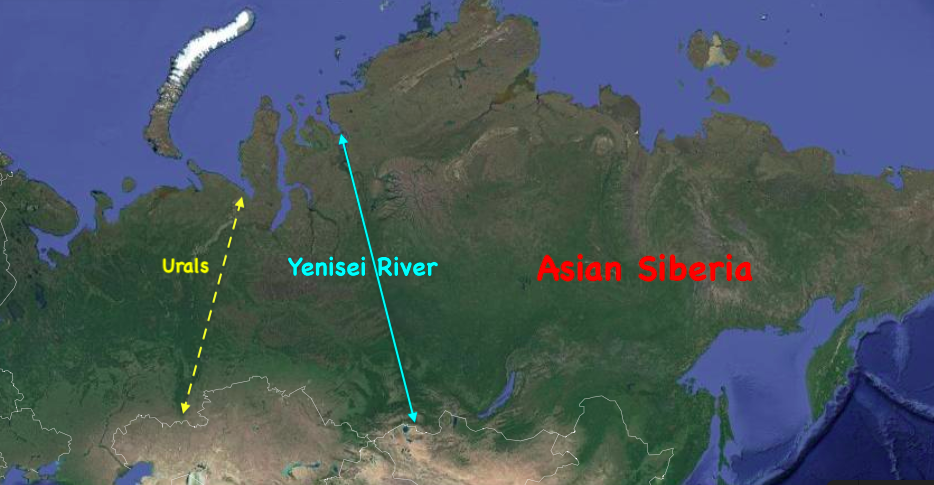
The Jamestown Foundation, which some experts describe as mainly non-partisan and relatively unbiased, has published an interesting article by Paul Goble in which he reminds us that “Russia east of the Urals comprises more than two-thirds of the Russian Federation but has only about one-fifth of that country’s population. It is where most of Russia’s natural resources are to be found, though the earnings from their extraction largely go to Moscow and not to local people. The region is located three to ten time zones east of Moscow and is linked to the center by few roads or rail lines. Its people are far closer to China and other Pacific rim countries — including the United States — than to the core of the Russian Federation. Because of their roots in explorers, those fleeing oppression, and those sent there by the state for punishment, eastern Russians have always been more independent minded and entrepreneurial than Russians in central and western Russia. Perhaps the most important measure of this cultural divide is that Protestant faiths dominate the religious scene there, not the Russian Orthodox Church of the Moscow Patriarchate.”
It is related to something I have been saying for a long time: Siberia (essentially everything East of the Yenisei River (some say everything East of the Urals) is Asia …
… while Russia, per se, is an Eastern European country.
[…]
A few years ago a couple of middle-ranked Chinese officials suggested to me that one of China’s long-term strategic plans was (and I’m guessing still is) to encourage separatist movements in Siberia which, they hoped, will succeed in creating three or four (maybe even five or six) “autonomous” states in Siberia which will, like Mongolia, look, primarily to China for trade and support.
China
covetsneeds the resources, including water, that Siberia has. I have, in the past, forecast a Sino-Russian “Water War” in Siberia. But, speaking broadly and generally, the Chinese don’t like wars: they are expensive and unpredictable. They would much rather play a modest, behind the scenes role in creating a handful of weak, independent Siberian states with which they can trade to their advantage. They do not, I was told, wish to annex Siberia ~ some Chinese feel that the Qing Dynasty (1644 to 1912) went too far when it annexed what is now the Xinjiang Uyghur Autonomous Region (新疆维吾尔自治区) in 18th century.(Tibet is a different matter and most of the Chinese people I know who might wish that Xinjiang was a more autonomous place, more like Kyrgyzstan, for example, believe that Tibetans are Chinese (and Uighurs are not) and Tibet is a “natural” part of China.)
I said a couple of days ago, that “Russia is a pariah state that is flailing about as it withers and dies.” But Putin is flailing about in the wrong directions. The Chinese are, I believe, cultivating and fertilizing Siberian separatist movements with a view to dismembering Russia and “liberating” Siberia. When that happens, and I’m confident that it is NOT an IF, the world will be a much different place.
Donald MacLean: The First of the Cambridge Five
The Cold War
Published 22 Jun 2020Our historical documentary series on the history of the Cold War continues with a video on the famous Cambridge Five and Donald Maclean in particular — a real Cold War-era spy story
Support us on Patreon: https://www.patreon.com/thecoldwar or Paypal: http://paypal.me/TheColdWar
✔ Merch store ► https://teespring.com/stores/thecoldwar
✔ Instagram ► http://www.instagram.com/thecoldwartv#ColdWar #Maclean #CambridgeFive
FDR’s “New Deal” and the Great Depression
The Great Depression began with the collapse of the stock market in 1929 and was made worse by the frantic attempts of President Hoover to fix the problem. Despite the commonly asserted gibe that Hoover tried laissez faire methods to address the economic crisis, he was a dyed-in-the-wool progressive and a life-long control freak (the Smoot-Hawley Tariff Act which devasted world trade was passed in 1930). Franklin D. Roosevelt won the 1932 election by promising to undo Hoover’s economic interventions, yet once in office he turned out to be even more of a control freak than Hoover. His economic and political plans made Hoover’s efforts seem merely a pale shadow.
For newcomers to this issue, “New Deal” is the term used to describe the various policies to expand the size and scope of the federal government adopted by President Franklin Delano Roosevelt (a.k.a., FDR) during the 1930s.
And I’ve previously cited many experts to show that his policies undermined prosperity. Indeed, one of my main complaints is that he doubled down on many of the bad policies adopted by his predecessor, Herbert Hoover.
Let’s revisit the issue today by seeing what some other scholars have written about the New Deal. Let’s start with some analysis from Robert Higgs, a highly regarded economic historian.
… as many observers claimed at the time, the New Deal did prolong the depression. … FDR and Congress, especially during the congressional sessions of 1933 and 1935, embraced interventionist policies on a wide front. With its bewildering, incoherent mass of new expenditures, taxes, subsidies, regulations, and direct government participation in productive activities, the New Deal created so much confusion, fear, uncertainty, and hostility among businessmen and investors that private investment, and hence overall private economic activity, never recovered enough to restore the high levels of production and employment enjoyed in the 1920s. … the American economy between 1930 and 1940 failed to add anything to its capital stock: net private investment for that eleven-year period totaled minus $3.1 billion. Without capital accumulation, no economy can grow. … If demagoguery were a powerful means of creating prosperity, then FDR might have lifted the country out of the depression in short order. But in 1939, ten years after its onset and six years after the commencement of the New Deal, 9.5 million persons, or 17.2 percent of the labor force, remained officially unemployed.
Writing for the American Institute for Economic Research, Professor Vincent Geloso also finds that FDR’s New Deal hurt rather than helped.
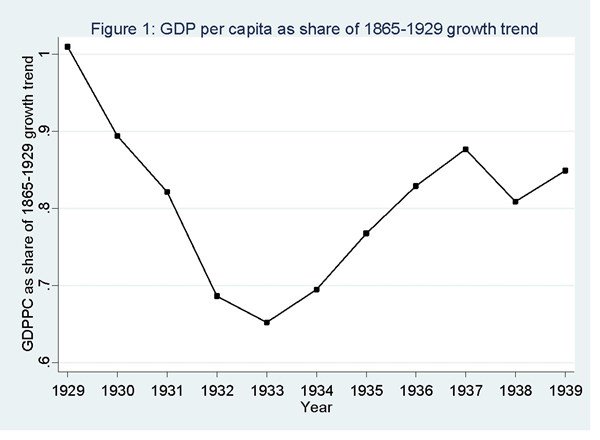
… let us state clearly what is at stake: did the New Deal halt the slump or did it prolong the Great Depression? … The issue that macroeconomists tend to consider is whether the rebound was fast enough to return to the trendline. … The … figure below shows the observed GDP per capita between 1929 and 1939 expressed as the ratio of what GDP per capita would have been like had it continued at the trend of growth between 1865 and 1929. On that graph, a ratio of 1 implies that actual GDP is equal to what the trend line predicts. … As can be seen, by 1939, the United States was nowhere near the trendline. … Most of the economic historians who have written on the topic agree that the recovery was weak by all standards and paled in comparison with what was observed elsewhere. … there is also a wide level of agreement that other policies lengthened the depression. The one to receive the most flak from economic historians is the National Industrial Recovery Act (NIRA). … In essence, it constituted a piece of legislation that encouraged cartelization. By definition, this would reduce output and increase prices. As such, it is often accused of having delayed recovery. … other sets of policies (such as the Agricultural Adjustment Act, the National Labor Relations Act and the National Industrial Recovery Act) … were very probably counterproductive.
Here’s one of the charts from his article, which shows that the economy never recovered lost output during the 1930s.
How to Safely Unload & Clear the Four Most Common Rifles
Forgotten Weapons
Published 10 Sep 2016http://www.armamentresearch.com
This is a basic instructional video on unloading and clearing the four most common types of rifles that will be encountered by journalists, aid workers, and other non-combatants in conflict zones today.
Armament Research Services (ARES) is a specialist technical intelligence consultancy, offering expertise and analysis to a range of government and non-government entities in the arms and munitions field. ARES fills a critical market gap, and offers unique technical support to other actors operating in the sector. Drawing on the extensive experience and broad-ranging skillsets of our staff and contractors, ARES delivers full-spectrum research & analysis, technical review, training, and project support services. Our services are often delivered in support of national, regional, and international initiatives, and can be conducted in both permissive and non-permissive environments.
ARES is an apolitical, policy-neutral organisation, providing technical assessments to legitimate customers. We reserve the right to decline any engagement we deem ethically problematic.
United Nations Global Marketplace (UNGM) number: 358103
QotD: Gandhi’s legacy
Some Indians feel that after the early 1930s, Gandhi, although by now world-famous, was in fact in sharp decline. Did he at least “get the British out of India”? Some say no. India, in the last days of the British Raj, was already largely governed by Indians (a fact one would never suspect from this movie), and it is a common view that without this irrational, wildly erratic holy man the transition to full independence might have gone both more smoothly and more swiftly. There is much evidence that in his last years Gandhi was in a kind of spiritual retreat and, with all his endless praying and fasting, was no longer pursuing (the very words seem strange in a Hindu context) “the public good.” What he was pursuing, in a strict reversion to Hindu tradition, was his personal holiness. In earlier days he had scoffed at the title accorded him, Mahatma (literally “great soul”). But toward the end, during the hideous paroxysms that accompanied independence, with some of the most unspeakable massacres taking place in Calcutta, he declared, “And if … the whole of Calcutta swims in blood, it will not dismay me. For it will be a willing offering of innocent blood.” And in his last days, after there had already been one attempt on his life, he was heard to say, “I am a true Mahatma.”
We can only wonder, furthermore, at a public figure who lectures half his life about the necessity of abolishing modern industry and returning India to its ancient primitiveness, and then picks a Fabian socialist, already drawing up Five-Year Plans, as the country’s first Prime Minister. Audacious as it may seem to contest the views of such heavy thinkers as Margaret Bourke-White, Ralph Nader, and J.K. Galbraith (who found the film’s Gandhi “true to the original” and endorsed the movie wholeheartedly), we have a right to reservations about such a figure as a public man.
I should not be surprised if Gandhi’s greatest real humanitarian achievement was an improvement in the treatment of Untouchables — an area where his efforts were not only assiduous, but actually bore fruit. In this, of course, he ranks well behind the British, who abolished suttee — over ferocious Hindu opposition — in 1829. The ritual immolation by fire of widows on their husbands’ funeral pyres, suttee had the full sanction of the Hindu religion, although it might perhaps be wrong to overrate its importance. Scholars remind us that it was never universal, only “usual.” And there was, after all, a rather extensive range of choice. In southern India the widow was flung into her husband’s fire-pit. In the valley of the Ganges she was placed on the pyre when it was already aflame. In western India, she supported the head of the corpse with her right hand, while, torch in her left, she was allowed the honor of setting the whole thing on fire herself. In the north, where perhaps women were more impious, the widow’s body was constrained on the burning pyre by long poles pressed down by her relatives, just in case, screaming in terror and choking and burning to death, she might forget her dharma. So, yes, ladies, members of the National Council of Churches, believers in the one God, mourners for that holy India before it was despoiled by those brutish British, remember suttee, that interesting, exotic practice in which Hindus, over the centuries, burned to death countless millions of helpless women in a spirit of pious devotion, crying for all I know, Hai Rama! Hai Rama!
Richard Grenier, “The Gandhi Nobody Knows”, Commentary, 1983-03-01.
August 9, 2020
Canadian Art magazine’s “woke suicide pact”
As a cultural barbarian and all-around Neanderthal, it will come as little surprise to both my readers that I’d never even heard of Canadian Art magazine. As a result, the recent decision to cease publication due to the unresolved (and almost certainly unresolvable) issues of needing to be funded by rich white people:
These evils were explained in a long article published by Canadian Art‘s former editor-in-chief, David Balzer (self-described “gay, fag, queer. Ambivalent Libra“), in which he complains that the progressive agenda of the magazine he edited was forever being undercut by the need to solicit funds from wealthy white donors. Or, as he describes it, the pursuit of: “white, liberal money — the champagne socialists.”
Shockingly, these donors are not especially fond an incessant slew of articles with titles such as Drop the Charges and Defund the Police, Says New Artists’ Letter for Black Lives, Give Us Permanence — Ending Anti-Black Racism in Canada’s Art Institutions, and A Crisis of Whiteness in Canada’s Art Museums.
Balzer’s analysis of the growing tension between establishment donor and do-good editor is spot on:
Most boards, which are also majority white, are [interested] in going to where they believe the money is. So the argument goes: It takes a certain talent, panache, to be president, director, or CEO, to open those pocketbooks, and without these skills, culture cannot run. This argument implies that culture cannot run if its backrooms are not white … Many corporate partners make possible the lavish, yearly fundraising galas that cultural organizations host: ostentatious displays of whiteness and wealth that are the public-facing versions of the aforementioned work done by white presidents, directors and CEOs.
It’s a problem that every charity, art outlet, and activist organization in Canada will face. Supporting the arts is rarely an act of pure altruism. It has always been a status flex by the well-connected barons and baronesses of privilege. At its most cynical, arts funding is a high-class game of reputation laundering.
MGB 81, the Spitfire of the Seas | World War II gunboat review | Motor Boat & Yachting
Motor Boat & Yachting
Published 16 Jan 2019We have the immense privilege of getting behind the wheel (and guns) of MGB 81, the Spitfire of the seas.
Filmed by Paul Wyeth: http://www.pwpictures.com/
► For the latest reviews, new gear launches and tour news, visit our website here – http://www.mby.com
►Follow us on Twitter here – https://twitter.com/mbytimeinc
QotD: The economic concept of “revealed preferences”
Economists have a handy term called “revealed preferences”. In colloquial English it means “look at what people do, not what they say, and certainly never take notice of what they say others should do”.
Now, you can’t help but notice that there is a disparity between those who say that taxes should be higher and those who act as if they should be. Clearly, an individual who really believes that the Government is more effective at spending his money would voluntarily offer up more than the legal minimum of taxation. That we have fewer people acting in this manner than are to be found writing columns and making speeches calling for higher taxation shows a certain gap, does it not, between public utterances and private actions? Why, we could make such donations a litmus test for those believers in higher taxation and state spending who want to compel all of us to pay more. Only those who show their commitment by sending a cheque to the Treasury should be treated seriously.
Cheques, by the way, should be made out to “The Accountant, HM Treasury”, and sent to 1 Horse Guards Road, London SW1A 2HQ. A 2nd-class stamp is sufficient and you are encouraged to add a covering note so that your donation is spent in the way you like.
Tim Worstall, “Show us your cheques”, Times of London, quoted in Continental Telegraph, 2020-05-07.
August 8, 2020
Andrew Sullivan – “[T]he Kendi test: does the staff reflect the demographics of New York City as a whole?”
In his latest Weekly Dish, Andrew Sullivan looks at an earnest diversity initiative of The Newspaper Guild of New York:
I’m naming this after Ibram X. Kendi because his core contribution to the current debate on race is the notion that “any measure that produces or sustains racial inequity between racial groups” is racist. Intent is irrelevant. I don’t think many sane people believe A.G. Sulzberger or Dean Baquet are closet bigots. But systemic racism, according to Kendi, exists in any institution if there is simply any outcome that isn’t directly reflective of the relevant racial demographics of the surrounding area.
The appeal of this argument is its simplicity. You can tell if a place is enabling systemic racism merely by counting the people of color in it; and you can tell if a place isn’t by the same rubric. The drawback, of course, is that the world isn’t nearly as simple. Take the actual demographics of New York City. On some measures, the NYT is already a mirror of NYC. Its staff is basically 50 – 50 on sex (with women a slight majority of all staff on the business side, and slight minority in editorial). And it’s 15 percent Asian on the business side, 10 percent in editorial, compared with 13.9 percent of NYC’s population.
But its black percentage of staff — 10 percent in business, 9 percent in editorial — needs more than doubling to reflect demographics. Its Hispanic/Latino staff amount to only 8 percent in business and 5 percent in editorial, compared with 29 percent of New York City’s demographics, the worst discrepancy for any group. NYT’s Newsroom Fellowship, bringing in the very next generation, is 80 percent female, 60 percent people of color (including Asians), and, so far as I can tell, one lone white man. And it’s why NYT‘s new hires are 43 percent people of color, a definition that includes Asian-Americans.
But notice how this new goal obviously doesn’t reflect New York City’s demographics in many other ways. It draws overwhelmingly from the college educated, who account for only 37 percent of New Yorkers, leaving more than 60 percent of the city completed unreflected in the staffing. It cannot include the nearly 19 percent of New Yorkers in poverty, because a NYT salary would end that. It would also have to restrict itself to the literate, and, according to Literacy New York, 25 percent of people in Manhattan “lack basic prose literary skills” along with 37 percent in Brooklyn and 41 percent in the Bronx. And obviously, it cannot reflect the 14 percent of New Yorkers who are of retirement age, or the 21 percent who have yet to reach 18. For that matter, I have no idea what the median age of a NYT employee is — but I bet it isn’t the same as all of New York City.
Around 10 percent of staffers would have to be Republicans (and if the paper of record nationally were to reflect the country as a whole, and not just NYC, around 40 percent would have to be). Some 6 percent of the newsroom would also have to be Haredi or Orthodox Jews — a community you rarely hear about in diversity debates, but one horribly hit by a hate crime surge. 48 percent of NYT employees would have to agree that religion is “very important” in their lives; and 33 percent would be Catholic. And the logic of these demographic quotas is that if a group begins to exceed its quota — say Jews, 13 percent — a Jewish journalist would have to retire for any new one to be hired. Taking this proposal seriously, then, really does require explicit use of race in hiring, which is illegal, which is why the News Guild tweet and memo might end up causing some trouble if the policy is enforced.
And all this leaves the category of “white” completely without nuance. We have no idea whether “white” people are Irish or Italian or Russian or Polish or Canadians in origin. Similarly, we do not know if “black” means African immigrants, or native black New Yorkers, or people from the Caribbean. 37 percent of New Yorkers are foreign-born. How does the Guild propose to mirror that? Ditto where staffers live in NYC. How many are from Staten Island, for example, or the Bronx, two places of extremely different ethnic populations? These categories, in other words, are incredibly crude if the goal really is to reflect the actual demographics of New York City. But it isn’t, of course.
My point is that any attempt to make a specific institution entirely representative of the demographics of its location will founder on the sheer complexity of America’s demographic story and the nature of the institution itself. Journalism, for example, is not a profession sought by most people; it’s self-selecting for curious, trouble-making, querulous assholes who enjoy engaging with others and tracking down the truth (at least it used to be). There’s no reason this skillset or attitude will be spread evenly across populations. It seems, for example, that disproportionate numbers of Jews are drawn to it, from a culture of high literacy, intellectualism, and social activism. So why on earth shouldn’t they be over-represented?
And that’s true of other institutions too: are we to police Broadway to make sure that gays constitute only 4 percent of the employees? Or, say, nursing, to ensure that the sex balance is 50-50? Or a construction company for gender parity? Or a bike messenger company’s staff to be reflective of the age demographics of the city? Just take publishing — an industry not far off what the New York Times does. 74 percent of its employees are women. Should there be a hiring freeze until the men catch up?

The Cold War & Decolonization — History Summarized
Overly Sarcastic Productions
Published 7 Aug 2020Keep safe and stylish with a Red-And-Blue facemask from Volante Design, or DONATE to help students in public schools receive high-quality masks for free — https://bit.ly/2DwE9O7
August of 2020 marks the 75th anniversary of the end of the Second World War. So I wanted to make a video about that. That was a bad idea…
What do you get when a Classically-Minded historian ventures about 2,000 years outside of their comfort zone? A mess. A well-intentioned mess is what you get. BUT a mess that we can learn from! So join me as we dig into the aftermath of the Second World War to analyze the origins of the Cold War and the decolonization of European Empires.
SOURCES & Further Reading: The Cold War by Gaddis, The Wars of French Decolonization by Clayton, British decolonization, 1946-1997 by McIntyre, The Cold War’s Killing Fields by Chamberlin, The Cold War: A Very Short Introduction by McMahon, and “Crash Course European History [Parts 42-47]” by Green.
This video was edited by Sophia Ricciardi AKA “Indigo”. https://www.sophiakricci.com/
Our content is intended for teenage audiences and up.DISCORD: https://discord.gg/kguuvvq
PATREON: https://www.Patreon.com/OSP
MERCH LINKS: https://www.redbubble.com/people/OSPY…
OUR WEBSITE: https://www.OverlySarcasticProductions.com
Find us on Twitter https://www.Twitter.com/OSPYouTube
Find us on Reddit https://www.Reddit.com/r/OSP/
From the comments:
Overly Sarcastic Productions
1 hour ago (edited)
Some clarifications:
North Africa did of course see conflict, the Pacific did get occupied — even the places that didn’t (eg: India) still paid for the war. Damn double-negatives.That weird Romania-Hungary-Russia border is a holdover from WWII. The border lasted until 1946 and was changed in 1947. Later in the video you’ll see the more familiar borders.
Indonesia declared Independence in 1945 (Like Vietnam), but the Netherlands didn’t withdraw until 1949, hence my mention of ’49.
“The show exploits the most extreme disaster LARPers, but their visions of the apocalypse are typical”
Jen Gerson does a bit of disaster-watching, or rather not so much watching disasters as watching people prepping for disasters:
If you spend a few hours devoted to consuming episodes of the reality TV show Doomsday Preppers, it becomes impossible to avoid this obvious conclusion: doomsday preppers are probably the least prepared of any of us to survive the apocalypse.
Take Season 2, Episode 14, for example, in which a 44-year-old man in Hawaii believes that he will use his intuition and limited backcountry skills to survive a tsunami — his first such intuition is to get into a boat.
More typically, the television show documents Middle American families who believe they can buy their way out of society’s collapse by burying bunkers and stockpiling food, weapons and tactical gear.
Most of them seem paranoid. A few come off as genuinely disturbed. All of them seem sad.
Ask them what they’re so afraid of and they will list their apocalypse of choice: electromagnetic pulse, financial collapse, famine, drought, coup, a population-devastating plague.
The show exploits the most extreme disaster LARPers, but their visions of the apocalypse are typical. We were all prepared for zombies, and aliens — the surround-sound end-of-the world in which we would take up arms against invading forces and ferry our children to the bug-out Eden in the mountains.
Nobody pictured the apocalypse would like this; stuck at home for months at a time, pounding Oreos and beer at 11 a.m. and watching Doomsday Preppers on Netflix while faking a work day on the couch. For most, heroism has been an act of idleness.
Tank Chats #77 Jagdtiger | The Tank Museum
The Tank Museum
Published 14 Jun 2019David Willey, Curator at The Tank Museum, presents a Tank Chat on the mighty WW2 German Jagdtiger.
Support the work of The Tank Museum on Patreon: ► https://www.patreon.com/tankmuseum
Visit The Tank Museum SHOP: ► https://tankmuseumshop.org/
Twitter: ► https://twitter.com/TankMuseum
Instagram: ► https://www.instagram.com/tankmuseum/
Tiger Tank Blog: ► http://blog.tiger-tank.com/
Tank 100 First World War Centenary Blog: ► http://tank100.com/ #tankmuseum #tanks #tankchats
QotD: The British Empire
Security empires come and go. While they serve a purpose, their citizens are willing to pay the cost. When they become too expensive to maintain, they simply fold, or get ground under. They work to purpose, or stop.
Conquest empires rarely outlive their founders, or only last a few generations. Alexander’s generals, or Charlemagne’s children and grandchildren, dividing and subdividing into smaller and smaller units, is the norm for such empires. (If not straight collapse when the dictator holding it all together vanishes.)
The only “conquest” empires that have held up are those that send settlers into the lands of hunter-gatherers or nomads. The United States, Russia and Australia being good examples. (But the only reason they can hold up is if the captured territory can be converted into a functional part of the state and society … something the US and Australia have largely managed … Russia’s attempts to enforce this unity by repression of its more developed conquered peoples have not been so successful over the last few centuries, and it is unlikely that China will do much better long-term no matter how much repression it introduces into its recent conquests of established societies like Tibet and the Uyghurs.)
Which leaves only trade empires as potentially successful long term options. And only because their success is not measured by sustaining the political unity of the “empire”, but by sustaining its economic goals.
The most successful empire in world history is the British empire, which could delightedly declare itself obsolete in the 1920s, and again (after having to work mostly co-operatively to fight World War Two) in the 1950s. Both times it encouraged the member states to go look after themselves (some successfully and some less so), and yet it still managed to leave an almost completely secure legacy for its existence … relatively safe international free trade routes. (The almost complete elimination of both piracy and slavery worldwide just being minor side benefits of the British Empire.)
For an empire developed “in a fit of absent mindedness”, and as a byproduct of trying to develop free trade around the world: the measure of success has to be the Commonwealth of Nations – comprising 54 nations with about 1/3 of the world’s population, getting together to play cricket every year and hold a Commonwealth Games every 4 years.
This is not an empire that copllapsed, or was destroyed. This is an empire that over a century or so (from granting independent Dominion status to Canada in 1886 [Canadians stoutly maintain it was 1867], Australia 1901, New Zealand and South Africa pre-Great War, Ireland and Egypt interwar, India and Pakistan post war, large parts of Asia and Africa in the 60s and 70s etc.); nonetheless developed and secured the international free trade system that the world has embraced. (Including a re-integration by an early exit-er from the empire … the 13 out of 35 British north American colonies that became the United States … and who finally inherited the title of world policeman when the rest of the Commonwealth nations had got sick of the whole thing.)
Nigel Davies, “Types of Empires: Security, Conquest, and Trade”, rethinking history, 2020-05-02.