
Rex Krueger
Published 12 Aug 2020A quick and easy guide to making your own sawhorses!
More video and exclusive content: http://www.patreon.com/rexkrueger
Get the Plans!: https://www.rexkrueger.com/store/2d7p…
(more…)
August 13, 2020
Make your own Japanese Saw Horses!
Comments Off on Make your own Japanese Saw Horses!
Hitler’s screen idol – Leni Riefenstahl – WW2 Biography Special
World War Two
Published 12 Aug 2020Leni Riefenstal’s film techniques were groundbreaking and are still influential today. She did, though, create her most famous works in the service of Adolf Hitler.
Join us on Patreon: https://www.patreon.com/TimeGhostHistory
Or join The TimeGhost Army directly at: https://timeghost.tvFollow WW2 day by day on Instagram @World_war_two_realtime https://www.instagram.com/world_war_two_realtime
Between 2 Wars: https://www.youtube.com/playlist?list…
Source list: http://bit.ly/WW2sourcesWritten and Hosted by: Indy Neidell
Director: Astrid Deinhard
Producers: Astrid Deinhard and Spartacus Olsson
Executive Producers: Astrid Deinhard, Indy Neidell, Spartacus Olsson, Bodo Rittenauer
Creative Producer: Joram Appel
Post-Production Director: Wieke Kapteijns
Research by: Madeline Johnson
Edited by: Monika Worona
Sound design: Marek Kamiński
Map animations: Eastory (https://www.youtube.com/c/eastory)Colorizations by:
– Norman Stewart – https://oldtimesincolor.blogspot.com/
– Olga Shirnina, a.k.a. Klimbim – https://klimbim2014.wordpress.com/Sources:
– BundesarchivArchive by Screenocean/Reuters https://www.screenocean.com.
A TimeGhost chronological documentary produced by OnLion Entertainment GmbH.
From the comments:
World War Two
4 hours ago
Thanks to Madeline Johnson for the research for this episode. In many ways it’s our community who keep TimeGhost going. If you want to be part of this then join the TimeGhost Army on www.patreon.com/timeghosthistory or https://timeghost.tv.Please let us know what other Bios you’d like to see. And if you have a question about the war you’re dying to have answered, submit it for our Q&A series, Out of the Foxholes at: https://community.timeghost.tv/c/Out-of-the-Foxholes-Qs.

Comments Off on Hitler’s screen idol – Leni Riefenstahl – WW2 Biography Special
Warsaw, August 1920
Lawrence W. Reed discusses one of the most historically significant battles of the 20th century:
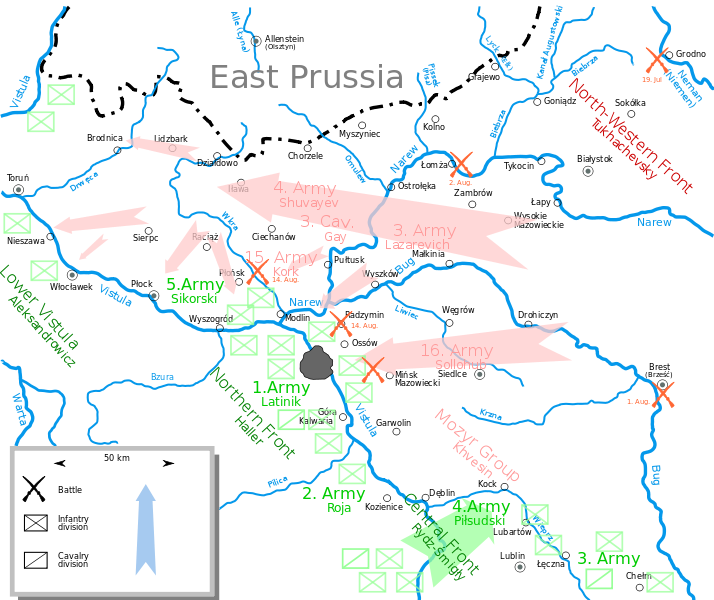
Initial Soviet advances during the Battle of Warsaw, 12 August, 1920.
Map by Halibutt via Wikimedia Commons.
This month marks the 100th anniversary of one of the most important military engagements of the 20th Century. It will be celebrated in Poland, the country which won it decisively. The country which lost it, Vladimir Lenin’s nightmarish gulag known as the Soviet Union, is thankfully extinct. Free people everywhere should be grateful to the Poles for the victory.
From 1795 until 1918, Poland disappeared as Austria, Prussia, and Russia partitioned it into pieces for themselves. Upon its re-emergence as an independent nation (an outcome of World War I), a reconstituted Poland immediately faced an existential challenge from Moscow. Lenin’s Bolsheviks were still consolidating power at home but their territorial appetites were well known to Poles and their new Chief of State, Józef Piłsudski. The fateful Polish-Soviet War broke out in February 1919.
Making war on Poland was more than a local affair to the Soviets. They made it plain that the Poles were simply in the way of their larger goal: exporting communism to the rest of Western Europe. Germany, gripped by post-war economic and political chaos, seemed ripe for a Marxist revolution if only Soviet troops could move in and assist, but Poland would have to be disposed of first.
Nicknamed “the Red Napoleon,” Soviet commander Mikhail Tukhachevsky ordered, “To the West! Over the corpse of Poland lies the road to worldwide conflagration. March upon Vilnius, Minsk, Warsaw and onward to Berlin over the corpse of Poland!” Bolshevik theoretician and Lenin confidant Nikolai Bukharin publicly declared that the campaign would take communist forces “straight to London and Paris.” In a letter to Joseph Stalin, Lenin himself suggested the Red Army should attack Romania, Czechoslovakia, and Hungary for the purpose of provoking a communist revolution in Italy, to which Stalin replied in the affirmative.
Both Tukhachevsky and Bukharin, by the way, were executed during Stalin’s purges in 1938 but they were at Lenin’s side and at the pinnacle of Soviet power in 1920. Lenin died in 1924 and was eventually succeeded by Stalin.
Soviet victories in the summer of 1920 looked unstoppable, as Moscow’s Red Army pushed to within striking distance of the Polish capital. From August 12-25, the Battle of Warsaw raged. Foreign observers expected the imminent collapse of Poland. Then, the tactical brilliance of Pilsudski and his chief of staff Tadeusz Jordan-Rozwadowski plus the legendary courage of Polish fighters combined to produce what Poles call “the Miracle on the Vistula.” Author Michael Peck writes in The National Interest:
Just as all seemed lost, Marshal Pilsudski unleashed his masterstroke, a move worthy of Robert E. Lee or Rommel. While the central Russian armies were fixated on Warsaw, a Polish strike force side-slipped to the south of the city, and then turned north in a left hook into the exposed Russian flank. Surprised, demoralized, and outmaneuvered, the Russian armies disintegrated, with some retreating back to Russia and others fleeing to German territory to be interned. Pilsudski’s counteroffensive was assisted by the breaking of Russian codes, a Polish specialty that they later used to crack the Nazi Enigma machine.

Piłsudski’s attack from the Wieprz river area on August 15, 1920.
Map by Halibutt via Wikimedia Commons.
Comments Off on Warsaw, August 1920
Development of the Luger Automatic Pistol
Forgotten Weapons
Published 31 Oct 2016http://www.patreon.com/ForgottenWeapons
Cool Forgotten Weapons Merch! http://shop.bbtv.com/collections/forg…
Lugers! there are approximately a gazillion different recognized varieties, because the pistol became so popular and iconic. And yet … they all kinda look the same, don’t they? (If you are a Luger collector, don’t answer that!) A great many (I daresay the significant majority) of the Luger variations are minor changes in production details. So, what was involved in the mechanical evolution of the Luger?
Not much, really — which is a testament to the talents of Georg Luger. He got the gun almost totally right on his first try. There are, however, two major variants of the Luger mechanically — the 1900 model and the 1906 model. In this video I will walk through the differences between these two, as well as the initial Borchardt pistol that Luger used as his starting point and a couple other relevant milestones (a Swiss trials gun and a transitional French trials gun). And since they are the most common of the military models, we will also take a quick look at the German Army, Navy, and Artillery models.

Comments Off on Development of the Luger Automatic Pistol
QotD: The discovery of anaesthesia and antisepsis
The first demonstration of the ether gas was performed at Massachusetts General Hospital in October, 1846, by a Boston dentist, William T. G. Morton. For the first time, surgical operations could be performed painlessly. Within two months, the invention was known and being applied in every capital of Europe, and in little more time it became commonplace internationally. The number of surgical operations vastly increased, as it was no longer necessary to hold patients down, and act very quickly.
Joseph Lister first used carbolic acid (phenol) to perform sterile surgery at the Glasgow Royal Infirmary, in August, 1865. This would have the effect of vastly increasing the survival rate from these now commonplace surgical operations. But the news took years to circulate, and by the twentieth century surgeons were still working with infected equipment in filthy environments. Indeed, I have read accounts of the horrors of battlefield medicine in the First World War: men with survivable injuries, lost by the hundred thousands from ignorant, unnecessarily unhygienic medical procedures.
As Dr Gawande points out — in passing — both advances made life easier on patients. But the second saved lives on a — vastly — greater scale. The first was unique, in making life easier for doctors, who no longer had to operate on screaming, writhing customers. This also, incidentally, hugely increased their trade, and thus their income. Washing up, effectively, only added nuisance.
I already knew this history — my mommy was a ward matron, after all — but until the comparison was spelt out, the full significance was lost on me. I had read the “official” versions in several standard medical histories. They assume the slow spread of antisepsis was a problem of communications. Gentle reader will note that this is a lie. Methods of communication did not slow in the generation between the two inventions.
David Warren, “Heaven, Hell, & Alder Hey”, Essays in idleness, 2018-05-09.
Comments Off on QotD: The discovery of anaesthesia and antisepsis
August 12, 2020
CGP Grey was WRONG
CGP Grey
Published 11 Aug 2020‣ What Was TEKOI? (original version): https://www.youtube.com/watch?v=PCeMC…
‣ What Was TEKOI? (corrected version): https://www.youtube.com/watch?v=PCeMCwxayp0
‣ TEKOI Commentary: https://www.youtube.com/watch?v=ufsYK…
## CrowdfundersBob Kunz, John Buchan, Nevin Spoljaric, Donal Botkin, BN-12, Chris Chapin, Richard Jenkins, Phil Gardner, Martin, Steven Grimm, سليمان العقل, David F Watson, Colin Millions, Saki Comandao, Ben Schwab, Jason Lewandowski, Marco Arment, Shantanu Raj, rictic, emptymachine, George Lin, Henry Ng, Thunda Plum, Awoo, David Tyler, Fuesu, iulus, Jordan Earls, Joshua Jamison, Nick Fish, Nick Gibson, Tyler Bryant, Zach Whittle, Oliver Steele, Kermit Norlund, Kevin Costello, Derek Bonner, Derek Jackson, Mikko , Orbit_Junkie, Ron Bowes, Tómas Árni Jónasson, Bryan McLemore, Alex Simonides, Felix Weis, Melvin Sowah, Christopher Mutchler, Giulio Bontadini, Paul Alom, Ryan Tripicchio, Scot Melville, Bear, chrysilis, David Palomares, Emil, Erik Parasiuk, Esteban Santana Santana, Freddi Hørlyck, John Rogers, Leon, Peter Lomax, Rhys Parry, ShiroiYami, Tristan Watts-Willis, Veronica Peshterianu, Dag Viggo Lokøen, John Lee, Maxime Zielony, Julien Dubois, Elizabeth Keathley, Nicholas Welna
## Music
David Rees: http://www.davidreesmusic.com

Comments Off on CGP Grey was WRONG
Defending Sir John A.
In his latest post for The Dominion, Ben Woodfinden attempt to defend that horrible racist, sexist, homophobe, transphobe, non-intersectional, dead, white, cis-gendered male monster, Sir John A. Macdonald:
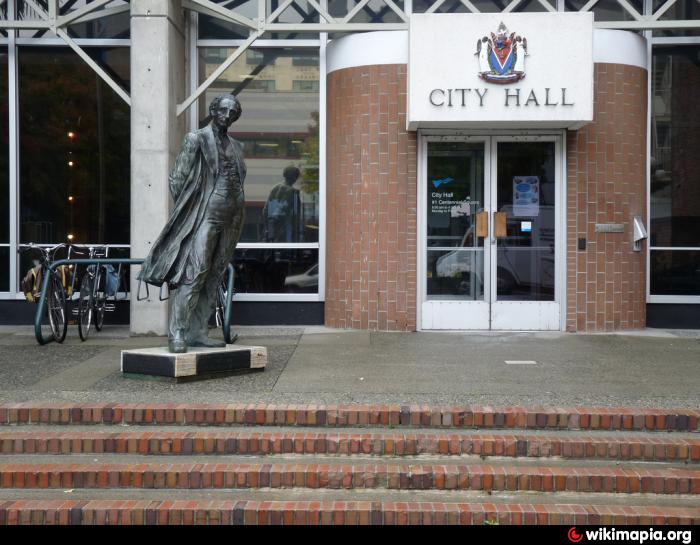
Statue of Sir John A. Macdonald that formerly stood in front of City Hall in Victoria, British Columbia.
Wikimedia Commons.
The way you’re supposed to begin a piece like this is with a sort of penitential act. I should begin a discussion of Sir John A. Macdonald with a confession of his various sins and crimes, before offering an apology, and a reluctant defence of our first prime minister that essentially boils down to “history matters,” without actually explaining what that history is or why it matters.
If you do this you’ve already lost the historical fight, because you’ve willingly ceded the narrative to Macdonald’s detractors, and fallen back to a defence of history in some abstract sense, instead of a defence of Macdonald himself. This kind of Girondin impulse is far too common amongst many liberals and conservatives now, especially in elites institutions and fields like journalism and academia.
[…]
No one, including me, claims that Macdonald was a saint, and Canada’s treatment of Indigenous people and migrants in the early days of Confederation was racist, and wrong. I doubt any serious person would deny this. But even on these questions, Macdonald’s record is complex. Tristin Hopper, wrote an excellent and accessible piece in the National Post simultaneously laying out both the bad things Macdonald was responsible for, and also Macdonald’s paradoxically ahead of his times views on Indigenous voting rights, and recognition of the terrible plight of Indigenous peoples.
But this is only part of the story of Macdonald, and the crucial role he played in our history. Too often this is all that gets discussed, ceding the narrative to Macdonald’s detractors and dooming him to inevitable damnatio memoriae. This is why, in the name of defending our history, we cannot simply defend capital H History, we have to defend the substance of our actual history.
Macdonald’s central role as the key architect of Confederation, and our country, is not well known because Canadian history, especially the history that led to confederation, is not well known by Canadians. It’s a national embarrassment, and in this vacuum it is easy to build incomplete and partial narratives about what Canada is and what Canada means.
Macdonald is best described as “the indispensable politician.” Confederation was not inevitable, it took adept figures like Macdonald to make it happen. Macdonald was not an ideologue, and his political career was defined by his masterful ability to forge coalitions and working compromises between seemingly intractable groups. He was an important political figure in the United Province of Canada (the union of Upper and Lower Canada), and proved adept at balancing and forging coalitions with the warring and disparate factions from Upper and Lower Canada forced into an uncomfortable union. He resisted, but worked and ultimately partnered with uncompromising reformers in the province like George Brown, while ultimately laying the groundworks for constitutional reform that Brown, though principled, could almost certainly never have achieved.
Comments Off on Defending Sir John A.
I Bet You Don’t Know At Least ONE Of These Blue Tape Tricks
Inspire Woodcraft
Published 29 Jan 2019What CAN”T this stuff be used for? Today we’re talking thirteen ways to make blue painters tape do more work for you in the shop.
TOOLS SPECIFIC TO THIS VIDEO:
My Favorite Blue Tape (Single Roll)- https://amzn.to/3e5GFc6
Blue Tape SIX-PACK (I personally buy it like this because it’s less expensive overall)- https://amzn.to/2Rcja7iALL MY HAND TOOLS, POWER TOOLS, CAMERA GEAR AND MORE:
https://www.amazon.com/shop/inspirewo…

Comments Off on I Bet You Don’t Know At Least ONE Of These Blue Tape Tricks
QotD: The circle of recycled life
2. As soon as they are completed millions of these colorful and compelling 100% recyclable advertising supplements are shipped by truck to the various regional receiving centers of the U.S. Post Office.
3. From those centers, any number of allocated pallets of these colorful and compelling 100% recyclable advertising supplements are broken out, put on U.S. Post Office trucks and delivered to local postal carrier destinations inside northern California.
4. My personal Paradise postal carrier and hundreds of others report for work at local postal carrier centers throughout northern California and load up their vans with enough of these colorful and compelling 100% recyclable advertising supplements to deliver one or more to each and every house on their route.
5. My very polite personal Paradise postal carrier parks her van at the end of my block and loads her sack with these colorful and compelling 100% recyclable advertising supplements.
6. She comes up my walk, up the porch stairs, and deposits my full share of these colorful and compelling 100% recyclable advertising supplements into my mailbox with a clang every day between one and three in the afternoon.
7. Hearing the clang I sigh and wend my weary way to the front door and open my mailbox and pluck out said colorful and compelling 100% recyclable advertising supplements.
8. With a heavier sigh I go back in, trudge through my house, out my back door to the alley, and place the colorful and compelling 100% recyclable advertising supplements into my Recycling bin with the rest of the week’s mound.
9. Tomorrow the huge, lumbering Paradise Waste Management Recycling garbage truck will stop and empty my Recycling bin into its maw and haul all the colorful and compelling 100% recyclable advertising supplements off to the Chico California Recycling and Brand New Mountain of Garbage center.
10. The collected colorful and compelling 100% recyclable advertising supplements will then be shipped, by truck, to the center for turning recyclable paper into … recycled paper which will then be used by a concerned and responsible corporation for their twice-weekly colorful and compelling advertising supplements printed on 100% recycled paper.
Wash. Rinse. Repeat. Next year, as sure as spring brings septic system failures to Paradise, postage will increase because the U.S. Postal Colorful and compelling 100% recyclable advertising supplements “Service” will need more money to keep The Recycled Circle of life going.
Gerard VanderLeun, “The Circle of Recycled Life”, American Digest, 2018-06-01.
Comments Off on QotD: The circle of recycled life
August 11, 2020
The Vanishing Aral Sea
The History Guy: History Deserves to Be Remembered
Published 22 May 2017The History Guy examines the Aral Sea and the confluence of geography and history.
The History Guy uses images that are in the Public Domain. As photographs of actual events are often not available, I will sometimes use photographs of similar events or objects for illustration.
Patreon: https://www.patreon.com/TheHistoryGuy
The History Guy: Five Minutes of History is the place to find short snippets of forgotten history from five to fifteen minutes long. If you like history too, this is the channel for you.
Awesome The History Guy merchandise is available at:
teespring.com/stores/the-history-guyThe episode is intended for educational purposes. All events are presented in historical context.
#history #thehistoryguy #worldhistory

Comments Off on The Vanishing Aral Sea
David Warren offers an unusually contrarian view of the Bronze Age collapse
Sea Peoples? Faugh, Mr. Warren isn’t buying any of that old rope. It wasn’t earthquakes, famine, plagues, or even multiple waves of heavily armed undocumented immigrants landing on the shores … it was mere “progress”:
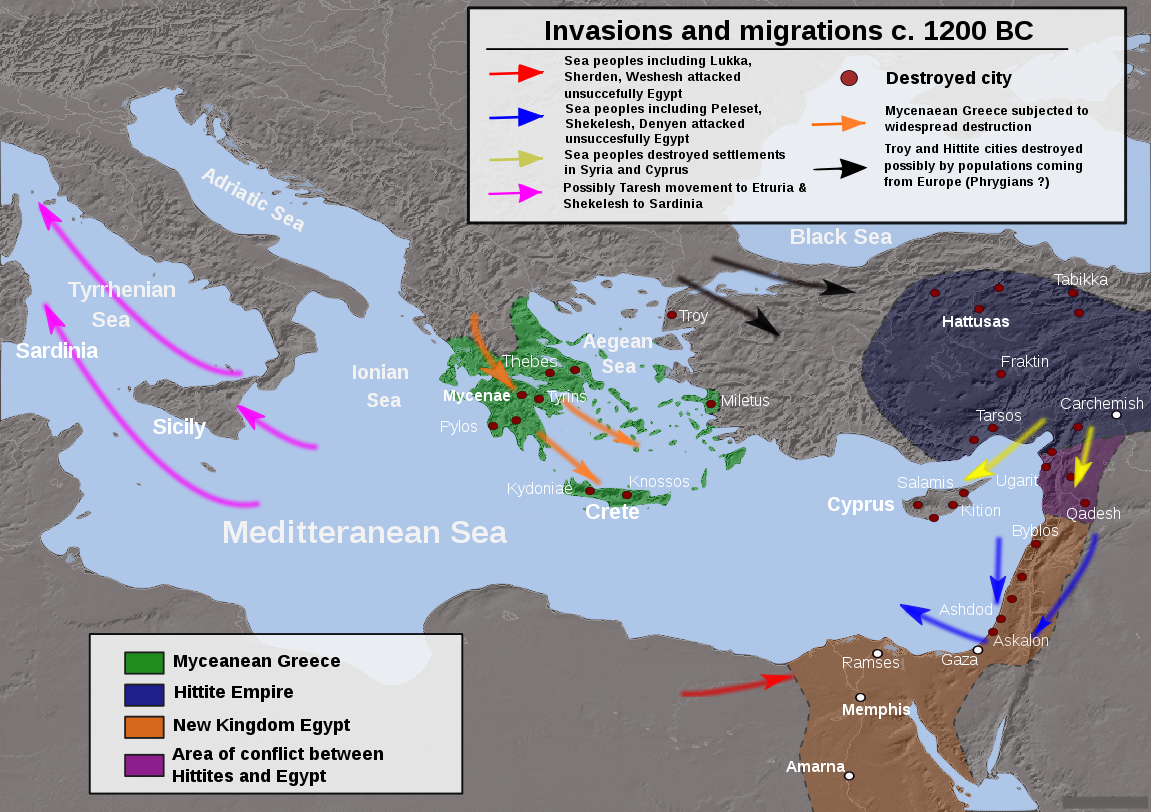
Migrations, invasions and destructions during the end of the Bronze Age (c. 1200 BC), based on public domain information from DEMIS Mapserver.
Map by Alexikoua via Wikimedia Commons.
When did the Bronze Age end, and the Iron Age begin? The ages of plastic, silicon, and graphene may have succeeded even the latter, but I’m still not comfortable with iron. Neither were the Cypriots, nor the Egyptians, incidentally — some thirty-something centuries back. Before even that, iron was freely available in a globalized world. I once took a modified fishing boat from Cyprus to Mersin; I wouldn’t encourage swimming it. But the voyage is not far, and too quick with a motor. Even in a row boat, it would have been easy to smuggle ferrous materials, either way.
Yet for centuries, such “highly sophisticated” societies as those of Cyprus and Egypt, stuck with copper and bronze; with gold and silver adornments. The rest of the world might have been with the progressive agenda, but they were not. I speculate that they didn’t like the way iron rusts; there’s something cheap about it. But whatever the objection, they stood their ground. There are old iron objects to be found in both places, but few.
Much later, when the “lifestyle” advocates for the new fashionable metal had won out, and the tide of iron was flooding, it is interesting that the craftsmanship of objects is relaxed. Even ceramics become dull, boring, repetitious; skills are forgotten. We have craftsmen who obviously don’t give a damn any more, just like today. We have the encroaching realm of “productivity,” quantity. Soon these places are easy to knock over, by the conquering savages always lurking about.
We have conservative societies, overwhelmed by technology; and no longer trading on their own terms. In the larger Minoan sphere, we have barbarization. Dynastic Egypt will survive only in Coptic fragments. Greeks, Romans, and finally Arabs will be trashing the place. Ancient civilizations fall.
I regret “progress.” We should resist it heart and soul.
Egypt’s Colonial and Zionist Troubles | The Suez Crisis | Prelude 1
TimeGhost History
Published 10 Aug 2020Recently independent Egypt, under President Gamal Abdel Nasser, navigates the turbulent waters of the Cold War, seeking national autonomy, while negotiating its relations with the British Empire, United States, and the Soviet Union. The question is, how will Egypt realize its self-determination with these powers vying for dominance in the region?
Join us on Patreon: https://www.patreon.com/TimeGhostHistory
Hosted by: Indy Neidell
Written by: Joram Appel and Francis van Berkel
Director: Astrid Deinhard
Producers: Astrid Deinhard and Spartacus Olsson
Executive Producers: Astrid Deinhard, Indy Neidell, Spartacus Olsson, Bodo Rittenauer
Creative Producer: Joram Appel
Post-Production Director: Wieke Kapteijns
Research by: Joram Appel
Image Research: Ian Irungu, Shaun Harrison & Karolina Dołęga
Edited by: Karolina Dołęga
Sound design: Marek KamińskiColorizations:
Mikolaj UchmanVisual Sources:
National Archives NARA
Library of Congress Geography and Maps Department
Tropenmuseum
Wellcome Images
National Army Museum of New Zealand
Imperial War Museum: HU70788,
National Photo Collection of Israel
Fortepan – ID 32790
Bibliotheca AlexandrinaMusic:
“Descending Mount Everest” – Trailer Worx
“Dreamless Nights” – The New Fools
“March Of The Brave 10” – Rannar Sillard
“Break Free” – Fabien Tell
“The Unexplored” – Philip Ayers
“It’s Not a Game” – Philip Ayers
“Foreign Signs” – Philip AyersArchive by Screenocean/Reuters https://www.screenocean.com.
A TimeGhost chronological documentary produced by OnLion Entertainment GmbH.
From the comments:
TimeGhost History
1 hour ago (edited)
Welcome to the first episode of our series on the Suez Crisis! It’s a 7-episode wild ride through secretive international collusion, clashing nations, and imperial anxieties. It’s a watershed moment in a variety of entangled histories: decolonization, the Arab-Israel Conflict, the rise of America as a superpower, the growing power of the UN, and much much more. It’s a lot to take in, but we hope that we’ve made this series as digestible (and enjoyable!) as possible. Thanks to our TimeGhost Army members for choosing this series. Want to be part of the effort that makes stuff like this happen? Join us at patreon.com/timeghosthistory or https://timeghost.tv.Cheers,
Francis.
Comments Off on Egypt’s Colonial and Zionist Troubles | The Suez Crisis | Prelude 1
Orwell’s “Notes on Nationalism”
In Quillette, Adam Wakeling discusses George Orwell’s essay in the postwar magazine Polemic:
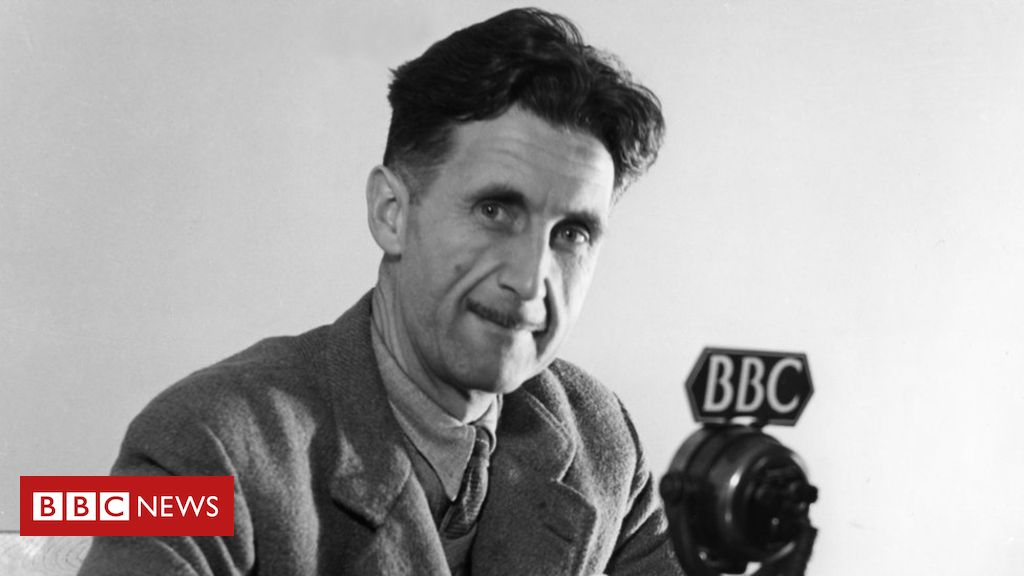
In the bleak post-war Britain of October 1945, an essay by George Orwell appeared in the first edition of Polemic. Edited by abstract artist and ex-Communist Hugh Slater, the new journal was marketed as a “magazine of philosophy, psychology, and aesthetics.” Orwell was not yet famous — Animal Farm had only just started appearing on shelves — but he had a high enough profile for his name to be a boon to a new publication. His contribution to the October 1945 Polemic was “Notes on Nationalism,” one of his best and most important pieces of writing. Amidst the de-Nazification of Germany, the alarmingly rapid slide into the Cold War, and the trials of German and Japanese war criminals, Orwell set out to answer a question which had occupied his mind for most of the past seven years — why do otherwise rational people embrace irrational or even contradictory beliefs about politics?
As a junior colonial official in Burma, the young Eric Blair (he had not yet adopted the name by which he would be known to posterity) had been disgusted by his peers and superiors talking up the British liberty of Magna Carta and Rule Britannia while excusing acts of repression like the massacre of Indian protestors at Amritsar in 1919. As a committed socialist in the late 1930s, he openly ridiculed those who claimed to be champions of the working class while holding actual working-class people in open contempt. And he had watched the British Communist Party insist that the Second World War was nothing more than an imperialist adventure right up until the moment when the first German soldier crossed the Soviet frontier, at which point it instantly became a noble struggle for human freedom.
Orwell’s most personally searing experience, though, had come in Barcelona in 1937. The previous year, he had travelled to Spain to fight in the Civil War on the Republican side. His poor relationship with the British Communist Party led him to enlist in the militia of an anti-Stalinist socialist party, the POUM (Partido Obrero de Unificación Marxista, or Workers’ Party of Marxist Unification). Even while it was fighting a bitter winter campaign in the Aragon mountains, the POUM was subject to a relentless propaganda campaign by pro-Soviet Republicans who insisted it was a secret front for fascism.
Over May and June 1937, the POUM and the other independent left-wing organisations in Barcelona were brutally suppressed by the Republican Government and Soviet-backed Communists. Orwell saw his friends and comrades smeared, arrested, and in some cases shot. He only made a narrow escape back into France himself. Upon his return to Britain, he found the British Communist Party resolute in its line that the POUM was a fascist party. Admitting that there could be a difference of opinion among left-wing groups with respect to the Soviet Union, or that the Spanish Communists could have acted unjustly, was unacceptable. And when Orwell published his own account of the events in Spain, Homage to Catalonia, few were interested in reading it. The betrayal of the POUM weighed on Orwell’s mind through the Second World War, and Animal Farm provided an outlet for his anger. But those bloody spring days in Barcelona also informed “Notes on Nationalism.”
“Notes on Nationalism” is not an ideal title, as Orwell was not talking only about loyalty to country. Rather, he used nationalism as a short-hand for any type of group loyalty — to a country, but also to a religion, a political party, or an ideology itself. A nationalist may be defined by his membership of a group, or by his opposition to one, which Orwell called “negative” nationalism. Orwell used anti-Semites as an example of the latter, as well as the “minority of intellectual pacifists whose real though unadmitted motive appears to be hatred of Western democracy and admiration of totalitarianism.” He then set out to explain how everyone — no matter how reasoned and level-headed — is capable of irrational and biased thinking when our sense of group identity is challenged.
He identified three characteristics of “‘nationalistic’ thinking.” First, obsession — the ideologue’s need to filter everything through an ideological lens. Entertainment is not entertaining unless it is orthodox. Second, instability — the ability of the ideologue to go from believing one thing to quickly believing another to follow the party line. And thirdly, indifference to reality. One of the most interesting aspects of “Notes on Nationalism” is the “inadmissible fact” — something which can be proven to be true and is generally accepted but cannot be admitted by the adherents of a particular ideology. Or, if the fact is admitted, it is explained away or dismissed as unimportant.
The ideas explored in “Notes on Nationalism” run through much of Orwell’s writing, most obviously his anti-totalitarianism and hatred of hypocritical pieties. But central to his argument is how nationalistic thinking exposes our inescapable biases. “The Liberal News Chronicle,” he wrote, “published, as an example of shocking barbarity, photographs of Russians hanged by the Germans, and then a year or two later published with warm approval almost exactly similar photographs of Germans hanged by the Russians.” This anticipated the doublethink of Nineteen Eighty-Four, in which atrocities “are looked upon as normal, and, when they are committed by one’s own side and not by the enemy, meritorious.” The first step down the deceptively short road to totalitarianism is believing that our political enemies pose such a grave threat that defeating them takes precedence over truth, consistency, or common sense.
Comments Off on Orwell’s “Notes on Nationalism”
Napoleon’s greatest foe
Lindybeige
Published 18 Jan 2018Support me on Patreon: https://www.patreon.com/Lindybeige
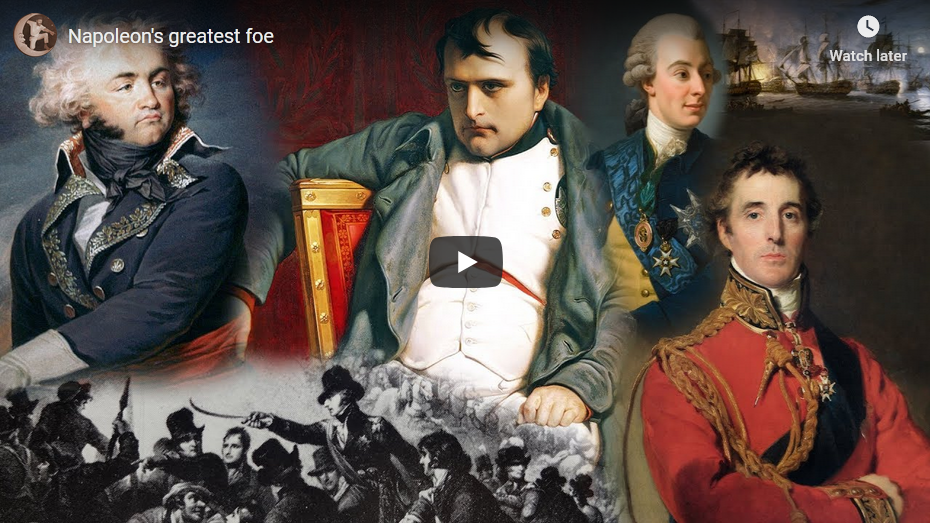
Possibly I did too much research for this one. Trying to stay on-topic when the subject is so vast and so interesting was not easy, hence the rather long video. I didn’t mean to say quite so much about what an utter £$%&*! Napoleon was, but he was so thoroughly vile that it proved impossible not to include some details about the man who won his promotion in the army by mowing down civilian protesters in the streets of Paris with grapeshot from his artillery batteries. Anyway, here are tales of bravery and virtue, as well as horrendous some of brutality, lies, and death.
Correction: The battle against the Russian fleet is called Svensksund (Swedish sound, as in channel), not Svenksund. I missed out an S in my haste.
Buy the music – the music played at the end of my videos is now available here: https://lindybeige.bandcamp.com/track…
Lindybeige: a channel of archaeology, ancient and medieval warfare, rants, swing dance, travelogues, evolution, and whatever else occurs to me to make.
▼ Follow me…
Twitter: https://twitter.com/Lindybeige I may have some drivel to contribute to the Twittersphere, plus you get notice of uploads.
website: http://www.LloydianAspects.co.uk
Comments Off on Napoleon’s greatest foe
QotD: Our culture shapes what we can see
I have a little more insight into how culture shapes what’s possible to think, because I changed my culture as an adult. While this can be done (obviously) and immigrants should be encouraged to do it, (or go home), the acculturation is never complete. What happens is that you acquire a sort of cultural double vision. Depending on how far your acculturation goes, you’ll see the defects in thought or at least the unquestioned assumptions in one of the countries better, but also have a strong feeling of being outside enough to see some flaws in your dominant culture. In my case, for instance, I see the flaws in Portugal very clearly, like the obsession with speed over diligence or being decisive over being right, but I still see some in the US which is why sometimes I say “what people born and raised here don’t see.”
I have, of course, even more insight, due to being a conservative in the US, in a culture and profession (the arts/publishing) that is not only majority left, but majority extreme left. For many years, the only way to stay at least plausibly under cover was to see what they were seeing, and what they expected.
But without that, most people are blind to the … ah, unconscious or unthinking parts of their culture. Heck, even with what I’ve been through, I still tend to accept a lot of things unconsciously, unless I step back and go “Now wait a minute.”
Sarah Hoyt, “Slouching Into Shackles”, According to Hoyt, 2018-04-27.
Comments Off on QotD: Our culture shapes what we can see


