World War Two
Published 6 Aug 2020George Orwell is one of the most famous English writers in the modern age. But how did he become the man who would coin so many of the words we still use in our political debates?
Join us on Patreon: https://www.patreon.com/TimeGhostHistory
Or join The TimeGhost Army directly at: https://timeghost.tvFollow WW2 day by day on Instagram @World_war_two_realtime https://www.instagram.com/world_war_two_realtime
Between 2 Wars: https://www.youtube.com/playlist?list…
Source list: http://bit.ly/WW2sourcesHosted by: Indy Neidell
Written by: Rune Væver Hartvig
Director: Astrid Deinhard
Producers: Astrid Deinhard and Spartacus Olsson
Executive Producers: Astrid Deinhard, Indy Neidell, Spartacus Olsson, Bodo Rittenauer
Creative Producer: Joram Appel
Post-Production Director: Wieke Kapteijns
Research by: Rune Væver Hartvig
Edited by: Mikołaj Cackowski
Sound design: Marek Kamiński
Map animations: Eastory (https://www.youtube.com/c/eastory)Colorizations by:
Cassowary https://www.flickr.com/photos/cassowa…
Klimbim https://www.flickr.com/photos/2215569…Sources:
Wellcome Images V0014461
Bundesarchiv
Narodowe Archiwum Cyfrowe
From the Noun Project: Pig by supalerk laipawat, Horse by supalerk laipawat, Goat by Laymik, Sheep by Laymik, Cow by supalerk laipawat, Chicken by supalerk laipawat, Farmer by Symbolon, Podium by Focus LabSoundtracks from the Epidemic Sound:
Howard Harper-Barnes – “London”
Johannes Bornlof – “Deviation In Time”
Johannes Bornlof – “The Inspector 4”
Skrya – “First Responders”
Jo Wandrini – “Puzzle Of Complexity”Archive by Screenocean/Reuters https://www.screenocean.com.
A TimeGhost chronological documentary produced by OnLion Entertainment GmbH.
August 7, 2020
From Medieval Letters Patent to our modern patents, by way of Venice
In the latest Age of Invention newsletter, Anton Howes traces the lines of descent from the Letters patent of the Middle Ages, through Venetian legal innovations, to what began to resemble our modern patent system:

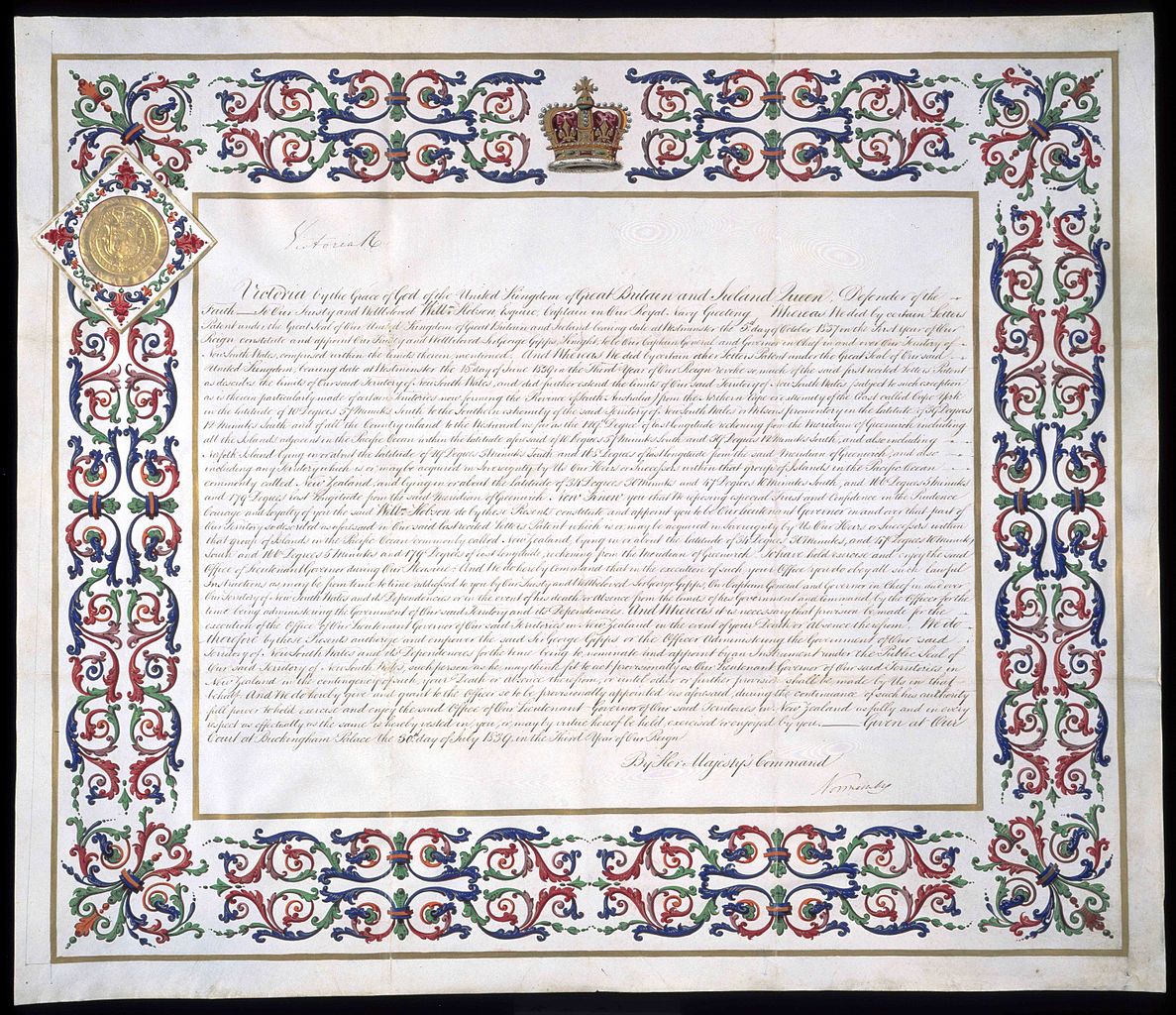
Letters Patent Issued by Queen Victoria, 1839
On 15 June 1839 Captain William Hobson was officially appointed by Queen Victoria to be Lieutenant Governor General of New Zealand. Hobson (1792 – 1842) was thus the first Governor of New Zealand. This position was renamed in 1907 as “Governor General”. Hobson arrived in New Zealand in late January 1840, and oversaw the signing of te Tiriti o Waitangi only a few days later. By the end of 1840, New Zealand became a colony in its own right and Hobson moved the capital of the colony from the Bay of Islands to Auckland. He served as Governor until his death in 1842 after he suffered a stroke at the age of 49.
Constitutional Records group of Archives NZ via Wikimedia Commons.
Patents for invention — temporary monopolies on the use of new technologies — are frequently cited as a key contributor to the British Industrial Revolution. But where did they come from? We typically talk about them as formal institutions, imposed from above by supposedly wise rulers. But their origins, or at least their introduction to England, tell a very different story.
England’s monarchs had long used their prerogative powers to grant special dispensations by letters patent — that is, orders from the monarch that were open for all the public to see (think of the word patently, from the same root, which means openly or clearly). For the most part, such public proclamations had been used to grant titles of nobility, or to appoint people to positions in various official hierarchies — legal, religious, and governmental. And, of course, letters patent could be used to promote the introduction of new technologies.
[…]
Monopolies in general, of course, over particular trades or industries had been granted for centuries, by rulers all across Europe. They granted such privileges to groups of merchants, artisans, and city-dwellers, giving them rights to organise and regulate their own activities as guilds or as city corporations. Inherent to all such charters was the ability of the in-group to restrict competition from outsiders, at least within the confines of their city. And the ruler, in exchange for granting such privileges, typically received a share of the guild’s or corporation’s revenues. But such monopolies were very rarely given to individuals. When they were, it was often so unpopular as to be almost immediately overturned. And they were rarely used to encourage innovation.
With one exception: Italy. Throughout the fifteenth century, some Italian city guilds had begun to forbid their members from copying newly-invented patterns for silk and woollen cloth, effectively granting a monopoly over those patterns to the individual inventors. In Venice, a 50-year monopoly was granted in 1416 to one Franciscus Petri, of Rhodes, to introduce superior fulling mills. In Florence, the famous architect and engineer Filippo Brunelleschi was granted a monopoly in 1421 for a vessel he designed for transporting heavy loads of marble, in exchange for revealing the secrets of his design. The printing press was also introduced to Venice using such a privilege, with a 5-year monopoly granted in 1469 to Johannes of Speyer, though he died only a few months after receiving it. And these ad hoc grants were made with increasing frequency, such that in 1474 Venice legislated to make them more systematic, declaring that 10-year monopolies could be obtained for all new technologies, either invented or imported (though it continued to also grant ad hoc patents, with the terms and durations decided on a case-by-case basis as before). Under the 1474 law, Venice was soon granting patent monopolies to the introducers of various mills, pumps, dredges, textile machines, printing techniques, and even special kinds of lasagna. It granted over a hundred patents in the first half of the sixteenth century, with many more thereafter.
From Venice, the use of patent monopolies as an instrument of policy spread abroad, with the initiative coming from the would-be introducers of novelties themselves. In the mid-fifteenth century, for example, a French inventor who had acquired patents in Venice was also successfully lobbying for similar privileges from the archbishop of Salzburg, the duke of Ferrara, and the Hapsburg Holy Roman Emperor. The use of patent monopolies thus soon diffused to the rest of Italy, to Germany, and to the various dominions of the Spanish emperor — including Spain itself, its American colonies, and the Low Countries.
And, eventually, to England. But not in the way we might expect. In 1496, the Venetian explorer Zuan Chabotto (aka John Cabot) acquired a patent monopoly from Henry VII over the trade and products of any lands he was to discover — a legal procedure unlike anything that earlier English explorers had attempted (they had merely been granted licenses). Cabot’s grant even differed from the agreements made by Christopher Columbus with the Spanish crown, or by earlier explorers for the Portuguese. Columbus, for example, was effectively granted a patent of nobility — the hereditary titles of viceroy, admiral, and governor. He and the Portuguese explorers were direct agents of the crown, with military and justice-dispensing responsibilities over any newly conquered lands — a model derived from the Christian conquests of Muslim Iberia. Columbus effectively became a marcher lord, a custodian and defender of Spain’s new borderlands.

“40:1” Pt. 2 – Another Polish Last Stand – Sabaton History 079 [Official]
Sabaton History
Published 6 Aug 2020At the end of September 1939, Poland was burning. Trapped in an ever shrinking corridor between the Wehrmacht and the Red Army, the last remaining Polish forces were still holding out. Isolated, short of ammunition and supplies, and without hope for relief. The last Polish Army, the SGO Polesie, was making its way towards the Vistula, as it was cut off by German motorcycle troops. Determined to sell their lives dearly, the SGO Polesie dug in and prepared for a last stand.
Support Sabaton History on Patreon: https://www.patreon.com/sabatonhistory
Listen to “40:1” from the album The Art Of War:
https://music.sabaton.net/TheArtOfWarWatch the Official Music Video of “40:1” here:
https://www.youtube.com/watch?v=epeQw…Listen to Sabaton on Spotify: http://smarturl.it/SabatonSpotify
Official Sabaton Merchandise Shop: http://bit.ly/SabatonOfficialShopHosted by: Indy Neidell
Written by: Markus Linke and Indy Neidell
Directed by: Astrid Deinhard and Wieke Kapteijns
Produced by: Pär Sundström, Astrid Deinhard and Spartacus Olsson
Creative Producer: Joram Appel
Community Manager: Maria Kyhle
Executive Producers: Pär Sundström, Joakim Broden, Tomas Sunmo, Indy Neidell, Astrid Deinhard, and Spartacus Olsson
Post-Production Director: Wieke Kapteijns
Edited by: Karolina Dołęga
Sound Editing by: Marek Kaminski
Maps by: Eastory – https://www.youtube.com/c/eastory
Archive by: Reuters/Screenocean https://www.screenocean.com
Music by Sabaton.Sources:
Paul Otto courtesy Glenn Jewison
University of Wisconsin-Milwaukee Libraries
Bundesarchiv
Imperial War Museums: HU106375
Museum of Warsaw
Narodowe Archiwum Cyfrowe
Centralne Archiwum WojskoweAn OnLion Entertainment GmbH and Raging Beaver Publishing AB co-Production.
© Raging Beaver Publishing AB, 2019 – all rights reserved.
From the comments:
Sabaton History
2 days ago (edited)
Once again the time has come for the Polish people to show what they’re made of.This time they’re facing a gargantuan two-headed monster of an enemy and are outnumbered many many times over.
They may not win, they may not even live to see another day — but The Polish will not give up without giving their all.
Spirit of Spartans
Death and glory
Soldiers of Poland
Second to noneSo come, bring on all that you’ve got
Come hell, come high water — never stop!With the help of Indy and the TimeGhost team you can learn more about the Soviet invasion of Poland and the last days of The Polish Defensive War in these two episodes of the “World War Two In Real Time” series:
“The Russians are Coming! – The Soviet Invasion of Poland” – WW2 – 004 – September 22, 1939
https://youtu.be/8vjBp-qyNVE“Poland is Crushed” – WW2 – 005 – 29 September, 1939
https://youtu.be/OOPiUaakSXM
Aftermath of the Beirut explosion
Kareem Shaheen, who lived and worked in Beirut for some years, reports on the devastation and the ongoing debate over causes and responsibility:

Part of a photo gallery posted by CNN shows the site of the explosion in Beirut harbour. Note the massive grain elevator structure has been partly demolished, but the buildings on the other side almost certainly suffered far less damage for being in the blast shadow of such a massive concrete shield.
Photo gallery – https://www.cnn.com/2020/08/05/world/satellite-images-beirut-explosion-before-after-trnd/index.html
The Lebanese prime minister and security officials said the explosion was likely caused by a 2,700 tons of highly explosive ammonium nitrate that had been abandoned in the port. By comparison, the Oklahoma City bombing was about 2.2 tons of the same substance.
Reports indicate that the ammonium nitrate had been seized years ago, and knowing Lebanon, it was left there either out of negligence, or because the self-interested ruling classes of the country — a mafia in its own right — could not agree on how to divvy up the profits from the stuff.
Naturally, America’s arsonist and conspiracy theorist in chief, Donald Trump, speculated in a press conference that the explosion looked like a bomb. His generals told journalists, anonymously, that they had no idea what he was talking about.
But in a country already on the verge of collapse, the damage of this speculation was done. Conspiracy theories are now rampant.
Donald Trump’s comment may have been ill-informed, but the conspiracy theorists — along with anyone who thinks they know anything about explosives — were busy spinning pet theories regardless of what he said.
One that made the rounds seized on a tweet by Israeli Prime Minister Benjamin Netanyahu about a raid on pro-Iranian targets in Syria, and linked it to the Beirut explosion. The terrible size of the explosion prompted fears that it was a tactical nuclear strike. Independent Arabia — which licenses the British Independent newspaper brand and is owned by a Saudi Arabian publisher — reported, falsely, that the Canadian embassy said that the explosion’s fallout contained depleted uranium. Another media organization linked to the Lebanese president’s party claimed the explosive material was bound for terrorist groups in Syria.
The explosion could not have come at a worse time. Even before the blast, Lebanon was a failed state. Over most of the past year, it has suffered hyperinflation akin to the crisis in Venezuela.
Lebanon endured a 15-year civil war that ended in 1990 with an accord that divided power equally among its various religions and sects, while ensuring no accountability for the warlords who reigned over militias that carried out atrocities.
Many of these warlords, or their sons, are still in charge, and have built corrupt patronage networks to enrich themselves and their loyalists. Most are beholden to outside powers like Iran and Saudi Arabia, who have turned Lebanon into a proxy battleground for their own geopolitical interests. The most powerful military force in the country is Hezbollah, Iran’s favoured proxy militia, which was instrumental in keeping Syria’s dictator, Bashar Al-Assad, in power. The war drove a million Syrians to seek refuge in Lebanon, which had a pre-war population of just four million.
Myth and Reality of the Ross MkIII Rifle
Forgotten Weapons
Published 16 Jun 2013There is a long-standing urban legend about the Canadian Ross rifle, a straight-pull bolt action that was used in lieu of the SMLE by Canadian troops early in World War One. The story is that the Ross would sometimes malfunction and blow the bolt back into its shooter’s face, with pretty horrible results. Well, I wanted to learn “the rest of the story” — could this actually happen? What caused it? How could it be prevented? In short, what would a Ross shooter need to know to remain safe? And if I could get some cool footage of a bolt blowing out of a Ross in the process, all the better.
Well, reader Andy very generously provided a sporterized Ross for the experiments, and I started reading into what the issue really was. Turns out that the legend was quite true — you can put a Ross MkIII bolt together the wrong way, and it will allow you to fire without the locking lugs engaged, thus throwing the bolt back out of the gun at high velocity. However, the issue was recognized fairly quickly, and the vast majority of Ross rifles were modified with a safety rivet to prevent this from happening. It is also quite easy to determine if a Ross is assembled correctly, once you know what to look for.
QotD: Celibacy and chastity
Despite the common misunderstanding of the word, “celibate” does not refer to someone who abstains from sex. “Celibate” refers to someone who forgoes marriage — the part about not having sex is implied, at least in the Christian world, give or take an Alexander VI or two. “Chaste,” at the same time, doesn’t quite mean what people think it does: It refers principally to the abstention from extramarital sex, which in the case of the celibate means abstention from sex categorically. But chastity is part of marriage, too, describing a reverent attitude toward sex. In the Christian view (which is to say, in the view of Western civilization until ten minutes ago), the procreative act is the means by which men and women in union with one another participate in God’s creative work. “Chastity” means a lot more than mere abstinence. Chastity isn’t some kind of genital veganism.
There has been some pretty elevated stuff written on that subject, and if you want to take that particular high road, then Professor Robert George of Princeton is your guy. But consider the low road, too. There’s another conclusion, maybe a little bit cynical, that could be drawn from this: If you are a sexually frustrated young man, the smart play would be to join a church.
Kevin D. Williamson, “Advice for Incels”, National Review, 2018-05-10.
August 6, 2020
Rhodes: A Short History
History Time
Published 2 Mar 2017*****This was one of the first videos I ever made.
******Subscribe for much better narration on the newer videos and tons more historical awesomeness*****Situated at a crossroads between East and West, in a strategic location between the Aegean and the Mediterranean, Rhodes has long been fought over by the surrounding powers. As a result, Rhodes is one of the most historic sites on Earth.
If you liked this video and have as little as a dollar to spare then please consider supporting me on Patreon for more and better content in the future:- http://www.patreon.com/historytimeUK
Are you a budding artist, illustrator, cartographer, or music producer? Send me a message! No matter how professional you are or even if you’re just starting out, I can always use new music and images in my videos. Get in touch! I’d love to hear from you.
I’ve also compiled a reading list of my favourite history books via the Amazon influencer program. If you do choose to purchase any of these incredible sources of information, many of which form the basis of my videos, then Amazon will send me a tiny fraction of the earnings (as long as you do it through the link) (this means more and better content in the future) I’ll keep adding to and updating the list as time goes on:-
https://www.amazon.com/shop/historytimeI try to use copyright free images at all times. However if I have used any of your artwork or maps then please don’t hesitate to contact me and I’ll be more than happy to give the appropriate credit.
—Join the History Time community on social media:-
Instagram:-
https://www.instagram.com/historytime…
Twitter:-
https://twitter.com/HistoryTimePete
Congress legislating on high tech is like your Grampa telling you how to play your favourite online game
Brad Polumbo on the notion that the politicians in Washington (or Ottawa, or London, or Canberra, …) are in any way capable of sensibly regulating the high tech sector:
While many principled small-government conservatives, such as Sen. Rand Paul, still back a free-market approach to tech policy issues, Hawley is not an outlier by any means.
Indeed, President Trump has also backed the regulation of social media companies to combat perceived anti-conservative bias. And the most popular conservative media personality in the country, Fox News host Tucker Carlson, regularly rails against Big Tech — even agreeing with progressive proposals to use the heavy hand of government antitrust regulation to break up companies such as Facebook and Google.
So, if major figures from both parties can agree on regulating Big Tech, it must be a good idea, right? Not so fast.
From left to right, the intentions behind these regulatory proposals are often good. After all, most reasonable people would likely share Democrats’ desire to see Big Tech better handle misinformation, “fake news,” and foreign election interference, while conservative Republicans’ calls for political neutrality online are no doubt appealing in the abstract.
Unfortunately, in their haphazard rush to score political points through government action, would-be regulators from both parties are forgetting the inevitable “knowledge problem” that plagues any central planners who try to dictate the minutiae of complicated industries from the halls of Washington, DC.
Economic philosopher Friedrich A. Hayek diagnosed this fatal flaw of government control in his seminal work “The Use of Knowledge in Society.”
“If we can agree that the economic problem of society is mainly one of rapid adaptation to changes in the particular circumstances of time and place,” Hayek wrote. “It would seem to follow that the ultimate decisions must be left to the people who are familiar with these circumstances, who know directly of the relevant changes and of the resources immediately available to meet them.”
“We cannot expect that this problem will be solved by first communicating all this knowledge to a central board which, after integrating all knowledge, issues its orders,” he continued. “We must solve it by some form of decentralization. But this answers only part of our problem. We need decentralization because only thus can we insure that the knowledge of the particular circumstances of time and place will be promptly used.“
Fast freehand sharpening: no jigs, no guides, no sandpaper
Rex Krueger
Published 5 Aug 2020Learn to sharpen with just your hands and affordable oil-stones.
More video and exclusive content: http://www.patreon.com/rexkrueger
(more…)
Fallen flag — The Lehigh and Hudson River Railway
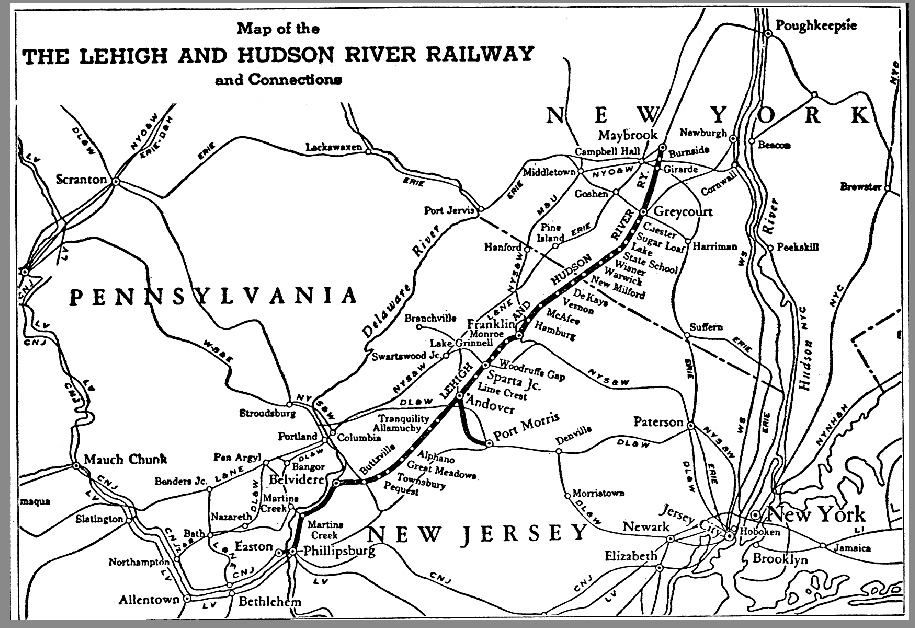
This month’s Classic Trains featured fallen flag is a northeastern railway I didn’t know much about, the Lehigh and Hudson River. If you asked me to complete the phrase “Lehigh and …”, I’d most likely have said “New England”, which was a larger operation but is perhaps only remembered now as the second major American railway to file for abandonment after the New York, Ontario & Western. The L&HR earned its keep primarily as a bridge line, with additional revenues from online anthracite coal mines. From the original founding in 1881, it operated until it was incorporated into Conrail in 1976.
L&HR’s origins date to 1860, when arrival of the New York & Erie Railroad, at Greycourt, New York, 10 miles north of Warwick, prompted construction of the Warwick Valley Railroad under the leadership of Grinnell Burt. The Warwick Valley operated as a 6-foot-gauge feeder to the same-gauge NY&E, using the big road’s equipment for two decades. Around 1880, WV assumed its own operations, was standard-gauged, and built the 11-mile Wawayanda Railroad, which tapped agricultural and mineral sources at McAfee, New Jersey. Further extension southward soon followed.
Two projected competitive lines were combined as the Lehigh & Hudson River Railroad, extending from a Pennsylvania Railroad connection at Belvidere, New Jersey, on the Delaware River, to Hamburg, New Jersey, where three miles of isolated Sussex Railroad track linked it to the Warwick Valley. In 1882 the extensions were folded into the 61-mile Lehigh & Hudson River Railway.
In addition to the New York & Erie’s mainline business at Greycourt, its Newburgh Branch provided access to Hudson River carferries crossing to the New York & New England’s Fishkill Landing. Anthracite coal, particularly from mines of affiliate Lehigh Coal & Navigation, was a major eastbound commodity. Anticipating completion of the Poughkeepsie Bridge a few miles upstream, the Orange County Railroad built north of Greycourt to connect with the New York, Ontario & Western at Burnside in 1890. Via trackage rights, this provided a first connection with the Central New England & Western at Campbell Hall, New York. Within a year, the Orange County was extended from Burnside to CNE’s new Maybrook yard.
Simultaneously, trackage rights were obtained from the Pennsy over 13 miles of its Belvidere-Delaware Division (“Bel-Del”) to Phillipsburg, New Jersey. There, disconnected subsidiaries undertook bridging the Delaware to access Easton, Pennsylvania, and the Jersey Central and Lehigh Valley. The bridge also opened in 1890, creating a three-state route of about 85 miles. The L&HR thus fulfilled the prescient vision of the line’s 1861 directors, who reported, “It was well understood by those … promoting the construction of the Warwick Valley Railroad, that in all probability it would be but a link in a great chain destined to be one of the most important thoroughfares, and to effect an important influence upon the commerce and manufacturers of an extensive section of our country …” Additional links soon extended the chain of this “important thoroughfare.”
Post WWII United Kingdom – Cold War Documentary
The Cold War
Published 11 Apr 2020Our historical documentary series on the history of the Cold War continues with a video on the post-World War II situation in the United Kingdom
Support us on Patreon: https://www.patreon.com/thecoldwar or Paypal: http://paypal.me/TheColdWar
✔ Merch store ► https://teespring.com/stores/thecoldwar
✔ Instagram ► http://www.instagram.com/thecoldwartv#ColdWar #UK #WorldWar
QotD: Selling booze to the immature
I’m getting really sick of manufacturers trying to extend their user base by appealing to younger people, playing on their unsophisticated and undeveloped taste buds by adding Kool-Aid flavors to grownup drinks. (Chocolate vodka? are you fucking kidding me?) This is akin to trying to get more women to shoot guns by making gunpowder smell like lilacs.
I am, by the way, fully aware of how innovation works — that most of civilization has occurred because someone, somewhere said: “Y’know, I bet if we just changed …” — but that’s confusing improvement with extension. Tinned fruity-flavored gin is not an improvement.
I know that raspberry-flavored beer may have caused more people to take to beer drinking, but that’s changed things, and not for the better. Go into any bar and look at what beers are on tap these days. Barely a drinkable one available, and worse, they’ve pushed all the decent beers into bottles (or out of stock) while hipsters and chickies are catered to with the latest fad, Strawberry IPA [pause to be sick].
Basically, booze manufacturers are changing their products to appeal to people who don’t like booze. In the old days of marketing, we used to call that pointless endeavor “catching eels” (try catching an eel in mid-air when someone tosses it in your direction and you’ll see what I’m talking about). Not only is it pointless, it’s mercurial because what’s popular today won’t be popular tomorrow as your fickle new customers chase after the next “Flavor Of The Month”, and you’ll have gone from catching one eel to catching multiple eels. That’s something they don’t teach in the Marketing section of the typical MBA course because MBAs are all about theory (“line extension”, “product enhancement”, etc.). And don’t tell me I’m talking nonsense because I’ve seen the curricula.
Kim du Toit, “Gilding the Lily #268”, Splendid Isolation, 2018-05-24.
August 5, 2020
Driver Experience @ Pecorama 2020
PECO
Published 4 Aug 2020A look at the new driver experience courses on the Beer Heights Light Railway at Pecorama — summer 2020
Red Toryism, limited government and other Canadian political sinkholes
In his latest article in The Dominion, Ben Woodfinden talks about the political void where most Canadian conservatives keep their notions about what “conservatism” actually means in the Canadian context:
This passage is from the Red Toryism essay:
Modern Canadian conservatism champions “small government”, seemingly without having any theory of what the state is actually for. Absent such a framework, it is difficult to identify governing priorities let alone to develop a philosophically coherent blueprint for action. When Conservatives get elected, they often have no idea of how to achieve the “fiscal responsibility” they preach. A series of ad hoc actions and policies follow, and the predictable result is failure to roll back the state in any significant or lasting way.
This, predictably, did not please everyone, and in a political landscape where we often still think that the divides between left and right are really about “big” versus “small” government, this was to be expected. But a conservative theory of government needs to escape this paradigm.
While conservatism is a broad tent, one unifying feature should be a commitment to limited government. But limited government is a term that often gets conflated with ideological “small government” that sees most of the modern state as illegitimate, and would eliminate most of it and leave the state to provide just the most minimal night-watchman functions. But small government, while a valid view to hold, is not limited government, and conservative government cannot just be about small government.
Limited government means constitutional government that is accountable and constrained by the rule of law, and while there are aspects of the modern state that need to be reformed, tamed, and limited, conservative government cannot just be about trying (and failing) to shrink the state. Conservatives have too often, I think, adopted the rhetoric of small government, without actually being true believers, and in the process they find it very difficult to actually reform and shape the state because they have put little thought into what government actually ought to be about.
Let me give you an example. Recently my friend Asher Honickman and I wrote a column for the National Post calling for a “parliamentary revival.” One specific and important reform we want to see is an expanded House of Commons to 500 MPs. More MPs would make for better party, and parliamentary government. But multiple people, including well connected conservatives, privately told us that while they think this is a good idea, one reason it won’t happen is because conservatives will just look at it through the lens of more spending of tax dollars on politicians. Instead the conservative impulse is to just try and shrink the size of legislatures to save a little bit of money.
In this case small government ideology actually gets in the way of reforms that would help make government more accountable, and limited. MPs should be held accountable and have their spending and salaries heavily scrutinized, but the cost of 150 more MPs would be nothing in the grand scheme of things.
This misses the point. More MPs would make for more accountable and better parliamentary government, and allow parliament, instead of both the bureaucracy and judiciary to increasingly take over more and more of lawmaking and governing that should be done by elected officials. The choice isn’t between more government or less government, in this case it’s a choice between who you’d rather be governed by; MPs who can scrutinize the government more, legislate with more freedom, and who you can hold to account, versus unelected bureaucrats with minimal oversight and limited accountability to elected officials.
In short, a conservative theory of governance should prioritize limited government, but in some cases this might require an attempt to strengthen (and more spending) on certain parts of government to constrain other parts.
It’s a rare Canadian conservative who’s willing to be quoted as saying that any part of human life is not automatically part of the remit of the federal government … how do you carve a “limited” government philosphy out of that?