Lindybeige
Published 16 Jul 2015Support me on Patreon: https://www.patreon.com/Lindybeige
This one has been a long time coming, but now I’m glad that I’ve said it. It may disappoint many die-easy fans of unnecessary carnage, but the truth about berserkers is that they may have been a great deal more sensible and human than the rage-fuelled psychos so beloved by the world’s male teenagers.
Here’s a link to Roderick Dale’s new Viking book (although Amazon inaccurately describes it as an audiobook and abridged): http://www.amazon.co.uk/Viking-Experi…
For those wanting the full 100,000-word thesis, try here: http://eprints.nottingham.ac.uk/28819/
Lindybeige: a channel of archaeology, ancient and medieval warfare, rants, swing dance, travelogues, evolution, and whatever else occurs to me to make.
▼ Follow me…
Twitter: https://twitter.com/Lindybeige I may have some drivel to contribute to the Twittersphere, plus you get notice of uploads.
August 5, 2020
Berserkers! The facts and the fictions
QotD: Responsibility
I have always been deeply suspicious of the word “responsibility”. It has again and again sounded like someone else telling me that I must do what he wants me to do rather than what I want to do. If he is paying my wages, then fair enough. But if he is explaining why I should vote for him, and support everything he does once he has got the job he is seeking, not so fair.
The sort of thing I mean is when a British Conservative Party politician says, perhaps to a room full of people who, like me, take the idea of personal liberty very seriously: Yes, I believe, passionately, in personal liberty. The politician maybe then expands upon this idea, often with regard to how commercial life works far better if people engaged in commerce are able to make their own decisions about which projects they will undertake and which risks they will walk towards and which risks they will avoid. If business is all coerced, it won’t be nearly so beneficial. We will all get poorer. Yay freedom.
But.
But … “responsibility”. We should all have freedom, yes, but we also have, or should have, “responsibility”. Sometimes there then follows a list of things that we should do or should refrain from doing, for each of which alleged responsibility there is a law which he favours and which we must obey. At other times, such a list is merely implied. So, freedom, but not freedom.
The problem with politicians talking about responsibility is that their particular concern is and should be the law, law being organised compulsion. And too often, their talk of responsibility serves only to drag into prominence yet more laws about what people must and must not do with their lives. But because the word “responsibility” sounds so virtuous, this list of anti-freedom laws becomes hard to argue against, even inside one’s own head. Am I opposed to “responsibility”? Increasingly, I have found myself saying: To hell with it. Yes.
I have often been similarly resistant to the language of Christianity, of the sort that dominates what is being said in churches around the world today. How many times in history have acts of tyranny been justified by the tyrant saying something like: We must all bear our crosses in life, and here, this cross is yours. “God is on my side. Obey my orders.” The truth about the potential of life to inflict pain becomes the excuse to inflict further pain.
Brian Micklethwait, “Jordan Peterson on responsibility – and on why it is important that he is not a politician”, Samizdata, 2018-03-30.
August 4, 2020
Nationalism DOESN’T explain WHY Austria-Hungary collapsed
TIK
Published 3 Aug 2020The go-to answer is that national or ethnic divisions caused the collapse of the Austro-Hungarian Empire. But is this really the case? Using multiple sources, it’s time to provide YouTube with a narrative which doesn’t confirm nationalist beliefs. The Habsburgs survived the collapse, with Emperor Karl / Charles trying to reclaim his throne later on before being exiled. However, by about mid-November 1918, he had lost all power. The fact that there is no specific date when Austria-Hungary collapsed, and the fact that the “national revolutions” were met with relatively little opposition, speaks volumes. As does the fact that the new states were all multinational, which undermines the narrative that nationalism was the reason why Austria-Hungary collapsed. Leave your thoughts in the comments below.
⏲️ Videos EVERY Monday at 5pm GMT (depending on season, check for British Summer Time).
– – – – –
📚 BIBLIOGRAPHY / SOURCES 📚
Judson, P. The Habsburg Empire: A New History. Belknap Press, Kindle 2016.
Kiste, J. The End of the Habsburgs: The Decline and Fall of the Austrian Monarchy. Kindle 2019.
Macgregor, J. & Docherty, G. Prolonging the Agony: How the Anglo-American Establishment Deliberately Extended WW1 by Three-and-a-Half Years. Trine Day LLC, 2018.
Marx, K. Capital: A Critique of Political Economy: Volume III. PDF, English edition, 2010. (Originally written 1894)
Mises, L. Socialism: An Economic and Sociological Analysis. Liberty Fund, 1981. 1969 edition (roots back to 1922).
Oxford Dictionary of English, Oxford University Press, Third Edition 2010.
Rady, M. The Habsburgs: The Rise and Fall of a World Power. Perseus Books, Kindle 2020.
Watson, A. Ring of Steel: Germany and Austria-Hungary at War, 1914-1918. Penguin Books, 2015.Cornwall, M. “Propaganda at Home (Austria-Hungary).” 1919. https://encyclopedia.1914-1918-online….
Online Latin-Dictionary http://www.latin-dictionary.net/defin…
Online Etymology Dictionary https://www.etymonline.com/word/publicFull list of all my sources – https://docs.google.com/spreadsheets/…
– – – – –
⭐ SUPPORT TIK ⭐
Want to ask a question? Please consider supporting me on either Patreon or SubscribeStar and help make more videos like this possible. For $5 or more you can ask questions which I will answer in future Q&A videos. Thank you to my current Patrons! You’re AWESOME! https://www.patreon.com/TIKhistory or https://www.subscribestar.com/tikhistory
– – – – –
ABOUT TIK 📝
History isn’t as boring as some people think, and my goal is to get people talking about it. I also want to dispel the myths and distortions that ruin our perception of the past by asking a simple question – “But is this really the case?” I have a 2:1 Degree in History and a passion for early 20th Century conflicts (mainly WW2). I’m therefore approaching this like I would an academic essay. Lots of sources, quotes, references and so on. Only the truth will do.
This video is discussing events or concepts that are academic, educational and historical in nature. This video is for informational purposes and was created so we may better understand the past and learn from the mistakes others have made.
Building and Gluing the Benches | The Picnic Bench Project
Matt Estlea
Published 3 Aug 2020In this video, I get the benches attached to their frames and all glued up. It’s really coming together now. Let’s get to it.
#picnicbench #woodworking #buildingapicnicbench
_________________________________________________________________Support what I do by becoming a Patron! This will help fund new tools, equipment and cover my overheads. Meaning I can continue to bring you regular, high quality, free content. Thank you so much for your support! https://www.patreon.com/mattestlea
Don’t want to commit to a monthly direct debit but still want to help out? That’s fine!
You can make a one time donation here: www.mattestlea.com/donate
You can donate us biscuits here: www.mattestlea.com/wishlist
_________________________________________________________________
BUY THE WOODWORKING BIBLE HERE:
www.mattestlea.com/the-woodworkers-manual
_________________________________________________________________SOCIAL MEDIA
Instagram: www.instagram.com/mattestlea
Twitter: www.twitter.com/mattestlea
Patreon: www.patreon.com/mattestlea
Pinterest: www.pinterest.com/mattestlea
LinkedIn: www.linkedin.com/in/matt-estlea-b6414b11a/
_________________________________________________________________
See what tools I use here: www.mattestlea.com/equipment
My Website: www.mattestlea.com
_________________________________________________________________My name is Matt Estlea, I’m a 24 year old Woodworker from Basingstoke in England and my aim is to make your woodworking less s***.
I come from 5 years tuition at Rycotewood Furniture Centre with a further 1 year working as an Artist in Residence at the Sylva Foundation. I now teach City and Guilds Furniture Making at Rycotewood as of September 2018.
If you’re interested in studying at Rycotewood, view their courses here:
www.mattestlea.com/rycotewoodI also had 5 years of experience working at Axminster Tools and Machinery where I helped customers with purchasing tools, demonstrated in stores and events, and gained extensive knowledge about a variety of tools and brands. I discontinued this at the start of 2019 to focus solely on video creation and teaching.
During the week, I film woodworking projects, tutorials, reviews and a viewer favourite ‘Tool Duel’ where I compare two competitive manufacturers tools against one another to find out which is best. I also have a Free Online Woodworking School which you should definitely check out!
www.mattestlea.com/school
I like to have a laugh and my videos are quite fast paced BUT you will learn a lot, I assure you.
Lets go make a mess.
Ontario’s COVID Alert app
Michael Geist explains why he has installed the Canadian government’s COVID App on his phone, despite the privacy concerns such government tracking apps present:
The Canadian COVID Alert app is ultimately as notable for what it doesn’t do as for what it does. The voluntary app does not collect personal information nor provide the government (or anyone else) with location information. The app merely runs in the background on an Apple or Android phone using bluetooth technology to identify other devices that come within 2 metres for a period of 15 minutes or more. Obviously, the distance and timing are viewed as the minimum for a potential transmission risk. If this occurs, a unique, random identifier is stored on each person’s device for a period of 14 days. After the 14 day period, the identifier is deleted from the device.
The identifier does not identify a specific person or location information, and is not sent to any centralized database. If a person tests positive for the virus, they are given a key code to input into the app. Once the key code is inputted, anyone that was identified as being potentially exposed over the prior 14 days receives a notification that this has occurred and they should consider testing and/or self-isolating.
From a privacy perspective, this is very low risk. Indeed, the government’s position – confirmed in the Privacy Commissioner of Canada’s analysis – is that there is no collection of any personal information and therefore the Privacy Act does not apply. The Privacy Commissioner rightly points out this raises some concerns about the state of the law (arguing it should be sufficiently robust to allow for reviews of this kind), however, the use of random identifiers ensures that identification of individual is very unlikely. Moreover, the Privacy Commissioner’s review concludes that “there are very strong safeguards in place” with security of the data, commitments limiting use, independent oversight, and a pledge to de-commission the app (including deletion of all data) within 30 days of the Chief Public Health Officer of Canada declaring the pandemic over.
The Ontario Information and Privacy Commissioner was also engaged in the review process. Her recommendation letter points to commitments for potential ongoing issues, including ensuring that the app is effective, that there is monitoring of third party components such as the Google-Apple Exposure Notification System, and public transparency associated with the app and its use.
While the app passes legal muster, its introduction reinforces the problems with social inequities that COVID-19 has laid clear. Much like the connection between socio-economic status and infection risk, the app itself is only accessible to those who can afford newer Apple and Android devices. That obviously means that those with older phones or no wireless access at all are unable to use it. While I don’t think that is reason to abandon the initiative, the government should be exploring alternatives to allow all citizens to implement these safeguards.
Sturmtruppen Firepower: The Artillery Luger
Forgotten Weapons
Published 4 Apr 2020https://www.instagram.com/rockislanda…
https://www.youtube.com/user/RockIsla…
This is lot #3569 in the upcoming RIA Premier Auction. It was scheduled for April, but has been postponed — check their web site for upcoming Online Only auctions every month, though!
The lP08 (Lange pistole 08) was formally adopted in 1913 to replace the Reichsrevolver for the field artillery. These were the German light artillery troops, who were specifically given a pistol caliber carbine to provide maximum firepower in a very compact package. They were made by the Erfurt Arsenal in 1914, and by DWM throughout the war, with a total of about 180,000 made.
What is most interesting to me is the evolution of the use of the “artillery Luger” throughout the course of World War One. Starting as simply a compact weapon for artillery, it was quickly recognized by aviators as an ideal weapon for aircraft before the mass introduction of aerial machine guns. The stock allowed more accurate fire, and the semiautomatic operation minimized the handling movements required to fire. More substantially, it was adopted by the German Sturmtruppen for maximizing the striking power of small and flexible units. It is for these men that the 32-round drum magazine was developed in 1916. This represents one of the very few formal military uses of a pistol-caliber semiautomatic carbine, as it was superseded by the advent of the submachine gun in 1918.
A few small batches were made in the 1920s and 1930s, but it would not see significant use in World War Two – leaving it a weapon specifically iconic to the Great War.
http://www.patreon.com/ForgottenWeapons
https://www.floatplane.com/channel/Fo…
Cool Forgotten Weapons merch! http://shop.bbtv.com/collections/forg…
Contact:
Forgotten Weapons
6281 N. Oracle #36270
Tucson, AZ 85740
QotD: Epicureans are not hedonists
… for now I am tempted amidst the “darling buds of May” to ponder with affection the proverbial injunction “Eat drink and be merry!”
Many people consider that a fair summary of the Epicurean philosophy, named for its founder, the Athenian philosopher Epicurus who lived from 341-270 B.C., a few generations after Plato. It is a natural mistake. After all Epicurus did say that “Pleasure is the starting-point and goal of living blessedly.”
A common Greek word for pleasure is “hedone,” whence our word “hedonism.” A hedonist, we know, is someone who devotes himself to sensual pleasure. Add that to the fact that Epicureanism is a deeply materialistic philosophy — “all good and bad,” Epicurus says, “consists in sense experience” — and it is easy to see why people often conclude that Epicureanism advocates sensual abandon.
Easy, but mistaken.
For in fact, Epicureanism is a deeply ascetic philosophy. It preaches the gospel of pleasure. But it defines pleasure in such a way that no hedonist worth his salt would embrace it.
A hedonist is someone devoted to pleasure in the positive sense: he seeks to gratify his senses.
An Epicurean is devoted to pleasure in the negative sense: he seeks to avoid pain. “We do everything we can,” Epicurus wrote, “for the sake of being neither in pain nor terror.”
It is a melancholy fact that the human frame, while capable of great joy and pleasure, is susceptible to even greater pain and misery. The pleasures afforded us are delicate blossoms; the pains we are susceptible to are like a raging wildfire in comparison. Epicurus and his followers took note of this fact. Indeed, it was a fact that mesmerized their imaginations.
Epicurus says that pleasure is the goal of life. But what he taught was immunity to pain. “The removal of all feeling of pain,” he wrote, “is the limit of the magnitude of pleasures.” There was a core of common sense about the Epicurean approach to life. He advised his followers to live simple, healthy lives, to shun extravagances of all sorts. Of course, that is something many philosophers, indeed many friends and parents, would also advise. There is nothing distinctively Epicurean about the injunction to live simply and soberly.
There are three things distinctive about Epicureanism. One is its identification of pleasure with the absence of pain. Another is its emphasis on sense experience as the ultimate reality. The third is its identification of tranquillity as the aim or goal of life. (The Greek word is “ataraxia,” i.e., not troubled, not disturbed: note the privative character of the Epicurean ideal.)
If it is to succeed, Epicureanism must deliver us not only from physical pain but also from anxiety and mental anguish. The prospect of death, Epicurus knew, upset many people. Hence he and his followers expended a great deal of effort trying to remove the sting, the fear, from the prospect of death.
Epicurus offered two things to battle the fear of death: an attitude and an argument. The attitude was one of mild contempt: the right sort of people, he implies, do not get in a tizzy about things, not even about death. The argument is equally compelling. “Get used to believing,” he says, “that death is nothing to us.”
Roger Kimball, “Coronavirus, Flynn and Epicureanism”, American Greatness, 2020-05-02.
August 3, 2020
Recycling is a SCAM!
J.J. McCullough
Published 29 Jun 2019Recycling is a disaster. This video was sponsored by Loonie Politics! Sign up using the code word “McCullough” for 25% off! https://looniepolitics.com/register/
Visit the channel of guest star Demetrios: https://www.youtube.com/channel/UCNKV…
An in-depth look at Canadian recycling:
https://globalnews.ca/news/5199883/ca…The Vice video I mentioned:
https://www.youtube.com/watch?v=Pv1UP…FOLLOW ME:
🇨🇦Support me on Patreon! https://www.patreon.com/jjmccullough
🤖Join my Discord! https://discord.gg/3X64ww7
🇺🇸Follow me on Instagram! https://www.instagram.com/jjmccullough/
🇨🇦Read my latest Washington Post columns: https://www.washingtonpost.com/people…
🇨🇦Visit my Canada Website http://thecanadaguide.com
Romanticizing the past
Sarah Hoyt points out that the past really is a foreign country and they do things very differently there … and for good reasons:

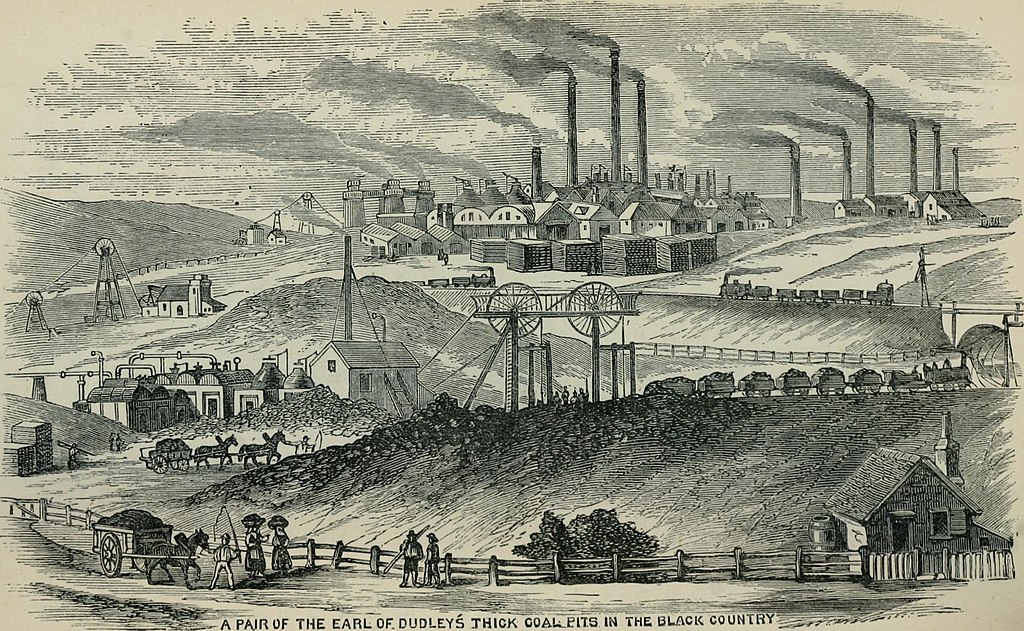
An image of coal pits in the Black Country from Griffiths’ Guide to the iron trade of Great Britain, 1873.
Image digitized by the Robarts Library of the University of Toronto via Wikimedia Commons.
So, quickly: The industrial revolution was not a disaster to your average peasant. It was a disaster for landowners.
Yes, yes, the conditions in the factories were terrible. By our standards. The lifespan was very short. By our standards. The anomie of the big cities, yadda yadda. When compared to what? Small villages? Ask those of us raised in them. Yes, there was child labor. As compared to what at that time? Other than the life of the upper classes?
Look, we don’t have to guess about this stuff. In India, in China, in other places that came to the industrial revolution very late, we’ve seen peasants leave the land where their ancestors had labored, to flock to the big cities, to take work we find horrible and exploitative at wages we find ridiculous.
And even if China has added “labor camp” and prisoner wrinkles to it, note that’s because China is a shitty communist country, not because the migration wasn’t there before. Also the labor camp aspects, as much as one can tell (and it’s hard to tell, due to the raging insanity of the regime) seem to have grown as the people grew more prosperous, as a result of the industrial revolution and thereby demanded higher wages, which positioned China more poorly as the “factory of the world.”
In fact, idealizing “living off the land” has been in place since at least the Roman empire, and probably before. It’s also been MISERABLE at least since then and probably before.
Because pre-industrial revolution farming sucked. It sucked horribly. And it kept you on the edge of subsistence. It double sucked when you were subjected to a Lord. Look, systems of serfdom, etc. didn’t come about because living in a Lord’s domain was so great, and everyone wove wreaths and danced around maypoles all the time, okay?
The bucolic paradise of a farmer’s life was mostly a creation of city dwellers, often noblemen, who saw it from the outside.
There are estimations that most people had trouble rearing even one child, and most of one generation’s peasants were people fallen from higher status. I don’t know. That might be exaggerated. Or it might not.
Even during the industrial revolution, it was normal for ladies bountiful to take baskets of food to tenant farmers because … they couldn’t make it on their own.
And btw, the more the industrial revolution pulled people to the cities, the more the Lords and “elites” talked about how great the countryside was and how terrible the factories/cities/new way of living were.
A lot of artists and pseudo bohemians jumped in on this bandwagon and so did Marx, who was both a pseudo bohemian, by birth “elite” (Well, his family had a virtual slave attached to him. He impregnated her too, as was his privilege), and by self-flattery intellectual.
Therefore the factories were the worst thing ever, the men who owned them, aka capitalists were terrible, terrible people — mostly because Marx wasn’t one, and probably because they laughed at him — and the proletariat they exploited horribly would rise up and —
All bullshit of course. Later on his fiction needed retconning by Anthony Gramsci who, having the sense to realize the “workers” weren’t rising up, just getting wealthier and escaping the clutches of the “elites” more made the “proletariat” a sort of “world proletariat” centered on poorer/more dysfunctional countries. This had the advantage of making the exploited masses always be elsewhere (or the supposed exploiters) and therefore made it easier to pitch group against group to the eternal profit of rather corrupt “elites.” Mostly political classes which are descended from “the best people.”

Creating the Dovetailed Frame for the Bench Top | The Picnic Bench Project
Matt Estlea
Published 2 Aug 2020In this video, I get the dovetailed frame for the bench top in place and answer some of your concerns from the previous video!
► Buy the Ridge Wallet here: https://www.ridge.com/ESTLEA
Use the Promo Code ‘ESTLEA’ to claim your 10% off!
_________________________________________________________________
Support what I do by becoming a Patron! This will help fund new tools, equipment and cover my overheads. Meaning I can continue to bring you regular, high quality, free content. Thank you so much for your support! https://www.patreon.com/mattestlea
Don’t want to commit to a monthly direct debit but still want to help out? That’s fine!
You can make a one time donation here: www.mattestlea.com/donate
You can donate us biscuits here: www.mattestlea.com/wishlist
_________________________________________________________________
BUY THE WOODWORKING BIBLE HERE:
www.mattestlea.com/the-woodworkers-manual
_________________________________________________________________SOCIAL MEDIA
Instagram: www.instagram.com/mattestlea
Twitter: www.twitter.com/mattestlea
Patreon: www.patreon.com/mattestlea
Pinterest: www.pinterest.com/mattestlea
LinkedIn: www.linkedin.com/in/matt-estlea-b6414b11a/
_________________________________________________________________
See what tools I use here: www.mattestlea.com/equipment
My Website: www.mattestlea.com
_________________________________________________________________My name is Matt Estlea, I’m a 24 year old Woodworker from Basingstoke in England and my aim is to make your woodworking less s***.
I come from 5 years tuition at Rycotewood Furniture Centre with a further 1 year working as an Artist in Residence at the Sylva Foundation. I now teach City and Guilds Furniture Making at Rycotewood as of September 2018.
If you’re interested in studying at Rycotewood, view their courses here:
www.mattestlea.com/rycotewoodI also had 5 years of experience working at Axminster Tools and Machinery where I helped customers with purchasing tools, demonstrated in stores and events, and gained extensive knowledge about a variety of tools and brands. I discontinued this at the start of 2019 to focus solely on video creation and teaching.
During the week, I film woodworking projects, tutorials, reviews and a viewer favourite ‘Tool Duel’ where I compare two competitive manufacturers tools against one another to find out which is best. I also have a Free Online Woodworking School which you should definitely check out!
www.mattestlea.com/school
I like to have a laugh and my videos are quite fast paced BUT you will learn a lot, I assure you.
Lets go make a mess.
The Magic of Terry Pratchett by Marc Burrows
Rachel Cunliffe looks at a recent biography of the great science fiction/fantasy author Terry Pratchett by Marc Burrows:
A satirical sci-fi/fantasy writer might not seem the obvious choice to dissect the world-changing magnitude of an unforeseen pandemic — or so you might think if you’ve never read any of his books. But anyone familiar with the Pratchett’s oeuvre will know that the scouring wit and the unflinching grasp of humanity at its best and worst found within his pages would be the only true way to understand what has happened to our world since the start of the year.
Alas, we will never know how Sir Terry would have woven the government’s dysfunctional pandemic response, the etiquette of social distancing, mask and anti-mask culture or the mass shift to remote working into the realm of the Discworld (although we can be fairly confident that he would have done). But glimpses can be found in The Magic Of Terry Pratchett, a new biography by writer and comedian Marc Burrows.
This is the first full biography of the great man, from his upbringing in the quintessentially English hamlet of Forty Green, Buckinghamshire, to his battle with Alzheimer’s (which Pratchett dubbed “the Embuggerance”) and ferocious campaign for a law change to allow assisted dying — and featuring a whistle-stop tour of his 60-odd books.
It is, as Burrows admits from the start, the project of a committed fanboy. The author never actually got to speak to his literary hero (“This book is my chance to meet Terry Pratchett. It’s yours as well,” he explains early on), and has instead pieced together his life story through old interviews, archives, and conversations with friends and contemporaries.
The result is an engaging quest to get to know the man that both explores and adds to the mythology surrounding him. Pratchett was, as Burrows makes clear, a storyteller first and foremost, and some of his oft-repeated anecdotes — such as encountering a dead body age 17 on his first day as a junior reporter, or filing his copy from a shed on the roof — may have been based more on fantasy than reality. Where he cannot verify, Burrows sticks to the strategy taken by Tony Wilson in the film 24 Hour Party People: “When you have to choose between the truth and the legend, print the legend”.
As such, while this book will no doubt be of greatest interest to Pratchett fans, even those who have never opened a Discworld novel will find themselves entertained by its numerous detours — encompassing the educational apartheid of the 1950s, a surreal stint doing PR for Britain’s nuclear industry, and the once vibrant, now sadly endangered local journalism ecosystem.
Ultimate French Cleat Tool Wall
Ben Tardif
Published 29 Feb 2020I have finally moved tools into the workshop! First thing to do is get organized, so I built this French Cleat Wall to store all of the tools that will get used most frequently. This is designed to be a grab and go wall, so tools are set up and ready to be used right away. This is just the first step in organizing my new workshop. Enjoy!
Follow me on Instagram:
https://www.instagram.com/bentardif/Music by: David Cutter Music – http://www.davidcuttermusic.com
QotD: History or “Her” story?
In another land, a long, long time ago, I was a student of languages. It was there that I came across the American left’s obsession with corrupting the language.
In my last year in college, I had American Literature taught by a Fullbright exchange professor. I will never forget the moment the poor man — talking to a class of 36, all women as such classes often are — let slip the innocent word “him” to mean an indeterminate gender. He paused, went white, his eyes widened, and he said, “I mean, I mean, he or she.”
Meanwhile, the class of 36 was staring at him in puzzlement. It took us a while to take it all apart and realize he thought we’d be offended by the use of “he” to mean someone generic, of indeterminate gender.
I think we patted him kindly on the shoulder and told him that no, really, we weren’t offended. The usage was the same in Portuguese and we’d been told it was the same in most Indo-European languages. And who on Earth would get offended over semantics? The language was the language. It meant nothing about us personally.
This was of course before I married, came to the U.S. and found that for the American woman circa 1985, the language was not just personal, it was personally offensive.
I remember standing in horror underneath a bookstore section proudly labeled Herstory.
Of course the etymology of the word history is not his + story, the sort of pseudo-clever deduction about language that I was used to from the near-illiterate elderly people in the village. (It would be too complex and involve Portuguese, but there was this old farmer who had somehow deduced from the Portuguese word for farmer that farmers were the only ones who would be saved at the end of time.)
History, of course, is not originally an English word. It comes from the Latin historia — meaning a relation of events — by way of the French estoire, meaning story. Note please that in neither of those languages does “his” mean “belonging to him.” And that making the same sort of illiterate assumptions about the French word, we’d get “It is oire.”
I thought that the store must have hired an illiterate employee, but no, over the next ten years, in various circumstances, and possibly still except for the fact that I’ve learned to silence such fools with a death glare, I’ve come across the same smug-idiot assumption and “corrections” of the English word, so as to “fight against the patriarchy.”
That this is done by people who paid more money than I make in a couple of years for a college degree, and who, doubtlessly, think that etymology is a dish made with onions, or perhaps a conspiracy of the patriarchy fills me with a sort of dull rage that has no outlet.
Sarah Hoyt, “The Semantic Whoredom of the Left”, PJ Media, 2018-05-11.