
Rex Krueger
Published 16 Sep 2026[AI summary: Rex Krueger investigates a vintage drop-leaf gate leg table to determine whether it was handmade or factory-built. By examining specific construction techniques, joinery, and material choices, Rex deciphers the history of this piece and explains how such multi-purpose furniture served past households.]
All my plans!: https://www.rexkrueger.com/
More Furniture Forensics: • Furniture Forensics
Compass Rose Toolworks: https://www.compassrosetools.com/
Join the Mailing List: http://eepurl.com/g3rkmv
Get my woodturning book: http://www.rexkrueger.com/book
Get My Book, Everyday Woodworking: https://amzn.to/3oyjC0E
Follow me on Instagram: @rexkrueger
September 17, 2026
Is This Table Really 200 Years Old? (Furniture Forensics)
Comments Off on Is This Table Really 200 Years Old? (Furniture Forensics)
September 12, 2026
“STOP POWER TOOLS! the signs say. WOODWORKING UNDER THREAT!”
On the social media site formerly known as Twitter, ESR has a thought experiment for us:

Prefabbed components and appliances for a Levittown home.
Image from Construction Physics.
Imagine it’s the 1940s. You’re a carpenter. Power tools are beginning to replace hand tools for ordinary work. Furthermore, jobs that would have been impossible or ruinously expensive are suddenly within reach.
You show up at a worksite one fine morning and it’s being picketed. STOP POWER TOOLS! the signs say. WOODWORKING UNDER THREAT!
Puzzled, you accost one of the demonstrators and ask him why he has a signboard in his hand rather than tools.
“Power tools are a menace!” he says. “How are you going to train apprentices if they can’t feel the wood through their hands?”
“What happens when we can chew through aged quality timber faster than we can grow new trees?”
“Carpentry isn’t just a set of skills and habits, it’s a mindset. It won’t be any true carpenters left if we let this go on.”
You inquire further and discover that they have plans. Plans to exclude from any job they work on any craftsman who has ever used a power tool or even spoken approvingly about them.
Meanwhile, inside the picket line, a house is going up. Men are working. Cutting and joining the framing is going faster than you could have imagined 10 years ago.
You look at the workers. You look at the demonstrators. One group is talking. The other is getting stuff done. One group looks like the past, the other like the future. In this moment, you get to decide which group you’re going to join.
This post was not about carpentry.
Comments Off on “STOP POWER TOOLS! the signs say. WOODWORKING UNDER THREAT!”
September 28, 2025
The beginning woodworker … an easy mark
On his Substack, Christopher Schwarz posts a weekly “earlywood” article pulled from his extensive back-catalogue of woodworking books and magazine articles. This week, he addresses the plight of the beginner in the woodworking hobby just before the internet became ubiquitous:
When people begin woodworking, most go through a phase (I did) in which they are willing to soak up every single piece of information they can find. Many will subscribe to multiple woodworking magazines, buy astonishing numbers of woodworking books, seek out catalogs and advertisements for woodworking tools, and buy anything they can afford that looks remotely useful.
This is when people are vulnerable. They need guidance. Unfortunately, woodworking is a mostly solitary pursuit. And so we spend incredible, astonishing and shocking amounts of money on equipment, books and instruction. And most of it is of questionable worth.
Because of this phenomenon:
- The woodworking magazine business had a glut of magazines. When we ran the numbers in the 1990s, we surmised that there should be three magazines serving woodworkers. Instead, there were more: Fine Woodworking, WOOD, American Woodworker, Woodsmith, Shopnotes, Workbench, Popular Woodworking, Woodworker’s Journal, Woodshop News, Woodcraft, Weekend Woodcrafts, Woodwork and a host of specialized magazines. What propped up these magazines? Beginners. Eventually, most woodworkers winnow their subscriptions down to one or two magazines. But the spendthrift beginner made it possible for many magazines to survive.1
- The woodworking book industry produced a glut of books. In the 1990s, my mailbox was stuffed with new woodworking books every week. It wasn’t unusual to see seven or eight new woodworking titles in a month. That’s coo-coo. Why did this work? New woodworkers wanted the latest information. New books are better than old books (duh!). And so publishers churned out books that had an 18-month life cycle before disappearing forever.2
- The woodworking tool industry thrives on new SKUs. After covering woodworking tool manufacturers for nearly three decades, it’s obvious that they introduce new products every year to goose sales. That’s why you have a new crop of cordless drill/drivers every year. And it’s also why you have a rash of odd products that seem (on the surface) to be innovative – silicone glue brushes, painter’s pyramids, many router table jigs, marrying a chisel with a rasp, aluminum squares, putting a laser on everything, oddball and worthless sanders (the Black & Decker Mouse; Porter-Cable Profile Sanders), and battery-powered clamps and tape measures. The list is endless, and it’s not a modern phenomenon. When my grandfather was woodworking in the 1970s, he was charmed by a jig that let you cut dovetails with a corded drill. The only people who are dumb enough to fall for these products are beginners and woodworking journalists. Beginners don’t know better, and journalists need copy to fill the empty space between the covers.3
Some of you might be thinking I’m exaggerating my experiences. I’m not. The good news is that the Internet did a Half-Nelson on most of these stupid business practices. When people now go through their “indiscriminate sponge” phase, they do it on YouTube and soak up as much ridiculousness as they wish.
For free. Mostly.
Eventually, they will be able to ignore the tool-chugging nincompoops and focus on what’s important: Building basic skills using simple and robust tools (and maybe a few well-built machines).
Honestly, it’s a good thing to be a bit jaded about the woodworking tool and publishing industries. It makes you a better consumer and encourages us to do better. So please, for the sake of the future of the craft, don’t buy the Bench Cookies.
- Some modern context follows. Many of these magazines have disappeared or have been consolidated. But you know what? I still think we have too many woodworking magazines these days. Or not enough. I forget which is right.
- More modern context follows. Most of these publishers have gone tits up. And good riddance. We don’t need a new book every year on advanced router techniques.
- Modern context follows. Nothing has changed here.
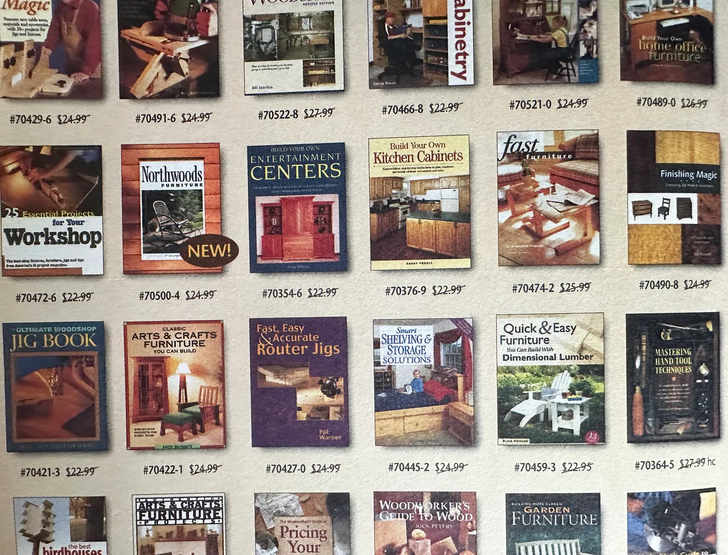
I matched this profile of the “indiscriminate sponge” beginner and I had huge numbers of woodworking books and magazines … until I finally noticed that the magazine articles in the latest issue were basically the same as the ones I’d first seen three years earlier, just with more gee-gaws and doo-dads added (microadjusters-for-everything were flavour of the month when I finally exited my sponge phase).
Comments Off on The beginning woodworker … an easy mark
April 18, 2025
How a grinder can change your woodworking
Rex Krueger
Published 16 Apr 2025
Comments Off on How a grinder can change your woodworking
December 14, 2024
I Tried All The Cheap Bench Grinders … Here’s what happened
Rex Krueger
Published Aug 14, 2024GRINDERS!!!
Comments Off on I Tried All The Cheap Bench Grinders … Here’s what happened
October 5, 2024
The Woodworker (1940) – Vocational training film
Charlie Dean Archives
Published Aug 10, 2013http://archive.org/details/Woodwork1940
Woodworking in mills, construction and cabinetmaking.
CharlieDeanArchives – Archive footage from the 20th century making history come alive!
Comments Off on The Woodworker (1940) – Vocational training film
March 20, 2024
Jointing on a Bandsaw | Paul Sellers
Paul Sellers
Published Dec 1, 2023This bandsaw hack is one you have never seen before because I invented it.
Planing dead flat for hand planing or power planing can take time, but this bandsaw method takes only a few short minutes to do, and you are on your way to your work faster than blinking.
(more…)
Comments Off on Jointing on a Bandsaw | Paul Sellers
October 30, 2023
The funny side of reviewing woodworking tools
Christopher Schwarz used to be the editor of one of the big US woodworking magazines and part of the job included being inundated with free tools from manufacturers eager to get a review in an upcoming issue of the magazine. Some — and not just the marginal producers — had the misfortune of shipping tools that failed to work properly (or at all) when tested:
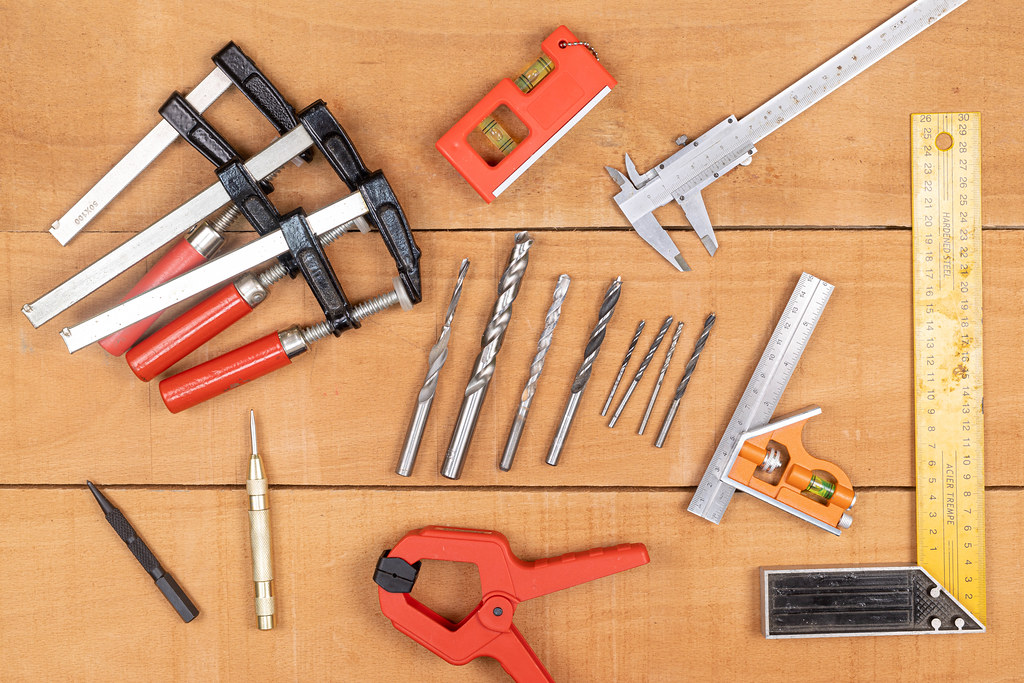
“Woodworking Tools on the wooden table” by wuestenigel is licensed under CC BY 2.0 
 .
.
… it should come as no surprise that toolmakers also make mistakes. Most readers probably think that the tools that came into our shop had been carefully tested and tuned by the manufacturers to make sure they were perfect. Based on how many goofed-up tools I saw, I doubt that’s the case.
And in fact, I took it as a mark of the toolmakers’ honesty when they sent us one right off the warehouse floor.
Here’s a small sample of some of the stuff I’ve seen:
DeWalt: The company makes good tools, but we had a jigsaw come into the shop where the blade clamping mechanism failed. It went click, click, then the blade dropped out like a rotten tooth. When DeWalt introduced its first hybrid table saw, the first rip fence we got was twisted. So was the second. The third replacement was fine.
Delta: When Delta introduced its C-arm drum sander, we were all excited in the shop. We set it up, plugged it in and cranked the puppy up. It spun up and then spun down forever. The motor burned out after three seconds.
Harbor Freight: It might sound too easy to pick on this discount seller. But they sell tools and people buy them. So here goes: When we tested the company’s plunge router, the collet failed. The bit slipped out and flew out. That was one of the days that I wished we had some Depends in the first-aid kit.
Black & Decker: Here’s every tool marketer’s worst nightmare. Black & Decker sent us its new cordless tape measure. Now let’s ignore for a moment the possibility that you do not need an electric tape measure. So Senior Editor David Thiel took it out of the box in front of the entire staff and demonstrated how it works. The tape extended about a foot and then died forever.
Metabo: Cordless drills aren’t supposed to shoot flames out the back are they?
Lobo: When we tested its edge sander the sheet metal base flexed like tin foil. You would turn the machine on, and the thing would do the twist like Chubby Checker.
Powermatic: Yes, even Powermatic. An early version of its benchtop mortiser had a flaw in the piece of metal that joined the motor to the arm mechanism. The gears on the interior stripped out. So when you pulled the arm, the motor never moved.
Tools for Working Wood: The Ray Iles mortising chisels are great, but one of my students at the Marc Adams School of Woodworking snapped the tip off one when working in poplar. I heard it from across the room. It turned out that a few of the tools had been made from A2 instead of D2. It did make for an amusing day as everyone crowded around the chisel like the victim of a car accident.
Lie-Nielsen Toolworks: I had a narrow iron shoulder plane that was an early production run. The bronze grip wouldn’t stay in place when you retracted the iron. When I turned the screw, the plane disassembled itself in my hands.
Veritas: An early version of the Veritas cabinet scraper (an adaptation of the No. 80) would clog after a few passes like Crystal Gayle’s shower’s drain. The company has since fixed that problem and the tool works great.
Stanley Tools: During a test of jack planes, we had a tool that simply would not function. It was like it was haunted. If you snugged up the frog screw to where you thought it should be, you couldn’t adjust the iron. If you loosened the frog screw so you could adjust the iron, the thing would chatter and shake like a Vega going 56 mph. We never figured that one out.
Wenzloff & Sons: While teaching a sawing class at Kelly Mehler’s School of Woodworking, one student’s carcase saw was misbehaving. It was tearing out the shoulders of his tenons something fierce. At first I thought it was user error. Turns out the saw was filed for rip when it was supposed to be crosscut.
Let me conclude by saying that mistakes slip out the door for every toolmaker (and magazine editor and book publisher). We’ve never heard of any toolmaker with zero returns. The real test of a toolmaker (and editor) is how you deal with the mistakes when they occur.
Comments Off on The funny side of reviewing woodworking tools
December 22, 2022
The Minimum Timber Bench // Start woodworking for less!
Rex Krueger
Published 21 Dec 2022The Minimum Timber Bench plans are 34 pages of full-color, step-by-step instructions in standard and metric measurements. The plans include a full stock list and cut list. Every image is modeled in 3D and each step includes tips and tricks to make your build easier. This bench is designed for beginning woodworkers and power-tool woodworkers who want to get into hand tools. You can build it completely by hand or with a few common machine tools. Get your plans here: https://www.rexkrueger.com/store/mini…
The Minimum Timber Bench Course is eight chapters of detailed build instructions. Follow along as I do each step of the build using basic machine tools (and a few hand tools). I’ll take you from stock selection all the way through to flattening and using the bench. The course is 80 minutes long, fully searchable, and includes the complete plans for FREE! Learn more here: https://tinyurl.com/43yfhjwb
(more…)
Comments Off on The Minimum Timber Bench // Start woodworking for less!
November 24, 2022
Can I make an AUTHENTIC Katana from wood?
Rex Krueger
Published 23 Nov 2022Historical weapon, beautiful construction & a great holiday gift, Katanas have it all!
Patrons get all plans early: http://www.patreon.com/rexkrueger
Get the FREE templates!: https://www.rexkrueger.com/store (scroll down to bottom of page).
(more…)
Comments Off on Can I make an AUTHENTIC Katana from wood?
June 9, 2022
Packing My Basement Shop and Moving to a New Building
Rex Krueger
Published 8 Jun 2022Out of the basement & over to the new shop!
(more…)
Comments Off on Packing My Basement Shop and Moving to a New Building
April 4, 2022
Clever tricks with forstner bits
Stumpy Nubs
Published 9 Dec 2021These tips and tricks will help you bet more from your forstner bits.
*Tools used in this video:*
Fisch Forstner Bits: https://amzn.to/2tvzbJg*More links to check out:*
-More videos on our website: https://stumpynubs.com/
-Subscribe to our e-Magazine: https://stumpynubs.com/browse-and-sub…
-Check out our project plans: https://stumpynubs.com/product-catego…
-Instagram: https://www.instagram.com/stumpynubs/★THIS VIDEO WAS MADE POSSIBLE BY★
Fisch Forstner Bits: https://amzn.to/2tvzbJg
Fisch Drill Bits: https://amzn.to/2BHJLl4
*Please help support us by using the link above for a quick look around!*
(If you use one of these affiliate links, we may receive a small commission)

Comments Off on Clever tricks with forstner bits
December 23, 2021
Setting Up Your First Woodturning Lathe || Unboxing, Parts, and Accessories
Rex Krueger
Published 22 Dec 2021How to prepare your first lathe right out of the box.
ALL PLANS 50% OFF UNTIL CHRISTMAS!! https://www.rexkrueger.com/store
Get the PDF of One Week to Woodturning (Revised Edition): https://tinyurl.com/rexkrueger
Kindle Version: https://amzn.to/3so6lu0
(more…)
Comments Off on Setting Up Your First Woodturning Lathe || Unboxing, Parts, and Accessories
October 24, 2021
Sand, Scrape or Plane? The REAL reason…
Stumpy Nubs
Published 11 Jul 2021How the process makes one method better than others.
Related videos►
Sanding:
-Sanding like a pro https://youtu.be/qDYPGgjQmF4
-Sanding between coats of finish https://youtu.be/Q0lEM_BOgmo
-Cork sanding blocks https://youtu.be/EyBpO0S-SoI
-Choosing the right sandpaper https://youtu.be/0srywz2SwQo
-Random orbital sander tips- https://youtu.be/Gt0pdxoSMPUScraping:
-Sharpening card scrapers https://youtu.be/MmNr0aj89t0
-Using card scrapers https://youtu.be/MmNr0aj89t0Planing:
-Two planes you should have https://youtu.be/GXnU0uwWwsE
-Cambered plane irons https://youtu.be/j7yL8ud03hkCheck out Sjobergs workbenches and help support us►
Sjobergs: https://affinitytool.com/brands/sjobergsSubscribe (free) to Stumpy Nubs Woodworking Journal e-Magazine► http://www.stumpynubs.com/
Follow us on social media►
Instagram: https://www.instagram.com/stumpynubs/
Twitter: https://twitter.com/StumpyNubs
Personally, I far prefer using a hand plane or a scraper to sanding, as I find the noise and dust get hard to cope with fairly quickly, so most of my projects get the absolute minimum level of sanding.

Comments Off on Sand, Scrape or Plane? The REAL reason…
May 12, 2021
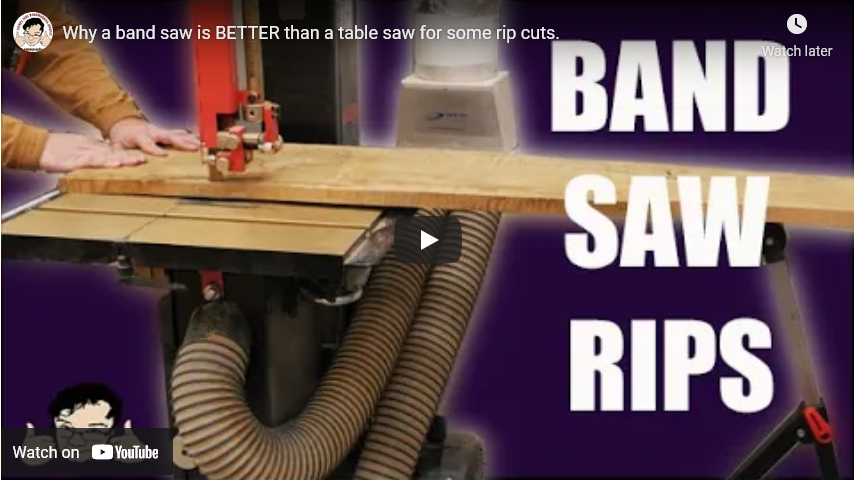
Why a band saw is BETTER than a table saw for some rip cuts
Stumpy Nubs
Published 6 Feb 2021We identify the times when a band saw is the better choice for rip cuts, and how to get the best results with it.
When you use this link to visit our sponsor, you support us►
Harvey Woodworking Machinery: https://www.harveywoodworking.com/
Subscribe (free) to Stumpy Nubs Woodworking Journal e-Magazine► http://www.stumpynubs.com/subscribe.htmlFollow us on social media►
Instagram: https://www.instagram.com/stumpynubs/
Twitter: https://twitter.com/StumpyNubs
Comments Off on Why a band saw is BETTER than a table saw for some rip cuts


