
EliasIak2011
Published 30 Nov 2012“The Doors: Mr. Mojo Risin’ — The Story of LA Woman“
October 14, 2023
Ray Manzarek – “Riders On The Storm”
Comments Off on Ray Manzarek – “Riders On The Storm”
October 13, 2023
QotD: Sales of George Orwell’s Nineteen Eighty-Four
Nineteen Eighty-Four remains widely read today — and ubiquitously quoted and cited. In fact, during the spring of 2017, in the wake of the inauguration of President Donald Trump — and controversies about the “alternative facts” that his aides marshaled as evidence of record attendance figures at the event — the book achieved the remarkable, unprecedented feat of skyrocketing to number one on fiction bestseller lists. This occurred an astonishing 67 years after its original date of release. Nothing of this kind had ever happened to another book in publishing history. And, in the case of Nineteen Eighty-Four, it was the fourth time that it had topped the bestseller lists: first in 1954, in the U.K., after a BBC-TV adaptation sent sales soaring; second, throughout the English-speaking world during the so-called countdown to 1984 between October 1983 and April 1984; and third, in 2003, as the centennial commemorations of Orwell’s birth dominated the headlines and airwaves on both sides of the Atlantic.
In fact, it is fair to say that Nineteen Eighty-Four has never not been a bestseller and a publishing phenomenon. According to the website Ranker.com, the work has sold more than 25 million copies since 1949. More than a half century later, Manchester Guardian readers voted Nineteen Eighty-Four the most influential book of the 20th century. Waterstone’s, a British bookstore chain, has ranked Orwell’s dystopia as the second most popular book of the 20th century (behind J.R.R. Tolkien’s The Lord of the Rings). That is an amazing feat in its own right, given that most people understandably do not particularly enjoy reading (let alone rereading) nightmarish stories of torture, betrayal, and brainwashing. The book’s ascent to the top of fiction bestseller lists in 2016 and 2017, along with the ceaseless invocation of Orwell’s catchwords to characterize the Trump administration, induced Signet, Orwell’s American publisher, to rush out a new print run of 500,000 copies. Expectations are that total sales will pass 30 million by the time of the 2020 election in the United States.
John Rodden and John Rossi, “George Orwell Warned Us, But Was Anyone Listening?”, The American Conservative, 2019-10-02.
Comments Off on QotD: Sales of George Orwell’s Nineteen Eighty-Four
October 12, 2023
Canada, “a country with short arms and long pockets”
In the National Post, John Ivison recounts Canada’s continuing inability to live up to expectations internationally, especially militarily:
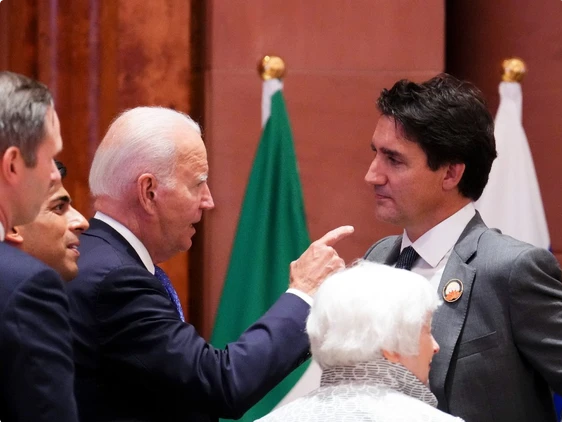
US President Joe Biden talks to Canadian Prime Minister Justin Trudeau, March 2023.
On the eve of Russia’s invasion of Ukraine, Mark Norman, the former vice-chief of defence, made a prediction that sounded overblown at the time.
“I really think the Americans are going to start ignoring us because they don’t think we are credible or reliable. They are not even putting pressure on us anymore,” he said in a January 2022 National Post interview, based on his conversations with contacts in Washington.
It turns out he was absolutely right.
Since then, leaked Pentagon documents have confirmed that sense, indicating that the U.S. believes “widespread defence shortfalls have hindered Canada’s capabilities, while straining partner relationships and alliance contributions”.
Canada left little room for doubt about its diminished capabilities when it took a pass on NATO’s largest-ever air exercise last summer, because its jets and pilots were involved in “modernization activities”. That absence left the impression that this country might not be able to show up in certain circumstances.
Even before the unfolding tragedy in the Middle East, America was letting it be known that it felt overstretched and needed regional allies to share the burden.
When President Joe Biden visited Ottawa in March, he asked Justin Trudeau to lead a mission to Haiti, which had descended into mob rule. Since the Liberals were elected on a peacekeeping ticket in 2015, it was a logical request. However, Trudeau demurred, presumably on the grounds that Canada’s security forces were stretched too thin by operations in Latvia and fighting wildfires at home. The upshot is that Kenya is set to send 1,000 security officers to the beleaguered island nation.
The recent news that Canada now plans to trim its defence budget by nearly $1 billion — a total of $17 billion over 20 years, if savings are recurring — has reinforced the image of a country with short arms and long pockets.
Against that background, it was no surprise that on Monday Biden hosted a call with the leaders of France, Germany, Italy and the U.K. to discuss the crisis in the Middle East — and didn’t include Canada.
A statement by the G7 minus Canada and Japan (which has a negligible Jewish population) was issued saying that the five countries would ensure Israel is able to defend itself.
Over at The Line, Matt Gurney discovered that the federal government was actively trying to hide the fact that Canadians in Israel were not able to access Canadian embassy services by pretending that the word “operational” meant “open and functional”:
On Sunday evening (hours after we published our dispatch), I received a reply from GAC. This was the reply:
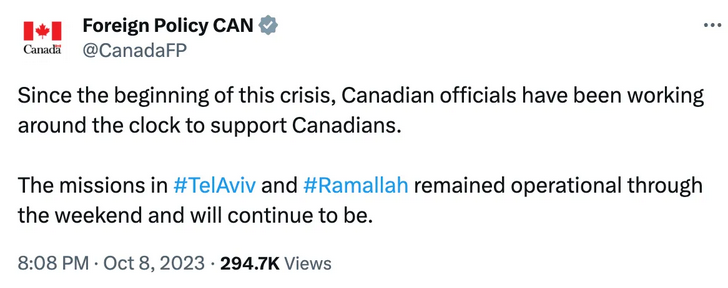
Since the beginning of this crisis, Canadian officials have been working around the clock to support Canadians. The missions in Tel Aviv and Ramallah remained operational through the weekend and will continue to be. Our missions will open on Monday October 9th, unless security conditions do not allow for it. We will be assessing the security situation daily, in coordination with our allies.
Okay! That seemed fair. But not having been born yesterday, and being in a profession where people try to spin me all the time, I noticed something immediately. The distinction GAC was drawing between “operational” and “open” stood out to me. I replied at once seeking clarification, and heard nothing back. Not even an acknowledgement.
This word choice mattered. The government publicly used the “operational” messaging. Members of the government repeated it. This was what they were telling the Canadian people: all is well, ignore those nasty media people and members of the opposition. Of course the embassies were “operational”!
See that tweet? The one pasted above? I checked out who was retweeting it. Lots of people did! And that included a bunch of Liberal MPs, a bunch of Canadian diplomats, members of the media, and what I’ll politely refer to as a group of “usual suspects” I recognize from online as being proxies for the Liberal government’s messaging (or at least really devoted True Believer Liberal partisans).
On Monday morning, having heard nothing back about what “operational” meant as opposed to “open”, I asked for a specific clarification in the terminology. What was “operational” vs. “open”? I also asked for specifics on what services were available locally from Canadian diplomatic missions in Israel over the weekend in real time, and how that would change when the embassy “opened” on Monday. I asked about the staffing level at the embassy on the weekend, and how that would compare to a normal workday, and also to a normal weekend.
Rather than answer a simple question, our government would much rather obfuscate and prevaricate as a matter of policy. That, by itself, tells you everything you need to know about both our political leaders and the civil service organizations they control.
Comments Off on Canada, “a country with short arms and long pockets”
KAMIKAZE: HMS Formidable, May 4, 1945
Armoured Carriers
Published 18 Apr 2020It was the height of the invasion of Okinawa. Japan was throwing a last-ditch effort at unseating US Marines from their beachheads. Kamikazes swarmed the skies. HMS Formidable, part of the British Pacific Fleet interdicting attacks from Formosa (Taiwan), was to suffer a direct hit on her armoured flight deck. Here’s what happened — in the words of those who were there.
(more…)
Comments Off on KAMIKAZE: HMS Formidable, May 4, 1945
QotD: America before identity politics
Pick even minor items of their catechism (if so all-encompassing a creed as Leftism can be said to have “minor” items). It’s an article of the One True Faith, for instance, that seven out of every five college girls are raped the minute they set foot on campus. And yet … free college! Yeah, Bernie, let’s march a whole bunch of new rape victims straight into the frat house, on the taxpayer’s dime. Makes sense. And speaking of free college, y’all know how you love to wave your degrees around, because that’s how you win at Internet? How’s that going to work, now that everyone has a Gender Studies degree?
Yeah, ok, I know, if they could see the obvious consequences of their actions, they wouldn’t be Liberals in the first place. But still — all of this is so obvious, so determinedly cattywampus to reality, that it has to be by design. T.S. Eliot was right — it’s “gesture without motion”, but I’ll be damned if I can figure out how they pull that off. Which is why I suspect it’s actual, neurological changes in their brains, brought about by too much soy.
Severian, “The Hollow Men”, Rotten Chestnuts, 2020-12-19.
1. Gosh, wasn’t The America That Was a hoot? If you’re under 35 you’ll just have to trust me on this, but there was a point in American history when homosexuals didn’t have to be 1000% gay all the time, to the exclusion of everything else. I know, I know, and it gets weirder – back then, you could even be friends with a homosexual and not have homosexuality come up for days, weeks, even months at a time! You and Steve went to different bars on Saturday night, but other than that, you pretty much just carried on treating each other like, you know, people. And I know this sounds crazy, but even when talking about relationships it wasn’t a big deal. “Hey, Sev, how are things with Becky?” “Pretty good, man, how’s it going with Todd?” And … that was pretty much it. Sounds like life on Mars now, but I swear to you, it happened.
Comments Off on QotD: America before identity politics
October 11, 2023
Art Deco in 9 Minutes: Why Is It The Most Popular Architectural Style? 🗽
Curious Muse
Published 3 Sept 2021What comes to your mind when you think of the 1920s? For most people, the 1920s conjures up images of jazz, flappers, Old Hollywood, the Great Gatsby, and the Chrysler Building in New York City. It was a time of prosperity, exorbitant spending, and entertainment that gave rise to one of the most popular decorative arts and architecture movements — known as Art Deco.
Characterized by exquisite craftsmanship, lavish decoration, and rich materials, the style has become synonymous with the Roaring Twenties. So, what was the Art Deco movement all about and what differentiates it from other major movements? Finally, despite its popularity today, what makes Art Deco so closely associated with the 1920s?
In this week’s video, we’ll dive into the history of the era and learn about Art Déco, the style that continues to inspire designers and architects around the world!
(more…)
Comments Off on Art Deco in 9 Minutes: Why Is It The Most Popular Architectural Style? 🗽
October 9, 2023
Janice Fiamengo finds a reason to watch the Barbie movie
I generally don’t watch movies these days, so I was never in the target audience for Barbie, but Janice Fiamengo has changed her mind about whether you should watch it:

I have changed my mind about Barbie. When I discussed it last week with my good friend Tom Golden (you can see our conversation here), I advised against viewing it.
I now recommend giving it a watch, not for pleasure or even ideological interest — it is too dull and humorless for that, with a senseless plot, wooden dialogue, and a coy voice-over — but for clarification. The high-grossing movie offers a vivid encapsulation of our culture’s view of men and women, complete with its own inadvertent self-subversion. Watching it is a leaden but useful reminder that feminists really are this self-destructively stupid, and really do want to destroy “patriarchy”, by which they mean masculine freedom, self-respect, and leadership. They no longer even pretend to value equality.
Men and boys (and the women who love them), take a good look.
In Barbie, men are at best second-class citizens who by movie’s end, in an improvement over their former nullity, are content to follow banal female directives about their attitudes and identity. In a jaw-droppingly condescending scene after the failed Ken Rebellion, Ken is counseled on how to find himself. He is told that it’s okay to cry (as he bawls like a baby) and is admonished to “figure out who you are without [Barbie/woman]”. He and the other Kens seem grateful for the puerile admonition and willing to be male on Barbie terms: sexless, rudderless, effeminate. They certainly can’t be equal, the film makes clear, because they make a mess when they’re in charge.
Keeping men in check means shielding them even from images of patriarchal (meaning competent, self-directed, masculine) men: Ken runs amok only after seeing a world (the “real world”) in which men are allegedly respected merely for being men, one of the more risible feminist lies in the movie. Feminists have never understood that men earn respect. But in the feminist vision, any possibility that men may perceive themselves as essential to their society — and as owed acknowledgement for the goods they bring — must be suppressed. Only women are essential.
Perhaps the feminist director of Barbie intended the portrayal of the Kens to reflect the situation of women under patriarchy (one searches in vain for a coherent analytical perspective). In Barbie Land, Kens are objects (not sex objects since there is no sex or even heterosexual desire) who exist only to compete, fruitlessly, for Barbies’ attention.
In the real patriarchal past, of course, women were never so reduced precisely because of male sexual longing, love, familial affection, chivalry, religious ideals, empathy, reasoning about justice, and the desire for procreation. All such longings or allegiances are absent from Barbie life. If the Barbies desire children and family — never made clear in the movie, though perhaps gestured to in the final scene when Barbie, now human, visits her gynecologist — theirs will likely be families without Kens. Whether in the real world or in Barbie Land, men are peripheral at best, dangerous at worst, and often mildly contemptible and tiresome with their “egos and petty jealousies”. The only good thing about Kens is that they are easy to manipulate.
The disdain is fathoms deep.
Women, in contrast, are complete in themselves, sufficient for each other in a world in which all positions of power — from President to CEO, doctor, pilot, astronaut, ambulance worker, professional athlete, and Nobel Prize-winning journalist — are occupied by women (and a few trans people, it seems), and in which neighborhoods function without any dirty, dangerous jobs, external threats, heavy machinery, complex repairs, or strenuous labor.
This aspect of the movie, by the way, is a striking illustration of the inability of the feminist mind to remember or even understand what men actually do: the risky, body-wearying and ingenuity-demanding work that feminists only rarely, if ever, advocate for women and which they are frequently hard-pressed even to name. One of the many magic tricks of feminism is its continual disappearing of distinctive male inventiveness, skill, adaptability, and heavy-lifting.
Comments Off on Janice Fiamengo finds a reason to watch the Barbie movie
“Wildly popular public sentiment is disorder, and has to be restrained”
Chris Bray outlines one of the many (many) ways that elected officials are insulating themselves from the voters who elected them to ensure that they only hear what they want to hear from the public … and as little of it as they can get away with:
Wildly popular public sentiment is disorder, and has to be restrained. So here, let’s start with something vital and interesting, and then work our way through the process a local government is using to kill it. As always, the point about this local story isn’t just the local story, since versions of this are happening all over the country (and with federal assistance).
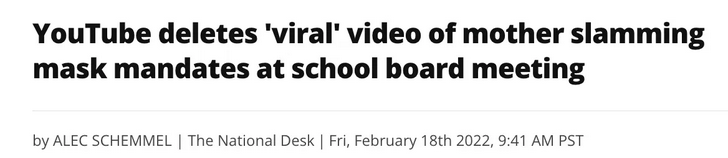
Early last year, an angry Virginia mom spoke to the Prince William County school board, blasting mask mandates in schools. Her fiery three-minute speech went viral, until YouTube, which now seems to mostly exist to prevent discussion, killed it:
It’s back, in a less-watched version that YouTube hasn’t gotten around to cancelling yet:
Here’s a version on Rumble, if you’d rather watch it there, but Substack doesn’t embed Rumble video.
The second thing to notice in that video, after you notice the clarity and strength of Merianne Jensen’s comments, is the response: an enormous audience of parents shouting and cheering in support as another parent sharply criticizes school district policy. The public is present for a government meeting, and the public is engaged. Citizens are participating, enthusiastically and in large numbers, which is supposed to be a thing we regard as an ideal.
[…]
Public comment is limited to one hour, full stop, no matter how many people wish to speak, and no matter how urgent a controversy before the board might be. The public — the entire public — gets an hour. But, second, that hour is alloted through an application process in which people who wish to speak to the school board fill out an online form that a clerk then evaluates and processes, deciding whether or not a request to speak will be granted. Detailed contact information is required before the school district will consider your request to speak, and national organizations and other outsiders have no right to speak at all, since public comment is limited to verified residents of the county. The form is a masterpiece of passive-aggressive nudging, communicating with great clarity that your desire to offer public comment is merely being tolerated. Read this carefully, because in a few minutes we’re going to get to the pernicious way this system is now being gamed:
This form does NOT confirm your request to be added to the list of speakers for Citizen Comment Time. You will receive a separate email indicating the status of your request. As a reminder, speakers are signed up to speak on a first-come, first-served basis.
Thank you again for your interest.
Citizens may sign up to be placed on the list of speakers for the citizen comment period starting at 8:00 a.m. on the Saturday immediately preceding the School Board meeting at which the citizen wishes to speak. Requests received prior to 8:00 a.m. on the Saturday immediately preceding the School Board meeting will not be honored. Speakers will be signed up on a first-come, first-served basis, ending at noon on the day of the meeting. The sign-up list will close once the number of total speakers who have signed up reaches twenty and there will be no sign-up thereafter, nor at the meeting.
That last sentence will become important: twenty commenters are signed up in advance, in the order in which they apply, and then the list for public comment is closed, the end. Can you see where this is going?
Before we get there, I’ll just note that a more detailed board policy on comments, available here, adds that the board chairman can end a public comment session, and ask school district security to remove speakers, if a commenter wanders into “inappropriate topics” or a tone the board regards as uncivil. You can feel the spontaneity and openness being drained.

Comments Off on “Wildly popular public sentiment is disorder, and has to be restrained”
October 8, 2023
Can we get back to de mortuis nil nisi bonum any time soon?
The Latin phrase refers to speaking nothing but good of the (recently) deceased, but as partisan passions rise, the urge to wave the bloody shirt and denigrate the dead overwhelms decency and common sense:

Of all the vices that can contribute to the collapse of civil society, a special place of honor surely needs to be reserved for mocking the newly murdered.
I don’t mean mocking the newly dead. The somewhat mawkish view that no ill should be spoken of the recently departed has always seemed rather priggish to me. It would, in fact, be absurd if we decided that in the wake of, say, Mitch McConnell’s or Noam Chomsky’s death, we couldn’t criticize their lives, careers, and beliefs. “If they’d given him an enema, they could have buried him in a matchbox” was my old friend Christopher Hitchens’ comment on the passing of Jerry Falwell. Rude, surely. Too soon, sure. But a swipe, not a gloat. And on Fox News. To Ralph Reed.
What crosses the line of what Orwell prized as “common decency” is using the occasion of someone’s untimely death to say they deserved it. “The homosexuals have declared war on nature, and now nature is exacting an awful retribution” was Pat Buchanan’s charming response to the outbreak of the AIDS epidemic. In the same vein today, on the other side as it were, there’s a “Herman Cain Award” subreddit with half a million members, devoted to naming and mocking vaccine skeptics who subsequently died of Covid. A giant, unified chorus of “ha-ha”s across the decades.
Social media and CCTV cameras have made the schadenfreude more visceral. This past week, a young “social justice” activist, Ryan Carson, was knifed to death on the street by a deranged 18-year-old assailant, as Carson’s girlfriend, paralyzed with shock, looked on. We might once have just heard of or read about this attack. Now we see it as it happens. Its reach might once have been limited by media gatekeepers. Now it can reach millions in a matter of hours on social media. And if you’re Elon Musk and your strategy for Twitter is to make it a more visual, visceral, sticky site, it’s gold. Within hours of Carson’s death, his last, terrifying moments were accessible to millions: a snuff video in all but name, now available to be monetized by gawkers.
And indecent gawkers. “It’s good to make fun of people who support criminals when they get murdered by criminals,” commented one on Twitter. “Ryan Carson took the phrase ‘bleeding heart liberal’ way too literally,” said another. (Carson’s actual heart was pierced by the murder weapon.) Other virtual tricoteuses went after the traumatized bystander: “Ryan Carson’s girlfriend is the Douche of the Week. 1. Showed almost no concern as her guy was murdered. 2. Expressed zero concern as he lay on the ground dying. Didn’t even bend down. 3. Refused to give police the murderer’s description. Soulless Marxist.” Another: “WHAT??? Ryan Carson’s girlfriend … started a GoFundMe page to make money off his death. I would tell her to eat trash but that’s cannibalism.” Or this: “She didn’t react when he was stabbed but she sure didn’t hesitate to raise $50k on go fund me. Makes you wonder.”
Makes you wonder what exactly? Twitter reminds me of Trump: you can’t believe it can go lower — until it always does.
I should stipulate, I suppose, that I doubt I would have been one of Ryan Carson’s favorite writers. His views on crime and policing were, to my mind, hopelessly naive and deeply counter-productive for real social justice. He also once tweeted upon news of Rush Limbaugh’s death — “lmao hell yeah” — and called himself, presumably with a wink, “COO of Antifa.” But many of us have lost our moral bearings in this cold civil war. And Carson was a human being, son of a mother and father, murdered senselessly, traumatizing a whole host of others. In that context, nothing else matters but his humanity. Lambaste his views; but don’t delight in his death even as millions can see his final, deeply vulnerable moments of panic and fear.
The same should be said to the online trolls who went after Josh Kruger, a lefty Philly journalist (and Dish reader) killed in his home this week, and Pava LaPere, a BLM-touting entrepreneur in Baltimore murdered brutally the week before. (I’ll spare you the Twitter comments.) The impulse to use anything to advance a narrative: this is how far we’ve sunk into bitter, vicious tribalism.
And is it me or is Musk’s Twitter obviously making all this worse, putting out more and more videos of street crime, bar fights, robberies, and brawls, often with racial tension fueling them? In our collective psyche there is the problem of mentally ill people committing crimes on the streets, and there is also the problem of everyone constantly seeing videos of mentally ill people committing crimes on the streets. It distorts our judgment; it privileges the vivid and violent over the lucid and peaceful. It normalizes and numbs us to violence and can incentivize it. And this emotive tribal priming makes us more likely to react to the deaths of our political opponents with glee.
The End of the Warsaw Uprising – WW2 – Week 267 – October 7, 1944
World War Two
Published 7 Oct 2023The Warsaw Uprising comes to its conclusion, a tragic one for the Poles. In the field in Europe, there are Allied attacks toward Aachen, Bologna, and Debrecen, while in China the Japanese have begun a new phase of their Ichi Go Offensive.
(more…)
Comments Off on The End of the Warsaw Uprising – WW2 – Week 267 – October 7, 1944
QotD: Internet – pro and con
Those of us who came of age before Endless September still regard the Internet as a tool. I can do online in two minutes what used to take me two hours in meatspace. For instance, when I first started working full time, I’d have to waste my entire lunch break on the first Monday of every month taking my physical paycheck down to the brick-and-mortar bank, where I’d fill out a bunch of paper to move money around, which I’d hand to a real person who took her sweet goddamn time filing it, and so on. Fight traffic all the way there, fight traffic all the way back, and yeah, that’s a full hour, even when the bank is relatively close. If that bank is closed, or there’s road construction or something, I’d have to spend all Saturday morning doing it, because banks kept bankers’ hours and so I’d better get there and get it done during the three-hour window the brick-and-mortar place was open. And since everyone else on earth was in the same situation …
These days, I’m hard pressed to remember the last time I stepped a real foot inside a physical bank. There’s simply no need. Everything is automatic. Which is convenient, no doubt, but that’s ALL it is: I’ve saved X minutes / hours in my day, which I can use to do other stuff. Other stuff like “see my friends” or “take a walk” or “read a book”. You know, real person stuff. I might read the book online; I might check my email if there’s nothing else to do; but there too the Internet is just a boredom-alleviation tool; something conveniently to hand that passes the time when there’s no other easily accessible way to pass the time.
I would find it inconvenient, sometimes extremely so, to throw the Pocket Moloch in the nearest lake, but the thought doesn’t fill me with dread. Oh, the Net’s down? Shrug.
Not so with the younger generations. I have friends I haven’t seen in weeks, months, years, but when we get together again, it’s like we were never apart, because we met in meatspace and have so much real, personal interaction to fall back on. Younger generations have “friends” they’ve never met in the flesh. Not once. Tell me “Hey, you’re not going to be able to see Tim for a few months” and it’s no big thing. I can still call Tim, or write Tim a letter, or just catch up with him when he gets back, to hear all the cool stories he has. Tell the younger folks “Tim is offline” and they freak the fuck out. Tim is inseparable from the Pocket Moloch in a way we oldsters can only dimly grasp.
They would, I’m sadly sure, prefer to interact with Tim entirely digitally. If you haven’t done it yet, try to find some young people hanging out in a group. It’s actually not the easiest thing to do – which should tell you something right there – but if you manage it, you’ll notice that they spend more time texting than they do talking to each other. And here’s the real kicker: Half the time, they’re texting each other. The same people who are physically right there.
That’s a mentality I can’t begin to grasp. I wonder if it can be broken. I’m not optimistic.
Severian, “Friday Mailbag”, Founding Questions, 2023-07-07.
Comments Off on QotD: Internet – pro and con
October 7, 2023
“Many people who hold ‘luxury beliefs’ … are oblivious to the consequences of their views”
Rob Henderson, guest-posting at The Free Press, illustrates several recent examples of well-connected people holding what he coined as “luxury beliefs” being suddenly introduced to the real-world consequences of their beliefs:
Recently, two high-profile supporters of “justice reform” were murdered.
At 4 a.m. on Monday, Ryan Carson, a 32-year-old social justice and climate change activist, was walking with his girlfriend in Bedford–Stuyvesant, Brooklyn, when he was stabbed to death by a stranger. Only a few hours earlier in Philadelphia, activist and journalist Josh Kruger was shot and killed in his home.
And two Democratic lawmakers who voted to “redirect funding to community-based policing reforms” have been recent victims of violent crime.
On Monday night, blocks away from the Capitol in Washington, D.C., Congressman Henry Cuellar was carjacked by three armed men. (The lawmaker survived the incident unscathed.) In February, Angie Craig was attacked in an elevator at her apartment building in Capitol Hill. A homeless man demanded she allow him into her home to use the restroom, then he punched her and grabbed her around the neck. She escaped after throwing hot coffee on him.
Of course, these people did not deserve harm because of their support for soft-on-crime policies. But I’ve long argued that many people who hold “luxury beliefs” — ideas and opinions that confer status on the upper class, while often inflicting costs on the lower classes — are oblivious to the consequences of their views. Support for defunding the police is a classic example.
Luxury beliefs can stem from malice, good intentions, or outright naivete.
But the individuals who hold those beliefs, the people who wield the most influence in policy and culture, are often sheltered when their preferences are implemented.
Some online commenters have said that my luxury beliefs thesis is undermined by these tragic events, because the victims were affluent and influential — and they still suffered the consequences of their beliefs.
But the fact remains that poor people are far more likely to be victims of violent crime. For every upper-middle-class person killed, 20 poor people you never hear about are assaulted and murdered. You just never hear about them. They don’t get identified by name in the media. Their stories don’t get told.
Comments Off on “Many people who hold ‘luxury beliefs’ … are oblivious to the consequences of their views”
October 5, 2023
The Soviet Spies who Kickstarted the Nuclear Arms Race
World War Two
Published 4 Oct 2023Last episode we saw Klaus Fuchs steal details of the American atomic bomb for the Soviet Union. But he’s only one component of a much bigger conspiracy. Today, Astrid introduces you to the mysterious web of Soviet atomic spies. Their work changed our world forever.
(more…)
Comments Off on The Soviet Spies who Kickstarted the Nuclear Arms Race
From Hilaire Belloc’s sailboat to your nearest international airport terminal
The most recent review at Mr. and Mrs. Psmith’s Bookshelf considers Hilaire Belloc’s The Cruise of the “Nona”:
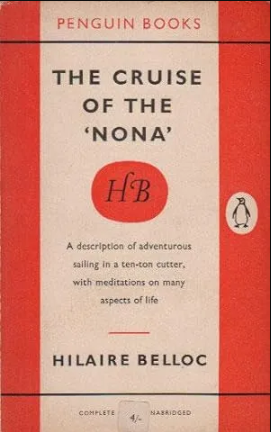
Late in the May of 1925, around midnight, Hilaire Belloc climbed into a tiny boat and put out to sea so that he would have some time to think. The sea gives ample time to think, especially if like Belloc you disdain the use of a motor. Some wag once jested that sailing is like being at war: long stretches of boredom punctuated by moments of abject terror. I suppose in some sense that’s correct, but give me the boredom of the sailboat any day over the boredom of the trench, the boredom of the cubicle, the boredom of endless doomscrolling.
Sailing is productive boredom, and seems unusually well calibrated for causing the mind to wander in interesting or delightful or just plain ridiculous directions. Maybe it’s the stimulating effects of the wind in your face and the smell of salt in the air, or maybe it’s the weird altered state of consciousness that comes from staring at the ocean. I think it’s because sailing is the human condition in miniature. It places you perfectly-balanced on a knife’s edge between agency and helplessness, and in so doing it both spurs the mind to activity and gives it space to relax and reflect.1
[…]
Anybody who’s travelled extensively in the third world has seen the modern version of this. There’s nothing intrinsic to being a reformer or a liberalizer that makes you an agent of American power, and yet … there’s a better than even chance that you are. After a while these people all blend together — the idealistic students, the LGBT activists, the NGO staffers, the embassy employees recruited from amongst the locals. They come from a hundred nations, from every conceivable race and religion, and yet something invisibly and inexorably molds them all into the same shape, like iron filings lining themselves up in the presence of a powerful magnet.
Soon they have American souls, and divided loyalties to match. The local regime panics and views them as an internal enemy, which only furthers their alienation from their motherland and their flight into the bosom of Global America. Most empires rule primarily though influence, not coercion, and this class of people is one of America’s most powerful weapons for maintaining and extending its hegemony.
A related phenomenon is the awful sameness that is slowly taking over the whole world. Perhaps your cruise ship docks at a dozen ports over the course of its journey, and every one of them looks exactly the same — the same tiki bar with the same sign, the same shops selling the same ornamental kitsch probably all made in the same factory. You aren’t visiting a place, you’re visiting a psychic manifestation of the Buffetverse, another outpost of Margaritaville, a Potemkin seaport with frozen daiquiris. You all know what I’m talking about. We make fun of it all the time, because cruise ships are for chuds. But it doesn’t just happen with cruise ships.
The cancer usually starts in an international airport. Form follows function, so it’s superficially reasonable that every airport on earth should look and feel exactly the same. But the real reason is that it follows in the wake of the kinds of people who fly into those airports, praising the broadening effects of foreign travel whilst terraforming everything they touch until it resembles the “arts district” of a midsize American city, replete with distressed wood finishes, gravid with craft beers. Real foreignness would cause these people to recoil in shock, or to demand a peacekeeping intervention. It’s not unusual for the imperial functionary class to be parochial, but what’s surreal about ours is how they combine the blinkered innocence of a farm boy with an ideology of weary cosmopolitanism.
None of this was as far along when Belloc took his little cruise, but the seeds had been planted, and he could feel in his bones that something horrible lay across the horizon. So he fights it the only way he knows how — by noticing and celebrating everything distinctive and local and weird about every place he visits. No island is too small for him to mention by name and recall a ghost story or two associated with it. No village is too commonplace for him to remark on the habits, physiognomy, and vices of the people who live in it. It’s the same spirit as that which animates Chesterton’s essay on cheese, but applied to a hundred hamlets and fishing ports, a paean to the regional diversity and distinctiveness that was already slipping away.
1. Oh hey, it’s the focused-mode and diffuse-mode of cognition! The best way to think deeply about anything is to toggle between them.
Comments Off on From Hilaire Belloc’s sailboat to your nearest international airport terminal
The Great War: Its End and Effects, Lecture by Prof Margaret MacMillan
McDonald Centre
Published 25 Jan 201922 January 2019, “How far did the Versailles Treaty make Peace?”, Professor Margaret MacMillan, Warden of St Antony’s College, Oxford. The lecture was sponsored by Christ Church Cathedral and the McDonald Centre for Theology, Ethics, and Public Life, Oxford.
Comments Off on The Great War: Its End and Effects, Lecture by Prof Margaret MacMillan


