
Professor Mark Crispin Miller teaches media studies at New York University (NYU) and is an expert in propaganda. Dr. Miller says just about everything concerning Covid was simply an elaborate exercise in propaganda. Dr. Miller explains, “The propaganda dimension is crucial to our understanding of what went down. Some people like to say this is a result of a number of ‘blunders’ by the health authorities and the government. ‘Blunders’. No, these are not ‘blunders’. When everything they recommend is deleterious and destructive of people’s health … When they suppress the truth about life saving remedies in furtherance of this so-called ‘vaccination program’, and when the so-called ‘vaccines’ have abysmal records for safety and effectiveness and those records are all hidden, we cannot reasonably conclude this is all the result of ‘blunders’. I have called the period from 2020 through the present a ‘Propaganda Masterpiece’. … Covid and every aspect of that whole crisis was engineered with extreme brilliance and sophistication of a propaganda operation. This was followed by the George Floyd moment. This served a number of purposes quite in line with the Covid crisis, which is to shut down society, cripple the economy and destroy the middle class … Also, another important aspect of this whole propaganda epic has been to divide the American people … No matter what side of the struggle we are on, what matters is the struggle took place at all. It is deeply divisive …”
Dr. Miller goes on to say, “I know a lot about propaganda, and this is unprecedented in the history of mass persuasion. There has never been anything like this because this is global. This has never happened before. We had Stalin’s crimes … We had Hitler’s aggression and the Holocaust. We had 911 and the ‘War on Terror’. None of those actually begin to compare to what we have now because what we have now is planetary. It’s worldwide.”
Dr. Miller does not call the CV19 bioweapon/vax a genocide. He says it is really a global democide. Meaning everyone and anyone is being murdered with the CV19 bioweapon/vax. Dr. Miller says, “My Substack is called ‘Died Suddenly’. I started it in February of 2022 when I noticed many, many people were dying suddenly for no given reason. In the history of obituaries, certainly in the United States, that is unprecedented. Obituaries always tell you why somebody died. Even if the person is very, very old, you have a cause of death. Now, all kinds of people are dropping dead for no reason and often very young … We do a weekly overview with as many pictures of these people as possible. This is the point. There are many statistical claims of the numbers of people who are dying … But as Stalin said, ‘One death is a tragedy, a million deaths is a statistic’. This is brutal, cynical wisdom, and he was absolutely right. If you read 1 million people starved in Ukraine, you say that’s too bad. If you look at page after page after page of people’s faces and names with the names of their survivors, it’s not so easy to shrug off.”
Greg Hunter, “CV19 – A Propaganda Masterpiece – Mark Crispin Miller”, USAWatchdog, 2023-06-10.
October 5, 2023
QotD: The Wuhan Coronavirus pandemic was a “propaganda masterpiece”
October 4, 2023
“John Adams said that a republican constitutional structure didn’t guarantee republican virtue in government”
Chris Bray reflects on the 17th amendment to the US Constitution in light of the appointment of California’s new senator:
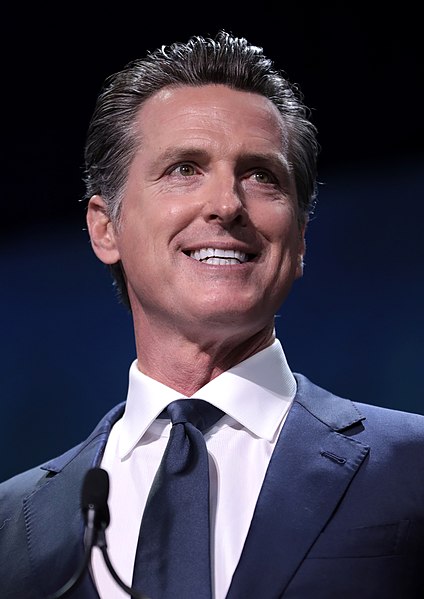
California Governor Gavin Newsom speaking at the 2019 California Democratic Party State Convention in San Francisco, California on 1 June, 2019.
Photo by Gage Skidmore via Wikimedia Commons.
… the Senate was supposed to be the national storehouse of wisdom, restraint, discipline, and worldly experience. You may already be seeing that we wandered away from this idea at some point.
The 17th Amendment, ratified in 1913, gave voters the power to directly elect senators, reducing the influence of state legislatures and opening the upper house to mass media popularity contests. The 16th Amendment — “Congress shall have power to lay and collect taxes on incomes” — was ratified the same year, a one-two punch of Progressive centralization of power.
The democratizing and centralizing character of the 17th Amendment gave us a parade of powerful idiots that culminated in John Fetterman, passing through Mazie Hirono and the professional Ted Baxter impersonator Sheldon Whitehouse, so it looks like a failure. But we’ve just run an experiment, thanks to Dianne Feinstein’s white-knuckled grip on her personal status, and the results are … interesting.
The California legislature, in its infinite wisdom, has given the governor the unilateral authority to appoint Feinstein’s replacement, so we’re not quite seeing the exact duplicate of the original constitutional design for the Senate. But we’re seeing something like it: a senator chosen by something other than the popular vote, elevated to the Senate after selection by a longtime state official who has deep personal familiarity with the pool of people who might do the job. You know, a statesman.
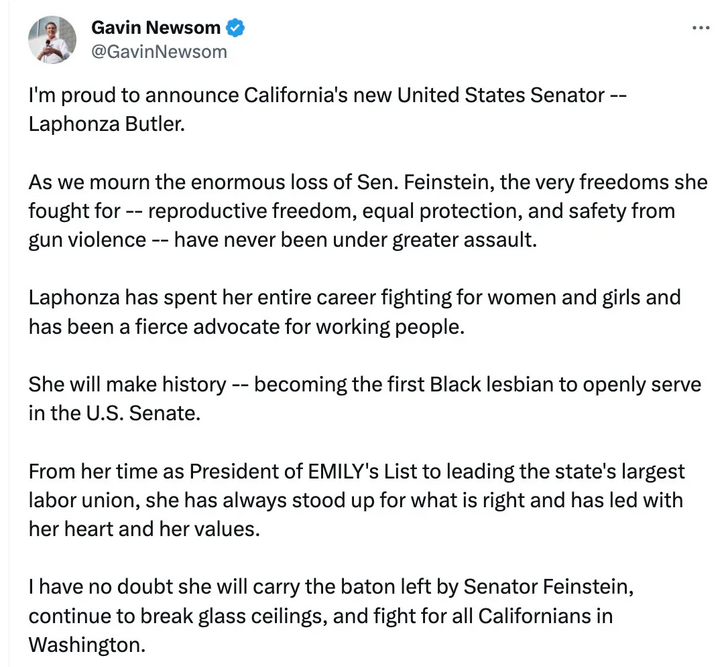
Newsom’s choice for Feinstein’s seat is almost miraculous in its awfulness, an appointment distinguished by cravenness and sleazy insiderism. Naming a new senator from a state with 39 million people in it, he has chosen the Maryland resident Laphonza Butler — who has never held any elected office anywhere.
Butler is a career activist and party hack, an SEIU official who went on to run the abortion PAC EMILYs List. She is, in other words, one of the people whose function in life has been to raise money for the Democratic Party. She’s an ATM, and she’s never been anything else. She’s being appointed to the United States Senate without having ever convinced any voters anywhere to elect her to anything, and she’s rising to the upper house of the national legislature with no experience of any kind in any relevant field. Advice and consent on foreign policy? Confirmation of judicial nominees? Well, she has experience raising money for candidates, so. It’s a straight payoff: generate cash for the party for twenty years, get a free high-status ride in the Senate.
Here’s how Newsom explains the choice:
She’s a black lesbian who gives us money, end of statement. California’s idiot politicians find the choice exciting.
October 3, 2023
The William Tell Aerial Gunnery Competitions; The CF-101 Voodoo in action
Polyus
Published 23 Aug 2021William Tell: an aerial gunnery competition to assess NORAD’s interceptor squadrons. Canadian CF-101s entered 7 of these competitions and won 3 overall “Top Gun” awards as well as one “Top Unit” award. Pretty impressive results when considering how few squadrons Canada fielded as compared with the vast United States Air Force. Results confirmed that the CF-101s on quick reaction alert at bases across the country were indeed useful in their defense.
(more…)
QotD: The meteorologically mild 20th century
[…] I read a lot of history and thus know a fair bit about how weather impact has been perceived by humans over time. It is a fact that the 20th century was an abnormally lucky hundred years, meteorologically speaking. The facts I managed to jam into tweets included (a) the superstorm that flooded 300 square miles of the Central Valley in California in the 1860s, (b) rainfall levels we’d consider drought conditions were normal in the U.S. Midwest before about 1905, and (c) storms of a violence we’d find hard to believe were commonly reported in the 1800s. I had specifically in mind something I learned from the book Wicked River: The Mississippi When It Last Ran Wild, which relays eyewitness accounts of thunderstorms so intense that travelers had to steeple their hands over their noses in order to breathe air instead of water; but a sense that storms of really theatrical violence were once common comes through in many other histories.
We had a quiet century geophysically as well – no earthquakes even nearly as bad as the New Madrid event of 1812, which broke windows as far north as Montreal. And no solar storms to compare with the Carrington Event of 1859, which seriously damaged the then-nascent telegraph infrastructure and if it recurred today would knock out power and telecomms so badly that we’d be years recovering and casualties would number in the hundreds of thousands, possibly the millions.
(I’m concentrating on 19th-century reports because those tended to be well-documented, but earlier records tell us it was the 20th century calm that was unusual, not the 19th-century violence.)
The awkward truth is that there are very large forces in play in the biosphere, and when they wander out of the ranges we’re adapted to, we suffer and die a lot and there really isn’t a great deal we can do about it; we don’t operate at the required energy scales. For that matter, I can think of several astronomical catastrophes that could be lurking just outside our light-cone only to wipe out all multicellular life on Earth next week. Reality is like that.
But none of this would fit in a tweet, so what I said in summary was that this may be the new normal – or, rather, the old normal returning. Humans didn’t do it.
Eric S. Raymond, “Heavy weather and bad juju”, Armed and Dangerous, 2011-02-03.
October 2, 2023
Why France Lost Vietnam: The Battle of Dien Bien Phu
Real Time History
Published 29 Sept 2023After the French success in the Battle of Na San, the battle of Dien Bien Phu is supposed to defeat the Viet Minh once and for all. But instead the weeks-long siege becomes a symbol of the French defeat in Vietnam.
(more…)
Glenn Reynolds explains “why leftist groups use underage kids as their stalking-horses, shock troops, and human shields”
In his most recent Substack post, Glenn Reynolds (aka the “Instapundit”) grants the late Senator Dianne Feinstein a kind mention before digging into the widespread phenomenon of progressive groups using children and younger teens as their public face:

One reason is the “culture of youth”, with dates back to around the time I was born. The notion – alien to human civilization for almost its entirety – was that younger people know more, are more insightful, and deserve more attention than older people.
The problem with this argument is that it is absurd. (There’s a reason why it’s alien to pretty much all previous human civilization, and it’s not because previous human civilization didn’t know what it was doing). Well, that’s one problem. Another problem is that it is manipulative and dishonest. And it’s sufficiently damaging for the young people involved that it borders on abuse.
First, the manipulative and dishonest part. Kids are cute; people instinctively (literally) like them. Associating them with your ideology is intended to produce a halo effect. (Even the Nazis did this.)
But people’s natural feelings toward adorable kids, like their feelings for puppies, baby goats, etc., have nothing to do with policy. Relying on something like that is practically an admission that your views lack substance.
Likewise, the fact that kids believe your views means nothing. Kids believe in Santa Claus, the Tooth Fairy, and superheroes. The very essence of kidhood is the inability to reliably make rational choices. We recognize this with laws setting the age of consent for sex, a drinking age, and a voting age, as Sen. Feinstein pointed out.
The really manipulative part, though, lies in sending kids to express your views, then calling it abusive if people point out that the views they’re expressing are stupid. (We got this all the time with children’s crusaders like David Hogg and Greta Thunberg until they became too old for it to work, at which time their stars began to set.)
If your ideas need to be expressed by people that others aren’t allowed to criticize, that’s a solid indicator that your ideas can’t withstand criticism, because they’re stupid.
It’s also abusive to put kids through this. Telling kids that they’re needed to save the world may fit Harry Potter / Percy Jackson childhood fantasies – but putting that pressure on them in the real world is enormously stressful. Turning kids to crusaders tends to end badly – see, e.g., the original Children’s Crusade – and is likely to be emotionally draining and damaging for them at the very least. Kids shouldn’t take responsibility for the world. That’s adults’ job. Encouraging them to do so for political ends is abusive and wrong.
Nonetheless political groups do this all the time, and usually don’t get a lot of pushback. I think it’s time for that to end.
October 1, 2023
The End of Market Garden – WW2 – Week 266 – September 30, 1944
World War Two
Published 30 Sep 2023This week, Operation Market Garden comes to its unsuccessful conclusion, but there’s a lot more going on — the Soviets launch an offensive in the Estonian Archipelago, the Warsaw Uprising is on the ropes, the Allies advance in Italy, the Americans on Peleliu, and Tito and Stalin make plans to clear Yugoslavia of the enemy.
(more…)
September 30, 2023
The Man Who Stole the Atomic Bomb
World War Two
Published 29 Sep 2023In the New Mexico desert, a secret team of scientists is working flat out to develop atomic bombs. It’s the most important American military project in history. But one of those scientists lives a double life. Klaus Fuchs has decided to betray his country and share America’s most secret technology with the Soviet Union. But is he the only person who has turned traitor?
(more…)
QotD: Incentives matter, college student edition
Which is an odd position for someone who spent as long as I did toiling in the groves of academe to take, I realize. So let me explain: As with the Vibrancy, I dislike their behavior – intensely. But I don’t blame them for acting that way. If you want to know what’s wrong with our entire Postmodern, homo economicus way of looking at the world, there you go. I don’t blame them, because they have every rational incentive to behave that way, and none not to (indeed, acting other than they do comes with a considerable cost).
College kids don’t read, don’t study, don’t do anything other than attempt, insofar as possible, to regurgitate lectures word-for-word on the “exam”, after which they promptly forget everything. Once more, with feeling: I do not blame them for this, since pretty much everything they “learn” is so worthless, it’s antimatter education. I’m not joking when I say it’s all just Social Justice Mad Libs: “The [group] was oppressed by Whitey through [adjective] [adjective] [noun], and that’s why Pale Penis People are evil.”
For example, I taught for a few semesters at a college that tried very hard to run “African-American” versions of core classes as a marketing stunt. There was “US History to 1865”, for example, and, in parallel, “African-American History to 1865.” Leaving aside the fact that you could cover the whole fucking course in about five minutes – “there sure was a lot of slavery back then!” – even the faculty, all of whom were of course raving SJWs, laughed at the sheer pointlessness of it. “US to 1865” was already nothing but “Negroes and Lesbians save the Republic!”, or vice versa, depending on whether or not the prof teaching the course this semester was the Angry Black Feminist Marxist, or the Angry Marxist Feminist Lesbian.
Severian, “College Kids”, Rotten Chestnuts, 2020-12-12.
September 28, 2023
QotD: “Tenure Track” positions in an American university
A tenure-track position begins with a national (or international) search and a fairly long hiring process (from job-posting to job-offer usually takes around 6-8 months). A newly hired professor is an assistant professor, which means they are on the tenure track but do not yet have tenure. Instead, after about five to six years, they’ll go up for tenure review, where a committee of faculty in their department along with some external reviewers will look at all of the work the professor has done since their appointment and either recommend them for tenure or not; the university leadership structure typically has a role in confirming a grant of tenure but this is generally a rubber-stamp role. By far the most important part of tenure review at large universities is research; this is the part of the system that is “publish or perish”.1 Untenured tenure-track faculty (so, assistant professors) represent roughly 9% of all faculty members in the United States, according to the AAUP.
A professor that passes tenure review becomes an associate professor, which confers tenure (making it difficult to fire them) as well as a bump in pay. After another few years, they can go up for review again for promotion to the next rank, simply professor (often termed “full professor” for clarity), which comes with another bump in pay. This second transition is different from the first though; whereas the review from assistant to associate professor is an “up or out” moment (you either get tenure and stay or get rejected for tenure and leave the department), some professors can and do remain associate professors forever. Finally, a handful of professors who really distinguish themselves may wind up with an endowed chair and we tend to call these folks distinguished professors, though their actual job title will usually be something like “the so-and-so Professor/Chair of this-and-that” where the ‘so-and-so’ is the name of the donor that endowed the money being used for the distinguished professorship. Tenured professors represent roughly 24% of all university professors according to the AAUP, meaning that the total slice of tenured or tenure-eligable professors in higher education is just 33% – one third.
Let me say that again: only one third of all faculty work the way all of you think all faculty works. Just one third. This is a big part of what I mean when I say that the United States’ university system is being pillaged without the public knowing; if you told most people “only one third of college instructors are actually professors, most of your little Johnny’s classes are taught by non-professors now“, they’d be shocked! But that’s the current situation.2
Tenure-track professors generally teach a fixed course-load, expressed in most cases as a load over semesters, so a “2/2” (pronounced “two-two”) load is four courses a year (two in each semester). Tenure-track faculties at research-focused universities (which are all of the flagship state schools) generally teach a 2/2 load; mixed research/teaching schools (your third-string state schools and less well-funded private schools) often have 3/3 loads. Teaching-focused institutions may have 4/4 or 5/5 teaching loads (or more) and of course fractional loads (like a 2/3, etc.) do exist, but are less common.
In addition to teaching, tenure-track faculty are expected to publish research and do “service”. We’ll talk in another post more about these demands (indeed, we’ve talked about research already), but they deserve a few words here. The amount of research demanded varies by the level of institution; at an R1 the general expectation for a faculty member going for tenure in a humanities department is that their book is out3 and they have a good number of articles and other publications besides. At less research-focused universities, you might see instead that tenure is set at a certain number of articles and the book is instead at the jump to full professor.
Meanwhile “service” refers to all of the non-teaching roles faculty fill in a department. The university is predicated on self-governing departments of academics (“colleges” in the literal sense of an association of colleagues) and so departments are effectively run by committees and faculty appointed to do various key roles: student advising, graduate admissions committees, hiring committees, committees on teaching, and of course department chair (and possibly vice or assistant chairs) who steers the department. Of course faculty are assisted in those roles by the department staff who handle much of the paperwork, compliance and book-keeping. Some, but by no means all, of these service jobs come with a “course release” which is to say the faculty member teaches less in order to do the extra service, but there is an expectation of a certain amount of service work always being part of the workload mix.4
Finally, the more important service positions are often restricted to either associate or full professors – you have to get tenure first before you get a particularly loud voice in the running of the department. Nevertheless, even assistant professors are going to be “in the room” when decisions about courses, resource allocation, scheduling, and so on are made, which matters quite a lot. Moreover, because even assistant professors are expected to become permanent members of the department, their interests tend to be considered because, well, frankly, the tenured professors have to live with them for the next few decades, so you might as well be friends. This fact is really important for understanding why departments can be so callous to anyone not on the tenure-track (and why tenure-track faculty can be so oblivious to how callous they are being), because NTT faculty are usually not in the room when decisions are made.
Bret Devereaux, “Collections: Academic Ranks Explained Or What On Earth Is an Adjunct?”, A Collection of Unmitigated Pedantry, 2023-04-28.
1. A phrase that I am sick to death of hearing, but it seems to be functionally the only thing most people in the public know about academia and also the thing that select members of the public seem to think we need repeated to us at every possible opportunity, as if we’re not aware. It’s useless in any case, in history at least. Which hiring numbers being what they are now, by far the most common career path is in fact, “publish and then perish”.
2. In fact, COVID made these numbers look better than they had in the years previously, not because universities hired more tenure-line professors (they didn’t), but because they fired a lot of non-tenure line professors due to COVID, taking advantage of their lack of job protection.
3. In yesteryear, a book simply forthcoming was good enough. These days, that might not even be good enough to get hired as this entire system breaks down. By the end of 2022, I had actually qualified for tenure at the institutions which did not hire me in 2020; I still do not have a tenure track job.
4. So for instance being department chair often comes with a course release, but being on a committee or serving as an undergraduate or graduate advisor often doesn’t.
September 25, 2023
Something, something “sins of the fathers”, something, something Elon Musk
Chris Bray provides an example of how “mainstream psychosis” has become the new normal, at least among academics and our so-called “elites”:
My argument is not “the news media lies”, or “there’s a lot of misleading discourse”. My argument is that whole overlapping layers of high-status America — in academia, in media, and in politics — are psychotic, fully detached from reality and living in their own bizarre mental construction of a fake world. I don’t mean this figuratively, or as colorful hyperbole. I mean that the top layers of our most important institutions are actually, literally populated by people who are insane, who have cultivated a complete mental descent through the looking glass.
So: Jill Lepore.
Lepore is as high-status as it’s possible to be. She holds an endowed chair at Harvard, she has a Bancroft, and she’s been on the masthead at the New Yorker for almost two decades. She has about as much institutional validation as an academic historian can get. And she just published an essay that wouldn’t be out of place in foot-high crayon letters on the wall of a mental institution.
“What happened to antisemitic rants before social media”, is the actual subhed. You see, before Twitter, people who said that Jews were bad were very marginal, and no one ever listened to them. At the risk of giving away too much personal information, I’m writing this in a bar, and the bartender is giving me some fairly aggressive side-eye over the burst of nervous laughter that I just dropped. Musk’s grandfather was named J.N. Haldeman, and he wrote a lot about how much he didn’t like Jews, and here’s what Lepore has to say about that:
But Haldeman’s legacy casts light on what social media does: the reason that most people don’t know about Musk’s grandfather’s political writings is that in his lifetime social media did not exist, and the writings of people like him were not, therefore, amplified by it. Indeed, they were very unlikely to circulate widely, and are now quite rare.
Jill Lepore has a PhD in history, and she thinks that antisemitic speech was quite rare before social media. Here’s a link to a non-paywalled version of the essay, and I encourage you to go read it. Otherwise you’re going to struggle to believe me. See for yourself, and then come back and I’ll talk about it.
How, if you want to argue that negative statements about Jews had little reach before social media, do you explain … Jewish history? Why didn’t they have time for the bread to rise, Jill? Before Twitter, screeds against Jews “were very unlikely to circulate widely,” except for, I don’t know, Mein Kampf? We dip the parsley in the salt water to remember the bitter tears of our ancestors, who never faced any antisemitism because it was very marginal and never allowed to circulate widely.
It gets better, though, because Haldeman was born in Minnesota, then raised in Canada, and then moved to South Africa two years after the formal implementation of apartheid. He wrote white supremacist tracts in apartheid South Africa, and Lepore maintains that the reach of his racist literature was sharply limited by the absence of social media. See, it was very rare to be able to read racist views in apartheid South Africa.

Girardoni Air Gun (original 1780 example)
Forgotten Weapons
Published 7 Jun 2014The Girardoni (also spelled Girandoni) air rifle was a very advanced design adopted in 1780 by the Austrian Army. While the standard arm of the day was a single-shot flintlock, the Girardoni offered a massive firepower advantage to the men who carried it. The guns (designed by Bartholomäus Girardoni, of Vienna) had a magazine capacity of 22 round balls, which could all be fired within 60 seconds. The balls were .46 caliber, weighing approximately 153 grains, and were propelled at 400-450 feet per second. They were rumored to be silent, but actually had a loud report (although quieter than gunpowder firearms). One of these rifles was carried by the Lewis & Clark expedition into the American West.
The Austrian Army used them for a relatively short time — they were taken out of service by Imperial order in 1788, and issued back to Tyrolian sniper units only in 1792. The reasons for their replacement were more logistical than the result of any actual shortcoming with Girardoni’s design. The problem was that they required special training to use (compared to a normal firearm), required specially trained and equipped gunsmiths to repair and maintain, and difficulty maintaining them in combat conditions. Dr. Robert Beeman has written an outstanding illustrated article on Austrian airguns in general and the Girardoni in particular, which I highly recommend for anyone interested in more detail on these fascinating weapons:
http://www.beemans.net/Austrian%20air…
However, I am privileged to be able to share with you this video of an original 1780 Girardoni put together by Luke Haag for presentation at the 2014 AFTE conference in Seattle. Mr. Haag does a great job explaining the operation of the gun, its capabilities and accessories.
QotD: The economics of American slavery
Economists have been thinking about such issues for half a century. You wouldn’t know it from the King Cottoners. They assert, for example, that a slave was “cheap labor”. Mistaken again. After all, slaves ate, and they didn’t produce until they grew up. Stanley Engerman and the late Nobel Prize winner Robert Fogel confirmed in 1974 what economic common sense would suggest: that productivity was incorporated into the market price of a slave. It’s how any capital market works. If you bought a slave, you faced the cost of alternative uses of the capital. No supernormal profits accrued from the purchase. Slave labor was not a free lunch. The wealth was not piled up.
The King Cotton school has been devastated recently in detail by two economic historians, Alan Olmstead of the University of California at Davis and Paul Rhode of the University of Michigan. They point out, for example, that the influential and leftish economist Thomas Piketty grossly exaggerated the share of slaves in U.S. wealth, yet Edward Baptist uses Piketty’s estimates to put slavery at the center of the country’s economic history. Olmstead and Rhode note, too, from their research on the cotton economy that the price of slaves increased from 1820 to 1860 not because of institutional change (more whippings) or the demand for cotton, but because of an astonishing rise in the productivity of the cotton plant, achieved by selective breeding. Ingenuity, not capital accumulation or exploitation, made cotton a little king.
Slavery was of course appalling, a plain theft of labor. The war to end it was righteous altogether — though had the South been coldly rational, the ending could have been achieved as in the British Empire in 1833 or Brazil in 1888 without 600,000 deaths. But prosperity did not depend on slavery. The United States and the United Kingdom and the rest would have become just as rich without the 250 years of unrequited toil. They have remained rich, observe, even after the peculiar institution was abolished, because their riches did not depend on its sinfulness.
Dierdre McCloskey, “Slavery Did Not Make America Rich: Ingenuity, not capital accumulation or exploitation, made cotton a little king”, Reason, 2017-07-19.
September 24, 2023
Operation Market Garden Begins – WW2 – Week 265 – September 23, 1944
World War Two
Published 23 Sep 2023Monty’s Operation(s) Market Garden, to drop men deep in the German rear in the Netherlands and secure a series of bridges, begins this week, but has serious trouble. In Italy the Allies take Rimini and San Marino, but over in the south seas in Peleliu the Americans have serious problems with Japanese resistance. Finland and the USSR sign an armistice, and in Estonia the Soviets take Tallinn, and there are Soviet plans being made to enter Yugoslavia.
(more…)
Architect Breaks Down Why All American Diners Look Like That | Architectural Digest
Architectural Digest
Published 1 Jun 2023Today Michael Wyetzner of Michielli + Wyetzner Architects returns to Architectural Digest to explore the design evolution of American diners. A cornerstone of American dining culture, their distinctive style has been emulated around the world making them a popular salute to the USA. Michael provides an expert look into the history behind their design evolution from the 1920s through to the 1960s and explains why all diners came to look like that.
(more…)


