
In the 1300s the Black Death swept through England and killed somewhere between a third and half of the entire population. Entire villages emptied. Labour shortages reshaped the economy. And the survivors started moving. Massive waves of migration poured into London and the southeast from every corner of the country, bringing with them dozens of regional dialects that had never been in the same room before.
And somewhere in that collision of accents and dialects, something shifted. Literally. The vowels started moving.
Between roughly 1400 and 1700 every single long vowel in the English language changed how it was pronounced. It’s called the Great Vowel Shift. Before it happened, English vowels worked the way vowels work in Italian or Spanish. The letters did what they looked like they should do. “Bite” was pronounced “beet”. “House” was pronounced “hoos”. “Name” was pronounced “nahm”. “Knight” was pronounced “k-nicht” with a guttural sound at the end like you were clearing your throat. English was phonetic. The spelling matched the sounds. It made SENSE.
And then it didn’t.
All the long vowels began migrating upward in the mouth. The tongue positions shifted higher and higher over the course of about 300 years. And the vowels that were already at the top had nowhere left to go so they broke apart into two sounds. “Ee” became “eye”. “Oo” became “ow”. A 300-year linguistic pileup that nobody voted on and nobody agreed to. It just happened. And it happened during the worst possible window of time.
William Caxton brought the printing press to England in 1476. One of the most important technological developments in the history of communication. And it arrived RIGHT IN THE MIDDLE of the Great Vowel Shift.
Caxton started standardizing English spelling based on how words sounded at that exact moment. Printers needed consistency. They needed to pick a spelling and commit. So they did. But the sounds kept changing after the spelling was already locked in. The vowels were still moving. The consonants were still dropping. And the printed page couldn’t keep up.
We had ONE CHANCE to get English spelling right and we fumbled it at the worst possible moment.
This is why English spelling is a disaster. It’s not random. It’s not lazy. It’s a snapshot of a language mid-transformation that got frozen in place by a new technology and was never corrected. Every word you have ever misspelled, every silent letter that made you feel stupid, every time you stared at “knight” and thought why is there a K in this. You used to pronounce that K. You used to pronounce that GH. Those sounds died 500 years ago and the letters are still standing there like gravestones. English spelling is full of ghosts.
That’s why “food” and “good” and “blood” are spelled almost identically but sound completely different. In Chaucer’s time around the 1390s they all rhymed. In Shakespeare’s time around the 1600s they still rhymed but with a different vowel. And then sometime after that they each went their own separate way and the spelling just stood there watching like it had given up entirely.
And HERE IS THE THING. Other languages went through similar vowel shifts. German had nearly identical changes happen to its long vowels around the same period. And German just updated its spelling. They adjusted the orthography to match the new pronunciation. Like reasonable people. English looked at the same problem and said no. We’re going to keep the old spelling. Everyone will simply have to deal with it. Every person who has ever stared at “though” and “through” and “thorough” and “thought” and wondered why four words that look almost identical are all pronounced differently? Collateral damage. Five hundred years of collateral damage and we just accepted it.
Ok so that’s the vowels. That’s the background. Now we get to the accents and this is where I lost my mind.
The single biggest difference between standard American English and standard British English today is something called rhoticity. This is a real linguistics term even though it sounds completely made up. Rhotic speakers pronounce the R sound in words like “hard” and “car”. Non-rhotic speakers drop it. “Hard” becomes “hahd”. “Car” becomes “cah”. That one feature is doing like 80 percent of the work when your brain hears someone speak and categorizes them as British or American.
Here’s what nobody told you.
In 1776 everybody was rhotic. Americans AND the British. Both sides of the Atlantic pronounced their Rs. The fancy non-rhotic accent that we now think of as THE British accent, the one you hear in your head when someone says “British accent”, the one every villain in every movie has? That accent did not exist yet. It developed in the late 18th and early 19th centuries when the upper classes in southern England started dropping their Rs as a prestige marker. A fashion statement. And then it spread downward through society and outward through the Empire.
The accent we associate with the British Empire is actually newer than the American Revolution.
I need to say that again because it didn’t land the first time I heard it either.
The accent that we think of as “British” is newer than the country that broke away from Britain. Americans didn’t lose the British accent. The British lost the British accent. Americans are the ones who kept it.
Emma, “The Plague That Broke English (And Why the Founding Fathers Didn’t Sound British)”, Past Life, Present Cleavage, 2026-04-03.
August 5, 2026
QotD: “This is why English spelling is a disaster”
August 3, 2026
Invasion of Iraq, 2003
Real Time History
Published 6 Mar 2026In March 2003, a US-led coalition invades Iraq. US President George W. Bush claims he must disarm Iraqi dictator Saddam Hussein of weapons of mass destruction and depose a brutal regime supporting global terror. But after a lightning capture of Baghdad and other Iraqi cities in the south, the war is far from over.
(more…)
August 2, 2026
“Cash for Clunkers” – the seen and the unseen
French economist Frédéric Bastiat explained why the “Cash for Clunkers” program would fail … and he wrote about it more than a hundred years before it happened – “That Which is Seen, and That Which is Not Seen”. The US government publicized the “seen” … removing older cars from the roads in pursuit of lowering pollution. Nobody publicized the “unseen”, as Handre explains:

The Cash for Clunkers program, which Congress passed in June 2009 and burned through its $3 billion budget in under two months, destroyed functional wealth on a national scale, and somehow they called it “stimulus”.
The mechanics were simple: trade in a working car, receive up to $4,500 toward a new one, and watch government employees pour sodium silicate into the old engine to make it seize permanently. Around 700,000 vehicles got crushed. These were not rusted-out death traps. The eligibility rules required the trade-in to be drivable and insured. You were watching the state systematically annihilate usable capital because Keynesian demand theory told it that destruction generates recovery. Frederic Bastiat explained why this is wrong in 1850, in an essay short enough to read on your lunch break. Congress ignored it.
The ripple effect hit people the government never mentioned in its press releases. Mechanics lost repair work. Used-car dealers watched their inventory evaporate. Low-income buyers who depend on the sub-$5,000 market faced prices that jumped roughly 10% in the years after the program. Free market economists call this “seen versus unseen”. Politicians only showed you the gleaming new Chevy Malibu driving off the lot. They never showed you the single mother in Akron who needed a $3,000 Corolla and found nothing affordable left on the lot.
Even the environmental justification collapsed under basic scrutiny. A 2009 study by Resources for the Future calculated that the program cost between $237 and $365 per ton of carbon dioxide reduced. The voluntary carbon credit market at the time priced a ton around $10 to $20. The government spent up to thirty times the market rate to achieve an environmental outcome the market was already pricing far more efficiently.
This is what central planning always does. It takes your money, destroys real assets, and transfers wealth from the poor to auto manufacturers and their financiers. The program’s designers received awards. The Akron mother paid higher prices. The engines sat crushed in junkyards. Nobody in Washington answered for any of it.
August 1, 2026
Homelessness isn’t the real problem … it’s feral humans
Many well-meaning people see “homeless” individuals on the street and think the problem is that these individuals don’t have homes. An obvious solution occurs: we’ll just give them homes so they won’t need to sleep rough on the streets. What a great idea! With the best of intentions! What could possibly go wrong?
The real problem isn’t that there aren’t enough homes … some of those “homeless” people on the street actually do have places to sleep but for one reason or another choose not to. The real problem for most of them is that they’ve gone feral:

If you give problems the wrong names, you can’t understand them.
If you can’t understand problems, you can’t fix them.
There are almost no homeless people in America. There are only feral humans.
A homeless person is someone whose distinguishing feature is not having a home. I was homeless once, for a day, when the lease on one apartment expired before the next one was cleaned, repaired, and ready.
I parked a moving van full of my worldly possessions at my university, and slept on a couch in the student commons.
That’s “homeless”.
“Feral” is when a human cannot live within society, or comply with the basic expectations required for membership.
Yes, they do not have homes.
But this is not their distinguishing feature. Because they also don’t have jobs, sanity, sobriety, manners, morals, or hygiene.
Which is why they do not have homes.
If you give them a house, because you think they are “homeless” rather than “feral”, then they will simply repeat, within that structure, the same feral behavior.
And soon that structure will be uninhabitable.
Which, for certain people, is the whole point.
A man whose job is to sell 3d printed houses isn’t trying to fix the feral-human problem. He’s trying to sell 3d printed houses.
And it’s one hell of a lot easier to sell them to bureaucrats who aren’t spending their own personal money.
It doesn’t matter if 3d printed houses suck to live in. It doesn’t matter if the feral humans trash them. Nobody in this equation cares about the feral humans, even the feral humans themselves.
And nobody in this equation cares about the taxpayers. If the feral humans are still feral, then the 3d house grifters can sell more gimmick houses, and the bureaucrats can spend more of someone else’s money.
If a violent political upheaval becomes necessary, this will be very unpleasant for everyone involved, but at least afterwards, we will all be able to use the feral humans, bureaucrats, and grifters to fertilize the garden of new homes.
Which will be made out of bricks.
Update, 2 August: Welcome, Instapundit readers! Have a look around at some of my other posts you may find of interest. I send out a daily summary of posts here through my Substack – https://substack.com/@nicholasrusson that you can subscribe to if you’d like to be informed of new posts in the future.
Eugene Stoner’s Future Assault Rifle Concept (F.A.R.C.)
Forgotten Weapons
Published 6 Mar 2026After developing the AR-15 with Armalite, Eugene Stoner worked for a number of different companies. In 1972 he co-founded Ares Inc, where he and his partners worked on a wide variety of weapons platforms. Their work included rapid-fire cannons and full-fledged artillery as well as small arms. The first of those small arms was the Future Assault Rifle Concept — FARC. This was a gas piston, rotating bolt 5.56mm rifle design with a number of interested elements. The FARC-1 was a concept on paper only, leading to production of a few FARC-2 and FARC-3 prototypes. The project was cancelled in the wake of the end of the Vietnam War as funding for such things was much less readily available.
(more…)
QotD: The “tiers” of US post-secondary education
Level two is your SPLACs [Small Private Liberal Arts College (the denizens of a SPLAC are of course Splackavellies, in honor of the stupidest song of the 1990s, which is an amazingly high bar)]. The Ivy League schools are SPLACs, and the rest of them are their lesser (sometimes extremely lesser) imitators. You don’t need to publish squat to get tenure at Yale or Harvard if you bring something else [visible diversity, for example] to the table.
The third level is the junior college level. They call themselves “community colleges” in most cases — can’t use junior, it’s able-ist or age-ist or some shit-ist — but you know what I mean. Lots of kids do their first two years at one, getting all the BS “liberal arts” requirements out of the way before they transfer to Ohio State (etc.) to do their major classwork, so lots of History (etc.) profs work at JuCos. (This is the way to do it if you feel you must go to college for some reason, which 90% of the time you mustn’t).
I’ve done time at all three, because of academia’s worst-kept secret: Something like 75% of ALL classes, nationwide, at all levels and in all disciplines, are taught by non-tenure track faculty. Lots of these instructors are grad students, who will theoretically go on to get tenure-track jobs, but there’s a vast floating pool of scab labor known as “adjunct professors”, and I was one of those — a guy with a PhD who isn’t on the tenure track …
… and now never will be, because “adjunct professor” is like “sex worker” — yeah, it’s theoretically just a job now, but good luck getting hired to do anything else once it’s on your resume.
In my case that was by choice, as I loved my field, I loved teaching, but I did NOT love all the rest of the shit that goes along with university employment, and since I had (and have) an ad libitum gig that pays the bills I could follow my bliss, as they said back in the Sixties (I’m told). And since all eggheads are tech-illiterate I was able to do a lot of “online ed”, too. Which is the easiest money you’ll ever make as a professor (yep, I was one of those guys, not University of Phoenix but similar, and y’all, I have stories … oh, how I have stories. Everything you think about “online ed” is true, in spades. If you’re a few credits shy of that AA degree and just need a rubber stamp, then by all means go that route. If not, the University of YouTube has you covered).
Severian, “Friday Mailbag”, Founding Questions, 2022-07-01.
July 30, 2026
Support for capital punishment is the opposite of a luxury belief
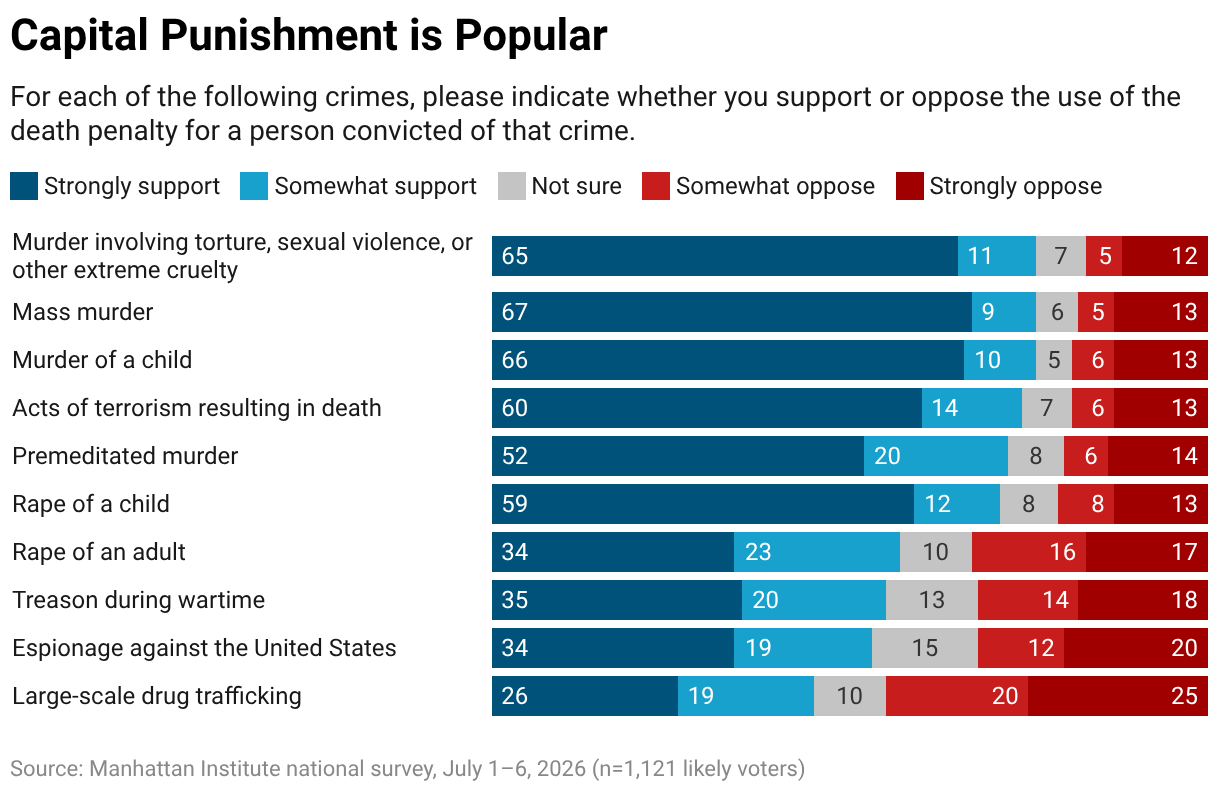
As noted in City Journal, support for capital punishment is overwhelmingly high … which is why politicians and wealthy progressives whole-heartedly oppose it. As you probably know, a “luxury belief” is one that is usually held by people who will not be in any way impacted by the downstream effects of that belief. It’s not the wealthy and privileged who suffer when murderers get out of prison, so they are generally all in favour of ever greater leniency in sentencing and easing parole conditions. Poor and middle class people are more likely to suffer when violent criminals return to their communities, which is why they generally want longer incarceration for violent crimes and favour capital punishment for certain abhorrent acts of murder. Charles Fain Lehman has more:
Those findings undermine the narrative, routinely advanced by death-penalty abolitionists, that capital punishment is on the decline because the public has turned against it. In reality, both public opinion and the current composition of the Supreme Court militate in favor of expanding the death penalty’s use — and, specifically, relaxing many of the arbitrary and undemocratic restrictions imposed on it by courts over the past several decades.
Abolitionists have based their case for declining public support on polls such as Gallup’s, which for nearly a century has asked respondents if they are “in favor of the death penalty for a person convicted of murder”. The share in favor has indeed dropped steadily since the 1990s, from a 64-point difference between support and opposition to just a 6-point split today.
That question, though, artificially reduces support by asking about all murders. Under current precedent, only certain heinous murders — those in which jury-determined aggravating factors outweigh mitigating factors — are eligible for the death penalty. There is likely far more support, for example, for executing Dylann Roof specifically than there is for executing all murderers generally.
The new MI poll illuminates this point. It asks about support for capital punishment under a variety of circumstances. The result is lopsided endorsement in the event of, for example, murder involving “extreme cruelty”, mass murder, or the murder of a child — all supported by 3-to-1 margins. Death for premeditated murder generically has 72 percent support, suggesting that even clarifying intent significantly increases support for capital punishment.
Notably, the poll also finds majority support for executing those who rape a child (71 percent) or an adult (57 percent). Yet neither offense would, absent a concurrent murder, be death-eligible. The Supreme Court ruled that applying the death penalty to non-murdering rapists violated the Eighth Amendment’s prohibition on “cruel and unusual punishment” in 1977’s Coker v. Georgia, a prohibition it extended even to child rapists in a 2008’s Kennedy v. Louisiana. With certain exceptions for crimes against the state, the Kennedy majority asserted, a crime that did not result in the taking of someone’s life was categorically ineligible for the death penalty.
Both decisions were justified by reference to the court’s “evolving standards of decency” test. First introduced in 1958’s Trop v. Dulles, the test has led the court to understand “cruel and unusual punishment” through its interpretation of “the evolving standards of decency that mark the progress of a maturing society”. That lens allowed it to reach the conclusions it did in Coker, Kennedy, and numerous other narrowings of the use of the death penalty. In combination with the aggressiveness and gamesmanship of the capital defense bar — which spends decades filing often-frivolous procedural motions to keep clearly guilty clients alive — the result has been a steady choking off of capital punishment.
Update, 31 July: Welcome, Instapundit readers! Have a look around at some of my other posts you may find of interest. I send out a daily summary of posts here through my Substack – https://substack.com/@nicholasrusson that you can subscribe to if you’d like to be informed of new posts in the future.
July 29, 2026
The American Deep State’s biggest experimental laboratory
On Substack, John Carter links to the latest of kulak’s fascinating-and-unsettling Anarchonomicon posts with this introduction:

Kulak’s thesis here is that English Canada generally, and Toronto specifically, is ground zero for a lot of the more insane gay race communism trends because America has been using Canada as a testing ground for psychological operations since the 1950s.
That sounds kind of nuts but he makes a plausible case. Since Canada is technically a foreign country, intelligence agencies don’t face the same limitations they do at home. Since Canada is almost culturally identical to the US, what works in Canada will generally work domestically (and all the GAE psyops are ultimately aimed at America’s domestic tax cattle).
Kulak also brings the receipts here, showing how things like MeToo and GamerGate seem to have been prefigured by similar movements in Canada a couple years before.
One thing he misses is land acknowledgements, which began spreading in Canada in 2013 or so, and have since started appearing at American and Australian universities. I don’t know for sure that they started in Canada, all I can say is that it was Canada where I first noticed them, and where they have become ubiquitous.
Multiculturalism is another Canadian export, developed here in the 60s and rapidly introduced all over the Western world. The prime ministers who introduced it were American puppets, and the ideology itself has a very broadly American “nation of immigrants” feel to it.
Anyhow, you motherfuckers, two can play this game.
On the land acknowledgements, the first time I encountered it was at my son’s university graduation ceremony, but his university had a big First Nations specialization so it didn’t seem too outlandish at the time. Since then, of course, pretty much every event in urban Canada seems to feature a land acknowledgement and they don’t appear to be optional any more.
Anyway, on to kulak’s post on “The Battle for the Mind of North America”:
The Land of Mind-Rape and Honey
Canada is/was a nice enough place to visit or grow up … several large nice cities surrounded by tons and tons of quaint and cute functional “Mainstreet USA” style quirky little towns.
The “Rape” refers to Rapeseed, the primary ingredient in Canola Oil, the unhealthy seed-oil. (they named it “Canada Oil” because “Rape Oil” might make people hesitate)
But when you scratch at the surface there’s something profoundly deeply wrong with Canada. You can feel it. You can see it when you look out your window or when you turn on your television. You can feel it when you go to work … when you go to church … when you pay your taxes.
and the Canadians are quite pleased to tell you just what that thing is:
America.
Funnily though, when you ask what Americans have done to them or what is wrong with America, they’ll tell you things about moral degeneracy and perfidy of Americans … no different than what the American elite and the US Government expresses about its own populace.
For reference: Canada is a vassal of the US.
It has been since the 1960s when the British lost the Suez Crisis and the American Deep State backed “Multiculturalism”, an end to “God Save the Queen”, legalized sodomy, ended prayer in public schools, demilitarized Canadian education (which til the 60s included rifle practice, marching, and survival training) … and oh ya a new flag.
The Canadian flag, adopted in 1964 … which the very year should be a “red flag”. Is in fact, an American flag. It is the symbol of America’s diplomatic and espionage victories over the British Empire and its final conquest of Canada.
Canada’s entire culture, defined by being British, Imperial, warlike, frontier militiamen (Indeed Canada’s 1950s culture in many ways resembled Washington’s and Jefferson’s colonial American culture more than America did) … was ripped out in the course of a decade … quite intentionally and by design.
Indeed Canada was the testing ground for the Global American Empire’s psychological cultural program.
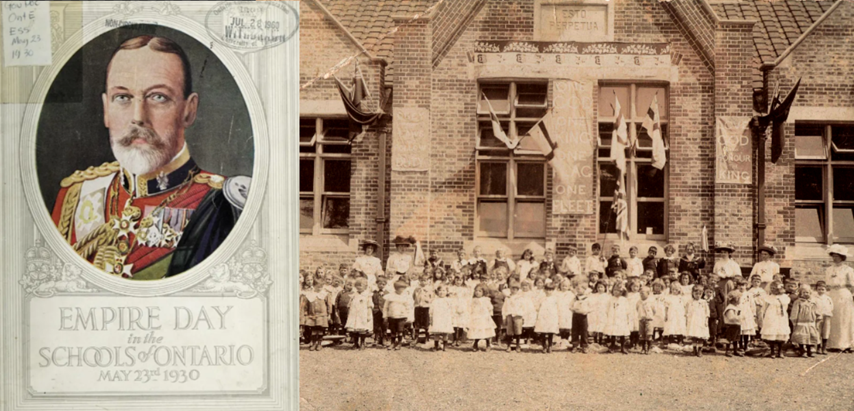
To get a feel for just HOW aggressively Canadian culture was purposefully ripped apart … I encourage you to flip through the various programs for “Empire day in the Schools of Ontario” up on archive to see English Canada’s actual natural culture. (I will be writing about this in more detail in another piece.)
And Please Note: The British did nothing comparable … the “Narnia” age of Canada coexisted with The Fabians, George Bernard Shaw, and the basically open communist treason of the actual British Aristocracy.
The mottoes on the posters: “Obey/ the Law/ Follow/ Duty”, “One God/ One King/ One Flag/ One Fleet”, “Love God and Honour the King”
This was immediately ripped out by State Department’s assets like Pearson and Trudeau in the 60s and 70s in favour of “Multiculturalism”.
How does the one Canada: Royalist, Militaristic, Patriotic as Can Be, defined by the three institutions of Church, Militia Armoury, and the old-style High School ruthlessly enforcing standards … More akin to Cadia from 40k than a 21st century country … How did it transform into the modern Canada within living memory?
How do you destroy the entire culture of a country and replace it with an entirely new culture in front of its population’s very eyes … without resistance and without protest?
Well that’s the problem that was solved here.
Canada was the testing ground for all of the American Government’s cultural occupational weapons it would go on to use on Europe and on its own people.
Terms like “melting pot”, “racism”, “tolerance”, “the open society” … These of course has all been coined by American Jewish and Communist activists (“Racism” specifically is a Trotskyist doctrinal term of art propagated by Trotsky’s personal pamphlets, and you should call any “Conservative” who ever uses the term a Communist traitor).
However it was in Canada that top down US foreign policy institutions first applied the current model to a country which they had conquered without a war.
Indeed when one looks into “Denazification” in Germany or the US occupations of France, Italy, or Japan you find little to no overlap between the language, structure, and even values of the “Democratic”, “antifascist”, and “Peaceful” occupational ideology and modern Globohomo.
“Monument to Multiculturalism”. Toronto. Erected 1985. (The “Monument” can be interpreted two ways … the man and doves working together to build a unified world … or the man is unwittingly cooperating in his own caging and enslavement)
Whereas in Canada the US occupational ideology EXACTLY resembles modern globohomo. From the outset.
Pierre Trudeau’s first major political moment was the 1967 decriminalization of homosexuality.



The Korean War Week 110 – The Democratic Candidate – July 28, 1952
The Korean War by Indy Neidell
Published 28 Jul 2026In Chicago, the Democratic Party chooses Adlai Stevenson as their candidate for the Presidential election to be held November 4th; he’ll square off against Dwight Eisenhower, the Republican candidate. Also, in the US, the steelworkers strike comes to an end. In Korea, torrential rains prevent action on the ground this week, though the UN continues its summer aerial bombing campaign of the north in the skies.
The changing nature of Canadian patriotism
On the social media site formerly known as Twitter, Jay Currie contrasts the kind of patriotism most Canadians grew up with against the politicized version hijacked by the Liberals as a tool in their never-ending quest to re-shape Canadians in their preferred image:
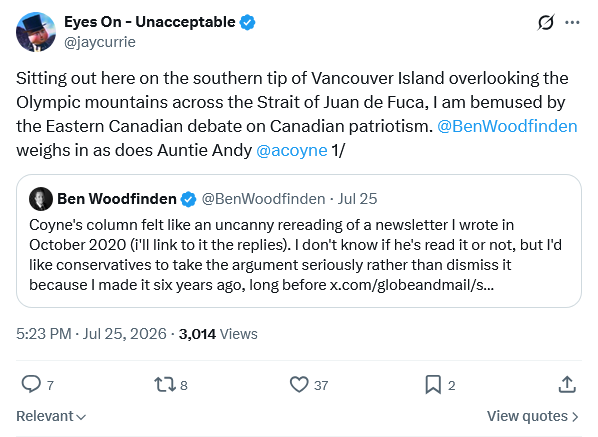
Sitting out here on the southern tip of Vancouver Island overlooking the Olympic mountains across the Strait of Juan de Fuca, I am bemused by the Eastern Canadian debate on Canadian patriotism. @BenWoodfinden weighs in as does Auntie Andy @acoyne
The current version of the debate is focused on whether the Conservative Party is “patriotic enough”. In less fraught times that would translate to “love of Canada” but now it comes down to anti-American and, more importantly, anti-Trump enough.
Probably because, after twelve years of Trudeau/Carney there is very little “Canada” left to love. We’re a post-national, genocidal, nearly European entity ruled from an embattled Ottawa beset by Americans, Chinese and our own separatists.
From the Ottawa/Toronto point of view Canada’s singular attribute is our willingness to punch Trump right in the nose. And woe betide the traitors like Smith, Moe and Frechette who are not willing to get behind Captain Canada as he takes his roundhouse swings.
And the Conservative Party is failing on the patriotism front precisely because a significant part of it thinks punching the Yanks in the nose is possibly the dumbest thing they have ever heard. Why the Hell would we do that?
On the Auntie Andy/Woodfinden scale of patriotism this disqualifies the CPC from ever winning a federal election because only Canadian Patriots should be allowed to command the Ottawa ramparts eyes firmly fixed on the perfidious Yanks.
As a thought experiment try to define Canadian patriotism without reference to the US or Donald Trump. I assure you it can be done. The way you do it is begin with the ground you are on. Where is it? What is it? What can you see?
Now, think about your neighbours, the stores you go to, the pub you like, the golf course or soccer field or swimming pool you prefer, the schools you went to, the teams you played on, yes, your favourite NHL team, vacation spot, drive.
Essentially these and hundreds of other details are the ground truths of your Canada and it is that Canada where your patriotism begins. The Canadian flag, the Peace tower, your favourite version of “Oh, Canada” are all abstractions of this ground truth.
People don’t fight for “King and Country”, they fight for their children, their spouse, their parents, their neighbours. That is where the real loyalty lies. It’s acutely local and it accretes across time, across generations.
The Liberal Party project of the last half century has been to replace this hyper-localized patriotism with an synthetic, denatured, atomized Patriotism which defines itself by what it is against, not what it is for. It is a deeply unsatisfying project.
The fact the CPC is wary of this synthetic patriotism is to its credit. Looking at its messaging in the last election at least a part of the CPC understands that Canada is the ground you stand on, not an invention of Ottawa. It’s the right message.
At Without Diminishment, Carl Vallée identifies one of the structural strengths of the left that allow them to concentrate on achieving and maintaining power: unity of vision across all progressive parties.

Exit Trudeau, enter Carney.
It must be admitted that the Liberals have dominated the political landscape for much of the past century, enabling them to weave their own partisan symbols and values into the fabric of Canadian institutions.
The federal state as it exists today is a legacy of Liberal Party rule. Pierre Trudeau’s Charter of Rights and Freedoms fundamentally changed the trajectory of this country, but the ideology underpinning it had begun to take shape even before his time. Whether one considers multiculturalism, mass immigration or the red maple leaf flag, Canada is a country whose institutions naturally lean, if not lurch, to the left.
Therefore, conservatives must swim against the current, almost perpetually. Why is this? I submit that it stems from the fact that Liberals in both English Canada and Quebec are ideologically closely aligned and share a common vision of Canada. The left often looks much the same everywhere. Certainly, its values, methods and codes of communication are identical across the Western world.
In Canada, Liberals will not hesitate to weaponise the state to ensure their values endure. The alignment between Liberals in Quebec and English Canada has been critical to their electoral success.
Conversely, the right are more locally rooted and provincial, and are therefore less inclined to share a broad common vision with their compatriots across the country. This poses a challenge to both the coherence of Canadian conservatism and its electoral arithmetic.
Conservatism in Quebec is not libertarian, and here we envisage using the state to advance nationalist and conservative ends. What we conserve in Quebec is not what our friends in Western Canada or Ontario seek to conserve.
Arrayed against our alliance of local political traditions are the Liberals, who share and promote a single, pan-Canadian narrative. The inability of the right to offer a catch-all vision capable of rallying the anti-Liberal vote partially explains the electoral success of the Liberal Party over the past few decades.
Structurally, the 1982 rupture over the imposition of the Charter has made this phenomenon almost permanent, despite the efforts of prime ministers Brian Mulroney and Stephen Harper to rally coalitions against the Liberals. Neither was able to prevent the Charter from entrenching itself as Canada’s new national narrative, despite the explicit opposition of Francophones, one of the country’s founding peoples.
If there is a fault, it does not lie solely with the pan-Canadian conservative movement, but also with Quebec’s bleus, who failed to invest in the Conservative Party of Canada, the only political party capable of rivalling the Liberals. As a result, the Quebec vote is split between the Conservatives and the Bloc Québécois, whose voters are much less left-wing than the party’s current leadership. In the 2025 federal election, the combined Conservative and Bloc vote in Quebec actually exceeded the Liberal vote.
July 28, 2026
“The gun is the most misunderstood object in Western civilization”
On the social media site formerly known as Twitter, Krzysztof Szczawinski discusses the history of the right to bear arms from ancient Greece to modern America:
The gun is the most misunderstood object in Western civilization. Not a weapon. A technology. The technology that made the idea of equality physically real.
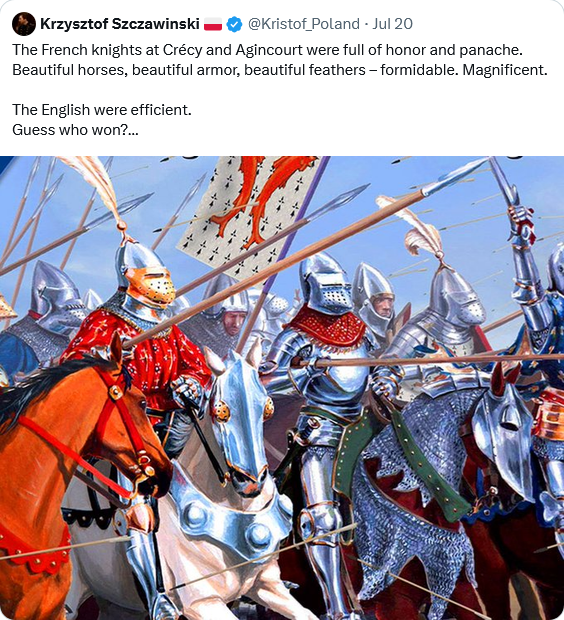
1. The longbow democratized warfare – a peasant could kill a knight with a stick and a string, and Agincourt proved it. The gun completed the process. The armored warrior class whose claim to social dominance rested on physical superiority became obsolete. The aristocratic monopoly on violence ended not with a philosophy but with a mechanism. The gun is the physical enforcement of the idea that all men are created equal. Which is why the American founders put it in the second amendment – not as an afterthought, but as the guarantee of everything else.
2. The Roman citizen had the right to bear arms. The Greek citizen had it. The English yeoman had it. The Swiss canton built its entire civilization on it. The disarming of the population has always been, in every civilization, in every century, the first act of the government that intends to stop being answerable to that population. Show me a disarmed population and I will show you a population that lost something else shortly after.
3. The Second Amendment is not about hunting. It is not about sport. It is about the relationship between the armed citizen and the state – the explicit constitutional acknowledgment that the citizen’s right to defend himself, his family, and his civilization against any threat, including the government itself, is not granted by the state and cannot be revoked by it. Power flows upward from the armed citizen, not downward from the armed state.
4. The gun defends the family. The woman alone with her children. The farmer on the edge of civilization. The shopkeeper in the neighborhood the police no longer patrol. The gun is the equalizer – the technology that makes the physical difference between a large man and a small woman irrelevant. Every argument for disarmament is, at its core, an argument that the state will protect you better than you can protect yourself. The evidence for this proposition is not encouraging.
5. In Europe, the disarmament is now nearly complete – and it happened precisely as the state’s ability and willingness to protect its citizens began to decline. The timing is not coincidental. A population that cannot defend itself must trust the state to defend it – which is a population that cannot effectively question whether the state is doing so. The dependency is the design.
6. The gun is a civilizational technology in the deepest sense: it requires responsibility, judgment, and the willingness to accept the consequences of your decisions. You cannot outsource it. You cannot have a committee fire it. It is the most anti-bureaucratic object ever invented – a direct, personal, consequential instrument that puts the full weight of the decision on the individual holding it. Which is precisely why the administrative state finds it intolerable. Not because it is dangerous. Because it is sovereign.
7. The family that can defend itself does not depend on the state for its most fundamental security. The civilization that can defend itself has not yet outsourced its survival to an institution that will negotiate the terms of that survival on its own behalf. The gun determines who controls violence – and therefore who controls everything that violence can threaten. Which is everything. The Sobieski who rode down the hill had a sword and sixty thousand horsemen. The equivalent today is the armed citizen who understands what he is defending and why. Every civilization that forgot this discovered it the hard way. The ones that remembered it are still here.
July 27, 2026
Biosphere 2
Sama Hoole on a now-obscure experiment in the early 1990s which didn’t produce the expected results at all:

Eight people sealed themselves in a glass dome to prove humanity could feed itself on plants, and spent two years starving in front of the world’s press.
Biosphere 2 cost a hundred and fifty million dollars. Three acres of Arizona desert under sealed glass, eight crew, door shut on 26 September 1991, nothing in or out for two years. The farm inside was worked intensively and by any agronomic measure it was superb, out-producing the most efficient smallholder farming on earth by a wide margin.
It produced 83 per cent of what they needed.
Which left Roy Walford, the crew doctor, in a sealed box with seven hungry colleagues and his own life’s work. Walford was a UCLA pathologist who had spent thirty years arguing that severe calorie restriction extends lifespan. He had doubled it in mice. And here was reality handing him his own hypothesis with the door welded shut.
So he called it a health programme.
The menu became vegetables, half a glass of goat’s milk a day, and meat or fish about once a week. The men lost close to a fifth of their body weight, the women about a tenth. And the markers Walford cared about behaved impeccably: blood pressure, glucose, cholesterol and triglycerides all down at least twenty per cent, into ranges any doctor would frame. He published it in PNAS in 1992.
The bloodwork was magnificent. The people were falling apart.
Jane Poynter wrote the book afterwards. Fatigue, depression, mental fog, and a preoccupation with food that ate the entire interior life of the crew. They stole from each other. They split into two factions that stopped speaking. The ecological research the building had been constructed for was largely abandoned by people who no longer had the headroom for anything past the next meal. The ants and cockroaches, by contrast, were thriving.
The air was leaving too. Oxygen started at 20.9 per cent and kept dropping and nobody knew where it was going. Columbia eventually worked it out: the concrete was quietly eating it. So oxygen had to be pumped in from outside, which is an interesting result for a sealed world.
Walford’s verdict on the mutiny is the whole thing in one sentence. He said afterwards that any other physician aboard would have panicked and declared they were starving, but that he knew they were on a programme of health enhancement.
He knew. Seven other people, visibly wasting, were simply mistaken.
He came out in 1993, developed ALS, blamed the conditions inside, and died in 2004 aged 79 after years on 1,600 calories a day in pursuit of a longer life. The mice got double. He did not make it to average for an American professor.
Every argument you have heard this decade was already in that building. Grow it locally. Take the animals out. Eat less. Watch the numbers improve.
Eight of the most motivated humans alive, handed three acres of the best-managed farmland on the planet and no meat, could not feed themselves.
The press reported the fighting as a personality clash.
And he updated:
I left something out of that one.
Biosphere 2 had a working farm, and the farm had pigs, chickens and goats. Only one of those three was still alive when the door opened, and the reason why is the most useful thing the entire two years produced.
Biosphere 2 had livestock, and the crew ate the pigs first.
Zazu and Quincy were Ossabaw dwarf pigs. In the first year one of them produced a litter of seven, which inside a sealed glass building where every calorie was counted should have been the best news anybody had.
They killed them anyway.
The chickens went too. Mrs Fruitcake and the rest, slaughtered because they were eating more than they were laying.
Neither animal was killed for meat. They were killed for competing.
A pig and a chicken have one stomach, and it wants exactly what a human wants: grain, roots, beans, anything starchy or dense. Inside Biosphere 2 there was no outside, no feed lorry, no surplus. Every mouthful a pig took came off the plate of one of eight visibly starving people. The crew did the arithmetic and reached for the knife.
Now notice which animals survived the cull.
The goats. Milky Way, Stardust and Vision, three African pygmy goats, milked daily for the full two years. And in the crew’s own scientific write-up, published in Advances in Space Research in 1995, they recorded that the goats were the most productive domestic animals in the entire system.
The most productive thing in a building where the humans lost a fifth of their body weight was the ruminant.
It is the four stomachs. A goat is a fermentation vat on legs. She runs on stalks, leaves and crop residue, the fibrous rubbish that comes off any farm and that no human gut can process, and turns it into milk. She was never taking food off the crew. She was manufacturing food out of what the crew threw away.
So that sealed box did test the great modern argument, the one about feeding crops to animals being a waste of land and calories.
It found the argument correct for pigs and chickens.
It found it wrong for the animal that eats grass.
Biosphere 2 gets quoted endlessly as proof we should grow plants and drop the livestock. Eight people with the most productive farmland on earth ran that experiment properly, went hungry for two years, and kept exactly one kind of animal alive throughout, because she was the only one paying rent.
They killed the pigs to feed the people and kept the goat to feed the people.

July 26, 2026
QotD: Progressives know they’re on the “right side of history”
Whatever happens, then, happens either exactly as they foretold — even if they never bothered to actually prophesy, or to even think about it at all until just this second — or is a temporary victory by the forces of evil, a temporarily successful holding action against the inevitable Triumph of Progress.
It’s a fascinating chicken-and-egg conundrum: Did the Left take to Marxism because they’re so invincibly self-righteous, or does their sanctimoniousness come from their dedication to Marxism? It doesn’t really matter, because the practical effect is the same either way: Their consciences are completely short-circuited. They can do the most awful stuff with a smile on their faces, because “awful” is relative, comrade – as you’d know if you had the proper proletarian consciousness; if you understood things from History’s perspective, as they do.
Severian, “Escriva Ch.8: Examination of Conscience”, Founding Questions, 2022-06-26.
July 25, 2026
Civil War Gwyn & Campbell Carbines (aka Cosmopolitan, Union, & Grapevine)
Forgotten Weapons
Published 2 Mar 2026The first version of this carbine was the Cosmopolitan, designed and patented by Henry Gross in 1859 and manufactured by Edward Gwyn and Abner Campbell. It is a single-shot .52 caliber carbine that loads from the breech with a paper cartridge and a separate external percussion cap. After producing a batch of the guns, Gwyn and Campbell realized that the breechblock design could be much simplified, and they patented that simplification — essentially pushing Gross out of his own invention.
Several successive contracts for the carbines were fulfilled during the Civil War, with about 8,200 produced in total. It was not the most popular or most numerous cavalry carbine of the war, but it is rather remarkable for actually being reliable and delivered consistently on time.
(more…)
July 24, 2026
To Zohran Mamdani, “working class” means earning less than a million a year
Rob Henderson coined the fantastically useful phrase “luxury beliefs”, and regularly points out examples of people expressing beliefs that allow them to virtue signal at little or no cost, yet if the ideas were implemented would harm those not as privileged as the speaker:

New York City mayor Zohran Mamdani, 10 February 2024.
Photo by Kara McCurdy via Wikimedia Commons.
In a recent New York Times interview, Zohran Mamdani, New York City’s socialist mayor, struggled to define “working class”.
At one point he was asked point-blank, “How do you define the working class?”
Mamdani replied, “I think if you have to work to pay your bills, I think that that is one definition of being a part of the working class”.
After some pushback from the interviewer, Mamdani said he would draw the line at “about a million dollars a year”. I have no idea how he can say that without any embarrassment, but that’s why he’s a politician and I’m not. Say what you will about him, but the man knows his base. These are the people who claim to be the champions of women yet — and please forgive what has now become a hackneyed line — can’t define what a woman is, and they claim to be the champions of the working class, yet can’t define what the working class is. Or they redefine both terms to be so expansive that they could potentially encompass just about everyone.
This is where the luxury belief class has steered us.
Anyone who isn’t a millionaire gets to be working class now. It sounds absurd but that’s where we’re at now. Remember during the primaries in 2015, Bernie Sanders said that “the millionaires and the billionaires” need to pay their fair share? At some point over the past decade, he dropped “millionaires” because he became one. Now you see the millionaires condemning only the billionaires. Mark my words, at some point in the not-too-distant future, you will see the billionaires disparaging the trillionaires. Maybe inflation will hasten that phenomenon.
Anyway, in that Mamdani interview, the focus on defining class by money is revealing.
People often conflate social class with economic class. This allows us to talk about the former while pretending we are talking about the latter.
It is easier to discuss income than educational pedigree, accent, hairstyle, clothing, taste, or zip code.
But education usually signals social class more clearly than income does.
Research has found that parental educational attainment is the most important objective indicator of social class. This is because, compared with parental income, parental education is a more powerful predictor of a child’s future lifestyle, tastes, and opinions. If your parents went to college but you didn’t, you’re still middle-class or higher. Not working class.
Education shapes habits, networks, and outlook long after the degree is earned. Higher education bestows cultural capital: patterns of speech, tastes, opinions, and expectations about life. Income may rise and fall over a lifetime. The worldview formed in selective institutions usually endures. By that standard, college graduates, regardless of earnings, are not working class.
Education also shapes political views more strongly than income does.
In 2021, Ezra Klein pointed out that “We tend to think of class as driven by income” but that “A high school dropout who owns a successful pest extermination company in the Houston exurbs might have an income that looks a lot like a software engineer’s at Google, while an adjunct professor’s will look more like an apprentice plumber’s. But in terms of class experience — who they know, what they believe, where they’ve lived, what they watch, who they marry and how they vote, act and protest — the software engineer is more like the adjunct professor.”
Plainly, a PhD who takes a job driving a taxi will tend to vote like other PhDs, not like other taxi drivers, especially if he or she also has a parent with a college degree.
It was so much easier to recognize the British classes, at least back in the 1960s that is:
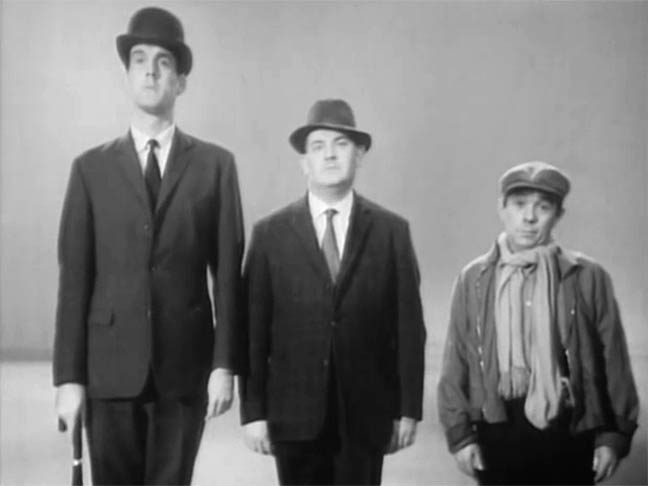
John Cleese, Ronnie Barker, and Ronnie Corbet as the avatars of the British upper, middle, and lower classes
Original version from The Frost Report, 7 April 1966.


