
Like many terrible ideas, postmodernism started with a question. The wreckage left over from the Second World War, the incomprehensible scale of the slaughter, the industrialised genocide, the atom bombs – all this brought about by the most advanced nations on earth, the ones that considered themselves civilised. How could the same cultures that brought us the Enlightenment, human rights, individual liberty and the scientific revolution also give us Auschwitz, slavery and the brutal repression of colonised people? As the second half of the century got underway, intellectuals were naturally inclined to question the West’s founding principles and what they saw as the illusion of progress. It was time to interrogate its assumptions, take apart its certainties, and puncture its claim to hold universal values.
Leading the way were the French intellectuals, who in the 1960s and 70s questioned the deepest of those assumptions, beginning with truth itself. Was there really such a thing as “objective truth”, or was it simply an invention of the powerful, something declared rather than discovered? Was “progress” a description of reality or just the story told by whoever won? These are serious questions from which they could make fair observations. They were right to point out that institutions serve their own interests, and grand narratives play a defining role in our understanding and interpretation of the world. The trouble is that the same intellectuals didn’t try to place the answers intelligibly within the larger story of our lives. Postmodernism made interrogating power the overriding intellectual move and the answer to its own question.
Postmodernism doesn’t lend itself to a simple explanation, which is appropriate, as we shall see. However, dig beneath the deliberately impenetrable jargon, and the core claims are as follows. There is no objective truth, only competing narratives. What we think of as “knowledge” is just something the powerful tell us is the case. Language doesn’t describe reality but constructs it. Science, reason, and universal liberalism are inventions of Western minds, specifically male ones, while the Enlightenment idea of the individual with supposed natural rights is just another concept made up by those most likely to benefit from it.
There’s an obvious paradox at the outset. In what sense is it true to say there’s no such thing as objective truth? The question is meaningless because the premise is nonsensical. As Roger Scruton put it, “A writer who says that there are no truths, or that all truth is ‘merely relative’, is asking you not to believe him. So don’t.”
Despite the obvious contradiction, it’s an idea that has been pushed aggressively by campus authoritarians for decades. No narrative deserves authority, they say, while demanding intellectual obedience to a narrative of their own.
Frederick Alexander, “Postmodernism: The Idea That Ate Itself”, The Gadfly, 2026-04-03.
August 14, 2026
QotD: Postmodernism’s origins
August 13, 2026
“Defund the police!” from around day five onwards
A grim joke I’ve seen many times on various social media sites features the kind of people who’d agree to defund the police, but not because they want to take it easy on criminals … but because if there are no police enforcing the laws, there’d be no police limiting “bag counts”. With no police to make arrests (and likely no jails or courts to provide some kind of due process), the victims of crime will either surrender to the perps, or get as fully armed as they can manage. You can’t maintain a civil society if everyone has to take on the policing role for themselves everywhere and at all times.

“Defund the Police” by Taymaz Valley – CC BY 2.0
I always laughed at “defunding the police”, because I know how that would go. The people who advocate it are incapable of thinking beyond first-order consequences.
So, let’s suppose major American city X fully defunds its police. How will this play out?
For a short time, criminals will have a field day. They will shoplift, rob, mug, and invade homes to their hearts’ content. Because who’s going to arrest them?
But then their victims are going to arm up. Homeowners, shopkeepers, and ordinary citizens will start open-carrying and shooting criminals. Because who’s going to arrest them?
So far, so good.
Now, here’s the part that isn’t obvious. 60% of index crimes are committed by Black people. Once the shooting phase starts, Black criminals are going to form gangs (if they haven’t already) so they can overwhelm individual targets.
Once Black gang predation becomes routine, the rational strategy for whites and Hispanics and Asians becomes to simply start gunning down groups of multiple Blacks on sight. Because who’s going to arrest them?
The same dynamic applies to any minority with a higher criminal propensity than white people. Which is basically all of them except for Northeast Asians.
Innocents will not be spared. If there are any left — it’s a statistical fact, for, example, that Black women have a higher rate of criminal violence than white men.
The eventual result would be a white nationalist’s wet dream. Minorities dead or keeping very, very quiet in order not to get shot. They might be able to hold mono-ethnic enclaves in the short term, but venturing outside them would be asking for death.
I’m pretty sure this is not what advocates of defunding the police want to happen. But these are the same people who were all gung-ho for police bodycams, and we all know how that turned out.
Update: You can always count on the Babylon Bee to provide timely and informative context for any issues we face in today’s complex world – What If We Abolished Prisons and Defunded the Police?
August 12, 2026
“It might be Carney’s unconditional surrender to Trump, but it’d be worse under Poilievre”
I exaggerate a tad in my choice of headline, but Canada’s bought-and-paid-for relic media will always choose to present a spectacular Carney faceplant as being somehow better than any theoretical action by Poilievre. If Carney’s going to surrender to the Yanks unconditionally, it would obviously be far worse if the Leader of the Opposition had been PM instead. eLbOwS uP, everyone!:

The new Canadian trade flag – The Line
Well, it looks like our prime minister is losing his nerve, eh?
Reports are now leaking fast and furious that Trump’s surprise August 19 tariffs have worked to break our strategic patience. Canada is working to secure some kind of interim deal, and if the leaks are to be believed, we’re going to give the Americans essentially everything they want while they maintain most tariffs on us. It appears to be a shit deal for us, and one that puts us directly in the glide path toward vassal state.
Worse — and, to be frank, I do think this is the worst part of all of this — it’s the exact opposite of what we elected Mark Carney to do. When facing economic and political aggression from a neighbour and once-ally like the United States, surrender vs. resistance is a valid conversation to have. Given our circumstances, one could make a legitimate case for either choice. However, as a people, we did have that conversation, in the spring of 2025. We did make that choice. We chose resistance. We chose sacrifice. That was the premise of the last election, and that was the value proposition Mark Carney made for himself.
Instead, what we’ve actually done in the past year-and-a-half is a counter-productive middle path: yes, we’ve made moves toward strengthening our economy internally, and this is all to the good. But when it comes to measures that require a willingness to stand up to real power, all we’ve offered has been performative resistance in the form of angry social media sputtering and grandiose global speeches, followed in private by concession after concession. This has left us with the worst of both options. We’ve demonstrated that we lack the collective will to sustain real economic sacrifice. And we’ve just annoyed the Americans, which has clearly only increased their desire to make an example of us.
What we absolutely did not vote for was the prediction offered by Ian Bremmer of the Eurasia Group, a political risk analysis firm with long ties to Carney and the Liberals. Last year, Bremmer wrote: “Canadian leaders have a political incentive to put up a bigger fight because Trump’s threats toward Canada’s economy and sovereignty have sharply inflamed nationalist sentiment north of the border in the run-up to the April 28 elections. However, I expect Ottawa will quietly fold shortly after the vote to ensure that ongoing relations with the U.S. remain functional.”
Congratulations, Canada. You got punk’d.
In honesty, I can’t think of a worse strategy for achieving a remotely fair trade deal with the United States than the one Carney chose to follow. If he’d been dealing with George W. Bush, this plan might have worked, but I think that Bush was the last US president who would put up with the juvenile performative “strategy” Canada used. Barack Obama would have easily turned the tables, as the relic media loved (and still love) Obama more than they love maple syrup and oxygen. Even Joe Biden’s handlers could have highlighted just how J.V. Canada was acting. But for some reason, the Liberals decided that constantly pissing in Donald Trump’s cornflakes was a winning strategy. And now we’re looking at a maple-flavoured Appomattox Court House meeting … and Trump has no interest — quite the opposite, in fact — in being as generous to a defeated foe as Ulysses S. Grant was to Robert E. Lee.
The Korean War Week 112 – The Chinese Take Siberia – August 11, 1952
The Korean War by Indy Neidell
Published 11 Aug 2026There’s heavy fighting in the field this week for a position the US Marines call Siberia. Behind the scenes there’s worry, though, as the US Army is more and more facing a manpower crisis. They are, however, training ever more South Korean troops to one day hopefully bring all their own troops home from the Korean peninsula, and leave it defended by the locals.
US Army M68 Close Combat Optic aka Aimpoint CompM Series
Forgotten Weapons
Published 16 Mar 2026When Aimpoint entered the competition for a US Army standard-issue combat optic in the 1990s, they really didn’t expect to win. The other finalists were Trijicon and Meprolite, and it seems like a safe bet that the American firm — Trijicon — would get the contract. However, it ended up going to Aimpoint’s CompM on both price and technical capability. This meant an order for 100,000 of the optics, requiring Aimpoint to massively scale up. It also led to a series of improvements to the design, which became the CompM2, CompM3, and CompM4.
Today, we are looking at the history of this evolution. How the Aimpoint 3000 became the Comp[etition], how the Comp was ruggedized to the CompM[ilitary], and how the Swedish Army Aimpoint CS led to the current CompM4.
(more…)
August 11, 2026
The surging Democratic Socialists of America
J.D. Tuccille on the unlikely rise of the DSA faction within the Democratic party in time for the 2026 midterm elections:

Abdul El-Sayed’s victory in the Michigan Democratic Senate primary battle is only the latest by candidates affiliated with or adjacent to the Democratic Socialists of America (DSA). Unlike many of the openly socialist officeholders and political hopefuls gaining traction in the Democratic Party, El-Sayed claims to be a capitalist, but his positions are indistinguishable from those of the left-wing figures he campaigns with, such as Sen. Bernie Sanders (I–Vt.), Rep. Alexandria Ocasio-Cortez (D–N.Y.), and podcaster Hasan Piker, who has aligned himself with both the Chinese government and Hamas.
As democratic socialists in general and the DSA in particular take over the Democratic Party, it’s worth examining the positions they take, the enemies they pick, and who supports them to see what they have in store for us as they seek to remake the country.
Young, Credentialed, and Unhappy Recruits
At a time when trust in higher education is sliding among Americans, the socialist surge is largely a project of young college graduates. El-Sayed “eked out his victory by winning young voters and highly educated voters”, finds a Washington Post analysis. That squares with a June Pew Research report that “Democrats who are White, younger or college-educated are more likely to view democratic socialists positively”. Credentialed but relatively low-income people make up the core of DSA recruitment.
Political analyst Nate Silver writes that “the sweet spot for the DSA” is “voters with postgraduate degrees but lower-to-middle household incomes of $30K to $60K per year”. Silver adds that “only 19 percent of Americans with bachelor’s degrees or higher had household incomes of $60K or below. The DSA rate is around twice that.” He puts this in the context of Peter Turchin’s elite overproduction hypothesis which argues that the country’s universities crank out too many credentialed graduates, with student loan debt attached to not-so-useful degrees, to be absorbed into the prestigious positions they believe they’re entitled to. The result is disillusionment and a search for somebody or something to blame.
That blame is falling on capitalism, American and western civilization in general, and Israel and Jews (the line between the people and the only majority-Jewish nation is inherently fuzzy, and “antizionism” has become a cover for bigotry the way the pseudoscientific term “antisemitism” repackaged old-fashioned Jew-hatred in the 19th century).
[…]
Socialists Revive Ancient Bigotry
DSA-aligned figures are not especially fond of the United States and its allies. It’s not difficult to find comments like New York socialist congressional candidate Darializa Avila Chevalier’s quip: “I forgot to get napkins so I just wiped my hand on the American flag behind me”. But as a group, they especially despise the world’s only majority-Jewish state.
Michigan’s El-Sayed says he believes the Israeli government is as evil as the terrorist group Hamas, which launched the October 7 attacks, and calls it guilty of “apartheid” and “genocide”. The DSA last year adopted a resolution denouncing Zionism (the belief that Jews have the right to establish and maintain Israel) as “a racist, imperialist, settler-colonial project” and made belief that “Israel has a right to defend itself” an offense punishable by expulsion from the organization. Hasan Piker claimed and repeated that Hamas is “a thousand times better” than Israel. Colorado congressional candidate Melat Kiros declined to label as antisemitic a deadly firebombing attack on a Jewish rally in Boulder.
“Some people did some things” during the pandemic, let’s move on …
I noted a little while back that I was astonished how quickly the “Spanish Flu” epidemic slipped out of the historical record in the early 1920s, but having gone through the Wuhan Flu experience, I understood it far better. In the Spanish Flu era, the survivors needed to move on with their lives, while in the Covid era, a lot of people wanted to forget how they’d treated their friends, co-workers, and fellow citizens. Different motivations, but similar results. But we shouldn’t let the Covid years slip gently out of memory, because people in positions of power and journalists who should have reported honestly all elected to go full authoritarian and need to be held to account for it, as L. Wayne Mathison explains:

This was never just an American problem, and it was never just about Anthony Fauci.
Canada had its own version of the same institutional failure.
During COVID, too many journalists stopped asking hard questions and started treating government public-health messaging as settled truth. Canadians who questioned lockdowns, mandates, school closures, travel restrictions or changing mask guidance were often dismissed as ignorant, selfish, dangerous or conspiratorial.
Some people certainly did spread nonsense. That does not excuse treating every dissenting argument as misinformation.
Good journalism is supposed to challenge power, especially during an emergency when governments are exercising extraordinary power over ordinary citizens.
Instead, much of our media became emotionally invested in defending the institutions it should have been scrutinizing.
That creates a serious problem now. Admitting that governments, public-health officials or journalists got important things wrong means admitting that people were sometimes mocked, censored or socially punished for raising questions that deserved answers.
So the temptation is to defend the old narrative rather than examine the record honestly.
Canada needs a proper accounting of the pandemic response. What worked? What failed? Which restrictions produced enough benefit to justify their cost? What happened to children, small businesses, mental health, civil liberties and public trust? Where did officials communicate uncertainty honestly, and where did they pretend to know more than they actually knew?
I followed the rules. I got vaccinated. I took COVID seriously.
But I will never accept the idea that taking a virus seriously required switching off critical thought.
Science improves through questioning. Journalism exists to question authority. Democracy requires governments to justify extraordinary powers.
We should have demanded all three.
QotD: The long lead-up to the invasion of Iraq
The Americans kicked Iraq out of Kuwait quickly and easily, and then … hesitated about what to do next. Nobody wanted to keep Saddam around (remarkably, when you have outlived your usefulness, people suddenly start to notice all of your human rights abuses), but nobody wanted to march into Baghdad and topple him either. There was some wishful thinking that the Kuwait defeat would cause Saddam’s regime to collapse, but most US foreign policy thinkers just shrugged their shoulders and figured better Saddam than chaos and a Vietnam-style quagmire. One especially perceptive official put it this way to a PBS journalist:
I felt there was a real danger here that you could get bogged down in a long drawn out conflict … and then you’ve got to worry about what comes after. And then you have to accept the responsibility for what happens in Iraq, accept more responsibility for what happens in the region. It would have been an all-US operation, I don’t think any of our allies would have been with us, maybe Britain, but nobody else. And you’re going to take a lot more American casualties if you’re gonna go much around in Iraq for weeks on end trying to run Saddam Hussein to ground and capture Baghdad and so forth and I don’t think it would have been worth it.
That official’s name was Dick Cheney.
So Saddam was left in place, and throughout the ’90s American policymakers seethed about it. There was no official policy that said we were going to overthrow him, but prominent politicians like Al Gore were out there writing op-eds saying that Saddam must be toppled and his government dismantled. This produced what Mazarr calls “destructive ambiguity” — everybody knew that everybody else knew that the real policy was to get rid of the guy, but since this was an unofficial position it went through none of the usual policymaking channels and was never formally debated. It also left a lot of room for freelancing.
For example, CIA clandestine operative Bob Baer (whose memoir is a terrifically fun read, by the way) began organizing a coup in 1995, not because he was directly ordered to do so but because he thought it was what his supervisors wanted. Even the strategy of the coup points towards this ambiguity — rather than straightforwardly overthrowing the government, it aimed to spark a rebellion that would gain some momentum but not enough to win, so that when Saddam moved to crush it the US would be pulled in and forced to act.1 Think for a moment about what an odd plan this is, and how it only makes sense if you believe the US secretly wants to invade while officially pretending not to.
The leader of this rebellion was supposed to be Ahmed Chalabi, one of the more fascinating characters in this story. Chalabi was a dapper, cosmopolitan, and erudite bank manager who got exiled from Iraq for gross financial corruption. He promptly reinvented himself as a freedom fighter, rented beautiful houses stocked with fine art in several major cities, and set about ingratiating himself with Western elites. He also began organizing his fellow emigrés and exiles into an effective political lobbying force. Unsurprisingly given his educated and aristocratic manner, he was extremely good at the lobbying part, and soon placed a special focus on the United States, wining and dining congressmen and writing op-eds for major newspapers. Soon he managed to convince the CIA that there were thousands of resistance fighters back in Iraq ready to follow him into battle.
He was good at convincing, but they also wanted to be convinced. Chalabi and his fellow emigrés were charming, cultured, westernized intellectuals who at least pretended to be pro-democracy. It was oh-so-tempting to believe that everybody in Iraq was like that, when in fact they were completely unrepresentative. As a rule of thumb, when a country has a revolution or a civil war or other social breakdown, the ones who make it out are the ones bright enough to see it coming and rich or well-connected enough to escape. Whether it’s the Russian Revolution, the Lebanese Civil War, or whatever you call what’s happening in South Africa, the people who leave are not a random subset — they’re the creme-de-la-creme. Unfortunately the US government somehow couldn’t figure this out in the case of Iraq. They met the emigrés, and were impressed by them, and decided that Iraq really was a civilized and cosmopolitan place under the surface, when in fact the society that created the emigrés had been destroyed decades earlier.
The emigrés represent one pole of the Baptists-and-bootleggers coalition that emerged in the ’90s to advocate for the overthrow of Saddam’s regime. The other is exemplified by Paul Wolfowitz, a soft-spoken academic who bounced between senior government positions and jobs at think tanks. Wolfowitz was a humanitarian in the most sincere sense. Much of his extended family had been killed in the Holocaust. The plight of oppressed peoples was not an abstraction for him, and he dedicated his life and career to the proposition that the United States should use all available means to end tyranny and oppression wherever they existed.
Wolfowitz is commonly described as a fanatical neoconservative, and he is, but I think it’s important to demystify that term. Too often it gets used as a catchall for “people we don’t like”, but at least when it comes to foreign policy the neoconservatives fit squarely within the American mainstream. With the notable exception of Donald Trump, every American president of the past few decades has had essentially the same foreign policy, driven by essentially the same core ideas: (1) Americans are the good guys, (2) it’s the job of the good guys to right wrongs wherever they are happening, (3) freedom and democracy are the non-negotiable inheritance of everybody on planet earth. These ideas drive the neoconservatives, yes, but they also drive Samantha Power and Susan Rice, not to mention Hillary Clinton and Barack Obama.
If you are an American, it may not be apparent to you how weird these ideas seem to the rest of the world. If I were to characterize how previous empires — and America’s current rivals — think about the world, it would be more like: (1) every country has core interests and peripheral interests, (2) you should not interfere in another country’s core interests if you can help it, (3) different peoples and cultures are adapted to different forms of government, and this diversity makes life spicy and interesting. Perhaps most shocking to Americans: most countries do not self-identify as “the good guys”, instead they think of themselves as a people with a history and a set of territorial claims.2
Mazarr describes this peculiar American quality as “the missionary impulse”, and notes that while it comes from a well-intentioned place, it “can produce a theological and absolutist conception of America’s responsibility as well as a romantic conviction that America can renovate other societies at will”. Or, to put it in blunter words, it makes us do insane things like invade and occupy a culturally alien country on the other side of the world, and stand there in blinkered incomprehension when people don’t like it. Perhaps the most damning thing about this missionary impulse is the way it provides a self-excusing justification for recklessness: since America is definitionally the good guys, all the horrible consequences of America’s dumb decisions must be somebody else’s fault, and anyway we meant well so you can’t really blame us.3 It’s like a speeding driver who hits and kills pedestrians over and over again, and when confronted gets huffy and points out he’s on his way to feed people at a soup kitchen.
Why is our national character like this? It’s one of those eternal questions. Maybe it’s because we were settled by various strains of fanatical Protestants, or because our ethnos was born during the Enlightenment, or some other “genetic” factor. Alternatively, it could be something about our historical development, or perhaps the large oceans that have always insulated us from most of the negative consequences of our decisions. Or maybe it’s just inevitable that whoever the current world empire is will feel this way, a consequence of our “unipolar moment”.4 Whatever the cause, it’s been a frequent source of misunderstanding between American and foreign diplomats, and few more so than Iraq’s.
The inability of the Iraqi regime, and of Saddam Hussein in particular, to “get” America or its motivations is a recurring bit of comic relief in Mazarr’s book, and one of the first big episodes of it occurs here in the mid ‘90s. This was the time when the Iraqis completely shut down their WMD programs and destroyed every trace of them. But even while halting their nuclear, chemical and biological weapons projects, they continued to loudly insist that they were operational. This appears to have been done out of fear that they would lose prestige if they admitted to backing down. Saddam also really wanted the Iranians to think that he still had chemical weapons out of fear that they’d invade if he didn’t, and he figured that US intelligence would obviously figure out that the programs had been stopped, so they didn’t have to come out and say it themselves.
I remember when I was a kid watching Dr. Strangelove, and laughing at the part where the Soviets built a doomsday device without telling anybody, completely defeating the purpose of having a doomsday device. Then I got older, and learned that no actually, in real life the Soviets built a doomsday device, and then didn’t tell anybody, because they apparently assumed that its psychological effect would be more powerful if America found out about it from its spies (naturally, we didn’t find out until after the Cold War was over). Saddam’s mistake was a weird inverse of this, destroying all his doomsday weapons and then just assuming we’d figure it out. I guess the moral of the story is that in real life, these too-clever-by-half schemes where you double-bluff your opponent are rarely worth it.5
Anyway, Saddam destroyed all of his WMD, and then kicked out the UN inspectors so as to maintain the charade that he still had them. At the same time that all of this was happening, the sanctions regime that the US had imposed was clearly falling apart. European and Asian businessmen were swarming all over Baghdad, trying to get things in place for when foreign investment inevitably flooded back into the country. All of this contributed to an ambient sense that something had to be done; the attempt to kick the can down the road was failing. By the late ’90s, the Clintons had already convinced themselves that a rematch with Saddam was inevitable, but they didn’t have time to act on it before their term was up and a new sheriff rolled into town.
John Psmith, “REVIEW: Leap of Faith, by Michael J. Mazarr”, Mr. and Mrs. Psmith’s Bookshelf, 2025-06-30.
- Yes, this was exactly Strelkov’s strategy in the Ukrainian civil war. And for similar reasons — the Russian government as an official body was dithering and indecisive, but a large faction within it wanted to act.
- My north star here is, as always, my former coworker from Bulgaria.
- Graham Greene did an exquisite job skewering this attitude in his novel The Quiet American. One character says of the titular American: “I never knew a man who had better motives for all the trouble he caused”.
- Did the Romans feel this way? Did the Chinese? I don’t actually know, but I think there’s something distinctive about the American imperial attitude. It really does come down to our belief that we’re bombing you for your own good (or overthrowing your government for your own good, or whatever). My sense is that past hegemons have been a bit more honest.
- Then again, Gaddafi did what Saddam arguably should have done, and look what that got him. I guess the real lesson is just not to make too much trouble until your nukes really work.
August 9, 2026
The drift toward socialism in the west
I’m reminded of that line from Kipling: “And the burnt Fool’s bandaged finger goes wabbling back to the Fire”, as most western countries have had plenty of opportunities to observe socialism in the wild, yet there’s always the chorus that it “wasn’t real socialism” and this time it’ll be great:

Socialism survives because it flatters the most powerful human instinct you have: the desire to believe that good intentions produce good outcomes.
The engine is pure motivated reasoning: not ignorance, not stupidity.
Venezuela collapsed from one of Latin America’s wealthiest economies into a country where citizens lost an average of 11 kilograms of body weight in 2017 because food disappeared. The Soviet Union murdered tens of millions in gulags and deliberately starved Ukraine in 1932-33. Cuba turned a middle-income Caribbean nation into a prison island. West and East Germany, North and South Korea. The pattern repeats, and yet the ideology never takes the blame.
Here’s why. Socialism’s defenders always move the goalposts. When the USSR fell, they said it wasn’t “real” socialism. When Venezuela imploded under Chavez and Maduro’s nationalizations, they blamed American sanctions. There is always an excuse, and that excuse always points away from the central planning mechanism itself.
Ludwig von Mises nailed this in 1920 in his essay on economic calculation. Without prices set by voluntary exchange, planners cannot allocate resources rationally. You get shortages and surpluses simultaneously, not because bureaucrats are evil, but because they are operating blind. The information simply does not exist in a form they can use.
Mises’s argument is uncomfortable in a specific way: it says the system cannot work regardless of who runs it. You cannot fix central planning by finding better central planners.
The real villain is the intellectual class, professors and politicians who build careers selling the promise of top-down coordination. They capture universities, media institutions, and government agencies, and they teach each new generation that the solution to failed socialism is more socialism.
Socialism survives because the people promoting it face zero personal cost when it fails. The Venezuelan peasant starves. The tenured professor in Boston gets a book deal.
That gap between who sells the idea and who pays for it is what keeps the whole rotten project alive.
Celina notes that a recent Cato Instutute report shows uncomfortably strong support for both socialism and communism in the youngest groups:
This summer, America celebrated the 250th anniversary of its founding. At the same time, the Cato Institute, a libertarian think tank whose entire institutional purpose is the defence of free markets, commissioned a survey with Morning Consult of 2,253 American adults. The survey included the usual questions: pride in country, knowledge of what the anniversary commemorated, and belief in the American Dream.
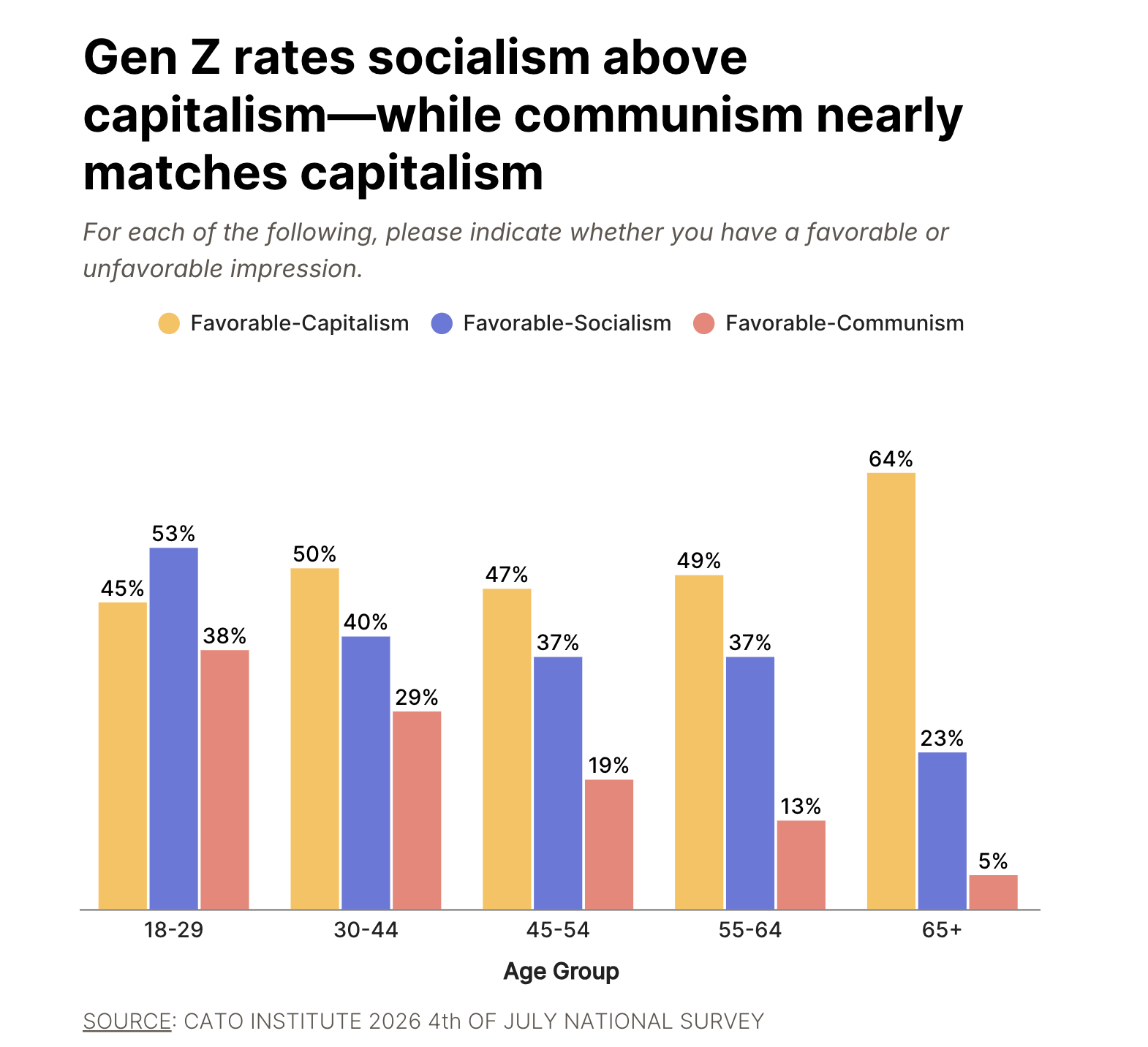
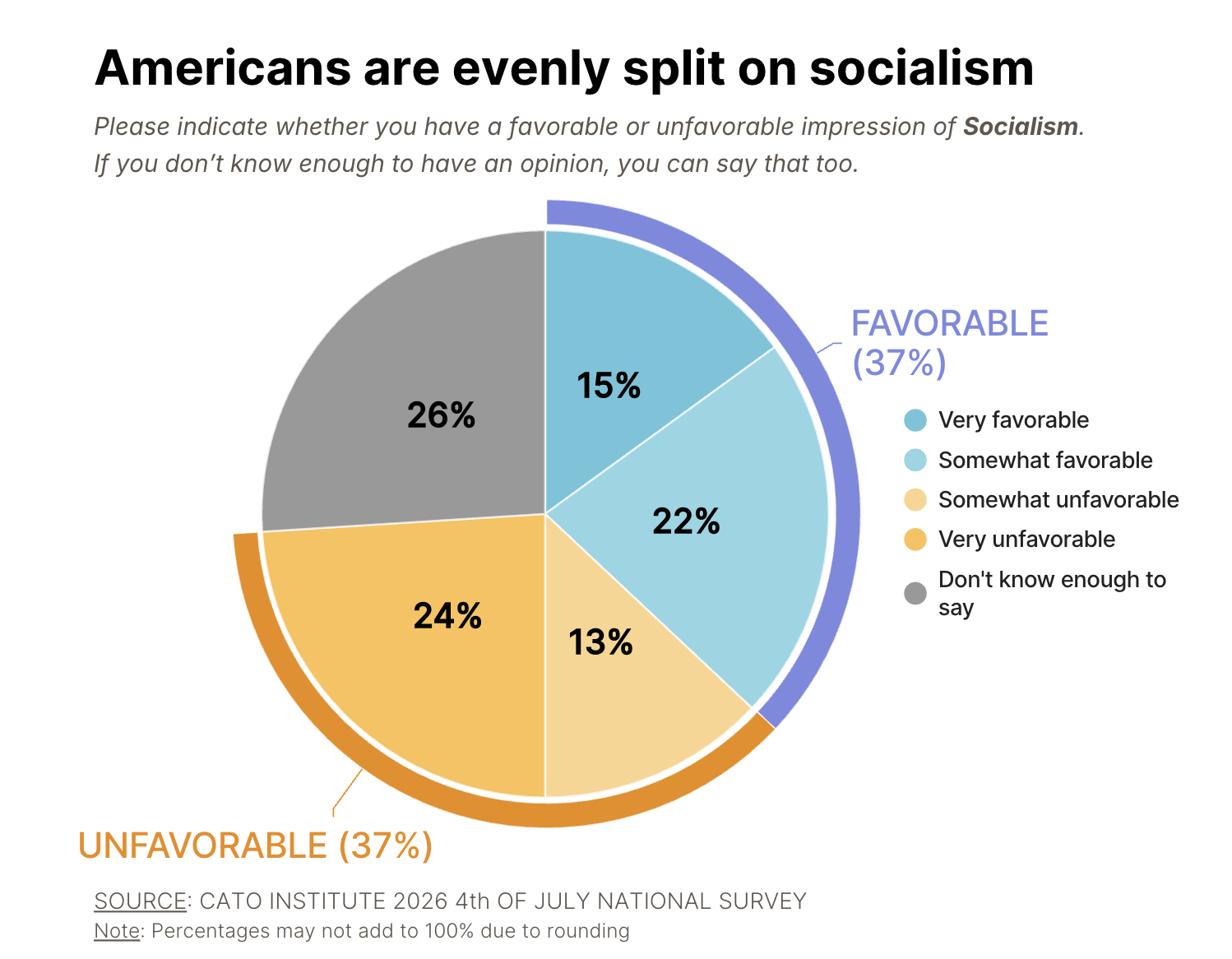
Besides the typical civic questions, the Cato questionnaire also asked Americans their feelings on communism, socialism and capitalism. The responses were quite explosive; the survey’s authors reported that: 21 percent of Americans said they held a favourable view of communism.1
Not socialism but communism. The word itself, which to the older Western mind is attached to the gulag and the Stasi and the Cultural Revolution, the one that American politics spent literally seven decades treating as roughly synonymous with treason.
Among Americans aged 18 to 29, the figure was 38 percent. In that cohort, favourable views of communism (38 percent) ran only seven points behind favourable views of capitalism (45 percent), and the generation was the only age group in which favourable views of communism actually edged out unfavourable ones, 38 to 36. Socialism, meanwhile, outpolled capitalism among the young outright: 53 percent favourable against capitalism’s 45. Also, the generational gradient was almost perfectly linear. Favourability toward communism fell from 38 percent among Gen Z to 29 percent among younger millennials, 19 percent among the middle-aged, 13 percent among those approaching retirement, and just 5 percent among seniors, the Americans old enough to remember duck-and-cover drills, Brezhnev, and the Berlin Wall as a piece of functioning infrastructure.
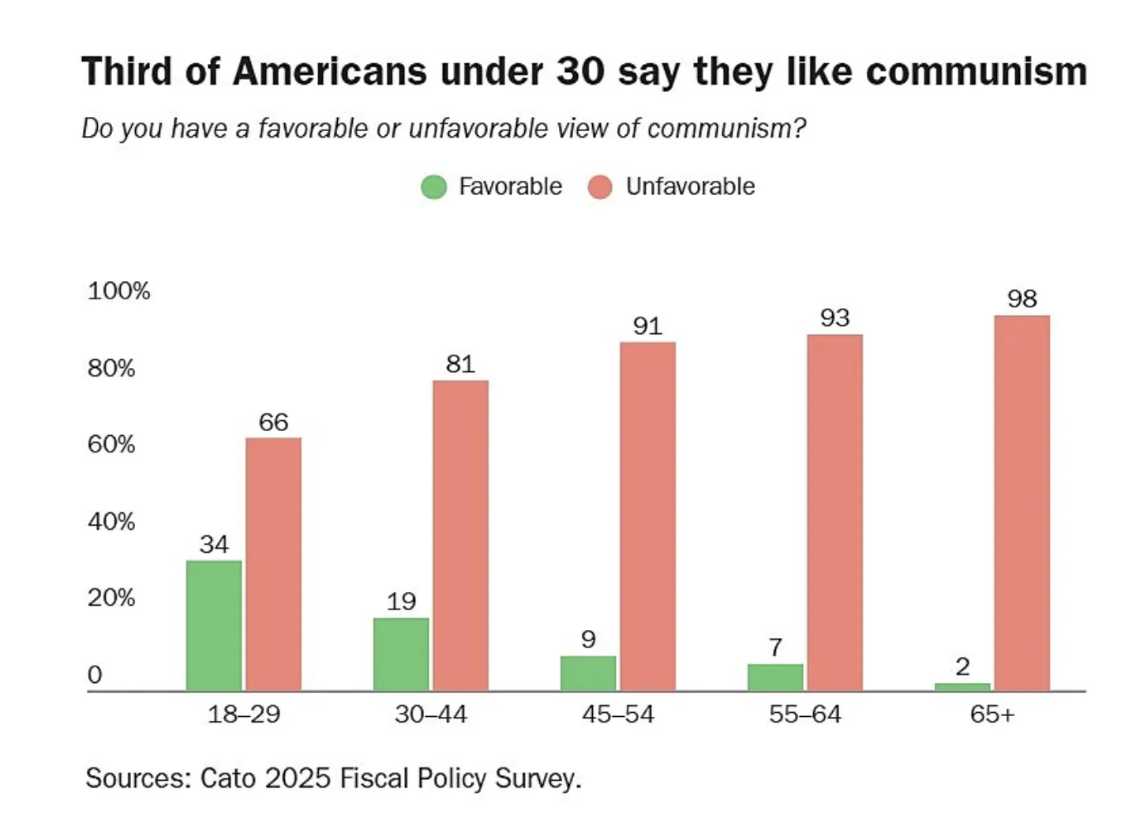
The 2026 Cato survey was not a fluke, which would be plainly obvious to people with even a slight interest in American politics. We also know this was not a fluke because the year before, in March of 2025, a Cato/YouGov survey of 2,000 adults found 34 percent of under-30s favourable toward communism and 62 percent favourable toward socialism. Cato’s senior editor Michael Chapman recorded roughly 52 million Americans aged 18 to 29, reporting a 34 percent favourability figure implying something on the order of eighteen million young people willing to say a kind word about an ideology that the Black Book of Communism credits with approximately 100 million deaths.
If you know a bit about the history of communism in America, you can understand why these numbers landed the way they did. American attitudes toward communism for most of the twentieth century were not just slightly negative; they were extremely so. Anti-communism was one of the few genuinely bipartisan commitments in American life, embraced by Cold War liberals and conservatives alike. Congress quite literally passed the Communist Control Act of 1954, effectively outlawing the Communist Party. Having any public sympathy for communism was politically and professionally fatal, as evidenced by the loyalty oaths, blacklists, and the House of Un-American Activities Committee (HUAC). When Gallup asked Americans in 1949 what “socialism” meant to them, the largest share answered on the lines of “government ownership of the means of production”, and they wanted no part of it. Communism, the harder and more explicit term, was too unthinkable during that time to even be asked in the poll.2
https://www.cato.org/blog/new-poll-nearly-half-americans-dont-know-what-americas-250th-celebrating
https://news.gallup.com/vault/240749/gallup-vault-americans-views-socialism-1949-1965.aspx
Clearing Bannerman’s Castle: A Century of Explosive Ordnance
Forgotten Weapons
Published 11 Mar 2026The Bannerman family decided to sell Bannerman’s Island to the state of New York in the 1950s, but the sale required that they first clear all the ordnance off it. That was no simple task, and the military was not interested in the job. Instead, the family found Val Forgett Jr, a demolitions expert who happened to be looking for seed money to start a business making reproduction black powder revolvers. His offer to do the cleanup work was accepted, and he spent a summer doing the job and put the proceeds into the first Navy Arms reproduction 1851 Colt Navy revolvers.
This video includes the talk given by Forgett to the Armor and Arms Club of New York in the 1990s explaining the process of clearing out the ordnance from the island …
(more…)
August 8, 2026
Larry Correia’s A to Z Guide to Anti-Gun Vulture Talking Points
On the social media site formerly known as Twitter, Larry Correia reposts his talking point guide on the issue of gun control:
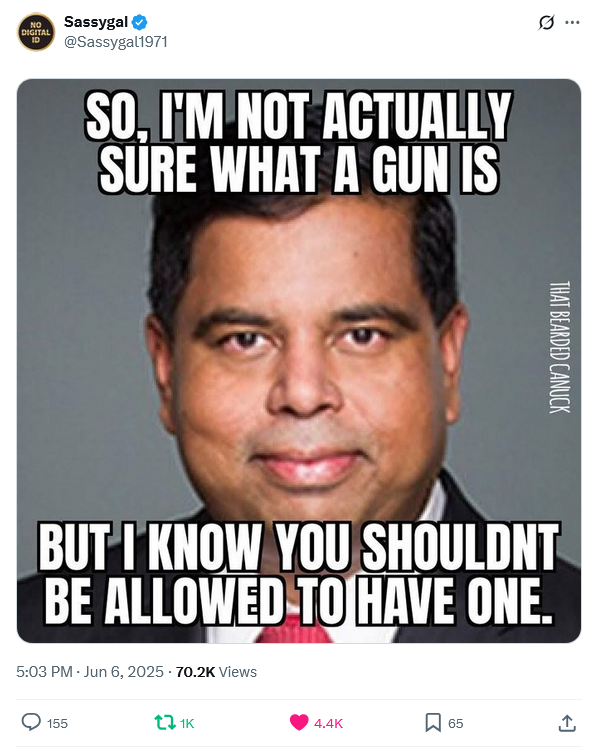
Looks like it is time to once again post my A to Z Guide to Anti-Gun Vulture Talking Points!
A. Gun owners are never trained enough so are dangerous and shouldn’t be armed at all.
B. Gun owners who do train are crazy psychos living out their wannabe fantasies itching to shoot someone.
C. Even though it takes orders of magnitude more effort to become marginally effective with martial arts than a gun, you are better off using martial arts and not having a gun.
D. *Real Men* use their hands. This is why your mom and grandma shouldn’t have guns either.
E. Twitter randos who have never been punched in the face are experts on real life violence, and whatever you have personally experienced doesn’t count.
F. No matter how trained you are, it is never enough for the hypothetical attacker they make up. Sure, your concealed handgun might be enough to stop a regular robber or rapist, but what about if you get attacked by 20 Chechen terrorists with AKs, huh? Huh? (we call this the Dracula Riding Godzilla rule)
G. If the anti-gun vulture was ever in the military, this makes them a Military Trained Expert. Even though most of the time this means they got to put 20 rounds through an M-16 once in 1992.
H. No matter how many certified MMA bad asses or combat vets go “lol wut, dork? I’d rather have a gun.” the anti-gun Twitter vulture will remain undeterred.
I. Goldilocks Rules apply. No matter how much you know about guns, you’re either too ignorant and dangerous, or you know too much and that makes you dangerous. Whatever amount the anti-gun zealot knows is Just Right.
K. Whatever stats they pull out of their ass are sacrosanct. If you cite any numbers they reflexively scream “SOURCE?!” and then have some reason they won’t accept that source when provided. “The actual FBI Crime Statistics? LAME!”
L. At some point they’ll need to talk about how big our penises are, because guns are for compensation. Obviously the female gun owners are compensating for their tiny uteruses.
M. “I believe in the Second Amendment BUUUUUUUUT-” (insert statist bullshit here)
N. If you insist on using terms correctly and words having actual definitions, clearly this demonstrates you are a fanatic. Words mean whatever they need to mean in that moment, especially legal ones.
O. “Castle Doctrine” is a secret right wing code word that means that you can just shoot whoever you want.
P. Get ready for a history lesson about “what the founders really intended” from some dumb motherfucker who was stoned through every history class in high school.
Q. Everybody knows big blue cities are way safer than the scary red state flyover country.
R. Gun control isn’t racist! Sure, historical gun control was all about keeping guns out of the hands of the “undesirables” like freed slaves, Indians, and the Irish, but that’s totally different now!
S. AR-15s are the most dangerous gun that’s ever existed. It can fire ten thousand ultra deadly murder bullets a second and each one can explode a moose from a thousand yards away. There is nothing this miracle death machine can’t do.
T. lol your AR-15s are utterly useless against a tyrannical government.
U. The NRA is an all-powerful, super evil entity which has tricked innocent Americans into wanting ultra deadly assault rifles, to satisfy their incessant blood lust. They do this through their ultra powerful marketing, like giving out free hats.
V. Anti-gun organizations are all totally innocent grass roots movements made up of moms, orphans, and kittens, funded entirely by bake sales, who just want the best for all Americans.
W. “I grew up around guns” makes you an unassailable subject matter expert on the topic.
X. The gun industry is made up of giant soulless mega corporations who make trillions of dollars off of selling Glocks to preschoolers. This message was brought to you by benevolent small businesses like the six companies that own most of the world’s media.
Y. Even though everything the anti-gunner proposes is ass backwards and would just make the problems they are crying about worse, and everywhere they get their way good people are disarmed while evil doers are empowered…they CARE HARDER than we do. So we’re the real bad guys.
Z. “You sound angry.”
August 7, 2026
The History of Gumbo in New Orleans
Tasting History with Max Miller
Published 10 Feb 2026Shrimp and crab gumbo with beef and ham hock served with rice
City/Region: New Orleans
Time Period: 1885New Orleans is one of my favorite food cities. Gumbo, a rich, thick soup or stew (depending on who you’re talking to), is an embodiment of the many cultures that have lived there. Ingredients and techniques from Native Americans, Africans, French, Spanish, and Acadian roots, just to name a few, have a place in gumbo.
While this is a relatively simple dish, it is absolutely packed with flavor. I was blown away by how a handful of ingredients, cooked down over time, came together to make such a delicious dish. Go to New Orleans and try one of the many versions of gumbo, and in the meantime, make this historical version that is so, so good.
Gombo With Crabs, or Shrimp
To a pound of beef add half a pound knuckle of ham; chop up both in inch pieces and fry them brown in two tablespoons of boiling lard; add to them four large crabs cut up, or a pound of peeled shrimps, or both if desired; cut into this four dozen small okra pods, one large onion, a little red pepper, and salt to taste. Let all simmer on a slow fire for about twenty minutes; then fill up with warm water, enough to cover the contents two inches deep. Let this boil for two hours. If it becomes too thick, add as much water as required. If preferred, a chicken can be used instead of beef.
— La Cuisine Creole compiled by Lafcadio Hearn, 1885
QotD: A provisional taxonomy of “stupid smart guys”
If we assume this is a universal mental process, I suggest, then saying someone has a low-normal IQ does not mean he’s always going to do stupid things. He has those three-B flashes too. It might take a while for him to cotton to something that seems obvious, but cotton he will, in three-B fashion.
Moreover, Jaynes is good on the complexity of unconscious tasks. The mechanical parts of driving, once learned, are completely unconscious. Try teaching someone to drive and you’ll see it right away. You’ll find yourself literally side-seat driving — your foot pushing down on an imaginary brake, unconsciously. And you never really forget those unconscious patterns, either. You may not have ridden a bike in 30 years, but you could go out and do it right now. Same way with swimming, or the manual of arms — if you’ve been through Basic, a guy with the proper tone of voice can have you twirling around like a marionette, even if you got out of uniform decades ago.
The actual low IQ guys might be the most dangerous cogs in the machine.
The Dunning-Krugerrand. That’s Larry Correia’s phrase, and it’s great. This is the person who believes he’s way smarter and more competent than he actually is. Which on the one hand, they all do. But on the other hand, there are levels above D-K, so please hold fire for now.
The Artiste. It’s been my great … fortune, actually, to have been around a lot of Media people in my youth. I dated a gal who did production work for one of the big tv news programs in a fairly large city, so I saw the video side of it, at least, from close range. The on-camera bobbleheads are all Ron Burgundy, of course, but the production people are usually quite bright … but in a very odd way. They have what I came to think of as “the artist’s eye”. They naturally see everything in terms of camera angles and visual presentation, and training develops this to a very high degree.
This leads to wildly divergent takes on things. You or I see the police approaching a stopped car with their guns drawn, or firemen pulling up in front of a burning building, and we think something like “Damn, crime is out of control!” or “I hope everyone’s ok.” News people — video people, at least — think “What a shot!” They frame the visuals first, then start processing the propositional content … if they ever do. The longer they work in “news”, the more the propositional content — “the cops are arresting a bad guy”; “there are real people in real danger in that burning building” — drops away.
Same thing, I imagine, with the folks on the verbal end. They have a novelist’s sense of pace, structure, and so on. Is what they’re writing true? Of course not! At one point about 30 years ago they felt the need to justify this, and created a whole new category of writing: “creative nonfiction“, aka lies, aka “the news”. The “creative nonfiction” people will tell you, in Wiki’s words, that it “uses literary styles and techniques to create factually accurate narratives”. Emphasis mine, because like the cameraman who ends up exclusively focusing on the shot and never thinks about the life behind the shot, so the writer of “creative nonfiction” gets caught up in the creative part, and just kinda forgets the “nonfiction” part.
Medicalization. Not a category of people, but a technique. We say smart people tend to be spergy, and stupid smart people tend to be really spergy, but that’s mistaking effect for cause. They’re not very good at reading people, and have no social savvy, but that’s because they don’t practice — because they don’t need to practice. They medicalize their deficiencies. Instead of acknowledging a weakness in their game, they attribute it to a pathology.
Severian, “The Stupid Smart Guy”, Founding Questions, 2022-07-13.
August 6, 2026
B-29 Superfortress – A $3.7bn Trial By Fire
HardThrasher
Published 5 Aug 2026The Boeing B-29 Superfortress was the most advanced bomber of World War Two — but also one of the most troubled and expensive aircraft ever built, and was plagued with flaws.
Developed at extraordinary speed, the B-29 could fly higher, faster and further than earlier heavy bombers while carrying a formidable bomb load.
It introduced pressurised crew compartments, remote-controlled gun turrets, advanced fire-control systems and enormous Wright R-3350 engines. But it couldn’t hit a barn door with its guns, had urine in the brakelines and engines which kept exploding due to all the flammable metal in them.
This video explores how the B-29 was designed, why it cost more than the Atomic Bomb to develop and how the United States overcame these challenges to get it into the war.
And yes, this is purely an excuse for me to make videos about the bomber war in the Pacific, so yar booh sucks 😊
00:00 Introduction
01:47 MOAR, MOAR, MOAR
05:48 Origin Story
12:52 Built It And They Will Come
17:57 The Battle of Kansas
19:12 Root Causes – The Key Problems
23:59 So Wright It’s Wrong
32:39 ConclusionsSources
1. Pace, S., Boeing B-29 Superfortress, Crowood Press, 2003 p.53
2. Werrell, K.P., Blankets of Fire, US Bombers over Japan during World War II, Smithsonian Institution Press, 1996, p.82
3. Werrell, K.P., p.68
4. [Deleted Section]
5. Pace, S., p.23
6. Sixteenth Census of the United States, 1940–1940, NAID: 16660414
7. Werrell, K.P., p.75
8. Le May & Yenne, Superfortress – The Boeing B-29 and American Airpower in World War II, Westholme Publishing 2007 (original published 1988 by McGraw) p.78
9. Le May & Yenne, p.78
10. Werrell, K.P., p.80
11. Le May & Yenne, p.80
12. Werrell, K.P., p.67
13. Werrell, K.P., p.67
14. Werrell, K.P., p.80
August 5, 2026
The Korean War Week 111 – Will Stalin’s Nightmare Come True? – August 4, 1952
The Korean War by Indy Neidell
Published 4 Aug 2026The UN conducts a massive bombing raid on the North Korean capital Pyongyang this week, and in the field, the bloody fight for Old Baldy continues. Behind the scenes, though, Presidential Candidate Dwight Eisenhower’s foreign policy guy John Foster Dulles is advocating for massive retaliation — in Korea and beyond — against all Communist states, to do more than simply “contain” them.


