It’s one of those numbers that sings so easily you’d have to be a total idiot to louse it up. I’ve always loved it because it’s pure Americana, a song that no other culture could have produced. As I mentioned last week, I’m often asked how I started writing, what got me interested, who were my influences, all the usual questions. And I don’t really have a ready answer. But, if I were to be semi-serious about it, it was songs like this that tickled my curiosity about language – not just the words and phrases and images, but the way the ideas were expressed so neatly. Compression is the essence of songwriting, and if you had to come up with a couplet that defines the genre, that encompasses a whole world and a whole point of view and an entire musical tradition, “I found a million dollar baby in a five and ten cent store” comes as close as any.
I once asked a friend in the French music biz how the song went over there. I hummed him the tune and he sang me the French lyrics and, although I can’t recall any of them, I remember they were entirely different from the English words. It’s not just the five-and-ten that’s hard to translate or the million dollar baby. But the concept of finding the latter inside the former is also very American. There are a ton of Mitteleuropean operettas in which the prince or duke or count wanders into the streets in disguise and falls in love with a serving wench, but the serving wench usually turns out to be a Countess or Margravine or some such also wandering around in disguise. Even the British are prone to this syndrome (Spring In Park Lane, etc). But in an American song the shop girl is a genuine shop girl, and she’s still a million dollar baby. That’s what makes it American.
In the Sixties, by the way, you could have found a future billion dollar baby in a five and ten cent store: Sam Walton, founder of Wal-Mart, got his start in retail as a franchisee at a Ben Franklin’s, founded in 1920 by the Butler brothers, who’d been in the five-and-dime business since the 1870s. I’m not saying “I Found a Million Dollar Greeter in the Big Box Store at the Strip Mall on the Edge of Town” would be as big a hit, but there is an historical continuity from the Butlers to Wal-Mart.
Mark Steyn, “I Found a Million Dollar Baby (in a Five and Ten Cent Store)”, Steyn Online, 2020-10-25.
August 23, 2026
QotD: “I found a million dollar baby in a five and ten cent store”
August 22, 2026
TRW Low Maintenance Rifle: America’s Roller Locked Flechette Rifle
Forgotten Weapons
Published 30 Mar 2026TRW’s Low Maintenance Rifle seems to have been the result of a program to use a blank slate and a modern space age scientific mindset to develop a rifle that would be more reliable and effective than other existing designs. It was contracted to TRW during the Vietnam War, and they produced a very light, long stroke gas piston rifle with a roller-locked bolt. It was chambered for the XM216 single-flechette cartridge, with a muzzle velocity of a screaming 4700 fps. After production of three prototypes, the design was revised to use standard 5.56mm M193 and M196 ammunition. Three more rifles were made in this form before the program was cancelled in 1973 as the end of the Vietnam War caused funding to dry up for this sort of thing.
(more…)
August 21, 2026
Batman as a modern Sisyphus
I don’t normally post much about comic book characters, because my interest in comic books lasted from about 1965 to 1975 … a very different era than most of the comic books of today (I’m sure it’s considered tantamount to a hate crime to refer to them as “comic books” by a significant number of long-time fans). Here, Devon Eriksen explains why the Batman character is a modern rendition of the Greek hero Sisyphus and his eternal punishment in the underworld:

Batman, the fictional character, does not embrace the Batman Fallacy because he is written as stupid. He’s obviously intended to be very intelligent.
But the many, many authors of this character have always agreed that he must have this one critical blind spot.
Why?
So the story can continue.
See, if Batman kills the Joker, or turns him over for execution, the story, or at least a popular villain, is over. No more Joker stories.
So the character of Batman must be created in the image of Sisyphus… always struggling against the manifestation of the problem, but never able to address the root cause.
All of Batman’s victories must be against the Joker’s latest scheme, not the Joker himself. He must forever be playing defense, making heroic efforts merely to maintain things as they are, like the Red Queen running as fast as she can just to stand still.
This is how the Joker, a man of no special resources or talents, whose sole advantage is utter disregard for law, empathy, or human life, can be a challenging foe for a billionaire genius superathlete with an endless array of technologies and skills.
He can simply generate schemes forever. He doesn’t have to win always, or even often. Because every one of his victories is real and has permanent consequences, and every one of his defeats is temporary, pending a rematch.
Batman, by his very nature, can never stop the Joker, only slow him down.
If Batman were a different character, if he were willing to, say, throw the Joker out of a helicopter over a vast body of water, then the story would eventually end, because pretty soon the setting would no longer need Batman.
And no doubt on that day, there would be a great deal of whinging over whether throwing the Joker out of a helicopter was a “human rights abuse”, as if the Joker himself were not a walking, talking human rights abuse to begin with.
But Batman can never win, and never stop fighting, because he refuses to go on the offensive and remove his enemies from play.
This post is not about Batman.

Nikola Tesla’s Weird Eating Habits
Tasting History with Max Miller
Published 24 Feb 2026Roast duck, sadly without a crispy skin, with creamy celery sauce
City/Region: New York
Time Period: 1896Nikola Tesla was a scientific genius and a very eccentric man in many aspects of his life, especially in his eating habits. He only ate at a few restaurants where he had reserved tables, and he required two dozen napkins with which he’d wipe down each piece of silverware before dropping the napkins on the floor.
He would sometimes supervise the cooking of his meals, including this duck roasted under a smothering of celery, a recipe which journalist and author of Prodigal genius; the life of Nikola Tesla, John J. O’Neill, said “was of his own devising”. With the lack of detail about this dish, it’s impossible to say if this method is what was intended, but I found that roasting with the celery didn’t impart much flavor.
The celery sauce, which has a bit of nutmeg, does pair nicely with the duck, but I prefer duck with a nice crispy skin and a sweet sauce.
Roast Ducks
Truss the birds … rub a little butter over them and dredge with flour, salt and pepper, and roast in a hot oven for twenty or thirty minutes. If preferred stuffed, peel, core and quarter some apples and fill the body with them, removing them when the bird is done, as they are not fit to eat, the flavor being too strong …Celery Sauce for Boiled Fowls
Wash thoroughly and trim a head of celery. Put it into boiling water, with one tablespoonful of salt, and boil it until it is tender. Then drain it through a colander, and cut into pieces one-half inch in length. Blend a large tablespoonful of flour with one-fourth pint of the broth in which the fowls are boiling. Mix till it is quite smooth, add one ounce of butter, a small piece of grated nutmeg, and salt to taste, and mix it with one-fourth pint of milk. Place it over the fire in a saucepan, and stir it till it boils. Let it boil for ten minutes and then throw in the pieces of celery; when it is quite hot again, pour it into a sauce-tureen, and serve.
— The Cook Book by “Oscar” of the Waldorf by Oscar Tschirky, 1896
QotD: The Amish
The basic organizational unit of Amish society — after the extended family, which is vital and often includes three generations under one roof — is the “church district”, a community of twenty-five to forty families who live within a short buggy-ride of one another. The leaders of the district are chosen by lot from among the married men, and each is governed by an Ordnung, an unwritten set of rules laying down expectations for behavior. It’s this Ordnung that contains the restrictions on technology and lifestyle that we typically associate with the Amish, covering everything from what color you can paint your barn (one group insists on red because white would be too worldly) to whether you can use mechanical milking machines. The church revisits their Ordnung every six months or so to see if it needs updating — one group had originally approved walkie-talkies for communication while hunting, but then discovered boys were using them to flirt with girls and decided to ban them. Church districts with similar Ordnungs are “in fellowship”, and a cluster of districts in full fellowship with one another are an “affiliation”. (A “settlement”, like the Holmes County Settlement, is a cluster of geographically contiguous districts regardless of affiliation.)
Importantly, few of these restrictions are based on the idea that the banned technology or behavior is wrong in and of itself: for instance, every Ordnung forbids a baptized Amish adult to own a car, but boys from some Amish families have cars for a while in their teens and all but the most conservative affiliations will pay someone else to drive them if they need to go farther than their buggy can take them. Or to put it another way, nobody thinks the English are bad people for driving cars — they just think we’re not Amish.
So if an Ordnung mostly isn’t meant to keep you from doing intrinsically evil things, like murder and adultery and blasphemy, what is it for? How do you decide what to allow? What are you optimizing for when you design it?
Two things, mainly, though they’re not neatly separated. The first and most important role of the Ordnung is engendering the virtue the Amish call Gelassenheit. There’s not a perfect English translation for the German,1 but Hurst and McConnell describe it as a spirit of “selflessness, humility, or meekness”, a subordination of self to community. Amish scholar2 Donald Kraybill wrote that Gelassenheit is meant to develop a “yielded self” that “stands in contrast to the bold, aggressive individualism of modern [English] culture”. Thinking too highly of yourself, or trying to outdo others, are failures of Gelassenheit, but they’re hard to avoid when you have to market your personal #brand or compete in the marketplace. Unmechanized agriculture, on the other hand, was very good at nurturing Gelassenheit: a farmer is necessarily aware of his dependence on natural forces beyond his control, which keeps him humble. Nowadays the Amish worry that shifts way from their traditional lifestyle will “foster the notion that the worker controls his or her work and life”, which might “breed an attitude of self-sufficiency, even arrogance” that is antithetical to their values.
The concern for Gelassenheit shows up particularly in Amish approaches to childrearing. Where English society values self-expression, intellectual curiosity, and individual accomplishment, Amish parents rank obedience and self-control as the most desirable qualities in children. (More than half of the parents the authors surveyed put “being interested in how and why things happen” at the bottom of their list.) They also report that teachers at Amish schools tend to be “preoccupied (to our eyes) with minor aspects of misbehavior that signaled nonparticipation in the group or lack of obedience to authority”. All of this carries through into the workplace, too: the Amish generally think white collar workers are “out to make the big bucks” and that their jobs are be difficult or impossible to undertake with a “meek spirit”. So if you can’t farm (and increasingly you can’t), the Amish think your work should be something near home that uses your hands, allows your family to participate, and contributes directly to your community. No arguments here that building dashboards to give executives deeper insight into critical business functions leads to the more efficient allocation of global capital and lifts all boats; they want you to make food or furniture or something.
The Ordnung‘s second goal is to separate believers from the broader world. This is partly a legacy of the Anabaptist experience of persecution, partly a response to Biblical passages like Romans 12:2’s warning not to “be conformed to this world”, and partly a protective measure against a world that isn’t interested in Gelassenheit, but the dualism between Amish and “English” is a vital part of what it means to be Amish. Of course, it’s impossible to clearly differentiate between things that promote a particular mindset/virtue and things that mark you out as different: the distinctive Amish “plain dress“, for instance, both limits opportunities for vanity and marks out the wearer as, well, kind of a weirdo. (There’s sometimes also a sub-goal of separation from other Amish affiliations — one Amish man is quoted saying, “The only reason the Old Order doesn’t have rubber wheels [on their buggies] is because the New Order did it first”.)
Jane Psmith, “REVIEW: An Amish Paradox, by Charles E. Hurst and David L. McConnell”, Mr. and Mrs. Psmith’s Bookshelf, 2025-12-15.
- And they mean something different by it than Heidegger does!
- Okay, this one is a Mennonite scholar of the Amish.
August 20, 2026
The Frankfurt School – The most destructive intellectual project of the 20th Century
People tend to underestimate how influential intellectual movements can be, as they rarely get outside attention until they’re deeply entrenched in the university system. The Frankfurt School‘s damage record is unmatched by any other intellectual movement of the era:
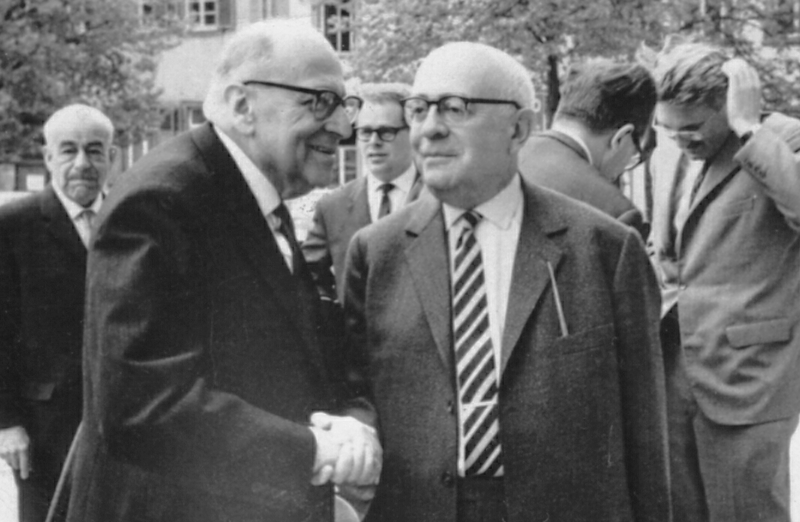
Notable members of the Frankfurt School in Heidelberg, April 1964 at the Max Weber-Soziologentag. Max Horkheimer is front left, Theodor W. Adorno front right, and Jürgen Habermas is in the background, right, running his hand through his hair. Siegfried Landshut is in the background left.
Photograph by Jeremy J. Shapiro via Wikimedia Commons.
The Most Destructive Intellectual Project of the Twentieth Century.
The Frankfurt School. You should know what it was, what it built, and why you are still living inside it.
1. The Institute for Social Research was founded in Frankfurt in 1923 and relocated to Columbia University in 1934 when Hitler came to power. The civilization they had decided to dismantle gave them refuge when another tried to kill them. They spent the next five decades producing the theoretical infrastructure for that dismantling. Western civilization itself was the problem: reason, the Enlightenment, the family, tradition, authority. Not reformed. Dismantled.
2. They called it Critical Theory – and the name is the program. Everything is to be criticized; nothing is to be built. In The Dialectic of Enlightenment (1944), Adorno and Horkheimer argued that Western reason — the reason that produced Newton and the rule of law — contained the seeds of Auschwitz. Not that reason had been misused, but that reason itself, taken to its conclusion, produces the death camp. This was not a critique of institutions. It was an indictment of the civilization itself.
3. Adorno gave them the psychological weapon. The Authoritarian Personality (1950) classified conservatism, religious faith, patriotism, and the traditional family not as political positions but as symptoms of a proto-fascist personality. If you believe in the nation or the father’s authority, you are pre-fascist. The opponent was no longer wrong – he was sick. You don’t argue with a pathology. You treat it. This made dialogue impossible. You don’t persuade someone who is wrong; you diagnose someone who is sick. Politics becomes therapy, and disagreement becomes pathology.
4. Marcuse gave them the political weapon. Repressive Tolerance (1965) argued that tolerating wrong ideas is itself oppression. True tolerance therefore requires suppressing intolerant ideas. The left decides which ideas are intolerant. Everyone else is silenced – not despite tolerance, but “in its name”. Censorship dressed in the vocabulary of liberation.
5. The generation that read Marcuse at Columbia, Berkeley, and Yale went on to run universities, media, foundations, NGOs, content moderation departments, and the EU regulatory apparatus. They implemented the argument sincerely because they had been taught it as philosophy. This was the Frankfurt School’s greatest achievement: it produced true believers.
6. French Theory picked up the tools and made them aesthetic. Foucault made the critique of power literary. Derrida made the critique of meaning philosophical. Deleuze made the critique of identity elegant. A political program became a cultural sensibility. You can argue with a program. A sensibility is in the air you breathe. By the time these ideas reached the American campus through the French conduit, they were no longer ideology. They were the water. The fish did not know they were wet.
7. A civilization stands on three pillars: truth exists and is accessible to reason; good is distinguishable from evil; and there is an inheritance worth transmitting. The Frankfurt School attacked all three – systematically and with considerable intellectual sophistication. It produced a generation that knows how to deconstruct and has forgotten how to build. That sees power everywhere and beauty nowhere. The ultimate achievement was to make destruction feel like progress. Every inherited institution became suspect; every constraint became oppression; every act of preservation became reactionary. Deconstruction became the default, while construction became something that needed to justify itself.
The answer is not another theory. It is the thing the Frankfurt School most feared: the builder who simply builds, the scientist who follows the evidence, the father who transmits what was transmitted to him.
The deconstruction machine runs on the assumption that nothing is worth building.
Prove it wrong.
Tell the truth, have courage, and build.
The Korean War Week 113 – The Battle of Bunker Hill – August 18,1952
The Korean War by Indy Neidell
Published 18 Aug 2026There’s plenty of action as Chinese troops battle with the US Marines over Hill 112- now known as “Bunker Hill”- throughout the whole week. Back in the USA, questions continue to circulate about the government’s strategy of limited war in Korea. The conflict looks set to play a key role in the 1952 Presidential Election, as candidates Dwight D. Eisenhower and Adlai Stevenson begin to feel the scrutiny of the American public.
00:00 Intro
00:19 Recap
00:41 The Battle of Bunker Hill
05:16 Marine Artillery
06:13 The Peace Talks
07:51 Limited War
11:45 The Presidential Candidates
13:44 Summary
13:57 Conclusion
August 18, 2026
M15 Automatic Rifle (aka T44E5): Adopted But Not Produced
Forgotten Weapons
Published 23 Mar 2026When the US replaced the M1 Garand, the plan was to adopt both a select-fire infantry rifle and a heavy-barreled support weapon on the same platform. During development, both the T44 (later M14) and T48 (FAL) rifles had heavy-barreled versions. In the case of the M14, the final iteration of the heavy-barreled weapon was the T44E5, which was formally adopted as the M15. Before it could be actually put into production, though, it was cancelled as unnecessary.
In testing, first the Marine Corps and then the Infantry Board found that fitting a standard M14 with a detachable bipod gave the same performance as the M15 — and so why bother with an extra version of the gun? Of course, the equal performance was really quite poor compared to proper light machine guns, and once the M14 got into service this shortcoming was noticed. this led to the M14A1 aka M14E2 project, to essentially recreate the M15 with a pistol grip stock and front grip.
Thanks to the Springfield Armory National Historic Site for giving me access to this truly unique specimen from their reference collection to film for you! Don’t miss the chance to visit the museum there if you have a day free in Springfield, Massachusetts: https://www.nps.gov/spar/index.htm
(more…)
QotD: A quick heuristic for evaluating public figures
InfantryDort @infantrydort
The amount of trust I have in a person is directly proportional to how many legacy media hit pieces they attract.
My first thought was: good heuristic for evaluating public figures!
My second thought was: No, wait. Sometimes the legacy media attacks genuinely bad people.
My third thought was: … but this happens surprisingly seldom. Why is that? A few seconds of thought reveal the answer.
When you’re policing an orthodoxy (and the legacy media definitely sees its job as policing an orthodoxy) the most dangerous person isn’t the one whose beliefs are radically different from the orthodoxy, but the deviant whose position is just close enough to attract converts from within the orthodox mass.
Heretics get burned more often than do unbelievers.
So yes, InfantryDort is right. Probabilistically, trusting public figures that the media constantly does hit pieces on is unlikely to tangle you up with the genuinely evil and crazy, and much more likely to point you at truth-seekers.
ESR, The social media site formerly known as Twitter, 2026-05-15.
August 17, 2026
Peacemaker and the Red Skull’s Ghost: Breaking The Post-WWII Mythos
Feral Historian
Published 10 Apr 2026I expect half the viewers to think I sound like a Leftist and the other half to think I’m turning into their Right-wing uncle with a little dash of conspiracy theorizing on this one. But there’s a point here that I think is worth stating. Or maybe it’s just a silly video about superheroes and a war we can’t seem to get over.
00:00 Intro
03:18 Pennyworth
04:40 Political Sabotage
11:08 Contending with the Ghost
(more…)
August 15, 2026
“Forestalling collapse is simple: all we need do is reinstate meritocracy within institutions”
John Carter discusses the ever-more-concerning collapse in basic competence in western societies, which left unchecked will absolutely lead to civilizational collapse due to the vastly complex interconnection of so many systems that we all depend on day and night:
Helen Andrews recently wrote an essay for Compact Magazine, titled The Racial Crossroads, which has been making waves for daring to use the verboten descriptor “race communism” for the acrimonious racial spoils system that has replaced meritocracy throughout the dying West. It’s very good. You should read it.
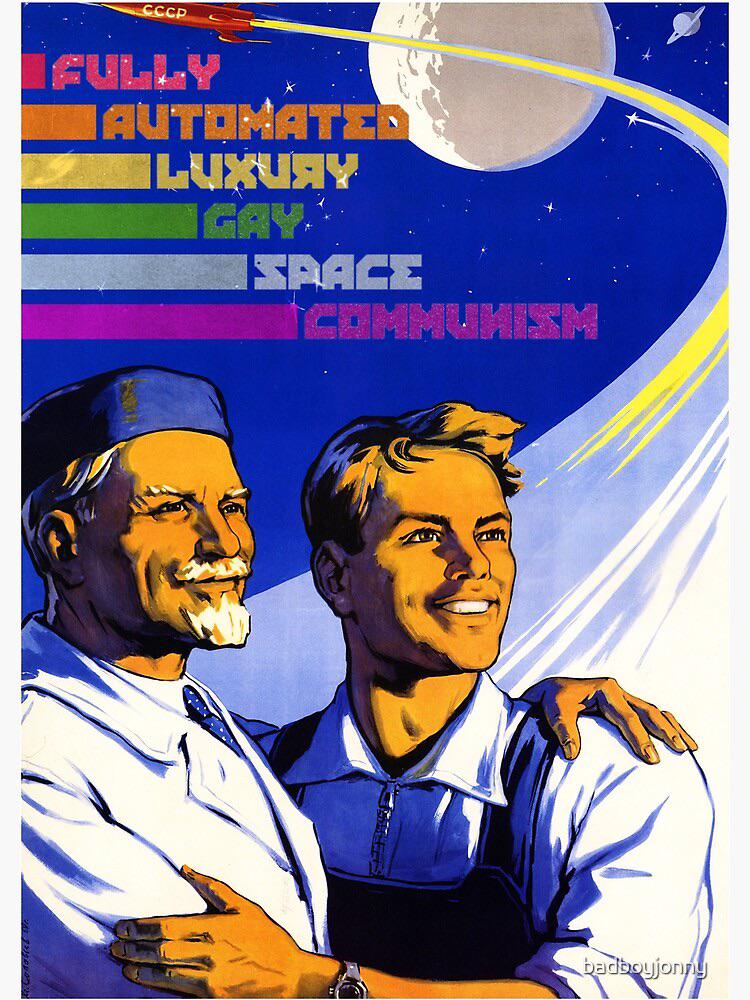
Personally, I prefer the more descriptive “gay race communism”. The progress pride flag is inseparable from the clenched Marxist fist of Black Lives Matter in regime iconography. Moreover, gay race communism is a deliberate subversion of the left’s own “fully automated luxury gay space communism” meme.
There are zero communists who actually look like this, gay or otherwise.
To be fair, Andrews introduces the concept as “gay race communism”, and even directly acknowledges its coinage by Twitter anon Drukpa Kunley. It wasn’t that long ago that conservative popularizers laundered ideas emerging from the anonosphere without attribution, as a means of hiding their origin and making themselves look more original, and Helen deserves credit for not doing this. Also to be fair, given the focus of Andrews’ piece, adding the “gay” to “race communism” could be seen as an unnecessarily inflammatory complication. It isn’t, but we’ll get to that in due time.
Andrews spends the first half of her essay detailing how the regulatory framework built by the Civil Rights Act created the cultural conditions for the rise of wokeness, affirmative action, and DEI initiatives. The official explanation given for anti-discrimination laws was that they were well-intended correctives to the legacy of slavery and Jim Crow. Affirmative action was to be an explicitly temporary measure to give American blacks a helping hand, with the understanding that – after a decade or at most a generation of assistance – they would no longer need a thumb on the scale. Once racism was defeated, we could all live in utopian colour-blind race-neutral Star Trek liberalism, judging one another by the content of our individual characters and no more concerned by the phenotypic differences of ancestral population groups than we are by sartorial quirks. Kumbayah and such. This isn’t an original argument: the same points have been made by Christopher Caldwell in his 2021 book The Age of Entitlement, and of course most directly by Richard Hanania in his 2023 book The Origins of Woke (whom Andrews doesn’t mention, possibly because everyone hates Hanania now).
The central point of Andrews’ essay is the following:
The old racial bargain is breaking down, due to a combination of changing demographics and a dawning realization that racial outcomes are not going to converge any time soon. One possible path forward is to throw out the old racial bargain and establish a new one based on equality under the law. The other possible path is to accept permanent racial favoritism at every level of society.
As Andrews sees it, the first problem with the Civil Rights regime is that it reifies the abstraction of equality into a legal presumption that there are no salient biological differences between human population groups. This simply isn’t true, but the assumption that it is true leads to the necessary conclusion that all differences in outcome between groups must be a consequence of discrimination based on irrational prejudice, rather than a natural result of inborn distinctions of cognitive capacity or behavioural profile. Biological differences are real and significant, but the make-believe that they are socially constructed and unimportant incentivizes a perpetual inquisition that dismantles society as it persecutes innocent people for ever more tenuous spectres of racism implicitly haunting the privileged depths of their incorrigbly white ids. This places institutions in an impossible quandary, since the only way to avoid being dragged into court in discrimination lawsuits is to preemptively discriminate in favour of protected groups, which is to say, against unprotected groups. Human resources departments have formed as a direct response to the legal sword of Damocles poised over every institution’s neck: their function isn’t actually to hire the best people, or to hire anyone at all, but rather to ensure that the employer won’t get sued for hiring people from the wrong groups, or not hiring the people from the right groups, or for allowing people from the right groups to get offended by things said by people from the wrong groups. A doctrine predicated on denial of reality must go to war with reality to preserve itself, and as the war on noticing grinds on the battlefront presses into ever more intimate corners of people’s lives, their public speech, their private speech, their silent thoughts, their very emotions.
Your emotions are illegal, chud.
The second problem Andrews identifies is demographic mission creep. When race communism first got rolling in the 50s and 60s, the focus was quite specifically on African-Americans, who had an arguable claim to restitution on the basis of their long period of bondage on the cotton plantations.1 White Americans largely agreed with that, and were trying to do the decent thing, to make up for the abuses and indignities suffered by the disadvantaged blacks.
The mass migration of the third world into the first upsets that balance. America is no longer a 90% white country with a small rump of Africans, but more like a 50% white country, with large and growing minorities from every benighted slum in the Global South … and every single one of those groups gets to classify itself as an oppressed racial minority from the Global Majority, and therefore help itself to the largess spilling forth from the cornucopia of white guilt. In the 70s and 80s affirmative action was largely no more than an annoyance for white Americans, but in the 2020s young American whites find themselves shoved aside in university admissions, in corporate hiring, in the availability of loans and grants for education, in the availability of venture capital, in promotions, and so on, with these opportunities being bestowed instead upon supposedly oppressed minorities who arrived five minutes ago and were never actually oppressed by white Americans.
[…]
Institutional collapse is a near certainty on this track. Our civilization is a staggeringly complex system of systems. Operating and maintaining those systems requires a high degree of competence. Competence has to be learned, but it can’t be learned by anyone. DEI pushes incapable people into key positions, while denying even the opportunity for training to the potentially capable. Eventually, the systems themselves begin to malfunction. Repair becomes impossible, because there’s no one who actually knows how to repair the systems: the ones working in the system are too stupid to understand it, while those who could have learned were locked out and therefore didn’t learn what they needed to know. One system breaks, causing a problem in another system, which leads to a problem in a third system, and soon cascading failures junk the entire machine. DEI – and by extension, Civil Rights – has precipitated a competence crisis, and Complex Systems Won’t Survive the Competence Crisis.
This complex systems collapse is already happening. Andrews uses the example of failures in airplane manufacturing, pilot training, and air traffic control that have made air travel that much more hazardous, and which seem to trace directly to DEI-motivated recruitment policies, although naturally it is difficult to verify this as the regime does everything it can to obscure such a connection. The general enshittification of the Internet is probably at least partly a result of less talented and less scrupulous Indians replacing white software engineers. Entertainment media has become ludicrously bad in direct proportion to the replacement of white male directors, showrunners, screenwriters, animators, artists, and programmers by women of pronouns. Academia is in the midst of a credibility collapse for exactly the same reason.
It is not hard to extrapolate this degenerative process out a generation or two. Instead of building cities on Mars, we will be bouncing over potholes on dirt roads. Tap water will have to be boiled, assuming water even comes from taps. Electricity will only be available a few days a week, and that in the good neighbourhoods. What did South Africans use for light before they had candles? Light bulbs. There are still liberals in South Africa, by the way.
Forestalling collapse is simple. All we need do is reinstate meritocracy within institutions.
Simple does not mean easy. Reinstating meritocracy is in fact ideologically impossible for the regime.
- The merits of that case can certainly be debated: white Americans have spilled rivers of their blood and mountains of treasure to end and make up for slavery, and when is enough enough?; the crime and dysfunction blacks have brought to American cities must surely be included against them in the accounting; the standard of living of the most low-down American hood rat is orders of magnitude better than that of his distant cousins in the shantytowns of Lagos, suggesting that if anything blacks should be grateful for free transport to the New World. Putting all of that aside, the fact remains that American blacks have a long history in America, and therefore have some claim to consideration.

Mark Steyn denies being a “Never Trump”-er
From his sickbed, Mark Steyn responds to a criticism from one of his long-time readers that he’s “gradually devolved into NeverTrumpism:

I have no idea where I saw this meme, but it makes me laugh
I begin to understand why, since I emerged from my coma, the docs have recommended eschewing the Internet. Following Wednesday’s Clubland Q&A, Joe Huber comments:
Unfortunately, SteynOnline (once my favorite place to visit) has gradually devolved into NeverTrumpism, and that’s sad. But it is what it is.
We may have to introduce weekly ceremonial expulsions from The Mark Steyn Club. I’m not “NeverTrump” on immigration, DOGE, MAHA, endless war, etc, and I would still favour him over any likely Democrat candidate or “mainstream” Republican. The first time I met him was over thirty years ago, when his then wife was auditioning for a Broadway musical produced by a friend of mine. The only substantive exchange we had that day was his demand for assurance that the show was a bona fide hit … because the defining characteristic of Trump has always been his utter contempt for what he calls “losers” and his disinclination to allow his brand to be contaminated by association with them.
So it is a mystery to me that he allowed himself to get mixed up with an institution that, by any objective measure, is the biggest “loser” on the planet.
By contrast, my position on this has been exactly the same throughout the time Mr Huber regarded SteynOnline as “my favorite place to visit”. This piece, for example, was published in the print edition of National Review over fifteen sod-bollocking years ago, and its first sentence remains the question that, multiple unwon wars later, the Rah-Rah Right still declines to answer. I recall multiple back-and-forths with the editors over passages they felt were too strong meat, and I would probably write it more bluntly today. But its comparative sobriety should cause Mr Huber to reflect that his charge of “NeverTrumpism” is bollocks, and that my concerns about US inability to use half of the entire planet’s military budget to accomplish any minimal strategic purpose is principled, long-held, and borne out by any random headline. From today:
Russia Captures Record Share of India’s Oil Market
And so it goes. (Incidentally, just as a minor point: I note the increasing adoption of the term “West Asia” for the zone of conflict. “Middle East” is a designation that reflects the view from Washington; “West Asia” is how it looks from Delhi and Beijing.)
You will see in the latter half of my ancient piece the reference to the US military as “the expeditionary force of the Parliament of Man”. It is safe to say that President Trump — with his declaration that he’ll pick the next Supreme Leader — does not see it like that, but that’s the point: the rhetoric may change, but the self-bollocksing of American warmongering does not.
QotD: “The progressive is a walking paradox”
If I loudly claim to love vanilla ice cream, yet every time I return from the Mr Whippy van I’m holding a choc-ice, my revealed preference is evidently for chocolate — not vanilla.
Thus the truth of a person’s preferences is revealed through their actual choices and behaviour, not by what they claim to prefer.
It’s unfortunate we can’t simply listen to their words, but they are so oriented toward the external, the aesthetic, and the performative (“Theater Kid Progressivism”) that we must instead look at their proximal behaviours — where they actually choose to live and raise their families, for example, to extrapolate backwards their true feelings on mass migration and its consequences.
This is the lens through which we should try to understand our Progressive class.
The bitterest irony, the irony of ironies, is this: progressives, especially those who voted for it, self-evidently do not feel at home in the societies they helped create.
If they were genuine believers, they would live contentedly amidst their new friends.
Instead, they scuttle off into the countryside, the leafy suburbs, or gated enclaves, abandoning the very demographic transformation they imposed on others.
It is often said that if liberals didn’t have double standards they wouldn’t have any at all, but while this is very funny (and true), there’s more to it.
It reveals a profound non-confluence between their stated attitudes and their actual behaviours, indicative of extreme cognitive distortion.
They protest performatively that open borders and rapid demographic change are a universal good, even moral imperatives and (admittedly less often nowadays) sources of strength.
Yet when it comes to their most intimate revealed preference — where they opt to live and raise their families — they consistently prioritise homogeneity, good schools, and cultural familiarity.
They lobby and vote without end for policies that maximise immigration into lower- and middle class neighbourhoods, then abandon those very communities for pastures anew, safely insulated by postcodes and house prices.
Their revealed preference is that do not want to live in the Canada (or Britain, or America, or Europe) they are busily helping to construct.
They enjoy the vibes, the moral status, the Instagram aesthetics, while quietly falling back to the leafy, high-trust environments their grandparents took for granted.
Progressives love to speak of taboos (indeed if there is a pastime more alluring and intoxicating to the progressive than “breaking taboos”, I am yet to come across it, but I digress) yet is the greatest taboo of all right in front of us after all, carrying a basket of organic fruit and veg from Waitrose?
To interrupt the Progressive in the midst of his communal dream state, to turn our collective eye away from the brave new world they are building for us and to instead look inwards, to look the Liberal cuckoo directly in the eye and put words to the disparity between their words and their actions …
The subject of lawful and legal deportations is increasingly mainstream, yet what of urban renewal and rewilding by means of progressive importations?
The Progressive is a walking paradox, he is both the centre of attention and the ghost at the feast all at once.
Æthelstan, The social media site formerly known as Twitter, 2026-05-14.
August 14, 2026
Ontario premier doubles-down on provoking Trump. What could go wrong?
At some point you have to ask yourself … if Canada was being run by people who wanted to destroy it, what would they have done differently in the trade negotiations with Donald Trump’s government?

Is Doug Ford the dumbest Canadian?
I know, it is a deep bench. But the tubby premier is extraordinary. You have to appreciate talent.
There are, apparently, two schools of Canadian thought on the trade fracas with the US. “Punch the bully in the nose.” and “For God’s sake get a deal already.” As I prefer a Canada with an economy, I pick door number 2.
Our Chief Trade Negotiator Janice Charette, is more combative. If Trump brings in his retaliatory tariffs in a week she’s packing up and going home. That’ll learn him.
The idle threat school of negotiation enjoys wide currency in both Ottawa and Queens Park. Meanwhile, Canadian businesses are looking [longingly] at the low tax, low reg world inside the Trump tariff wall.
I’m having a beer with a buddy who is in “founder’s mode” on a startup and, frankly, he’d be crazy not to be looking at domiciling his business in the States. Sure, have a Canadian sub, but why put your main business in Canada?
And decisions like this are being made all over Canada and, indeed, the world. People might hate Trump and all his works but the business attractions of Red States make Ontario and BC look pathetic.
You would think that after Ford’s Super Bowl ad fiasco he would have the wit to remain silent as his province’s fate is being negotiated. You know, avoid more damage. But no, the tubby premier likes to “talk tough”.
I actually feel a bit sorry for Carney having to deal with the fallout of this idiot’s remarks. Unless, of course, like the Super Bowl ads, Carney actually encouraged these remarks … In which case the competition for dumbest guy in Canada has tightened up.