
Let me remind you of the educational vision of the Founders, by way of E.D. Hirsch: “The American experiment … is a thoroughly artificial device designed to counterbalance the natural impulses of group suspicions and hatreds … This vast, artificial, trans-tribal construct is what our Founders aimed to achieve.” Intersectionality aims for the exact opposite: an inflaming of tribal suspicions and hatreds, in order to stimulate anger and activism in students, in order to recruit them as fighters for the political mission of the professor. The identity politics taught on campus today is entirely different from that of Martin Luther King. It rejects America and American values. It does not speak of forgiveness or reconciliation. It is a massive centrifugal force, which is now seeping down into high schools, especially progressive private schools.
Today’s identity politics has another interesting feature: it teaches students to think in a way antithetical to what a liberal arts education should do. When I was at Yale in the 1980s, I was given so many tools for understanding the world. By the time I graduated, I could think about things as a Utilitarian or a Kantian, as a Freudian or a behaviorist, as a computer scientist or a humanist. I was given many lenses to apply to any one situation. But nowadays, students who major in departments that prioritize social justice over the disinterested pursuit of truth are given just one lens — power — and told to apply it to all situations. Everything is about power. Every situation is to be analyzed in terms of the bad people acting to preserve their power and privilege over the good people. This is not an education. This is induction into a cult, a fundamentalist religion, a paranoid worldview that separates people from each other and sends them down the road to alienation, anxiety, and intellectual impotence.
Jonathan Haidt, “The Age of Outrage: What the current political climate is doing to our country and our universities”, City Journal, 2017-12-17.
December 3, 2023
December 2, 2023
Joe Biden solves the inflation problem, fat!
Like any lying dog-faced pony soldier would know, it’s as easy as saying “Trunalimunumaprzure“:
Inflation is kicking just about everyone in the junk here lately, regardless of whether that junk is an innie or an outie. It’s been rough on a lot of us, but I know just how hard it’s been on me and mine.
Prices are up significantly over the last few years and my income isn’t up nearly as much. This creates issues with our finances. The upside is that it’s forced me to be better with money.
But prices are still higher than Willie Nelson on a SpaceX flight.
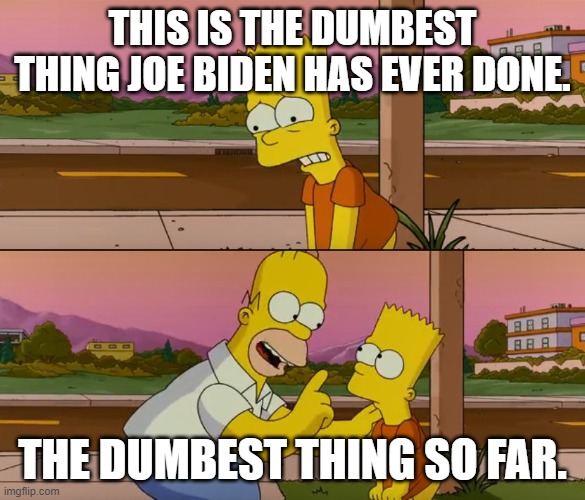
Luckily, President Joe Biden has figured out the solution to all our problems. He’s going to just tell companies to drop prices.
This week, the White House announced the launch of a Council on Supply Chain Resilience, created with the hope to “strengthen America’s supply chains” and “lower costs for families.”
…
President Joe Biden delivered remarks from the White House on Monday to announce the new council’s creation. He touted the lower inflation rate and falling grocery prices but admonished American companies for, in his view, not going far enough.
“Let me be clear: To any corporation that has not brought their prices back down — even as inflation has come down, even as supply chains have been rebuilt — it’s time to stop the price gouging,” Biden warned, imploring them to “giv[e] the American consumer a break.”
Here’s the issue, at least as I see it.
At Thanksgiving, it was noted here that prices are nearly 20 percent higher than in 2019. This while inflation has supposedly decreased. Prices are still high because it’s not so much that inflation has fallen but that the rate of inflation’s increase has fallen. It doesn’t mean prices should drop, only that they should increase at a slower rate.
December 1, 2023
QotD: The OODA loop
OODA theory is worth reading about in more depth for anyone interested in … well, any kind of competitive dynamics, actually – military, commercial, individual, anything. The Wikipedia article is a good start. Stripped to its essentials, the theory is that competing entities have to go through repeated iterations of observing conditions, relating observation to a generative theory, deciding what option to pursue, and acting. Victory tends to go to the competitor who can run this cycle the fastest.
OODA theory was originally generalized from the observation that in fighter design, maneuverability (especially a shorter turning radius) beats straight-line speed. When you get inside your opponent’s OODA loop, either physically or conceptually, you can attack him from unexpected angles. You can be where he isn’t. You have the initiative; he is reduced to reacting, often with too little and too late.
Eric S. Raymond, “The Smartphone Wars: Tightening the OODA Loop”, Armed and Dangerous, 2011-02-18.
November 30, 2023
Canadian government declares victory over Google, then lays down its arms and marches into captivity
The Trudeau government has won a glorious, historic victory over the evil capitalistic powers of Google in the war of Bill C-18. Let all patriotic Canadians raise their hands to cheer our victorious politicians before they have to admit out loud that they fucked up real good:

Heritage Minister Pascale St. Onge has surrendered to Google and Canadian media have avoided what would have been a catastrophic exclusion from the web giant’s search engine.
In the short term, this is very good news. The bureaucrats at Heritage must have performed many administrative contortions to find the words needed in the Online News Act‘s final regulations to satisfy Google, a beast which isn’t easily soothed. In doing so, they have managed to avoid what Google was threatening — to de-index news links from its search engine and other platforms in Canada. Given that Meta had already dropped the carriage of news on Facebook and Instagram in response to the same legislation, Google’s departure would have constituted a kill shot to the industry.
Instead, the news business will get $100 million in Google cash. For this, all its members will now fight like so many pigeons swarming an errant crust of bread.
The agreement will also allow the government, while surrounded by an industry whose reputation and economics have been devastated by this policy debacle, to attempt to declare victory. Signs of that are already evident.
That’s the good news.
The bad news is that while 100 million bucks is nothing to sneeze at, in the grand scheme of things it is a drop in the bucket for an industry in need of at least a billion dollars if it is to recover any sense of stability. Indeed, when News Media Canada first began begging the government to go after Google and Meta for cash, some involved were selling the idea that sort of loot was possible.
This did not turn out to be so.
Instead of the $100,000 per journo cashapalooza that was once hoped for, the final tally will be more like $6,666.00 per ink-stained wretch.
That figure is based on two assumptions. The first is that the government has agreed to satisfy Google’s desire to pay a single sum to a single defined industry “collective” that would then divide the loot on a per-FTE (full-time employee) basis to everyone granted membership in the industry’s bargaining group. Google had made it clear it had no interest in conducting multiple negotiations and exposing itself to endless and costly arbitrations. So, as we have a deal and Google held all the cards, it’s fair to assume it got what it wanted — a single collective with a single agreement and a single cheque.
Why Wilders’ PPV appealed to Dutch voters and why the establishment is utterly horrified
In The Free Press, Ayaan Hirsi Ali and Evelyn Markus explain why Geert Wilders’ Party for Freedom took so many seats in the Dutch elections:
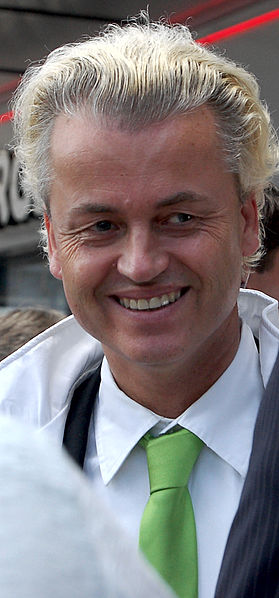
Geert Wilders, leader of the Dutch Party for Freedom (PVV).
Photo by Wouter Engler via Wikimedia Commons.
It was in 2004, the same year that Theo van Gogh was brutally murdered, that Geert Wilders saw his opening.
Though Wilders had been in Dutch politics for a long time, that year Wilders left the VVD — the center-right party where he served alongside Ayaan — and branched out on his own with a new party, the Party for Freedom. The key issue that led to his break was that Wilders refused to countenance the possibility of EU membership for Turkey (which the VVD was willing to accept as long as certain conditions were met).
Almost immediately, Wilders became the most controversial man in Dutch politics. He urged the banning of the Quran and a halt to the construction of new mosques. He railed against what he described as the “Islamization of the Netherlands”. When he asked a crowd in 2014 whether they wanted “more or fewer” Moroccans, the crowd chanted “fewer”, and Wilders replied that this was something that would be arranged. Prosecutors argued this constituted an illegal collective insult, and the Dutch High Court ultimately ruled that Wilders was guilty, but without sentencing him to a penalty.
It was easy to be scandalized by Wilders. The press and the political class certainly were. Some publicly supported Wilders’ prosecution in the “fewer Moroccans” case.
We disagreed — and still do — with Wilders’ calls for blanket bans on additional asylum seekers, with the notion of banning the Quran (let alone any book), and with his consistent failure to draw a distinction between Islam and Islamism.
But we understand how and why his message resonated with the public.
While elites over the past two decades have told the public to ignore their lying eyes, Wilders continued to emphasize the hot-button subjects that resonated with the public: the struggling economy, the importance of borders, the risks of devolving too much power to Brussels, the threat of Islamism, and the challenge of mass migration.
While elites told the public that opposing migration was xenophobic, ordinary people noticed structural changes in their country and felt they — the public — had not been adequately consulted. In the 1960s, 60,000 Muslims lived in the Netherlands; today there are around 1.2 million, thanks to massive chain migration, asylum, and a high birth rate. (Fewer than 50,000 Jews remain in the country.)
While political elites told the public to be tolerant of Islam, in keeping with a long-standing tradition of religious tolerance, ordinary people saw that Islamists were increasingly well-entrenched in the country, a point even made by Dutch intelligence officials. Although Wilders’ rhetoric can be uninhibited and extreme, he articulates a general and perfectly legitimate feeling among voters who know that Islamism is a threat to their way of life and want to oppose it. (Wilders has been the subject of sustained Islamist threats and has had to live his life within a tight security bubble because of them.)
While elites told the public that giving more power to the EU was an unqualified good, ordinary people took a more nuanced view. When we left the Netherlands in the early 2000s, the Dutch were solidly pro-EU. Today, although most Dutch voters do not wish to leave the EU, there are growing concerns that, especially when it comes to migration and borders, too much authority has been ceded to supranational institutions.
Over the years, we have heard more and more friends express private sympathy with Geert Wilders. And it should be noted that during the most recent campaign, he toned down some of his more extreme rhetoric. Previously, his party called for a “Ministry of Re-migration and De-Islamization”. That is no longer the case. Similarly, the phrase “Islam is not a religion, but a totalitarian ideology”, which was previously part of the election manifesto, was scrapped. This time around, Wilders emphasized his commitment to working within the Dutch coalition system, which he conceded would require him to make compromises in order to be able to govern.
The recent aggressive and occasionally violent pro-Palestinian demonstrations in the Dutch streets — as elsewhere — may have been the final blow that led to last week’s landslide. It’s worth noting that Wilders’ voters do not fit a crude stereotype — he won the most votes of any party among voters between the ages of 18 and 35.
The challenge facing Javier Milei
Craig Pirrong outlines just how much work Argentinian President-Elect Javier Milei will have to accomplish to begin to bring Argentina’s government in line with his electoral mandate:

When I wrote Milei is not a leftist, let’s say that rather understates the matter. Milei loathes leftists and leftism, and repeatedly refers to them on television and in public appearances in scatalogical terms, calling them “leftards”. He despises collectivism, and asserts bluntly that leftists are out to destroy you. His mission is to destroy them first.
As someone so vehemently hostile to the left and well outside conventional political categories, Milei’s victory has triggered a mass moral panic, especially in the media. The New York Times coverage was (unintentionally) hilarious: “Some voters were turned off by his past outbursts and extreme comments over years of work as a television pundit and personality.” Well, obviously a lot more weren’t, but I guess one has to take solace where one can, eh, NYT?
Milei’s agenda is indeed a radical one, especially for a statist basket case like Argentina. To combat the country’s massive (140 per cent annualised) inflation, Milei says he will dollarise the economy and eliminate (“burn down”) the central bank. He also wants to reduce radically the role of the state in Argentina’s economy. He says he wants to “chainsaw” the government – and emphasises the point by campaigning with an actual chainsaw.
His election on this programme sparked a rally in Argentine financial markets, with government debt rising modestly and stock prices rallying smartly.
Will Milei be able to deliver? Some early commentary has doubted his ability to govern based on the fact that his party’s representation in the legislature is well below a majority. That may be an issue, but not the major obstacle to Milei’s ability to transform Argentina into what it was at the dawn of the 21st century: an advanced, rapidly growing economy and a relatively free society.
The real obstacle is one that is faced by anti-statists everywhere – the bureaucracy. (I do not say “civil service” because that phrase is at best aspirational and more realistically a patent falsehood. Akin to the Holy Roman Empire that was neither holy nor Roman, the “civil service” is neither civil nor a service.)
Argentina’s bloated state is its own clientele with its own interests, mainly self-preservation and an expansion of its powers. Moreover, it has created a whole host of patronage clients in business and labour. Milei’s agenda is anathema to this nexus of public and private interests. They will make war to the knife to subvert it.
Even a president with an electoral mandate faces formidable obstacles to implementing his agenda. The most important obstacle is what economists call an “agency problem”. The bureaucrats are agents of the chief executive, but it can be nigh unto impossible to get these agents to implement the executive’s directives if they don’t want to. Their incentives are not aligned with the executive, and are often antithetical. As a result, they resist and often act at cross purposes with the executive.
The modern chief executive’s power to force his bureaucratic agents to toe the line is severely circumscribed. At best, the executive can make appointments at the upper levels of the bureaucracy (such as the heads of ministries or departments), but the career bureaucrats who can make or break the executive’s policy are beyond his reach, and not subject to any punishment if they subvert the executive’s agenda.
November 29, 2023
Grover Cleveland – more “republican” than any Republican alive today
Not having studied American history in school, I don’t know a lot about most American presidents, especially those of the 19th century whose names aren’t Jefferson, Jackson, or Lincoln. One of the presidents I only knew about because his name turned up in a lot of original Trivial Pursuit questions was Grover Cleveland, the only man (so far) who has ever been elected to non-consecutive terms:
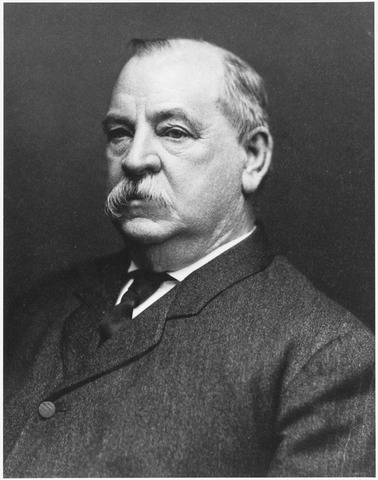
Grover Cleveland (1837-1908), President of the United States, 1885-89 and 1893-97.
Photo from the National Archives and Records Administration (NAID 518139) via Wikimedia Commons.
Cleveland won the White House in 1884 on a platform of restraining federal spending and corruption. Running for re-election in 1888, he won the popular vote but lost to Republican Benjamin Harrison in the Electoral College. A major reason he came out of retirement to run again in 1892 was the reckless spending of the Harrison administration. He beat Harrison that year and became the only man ever elected to non-consecutive terms (1885-89 and 1893-97).
I call to the reader’s attention an article ex-President Cleveland wrote three years after the end of his second term, in June 1901. Titled “The Waste of Public Money”, it was one of half a dozen he penned for The Saturday Evening Post. In this one, he referred to “a malign condition which threatens us,” an “evil” that he saw as “calamitous and destructive to our national character and integrity”.
In 1901, the federal government spent half a billion dollars over the whole year, roughly equivalent in real terms to around $12 billion today. Washington spends that much now in about half a day. Lest you think the feds were misers in 1901, ponder what Cleveland had to say in his article that year:
Probably no one will have the hardihood to deny that the cost of our Government is excessive and wasteful, and that for this condition the heedless neglect and indifference of our people are in some degree responsible … If the aggregate mass of our people are at all blameworthy on account of the present advanced stage of public prodigality, it is largely because they overlooked and tolerated its small beginnings, when at all times they should have been vigilant and uncompromising. A self-ruling people … should constantly remember that nothing multiplies itself more abundantly than national extravagance, and that neither an individual nor a popular government can easily correct or check habits of waste.
The former president did not for a moment believe that only the politicians were to blame for excessive spending. He boldly asserted that many Americans embraced it. They were effectively bought and paid for, guilty of “accepting the bribes of selfish and personal advantage which public waste and extravagance offer”.
Cleveland was often warned by advisers to moderate his stances to avoid controversy. Biographer H. Paul Jeffers quotes him as responding once to such advice by asking, “What is the use of being elected or re-elected unless you stand for something?” When he vetoed a bill to relieve drought-stricken farmers with federal money, he made it plain that “though the people support the government, the government should not support the people”. He saw his job as upholding the Constitution and keeping the federal government in its proper place, not weakening “the bonds of common brotherhood” by robbing Peter to pay Paul.
This was a man who said what he meant and meant what he said, come Hell or high water. He spoke with a clarity of principle that makes a nation great, and the absence of which makes a great nation fail. He understood that no society in history that allowed itself to be bribed by its politicians ever survived such legal larceny.
In the final paragraphs of his June 1901 Saturday Evening Post article, Cleveland admonished his fellow Americans. With these words, he urged them to muster the character to resist being bribed with their own money:
The lessons of extravagance and paternalism must be unlearned; economy and frugality must be reinstated; and the people must exact from their representatives a watchful care for the general welfare and a stern resistance to the demands of selfish interests, if our Government is to be an enduring and beneficent protection to a patriotic and virtuous people.
Many Americans today would undoubtedly dismiss Cleveland’s warnings as “quaint” and “old-fashioned”. They want the government to give them stuff and they don’t think much about who will pay for it. They think even less about how it corrupts the national character.
QotD: The children of the revolution
As soon as you saw people as things to be measured, they didn’t measure up. What would run through the streets soon enough wouldn’t be a revolution or a riot. It’d be people who were frightened and panicking. It was what happened when the machinery of city life faltered, the wheels stopped turning, and all the little rules broke down. And when that happened, humans were worse than sheep. Sheep just ran; they didn’t try to bite the sheep next to them.
Terry Pratchett, Night Watch, 2002.
November 28, 2023
Pierre Trudeau and Canada’s choice to become an international featherweight in the 1970s
In The Line, Jen Gerson endures a foreign policy speech from Mélanie Joly that takes her on a weird journey through some of Canada’s earlier foreign policy headscratchers … usually leading back to Justin Trudeau’s late father:
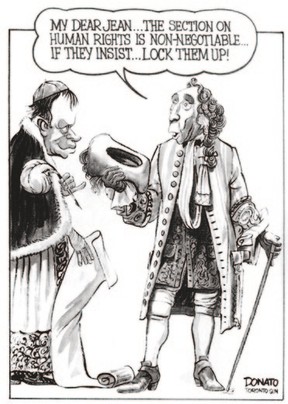
A Toronto Sun editorial cartoon by Andy Donato during Pierre Trudeau’s efforts to pass the Canadian Charter of Rights and Freedoms. You can certainly see where Justin Trudeau learned his approach to human rights.
If I saw a statue of P.E.T. on the roof of a foreign affairs building that looked like it were competing for a 10th place spot in the Eurovision tourney, I don’t know how I’d feel: embarrassed, touched, certainly too polite to say anything honest. I probably wouldn’t be so struck with awe by the sight that I’d be keen to shoehorn the anecdote into a major policy speech in front of the Economic Club.
And yet.
Joly’s speech was striking in that it could be divided into two distinct parts: The first half was a cogent and clear-eyed examination of the state of play of the world, one that acknowledged a fundamental shift in the assumptions that underpin the global order. Nothing one couldn’t glean from the Economist, but grounded nonetheless. The global order is shifting, the stakes have increased, and the world is going to be marked by growing unpredictability.
“Now more than ever, soft and hard power are important,” Joly noted, correctly, ignoring the fact that Canada increasingly has neither, and doesn’t seem to be doing much about that.
And this brings us to the second half of the speech, which was an attempt to spell out the way Canada will navigate this shift, by situating itself as both a Western ally and an honest broker: we are to defend our national interests and our values, while also engaging with entities and countries whose values and interests radically diverge from our own. “We cannot afford to close ourselves off from those with whom we do not agree,” Joly said. “I am a door opener, not a door closer.”
This was clearly intended to be analogous to the elder Trudeau’s historic policy of seeking cooperation with non-aligned countries — countries that declined to join either the Communist or the Western blocs throughout the Cold War.
[…]
If our closest allies treat us like ginger step-children as a result of our own obliviousness and uselessness, our platitude-spewing ruling class is going to seek closer relationships in darker places: in economic ties with China, and in finding international prestige via small and middling regional powers or blocs whose values and interests are, by necessity or choice, far more malleable than our own.
These cute turns of phrase are a matter of domestic salesmanship only. “Pragmatic diplomacy” is a thick lacquer on darker arts.
Which brings us back to Macedonia, again. Or North Macedonia, if you’re a stickler.
Before it declared independence in 1991, Macedonia was a republic within the Socialist Federal Republic of Yugoslavia. During much of Trudeau Sr.’s time, Yugoslavia was led by Josip Tito, a Communist revolutionary who broke with Stalin and spearheaded a movement of non-aligned countries, along with the leaders of India, Egypt, Ghana, and Indonesia. Tito was one of several despotic and authoritarian leaders with whom Trudeau Sr. sought to ingratiate himself to navigate the global order.
P.E.T.’s most ardent supporters maintain a benevolent amnesia about just how radical Trudeau Sr. was relative not only to modern standards, but to world leaders at the time.
During the 1968 election, Trudeau promised to undertake a sweeping review of Canada’s foreign affairs, including taking “a hard look” at NATO, and addressing China’s exclusion from the international community.
In 1969, America elected Richard Nixon a bombastic, controversial, and corrupt president who forced Canada examine the depth of its special relationship with its southern neighbour. At the time, this was termed “Nixon shock.” And it could only have furthered Trudeau Sr.’s skepticism of American hegemony.
It was in this environment of extraordinary uncertainty, and shifting global assumptions and alliances, that Trudeau Sr. called for a new approach to Canadian foreign policy. He wanted a Canada that saw itself as a Pacific power, more aligned to Asia (and China). Trudeau also wanted stronger relationships with Western Europe and Latin America, to serve as countervailing forces to American influence.
Geert Wilders
Mark Steyn on the suddenly fascinating-to-American-media Dutch politician Geert Wilders, with whom he has had a long association:
Geert Wilders, leader of the Dutch Party for Freedom (PVV).
Photo by Wouter Engler via Wikimedia Commons.
Times are bad, and the respectable chaps are explicit about their eagerness to make them more so — more mass immigration, more green bollocks, more “digital identity”, more “variants” and more “public health”, more mutilation and sterilisation of your middle-schoolers …
This last week I’ve received a bazillion queries demanding to know what I make of Geert Wilders. It’s true that a lot of commentary on his victory is close to witless: in America, he is apparently “the Dutch Trump” — because they’re both, er, blond. As David Reaboi pointed out on Twitter, Wilders has been a thorn in the side of the Dutch state since the days when “Trump was donating to Democrats”. In 2005, when The Donald was still sufficiently “respectable” that Hillary Clinton attended his wedding, Wilders had already been expelled from his party for objecting to Turkish membership of the European Union.
So he’s been at this a long time – and yours truly goes back a long way with him. He did me the great honour of inviting me to write the introduction to his book, Marked for Death, which is a cracking read — not just my bit, but his parts too: Geert writes way better in English than most anglo politicians do. (We have a few copies at the SteynOnline bookstore, and I’ll even sign it for you: the perfect Christmas gift for the “far right” members of your family.)
But here’s the most relevant aspect of how Wilders was ahead of the game. I try not to let my own twelve years in the dank septic tank of Washington pseudo-justice get to me, but, as you know, for me the only salient point about this US election season is that the multitudes of prosecutors and judges of the American state are willing to torture the plain meaning of the nation’s laws in order to get Trump convicted of … something, anything, as long as it gets him banged up in gaol for the rest of his days.
This is the central fact of our increasingly post-democratic age: the criminalisation of political opposition. If you’re in European-style multi-party systems, they’ll deny you bank accounts and seize your kids’ iPads, and if necessary find twenty coppers to jump you in the street. But, if you’re in America’s bloody awful frozen two-party system, the leader of Party A will unleash the resources of the world’s most lavishly funded Deep State on the leader of Party B and persuade anyone around him to cop a plea on crimes they didn’t commit — mainly because those crimes don’t actually exist.
In that sense, rather than Geert being the Dutch Trump, Trump is the American Geert. Until Biden came along, no other settled western democracy had been as zealous as the Netherlands in prosecuting opposition politicians for their policy platforms.
November 27, 2023
“A law for which no enforcement mechanism exists is not a law. It is a LARP or a declaration of feeling”
Kulak takes on politics and violence:
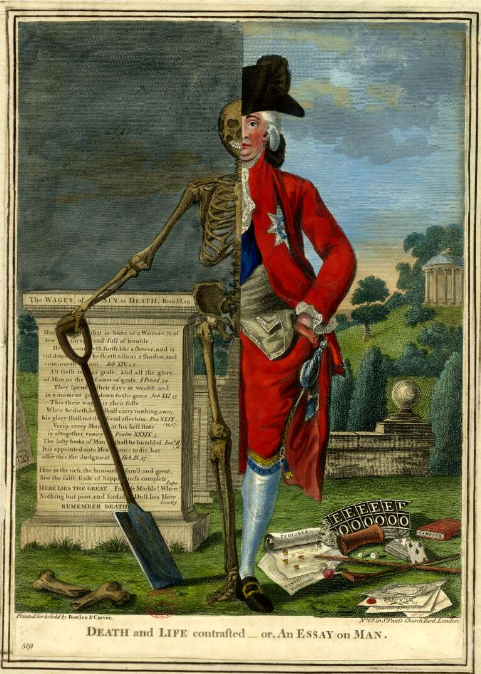
“Death and Life constrasted … or, an Essay on Man” by Robert Dighton, 1784.
British Museum number 1935,0522.3.55.
The power of any law comes from the fact that armed men stand ready to commit an escalating series of violence against those who do not comply. And even the lightest touch, subtlest “Nudge” laws gain their power via subtly manipulating the circumstances in which violence by state is already applied. (When you fill out the tax form you must fill out or be dragged to prison, this new law will let you fill in a box to receive $200 back if you have a dog … whom the IRS would shoot before taking you to prison if you had not surrendered the money to them in the first place)
To say someone has political power whether a voter, an activist, or a politician … is to say they can effect political outcomes such that they can make violence more or less likely to be exercised against someone.
If your political activism and activity is not connected to any mechanism to commit violence, whether through the states agents, or through an illegal organization … you are not a political actor. You are a “citizen”, “voter”, “activist”, “politician” in the same way the madman at the asylum is “Napoleon”, you may play-act with the symbols of power … but you do not interact with it.
All Political Discussion Terminates in Violence
All discussions of politics is inevitably, and CAN ONLY BE, a conspiracy to commit violence, whether legally through the state, illegally through some form of direct action or “terrorism”, or Stochastically through some impact on the culture or wider discussion which will make the prior two more likely or effect their nature.
If your supposedly political speaking’s have no connection to state or non-state “policy” Ie. Violence … then they are not political. You are engaged in fantasy at best, grovelling at worst.
This is why so many in the safety brigade and regime are not incorrect when they call the political speech of their opponents “Dangerous” or a form of “violence” all political speech is necessarily, by the nature of being political, directed to altering the atmosphere, calculus, mechanisms, and willing committal of state and non-state violence.
.
None of this should be shocking
Clausewitz observed “War is politics by other means”
Vladimir Lenin observed the inverse: “Politics is warfare by other means”
In both they merely restated Hobbes: The state of nature is a state of war and peace is merely an artifice mutually consented to by all sides under a sovereign … which can be unilaterally terminated at will by any party, and rationally must be terminated in any one of a thousand circumstances.
That Rights and Liberties are “Given by God” is a euphemism for the violence and threat implicit in the claims of free men.
The founders saying their rights were “endowed by God”, was no different than Carolus Rex declaring he was “Chosen by Heaven” … It was a euphemism and a flex that their violence and dominance of fate had left them masters of their domain, and that they’d meet any challenge with as much violence as a crusader or Inquisitor would visit upon a heretic challenger.
November 25, 2023
“Three or more reporters, arranged in a scrum … are dumber together than any of them alone”
I’m not a fan of the legacy media, although I’ve met good folks who worked or still work in the field, and the modern incarnation of the media has become so much more transparently a PR team for the big progressive wet dreams of bigger and bigger government and more and more centralized control over peoples’ lives. I’ve never met Paul Wells, but he’s respected by some of the media people I’ve met and generally has interesting things to say, perhaps more so that he’s his own boss and publishes on Substack these days:
Images returned for an image search for “Stephen Harper media scrum”
One reason I don’t like to play along with subscribers who assume this newsletter is a running critique of “the mainstream media” is that I know too many journalists. The best ones are wonderful and most are fine. Most are better at some part of the craft than I am. They don’t hesitate to make that fourth or fifth call, they’re forever willing to butt their heads against the surreal access-to-information regime, they understand interest rates, whatever. They often (not always!) admit errors publicly, which gives the occasional schoolyard bully a chance to make fun of them for doing what bullies never do. Many have an appropriately tragic sense of what it means to work in an industry that has been collapsing for 20 years.
But as a robust rule, reporters don’t mass well. Three or more reporters, arranged in a scrum — the term of art for an impromptu news conference that the newsmaker can leave at any moment — are dumber together than any of them alone. I caught glimpses of this early on. The first time I ever had to scrum a prominent politician at an important moment, I couldn’t believe how bad most of my more experienced colleagues’ questions were. My National Post column and my first book often featured satirical descriptions of scrum dynamics. But it really got bad when Stephen Harper was prime minister.
Harper was a master at generating dumb scrums. The ingredients for a dumb scrum are (1) pre-existing mutual animosity between newsmaker and reporters; (2) a tight limit on time or the number of permitted questions; (3) a few minutes before the scrum to allow the reporters to work on ways to maximize their advantage. This last is not essential but it’s a tremendous catalyst of dumbness, because reporters who are trying to select the best questions always ask worse questions.
If 10 reporters know they will only have time for two to four questions, their responses become predictable. They will need to “get him” (the newsmaker) on “the story of the day”. That is, they need to collect audio and video clips of the newsmaker talking about a dramatic event that happened within the last several hours. That’s because broadcast has room for fewer words than print does, so broadcast’s needs are more rigid. It’s simply pointless to urge colleagues before a scrum to get the newsmaker reminiscing about his youth, or to drag up some disagreement from 2019 that might be newly relevant, or to debate the fine points of trade law. The questions that work in scrums are of the “Aren’t you …” or “Didn’t you …” kind.
Unfortunately, such questions are child’s play to defuse. A junior staffer can tell her cabinet minister what to expect in a scrum, and in 70 guesses over a month she might be wrong three times. Scrum questions are always narrow and pointed, even though every reporter learned early that it’s their very narrowness that makes such questions easy to dodge. “Aren’t you siding with the convoy protesters when you …?” “Not at all. I’m calling for basic fairness.”
Often, the goal in a scrum is to record the newsmaker confessing to a terrible error, ideally a complete moral breakdown. Sometimes it’s not even personal, although the aforementioned pre-existing mutual animosity definitely helps. It’s just that it would be fantastic radio if the newsmaker did collapse in an audibly self-incriminating heap. This too is an easy bullet to dodge. Once I know you are trying to get me to confess my soulless incompetence, all I have to do is talk about anything else, and I win.
Dumb scrum dynamics are hard to avoid. They’re the product of simple physics — there is no time for a thoughtful exchange — mixed with collegial generosity. Reporters with more complex ambitions have to take one for the team, so the clip people can get their clip. None of the rules I have described is set in stone. In 2015 I spent several days covering Stephen Harper’s last campaign, and my colleagues let me simply ask my questions without telling them what I’d ask. But I had to do it in rotation, which meant I got two questions in a week. Meanwhile most of them worked together to concoct questions he could see coming from a mile away.
QotD: Political language mirrors the ritualized nature of political life
In a crisis, they recite. We’ve all watched them do this. “This is not who we are.” “Let me be clear: Hate has no home here.” You know what they’re going to say before they say it, and you know the tone before you hear it. The current mayor of Los Angeles is very fond of “our message has been very clear” and “we’re going to link arms and stand together”, so you’re not surprised to hear her respond to a question with something like, “Well, Maria, thank you for that great question. Our message has been very clear: We’re going to link arms and stand together.” Listening to elected officials speak is qualitatively different than listening to people speak. They perform the ritual behaviours of their status group.
[…]
They become debilitated by a lifetime of ritual language. If a staffer hasn’t told them to look somber and say “I’m sorry for your loss”, they don’t know how. It isn’t a line they’ve been equipped with for the event. Hey man your kids burned to death I almost lost my Corvette once, man. All kiddin’ aside, man!
[…]
They aren’t people anymore. They can’t talk like people. They don’t have normal human affect. What’s particularly interesting is that this learned inability to read human cues is recent and narrow. Bill Clinton, as much a politician as anyone who has ever lived, had a well-known ability to see people and signal his empathy, or at least to do a brilliant job of faking it. Similarly, Donald Trump is obviously very very fond of Donald Trump, who is amazing, trust me, everybody says so, but he has a normal human ability to spontaneously bullshit with the normals. Elite disconnection isn’t inevitable.
The broken personal thing behind all the broken institutional things is a loss of basic human connection and behavior. It’s a learned disconnection, and they can’t hide it.
Chris Bray, “The Mask Becomes Your Face”, Tell Me How This Ends, 2023-08-22.
November 23, 2023
Clown world is what you get when children run things in the real world
Theophilus Chilton on the overgrown children who populate what used to be the adult world in the West:
If you’ve been around dissident Right circles for any length of time, you’re probably seen the term “clown world” used to describe the modern Western world. If you’ve paid any attention at all to the state of the world around us, you know just how apt of a description that term really is. Modernity as it is expressed today transcends the types of degeneracy and corruption that have been seen in previous decadent periods and has plumbed to nadirs of human depravity that previous generations would have literally found unspeakable because they would not have had the vocabulary to even describe them. To any rational adult observer of any previous age, no matter how dissolute, today’s western social, political, and moral situation would seem completely clownish and unserious.
That this would be the case is practically inevitable given the type of people involved within the plethora of left-wing causes and intersectionality factions. As a general rule, the political and cultural Left are very childish, not just in their behaviour, but also in their worldview, demeanor, and mindset. Any normal person who has ever dealt with them on social media (or the real world, if you’ve had the misfortune) can abundantly testify to this. Now, I’m not really talking about the “boss lefties”, the people who really run the show concerning left-wing activism. Rather, I’m describing the rank-and-file lefties who fill out the echelons of “ground level” activism – ranging from the antifa street drek to the college students whining about microaggressions to the HR representatives in multinational corporations.
I sincerely believe that to understand the psychology of those on the Left, one must approach the issue from the standpoint of juvenile behaviourism. Observing how and why children – as in actual children – act as they do will shed light on why those on the Left are the way they are. I want to emphasise that what I’m saying here isn’t meant to be the usual derogation that people on opposite sides of the political divide routinely throw at each other. I am literally saying that, for whatever reason, the stunting of the emotional and rational growth of the minds of those who are drawn to the hard core of the Left results in similarities in psyche and behaviour between the two groups.
The first and most obvious similarity revolves around the acceptance of wishful thinking as a credible alternative to verifiable reality. This manifests itself in two related ways – the willingness to believe fantasies that have no credible claims to being truth, and the concurrent unwillingness to accept legitimate evidences which disagree with those fantasies.
Anyone who has kids knows that when a small child wants to believe something, they’re going to believe it, no matter what you say or show them to the contrary. Children do this because they do not have a firm grasp on the nature of reality, since they’re still essentially learning from the world around them what reality even is. They haven’t quite learned yet “how the world works”, so to speak, hence they’re still open to “other possibilities”, and assume that if they want these possibilities to be, then they can be.
Sadly, left-wing activists and SJWs operate on essentially the same set of basic premises. Despite all evidences to the contrary, they will believe that homosexuality is normal, people can actually change their sexes, adult-child sexual relationships are healthy, large-scale third world immigration is enriching, computer simulations that predict extremes of global warming are credible reflections of actual climatological science, and so forth. Instead of accepting that arguments to the contrary can even exist, much less penetrate their self-contained fact space, leftists will attempt to mold reality to their preferences by dismissing contrary arguments with one of more “signaling phrases” (i.e. racist, sexist, transphobic, etc.). In this way, they believe they have negated the very existence of those contrary arguments, thus preserving their preferred perceptions.
Another area of similarity is seen in the social dynamics of cliquishness, which both children and leftists display in social settings. We should understand that cliquishness involves much more than the mere existence of in-groups and out-groups. Everybody has groups to which they belong and do not belong, and that is a fundamental factor in human sociability. What makes cliquishness different is that it involves the purposeful engineering of social dynamics for the objective of establishing the power of and loyalty to one or a small group of actors within a set which normally would act as a broad in-group. In other words, it functions as a way of destructively dividing a body of people who you would typically find bound together by more commonalities than differences. For children, this could be classmates within a school setting. For adults, it could mean anything from an office or church environment all the way up to the national level. Ostensibly, children at a school are all there for the same purpose. In the corporation, workers are, in theory, all supporting the company’s stated goals. Within a nation, a sense of asabiyya, of social solidarity, is supposed to obtain.
The whole purpose of left-wing activism is to destroy social solidarity, and to do so in an ever-changing and unpredictable manner. Within cliques, the accepted in-group is ever-shifting and individual members can be subject to sudden changes in status among the group based on anything from personal whim to the requirements of a newly imposed ideological orthodoxy. This is seen regularly on the Left and serves to demonstrate the fragility of the Left’s intersectionality alliance.
November 22, 2023
QotD: American universities, “sportsball”, and wealthy alumni
NOT, I hasten to add, because the Prez and the Trustees (hereafter: The Administration) were some kind of normal folks. Oh God no — quite the opposite, in fact. No open conservative has been hired to any position in academia for the past thirty, forty years; to make it into the ranks of The Administration, you have to be #woker than #woke. Rather, it was because The Administration were among the few mortals privy to the college’s balance sheet. Seriously, those things are more closely guarded than our nuclear launch codes … but The Administration sees them, and draws the only possible conclusion: Without sportsball, the whole university system is toast.
But alas for the bottom line, Intersectionality is a jealous god, and xzhey will have none before xzhem. The Administration knows — they must know, they can’t not know — that all the stuff that makes big league college football go comes from “boosters”, i.e. rich idiots with way more money than sense, and their corporations. But since The Administration is full of even dumber Marxists than the faculty — yeah yeah, I know, I didn’t think it was possible either — they’ve apparently decided to assume, in true Leftist style, that since the money has always just kinda, you know, been there, it will continue to, you know, somehow, someway, continue to be there.
I mean, what are those rich oilmen from Texas gonna do, not watch football?
Severian, “Ludicrous Speed Update: The NCAA”, Rotten Chestnuts, 2021-04-14.


