Quotulatiousness

July 27, 2025

“[T]he wonderful warm kind progressives, the Maple Leaf edition of “‘hate has no home here'”

Filed under: Cancon, Health, Media, Politics — Tags: , , , , — Nicholas @ 05:00

Chris Bray looks at the kind of people who supported the lockdowns during the pandemic and heartily condemned those lesser folks whose careers and livelihoods were threatened and how they hope for examples to be made of the “leaders” of the Freedom Convoy back in 2022:

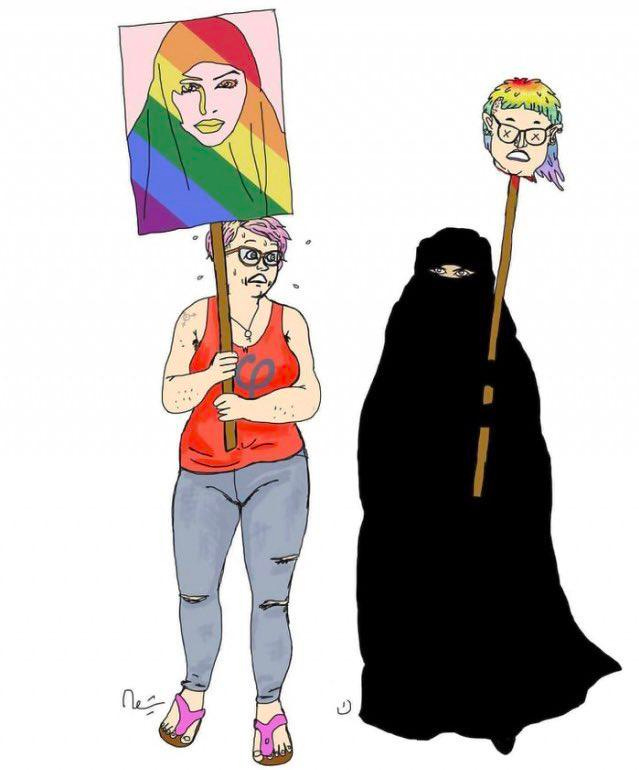
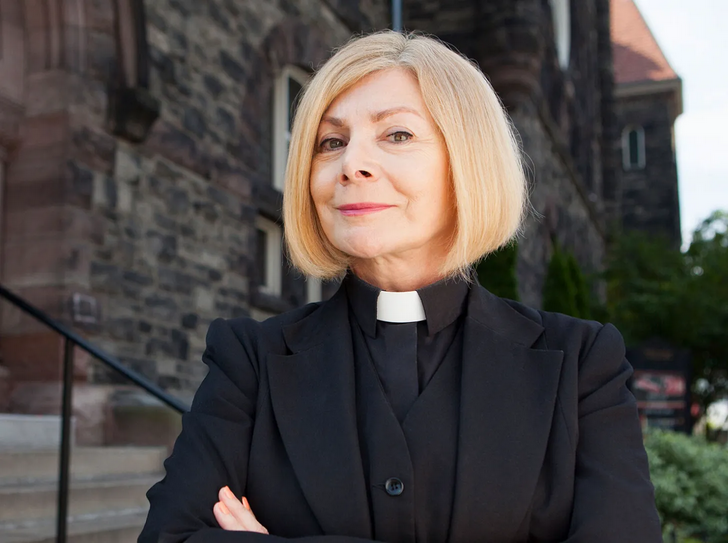
Let’s start with a comparison to the good people in Canada, the wonderful warm kind progressives, the Maple Leaf edition of “hate has no home here”. Cheri DiNovo is, let me put this very gently, an instantly recognizable social type, “one of Canada’s best-known and most ardent queer ministers and an Ontario politician who would help pass some of the province’s most integral LGBTQ2S+ policy”. You already know her by her facial expression:

slay, girlboss

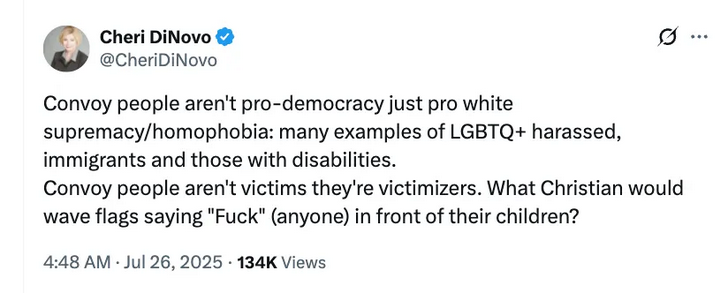
As the leaders of the Freedom Convoy face sentencing in court, DiNovo has this to say about their monstrous cruelty:

The Freedom Convoy: white supremacist homophobes who harassed and brutalized LGBTQ+ people and immigrants and the disabled, lashing out in a stunning wave of public cruelty. It was like a NUREMBERG RALLY with trucks, obviously. Here, look at some of the monstrous acts of public brutality committed at this mass expression of hate and rage:

YOU KNOW WHO ELSE DANCED TOGETHER THINK ABOUT IT

Rupa Subramanya, a journalist who uses the old and mostly forgotten technique of talking to people, wandered the crowds in Ottawa (in her own neighborhood) and reported that Freedom Convoy protesters mostly talked about their desire to recover a sense of hope. Their grievances were clear, thoroughly explained, and entirely defensible. Here’s a sample paragraph, a discussion with one of the VICIOUS WHITE SUPREMACISTS:

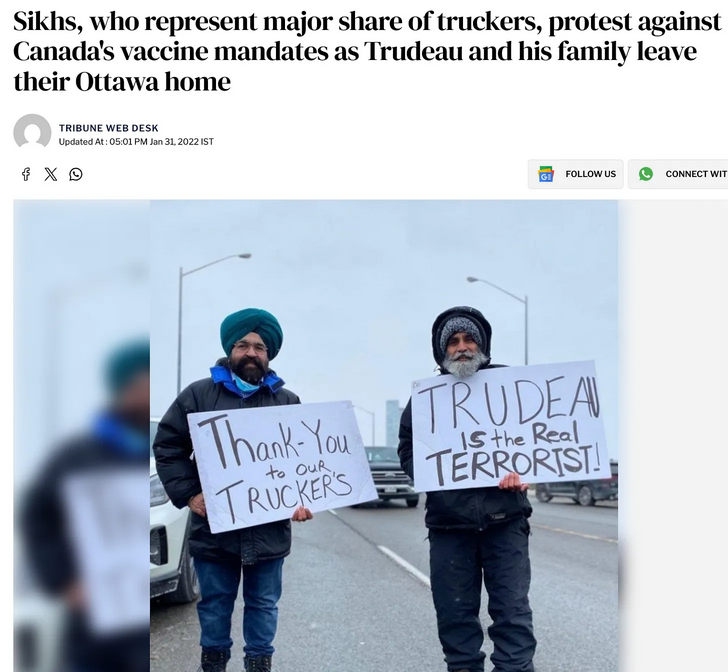
    Kamal Pannu, 33, is a Sikh immigrant and trucker from Montreal. He doesn’t believe in vaccinations; he believes in natural immunity. He had joined the convoy because the Covid restrictions in the surrounding province of Quebec had become too much to bear. He said that he and his wife used to do their grocery shopping at Costco, until the government decreed that the unvaxxed would be barred from big-box stores. Since then, their monthly grocery bill had jumped by $200. “Before,” he said, “we didn’t look at the price of what we were buying. Now, we sometimes put items back because we don’t have that much money.”

See this clearly against Cheri DiNovo’s framing, and remember it:

The white supremacist protesters who hate immigrants; for example, Kamal Pannu, a Sikh immigrant and trucker.

In fact, Sikhs make up a substantial share of the trucking industry in Canada, and so had a significant presence at the Freedom Convoy:

See the WHITE SUPREMACISTS saying that they HATE IMMIGRANTS!?!?!? Because Cheri DiNovo does. She thinks categorically: good people who support the Liberal Party, Literally Adolf Hitler who doesn’t. She has no capacity for seeing the thing itself, as it was on the ground, in physical reality. Literally nothing, no evidence or substance of any kind, could ever have prevented her from saying that a protest against Justin Trudeau’s government was white supremacist and homophobic. She’s out of her fucking mind. She has no connection to any form of reality, at all, in any way, ever. She doesn’t see anything. She doesn’t know anything. She’s ignorant noise and infinite sanctimony, with a pair of legs to carry it around.

This is “left” politics in the Anglosphere. Symbol symbol symbol, you NAZI! It doesn’t connect. It’s all chanting and performance and status-signaling, and it never leaves the house. It left reality behind ten years ago, and now it’s out there sailing past Pluto. For adherents of the Manichean religion of wokeism, categorical thinking covers all bases. People who don’t get mRNA injections are misogynistic racist bigots, obviously.
Update: Fixed broken link.
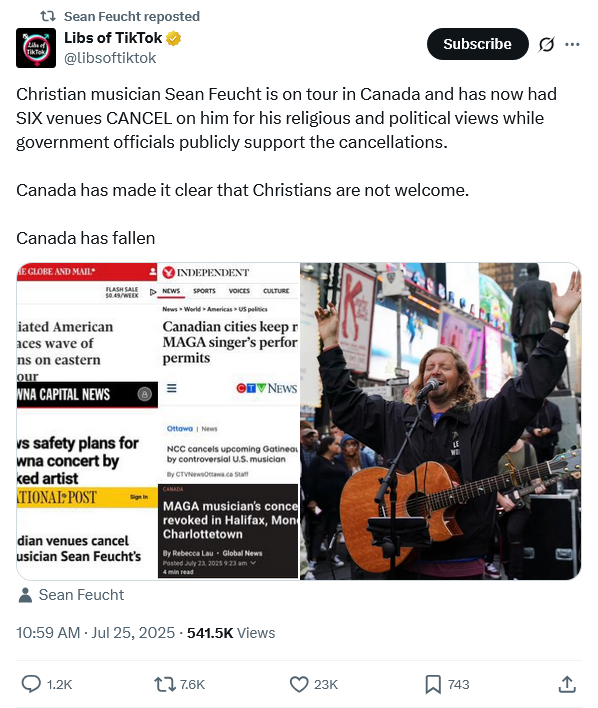
I’m sure I would never have heard of Sean Feucht until they tried to silence him

Filed under: Cancon, Government, Media, Politics, Religion, USA — Tags: , , , , , , — Nicholas @ 03:00

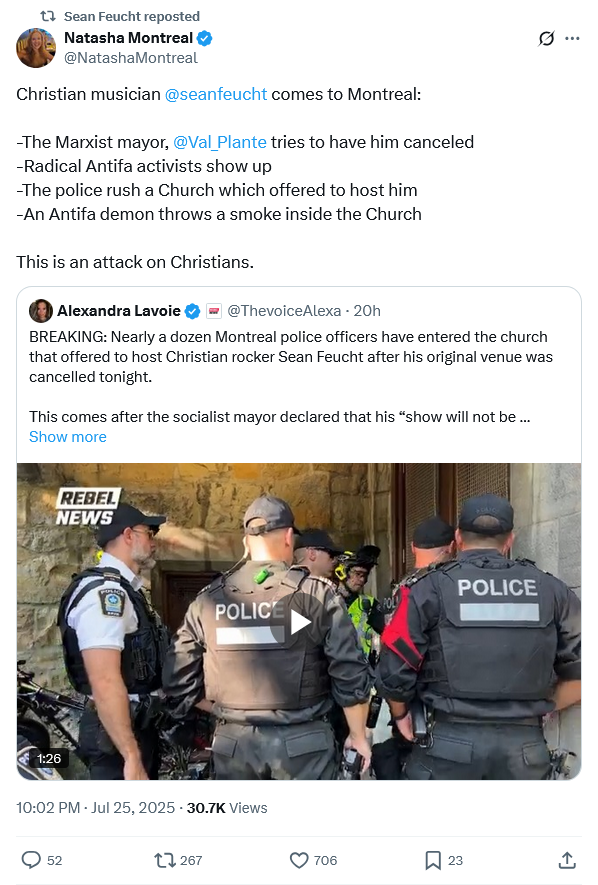
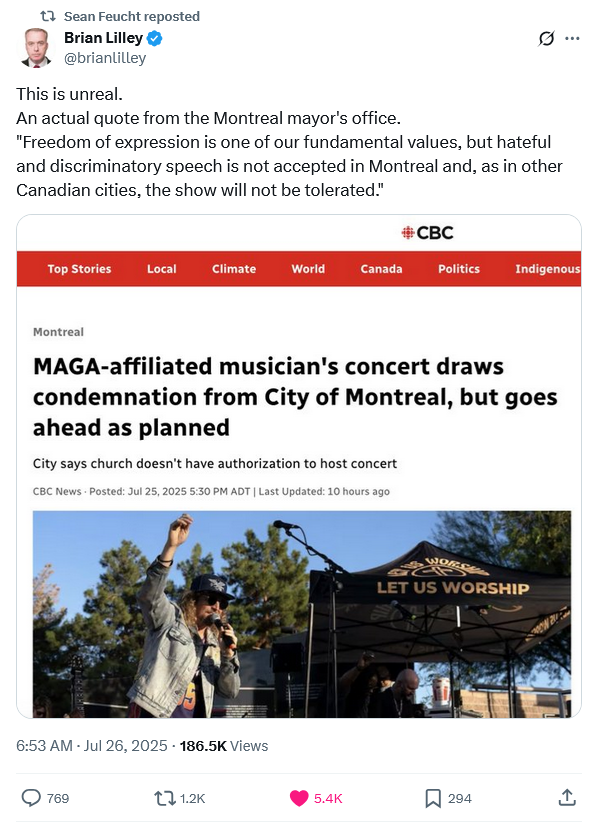
It’s hard to believe how Canadian municipal and provincial authorities deal so gently with disruptive pro-Hamas protests that regularly threaten the lives and property of Canadian Jews compared with the positively authoritarian way they are reacting to “MAGA” Christian performer Sean Feucht‘s concerts:

July 25, 2025

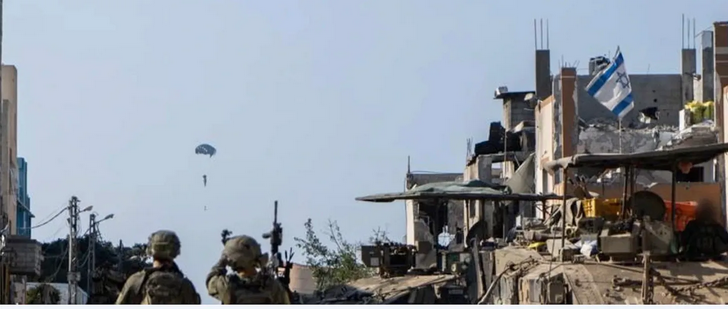
The ongoing conflict in Gaza

Filed under: Media, Middle East, Politics — Tags: , , , , , , , — Nicholas @ 03:00

On his Substack, John Spencer responds to a New York Times op-ed that claims Israeli forces in Gaza are engaged in genocide:

In his New York Times op-ed titled “I’m a Genocide Scholar. I Know It When I See It“, Omer Bartov accused Israel of committing genocide in Gaza. As a professor of genocide studies, he should know better. Genocide is not defined by a few comments taken out of context, by estimates of casualties or destruction, or by how war looks in headlines or on social media. It is defined by specific intent to destroy a national, ethnic, racial, or religious group in whole or in part. That is a high legal bar. Bartov did not meet it. He did not even try.

I am not a lawyer or a political activist. I am a war expert. I have led soldiers in combat. I have trained military units in urban warfare for decades and studied and taught military history, strategy, and the laws of war for years. Since October 7, I have been to Gaza four times embedded with the Israel Defense Forces. I have interviewed the Prime Minister of Israel, the Defense Minister, the IDF Chief of Staff, Southern Command leadership, and dozens of commanders and soldiers on the front lines. I have reviewed their orders, watched their targeting process, and seen soldiers take real risks to avoid harming civilians. Nothing I have seen or studied resembles genocide or genocidal intent.

Bartov claims that five statements by Israeli leaders prove genocidal intent. He begins with Prime Minister Netanyahu’s comment on October 7 that Hamas would “pay a huge price”. That is not a call for genocide. It is what any leader would say after the worst terrorist attack in the nation’s history. He also cites Netanyahu’s statements that Hamas would be destroyed and that civilians should evacuate combat zones. That is not evidence of a desire to destroy a people. It is what professional militaries do when fighting an enemy that hides among civilians.

Bartov presents Netanyahu’s reference to “remember Amalek” as a smoking gun. But this is a phrase from Jewish history and tradition. It is engraved at Israel’s Holocaust memorial, Yad Vashem, and also appears on the Holocaust memorial in The Hague. In both places, it serves as a warning to remain vigilant against threats, not as a call for mass killing.

He also highlights Defense Minister Gallant’s use of the term “human animals” to describe Hamas fighters. That is not a war crime. After the slaughter, rape, and kidnapping of civilians on October 7, many would understand or even share that reaction.

Unable to find intent among those actually directing the war, Bartov turns to far-right politicians like Bezalel Smotrich and Nissim Vaturi. These individuals do not command troops, issue orders, or shape battlefield decisions. I have studied the actual orders. They focus on destroying Hamas, rescuing hostages, and protecting civilians whenever possible. Their rhetoric is irrelevant to the legal case.

Israel has taken extraordinary steps to limit civilian harm. It warns before attacks using text messages, phone calls, leaflets, and broadcasts. It opens safe corridors and pauses operations so civilians can leave combat areas. It tracks civilian presence down to the building level. I have seen missions delayed or canceled because children were nearby. I have seen Israeli troops come under fire and still be ordered not to shoot back because civilians might be harmed.

Israel has delivered more humanitarian aid to Gaza than any military in history has provided to an enemy population during wartime. More than 94,000 trucks carrying over 1.8 million tons of aid have entered the territory. Israel has supported hospitals, repaired water pipelines, increased access to clean water, and enabled over 36,000 patients to leave Gaza for treatment abroad.

July 24, 2025

When tolerance becomes a fatal flaw

Filed under: Britain, Media, Politics, Religion — Tags: , , , , , — Nicholas @ 03:00

At The Crescent and the Guillotine, Paul Friesen explains why too much tolerance leads to the eventual collapse of social order and perhaps even the culture itself:

It is difficult to know what people are thinking when they endorse the importation of people who want to kill them for their lifestyle choices.

It was Karl Popper who warned that a tolerant society must be intolerant of intolerance, or it would cease to be tolerant at all.1 A delicious paradox, too often quoted and too rarely heeded. For we have taken the first half of the dictum — the imperative to tolerate — and chiseled it into law, into policy, into university mission statements and NGO pamphlets. But the second half — the requirement to draw a line, to say “no further” — has been treated like garlic in a vampire movie: an antique, anathema, unfashionable.

And so, the paradox has become pathology.

Our courts allow sharia arbitration councils to function in British cities, adjudicating matters of family and inheritance with standards that would make a 12th-century canon lawyer flinch. Our schools include faith-based curricula that require hijabs for seven-year-olds and teach that homosexuality is satanic filth. Our public broadcasters will air a documentary about the importance of free speech, followed immediately by a segment about why cartoons of Muhammad are “unhelpful”.

This is not multiculturalism. It is masochism. It is the belief that liberalism must be so open-minded that its own brains are spilled onto the prayer mat. It is the fetishization of identity at the expense of liberty. It is the ideological pacifism of a society too terrified to assert its own values, lest it be accused of “racism” by those who mistake ideology for ethnicity.

We have enshrined the rights of the theocrat while criminalizing the instincts of the secularist. The result is not harmony — it is humiliation.

[…]

The West’s greatest achievement is not democracy, nor capitalism, nor even the separation of powers. It is the separation of truth from tribalism — the idea that individuals are not to be judged by their creeds, but by their conduct. That women are not property. That speech is not violence. That blasphemy is a right, not a crime.

These are not Western values. They are universal values, discovered in the West by accident of history and preserved through blood, rebellion, and satire. They are the principles that allowed Jews, heretics, atheists, and apostates to live not just safely, but freely. And they are now under threat — from within.

The real problem is not Islam. It is the Western inability to demand anything of those who import their gods and their grievances into liberal society. We treat every imported superstition as sacrosanct and every local tradition as suspect. We require ex-Muslims to whisper their fears while we amplify the complaints of veiled Islamists who denounce our culture from our own podiums.

We are not being pluralistic. We are being duped.

And the cost of this self-deception is measured not just in freedoms surrendered, but in lives lost.

Lives like that of Yameen Rasheed, the secular Maldivian blogger who thought he could use satire to push back against theocracy — stabbed to death in his own hallway. Lives like that of Farkhunda Malikzada, beaten and burned in the streets of Kabul by a mob of men — because someone thought she burned a Qur’an. Lives like that of Samuel Paty, beheaded outside a French school by a refugee he welcomed — because he dared to show a cartoon in a civics class.

These are not random tragedies. They are the predictable outcomes of an ideological toxin given immunity in the bloodstream of liberal society.

What do all these victims have in common? They did not die at the hands of misunderstood minorities or “oppressed voices” who simply needed better integration programs. They died at the hands of men who were indoctrinated — sometimes abroad, often at home — with the idea that God’s honor is more valuable than human life, and that dissent is not to be debated but extinguished.

And more damning still: they died in environments that should have protected them. Environments that instead prioritized sensitivity over security, dialogue over clarity, understanding over justice. Environments where the ever-watchful eye of diversity officers and DEI consultants was trained, not on the assailants, but on the tone of the victims.

We have created a culture where courage is pathologized, clarity is punished, and moral equivalence is the new orthodoxy. When Islamist mobs swarm the streets chanting slogans that would make the Inquisition blush, we are told to “listen to their anger”. When feminists protest the veiling of children, they are told to “respect cultural differences”. When Jews complain about chants of “From the River to the Sea”, they are informed that they are “overreacting”, “weaponizing trauma”, or — most insultingly of all — “confusing Zionism with antisemitism”.

This is not inclusivity. It is assisted suicide.


    1. I refer here to Karl Popper’s 1945 work The Open Society and Its Enemies, specifically in Volume 1: The Spell of Plato, Note 4 to Chapter 7. Here’s the relevant passage, paraphrased for clarity:

    “Unlimited tolerance must lead to the disappearance of tolerance. If we extend unlimited tolerance even to those who are intolerant … then the tolerant will be destroyed, and tolerance with them.”

    Popper argues that a tolerant society has the right — not to suppress opinions — but to defend itself against those who would destroy tolerance itself, especially if such groups refuse to engage in rational discourse and instead promote violence or coercion. It’s often called “the paradox of tolerance“.

July 22, 2025

Bitter reality is coming for the laptop class

Spaceman Spiff foretells the end of the managed paradise of the “unsophisticated sophisticates” of the privileged laptop class who have been able to keep their dream alive at the expense of everyone outside their rarefied and protected bubbles:

There seems to be a section of society populated with gullible conformists who believe many of the manufactured narratives designed to manage society.

Most are the credentialed products of universities. The laptop class of professionals who operate the corporations, institutions and key organizations.

Their worldview is comprised of stories which are downloaded and stored as mental models. Adhering to these narratives can then devolve into belief systems that are placed beyond criticism. This in turn can easily degenerate into a kind of fanaticism.

Ideas like mass migration and the destruction of reliable energy sources are crazy and yet they are primarily in existence thanks to the efforts of this layer of society, the professionals who implement policies desired by the ruling class.

While some among them are cynically exploiting today’s fads for their own ends, many seem to be true believers.

How can they believe these things so completely? What is going on?

Rebels searching for causes

Most of today’s great crusades seem to have the same characteristics. They are easily downloaded and consumed, they are socially rewarded within some circles, and they are not immediately obvious as issues at all.

The most popular are pre-prepared to an almost comical degree and thoroughly focus-grouped to ensure minimal friction among their consumers.

Many even come with slogans attached. Diversity is our strength is every bit as artificial as two weeks to flatten the curve, but it goes down easily with no thought required, which is the point.

The ideas that stick are the ones most useful to demonstrate virtue. Showing off to your peers you are non-sexist, non-racist and non-homophobic helps secure your place in many professional hierarchies where visible in-group membership matters.

The most prized causes appear to be non-obvious where the conclusions are not reachable with the evidence available.

This confusing aspect makes many question some new idea or policy, but in the laptop class often triggers a sense of smugness that they see beyond the obvious to the obscure thanks to their impressive intellects. Criticism can then be dismissed as simplistic providing a rewarding sense of superiority.

Much of the above is evident in the belief systems of today’s professional classes.

[…]

What to make of all this?

Does any of this matter? Yes it does. It is this section of society that ultimately puts in place the ruinous ideas of the ruling class.

They are in the corporate offices, the local councils and the schools. They are running the television stations and the publishing houses. They are captured by groupthink. Everyone they know thinks as they do. All criticism is easily dismissed.

Very little can penetrate this bubble. Except one thing.

Over time reality intrudes. Models should be updated to accommodate new findings and observations, but that is challenging when they have been uncritically downloaded to satisfy psychological needs.

Contrary evidence threatens one’s sense of self so scrutiny is avoided. When these avoidances ultimately fail some dig even deeper. Magical thinking seems to be everywhere.

The ultimate effect is either a reassessment of one’s worldview, or a psychotic break from reality. We see examples of the latter; Trump Derangement Syndrome is one well known borderline psychosis but there are others.

July 21, 2025

Was Juan Perón a Fascist? The Cold War Origins of Peronism – W2W 037

TimeGhost History
Published 20 Jul 2025

Was Juan Perón really a fascist, a socialist, or something entirely different? In this episode of War 2 War, we explore the rise of Peronism in post–World War II Argentina and how Perón tried to position his country between the superpowers of the Cold War.

Through labour reforms, nationalist rhetoric, media control, and brutal repression of dissent, Juan and Eva Perón created a powerful populist regime that borrowed ideas from both fascism and socialism, while claiming to reject both. From Argentina’s “Third Way” to its complicated ties with the US, USSR, and even Nazi fugitives, we examine the ideology, contradictions, and legacy of Peronist rule.

Was Peronism a unique form of authoritarian populism, or just another face of fascism?

Join us as we uncover the foundations of Argentina’s Cold War identity and the true political nature of Juan Perón.
(more…)

July 19, 2025

No issue is so important that we can’t have a proper debate on the merits

Filed under: Government, Media, Politics — Tags: , , , , , — Nicholas @ 05:00

On Substack, Lorenzo Warby refutes the claim that some issues are just too important/too urgent/already decided:

One of the features of the “progressive” politics of the unaccountable classes — those who are just paid for turning up — is the demand that there be “No Debate” about various issues. The most obvious instances are “No Debate” about Trans and “No Debate” about climate change — hence demands that climate scepticism be outlawed.

All such “No Debate” claims are crap. First, any “No Debate” claim is presumptive evidence that what you are pushing is either not true or, slightly more subtly, is a mountain of bullshit erected on a molehill of truth. Robust cases for claims about the world are not afraid of debate.

Various moral urgency claims are mounted to support such “No Debate” claims. How do we determine moral urgency? From the evidence. If the evidence is clear, debate will not threaten that alleged urgency. On the contrary, it will reveal the urgency more clearly.

The underlying philosophical dynamic underlying “No Debate” claims is Critical Constructivism — the claim that reality is socially constructed; that all statements and knowledge claims are, in fact power claims; and that the righteousness of a claim can be determined by their (alleged) effects on (morally differentiated) social groups.

The underlying social dynamic is the use of affirmed beliefs to determine and display righteousness. If affirming X shows one to be one of the righteous, then not believing X shows one to be of the unrighteous. This is typically expressed in various terms of moral abuse (racist, Transphobe, Islamophobe, etc) whose use in media and academe has soared since 2014.

This is not because Western societies have become more bigoted — on any reasonable measure they have become far less so over time — but because the politics of Righteous Affirmed Belief has dramatically surged and so has therefore the stigmatisation of dissent.

To claim that affirming X shows ultimate moral propriety requires stigmatising not-X. For something is morally proper — indeed morally trumping — only if the opposite is morally improper. Thus is moral propriety is enforced by stigmatisation. Hence silence is violence — one must profess righteousness. Hence also words are violence — if affirmation of belief is the ultimate marker of righteousness then expressed disbelief becomes the ultimate marker of abusive malevolence. These dynamics lead to a great deal of preference falsification — people publicly affirming, or at least not opposing, claims that they do not privately believe.

Old and tired: the Overton Window … New and hot: the Trump Door

Filed under: Government, Media, Politics, USA — Tags: , , — Nicholas @ 04:00

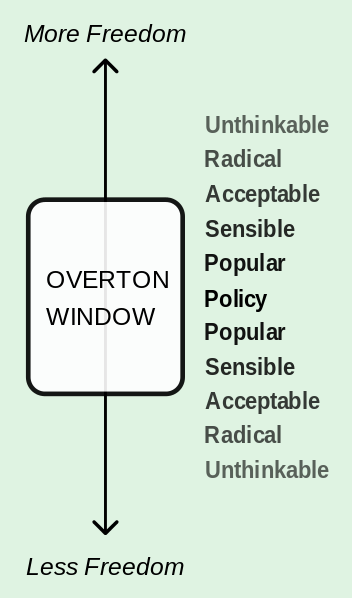
In The Line, Mike Colledge considers how Trump has managed to change the political environment that used to be fairly well described by the Overton Window:

Diagram of the “Overton Window”, based on a concept promoted by Joseph P. Overton (1960–2003), former director of the Mackinac Center for Public Policy. The term “Overton Window” was coined by colleagues of Joe Overton after his death. In the political theory of the Overton Window, new ideas fall into a range of acceptability to the public, at the edges of which an elected official risks being voted out of office.
Illustration by Hydrargyrum via Wikimedia Commons

The Overton Window, named after Joseph Overton of the Mackinac Center for Public Policy, is used to explain how policy ideas gain acceptance and move from idea to policy. The “window”, as Overton saw, could include a wide range of ideas from those with little to no support to those that have matured, gained public traction, and could be supported by the public as legitimate policy options for governments. The “window” was not static. It could — and did — shift, expand, or contract based on social movements, economic pressures, cultural trends, and/or the actions of leaders in the public and private sectors.

Those who wanted to push ideas into the window and gain acceptance and support usually had to spend considerable effort — and sometimes years — promoting and making the case for their cause and moving it into the mainstream. Al Gore’s documentary An Inconvenient Truth and Greta Thunberg’s ongoing efforts to push for action on climate change are examples of leaders using their profile to push and keep climate change action in Overton’s Window.

Lately, though, it feels like the Overton Window has been replaced by the Trump Door. While Overton observed and studied what was happening, Trump is more of an active participant. Overton provided us with an analytical framework; Trump’s door is more of a tactical approach.

And this is a big change. The world moves much faster than it did in the mid-90s when Overton first created his “window”. The democratization of communications and the speed of communications means anyone can comment, report, or share an opinion instantly (and often without considering the consequences). Increased polarization means that leaders looking to act and to reinforce support for their desired policies do not have to wait for a majority to support a given policy before they act. They merely need a vocal plurality of their own supporters to move forward with an idea.

Trump hasn’t so much smashed the window as he has replaced it with a large swinging Western saloon-style door. He has shown no interest in framing and positioning an issue for the public’s consideration in hopes of building support from a majority. He is throwing ideas into and out of the public-consideration saloon as fast as possible. Some ideas he throws in as distractions. Others he throws in as announcements of his intent regardless of the public’s perspective.

To those of you saying in your head “I don’t think Trump thinks this deeply about what he is doing,” you could be correct. But the net impact of his actions is the creation of a Trump Door that, unlike a window, is not transparent and, again unlike Overton’s Window, is not about building public acceptance. It is a tool to achieve his goals as fast as possible. When obstacles require a shift in policy — given there is no need to engage the public — he simply throws another idea into the saloon.

Trump administration records huge increase in tariff revenues

Filed under: Government, Media, Politics, USA — Tags: , , — Nicholas @ 03:00

Oddly, most of the coverage on the US government’s surge in tariff income fail to emphasize two relevant facts: first, that the money is largely being paid by American consumers and second that it’s a surge driven by the fact that higher tariffs will kick in soon. J.D. Tuccille reports:

I have no idea where I saw this meme, but it makes me laugh

Last Friday, U.S. Treasury Secretary Scott Bessent took a victory lap as his department reported an unexpected increase in receipts from tariffs. The revenue undoubtedly came from a surge in imports to the U.S., which led to payments that filled federal coffers. It would seem to be a win for an administration that has staked an awful lot on waging a trade war with the entire planet to (take your pick) redress wrongs done to America, raise revenue for the government, and encourage domestic manufacturing and employment. But that victory lap comes too soon; the tariff windfall more likely represents efforts by U.S. firms to accumulate inventory before tariff rates rise even higher.

[…]

That mention of “higher prices on imported goods paid by US consumers and firms” deserves to be emphasized because it highlights the fact that tariffs are taxes on Americans. Ultimately, most of the burden of high rates is shouldered by companies and individuals within the U.S. As the Tax Foundation’s Alex Durante pointed out in February, “rather than hurting foreign exporters, the economic evidence shows American firms and consumers were hardest hit by the Trump tariffs”.

The Yale Budget Lab agrees, estimating in May that “the price level from all 2025 tariffs rises by 1.7% in the short-run, the equivalent of an average per household consumer loss of $2,800” in 2024 dollars. In particular, the Yale economists found “consumers facing 15% higher shoe prices and 14% higher apparel prices in the short-run”.

Even Walmart, which had vowed to absorb as much as possible of the tariff burden, conceded two months ago that prices would have to rise because of the trade war.

This week, the Federal Reserve Bank’s “beige book” noted that “in all twelve Districts, businesses reported experiencing modest to pronounced input cost pressures related to tariffs” and that “many firms passed on at least a portion of cost increases to consumers through price hikes or surcharges”.

Penn Wharton’s concerns, mentioned above, about “lower economic growth” are shared by the Tax Foundation and by the Yale Budget Project. The Tax Foundation’s Erica York and Alex Durante forecast that the Trump administration’s tariffs would “reduce US GDP by 0.8 percent” before taking foreign retaliation into account. Yale economists see a similar GDP reduction of 0.7 percent.

If the courts issue a final ruling against Trump’s use of the International Emergency Economic Powers Act (IEEPA) to impose tariffs, that will reduce the negative effects on the economy. But it will also take a chunk out of the revenues the administration expects to collect.

So, Secretary Bessent’s victory lap on tariff revenues was a little premature. And so are hopes that the trade war won’t damage commerce and the U.S. economy.

July 18, 2025

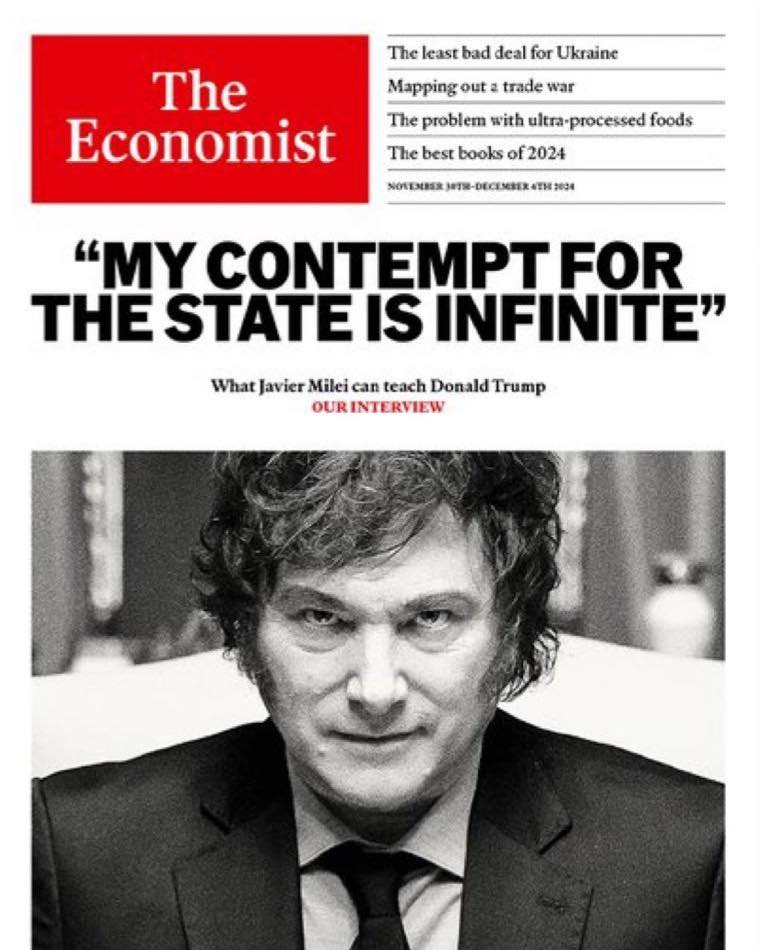
Argentina’s self-described anarcho-capitalist president

Filed under: Americas, Economics, Government, Media, Politics — Tags: , , , , — Nicholas @ 03:00

J.D. Tuccille says that Argentinian President Javier Milei may be the politician who has most successfully “defied the expectations of the chattering class” by not only winning the presidency but also by the completely unexpected turnaround of the national economy:

Drawing on official data, Reuters reports that Argentina’s “economic activity rose 7.7 per cent in April compared with the same month last year”. That was higher than expected and a welcome addition to news that the economy had grown by 5.8 per cent during the full first quarter relative to the same quarter the previous year. Early numbers put Argentina’s second-quarter growth at 7.6 per cent. By contrast, Canada’s economy grew at an annual 2.2 percent in the first quarter and the U.S. economy shrank a bit.

In equally encouraging news, Argentina’s “monthly inflation rate has fallen below two per cent for the first time in five years,” according to the Financial Times. That’s still high in North American terms, but Argentina’s governments have a history of wildly expanding the money supply to pay off debt and finance expenditures, resulting in inflation rates in the hundreds and even thousands per cent per year. Inflation slowed somewhat in recent years, but it was over 200 per cent in 2023 and Milei was elected on a promise to stabilize prices — even if it meant adopting the U.S. dollar as the country’s official currency.

Importantly, the poverty rate in Argentina has also fallen to 38.1 per cent of the population at the end of 2024 from 41.7 per cent when Milei took office. Again, that remains very high, but it’s an improvement in a country where politicians have long seemed committed to keeping people poor and dependent on the state.

This wasn’t supposed to happen. In a November 2023 open letter, over 100 economists warned that Milei’s economic “proposals, rooted in the economy of laissez-faire and which include controversial ideas such as dollarization and significant reductions in public spending, are fraught with risks that make them potentially very harmful to the Argentine economy and people”.

The economists — including such academic luminaries as Thomas Piketty and Jayati Ghosh — warned of havoc if Milei implemented his free-market plans. Voters weren’t impressed by the forecast of doom; they chose the self-described “anarcho-capitalist” economist and his upstart political coalition over the standard-bearer of the dominant Justicialist Party.

The Justicialists have been the strongest force in Argentine politics since their launch in the 1940s by Juan Peron. Peron served as a military observer in Europe and apparently combined the worst ideas he encountered into a peculiarly Argentine ideology he called “justicialism”, better known as Peronism. At its heart, the ideology drops the pretense of any practical difference between socialism and fascism and promotes a brutal mélange of statist economic schemes. This means that, while most property and business activity is in private hands, it’s subject to government dictates, distortions, and control.

July 17, 2025

A renewed push to ban AfD from contesting elections in Germany

Filed under: Germany, Government, Law, Liberty, Media, Politics — Tags: , , , , , , — Nicholas @ 03:00

eugyppius updates us on the state of play as the various smaller parties in Germany try to ban Alternative für Deutschland (AfD) which had risen from fringe status to being the most popular political party after the last federal election:

I’m far from a sensationalist, and I’ve repeatedly discounted the likelihood of an AfD ban – not least because the German establishment and the left in particular have good reasons to keep the AfD around. Lately, however, I’ve begun to appreciate that there are deeper, systemic forces working against the AfD in this case. These forces are beyond anybody’s control and if nobody does anything, they may well end in political catastrophe that is much bigger than any single party.

Since the end of the Merkel era, the German left has become thematically scattered, and so they have retreated to the only coordinating issue the German left has ever had, which is hating the right. As climatism started to fade, the social welfare state exceeded its limits and mass migration went sour, AfD bashing became the sole unifying principle for much of the SPD, Die Linke and the Greens. Hating the right is particularly important because it keeps leftist politicians and their activist class on the same page. Without a crusade against the right, a great chasm opens between the antifa thugs who want to smash the state and destroy capitalism on the one hand and the schoolmarm leftoid establishment functionaries in the Bundestag who want to mandate gender-neutral language for the civil service on the other hand. What is more, the firewall against the AfD splits the right and keeps the shrinking left in government. It is a win-win for leftoids everywhere.

Recent events, however, show why things cannot continue as they are now indefinitely. Over time, our Constitutional Court will begin to fill with leftist justices supported by the left parties, who like the rest of the left will also want to ban the AfD. Brosius-Gersdorf and Kaufhold are omens here. Right now the system is held in perfect balance; the left talks a big game about wanting to stamp out the AfD, but they can always justify their hesitation by saying the outcome of ban proceedings is too uncertain. When the necessary judicial majority for an AfD ban is finally secured in Karlsruhe, everything changes. At that point, there will be no excuse for not proceeding with a ban. The activists and the NGOs will take to the streets if their political masters in Berlin don’t begin the process. The CDU will be brought around by media smear campaigns and antifa intimidation.

Keep in mind that this is not about the AfD, but about imperatives within the left itself. No amount of moderation, polite messaging or triangulation on the part of the AfD can get the left to stop or pursue other goals. Unless some exogenous force introduces a new unifying obsession for the left parties and their activists, they will never stop gnawing on this particular chew toy.

Practically, this probably means that the AfD has an expiration date. If they can’t get into government at the federal level and if nothing else changes, they will find themselves facing ban proceedings before a court stacked with leftists who hate them in the next 10 or 15 years. The federal elections in 2029 seem like the last opportunity to normalise the AfD before this final escalation.

People in the CDU need to realise how serious this is, because their fate hangs in the balance as much as the fate of the populist opposition to the right of them. It is absolutely necessary that they break the firewall and enter some kind of arrangement with the AfD before it is too late. It doesn’t matter how much the press freaks out. It doesn’t matter how many violent antifa thugs take to the streets. It doesn’t matter how many party headquarters the leftists invade and vandalise. The firewall will fail in one direction or the other, and if it fails with an AfD ban, we are all in very deep shit.

July 16, 2025

Matt Gurney’s “Hollywood Thesis”

I almost skipped reading this one, as Matt and Jen usually keep their own columns behind the paywall, but this one is free to non-paying cheapskates like me:

… I actually think there is one way that Hollywood — and probably mass entertainment writ large — has kind of warped our society. It’s not that it has promoted degeneracy or loose morals or shameless enjoyment of vice. It’s more insidious. And probably more dangerous.

I think Hollywood has tricked us into thinking that, in an emergency, our governments will prove to be a lot more competent than they will be. And usually are.

This is something I’ve been thinking about for a while. I’ve mentioned it to my Line colleagues before, and I call it my Hollywood Thesis. As I see it, the broader public has fairly accurate expectations about the level of service they can expect from their government. Sometimes it’s good, sometimes it’s bad, but it’s mostly realistic. We basically know what we’re getting into when we, for example, drag the trash bin to the curb, or turn on a tap in the morning, or go to an emergency room because you need to get stitched up after a minor mishap.

But I’ve observed over the years an interesting exception. When the public is confronted with any kind of new or unexpected threat, people, for some reason, believe their government will have some secret ability or unexpected expertise in dealing with it. Maybe it’s a quirky scientist working in the bowels of some ministry or department. Maybe it’s an elite team of experts. Or some hidden base loaded with commandos and advanced weaponry.

Wrong. And I’ve been thinking about this. Why do we assume the same government that is, for instance, struggling to fill potholes in my city, or hire enough nurses in my province, or fix a federal payroll system, is going to be more competent when presented with something totally out of the blue? This flies in the face of all of our lived experiences with government. It’s a generous assumption of state capacity that is, to put it charitably, unearned.

So why? What explains this?

It’s Hollywood. It has to be.

Lots of smart, competent people have government jobs. One of the great joys of my career has been the opportunity to speak with many. There are shining lights of unusual competency in every department, and at every order of government, really — my colleague Jen Gerson recently told our podcast listeners about how one of these hidden gems helped her cut through a confusing and dysfunctional process so she could get a permit. And I will never get tired of saying good things about the men and women of the Canadian Armed Forces — true miracle workers we do not support enough.

But there aren’t hidden capabilities. There aren’t secret teams. The same people trying to prevent Canada Post from going on strike will be the same people handling the next pandemic — or who would be responsible for opening a dialogue if aliens decided to land their mothership in the middle of a Saskatchewan farm.

It’s within the range of possibilities that, presented with a unique challenge, government leaders could rise to meet it … as long as it’s a completely unexpected situation with no pre-existing rules or regulations or bureaucratic processes in place. I admit it’s not the way the smart money would bet, but it’s technically a possibility.

Offensensitivity over a 12 year-old wearing a Union Jack dress to school

Filed under: Britain, Media, Politics — Tags: , — Nicholas @ 03:00

I’m not in the least bit surprised to hear that a 12 year-old girl has triggered the sensitive souls at her school for choosing to wear a Spice Girls style Union Jack dress to her school’s Cultural Diversity Day:

Photo from The Daily Sceptic

Another month, another glaring example of toxic activism sweeping through the British workplace, and this time, it’s no less than shocking.

On July 11th, 12 year-old Courtney Wright was sent home from Bilton School in Rugby, Warwickshire, simply for wearing a Union Flag dress and hat for the school’s Cultural Diversity Day. She had put effort into her costume, even writing a speech celebrating British culture: Shakespeare, fish and chips, tea, the Royal Family. Yet for what was a harmless celebration of her national culture, she was excluded.

The school’s response? A sanctimonious head of year, presumably with the support of management and colleagues, told her: “You get to celebrate your culture every day. This is for everyone else.” Then ordered her to remove her outfit and wear a second-hand uniform or go home. So she, rightly, called her father, who came to collect her.

Stuart Field, her father, a 47 year-old Marine Engineer, alleges she was not alone. A boy was reportedly sent home for wearing a farmer’s costume, illustrating a broader, troubling trend: the suppression of British symbols and pride in the name of “diversity”.

[…]

The aftermath saw the usual potted response from the school’s governing trust, the Stowe Valley Trust about how it values “diversity”, “respect” and so forth, yet its words ring hollow. It claims to regret “upset caused”, note, not the exclusion itself – only the distress that followed. It says it will “reflect on how this could have been handled better”. It then goes on to assure parents that it will be looking at the policies and training.

But what does that really mean? The trust refuses to admit that sending a girl home for celebrating her country was an appalling and divisive breach of common sense and, arguably, of law. Their language suggests an attempt to dodge accountability, to spin it as a mere mishandling rather than a fundamental failure.

At Spiked, Hugo Timms points out that this is merely a slightly more visible version of what British children learn in school … that there’s nothing at all to be proud about if you’re British:

British schoolkids have long been encouraged to be ashamed of their nationality and history. They’re taught “anti-racism” lessons and to constantly check their privilege as Brits. They study “decolonised” curricula, shorn of “triggering” British authors. Now, it seems, even dressing up as a Spice Girl and praising Shakespeare are being treated as beyond the pale.

[…]

You might say Courtney’s outfit was not exactly “traditional”, inspired by Geri Halliwel’s famous Union Jack dress from the 1997 Brit Awards. But that was clearly not the issue. What the school’s instructions really meant was that she should dress as any nationality or heritage, so long as it’s not British. According to Courtney’s father, Stuart Field, the school also turned several other pupils away at the gates on Culture Day, including a boy with a St George’s flag, a boy with a Welsh flag and a boy dressed as a farmer with a checked shirt and a traditional flat cap.

Courtney’s school also stopped her from giving a speech about what being British meant to her. “In Britain”, she would have said, “we have lots of traditions including drinking tea, our love for talking about the weather and we have the Royal Family”. “We have amazing history, like kings and queens, castles, and writers like Shakespeare.” It also praised British humour, “our values of fairness and politeness”, and fish and chips. Not exactly Enoch’s “Rivers of Blood“, is it?

July 15, 2025

What the CBC calls a “360-degree view of a story”

Filed under: Cancon, Media, Politics — Tags: , , , — Nicholas @ 03:00

On the social media site formerly known as Twitter, Harrison Lowman provides a detailed example of how the CBC prefers to present stories to Canadians — which signally fail to present a “360-degree view” because the CBC actively avoids including actual disagreement on any given topic:

THREAD: When you make complaints about patterns of bias or skewed reporting on the CBC, you are often met by CBC supporters who proceed to demand a list of examples.

When they don’t receive it immediately from you, they proceed to tell you you’re the biased one …. that “it’s in your head”. It feels like a bit of gaslighting to be honest.

So let me, as someone who has worked at the CBC, provide you a prime example of CBC coverage I think is glaringly biased and you can tell me what you think:
/1

Earlier this summer, the CBC published this radio/TV story. The webpage version is headlined “Supervised drug site at Kingston prison has only had one visitor despite being open since 2023”

The story details a trial project where prisoners at a Kingston-area prison have been given the ability to inject, snort, or swallow the drugs they’ve smuggled into their cells under the supervision of a nurse.

The news hook is that only ONE inmate has visited the site since its inception more than a YEAR ago.

https://cbc.ca/player/play/video/9.6802851
/2

The CBC journalist then proceeds to interview three people: 1. someone running the program, 2. a retired academic expert sympathetic to the program wanting it expanded, and 3. a former inmate who was not in jail when the program started. All sources appear generally in approval of the pilot program.

In the story:
– At no time does the journalist speak to someone who sees this pilot program as the wrong approach. Keep in mind a recent Abacus poll shows a mere 19% of Canadians support expanding safe injection sites. (You’re literally ignoring the vast majority of the population here.)

– At no time does the journalist reveal the cost of said program: a whopping $517,000 taxpayer dollars so that a SINGLE inmate could get high.

– Nor do they speak to someone who says (as many in the public would rightly ask) if given the cost and almost non-existent use, whether it’s worth continuing the program, or whether there’s a better way to spend this money within the corrections system- rehabilitation etc.

/3

Instead the CBC journalist exclusively focusses on the “barriers” to using the jail drug program, implying this all that can change- ie. look at making it easier for the inmates to use drugs.

The coverage, highlighting barriers:
– implies that they should operate at night, because it’s current hours “don’t line up with when inmates want to get high.”;
-In the written version of the article: source: “They’d prefer to take drugs during their free time after supper.”

– That prisoners need to be allowed to smoke crystal meth as part of the program.

– That prisons need to make it so using the program won’t mean users getting unwanted attention from fellow inmates, officers…etc.
/4

Last week, CBC News’ general manager and editor in chief Brodie Fenlon said:

“The job of a CBC News journalist is to report facts, to proportionately surface the variety of viewpoints that exist about those facts, to provide context and counter narratives where they exist, and to ensure credible analysis is in the mix. The goal is to give you a 360-degree view of a story so you can draw your own conclusions.”

“… We don’t shy away from contrarian views or perspectives that challenge orthodoxy.” “The best journalism often involves facts and viewpoints that challenge our own worldview.”

In what world is this a 360 degree view of this story? In what world is this a story that challenges orthodoxy?

Instead, this coverage appears to tell viewers the CBC approves of safe injection sites … for criminals, and doesn’t prioritize taxpayer $ waste in its coverage.

With this story, CBC is just clearly not meeting their own journalistic standards, and are failing to adequately inform the public.

There’s your example. Tell me I’m wrong.

The CBC must do better.

I plan to launch a complaint with the CBC ombudsman. It won’t be my first.

https://cbc.ca/news/editorsblog/cbc-news-platforming-1.7580219

Among the responses was this one from Andrew Kirsch:

I wrote the 1st ever memoir about being a Canadian spy. It was a National bestseller but largely positive about the org. I desperately tried to get on CBC (and TVO) to promote it. They weren’t interested. A while later my ex-colleague wrote a memoir about her career with a focus on institutional racism at CSIS. She was interviewed and her book was featured all over the website. I don’t want to take anything away from the other book. I just felt like mine was also a Canadian story worth telling.

July 13, 2025

QotD: The ever-elusive perfect future (maybe we can get there with more blood spilled…)

Filed under: History, Politics, Quotations, USA — Tags: , , — Nicholas @ 01:00

What the modern hard left wants is the same they’ve wanted since the French Revolution: claim the present in the name of the future, repudiate the past, then own the past, redefine it to their terms, then make it off limits for discussion unless you keep within the lines they’ve defined. Discussion of the past outside of the boundaries is counter-revolutionary, and proper consciousness has to be displayed at all times.

James Lileks, The Bleat, 2020-06-15.

« Newer Posts — Older Posts »

Powered by WordPress