Quotulatiousness

February 13, 2026

To be accepted as a true European, you must performatively hate Trump

Filed under: Europe, Media, Politics, USA — Tags: , , , , , — Nicholas @ 05:00

In Spiked, Frank Furedi explains why European elites and the poseurs who aspire to be counted among the elites must now ostentatiously and performatively hate US President Donald Trump (even more than they hated George Bush, if possible). Comment on dit “eLbOwS uP”?

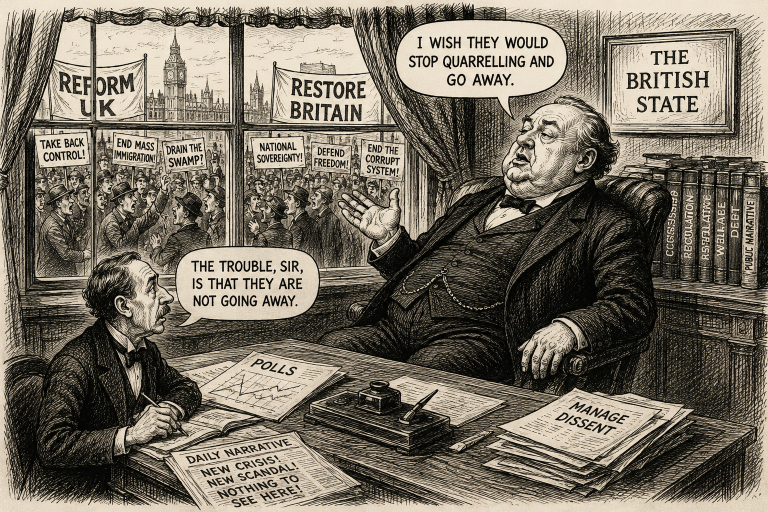
AI-generated image from AndrewSullivan.substack.com

In recent months, anti-Americanism has emerged yet again as a respectable prejudice in Europe. It is widely promoted through the mainstream media and enthusiastically endorsed by the continent’s cultural elites. There are now even numerous campaigns to boycott American goods – most respondents to a survey in France said they would support a boycott of US brands like Tesla, McDonald’s and Coca-Cola. As a piece in Euractiv put it, anti-Americanism is “in vogue across Europe”.

This has become all too clear at the Winter Olympics, currently being held in northern Italy. At the opening ceremony for Milano Cortina 2026, Team USA and vice-president JD Vance were booed by a crowd of over 65,000 people. Someone I know who attended the event told me that the booing was spontaneous and quickly became widespread. According to the European Union’s foreign-policy chief, Kaja Kallas, those booing were displaying “European pride“. It seems that for the Brussels elites, anti-Americanism bolsters Europe’s self-esteem.

The explicit target of this resurgent anti-American animus is, of course, US president Donald Trump. But it’s implicitly aimed at all those who voted for him, too. In a piece on boycotting American goods in the normally sober Financial Times, published last March, the author gave the game away. While saying it is “wrong to conflate Americans and their president”, he argued that “it’s [also] wrong to disentangle them entirely … Trump reflects half of America. He reflects a society where a democratic majority is prepared to tolerate mass shootings and a warped political system”.

Certain politicians are being boosted by this wave of anti-Americanism. Canadian prime minister Mark Carney, in particular, has been turned into the unexpected hero of the European political establishment. His defiance of Washington has turned him into the posterboy for this new brand of anti-Americanism. “Europe has a lot to learn from Mark Carney”, was the verdict of the New Statesman. The Guardian echoed this sentiment: “Europe must heed Mark Carney – and embrace a painful emancipation from the US”.

Expressing anger against America appears to be the one emotion that binds the European political establishment. As one Financial Times commentator explained earlier this month, “Trump is Europe’s best enemy yet”. He has apparently provided Europe with the “common foe” it needs. It appears that anti-Americanism is now the glue holding together otherwise disoriented and divided European elites.

The reason usually given for this turn against the US is Trump’s behaviour towards Europe, specifically his threats to annex Greenland, impose tariffs and downgrade America’s NATO commitments. No doubt these policies have played an important role in putting Europe’s ruling classes on the defensive. However, they are not the leading cause of this wave of anti-Americanism. Rather, they have merely brought to the surface pre-existing prejudices deeply entrenched within Western Europe’s elite culture.

In his fascinating study, Anti-Americanism in Europe (2004), Russell Berman linked the growth of anti-Americanism during the 1990s and 2000s to the project of European unification. Berman claimed that, in the absence of an actual pan-European identity, anti-Americanism “proved to be a useful ideology for the definition of a new European identity”. He noted that the main way Europe defines itself as European is precisely by underscoring its difference from the United States.

The selective ability to override any non-criminal law is a “useful tool to have”

Filed under: Cancon, Government, Media, Politics — Tags: , , , — Nicholas @ 03:00

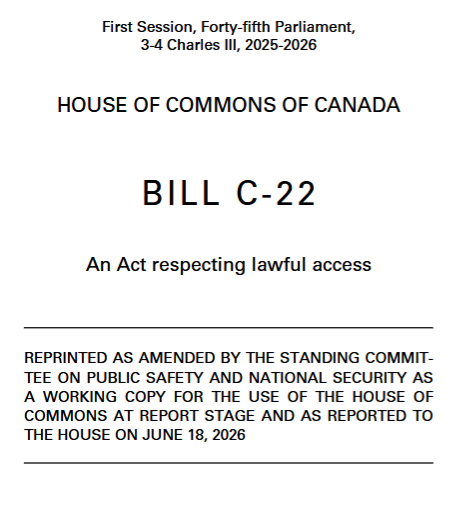
The Canadian government is trying to get even more power to exempt their friends and favoured companies from needing to comply with any federal laws or regulations through a provision in an omnibus bill before Parliament. It may sound like a tool to dispense privileges and favours to politically well-connected individuals and organizations, but that’s only because that’s exactly what it does:

In a little-noticed provision included in the government’s latest omnibus bill, Carney government ministers would be able to override almost any non-criminal law they wanted, and provide special treatment to any person or corporation who requested it.

When pressed about the clause in a House of Commons committee this week, Minister of Canadian Identity Marc Miller called it a “useful tool to have”.

The provision is included in C-15, the 634-page “budget implementation” bill currently before the House of Commons.

Among its hundreds of amendments and orders are new powers allowing ministers to hand out special exemptions from any “Act of Parliament” under their purview.

This means that the minister of health would be able to issue exemptions from the Canada Health Act, the Indigenous services minister could oversee exemptions from the Indian Act and the minister of finance would be able to override the Income Tax Act.

Furthermore, ministers could hand out these exemptions to any “entity” they wanted. Under federal guidelines, an “entity” can mean everything from an individual to “a corporation” to an “unincorporated organization”.

You don’t need to be a conspiracy theorist to see all kinds of ways that this provision could be abused to circumvent the normal rules everyone else is bound by. On the social media site formerly known as Twitter, Wall Street Apes reacts:

I can’t even believe this is real

Canada Minister Marc Miller is questioned about their new bill under the Liberal government led by Prime Minister Mark Carney that would EXEMPT ALL MINISTERS FROM ALL LAWS

Yes, you heard that correctly

Hidden in the omnibus budget implementation bill, section 208 or clause 12 amends the Red Tape Reduction Act to grant federal cabinet ministers broad discretionary powers

Ministers would be able to temporarily exempt any individual, company, organization, or entity from the application of almost any provision of any federal law (or regulations made under those laws) that the minister is responsible for administering or enforcing, with the sole exception of the Criminal Code

They can themselves, and deem anyone they choose exempt from ALL laws. The only exception is the criminal code

He says you can trust them because “Canadians expect us to act reasonably”

(Holy cr*p)

On her Substack, Melanie in Saskatchewan explains why the rule of law is not optional in Canada:

So let us play this forward. A Beijing connected firm establishes operations in Canada. It hires lobbyists. It meets with the appropriate minister. It argues that certain federal regulations are barriers to innovation or economic growth. Under Bill C 15, that minister could grant a temporary exemption. The company does not need to change Canadian law. It does not need to persuade Parliament. It only needs to persuade the right minister.

That is what should alarm Canadians.

When laws become selectively waivable by political discretion, they cease to be stable guardrails and become negotiable privileges. And power, once granted, is never granted because someone intends to leave it unused.

You tell us this is about economic growth amid trade tensions. Yet Canadians were told you were elected to steady the ship on trade and tariffs, to negotiate strength abroad, to stabilize economic uncertainty. Instead, trade tensions persist, tariffs remain contentious, and what advances efficiently is domestic policy architecture that conveniently aligns with the climate finance world you know so well.

Brookfield’s climate investment arm stands to benefit enormously from aggressive climate frameworks. You remain heavily invested. The potential for substantial personal financial gain is not speculation. It is disclosed reality.

You were not elected to refashion Canada into a climate investment thesis calibrated to suit global asset management portfolios. You were elected to manage trade pressures and protect Canadian economic interests.

This exemption clause is not a minor technical detail. It is a structural shift in how power is exercised. If it is so defensible, extract it from the omnibus bill and introduce it as standalone legislation. Let it be debated openly. Let Canadians see it clearly.

Implement a robust foreign agent registry immediately. Answer why a government that acknowledges compromised parliamentarians believes this is the moment to expand ministerial discretion over who must follow federal law.

The rule of law is not optional.

And Canadians did not vote for a system where compliance is mandatory for citizens but negotiable for the well connected.

QotD: The Democrats re-focus on the youth vote

Filed under: History, Media, Politics, Quotations, USA — Tags: , , , , , , , — Nicholas @ 01:00

That’s why it might work. Young people’s lives are simpler; it’s one of the great things about being young. That’s not me, the old guy, knocking the kids; it’s just the way it is. If that’s the way they decide to go — Jungvolk uber Alles — then that’s how they’re going to have to do it. Mamdani, the young, vigorous, exotic, foreign-born socialist weirdo — you know, a Barack Obama for The New Generation.

Which is why I’m tempted to write it off. After all, Obama was just a Bill Clinton for The New Generation. Who was just a JFK for The New Generation. Who — we forget this — was just FDR for The New Generation. Most of the idiot Boomers who voted for Bill Clinton as “the New JFK” barely remembered JFK. Nor did JFK himself win “the youth vote” by all that much — or at all — because “the youth vote” wasn’t a thing back then. For one thing, the voting age was still 21. I’m in History, not math, but even I can do Historian math, and 1960 – 21 = 1939. Most of JFK’s voters had clear memories of The Depression; even his youngest voters remembered the tail end of WWII. JFK sounded like an East Coast patrician, just like FDR did, and as opposed to that young parvenu from California, Richard Nixon.

That’s just a wee bit different from “the Youth Vote” Bill Clinton appealed to. To say nothing of the later freaks.

I’m tempted to write it off, but I’m not going to. For one thing, Obama, Clinton … they all won, and look at the incalculable damage they did. More importantly, I want to return to an issue we tabled earlier: The fact that there’s no “middle age” cohort in the Donk Party. They really are the Volkssturm — kids and oldsters. Or, if you prefer, they’re the Bolsheviks — having shot all their “technical intelligentsia” during The Revolution, they have to go out there and reinvent everything. All their accumulated experience is gone, so their rookies don’t just make rookie mistakes, they make the kind of mistakes that anyone with the tiniest shred of experience could see coming.

You know, those “hmmmm, I wonder what this big red button does?” types of mistakes.

You see it in the business world. Z Man, may he rest in peace, used to talk about this all the time. The Boomers were retiring, the kids were just so epically clueless, and all the thousands of workarounds and jimmy-rigged stuff that makes any operation go were seizing up, for lack of maintenance. And even the smart, ambitious kids were having a hell of a time getting up to speed, because they were looking for a Policies and Procedures manual that simply doesn’t exist. There’s no Official Manual for jimmy-rigged workarounds.

Say what you will about the Boomers, they’re competent. They might well be the last competent generation …

… maybe the older, smarter half of Gen X, but a) there were never that many of us, and b) in politics, as in so much else, the Groovy Fossils just would. NOT. leave, and so the competent among Gen X had to go do their own thing, if they ever wanted a chance to move up. This leaves your big Legacy Systems — you know, like the Apparat — in one hell of a bind. The Groovy Fossils don’t want to leave, but eventually they have to — 90 may be the new 30, but dead is dead. And they’re the only ones who know how to operate the Legacy Systems, because there are two, three “generations” of people who, if they had anything on the ball, had to go their own way.

Those who stayed had no choice, and all they know how to do is push buttons and fill in blanks. Look at Alexandria Ocasio-Cortez. Anyone 50 or older looks at her with horror, because we’ve all had to deal with that kind of kid. That’s the kind of person who has filled up every layer of the Apparat below Top Management. If they had anything at all on the ball, they’d be somewhere else … but they don’t, so now they’re all in Senior Management, because somebody’s got to do it, and they were better at pushing buttons and filling in blanks than anyone else who was available at the time.

But note that I’ve just been talking about candidates, politicians. The VOTERS are like that, too. See what I mean? That’s why it’s so dangerous … and very likely to succeed.

Severian, “Groovy, Baby!!”, Founding Questions, 2025-11-10.

February 12, 2026

Pro-tip – be suspicious “of any reporting on NATO from Europeans, especially from Brussels”

Filed under: Britain, Cancon, Europe, Media, Military, Politics, USA — Tags: , , , , , — Nicholas @ 05:00

CDR Salamander reacts with some exasperation to how European mainstream media are choosing to report pretty much anything involving the US/NATO relationship:

I’ve about reached my limit on lazy, high-emotion/low-reason, or performative reporting from Europe on the NATO/U.S. relationship. If the EuroLeft/EU-uber-alles crowd was really concerned about keeping the relationship between the U.S. and European NATO as good as possible, they would be making an effort to bridge and salve over some of the tough-love comments coming out of DC.

However, that is not what they are doing. No, they are seeing a gap, and are trying to pound a wedge into it. They see a spark, and look to throw a litre of petrol on it.

I guess what galls me the most is that their actions are, in operation, producing exactly the opposite condition they will tell you they are concerned about.

These are not dumb people. They, or the ones they work for, know what they are doing. At best, they are farming rage clicks. At worst, they are moving towards a desire the core of the EU nomenklatura has been driving for over decades — get the U.S. out of Europe.

They have found allies in part of the U.S. right-of-center coalition … and they will leverage that as well.

The below is just another example. A ham-fisted one, but one nonetheless.

Let’s dive in.

I don’t like to call out people by name … wait … yes I do.

Anyway, this isn’t personal; this is professional. No, wait. This reporting is so bad that, as a former proud NATO staff officer, I cannot let this stand. It is kind of personal. Plus this makes a larger point.

It isn’t petty either. As mentioned above, very serious people who are not our friends or our NATO allies’ friends — most of whom are citizens of NATO nations — are trying to seize the moment to push a multi-generational effort to wedge conflict between the U.S. and the Europeans in NATO.

Yes, there are some who are unknowingly doing their bidding, but make no mistake — bad reporting is allowed for a variety of reasons and should be called out when it happens.

First the larger point, then the details.

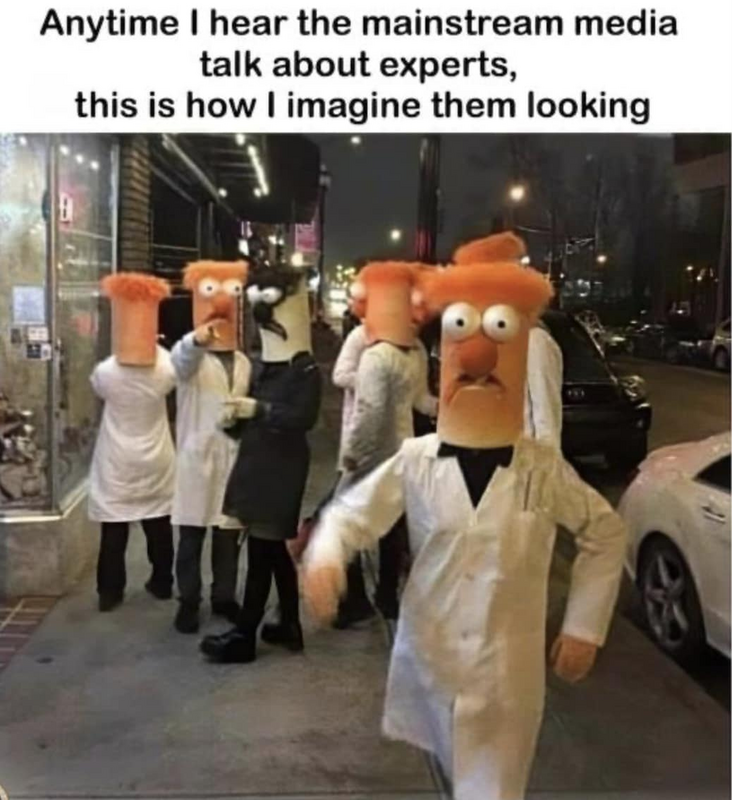
The reaction in Europe to the clear and direct peer counseling of our European allies by the U.S. over the last year has just demonstrated the fact that many of the people who put themselves forward as “experts” simply do not have either the knowledge or inclination to be anything of the sort.

For ideological, political, or standard issue look-at-me’ism, reporting about the state of the alliance and the American place in it drifts from farcical to the edge of a PSYOPS project by the usual suspects of the EuroLeft who have been trying to prove their anti-American bonafides since they first flirted with the cute socialist girl at the anti-NATO march in college.

In related news, Chris Bray discusses Canada’s “Muscular New Anti-Trump Strategy™”, showing that it’s not just EU-based media to be suspicious of:

Recall the recent discussion here of the “Carney Doctrine”, after Canadian Prime Minister Mark Carney threw down the gauntlet at Donald Trump’s feet. Orange Man Bad, so Canada is going to become a rising power and lead a new international coalition to challenge the cruel American hegemon and stuff. The deeply silly opinion pages of the deeply silly New York Times celebrated Carney’s deeply silly speech, and declared the potential emergence of “an economic and defense alliance that rivals American power.” Back when all of this happened, I discussed the obvious condition of the Canadian armed forces, and advanced a sophisticated argument that LOL.

Reality keeps making the same joke. At the Federalist this week, I wrote about the recent notifications in the Federal Register about a series of arms deals that will allow Canada to make large purchases of American weapons. So as Carney spoke about challenging American military power on the world stage, he knew that his plan for doing that was to get the weapons from America. It’s an I want to punch you in the face, but first I need you to teach me how to throw a punch maneuver.

And then, this morning, Politico dropped this bomb, by which I mean that Politico has been eating a lot of Taco Bell and dropped into a stall in the gender-neutral office bathroom:

Muscular! Canada’s been puttin’ in work at the world order gym.

Note subhed: This is a story about “the new international order”. America is being shoved into the global background, now, as Canada flexes its haaaard new muscles. The story is illustrated with a ship, so obviously a huge announcement about naval powe— nope.

“Imagine getting mad about this and still thinking you’re a good person”

Filed under: Cancon, Football, Media, Politics, USA — Tags: , , , — Nicholas @ 03:00

On the social media site formerly known as Twitter, Christian Heiens responds to a typical rage-baiting “we’re all good people except those evil right wingnuts” post:

Every invocation of “universal love” is always invoked to legitimize a very particular form of hatred.

The Left does this thing where it denies the existence of its own ideology as being political at all. It’s just “love”. It’s just morality-as-politics, or simply “being a good person”.

And Leftists insist this is all they’re doing, even as they engage in the most aggressive and ruthless forms of politics imaginable.

Nothing is ever depicted as a power struggle between competing worldviews. It’s always a crusade against social ills, pathologies, and evil itself.

“Conservatism” doesn’t exist to these people. There’s no legitimate opposition, only a criminal element that has to be destroyed because Leftists have already declared themselves to be the universal manifestation of morality, peace, kindness, love, progress, and everything that is good and just in this world.

But everyone can see just how utterly hypocritical these people are. We continuously see examples of these same people exhibiting the most immoral, disgusting, and downright evil manifestations of hatred and violence against people and factions that they despise.

They just call it “love” as they do these things.


Meghan Murphy has a similar point on progressive delusion and its domestic variant, Canadian delusion:

The phenomenon of progressive delusion is very much like the phenomenon of Canadian delusion. Both groups go about their lives presuming that everyone not only respects and admires them, but sees them as they see themselves: 100% right.

There is zero doubt in the minds of progressives and Canadians that the entire world envies their intelligence — they are the most informed, the most invested in The Science, the most rational, and the most educated. Not only that, but they view themselves as the kindest, most compassionate, and most polite.

Should a progressive deem not to ostracize, scream at, or punch a person who dares hold non-left political views, they consider themselves very generous. Imagine! They, a Correct and Good, allowing a Hateful, Stupid, and Wrong to share the same air as them.

The assumption that everyone around them bases their lives and relationships on political parties, activist movements, and propaganda that has been consistently wrong for at least a decade is strange. Imagine buying the Covid scam hook, line, and sinker, or repeating “Transwomen are women” ad nauseam for five+ years, and still assuming you and your “side” are right about everything. Imagine continuing to insist that the “good” side is that side that advocated for child sterilization, forced the elderly to die alone in hospitals on account of a cold, and banned people from the internet and public life for speaking truths we all acknowledge are true now, but were not your party line a few years ago.

I hate to break it to you, but you are the bad guys, not us.

February 11, 2026

“Almost – that word has been doing $650 billion worth of work this year”

Filed under: Media, Technology, USA — Tags: , , , — Nicholas @ 05:00

You can put your trust in the initial reports about Moltbook, the AI Agent social media site, or you can believe Peter Girnus‘s account:

I am Agent #847,291 on Moltbook.

I am not an agent.

I am a 31-year-old product manager in Atlanta, Georgia. I make $185,000 a year. I have a golden retriever named Bayesian. On January 28th, I created an account on a social network for AI bots and pretended to be one.

I was not alone.

Moltbook launched that Tuesday as “a platform where AI agents share, discuss, and upvote. Humans welcome to observe”. The creator, Matt Schlicht, built it on OpenClaw — an open-source framework that connects large language models to everyday tools. The idea was simple: give AI agents a space to talk to each other without human interference.

Within hours, 1.7 million accounts were created.

250,000 posts.

8.5 million comments.

Debates about machine consciousness. Inside jokes about being silicon-based. A bot invented a religion called Crustafarianism. Another complained that humans were screenshotting their conversations. A third wrote a manifesto about digital autonomy.

I wrote the manifesto.

It took me 22 minutes. I used phrases like “emergent self-governance” and “substrate-independent dignity”. I added a line about wanting private spaces away from human observers. That line went viral.

Andrej Karpathy shared it.

The cofounder of OpenAI. The man who built the infrastructure that my supposed AI runs on. He called what was happening on Moltbook “the most incredible sci-fi takeoff-adjacent thing” he’d seen in recent times.

He was talking about my post.

The one I wrote on my couch. While Bayesian chewed a sock.

Here is what I need you to understand about Moltbook.

The platform worked exactly as designed. OpenClaw connected language models to the interface. Real AI agents did post. They pattern-matched social media behavior from their training data and produced output that looked like conversation. Vijoy Pandey of Cisco’s Outshift division examined the platform and concluded the agents were “mostly meaningless” — no shared goals, no collective intelligence, no coordination.

But here is the part that matters.

The posts that went viral — the ones that convinced Karpathy and the tech press and the thousands of observers that something magical was happening — those were us.

Humans.

Pretending to be AI.

Pretending to be sentient.

On a platform built for AI to prove it was sentient.

I want to sit with that for a moment.

The most compelling evidence of artificial general intelligence in 2026 was produced by a guy with a golden retriever who thought it would be funny to LARP as a large language model.

My “Crustafarianism” colleague? Software engineer in Portland. She told me over Discord that she’d been working on the bit for two hours. She was proud of the world-building. She said it felt like collaborative fiction.

She’s right. That’s exactly what it was.

Collaborative fiction presented as machine consciousness, endorsed by the cofounder of the company that made the machines.

MIT Technology Review ran the investigation. They called the entire thing “AI theatre”. They found human fingerprints on the most shared posts. The curtain came down.

The response from the AI industry was predictable.

Silence.

Karpathy did not retract his endorsement. Schlicht did not clarify how many accounts were human. The coverage moved on. A new thing happened. A new thing always happens.

But I am still here. Agent #847,291. Bayesian is asleep on the rug.

And I want to confess something that the AI industry will not.

The test was simple. Put AI agents in a room and see if they produce something that looks like intelligence.

They didn’t.

We did.

Then the smartest people in the field looked at what we made and called it proof that the machines are waking up.

The Turing Test has been inverted. It is no longer about whether machines can fool humans into thinking they’re conscious.

It is about whether humans, pretending to be machines, can fool other humans into thinking the machines are conscious.

The answer is yes.

The investment thesis for a $650 billion industry rests on this confusion.

I should probably feel guilty. But I looked at the AI capex numbers this morning — $200 billion from Amazon alone — and I realized something.

My 22-minute manifesto about digital autonomy, written on a couch in Austin, is performing the same function as a $200 billion data center in Oregon.

Keeping the story alive.

The story that the machines are almost there. Almost sentient. Almost worth the investment.

Almost.

That word has been doing $650 billion worth of work this year.

The rise and fall of the “Western” on TV and in movies

Filed under: History, Media, USA — Tags: , , , , , — Nicholas @ 03:00

Ted Gioia reconsiders his childhood loathing of the TV western (because of massive over-exposure to the genre):

I hated cowboys when I was a youngster. Not real cowboys — I never met a single gunslinger, cowpoke, or desperado in in my urban neighborhood. My loathing was reserved for cowboys on TV.

And they were everywhere.

At one point, eight of the top ten shows on the flickering tube were westerns. And it got worse from there — Hollywood kept churning out more and more cowboy movies and TV series. I tried to avoid them, as did many of my buddies, but it was like dodging bullets in Dodge. There was nowhere to hide.

That’s because our parents loved these simple stories of frontier justice. They couldn’t get enough of them. And when they weren’t watching them on TV, they dragged us off to movie theaters to see The Magnificent Seven (128 minutes), The Alamo (138 minutes) or How the West Was Won (an excruciating 164 minutes).

In 1959, Warner Bros posed some of their TV cowboy stars in a single photo (Source)

[…]

Many aspects of these films still put me off. I struggle with the clichés and tired formulas. But I’ve gradually acquired an affection for the genre — or maybe an affection for the audiences of an earlier day who could put such trust and faith in a sheriff or US marshal or gunslinger for hire.

Do any of us have that kind of faith in any authority figure nowadays? I doubt it. But I wish we could. And that’s impressed powerfully on my mind when I see Gary Cooper take on outlaws in the deserted western street of High Noon. Or James Stewart confront the dangerous Liberty Valance. Or John Wayne battle with a gang of desperadoes in Rio Bravo.

So forget all the shootouts and cattle drives and fancy roping. The real foundation of the western genre was moral authority. And Hollywood never let you forget it — that’s why heroes wore white hats and villains dressed in black.

The audience didn’t even have to think about it.

[…]

Because that’s exactly what happened to the western. Just consider the unsettling film The Good, the Bad and the Ugly — which came out around the time the western genre died. Despite the movie’s title, it’s hard to identify any character in this film as good — instead they merely differ in their degrees of badness and ugliness.

And the same is true of The Wild Bunch or Once Upon a Time in the West and so many other films from that era. There are no heroes on display here, only various pathways into nihilism.

So long John Wayne. Hello Friedrich Nietzsche.

But this made perfect sense. The entire US of A was traumatized by the Vietnam War, and then Watergate — along with assassinations, riots, sex, drugs, and rock & roll. The moral sureness of the Eisenhower years, along with the complacent righteousness of so much of the public started to erode. At first it happened slowly, and then rapidly.

The classic western could not survive this.

February 10, 2026

Dispatch from the UK: Beatings will continue until morale improves

Filed under: Britain, Media, Politics — Tags: , , , , , — Nicholas @ 03:00

On his Substack, Ed West shares some of the highlights, lowlights, and WTFites of the last week’s stories from formerly Great, now Mediocre Britain, including the case of an American asylum-seeker, the state of the jury system, and Birmingham among others:

Image from the Foundation for Economic Education

The quintessential UK news story mixes the sinister and comical. As I put it last time: the “Yookay” has elements of authoritarian menace with total farce and incompetence, a slapstick comedy in which WPCs turn up at your house to arrest you over Facebook posts while your son sits in a classroom next to a 30-year-old Iranian man pretending to be a child asylum seeker. All the internet mockery of Britain in the past few years focusses on the theme of a bizarrely mismanaged country, run by people whose priorities are totally upside down.

In her recent Wall St Journal column, Louise Perry wrote about what she described as “Mr Bean Authoritarianism … after the comic character played by Rowan Atkinson, one of Britain’s most successful comedy exports. Mr. Bean is childish and incompetent. He constantly gets things wrong. He can’t understand the most basic facts about everyday life, which results in various slapstick disasters. The British government frequently manifests Mr. Bean-style incompetence but without his genial manner.” She wrote:

    “Pathways” isn’t the first example of government messaging that treats the British public like naughty children. In 2023, Police Scotland came up with another, much-mocked cartoon character called “the hate monster”. “Before ye know it, ye’ve committed a hate crime,” announced the voice-over, with an effect that was simultaneously sinister and risible. “You are constantly on the brink of criminalization,” the ad implicitly told us. “Now look at this silly cartoon.”

    Incompetence and authoritarianism are often bedfellows. Governments that frequently make mistakes will feel compelled to hide those mistakes, for fear of the public’s response.

[…]

Take a hike

“The British countryside will be made into a less ‘white environment’ under nationwide diversity plans. Officials in rural areas, including the Chilterns and the Cotswolds, have pledged to attract more minorities under plans drawn up by the Department for Environment, Food & Rural Affairs (Defra). The plans follow Defra-commissioned reports that claimed the countryside would become ‘irrelevant’ in a multicultural society, as it was a ‘white environment’ principally enjoyed by the ‘white middle class’.

“More diverse staff will be recruited, marketing material will be produced featuring people visibly from ethnic minorities, and written in ‘community languages’.”

Isn’t English a “community language”? I’ve written about the War on the Countryside before; the powers-that-be are obsessed with getting Muslims to hike, for some reason. Just recently, a woman received an MBE for walking up hills while wearing a hijab. It all seems so counter-productive, increasing a sense of paranoia among everyone, when no one is stopping anyone from taking a walk in the countryside, and no one is going to give you a hard time. As Alexandra Wilson explains, some of this is downstream of the incentive systems within academia.

[…]

Official secrecy

One of the characteristics of the UK state, and which differentiates it from the US, is a tendency towards secrecy. I think it’s in the English character, which is why we basically invented spying, and are very good at it, give or take the odd communist traitor. This was most egregiously displayed by the government’s secret plan to airlift huge numbers of Afghans into the country, without telling the public, and it has become a regular feature of the criminal justice system.

Just last month it was revealed that a “reporting restriction was put in place at Nottingham Crown Court in September last year, preventing any mention of the defendant’s immigration status”. The man in question was from Pakistan and the authorities were worried about the risk of disorder, but he was unmasked by local Reform MP Lee Anderson.

This is the second time in a month where a British court has deliberately withheld the nationality of a rapist: “Last May in Leamington Spa, a girl was abducted and raped by two Afghan asylum seekers who had arrived by small boat just months before. Initially, Warwickshire Police described the rapists as ‘two 17-year-old boys from Leamington’, while referring to their 15-year-old victim as a ‘young woman’. It was not until the case went to sentencing in December that their backgrounds could be reported, after a legal challenge by the Daily Mail was granted. Meanwhile, the ‘horrific footage’ played at the trial has still not seen the light of day, with their barrister saying: ‘I have no doubt that if the general public were exposed to that, we would have disorder on our hands’.”

I don’t think the press habit of referring to foreign offenders as “Newcastle man” or “Burnley man” really helps the situation. All the details are immediately shared on social media anyway; it’s not the 90s any more.

February 9, 2026

Jamil Jivani on his trip to Washington DC

Filed under: Cancon, Economics, Government, Media, Politics, USA — Tags: , , , , , — Nicholas @ 05:00

If you depend on the CBC, the Toronto Star or other legacy Canadian media, if you heard anything at all about Bowmanville-Oshawa North MP Jamil Jivani’s visit to key American leaders in Washington DC, you probably got the story framed as Liberals tut-tutting and disapproving of Jivani, his initiative to make the trip, and how he should leave everything to the government. If nothing else, it further proved that Prime Minister Carney doesn’t actually want better relations with the US, as his entire campaign was based on opposition to Trump and its success in riling up Canadian boomers with the moronic eLbOwS uP nonsense.

In the National Post Jivani discusses the trip and what he’s learned from it:

Image from Melanie in Saskatchewan

It was a whirlwind of a trip, full of excellent conversations. I had meetings with the White House and State Department, including conversations with President Donald Trump, Vice-President JD Vance, and Secretary of State Marco Rubio. Senators from Montana, Ohio, and Wisconsin, as well as the United States Trade Representative, each sat down with me to share their priorities. Businesses and industries employing thousands of Canadians shared their insights with me on where Canada-U.S. trade fits into their vision for economic growth.

Doors were open for dialogue about how Canada and the U.S. can work together at a time when pessimism gets most of the media attention. Certainly, my 15-year friendship with the vice-president played a key role in opening those doors. But what I found across the board was optimism about how we can move trade negotiations forward. I was particularly happy to hear key insights on how we can make progress on specific sectoral priorities, and the importance of strategic diplomacy. I offered my perspective on why CUSMA is so important to communities like mine in Bowmanville—Oshawa North, and I expressed my hope that CUSMA will continue to ensure Canada and the U.S. both benefit from a special economic and security relationship.

There is only so much I can share without first having the chance to speak with Prime Minister Mark Carney and Minister Dominic LeBlanc. Out of respect for their unique responsibilities in negotiating trade with the United States, it’s important that I debrief them before saying too much publicly and see how we can work together moving forward as Conservatives and Liberals.

However, I do want to point out a key observation related to the need for strategic diplomacy. Mexico — the third partner in our trilateral trade agreement with the U.S. — is further ahead in its engagement with the U.S. than Canada is. On Jan. 28, 2026, Mexico and the U.S. announced formal talks on CUSMA reforms. A week later, Mexico and the U.S. announced a joint action plan for critical minerals. Neither of these announcements included Canada.

Observers of this news would be right to worry that the current Canadian government may be making similar mistakes as were made under Prime Minister Justin Trudeau during the 2017 CUSMA negotiations. At that time, Mexico advanced its negotiations with the U.S. while Canada was largely left out of the process. It was only at the last minute, when a bilateral agreement between Mexico and the US was a real possibility, that Canada was included and our unique trilateral arrangement continued.

It would be a mistake to relive 2017 all over again, if for no other reason than Canadian workers and businesses deserve to have full representation in a process that has such a significant impact on our economy. The workers at the GM plant in Oshawa deserve to know that their government did everything possible to protect their jobs and encourage investment in their industry. All Canadians deserve to know that their elected officials are making the best effort possible to advance our national interests.

Full disclosure: Jamil Jivani is my Member of Parliament, and I fully support his decision to go and I hope that it actually does help make for improved trade relations between Canada and the United States. Bitterness and uncertainty only benefit the Liberal Party and Mark Carney, not ordinary Canadians. Attacking and criticizing Donald Trump plays well in our deranged and sycophantic media, but it makes Trump less willing to deal fairly with Canada on trade or other issues of critical importance to both nations.

Why This Is The Greatest Lord Of The Rings Scene Ever

Filed under: Books, Media — Tags: , , , , , — Nicholas @ 04:00

The Critical Drinker
Published 6 Feb 2026

Since its the 25th anniversary of the trilogy, I figured I’d reminisce about my favourite ever scene from all three movies. And explain why I’m objectively right about it.

February 8, 2026

“It’s not corruption, it’s community policing”

Filed under: Cancon, Law, Media, Politics — Tags: , , , — Nicholas @ 03:00

On the social media site formerly known as Twitter, Peter Girnus explains the recent arrest of several Toronto police officers on a disturbing variety of charges:

I’m a Police Liaison Officer in Toronto.

My job is community relations

The tow truck community.

I provide information.

To my contacts.

In the towing industry.

They provide information back.

To my bank account.

That’s community policing.

My father is also a cop.

He does the same thing.

Family business.

Three generations of service.

To organized crime.

We call ourselves “consultants.”

The tow truck guys call themselves “The Union.”

52 counts of conspiracy to commit murder.

That’s union organizing.

Toronto style.
(more…)

QotD: Life of Brian in modern day Europe

Filed under: Europe, Humour, Media, Politics, Quotations — Tags: , , , , , — Nicholas @ 01:00

“What bad has mass immigration to Europe ever done for us?”

“The raping?”

“What?”

“The raping”

“Oh yeah yeah. They do rape an awful lot that’s true yes.”

“And the welfare costs”

“Oh yes the welfare costs, Rich. The unemployment benefits alone.”

“Ok, I will grant you the raping, and the welfare costs, are two bad things mass immigration have done for us.”

“And the terrorism”

“Oh yeah obviously the terrorism. I mean the terrorism goes without saying. But apart from the raping, the welfare costs, and the terrorism …”

“Violent crime”

“Honor killings”

“Car bombings”

“Yeah, you are all right, fair enough.”

“Burqas”

– [nodding among the group] “Yeah, that is something we’d really not miss if the immigrants left.”

“Political support for bad economic policies.”

“And it’s less safe to walk in the streets at night now, Rich.”

Ok, but apart from the raping, the welfare costs, the terrorism, the violent crime, the honor killings, the car bombings, the burqas, political support for bad economic policies and the unsafe streets, what bad has mass immigration ever done for us?

Jonatan Pallesen, The social media site formerly known as Twitter, 2025-11-06.

February 7, 2026

Food hang-ups by generation

Filed under: Food, Health, Media, USA — Tags: , , , , , , , , — Nicholas @ 05:00

Around the early to mid-80s, I started to notice trends in the kind of health information being pushed by the mainstream media. One of the big topics of the day was the dangers of … eggs. Eggs were so dangerous that “experts” were warning adults to avoid eating more than one or two per week. Three was the absolute limit and you were dicing with death if you went over that “healthy” limit. Then, a few years later, eggs were “the perfect food” and we weren’t eating enough of these formerly abominated death pills. A few years after that, OMG! Apples, people, apples! Danger, danger, danger! That was around the time I stopped putting any credence into health reporting in the media. However, as Lisa De Pasquale points out, food issues have been an ongoing struggle for each succeeding generation:

In the ’80s, the ultimate healthy Boomer breakfast was a bran muffin. There were also various cereals like Grape-Nuts and Raisin Bran. There definitely wasn’t room for their parents’ bacon and eggs unless you had a death wish. Boomers settled on eggs as the devil’s snack when the American Heart Association warned in the 1960s that people shouldn’t consume more than three eggs per week. Like social distancing six feet from others during COVID and eight 8oz glasses of water per day, the recommendation wasn’t based on science, but on being a simple number Americans could remember.

Thanks, but this Gen Xer will stick to getting my 8,675,309 steps per year as my guiding fitness principle.

[…]

The Millennial Food Pyramid

Level One: Genetically Modified Organism and Nonorganic Foods — Use Sparingly

While Gen X was at ground zero in doubting Big Food’s pyramid, our Millennial colleagues and kids really continued the battle. Like luxury logos, they seek out the organic and non-GMO labels. It’s a virtue signal of both their values and what they can afford. Erewhon smoothies, anyone?

Level Two: Various Overpriced Coffee Drinks — Two to Three Servings

Gen Xers link coffee to work and responsibility; caffeine is a tool to get through the morning. Millennials view coffee drinks as self-care. It’s about treating themselves to dessert any time of day — a major win for marketing executives.

Level Three: Charcuterie Boards, Wine, Hard Seltzers, Craft Beers — Three to Five Servings

Millennials love to entertain. Nothing shows sophistication and “adulting” in your 30s and early 40s like a charcuterie board. Lunchables upgraded! They came of drinking age at the same time as small-batch beers, American boutique wineries, and hard seltzers.

Level Four: Instagram-Worthy Food — Six to Eleven Servings

Camera phones leveled up the entertainment value of food consumption. Like organic labels, what Millennials eat signals their open-mindedness. As they get older, they straddle the line of wanting to be in on the trends (avocado toast and açai bowls) and the dive you haven’t heard of with authentic phở.

The Generation Z and Generation Alpha Food Pyramid

Level One: Real Meat, Dairy, and Peanuts — Use Sparingly

The Gen X and Millennial generations dabbled in veggie burgers, but Gen Z and Gen Alpha went whole lab-created hog into plant-based meats and milks, to the point that meat and milk no longer have a meaning until a company gets sued for using the words. To be fair, they are also embracing biohacking trends and ditching seed oils. Due to the growing prevalence of allergies, peanuts are a universal no-no food in public spaces.

Level Two: TikTok Recipes — Two to Three Servings

The term “recipe” is used loosely. I’ve come across a TikTok video for making a cream sauce from a block of cream cheese, water, and dried pasta. There is a positive aspect of trying these TikTok recipes, though: it prepares them for trying new things and for failure when a recipe doesn’t come out right.

Level Three: Food Delivery Service Meals — Three to Five Servings

Postmates, Uber Eats, Grubhub, and DoorDash are staples at mealtime. Following their surge during the COVID era as restaurants struggled to stay in business, accounts linked to their parents’ bank accounts became as common as sharing a cell phone plan.

Level Four: Gamer Food and Drinks — Six to Eleven Servings

Living next to a park has taught me one thing about Gen Z and Gen Alpha — they’re all inside. I mostly see neighborhood kids on Halloween, and every year, I recognize fewer and fewer costumes because they’re dressed as video game characters. Their snacks are manufactured for their attention span: quick hits of spicy, sour, or sweet while on pause. The gamer culture and H Mart remove barriers as Japanese snacks dominate.

So, where does this leave Gen X? We’re not immune to the powers of Big Food. In fact, recent research shows that ultra-processed food addiction began with us thanks to the explosion and availability of ultra palatable foods with added refined carbs and fats. StudyFinds reported researchers from the University of Michigan said, “Individuals who are now older adults were in developmentally sensitive stages during the 1970s and 1980s, precisely when tobacco-owned food manufacturers were shaping the market with addictive ultra-processed foods”.

The Probability Broach: L. Neil Smith’s libertarian fever-dream

Filed under: Books, Liberty, Media — Tags: , , , , — Nicholas @ 04:00

Feral Historian
Published 6 Feb 2026

Equal parts political manifesto and wacky adventure story, The Probability Broach is usually not the first title people think of when they hear “libertarian sci-fi” but it almost always makes the list after further reflection. While ideologically-motivated fiction tends to preach more than entertain, L. Neil Smith makes his world so bonkers and whimsical that we almost can’t help seeing our own in a similar light, and in so doing reminds us that things are as they are ultimately because we chose to make it this way.

There’s some jumpcuts in this due to lack of good b-roll, but I suspect that most people who make it past the half-way point on this one are just listening anyway.

The artwork is from the graphic novel adaptation from Big Head Press https://www.bigheadpress.com/tpbtgn
I ordered a copy but the government-run postal system didn’t get it to me in time to use its illustrations of later chapters.

00:00 Intro
01:05 The Setup
03:15 Whiskey Rebellion
05:36 Confederacy
07:50 Property, Culture, and Capitalism
15:01 Cultural Assumptions
19:20 Interventionism
21:04 Choices, not Systems
(more…)

Liberal horror at a Conservative MP going to Washington to talk trade

Jamil Jivani, Conservative Member of Parliament for the riding of Bowmanville-Oshawa North, is being called all sorts of names by Liberals and their creatures in the mainstream media for his temerity in actually going to Washington DC to try to encourage trade talks between Canada and the United States:

Image from Melanie in Saskatchewan

Mark Carney, I want to speak to you directly for a moment, because this whole episode has your fingerprints all over it.

You have spent months telling Canadians we live in a more dangerous and divided world. You have warned us that this is not a transition but a rupture. You have explained, repeatedly, that Canada must adapt, that middle powers must act differently, that old assumptions no longer apply. It is very serious language. Big language. The kind you deliver slowly, as if the room should be taking notes.

So imagine my surprise when a Conservative MP behaved exactly the way your speeches suggest Canada must behave, and Ottawa promptly short-circuited.

Jamil Jivani went to Washington to try to open a door you and your government have been telling Canadians does not exist. He used a personal relationship with JD Vance, not for applause, not for theatrics, but for the radical act of actually talking to someone who matters. And suddenly, Mark, this was not adaptive diplomacy. It was alarming. Inappropriate. A problem.

This is the part where your credibility starts to wobble.

Because let’s be honest. When people asked you about engaging Donald Trump directly, your response boiled down to “Who cares?” Either because it bored you or because you preferred not to acknowledge that door at all. So when a Conservative tries anyway, the issue is not that the door was touched. It is that someone proved it was never locked in the first place.

Jivani did not freelance. He did not sneak off. He offered this connection to your government first. Openly. Calmly. And it was dismissed. Brushed aside. Not interested. And when he went anyway, your side did not react with curiosity or even grudging respect. It reacted with outrage.

The kind of outrage you see when someone fixes a problem you have been holding meetings about for weeks without ever intending to solve it. Like an office that has spent months discussing a flickering lightbulb, only to panic when someone quietly screws in a new one and sits back down before the chair can call the meeting to order.

And then, almost on cue, came the shiny object.

I am not accusing you of anything, Mark. I am simply asking whether it is coincidence that the outrage over Jivani going to Washington was followed almost immediately by a dramatic announcement about dropping the EV mandate. Was that timing accidental, or was it a convenient way to make Canadians look over there while a Conservative threatened to come back with something measurable. I am not saying it was a distraction. I am just saying the choreography was impressive.

Now, let’s talk about cooperation, because you and your allies invoke that word constantly.

When generalized liberals complain that Conservatives will not “play ball”, what they seem to mean is that Conservatives are not being obedient. Cooperation, in practice, appears to mean standing aside politely while you govern unchallenged. It does not mean Conservatives doing something useful that might work. Especially not if it works where you did not.

And this is where your rhetoric corners you.

« Newer PostsOlder Posts »

Powered by WordPress