Quotulatiousness

August 18, 2019

The SNC-Lavalin affair was “unethical and contrary to law”, but “relatively above board”

Filed under: Cancon, Government, Law — Tags: , , , — Nicholas @ 03:00

The initial affair itself, that is. Andrew Coyne:

It is the element of deception that raises the conduct described in the ethics commissioner’s report from the merely unlawful to the potentially criminal.

Until now what we had thought we were dealing with was only a sustained and mounting campaign, by the prime minister and by those acting at his direction, to pressure the former attorney general of Canada to set aside the prosecution of SNC-Lavalin, a company with a long history of corruption and even longer history of contributing to the Liberal party, for reasons that explicitly included considerations of partisan advantage.

All of this was vastly improper on its own. Prosecutorial independence is one of the bedrock principles of our system of law, as fundamental as judicial independence. It is settled law that the attorney general, in consideration of a particular prosecution, may not be pressured by anyone, least of all the prime minister, for any reason, least of all partisan gain. Yet Jody Wilson-Raybould was, repeatedly, to the point of being threatened with dismissal if she did not capitulate.

Still, if unethical and contrary to law, this was relatively above board, in so far as the pressure on the attorney general was direct and undisguised: a scandal, to be sure, and grounds for more resignations than those submitted to date, but not, as the cliché has it, a crime. That, of course, is not the standard we should expect of public office holders — that they should merely avoid committing crimes — but it is at least a standard.

Whereas the conduct unearthed by the ethics commissioner may have fallen below even that line. What we have learned is that senior government officials were not just pressuring the former attorney general to interfere in a criminal proceeding, by the unprecedented means of overturning a decision of the independent director of public prosecutions: they were deceiving her.

They did so not only by keeping important information from her, but by providing her with misleading information. They acted, not only in concert with each other, but with officials at SNC-Lavalin, and they carried on this conspiracy to, in the commissioner’s words, “circumvent, undermine and ultimately attempt to discredit” the authority of the attorney general even as the company’s appeal of the DPP’s ruling was before Federal Court — a proceeding to which the attorney general, via the DPP, was a party.

QotD: “Hitting back” at protectionist policies

Filed under: Business, Economics, Government, Quotations — Tags: , , — Nicholas @ 01:00

You buy lawn-care services from company XYZ located on the other side of town. Your neighbor, Mr. Stump, takes it upon himself to hold you up at gunpoint to the tune of $25 each time you buy services from XYZ rather than from Stump’s teenage son. You are less powerful than Stump and, not being suicidal, you pay the “tariff” that he officiously demands. But Stump is a magnanimous fellow, and so he agrees to a deal with XYZ: Stump drops his tariffs on your purchases from XYZ in return for XYZ agreeing to raise the price it charges you by $15.

But soon a trade dispute erupts. Stump discovers – correctly, we can assume – that XYZ is charging you less for its lawn-care services than Stump agreed is acceptable for you to be charged and that XYZ agreed in the trade deal to charge. Stump, being a master negotiator, threatens to reimpose the $25 tariff on you unless and until XYZ raises the price it charges you to at least the level that Stump has divined is acceptable and that is enshrined in the terms of the trade agreement between him and XYZ. Alas, XYZ gives in and agrees to raise the price it charges you. Stump then boasts that, by not letting XYZ get away with breaking its word in the trade deal, he is not only protecting the neighborhood from dangerously low prices but is also upholding the sacred rule of law and the sanctity of contractual agreements.

Of course, in reality, Stump’s presumptuous exercise of the power to rob you impose a tariff on you whenever you engage in commerce that he finds objectionable is a wrong inflicted on you and on your trading partner, XYZ. The fact that the practicalities of the situation result in your and XYZ going along with the “deal” to entice Stump to stop robbing you each time you buy XYZ’s services does not ethically oblige you to stick to the terms of the deal if you can, in secret, get better terms from XYZ. When Stump threatens to reimpose on you the $25 tariff, he harms you. That is, when in response to Stump’s threat to reimpose the tariff XYZ agrees to abide by the terms of its trade agreement with Stump and raise the price that it charges you, you are made worse off, not better off.

Stump’s enforcement of this agreement, in short, does not protect you from further victimization in the future; instead, that enforcement is itself an act of victimizing you. Successful enforcement of this agreement assures you a future less prosperous than it would be were Stump instead to ignore XYZ’s “violation” of the deal.

Note: we can all agree that, between the two options (1) $25 tariff and (2) no tariff but an enforced price-hike, under the trade agreement, of $15, that the second option is better for you than the first option. It is in this limited sense that trade agreements in reality are beneficial. But there’s a third option: (3) Stump does not interfere with your commerce and you pay whatever price you negotiate with XYZ without that price being artificially affected by Stump’s interference. This third option is, for you, the best of the three – and it’s the only fully ethical one of the bunch. (So when Dan Griswold, myself, and other free-traders defend trade agreements, we do so with the realistic recognition that option (3) is politically infeasible. Given this unfortunate infeasibility of option (3), we endorse option (2) over option (1).)

Don Boudreaux, “Strict Enforcement of an Impoverishing Deal Assures Continuing Impoverishment”, Café Hayek, 2017-07-07.

August 14, 2019

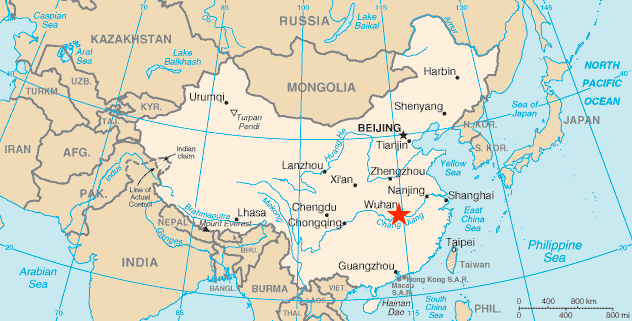
Hong Kong’s struggle with the Chinese government

Filed under: China, Government, Law, Liberty — Tags: , , , , — Nicholas @ 03:00

Andrew Coyne on the desperate situation of the Hong Kong protests:

2019 Hong Kong anti-extradition law protest on 16 June, captured by Studio Incendo from Flickr.
Photo via Wikimedia Commons

A sickening pall of inevitability hangs over the protests in Hong Kong, now in their tenth week. Neither side can afford to back down – the protesters, because their way of life, indeed their very lives, are at stake; the Beijing-backed government, for the precedent it would set, and the hope it would inspire.

As the violence mounts — most of it, to date, on the part of the police, or in some cases the Triad gangs hired to beat and intimidate the protesters — so does the likelihood of mass bloodshed, a reprise of the Tienanmen massacre of 30 years ago. Some of the protesters may indeed hope to tempt Beijing into such an appalling overstep; however horrific the prospect, or improbable their chances, it is difficult to blame them.

For as the people of the world’s freest city fend off being swallowed by one of the world’s most repressive dictatorships, they do so largely alone. Fifty-six years ago, when West Berlin faced a similar threat from the Eastern Bloc, the democratic world rallied to its cause – because its cause, they knew, was their cause. President John F. Kennedy went to Berlin to give his great, moving “ich bin ein Berliner” speech, declaring before the world that “all free men, wherever they may live, are citizens of Berlin.” These were not just words — it was NATO policy to defend the city with arms, if necessary.

And today? The president of the United States refers to the protesters as “rioters,” the Beijing-approved term. Should President Xi Jinping decide to suppress the unrest in Hong Kong by force, he seems to be signalling, he would be willing to look the other way — perhaps for reasons of state (what are a few hundred or even thousand lives if it helps close a trade deal?), or perhaps just out of his habitual admiration for dictators. But the government of Canada — 300,000 of whose citizens, let us remember, live in the city — has been scarcely more robust in their defence; neither have most western governments.

QotD: Proto-progressive thought

Filed under: Government, History, Liberty, Politics, Quotations — Tags: , — Nicholas @ 01:00

[Robert Southey] conceives that the business of the magistrate is not merely to see that the persons and property of the people are secure from attack, but that he ought to be a jack-of-all-trades, architect, engineer, schoolmaster, merchant, theologian, a Lady Bountiful in every parish, a Paul Pry in every house, spying, eavesdropping, relieving, admonishing, spending our money for us. His principle is, if we understand it rightly, that no man can do anything so well for himself as his rulers, be they who they may, can do it for him, and that a government approaches nearer and nearer to perfection in proportion as it interferes more and more with the habits and notions of individuals.

Thomas Babington Macaulay, “Southey’s Colloquies on Society”, 1830.

August 12, 2019

Australia’s government broadband fiasco might be a useful lesson for Senator Warren

Filed under: Australia, Business, Economics, Government, Politics, Technology, USA — Tags: , , — Nicholas @ 03:00

In the race for the Democratic party’s presidential nomination, Senator Elizabeth Warren recently proposed a government-provided broadband rollout across the United States to compete with or supplant the existing private ISPs. Arthur Chrenkoff suggests that looking at Australia’s experience with a very similar plan might encourage her to abandon her proposal after a brief airing on the campaign trail:

Senator Elizabeth Warren speaking at the Iowa Democrats Hall of Fame Celebration in Cedar Rapids, Iowa, on 9 June, 2019.
Photo by Lorie Shaull via Wikimedia Commons.

Maybe Senator Warren should have a pow-wow first with IT experts from Australia, who could enlighten her about our country’s 12-years-and-counting saga of the National Broadband Network, a Labor government initiative that the -then leader of the opposition, Tony Abbott, described as “a white elephant on a massive scale” but later adopted and continued while in government.

It started in 2007 as a policy for a government-rolled out broadband network, in most areas duplicating internet services already provided by private sector providers (mainly through the existing copper wire telephony network), which would be available as an option to all Australian households. In most cases it would be achieved through wired technology (fibre to the premises, later downgraded to a cheaper fibre to the node) with a satellite connection available to the most remote areas where cabling was impractical.

I remember thinking then that the project was an absurd waste of taxpayers’ money for a service of the type that telecommunication companies would be able and willing to provide in any case. At most, there was an argument that the government could step in and provide the infrastructure in some country areas where there was no commercial case for the private providers to proceed. Call me a clairvoyant but it was pretty clear to me that “broadband for all” would take a lot longer to roll out that planned, would cost significantly more than initially budgeted, and would very likely be technologically obsolete by the time it was finished.

August 10, 2019

Trump as the American Commodus

Filed under: Government, History, Media, Politics, USA — Tags: , , , , — Nicholas @ 05:00

In the New York Review of Books, Tom Holland explains that America isn’t Rome, even if the current President does rather remind him of the Emperor Commodus:

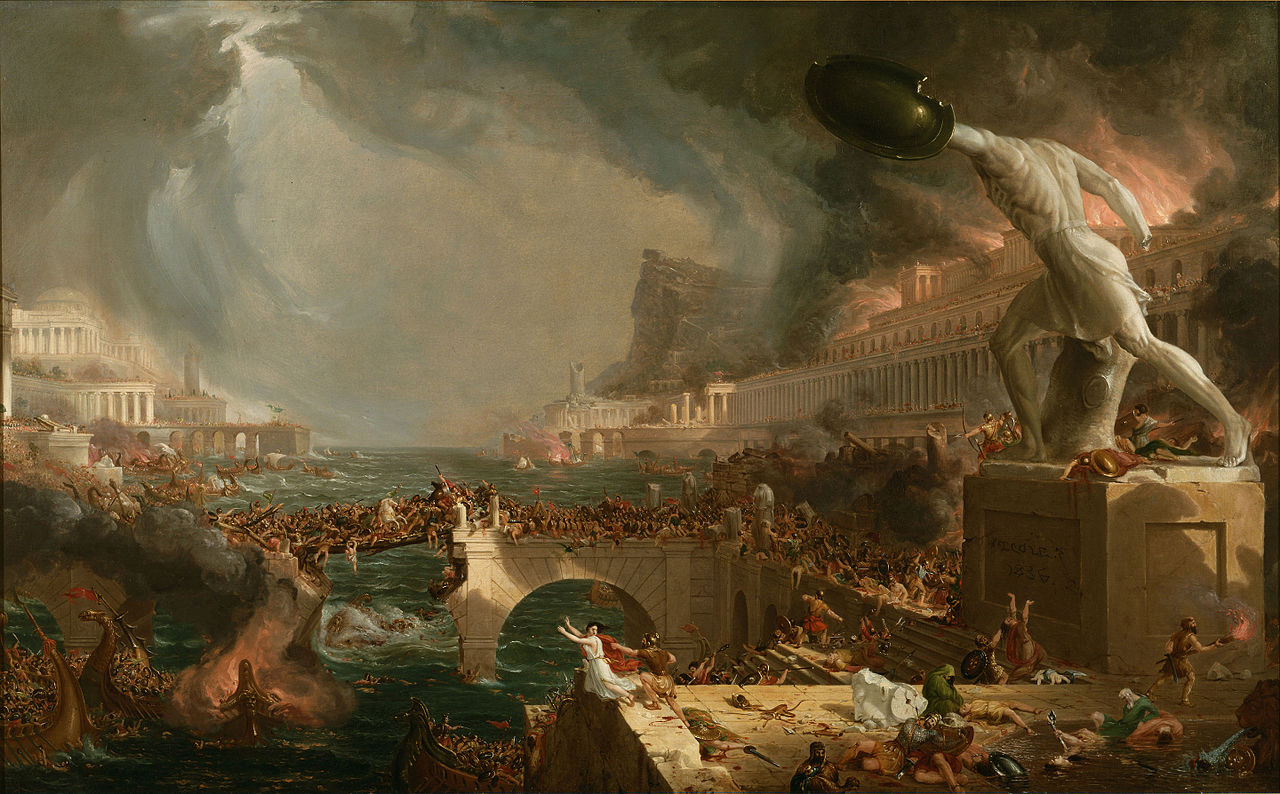
The Course of Empire – Destruction by Thomas Cole, 1836.
From the New York Historical Society collection via Wikimedia Commons.

When Edward Gibbon embarked on his great history of the decline and fall of the Roman Empire, he began his narrative with the accession of Commodus. Marcus Aurelius, the father of the new emperor, was a man who, in the noblest traditions of the Roman people, had combined the attributes of a warrior, a statesman, and a philosopher; Commodus was none of these.

“The influence of a polite age, and the labour of an attentive education,” Gibbon wrote sternly, “had never been able to infuse into his rude and brutish mind, the least tincture of learning; and he was the first of the Roman emperors totally devoid of taste for the pleasures of the understanding.” Instead, Commodus delighted in trampling on the standards by which the Roman political class had traditionally comported themselves. Most shockingly of all — as everyone who has seen Gladiator will remember — he appeared in the arena. His reward for this spectacular breach of etiquette was the cheers of the plebs and the pursed-lipped horror of the senatorial elite. To fight before the gaze of the stinking masses was regarded by all decent upholders of Roman morality as the most scandalous thing that a citizen could possibly do — but Commodus reveled in it. So it was, as Gibbon put it, that he “attained the summit of vice and infamy.”

Today, when conservatives contemplate a leader who, far from being merely an enthusiast for World Wrestling Entertainment, has long been an active and flamboyant participant in it, they may experience a similar shudder. Donald Trump, the only president of the United States ever to have been inducted into the WWE Hall of Fame, boasted that he had won “the highest ratings, the highest pay-per-view in the history of wrestling of any kind.” The Battle of the Billionaires — a proxy wrestling match fought in 2007 between Trump and Vince McMahon, the owner of WWE — had culminated in a victorious Trump strapping McMahon to a barber’s chair and shaving him bald. A decade later, Trump made clear just how much of an influence the theatrical violence of WWE had had on his approach to politics when he tweeted a video of himself body-slamming and repeatedly punching McMahon.

It was in a similar spirit, perhaps, that Commodus might have posed after decapitating an ostrich. Trump, smacking home his point, made sure before he tweeted the video to specify who his real target was. Clumsily superimposed over McMahon’s face was the CNN logo. “FraudNewsCNN” ran the hashtag. “The speed with which we’re recapitulating the decline and fall of Rome is impressive,” the conservative intellectual and former editor of the Weekly Standard Bill Kristol tweeted in response. “What took Rome centuries we’re achieving in months.”

The conviction that Trump is single-handedly tipping the United States into a crisis worthy of the Roman Empire at its most decadent has been a staple of jeremiads ever since his election, but fretting whether it is the fate of the United States in the twenty-first century to ape Rome by subsiding into terminal decay did not begin with his presidency. A year before Trump’s election, the distinguished Harvard political scientist Joseph Nye was already glancing nervously over his shoulder at the vanished empire of the Caesars: “Rome rotted from within when people lost confidence in their culture and institutions, elites battled for control, corruption increased and the economy failed to grow adequately.” Doom-laden prophecies such as these, of decline and fall, are the somber counterpoint to the optimism of the American Dream.

H/T to Niall Ferguson for this and the preceding Roman-related link.

Sulla’s dictatorships

Filed under: Europe, Government, History, Politics, USA — Tags: , , , , , — Nicholas @ 03:00

In New York magazine, Andrew Sullivan portrays the current state of the American Republic in light of the late history of the Roman Republic:

This 54 B.C. coin bears the portrait of the dictator Sulla. The moneyer was Q. Pompeius Rufus, the grandson of Sulla and his home would likely have had portraits of their famous ancestor. Thus, although posthumously struck, the portrait on these coins is probably an accurate representation.
Photo by CNG via Wikimedia Commons.

… zoom out a little more and one obvious and arguably apposite parallel exists: the Roman Republic, whose fate the Founding Fathers were extremely conscious of when they designed the U.S. Constitution. That tremendously successful republic began, like ours, by throwing off monarchy, and went on to last for the better part of 500 years. It practiced slavery as an integral and fast-growing part of its economy. It became embroiled in bitter and bloody civil wars, even as its territory kept expanding and its population took off. It won its own hot-and-cold war with its original nemesis, Carthage, bringing it into unexpected dominance over the entire Mediterranean as well as the whole Italian peninsula and Spain.

And the unprecedented wealth it acquired by essentially looting or taxing every city and territory it won and occupied soon created not just the first superpower but a superwealthy micro-elite — a one percent of its day — that used its money to control the political process and, over time, more to advance its own interests than the public good. As the republic grew and grew in size and population and wealth, these elites generated intense and increasing resentment and hatred from the lower orders, and two deeply hostile factions eventually emerged, largely on class lines, to be exploited by canny and charismatic opportunists. Well, you get the point.

After the overthrow of the monarchy, the new Republic went from strength to strength, struggling against and generally beating and absorbing other city states in the Italian peninsula, eventually rising to face the challenge of Carthage, the dominant power in the western Mediterranean. The eventual Roman victory over Carthage left Rome the superpower of its age, able to dominate and control even the remaining “great” powers of the eastern Mediterranean world. One of the costs of military dominance was an over-reliance on its citizen armies, which eventually changed the entire economy of the Republic, switching from largely small-holding farmers (who were subject to legionary service) to larger slave-worked farms that displaced the families of free citizens from their lands. The result was a constant inflow of impoverished rural citizens to the urban centres, especially Rome itself.

The newly enlarged urban poor found champions to push for reforms to aid them in their plight, the first of whom was Tiberius Gracchus (Extra Credits did a short video series on the Brothers Gracchi: Part I, Part II, Part III, Part IV, Part V, and an extra commentary video). The defeat and death of the Gracchi brothers by agents of the Patrician order led, as you might expect, to yet more polarization and further violent political struggle. This process was hastened by the conflict between Marius and his former protégé Sulla:

As the turn of the first century BCE approached and wars proliferated, with Roman control expanding west and east and south across the Mediterranean, the elites became ever wealthier and the cycle deepened. Precedents fell: A brilliant military leader, Marius, emerged from outside the elite as consul, and his war victories and populist appeal were potent enough for him to hold an unprecedented seven consulships in a row, earning him the title “the third founder of Rome.” Like the Gracchi, his personal brand grew even as republican norms of self-effacement and public service attenuated. In a telling portent of the celebrity politics ahead, for the first time, a Roman coin carried the portrait of a living politician and commander-in-chief: Marius and his son in a chariot.

A dashing military protégé (and rival) of Marius, Sulla, was the next logical step in weakening the system — a popular and highly successful commander whose personal hold on his soldiers appeared unbreakable. Tasked with bringing the lucrative East back under Rome’s control, he did so with gusto, prompting a somewhat nervous Senate to withdraw his command and give it to his aging (and jealous) mentor Marius. But Sulla, appalled by the snub, simply refused to follow his civilian orders, gathered his men, and called on them to march back to Rome to reverse the decision. His officers, shocked by the insubordination, deserted him. His troops didn’t, soon storming Rome, restoring Sulla’s highly profitable command, and forcing his enemies into exile. Sulla then presided over new elections of friendly consuls and went back into the field. But his absence from Rome — he needed to keep fighting to reward his men to keep them loyal — enabled a comeback of his enemies, including Marius, who retook the city in his absence and revoked Sulla’s revocations of command. Roman politics had suddenly become a deadly game of tit for tat.

When Sulla entered Rome a second time, he rounded up 6,000 of his enemies, slaughtered them en masse within earshot of the Senate itself, launched a reign of terror, and assumed the old emergency office of dictator, but with one critical difference: He removed the six-month expiration date — turning himself into an absolute ruler with no time limit. Stocking and massively expanding the Senate with his allies, he neutered the tribunes and reempowered the consuls. He was trying to use dictatorial power to reestablish the old order. And after three years, he retired, leaving what he thought was a republic restored.

Within a decade, though, the underlying patterns deepened, and nearly all of Sulla’s reforms collapsed. What lasted instead was his model of indefinite dictatorship, with the power to make or repeal any law. He had established a precedent that would soon swallow Rome whole.

QotD: Progressives and spontaneous order

I suspect that the single biggest factor that distinguishes “Progressives” from libertarians and free-market conservatives is the simple fact that “Progressives” do not begin to grasp the reality of spontaneous order. “Progressives” seem unable to appreciate the reality that productive and complex economic and social orders not only can, but do, emerge unplanned from the countless local decisions of individuals each pursuing his or her own individual plans. Therefore, “Progressives” naturally adopt a creationist view of society and of the economy: without a conscious and visible (and well-intentioned) guiding hand, society and the economy cannot possibly work very well. Indeed, it seems that for many (most?) “Progressives,” the idea that a spontaneously ordered economy can work better than one directed consciously from above – or, indeed, that a spontaneously ordered economy can work at all – is so absurd that when “Progressives” encounter people who oppose “Progressive” schemes for regulating the economy, “Progressives” instantly and with great confidence conclude that their opponents are either stupid or, more often, evil cronies for the rich and the powerful.

Conduct an on-going experiment: whenever well-meaning “Progressives” (of which there are very many) propose this government intervention or oppose that policy of reducing government’s role in the economy, ask if these “Progressives'” stated reasons can be understood to be nothing more than a reflection of a failure to understand the power and range of spontaneous-ordering forces in private-property settings. The answer will almost always be “yes.” Very often, no further explanation for “Progressives'” policy stances is necessary.

“Progressives” simply don’t “get” spontaneous order in human society. They see a problem and leap to the only conclusion that for them is sensible – namely, that that problem’s only realistic “solution” is that it be directly addressed by government officials. Indeed, even “Progressives'” frequent misdiagnoses of the results of trade-offs as being “problems” (or “market failures”) reflect a failure to understand spontaneous-ordering processes. Many phenomena and patterns that “Progressives” assume to be problems – for example, increasing inequality of monetary incomes – are often the benign results of the countless and nuanced individual trade-offs made by individuals. For “Progressives,” though, these “outcomes” are often assumed to be the consequence of sinister designs.

Don Boudreaux, “Bonus Quotation of the Day…”, Café Hayek, 2017-06-24.

August 9, 2019

What’s happening in Jammu and Kashmir?

Filed under: Government, History, India, Law, Religion — Tags: , , , , , — Nicholas @ 03:00

Pieter J. Friedrich reports on recent events concerning the unique constitutional status of Jammu and Kashmir within the Republic of India:

CIA map of the Kashmir Region in 2004.
Via Wikimedia Commons. Click image to see full-sized map.

Terror grips the most militarized zone in the world after India’s Central Government terminated Jammu and Kashmir’s 70-year-old “special status” as the first step towards stripping the disputed region of statehood entirely.

Internationally infamous as the world’s hottest potential nuclear flashpoint, J&K originally acceded to India in 1947 only on the condition that the newly-formed country be restricted from interfering in the domestic affairs of the mountainous northern region. The agreement was sealed between the last king of J&K, Maharaja Hari Singh Dogra, and the representative of the British crown, Governor-General Lord Mountbatten. In 1949, when passage of the constitution formed the Republic of India, the Maharaja’s conditions for accession were enshrined in Article 370.

The crux of the article – in combination with Article 35A of 1954 – was that, while J&K accepted India’s handling of issues like defense and foreign policy, the state otherwise reserved the right to autonomy in handling its domestic affairs. Kashmiris, thus, lived under their own distinct laws. Notably, citizens of other parts of India were prohibited from settling permanently or owning property in Kashmir. In the eyes of many Kashmiris, this prevented settler colonialism. On August 5, 2019, the President of India abolished this “special status” by decree.

Simultaneously, Home Minister Amit Shah – charged with India’s internal security – introduced a bill in the upper house of parliament to strip J&K of statehood, downgrade it to a “Union Territory,” and partition the region.

As Shah did this, the Central Government shut down Kashmir. It imposed a virtual curfew, banning movement of the public, shuttering educational institutions, and barring all public assemblies or meetings. It severed communications, cutting off phone and internet access. And it conducted arrests of mainstream Kashmiri political leaders – such as former chief ministers Mehbooba Mufti and Omar Abdullah – on unknown charges.

India’s ruling Bharatiya Janata Party, which was just re-elected in May, campaigned on promises to scrap J&K’s “special status.” The BJP’s manifesto alleged that it was “an obstacle in the development of the state,” while Shah insisted it stood in the way of of Kashmir becoming an “integral party of India permanently” and was necessary for “national security.” Indeed, the tumultuous region has suffered a significant influx in violence in recent years.

Since 2014, when Prime Minister Modi’s regime first came to power, terrorist incidents in J&K have nearly tripled and security forces deaths have nearly doubled. According to a July 2019 UN report, independent bodies documented 159 security forces deaths in 2018 – a figure comparable to US troop fatalities in Iraq in 2009. The latest round of escalating tensions traces back to at least 2010, when mass protests erupted over an “encounter killing” of three civilians by Indian Army troops. Protests again erupted in 2016. During suppression efforts, security forces killed hundreds of protesters.

The Central Government has responded by flooding J&K with more and more soldiers. The small region – slightly smaller than the United Kingdom – is already occupied by a bare minimum of 500,000 troops. Since late July 2019, India has deployed nearly another 50,000.

Delhi has additionally responded by repeatedly dissolving J&K’s elected state government, imposing direct rule three times since 2015. The last time was in June 2018, after India’s ruling BJP withdrew from a coalition with then J&K Chief Minister Mufti – apparently because she advocated “reconciliation” instead of a “muscular security policy” as the most effective solution to the Kashmir conflict. Elections have not been allowed since 2014.

The ongoing occupation as well as the long-term use of direct rule – imposed for approximately ten of the past 42 years – contribute to the perception of Kashmiris that they are nothing more than vassals within the Republic of India.

August 5, 2019

How Boeing lost its mojo

Rafe Champion linked to this interesting thumbnail-sketch history of the decline and fall of Boeing:

Let’s start by admiring the company that was Boeing, so we can know what has been lost. As one journalist put it in 2000, “Boeing has always been less a business than an association of engineers devoted to building amazing flying machines.”

For the bulk of the 20th century, Boeing made miracles. Its engineers designed the B-52 in a weekend, bet the company on the 707, and built the 747 despite deep observer skepticism. The 737 started coming off the assembly line in 1967, and it was such a good design it was still the company’s top moneymaker thirty years later.

How did Boeing make miracles in civilian aircraft? In short, the the civilian engineers were in charge. And it fell apart because the company, due to a merger, killed its engineering-first culture.

What Happened?

In 1993, Clinton’s Deputy Secretary of Defense, Bill Perry, called defense contractor CEOs to a dinner, nicknamed “the last supper.” He told them to merge with each other so as, in the classic excuse used by monopolists, to find efficiencies in their businesses. The rationale was that post-Cold War era military spending reductions demanded a leaner defense base. In reality, Perry had been a long-time mergers and acquisitions investment banker working with industry ally Norm Augustine, the eventual CEO of Lockheed Martin.

Perry was so aggressive about encouraging mergers that he put together an accounting scheme to have the Pentagon itself pay merger costs, which resulted in a bevy of consolidation among contractors and subcontractors. In 1997, Boeing, with both a commercial and military division, ended up buying McDonnell Douglas, a major aerospace company and competitor. With this purchase, the airline market radically consolidated.

Unlike Boeing, McDonnell Douglas was run by financiers rather than engineers. And though Boeing was the buyer, McDonnell Douglas executives somehow took power in what analysts started calling a “reverse takeover.” The joke in Seattle was, “McDonnell Douglas bought Boeing with Boeing’s money.”

[…]

The key corporate protection that had protected Boeing engineering culture was a wall inside the company between the civilian division and military divisions. This wall was designed to prevent the military procurement process from corrupting civilian aviation. As aerospace engineers Pierre Sprey and Chuck Spinney noted, military procurement and engineering created a corrupt design process, with unnecessary complexity, poor safety standards, “wishful thinking projections” on performance, and so forth. Military contractors subcontract based on political concerns, not engineering ones. If contractors need to influence a Senator from Montana, they will place production of a component in Montana, even if no one in the state can do the work.

August 3, 2019

We finally get an explanation for Justin Trudeau’s diplomatically catastrophic India tour

Filed under: Cancon, Government, India, Media, Politics — Tags: , , , , — Nicholas @ 03:00

A few days ago, I noted on social media:

This is exactly the sort of suave, diplomatic polish that will smooth over all the damage in the Canada-India relationship. This is a quote from PM Trudeau’s right-hand man in John Ivison’s new book:

“We walked into a buzzsaw — (Narendra) Modi and his government were out to screw us and were throwing tacks under our tires to help Canadian conservatives, who did a good job of embarrassing us,”

http://thepostmillennial.com/out-to-screw-us-butts-blames-indian-pm-for-trudeaus-disastrous-trip/ #JustinTrudeau #India #fiasco #books #GeraldButts #NarendraModi #diplomacy

I figured this had to be some kind of new variant of the old “modifed limited hangout“, but it’s so potentially damaging to an already badly frayed relationship that there had to be more to it … possibly a lot more to it. No rational senior official would say something like that unless there was a much worse revelation that it was intended to camouflage. But whatever it was would have to be “recall the High Commissioner” bad to justify that kind of self-inflicted diplomatic wound.

Justin Trudeau and family during India visit
Image via NDTV, originally tweeted by @vijayrupanibjp

Brian Lilley is similarly puzzled, but he has a simpler explanation: it’s that familiar combination of the Trudeau unwillingness to take responsibility, an over-developed blame-casting habit, and Trudeau’s own frequently demonstrated love of wearing costumes:

It’s one thing for Butts to think those things, another to voice them in a way that he knows will be made public. It’s also the most tone-deaf assessment of the trip I’ve seen since Sophie Trudeau went on TV and blamed the staff for those outfits.

I mean think about that trip, the two things that got Trudeau in trouble were the invite of the terrorist to dinner and the outrageous outfits. Both of those amount to self-inflicted wounds.

At least Butts admits the photos of Trudeau and his family were a problem.

“Nobody would remember any of that had it not been for the photographs. We should have known this better than anybody — in many ways we’d used this to get elected. The picture will overwhelm words. We did the count — we did forty-eight meetings and he was dressed in a suit for forty-five of them. But give people that picture and it’s the only one they’ll remember,” Butts told Ivison.

[…]

The simple fact of the matter is that the trip to India was a disaster, the kind Trudeau and his team weren’t used to dealing with. So now a year and half later they are still looking to lay the blame anywhere but where it belongs.

With themselves.

August 1, 2019

“People in Ottawa don’t invoke PMO frequently or lightly. It is done to intimidate and obtain compliance”

Filed under: Bureaucracy, Cancon, China, Government, Politics — Tags: , , , , — Nicholas @ 03:00

What we’re not allowed to know can’t hurt us … the federal government apparently figures that no charges can be contemplated if there’s no investigation allowed:

Parliament Hill in Ottawa.
Photo by S Nameirakpam via Wikimedia Commons.

Before colleagues voted to quash a review of whether the Liberal government acted improperly after a bureaucrat asked former ambassadors to temper public comments about China, Liberal MP Rob Oliphant told Parliament’s Foreign Affairs committee that he’s “distressed”.

Apparently, he was not distressed about a Foreign Affairs assistant deputy minister being asked to “check-in” on two former Canadian diplomats to China before making future pronouncements on Canada’s shambolic relations with the communist regime.

Oliphant’s also not distressed about the troubling optics that either diplomat – David Mulroney and Guy Saint-Jacques – felt The Globe and Mail should be aware of their reservations about said interactions, which the paper reported last week.

“I am very distressed, at the tone, at the idea and at the allegations that are being cast about by members of the opposition,” Oliphant, Parliamentary Secretary to the Minister of Foreign Affairs and non-voting member, claimed at the committee’s emergency meeting Tuesday.

Oliphant’s claim comes after either diplomat says the department’s ADM Paul Thoppil told them his call was at the behest of the PMO. Both Prime Minister Justin Trudeau and Foreign Affairs Minister Chrystia Freeland have denied they directed such outreach.

Mulroney, who had earlier warned about travel to China following the detention two Canadians there in December of last year, told the Globe that Thoppil cited the “election environment” and asked him to contact the department before making future statements.

“It wasn’t, in my view, so much an offer to consult and share ideas as to ‘get with the program’. People in Ottawa don’t invoke PMO frequently or lightly. It is done to intimidate and obtain compliance,” Mulroney is quoted as saying.

Saint-Jacques told the Globe that his conversation with Thoppil differed somewhat, “But I can understand that one could come to that conclusion when they say we should speak with one voice.”

What Is Money?

Filed under: Economics, Government, USA — Tags: , , , — Nicholas @ 02:00

Marginal Revolution University
Published on 18 Jul 2017

That may seem like a really simple question, but it’s actually kind of complicated. Paper bills and coins, or currency, is obviously money. But it doesn’t end there.

Technically, “money” is anything that is a widely accepted means of payment. This has changed throughout history. Once upon a time, cattle could be considered money. Or cowry shells. Today, cryptocurrencies like Bitcoin are being added to the mix.

Given that there’s no set definition for what makes a commodity money, there are a few measurements for the U.S. money supplies. The first, MB (or “monetary base”) measures currency and reserve deposits. This is what the Fed has the most direct control over.

Our next stop will be fractional reserve banking and the money multiplier.

QotD: Small government provides little scope for special interest lobbying

Filed under: Economics, Government, Quotations — Tags: , , , , — Nicholas @ 01:00

When a government is small, it can provide very limited benefits to special interest groups, so there is a small incentive for special interest groups to lobby the government. The successes of those that do lobby the government will cause the government to grow. This occurs because the great majority of voters and taxpayers are rationally ignorant about most government activity, making it easy to increase everybody’s taxes a small amount to provide a sizable benefit to a few. Most people do not have an incentive to investigate in detail the allocation of their tax dollars, but the special interest groups with the sizable benefit will repay the representatives with political support. Thus, special interest groups cause government growth.

The growth of government, in turn, raises the payoff available to special interest groups. With a higher payoff to special interest groups, this encourages the formation of new special interest groups to share in the payoff. A larger government can support a larger number of special interest groups. Thus, as government grows, more special interest groups form. The formation of special interest groups in turn increases the demand for special interest legislation, cause a further growth in government spending.

Randy Holcombe, An Economic Analysis of Democracy, 1985.

July 31, 2019

The quickest way to raise the real income of minimum wage earners

Filed under: Britain, Business, Economics, Government — Tags: , — Nicholas @ 05:00

Tim Worstall explains how to quickly raise the living standards of everyone in Britain earning the minimum wage, without costing employers any more:

I – Tim Worstall that is – then started pointing out that the difference between this living wage and the minimum wage was the amount of tax that we – shamefully – charge to the low paid. Tax being both income tax and national insurance contributions. In fact, I rather shouted about it around the place, at the ASI, and here in The Times in 2012.

    The gross annual salary of a full-time worker on the minimum wage is £12,070.50. We could come close to lifting every low-paid worker out of poverty if we simply increased the personal tax allowance from £8,105 to that sum. Not a penny of income tax or NICs should leave their pay packet. A full-time worker, however, on the living wage would be taking home £12,410.74, after the taxman has taken a cut — that’s only £340 more. And before the Foundation uprated the living wage yesterday, the annual difference was just £8.74.

    There are problems. Raising the personal allowance gives everyone a tax cut — which I’ll admit doesn’t break my heart. But we could lower the amount at which the higher rates of tax kick in to make up for that lost revenue. And won’t these workers lose their right to unemployment benefit and a pension, if they don’t pay NICs? No, they qualify already, as the system treats the very low paid as if they had made NI contributions. We should go farther. The link between the full-year minimum wage and the personal allowance for tax and NI should be made explicit. Change one and the government of the day must change the other. If the minimum wage is the minimum moral amount that someone’s labour is worth, then that is what they should get, not the amount after Denis MacShane’s European wanderings have been paid for.

    Which leaves us with two competing visions of how everyone can be free of poverty pay. The Living Wage Campaign’s vision is to shout at every employer in the country until they give in. The Worstall Way is to increase the incomes of the working poor by stopping taxing them.

« Newer PostsOlder Posts »

Powered by WordPress