Winston Churchill famously proclaimed democracy to be the least-worst government. Alas, quotability is not the same thing as wisdom. Worst at what, Sir Winston?
Speaking of quotable-yet-loony folks, Aristotle defined Man as “the political animal,” and as such had an answer to our question: The State’s purpose, Aristotle said, is to promote virtue.
Let’s leave the contentious topic of “virtue” aside, and step back to the definition of “Man.” Man isn’t a political animal. Man is a purpose-finding animal, an explaining animal. We simply can’t resist the siren song of teleology. We all live under some kind of State; therefore, we assume that “The State” must have a purpose. It’s in our DNA; we can’t do otherwise, but … we might be wrong. Perhaps “self-organization into some kind of government” is just one of Humanity’s givens, like “sexual dimorphism*” or “requires oxygen.” Maybe “government” just IS.
A dangerous thought, that. If it’s true, it desacralizes the State — the worship of which, I think we all agree, has driven all the major political events in the West since at least 1789. Historian Herbert Butterfield called the 20th century’s great mass movements “giant organized forms of self-righteousness,” but he could’ve taken that a step further — “popular” government of any sort invariably becomes a giant organized form of self-righteousness. People being people — that is, teleology-addled monkeys — it can’t be any other way. The State, since it exists, must exist to do something. What better something to do than to promote virtue?
So we’re back to Aristotle. But it looks like Aristotle stole a base. As a rule, people aren’t virtuous. Why else would they need the State to promote virtue? And yet, the State is made up of nothing but people. Aristotle also said that a cause can’t give something to an effect that it, the cause, doesn’t already have. So how, then, can the State — which, like Soylent Green, is made of people — itself make people virtuous?
See what I mean about this teleology stuff? The mind rebels. The State is a human thing. Humans made it, and every human act, we’re hardwired to believe, has a purpose behind it. That hardwiring may lead us into incoherence in under three steps, but so far as I know, I’m the only guy in the history of Political Science ever to suggest that government just … kinda … IS. That it evolved with us, and thus all our airy-fairy noodling about Divine Right and We the People and the Vanguard of the Proletariat and whatnot are just foolish blather about what’s basically still a monkey troop.
[…]
All this would be just philosophy-wank, better suited to a dorm room bull session after a few bong rips, if not for the fact that “desacralizing the State” has to be the #1 project of any viable Dissident movement. The State, as a human production, has only such “goals” as we give it … and, being made up of nothing but humans, is going to be as good at achieving those goals as we humans generally are at achieving any of our goals …
Severian, “The Least-Worst Government?”, Rotten Chestnuts, 2019-12-21.
March 24, 2020
QotD: “Desacralizing the State”
March 21, 2020
QotD: The reason people don’t get a say in how the rulers carry on
The People keep giving the wrong answer, in other words, so The People will not be asked anything of importance. Same as it ever was.
The problem with democracy, though, isn’t that people are fools. People are fools, of course, but since that’s as universal as gravity, any human institution will be staffed entirely with fools. But … just as the general characteristic “great leader” doesn’t necessarily translate into any specific competence, so the general truth “people are fools” doesn’t mean everyone is a fool about everything. Since we all know at least one other human being, we all know a blithering idiot who’s remarkably shrewd about one little slice of life. Junkies, for example, are idiots — taking hard drugs is a remarkably stupid idea, as every addict I’ve ever met readily confessed. And yet, when it comes to getting their drug of choice these morons are endlessly inventive. Billy Bob up the holler has six teeth and a fourth grade education, but he can MacGyver up methamphetamine out of household products like a Chemistry PhD.
The problem with democracy is twofold. The first — that it’s the best technique ever devised for organizing self-righteousness — deserves a book in itself. The second, though, is covered by a single word: ultracrepidarianism. It means “the habit of giving opinions and advice on matters outside of one’s knowledge.” Peter Strzok, for example, was probably a perfectly competent FBI agent, when it came to doing the things the FBI actually hired him to do. But he decided that he was also some kind of political science expert, as well as a human love machine, and here we are. See also: our “elected” “representatives” What else would you call sending someone like Alexandria Ocasio-Cortez, whose areas of expertise are “mixing drinks” and “having big tits,” to Congress, where she’s expected to make decisions of war and peace? Ultracrepidarianism is a feature, not a bug, of democratic systems, which is why even the very best “representatives” fuck up everything they touch.
Combine required ultracrepidarianism with real shrewdness and you get Stephen A. Douglas.
Take those, add in religious fervor, and you get the suicide cult that is the Democratic Party.
And here we are.
Severian, “Impeachment Thoughts”, Rotten Chestnuts, 2019-12-19.
March 19, 2020
The undifferentiated “labour lump” fallacy in Keynesian grand schemes
At the Continental Telegraph, Tim Worstall explains why old fashioned “shovel ready” infrastructure projects are no longer a viable way to address large scale employment needs:
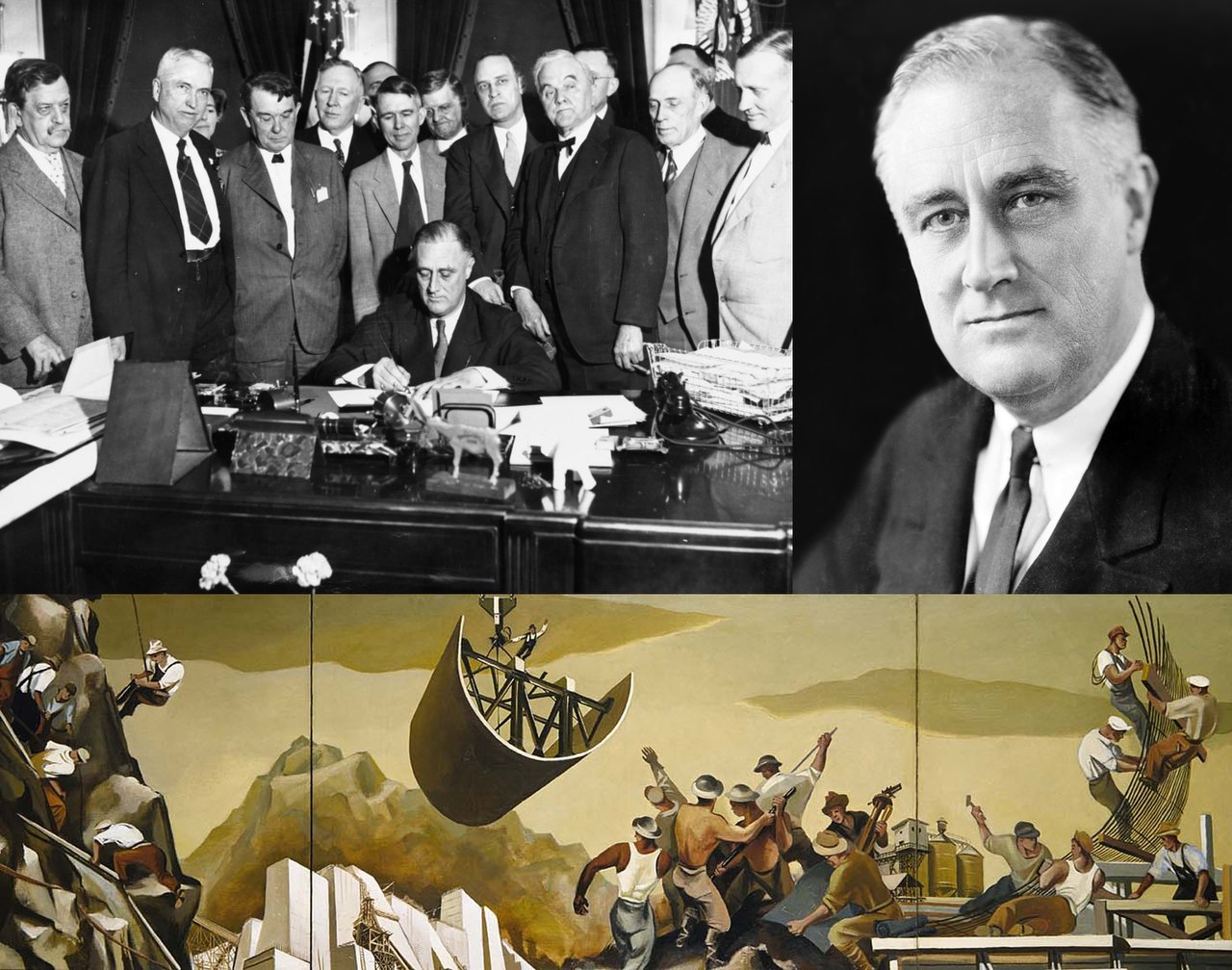
Top left: The Tennessee Valley Authority, part of the New Deal, being signed into law in 1933.
Top right: FDR (President Franklin Delano Roosevelt) was responsible for the New Deal.
Bottom: A public mural from one of the artists employed by the New Deal’s WPA program.
Wikimedia Commons.
We still get some slavering at the thought that in economic hard times we just get everyone off digging ditches. We get to hear Woody Guthrie singing again or something. The mass ranks of peasants dying at the Belomors Canal. Or maybe the navvies building the railways, it’s always difficult to know which historical episode they’ve got in mind.
Any economic down turn is always met with cries of “go build something” and they always do envision some mass mobilisation of labour to do it. The current one seems to be “insulate every house in the country and create jobs in every constituency”. The bit that is always missed being that most people haven’t a clue about how to do such work. The division of labour and specialisation have seen to that.
[…]
Having the diversity advisers – and this is a lovely thought even so – navvie the railways into being is going to be about as effective as having the navvies – and this is a lovely thought even so – doing the diversity advising. Division and specialisation of labor means the one is not a substitute for the other.
It’s only in GuardianWorld that labour is such a lump that can be allocated as the Commissars wish. Which presumably means their economics pages are written by the sports desk which does, to be fair, explain a lot about that output.
March 17, 2020
When the state renounces enforcing the law, there are two alternatives
Yesterday, David Thompson linked to a post by Natalie Solent about how the police in London failed to do anything about a blatant theft at a Boots pharmacy because it was considered a “civil matter”. The accused thief was prosecuted privately by the parent corporation, which is apparently the first time this has happened in England. As Natalie says, this is the “nice” option when the government fails to enforce the law of the land — or enforces it only sporadically and unevenly.
In the latest edition of the Libertarian Enterprise, Eric Oppen provides an example from the US in the post-Civil War era that shows the other option for private law enforcement:
Many of the victims of the kind of small-time crime committed by vagrants and the “homeless” are, themselves, far from rich. Repeated thefts can drive a small, struggling business under, and loss of, for example, a bicycle can represent a catastrophic blow to a poor person’s finances. This doesn’t address the sense of violation felt by those victimized by crime.
The original San Francisco Committees of Vigilance formed because the “forces of law and order” either were not doing their jobs, or were actively in league with the very criminals they were supposed to be suppressing. Many police were incompetent or lazy, while others were often corrupt on a scale that would shock Boss Hogg.
Do-it-yourself justice was far from uncommon in nineteenth-century America, including in the “civilized” East. In upstate New York, after decades of unpunished crime, the Loomis family gang received an epic comeuppance in 1865. Fifteen years earlier, their outraged neighbors had tried staging a raid on the Loomis farm, but uncertainty about who owned the stolen goods they found prevented any Loomis from being convicted. In 1865, many of their neighbors were returned Civil War combat veterans. They had become inured to violence, and they were tired of the Loomis’ thefts, arsons and intimidation. They killed George “Wash” Loomis, the leader of the gang, nearly lynched one of his brothers, and burned down the family’s home. After that, the Loomis family’s power was broken and their reign of crime was pretty much over.
These things happened because there was no other way to deal with these situations. Law enforcement, in those days, was primitive, especially outside of the major cities. Large corporations often had their own private police simply because of this fact.
The “social contract” is supposed to read something like “renounce personally avenging your wrongs, and society will do it for you.” But what can one do, when society is visibly abrogating the contract? Take it to court?
Vigilantism is not unknown even in Canada.

“Tombstone Courthouse State Historic Park” by August Rode is licensed under CC BY-NC-SA 2.0


March 16, 2020
Cognitive dissonance, family style
Severian has some fun discussing current events with a nephew:

Image from Castle of Chaos – https://castleofchaos.com/blog/5-tips-for-surviving-a-zombie-apocalypse/
Just recently I had some fun with one of my nephews, who’s unexpectedly home for “Spring Break.”
Let’s take this Wuhan Flu thing seriously, I said. But since that hits a little too close to home, let’s pretend it’s a zombie outbreak. I want you to take it 100% seriously. The zombie virus has made it to our shores. It’s not too bad yet, but there’s definitely a walking dead situation. So … what do you want the government to do?
Nephew of course starts rattling off all the Chuck Norris fantasies young college guys have. Close the ports, call out the army, firebomb the streets wherever infected are sighted, yadda yadda. All of this is translated from the teenager, but you get the gist of it:
Me: Ok. Now, since we’ve stipulated that we’re taking this 100% seriously: Do you really want to give the government the power to do all that?
Nephew: Of course!
Me: Ok. Well then, do you really want to give Donald Trump the power to do that?
Nephew: Oh my god no!!! Orange Man bad!!!
Me: Now wait a minute, Nephew. You just said you’re taking this 100% seriously. You just said you want the government to have the power to set up flamethrower checkpoints on all major roads. Well, who is the current head of the government?
Nephew: But … but … but … Orange Man BAD!!!!
Me: Remember, Nephew, you promised to take this 100% seriously. So are you seriously telling me that the first thing you’d do, in the event of the zombie outbreak, is call an emergency presidential election, in the hopes that someone — Joe Biden, Bernie Sanders, Tulsi Gabbard, somebody — would win, so that the right kind of person could take all those measures you said were so very, very, very immediately necessary?
Nephew: Uhhhh … no, I guess not.
Me: So you do want to give Donald Trump that power, since he is, in fact, the current head of the United States government?
Nephew: Oh my god no! Orange Man BAAAAAAADDDD!!!!
Me: Well then I guess you’re just not serious about this zombie outbreak, are you?
March 15, 2020
Those damned unintended consequences
Sarah Hoyt on the differences between intention and the real world:
Unintended consequences are the bane of social engineers. They are why the “Scientific” and centralized method of governance never worked and will never work. (Sorry, guys, it just won’t.)
Part of it is because humans are contrary. Part of is because humans are chaotic. And part of it is because like weather systems, societies are so complex it’s almost impossible to figure out what a push in any given place will cause to happen in another place.
This is why price controls are the craziest of idiocies. They don’t work in the way they’re intended, but oh, they work in practically all the ways they’re not. So, take price controls on rent. All they really do is create a market in which housing is scarce, landlords don’t maintain their property AND the only people who can afford to live in cities that have rent control are the very wealthy.
BUT Sarah, you say, aren’t rent controls supposed to make them affordable. Yeah. All that and the good intentions will allow you to go skating in hell on the fourth of July weekend.
Let’s be real, okay? I saw rent control up close and personal in Portugal. Rents were controlled and landlords were penalized for “not keeping the property up”.
In Portugal at the time, and here too, most of the time from what I’ve seen, the administration of property might be some management company, but that’s not who OWNS the damn thing. The owners are usually people who bought the property so it would support them in old age/lean times.
To begin with, you’re removing these people’s ability to make money off their legitimately owned property. And no, they’re not the plutocrats bernie bros imagine. These are often people just making it by.
Second, people are going to get the money some other way, because the alternative is dying. And people don’t want to die or be destitute. So they’re going to find the money. I have no idea what it is in NYC, etc, but in Portugal? it was “key buying.” Sure, you can rent the house for the controlled price, but you have to make a huge payment upfront to “buy the key.” From what I remember this was on the order of a small house down payment. And if you couldn’t do that, you were stuck getting married and living with your parents. And if you say “greedy landlords” — well, see the other thing you could do was leave the lease in your will. So the landlord didn’t know if they’d ever get control of their property back, and they needed to live off this for x years (estimated length of life.) So, that was an unintended consequence. The kind that keeps surfacing in rent-controlled cities in the US.
The same applies to attempts to “help” the homeless. Part of this, as part of all attempts to “fix” poverty is that the people doing it, usually the result of generations of middle class parents and strives assume the homeless and the poor are people like them.
To an extent, they’re correct. The homeless and the poor are PEOPLE. But culture makes a difference, and culture is often based on class and place of upbringing. And the majority of humanity, judging by the world, might be made to strive but are not natural strivers. Without incentive, most of humanity sits back, relaxes and takes what it’s given.
March 14, 2020
The still-secret “settlement” between the federal government and five hereditary chiefs of the Wet’suwet’en
Chris Selley points out some of the disturbing features of the as-yet-unrevealed agreement between Her Majesty’s Canadian government and five unelected First Nation chiefs that eventually got the railways running again:

“DSC02285” by Bengt 1955 is licensed under CC BY-NC 2.0
For starters, we still don’t know the details of the arrangement, struck earlier this month between Wet’suwet’en hereditary chiefs and federal and provincial government officials, that allowed for pipeline work to resume. Those details could well represent positive progress on establishing just what the Wet’suwet’en’s legal claim on their lands — affirmed by the Supreme Court in 1997 — really means. But did the government have any business negotiating with the chiefs in question in the first place?
Tait-Day doesn’t think so. The Office of the Hereditary Chiefs of the Wet’suwet’en, she told the committee, is “not accountable to the (Wet’suwet’en) nation.”
“By refusing to hear from elected councils, these governments have without merit prevented the most credible current governing voices from being heard,” she told the committee. “The Indian Act system must be reformed, but that does not invalidate the role of the elected councils. While imperfect, they continue to speak for the people until a better model is implemented.”
Even setting aside the exclusion of elected councils, the negotiations were of dubious legitimacy. They weren’t with the hereditary chiefs per se; rather, they were with the hereditary chiefs who oppose the pipeline. Not all do, and some support it — including Tait-Day, Gloria George and Darlene Glaim, founders of the Wet’suwet’en Matrilineal Coalition. For their apostasy, male chiefs simply stripped them of their titles. This is not in dispute: “We’ve stripped the names from three female hereditary chiefs for supporting the pipeline,” John Ridsdale, whose hereditary title is Chief Na’Moks, told APTN News in 2018. “A name is more important than money.”
Using the title of Chief Woos, Frank Alec has become the leading public face of the anti-pipeline hereditary chiefs. On his behalf, Canadians both Indigenous and non-Indigenous have shut down rail lines and blocked access to the B.C. legislature and marched in the streets. Until 2018, the title of Chief Woos belonged to Glaim. He took it from her precisely because she dared support the pipeline and the benefits that will flow from it to her people.
“By negotiating directly with (the Office of the Hereditary Chiefs of the Wet’suwet’en), Canada and British Columbia give legitimacy to a group of bullies and abusers of women,” Tait-Day told the committee. “We cannot be dictated to by a group of five guys.”
March 12, 2020
The Road to the Holocaust – Kristallnacht | BETWEEN 2 WARS I 1938 Part 3 of 4
TimeGhost History
Published 11 Mar 2020After years of gradually increasing persecution, the Nazis institute a nationwide pogrom on the night of November 9, 1938. It will signal the end of Jewish life in Germany.
Join us on Patreon: https://www.patreon.com/TimeGhostHistory
Hosted by: Indy Neidell
Written by: Francis van Berkel
Directed by: Spartacus Olsson and Astrid Deinhard
Executive Producers: Bodo Rittenauer, Astrid Deinhard, Indy Neidell, Spartacus Olsson
Creative Producer: Joram Appel
Post-Production Director: Wieke Kapteijns
Research by: Francis van Berkel
Edited by: Daniel Weiss
Sound design: Marek KamińskiSources:
Bundesarchiv_Bild:
102-04051A, 102-14469, 102-16475, 119-03-16-06,
119-04-29-36, 119-04-29-38, 119-2671-07, 119-5592-03A,
133-075,_Worms, 146-1970-041-46, 146-1970-061-65,
146-1979-046-22, 146-1982-174-26, 146-1982-174-27,
146-1984-092-26, 146-1988-078-07, 146-1989-071-05,
152-64-25A,_Wien, 152-64-29A,_Wien, 152-65-04,_Wien,
183-1982-0809-502, 183-1987-0703-514, 183-2006-0429-502,
183-R99542, 183-S21437, 183-S72707, 183-86686-0008,From the Noun Project:
noun_Government by Adrien Coquet,
noun_jail by Strongicon,
noun_Death by Icon Island,Colorizations by:
– Daniel WeissSoundtracks from Epidemic Sound:
– “The Inspector 4” – Johannes Bornlöf
– “Not Safe Yet” – Gunnar Johnsen
– “Last Point of Safe Return” – Fabien Tell
– “Guilty Shadows 4” – Andreas Jamsheree
– “Imperious” – Bonnie Grace
– “Death And Glory 1” – Johannes Bornlöf
– “Deviation In Time” – Johannes Bornlof
– “Dark Beginning” – Johan Hynynen
– “An Ancient Dome” – Trabant 33
– “Death And Glory 3” – Johannes Bornlöf
– “First Responders” – SkryaA TimeGhost chronological documentary produced by OnLion Entertainment GmbH.

March 11, 2020
Canadian National’s perfect storm
In Trains, Bill Stephens highlights the terrible time Canada’s largest railway has been having since the beginning of the year:
“DSC02285” by Bengt 1955 is licensed under CC BY-NC 2.0
It would be hard to imagine a worse start to the year for Canadian National, whose volume is down 16% due to a string of events that’s mostly odd, unrelated, and unrelenting. CN is taking it on the chin, as no other North American railroad has seen its volume fall by more than 10% this year and rival Canadian Pacific’s traffic is up 10%.
First, there was Mother Nature. Winter arrived in January with eight days of deep cold in Western Canada, forcing CN to restrict train length. Then powerful rainstorms lashed southern British Columbia starting Jan. 30, washing out CN’s main to Vancouver for six days.
The major washouts occurred in the rugged Fraser River canyon directional running zone where CN and CP share trackage, with CN hosting westbounds and CP carrying eastbounds. The railways had to resort to running directional fleets of 15 to 20 trains at a time over CP’s line. The single-track bottleneck caused eastbound traffic to stack up at the Port of Vancouver and westbounds to be staged as far away as the Prairies. The directional running zone ranks among the top three freight mains by tonnage in North America, alongside BNSF Railway’s Southern Transcon in the Southwest and Union Pacific’s triple track across Nebraska. So this blockage was, by itself, a big deal.
Then came nearly a month of civil protests. On Feb. 6, as CN began digging out from the washout backlog, the first of several First Nations blockades set up camp on CN’s tracks. The blockades, protesting a proposed natural gas pipeline in British Columbia, halted traffic on CN’s Montreal-Toronto mainline in the East. Also ultimately affected: CN’s line to Prince Rupert, British Columbia, which was blocked by protests for six days. Other protests came and went in Edmonton, Alberta; Winnipeg, Manitoba; Quebec; and British Columbia. CP was affected, too, but to a much lesser extent. CP even hosted detour traffic for CN between Montreal and Toronto.
As if that wasn’t enough, then came regulatory woes. The same day the protests began, a CP crude oil train derailed and caught fire in Guernsey, Sask., the second such wreck in the area since December. Hours later Transport Canada issued a ministerial order that restricted key trains – those with 20 or more cars of hazardous materials – to 20 mph in metropolitan areas and 25 mph elsewhere. With the stroke of a pen, Transport Minister Marc Garneau’s knee-jerk reaction effectively reduced CN’s overall capacity by a third. You could call this slowdown “Whoa Canada!”
March 10, 2020
QotD: Free trade versus protectionism
People trade freely countless times, each and every day. Yes, yes, I’m well aware that such trade isn’t ideally free. Occupational-licensing restrictions, for example, unjustly and harmfully obstruct domestic trade. But the fact remains that today within each country – including within the U.S. – trade is not typically obstructed based on geographic location or political boundaries. And therefore people buy and sell freely within countries. If the case for a policy of free trade were not practical – if it were only a theoretical curiosity – then it would be true that ordinary people would be even richer if the state obstructed their abilities to trade with each other domestically.
It’s a myth also that the economic case for a policy of free trade in any one country requires that other governments also practice free trade. The case for a policy of free trade is, at bottom, a case for unilateral free trade: while nearly everyone in the world would be better off if all governments adopted policies of free trade, nearly everyone in the home country would be better off if the home government adopts a policy of free trade regardless of the policies of other governments.
Protectionism is a nasty mash of logical fallacies, half-truths, hubris, economic ignorance, and cronyist apologetics.
Don Boudreaux, “Quotation of the Day…”, Café Hayek, 2017-12-18.
March 6, 2020
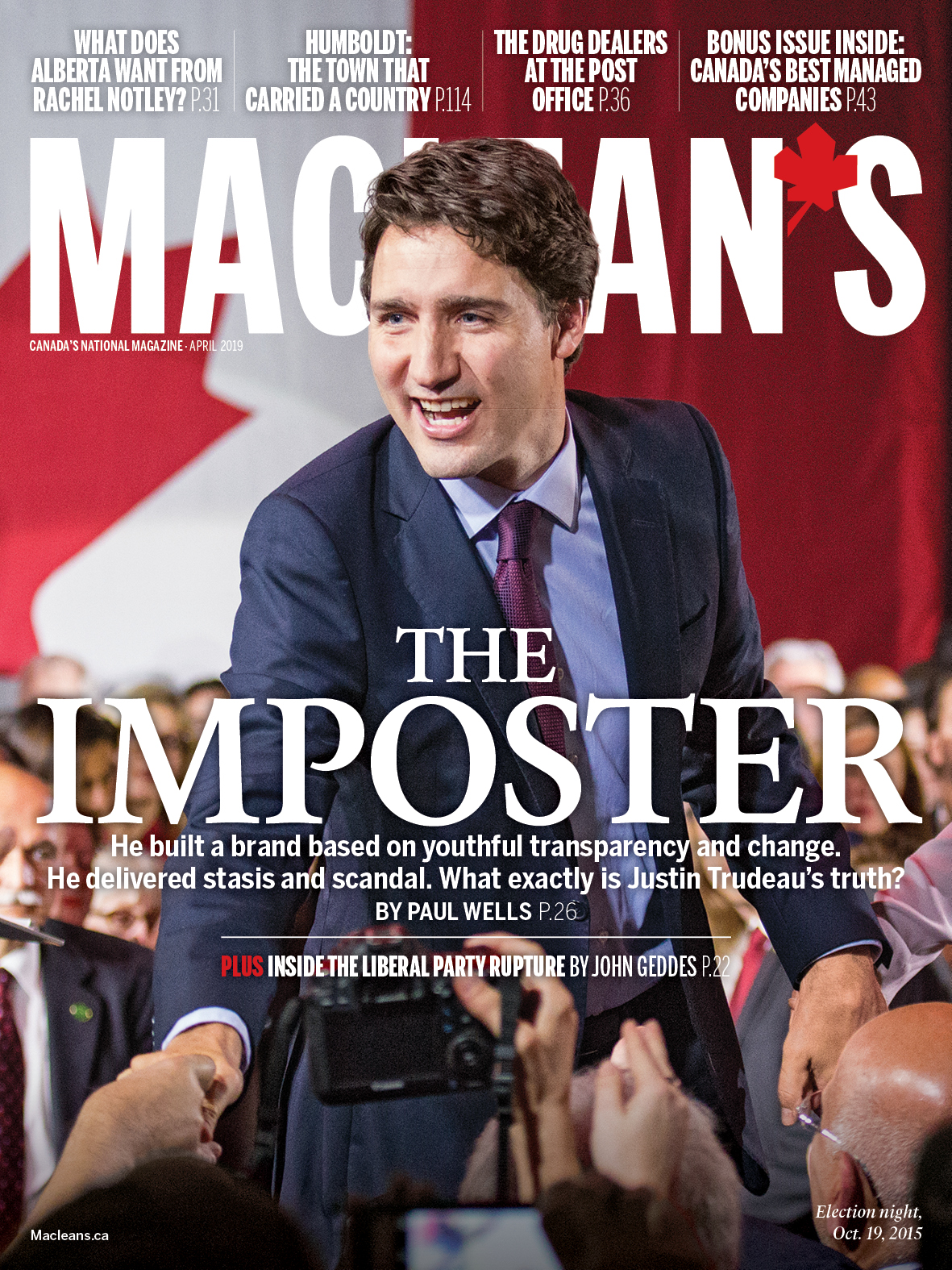
“[A] decision of such absolutely mind-boggling stupidity and irresponsibility that it could only have come from Justin Trudeau, himself”
Ted Campbell on the Trudeau government’s apparent abject surrender to the Wet’suwet’en hereditary chiefs (“apparent” because we still don’t have any details of the “deal”):
The Wet’suwet’en hereditary chiefs’ agenda seems simple enough to me. They don’t like the notion that the Wet’suwet’en people can elect band councils that might act for the good of the people and < quelle horreur > the people might even disagree with the hereditary chiefs. Some (male) hereditary chiefs seem to have managed to strip some other (female) chiefs of their titles because they, the female chiefs, sided with the elected councils. This is, in 21st century British Columbia, something of a replay of 17th century Europe and the end of the divine right of kings, except that the Wet’suwet’en hereditary chiefs might succeed where Charles I and Louis XVI failed because they have the dimwits in the Trudeau cabinet on their side.
To make matters worse, as John Morris of the Canadian Press points out in an article published in the Globe and Mail, the government negotiated with the hereditary chiefs, only ~ with the people who broke the law; and they ignored the elected leaders ~ the people who played by the rules.
How typically Trudeau: he surrenders, cravenly, to the reactionary, anti-democratic lawbreakers and, simultaneously, shuts out the elected representatives of the Wet’suwet’en peoples. Is that the Canada in which we all want to live? Is that the sort of “leadership” for which millions of Canadians voted in 2019? I think not. Justin Trudeau is both a fool and a coward and his party, the Liberal Party of Canada, has a duty to Canada: throw the bum out!
But, not to worry, the Trudeau regime’s
propagandistspress agents will tell us that it’s all good, we “won,” something or other … didn’t we? And who cares if we lost something nebulous like honour and responsibility? It’s all about reconciliation, isn’t it? What do trivialities like democracy and the national interest matter when really important things, like preserving the power of hereditary chiefs over elected councils, are at stake? But that reactionary system seems to have been strengthened, and so “It was a famous victory.”
QotD: Mercantilism
Don Boudreaux, “Quotation of the Day…”, Café Hayek, 2017-12-17.
March 4, 2020
Sir Philip Rutnam, former civil servant and new hero of the resistance
Brendan O’Neill on the unlikely new hero of the British bien pensant classes:
The liberal-left and even some on the supposedly radical left have a new hero: Sir Philip Rutnam. Yes, they’re now worshipping functionaries. They’re now falling at the feet of starched, bureaucratic civil servants. Worse, they seem to have completely forgotten about the Windrush scandal and the hostile environment policy – both of which were overseen by Sir Philip in his role as permanent secretary at the Home Office – in the rush to make him the hero of the hour. Why? Because Rutnam has crossed swords with Priti Patel, and the EU-pining, Boris-hating, populism-fearing left loathes nobody more than Priti Patel. Genghis Khan could have a pop at Priti and they’d be calling him a legend, such is the depth of their dislike for that “nasty woman”.
Official portrait of the Right Honourable Priti Patel, MP.
Photo by Richard Townshend.The speed and obsequiousness with which leftish people canonised Rutnam following his resignation on Saturday was alarming. Most of them probably hadn’t heard of him prior to his flounce, but suddenly he was a cross between Mother Teresa and Winston Churchill, the bestest civil servant of our time, the steady, wise, clever counter to the rabid ideologism of the Boris mob. A breathless Guardian editorial likened Boris Johnson’s government to the Jacobin terror, with its use of “studied recklessness” to “disrupt [and] demoralise” representatives of “the ancien regime“, like Sir Philip, the People’s Civil Servant, the Bureaucrat of our Hearts. Steady on, Guardianistas: Rutnam has only lost his job, not his head.
The rash, highly political beatification of Sir Philip hasn’t only airbrushed out of view the various screw-ups he has overseen, from fairly mundane screw-ups (while he was in transport) to truly immoral ones (like the Windrush scandal while he was at the Home Office). No, it also turns a blind eye to the unusualness and the cynicism of his extravagant resignation. Civil servants have been falling out with governments for as long as both have existed. But normally the civil servant in question would take it on the chin, slink off into obscurity (or maybe the Lords), and live out a plush retirement. Not Rutnam. He made his resignation into a political weapon. He seems to be out to undermine the elected government. That is more scandalous than Priti Patel allegedly asking civil servants why they are all so “fucking useless”.
The Patel / Rutnam clash is more than a personality problem. It’s about politics, and democracy. According to reports – and we must wait to see how true all this is – Rutnam “obstructed” Patel. He reportedly thought she wasn’t up to the job of home secretary and allegedly tried to hinder some of her priorities. If this is true, it looks like the unelected wing of government – the machinery of the civil service – seeking to block the wishes and programme of the elected wing of government. And now Rutnam is threatening to sue the government for constructive dismissal, which would further weaken Patel’s position, potentially hamper her Home Office work, and posit the bureaucracy against elected ministers.

March 3, 2020
QotD: Public service and competitive private enterprise
And I’m not suggesting that the levels of corruption and incompetence are comparable to those found in third world hellholes. A local official in your county council is very unlikely to demand a bribe and then have your daughter raped by his buddies if you decline. He’s especially unlikely to get away with it, and then douse your family in petrol and burn them alive if you complain – those are the levels of corruption found elsewhere in the world, so we need to retain some perspective here.
But those countries have not benefited from a thousand years of sacrifice to earn us a culture that has learned through bitter experience how to run a country. Our civil servants should be performing at the highest standard and be the best in the world, because what they inherited was a culture that conquered that world, and brought civilisation and progress (often at great cost) to every corner of it.
That they have fallen from these heights and now occupy such low places should be a matter for great national shame. And yet they continue to lord it over those they pretend to serve – try calling your local planning department if you want instruction in how supercilious a local functionary feels able to be when speaking to those he claims to serve. If you just want them to do their job, you better be prepared to beg.
Whereas on the flip side, we might agree that the private (voluntary) sector is largely filled with honest and hardworking people and entrepreneurs, but there are crony capitalists out there too.
Your local butcher and baker (those that have survived the regulatory avalanches under which the crony capitalists have begged their pet politicians to bury them) remain staunch servants of their customers (through regard to their own interests), whereas oligoplists (supermarkets, telcos, insurance companies, banks, energy suppliers or transport companies) deliver to us just what the monopolists of government do – an icy contempt that would soon turn to withering small arms fire if the laws allowed it.
Alex Noble, “Corruption In The Coercive And Voluntary Sectors: Rotten Apples? Or The Tips of Icebergs?”, Continental Telegraph, 2019-12-02.
March 2, 2020
The Trouble With Tumbleweed
CGP Grey
Published 1 Mar 2020Director’s commentary: https://www.youtube.com/watch?v=rbHQO…
## Crowdfunders:
Bob Kunz, Steven Snow, John Buchan, Nevin Spoljaric, Donal Botkin, Phil Gardner, Chris Chapin, Richard Jenkins, Martin, Steven Grimm, سليمان العقل, Colin Millions, Michael Mrozek, Saki Comandao, Jason Lewandowski, Andrea Di Biagio, David F Watson, rictic, Ben Schwab, Marco Arment, Elliot Lepley, Shantanu Raj, emptymachine, Bobby, Chris Amaris, George Lin, Mikko, Derek Bonner, Derek Jackson, Orbit_Junkie, Ron Bowes, Tómas Árni Jónasson, Henry Ng, Jordan Earls, Joshua Jamison, Nick Fish, Nick Gibson, Robert Webb, Jeffrey Podis, Thunda Plum, Awoo, David Tyler, Fuesu, iulus, Kevin Costello, Michael Reilly, Tyler Bryant, Kermit Norlund, chrysilis, David Palomares, Erik Parasiuk, ken mcfarlane, Leon, Tristan Watts-Willis, Veronica Peshterianu, Bear, Emi, Esteban Santana Santana, Freddi Hørlyck, John Rogers, Maarten van der Blij, Peter Lomax, Rhys Parry, ShiroiYami, Dag Viggo Lokøen, John Lee, Maxime Zielony, Elizabeth Keathley, Frederick The Great, Luxe Gifts, Rebecca Wortham, Bryan McLemore
Music by Music by: http://www.davidreesmusic.com
Wikipedia says:
A tumbleweed is a structural part of the above-ground anatomy of a number of species of plants, a diaspore that, once it is mature and dry, detaches from its root or stem, and rolls due to the force of the wind. In most such species, the tumbleweed is in effect the entire plant apart from the root system, but in other plants, a hollow fruit or an inflorescence might serve the function. Tumbleweed species occur most commonly in steppe and arid ecosystems, where frequent wind and the open environment permit rolling without prohibitive obstruction.
Apart from its primary vascular system and roots, the tissues of the tumbleweed structure are dead; their death is functional because it is necessary for the structure to degrade gradually and fall apart so that its seeds or spores can escape during the tumbling, or germinate after the tumbleweed has come to rest in a wet location. In the latter case, many species of tumbleweed open mechanically, releasing their seeds as they swell when they absorb water.
The tumbleweed diaspore disperses seeds, but the tumbleweed strategy is not limited to the seed plants; some species of spore-bearing cryptogams — such as Selaginella — form tumbleweeds, and some fungi that resemble puffballs dry out, break free of their attachments and are similarly tumbled by the wind, dispersing spores as they go.
[…]
In the family Amaranthaceae (i.e. broadly defined to include Chenopodiaceae), several annual species of the genus Kali are tumbleweeds. They are thought to be native to Eurasia, but when their seeds entered North America in shipments of agricultural seeds, they became naturalized in large areas. In the cinema genre of Westerns, they have long been symbols of frontier areas. Kali tragus is the so-called “Russian thistle”. It is an annual plant that breaks off at the stem base when it dies, and forms a tumbleweed, dispersing its seeds as the wind rolls it along. It is said to have arrived in the United States in shipments of flax seeds to South Dakota, perhaps about 1870. It now is a noxious weed throughout North America, dominating disturbed habitats such as roadsides, cultivated fields, eroded slopes, and arid regions with sparse vegetation. Though it is a troublesome weed, Kali tragus also provides useful livestock forage on arid rangelands.