Quotulatiousness

October 22, 2020

Carbon taxes may be the most efficient way to address GHG emissions, but no government has implemented them properly

I was persuaded by the economic arguments in favour of a carbon tax to address the externaly of greenhouse gas emissions, but I’ve long been skeptical that governments would actually implement them in a way to minimize economic distortion. A report from the Fraser Institute this week shows I was right to be doubtful, as none of the 31 OECD countries in the study have managed to introduce some form of carbon pricing without political “tinkering” … rather than replacing inefficient regulations, taxes and mandates with the carbon tax, they’ve generally just added carbon pricing on top of existing rules, making the carbon pricing scheme merely another tax grab that fails to achieve the stated goals:

Most economists consider human-made greenhouse gas (GHG) emissions an unintended negative externality of production and consumption. A negative externality occurs when the effects of producing or consuming goods and services impose costs on a third party which are not reflected in the prices charged for said goods and services. In the context of GHG emissions, this negative externality is calculated using the “social cost of carbon,” which is the future damage to society (adjusted to present value) of one additional tonne of carbon emitted to the atmosphere today.

Governments have a wide variety of policy alternatives to address the negative externality of emissions depending on the degree and depth of the policy intervention. They can either mandate individuals and firms to change their behaviour through com­mand-and-control regulations, grant subsidies and tax credits to foster cleaner energy sources, or use market-based mechanisms to correct the misalignment of incentives. It is widely acknowledged that carbon pricing, one of these market tools, is the most cost-effective policy to reduce emissions, as it relies on price signals and trade to provide flex­ibility to economic agents as to where and how emissions mitigation occurs.

[…]

This report includes thirty-one high-income OECD countries, where each country has either implemented a carbon tax, an ETS [emissions trading system], or a combination of both pricing mechan­isms. Carbon taxes are being implemented in 14 of them whereas 25 of these countries have their emissions covered by an ETS. Our analysis finds that, on average, 74 percent of carbon tax revenues in high-income OECD countries go directly into their general budget with no earmarking for any specific expenditure, while 12 percent are ring-fenced for environmental spending, and only 14 percent for revenue-recycling measures. This means that most governments are using carbon taxes as a revenue-raising tool rather than a mechanism to internalize the negative externalities of emissions in a cost-effective man­ner. Additionally, the vast majority of ETS revenues are being used to artificially acceler­ate the use of renewable energy sources, infrastructure, and technology.

The study also finds that no high-income OECD country has used carbon pricing to repeal emission-related regulations, but instead have introduced new ones following the adoption of the carbon tax or the ETS. Emissions caps, mandated fuel standards, technology-based standards, and renewable power mandates are just some examples of these regulations that undermine the cost-effectiveness of carbon pricing mechanisms. The majority of high-income OECD countries have a combination of support schemes for renewable energy sources, carbon pricing tools, and command-and-control regulations.

Overall, no high-income OECD country is following the textbook model of an optimal carbon pricing system, undermining their theoretical efficiency by design and implementation.

October 20, 2020

The watchful algorithms of the Nanny State’s AI tools

David Warren considers the evolution of the Nanny State’s arsenal of technological surveillance (supplemented by the Karenstapo):

While it is not in my interest, currently, for gentle reader to get off the Internet, the idea must have occurred to him. In times like these, why put yourself under watch from Big Brother (or, Big Sibling, as he might prefer)? Why surround yourself with his electronic eyes, the way I am presently surrounded by jackhammers?

Granted, Nanny State was devising ways to track its citizens, and to exercise “crowd control,” long before the Internet was invented. But we had the advantage with them, for they were incompetent, often laughably inept. However, Internet-plus-meejah-plus-activists-plus-Guvmint makes a more capable adversary.

I am not recommending a systematic withdrawal from the world. That is for people with a religious calling, or some grave eccentricity. Rather I am thinking of self-defence, in the spirit of buying a gun. Of course, I am writing from Canada, one of the countries where owning a gun is more-or-less illegal; as is any other form of self-defence. (“When seconds count, the police will be here in minutes.”) Though I have noticed that, upcountry, the “No Hunting” signs tend to be used for target practice.

The “other side,” as I see it, which always worked on numbers, now has algorithms. “Artificial Intelligence” can home right in. The Nanny State never took the individual seriously, except when he was offering a threat. Now it is threatened by anything human. It is, as it were, utilitarian in outlook — “the greatest good for the greatest number” — along with other fatuous concepts, unamenable to reason. By its nature, it is positivist, nominalist, relativist, and “idealistic” in a very abstract way.

Whereas we, so far as we are human, take ourselves quite personally. In a clinch, we often prefer our own survival, and the survival of family and friends, to the requirements of a bureaucratic “policy.” That this is “selfish” should be immediately affirmed.

Because the masses are now deprived of a Christian education, they misconstrue the “selfishness” of Christian teaching, which tells us that we ought selfishly to become saints. Our intention should be to get ourselves to Heaven, along with any we know who can be taken with us. But charity is not “selfish,” in ways they understand. Under modern tenets of “multiculturalism,” even fidelity to the old Christian view is decried as a form of selfishness, calling out for persecution. For this is because it is “cultural,” not “multi” — for all the many languages it speaks.

Our enemy wants us to eschew uniqueness, and become instead “diverse” — by which it means homogenized and narrowly interchangeable. Increasingly, this adversary has the means to enforce its arbitrary will.

QotD: The errors of socialist experiments

Filed under: Economics, Government, Quotations — Tags: — Nicholas @ 01:00

The rock on which socialistic experiments have hitherto always foundered is human nature. Any sound political system must be based on a correct appreciation of human nature; and socialism is bound to fail because it offends the best elements of human nature and panders to the worst.

Ivor Thomas, The Socialist Tragedy, 1951.

October 19, 2020

Sarah Hoyt – “… I’ve been feeling like I’m at the end of a Bond movie, and the villain is telling me his big master plan and how Western Civilization is tied to the train tracks and can’t escape”

In the latest Libertarian Enterprise, Sarah Hoyt explains why she’s not expecting the US federal election next month to resolve anything, at least not in a positive way:

At this point I hold about a 10% chance the Democrats/Socialists/Communists (interchangeable now that the masks are off) don’t fraud their way into full power, pack the court and rip our system apart, to install (yet again) a form of communism. This is complicated by the fact that a lot of them are in China’s pockets. Or rather, China has been filling their pockets for a long while. We might find ourselves working for racist, hegemonic overlords, besides suffering all the ills of a descent into communism. (By the way, they’ve already been doing this to some extent to the less fortunate countries, including most African countries. The left in the US and Europe believes this is benevolence. And that Chinese aren’t racist. I wouldn’t believe it, if it hadn’t been said to me over and over.)

There is maybe another 25% of chance we’ll find ourselves in CW II, now with even more foreign interference. What comes out of that, G-d only knows, and I’m not Him. Which is good, because I have trouble enough being me.

And there is a very strong chance that even if Trump wins the White House, besides continuing to have to drive a car where the wheel is disconnected (the extent of which I wasn’t even fully sure of until this month) he won’t do more than delay the crash.

Sometimes here, and particularly at insty, because I tend to do that really late at night when I’m exhausted and less able to control my moods, you’ll catch a hint of how hopeless I feel our situation to be.

In fact since the lockdown, I’ve been feeling we were screwed. That the lockdown was imposed all over the world on such flimsy evidence, that countries and churches, and every cultural institution not only submitted to it but kept telling the people how much it was needed sent me into a deep depression from which I haven’t fully recovered. (Again, the evidence that this virus was MAYBE as bad as the flu has been before our eyes since the beginning. You don’t need special equipment to see it. The homeless were congregating and not dying in droves. The people in slums in the third world weren’t dying at a higher rate than usual. And there were the numbers from the Diamond Princess. Which some idiot here tried to justify with “but they got the best treatment.” In a floating petri dish. With no special equipment. May G-d have mercy on the soul of every idiot who bought that bullshit.).

This last week, on the other hand, I’ve been feeling like I’m at the end of a Bond movie, and the villain is telling me his big master plan and how Western Civilization is tied to the train tracks and can’t escape.

Oh, not the massive corruption of the Biden crime family. I mean seriously. Any of you who didn’t know already that Crackhead McStripperbang wasn’t being paid for foreign countries for his services must have been living under a rock.

Not even the ridiculous, immediate coordination with which our tech overlords moved to clamp down on that information and preventing it from reaching the virgin ears of most of our willfully and willingly ignorant countrymen.

No, what discouraged me most was the “sexual preference” suddenly becoming a slur and Webster dictionary falling in line. (Seriously, guys, sexual preference goes way beyond orientation. For instance, my sexual preference is monogamous and with someone I love. If you think that there’s no preference involved, you must think people have absolutely no control over their impulses.) Because that bullshit couldn’t happen, even in the most totalitarian of conspiracies.

And that’s the terrifying thought. These people are no more conspiring than your breaklines being cut are a conspiracy not to stop the car.

They are a result of deep inlaid propaganda and misseducation which cause a lot of people to try to fall into line with the “word from above” and be “right” with those they view as the smart people and the masters of society.

October 18, 2020

Larry Correia on the danger in allowing Big Tech to decide what speech is and is not allowed to be heard

Filed under: Government, Liberty, Media, Politics, Technology, USA — Tags: , , , , , — Nicholas @ 05:00

The recent now-you-see-it, now-you-don’t over allegations that former Vice President Biden’s son used his father’s influence to gain vast sums of money are — ahem — unproven but persuasive. The frantic efforts of companies like Google, Facebook, and Twitter to keep those allegations out of the public eye get Larry Correia very angry:

If social media had banned Obama’s press secretary, and then stopped Diane Feinstein and Chuck Schumer from sharing articles from the New York Times, and then shut down the Obama campaign page nineteen days before his election against Mitt Romney, everyone would have lost their fucking minds. And rightfully so! Because that kind of blatant manipulation of information is evil.

If I put that into a thriller my editor would tell me it was too far fetched. Nobody would buy into such mustache twirling villainy, even if I was writing cyberpunk dystopia.

But Correia, they are private companies and you are usually against meddling in the affairs of private companies, you big hypocrite! Yeah, usually I am, but this is also something new, the likes of which mankind has never seen before, with these entities being the primary exchange of information for BILLIONS of people, so it’s kind of hard to put this thing which didn’t exist before into historical context. Facebook has no real competitors, and it has something like 2.7 billion regular users. With the flick of a switch it can stop a third of the Earth’s population from seeing whatever it doesn’t want them to see. Humanity has never had that before.

That’s real fucking power right there.

Now, unlike most people on the internet, I am not compelled to pretend to be a lawyer who just got my law degree from the University of Internet. Communications law is not my area, and I’m not going to be a Dunning-Krugerand talking about section 230 or whatever.

However, what I do know is that this is some seriously dangerous bullshit, and if we keep going down this road it is going to lead to some very bad ends. Freedom of speech functionally ceases to exist when both sides speak, but only one side is heard. If social media is a forum, then it needs to be an actual forum. If it is functionally a propaganda arm of the DNC, then so be it, but it can’t keep pretending to be something it’s not, while mindfucking the populace.

They are subpoenaing the Twitter CEO to come testify before congress but I expect that to be another utterly useless clown show where dummies ask dumb questions about something they don’t understand to some clever asshole who is just going to lie.

Like most liberty minded people, I have a reflexive dislike for government regulation of the free market. If the government can screw something up, it will. However I doubt I’ll feel that strongly about the sanctity of the free market as I’m being starved to death in a re-education gulag, after conservatives were stupid enough to let a tiny group of control freak statists have absolute power over the whole country’s speech and information.

What we’ve got right now with a handful of organizations having a monopoly over news and knowledge is stupid, getting stupider, and going to end extremely badly.

I don’t give a shit if you are liberal or conservative, the idea of some entity like Google determining what mankind is allowed to know or not know should terrify the shit out of you. Free speech becomes a meaningless concept if only approved speech is ever seen. And if you are cheering this shit on because right now it is helping your team score points against the other team, you are fool. Because once they have that power it is only a matter of time until one of your beliefs ends up on the naughty list too.

(note, that’s not an issue for Kool Aid drinking progs, because they don’t actually have any beliefs beyond GET POWER. It took them less than 24 hours to change “sexual preference” to a bad thing in the dictionary)

The only good thing about this situation is that even though Facebook and Twitter are trying to monopolize the flow of information, they are still bad at it. This week’s attempt at shutting down the New York Post‘s expose will probably go down as the biggest Streisand Effect in history. Their painfully obvious censorship will make far more people pay attention and lend credence to the report. Because after all, they wouldn’t try this hard to squish it, if there wasn’t some meat to it.

The diplomatic spat with China is “forcing the prime minister to bring out the biggest guns in his arsenal: his really serious socks”

Filed under: Cancon, China, Government, Politics — Tags: , , , — Nicholas @ 03:00

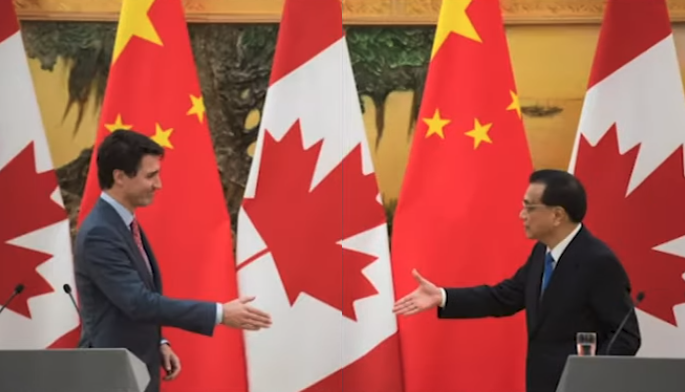
The Line shows just how seriously Justin Trudeau is taking China’s most recent not-so-veiled threats against Canadians in Hong Kong:

The warm glow of a good feed faded quickly in Ottawa, alas, where our nice little vacation from history continues its unravelling apace. China’s ambassador to Canada is issuing increasingly dire threats to the safety of our citizens, specifically the hundreds of thousands of Canadians living in Hong Kong, forcing the prime minister to bring out the biggest guns in his arsenal: his really serious socks, a very frowny photograph by Adam Scotti, and, we expect, the imminent announcement that on top of all her current duties, Chrystia Freeland will be appointed Progressive Minister In Charge Of Figuring Out What The Hell We Should Do About China But Not In A Way That Offends Anyone The Middle Class Build Back Green Error Error Program Alarm—

Whoa! Sorry! The Freeland Job Generator glitched again. No surprise, considering the miles Trudeau has put on it in only five years. Let’s hope it doesn’t give out entirely — we’d need 47 years to procure another one.

Anyway, as to the matter at hand, your Line editors are pragmatic folk. Canada can’t punch at the same level as China; under Mr. Trudeau, indeed, despite all our for-Liberal-egos-only preening about Canada being back, we can’t even punch at the same level as Ireland and Norway. But it’s time Canadians face facts: we can either continue pretending that China’s increasingly aggressive and threatening behaviour is a problem that will go away if we ignore it long enough, or we can at least pretend that we have balls and take what actions we can. Obviously we’re not going to send a fleet to parade up and down their coast, but there are things we can realistically do, and we aren’t. Australia, for instance, also in Beijing’s sights, has rolled out a series of measures to curtail China’s substantial influence there. Canada ought to be doing the same. And we could start by immediately banning Huawei, and encouraging every other country that would listen — which doesn’t seem to be many — that they should too.

Do we expect the Liberal government to do this? No. Making money shilling for the Chinese regime is the best thing to happen to post-politics Liberals since Ontario’s air ambulance service. But they should do this. And the delay is only gonna make it hurt more when events eventually force us to accept that China is not our friend, never has been, and never will be under the current political leadership.

October 11, 2020

QotD: Britain’s National Health Service cult

The NHS has not served the nation well, if international comparison is the criterion by which it should be judged. For example, when the NHS was founded (when British healthcare was among the best rather than the worst in Europe) the population of France had a life expectancy six years lower than that of Britain; it is now two years higher. The health of the population in Spain improved more under Franco than that of the British under the NHS in the same years. Of course, there are determinants of life expectancy other than healthcare systems, but at the very least the comparisons do not suggest any particular virtue to the NHS.

Survival from many serious illnesses such as cancer, heart attacks and strokes is lower in Britain than in most European countries. Publicity is sometimes given to these statistics but they are not immediately apparent to patients or their relatives, and in any case the NHS is immune to criticism because its deficiencies are assumed to be departures from its essential goodness or the result of inadequate funding.

No number of scandals, such as that of Mid Staffs in which hundreds of patients were neglected to a degree that often defied belief, all in plain sight of a large bureaucracy supposedly devoted to ensuring the quality of patient care, can dent faith in the NHS. Staff committed, and management connived at, acts of cruelty that would have made Mrs Gamp blush. Mr Cameron’s government, anxious not to seem an enemy of the NHS, which would have been politically damaging, swept the scandal under the carpet.

A system whose justification for its nationalisation of healthcare was egalitarianism has failed even in the matter of equality. If anything, the difference between the health of the richest and poorest sections of the population has increased rather than decreased under the NHS.

The gap between the life expectancy of unskilled workers and that of the upper echelons, which had been stable for decades before the foundation of the NHS, began to widen afterwards and is now far wider than it ever was. Again, there are reasons for inequality in health other than the deficiencies of healthcare, the prevalence of smoking and obesity, for example; but if systems are to be judged by their effects, the NHS has failed in its initial goal.

Theodore Dalrymple, “Empire of conformists”, The Critic, 2020-04-29.

October 9, 2020

The passing of the “unipolar moment”

Filed under: Cancon, China, Government, India, Politics, USA — Tags: , , — Nicholas @ 05:00

In The Dominion Ben Woodfinden considers the return of foreign policy concerns to Canadian politics after a multi-decade disappearance:

The collapse of the Soviet Union ushered in what the late Charles Krauthammer, in a famous Foreign Affairs essay [PDF], called the “unipolar moment” in which the United States became the unquestioned global hegemon, with no true political, economic, or ideological rivals left. We have been living for the last three decades in this moment.

But Krauthammer’s use of “moment” is deliberate. Krauthammer readily admitted that unipolarity was temporary, and that “no doubt, multipolarity will come in time.” Were he alive today, Krauthammer would probably be ready to proclaim the unipolar moment over. Great power rivalry is back, and the COVID-19 pandemic has accelerated this, killing off any hopes that the relationship between an increasingly aggressive China and the United States could be anything other than adversarial.

This rivalry looks set to become the defining feature of the post-COVID international order, and as the Meng Wanzou case and the kidnapping of the two Michaels reveals, Canada finds itself unavoidably caught in the middle of this burgeoning rivalry. Where Canada fits into this is now one of the most important questions facing our country today.

Canada’s relationship with the United States is our most important relationship. We are unavoidably connected to our neighbour, and our relationship with the United States is a largely amiable one. But despite our integration and close ties with America, Canada remains a sovereign nation, and most Canadians retain a desire for Canada to continue to behave and act like one. Similarly, while it is a Canadian pastime to criticize the flaws and failings of our southern neighbour, we still share the same fundamental democratic values. Thus when it comes to figuring out where Canada stands in the middle of this new great power rivalry, we have little choice but to be broadly aligned with the United States and other free democratic nations.

[…]

Canada can accomplish these goals by prioritizing the strengthening of our relationship with other democratic nations that share our values and are also wary of the rise of an aggressive China with global ambitions. There is no shortage of other nations that fit this description. Most obvious are other Commonwealth nations with which we share common values and history. I’ve written before here in defence of CANZUK, a proposed agreement between Canada, Australia, New Zealand, and the United Kingdom that would strengthen economic ties and prioritize foreign policy and military coordination between these four nations. This is a good start, and strengthening the relationship between other Westminster nations to ensure that we all have an independent voice alongside America would be valuable to all prospective CANZUK members. [Federal Conservative leader Erin] O’Toole was an early supporter of CANZUK during his 2017 leadership bid, and this is something we should prioritize.

Another Commonwealth nation that Canada should prioritize the strengthening of economic and political relations with is India, a nation also threatened by an assertive China. While Canada-India relations have soured under the current government, rebuilding this relationship should be a priority. The current Indian government is not without its controversies and diaspora politics in Canada is complicated to put it mildly. But in the face of a confrontational and dangerous Chinese regime, we don’t have much choice other than to pursue closer and warmer relations with India, even if this will displease some.

Speaking in code and public health

Filed under: Government, Health, Technology, USA — Tags: , , , , , , , — Nicholas @ 03:00

In The Line, Joshua Hind relates the tragedy that forced US emergency services to wean themselves off their many confusing (and sometimes conflicting) spoken codes and use plain language to help reduce tragic misunderstandings among different emergency response organizations:

“First responders on site of the Lac-Megantic train derailment” by TSBCanada is licensed under CC BY-NC-ND 2.0

In the beginning, it was standardized, and the best-known codes, like “10-4,” were consistent from town to town or state to state. But it didn’t take long for newer codes to emerge, which often meant different things depending on where you were. Efforts to reorganize the codes every 20 years or so only compounded the problem. On a local level, in any one town, it wasn’t a problem. But when cops or firefighters from different towns had to work together it could lead to disaster.

In 1970, a particularly severe wildfire season in California killed 16 people in a 13-day period and laid bare the cost of bad interagency communication. The rat’s nest of codes, abbreviations, and jargon prevented firefighters from different towns from communicating with the speed and clarity a major disaster demands. To address the problem, the U.S. Forest Service created FIRESCOPE, the first complete system for organizing and managing major incidents. One of the primary principles of this new system was to “develop standard terminology.”

Despite this effort, which later went national and then international (the province of Ontario has its own version, the “Incident Management System”) coded language continued to proliferate. Nearly 30 years after FIRESCOPE was launched, on September 11th, incompatible technology, lack of protocols, and a refusal to harmonize terminology likely contributed to the deaths of 121 firefighters who were caught in the collapse of the North Tower because they either didn’t hear or couldn’t understand the warnings that the building was about to fail.

Which brings us back to 2006, and FEMA’s notice to first responders. After decades of asking agencies to stop using coded language, the federal government made funding contingent on compliance. “The use of plain language in emergency response is a matter of public safety,” the memo’s introduction read. “There simply is little or no room for misunderstanding in an emergency situation.” From that point forward, all interdepartmental communication would have to be un-coded. A fire would be called “fire.” A shooting would be “a shooting.” And if you needed help, you’d say “HELP!”

Police, fire departments and paramedics slowly but surely got on board and started using some form of the incident management system which included plain language. As use of the system spread, other sectors, like large music festivals and other live events, began adopting the concepts to better synchronize public safety programs with the first responders who support them. Today it’s not unusual for producers, technicians and event security staff to attend training at the police college right next to fire captains and police officers.

Then COVID-19 happened, and we realized that no one had told Public Health.

October 7, 2020

QotD: The gullible generation

Filed under: Government, History, Liberty, Quotations, USA, WW2 — Tags: , , , , — Nicholas @ 01:00

World War II, which I have described (in The Probability Broach) as a struggle between competing brands of fascism, was much the same thing. For the beleaguered people of Europe, it meant being forced to choose between Adolf Hitler and Josef Stalin. Would you rather be shot or gassed?

For Americans, it meant looking for protection by a political regime so grossly and criminally corrupt that future historians will shake their heads, wondering how an entire people could be such suckers. “The Greatest Generation”, that miserable collectivist mouthpiece Tom Brokaw has called them. Looking back over what my father told me of his life, how his family suffered in the government-caused Great Depression, how he and his comrades risked unspeakable danger in the war, and how he became a prisoner in Germany — all to aggrandize the virtual godhood of Franklin Delano Roosevelt — I call them “The Gullible Generation”.

On the other hand, people loved the Roosevelt Administration so much that they passed a Constitutional amendment to make sure that no sonofabitch could ever be elected to more than two Presidential terms again.

World War II gave government complete, dictatorial control of American society, control of industry, control of communications, control of the economy, control that Roosevelt had desperately lusted after before the war, but failed to achieve. If anyone objected, or insisted on his rights under the Constitution, all the other side had to say was, “Don’t you know there’s a war on?”

The government enjoyed that level of control. Once the war was won, and people looked forward to a period of peace, the government plunged us into the Korean War, Vietnam, and an increasing number of undeclared and stupid conflicts in order to retain its power. “Don’t you know there’s a war on?” never worked quite as well as it had to shut dissenters up, but it’s clear that this scam will go on and on and on until something drastic is done to stop it.

L. Neil Smith, “The Deep State”, Libertarian Enterprise, 2019-04-14.

October 6, 2020

Has Boris had his fifteen minutes yet?

Filed under: Britain, Government, Politics — Tags: , , , , — Nicholas @ 05:00

James Delingpole is very much of the opinion that Boris Johnson’s time is almost up and is starting to consider who would replace him as British PM:

Prime Minister Boris Johnson at his first Cabinet meeting in Downing Street, 25 July 2019.
Official photograph via Wikimedia Commons.

It’s no longer a question of “if” but when the ailing, flailing UK Prime Minister crashes and burns. The only remaining questions now are “How much more damage is the buffoon going to inflict before he retires, gracefully or otherwise?” and “Who is going to pick up the pieces when he is gone?”

With the second question, my money is on Chancellor Rishi Sunak. Sure he’s a young-ish (40), fairly untested, partly unknown quantity and, perhaps worse, he’s a graduate of Goldman Sachs. On the other hand, with no General Election likely till 2024, it’s a simple fact that whoever replaces Johnson as prime minister will almost certainly be a member of his current cabinet. Sunak scores highly because he’s arguably the senior minister least tainted by Johnson’s spectacular mishandling of Chinese coronavirus.

Unlike Johnson, his preening Health Secretary Matt Hancock, and Chancellor of the Duchy of Lancaster Michael Gove, Sunak is not one of the so-called “Doves” advocating for ever more stringent measures — lockdowns, masks, curfews, quarantines, a mooted cancellation of Christmas.

Rather, he is the leader of the Hawk faction arguing that it is long since time to prioritise the economy.

Dominic Cummings advising Boris Johnson, probably

True, opinion polls currently favour the Doves — aka the Bedwetters. The British public has so far proved remarkably amenable to having its freedoms snatched away in order to keep it “safe” from coronavirus. Polls continue to suggest that the vast majority of British people want more authoritarian measures, not fewer, in order to deal with the crisis. And Dominic Cummings — the sinister, opinion-poll-driven schemer who, as Johnson’s chief advisor has been controlling the Prime Minister much in the manner of Wormtongue controlling King Théoden in Lord of the Rings — has been more than happy to oblige.

But it would be a massive error to assume that this state of affairs will last.

October 4, 2020

QotD: What everyone always suspected about Washington, D.C.

Filed under: Government, Quotations, USA — Tags: , , — Nicholas @ 01:00

A study shows that the greatest concentration of psychopaths is in Washington, DC. This is a contest in which it isn’t even close, as Politico informs us. But then again, you knew that, right?

Ryan Murphy, an economist at Southern Methodist University, “matched up the ‘constellation of disinhibition, boldness and meanness’ that marks psychopathy with a previously existing map of the states’ predominant personality traits, he found that dense, coastal areas scored highest by far – with Washington dominant among them. ‘The District of Columbia is measured to be far more psychopathic than any individual state in the country,’ Murphy writes in the paper.”

That explains an awful lot, now doesn’t it?

Justin Raimondo, “Washington, D.C. – The Epicenter of Crazy”, AntiWar.com, 2018-06-25.

October 2, 2020

The “Catch-22” in RBG’s majority opinion in City of Sherrill V. Oneida Indian Nation of N.Y.

Filed under: Government, History, Law, USA — Tags: , , , — Nicholas @ 03:00

In The Line, Meaghie Champion outlines the awkward position the Oneida First Nation found itself in after their case made it to the US Supreme Court:

Panorama of the west facade of United States Supreme Court Building at dusk in Washington, D.C., 10 October, 2011.
Photo by Joe Ravi via Wikimedia Commons.

In 2005, in the case of the City of Sherrill V. Oneida Indian Nation of N.Y., the U.S. Supreme Court ruled against the Oneidas, after the nation had attempted to assert sovereignty in traditional land they had to re-purchase after it had been illegally acquired.

Writing the majority position was the late liberal figurehead now being lionized in U.S. media — Ruth Bader Ginsburg.

Granted, she fought for women’s rights and accomplished a lot. She was a law school professor and a judge. She was one of the leaders of the American Civil Liberties Union. She was the second woman to ever serve on the United States Supreme Court. She was influential in a lot of cases on the Supreme Court, including a labour law case that inspired a law to be passed, and an environmental case that set new standards for who could be heard in court on environmental issues. Since her recent death, the news coverage has been singing her praises like hagiography.

But study history and you will find lots of villains, and no saints. Many First Nations people in North America look on Ginsburg’s reification with a much more skeptical eye.

Meanwhile, the sovereignty of many Indigenous nations in B.C. has never been extinguished. Many First Nations here are being corralled into signing treaties that give up lands, rights and sovereignty. They may look to the Oneida as a cautionary tale. When it comes to sovereignty, you must use it or lose it. Don’t look to courts to give it back later. Not even when you have a social justice saint for a judge.

Ginsburg ruled that Indian land in central New York acquired in violation of U.S. federal law, a treaty, and the U.S. Constitution, could not be reintegrated into the ancestral lands of the Oneida Indian Nation — that the Oneidas would be required to pay property taxes to the local government of the City of Sherill. That is, unless the Oneidas sacrificed that land and allowed the federal government to administer it as a trust.

Justice Ginsburg wrote that 200 years had passed since the initial illegal acquisition, the land had passed hands between jurisdictions multiple times over the period, and that the Oneida had just waited too long. (Even though the U.S. Supreme Court acknowledged in 2005 that there was no specific time limit on this kind of case.) She claimed in her opinion that it would just be “unfair” to the non-natives in this case. If the Oneida had sued in court sooner, then it would have been different.

In the long and fraught web of relationships between First Nations and the United States government, it’s hard to pick a time before the late 20th century or early 21st where a First Nations case might be given full and fair hearing by any federal court, which shows Ginsburg’s opinion to be … lacking in historical sensitivity.

October 1, 2020

Supreme Court Shenanigans!

Filed under: Government, Law, Politics, USA — Tags: , , , — Nicholas @ 06:00

CGP Grey
Published 30 Sep 2020

Far from being in trouble, Canadian film and TV investment has nearly doubled in the last 10 years

Filed under: Business, Cancon, Government, Media — Tags: , , , , , , , — Nicholas @ 03:00

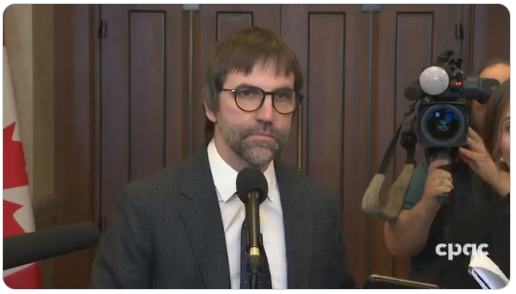
The Canadian government — particularly Canadian Heritage minister Steven Guilbeault — is eager to pass legislation to “get money from the web giants” and their primary justification is the claim that Canadian TV and movie funding has been shrinking. As Michael Geist explains, that’s a pants-on-fire lie:

CMPA Profile – Financing, Sources: CMPA Profile 2019, 2016, 2013

Canadian Heritage Minister Steven Guilbeault has said that his top legislative priority is to “get money from web giants.” While much of the attention has focused on his ill-advised plan to require Facebook to obtain licences for linking to news articles, his first legislative step is likely to target Internet streamers such as Netflix, Amazon and Disney with new requirements to fund Canadian content and to increase its “discoverability” by making it more prominent for subscribers. Based on his comments at several town halls, Guilbeault is likely to also create new incentives for supporting indigenous and persons of colour in the sector with a bonus for those investments (potentially treating $1 of investment as $1.50 for the purposes of meeting Cancon spending requirements). Much of the actual implementation will fall to the CRTC, which will be granted significant new regulatory powers and targeted with a policy direction.

Guilbeault’s case for establishing new mandated payments is premised on the claim that support for the film and television sector is declining due to the emergence of Internet streaming services, which have resulted in decreased revenues for the conventional broadcast sector and therefore lower contributions to Cancon creation. In fact, Guilbeault recently told Le Devoir that without taking action there would be a billion dollar deficit in support in the next three years. He says that his objective is to actually generate a few hundred million more per year in local production by the Internet streamers. In other words, he’s expecting roughly $2 billion in new investment over three years in Cancon from U.S. entities due to his planned regulations (moving from a billion dollar deficit to a billion dollars in extra spending).

While Guilbeault frames these regulatory requirements as a matter of fairness and “rebalancing”, industry data over the past decade tell a much different story. Indeed, there has been record setting film and television production in recent years, much of it supported by companies such as Netflix. CRTC chair Ian Scott last year said that Netflix is “probably the biggest single contributor to the [Canadian] production sector today.” While that is not entirely true – the data suggests that Canadian taxpayers are the biggest contributor with federal and provincial tax credits consistently the largest source of financing – the claim that there is a billion dollar deficit coming or that foreign streamers do not contribute to film and television production in Canada without a regulatory requirement is simply false.

« Newer PostsOlder Posts »

Powered by WordPress