Quotulatiousness

October 1, 2020

QotD: Even so-called “Keynesians” fail to follow Keynes

Filed under: Economics, Government, Quotations — Tags: — Nicholas @ 01:00

The thing about deficit spending is that you should only be doing it when you need to be doing it. No, this isn’t a rejection of that Keynesian idea or ideal, it’s the point of it.

When wages are flatlining, when the economy needs that bolus of extra demand then, OK, go borrow and spend. Or, in the MMT world, print money and spend. But once you’ve delivered that bolus and the economy has recovered then you must be able to stop that spending – whether delivered by borrowing or printing. That is, a permanent increase in spending is not Keynesian demand management, only a temporary one is.

Tim Worstall, “The Guardian‘s Absurd View Of NHS Funding”, Continental Telegraph, 2018-06-15.

September 30, 2020

The feds go trampling all over provincial responsibilities again

Filed under: Cancon, Government, Health, Law — Tags: , , , — Nicholas @ 03:00

Ted Campbell suggests that even a cursory reading of the constitution does not give the federal government the power to trespass (again) in what is clearly, legally, a provincial government area of responsibility:

“The Fathers of Confederation”
The original painting by Robert Harris (1884) was destroyed in the 1916 Parliament Building fire, and this image for the “Gallery of Canadian History” series of lithographs by Confederation Life Insurance Company is based on a photograph by James Ashfield (1885).
Libraries and Archives Canada item ID number 3013194. http://central.bac-lac.gc.ca/.redirect?app=fonandcol&id=3013194&lang=eng

[T]he Parliament of Canada should look to §91. Here is what the Constitution says are the areas of national government’s concern: The Public Debt and Property; The Regulation of Trade and Commerce; Unemployment insurance; The raising of Money by any Mode or System of Taxation; The borrowing of Money on the Public Credit; Postal Service; The Census and Statistics; Militia, Military and Naval Service, and Defence; The fixing of and providing for the Salaries and Allowances of Civil and other Officers of the Government of Canada; Beacons, Buoys, Lighthouses, and Sable Island; Navigation and Shipping; Quarantine and the Establishment and Maintenance of Marine Hospitals; Sea Coast and Inland Fisheries; Ferries between a Province and any British or Foreign Country or between Two Provinces; Currency and Coinage; Banking, Incorporation of Banks, and the Issue of Paper Money; Savings Banks; Weights and Measures; Bills of Exchange and Promissory Notes; Interest; Legal Tender; Bankruptcy and Insolvency; Patents of Invention and Discovery; Copyrights; Indians, and Lands reserved for the Indians; Naturalization and Aliens; Marriage and Divorce; The Criminal Law, except the Constitution of Courts of Criminal Jurisdiction, but including the Procedure in Criminal Matters; The Establishment, Maintenance, and Management of Penitentiaries; and Such Classes of Subjects as are expressly excepted in the Enumeration of the Classes of Subjects by this Act assigned exclusively to the Legislatures of the Provinces.

In that looooong list I can find more than adequate justifications for ministers and government departments that are responsible for: finance and revenue; industry, trade, and commerce; defence; foreign affairs; transport; fisheries and oceans; citizenship and immigration; health; and for independent agencies like the Bank of Canada, Canada Post and Statistics Canada. I cannot find anything that says we need a Minister for Women and Gender Equality, nor one for Diversity, Inclusion and Youth nor, especially, Ministers for Canadian Heritage and Middle Class Prosperity.

A lot of things have changed since 1867; the telegraph was still fairly new and innovative, a practical telephone wouldn’t be invented until ten years after confederation and the first useful long-haul radio transmission and reception, from Britain to Signal Hill in St John’s didn’t come until the dawn of the 20th century, thus ideas like the CBC, the Internet, Netflix, air traffic control and the North Warning System were far beyond the imagination of the men ~ they were pretty much all men, working in government, back in the 1860s, weren’t they? ~ who drafted the Canadian Constitution.

What was clear to them, based on the United States experiences, was that §90 to §95 which spell out “who does what to whom” were important to the functioning of a federal state, especially to one in which traditional provincial rights and diverse cultures were well established. Now, it is important to remember that in Canada’s long and rich history there were instances, especially during great wars, when the provinces agreed to federal intrusions into their areas of responsibility; this is not one long story of federal bullying. But what seems perfectly clear to me ~ and I suspect to e.g. John Horgan, Jason Kenney, Doug Ford, François Legault and the other premiers is that last week’s Throne Speech marks another major and quite unjustified federal assault on their jurisdictions. What’s happened, according to Manitoba Premier Brian Pallister, is that the provinces have all the health care delivery problems but, thanks, in some part, to tax decisions made in 1942, the feds have all the money. The solution is blindingly obvious: transfer tax “points” as some experts call them, to the provinces so that they, not Justin Trudeau, who have the problems of too few physicians, too few nurses and too few hospital beds also have the money to solve them.

September 29, 2020

Was it actually a “Plandemic”?

Filed under: Books, Britain, Government, Health — Tags: , , , , — Nicholas @ 03:00

Sean Gabb recently published a collection of essays written during the lockdown for Wuhan Coronavirus. This excerpt is from the introduction to “Plandemic” or The Hand of God?:

My general argument is that the Coronavirus Panic should be divided under two headings. The first is the Virus itself as a medical fact and the immediate responses. The second is a set of changes already evident and sometimes advanced before the March of 2020, but that have now been greatly accelerated. Of these, the second is by far the more important. The first, even so, is of interest in its own right.

The Virus has not been all that we were told it would be. Last March, much of the world was ordered into indefinite lockdown on the grounds that we faced the greatest pandemic since the Spanish Flu of a century ago. For weeks in my own country, the BBC filled the television screens with statements by scared, sweating politicians, and lifted all restraint from its own hyperventilating staff. Now, as I write in the middle of September, we can be sure that it killed no more people than a seasonal influenza, and that most of its victims were very old or had been already weakened by some other condition. We can be sure it killed no more than seasonal influenza. Given the questionable definition of Coronavirus deaths, it may have killed many fewer.

I know that pandemic infections often come in several waves, and second waves can be more deadly than the first. But the second wave we are now said to be entering is evidenced by infections rather than deaths, and these infections are counted and published in ways more questionable than the counting and publishing of the earlier alleged deaths. I do not know what will have happened by Christmas. I suspect, however, that nothing much will have happened.

I have no fixed idea of what caused the panic. I am told that the Coronavirus was a bioweapon that escaped from a government laboratory. If it was, I can imagine that political leaders all across the world were taken aside by their own scientists, who were working on something similar, and told of the coming apocalypse. I lack the scientific understanding to judge the truth of this claim. But, if true, it would explain the panic. It would also justify the panic, so far as no one might have known for sure how infectious and how deadly this bioweapon was.

I am more inclined, though, to believe that the panic was a universal hysteria just waiting to be realised. The world at the beginning of this year was in a similar moral state to the world in 1914. There had been a generation of rising prosperity and of rising discontent. Some groups had benefitted out of proportion to their numbers and believed merit. If only relatively, others had fallen behind. Some believed the progress had not been fast enough, and that it could be hastened by various institutional changes, others that it was bad in its effects, and that it should be at least slowed. In 1914, all these discordant energies were channelled – both by deliberate policy and by popular enthusiasm – into a catastrophic war. This year, they found their outlet in the Coronavirus. Since I am making the same point, I might as well quote Marx:

    Hegel remarks somewhere that all great world-historic facts and personages appear, so to speak, twice. He forgot to add: the first time as tragedy, the second time as farce.

I will only add that, on the real stage of world affairs, farce is always preferable to tragedy. Facemasks are better than gasmasks. Better the statistical mirage of last spring than the genuine casualties of Verdun and the Somme.

September 27, 2020

“It is a Chestertonian paradox which Chesterton himself never wrote: a government changing the nature of the state successfully and without opposition because nobody can believe what they are seeing, and so everybody politely ignores it.”

In The Critic, Peter Hitchens on the many civil institutions that have been seriously wounded — not so much by the Wuhan Coronavirus, but by government responses to it:

David Icke about to speak at Piers Corbyn’s 20 August anti-masking demonstration in Trafalgar Square.
Screencap from YouTube video – https://www.youtube.com/watch?v=DOZQ58uTWdw

The long retreat of law, reason and freedom has now turned into a rout. It was caused by many things: the mob hysteria which flowered after the death of Princess Diana; the evisceration of education; the spread of intolerant speech codes designed to impose a single opinion on the academy and journalism; the incessant state-sponsored panics over terror; the collapse and decay of institutions and traditions.

These have all at last flowed together into a single force, and we seem powerless against it. Absurdly, the moment at which they have achieved maximum power is accidental, a wild, out of-proportion panic response to a real but limited epidemic.

Outside total war and its obscenities, we have not seen what we are living through now. To list the constitutional events of the last few months is to ask the complacent chattering classes of Britain what it reminds them of: the neutering of parliament into a rubber stamp controlled by the executive; the death of political pluralism; the introduction of government by decree; the disappearance of the last traces of an independent civil service; the silence in the face of these events of media and courts; the subjection of the police to state edicts rather than to law.

[…]

Documents of this kind are not supposed to get out. In better times than these, with active and critical media, this particular passage — with its clear implication that it was the task of the state to scare us into compliance — might have led to the fall of the government. As it is, you will struggle to find mentions of it in the British national press. They are there, but they are hard to find and not on any daily front pages. This is not because of censorship or because of any kind of collective action.

It is because most people, having lived all their lives in relaxed freedom, are quite unable to believe what is in front of their eyes. It is a Chestertonian paradox which Chesterton himself never wrote: a government changing the nature of the state successfully and without opposition because nobody can believe what they are seeing, and so everybody politely ignores it.

This could not have happened, in my view, 60 years ago. Rigorous education, especially of the elite, had at that time created a significant class of people who knew how to think, and how to assess evidence. There would always have been someone, whether it was a Tam Dalyell or a Churchill, to point out the true direction of events and warn against them, prominently. Much of the press would have given this dissent house room, rather than obediently conforming (in order to #ProtectOurNHS). But in the intervening years such rigorous schooling has been replaced by an egalitarian education system which teaches its students what to think, not how to think. Criticism of the past is obligatory, but any cold-eyed assessment of the present — in which new ideas benevolently rule — is disliked and ignored.

As well as this, there have been the various spasms of panic and emotion which convulsed the country after the Cold War ended. These were profound attacks on reason. They were also attacks on limited government and the rule of law, which rest largely on the power of reason. Most people quite like being afraid of something, and many dislike freedom and the responsibility that comes with it. The honest among us all admit it.

Once, before Charles Darwin, Ypres and the Somme, the Christian religion answered those needs. The Fear of the Lord was the Beginning of Wisdom, and the devoted service of Christ was perfect freedom. Faith offered eternal life and helped people to accept temporal death as normal. This belief helped to sustain earthly liberty because, as Edmund Burke pointed out, the man who truly fears God will fear nothing else. No despot can get very far if there are such men around in any number.

Homelessness in Los Angeles

In Quillette, Amy Alkon talks about the homeless crisis in LA, particularly her own immediate experience with a couple who “camped out” in front of her house.

Throughout [Los Angeles Mayor Eric] Garcetti’s seven years as Mayor, Los Angeles has witnessed a shocking explosion of homelessness. When he took office in 2013, the city had about 23,000 residents classified as homeless, two thirds of whom were unsheltered, living on the streets. By mid-2019, the figure was about 36,000, and three-quarters of them were living on the streets. Currently, there are 41,000 homeless. Garcetti’s pet plan to alleviate the homelessness crisis was the construction of permanent supportive housing. In 2016, compassionate voters approved $1.2 billion in new spending to fund these units. Three years later, only 72 apartments had been built, at a cost of about $690,000 apiece. Meanwhile, an El Salvador-based company has come up with nifty $4,000 3D-printed houses that look like great places to live and can be put up in a single day.

There’s also been a failure to admit that housing alone isn’t the solution. As urban-policy researcher Christopher Rufo explains, only about 20 percent of the homeless population are people down on their luck, who just need housing and a few supportive services to get back on their feet. Approximately 75 percent of the unsheltered homeless have substance-abuse disorders and 78 percent have mental-health disorders. Many have both.

As a bleeding-heart libertarian, I feel personally compelled to try to help people who are struggling. I do this by volunteering as a mediator, doing free dispute resolution to provide “access to justice” to people who can’t afford court. And since about 2009, I personally have given support to one of those easily helpable 20 percent Rufo refers to, getting him paying work and a bank account, and storing his stuff in my garage. He is a good man and a hard worker — sober for many years — who simply seems to have issues in the “front-office” organizational parts of his brain that help most of us get our act together to, say, pay bills on time. He just needs somebody to back him up on the bureaucratic aspects of life. I’m happy to say he now has a roof over his head. He lives in a motel across the country, and all I still do for him is provide him with a permanent address. I receive his Veterans Administration and Social Security mail at my house, which I mail to him with smiley faces and hearts on the envelopes, colored in with pink and orange highlighter.

This success story would not be possible for most homeless people, the nearly 80 percent who are addicted and/or mentally ill. As Rufo writes:

    Progressives have rallied around the slogan “Housing First,” but haven’t confronted the deeper question: And then what? It’s important to understand that, even on Skid Row, approximately 70 percent of the poor, addicted, disabled, and mentally ill residents are already housed in the neighborhood’s dense network of permanent supportive-housing units, nonprofit developments, emergency shelters, Section 8 apartments, and single room-occupancy hotels.

    When I toured the area with Richard Copley, a former homeless addict who now works security at the Midnight Mission, he explained that when he was in the depths of his methamphetamine addiction, he had a hotel room but chose to spend the night in his tent on the streets to be “closer to the action.” Copley now lives … at the Ward Hotel — which he calls the “mental ward” — where he says there are frequent fights and drugs are available at all hours of the day. The truth is that homelessness is not primarily a housing problem but a human one. Mayors, developers, and service providers want to cut ribbons in front of new residential towers, but the real challenge is not just to build new apartment units but to rebuild the human beings who live inside them.

The situation is especially tragic for those who are so mentally ill that they cannot take care of themselves, and are often a danger to both themselves and others. And I sometimes wonder which movie star or other famous person needs to be stabbed or bludgeoned before politicians take meaningful action.

It’s fashionable in progressive circles to demonize law enforcement, but Rufo explains that in 2006, then-L.A. police chief Bill Bratton implemented a “Broken Windows” policing initiative on Skid Row. It led to a 42 percent reduction in felonies, a 50 percent reduction in deaths by overdose, and a 75 percent reduction in homicides. The overall homeless population was reduced from 1,876 people to 700 — a huge success. Activists filed lawsuits and ran publicity campaigns, slowly killing Bratton’s program, on the grounds that it “criminalizes homelessness.” As a libertarian, I’m opposed to drug laws and forced behavior — but only to a point. It is not compassion to leave people to be victimized by criminals simply because they are unhoused, nor is leaving mentally and physically disabled people strewn across the streets amidst piles of garbage a form of freedom.

Mayor Garcetti, in lieu of admitting the real challenges — the first step to taking meaningful action to alleviate the homelessness crisis — has simply ignored the human results of his failed policy. As a result, whole sections of the city, including formerly livable streets in my beloved Venice, have been turned into Skid Row by the Sea.

September 24, 2020

I thought we were supposed to speak well of the (politically) dead

Filed under: Books, Britain, Government, Media, Politics — Tags: , , — Nicholas @ 03:00

In The Critic, Nigel Jones examines the soon-to-be-published “political tittle-tattle” of the wife of an MP and junior cabinet minister during David “Dave” Cameron’s premiership:

For anyone who has been holidaying under a rock for the past fortnight and may have missed the furore, I should explain that Lady Swire, daughter of Mrs Thatcher’s former Defence Secretary Sir John Nott, is the wife of ex-Tory MP Sir Hugo Swire, an Old Etonian chum of David Cameron, who somehow failed to be promoted beyond the ranks of junior ministers during his pal’s Premiership, but remained a close confidante and boon holiday companion to the PM. Lady Swire herself is half-Slovenian, and though brought up in the bosom of the Tory establishment, may not be entirely attuned to the evasions, hypocrisy and double standards that make up British political life, which makes her book all the more enjoyable.

Throughout Dave’s inglorious time in office, Lady Swire kept a secret diary detailing intimacies of conversation, banter and badinage, and revealing insights that give – shall we say – a not wholly flattering picture of the ruling Tory clique at play during their most unguarded moments. The bad behaviour, petty jealousies and embarrassing remarks of Dave, George, Boris and Michael and their wives are set down in all their toe-curling cringeworthiness.

The diaries are to be published next week but have been serialised in The Times and reviewed and widely commented on in the rest of the media. The two main targets – the duopoly of Cameron and Osborne – have already expressed their displeasure at the revelations. But all the tut-tutting disapproval of Lady Swire’s profitable indiscretions misses the main point: there is nothing that the British public relishes and enjoys more than an exposé of their leaders with their dignity gone and their metaphorical trousers down.

Moreover, gossip and tittle tattle as set down in diaries often tells us more about the true nature of politics and the motivations and personalities of politicians than a thousand self-serving pompous political memoirs or dull works of dry political analysis. What we really want is gossip – the gamier the better – and all the inconvenient truths our rulers rather we didn’t know.

Very often what we learn from particular epochs of history are the telling anecdotes and juicy titbits revealed by diarists rather than the respectability that the statesmen themselves wish to present and be remembered for. Our picture of the Restoration of the monarchy in 1660, for example, and the very merry court of Charles II, along with the apocalyptic disasters of fire and plague that followed comes largely from the indiscreet journals of Samuel Pepys, Daniel Defoe, and John Evelyn.

September 23, 2020

Federal minister admits the Libranos’ plan is a shakedown to “get money from web giants”

Filed under: Cancon, Government, Media, Politics, Technology — Tags: , , , , — Nicholas @ 03:00

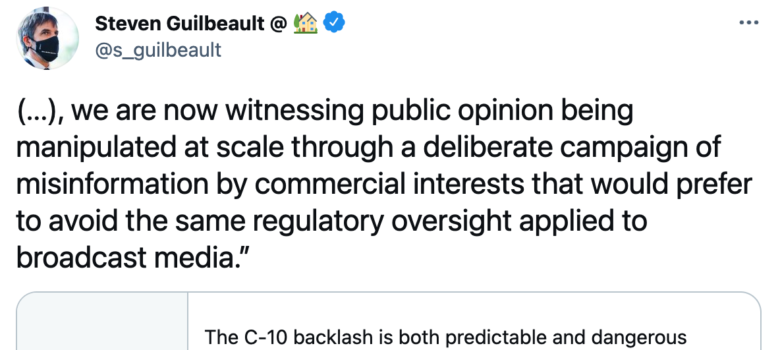
Michael Geist on a rare moment of honesty from Canadian Heritage Minister Steven Guilbeault on the federal government’s atrocity of an internet regulation plan:

Canadian Heritage Minister Steven Guilbeault, 3 February 2020.
Screencapture from CPAC video.

As Canadian Heritage Minister Steven Guilbeault prepares an Internet regulation plan that features the prospect of licences for linking, undermining net neutrality, and trade sanctions, he has typically argued that “it’s about fairness”, suggesting that foreign companies unfairly benefit from the Canadian market at the expense of domestic companies. Yet when Guilbeault appeared at a production sector town hall last week, he was far more candid. Guilbeault told the sector that in a minority government situation, his department had to choose between a massive bill changing “everything under the sun” or to slice it up into smaller pieces. Having chosen the piecemeal approach, Guilbeault pointed to his top priority: get money from the foreign Internet companies (his exact words at 47:58 were “the most pressing thing we needed to do was to get oxygen into the system, which is money. And go and get that money where that money is. Which is web giants.”)

In certain respects, the acknowledgement that this amounts to little more than a shakedown makes sense. CRTC Chair Ian Scott has said that Netflix is now probably the largest contributor to film and television production in Canada and the sector enjoyed record production numbers pre-COVID-19, so the data simply does not support claims that the streamers are hurting the industry. As for the news sector, the Minister has failed to deliver millions in promised tax credits and seemingly now wants an alternative that involves creating a licensing regime for linking to content.

Yet if the goal is simply a matter of wanting more money from Internet companies that can be used to support Canadian cultural policies, it is not clear why this is a matter for the Heritage Minister. Everyone wants more money from the Internet companies and countries around the world have a credible argument that the huge global Internet revenues should be more equitably apportioned among them. In other words, the way to “get money from web giants” is for Finance Minister Chrystia Freeland to tax them on their revenues. Those tax revenues would go into general tax revenues and can be spent in an transparent manner without the need for specialized subsidy programs. This isn’t easy. The U.S. unsurprisingly objects to a potential reduction in its tax revenues, which means that Canada must find allies with other countries in seeking global solutions on tax. Further, Guilbeault candidly recently told a publisher town hall that changes to the tax code is far more difficult than direct program spending.

The problem with Guilbeault’s preference for direct program spending subsidized by Internet companies is that it raises a host of complications and negative effects. For example, mandated Canadian content spending for companies such as Netflix could require the companies to pay into a fund that supports Canadian content production. However, the current rules make it challenging for those same companies to access those funds for their own productions. That leads to either a trade challenge (and the possibility of tariffs against key Canadian sectors such as dairy and steel) for being forced to pay into a system that is inaccessible to foreign providers or a reform to the system that would open things up to foreign providers and in the process undermine the competitiveness of domestic producers and broadcasters who are more reliant on tax credits and funding programs.

September 20, 2020

QotD: The anti-slavery movement

Filed under: Books, Britain, Government, History, Liberty, Quotations — Tags: , , , — Nicholas @ 01:00

“William Wilberforce,” writes Eric Metaxas in his book Amazing Grace, “was the happy victim of his own success. He was like someone who against all odds finds the cure for a horrible disease that’s ravaging the world, and the cure is so overwhelmingly successful that it vanquishes the disease completely. No one suffers from it again — and within a generation or two no one remembers it ever existed.”

What did Wilberforce “cure”? Two centuries ago, on March 25th 1807, one very persistent British backbencher secured the passage by Parliament of an Act for the Abolition of the Slave Trade throughout His Majesty’s realms and territories. It’s not that no one remembers the disease ever existed, but that we recall it as a kind of freak pandemic — a SARS or bird flu that flares up and whirrs round the world and is then eradicated. The American education system teaches it as such — as a kind of wicked perversion the Atlantic settlers had conjured out of their own ambition.

In reality, it was more like the common cold — a fact of life. The institution predates the word’s etymology, from the Slavs brought from eastern Europe to the glittering metropolis of Rome. It predates by some millennia the earliest laws, such as the Code of Hammurabi in Mesopotamia. The first legally recognized slave in the American colonies was owned by a black man who had himself arrived as an indentured servant. The first slave owners on the North American continent were hunter-gatherers. As Metaxas puts it, “Slavery was as accepted as birth and marriage and death, was so woven into the tapestry of human history that you could barely see its threads, much less pull them out. Everywhere on the globe, for 5,000 years, the idea of human civilization without slavery was unimaginable.”

Mark Steyn, The [Un]documented Mark Steyn, 2014.

September 18, 2020

From innovation to absolutism — English inventors and the Divine Right of Kings

In the latest Age of Invention newsletter, Anton Howes looks at how innovations during the late Tudor and Stuart eras sometimes bolstered the monarchy in its financial battles with Parliament (which, in turn, eventually led to actual battles during the English Civil War):

King Charles I and Prince Rupert before the Battle of Naseby 14th June 1645 during the English Civil War.
19th century artist unknown, from Wikimedia Commons.

The various schemes that innovators proposed — from finding a northeast passage to China, to starting a brass industry, to colonising Virginia, or boosting the fish industry by importing Dutch salt-making methods — all promised to benefit the public. They were to support the “common weal”, or commonwealth. And to a certain extent, many projects did. The historian Joan Thirsk did much pioneering work in the 1970s to trace the impact of various technological or commercial projects, revealing that even something as mundane as growing woad, for its blue dye, could have a dramatic impact on local economies. With woad, the income of an ordinary farm labouring household might be almost doubled, for four months in the year, by employing women and children. In the late 1580s, the 5,000 or so acres converted to woad-growing in the south of England likely employed about 20,000 people. That may seem small today, but at a time when the population of a typical market town was a paltry 800 people, even a few hundred acres of woad being cultivated here or there might draw in workers from across the whole region. In the mid-sixteenth century, even the entire population of London had only been about 50-70,000. As Thirsk discovered, innovative projectors also sometimes fulfilled their other public-spirited promises, for example by creating domestic substitutes for costly imported goods, or securing the supplies of strategic resources.

But the ideal of benefiting the commonwealth could also, all too frequently, be elided with serving the interests of the Crown. Projectors might promise the monarch a direct share of an invention’s profits, or that a stimulated industry would result in higher income from tariffs or excise taxes. Increasingly, they proposed schemes that were almost entirely focused on maximising state revenue, with little evidence of new technology. They identified “abuses” in certain industries — at this remove, it’s difficult to tell if these justifications were real — and asked for monopolies over them in order to “regulate” them, then making money by selling licences. Last week I mentioned patents over alehouses, and on playing cards. They also offered to increase the income from the Crown’s property, for example by finding so-called “concealed lands” — lands that had been seized during the Reformation, but which through local resistance or corruption had ostensibly not been paying their proper rents. The projectors would take their share of the money they identified as “missing”. And they proposed enforcing laws, especially if the punishments involved levying fines or confiscating property. The projectors offered to find the lawbreakers and prosecute them, after which they’d take their share of the financial punishments.

Projectors thus came to present themselves as state revenue-raisers and enforcers, circumventing all of the traditional constraints on the monarch’s money and power. They provided an alternative to Parliaments, as well as to city corporations and guilds, in raising money and propagating their rule. Taking it a step further, projectors offered the tantalising possibility that kings like James I and Charles I might rule through proclamation and patents alone, without having to answer to anybody. They thus experimented with absolutism for much of 1610-40, only occasionally being forced to call Parliament for as briefly as possible when the pressing financial demands of war intervened.

In the process, with the growing multitude of projects — a few bringing technological advancement, but many merely lining the pockets of courtier and king — the designation “projector” became mud. It was as if, today, the Queen were to use her prerogative to grant a few of her courtiers monopolies on collecting all traffic fines, or litter penalties, to be rewarded solely on commission. Or if she were to award an unscrupulous private company the right to award all alcohol-selling licences (perhaps on the basis that underage drinking was becoming common). The country would soon be awash with hidden speed cameras and incognito litter wardens, and the price of alcohol would go through the roof. The people responsible would not be popular. A recent book by economic historian Koji Yamamoto meticulously charts the changing public perceptions of projects, describing the ways in which innovators then struggled, for decades, to regain the public’s trust.

September 16, 2020

Lockdown justification theories

In the most recent Libertarian Enterprise, Sean Gabb reports on a demonstration last month in London organized by Piers Corbyn which resulted in Corbyn being almost instantly fined £10,000 despite other, larger and more violent demonstrations not drawing any kind of judicial sanctions:

David Icke about to speak at Piers Corbyn’s 20 August anti-masking demonstration in Trafalgar Square.
Screencap from YouTube video – https://www.youtube.com/watch?v=DOZQ58uTWdw

The consensus at the demonstration appears to have been that the Coronavirus is some kind of fraud, and that the laws to stop its spread are really intended to carry us into a nightmarish New World Order tyranny. I disagree with this view. I believe instead that, looking back from one or two years, the Coronavirus Panic will be seen as a disaster for at least the British ruling class, and as somewhere between a blessing and nothing very bad for the majority of everyone else.

For the avoidance of doubt, I have no belief in the goodness of our ruling class. The Labour Party represents a new and hegemonic Establishment. The project of this Establishment is to bring about changes that are meant to be fatal to the traditional peoples of my country, and that will not be to the advantage of the groups they are supposed to raise up. Whether this project is evil or deluded is beside my present point, though it is probably something of both. There are two possible views of the Conservative Party. It may be worth supporting because, though willing to see it roll forward of its own momentum, the leaders do not want to hurry the project forward, but are mainly interested in personal enrichment. Or it may be a Potemkin opposition — gathering votes from the discontented, while self-consciously making sure those votes are wasted. Again, the exact truth is beside my present point. What does matter is that we go into every election less free and less at home in our country than at the previous election.

This being admitted, there is a loose connection between me and the speakers and attendees at Mr Corbyn’s demonstration. At the same time, there is a difference between cynicism and paranoia. As a cynic, I do not believe that everything untoward that happens is there to hurry the project of change. I do not believe that our ruling class is in charge of everything. I do not believe that it understands everything. Whatever its origin, the Coronavirus appears to have driven our various rulers into a genuine panic. Yes, Boris Johnson is a fool, and there is an army of the powerful who wanted an excuse to stop our final departure from the European Union. Yes, the Democrats were looking to upstage Donald Trump in time for the next American election. But this has not been a panic in just two countries. The Japanese cancelled their Olympic Games — losing them for the second time in eighty years. The Chinese brought four decades of economic growth to an end. The Indians and South Africans panicked. So did most of the Europeans. The panic was joined by ruling classes with no visible interest in putting the dreams of the Frankfurt School into practice.

Focussing on my own country, what ruling class institution has benefitted from the Coronavirus Panic? Look beyond the propaganda, and it is plain that the response of the National Health Service was a disgrace. Myriads of diagnoses and treatments were cancelled without good reason. We still have no dentistry. The public sector as a whole went on paid leave for six months. The schools closed and the teachers vanished — no great loss there, of course. Even if none goes bankrupt, dozens of universities will need to downsize — no loss there either. The police behaved throughout like fascist goons. Every institution set up or adapted to advance the project of change has emerged from the past six months revealed as broken and covered in ridicule. What sort of a planned crisis is it that ends in magnified cynicism and in paranoia that can fill Trafalgar Square on a Bank Holiday weekend? The general mood in this country is approaching what you see at the end of a lost war.

Or what associated commercial interests have benefitted? The politicised entertainment media is flat on its back. The commercial property sector is entering a melt-down. House prices in all the nice parts of London are going into a downward spiral. Public finances will be squeezed for years to come; and, given a choice between projects of change and a liveable dole, the electors are likely to make their wishes undeniable. Globalised patterns of trade have been disrupted, raising question marks over all the presiding global institutions. The last thing financial services needed was another big shock. As for the commercial beneficiaries, these are libertarian by default. For all that can be said against them, Jeff Bezos and Mark Zuckerberg have opened the media to anyone who knows how to use a computer keyboard. Their turn to corporate censorship has, at every step, been a response to outside pressure. Every one of these turns has been half-hearted and driven by a natural, if not always creditable, desire to continue growing richer. There is no particular benefit for the American and British ruling classes if Mr Bezos becomes a trillionaire and Richard Branson ceases to be a billionaire.

On a related note, Jay Currie points out that the media’s current laser-intense focus on reporting Wuhan Coronavirus cases allows the narrative to continue relatively undisturbed and which might be totally overthrown if they reported instead on deaths from the Chinese Batflu (H/T to David Warren for that useful epithet):

In the UK, France, Ontario and various other jurisdictions COVID case counts have risen at an alarming rate in the past few weeks. Unfortunately, mandatory masking and strict lockdowns seem to be the only tools governments feel they have in the face of case count surges.

It can be argued that the increasing case counts may be an artifact of more testing. Or a product of the sensitivity of the tests themselves; but the actual case numbers keep going up.

Our media, God bless them, at a national level seem to be entirely focused on case counts to the point where, in this CBC story on Ontario’s numbers, there is simply no mention of the “death count”.

Why could this be? Well, take a look at these two graphs from Ontario:

If you look at the top graph the sky is falling and masks, social distance, lockdowns, school closures and “stay at home” all make a lot of sense. If you look at the bottom graph, COVID is over.

In Montreal over this last weekend up to 100,000 people marched against mandatory masks. The mainstream media downplayed the turnout and suggested that there were all sorts of conspiracy theorists, Qanon believers, far right and Trump supporters marching. There probably were. But I suspect the vast majority of the marchers were responding to the disproportionate response of the Quebec government to graphs which look very much like Ontario’s.

People are more than willing to go along with governmental measures they can see the point of. “14 days to flatten the curve and prevent hospitals from being overwhelmed” made sense back in April. And the measures taken then may well have worked. But it is mid-September and the hospitals and their ICUs are not even slightly overtaxed.

September 15, 2020

Critical Race Theory

Filed under: Government, Politics, USA — Tags: , , , — Nicholas @ 05:00

Dan Sanchez, Tyler Brandt, and Brad Polumbo discuss President Trump’s recent Executive Memo banning the use of federal government funds for Critical Race Theory training:

Critical Race Theory is a branch of Critical Theory, which began as an academic movement in the 1930s. Critical Theory emphasizes the “critique of society and culture in order to reveal and challenge power structures,” as Wikipedia states. Critical Race Theory does the same, with a focus on racial power structures, especially white supremacy and the oppression of people of color.

The “power structure” prism stems largely from Critical Theory’s own roots in Marxism — Critical Theory was developed by members of the Marxist “Frankfurt School.” Traditional Marxism emphasized economic power structures, especially the supremacy of capital over labor under capitalism. Marxism interpreted most of human history as a zero-sum class war for economic power.

“According to the Marxian view,” wrote the economist Ludwig von Mises, “human society is organized into classes whose interests stand in irreconcilable opposition.”

Mises called this view a “conflict doctrine,” which opposed the “harmony doctrine” of classical liberalism. According to the classical liberals, in a free market economy, capitalists and workers were natural allies, not enemies. Indeed, in a free society all rights-respecting individuals were natural allies.

Classical Race Theory arose as a distinct movement in law schools in the late 1980s. CRT inherited many of its premises and perspectives from its Marxist ancestry.

The pre-CRT Civil Rights Movement had emphasized equal rights and treating people as individuals, as opposed to as members of a racial collective. “I look to a day when people will not be judged by the color of their skin, but by the content of their character,” Martin Luther King famously said.

In contrast, CRT dwells on inequalities of outcome, which it generally attributes to racial power structures. And, as we’ve seen from the government training curricula, modern CRT forthrightly judges white people by the color of their skin, prejudging them as racist by virtue of their race. This race-based “pre-trial guilty verdict” of racism is itself, by definition, racist.

The classical liberal “harmony doctrine” was deeply influential in the movements to abolish all forms of inequality under the law: from feudal serfdom, to race-based slavery, to Jim Crow.

But, with the rise of Critical Race Theory, the cause of racial justice became more influenced by the fixations on conflict, discord, and domination that CRT inherited from Marxism.

Social life was predominantly cast as a zero-sum struggle between collectives: capital vs. labor for Marxism, whites vs. people of color for CRT.

September 13, 2020

Irish War of Independence – WW1 Veterans In A New Battle I THE GREAT WAR 1920

The Great War
Published 12 Sep 2020

Sign up for Curiosity Stream and get Nebula bundled in: https://curiositystream.com/thegreatwar

The conflict between the Irish independence movement and the UK government had been heating up since 1919. The summer of 1920 brought a new level of escalation with the arrival of the the Auxiliary Division of the Royal Irish Constabulary. Former veterans of the First World War were brought in to quell the rebellion and get hold of the strongholds controlled by the IRA.

» SUPPORT THE CHANNEL
Patreon: https://www.patreon.com/thegreatwar

» OUR PODCAST
https://realtimehistory.net/podcast – interviews with World War 1 historians and background info for the show.

» BUY OUR SOURCES IN OUR AMAZON STORES
https://realtimehistory.net/amazon *
*Buying via this link supports The Great War (Affiliate-Link)

» SOURCES
Hart, Peter: The IRA and Its Enemies (Oxford: Oxford University Press, 1998)

Harvey, A.D: “Who Were the Auxiliaries?” The Historical Journal, Vol. 35, No. 3 (Sep. 1992)

Hopkinson, Michael: The Irish War of Independence (Montreal & Kingston: McGill-Queen’s University Press, 2002)

Leeson, David: The Black and Tans: British Police and Auxiliaries in the Irish War of Independence, 1920-1921 (Oxford: Oxford University Press, 2011)

McMahon, Sean: The War of Independence (Cork: Mercier Press, 2019)

O’Brien, Paul: Havoc: The Auxiliaries in Ireland’s War of Independence (Cork: Collins Press, 2017)

Riddell, George: Lord Riddell’s Intimate Diary of the Peace Conference and After: 1918-1923 (London: Victor Gollancz Ltd, 1933)

Roxbourgh, Ian: “The Military: The Mutual Determination of Strategy in Ireland, 1912-1921” in Duyvendak, Jan Willem & Jasper, James M. (eds) Breaking Down the State: Protesters Engaged (Amsterdam: Amsterdam University Press, 2015)

Townshend, Charles: The Republic: The Fight for Irish Independence 1918-1923 (London: Penguin Books, 2014)

“Tubbercurry”, Manchester Guardian, 4 October 1920.

Hugh Martin: “‘Black and Tan’ Force a Failure”, Daily News, 4 October 1920.

» MORE THE GREAT WAR
Website: https://realtimehistory.net
Instagram: https://instagram.com/the_great_war
Twitter: https://twitter.com/WW1_Series
Reddit: https://reddit.com/r/TheGreatWarChannel

»CREDITS
Presented by: Jesse Alexander
Written by: Jesse Alexander
Director: Toni Steller & Florian Wittig
Director of Photography: Toni Steller
Sound: Toni Steller
Editing: Toni Steller
Motion Design: Philipp Appelt
Mixing, Mastering & Sound Design: http://above-zero.com
Maps: Daniel Kogosov (https://www.patreon.com/Zalezsky)
Research by: Jesse Alexander
Fact checking: Florian Wittig

Channel Design: Alexander Clark
Original Logo: David van Stephold

Contains licensed material by getty images
All rights reserved – Real Time History GmbH 2020

Are the Kielburgers fleeing before the real story breaks?

Filed under: Cancon, Government, Politics — Tags: , , , , — Nicholas @ 05:00

Ted Campbell listened to an Evan Solomon radio report recently and spells out the key points:

The Kielburgers, he notes are neither newcomers nor naifs. Mark Kielburger is a Rhodes Scholar and Craig Kielburger has, he say, “been rubbing shoulders with politicians since he was 12 years old.” They have, Mr Solomon says, been selling the “halo effect” to politicians and other celebrities, a list which he tells us includes Justin Trudeau, Barack Obama, Oprah Winfrey and Erin O’Toole and the “halo effect” says, in effect, if you come out and make us look good then we, being a famous, big-league charity will make you look good, too. It’s all part of an astute marketing plan.

But then Evan Solomon gets to the real question: if Tylenol, he says, can survive a scandal in which people died then why are the Kielburgers reacting so dramatically to what is, really, on the surface, a minor league scandal? So the Kielburgers paid Margaret Trudeau a few hundred thousand dollars to make a few charity appearances, is that such a big deal? I mean the Trudeaus are wealthy, aren’t they? They can’t be bought, can they? Well, most if us don’t have million dollar plus trust funds and most of us didn’t earn $450,000 in speaking fees in a year, but the Trudeau family is unlikely to have just forgotten about $250,000 in speaking fees paid to Margaret Trudeau. Bill Morneau may have forgotten about owning a villa in France, but unlike the Trudeaus, Mr Morneau is rich … really rich. So are the Kielburgers. The commercial property part of their WE empire, alone, is worth $50 Million. Could a few thousands dollars per appearance (she made 28 over four years, about one every couple of months) paid to Margaret Trudeau really threaten the entire WE empire?

[…]

My guess, and that’s all it is, is that there is real fear in the WE boardrooms and in WE’s legal department that Prime Minister Trudeau might be guilty of something more than just conflict of interest. Someone like Pierre Poilievre or the Lobbying Commissioner, for example, might think that further, deeper investigations are needed and those questions might lead investigators to look more deeply into why and how Justin Trudeau and the Kielburger brothers, themselves, cooked up the idea of WE Charity running a multi-hundred-million-dollar government programme and then trying to cover-up the whole thing.

Might those questions be enough to bring Justin Trudeau down?

Might those questions be enough to threaten the Kielburgers’ fortunes, even their freedom?

“Systemic racism” in Canada

Filed under: Cancon, Government, Politics — Tags: , , , — Nicholas @ 03:00

At The Line, a useful examination of what is meant in the Canadian context by the term “systemic racism”:

Can we go back one step? “Systemic racism.” Let’s start there: which system? The legal system? Our social welfare system? The policing system? The media? Our corporations? All of human society? Are we talking about Canadian society, or North American society as whole? Are there geographic limits to the systems we’re talking about? Is China systemically racist?

Let’s break this down further: what definition of “racism” are we using? Are we using the old definition whereby any bigotry based on skin colour is “racist”? Or are we engaging the new definition, where “racism” is an expression of structural power — and, therefore, only white people can be racist because only they hold structural power?

It’s impossible to fix a problem if we can’t come to a common understanding about plain meanings of the terms we are using. Vague in, vague out.

There are many statements of “systemic racism” that we, at The Line, would have no qualms agreeing with, i.e.; “The Indian Act is a clear example of systemic racism in Canadian law.” That isn’t a controversial position — but it also isn’t an unclear one. Asserting a belief in “systemic racism” sounds like a broadly agreeable thing to do, but the term is loaded with meaning and ideological baggage that is not immediately apparent.

Take, for example, a claim that Canadian society is systemically racist because it is structured at all levels to favour white dominance — and that any disparity of outcome between racial groups is proof of that fact. Well, that’s a much more all-encompassing ideological position, isn’t it? There’s a perfectly legitimate framework for critique in here, but there’s also a lot to unpack.

It’s easy to find legitimate examples of systemic racism while leaving the actual meaning and implications of the term both vague and tautological. But if we’re going to use statement of belief in “systemic racism” as some kind of litmus test for political acceptability, the clear meaning of the term matters.

In the absence of that clarity, using it as a gotcha question and backing people in public life into reciting this stuff as if it were some kind of statement of faith comes off as not a little creepy.

QotD: Price controls versus reality

Filed under: Economics, Government, Quotations — Tags: , , , , — Nicholas @ 01:00

Economic reality is not optional. Government-imposed price ceilings and price floors — although believed by those who view prices as arbitrary results of bargaining or of “power” relationships as merely changing the distribution of economic gain or pain — distort people’s view of economic reality. Price controls prevent people as consumers (including as employers of workers) and as producers (including as workers) from seeing economic reality as clearly as possible. Blinded by minimum-wage commands and other price controls, people act in ways that are the opposite of the ways that those who support the price controls ostensibly want people to act. Rent control, for example, prompts landlords and potential landlords to offer fewer rental units on the market. Minimum-wage commands lead employers to employ fewer low-skilled workers.

Non- (and poor) economists, seeing only that which is in front of their noses, observe the government-controlled prices and conclude that the results of these controls must be just what the government publicly proclaims it wishes these results to be. “Look! Rents are lower with rent controls! Wages are higher with minimum wages! We have helped the poor!

Those who fall for such superficial appearances, of course, do not grasp the nature of market forces and the role of prices. But the naiveté of such people runs much deeper: they are the sort of people who believe that if the messenger is forced to lie, the underlying reality changes, with the lie thereby converted into truth. Such people, in other words, believe in miracles. They believe that state officials performing incantations can miraculously change economic reality.

Don Boudreaux, “Quotation of the Day…”, Café Hayek, 2018-05-16.

« Newer PostsOlder Posts »

Powered by WordPress