
Let me tell you a parable about the origins of democracy. It isn’t actually true, but as with Nietzsche’s genealogies it isn’t supposed to be true, it’s supposed to be revealing. Once upon a time a country was ruled by a king, and inevitably whenever the old king died there was a huge and bloody civil war. Eventually, after the dust settled, one of the armies would be victorious and the other defeated, and the general of the victorious army would become the new king.
Then one day, somebody came up with a daring suggestion: what if instead of actually fighting a civil war, they instead had a pretend civil war. The two contenders for the throne would arm-wrestle, and everybody would treat the winner as if he had actually won the civil war, and thus many lives would be saved. Everybody applauded this idea, unfortunately the first time it was tried the loser of the arm-wrestling contest decided to try his luck anyways, broke the deal, started the civil war, and won. The problem with this approach is that it’s “unstable”, because one’s ability to win an arm-wrestle is only loosely correlated with one’s ability to win a hypothetical civil war. The rule-by-arm-wrestle system can work so long as nobody challenges it, but as soon as somebody does, it’s prone to collapse.
Then somebody else observed that in the last few civil wars, the side with the bigger army always won, and proposed that instead of settling the succession on the battlefield, the two sides simply count up the number of soldiers they would be able to muster, and the side with the largest hypothetical army would win without the war being fought. Note how different this situation is from the previous proposal! This time, the defeated party of the fake, simulated war has good reason not to be a sore loser, because he’s just seen that if the matter really came to blows, he’d probably lose. The solution is “stable” in this sense, all sides are incentivized to accept the outcome. And thus democracy was born.
I like this as a pragmatic argument for a loosely democratic system. It has nothing to do with the moral case for popular sovereignty, or whether it is right and just for the governed to have a say in government, it’s simply about avoiding violent instability by giving everybody a sneak peek at how the putative civil war might turn out, then all agreeing to not have it. But this theory has another selling-point, which is that it also tells us why democracy arose when it did, and why it may now be on the way out. If the principle is that governments will tend towards a form and structure and rule of succession that’s closely tied to their ability to fend off challengers, the that suggests that the most common form of government will depend heavily on what the dominant military technology and strategy of its era happens to be.
For example: in the early Middle Ages, wars were fought by a much smaller number of people, and success in warfare was more dependent on the actions of an elite group of professional soldier-aristocrats. And sure enough, political power was also concentrated in the hands of this much smaller group, because in the event that somebody decided to contest the state, it was the opinion of this group that mattered, not the opinions of everybody.
Sometime in the nineteenth century, the “meta” for total warfare changed dramatically. The combination of mass production, replaceable parts in machinery, and new weaponry that was deadly even in the hands of the untrained masses, all meant that suddenly the pure, arithmetic quantity of men under arms on each side became a much more potent factor in the military calculus. Is it any wonder that a little while later, democracy began to spread like wildfire around the globe? Mass suffrage and mass conscription are inextricably bound with one another. The people have generally ruled in our lifetimes, but only because a little while before (these things always operate on a lag) wars were decided by masses of conscripts with rifles.
There’s no rule that says this connection between military success and popular support has to hold true forever, and in fact it probably won’t. You can imagine this going a few different ways. Perhaps the conflicts of the future will be settled by vast swarms of autonomous killer robots, and the winner will be whoever can produce the best robots the fastest. This world might be conducive to rule by industrial conglomerates and robber-barons, a return to the great age of oligarchy, but with a less aristocratic, more plutocratic spin. If we look to the past, there was a class of societies whose militaries had an extreme ratio of capital intensity to labor intensity — the Mediterranean merchant republics with their fleets and their mercenary armies of condottieri. If future wars are settled by robots, we may find ourselves bowing to a new, doubtless very different, doge.
There’s another possible world, where control of information becomes supreme. You can think of this world as being an intensification of our current one, with an arms race of ever more sophisticated techniques for swaying the masses. Surface democracy spins out of control as an ecosystem of competing psychological operations vie to program or reprogram or deprogram swarms of bewildered and unsuspecting voters, alternatingly using them as betting chips and battering rams. This is a world ruled by the meme lords — brutally efficient teams of spin doctors, influencers, AIs, and the occasional legacy media organization. Like I said, pretty much just an intensified version of our current world.
My guess, however, is that neither of these worlds will come to pass, but instead a third one. The history of military technology is a history of the ancient contest between offensive technologies and defensive technologies, with both sides having held the crown at various points. We may be about to see the balance shift decisively in favor of offensive technologies, with extreme political consequences. Arguably we’ve been in that world ever since the invention of the atom bomb, but WMDs haven’t affected this strategic calculus as much as you might guess, due to all the issues surrounding their use (to be clear, this is a good thing).
Technology marches on, however, and I believe there’s a chance that it’s about to deliver us into a new golden age of assassination.1 Between miniaturized drones with onboard target recognition, bioengineered plagues designed to target exactly one person, and a host of more creative ideas that I don’t even want to write about for fear of summoning them into existence, it may soon become very dangerous to be a public figure with any enemies — that is to say, dangerous to be a public figure at all. What kind of men will rule such a world, where your reign could end the moment somebody discovers it?
Two kinds of men: men with nothing to lose, and men that you will never find. This world of ever-present threat to those with power is a world eerily well adapted to governance by grey, faceless men in grey, faceless buildings. A world of conspiracies hatched in unobtrusive exurban office parks, of directives concealed within stacks of paperwork, where the primary goal of power is to hide itself from view. In other words it’s the world that MITI already inhabits. As in so many things, the future is here, it’s just unevenly distributed.
John Psmith, “REVIEW: MITI and the Japanese Miracle by Chalmers Johnson”, Mr. and Mrs. Psmith’s Bookshelf, 2023-04-03.
1. Japan had a high-profile and socially traumatizing assassination just recently. I find it noteworthy that Abe was killed when he wasn’t Prime Minister anymore, but was perhaps more influential than ever as a deep state power player.
March 12, 2025
QotD: A different parable of democracy’s origins
March 11, 2025
The Myth and Truth behind Croissants – A Recipe from 1850
Tasting History with Max Miller
Published 29 Oct 2024Crescent-shaped bread rolls, from before the croissant was a flaky pastry
City/Region: France
Time Period: 1853Croissants weren’t always the buttery, flaky pastries that we know and love. While today, that flakiness is what defines a croissant, in the past, it was the crescent shape that was most important.
This recipe from the mid-19th century, a good 50 years before the croissant got its flakes, is a wonderfully soft bread. It doesn’t bear much resemblance to a modern croissant besides the shape, but it is much easier to make. The bread is a little plain, but would be lovely with some butter and jam.
In luxury bakeries, small loaves called croissants are prepared, usually in the semi-circular shape of a roll curved and tapered at the ends. The liquid is used to form the dough with one kilogram of flour consists of one or two eggs beaten and mixed with about five hundred grams of water. Moreover, the choice of flour, the dose of yeast, as well as the working of the dough, require the same care as when it comes to the other luxury breads mentioned.
— Des substances alimentaire et des moyens de les améliorer by Anselme Payen, 1853.
March 10, 2025
Rome (2004): HBO’s Untold 5 Season Story
Little Wars TV
Published 6 Sept 2024HBO’s Rome is one of the greatest television shows ever made, but the premium network infamously cancelled Rome after just two seasons. It is a decision HBO executives later admitted was a mistake. In this video essay, we explore why HBO cancelled Rome and what the showrunners envisioned as the full, five-season story arc. Which characters were meant to survive? What historical storylines would have been explored? And what was the show’s final scene supposed to be at the end of five seasons?
We’ll unearth interviews with Bruno Heller and William J MacDonald, hear from actors like Kevin McKidd, and attempt to piece together a vision of Rome‘s full potential if HBO had not cancelled the show prematurely.
(more…)
March 9, 2025
Europe’s leaders start talking about rearmament
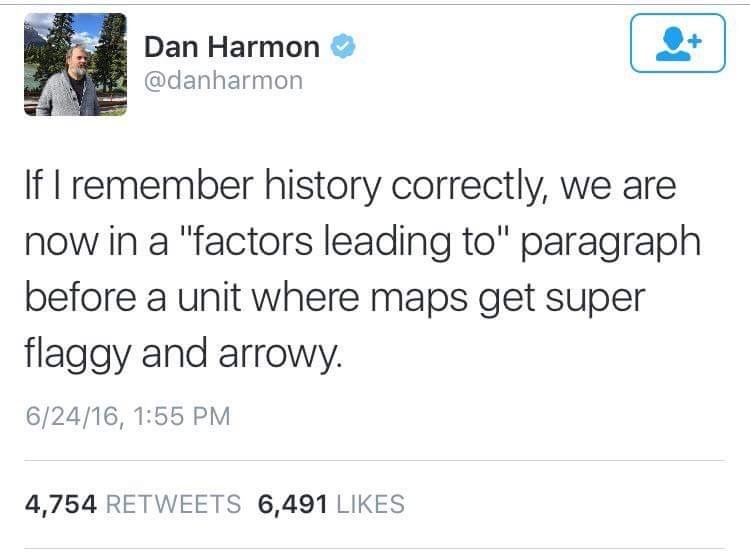
Yet another side-effect of the Trumpening has been a shift in attitude among European leaders on the issue of self-defence and military spending. eugyppius points out that the flashy new media campaign to drum up support for the new position has “borrowed” its design from an unfortunate donor:
For three years we have had war in Ukraine, masterminded on the NATO side by senile warmonger-in-chief Joe Biden. This war included bizarre moments, like direct attacks on German energy infrastructure, and also escalatory brinksmanship, as when Biden authorised long-range missile strikes within Russian territory, and the Russians responded with a not-so-subtle threat of nuclear retaliation. Throughout all of this madness, the Europeans slept, sparing hardly a single thought for their defence. Now that Donald Trump hopes to end the war in Ukraine, however, Continental political leaders are losing their minds. War: not scary at all. Peace: an existential threat.
The first way our leaders hope to dispel the disturbing spectre of peace, is via Ursula von der Leyen’s “ReArm Europe” initiative, which will permit member states to take on billions in debt to fund their rearmament. In this way, the clueless histrionic Brussels juggernaut hopes (in the words of Polish Prime Minister Donald Tusk) to “join and win the arms race” with Russia, even if (in the words of the Neue Zürcher Zeitung – h/t the incomparable Roger Köppel) we must “avoid for the moment a confrontation with the new Washington”. Becoming a global superpower with a view towards confronting the hated Americans is all about spending and time, you don’t need strategy or a plan or anything like that.
Those of you wondering whether it might be a better idea to rearm first and then set about alienating our powerful geopolitical partners simply lack the Eurotardian vision. These are such serious people, that in the space of a few days they spun up this remarkable logo for their spending programme …
… which obviously portrays the EU member states smearing yellow warpaint on themselves and in no way evokes the most notorious obscene internet image of all time. Nations just do stuff, but the Eurotards cannot even take a shit without bizarre hamfisted branding campaigns.
As I said, these are deeply serious people, and they also speak very seriously, in declarative sentences that don’t mean anything. In a publicity statement, von der Leyen said that these are “extraordinary times” which are a “watershed moment” for Europe and also a “watershed moment for the Ukraine”. Such extraordinary watersheds require “special measures,” such as “peace through strength” and “defence” through “investment”. Top EU diplomat and leading Estonian crazy person Kaja Kallas for her part noted that “We have initiative on the table” and that she’s “looking forward to seeing Europe show unity and resolve”. Perhaps there will also be money in the ReArm Europe programme to outfit Brussels with an arsenal of thesauruses so we do not have to hear the same words all the time.

At Roots & Wings, Frank Furedi says that “Europe Has Just Become A More Dangerous Place” thanks to the shift to “military Keynsianism” where future economic growth is mortgaged to current military spending:

Net Zero image from Jo Nova
Of course, it is still early days, and wise counsel may well prevail over Europe’s jingoistic shift towards a war economy. The justification for opting for military Keynesianism is the supposed threat posed by Russia to European security and the necessity for defending the integrity of Ukraine. However, it is evident to all that even if all the billions earmarked for the defense of Europe are invested wisely it will have little bearing on developments on the battlefields of Ukraine. Converting Germany’s ailing automobile industry to produce military hardware will take years as will the process of transforming Western Europe’s existing security resources into a credible military force.
Just remember that Germany’s railway infrastructure is currently in too poor a state to transfer tanks and other military hardware across the country. Years of obsessing with Net Zero Green ideology have taken their toll on Germany’s once formidable economy.
It is an open secret that Europe has seriously neglected its defence infrastructure. It is also the case that initiatives led by the EU and other European institutions are implemented at a painfully slow pace. The failure of the EU to offer an effective Europe wide response to the Covid pandemic crisis exposed the sorry state of this institutions capacity to deal with an emergency. The EU is good at regulating but not at getting things done. The EU’s regulatory institutions are more interested in regulating than in implementing a complex plan designed to rearm the continent.
Nor is the problem of transforming European defense into a credible force simply an matter to do with military hardware. European armies – Britain and France included – are poorly prepared for a war. The nations of the EU have become estranged from the kind of patriotic values necessary to support a real military engagement with Russia. Keir Starmer’s “coalition of the willing” raises the question of “willing to do what?”. At a time when neither France nor Britain can secure their borders to prevent mass illegal migration their willingness to be willing will be truly tested.
Macron and his colleagues may well be good at acting the role of would-be Napoleon Bonapartes. But these windbags are not in a position seriously affect the outcome of the war in Ukraine. As matters stand only the United States has the resources and the military-technological capacity to significantly influence the outcome of this war.
While all the tough talk emanating from the Brussels Bubble has a distinct performative dimension it is important to take seriously the dangers of unleashing an explosive dynamic that has the potential of quickly escalating and getting out of control. As we head towards a world of increased protectionism and economic conflict there is a danger that European rearmament could inadvertently lead to an arms race. History shows that such a development inevitably has unpredictable consequences.
What’s really concerning about the decision taken by the European Council is not simply its “spend, spend” strategy or its wager on the economic benefits of the arms industry. What is really worrying is that Europe’s leading military hawks lack clarity about the continent’s future direction of travel. Afflicted by the disease of geopolitical illiteracy the leaders of Europe have failed to address the issue of how they can navigate a world where the three dominant powers – America, China, Russia – have a disproportionately strong influence on geopolitical matters.
Italy’s Italian Fiasco
World War Two
Published 8 Mar 2025Today Sebastian puts Indy and Sparty in the hot seat for questions about the war in China and North Africa. Just what is the deal with the Italian Army anyway? How much fighting did the CCP do against the Japanese? And what’s the most overlooked event of the first year of war?
(more…)
Sulla: bloodthirsty psycho or saviour of the Republic?
Adrian Goldsworthy. Historian and Novelist
Published 23 Oct 2024Today’s question asked about Lucius Cornelius Sulla, the first man to the march his legions against the city of Rome, starting the first — but far from the last — of Rome’s civil wars. He killed a lot of people, broke a lot of laws and conventions, but as dictator also introduced a very “conservative” programme of reforms. How should we judge Sulla, as a selfish, brutal murderer, or as a reluctant rebel and well-intentioned reformer?
QotD: HR metastasized
The Peter Principle tells us that everyone gets promoted to their own level of incompetence. So, that explains why the people actually running HR departments are incompetent. The second is Parkinson’s Law, which everyone usually takes to be about work expanding to fill the time available etc. In reality the book as a whole is about how bureaucracy will eat an organisation from the inside. Like one of those parasitic wasps where the pupae eat the spider from the inside out. The lesson of this is that proper management of any organisation is a constant battle against the growth of the bureaucracy. Proper managers should — must — spend significant amounts of their time turning a blowtorch on that internal bureaucracy. Real slash and burn, proper Carthaginian Solution on their arses.
The third has the most direct and exact relevance here. Up the Organisation. In which we are told that the personnel department (what we had before Human Resources) should be the secretary of the line manager. Someone wants to hire someone? Sure. The person who decides who to hire is the person doing the hiring. He needs an assistant only in so far as someone should phone up the local rag to put the job ad in.
Now, it is necessary to have someone making sure the details for the paycheque are right, that they enrolled in the company equity scheme, health care is sorted. But that’s some beancounter preferably hundreds of miles away from any actual influence upon anything.
All of which — from that distillation of the finest ponderings upon corporate management civilisation has so far achieved — tells us what to do with Human Resources.
Turn the blowtorches on the power skirts. Possibly even the full Carthaginian. Tho’ who we’ll find to buy as drabs and doxies the usual inhabitants of HR is another matter. Dunno, might be worth ploughing them into the fields and selling the salt instead.
Tim Worstall, “The Invasion Of The Power Skirts”, It’s all obvious or trivial except …, 2024-12-06.
March 7, 2025
Soviet Invasion of Finland: Winter War 1939-40
Real Time History
Published 18 Oct 2024November 1939. Germany and the Soviet Union have conquered Poland, and Germany is at war with France and Britain. Moscow is free to do as it pleases in Eastern Europe and sets its sights on Finland – but the Winter War will be a nasty surprise for Stalin.
Corrections:
02:19 The dot marking Leningrad is about 80km too far east, it’s of course directly at the far eastern end of the Gulf of Finland.
(more…)
QotD: Infantry combat and esprit de corps
Well, no. Not quite.
We can approach this question through the idea of cohesion – the moral force that holds a group of combatants together on the battlefield under the intense emotional stresses of combat. The intense bonds that soldiers form in modern armies (particularly those in the European pattern) are not an accident, but a core part of how those armies, institutionally, seek to build cohesion. [W]e discussed briefly the emergence of the extensively drilled and disciplined “mechanical” soldier of Early Modern Europe, noting that this approach wasn’t necessary for the effective use of firearms (the Ottoman Janissaries, for instance, were quite good with firearms, but were not trained and organized in this way), but rather was a product of elite aristocratic (read: officer) disdain for their up-jumped peasant soldiers and thus the assumption by those aristocrats that the only way to get such men to fight effectively was to relentlessly drill them.
Now the funny thing about this system is that it clearly worked, but not for the reasons its aristocratic pioneers believed. It was only really after the Second World War that systematic study began to be made of unit cohesion (e.g. S.L.A. Marshall, Men Against Fire (1947), though subsequent literature on the topic is voluminous and Marshal’s work has its problems, but its conclusions are broadly accepted having been confirmed in subsequent studies) [NR: Some discussion on Marshall and his theories here]. What emerged quite clearly was that it wasn’t “the cause” or patriotism that held troops together under fire, but group cohesion born out of an intense need not to let fellow soldiers in the unit down. In short, what held units together and made them fight more effectively was (in part, there are many conclusions in Men Against Fire) the strong social bonds between comrades.
And, in fact, the drill and discipline of early modern European armies unintentionally did quite a lot of cohesion building things. Soldiers were removed from civilian society (isolation from larger groups builds unit cohesion), split into very small groups (keeping the core group that coheres below Dunbar’s number aids in group cohesion; thus why the platoon is a natural unit size) and then pushed through difficult and unpleasant training (that drill and discipline) creating a sense of unique shared experience and sacrifice. All of which doesn’t render men machines, but it does create strong social bonds within the units that will keep the men fighting even when they care little for their cause (which they generally did in this period; one does not find a super-abundance of patriotism among, say, the Army of Flanders).
And there is a tendency to point to this cohesion, its modern source in “toughening” boot camp and to say, “aha! That is the true universal about effective soldier-warriors!” Except – and you knew there was going to be an except – except it isn’t. Systems built on the use of drill and discipline for the development of unit cohesion through social bonds are actually, historically speaking, quite rare. We see systems like that in use by the Romans from the Middle Republic forward (but significantly faded by the end of late antiquity; the Byzantine army doesn’t seem to function this way), in China from the Han Dynasty onward, in Japan for the ashigaru infantry from the Sengoku period, and in Europe from the Early Modern period. That sounds like a lot, but that is relatively small minority of the historical period and even then in a relatively small minority of places. It is, for instance, a period that only covers about half of the historical period in Western Europe, the place most often associated with this very system of organization (though that association is perhaps unfair to East Asia).
Instead, most societies relied on existing social bonds formed outside of the experience of war for cohesion. Greek hoplite armies, for instance, generally formed up by polis (read: city) and then within those blocks by still smaller and smaller social divisions, so that family and neighbors would be standing shoulder to shoulder in the battle line (Sparta does this through the system of communal messes, the syssitia, but the idea that you fought alongside the men you dined with socially – your neighbors, generally – was perfectly normal in most Greek cities). That was intentional – it allowed the phalanx to cohere through the social pressure not to be seen as a coward before the men who meant the most to you, whose shaming gaze you would have to endure in civilian life. The same pressures, by the well, held together the (mostly volunteer) armies of the American Civil War (on this, see, McPherson, For Cause and Comrades (1997)).
By contrast, “warrior” classes often rely on a sort of class solidarity along with the demand of an individual military aristocrat to be individually militarily excellent. Richard Kaeuper quips of the literature of the medieval knightly class that it was filled with “utterly tireless, almost obsessional emphasis placed on personal prowess” (R.W. Kaeuper, Chivalry and Violence in Medieval Europe (1999)). We’ve talked a fair bit about the values of mounted aristocrats, both in their role as combatants and in their roles as generals and those values are relatively disconnected from discipline-induced forms of buddy-cohesion. Of course exactly what “good generalship” or “good officership” looks like varies wildly from place to place – Alexander was expected to command his cavalry from the front; Roman emperors rarely took the battlefield and when they did they commanded from the rear since it would be foolish to risk the “brain” of the army in personal combat and in any event someone at the front of a cavalry charge can hardly direct the rest of the army.
One of the things I find most striking about the “warrior ethos” advanced by writers like Pressfield is that it accepts as normal the unique nature of the bonds that hold soldiers together in battle, assuming this bond and its shared sacrifice to be at once unique to combat and also transcendent to all combatants. But one of the key points made very well in Sebastian Junger’s War (2010) and later Tribe (2016) is just how strange that experience is, historically. Junger notes that in earlier societies, soldiers would have returned from war into communities (often small, agricultural communities or tribal communities) every bit as close-knit as the infantry platoon – and indeed, often involving literally the same people as the infantry platoon. Instead, the intense feeling of uniqueness that modern soldiers feel about the bonds of combat is because of the historically unusual deracination produced by modern societies by the industrial revolution and the post-industrial period.
Bret Devereaux, “Collections: The Universal Warrior, Part IIb: A Soldier’s Lot”, A Collection of Unmitigated Pedantry, 2021-02-05.
March 6, 2025
Passionate belief in historical untruths
As mentioned in earlier posts, one of the most toxic exports from Australia to the rest of the Anglosphere has been the academic indulgence in believing that “settler colonialism” explains everything about the history of Canada, Australia, New Zealand and anywhere else the British diaspora touched:

Welby in Zanzibar
Throughout the English-speaking world elites are falling over themselves to believe the very worst of their own countries.
In Britain, the Church of England has committed itself to spend an initial £100 million on slavery-reparations in response to the discovery that its endowment had “links” with African enslavement. “The immense wealth accrued by the Church … has always been interwoven with the history of African chattel enslavement”, a document explains. “African chattel enslavement was central to the growth of the British economy of the 18th and 19th centuries and the nation’s wealth thereafter”. And this has “continuing toxic consequences”.
Yet almost none of this is true. The evidence shows that the Church’s endowment fund was hardly involved in the evil of slave-trading at all. Most economic historians reckon the contribution of slave-trading and slavery to Britain’s economic development as somewhere between marginal and modest. And between abolition in 1834 and the present, multiple causes have intervened to diminish slavery’s effects.
Consonant with his church’s policy, the (then) Archbishop of Canterbury, Justin Welby preached a sermon in Christ Church Cathedral, Zanzibar last year, in which he criticised Christian missionaries for treating Africans as inferior and confessed that “we [British] must repent and look at what we did in Zanzibar”.
Really? What the British did in Zanzibar during the second half of the 19th century was to force the Sultan to end the slave-trade. Indeed, the cathedral in which the archbishop was preaching was built over the former slave-market. And here’s what the pioneering missionary David Livingstone wrote about black Africans in 1871: “I have no prejudice against [the Africans’] colour; indeed, anyone who lives long among them forgets they are black and feels that they are just fellow men…. If a comparison were instituted, … I should like to take my place among [them], on the principle of preferring the company of my betters”.
[…]
St. John Baptiste church was one of many local churches to go up in flames during Justin Trudeau’s performative national guilt trip over “unmarked mass graves” at former Residential Schools across Canada.
Which bring us to Canada. The May 2021 claim by a Kamloops Indian band to have discovered the remains of 215 “missing children” of an Indian Residential School was quickly sexed up by the media into a story ‘mass graves’, with all its connotation of murderous atrocity. The Toronto Globe and Mail published an article under the title, “The discovery of a mass gravesite at a former residential school in Kamloops is just the tip of the iceberg”, in which a professor of law at UBC wrote: “It is horrific … a too-common unearthing of the legacy, and enduring reality, of colonialism in Canada”. Prime Minister Justin Trudeau ordered Canadian flags to be flown at half-mast on all federal buildings to honour the murdered children. Because the Kamloops school had been run by Roman Catholics, some zealous citizens took to burning and vandalising churches, 112 of them to date. The dreadful tale was eagerly broadcast worldwide by Al Jazeera.
Yet, four years later, not a single set of remains of a murdered Indian child in an unmarked grave has been found anywhere in Canada. Judging by the evidence collected by Chris Champion and Tom Flanagan in their best-selling 2023 book, Grave Error: How the Media Misled us (and the Truth about the Residential Schools), it looks increasingly probable that the whole, incendiary story is a myth.
So, prime ministers, archbishops, academics, editors, and public broadcasters are all in the business of exaggerating the colonial sins of their own countries against noble (not-so-very) savages — from London to Sydney to Toronto. Why?

The Iron Curtain Descends – W2W 10 – News of 1946
TimeGhost History
Published 5 Mar 20251946 sees the world teetering on the brink of a new global conflict. George Kennan’s long telegram outlines Moscow’s fanatical drive against the capitalist West, while our panel covers escalating espionage, strategic disputes over Turkey, and the emerging ideological battle between the U.S. and the USSR. Tune in as we break down the news shaping the dawn of the Cold War.
(more…)
HMCS Bonaventure – The Pride of Canada’s Fleet
Skynea History
Published 22 Oct 2024For today’s video, we’ll be looking at the last of Canada’s aircraft carriers. Not typically a navy you associate with that kind of ship, but the Canadians actually operated three during the Cold War.
The third, HMCS Bonaventure, is an interesting one. A small ship, that operated aircraft at the very edge of her capability. And routinely baffled American pilots in the process.
Yet, she was also a ship that came to an end before her time. Decommissioned and scrapped, right after an expensive (and extensive) mid-life overhaul. In what is generally seen as a bad political move, more than anything to do with her capabilities.
(more…)
QotD: Old Etonians
When I first started there, the traditions seemed daunting, and while you had a week of grace period to find your feet, it took a lot longer for the novelty truly to wear off. Dressed in a tailsuit that makes you look like a penguin, and that even the production team of Downton Abbey would question, it’s a complete culture shock. Teachers become “beaks”; homework becomes “EW (short for Extra Work)”, and the threat of “tardy book” (a punishment where you have to get up early to report to the School Office) is ever present. Your life is governed by a tutor, housemaster, and dame (a surrogate mother for your time there, and the most influential person in your day-to-day life), and outside of lessons (known as “schools”) you’re left to your own devices. It’s a sink or swim situation, and some can’t hack the overload of independence.
You’re constantly surrounded by things named after great men who have come before you – whether that be John Maynard Keynes (an economics society) or William Gladstone (a library) – and you can’t help but see yourself as heir to some great dynasty. Sitting in Upper School – a large schoolroom now mainly used for talks by visiting speakers – the walls are lined with marble busts of illustrious Old Etonians past, and it’s not hard to daydream about joining them. In our first ever assembly the head master put it best: “If you know that some interesting people have gone on to do some interesting things, whether it’s George Orwell or the Duke of Wellington, that does implicitly ask the question, why not you?” Success never seems far away, and often you’re regaled with tales about the time your beak caught a famous actor smoking, or how awful a pupil a noted academic once was. Neither does service, particularly when you pass the memorial boards for the First World War (as you do daily on the way to chapel): 1157 Old Etonians died, and 37 Old Etonians have won the Victoria Cross – 17 more than any other school.
In your final years, it’s fun to try and work out who’s going to be most successful after leaving, and – it never seems too outlandish – who among you could be a future prime minister. The people you consider are never confined to a particular group – it’s not “one of the debaters” or “one of the Rugby XV” – in fact, it’s often those who you can’t seem to categorize, or transverse the groups that are most magnetic. To get into Eton, you have to do well in the infamous “List Test”, composed of a computerized assessment and an interview with one of the beaks. For an eleven year old, it can be brutal (one boy left crying midway through our test), particularly as you don’t know what they want: they’re not looking for candidates that fit a particular box. Potential is valued more than current ability, and the greatest asset is that of being interesting. With only one in five getting an offer (odds stiffer than Oxbridge), and after five years of being expected to perform at the highest level, it’s unsurprising that students end up so successful.
Ivo Delingpole, “Boris and the Spirit of Eton”, Die Weltwoche, 2020-01-29.
March 5, 2025
Trump’s next target – Europe
Andrew Doyle thinks that the next step of Donald Trump’s culture war will be highlighted by a struggle over freedom of speech with the UK and the regulators of the European Union:
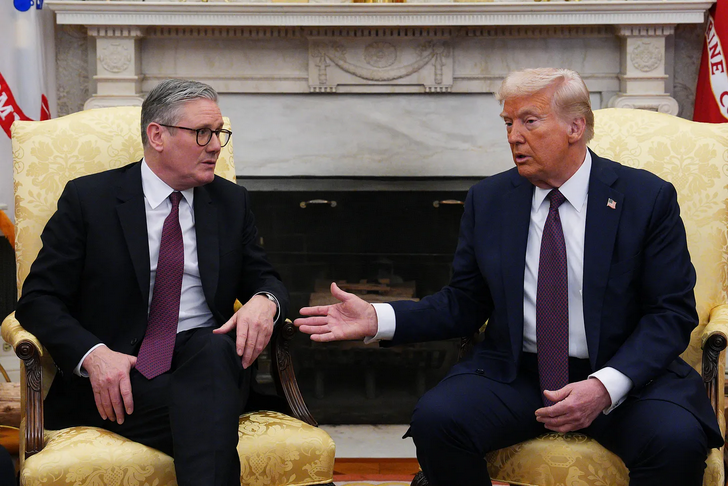
British PM Keir Starmer talks with US President Donald Trump in the White House.
New battle lines are forming in the culture war. While the woke movement appears to be in retreat, the forces of authoritarianism are regrouping for a fresh assault. Rather than maintaining a straightforward conflict between right and left, the next phase of the culture war will most probably be waged between Europe and the United States. It has all the qualities of a novel by Henry James for the digital age, with the distinctions between the old world and the new brought once again into sharp focus.
Free speech will be the key issue. Most of us will have seen the footage of vice-president J. D. Vance last week in the Oval Office taking Keir Starmer to task for the “infringements on free speech that actually affect not just the British” but also “American technology companies and by extension, American citizens”. Starmer pushed back, saying “in relation to free speech in the UK, I’m very proud of our history there”. It’s a bit like Hannibal Lecter boasting about his ongoing commitment to vegetarianism.
The word “history” was apt, given that Starmer’s government is seemingly determined to ensure that free speech is consigned to the past. One of its first acts after seizing power was to ditch the Higher Education (Freedom of Speech) Act. In February, Angela Rayner revealed her plans for the establishment of a sixteen-member council on “Islamophobia” which could see the criticism of religion criminalised. Meanwhile, Yvette Cooper has been staunchly defending the police for recording “non-crime”, while the chairman of the College of Policing, Lord Herbert, has suggested that the best approach to tackling the controversy is to simply rename “non-crime hate incidents” as something more palatable. Apparently Lord Herbert believes that the problem is the nomenclature, not the fact that citizens are being investigated by the armed wing of the state for lawful behaviour.
All of this is before we get to Starmer applying pressure to the judiciary to mete out draconian sentences for offensive posts and memes on social media, and the government’s determination to crack down on online “disinformation”. Ours is an authoritarian government, and Starmer’s Orwellian denial of the truth of his position in the Oval Office is to be expected. Autocrats throughout history have enacted censorship “for the public good”. Today, they target “disinformation”, a term so vague that it can be applied to anyone who questions the narrative of the ruling class.
And so, as I say, the new front of the culture war will most likely be transatlantic. The US government will simply not tolerate the widespread censorship of its citizens by laws passed overseas. Jim Jordan, chairman of the Committee on the Judiciary of the House of Representatives, has already issued subpoenas to eight US tech companies to divulge all communications they have had with the UK government regarding “content moderation” (i.e., censorship). Jordan is particularly concerned about the Labour government’s intention to empower OfCom to regulate social media, and he has specifically mentioned UK officials who “have already threatened to use UK laws to police American speech”.
N.S. Lyons suggested in the latest post at The Upheaval that Vice President J.D. Vance’s real message to the European leaders can be rephrased as “Give Up the Information War and GTFO”:
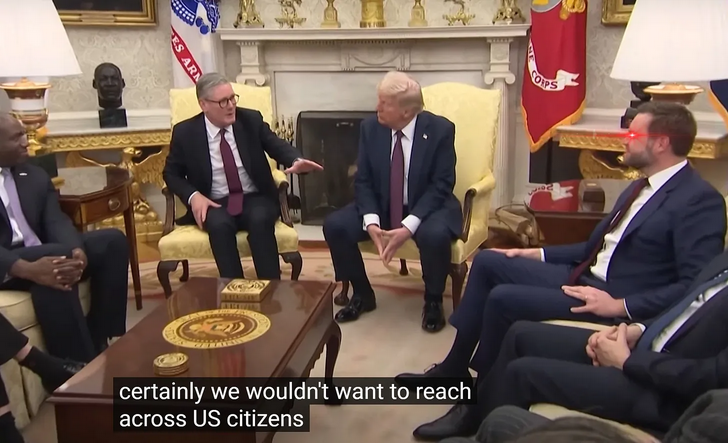
The political elite of Europe and the Anglosphere appeared shocked by J.D. Vance’s wonderfully blunt speech in Munich last month. The U.S. Vice President declared Washington’s top security concern to be “the threat from within” the NATO alliance and castigated assembled leaders for their increasingly brazen assaults on “democratic values”, including censoring speech, suppressing popular opposition parties, and canceling elections. But if this shock isn’t feigned then it is rather remarkable, given that these elites were in their own way already effectively at war with the United States. All Vance did was point out the nature of this hidden conflict.
Vance delivered multiple messages with his speech, the broadest and most historic of which was that the era of “post-national” globalist liberalism is over. The United States, he indicated, now has a core interest in seeing a Western world that is collectively strong because its sovereign nations are strong, with the self-confidence to independently defend themselves physically, culturally, and spiritually. His emphasis on promoting free speech and democratic legitimacy tied into this message, but was about far more than the importance of “shared values” or even Washington’s new friendliness to nationalist parties. Practically, it was an implied warning that the role Europe has been playing as a proxy actor in the political and ideological conflicts raging in the United States will no longer be tolerated. More specifically, it was a declaration that ongoing transatlantic institutional, technological, and legal support for America’s embattled left-wing deep state must end – or else.
After Donald Trump’s election in 2016, America’s panicked establishment elites reacted by attempting to construct a system for managing public opinion through strict control of information, especially online information. The idea was that growing public support for populism was fueled by “low-information voters” and their consumption of “misinformation” and “disinformation”, including from foreign actors, and that if their “information diet” could just be controlled then they would stop voting wrong. The underlying assumption here was of course that the elite’s own increasingly radical policy preferences were the only rational path, opposable only by the stupid and easily manipulated. As Trump’s defeated opponent Hillary Clinton would later put it, social media platforms had fundamentally changed the information environment and “if they don’t moderate and monitor the content, we lose total control”.
This intended system of thought-control would later grow into the censorship industrial complex that was partially revealed following Elon Musk’s acquisition of Twitter. But a big obstacle initially stood in the way: the U.S. Constitution and its protection of free speech. The public might be receiving the “wrong” information on the internet, but “our First Amendment stands as a major block to be able to just, you know, hammer it out of existence”, as John Kerry lamented in a speech to the World Economic Forum.
Under the Biden administration, this legal problem was partially solved by simply ignoring it, the federal government directly colluding with technology companies and a network of “independent” (state-funded) “fact-checking” organizations to impose mass censorship on American citizens. The result was, as one federal judge later described it, effectively “the most massive attack against free speech in United States’ history”.
A more subtle and sustainable work-around was also discovered, however. This was to circumvent the U.S. Constitution by outsourcing the policing of the internet and populist movements to other countries around the world. This could be done because the internet is global and so the whole network is affected by government regulations on any local market of sufficient size. Leaders on both sides of the Atlantic immediately grasped that legal and regulatory structures imposed by the European Union, with the leverage of its huge unified market, could for example force internet companies the world over – including U.S. companies – to change their behavior in order to comply and avoid losing access (this imperialistic regulatory strong-arming was dubbed the “Brussels Effect”, becoming Europe’s only significant innovation this century).

QotD: British and French Enlightenments
By the time she wrote, a number of historians had accepted that the Enlightenment, once characterized as the “Age of Reason”, came in two versions, the radical and the skeptical. The former was identified with France, the latter with Scotland. Historians of the period also acknowledged that the anti-clericalism that obsessed the French philosophes was not reciprocated in Britain or America. Indeed, in both the latter countries many Enlightenment concepts — human rights, liberty, equality, tolerance, science, progress — complemented rather than opposed church thinking.
Himmelfarb joined this revisionist process and accelerated its pace dramatically. She argued that, central though many Scots were to the movement, there were also so many original English contributors that a more accurate name than the “Scottish Enlightenment” would be the “British Enlightenment”.
Moreover, unlike the French who elevated reason to a primary role in human affairs, British thinkers gave reason a secondary, instrumental role. In Britain it was virtue that trumped all other qualities. This was not personal virtue but the “social virtues” — compassion, benevolence, sympathy — which British philosophers believed naturally, instinctively, and habitually bound people to one another. This amounted to a moral reformation.
In making her case, Himmelfarb included people in the British Enlightenment who until then had been assumed to be part of the Counter-Enlightenment, especially John Wesley and Edmund Burke. She assigned prominent roles to the social movements of Methodism and Evangelical philanthropy. Despite the fact that the American colonists rebelled from Britain to found a republic, Himmelfarb demonstrated how very close they were to the British Enlightenment and how distant from French republicans.
In France, the ideology of reason challenged not only religion and the church, but also all the institutions dependent upon them. Reason was inherently subversive. But British moral philosophy was reformist rather than radical, respectful of both the past and present, even while looking forward to a more enlightened future. It was optimistic and had no quarrel with religion, which was why in both Britain and the United States, the church itself could become a principal source for the spread of enlightened ideas.
In Britain, the elevation of the social virtues derived from both academic philosophy and religious practice. In the eighteenth century, Adam Smith, the professor of moral philosophy at Glasgow University, was more celebrated for his Theory of Moral Sentiments (1759) than for his later thesis about the wealth of nations. He argued that sympathy and benevolence were moral virtues that sprang directly from the human condition. In being virtuous, especially towards those who could not help themselves, man rewarded himself by fulfilling his human nature.
Edmund Burke began public life as a disciple of Smith. He wrote an early pamphlet on scarcity which endorsed Smith’s laissez-faire approach as the best way to serve not only economic activity in general but the lower orders in particular. His Counter-Enlightenment status is usually assigned for his critique of the French Revolution, but Burke was at the same time a supporter of American independence. While his own government was pursuing its military campaign in America, Burke was urging it to respect the liberty of both Americans and Englishmen.
Some historians have been led by this apparent paradox to claim that at different stages of his life there were two different Edmund Burkes, one liberal and the other conservative. Himmelfarb disagreed. She argued that his views were always consistent with the ideas about moral virtue that permeated the whole of the British Enlightenment. Indeed, Burke took this philosophy a step further by making the “sentiments, manners, and moral opinion” of the people the basis not only of social relations but also of politics.
Keith Windschuttle, “Gertrude Himmelfarb and the Enlightenment”, New Criterion, 2020-02.


