
World War Two
Published Nov 8, 2023Indy takes a look at the armoured beasts battling it out on the Western Front. On the German side we have vehicles like the long-serving Panzer IV, the sleek and modern Panther, and the obnoxiously heavy King Tiger. These are arrayed against the American stalwart, the M4 Sherman, and British tanks like the up-gunned Firefly, Cromwell, and Churchill.
(more…)
February 5, 2024
Western Front Tank Warfare 1944
Comments Off on Western Front Tank Warfare 1944
February 4, 2024
Is the Red Army too fast for its own good? – WW2 – Week 284 – February 3, 1945
World War Two
Published 3 Feb 2024Soviet forces have reached the old German border in force, however, logistical issues and a strong enemy presence possibly threatening their flanks means that a drive on Berlin may not be doable just now. Heinrich Himmler is in charge of the new Army Group to defend the Reich, and he has a host of problems. On the Western Front, the Allies finally eliminated the Colmar Pocket, and in the Philippines, the American advance reaches Manila, and the battle for the city is about to begin.
(more…)
Comments Off on Is the Red Army too fast for its own good? – WW2 – Week 284 – February 3, 1945
Civil strife in Spain before the full civil war broke out
Niccolo Soldo continues his in-depth look at the situation in Spain leading up to the outbreak of the civil war in 1936. It’s clear that bloodshed was in the immediate future — so much so that it’s almost surprising that it took as long as it did for the war to start in earnest:

Flag of Spain during the Second Spanish Republic (1931-1939).
Image by SanchoPanzaXXI via Wikimedia Commons.
In 1930, almost half of all Spaniards over the age of 10 were illiterate. The country was still overwhelmingly agrarian, with a small number of very wealthy landowners owning about 2/3rds of all the arable land in Andalusia alone, employing almost a million landless campesinos at barely subsistence-level wages. Industry was almost entirely found only in the north and northeast. Industrialization was beginning to pick up pace by the turn of the century, but was still very far behind the rest of Western Europe by the time the Second Spanish Republic came into being in 1931.
Despite Spain having one foot in the past, its other foot was in the present, a present that was rapidly changing and very unstable politically. The loss of confidence in King Alfonso XIII on the part of the middle and upper classes led to his abdication which opened the door to the establishment of the Second Republic, a democracy in a time when democracy itself was under attack throughout Europe, having already lost in Russia and Italy, and on its way to disappearing in other countries, most notably Germany.
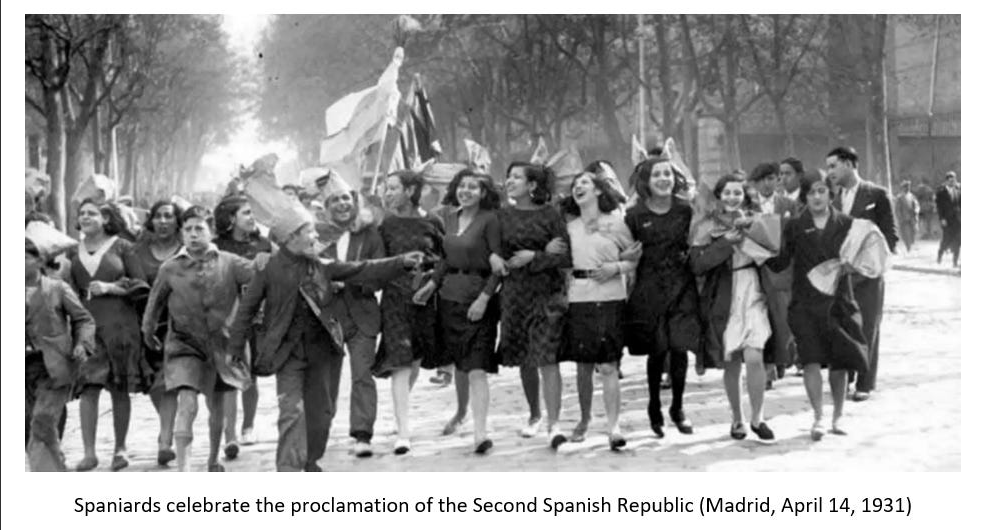
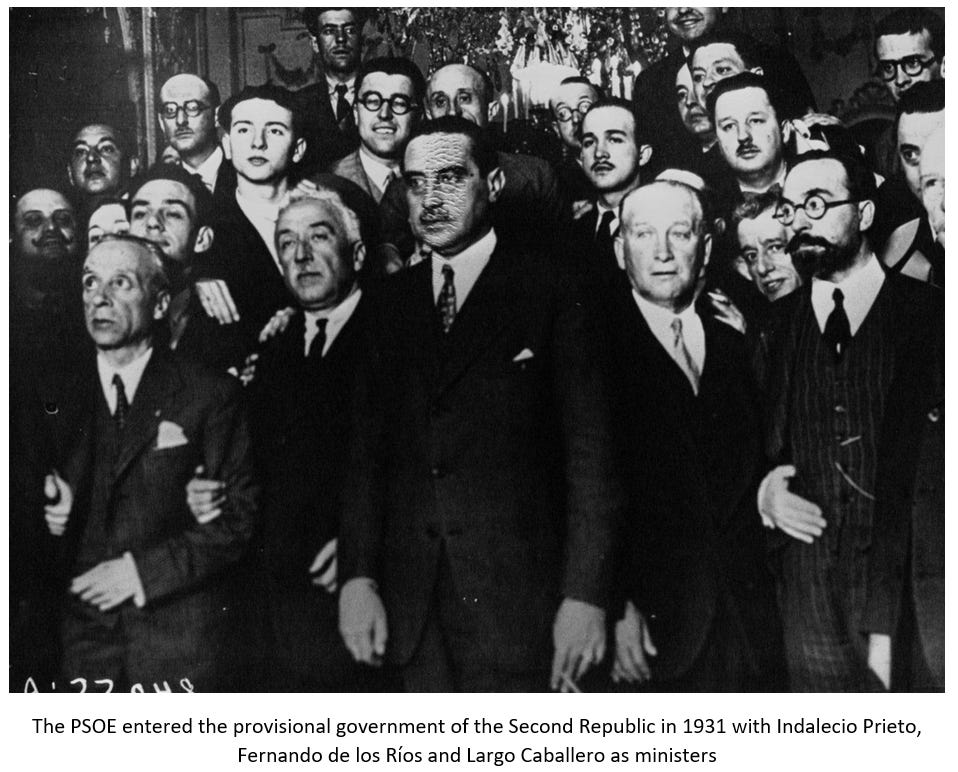
The end of the monarchy was celebrated throughout the country (with some exceptions), but not always for the same reason. Yes, anti-monarchist forces viewed the monarchy as retrograde and out of step with the modern era, but only the liberals and various republican parties were committed to democracy and parliamentary politics. The Socialists (PSOE) for example, were riven by factionalism and a generational divide whereby there were those who sought to use power in office to both settle scores with their old enemies in the military, the landowning class, and especially the Catholic Church, and to actually launch a revolution along Marxist lines. For them, the Second Republic was a vehicle for a larger goal, and not an end goal in and of itself. Anarchists celebrated the end of the monarchy, but they were opposed to any and all government on principle. For Anarchists, the Second Republic was also a path towards revolution as well. For Catalan separatists, the Spanish Second Republic was a stepping-stone towards independence, or at least towards as much political and economic autonomy as possible.
Conservatives were in a state of disarray upon the establishment of the Second Republic. Despite this condition, all the factions that could be grouped as “conservatives” largely supported the new regime … at least at the outset. Once the agenda of the first government of the Second Republic was made public, opposition began to harden.
Rather than trying to generate a grand consensus among the various factions that dominated Spanish politics, economics, and society in 1931, the liberals, republicans, and socialists who led the country from 1931-33 instead chose to attack the core interests of their political rivals to the right. The military was to be slashed via the retirement of a large number of its officer class, land was to be seized from wealthy landowners in order to redistribute it to the poor and landless, and the Catholic Church was to be stripped of its role in educating young Spaniards, with the Jesuits expelled from the country altogether, and many churches, convents, monasteries, episcopal residences, parish houses, seminaries, etc. expropriated by the Spanish state. Private Catholic schools were also expropriated and turned into government-run ones instead. The Church was also forced to pay taxes and was banned from all industry and trade, “… enforced with strict police severity and widespread mob violence”.
These attacks on the Catholic Church (which also saw the torching of churches, monasteries, and convents in 1931 as we saw in the previous entry in this series) resulted in the release of a Papal Encyclical by Pope Pius XI on June 5, 1933 entitled “Dilectissima Nobis“. In this encyclical, Pius XI decries the persecution of the Church in Spain, and asks Spanish Catholics to defend themselves and the Church from attacks by the government. He describes the attacks as “… [an] offense not only to Religion and the Church, but also to those declared principles of civil liberty on which the new Spanish regime declares it bases itself”. As we already saw previously, then-Minister of War in the Spanish cabinet, Manuel Azaña, famously declared that “All the convents in Spain are not worth a single Republican life“.
There was no attempt to build a solid democratic foundation for the Second Republic whatsoever. Instead, a cultural revolution was quickly ushered in, and an agrarian revolution was threatened, but only implemented half-heartedly. The first government of the Second Spanish Republic managed to alienate the military, the landowning class, conservatives, and the Catholic Church overnight.
On the other side of the political divide, the centrists were attacked from the left for not going far enough, fast enough. Campesinos and small landowners demanded immediate expropriation of latifundia estates to be redistributed to them. The youth wing of the PSOE urged the nationalization of all industry, which led to factionalism within the socialist groupings. Less radical socialists pointed to the extension of voting rights to women, to the enshrining of the eight hour workday in law, and to the increase in wages for industry workers as the biggest successes of the first two years of the Second Republic. These radical factions were not content with these incremental gains, and demanded “more, now!”
This radicalism culminated in the “Casas Viejas Incident”, which I described in the previous entry:
Staying true to form, the anarchists were restless and, as is their nature, opposed the present government in Spain as they opposed all governments, viewing them as inherently oppressive. Their massive labour union, CNT, led by the vanguard of FAI, began demonstrations in various locations across the country, with the greatest actions taking place in Andalusia. Political violence ensued, with two Civil Guards wounded. The Assault Guards, set up by the new Constitutional authorities in the Republic to provide a new force to purportedly protect those who lacked protection under the Monarchy, raided the village of Casas Viejas near Cadiz. They encountered a group of anarchists locked in a house and set fire to it (while disarming others in the village who were armed), and then executed them.
This act of state violence was committed not by fascists, nationalists, royalists, or even conservatives. It was committed by a liberal-socialist regime and its purposely-created security force, against anarchists. All the parties involved in this incident would find themselves on the same side in the not-too-distant Spanish Civil War.
Comments Off on Civil strife in Spain before the full civil war broke out
Johnson LMG: History & Disassembly
Forgotten Weapons
Published Feb 29, 2016The Johnson light machine gun is one of the lesser-known US military machine guns of WWII, although it seems to have been very popular with all those who used it in combat. Melvin Johnson made a commendable attempt to get his rifles adopted by the US military, but was unable to unseat the M1 Garand as American service rifle. However, he did make a significant sale of both rifles and light machine guns to the Dutch colonial army.
By the time those Dutch guns were ready to ship, however, the Japanese had overrun most of the Dutch islands. The guns were thus basically sitting on the docks with nowhere to go, and at that point the US Marine Corps took possession of them. Because of their short recoil action and quickly removable barrels, the Johnson guns were ideal for airborne Paramarines, and saw use in the Pacific with these forces. They were also used by the joint US/Canadian First Special Service Force in Italy.
In many ways, the Johnson LMG is similar to the German FG-42, although with more emphasis on full-auto use instead of shoulder rifle use. It fired from a closed bolt in semiauto and from an open bolt in full auto, and had a bipod both effective, light, and easily detachable. Overall the Johnson is a light, handy, and very easily dismantled weapon, and its popularity with combat troops seems well deserved.
Comments Off on Johnson LMG: History & Disassembly
February 3, 2024
A Day in Ancient Rome
toldinstone
Published Nov 10, 2023Following Marcus Aurelius on the day of his final triumph.
Chapters:
0:00 Another day
1:05 Petitions
3:12 Breakfast
3:51 The Triumph
4:44 Romanis Magicae
5:37 Artifacts of the wars
7:09 Caesar, you are mortal
(more…)
Comments Off on A Day in Ancient Rome
February 2, 2024
Perhaps something for Wodehouse fans who want a bit more sex and violence in their fiction
At The Conservative Woman, Alan Ashworth recommends a book by one of P.G. Wodehouse’s disciples, but only for those who are ready for Plum-like wit with “lashings of sex, violence, murder and drunkenness”:
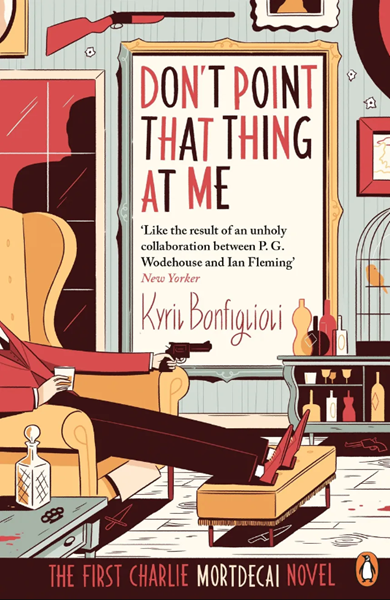
If, like me, you have read every line of PG Wodehouse’s 90-odd books – at least half a dozen times each in the case of the Jeeves novels – your attention might be piqued, if piqued is the word I seek, by one of the Master’s disciples. His name is Kyril Bonfiglioli.
In a trilogy about an art dealer named Charlie Mortdecai based loosely on himself, Bonfiglioli, or Bon as his friends and enemies called him, combines a Woosterish turn of phrase with lashings of sex, violence, murder and drunkenness. Mortdecai is snobbish, greedy, lustful, unscrupulous, untrustworthy, gloriously politically incorrect and hilarious to boot.
The first book, Don’t Point That Thing At Me, was published in 1973, two years before Wodehouse died. In a short foreword, Bon writes: “This is not an autobiographical novel: it is about some other portly, dissolute, immoral and middle-aged art dealer.”
The action begins with Mortdecai in his Mayfair mansion burning a gilt picture frame in the fireplace. He, of course, has a sidekick whose name begins with J but Jock has little in common with Bertie Wooster’s loyal manservant. As Bon puts it, “Jock is a sort of anti-Jeeves; silent, resourceful, respectful even, when the mood takes him, but sort of drunk all the time, really, and fond of smashing people’s faces in. You can’t run a fine-arts business these days without a thug and Jock is one of the best in the trade … his idea of a civil smile is rolling back part of his upper lip from a long, yellow dogtooth. It frightens me.
“Having introduced Jock – his surname escapes me, I should think it would be his mother’s – I suppose I had better give a few facts about myself. I am in the prime of life, if that tells you anything, of barely average height, of sadly over-average weight and am possessed of the intriguing remains of rather flashy good looks. (Sometimes, in a subdued light and with my tummy tucked in, I could almost fancy me myself.) I like art and money and dirty jokes and drink. I am very successful. I discovered at my goodish second-rate public school that almost anyone can win a fight if he is prepared to put his thumb into the other fellow’s eye.”
Charlie is receiving a visit from a fat policeman named Martland who suspects him, correctly, of involvement in the theft of a Goya from Madrid five days earlier.
“Somewhere in the trash he reads, Martland has read that heavy men walk with surprising lightness and grace; as a result he trips about like a portly elf hoping to be picked up by a leprechaun. In he pranced, all silent and catlike and absurd, buttocks swaying noiselessly. ‘Don’t get up,’ he sneered, when he saw that I had no intention of doing so. ‘I’ll help myself, shall I?’
“Ignoring the more inviting bottles on the drinks tray, he unerringly snared the great Rodney decanter from underneath and poured himself a gross amount of what he thought would be my Taylor ’31. A score to me already, for I had filled it with Invalid Port of an unbelievable nastiness. He didn’t notice: score two to me. Of course he is only a policeman.”
Martland features heavily in the ensuing romp, which involves several murders, a journey across America in a Rolls-Royce, a nymphomaniac millionairess and a remote cave near Silverdale, Lancashire.
The Sad Story of Churchill’s Iceman, Geoffrey Pyke
World War Two
Published Jan 31, 2024Geoffrey Pyke is remembered as an eccentric scientist who spewed out ideas like giant aircraft carriers made of icy Pykerete. But there was much more to him than that. He was a spy, a special operations mastermind, and his novel ideas contributed to the success of D-Day.
(more…)
Comments Off on The Sad Story of Churchill’s Iceman, Geoffrey Pyke
“Who funds you?”
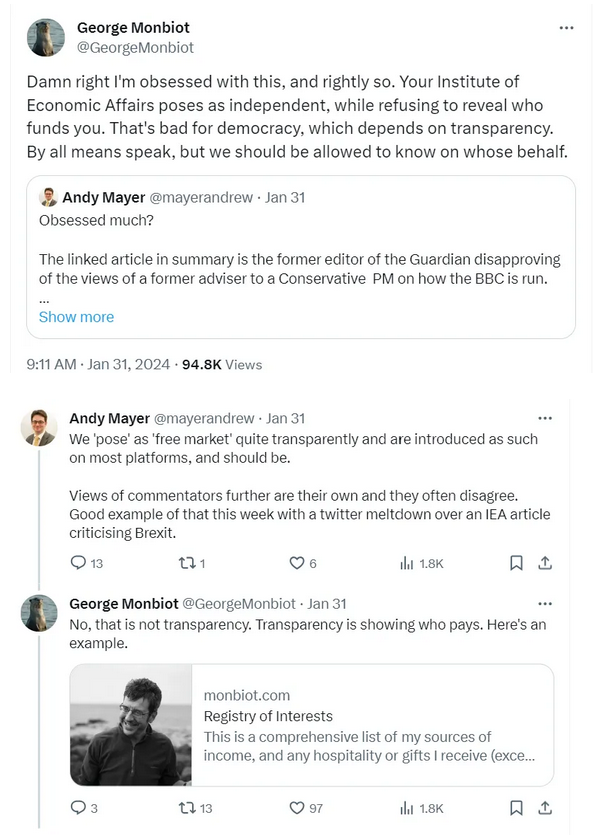
Tim Worstall considers George Monbiot (lovingly known as “The Moonbat” to early bloggers) and his demand that others make their sources of income transparent to show whether their opinions are being “bought” by shady interested parties:
George Monbiot has his positive attributes. His change of mind on nuclear power in the face of the evidence from Fukushima — that no one at all died from three reactors going pop, while 15k and more did from the tsunami and therefore he became in favour of nuclear — is an example. OK, that’s rather hitting someone over the head with a cluebat but it’s also true that Caroline Lucas didn’t manage to note that same point. So, there is that. Even if “more aware of reality that Caroline Lucas” is a low bar to have to clear.
George can also rather dig himself into holes. As he is here with his insistence about funding of varied think tanks and so on.
And, OK, let’s go look at George’s registry of interests […]
OK, that’s the sword that George declares he’s going to live by. Fair play and all that.
Except, except. Last year was pretty good, book royalties flowing in and more power to that typing. The core earning is The Guardian, royalties on top. Not unusual for a writer to be honest. Gain a core contract that produces an ongoing and assured income, spend time floating books or other work out there to see what happens to income. Freelancing is certainly a great deal more fun if you already know where the monthly nut is going to come from with such a core contract.
But, but.
Book royalties, umm, Penguin? Used to be part owned by Pearson, also at the time owners of the Financial Times. So that’s a connection into the shadowy world of international capitalists. It’s now Bertelsman, so foreign international capitalists to boot. Macmillan? They admitted to bribery in Sudan over a school books contract. So a link to international thieving capitalists too. HarperCollins? That’s Murdoch, no more need be said, right?
But, but, a reasonable response would be that this is all far removed from the level George works at. That would be a fair enough response too.
But note the thing here. By agreeing that there’s some level of connection which is too ephemeral to matter we are agreeing that this thing called the corporate veil exists. We can indeed don the tin foil hats and connect near anything we want. Pretty much all Europeans are 16th cousins for example. So I — and George — am/are responsible for WWI because we’re both related to the Kaiser, Emperor and Tsar all at the same time. It’s our family wot dun it, see? Within economic connections that concept, that there’s this thing ‘ere which is responsible not the further connections away from that, is called that corporate veil. I shop at Sainsbury’s sometimes. The Labour Minister husband of a Sainsbury’s heiress employed two butlers (before dumping her for his boyfriend if memory serves). It’s possible to claim that I therefore fund dual butlership but it’s not a claim that all that many are going to regard as valid.
But The Guardian, that core contract. The newspaper seems to have returned to profit recently but there was a decade or so there where it was losing tens of millions a year — and more in some 12 month periods. Those losses were covered by the profits from Autotrader more than anything else. So, George was funded by the facilitation of climate destruction through the trade in internal combustion engined cars.
If, you know, we wanted to put it that way.
February 1, 2024
Rome: Part 1 – Mythical Origins to the Founding of the Republic
seangabb
Published 31 Jan 2024This course provides an exploration of Rome’s formative years, its rise to power in the Mediterranean, and the exceptional challenges it faced during the wars with Carthage.
Lecture 1: Mythical Beginnings and the Founding of Rome (753 BC – 509 BC)
• What is said by the archaeology and modern research on the origins of Rome
• The lack of authentic literary history of Rome in its early period
• Legend of Romulus and Remus
• The establishment of Rome’s early monarchy
• Transition to the Roman Republic
(more…)
Comments Off on Rome: Part 1 – Mythical Origins to the Founding of the Republic
Newfoundland – “We used to be a country”
In The Line, James McLeod outlines a difficult period for the Dominion of Newfoundland which ended up narrowly voting to join Canada rather than resume self-rule that they’d had up to 1934 when the Newfoundland House of Assembly abolished itself:
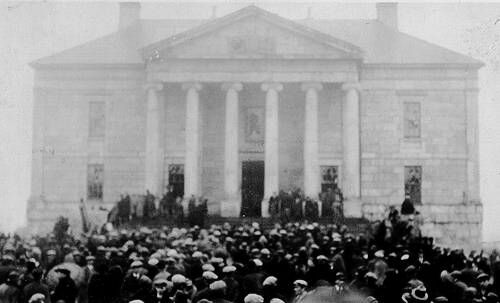
Great Riot of 1932 in front of the legislature, the Colonial Building, in Newfoundland.
Provincial Archives of Newfoundland and Labrador (Reference PANL A2-160), via Wikimedia Commons.
Before 1933, Newfoundland was proudly a dominion within the British empire. Under the Statute of Westminster, Newfoundland had the same legal status as Canada, New Zealand, South Africa and the Irish Free State.
Newfoundland was its own country. But it was a country in rough shape.
A year before the Amulree Report was published, a mob of about 10,000 people had gathered outside the Colonial Building in St. John’s. Families were living in destitution on six-cents-a-day government dole, and the government’s finance minister had just resigned and accused Prime Minister Richard Squires of personally lining his pockets with government funds.
The mob turned into a riot, which ultimately barged into the government building. Notably, the rioters briefly paused to observe a respectful silence when a brass band began playing “God Save The King”, but then they went back to rioting.
Squires fled on foot and went into hiding, and then emerged to call an election, which he lost in a landslide. During the campaign, one of his longtime allies, the prominent leader of the Fishermen’s Protective Union, openly wished for fascism.
“What is required for Newfoundland and what is most essential for the present conditions is a Mussolini,” said William Coaker.
Months later, with a new government, Newfoundland was on the verge of defaulting on its debt, and the British stepped in.
The vastly oversimplified version is that the British government was concerned that a member of the British Commonwealth defaulting on its debt could have major implications for the whole empire. So the British government bailed out Newfoundland, on the condition that a commission would be struck to investigate the island’s political and economic affairs. Lord Amulree, a British politician, was appointed as chair.
A year later, with the Dominion still teetering on the verge of bankruptcy, the Amulree Report was delivered. It contained this passage, with my emphasis added: “That it was essential that the country should be given a rest from politics for a period of years was indeed recognised by the great majority of the witnesses who appeared before us, many of whom had themselves played a prominent part in the political and public life of the Island.”
Amulree considered the possibility of some sort of national unity government, but could not get past the conclusion that, “Even if a National Government could be established on a basis which led to a suspension of political rivalry, the underlying influences which do so much to clog the wheels of administration and to divert attention from the true interests of the country would continue to form an insuperable handicap to the rehabilitation of the Island.”
In 1934, the Newfoundland House of Assembly voted itself out of existence. It was replaced by a “Commission of Government” which was just six unelected men, appointed by the British. Fifteen years later, Newfoundlanders narrowly voted to join Canada, although to this day conspiracy theories still linger about how democratic the referendum really was.
I am not a Newfoundlander, and I’m hesitant to make any sweeping statements about how Newfoundlanders relate to their own history. But for a decade, I worked as a journalist in St. John’s, covering politics and public affairs. The collapse of democratic self-rule in the 1930s still looms large in the collective identity of the province.
The Kohima Epitaph: Britain’s Forgotten Battle That Changed WW2
The History Chap
Published 9 Nov 2023What is the Kohima Epitaph and what has it got to do with Britain’s forgotten battle that changed the Second World War? Well, those of you living in the UK and who attend Remembrance Sunday services will probably know the words even if you don’t know the story behind them:
“When you go home, tell them of us and say,
For your tomorrow, We gave our today.”The memorial which bears those powerful words, stands in a cemetery containing the graves over over 1,400 British servicemen and memorials to over 900 Indian troops who died alongside them. They died in one of the bloodiest, toughest, grimmest battles of the Second World War. A battle sometimes called the “Stalingrad of the East.”
Outnumbered 6:1 and half of whom were from non-combat units, the multi-national British garrison stood their ground in bloody hand-to-hand fighting, refusing to retreat or surrender for two weeks until relieved. And even then the battle continued for another vicious month. That stand stopped the Japanese invasion of India in its tracks and turned the tide of the war in South East Asia. Both for its ferocity and its turning point in the war, it has been called: “Britain’s greatest battle”.
The Japanese lost 53,000 men from their army of 85,000.
The British (14th Army) lost 4,000 men killed and wounded.This forgotten victory was made possible by General William (Bill) Slim commanding the 14th Army. Rather like the battle and the 14th Army, General Slim has not received the recognition that he is due. And yet, it is almost completely forgotten. Rather like the army that fought against the Japanese in Burma.
So, as we near Remembrance Sunday, I think it is time to reveal the story of the Battle of Kohima in 1944.
(more…)
Comments Off on The Kohima Epitaph: Britain’s Forgotten Battle That Changed WW2
QotD: English hypocrisy, spoken
Sir Guthrie is a hybrid, a scientist-turned-apparatchik. “I’m sorry to be a nuisance,” he says, in that suave, hypocritical English way, which is at once admirable and disagreeable. This manner of speaking, of never saying quite what you mean, was illustrated in a French book of the time, La Vie anglaise, which tried to explain English manners to the French. When an Englishman says, “We must meet again,” the author explains, he means: “I hope never to see you again”; and when he says, “I know a little about”, he means: “I am an expert in”, or possibly even “the world-expert in”.
Alas, this indirect way of speaking, always tinged with irony and humour, has almost disappeared in favour of a cruder and less amusing manner of communicating. Literal-mindedness has replaced subtle codification, and with it, a people who were once subtle, if sometimes perfidious, have become crass and often aggressive. Irony, which the whole population once both understood and employed, and was so strong an aspect of the national character, has now disappeared, replaced by a disposition to querulousness and indignation.
Theodore Dalrymple, “What Seventy Years Have Wrought”, New English Review, 2019-10-26.
Comments Off on QotD: English hypocrisy, spoken
January 31, 2024
The ghost of Beeching haunts model railways?
In The Critic, Richard Bratby notes the solemn departure of the very last model railway train in Britain, at least based on recent reporting on the hobby:
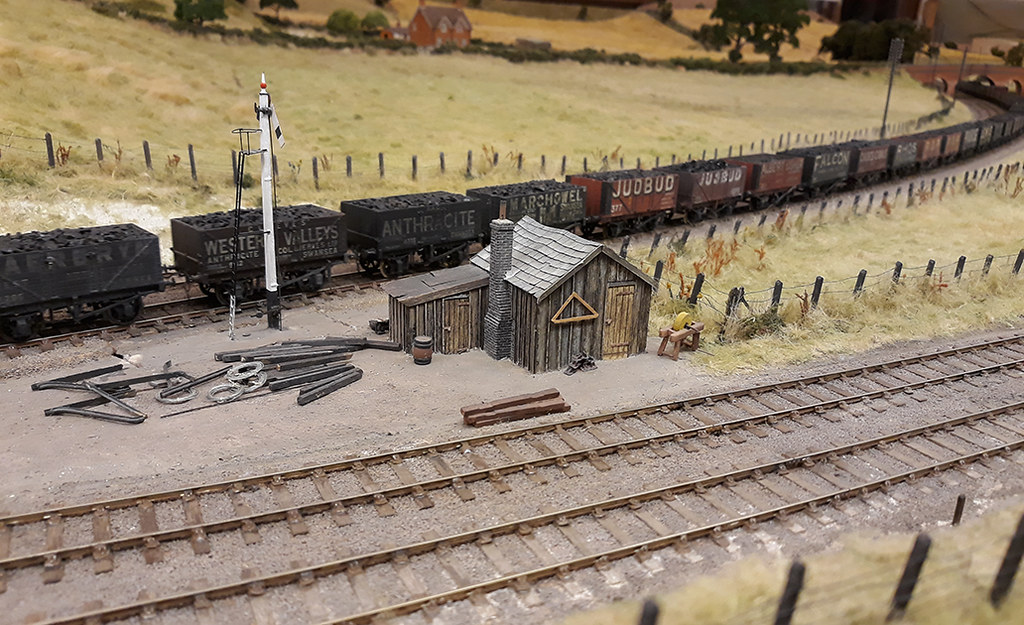
“Platelayers hut and coal train” by Phil_Parker is licensed under CC BY 2.0 
 .
.
The last model train has departed, and in the attics and spare bedrooms of Britain, closure notices the size of thumbnails are being glued to cardboard stations. OO gauge track is being torn up; weeds made from lichen and flock shoot up where once there were busy miniature main lines. It’s Beeching all over again, just tiny. And in a desolate parade, once-cherished model locos trundle off to 4mm scale scrapyards, to stand lifeless and forgotten until, like their real-life forebears, they are broken up to be recycled as … oh, I don’t know. iPhones. Xboxes. Something modern, anyway. Something cool.
Well, I read it in the Telegraph, so it must be true. “Death of the Model Railway” proclaimed the headline last weekend, and the same story duly popped up all over the media, usually with some variant of “running out of steam”, or “going off the rails”. I was a bit late coming to the news because it was Saturday and I’d spent the afternoon building a model goods wagon from a plywood kit. I’d just added the lettering, and it came as a jolt to learn that the hobby no longer existed. Gingerly, I poked at the varnish I’d just applied — damn, still sticky, and now there was a socking great out-of-scale thumbprint spoiling the look of the thing. That seemed real enough.
But why did those headlines seem so familiar — and ring so false? True, 2024 has begun badly in the railway modelling world. Last week the organisers of the annual Warley National Model Railway Exhibition — a giant show held at the NEC in Birmingham, and a highlight of the hobby’s annual calendar — called it quits. A few days previously, the venerable model railway shop Hattons had announced that it was closing down after 78 years. Taken together, you can see why a journo from outside this particular subculture might link unrelated events into a bigger, juicier story. And let’s face it, a dig at railway enthusiasts is always good for a laugh, isn’t it?
I won’t deny that both events stung me. As a kid in the 80s I used to visit Hattons at its original Liverpool location. Even then, it felt old-school: a gloomy, musty terraced shop, piled to the ceiling with boxes and display cases. But a Saturday visit was like entering Aladdin’s cave and we’d always leave with some new treasure, wrapped in brown paper. Hattons has long since moved to newer, brighter premises and refocused on its mail-order business. I realise with a pang of shame that I’ve never used either.
As for the Warley Exhibition; well, I was there with my dad in November. It’s a regular father and son fixture a few weeks before Christmas, and if we’re honest we probably look forward to it rather more. It was rammed — 80-odd layouts (please, never “train sets”) from the UK, Europe and America, with crowds jostling four deep, and trade stands offering everything from antique clockwork models to the latest digital tech. My 12-year old eyes would have popped out of my head at the quantity and quality of products available. One stall was using airport-stye scanners to produce miniaturised replicas of its customers, so they could ride their model trains in person. If this is a hobby in decline, I’m not seeing it.
I’m going to stick my neck out here: correlation does not imply causation, and railway modelling is actually thriving. What the headlines describe is a collision of two familiar, but separate, 21st century trends the death of the high street, and the decline of old-style social clubs. Hattons never went bust: it read the runes and decided to get out in good order. As for Warley; well, if anything, the Exhibition seems to have been a victim of its own success. Like many leisure pursuits, railway modelling in the 20th century revolved around clubs, with all the paraphernalia of committees and tea rotas. People don’t do that quite so much nowadays.
Comments Off on The ghost of Beeching haunts model railways?
QotD: The inner-most “zones” outside a typical pre-modern city
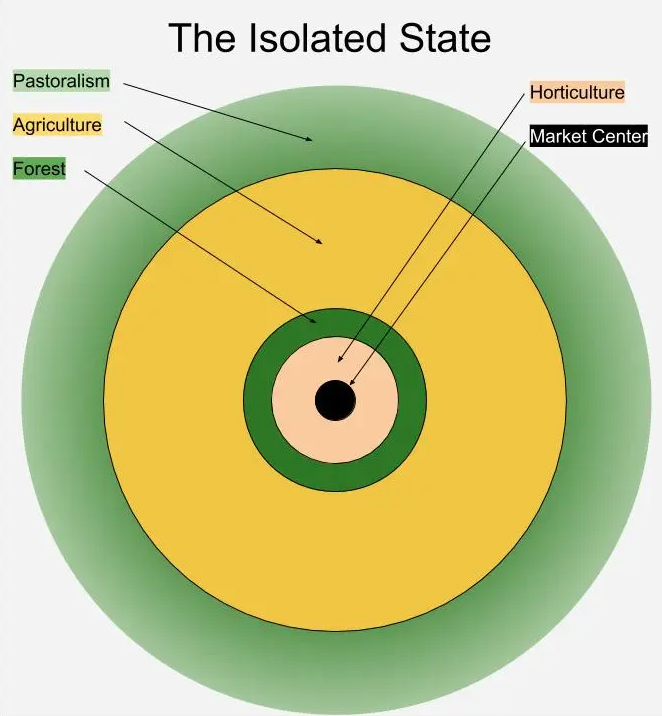
Diagram of von Thünen’s model from The Isolated State, after Morley (1996), 62. The agriculture ring is subdivided by intensity (intensive, long-lay and three-field), but here I have merged them for simplicity. The agriculture zone is wider because it did, in fact, tend to cover a larger area. The fade in the pastoralism zone is meant to indicate shifts from ranching to transhumance.
We’ll start at the inside, right next to the city and move outward. Imagine each “zone” as a wider concentric circle, moving outward from the city (see the image to the right). Because transportation costs (especially overland) are so high, distance from the city plays a dominant role in how the land is used and thus consequently what the countryside around the city looks like. As you move further and further away, transportation costs interact with the structure of agriculture to make different activities make more sense, creating somewhat predictable patterns.
Land very close to the city is valuable because its produce can reach the market with much lower transportation costs (and pretty much always in a single day’s walk). As a result, if the land can support any kind of productive use, it will not be left empty. Instead, the land is going to be put to the most productive use possible. Improvements that – because of cost or labor – might not be attempted on less valuable land further out will likely be done in close proximity to the city. Stepping out of our ideal model for a moment: this is especially true of irrigation, since cities tend to be on waterways (especially rivers) anyway, making irrigation both more valuable due to low transport costs and easier to accomplish.
Thus land in this innermost zone is likely to be heavily improved (irrigation, terracing to get maximum space out of hills, etc). Labor use will also be intensive, both because it is readily available (you are right next to the major population center) and because labor costs are small compared to the high value of the land. If you have managed to get some farmland right outside the city gates, it is very much worth your time to hire whatever labor you need to get the most out of it, so as to recoup the cost of buying or holding such valuable land.
The other improvement one is likely to do in this zone, at least for growing crops, is make extensive use of fertilizer, which in this case generally means manure. The good news is that this zone is directly next to the city, with its intense concentration of animals and people producing manure, making manure cheaper (yes, people did pay for it). Extensive use of manure lets the fields stay under cultivation more often – being fallowed less frequently. At greater distance, the cost of the manure for this begins to outweigh the value of the extra crops, but so close to the city, land this valuable ought to be kept producing as much as possible.
So what kinds of land use does this lead to? The two key activities that von Thünen identifies are horticulture and dairying, to which I’ll add trough-fed animals like pigs (not quite dairy, but as we’ll see, similar from an economic perspective). Why? Horticulture – the intensive growing of fruits and vegetables, often in small “market gardens” – is labor intensive and offers a high economic yield for the space. Land used for horticulture can be kept under almost continual cultivation (if manured, but see above), but gardens can be fussy and demand quite a lot of labor, compared to hardier plants (like maize corn or wheat). Likewise, dairy animals (which, up close to a large city, will be stall-fed rather than grazed or else transported in “on the hoof” and grazed much further out) and pigs (fed by trough) don’t require much space and offer a high economic yield. Both also produce manure which is in demand near the city for the reasons described above.
The other reason to keep these activities so close to the city is access to the market, for two related reasons. First, fresh dairy products, meats and vegetables spoil rapidly, so they must be gotten to market quickly. Remember that this is a world without refrigeration, so as soon as the plant is picked, the cow is milked or the pig is killed, the clock is ticking on spoilage (yes, there are ways to preserve meat, of course – but we’re talking fresh animal products). Precisely because these foods don’t travel or keep well, they tend to be luxury products as well – something produced for the market and bought by rich non-farmers who live in the city.
So what kind of terrain should we see here? Not open grassland or nice wide open fields. Instead, expect small plots, with clustered buildings, typically clinging to the roads leading into the city. Now – especially in the post-gunpowder age – there might be laws forbidding certain kinds of structures close to the city walls (if the city is walled), which might create some open space (but typically not vast). Likewise, when looking at historical city maps, also be wary: this innermost land-use zone was often contained within the city walls of smaller cities.
The next zone – also quite close to the city in von Thünen’s model is – perhaps somewhat surprisingly – a forest zone. That’s not to say that this is generally wild, uncontrolled forest. The reason for a forest zone at such close distance to the city is to provide wood, particularly firewood for heating. Trees might be arranged intentionally along field separations or on spots of agriculturally marginal land close to the city. Forests like these in the Middle Ages would often have been coppiced or pollarded – that is, the trees would have been intentionally cut to produce lots of long, thin straight branches which can be easily harvested to produce nice, evenly sized bits of wood.
Wood is obviously at no risk of spoiling, but it is heavy and bulky, making a close supply valuable. Moreover, the city will need quite a lot of it, for cooking and heating. That said, trees can often be grown either on very marginal (for agriculture) land or else between fields and farms outside of the city, so these patches of forest might often go on land that is a touch too rough or poor for intensive agriculture, or otherwise be squeezed in between land used for other purposes. Still, it is quite common to find spots of forest next to cities and villages alike.
(To answer a quibble in advance: of course this assumes wood is a key heating element. Societies in more arid climates often lack sufficient wood and might use dung, while wet enough areas may use peat. Historically, London shifted over to using mineral coal earlier than most places. All of these choices will impact the role and importance of forest near the city.)
Bret Devereaux, “Collections: The Lonely City, Part I: The Ideal City”, A Collection of Unmitigated Pedantry, 2019-07-12.
Comments Off on QotD: The inner-most “zones” outside a typical pre-modern city
January 30, 2024
The foul “nudgers” are at it again at Cambridge
Christopher Gage reports on a recent fun-reducing experiment by paid psychological meddlers at Cambridge University:

“Wineglass” by quinn.anya is licensed under CC BY-SA 2.0  .
.
Researchers found they could “nudge” people into drinking less wine when they denied the unsuspecting blighters a large 250ml measure.
Last summer, these wholly well-adjusted people convinced 21 Cambridgeshire pubs and restaurants to offer only small or medium glasses of wine. The result left the boffins breathless. But sadly, not in the medical sense of the word.
When denied a large, vivifying glass of wine, the subjects drank eight percent less than usual, and the pubs didn’t lose any money — smaller measures cost more. Puritans: two. Oenophiles: nil.
The usual suspects cooked up this obscene waste of time and money. Professor Dame Theresa Marteau, director of the behaviour and health research unit at Cambridge University, boasts lurid form in control freakery.
Her previous studies read like an almanac of neurotic impulses. The mad mullah dreams of shrinking plates and sinking sodas. This finger-wagger-in-chief obsesses with the vinous, porcine masses and what they may slip into their faces when she’s not looking. Marteau chillingly laments that large wine glasses “increase the pleasure of drinking wine”.
The fundamentally nosey swear these are the first murmurs of Utopia. Next, they’ll bend boozing regulations into a truncheon to batter the gastronomic swine over its head. They don’t stop. First, they shrink the large glass. Then, the medium glass affects as the large. What happens next? Take a wild guess.
This is not the work of some rogue Colonel Kurtz. One Daily Telegraph writer seized on the study. Employing the presumptuous “we” beloved of oppressive minds, they offered tips to help us drink less, assuming we drink large wines only because we are weak-willed effigies desperate for professional helpers to show us what’s best for us.
Advocates of “nudging” drive themselves senseless over this psychological thimblerig. The potential to correct “undesirable” behaviour proves too great to resist. They are a species of featherless biped with which I share nothing but the right to a trial before a jury of my peers.
As I write, I’ve just returned from a five-mile jaunt with 33 pounds strapped to my back. Loading a bag with weights burns double the calories. Therefore, whatever I do after that trek is my business alone. On my desk is a large glass of Portuguese red blend. Beside that soul-tingling measure sits a smouldering, hand-rolled, menthol-tipped cigarette.
Why strangers stake their mental well-being on what others put into their bodies, I will never know. Why they wish I’d sit here choking on sparkling water and its vegetable equivalent — celery — I’ve not the foggiest of insights. All I do know, friends, is that I am not the one in dire need of a few sessions with a psychoanalyst. My professional advice: Seven letters. Vulgar slang. A phrasal verb rhyming with “duck cough”.
Comments Off on The foul “nudgers” are at it again at Cambridge


