
Forgotten Weapons
Published Nov 6, 2023Morphy’s recently took the world record for the most expensive machine gun ever sold at public auction — with a transferrable FN Minimi. It sold for a winning bid of $490,000, which became a total price of $588,000 after adding the 20% buyer’s premium. Good heavens. So today, let’s consider why someone might speak THAT MUCH money for a Minimi …
(more…)
January 30, 2024
The Most Expensive Machine Gun Ever Sold
Comments Off on The Most Expensive Machine Gun Ever Sold
January 29, 2024
Peter Hitchens isn’t onboard with the march to yet another war
Writing in the Daily Mail, Peter Hitchens decries the apparent drift by western politicians into yet another war:

Are we the baddies? What if the Ukraine war is just as stupid and wrong as the Iraq war, but the state propaganda has been more successful and hardly anybody has realised … yet?
Many people to this day still think the damaging and morally dubious Western attacks on Serbia and Libya were justified. Many still think the gory attempt to destroy Syria was a good thing. It took ages for opinion to swing on the Vietnam war, back in the 1960s. And, as one who opposed the Iraq war, I remember only too well just how many (who now think they were against it all the time) were fooled into backing Sir Anthony Blair and George W. Bush.
The issue is more pressing as generals and admirals warn we must live in a militarised society and prepare for what they think is an inevitable war against Russia. They could get their way. If you go on backing this policy, you could be condemning yourself, your children or grandchildren to a world of war, privation and perhaps conscription into some sort of military service.
[…]
This is what I have never been able to work out. We have a Defence Secretary, Grant Shapps, who has perfected the art of shouting loudly while carrying a very small stick – thunderous, belligerent declarations while our Armed Forces melt away thanks to neglect and badly targeted spending. Perhaps, if the long-feared Russian invasion of Western Europe takes place, we can fend it off by dispatching our troops on the pestilential e-scooters and e-bikes which are this former Transport Secretary’s major contribution to the nation.
Certainly these vehicles are terrifying to those not riding them. They have nearly killed me more than once. And, piled up in heaps, they make formidable obstacles, as the people of London are finding.
What Mr Shapps does not seem to grasp is that Britain became great by staying out of continental conflicts, and letting others do the fighting. Even in the battle against Bonaparte, we paid our European allies to do most of the hard work.
Our greatness ceased when bombastic moralising took over, in 1914. We flung ourselves, supposedly nobly, into a Russo-German war. Within two years we were bankrupt, and bereft of the flower of our young manhood.
People still refuse to believe me when I say accurately that Britain has not paid off its huge 1914-18 war debts (now worth about £40 billion) to the USA. But I promise you it is true.
Four years of terrible loss left the Russo-German problem unsolved and we had to do it all again in 1939. After that we were even more bankrupt, and in 1946 had to ration bread, like some desperate People’s Republic. But for many years afterwards we were largely governed by grown-ups who had fought in actual wars and been wounded, and had seen death very near them, or endured bombing and a war economy. And so we largely stayed out of major foreign trouble.
Comments Off on Peter Hitchens isn’t onboard with the march to yet another war
Ancient Roman Garum Revisited
Tasting History with Max Miller
Published Nov 7, 2023
(more…)
Comments Off on Ancient Roman Garum Revisited
January 28, 2024
Himmler Takes Command – WW2 – Week 283 – January 27, 1945
World War Two
Published 27 Jan 2024A new German Army Group has been formed, tasked with protecting the Reich from the east and commanded by none other than Heinrich Himmler, who has never held such a command. The Soviets are really on the move in the east and have even begun reaching the prewar German border. In the west the Allies have cleared the Roer Triangle and are also working hard to eliminate the Colmar Pocket. In the Far East the Americans are advancing on Luzon, and in Burma the Allies have success on the Arakan and the Shwebo Plain, and finally manage to re open the Burma Road with China.
01:27 Soviet advances in East Prussia
09:23 Hungary and the fight for Buda
11:19 Operations Nordwind, Cheerful, and Blackcock
14:23 Block 5
16:14 American advances on Luzon
18:55 Allied successes in Burma
22:06 Summary
22:26 Conclusion
(more…)
Comments Off on Himmler Takes Command – WW2 – Week 283 – January 27, 1945
Adolescence is “a profoundly unnatural life-stage”
Sarah Hoyt on the plight of the younger Millennials and the Gen Z kids in our over-supervised safety-at-all-costs culture today:
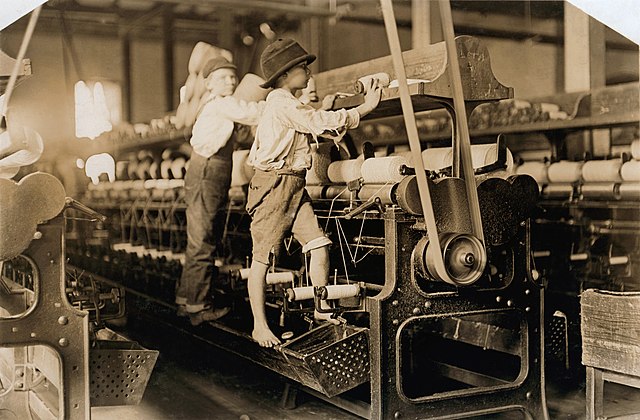
Child labour laws did generally get younger children out of dangerous places like mines, mills, and factories. Modern child labour laws instead keep young adults from gaining work experience in many cases.
Photo of pre-teen children working in a mill in Macon, Georgia in 1909. Photo NCLC.01581, Library of Congress via Wikimedia Commons.
Mostly, it gets attributed to “kids these days” but unless you have kids, these days, you don’t know how they are bound. And even if you do, you might not realize it, because all you see is the infantilization of a generation, and not that they, themselves, aren’t the ones doing the infantilizing, but all those “good rules” and regulations and laws are doing it.
I realized about 10 years ago that my son’s generation was about 10 years behind where we were. In their mid twenties they were doing things we did in our teens. It was disconcerting. And even I had no idea why, other than too much regimentation in school, too much of a never end of button counting, and not enough room or freedom to think or be on their own.
Since then … I’ve seen more. And a lot of the reason they are younger than we were is that the entire world is geared not to let them grow up. I mean, let’s be glad that — unprepared or not — they’re legal adults at 18, or people would be denouncing them for walking alone down the street, without an “adult” at 25.
There’s also … adolescence is in some ways a profoundly unnatural life-stage, and more or less invented in the 20th century. In the past, sure, people were children, and people grew to be adults, but there wasn’t this protracted time period where they were adults in size and at least some ability, but weren’t allowed to be adults: they weren’t allowed to earn or spend, or make their own decisions, for years.
The earn or spend thing is important. Kids used to grow along with their tasks. Read Tudor or colonial memoirs, and you find four year olds looking after cows or horses, or learning Latin, or other unlikely things even for twelve year olds in our time.
Mom went to work at 10 and started getting a salary. It wasn’t much, and 90% of it went to her parents’ budget. But she was working, holding down a job, doing things that were maybe not at adult level, but could lead to it, eventually, if she applied herself. This was normal for her generation. In my own generation, amid the working class, most people went to work at 10. Heck, amid the middle class, most people went to work at 15 or so, after 9th grade. Were they more mature than the rest of us that went all the way to college?
I wouldn’t have thought that at the time, but yes, of course they were. Most of my elementary school classmates were married, with kids by the time my biggest worries were final exams. Of course, with my intellectual pride I looked down on them but now I understand they were managing a very difficult job, which at the time I could not have done.
I always feel stunned and shocked when someone says the kids should be “holding down two jobs like I was at 16” or “working to pay their way through college”. (That last is a giggle as it has two impossibilities. Finding a job that pays enough after college which has a lot of make-work expectations, and making a full-time middle-class salary, which is what college costs these days.) Two Jobs. At 16. The difficulties in giving work to 16 year olds, increasingly restriction of hours, etc. combined with chaotic scheduling in the only unskilled jobs remaining (mostly just retail) means that until recently none of them could find A job. Let alone two. And the recently was during Covid. I haven’t seen so many little 16 year olds cashiering, or serving at tables recently. And that’s because most people I’m seeing are around my age: I guess unemployment is biting hard.
But you know, all these strong rules against “child labor” mean that most kids hit 18 or, if they’re going to college, 22 or — more likely, as most degrees (remember make work?) are taking 6 or 7 years — 24, with absolutely no job experience. Which means their applications aren’t even looked at. Not seriously.
Honestly, almost every young person — particularly young men — I know who found a job, and is doing relatively well, did so through contacts. Through friends of friends. Through knowing someone.
This is a bad sign, because it’s how Portugal functions, and it is not in any way shape or form meritocracy, which in turn contributes to other things falling apart.
But more and more what I’m seeing is young people hitting their mid twenties lost, and doing this, and doing that, and trying this and trying that, and nothing ever gels. To make things worse, they don’t have the habits mom had by 10, because they haven’t been allowed to acquire them.
There was a similar generation — one, while here we’re well into two — in Portugal, where unemployment was so bad (the generation before mine) that most people weren’t “established” on a path till their mid thirties. I’d guess about half of them never got the knack of it: of the day to day of working, fulfilling the work duties, just … the unglamorous day to day that makes us adults.
Comments Off on Adolescence is “a profoundly unnatural life-stage”
January 27, 2024
AFN-49: The Forgotten Full-Auto Brother of the FN-49
Forgotten Weapons
Published 20 Oct 20230:00 Introduction and Overview of the AFN 49
1:23 Detailed Insight into the AFN 49’s Global Presence
3:01 Demonstration and Explanation of the AFN’s Unique Features
5:05 Auto Trip Feature: A Deep Dive
7:27 Unique Characteristics of the AFN 49
8:48 The Journey of AFN 49s to the US
10:17 Conversion of Luxembourg AFN 49s: A Historical Perspective
10:43 Conclusion and AcknowledgementsA note to censors: This video is not a tutorial on full auto conversion. It is an explanation of how the system works, and provides no instruction of how to fabricate or modify parts to modify a semiautomatic firearm into a fully automatic one. Doing that would be illegal for most people — although certainly not all; conversion or ownership of machine guns is legal in most places with the appropriate government permission.
The SAFN, aka FN-49, is one of the classic post-war European battle rifles, and was sold to nine different countries in the early 1950s before the FAL became FN’s primary combat rifle offering. What is often forgotten is that despite being limited to a fixed 10-round magazine, nearly half of all FN-49s produced were actually fully automatic AFN-49s. The Belgian Army, Luxembourg Army, Luxembourg Gendarmerie, and Belgian Congo all purchased the automatic pattern. So today, we’re going to take a look at how it differs from the regular SAFN that we are used to seeing.
Interestingly, a batch of the Luxembourg Gendarmerie rifles were imported into the US without anyone realising that they were automatic until they arrived and were being unpacked. InterArms went to the IRS (the NFA was a tax law administered by the Treasury; this was before the formation of the ATF) and proposed removing the selector levers and auto sears, as well as milling off their attachment points on the receivers. The IRS agreed that this would be an acceptable conversion to render the guns legally semiautomatic only, and the changes were made before the rifles were sold. They remain on the US collector market today as an interesting example of legal conditions prior to the adoption of a pointless and punitive decree of “once a machine gun, always a machine gun”.
Many thanks to the Royal Museum of the Armed Forces and Military History in Brussels for access to this very cool piece! Check them out here: https://www.klm-mra.be/en/
(more…)
Comments Off on AFN-49: The Forgotten Full-Auto Brother of the FN-49
QotD: McCarthy was right
It’s likely that just about everything you know about Joe McCarthy, his life, his political career and his work against the Soviet infiltration of American government is incorrect, the history having been almost without exception written by his staunch enemies, in turn building on the work of McCarthy’s contemporaries to delegitimise and destroy the junior Senator from Wisconsin. Even in the conservative circles, the memory of McCarthy is often treated as a bit of family embarrassment; in part the testament to how successful the left-wing narrative has been but also perhaps the faint memory that half of his own party (the so called liberal wing) despised him at the time and worked hand in hand with the Democrats to destroy him.
Yet McCarthy was right – not just in a general sense of clearly understanding that communism is not merely an alternative path to a brighter future but an evil and inhuman ideology at war with the liberal, democratic and Christian West, but also in focusing on the federal bureaucracy’s strangely ineffectual response to the presence in its ranks of many people, often in very senior and influential positions, suspected of working for the communist cause.
Contrary to the official version, it was never McCarthy’s role to unmask Red agents; a job more appropriately done by investigative agencies. In his legislative role overseeing federal bureaucracies, he made it his mission to inquire why so many individuals, whose loyalty has already been put under the question mark by numerous internal and external investigations, had no problems staying in sensitive jobs for years and moving unhindered from one agency to another. Those named by McCarthy (on the Democrat insistence) were not simply some random individuals with vaguely progressive sympathies; already at the time many of them have been identified as Soviet agents and security risks in the testimony of communist renegades (like Whitaker Chambers and Elizabeth Bentley) or through secret FBI surveillance. Others were suspects on the account of their associations with Eastern European or local communists and causes.
Over the following decades, most have been further incriminated from a variety of sources, including Soviet defectors and the deciphered Venona transcripts of secret Soviet intelligence cables, which mention some 400 individuals in the 1940s and 50s United States as active agents and contacts or abettors and helpers. The problem was not Reds under the beds, but Reds quite literally in positions of access to highly valued classified information or positions of influence over the shape of US policy, from the White House, through the State Department, to a host of other departments and agencies. All this is now beyond any dispute, but these weren’t mere idle speculations at the time either. Lauchlin Currie, Owen Lattimore, Harry Dexter White, Nathan Silvermaster, T.A. Bisson and dozens and dozens of others did conspire in small groups and networks to pass on classified information to the Soviets or steer the American foreign policy into the direction favourable to the communists (particularly in China during and after the war). And yet, despite all having serious question marks over them, they were allowed to work in government for years undisturbed. It was not because of some giant communist conspiracy at the highest levels of government but because of the bureaucratic inertia, old boys’ networks and the organisational reluctance to admit problems – but also because communist agents within protected and promoted each other. Time and time again mistakes got buried instead of rectified. McCarthy dared to shed the public spotlight on the continuing outrage and ask why. It was like a poor country cousin being invited to a formal dinner by his big city relatives and dropping a loud fart between the entree and the main.
But the story of McCarthy goes beyond these well-established historical facts to the campaign of character assassination and falsification of the record that succeeded beyond anyone’s wildest dreams. There is truly nothing new under the sun when the entrenched liberal establishment wants to protect its turf and fend off its enemies and as you read what McCarthy has been subjected to in relatively short period of 1950-54 you will no doubt experience a sense of deja vu from recent history: indiscriminate mud throwing in a hope that something sticks; blatant lies, misrepresentations and misinterpretations of evidence; politicians working hand in hand with public servants to coordinate the attacks; destroying and withholding of information and evidence (for example, the security information about the suspected individuals being physically transferred from the State Department to the Truman White House so that it could not be subpoenaed or otherwise accessed; a practice condemned by the Republicans and then continued by the Eisenhower White House); blackmailing witnesses or preventing them from testifying; biased media running the narrative (fake news is nothing new); whitewashing the accused and discrediting the accusers; incessant lawfare; trumped up charges and defamation. Coincidentally, McCarthy too was compared to Hitler while at the same time being accused of helping Russians. McCarthyism is not what McCarthy has done to his supposed victims; it’s what the left has done to him. It’s what it keeps doing to people who get in the way and threaten to disturb the business as usual.
Arthur Chrenkoff, “Before there was Trump, there was Joe McCarthy”, Daily Chrenk, 2019-09-30.
Comments Off on QotD: McCarthy was right
January 26, 2024
QotD: How an oath worked in pre-modern cultures
That assurance comes from the presumption that the oath will be enforced by the divine third party. The god is called – literally – to witness the oath and to lay down the appropriate curses if the oath is violated. Knowing that horrible divine punishment awaits forswearing, the oath-taker, it is assumed, is less likely to make the oath. Interestingly, in the literature of classical antiquity, it was also fairly common for the gods to prevent the swearing of false oaths – characters would find themselves incapable of pronouncing the words or swearing the oath properly.
And that brings us to a second, crucial point – these are legalistic proceedings, in the sense that getting the details right matters a great deal. The god is going to enforce the oath based on its exact wording (what you said, not what you meant to say!), so the exact wording must be correct. It was very, very common to add that oaths were sworn “without guile or deceit” or some such formulation, precisely to head off this potential trick (this is also, interestingly, true of ancient votives – a Roman or a Greek really could try to bargain with a god, “I’ll give X if you give Y, but only if I get by Z date, in ABC form.” – but that’s vows, and we’re talking oaths).
Thus for instance, runs an oath of homage from the Chronicle of the Death of Charles the Good from 1127:
“I promise on my faith that I will in future be faithful to count William, and will observe my homage to him completely against all persons in good faith and without deceit.”
Not all oaths are made in full, with the entire formal structure, of course. Short forms are made. In Greek, it was common to transform a statement into an oath by adding something like τὸν Δία (by Zeus!). Those sorts of phrases could serve to make a compact oath – e.g. μὰ τὸν Δία! (yes, [I swear] by Zeus!) as an answer to the question is essentially swearing to the answer – grammatically speaking, the verb of swearing is necessary, but left implied. We do the same thing, (“I’ll get up this hill, by God!”). And, I should note, exactly like in English, these forms became standard exclamations, as in Latin comedy, this is often hercule! (by Hercules!), edepol! (by Pollux!) or ecastor! (By Castor! – oddly only used by women). One wonders in these cases if Plautus chooses semi-divine heroes rather than full on gods to lessen the intensity of the exclamation (“shoot!” rather than “shit!” as it were). Aristophanes, writing in Greek, has no such compunction, and uses “by Zeus!” quite a bit, often quite frivolously.
Nevertheless, serious oaths are generally made in full, often in quite specific and formal language. Remember that an oath is essentially a contract, cosigned by a god – when you are dealing with that kind of power, you absolutely want to be sure you have dotted all of the “i”‘s and crossed all of the “t”‘s. Most pre-modern religions are very concerned with what we sometimes call “orthopraxy” (“right practice” – compare orthodoxy, “right doctrine”). Intent doesn’t matter nearly as much as getting the exact form or the ritual precisely correct (for comparison, ancient paganisms tend to care almost exclusively about orthopraxy, whereas medieval Christianity balances concern between orthodoxy and orthopraxy (but with orthodoxy being the more important)).
Bret Devereaux, “Collections: Oaths! How do they Work?”, A Collection of Unmitigated Pedantry, 2019-06-28.
Comments Off on QotD: How an oath worked in pre-modern cultures
January 25, 2024
The Bathtub Hoax and debunked medieval myths
David Friedman spends a bit of time debunking some bogus but widely believed historical myths:

“Image” by Lauren Knowlton is licensed under CC BY 2.0 
 .
.
The first is a false story that teaches a true lesson — the U.S. did treat Amerinds unjustly in a variety of contexts, although the massive die off as a result of the spread of Old World diseases was a natural result of contact, not deliberate biological warfare. The second lets moderns feel superior to their ignorant ancestors; most people like feeling superior to someone.
Another example of that, deliberately created by a master, is H.L. Mencken’s bathtub hoax, an entirely fictitious history of the bathtub published in 1917:
The article claimed that the bathtub had been invented by Lord John Russell of England in 1828, and that Cincinnatian Adam Thompson became acquainted with it during business trips there in the 1830s. Thompson allegedly went back to Cincinnati and took the first bath in the United States on December 20, 1842. The invention purportedly aroused great controversy in Cincinnati, with detractors claiming that its expensive nature was undemocratic and local doctors claiming it was dangerous. This debate was said to have spread across the nation, with an ordinance banning bathing between November and March supposedly narrowly failing in Philadelphia and a similar ordinance allegedly being effective in Boston between 1845 and 1862. … Oliver Wendell Holmes Sr. was claimed to have campaigned for the bathtub against remaining medical opposition in Boston; the American Medical Association supposedly granted sanction to the practice in 1850, followed by practitioners of homeopathy in 1853.
According to the article, then-Vice President Millard Fillmore visited the Thompson bathtub in March 1850 and having bathed in it became a proponent of bathtubs. Upon his accession to the presidency in July of that year, Fillmore was said to have ordered the construction of a bathtub in the White House, which allegedly refueled the controversy of providing the president with indulgences not enjoyed by George Washington or Thomas Jefferson. Nevertheless, the effect of the bathtub’s installation was said to have obliterated any remaining opposition, such that it was said that every hotel in New York had a bathtub by 1860. (Wikipedia)
Writing more than thirty years later, Mencken claimed to have been unable to kill the story despite multiple retractions. A google search for [Millard Fillmore bathtub] demonstrates that it is still alive. Among other hits:
The first bathtub placed in the White House is widely believed to have had been installed in 1851 by President Millard Fillmore (1850-53). (The White House Bathrooms & Kitchen)
Medieval
The desire of moderns to feel superior to their ancestors, helps explain a variety of false beliefs about the Middle Ages including the myth, discussed in detail in an earlier post, that medieval cooking was overspiced to hide the taste of spoiled meat.
Other examples:
Medieval witch hunts: Contrary to popular belief, large scale persecution of witches started well after the end of the Middle Ages. The medieval church viewed the belief that Satan could give magical powers to witches, on which the later prosecutions were largely based, as heretical. The Spanish Inquisition, conventionally blamed for witchcraft prosecutions, treated witchcraft accusations as a distraction from the serious business of identifying secret Jews and Muslims, dealt with such accusations by applying serious standards of evidence to them.
Chastity Belts: Supposedly worn by the ladies of knights off on crusade. The earliest known evidence of the idea of a chastity belt is well after the end of the crusades, a 15th century drawing, and while there is literary evidence for their occasional use after that no surviving examples are known to be from before the 19th century.
Ius Prima Noctae aka Droit de Seigneur was the supposed right of a medieval lord to sleep with a bride on her wedding night. Versions of the institution are asserted in a variety of sources going back to the Epic of Gilgamesh, but while it is hard to prove that it never existed in the European middle ages it was clearly never the norm.
The Divine Right of Kings: Various rulers through history have claimed divine sanction for their rule but “The Divine Right of Kings” is a doctrine that originated in the sixteenth and seventeenth century with the rise of absolute monarchy — Henry VIII in England, Louis XIV in France. Medieval rulers were absolute in neither theory or practice. The feudal relation was one of mutual obligation, in its simplest form protection by the superior in exchange for set obligations of support by the inferior. In practice the decentralized control of military power under feudalism presented difficulties for a ruler who wished to overrule the desires of his nobility, as King John discovered.
Some fictional history functions in multiple versions designed to support different causes. The destruction of the Library of Alexandria has been variously blamed on Julius Caesar, Christian mobs rioting against pagans, and the Muslim conquerors of Egypt, the Caliph Umar having supposedly said that anything in the library that was true was already in the Koran and anything not in the Koran was false. There is no good evidence for any of the stories. The library existed in classical antiquity, no longer exists today, but it is not known how it was destroyed and it may have just gradually declined.
Comments Off on The Bathtub Hoax and debunked medieval myths
Finnish Jews, Polish Special Forces, and MREs – WW2 – OOTF 32
World War Two
Published 24 Jan 2024How did Finland treat its Jews, and what did Finnish people know about the Holocaust? Who were the mysterious Polish Silent Unseen? And, what sort of rations did soldiers carry? Find out in this episode of Out of the Foxholes.
(more…)
Comments Off on Finnish Jews, Polish Special Forces, and MREs – WW2 – OOTF 32
January 24, 2024
Poor Novak …
Chris Bray explains how vaccines provide complete immunity … but with a catch:

Novak Djokovic during his fourth round match at Roland Garros in June, 2023.
Detail of a photo by 350z33 via Wikimedia Commons.
Three years ago, Novak Djokovic refused to save his own life. Threatened by a deadly virus, he refused the lifesaving vaccines. And now you see the terrifying result. Djokovic is so obviously crippled by Covid-19, a virus he unnecessarily chose to face unprotected, that he’s … well, one of the most shockingly fit human beings on the planet, an absolute beast of a professional athlete who dominates a remarkably difficult one-on-one sport so completely that no one else in the game comes close to consistently playing at his level. I don’t follow tennis closely enough to be sure about any of that, so I Googled — to get the commissariat-approved answer — and found this statement: “Djokovic has been ranked No. 1 for a record total of 409 weeks in a record 13 different years.” NOW DO YOU SEE WHAT HAPPENS WHEN YOU DON’T GET VACCINATED!?!?!?!?
But what I can’t get over, the thing that just keeps churning in my mind, is that some jackass watched Djokovic play a match, in person, saw how completely he dominated, saw how absurdly healthy and fit he is, and then — at match point, at the end — shouted at him to get vaccinated, like he was rebuking someone for an appalling failure. Why won’t you protect your health, you stupid … most powerful and dominant professional athlete in the world.
Djokovic responded by drilling the very next serve for an ace to win the match, slamming it across the court so brutally hard that his much younger opponent couldn’t even get his racket on it and had to just watch it go by.
But the person in the crowd: To do that, to shout that thing at that person at that moment, requires a total immunity to information. You have to have a mind that can’t notice physical reality in any way, no matter how obvious it becomes. I guess you have to be the Novak Djokovic of stupidity, the best in the world at the game of making your own head fit inside your ass.
So, yes: Vaccines induce immunity. To information. In case you’re looking for a way to protect yourself from that.
Update: One of the journalists who mocked Djokovic for not being vaccinated reportedly died suddenly the other day.
Comments Off on Poor Novak …
France’s Final Battle Rifle Iteration: The MAS 49-56
Forgotten Weapons
Published 24 May 2019While the development of the MAS 49 had given France a very utilitarian rifle that could serve as both for both marksmen and grenadiers, it could still be made better. In large part, the change to the 49-56 pattern was motivated by the move to adopt NATO-compatible 22mm rifle grenades. With the new muzzle hardware, several other changes were made. A gas cutoff was added, to prevent wear and tear on the action from grenade use (something that was found to be a real problem on the MAS 49). The gas port was also moved farther down the barrel, and the hand guard and barrel were both shortened to make the rifle a bit lighter and handier.
Production began in 1957, and about 175,000 of the rifles were made, seeing service as France’s standard front-line infantry rifle until the adoption of the FAMAS in 1979.
(more…)
Comments Off on France’s Final Battle Rifle Iteration: The MAS 49-56
January 23, 2024
The battle of Sangshak, 1944
Dr. Robert Lyman discusses a new book by David Allison that covers one of the many small battles that made up the large Imphal-Kohima campaign:
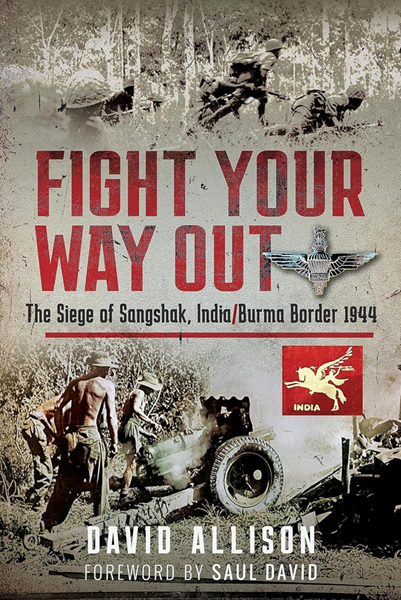
When Wavell, by then Viceroy of India, visited Imphal after the battle in October, to bestow knighthoods on the four victors — Lieutenant Generals Bill Slim (14 Army), Montagu Stopford (33 Corps), Geoffrey Scoones (4 Corps) and Philip Christison (15 Corps) — he admitted to Slim that he found the battle hard to follow, as it seemed to have been fought in “penny-packets”. In professing his ignorance of Slim’s great triumph, Wavell nevertheless hit the nail on the head. Sangshak was one of those penny-packet fights which cumulatively determined the outcome of Japan’s audacious invasion of India.
Like many battles in insufficiently examined wars, Sangshak has suffered over the years from a paucity of rigorous examination. Louis Allen’s magisterial The Longest War gave it short treatment in 1984, and very little else. Until now. I’m delighted to say that a Hong Kong-based Australian lawyer with a military background — David Allison — has produced a new account of this crucial battle, and it is absolutely outstanding. It can be purchased here. I recommend it very strongly. It’s not long: at 159-pages of text you can make your way through this in a couple of days, but it is diligently researched, well written and judiciously argued. For those who know something of the battle, the big arguments in the past about the state training of the 50 Indian Parachute Brigade, the temporary breakdown of its commander, Hope-Thomson and the supposed loss of the captured Japanese map and orders by HQ 23 Indian Division, are calmly and satisfyingly explained.
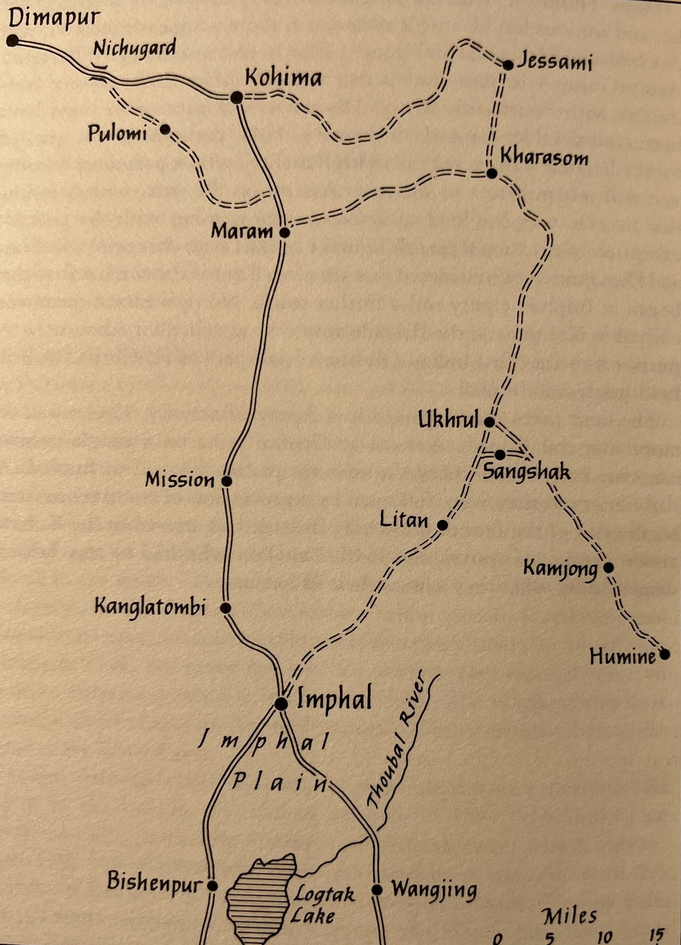
The story can be briefly told. The territory to the north-east of Imphal (centring on the Naga village of Ukhrul) had only the lightest of garrisons and no real defences. Until 16 March it was home to 49 Brigade, which was then despatched to the Tiddim Road to deal with the advance in the south of Lieutenant General Yanagida’s 33 Division. The brigade had considered itself to be in a rear area, and, extraordinarily, no dug-in and wired defensive positions had been prepared. It was one of the most serious British planning failures of the campaign. The entire north-eastern portion of Imphal lay effectively undefended. The gap left by the brigade’s departure had been filled in part by the arrival of the first of the two battalions of the newly raised 50 Indian Parachute Brigade (comprising the Gurkha 152 Battalion and the Indian 153 Battalion), whose young and professional commander, 31-year-old Brigadier M.R.J. (“Tim”) Hope-Thomson, had persuaded New Delhi to allow him to complete the training of his brigade in territory close to the enemy. The area north-east of Imphal was regarded as suitable merely for support troops and training. At the start of March, the brigade HQ and one battalion had arrived in Imphal and began the leisurely process of shaking itself out in the safety of the hills north-east of the town. To the brigade was added 4/5 Mahrattas under Lieutenant Colonel Trim, left behind when 49 Brigade was sent down to the Tiddim Road. To Scoones and his HQ, the area to which Hope-Thomson and his men were sent represented the lowest of all combat priorities. Sent into the jungle almost to fend for themselves, it was not expected that they would have to fight, let alone be on the receiving end of an entire Japanese divisional attack. They had little equipment, no barbed wire, and little or no experience or knowledge of the territory. No one considered it worthwhile to keep them briefed on the developing situation. To all intents and purposes, 50 Indian Parachute Brigade was an irrelevant appendage, attached to Major General Ouvry Roberts’ 23 Indian Division for administrative purposes but otherwise left to its own devices.
Before long, information began to reach Imphal that Japanese troops were advancing in force on Ukhrul and Sangshak. Inexplicably, however, this information appeared not to ring any warning bells in HQ IV Corps in Imphal, which was preoccupied with the developing threat in the Tamu area where the main Japanese thrust was confidently predicted. On the night of 16 March, the single battalion of 50 Parachute Brigade took over responsibility for the Ukhrul area from 49 Brigade, which was hastily departing for the Tiddim Road. They had no idea that an entire Japanese division of 20,000 men was crossing the Chindwin in strength opposite Homalin. On 19 March, large columns of Japanese infantry were reported advancing through the hills.
No one had expected them to be where they were. But the first shock came to the Japanese 3/58 battalion (Major Shimanoe), part of Lieutenant General Sato’s 31 Division – troops whose objective was Kohima, and not Imphal – who were bloodily rebuffed by the determined opposition of the young Gurkha soldiers at an unprepared position forward of Sheldon’s Corner. The 170 Gurkha recruits refused to allow the 900 men of 3/58 to roll over them and inflicted 160 casualties on the advancing Japanese. In the swirling confusion of the next 36 hours, Hope Thomson and his staff kept their heads, attempting to concentrate what remained of the dispersed companies of 152 Battalion and 4/5 Mahrattas back to a common position at the village of Sangshak, which dominated the tracks southwest to Imphal.
It was at this now-deserted Naga village that Hope-Thomson, on 21 March, decided to group his brigade for its last stand, his staff desperately attempting to alert HQ 4 Corps in Imphal to the enormity of what was happening to the north-east. The Japanese columns infiltrated quickly around and through the British positions, heading in the direction of Litan. The Japanese now began days of repeated assaults on the position in a battle of intense bravery and sacrifice for both sides. Hope Thomson’s men could only dig shallow trenches, which provided no protection from Japanese artillery.
Comments Off on The battle of Sangshak, 1944
The Korean War: The First Year
Army University Press
Published Jan 22, 2024Created for the Department of Command and Leadership and the Department of Military History at the US Army Command and General Staff College, The Korean War: The First Year is a short documentary focused on the major events of the Forgotten War. Designed to address the complex strategic and operational actions from June 1950 – June 1951, the film answers seven key questions that can be found in the timestamps below. Major events such as the initial North Korean invasion, the defense of the Pusan Perimeter, the Inchon landing, and the Chinese intervention are discussed.
Timestamps:
1. Why are there Two Koreas? – 00:25
2. Why did North Korea Attack South Korea? – 02:39
3. How did the UN stop the Communist invasion? – 06:30
4. Why did MacArthur attack at Inchon? – 10:24
5. Why did the UN attack into North Korea? – 14:27
6. Why did China enter the Korean War? – 18:51
7. How did the UN stop the Communist invasion … again? – 21:44
Comments Off on The Korean War: The First Year
T-34: The tank that won WWII
The Tank Museum
Published 27 Oct 2023The Soviet T-34 was the most prolifically produced tank of WWII. Basic and austere in design, it was highly effective and capable of being mass-produced. In this video we take a close look inside and out at the tank that made victory over Nazi Germany possible.
(more…)
Comments Off on T-34: The tank that won WWII


