
When SBF (whose initials immediately joined those of MBS and JFK as being instantly recognizable) was first arrested, I immediately proposed a typology of financial swindlers with two distinct poles — though no doubt there is a continuum between them that somewhat reduces the elegance of my typology.
First there is the dull, seemingly steady, respectable type, instantiated by Bernie Madoff, who had just the kind of personal gravitas that inspired confidence in the cautious. “Yes,” the cautious type thought as he gazed into Madoff’s calm and wise face, “he is just the type to whom I can safely entrust my money. He knows, if anyone knows, how to make money fruitful and multiply.”‘ His very dullness obscured from the cautious man the fact that he, the cautious man, was as motivated by greed and lust for painless enrichment as the most reckless gambler; and no man wants to think that he is motivated by greed. That is a vice that motivates others, not oneself.
Second there is the flamboyant genius type. For more adventurous investors in search of quick returns, a man like SBF is just the one to follow. His refusal to comply with elementary social conventions, even his wild hair, stood guarantor of his genius. Those who followed SBF as the children followed the pied piper deluded themselves by the following false syllogism:
Geniuses are unconventional.
SBF is unconventional.
Therefore, SBF is a genius.(Actually, even his unconventionality was conventional. Convention is that from which no man can ever fully escape.)
The nature of SBF’s “genius” has come to light in his thoughts of Shakespeare, against whose genius he applies statistical reasoning:
I could go on and on about the failings of Shakespeare … but really I shouldn’t need to: the Bayesian priors are pretty damning. About half the people born since 1600 have been born in the past 100 years, but it gets much worse than that. When Shakespeare wrote, almost all Europeans were busy farming and very few people attended university; few people were even literate — probably as low as ten million people. By contrast there are now upwards of a billion literate people in the Western sphere. What are the odds that the greatest writer would have been born in 1564? The Bayesian priors aren’t very favourable.
One could have a great deal of fun with this argument, for example by proving statistically that Isaac Newton was not one of the greatest physicists who ever lived, and indeed could never really even have existed, because the number of people in his time who could do simple arithmetic was so exiguous. How could he, then, together with Leibniz (another impossibility), have invented the calculus?
By contrast, we could also prove that we are living through a golden age of literature (as of every art) because there are now so many people who know how to write. Of course, our painting must be best because, comparatively speaking, our materials are so cheap and within the range of most people, all of whom have the time to take up painting. Think of how poor Spain was when Velasquez was painting! In Vermeer’s day they didn’t even have flush toilets! How, then, could his paintings be beautiful? Basquiat’s paintings must be much better because now we have electric light.
How could Dickens have been so funny when the infant mortality rate was so high and the life expectancy so low? Therefore, he was not funny. As for Mozart, he didn’t even have an electronic amplifier to his name, so how could his music have been any good? He hadn’t even heard of rap.
One swallow doesn’t make a summer, of course, or one vulture a flock, but one cannot help but remark that SBF was not some poor child who managed, by hook or by crook, to crawl out of a noisome slum, but the child of two professors at Stanford University (admittedly of law) who was himself expensively educated and who was, by the standards of 99.999 percent of all previously existing humanity (to use an SBFian type of statistic), extremely privileged. He was of the elite. His immortal thoughts on Shakespeare would not have been possible without his education, for they certainly would not have occurred to — shall we say — an illiterate illegal immigrant from El Salvador or Honduras.
No, it requires many years of training to come up with arguments such as his. And this in turn raises the question of what is going on in schools and universities (if, that is, SBF is not completely sui generis) that their alumni end up by saying things that make the pronouncements of Azande witch doctors look like those of the latest science. Perhaps — and let us hope that — SBF is not typical of his breed.
Theodore Dalrymple, “The Literary Financier”, New English Review, 2023-10-21.
January 23, 2024
QotD: Shakespeare was apparently a terrible writer, according to Bayesian analysis
January 22, 2024
NATO at 75
In The Critic, Peter Caddick-Adams considers the role of NATO as the alliance enters its 75th year:
In addition to NATO’s 12 founding countries, four others joined during the Cold War: Greece and Turkey (1952), West Germany (1955) and Spain (1982). Afterwards, the Czech Republic, Hungary and Poland (1999), Bulgaria, Estonia, Latvia, Lithuania, Romania, Slovakia, and Slovenia (2004), Albania and Croatia (2009), Montenegro (2017), and North Macedonia (2020) were all ushered safely into the NATO fold. Prompted by Russia’s aggression in Ukraine, Finland joined last year, while Sweden (currently held up by Hungary and Turkey), Bosnia-Herzegovina, Georgia, and Ukraine have applications pending. In every case the lure has been one of collective security against precisely what Russia is doing to Ukraine at present, and future procurement collaboration.
NATO standards of training and equipment are the envy of the world. When I was last in Lviv, before the 2022 invasion, I found a sticker affixed to the front door of the apartment block in which I was staying. It was placed there by a dodgy private military company seeking to recruit unemployed Ukrainians for foreign military adventures. Apart from modern kit and high rates of pay, it advertised Стандартная подготовка НАТО (NATO-standard training). Yes, even Russian mercenaries then regarded the alliance as the gold standard of military expertise.
NATO further reinvented itself in 1994 with the still-current Partnership for Peace (PfP) programme, aimed at creating trust and cooperation between members and (currently 19) others, mostly the remaining post-Soviet states, plus nations like Austria, Bosnia, Ireland, Malta, Serbia and Switzerland. It also engages with 7 other countries through its Mediterranean Dialogue initiative. During this era, NATO extended its activities into political and humanitarian situations that had not formerly been its concern, notably intervening during the breakup of Yugoslavia. Its first ever military deployment since establishment was to Bosnia in 1995, for which I was the official historian, headquartered a few hundred metres away from where the Austrian Archduke met his fate 81 years earlier, in Sarajevo.
For a seventy-five-year-old institution, NATO has shown itself remarkably resilient in taking on new roles, reflecting the concerns of the post-Soviet era. Since 1997, it has fostered the Euro-Atlantic Partnership Council, comprising all 31 NATO members and the 19 PfP countries. The same year saw the establishment of a NATO-Russia Permanent Joint Council, though Moscow’s mission to NATO was suspended in October 2021, along with that of the alliance in Moscow. With Finland becoming the 31st member state on 4 April 2023, and the application of Sweden pending, NATO is bigger than ever. Yet it is not cumbersome or ossified; its thinking and doctrine are regarded as world-beatingly agile. However, as Grant Shapps outlined on 15 January, the challenges are bigger than at any period during its life. This was the same day that Steve Rosenberg, the BBC’s Moscow correspondent, spotted an electronic billboard in the Russian capital. Next to Putin’s face, it read “Russia’s borders do not end anywhere”.
Although the “peace dividend” effectively ended with Russia’s annexation of the Donbass and Crimea in March-May 2014, it has taken ten years for a UK government minister to formally acknowledge that the world has changed irrevocably. In this election year there is one elephant in the room which neither party will address in any detail. Defence spending. Currently standing at 2.3 per cent of GDP, the national credit card is already maxed out on the NHS, transport, police, education, local government, justice and the rest. There is no more money in the pot, and although £50 billion may sound a lot, it isn’t. According to the World Bank, in 1960, we spent just over 7 per cent of GDP on defence; by 1970 this had declined to 5.2, and in 1990, to 4 percent. In 2017-18, we hit a low of 1.9 per cent of GDP. The largest chunk is spent on its workforce, military and civil service.
The combined militaries of all NATO members include around 3.5 million personnel, with much standardised equipment and logistics. More than enough to take on any global competitor. Yet, such protection and its main headquarters in Brussels, with various cutting edge command centres around Europe, do not come cheap. NATO’s requirement is that all member states contribute a minimum of 2 per cent of their GDP on defence. Only ten member states do this, including Britain, the USA, Greece, Croatia, Estonia, Latvia, Poland, Lithuania, Romania and France. Of these, America spends vastly far more ($811 billion) than the rest of the alliance put together. This imbalance feeds directly into the Republican narrative that Europe is freeloading on American muscle and goodwill. Not even the prospect of a Trump presidency seems to have shaken the non-compliant member states out of their somnolence. If this eventuality arises in Washington DC, and America starts to renege on its commitments to Europe and Ukraine, it will fall to Britain to lead NATO in Europe.
Nationalization of British Railways: What Went Wrong?
Railways Explained
Published 22 Oct 2023In today’s video we continue uncovering the story of railway development in Great Britain, as part of a special trilogy marking the Railways Explained’s achievement of 100,000 subscribers!
This is actually the second video in series, and it covers a period from the aftermath of World War II to the momentous era of rail privatization, which was quite challenging period for British railways, full of ups and downs, but it is mostly marked by the formidable challenges.
We talked about the pivotal moments, such as the birth of British Railways, the ambitious Modernisation Plan, the influential Beeching Report, structural reforms, and the eventual transition to rail privatization, which all defined the British railways during this transformative period.
This insightful journey through time illuminates the intricacies and milestones of a railway system that has left an indelible mark on the United Kingdom’s transportation history.
(more…)
QotD: Mao’s theory of “protracted war” as adapted to Vietnamese conditions by Võ Nguyên Giáp
Giáp was facing a different set of challenges in Vietnam facing either France or the United States which required the framework of protracted war to be modified. First, it must have been immediately apparent that it would never be possible for a Vietnamese-based army to match the conventional military capability of its enemies, pound-for-pound. Mao could imagine that at some point the Red Army would be able to win an all-out, head-on-head fight with the Nationalists, but the gap between French and American capabilities and Vietnamese Communist capabilities was so much wider.
At the same time, trading space for time wasn’t going to be much of an option either. China, of course, is a very large country, with many regions that are both vast, difficult to move in, and sparsely populated. It was thus possible for Mao to have his bases in places where Nationalist armies literally could not reach. That was never going to be possible in Vietnam, a country in which almost the entire landmass is within 200 miles of the coast (most of it is far, far less than that) and which is about 4% the size of China.
So the theory is going to have to be adjusted, but the basic groundwork – protract the war, focus on will rather than firepower, grind your enemy down slowly and proceed in phases – remains.
I’m going to need to simplify here, but Giáp makes several key alterations to Mao’s model of protracted war. First, even more than Mao, the political element in the struggle was emphasized as part of the strategy, raised to equality as a concern with the military side and fused with the military operation; together they were termed dau tranh, roughly “the struggle”. Those political activities were divided into three main components. Action among one’s own people consisted of propaganda and motivation designed to reinforce the will of the populace that supported the effort and to gain recruits. Then, action among the enemy people – here meaning Vietnamese who were under the control of the French colonial government or South Vietnam and not yet recruited into the struggle – a mix of propaganda and violent action to gain converts and create dissension. Finally, action against the enemy military, which consisted of what we might define as terroristic violence used as message-sending to negatively impact enemy morale and to encourage Vietnamese who supported the opposition to stop doing so for their own safety.
Part of the reason the political element of this strategy was so important was that Giáp knew that casualty ratios, especially among guerrilla forces – on which, as we’ll see, Giáp would have to rely more heavily – would be very unfavorable. Thus effective recruitment and strong support among the populace was essential not merely to conceal guerrilla forces but also to replace the expected severe losses that came with fighting at such a dramatic disadvantage in industrial firepower.
That concern in turn shaped force-structure. Giáp theorized an essentially three-tier system of force structure. At the bottom were the “popular troops”, essentially politically agitated peasants. Lightly armed, minimally trained but with a lot of local knowledge about enemy dispositions, who exactly supports the enemy and the local terrain, these troops could both accomplish a lot of the political objectives and provide information as well as functioning as local guerrillas in their own villages. Casualties among popular troops were expected to be high as they were likely to “absorb” reprisals from the enemy for guerrilla actions. Experienced veterans of these popular troops could then be recruited up into the “regional troops”, trained men who could now be deployed away from their home villages as full-time guerrillas, and in larger groups. While popular troops were expected to take heavy casualties, regional troops were carefully husbanded for important operations or used to organize new units of popular troops. Collectively these two groups are what are often known in the United States as the Viet Cong, though historians tend to prefer their own name for themselves, the National Liberation Front (Mặt trận Dân tộc Giải phóng miền Nam Việt Nam, “National Liberation Front for South Vietnam”) or NLF. Finally, once the French were forced to leave and Giáp had a territorial base he could operate from in North Vietnam, there were conventional forces, the regular army – the People’s Army of Vietnam (PAVN) – which would build up and wait for that third-phase transition to conventional warfare.
The greater focus on the structure of courses operating in enemy territory reflected Giáp’s adjustment of how the first phase of the protracted war would be fought. Since he had no mountain bases to fall back to, the first phase relied much more on political operations in territory controlled by the enemy and guerrilla operations, once again using the local supportive population as the cover to allow guerrillas and political agitators (generally the same folks, cadres drawn from the regional troops to organize more popular troops) to move undetected. Guerrilla operations would compel the less-casualty-tolerant enemy to concentrate their forces out of a desire for force preservation, creating the second phase strategic stalemate and also clearing territory in which larger mobile forces could be brought together to engage in mobile warfare, eventually culminating in a shift in the third phase to conventional warfare using the regional and regular troops.
Finally, unlike Mao, who could envision (and achieve) a situation where he pushed the Nationalists out of the territories they used to recruit and supply their armies, the Vietnamese Communists had no hope (or desire) to directly attack France or the United States. Indeed, doing so would have been wildly counter-productive as it likely would have fortified French or American will to continue the conflict.
That limitation would, however, demand substantial flexibility in how the Vietnamese Communists moved through the three phases of protracted war. This was not something realized ahead of time, but something learned through painful lessons. Leadership in the Democratic Republic of Vietnam (DRV = North Vietnam) was a lot more split than among Mao’s post-Long-March Chinese Communist Party; another important figure, Lê Duẩn, who became general secretary in 1960, advocated for a strategy of “general offensive” paired with a “general uprising” – essentially jumping straight to the third phase. The effort to implement that strategy in 1964 nearly overran the South, with ARVN (Army of the Republic of Vietnam – the army of South Vietnam) being defeated by PAVN and NLF forces at the Battles of Bình Giã and Đồng Xoài (Dec. 1964 and June 1965, respectively), but this served to bring the United States more fully into the war – a tactical and operational victory that produced a massive strategic setback.
Lê Duẩn did it again in 1968 with the Tet Offensive, attempting a general uprising which, in an operational sense, mostly served to reveal NLF and PAVN formations, exposing them to US and ARVN firepower and thus to severe casualties, though politically and thus strategically the offensive ended up being a success because it undermined American will to continue the fight. American leaders had told the American public that the DRV and the NLF were largely defeated, broken forces – the sudden show of strength exposed those statements as lies, degrading support at home. Nevertheless, in the immediate term, the Tet Offensive’s failure on the ground nearly destroyed the NLF and forced the DRV to back down the phase-ladder to recover. Lê Duẩn actually did it again in 1972 with the Eastern Offensive when American ground troops were effectively gone, exposing his forces to American airpower and getting smashed up for his troubles.
It is difficult to see Lê Duẩn’s strategic impatience as much more than a series of blunders – but crucially Giáp’s framework allowed for recovery from these sorts of defeats. In each case, the NLF and PAVN forces were compelled to do something Mao’s model hadn’t really envisaged, which was to transition back down the phase system, dropping back to phase II or even phase I in response to failed transitions to phase III. By moving more flexibly between the phases (while retaining a focus on the conditions of eventual strategic victory), the DRV could recover from such blunders. I think Wayne Lee actually puts it quite well that whereas Mao’s plan relied on “many small victories” adding up to a large victory (without the quick decision of a single large victory), Giáp’s more flexible framework could survive many small defeats on the road to an eventual strategic victory when the will of the enemy to continue the conflict was exhausted.
Bret Devereaux, “Collections: How the Weak Can Win – A Primer on Protracted War”, A Collection of Unmitigated Pedantry, 2022-03-03.
January 21, 2024
The Duke of Wellington, perhaps best known as the inventor of the Wellington boot …
Weaver Sheridan expresses some surprise that His Grace’s main source of fame is the credit for the invention of the Wellington, rather than his other, uninteresting achievements:
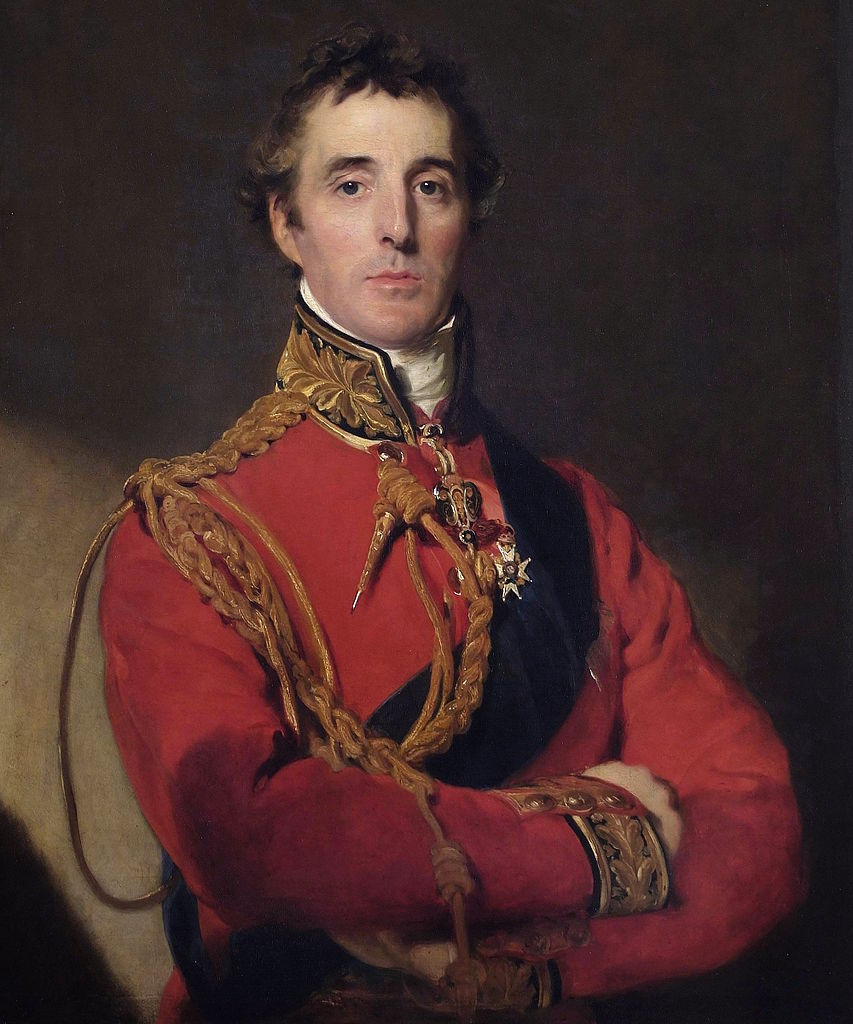
Arthur Wellesley, 1st Duke of Wellington (1769–1852) by Thomas Lawrence, circa 1815-1816.
Wikimedia Commons.
I know nothing should surprise us these days about dumbed-down Britain. But an article on the moronic Mail Online website the other day had me choking on my cornflakes.
It read: “In 2020, Mandy Lieu, 38, bought 935-acre Ewhurst Park in Hampshire, once owned by the inventor of the wellington boot, the Duke of Wellington, and vowed to turn it into a world-class organic farm and nature reserve.”
The inventor of the wellington boot!
Good grief, I know teaching of British history is nowadays outrageously skewed and bowdlerised, but I didn’t realise things had got this bad.
The article’s author obviously thinks the Iron Duke’s main claim to fame was the welly. Does she know nothing about him being a soldier and statesman, victor of the Peninsular War, victor of Waterloo, nemesis of Napoleon, twice Prime Minister? Or is the wellington boot reference made simply to get equally thick readers to relate to the story? Who cares about fusty old battles and boring politics? It is all so yesterday, isn’t it? But everyone knows what wellies are, don’t they?
To anyone with a modicum of interest in this country’s past, such ignorance is deeply depressing, to say the least. But I suppose it could be worse. Think what would happen if some Mail Online know-nothing hack was able to interview other historical figures …
“Sir Winston Churchill, tell us how you came up with the idea of a nodding bulldog to promote your insurance company.”
“Napoleon, having invented a popular type of brandy, was it perhaps rather egotistical to name it after yourself?”
“Pablo Picasso, as a car designer you must be thrilled to see your Citroën Grand C4 Picasso being crowned “Best Used MPV” in the Auto Express Used Car Awards 2023.”
The Red Army Overruns Poland! – WW2 – Week 282 – January 20, 1945
World War Two
Published 20 Jan 2024The huge new Soviet offensives charge ahead this week, taking Warsaw and Krakow; in the west the Battle of the Bulge is officially called over … though there is still fighting there. On Luzon, the Americans push out of their beachhead, though there is heavy fighting to secure their flank.
(more…)
A Book and a Rifle: The Vercors Resistance in WWII
Forgotten Weapons
Published 20 May 2018One of the single largest actions of the French Resistance during World War Two was Operation Montagnards — the plan to drop about 4,000 Allied paratroops onto the Vercors Massif when the resistance was activated in support of the Allied landings in Normandy and Provence. If you are scratching your head trying to figure out why you don’t remember that operation, it is because it never actually happened. The two Allied landings were originally intended to take place simultaneously, but logistical limitations forced the southern landings to be delayed about two months. In an deliberate decision to prevent the Germans from immediately understanding the nature of the Allied attack, the whole of the French Resistance was activated to support the Normandy landings in June 1944. The internal attacks in the south would force the Germans to keep significant forces in that area in expectation of a second landing, which would increase the chances of the Normandy landings succeeding. Unfortunately, the other result of this decision was that Resistance cells would come into the open in anticipation of imminent military support, which would not be coming. The southern elements of the Resistance were basically sacrificed in this gambit.
The Vercors Massif is a large geographical feature near Lyon and Grenoble which comprises basically a triangular sheer-walled plateau rising well above the surrounding plains. It offers a fantastically defensible redoubt, and that is what it was planned to be. Paratroops dropped onto the top of the massif would reinforce a substantial force of Maquis fighters, and create a serious strong point behind the German lines to aid in the fight inland from the landing beaches. The plan was organized in Algiers by Resistance representatives from the Vercors and Free French officers earlier in the war. Some have argued that the lack of support was simply due to the compromises of the single-landing plan, while others fault de Gaulle for deliberately abandoning the men and women on Vercors as part of a strategy to consolidate post-war political support — but that debate is beyond the scope of today’s discussion.
The fighters and civilians on the massif ultimately held out for about 6 weeks — only just too little to still be there when the Allied armored columns reached Grenoble. The German commander in the area spent several weeks making small probing attacks before the final assault with about 10,000 veteran Wehrmacht soldiers, glider-borne infantry, and tanks. Once that attack came, the fate of the Vercors was sealed. With proper military backing they could have defended their redoubt, but instead they had only a smattering of small arms and no heavy weaponry at all. It was a fight that was gloriously courageous but hopelessly doomed to failure.
I am privileged to have in my own collection a Berthier carbine tied to the Vercors Resistance, as evidenced by the brass embellishments on its stock. While I cannot conclusively prove it came from the Resistance, it was sold to me without any premium attached to them, and I have no reason to believe it is fake. And, of course, since I have no plans to sell it, I am not really concerned about conclusively proving its veracity to others. For me, it is a poignant icon of a tremendously heroic group. I hope I would live up to the bar they set should I ever be in a comparable situation!
(more…)
January 20, 2024
The British Empire would have failed a proper cost-benefit analysis
At the Institute of Economic Affairs, Kristian Niemietz is working on a paper on the economics of empire that, as he shows in this article, indicates that the empire was never a winning economic proposition for Britain as a whole, no matter how well certain well-connected individuals and companies benefitted:
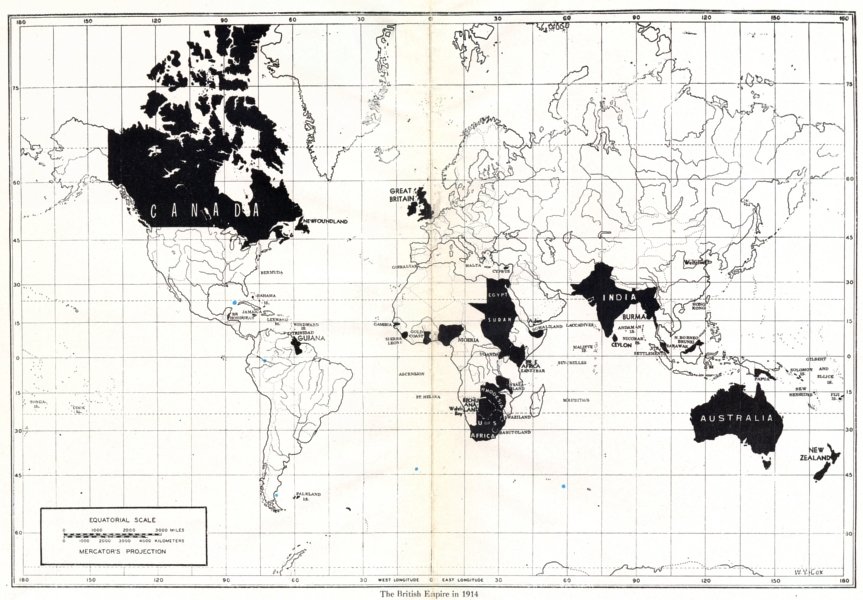
The British Empire in 1914 (via antiquaprintgallery.com)
But is it actually true that imperialism makes countries richer? Does imperialism make economic sense?
This question was already hotly debated at the heyday of imperialism. Adam Smith believed that the British Empire would not pass a cost-benefit test:
The pretended purpose of it was to encourage the manufactures, and to increase the commerce of Great Britain. But its real effect has been to raise the rate of mercantile profit, and to enable our merchants to turn into a branch of trade, of which the returns are more slow and distant than those of the greater part of other trades, a greater proportion of their capital than they otherwise would have done […]
Great Britain derives nothing but loss from the dominion which she assumes over her colonies.
He believed that Britain would be better off if it dissolved its Empire:
Great Britain would not only be immediately freed from the whole annual expense of the peace establishment of the colonies, but might settle with them such a treaty of commerce as would effectually secure to her a free trade, more advantageous to the great body of the people, though less so to the merchants, than the monopoly which she at present enjoys.
The liberal free-trade campaigner Richard Cobden agreed:
[O]ur naval force, on the West India station […], amounted to 29 vessels, carrying 474 guns, to protect a commerce just exceeding two millions per annum. This is not all. A considerable military force is kept up in those islands […]
Add to which, our civil expenditure, and the charges at the Colonial Office […]; and we find […] that our whole expenditure, in governing and protecting the trade of those islands, exceeds, considerably, the total amount of their imports of our produce and manufactures.
If imperialism was a loss-making activity – why did Britain and other European colonial empires engage in it for so long?
Smith and Cobden explained it in terms of clientele politics (or Public Choice Economics, as we would say today). Somebody obviously benefited, even if the nation as a whole did not. And the beneficiaries were politically better organised than those who footed the bill.
This proto-Public Choice case against imperialism was not limited to political liberals. Otto von Bismarck, the Minister President of Prussia and future Chancellor of the German Empire, hated liberals in the Smith-Cobden tradition, but he rejected colonialism in terms that almost make him sound like one of them:
The supposed benefits of colonies for the trade and industry of the mother country are, for the most part, illusory. The costs involved in founding, supporting and especially maintaining colonies […] very often exceed the benefits that the mother country derives from them, quite apart from the fact that it is difficult to justify imposing a considerable tax burden on the whole nation for the benefit of individual branches of trade and industry [translation mine].
In his writing about the economics of imperialism, even Michael Parenti, a Marxist-Leninist political scientist (who is, for obvious reasons, popular among Twitter hipsters), sounds almost like a Public Choice economist:
[E]mpires are not losing propositions for everyone. […] [T]he people who reap the benefits are not the same ones who foot the bill. […]
The transnationals monopolize the private returns of empire while carrying little, if any, of the public cost. The expenditures needed […] are paid […] by the taxpayers.
So it was with the British empire in India, the costs of which […] far exceeded what came back into the British treasury. […]
[T]here is nothing irrational about spending three dollars of public money to protect one dollar of private investment – at least not from the perspective of the investors.”
This leads us to a curious situation. Today’s woke progressives disagree with their comrade Parenti on the economics of empire, but they do agree with Britain’s old imperialists, who argued that the Empire was vital for Britain’s prosperity.
January 19, 2024
Vienna’s Iconic Chocolate Cake
Tasting History with Max Miller
Published 17 Oct 2023
(more…)
January 18, 2024
Understanding the Spanish Civil War
Niccolo Soldo offers an introduction to the context in which the Spanish Civil War took place, with emphasis on one side’s uneasy coalition of interests:
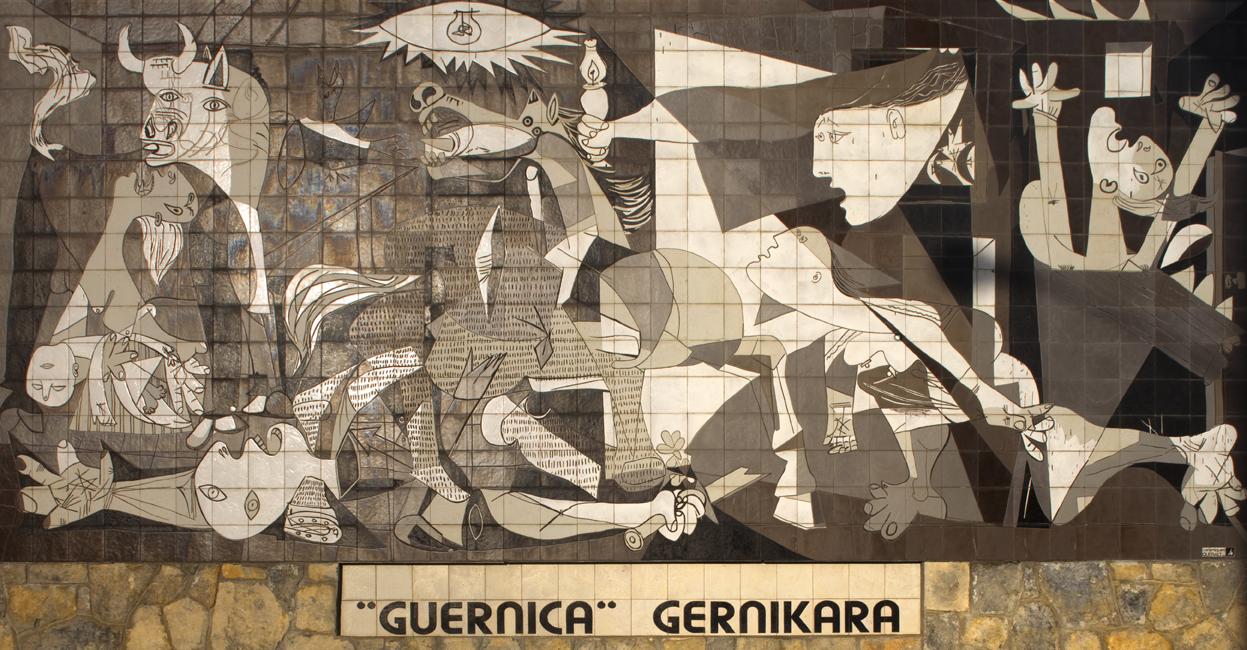
Picasso’s “Guernica” in mural form in the town of Guernica.
Photo by Papamanila via Wikimedia Commons.
At a crossroads in his life, [Ernest Hemingway] decided to go to Spain to cover the conflict for a newspaper chain. Out of his experiences in that war came For Whom the Bell Tolls (1940), one of his most celebrated novels. In this excerpt, he uses the female character “Pilar” to relate the story of how Republican forces massacred a group of people in a small town who were opposed to the government and supported the Spanish Generals seeking to overthrow it. Derided as “fascists”, each of the men were forced to pass a line of pro-government peasants who would beat them with flails before throwing them off of a cliff. Civil wars are indeed the most vicious, even in fictional depictions like this one.
The Spanish Civil War is odd for two reasons, the first one being that more than any other war that I can think of, historians have placed a much stronger focus on the politics of the conflict to the detriment of its military aspects. The second reason is much more important overall, and particularly germane to the subject of this essay: it is the only war that I can think of where the histories have been overwhelmingly written by the losers.1
If you ask a random, somewhat educated person in the West about the Spanish Civil War, they will generally say that “Franco was a fascist who allied himself to Hitler and Mussolini and won the civil war in the most brutal fashion possible. He was a dictator who hated democracy and killed thousands upon thousands of innocent people.” Beyond that, they might make mention of Hemingway and his novel, or even Pablo Picasso’s painting entitled “Guernica”2, that depicts the victims of the German Luftwaffe bombardment of that small Basque town in the north of Spain. Others still will relay the fact that the term “Fifth Column” came out of the Spanish Civil War.3 Added up all together, the most simplified take becomes “Franco bad, Republicans good”.
Of course this take is wrong, as this conflict was too complex to arrive at such a ridiculous reductionist conclusion no matter which side you sympathize(d) with. To give you a quick illustration of just how complex this conflict was, here is a list of the major domestic factions that took part in it:
Spanish Republican Side:
- People’s Army (the armed forces of the Spanish Republic)
- Popular Front (left-wing electoral alliance of communists, socialists, liberals, anarchists)
- UGT (very large trade union affiliated with the Spanish Socialists)
- CNT-FAI (massive trade union of anarchist militants)
- POUM (anti-Stalinist communists, including some Trotskyites)4
- Generalitat de Catalunya (Catalonian Autonomists)
- Euzko Gudarostea (Army of the Basque Nationalists)
Spanish Nationalist Side:
- Spanish Renovation (monarchists supporting the Bourbon claimant to the throne, Alfonso XIII, who abdicated in 1931)
- CEDA (the main conservative party, Catholic conservatives)
- Requetés (traditionalist Catholic monarchist militants who supported the Carlist Dynasty, mainly from the region of Navarre)
- Falange Española de las JONS (Spanish Fascists)
- The Army of Africa, including the Spanish Legion (Spanish Army in Spain’s then-colony of Morocco, with many Moroccans serving in it)
Add to this mix the International Brigades5 that fought on the side of the government, and the German and Italian forces who backed the rebels. To list off all the political groupings that participated in the war is a mouthful, but necessary to hammer home the point of the complexity of this conflict. So here goes: nationalists, monarchists (from two competing royal houses), fascists, conservatives, liberals, social democrats, socialists, communists (from two competing camps), anarchists, and regional autonomists. In short, this war had something for everyone, which is why it caught the attention of so many foreigners (especially famous ones) at the time. But before we dive into the run up to the civil war, we need to understand some of the history of Spain that lead up to this “world war in miniature”.
1. “History will be kind to me, for I intend to write it” – falsely attributed to Winston Churchill, but it makes for a good quote to illustrate the point. From the International Churchill Society: “‘Alas poor Baldwin. History will be unkind to him. For I will write that history.’ And another version often repeated is ‘History will be kind to me. For I intend to write it.’
What Churchill actually said, in the House of Commons in January 1948, was in response to a speech by Herbert Morrison, the Labour Lord Privy Seal, which attacked the Conservatives’ foreign policy before the war:
“For my part, I consider that it will be found much better by all parties to leave the past to history, especially as I propose to write that history myself.”
2. In January of 1937, Picasso was commissioned by the Spanish Republican government to create a work of art to display at the upcoming World’s Fair in Paris in order to draw international attention to their cause. At the time, Picasso was living in the French capital. It wasn’t until he read reports of the bombing of Guernica on April 26 of that same year that he felt inspired enough to create something that he felt was worthwhile for audiences to see.
3. In September 1936, General Francisco Franco supposedly claimed that there were “four nationalist columns approaching Madrid, and a fifth column inside of it ready to attack”.
4. Leon Trotsky did not support POUM and went on to disassociate himself from them and their actions. George Orwell joined POUM when he went to Spain to volunteer to fight against the Spanish nationalists.
5. Formed by volunteers from outside of Spain and almost entirely Stalinist in leadership and political orientation.
Kalashnikov vs Sturmgewehr!
Forgotten Weapons
Published 17 Sept 2016The German Sturmgewehr and the Soviet Kalashnikov are widely and rightly considered the two most influential and iconic of the modern military rifles. While the German rifle certainly influenced the Soviet design, the two were designed with different intentions and goals. The Sturmgewehr was an attempt to blend the roles of rifle and light machine gun, while the Kalashnikov was intended to blend the roles of rifle and submachine gun — and yet they both reached largely the same practical reality.
Which do you think was the better system?
January 17, 2024
Look at Life – Kings of Speed
PauliosVids
Published 9 Dec 2018British racing drivers have always been at the forefront of this exciting sport. This film examines what has helped to put them in this winning position.
From the comments:
alastairbeaton5245
3 years agoThis was the 1959 British Grand Prix at Aintree. Jack Brabham, who won the race, went on to win the first of his three World Championships, clinching the title in the last race of the year at Sebring when, having run out of fuel, he pushed his car over the line to finish fourth.
January 16, 2024
Why Real Dijon Mustard Is So Expensive | So Expensive Food | Business Insider
Insider Business
Published 12 Jul 2022Dijon mustard has a tangier, sharper, and spicier flavor compared to other types of mustard. It takes its name from the town of Dijon in Burgundy, France, where it originated. But despite its name, the majority of Dijon mustard that is sold all over the world doesn’t come from France. The few jars that do will cost you up to six times more than regular Dijon mustard (or double if we want to compare it to Grey Poupon). So how is real Dijon mustard different? And why is it so expensive?
Editor’s Note: In this video, the translations at 2:10 and 3:16 are incorrect. The rind of the mustard seed is wrongly referred to as “sound of mustard”. The correct translation is mustard bran. Insider regrets the error.
(more…)
January 14, 2024
Soviet and American Massive Attacks – Week 281 – January 13, 1945
World War Two
Published 13 Jan 2024In the East, the Soviets launch a massive series of new offensives. In the West, Monty holds an ill-judged press conference about the Battle of the Bulge. Operation Nordwind, the German offensive in Alsace, continues. In Hungary, there’s house to house fighting as the Red Army besieges Budapest. In Asia, the Allies wrestle with the Kamikazes, begin their landings on Luzon, and advance in Burma.
00:54 Intro
01:12 Recap
01:22 Montgomery’s Press Conference
05:53 Operation Nordwind
07:07 The battle for Hungary
09:38 The huge Soviet offensive begins!
12:22 American landings on Luzon
15:29 Anti-Kamikaze tactics
18:11 Slim’s advance in Burma
21:11 Conclusion
(more…)
The insane miscarriage of justice in Britain’s Post Office and the courts
The British Post Office (formerly the Royal Mail) has spent the last several years prosecuting many of its own staff for financial skulduggery uncovered by the Post Office’s computer system. Many people have been convicted and punished, yet it now comes to light that the real culprit is the faulty accounting methods used in the Post Office’s Horizon software:
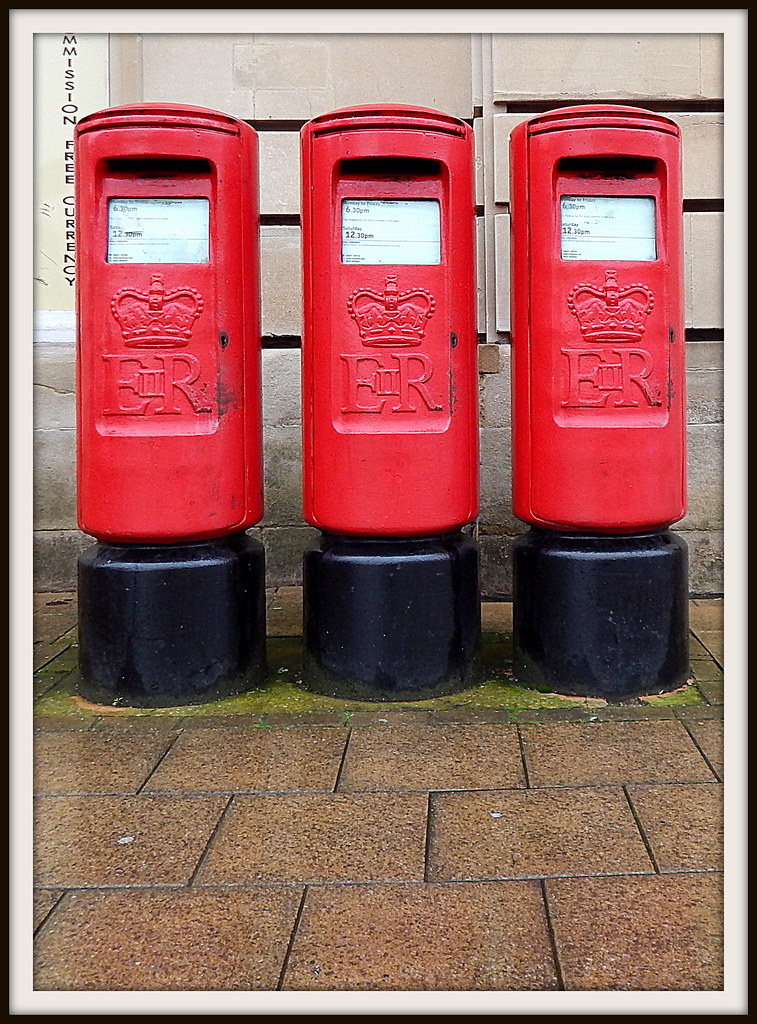
“Atten-SHUN! EIIR Red Pillar Boxes” by drivethr? is licensed under CC BY-SA 2.0 

 .
.
What went wrong at the Post Office over that Horizon computer system is being described as very difficult, complicated, we’ll never really find out and Whocouddaknowed?
This is not correct. The Post Office knowed, ICL knowed, Fujitsu knowed.
Therefore and thus, as I’ve said before, just Jail Them All. There will be some who will be able to argue their way out on the basis of their innocence and that’s fine, even great. But let’s start with everyone on the right side of the bars.
It’s long been — as I’ve said — common gossip among programmers that the base problem really was pretty base. The Horizon system counted incompletes as a transaction. So, a transaction is going through and it doesn’t quite make it. Communication problems, something. A sensible system looks at incompletes and ignores them. Only completes, fully handshaken and agreed, change the accounting ledgers. Horizon did not do this. It would count the incomplete as one transaction, then when the full one came through count that as an additional, extra, transaction.
This is how a branch thought it had one number, the centre another. Because the branch regarded the incomplete and the resend as only the one transaction, the centre as two.
But common gossip among programmers isn’t enough, obviously.
It’s bad enough that glitchy software could cause such human tragedy, but it’s worse: Post Office management knew and chose to cover it up.


