
Real Time History
Published 20 Feb 2026After the defeat in the 1st Sino-Japanese War, the Qing Dynasty is under pressure: Some are calling for domestic reforms and ousting Western influence, while the Great Powers want to further open up China for their businesses. Violence erupts when the so called Boxer movement kills several Westerners.
(more…)
July 20, 2026
Eight Great Powers Invade China: the Boxer Uprising 1900-1901
Comments Off on Eight Great Powers Invade China: the Boxer Uprising 1900-1901
July 19, 2026
The rise of the populist right in Australia
Celina outlines the conditions that allow populist movements to displace traditional centre-right parties as Australia’s One Nation under Pauline Hanson is in the process of displacing the Liberals:

Everyone has an opinion about why One Nation is surging. Most people argue it’s immigration. Others say it’s the cost of living, housing, or just a general distrust of politicians. And obviously all of those things are factors.
But of course, all of those explanations are just opinions, and more importantly, they don’t really explain why this is happening now.
One Nation isn’t the first party of its type to emerge, in fact, Australia is actually pretty late to this trend. We’ve already watched similar parties rise in Britain, the United States, Germany, France, Italy, the Netherlands, Sweden and across much of Western Europe.
[…]
So if immigration alone explains One Nation’s rise, why didn’t One Nation explode ten years ago?
The answer, according to a growing body of political science, isn’t simply that voters changed. It’s that the centre-right stopped functioning the way it used to. For decades, parties like the Liberal Party acted as gatekeepers. They bundled together free-market economics, cultural conservatism and a vague patriotism into one broad electoral coalition. But the Liberal Party has fractured rapidly and everything has changed.
This is exactly what happened with Trump and the Republican Party, with Brexit and then Reform UK in Britain, and with similar populist parties across Europe. The rise of the populist right isn’t just about people becoming more conservative, it’s about the collapse of the old centre-right policy formula. Australia is now going through exactly the same process.
As a comparison, Reform UK established itself as the dominant force on the British right rivaling the Tories whilst they were already crumbling, which allowed those voters to become apart of Reforms broader support base. Analyses of the 2024 election in the UK found that around 80% of Reform voters had voted Conservative in 2019. The same thing now seems to be happening with One Nation. Some of that growth comes from former Liberal voters. Some comes from people who previously supported smaller right-wing parties and have now consolidated behind One Nation because they think it’s the only party capable of replacing the Liberals. Some comes from Labor. But overwhelmingly, this is a story about the collapse of the centre-right rather than some sudden ideological revolution among Australians.
So yes, immigration matters. Cost of living matters. Housing matters. But those things explain why voters became dissatisfied. They don’t explain why millions of those voters suddenly stopped expressing that dissatisfaction through the Liberal Party and started expressing it through One Nation instead. To answer that question, you need political science and when you look at the research, the rise of One Nation starts looking like Australia’s version of a much bigger political realignment that’s already transformed much of the Western world.
So, populist insurgencies are underway in Australia, Britain, France, Germany, Italy, and the Netherlands … so why not in Canada, where all of the conditions are at least as pro-populism as any of the others? My answer is propaganda. Most Canadians still get their daily news and opinions from traditional sources — almost all of whom are now directly on the government’s payroll. Most Canadians are as insulated from dissident voices as Germans were in the 1930s … and Canadians still trust their government more than most other westerners.
July 18, 2026
The Top WW2 Spy Was a Disabled Woman
World War Two
Published 16 Jul 2026Virginia Hall was one of the most extraordinary spies of World War II. An American operative for Britain’s Special Operations Executive and later the OSS, Hall built resistance networks in occupied France, coordinated intelligence, organized safe houses, helped escaped prisoners and airmen, and supported maquis fighters who sabotaged German operations during the liberation of France.
Known to the Gestapo as “the Limping Lady”, Hall worked with a wooden prosthetic leg she nicknamed Cuthbert. After escaping over the Pyrenees, she returned to France in 1944 in disguise, operating a radio, arranging parachute drops, and helping organize resistance forces against the German occupation.
This is the true story of Virginia Hall: the disabled American spy who became one of the most feared Allied agents in Nazi-occupied Europe — and one of the most important women in WWII intelligence history.
QotD: Britain’s National Trust wants to eliminate the “outdated mansion experience”
Think of the National Trust, and what probably comes to mind is an image of a middle-aged, middle-class couple pottering round a neo-classical pile built at vast expense by a spendthrift earl in the 18th century, and then surrendered to the Nation in lieu of inheritance tax sometime in the late 1940s. After all, its purpose is surely to preserve historically significant houses and gardens for the enjoyment and education of the general public.
Well, it seems not. Seek out the National Trust’s Strategy to 2025, and the first words you read are: “Our 21st-century ambition is to meet the needs of an environment under pressure, and the challenges and expectations of a fast-moving world … Underpinning this is our renewed commitment to diversity and inclusion and playing our part to create a fair, equal society, free from discrimination.”
In their “10-year Vision”, written in the same hideous identikit jargon, they talk about a “revolutionary” move away from the “outdated mansion experience”. The Trust provides little evidence that stately homes are becoming less popular; reading between the lines the main problem that the Vision’s authors seem to have with the English country house is that it is old and traditional and popular with comfortably-off white people.
I don’t particularly want to get stuck into the National Trust. But they do provide a particularly interesting example of a problem afflicting institutions in modern Britain, namely the relentless politicisation of parts of life which should represent an escape from politics.
Niall Gooch, “What is the point of the National Trust?”, UnHerd, 2020-10-19.
Comments Off on QotD: Britain’s National Trust wants to eliminate the “outdated mansion experience”
July 17, 2026
British logistics in the Falklands, 1982
A new post at the Operational Art of War considers the amazing achievements in logistical support that allowed the British to re-take the Falkland Islands so soon after the Argentine invasion in 1982:
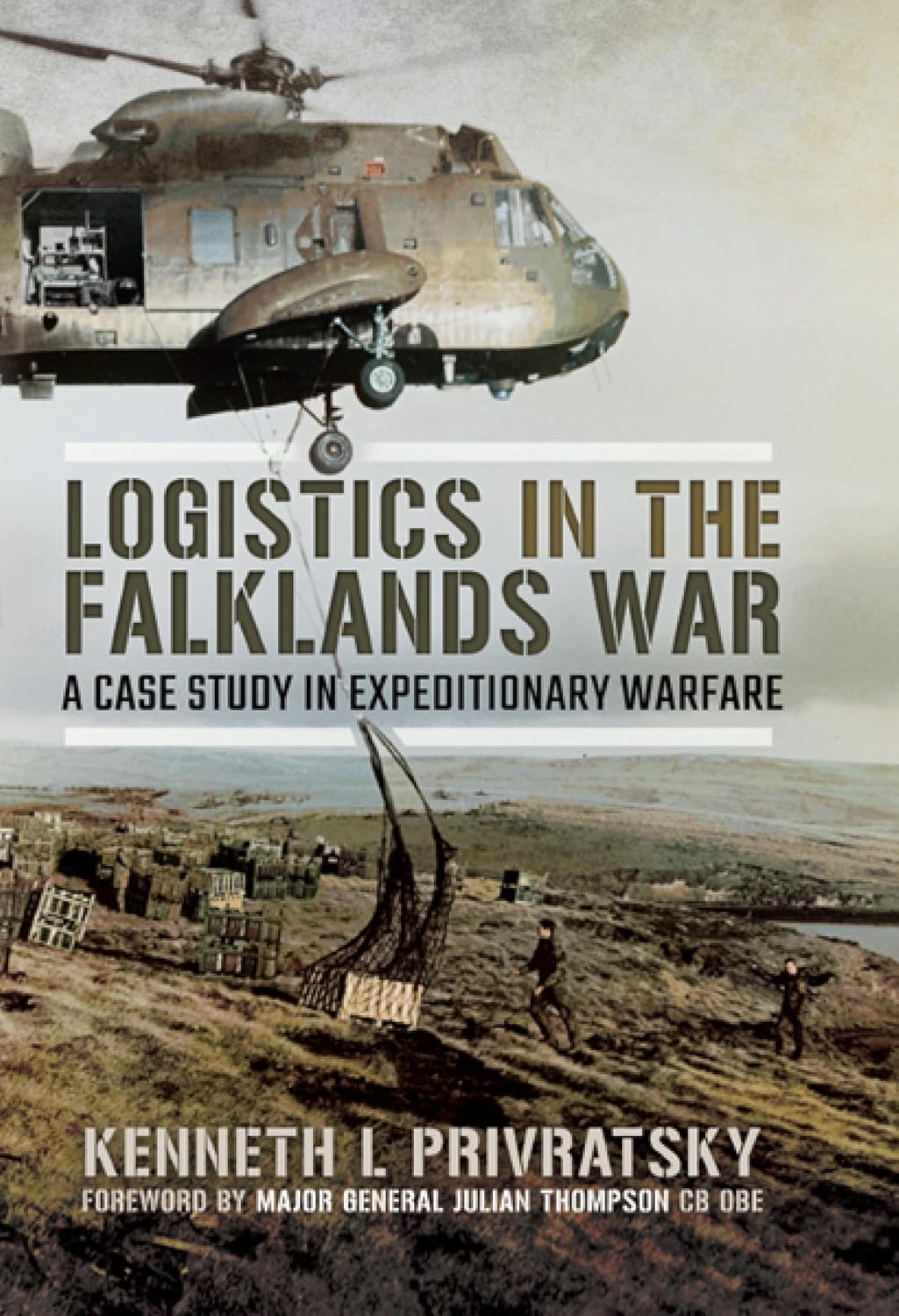
This post is largely highlights from a book I think everyone should buy, called Logistics in the Falklands War: A Case Study in Expeditionary Warfare by US retired MGen Privratsky.
[…]
I read the book as part of a long term project on the history of command and communications in the Falkland War. I couldn’t figure out how the British managed to pull off victory given the logistical challenges, so I purchased this book hoping to find answers.
Having now read the book I know WHAT the British did to win the war, but I have ZERO clue how they managed to make it work. The conditions and limitations they faced were so much worse than I thought.
I can honestly say this is the most interesting book I have read in years, which is a shock to me as I’m typically as bored by logistics as the next non-logistician. It was genuinely more engaging and entertaining than the battlefield accounts of that war.
The Logistics Challenges of the Falklands War
The task eventually given to the British task force was to retake the Falkland islands from the Argentines. This was a daunting task, both logistically and in terms of the actual ground combat.
Strategic Logistics
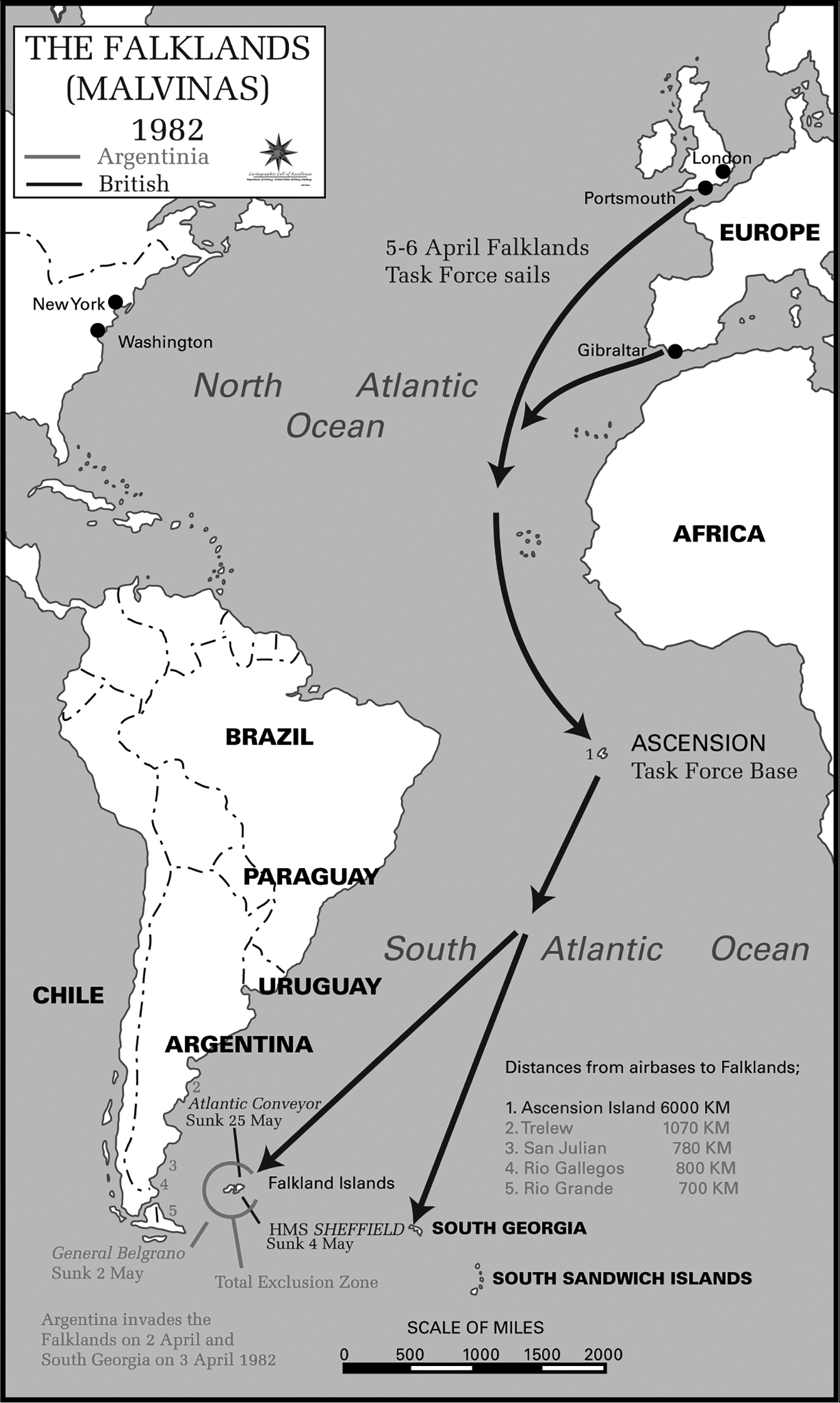
Strategic logistics is providing the lifeline of supplies, personnel, maintenance and health care between the home country and a staging area about 300km outside the combat zone. British strategic logistics involved a link from England to a small British held island half way between Brazil and Africa called Ascension. This link was 4,300 miles (6,900 km) by sea from Portsmouth. It had an airport and one jetty capable of handling one or two small commercial ships.
The next link was a further 3,600 miles (5,800 km) from Ascension to a logistics loitering area about 200 miles (320 km) short of the Falkland Islands. This was just a box drawn on a map in the middle of the ocean where the larger supply ships would loiter, outside the range of the Argentine air force.
[…]
Tactical Logistics
Tactical Logistics holds a few days’ supply (eventually the BSA/DSA held about 30 days supply ashore at San Carlos) but it’s main job is to move supplies, broken equipment, replacements and injured personnel between the BSA/DSA and the manoeuvre units.
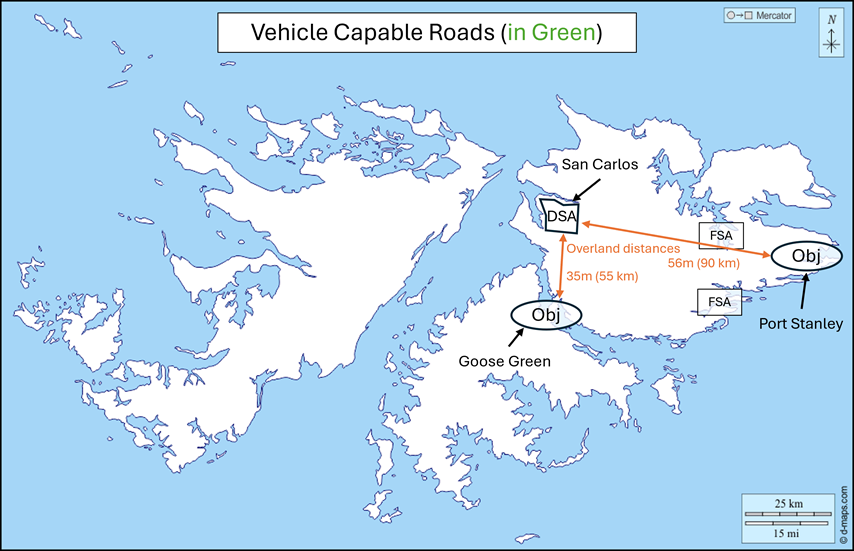
Normally the backbone of Tactical Logistics is trucks. Here there was a problem, as the image below is a comprehensive of all the paved and unpaved vehicle capable roads in the Falklands, excluding those in the vicinity of Port Stanley.
“Roads? Where we’re going Marty we don’t need roads.”
The details of tactical logistics take up several chapters of the book. The brief version is:
- The troops marched from the DSA to the Objective;
- For the attack on Port Stanley two days supply of Ammunition, Shells, fuel and shells were brought to the two Forward Support Areas (FSAs) along with skeletal field hospitals;
- Helicopters spent about 2 weeks bringing the artillery from the DSA to outside Port Stanley; and
- Limited emergency resupply of ammunition and casualty evacuation was available from the FSA to the troops in combat. However, most of the ammunition going brought and casualties evacuated rearward was done on foot over what can charitably be described as walking tracks.
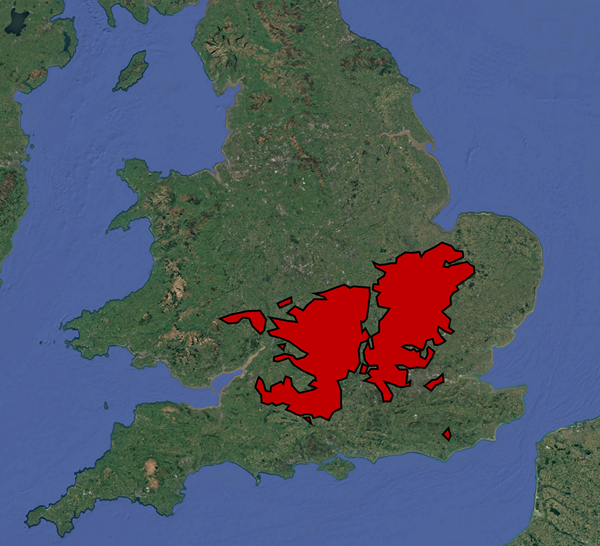
Tactical Logistics in the Falklands was so difficult because there were no roads and the distances involved were enormous. While the orange arrows above give a sense of the distances involved, the image blow shows the size of the Falkland Islands superimposed over England.
[…]
Conclusion
Prior to reading Logistics in the Falklands I couldn’t quite figure out how the British managed to pull a victory out the hat, given the challenges of projecting power literally on the opposite end of the globe. Having read the book I am now convinced the British military in 1982 was either the best improvisational armed force in history or under some kind of Divine mandate.1
- Maybe both.
Comments Off on British logistics in the Falklands, 1982
Why Did the Best Woodworking Vise Disappear?
Rex Krueger
Published 16 Jul 2026AI-generated video summary: Rex Krueger investigates the historical evolution of woodworking vises, comparing modern metal clamps with traditional wooden designs inspired by an 1812 manual. By constructing a classic English face vise, the process examines how economic pressures and shifts in manufacturing trades influenced the tools favored by woodworkers across several centuries.
Comments Off on Why Did the Best Woodworking Vise Disappear?
Why solar power is not the answer for Britain
On the social media site formerly known as Twitter, Sama Hoole looks at a recent World Bank report that shows very clearly why solar power should not even be on the power options list for Britain:
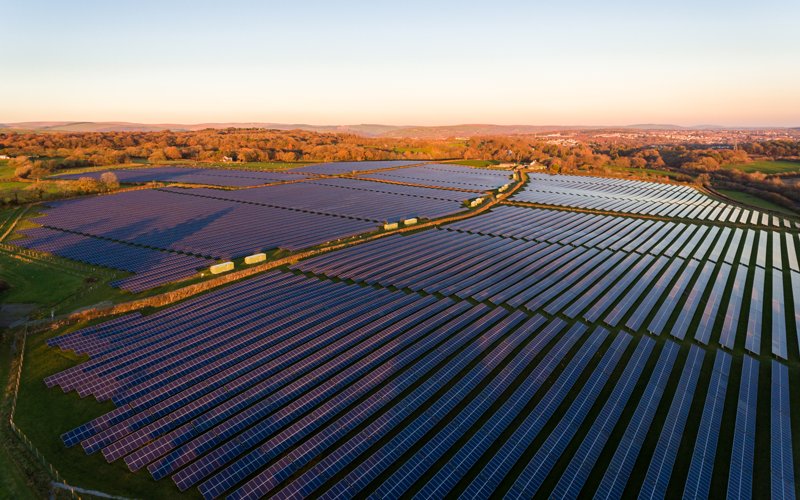
The World Bank ranked every country on earth for practical solar potential.
Britain came second from bottom. Not second from bottom in Europe. On the planet. Out of everywhere they measured, the only place with worse conditions for a solar panel is Ireland. Norway is above us. Norway, where the sun clocks off entirely for part of the year, is a better bet than Lincolnshire.
The reasons are not a mystery. We sit at 53 degrees north, the same line as Edmonton, Alberta. The sun in December gets about as high as a first-floor window and then thinks better of it. And there’s the cloud, which is not a detail, it is the national personality. A square metre of London gets 0.52 kilowatt hours of sunlight a day in December and 4.74 in July, so the panel does nine times less work in the month your heating is on than in the month it isn’t. Across the whole of 2024, British solar ran at 9.5% of what it’s rated at. The other 90.5% is a photograph of a power station.
Now the other column.
The ground we’re bolting it to is Trent valley silt and Lincolnshire fen. Some of it took three hundred years to drain. It grows wheat at yields that most of the planet cannot get near, in a climate so reliably damp that grass grows here without anyone asking it to, which is the entire reason this island has cattle and cheese and a butcher.
So we are, measurably, one of the worst places on earth for sunlight and one of the best on earth for food.
And we’ve had a good long look at both of those numbers and gone with sunlight.
Somewhere in Namibia, which the same report ranked first, there is a patch of absolutely nothing, in full sun, wondering what it did wrong.
Comments Off on Why solar power is not the answer for Britain
Eating Like a Victorian Workhouse Inmate – Scouse & Suet Dumplings
Tasting History with Max Miller
Published 20 Jan 2026Thickened vegetable and meat stew with suet dumplings with parsley
City/Region: England
Time Period: 1901The food served in Victorian workhouses could vary widely depending on the time, place, and management of a particular establishment. Operating under the notion that if the food served to the inmates (yes, that’s what they were called) of a workhouse was worse than the average, it would encourage them to choose to not be poor (yes, those in power believed that being poor was a choice), workhouse food tended to be … not great.
The recipes for this stew and dumplings come from actual workhouse cookbooks, and they’re actually quite tasty, though the Victorian reality was often far from what you might make today with fresh ingredients. Meat could be too tough to eat, bugs and rat droppings were not uncommon, vegetables could be rotten, and the stew watered down.
As written, it makes a simple, hearty, thick meat and vegetable stew with dumplings that are rather dense, though they have a bit of fluffiness. It’s quite good, though I’m under no impression that it’s close to what the poor were actually being served.
Meat Stew (or Scouse)
Ingredients.
5 ozs. Raw Beef free from bone (Stickings or similar quality).
1 oz. Flour.
½ oz. Dripping or Fat.
4 ozs. Potatoes.
4 ozs. Carrots and Turnips.
½ oz. Onions
Pepper and Salt to taste.
Water to make 1 pint.
Method. — Cut up the meat and vegetables. Fry the flour in the fat till brown, stir in the water, add pepper and salt; then put in the meat and vegetables. Simmer gently for two hours. To make 1 pint of stew.
— Manual of Workhouse Cookery (1901)Suet Dumplings. 6 oz. flour, 2 oz. chopped suet, 1/16 oz. baking powder, ¾ oz. chopped parsley, salt and pepper. Mix all the dry things, rubbing the suet through the flour; make into a firm paste with the cold water; divide into ten or twelve small pieces, which roll up into balls, having the outsides well floured. Drop the balls into the stew, and cook for half an hour longer; then serve.
— Miss F. A. Merchant in Management and Construction of Poorhouses and Almshouses by George A. Mackay
Comments Off on Eating Like a Victorian Workhouse Inmate – Scouse & Suet Dumplings
July 16, 2026
QotD: The nostalgic British elements of Canadian nationalism
Britishness survives as civic nationalism. Old British Canada may be gone, but aspects of that Britishness live on. We should celebrate our history and our historic symbols, but this alternative shouldn’t set about restoring it all. A future oriented embrace of our history needs to be built around the active parts of this Britishness that have now become truly Canadian. For example, the Crown in Canada is not now just a British institution, it’s a Canadian institution. Same with our democratic institutions and parliamentary traditions, which we must work to strengthen and renew.
Embracing this enables us to thread the needle on our relationship with America. Part of what makes us different historically, culturally, ideationally, and in disposition from America, is this history. Just as Canadian Britishness has survived to the present day in unique ways, our desire not to become Americans is alive and well. A homegrown Canadian Britishness enables us to continue this without falling into crass anti-Americanism, and without requiring us to embrace the new Liberal nationalism to reject America. We should see America as an amicable cousin, but one that we are distinct and different from.
But most importantly, what this new kind of national identity needs to build around needs to be an evolution of the liberal nationalism that emphasizes and consciously builds around our regional pluralism. […] but the kind of rationalistic liberalism that our modern national identity is built around, while sold as a way of dealing with diversity, suffers from some serious internal tensions. Liberalism, especially the Canadian variant of it, implicitly depends upon and encourages a degree of homogenization that flattens hard cultural differences. We need to become more pluralistic, and less liberal.
Ben Woodfinden, “True North Patriotism and a Distinctly Canadian Conservatism”, The Dominion, 2020-10-20.
Comments Off on QotD: The nostalgic British elements of Canadian nationalism
July 14, 2026
QotD: Subaltern Studies
You can come at this in a few different ways. In the History biz, a big buzzword used to be “agency”. Not as in “three letter”, but as in “ability to meaningfully affect your environment”. One has “agency” insofar as one is able to get one’s way. It’s a big deal in the ivory tower, because if the grand sweep of History since the Middle Ages tells us anything, it’s that White guys tend to get their way, while brown guys do not. There are entire continents (and Subcontinents) full of millions of people, run by a handful of honkies.
Obviously that’s very very bad for them … but very very good for you if you want tenure, providing you can find some way to prove that the honkies weren’t really in charge. Subaltern Studies, for instance, is a field where, at its worst, literally anything a brown person does, or doesn’t do, is an example of “agency”, because it’s an example of “resistance” — doing exactly what Whitey says is really sticking it to Whitey, because extremely dense polysyllabic theory-laden reasons.
The stated goal of all this being, to give “agency” to the subaltern. But that’s the funny thing: While explaining at enormous length why “doing exactly what Whitey says” is somehow “resistance”, these folks were in fact acknowledging the massive agency — no quotation marks — of the British. They said “Jump, frog!” and seven hundred fifty million people asked “How high?” There’s only so much jargon can do to disguise that basic power dynamic, which is why “Subaltern Studies” isn’t the hot new thing anymore.
Severian, “Externalizing”, Founding Questions, 2022-07-14.
Comments Off on QotD: Subaltern Studies
July 12, 2026
How WW2 Really Started: Appeasement! – Death of Democracy 23 – Q3 1938
World War Two and Spartacus Olsson
Published 11 Jul 2026On September 30, 1938, Neville Chamberlain returned from Munich promising “peace for our time”. Adolf Hitler returned to Berlin with the Sudetenland.
In this episode of “Death of Democracy”, Spartacus Olsson reports from Berlin as Nazi Germany escalates on two fronts: terror against Jewish citizens at home, and diplomatic blackmail against Czechoslovakia abroad.
While the Evian Conference fails to open the world’s doors to Jewish refugees, the Nazi regime tightens the trap with identity cards, forced names, professional bans, the opening of Mauthausen, and Eichmann’s machinery of forced emigration in Vienna.
At the same time, Hitler manufactures the Sudeten Crisis, threatens war, breaks Czechoslovakia’s defenses through the Munich Agreement, and convinces much of Europe that surrendering another country’s territory is the price of peace.
This is Germany in Q3 1938: the lie that Hitler would not start another war — and the world’s decision to believe him.
Comments Off on How WW2 Really Started: Appeasement! – Death of Democracy 23 – Q3 1938
July 11, 2026
Governments should not have easy access to emergency powers
As we found out in Canada in 2022, when the government gives itself emergency powers unrestricted by normal legal procedure and due process, they abuse those powers. The UK government is eager to grant itself similar powers due to a “climate emergency” that will, among other things suspend habeus corpus and the 1689 Bill of Rights:

Emergency, d’ye see? National security emergency.
But here’s the problem if the government declares a national security emergency:
Part 1 of the act establishes a new and broad definition of “emergency”. The definition includes war or attack by a foreign power, which were defined as emergencies under previous legislation, as well as terrorism which poses a threat of serious damage to the security of the United Kingdom and events which threaten serious damage to human welfare in a place in the United Kingdom or to the environment of a place in the United Kingdom.
Damage to the environment in the UK. So, that matches. And if they then declare such an emergency, under the act, then the following laws — among others — no longer apply:
The only primary legislation which may not be amended by emergency regulations is the Human Rights Act 1998 and part 2 of the Civil Contingencies Act itself
That is, all other laws no longer apply. It’s an Enabling Act, allowing rule by decree for the length of the emergency. Absolutely everything is up for grabs. These laws are not, repeat not, protected:
The peers tried to protect the following laws from emergency regulation:
Habeas Corpus Act 1679
Bill of Rights 1689
Section 7 of the Parliament Act 1911 which limited the duration of a parliament to five years[e]
Act of Settlement 1701
House of Commons Disqualification Act 1975
Life Peerages Act 1958
House of Lords Act 1999
Seriously, it wipes out the entire legal and constitutional structure.
So, you know, no. Not because there is, or isn’t, a climate change emergency. But because of the powers they’ll take if one is declared.
No.
It’s not November yet, but this sign seems rather appropriate:
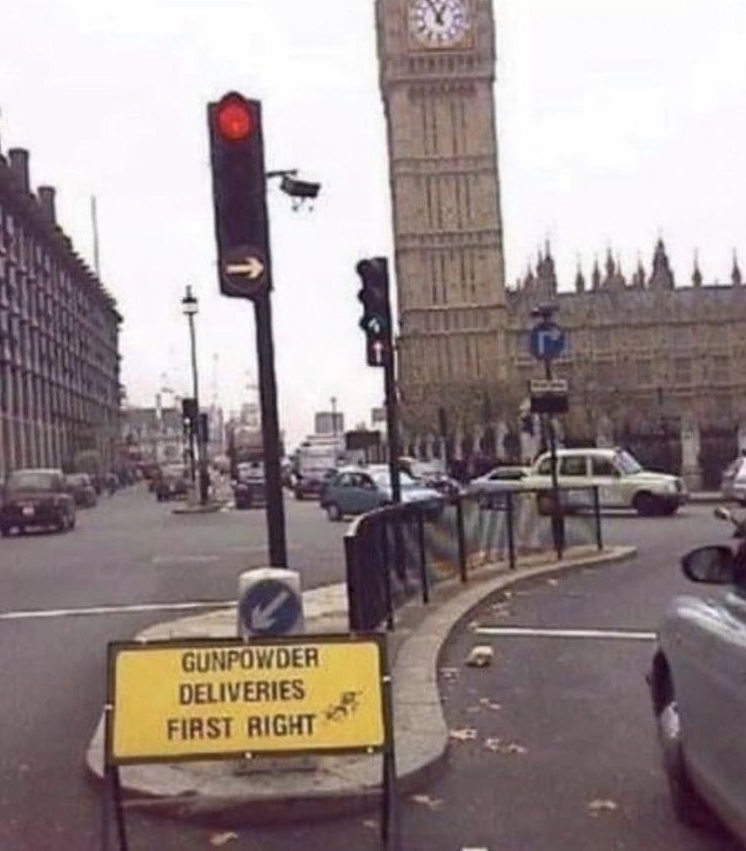
Comments Off on Governments should not have easy access to emergency powers
British censorship laws do not apply outside the UK’s jurisdiction
On Substack Notes, Lorenzo Warby links to a fascinating discussion about the ongoing struggle between the UK government’s Ofcom and the US-based 4chan and their legal representatives, saying “The totalitarian wannabes currently running the UK do not apparently grasp that the American Revolution and War of Independence was a thing. Also, being totalitarian wannabes, they have no sense of humour.”

A UK cabinet minister, Rt. Hon. Liz Kendall MP, Secretary of State for the Department of Science, Innovation and Technology (“DSIT”), discussed the infamous “hamster e-mail” I sent on behalf of my client 4chan to the UK’s Internet censor, on national radio today in the UK. […] My father always told me, when I was growing up, “when a cabinet minister holding the technology policy brief for a G7 Member State is talking about your e-mailed jokes to an audience of millions on national broadcast media, that is the right time to explain the joke, especially if the cabinet minister didn’t get the joke”.
That explanation follows.
The backstory – Hamster #1
The hamster joke has a bit of a history to it. Ofcom, the UK’s Internet censor, first made contact with my American client 4chan in June of 2025 in its attempt to impose British censorship law on that website. I was subsequently retained as defense counsel, pro bono.
Ofcom then “provisionally fined” 4chan on August 16th, 2025 for refusing to obey the UK’s censorship regime. We were invited to make representations to the regulator following that provisional fine decision.
We did two things in response to that. The most newsworthy response was to file a lawsuit against the regulator in the DDC. Before that, however, we explained our position to Ofcom in writing and gave them an opportunity to walk away:
To wit, Ofcom’s fine notices were not properly served and were not enforceable in the United States. Note that we also gave Ofcom fair notice that while this might have been their first attempt to enforce their censorship orders in America, this was not our first rodeo when it came to successfully refusing such orders.
No quantity of officious and haughty foreign demand letters will change our stance. The UK could even pass a bill of attainder – historically Parliament’s most extreme and powerful legislative weapon – against my client, for all I care. My client’s right to operate its service lawfully in the United States is protected by the First Amendment. There is no law Parliament could enact that would change that fact.
I am very familiar with how this movie ends, and it does not end with 4chan paying Ofcom’s fine.
It may end with the UK’s censors getting a blocking order that it serves on its own ISPs; that would be the UK visibly censoring its own people, rather than censoring my client, and doing so ineffectively, at that, as ISP blocks can be circumvented with a VPN. That is a consequence my client is prepared to accept.
England might have the Online Safety Act, but the United States has the U.S. Constitution. These rulesets do not override each other; they are, rather, mutually exclusive. In America’s domain, the Online Safety Act essentially doesn’t exist. It has about as much legal force as a pile of shredded paper one might use to line a hamster’s cage.
Peace was always an option here, but that would have required the UK to abandon the fiction that its rules override the U.S. Constitution on U.S. soil, which we are not prepared to accept.
My clients did not start this fight, but by golly we do intend to finish it.
My client sued Ofcom two weeks later.
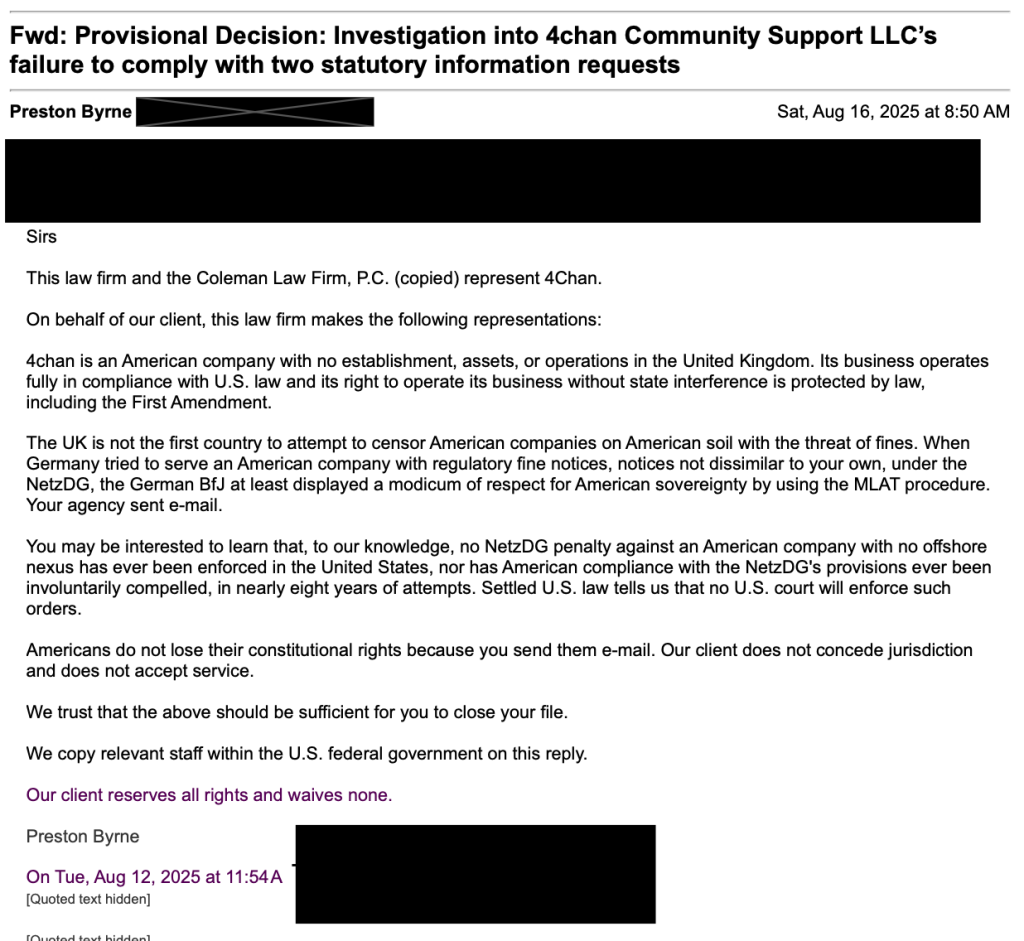
There’s much more, so do read the whole thing.
Comments Off on British censorship laws do not apply outside the UK’s jurisdiction
Road to Rangoon, Ep. 2 – Jungle Commandos Operation Romulus & Hill 170
HardThrasher
Published 10 Jun 2026In the Arakan, it turned out the third time was the charm, at least for those lucky enough to survive the jungle, malaria and a coastline without maps.
In this episode we return to Burma and the Arakan, where Operation Romulus turned a miserable sideshow into a strategically vital victory. We look at XV Corps’ third attempt to take Akyab, the extraordinary march of the 81st and 82nd West African Divisions, the improvised amphibious landings at Myebon, and the brutal fight for Hill 170, where the Royal Marine Commandos as we know them today, cut their teeth
Featuring Operation Romulus, Pungent, Lightning, Akyab, Myebon, Kangaw, Hill 170, the Black Tarantulas, 3 Commando Brigade, 25th and 26th Indian Divisions, and Japanese 28th Army.
00:00:00 – Intro
00:02:28 – Recap
00:08:15 – Operation Romulus – the Plan to take the Arakan
00:20:57 – The Attacks Begins
00:30:34 – Meanwhile in land
00:43:10 – Op Pungent and the Fight for Meybon
00:50:43 – The Final Assault
00:56:06 – Aftermath
00:57:41 – Epilogue
00:59:13 – Survivor’s Club
(more…)
Comments Off on Road to Rangoon, Ep. 2 – Jungle Commandos Operation Romulus & Hill 170


