
Royal Armouries
Published 4 Feb 2026This episode of “What Is This Weapon?” Jonathan examines a seemingly ordinary Sterling/Patchett submachine gun that turns out to be anything but.
This is a rare opportunity to examine a historically significant firearm that was owned and more than likely, used by Britain’s wartime Prime Minister.
0:00 Intro
1:55 The Hidden Plaque & Churchill Connection
3:36 Provenance: Churchill’s Firearm Certificate
5:58 Not a Wall Hanger: Ammunition & Use
6:05 Patchett vs Sterling: Design Differences
10:43 Churchill, Firearms & Wartime Image
14:49 Legacy & Back Next Week for Another Archive Film
(more…)
July 11, 2026
Winston Churchill’s Personal Patchett/Sterling Submachine Gun
Comments Off on Winston Churchill’s Personal Patchett/Sterling Submachine Gun
July 9, 2026
Here’s why “free range children” went away
As a child in England and then in Canada, I had a pretty wide range for unsupervised activities and I generally took advantage of that. On foot or riding my bicycle, it was completely normal for me to be several miles from home on any given day. I’ve posted this image a few times, showing the “free range” diminishing generation by generation for an English family, and it’s mostly true here in Canada and in the United States as well:
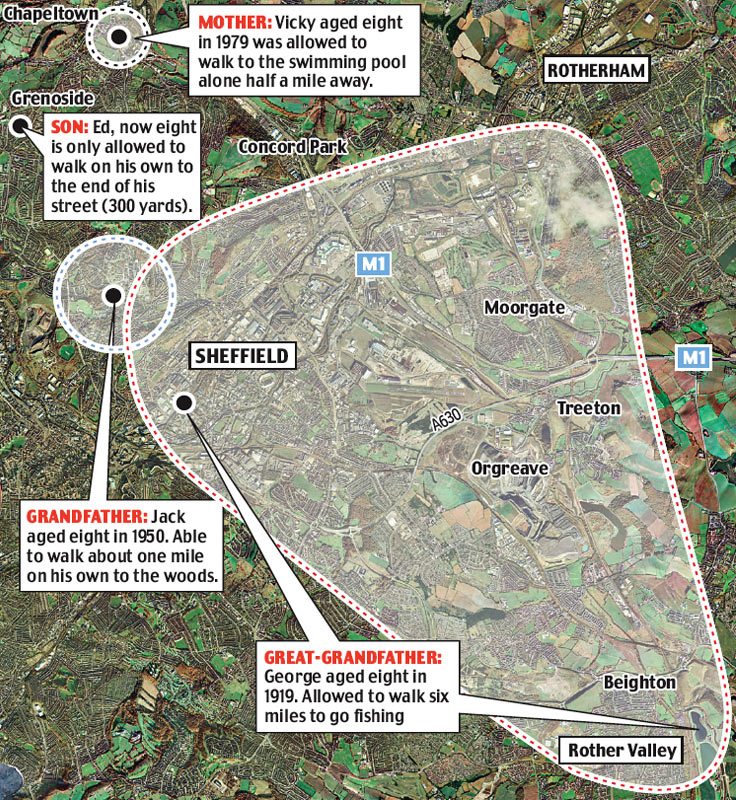
Graphic showing the diminishing “free ranges” of each generation of an English family.
At Classical Ideals, Megha Lillywhite discusses the “political extremism” involved today in trying to raise your children:
One of the most fundamental things that children require in order to grow up healthy, strong, wise and good, is a lot of time outdoors and in public spaces. Yet what we see from more traditional families in the west, as well as from extremely wealthy families, is that they are holding their children closer than ever, and enclosing them in increasingly smaller and more carefully selected bubbles of protection.
This is because “the outdoors” and “public life” is territory that has increasingly been ceded by western society to violent criminals, the mentally ill, and drug addicts. Parenting, for those who are vigilant to the threats, can no longer be “laissez-faire” and it has become less about choosing the ideal, and more about choosing the least damaging option.
But what has been lost? And what must be reclaimed for those of us with power and spirit to have any kind of meaningful victory in this world?
Most leftists see politics through the framework of wanting to be “a good person” as it is defined by their peer group and ideology. The ordinary person, on the other hand, views politics through the set of decisions that would best protect their children and give them the best chance at a good life.
Why is this? Leftists either don’t have children, or they have children but live in gilded cages and are therefore untouched (yet) by the consequences of their ideological beliefs.
Children must exist as part of a broader community in order to develop healthily. They must be able to go to a public library, the local shop, ride their bikes to the park, take the city bus or walk to their grandmother’s house on their own. They must be able to play outside unsupervised for hours on end in their neighbourhoods.
[…]
But some measure of freedom is also necessary for children to develop a healthy psyche. A child who can go to the shop and pay for milk on his own and bring it home will develop not only a sense of responsibility, but will feel confident in his ability to do useful things. A child who can visit his friends and relatives on his own will develop social skills and a sense of belonging. A child who can go to the library on his own can begin the lifelong journey of guiding his own learning.
[…]
In a 2007 study done in Sheffield, UK by Dr. William Bird, he found that children in 1926 were allowed to roam up to six miles away from home unsupervised and by 2000, that number dropped to 300 metres. The major drop off happened around 1979 which is coincidentally the time when mass migration began in the United Kingdom and demographics of towns like Sheffield began to seriously shift. In the recent “Rape Gang Inquiry” released by the Restore Party of Britain, the report which details three decades of kidnap, rape and murder of a quarter of a million British girls which would have began around this time. So English parents restricting their children’s freedoms around this time period was not something hysterical or unfounded.
We must be politically courageous in order to admit what is required to maintain that kind of a world. Stated simply, a safe, healthy and good childhood requires a fundamental rejection of leftist “empathy” politics. There is one incident in particular that can help to describe how this system functions today.
Link from John Carter on Substack Notes, who commented:
The same shift towards a confined, highly monitored childhood took place in the US, corresponding to the great suburbanization. The suburbs grew due to white flight from the cities, following their colonization by blacks and the de facto ban on community defence enforced by the civil rights act.
Suburban municipal architecture is largely comprised of informal defensive barriers that prevent undesirable elements from penetrating the neighborhoods undetected.
This enables middle class parents to deniably insulate their children from the worst consequences of diversity, but at the cost of raising their children in open air prisons, in a stifling social atmosphere characterized primarily by a brittle insistence upon euphemistic avoidance of direct acknowledgement of the real issues. “Racism is simply terrible! We just wanted to live somewhere with good schools.”
Children brought up amidst the tedious fakery of the suburbs naturally become attuned to the pervasive hypocrisy of suburban white culture. They have to: simply navigating this culture requires the ability to understand the unsaid, while pretending that one has not understood it. Combined with the open air prison environment inhibiting emotional development, this is a powerful recipe for induced neurosis.
There are only a few possible outcomes: 1) they become cowardly hypocrites themselves; 2) they reject the hypocrisy and become fanatical anti-white race communists; 3) they reject the hypocrisy and become fascists.
Comments Off on Here’s why “free range children” went away
QotD: The labels “capitalism” and “socialism”
Before identifying why they were wrong, we need to acknowledge what Marx and his disciples were right about. Inequality did increase as a result of the Industrial Revolution. Between 1780 and 1830 output per laborer in the United Kingdom grew over 25 percent but wages rose barely 5 percent. The proportion of national income going to the top percentile of the population rose from 25 percent in 1801 to 35 percent in 1848. In Paris in 1820, around 9 percent of the population was classified as “proprietors and rentiers” (living from their investments) and owned 41 percent of recorded wealth. By 1911 their share had risen to 52 percent. In Prussia, the share of income going to the top 5 percent rose from 21 percent in 1854 to 27 percent in 1896 and to 43 percent in 1913. Industrial societies, it seems clear, grew more unequal over the course of the nineteenth century. This had predictable consequences. In the Hamburg cholera epidemic of 1892, for example, the mortality rate for individuals with an income of less than 800 marks a year was thirteen times higher than that for individuals earning over 50,000 marks.
It was not necessary to be an intellectual to be dismayed by the inequality of industrial society. The Welsh-born factory owner Robert Owen envisaged an alternative economic model based on cooperative production and utopian villages like the ones he founded at Orbiston in Scotland and New Harmony, Indiana. It was in a letter to Owen, written by Edward Cowper in 1822, that the word “socialism” in its modern sense first appears. An unidentified woman was, Cowper thought, “well adapted to become what my friend Jo. Applegath calls a Socialist”. Five years later, Owen himself argued that “the chief question … between the modern … Political Economists, and the Communionists or Socialists, is whether it is more beneficial that this capital should be individual or in common”. The term “capitalism” made its debut in an English periodical in April 1833 — in the London newspaper the Standard — in the phrase “tyranny of capitalism”, part of an article on “the ill consequences of that greatest curse that can exist amongst men, too much money-power in too few hands”. Fifteen years later, the Caledonian Mercury referred with similar aversion to “that sweeping tide of capitalism and money-loving which threatens our country with the horrors of a plutocracy”.
Niall Ferguson, “Capitalism, Socialism and Nationalism: Lessons from History”, 2020-02.
Comments Off on QotD: The labels “capitalism” and “socialism”
July 4, 2026
In the “early Victorian period … drinking whisky was the modern-day equivalent of licking hallucinogenic toads”
Scotland was terra incognita to the English for far longer than one might think, even though the two kingdoms shared a monarch as early as 1603. On his Substack, Ed West shows how modern day Scotland has long since emerged from the mysterious shadows of the past:
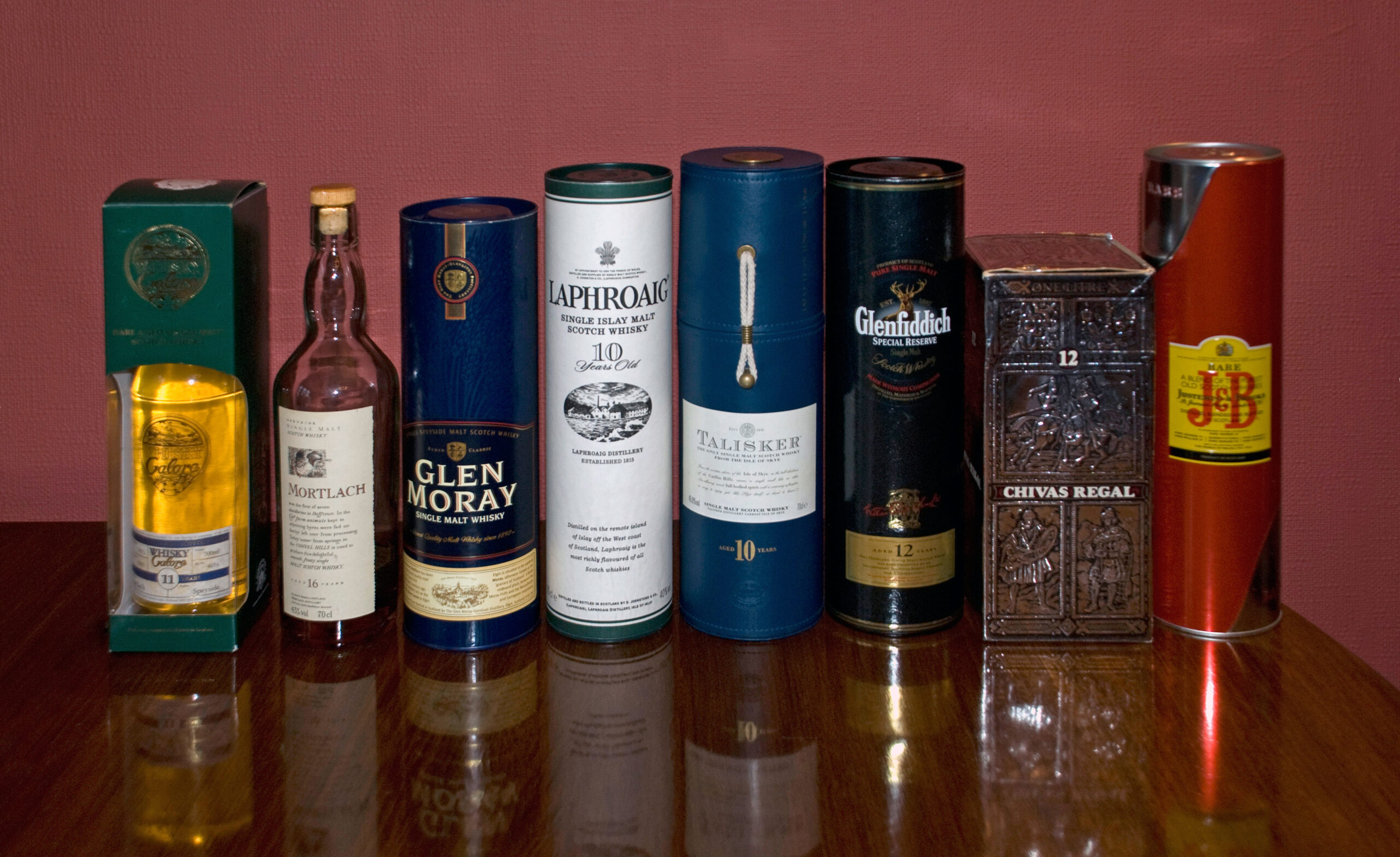
“Scotch whiskies” by Chris huh is licensed under CC BY-SA 4.0 

 .
.
In his highly entertaining history of alcohol and the British, Empire of Booze, Henry Jeffreys observed how one effect of the Napoleonic Wars was to make Scotland a popular destination for English holiday makers. What with the continent being isolated and everything, there weren’t many more exotic places for the richer, more adventurous traveller to visit.
The country was until then largely unknown to many people south of the border, something also true of its trademark drink. “Highland and lowland whisky in the early 19th century would have been a mystery to the majority of Englishmen”, Jeffreys writes: “In the literature of the Georgian and early Victorian period it’s apparent that drinking whisky while in Scotland was the modern-day equivalent of licking hallucinogenic toads while in the Amazon or eating rancid whale in Iceland”.
The conflict with revolutionary France proved to be a great boost to Brand Scotland, and not just because of the limits it placed on rival destinations, but also for the dash that the Scots cut on the field. This culminated with a momentous scene in which “the Highland regiments dazzled the French when the Allied armies marched into Paris”.
Here they wowed both friends and enemies alike, and Sergeant Thomas Campbell of the Grenadier Company recalled how the Tsar even personally “examined my hose, gaiters, legs, and pinched my skin, thinking I wore something under my kilt, and had the curiosity to lift my kilt up to my navel, so that he might not be deceived”. Thanks to the likes of the Black Watch and Gordon Highlanders, the Scots had arrived on the global stage, and no one would ever forget Die Damen aus der Hölle (Ladies from Hell) as German troops would later call Highlanders.
This period of upheaval and war – the birth pangs of true modernity — was marked by a growing craze for Highlandism, “a peculiar phenomenon where lowland Scotland, a predominantly settled mercantile society, took on the trappings of the Highlander as a way of differentiating themselves from Englishmen who they were now yoked to in the Union”.
Previously viewed as menacing, the Highlanders had been tamed by the defeat of the Jacobites and the Clearances that followed, making this once-feared Gaelic culture now safe for English speakers to adopt as their own. Much of this was driven by the romantic imagination of Edinburgh’s Walter Scott, who helped shape both Scottish national identity and the 19th century resurgence of medievalism. Perhaps more than literature, however, Highlandism was boosted by the region’s most famous export — whisky. As Jeffreys writes: “The growth of Scotch coincided with the birth of Highlandism”.
The development of Brand Scotland was also helped by a man widely regarded as Britain’s greatest buffoon and waste of space, the former Prince Regent. Historian John Plumb described a hugely influential visit by the now George IV in 1822, where: “He paraded Edinburgh in the kilt, resplendent in the Royal Stuart tartan and flesh-coloured tights, and yet managed to keep his dignity. The Scots loved it! Quaintly enough, George IV had struck the future note of the monarchy … Be kilted! Be sporans! Be tartans! Riding up Princess Street … To the roaring cheers of loyal Scots, he was showing the way that the monarchy would have to go if it were to survive an industrial and democratic society.”
It was the start of a beautifully symbiotic relationship, with the Royal Family immersing themselves in Highlandism ever since, spending much of their summer holidays there and helping to project an ideal of a region famed for its dramatic countryside, castles, distilleries and golf courses. They’re not alone: Donald Trump, whose mother hailed from the Isle of Lewis, has a noted fondness for the old country, even if this is not always reciprocated, and no doubt many more of his compatriots will be making the pilgrimage in the coming year thanks to the country’s newest brand ambassadors. These are, of course, another occupying force of Scots, the fans of the national football team who followed their country’s brief recent appearance at World Cup.
The Scots in Boston marched as proudly as their ancestors. Their bagpipers serenaded the opposition. Some even turned up at a wedding. They came to watch the Boston Red Sox, which one local described as “the best thing that’s happened in years”. They attracted many neutrals, including a duck. Folk songs were written about them. Everyone loved them, even if some struggled to understand them.
The Boston Globe published a full-page letter thanking them. One local reported how Scotland fans leaving Boston was “almost like a day of mourning for the Americans“. After they left, Massachusetts State Senator Paul Feeney made an emotional farewell, thanking them for visiting children’s hospitals and donating money to local charities: “You’ve been great, courteous guests, you’ve been polite and you’ve been fun and I don’t want that to end”. He invited them to return next year, by which time Glasgow will be twinned with Boston. Indeed, Scottish fans so impressed the Bostonians that the city changed its zoning laws, not an easy task in America. They may even have solved the fertility crisis. Indeed, the Tartan Army charm offensive in Boston has been so overwhelming that I half suspect it’s some sort of devious RICU operation.
Comments Off on In the “early Victorian period … drinking whisky was the modern-day equivalent of licking hallucinogenic toads”
The Dark Truth Behind America’s National Anthem
The Rest Is History
Published 8 Jun 2026How did the War of 1812 result in America’s national anthem, The Star Spangled Banner? Who came up with it? And, why does this origin story make the anthem so controversial?
Join Dominic and Tom as they launch into the first episode of their Football World Cup special, with the story behind America’s national anthem, and its secret story.
0:00 – Lloyd’s
01:21 – The Star-Spangled Banner
02:43 – A World Cup Series on National Anthems
04:08 – America’s Most Controversial Anthem
05:00 – The Forgotten War of 1812
09:10 – Britain Strikes Back
11:39 – Francis Scott Key Boards the British Fleet
15:27 – The Bombardment of Fort McHenry
18:14 – The Giant Flag That Inspired the Anthem
20:41 – Francis Scott Key Writes the Poem
23:28 – Why the Anthem Used an Old English Tune
26:13 – The Anacreontic Song
29:07 – How the Song Became a Hit
30:37 – The Times
31:48 – Is The Star-Spangled Banner About Slavery?
36:08 – Escaped Slaves and the British Army
40:55 – The People Who Found Freedom Under the Union Jack
42:29 – Francis Scott Key’s Complicated Legacy
47:06 – The Song Spreads Across America
51:39 – Why America Took So Long to Get a National Anthem
56:42 – How It Finally Became the Anthem
57:06 – Controversial Performances
1:00:17 – Colin Kaepernick and Taking the Knee
1:02:39 – Can You Separate the Anthem from the Author?
1:03:03 – The Abolitionist Version of the Anthem
1:04:13 – Coming Next: God Save the King
1:06:33 – The Rest Is History ClubVideo Editors: Jack Meek, Harry Swan + Adam Thornton
Social Producer: Harry Balden
Producers: Tabby Syrett & Aaliyah Akude
Senior Producer: Callum Hill
Executive Producer: Dom Johnson
Chief Digital Officer: Sam Oakley
Comments Off on The Dark Truth Behind America’s National Anthem
QotD: “Yankee Doodle”
[…]
Which is how we ended up with a patriotic standard that is also a death threat, a sodomy joke, a farm boy’s account of watching grown men handle their enormous guns with mounting enthusiasm, and the song we teach five year olds at Fourth of July parades. All of this has been inside the song the whole time. I want to walk through what is actually in there, because once you can see it you cannot stop seeing it, and I think we owe the song more than we have been giving it.
Start with the title, because the title is already doing two things at once. “Yankee” is almost certainly from the Dutch Janke, a diminutive Dutch settlers in New York used to mock their English neighbors. The British army picked it up as convenient shorthand for a provincial American. A rube. A man of no consequence. “Doodle” meant fool, from the German dudel, and this is the part that makes it into the elementary school music program. The part that does not is that “doodle” was also eighteenth-century British slang for a penis. Both meanings were in active circulation. Neither was obscure. When the British handed this song to their regulars as a marching tune intended to demoralize the enemy, they were calling the colonists provincial idiots and, on a second pass, Yankee dicks. The American troops heard the title and, in the great tradition of men who have already stopped caring what anyone thinks of them, said yes, that one, put it on the flag.
The first thing the song was is a threat.
Yankee Doodle’s come to town / For to buy a firelock / We will tar and feather him / And so will we John Hancock.
British soldiers were singing verses like this one in the run-up to Lexington. Tar and feathering was not a prank. It was a ritual. Men were stripped, had boiling pine tar poured directly onto bare skin, rolled in feathers while the tar was still cooling, and paraded through town as public spectacle. The skin came off with the tar. Some victims died in the days that followed from shock and from infections in the raw flesh. The British soldiers are singing about doing this to a specifically named man. John Hancock. The wealthiest man in Boston, already on London’s list for arrest. “So will we John Hancock” uses his name as a verb. We will do this to him. We will use his body to make a point.
The soldiers singing this were on their way to arrest him. They missed. Hancock got through Lexington, made it to Philadelphia, and in the summer of the following year signed the Declaration of Independence in letters so large that his name became, in English, the common noun for a signature. The verb became the noun. We will destroy you publicly became I was here, I did this, come and get me. The song that had been a mob-violence threat against a living dissident was now, a year later, being sung by the men who had saved him as they mustered for the same war. The target of the verse became the architect of the country that kept the verse. This is the first transformation the song undergoes and it is not subtle. It is also not the last.
The second thing the song is is a sodomy panic. He stuck a feather in his cap and called it macaroni. Every American schoolchild has been told this means the colonist was too stupid to know what fashion was. That is the sanitized reading. The full reading requires understanding what the Macaroni Club was. Young English aristocrats came back from the Grand Tour in Italy wearing wigs so tall they required structural adjustment to pass under a doorframe, corseted coats, embroidered slippers, and Continental affectations so pronounced the London press began printing caricatures of them within the year. “Macaroni” meant dandy, in the same dictionary-accurate way “doodle” meant fool. Technically correct. Missing the entire point.
The point is that the Macaroni Club had become, by the 1770s, a convenient public container for British anxieties about male effeminacy, foreign moral contamination, and sodomy. The caricatures drew them in pinched silhouettes and muffs, in poses the London audience was supposed to read as unmistakably queer. The courts were not caricaturing. They were prosecuting. Men were pilloried. Others were executed. The word “macaroni” was carrying the weight of active criminal cases at the exact moment “Yankee Doodle” was being composed. A British army surgeon named Richard Shuckburgh is the likely author of the most famous macaroni verse, and what he wrote was a joke with a second floor. On the ground floor: the colonial rube does not know what high fashion is and mistakes a single feather for an entire wardrobe. On the second floor: the colonial rube has just put on the signifier of a group of men the British state is currently prosecuting for sodomy, and he does not realize what he has announced himself as. He is a joke to the troops singing the song, and the joke is that he is queer and does not know it.
The colonists heard all of this and kept the song anyway. The British were banking on a shame that had already dissolved. You cannot humiliate a people that has stopped needing your approval. The song arrived as an instrument of British contempt, and the colonists adopted it anyway, and from that moment on it stopped being a British song and started being something else. A vessel. Whatever the singer needed it to carry, the song carried. That is the reclamation, and it is also the engine of everything that happens to the song from here.
Emma, “Yankee Doodle, Undressed”, Past Life, Present Cleavage, 2026-04-22.
July 1, 2026
The Korean War Week 106 – The Battle of Old Baldy – June 30, 1952
The Korean War by Indy Neidell
Published 30 Jun 2026On the ground, the fight for the hilltop they call “Old Baldy” really heats up this week, and it’s a bloody one. In the air, the bombing campaign to destroy the North Korean hydro-electrical complex continues, and the Suiho dam, one of the world’s largest, is put out of action and the power is out across much of the country.
00:00 Intro
00:45 Recap
01:14 Suiho Dam
05:22 Old Baldy
09:04 Army Budgets
14:29 Planning a coup?
16:08 Summary
16:22 Conclusion
17:10 Call to Action
Comments Off on The Korean War Week 106 – The Battle of Old Baldy – June 30, 1952
June 29, 2026
King Charles disclaims the title “Defender of the Faith”
His Majesty has been hinting of his preference for Islam since at least his thirties … becoming formal head of the Church of England fits poorly with his likely personal beliefs. This isn’t really a surprise, as the Church of England has been drifting a long way from its roots for generations now, but symbolically it is quite important, as Donna-Louise Flowers writes on Substack Notes:
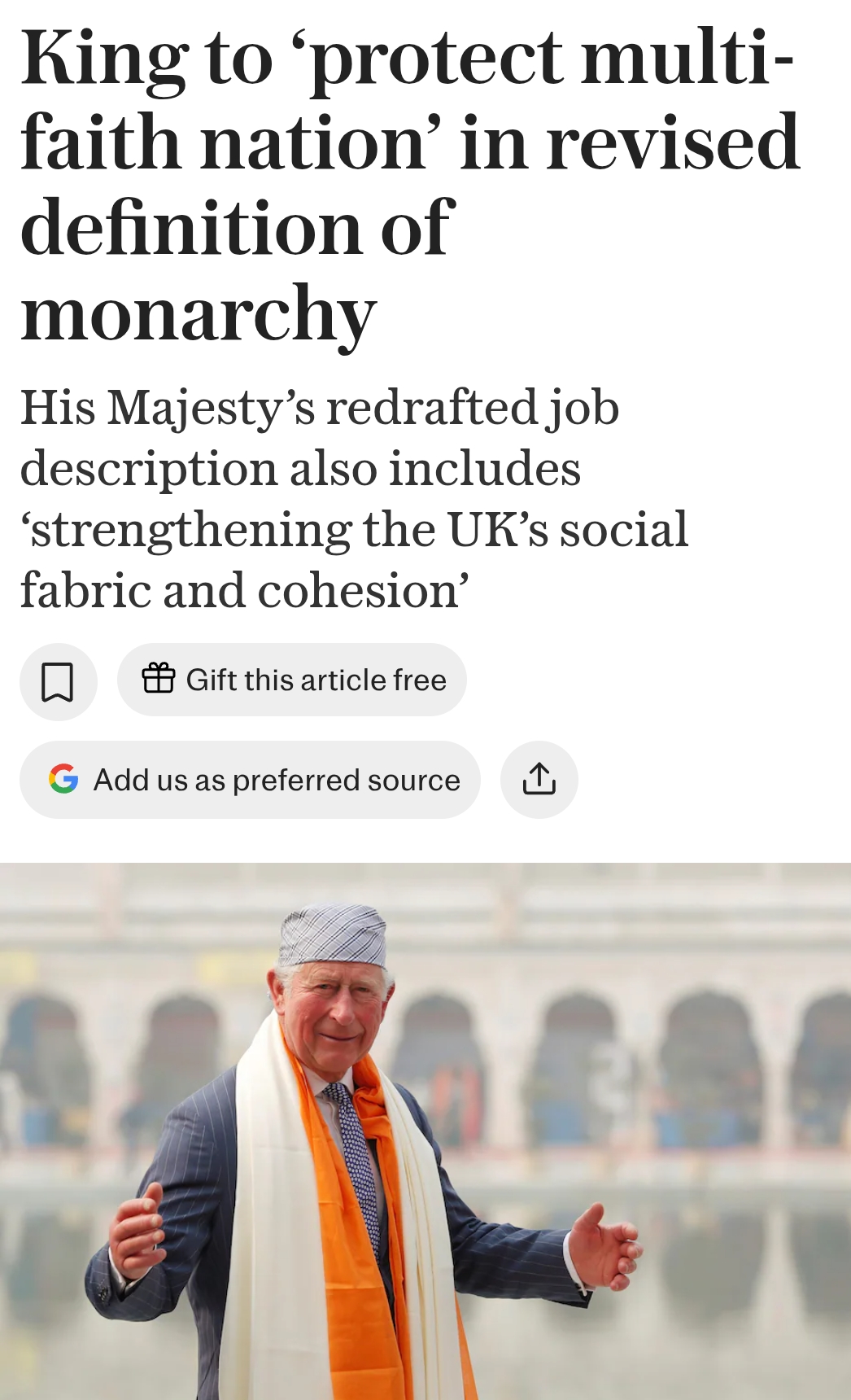
This Is the End of Britain: King Charles Just Formalised the Surrender
This is absolutely shocking. It is an absolute outrage. And it feels like the beginning of the end for Britain as we have known it.
In the latest Sovereign Grant report, Buckingham Palace has ditched the ancient title “Defender of the Faith”. No more defending the Christian foundation of this realm. Instead the King is now described as protecting “the space for Faith within the multi-faith nation”. What utter nonsense. Britain is a Christian country. That is not up for debate or negotiation. If the monarch abandons that core duty, then the institution itself has abandoned the British people.
Other faiths exist here, yes. But their presence does not require the Head of State and Supreme Governor of the Church of England to water down his role into some vague, multi-faith referee. His job is to defend the Christian faith of this nation. Full stop. Not to bend over backwards for every new arrival.
King Charles has spent decades signalling exactly this shift — praising interfaith dialogue, building ties across communities, and even calling Islam a religion of peace. Now it is baked into official Palace language. While we watch our Christian heritage eroded, churches close, and British identity dissolve, the monarchy chooses accommodation over duty.
This is more than infuriating. It is a profound betrayal. We see the reality on the ground: halal meat quietly served in the NHS and in schools to everyone — often without proper consent or even basic awareness. Islamic practices are increasingly imposed on the wider population while native Britons are expected to stay silent and pay for it. Everything is tilting. Sharia norms creep in, demands multiply, and our own traditions are treated as optional extras.
We do not fly to Saudi Arabia, Pakistan or anywhere else and demand they rewrite their entire way of life, abandon their religion, and serve us bacon sandwiches in their institutions. Why then must Britain endlessly accommodate, dilute, and apologise for existing as a Christian country? Why are we expected to change everything while others refuse any compromise?
This multi-faith rebranding is not progress. It is cultural surrender dressed up in polite language. A monarch who stands for everything stands for nothing. Britain had a specific, Christian character that allowed it to become the tolerant society it once was. Hollow that out and you do not get harmonious diversity — you get the slow erasure of the host culture.
I am deeply offended. Millions of ordinary Britons are deeply offended. This feels like the end of Britain as a coherent nation with its own history, faith and identity. The King’s role was never to manage a neutral spiritual marketplace. It was to defend the faith of this realm.
Enough of the euphemisms and the quiet capitulation. Call it what it is: a disgraceful abandonment of duty at the very top. If this continues, there will be nothing left worth defending. Britain deserves better.
Amusingly, the title “Defender of the Faith” was granted to King Henry VIII by Pope Leo X for a book (almost certainly co-written if not ghostwritten) refuting Martin Luther. King Henry “forgot” to disclaim the title when he broke with Rome a few years later …
QotD: Roman Imperial frontiers and “defensive barbarism”
Here’s another one — why is Hadrian’s Wall where it is? There’s a much shorter and more defensible alternate location to the north, where the Firth of Forth and the Firth of Clyde create a natural bottleneck. In fact at one point the Romans did build a wall there and claimed all the intervening territory. On paper, the Antonine Wall looks better in every way than Hadrian’s Wall. [Image from original post] It’s shorter, so requires less military “output” to defend. And it encloses more area, so brings to the “inputs” of the machine of state both additional arable land and additional people who can be taxed and conscripted. But as it happened, the Antonine Wall was quickly abandoned, and the empire retreated to Hadrian’s Wall. Why?
It all had to do with the people living between the two walls. They were … hill people who had perfected the art of not being governed. They managed to be so thoroughly intractable, so impossible to control or corral, so very unpleasant to be around, that the Romans eventually threw up their hands in disgust and left them alone. It’s important to understand that this means they must have been true outliers, because the Roman Empire had “unit economics” like an enterprise SaaS business, where “customer acquisition costs” are financed on the assumption that they’ll be paid back in the distant future. Every Roman bureaucrat understood that newly conquered territories would be a drain on fiscal and military resources for a while, until a generations-long process of pacification and Romanization slowly made them net contributors in both departments. But in the case of the lands between the two walls, the payback timeline was so long, and the implied interest rates so high, that even a people as meticulous and relentless as the Romans decided there were better opportunities elsewhere. I count this as a serious victory for the theory of defensive barbarism.
John Psmith, “REVIEW: The Grand Strategy of the Roman Empire by Edward Luttwak”, Mr. and Mrs. Psmith’s Bookshelf, 2023-11-13.
Comments Off on QotD: Roman Imperial frontiers and “defensive barbarism”
June 27, 2026
Destroyed In Four Minutes – The Battle of Cape Matapan
TimeGhost Cartographic
Published 26 Jun 2026March 1941. As British troops sail to reinforce Greece ahead of the expected German invasion, the Italian Navy sees a chance to strike. A powerful battlefleet puts to sea, hoping to intercept the convoys and seize back the initiative in the Mediterranean.
But the British know something is coming.
With the Mediterranean Fleet stretched to its limits, Admiral Andrew Cunningham must make a critical decision. Relying on intelligence and naval aviation in a race against time, the Royal Navy heads out to meet the tide headed their way.
What follows is one of the most dramatic naval engagements of the Second World War, culminating in a brutal conclusion that would leave a lasting mark on the Mediterranean campaign.
Comments Off on Destroyed In Four Minutes – The Battle of Cape Matapan
June 25, 2026
Why Britain voted for Brexit
Pat Condell explains some of the reasons British voters chose Brexit over staying in the EU back in 2016:

Why did we vote for Brexit ten years ago? Because we understood that the core purpose of the European Union is to destroy the independent countries of Europe by opening the borders and transforming a diverse continent of sovereign nations into a single homogenous political bloc governed by a committee of unelected bureaucrats, as a model for the planned global dictatorship.
Obviously, you’re not going to get many votes for that if you just lay it out for people, so you start with something innocuous like trade.
You say “Let’s harmonise our trade arrangements and everything will run more smoothly.”
And people say “Yes, that sounds like a good idea.”
Then you say “While we’re at it, let’s give this small group of people the power to organise all this from one place, and everything will run more smoothly.”
“Well, I suppose that makes sense. We want things to run smoothly.”
Then it’s “Actually, let’s give these people the power to make our laws and override our parliament and justice system, and everything will run much more smoothly.”
“Hold on a second, I don’t know about that …”
“You fascist. You racist. You xenophobe. You bigot. You pig ignorant little Englander. You vermin. You scum.”
Although that attitude certainly helped to tip the balance, the most important reason we voted for Brexit is that politicians had no right to sign away the governance of the UK to a foreign entity, but that is what they did, while pretending it was about trade. They lied to us, and they tried to cheat us out of our country.
That is why we voted for Brexit, and it’s why we’re now being punished for our disobedience by traitors who refuse to secure the border and who are allowing our country to be flooded with millions of unwanted and incompatible immigrants and illegally invaded and occupied by an army of dangerous military age men in whose presence no woman or child is safe.
Forced mass immigration from hostile and barbarous cultures is punishment for Brexit. Our country is being purposely destroyed for not voting the way we were told.
Comments Off on Why Britain voted for Brexit
June 24, 2026
The Korean War Week 105 – Destroy Suiho Dam! – June 23, 1952
The Korean War by Indy Neidell
Published 23 Jun 2026Since the beginning of the war UN air power has studiously avoided hitting North Korea’s hydro-electric complex, since the power the dams provide is mainly for civilian use, but that changes this week! Meanwhile on the ground, the focus has turned to capturing Communist POWs for information, but that task has suddenly proved impossible now that the UN POW camps are firmly back in UN control, and it seems the Communists now prefer even death to capture.
00:00 Intro
00:29 Recap
00:59 Taking Prisoners
03:18 The Shropshires
05:54 Ammunition Shortage
08:41 Targeting Power Plants
14:55 Summary
15:10 Conclusion
15:58 Call to Action
Comments Off on The Korean War Week 105 – Destroy Suiho Dam! – June 23, 1952
June 22, 2026
Two-tier Keir resigns as UK Prime Minister
History will not be kind to Sir Keir Starmer’s time in office, both for his actions and his failures-to-act. The Labour Party will now select the next person to live at Number 10 Downing Street, as they still hold a majority in the House of Commons and are not required to go back to the people for a new mandate, regardless of who is their party leader.
Rupert Lowe, the leader of Restore Britain, greeted the news on the social media site formerly known as Twitter:
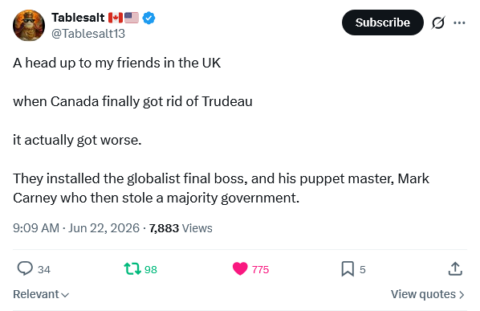
I reposted this on my other social media accounts, saying “Sadly, this is completely true. We belatedly ditched the clown prince of progressivism … only to install Mark Carney, who believes all the same progressive shibboleths that Trudeau did, but he’s far more capable of implementing them by hook or by crook.”
Starmer resigns — he has been a truly disgraceful Prime Minister.
I do not believe him to be a good man or a patriot.
He has deliberately and rapidly accelerated the destruction of our Britain, of our home.
History will not remember him kindly, nor should it.
I sat in Parliament, looking him in the eye, listening to him attempting to justify his decision to block a national inquiry into the mass rape of young British girls.
I will never forgive him. For that, and so much else.
What comes next, I do not know.
Whatever that is, Restore Britain will be ready to offer the British people a democratic route out — a better way, the only way.
But Starmer is gone.
And that is a good thing.
Enjoy it.
Former Manchester mayor and recently elected Member of Parliament for Makerfield Andy Burnham is the most likely successor to Starmer.

Then-Prime Minister Sir Keir Starmer visiting Holy Trinity Church of England Primary School in Manchester on 13 April 2026 with Andy Burnham, Mayor of Greater Manchester.
Picture by Lauren Hurley / No 10 Downing Street via Wikimedia Commons.
Comments Off on Two-tier Keir resigns as UK Prime Minister
June 21, 2026
How Britain Made the L1A1 SLR: archive film with intro by Jonathan Ferguson
Royal Armouries
Published 21 Jan 2026Following last week’s look at the very first L1A1 SLR ever produced (1957), we’re sharing a remarkable Royal Small Arms Factory (RSAF) Enfield archive film, shot in the 1960s, showing the key stages of L1A1 manufacture and a rare glimpse of the original Enfield pattern room.
Then we step back and let the film speak for itself, nearly an hour of pure production and engineering process.
0:00 Intro
3:05 Enfield + Pattern Room
3:57 Planning & Tooling
4:37 Rifle body: Heat treat → Machining → Inspection
18:16 Barrels: Drilling, Rifling, Plating & Production line
34:28 Housing/Trigger, Furniture & Magazines
50:16 Assembly → Proofing/Testing → Packing & Dispatch
(more…)
Comments Off on How Britain Made the L1A1 SLR: archive film with intro by Jonathan Ferguson
June 20, 2026
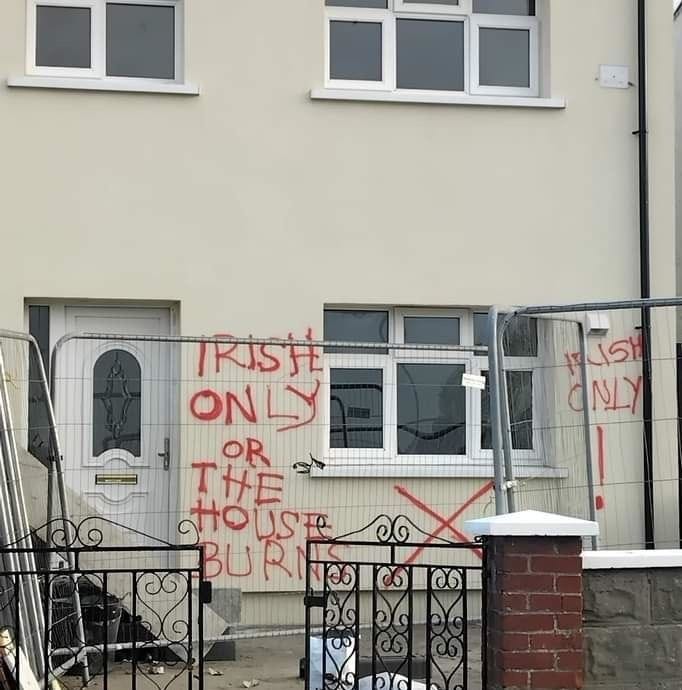
Lessons learned: “In Ballymena and Belfast, violence worked; in Epping, peaceful protest did not”
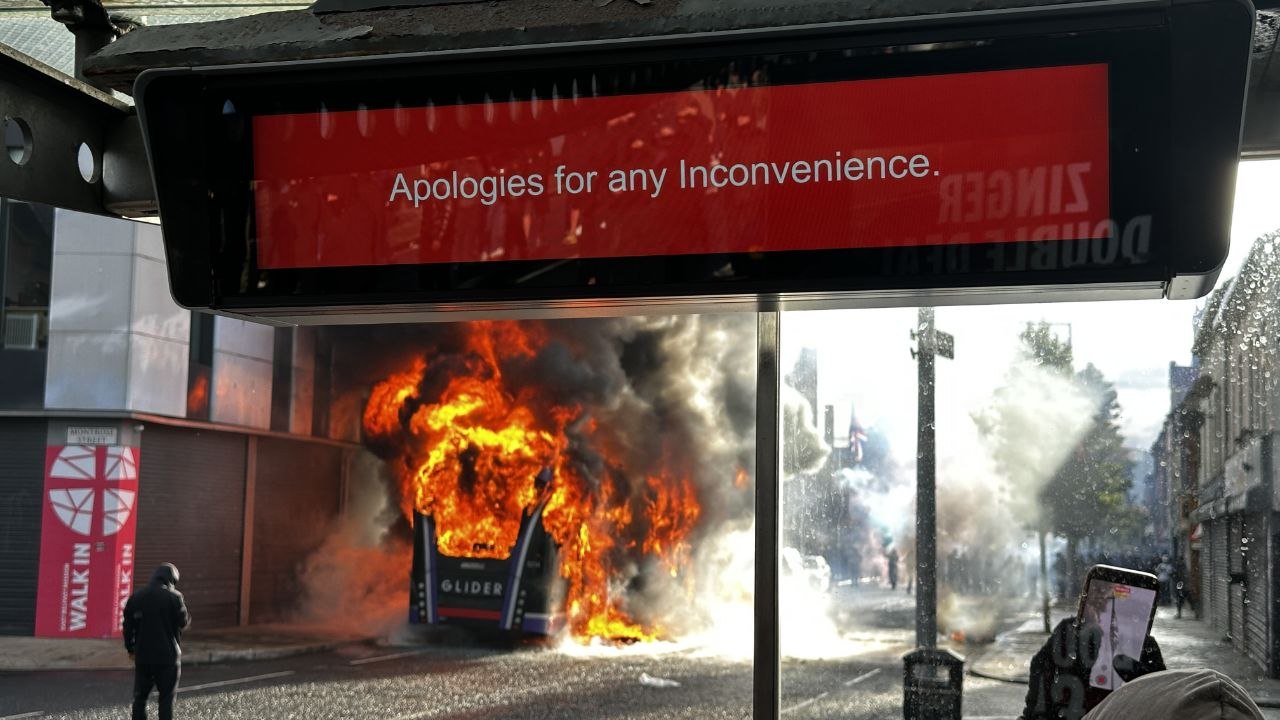
The flare-up of anti-immigrant/anti-government violence in Belfast has drifted out of the headlines lately, as state-oriented media try to get their audiences back onto safer topics like footy and hissing at the Bad Orange Man. But the situation in Northern Ireland has not resolved itself in the preferred way — preferred, that is, by the British government. John Carter responds to some American social media users who loudly wonder why British men generally are not “doing something” now:

In response to the migroid atrocity du jour, one often hears Americans ask “why haven’t British men done anything?”, to which Americans will flatteringly reply to themselves, “It’s because those BRITCUCKS have gone SOFT, they gave up their GUNS like little BITCHES, but you won’t see anyone trying THAT in a SMALL TOWN”. Which conveniently elides the awkward detail that American men, armed to the teeth as no other people on Earth, have allowed themselves to be pushed around this way and that since the sleep of the good Reverend Doctor Martin Luther King, Junior (PBUH) was disturbed by his little dream. “Just you wait”, Americans will promise when this is pointed out, “The electric boogaloo will come any day now, you’ll see!” Sure we will. In the meantime, all those guns have done precisely nothing to prevent the relentless incursions of Section 8 housing, disparate impact, affirmative action, DEI, anti-discrimination training, Title IX, human resources, and all the rest of the soft tyrannies that flew out of the Pandora’s box of America’s ersatz race communist constitution. There was no resistance to any of this. Heavily armed red state Americans abandoned the cities for the suburbs rather than standing and fighting for them, and then stolidly watched as their kids were sidelined in education and employment while being terrorized by black criminals.
American speech is protected by the first amendment and backstopped by the second, yet nevertheless you will not find many Americans daring to even so much as mutter the forbidden word of power. This is not because white Americans don’t understand the problems. They have developed an elaborate vocabulary of “bad neighbourhoods” and “good schools” and “urban crime” and “troubled youth” and so on and so forth with which to discuss, in whispers, after glancing twice over their shoulders, the realities of life in the USSA. There is no law against parrhesia [Wiki], technically an American citizen may say whatever he pleases without consequence, but of course frank speech in this Greek sense requires courage by definition, and there has been a great shortage of that. You can say whatever you please, yes, of course, fill your boots, but you will find yourself ostracized, divorced, unemployed, and homeless if you speak too directly, so you know, shut up. The unspoken strictures of the longhouse are a more effective prison than iron bars for those whose spirits have been cowed.
Meanwhile, last week there was a minor uprising in Belfast. Hadi Alodid, a gentlemen of Sudanese extraction, enriched the face of Stephen Ogilvie, a local bloke with special needs, providing him with extensive tribal scarring in a generous act of cross-cultural exchange, and only claiming two of his eyes in payment. The entire incident was caught on video. Ogilvie’s life, though not his sight (and he was already hard of hearing) was saved by three Irish men who rushed in to beat the innocent Sudanese rocket surgeon off with their hurling sticks. In the aftermath, it emerged that Ogilvie had helped Alodid move in to his new accommodations just a few days before. No good deed, etc.
[…]
The uprising was variously described as a protest and as a riot, but it was neither of these. A protest is when an angry crowd gathers to chant some slogans and wave around some signs, pretending that their numbers are a display of power, and deluding themselves that Power will redress their grievances because a noisy lump of quivering biomass is somehow intimidating to Power. A riot is an explosive release of emotional energy that results in some property destruction and futile confrontations with armoured riot police, typically ending with the rioters being rounded up and jailed. In some cases, it’s true, protests and riots appear to produce political change, but this is almost invariably because Power has orchestrated these little carnivals in order to sanctify the policies it’s already decided upon under the guise of “bowing” to “pressure” from the “public”. The Canadian government, by the way, has long since mastered a non-violent variant of this dark art: practically every “public policy research group” in the country is funded by the government to pressure the government to do what the government already wants to do. Show me what Our Democracy looks like; this is what Our Democracy looks like.
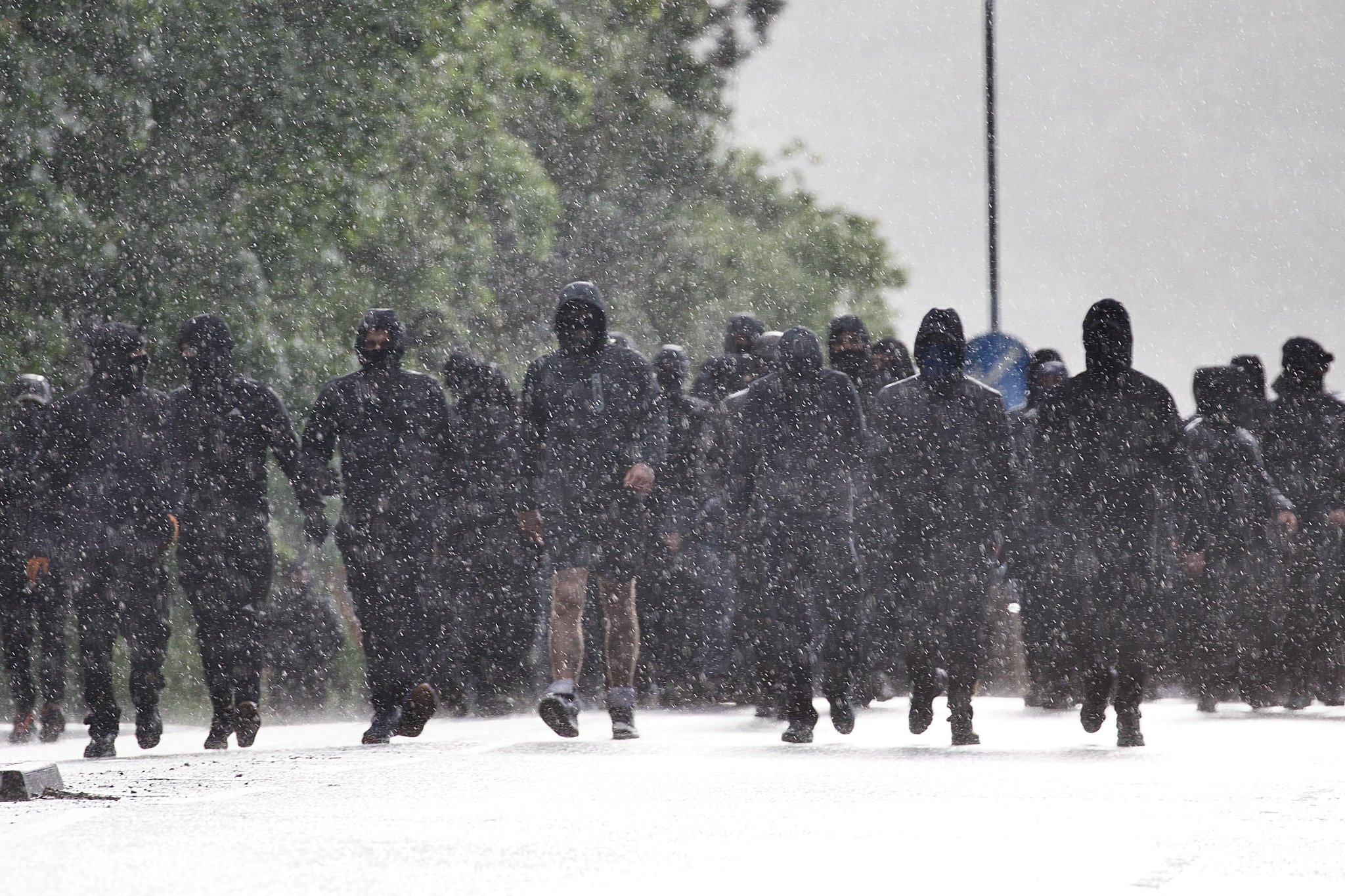
There were no signs being waved around in Belfast, no chanting of slogans. While there was a great deal of violence, it was not random and senseless, but methodical and carefully targeted. It unfolded with the tight discipline of a coordinated military operation.
The day before the uprising started, a communique was sent out to local businesses, instructing them to close before the fun started. At the appointed hour loose formations of young men, indistinguishable in black hoodies, fanned out across the city.
[…]
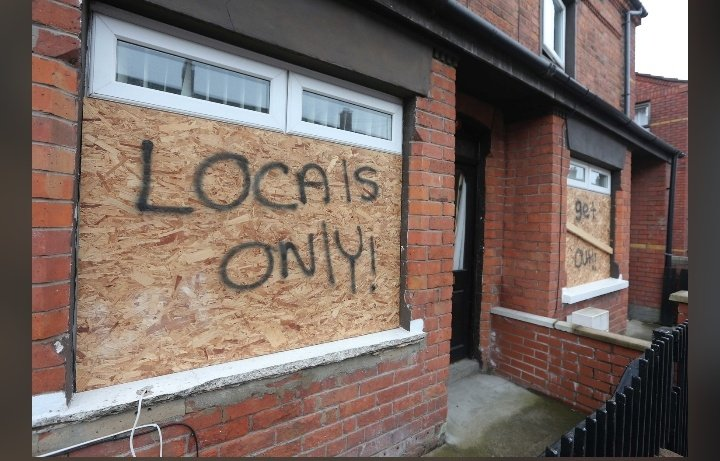
The uprising in Belfast was not nihilistic violence for the sake of violence, though I’ve no doubt the lads were enjoying the opportunity for mayhem. It was violence towards a specific political objective: driving the foreigners out. Migrants whose domiciles were destroyed were directly deprived of housing. Migrants who managed to avoid this were made to worry that they will be next. Landlords taking government money to house migrants, or even thinking about doing so, now need to worry about the immediate cost of repairs and the ongoing expense of higher insurance premiums, making the Home Office’s lucre a lot less attractive. Landlords also need to worry about escalation: reportedly, letters were circulated which heavily implied that bricks and petrol bombs were just the first step on the violence ladder, and that the paramilitaries would be quite happy to take more decisive measures against the landlords themselves should the message not be received.
All of this is very sad, and I don’t want to seem heartless. The immigrants whose houses were destroyed were probably innocent; there was one particularly touching video of a nurse from Ghana or somewhere. Unfortunately, that is the nature of these things. They were brought in by the government en masse as a form of biological warfare against the native population. The government wants them there, the people want them gone, and the government refuses to listen, so, this is what happens.
Only 27 migrants were actually made homeless by the arson, but reportedly, quite a few are already clearing out on their own. The British government quite naturally condemned the violence, organizing a rally against racism in the aftermath, but it also responded by instructing the media to emphasize that it would be cracking down on illegal immigration into Northern Ireland. Underneath the condemnation, there is a clear message to all of this: in this case, violence worked.
That message has been sent before in Northern Ireland. Exactly one year to the day before the uprising in Belfast, there were riots in the small town of Ballymena after the courts let two gypsy boys off with delicate wrist taps for raping an Irish girl. The rioting went on for two weeks, and resulted in two thirds of the gypsy population clearing out. Again: violence worked.
Contrast Ballymena with the other major British protest movement last summer: the anti-migrant hotel protest in Epping, a London exurb populated largely by Londoners driven out of their city by diversity, which started when one of the migrants diversified a teenage girl. In contrast to the eruption in Ballymena, the protest in Epping was explicitly non-violent: the only violence came at the hands of the cops arresting people for flying Union Jacks. The mothers of Epping spent months gathering outside the migrant hotel, holding signs and raising awareness. The council also fought the migrant hotel in the courts, and enjoyed early success when a judge found that the location was zoned as a hotel but not as a migrant dormitory, essentially telling the Home Office that they didn’t have a loicense for that. This legal victory was short-lived. The decision was overturned almost immediately by a higher court judge, who explicitly found that whatever the concerns of the people of Epping as to their children’s safety, these were outweighed by the human rights of the mystery meat that had washed up on Britain’s shores, and by the government’s interest in housing them. As a result, parallel lawsuits that had been launched by councils across the country were dropped. The migrant hotel in Epping was eventually shut down, but this likely had more to do with the government’s switch to “Operation Scatter” in which migrants were garrisoned in smaller houses all over the country, rather than concentrated in a few large centres, than it did with the government responding to the concerns of British subjects.
In Ballymena and Belfast, violence worked; in Epping, peaceful protest did not.
Update, 22 June: Welcome, Instapundit readers! Have a look around at some of my other posts you may find of interest. I send out a daily summary of posts here through my Substack – https://substack.com/@nicholasrusson that you can subscribe to if you’d like to be informed of new posts in the future.


