
TimeGhost History
Published 17 Aug 2025After WWII, Britain and France face the decline of their empires and the looming Soviet threat. Desperate for security, they forge the Dunkirk and Brussels Pacts, but quickly realize they need American support. As old alliances shatter and Germany becomes the front line, the world divides into two camps with the formation of NATO and the Warsaw Pact. Secret deals, rearmament, and the fear of communist tanks rolling across Europe set the stage for decades of Cold War rivalry.
(more…)
August 18, 2025
How One Treaty Split The World In Two – W2W 40
Comments Off on How One Treaty Split The World In Two – W2W 40
August 17, 2025
To replace a people, first you need to induce guilt and self-hate
On his Substack, Frank Furedi discusses just how negatively the British establishment views the national flag and those uncultured boors who display it:
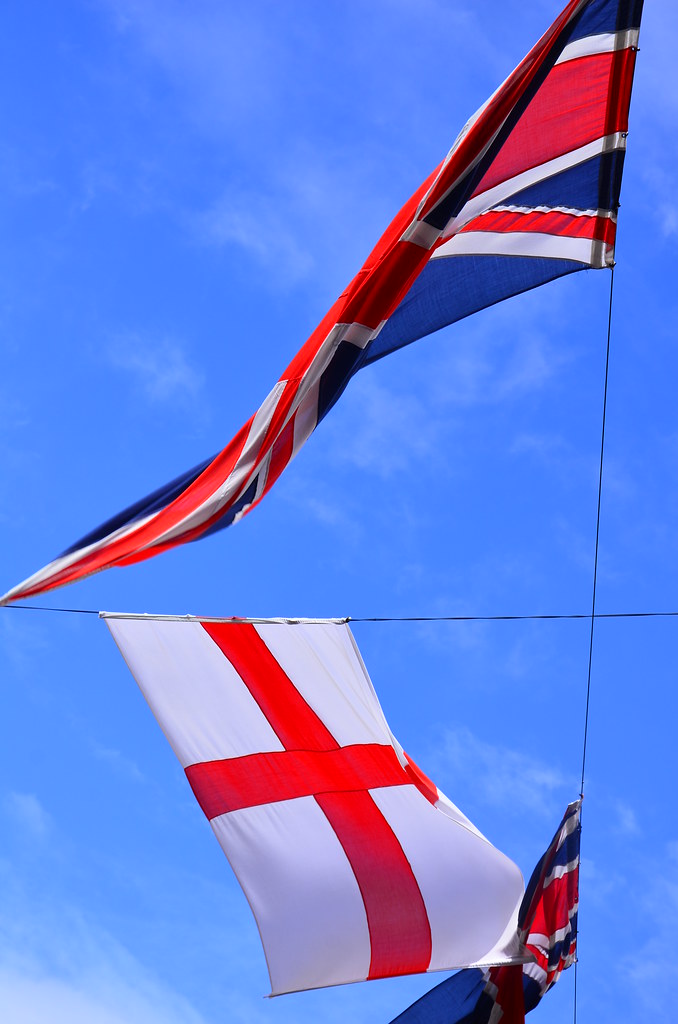
“Union Jacks and crosses of St George” by Ben Sutherland is licensed under CC BY 2.0 
 .
.
First a confession. I am not a serial flag-waver. In fact, one of the features of British history that I always appreciate is that its people possessed so much confidence about itself that it did not see the need for ostentatious displays of patriotism and flag waving. However, today matters are different. The nation’s cultural and political elites regard the Union Jack and the St George’s Cross — the flag of England — with embarrassment and studied contempt. Today many British institutions would rather fly the Palestinian flag or the LGBTQ+ or of Ukraine than flags that bear the nation’s symbols. Outwardly pride in Britain is in danger of being displaced by the sentiment of self-loathing.
Foreign observers are often surprised by the relative absence of Britain’s flag in public spaces. As one such observer noted recently, in Oxford Pride flags are outnumbered the Union Jack “by at least fifty to one”. He noted that the “next day in London, I saw Pride flags all about, with the Union Jack reserved for tourist sites like the Tower of London, which also sported Pride flags”.
In fact, the British Establishment’s reaction towards England’s flag is often communicated through the sentiment of ridicule and hatred. This sentiment has been embraced by local councils, particularly ones that are under the influence of Labour and the Lib Dems. Many of them feel entitled to prevent these flags from being displayed. Most recently the Birmingham’s Labour dominated council has ordered the removal of Union and St George’s flags from lamp posts in this city. The Council announced its decision to remove the flag on the ground that they put the lives of pedestrians and motorists “at risk” despite being up to 25ft off the ground! Needless to say, the Council applies a different standard of judgment when it comes flying the Palestinian flag, which are flown all over the City. Presumably this flag does not constitute a danger to motorists and pedestrians.
In Birmingham, Britain’s second largest city flying the flag of the nation is regarded by local officialdom as a risk to safety.
The British Establishment feels contempt towards not only Britain’s flags but also towards the people who enthusiastically identify with them with patriotic pride. An incident involving Emily Thornberry, Labour MP for Islington South, in November 2014 captures well the contempt that significant sections of the British political class have towards the symbolic displays of patriotism. During a by-election campaign in Rochester, she posted a photo of a house displaying three St George’s flags, with a white van parked outside, and accompanied it with the arch caption, “Image from #Rochester”. The implication of her post was that those who decorated their house with the flags of England were a legitimate target of disdain. Since they were obviously morally inferior to her superior kind there was no need for a caption explaining this on her post.
Millennial Woes discusses how the contempt of the elites for the British people is leading to increasing possibility of civil unrest … or worse:
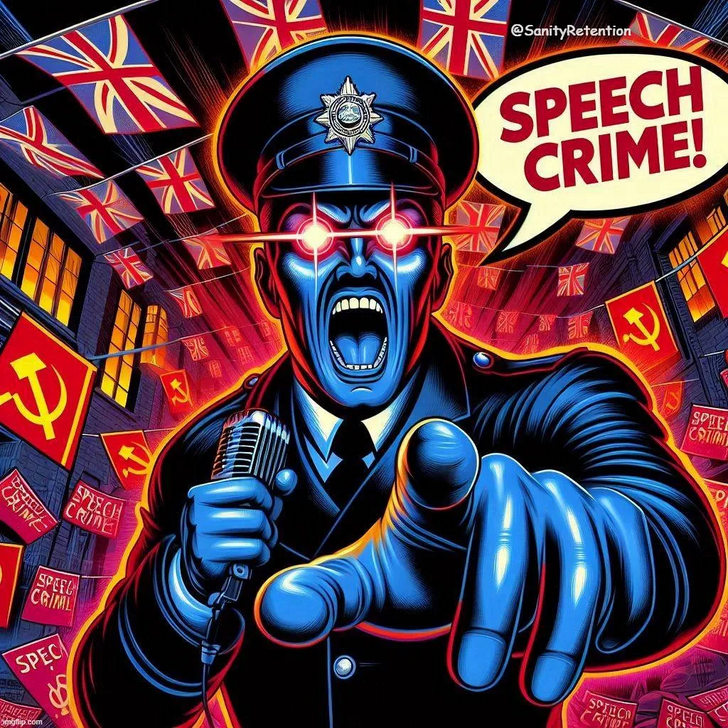
The short answer as to “why?” is that, even in mid 2025 when many people are sensing a mood developing, the government is still doing all the things that are bringing that mood about. They have no reverse gear. Despite their rhetoric, they are not reducing immigration and are certainly not doing mass deportation. In addition we have learned that, for years, they have been covertly propagandising us. Meantime the hate speech laws which muzzle us are still in force and being strengthened. Recently, the Online Safety Act came into force and the very next day numerous internet platforms had to start censoring content. We can literally see our oppression increasing in real-time. And even now, they want more. Always, we feel the government trying to stop us talking about its abuse of us. (Even as I type these words, I am aware that they could get the police raiding my home and seizing my devices.)
Image from Millennial Woes
The same is true in the media. This morning I heard that the BBC are making a high-profile drama about 11th Century Britain in which a key historical figure will be played by a Black actor. Our news media is still biased in favour of mass immigration at any cost. Adverts are still full of black-man-white-woman couples. It is relentless.
In business, White people are handicapped by preferential treatment for non-whites in employment, business loans and career opportunities. A few days ago I got an advert on YouTube featuring a business consultant woman who defiantly said “at the end of the day, diversity is the key to success”. Middle-class White people habitually work against each other and their group interests, causing personal failure and burning resentment for many of their ethnic kin.
It doesn’t actually matter whether the people who perpetuate all of this truly “believe” in it. What matters is that they are prepared to behave as if they do. The incentives have taken on a life of their own, become self-perpetuating, making alternatives almost illegal and certainly a guarantor of “social death” and “professional death”. Even with all the evidence that diversity is bad, nobody in the professional class will dare to speak against it because, even now, that would be the end of their career. And so the poisoning continues.
In short, I feel that my country’s mainstream is working constantly against my ethnic group surviving. Furthermore I see no end in sight for this ethnic sabotage.
And many other people think the same – more and more all the time, in fact. This is why they are getting ever more angry.
Among young people there are more reasons still, economic pressures which mean they can’t get on the property ladder and build the security to start a family. That is immensely frustrating for a lot of energetic young adults, and they haven’t got (haven’t been able to get) much to lose. When a society doesn’t facilitate this most basic desire in people, it should expect upheaval.
However, against this backdrop of oppression, dysfunction and madness, the main catalyst for civil unrest will be something much more concrete: refugees sexually assaulting White women and children. Such crimes are now occurring every day. Unfortunately, there is no reason why they will lessen in frequency. (I will not endanger myself further by explaining why. Everyone knows.)
And it is the fact that, indeed, “everyone knows” which makes civil unrest inevitable. It isn’t just spergs, theorycels, doomers, basement-dwellers and politics or race science obsessives any more; it’s the apolitical working-class who just want a decent chance at life. When they believe their own government is denying them that, it is inevitable that they will “rise up”. It is only a question of when, where, how and how many.
It has been pointed out that, during covid, the public didn’t “rise up”. But I say this was because, despite the restrictions and the perversity of that situation, throughout it people were still comfortable. Most importantly, they didn’t feel their children were in danger. That is the key thing. Dangers that never attended raising a child in Britain thirty years ago are now ubiquitous, even if you live in a nice middle-class town.
Update, 18 August: Welcome, visitors from Instapundit. Please do have a look around at other posts you may find of interest. I send out a daily summary of posts here through my Substack – https://substack.com/@nicholasrusson that you can subscribe to if you’d like to be informed of new posts in the future.
Battle of Norway, 1940
Real Time History
Published 7 Mar 2025The Battle of Norway in Spring 1940 cemented the reputation of the daring and invincible German war machine under Adolf Hitler. But while Denmark and Norway were successfully occupied by Germany, the campaign came at a heavy cost. This was especially true for the German Kriegsmarine which lost a significant amount of warships including the Blücher — losses that essentially crippled them for the remainder of the war.
(more…)
Comments Off on Battle of Norway, 1940
August 16, 2025
The First Poison Gas Attack of WW1: 2nd Battle of Ypres 1915
The Great War
Published 15 Aug 2025By April 1915, the Western Front was mired in trench warfare. Germany’s new Chief of Staff, General Erich von Falkenhayn, didn’t think his army could break the deadlock, and Germany needed to help struggling Austro-Hungarian forces in the East. Before the Germans turned against Russia though, they decided to attack in the West to keep the Allies off balance. They chose to strike at the vulnerable Ypres Salient – and they would support the coming offensive with a weapon their enemies had never seen.
(more…)
Comments Off on The First Poison Gas Attack of WW1: 2nd Battle of Ypres 1915
Britain slides further down the free speech rankings
At The Conservative Woman, Bruce Newsome reports on the parlous state of free speech in the United Kingdom:

SINCE 2021, the Index on Censorship has ranked Britain as “partially open” (the third tier). Britain ranks 20th for press freedom (worse than Trinidad and Tobago).
Just released: The US State Department concludes that in 2024, Britain’s human rights “worsened” and the British government is partial in protecting rights and freedoms: “Significant human rights issues included credible reports of serious restrictions on freedom of expression, including enforcement of or threat of criminal or civil laws in order to limit expression; and crimes, violence, or threats of violence motivated by antisemitism. The government sometimes took credible steps to identify and punish officials who committed human rights abuses, but prosecution and punishment for such abuses was inconsistent.”
There are three main categorical freedoms being routinely violated in Britain. In US Constitutional law, they are known as speech, assembly and press. British authorities need a reminder.
Let’s fully understand how this started, more than 25 years ago. In 1999, the Macpherson inquiry into the 1993 murder of Stephen Lawrence recommended that police should record hateful incidents as a matter of intelligence, even if the incidents were not criminal. Quangos led by the College of Policing encouraged police forces to record non-crime hate incidents (NCHIs). Police took it upon themselves to visit the supposed haters, to “correct your thinking“, to intimidate them with warnings of escalation, and even to strong-arm them into taking thought-correction classes with the police, at cost.
The 2006 Racial and Religious Hatred Act criminalises hatred of protected characteristics. It was once sold as a protection against violence, but was soon wielded to criminalise speech.
Police make more than 30 arrests a day (more than 10,000 per year) for online speech and record 66 non-crime hate incidents per day.
Despite several administrations claiming to review and restrict the definitions of hate speech and NCHIs, the definitions remain too vague to prevent police from repressing speech they don’t like. In 2024, the Free Speech Union submitted freedom of information (FoI) requests to all 43 police forces in England and Wales to see if recording went down since a new code of practice of June 2023. The number has actually increased. This year the current government sneakily signalled its appreciation of NCHIs in response to a petition to abolish them.
The latest statute aimed at free speech came into force on July 25: the Online Safety Act. The Bill was marketed as a necessary legislation to protect minors from harmful material such as pornography, self-harm forums, and bullying towards suicide. Like the Hatred Act, the Online Safety Act is being used to suppress politically inconvenient content.
British public authorities (and social media) are suppressing speech and the press selectively with political, religious and ethnic prejudice.
Comments Off on Britain slides further down the free speech rankings
August 15, 2025
The pen that ended WWII: Inside Field Marshal Slim’s hidden collection
BFBS Forces News
Published 14 Aug 2025Ahead of VJ Day — go behind the scenes for a rare glimpse into the private collection of Field Marshal Slim’s wartime artefacts.
In this exclusive film, Tim Cooper visits Viscount Slim — grandson of the legendary Second World War commander — for an intimate look at a treasure trove of historical items. From a razor-sharp Japanese sword surrendered in 1945, to the pen that signed peace, and even the stark telegram announcing Britain’s entry into war, each item tells a powerful story.
(more…)
August 14, 2025
D-Day’s Flat Pack Ports OR Lord HT Gets Cross with The Fat Electrician
HardThrasher
Published 13 Aug 2025In which we use the @the_fat_electrician as an excuse to talk about the Mulberry Harbours, make a specific threat to a building in the United States and get to oogle at giant bits of floating concrete.
Primary Source – Codename Mulberry – Guy Hartcup, Pen & Sword Military. Kindle Edition 2014 (org. 1977)
(more…)
Comments Off on D-Day’s Flat Pack Ports OR Lord HT Gets Cross with The Fat Electrician
August 12, 2025
Britain warns online platforms about “overzealous” interpretation of online safety law
“Ben the Layabout” posted a note over at Founding Questions linking to a Telegraph article [archive.ph link] that seems to indicate the British government is demanding that online services both enforce the letter of the law and the spirit … whatever that might mean at any given moment in time:
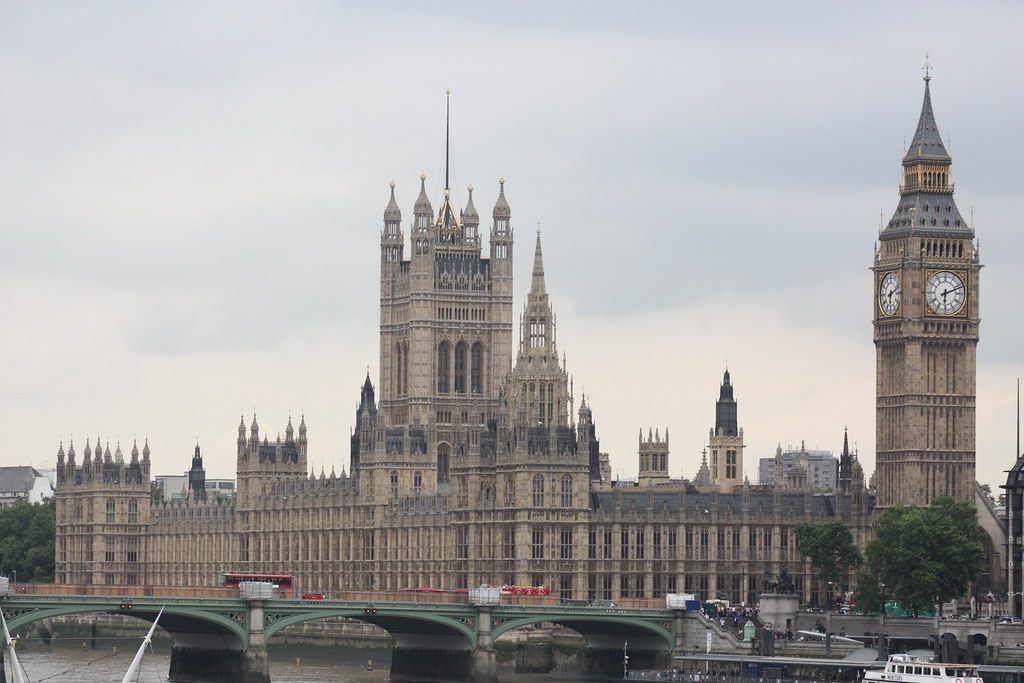
“Palace of Westminster”by michaelhenley is licensed under CC BY-NC-SA 2.0


Social media giants face huge fines for curbing free speech by “overzealous” enforcement of online safety laws.
Ministers have told platforms including Facebook, X, Instagram and TikTok they must not restrict access to posts that express lawfully held views.
The warning, in an apparent change of tone from ministers, comes amid a backlash over websites blocking users from viewing material, including parliamentary debates about grooming gangs.
Campaigners have said that free speech is threatened by the Government’s application of the Online Safety Act, which is meant to protect children from harmful content.
JD Vance, the US vice-president, used a visit to the UK this week to warn ministers against going down the “dark path” of censorship.
Whitehall sources have expressed concern that social media firms, some of which have criticised the law, “have been overzealous” in enforcing it and must be “mindful” of the right to freedom of expression.
The Science Department, which oversees the legislation, told companies they could face fines if they failed to uphold free speech rules.
A spokesman said:
As well as legal duties to keep children safe, the very same law places clear and unequivocal duties on platforms to protect freedom of expression.
Failure to meet either obligation can lead to severe penalties, including fines of up to 10 per cent of global revenue or £18m, whichever is greater.
The Act is not designed to censor political debate and does not require platforms to age gate any content other than those which present the most serious risks to children such as pornography or suicide and self-harm content.
Platforms have had several months to prepare for this law. It is a disservice to their users to hide behind deadlines as an excuse for failing to properly implement it.
So online sites big and small are required to obey the British law, but only as and how the British government wants it enforced or they’ll levy massive punishment. Too lax? Punishment. Too strict? Also punishment. It’s almost as if Britain wants to be cut off from the rest of the internet …
Comments Off on Britain warns online platforms about “overzealous” interpretation of online safety law
German-Soviet Invasion of Poland 1939
Real Time History
Published 8 Aug 2025Germany and the Soviet Union both regarded the Polish state as a creation of the post-WW1 system, and both had claims on Polish territory. In the summer of 1939, Adolf Hitler decided to invade Poland in a fait acompli against the Allies. In a secret agreement between Germany and the Soviet Union they agreed on dividing up the Polish state and Eastern Europe.
(more…)
Comments Off on German-Soviet Invasion of Poland 1939
QotD: Rick Wakeman – “I was Spinal Tap for real”
One afternoon [Wakeman] dropped by a local recording studio, where he spotted an odd little keyboard in the corner. The manager of the studio, Tony Visconti, told him it was a Mellotron, the spooky-sounding, electro-mechanical instrument made famous by the Beatles on “Strawberry Fields”. But it was so difficult to play that nobody in the studio could figure out how to use it. “Mind if I have a go?” asked Wakeman. Visconti and his recording crew watched in awe as the gawky kid made the mellotron sing.
“How’d you do that?” an engineer asked.
“Don’t tell him,” Visconti told Wakeman. “It’ll make you a fortune!”
Visconti asked Wakeman if he could come back to play mellotron for one of his artist’s recording sessions. After getting dropped off at the studio by his mother, Wakeman was greeted at the studio by a precocious young rocker whose eyes appeared to be two different colors. His name was David Bowie, and he wanted Wakeman to play mellotron on “Space Oddity”, the title track of his second album. “This will be a piece of cake for you,” he reassured Wakeman.
“Oh, okay,” Wakeman stammered.
“I take it you have played a piece of cake before?” Bowie replied. Wakeman, confused and nervous, offered no reply.
“Well,” Bowie went on, “maybe not then.”
The song launched a lifelong friendship with Bowie, and Wakeman’s career. He became rock’s go-to keyboardist, playing in countless sessions. In 1970, Melody Maker, at the time England’s most influential music publication, featured Wakeman on a cover story that anointed him “Tomorrow’s Superstar”. Bowie offered him a few key pieces of advice: get your own band, play with musicians who understand you, and, when it comes time to perform, “do what you want onstage, especially if you’re using your own money. Don’t let a promoter, agent, or manager tell you otherwise — they don’t have the imagination.”
Wakeman put the advice to use in the brashest of ways: He turned down Bowie’s offer to play in his sideband, the Spiders From Mars, and instead became the keyboardist for Yes. With its mystical lyrics, orchestral productions, Tolkienseque album art, and long, multipart songs, Yes exemplified progressive rock in all its technical breadth and portentous glory. Wakeman, who surrounded himself with keyboards and wore a cape to hide his arms after a critic said he moved like “a demented spider”, became prog rock’s most iconic star. “Here comes Rick, the caped crusader!” the band’s lead singer, Jon Anderson, recalls with a laugh. “He had a great sort of stance onstage, and very powerful energy. It really put him apart from any other keyboard player.” Or, as Wakeman deadpans, “I was Spinal Tap for real”.
David Kushner, “The Stranger-Than-Fiction Secret History of Prog-Rock Icon Rick Wakeman”, Vanity Fair, 2020-06-25.
Comments Off on QotD: Rick Wakeman – “I was Spinal Tap for real”
August 11, 2025
Speed vs Armour: The Unexpected History of Fast Tanks
The Tank Museum
Published 21 Mar 2025Would you rather go to war in a tank that was quick but lightly armoured – or heavily armoured but slow?
The concept of fast tanks has existed since the First World War, but making a tank fast is easier said than done. You can increase the speed, but only by compromising the other two sides of The Iron Triangle.
Whilst a good power to weigh ratio is key to making a tank go fast, there are other factors that need to be considered. J Walter Christie pioneered the innovative helicoil spring suspension system – an invention that allowed tanks to cope with travelling at high speeds across country. Although not picked up by the US Army, the brilliance of Christie’s suspension was recognised by the Soviets and soon made an appearance on the BT-Series of tanks – and most effectively on the T-34.
Back in the UK, the newly mechanised cavalry was making use of some brand-new Cruiser tanks. Whilst these were fast vehicles, this was coming at the cost of effective protection. Some military thinkers advocated for the concept of “speed as armour” but results were mixed – with the Crusader and Cromwell both proving to be capable tanks.
After the war, the British Army finally moved on from “speed as armour” and settled on sacrificing a bit of speed for the sake of better protection. This was incorporated first into the concept of Universal Tanks and remains a fixture in the modern Main Battle Tank.
So, we’ll ask again. Would you rather go to war in a tank that was quick but lightly armoured – or heavily armoured but slow?
00:00 | Introduction
00:51 | What Makes it a Fast Tank?
02:39 | What is a Fast Tank For?
04:39 | Suspension of Disbelief
06:34 | Speedy Soviets
08:29 | Cruisers Replace Cavalry
11:20 | The Second Wave
13:19 | Cruising in Europe
19:08 | One Tank to Do It All
(more…)
Comments Off on Speed vs Armour: The Unexpected History of Fast Tanks
August 9, 2025
Alert the non-crime hate incident police: soccer star proclaims pride in being English!
In Spiked, Obadiah Mbatang discusses a recent disturbing incident of a member of the Lionesses (England’s female national soccer team) saying something completely unacceptable to the great and the good:
So the Lionesses were victorious in the UEFA Women’s Euros, holding the title they won in 2022. England forward Chloe Kelly, who scored the decisive penalty in the final against Spain, declared after the match: “I am so proud to be English”.
To hear a sports star make such a simple and patriotic statement was, for most of us, a pleasant breath of fresh air. Just as refreshing has been the muted response to her declaration of national pride. In the week or so since, there have been no online campaigns denouncing Kelly’s views as “problematic”. This raises the question: is it just the Lionesses who are allowed to be patriotic?
Compare the response to Kelly’s post-match comment with the recent treatment of Courtney Wright, a 12-year-old schoolgirl from the West Midlands. A few weeks ago, she wore a Union Jack dress inspired by the Spice Girls to her school’s “Culture Day”, in which pupils were encouraged to “proudly represent their heritage”. Courtney, who had also prepared a speech celebrating Shakespeare and fish and chips, was put into isolation by her school and then sent home. Essentially, she was told it was unacceptable to express pride in being British.
What followed next gave us a fascinating, if depressing, insight into the online left. Aaron Bastani, co-founder of Novara Media, came out in defence of Courtney. “A white British person being proud of their country and its accomplishments does not make them racist”, Bastani said on X. “Either all groups get to celebrate identity and culture, or none.” Yet for striking a fair-minded and consistent approach, he was attacked by his largely left-wing audience.
One notable assault came from Eleanora Folan, who runs the hugely popular “Stats for Lefties” X account. Folan said celebrating British culture “literally does” make someone racist because “the concept of white ‘identity’ is inherently exclusionary and racist”, adding that “all of Britain’s ‘accomplishments’ were built on racism and imperialism”.
Now, I suspect Eleanora and many on the left would never say that Nigerians should view their heritage as “evil” because of the Biafran War and the anti-Igbo pogroms of the 1960s and 1970s. Does anyone on the left talk about King Ghezo’s determined efforts in the 19th century to maintain slavery, even as the British tried to stamp it out in his West African kingdom? Would they say that British people of Arab descent should be ashamed because of Arab slavery of Africans, which still persists to some extent today? Should British people of Rwandan Hutu descent be ashamed because of the Rwandan genocide? Of course not.
Admittedly, there is no shortage of right-wing whataboutery that uses the histories of other countries to avoid discussing the darker aspects of Britain’s past. But that is not what is going on here. Courtney’s treatment by her school, and those online leftists blasting her as racist, reveals that self-loathing oikophobia remains one of the dominant prejudices of the left.
August 6, 2025
QotD: Modern English night life
Recently I stayed overnight in a charming small cathedral city in England, genteel by day and Gomorrah by night. It is a little like H.G. Wells’ story The Time Machine, set 3,000 years hence, when humanity has divided into two: the effete, gentle, vegetarian diurnal Eloi, and the ugly, vicious, carnivorous nocturnal Morlocks, who emerge from underground once the sun goes down and prey on the Eloi.
I had booked no place to stay until the last minute, and found only a room above a cavernous, darkened bar, for me an antechamber of Hell, where the Morlock youth of the cathedral city gathered to enjoy themselves — or at least to pretend to do so, for I have long thought that those who cannot enjoy themselves without shouting and screaming are really hysterics, trying to convince themselves that they are enjoying themselves when actually they do not really know how to do so.
Theodore Dalrymple, “Evening Above the Hell-Bar”, Taki’s Magazine, 2019-12-16.
Comments Off on QotD: Modern English night life
August 5, 2025
Inside the CIA Coup That Changed Iran Forever! – W2W 38
TimeGhost History
Published 3 Aug 2025In 1953, a battle for Iran’s soul erupts on the streets of Tehran. Prime Minister Mosaddegh defies British oil interests, outwits Soviet intrigue, and faces down the Shah — but a secret Anglo-American plot changes history forever. As coups, street mobs, and betrayal plunge Iran into chaos, the nation’s fragile democracy is crushed and a brutal new order rises. This is the untold story of oil, espionage, and the coup that reshaped the Middle East.
(more…)
Comments Off on Inside the CIA Coup That Changed Iran Forever! – W2W 38
August 4, 2025
Day Ten – German Victory in the Battle of France – Ten Days in Sedan
World War Two
Published 3 Aug 2025May 19, 1940. Ten days into Fall Gelb, Guderian’s panzers thunder toward the Channel, poised to slam a steel ring around nearly half a million Allied troops. In Paris, Paul Reynaud ousts Daladier and Gamelin, calling back Marshal Pétain and General Weygand as France’s last throw of the dice. The pocket is almost shut, yet the story is far from over. Is there time for one more twist? Keep watching as we follow the fight to its end and discuss the aftermath of this campaign.
(more…)
Comments Off on Day Ten – German Victory in the Battle of France – Ten Days in Sedan


