Quotulatiousness

May 31, 2025

“U.S. libertarians [are] the best friends Canada doesn’t know it has”

In the National Post, Colby Cosh sings the praises of American libertarians for their work in trying to dismantle some of Donald Trump’s dubiously Constitutional extensions of presidential power:

The James L. Watson Court of International Trade Building at 1 Federal Plaza in Lower Manhattan, New York City.
Photo by Americasroof via Wikimedia Commons.

The U.S. Court of International Trade (CIT) issued a decision Wednesday that annuls various salvos of surprise economic tariffs, including ones on Canada, that have been enacted by President Donald Trump since his inauguration in January. I won’t lie to you: I had the same initial reaction to this consequential news that you probably did, which was “Hooray!” and then “Huh, there’s a U.S. Court of International Trade?”

This court is surely unfamiliar even to most Americans, no doubt because much of its work involves settling issues like “Do hockey pants count as ‘garments’ or ‘sports equipment’ under customs law?” Nevertheless, the CIT does have exclusive jurisdiction over civil actions involving U.S. trade law. It’s just that no president has ever before rewritten the tariff schedule of the republic in the half-mad fashion of a child taking crayons to a fresh-painted wall.

The American Constitution, from day one, has unambiguously assigned the right to set international tariffs to Congress. Congress is allowed to delegate its powers to the president and his agents for limited or temporary purposes, but it can’t abandon those powers to him altogether. Defining this legal frontier is what the CIT was asked to do, and their demarcation of it will now swim upward through higher appellate courts (its decision has been put on hold in the meantime).

The lawsuit was actually two parallel suits raising overlapping objections to the tariffs. One was brought forward by 12 U.S. states, and the other was filed by a group of tariff-exposed American businesses, including manufacturers of bikes, electronics kits and fishing equipment. The latter set of plaintiffs was roped together by the usual posse of heroic libertarians and legal originalists, including George Mason University law prof Ilya Somin.

About 24 hours after Trump originally announced the “Liberation Day” worldwide tariffs, Somin quickly blogged about how insanely unconstitutional the whole idea was, and concluded his article essentially by saying “I’m darn well gonna do something about this nonsense”. I don’t mean to suggest he deserves primary credit; I only intend to call attention, once again, to U.S. libertarians being the best friends Canada doesn’t know it has.

May 30, 2025

Was Germany Really Starved Into Surrender in WW1?

Filed under: Britain, Economics, Germany, History, Military, USA, WW1 — Tags: , , , , , , — Nicholas @ 02:00

The Great War
Published 10 Jan 2025

From 1914 to 1919, Allied warships in the Atlantic and Mediterranean controlled maritime trade to and from the Central Powers – stopping shipments of weapons and raw materials, but also food, from reaching their enemies. At the same time, hundreds of thousands of German civilians died of hunger-related causes. Often, these deaths and even the outcome of the war are attributed to the naval blockade – but did the British really starve Germany into surrender in WW1?
(more…)

May 29, 2025

QotD: FDR and Herbert Hoover in the Great Depression

November 1932. Hoover has just lost the election, but is a lame duck until March. The European debt crisis flashes up again. Hoover knows how to solve it. But:

    He had already met with congressional leaders and learned, as he had suspected, that they would not change their stance without Roosevelt’s support. Seized with the urgency of the moment, he continued to bombard his opponents with proposals for cooperation toward solutions, going so far as to suggest that Democratic nominees, not Republicans, be sent to Europe to engage in negotiations, all to no avail. Notwithstanding what editorialists called his “personal and moral responsibility” to engage with the outgoing administration, Roosevelt had instructed Democratic leaders in Congress not to let Hoover “tinker” with the debts. He had also let it be known that any solution to the problem would occur on his watch – “Roosevelt holds he and not Hoover will fix debt policy”, read the headlines. Thus ended what the New York Times called Hoover’s magnanimous proposal for “unity and constructive action”, not to mention his 12-year effort to convince America of its obligation and self-interest in fostering European political and financial stability …

    During the debt discussions and to some extent as a result of them, the economy turned south again. Several other factors contributed. Investors were exchanging US dollars for gold as doubt spread about Roosevelt’s intentions to remain on the gold standard. Gold stocks in the Federal Reserve thus declined, threatening the stability of the financial sector … what’s more, the effectiveness of [Hoover’s bank support plan], which had succeeded in stabilizing the banking system, was severely compromised by [Democrats’] insistence on publicizing its loans, as the administration had warned. For these reasons, Hoover would forever blame Roosevelt and the Democratic Congress for spoiling his hard-earned recovery, an argument that has only recently gained currency among economists.

And:

    Alarmed at these threats to recovery, Hoover pushed Democratic congressional leaders and the incoming administration for action. He wanted to cut federal spending, reorganize the executive branch to save money, reestablish the confidentiality of RFC loans, introduce bankruptcy legislation to protect foreclosures, grant new powers to the Federal Reserve, and pass new banking regulation, including measures to protect depositors … He was frustrated at every turn by Democratic leadership taking cues from the President-Elect … On February 5, Congress took the obstructionism a degree further by closing shop with 23 days left in its session.

In mid-February, there is another run on the banks, worse than all the other runs on the banks thus far. Hoover asks Congress to do something – Congress says they will only listen to President-Elect Roosevelt. Hoover writes a letter to Roosevelt begging him to give Congress permission to act, saying it is a national emergency and he has to act right now. Roosevelt refuses to respond to the letter for eleven days, by which time the banks have all failed.

Then, a month later, he stands up before the American people and says they have nothing to fear but fear itself – a line he stole from Hoover – and accepts their adulation as Destined Savior. He keeps this Destined Savior status throughout his administration. In 1939, Roosevelt still had everyone convinced that Hoover was totally discredited by his failure to solve the Great Depression in three years – whereas Roosevelt had failed to solve it for six but that was totally okay and he deserved credit for being a bold leader who tried really hard.

So how come Hoover bears so much of the blame in public consciousness? Whyte points to three factors.

First, Hoover just the bad luck of being in office when an international depression struck. Its beginning wasn’t his fault, its persistence wasn’t his fault, but it happened on his watch and he got blamed.

Second, in 1928 the Democratic National Committee took the unprecedented step of continuing to exist even after a presidential election. It dedicated itself to the sort of PR we now take for granted: critical responses to major speeches, coordinated messaging among Democratic politicians, working alongside friendly media to create a narrative. The Republicans had nothing like it; the RNC forgot to exist for the 1930 midterms, and Hoover was forced to personally coordinate Republican campaigns from his White House office. Although Hoover was good (some would say obsessed) at reacting to specific threats on his personal reputation, the idea of coordinating a media narrative felt too much like the kind of politics he felt was beneath him. So he didn’t try. When the Democrats launched a massive public blitz to get everyone to call homeless encampments “Hoovervilles”, he privately fumed but publicly held his tongue. FDR and the Democrats stayed relentlessly on message and the accusation stuck.

And third, Hoover was dead-set against welfare. However admirable his attempts to reverse the Depression, stabilize banking, etc, he drew the line at a national dole for the Depression’s victims. This was one of FDR’s chief accusations against him, and it was entirely correct. Hoover knew that going down that route would lead pretty much where it led Roosevelt – to a dectupling of the size of government and the abandonment of the Constitutional vision of a small federal government presiding over substantially autonomous states. Herbert Hoover, history’s greatest philanthropist and ender-of-famines, would go down in history as the guy who refused to feed starving people. And they hated him for it.

Scott Alexander, “Book Review: Hoover”, Slate Star Codex, 2020-03-17.

May 24, 2025

Forget it, Fraser Institute: as Trudeau explained, there’s no business case for Canadian LNG

Filed under: Asia, Cancon, Economics, Environment — Tags: , , — Nicholas @ 03:00

In the National Post, Tristin Hopper reports on a recent Fraser Institute study on the benefits of expanding the production of Canadian liquid natural gas, but as the meme might put it, the feds don’t want benefits, they want to eliminate Canadian LNG production:

A new report says that if Canada really wanted to save the climate, the most effective thing it could do would be to sell as much natural gas to Asia as humanly possible.

The 46-page study, published on Thursday by the right-leaning Fraser Institute, is premised on the notion that Canadian natural gas exports could singlehandedly reduce Asian dependence on coal.

If Canada could double its LNG production, write the authors, it would divert enough coal from Asian power plants to stop 630 million tonnes of greenhouse gases per year from entering the Earth’s atmosphere.

For context, that nearly represents Canada’s entire carbon footprint. According to the most recent figures from Environment and Climate Change Canada, the country was responsible for 694 million tonnes of carbon emissions in 2023.

“Instead of focusing on reducing domestic GHG emissions in Canada by implementing various policies that hinder economic growth, governments must shift their focus toward global GHG reductions and help the country cut emissions worldwide,” the report says.

The Fraser Institute’s calculation is based on the simple fact that natural gas is an easy substitute for coal, and can produce the same amount of energy with far lower emissions.

The U.S. Energy Information Administration maintains a ranking of fossil fuels by the quantity of emissions they produce for every one million BTUs (British Thermal Units) — roughly the amount of power needed to heat a standard house for several days.

Generating one million BTUs by burning coal will produce between 93 and 103 kilograms of carbon dioxide. Doing the same with natural gas will produce just 53 kilograms.

Canada currently produces about 17.9 billion cubic feet per day of natural gas. Most of this is consumed domestically, while 39 per cent is exported, mostly to the United States via pipeline.

The Fraser Institute calculated that if Canada could double production and “send the surplus … to Asia”, it could potentially supplant more than 200 million tonnes of coal every year.

QotD: Comparing living standards and technology between the Roman period and medieval western Europe

The first crucial question here is exactly when in the Middle Ages one means. There is a tendency to essentialize the European Middle Ages, often suggesting that the entire period reflected a regression from antiquity, but the medieval period is very long, stretching about a thousand years (c. 500 to c. 1500 AD). There is also the question of where one means; the trajectory of the eastern Mediterranean is much different than the western Mediterranean. I am going to assume we really mean western Europe.

While I am convinced that the evidence suggests there was a drop in living standards and some loss of technology in the immediate aftermath of the collapse of the Roman Empire in the West, most of that drop was fairly short-lived. But exactly when development in medieval Europe meets and then exceeds the same for antiquity (typically we’re comparing the second century height of the Roman Empire) also depends on exactly what kind of measure is being used.

If the question, for instance, is agricultural productivity on a per capita basis (the most important component of per capita economic production), medieval Europe probably moves ahead of the Roman Empire fairly quickly with the introduction of better types of plow and widespread use of watermills for grinding grain. My understanding is that by c. 1000 AD, watermills show up fairly frequently in things like monastic charters, suggesting they were reasonably widespread (the Romans used watermills too, though their spread was uneven) and by that point, plow technology had also moved forward, mostly through the development of plow types better suited to Europe’s climate. So as best we can tell, the farmer of c. 1000 AD had better tools than his Roman predecessors and probably had such for some time.

If the question is technology and engineering, once again what you see depends on where you look. Some technologies don’t appear to have regressed much, if at all, ironworking being one example where it seems like little to nothing was lost. On the other hand, in western Europe, the retreat in architecture is really marked and it is hard to say when you would judge the new innovations (like flying buttresses) to have equaled some of the lost ones (like concrete); certainly the great 12th/13th century Cathedrals (e.g. Notre Dame, the Duomo di Sienna and I suppose the lesser Duomo di Firenze, if we must include it) seem to me to have matched or exceeded all but perhaps the biggest Roman architectural projects. Though we have to pause here because in many cases the issue was less architectural know-how (though that was a factor) as state capacity: the smaller and more fragmented states of the European Middle Ages didn’t have the resources the Roman Empire did.

If one instead looks for urbanization and population as the measure of development, the Middle Ages looks rather worse. First and Second century Rome is probably unmatched in Europe until the very late 1700s, early 1800s, when first London (c. 1800) and Paris (c. 1835) reach a million. So one looking for matches for the large cities and magnificent municipal infrastructure of the Romans will have rather a long wait. Overall population is much more favorable as a measurement to the Middle Ages. France probably exceeds its highest Roman population (c. 9m) by or shortly after 1000AD, Italy (c. 7.5m) by probably 1200; Spain is the odd one out, with Roman Hispania (est. 7.5m) probably only matched in the early modern period. So for most of the Middle Ages you are looking at a larger population, but also a more rural one. That’s not necessarily bad though; pre-modern cities were hazardous places due to sanitation and disease; such cities had a markedly higher mortality, for instance. On the flip-side, fewer, smaller cities means less economic specialization.

So one’s answer often depends very much on what one values most. For my own part, I’d say by 1000 or 1100 we can very safely say the “recovery” phase of the Middle Ages is clearly over (and I think you could make an argument for setting this point substantially earlier but not meaningfully later), though even this is somewhat deceptive because it implies that no new technological ground was being broken before then, which is not true. But the popular conception that the whole of the Middle Ages reflects a retreat from the standards of antiquity is to be discarded.

Bret Devereaux, Referenda ad Senatum: August 6, 2021: Feelings at the Fall of the Republic, Ancient and Medieval Living Standards, and Zombies!”, A Collection of Unmitigated Pedantry, 2021-08-06.

May 22, 2025

QotD: Public goods

Filed under: Economics, Government, Quotations — Tags: , , , — Nicholas @ 01:00

The reason we institute government is to get public goods created. Public goods are those things that are non-rivalrous, non-excludable, therefore difficult to near impossible to make money from. Therefore we rather expect private capitalism to underproduce such public goods. Let’s all chip into a pot which produces them for us instead then. And a wide reading of public goods would include things like the rule of law, drains and keeping the French at bay (usefully, those last two can be combined, afraid of drains are Frenchies as they imply washing).

Or, the internet was originally set up to provide a secure comms network when the bombs all went off — that routing in packets was the whole point, being able to route around the polished glass that used to be Indianapolis. GPS was funded by the Navy to have precise coordinates to lob our own bombs at. Both difficult things to profit from so government did them.

Then along came some entrepreneurs and they saw that it was good. Some use could be made of the existence of those things. And this is — it’s essential to understand this — exactly what an entrepreneur is. Someone who takes extant assets and resources, possibly combining them in new ways, and sets out to end up with hot and cold running Ferraris from having done so. We consumers then end up vastly richer than our starting point. One, wholly serious, measurement of the value of search and free email (so, roughly, Google) is $18,000 per person per year. No, there are not too many zeroes there, eighteen thousand of those big fat United States dollars per person per year.

OK. So we institute government to gain public goods. We get public goods from government. Entrepreneurs then do their job, picking up extant assets to use in novel ways that enrich all of us out there. Excellent, the system is working. The system is making us out here the richest society living highest on the hog that has ever existed.

Tim Worstall, “Mazzucato: ‘BUT WHERE IS MY SECOND DOZEN PAIRS OF LOUBOUTINS?'”, It’s all obvious or trivial except …, 2025-02-12.

May 20, 2025

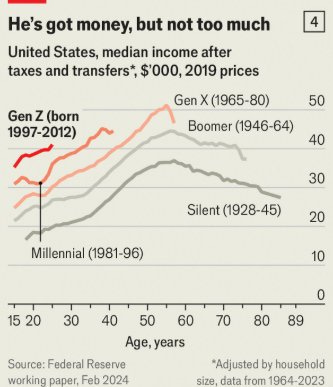
Gen Z is blaming Capitalism for the sins of Cronyism

Filed under: Bureaucracy, Cancon, Economics, Media, Politics, USA — Tags: , , , , , — Nicholas @ 03:00

Lika Kobeshavidze at the Foundation for Economic Education explains why angry Gen Z’ers are blaming capitalism but should instead be blaming crony capitalism for the economic plight they find themselves in:

Image Credit: Custom image by FEE

Across college campuses, on TikTok feeds, and in everyday conversations, a familiar narrative is gaining steam: capitalism is broken.

Rising rents and stagnant wages fuel the claim among some young people that free markets have failed an entire generation. According to a 2024 poll by the Institute of Economic Affairs, more than 60% of young Britons now view socialism favorably. In the United States, the trend is similar, with Generation Z increasingly skeptical of capitalism’s promises.

But much of this idealism is rooted in distance — many of the young people romanticizing socialism have never lived through the economic dysfunction or political repression it often brings. For those who experienced Soviet shortages, Venezuelan collapse, or East Germany’s surveillance, the word socialism doesn’t suggest fairness or opportunity — it suggests fear, failure, and control. There’s a reason so many fled those systems to come to freer countries. What sounds utopian in theory has too often turned dystopian in practice.

But blaming capitalism misses the mark. The real culprit is cronyism, the unholy alliance between big government and big business that twists markets, blocks competition, and rewards political connections over genuine innovation.

[…]

Cronyism is not limited to one country or one political party. Across the United States and Europe, the symptoms are the same.

In the US, Canada, and the UK, the dream of homeownership slips further away for young people. Sky-high housing prices are blamed on “market failure”, but the real cause lies in layers of government-imposed barriers: restrictive zoning laws, burdensome permitting requirements, and endless bureaucratic delays. Big developers who can afford to navigate or influence the system survive. Everyone else gets locked out.

In Europe, the pattern repeats. France’s labor laws, designed to protect workers, instead stifle opportunity. Hiring becomes risky and expensive, especially for young people. Large corporations, with the resources to manage compliance costs, consolidate their dominance. Small firms and startups never get off the ground.

There’s also a persistent myth that big business fears government intervention. In reality, the largest corporations often embrace it, because it keeps them on top. Tech giants like Facebook and Google now lobby for more regulation, knowing that complex new rules will strangle smaller competitors who can’t afford fleets of compliance officers. Green energy subsidies, meant to combat climate change, often end up showering billions on well-connected firms while locking out emerging innovators.

Cronyism doesn’t reward the best ideas. It rewards the best lobbyists.

May 19, 2025

The Roman Empire and climate change

Sebastian Wang considers “what we all know” about the rise and fall of the Roman Empire in the light of more recent research (not all of it politically motivated) into climate change:

The approximate extent of the Roman empire circa 395AD.

Before we get into climate, and for those who tend to the wholly ignorant spectrum of my readers, we need a quick sketch of Roman history. The Empire officially began in 27 BC, when Octavian — better known as Augustus — became the first emperor. It ended in the west in AD 476, when the last western emperor was kicked out. As said, the eastern half, based in Constantinople, carried on for another thousand years.

Broadly, we can divide Roman history as follows:

  • 27 BC – AD 180: The golden age. Augustus and his successors took over and further expanded a huge empire. There was peace (mostly), trade flourished, and cities grew. People call it the “Pax Romana“.
  • AD 180 – 284: Everything starts to fall apart. This is called the Crisis of the Third Century. Civil wars, foreign invasions, plagues, and economic collapse all hit at once.
  • AD 284 – 395: The empire pulls itself together. Emperors like Diocletian and Constantine bring in reforms. But the empire is now divided for administrative convenience — east and west.
  • AD 395 – 476: The west goes under. It’s invaded. It’s conquered and broken up. Very quickly, it disappears. Though, once again, a parochial view of history, we call this the Fall of the Roman Empire.

The standard histories still blame bad rulers or too many wars. That’s fair enough. There were some very bad rulers, and the wars without number. But if you look at the climate data — tree rings, ice cores, sediment levels — you start to see another pattern underneath what may be called the political and economic superstructure of Roman history.

When Rome came to greatness, the climate was unusually good. From around 200 BC to AD 150, there was a long phase of stable, warm, and mostly wet conditions. Scientists call this the Roman Climate Optimum. In Egypt, the Nile flooded regularly and well. That meant lots of grain. In the Alps, glaciers shrank. In northern Europe, people were growing grapes in places too cold for vineyards today. In the Middle East, the Dead Sea stayed high, showing good rainfall.

This kind of weather made everything easier. Crops were reliable. Surpluses could be taxed. Cities could be fed. Roads and aqueducts could be built and maintained. And because the army was well supplied, the Empire was protected, and could even continue a modest expansion. But, as McCormick and his team point out, the high phase of Nile flooding correlates exactly with the high point of Roman prosperity — and once those floods became less predictable, problems followed.

The good times came to an end. By the mid-second century, a wave of volcanic eruptions thew great masses of dust into the atmosphere, blocking sunlight. Solar activity dropped. The climate became less stable. Then came the Antonine Plague in AD 166. It probably started in the east and spread quickly. Some think it was smallpox. Whatever it was in terms of microbiology, it was almost certainly brought on by changes in the climate. It may have killed a third of the Empire’s population.

Worse was coming. By AD 200, climate records show more erratic rainfall and cooling. In Gaul and the Balkans, harvests became less predictable. Glaciers began to advance again. Speleothem data from Austrian caves shows sharp shifts in rainfall patterns.

At the same time, the empire started to shake. Between 235 and 284, Rome had over twenty emperors. Most were generals who seized power, then got killed. Civil wars broke out. Trade declined. Foreign tribes pushed harder at the frontiers. Coin hoards — money buried for safety — increased in number. That’s usually a sign of fear and instability. Cities shrank. The economy shrivelled.

Was this all because of climate? No — not wholly. A good definition of historical crank is someone who tries to explain everything in terms of one cause or set of causes. But as McCormick et al. argue, bad weather made everything worse. It weakened agriculture, strained supplies, and made people more likely to panic or rebel. In a world without modern logistics, you couldn’t afford bad harvests two or three years in a row.

The empire buckled in the third century, but didn’t collapse. And its survival probably was an effect of human agency. A line of competent Emperors rose from the army and stabilised the frontiers. This line culminated in the reigns of Diocletian and Constantine, who restructured the Empire. They fixed taxes. They reorganised the army. Constantine built his new capital in the east. His successors found Constantinople safer and more strategically useful than Rome.

This being said, around AD 290, climate records suggest a small rebound. Warmer temperatures and better rainfall returned — especially in the east. That helped the eastern provinces recover faster. They had stronger governments and better infrastructure. But climate helped. Dead Sea levels remained relatively high, which meant steady rain in the Levant.

The west wasn’t so lucky. Italy and parts of Gaul stayed unstable. In Britain, pollen records show that farmland was being abandoned. The archaeology matches this, with fewer building projects and shrinking urban centres. The killing shock for the west came in the fifth century. In Central Asia, a long drought began around AD 370. Steppe tribes like the Huns were hit hard. They migrated west, pushing other tribes like the Goths ahead of them. In AD 376, the Goths crossed the Danube into Roman territory. Two years later, they crushed a Roman army at Adrianople. This all happened in the eastern half. But greater wealth and better leadership allowed the government in Constantinople to push the barbarians west. Over the next century, the western empire was hit again and again.

Meanwhile, the weather got worse. Europe cooled. Rainfall patterns shifted. Flooding and crop failures increased. Volcanic sulphur levels spike in the ice core record from Greenland.

Rome was sacked in AD 410. Again in 455. Finally, in 476, the last western emperor was deposed. That was it. The western Roman Empire was gone.

The east survived. But was hardly untroubled. In AD 536, a huge volcanic eruption darkened skies around the world. The sun barely shone. Crops failed. Famines spread.

A few years later, the Plague of Justinian broke out. It probably started in Egypt and spread through trade routes. Some say it killed half the population in affected areas.

Climate and disease worked together. Hunger weakened people. Infection finished them off. As McCormick et al. put it, the event of 536 and the plague that followed created one of the worst demographic shocks in recorded history.

May 16, 2025

QotD: Marxist and socialist revolutions

Filed under: Africa, Books, Economics, Quotations — Tags: , , , , , — Nicholas @ 01:00

Professor Chirot’s theory is that revolutions break out when an outmoded governments refused to recognise their own outmodedness and hence to reform. This obviously has some similarities with the Marxist idea that revolutions occur when the relations of production of a society can no longer contain its productive forces, and is in contradiction to Tocqueville’s idea that revolutions break out not when rigid and dictatorial regimes are at their most oppressively rigid and dictatorial, but when they begin to reform and meet the demands of those who demand change. This is not to say that Professor Chirot is wrong, but one might have expected him to make allusion to the two theories.

The collapse of communist regimes in Eastern Europe, which he is happy to call revolutionary, also does not support his rough schema. It is not that the communist regime refused to reform, it is that it was incapable of reform for the same reason that a woman can’t be a little bit pregnant. If a regime makes the kind of claims for itself that the communist regime made, even if the leaders had themselves long since ceased to believe them, namely that it is the ineluctable denouement of all history, if not that of the universe itself, it cannot retreat, all the more so because its crimes, which one could and would have been claimed as a step in the march of history, would thereafter be seen for what they were: the choices of fanatical psychopaths avid for total power.

Professor Chirot seems to have a slight soft spot (admittedly only implicit) for socialism, that is to say for something more than mere social democracy. In his discussion of the case of Angola, in which a revolutionary movement emerged triumphant, but whose post-revolutionary regime was a pure kleptocracy under cover of Marxist rhetoric, he says: “Much more could have been done through either a market-friendly or a genuinely more socialist approach to economic development”.

This surely implies that somewhere, at some time, there was a socialist regime that would have handled Angola’s oil bonanza better, in which case one would have liked an example that it might have followed. Norway, perhaps? But Norway is not socialist, it is social democratic. Besides, Norwegians and Angolans are scarcely the same in a very large number of ways. I would have thought that the chances of Angola following the Norwegian model were, and are, approximately, and perhaps even exactly, zero.

Theodore Dalrymple, “Longing for Revolution”, New English Review, 2020-05-13.

May 15, 2025

“You can earn a degree in economics without ever encountering the Depression of 1920-1921”

Filed under: Economics, Government, History, USA — Tags: , , , , — Nicholas @ 03:00

Most modern economists focus on the lessons learned (and not learned) from the Great Depression, but as John Phelan points out, a better learning experience occurred nearly a decade earlier:

Warren G. Harding, 14 June 1920.
Library of Congress control number 2016828156

In July 1921, the United States emerged from a depression. Though the economic statistics of the time were rudimentary by modern standards, the numbers confirm that it had been bad.

By one estimate, output fell by 8.7 percent in real terms. (For comparison, output fell by 4.3 percent in the Great Recession of 2007-2009). From 1920 to 1921, the Federal Reserve’s index of industrial production fell by 31.6 percent compared to a 16.9 percent fall in 2007-2009. In September 1921, there were between two and six million Americans estimated unemployed: with a nonagricultural labor force of 31.5 million, this latter estimate implies an unemployment rate of 19 percent.

“In this period of 120 years,” wrote one contemporary, “the debacle of 1920-21 was without parallel”.

And then it was over. From 1921 to 1922, industrial production jumped by 25.9 percent and residential construction by 57.9 percent. Manufacturing employment increased by 9.5 percent and real per capita income by 5.9 percent. The 1920s began to roar.

What caused the crash of 1920-1921? Why was it so short? And why was the economic recovery so vigorous?

[…]

Bust to Recovery

As output slumped and unemployment soared, there were those urging action. In December 1920, Comptroller of the Currency John Skelton Williams wrote:

    It is poor comfort to the man or woman with a family denied modest comforts or pinched for necessities each week to be told that all will be, or may be, well next year, or the year after. Privations and mortifications of poverty can not be soothed or cured by assurances of brighter and better days some time in the future. Our hope and purpose must be to forestall and prevent suffering and privation for the people of today, the children who are growing up and receiving now their first impression of life and their country.

No such policies were forthcoming.

In October 1919, Woodrow Wilson, then entering the last year of his presidency, was incapacitated by a stroke and his administration ground to a halt: “our Government has gone out of business”, wrote the journalist Ray Stannard Baker.

Wilson’s successor Warren G. Harding, who took office in March 1921, supported Strong’s policies, noting “that the shrinkage which has taken place is somewhat analogous to that which occurs when a balloon is punctured and the air escapes”.

While lower prices meant reduced incomes for some, they meant reduced costs for others. Eventually, producers and consumers started to buy again. By March 1921, lead and pig iron prices bottomed out: cottonseed oil, cattle, sheep, and crude oil followed by midsummer.

The higher interest rates had attracted gold. From January 1920 to July 1921, foreign bullion augmented the American gold stock by some $400 million to $3 billion. By May 1921, 80 percent of the volume of Federal Reserve notes was supported by gold. Interest rates could fall.

In April, the Federal Reserve Bank of Boston cut its main discount rate from 7 to 6 percent. The Federal Reserve Bank of New York followed suit next month, cutting from 7 to 6.5 percent. The Roaring Twenties began.

The Lessons

Students of macroeconomics will learn about the Great Depression of the 1930s. They will learn that many of the policies routinely used to fight downturns now — fiscal stimulus and expansive monetary policy — were forged in those years. You can earn a degree in economics without ever encountering the Depression of 1920-1921. Yet, initially, it was as bad as that which began in 1929 but ended more quickly and was followed by a rapid recovery.

Whereas the policymakers of the 1930s — led by the defeated vice-presidential candidate of 1920, Franklin D. Roosevelt — diagnosed the economic problem facing them as unemployment and deflation, those of 1920 diagnosed it as the preceding inflation. Where policymakers of the 1930s used cheap money and government spending to boost demand, those of the 1920s saw this as simply repeating the errors which had created the initial problem. To them, there could be no true cure that didn’t deal with the disease, rather than the symptoms.

It is for history to judge who was correct, but it’s undeniable that the recovery of the Depression of 1920–1921 was immensely stronger and faster than that of the Great Depression. Ironically, this may be the very reason it is often overlooked in history and economic courses.

An additional lesson of eternal relevance can also be drawn: successful solutions will be those which are based on a correct diagnosis of the problem.

May 12, 2025

The rise of the Hansa

Filed under: Economics, Europe, Germany, History — Tags: , , , , , — Nicholas @ 05:00

At Works in Progress, Agree Ahmed describes the conditions in northern Europe in the Middle Ages that helped create the Hanseatic League:

Today, we typically think of coalitions in the context of modern electoral politics. So it might be surprising that one of the greatest case studies in the history of coalitions is a community of medieval German merchants known as the Hansa.

Starting as individual traveling traders, the Hansa built up coalitions for collective bargaining, collective action, and collective security. Through this process, they formed Northern Europe’s first ever long-distance trade network.

Without corporate structures, they built supply chains that distributed goods between Northern Europe’s major ports, with capillaries that spread into each city’s hinterlands. Without formal territory, their laws governed trading hubs spanning thousands of miles, from London all the way to Western Russia. And, despite being composed of hundreds of member cities, the Hanseatic League had no head of state. Yet the Hansa still managed to sign treaty after treaty with foreign rulers and, a few times, even fought (and won!) wars.

[…]

Better climate, more arable land, and better farming techniques lifted Europe’s crop yields to above subsistence levels for the first time since the Roman period. After several centuries of decline, Europe’s population grew from 18 million in the 600s to over 70 million by the 1300s – nearly triple the population of the Roman period. The nutritional surplus allowed for Europe’s first significant artisan class since the Roman empire. Each town had common craftsmen like blacksmiths, leatherworkers, and carpenters. But local skills and resources allowed for the emergence of specialized crafts, which were unique to specific regions and could therefore be traded.

Tax-hungry lords across Europe began to set up permanent marketplaces for their growing communities. And so hundreds of towns formed in Europe, filled with workers who had flocked from countryside manors. These towns were the first substantial permanent markets in Northern Europe’s history.

As production accelerated, so did shipping. The warmer climate meant waterways in the North and Baltic Seas were navigable for longer stretches of the year. Meanwhile innovations in boatmaking dramatically improved shipping capacity. Excavations of the few surviving ships from this era show that, in the span of a few centuries, vessels tripled their average tonnage from 10 to 30 while dropping the number of rowers required by a factor of four.

The breakthrough in tonnage starting in 900 can be credited to the knarr, a Viking-style ship that was shorter and wider than the longboat that preceded it, allowing it to load substantially more cargo with a smaller crew. Prior to the knarr, trade convoys had to carry cargo on longboats, which were agile but could only carry small fractions of what the knarr could.

A model knarr in the Hedeby Viking Museum in Germany.
Image Source: Europabild via Wikimedia.

When Northern Europe’s first long-haul merchants set off on their voyages, they faced a world that had not yet been ordered for trade. Sailors had to worry about pirates in the Baltic and shipwrecks at icelocked winter ports.

Riverways gave merchants access to inland communities, where they could find products at lower prices to then sell for a profit in major port cities. But riverside towns were more interested in their own engineering projects or grinding their grain and so would block rivers with dams and water mills, and they would redirect water to irrigate fields.

And even if a river were clear of obstructive mills or dams, it might be heavily punctuated by toll stations. The Rhine River, a key shipping artery that connected inland Germany with the Baltic coast, had tolls approximately every five kilometers.

Under the laws of the Holy Roman Empire, the right to collect tolls on the Rhine could only be granted by the Emperor. But unauthorized tolling stations, or tolls levied in excess of what was authorized, were so rampant that the malpractice had a name: the lonia iniusta (Latin for “unjust tolls”). Some local authorities enforced toll collections along rivers by running chains from bank to bank, making it impossible for a boat to pass without paying. Others would patrol the river on their own boats and deny vessels passage until they paid up.

In the first four years of the Great Interregnum Period (1250–73), when the Empire had no emperor, the number of toll stations on the Rhine doubled to 20. This is the origin of the term “robber baron”: local barons, operating out of riverside castles, would set up illicit toll stations and demand significant shares of merchant cargo in order to pass.

The journey on land wasn’t much easier. Toll booths were similarly common. Nominally, these were to pay the landowner for the maintenance of the roads and bridges but in reality they were usually left dilapidated. Merchants voyaging on land had to load their wares on the backs of mules and horses (which were about a third the speed of ships). The narrow widths of medieval roads meant these caravans stretched out in long lines, leaving animals and cargo physically exposed. These vulnerable, slow moving, value-dense caravans attracted bandits who roamed the isolated roads between towns. It was nearly guaranteed a caravan would face an attempted robbery – either illegally by bandits or (somewhat) legally in the form of a toll shakedown – over the course of a sufficiently long trip.

As a matter of safety, Northern European merchants learned to move together in armed groups. These traveling merchant bands were called hansas, a Lower German word meaning “company” or “troop”. When a hansa formed for a trip, they elected an alderman (literally “elder man”) who would speak on behalf of the group to the various authorities – lords, princes, bishops, and other rulers – they might encounter along the way.

Once they completed the arduous journey, the merchants had to deal with the local governments of their destination cities, each of which had different and constantly changing laws. To protect the local merchants and craftsmen within their city walls from competition, princes might demand exorbitant taxes from foreign merchants or deny them access to the city altogether. Merchant bands had to negotiate collectively to secure the right to trade within each city in which they wished to conduct business. And if they made it into the city walls, they might not make it out: capricious lords might suddenly imprison foreign merchants (as happened to German merchants in England in 1468 and Novgorod in 1494), raid their offices, or seize their merchandise.

Local laws threatened foreign merchants more than they protected them. Most town courts, themselves newly formed, had minimal experience adjudicating long distance commercial disputes. When such disputes did arise, courts could take weeks or months to arbitrate them, and were heavily biased towards locals over foreign traders. Without sovereign states, merchants were left dealing with a fractured landscape of town courts, where each market had its own idiosyncratic laws. And because foreign traders could evade punishment by fleeing overseas, courts in England, France, Italy, and the Holy Roman Empire often collectively punished foreign merchant communities for the unpaid debts of their countrymen.

The lack of early medieval records makes it difficult to quantify just how much Northern European commerce grew as a result of continuous long distance trade. Before the late medieval period, Northern Europe’s archaeological record of trade shows just several dozen sites known as emporiums: small, temporary settlements outside of towns where foreign merchants traded with locals. But starting in the late medieval period (1300 to 1500), Lower German merchants began to change this.

H/T to Niccolo Soldo for the link.

May 11, 2025

Will Amtrak survive the DOGE treatment?

Filed under: Economics, Government, Railways, USA — Tags: , , , — Nicholas @ 03:00

J.D. Wong outlines Amtrak’s never-ending financial difficulties:

“Amtrak” by Mike Knell is licensed under CC BY-SA 2.0 .

Founded 54 years ago, Amtrak set out on a bold adventure to see if passenger trains could be profitable. Fast forward to today, this experiment has been unsuccessful. Politicians have often crafted routes to win votes rather than attract riders. As a result, Amtrak has been squandering taxpayer money since its start in 1971.

Take, for instance, the Infrastructure Investment and Jobs Act of 2021. It allocated a monumental $66 billion to bolster passenger rail. Yet, even with this backing, Amtrak’s losses soared from $1.12 billion in FY2019 to $2.12 billion in FY2024. This financial drain isn’t new; America’s passenger trains have lost money for 79 years.

Amtrak asserts that it is “on-track to reach operational profitability”. Yet, this is a bald-faced lie. While Amtrak reported a loss of $705.2 million for FY2024, it didn’t include:

  1. $966.2 million in depreciation;
  2. $447.3 million in “Project Related Expenses”;
  3. $314.1 million in state subsidies, which it classified as “revenue”;
  4. $26.9 million in Office of Inspector General funding

By omitting these costs, Amtrak paints an optimistic view of its financial health. In reality, Amtrak needs larger subsidies than ever before. In fact, Amtrak has been deceiving Congress with its “path to profitability” since 1990.

Although Amtrak touted a “ridership record” for FY2024, this figure is misleading too. Ridership numbers don’t reflect the average length of each passenger’s trip. A more insightful metric is passenger-miles, which measures how far people are traveling. In fact, Amtrak only transported 6.54 billion passenger-miles in FY2024. This is a decrease of 3.40 percent since FY2013.

Amtrak often attributes its financial struggles to its long-haul routes. Yet, the outlook is even bleaker for its short-haul, state-supported routes. Amtrak reported a $251.5 million loss for these routes in FY2024. Yet, with $314.1 million in state subsidies included, the true loss hits $565.6 million. This represents a shocking 94 percent increase from the $291.7 million lost in FY2019.

Amtrak’s advocates often cite highway “subsidies” to explain its financial debacles. But Amtrak guzzles about 39 times more subsidies per passenger-mile than highways do.

Amtrak asserts that freight trains “interfere” with its passenger services. However, Amtrak often makes questionable route choices despite having legal priority over freight. Between Chicago and Los Angeles, the Desert Wind lost less money than the Southwest Chief. Despite this, Amtrak favored the Southwest Chief, which passed through more congressional districts. It discontinued the Desert Wind in 1997, leaving Las Vegas with no train service.

QotD: Corporate taxes

Filed under: Business, Economics, Government, Quotations — Tags: , — Nicholas @ 01:00

Many politicians, pundits and some economists would have us believe that corporations pay taxes, but do they? Economists distinguish between entities who ultimately bear the tax burden and those upon whom tax is initially levied. Just because a tax is levied on a corporation doesn’t mean that the corporation bears its burden. Faced with a tax, a corporation can shift the tax burden by raising its product prices, lowering dividends or laying off workers. The lesson here is that only people pay taxes, not legal fictions like corporations. Corporations are simply tax collectors for the government. Similarly, no one would fall for a politician telling a homeowner, “I’m not going to tax you; I’m going to tax your property”. I guarantee that it will be a person, not the property, writing out the check to the taxing authority. Again, only people pay taxes.

Walter E. Williams, “Economics Reality”, Townhall.com, 2020-02-04.

May 8, 2025

QotD: Trade empires

Filed under: Economics, History, Military, Quotations — Tags: , , , , — Nicholas @ 01:00

The final (and possibly ultimate) sort of empire is the Trade Empire. These develop more because exploring traders have a need for safe bases and secure lines of communication to make their trade work. Theoretically trade empires could be land based (and both the American West and the Chinese spread down the Silk Road argue the case that they started as trade security rather than conquest … no matter how they finished). But in reality the main cause of and reason for trade empires is the development of water transport. Specifically ocean transport.

So let us consider the motives of Empire in a few cases.

The Phoenicians had a magnificent trade empire, though with a few elements we find familiar from the more recent Viking version, or indeed the Venetian “Republic” — namely a bit of raiding, and quite a bit of slave trading. All three broadened into a bit of conquest — Carthage, Normandy and the sack of Constantinople in the 4th Crusade come to mind — but all those offshoots were by-products of the original cultures, and none of them became the norm for the ongoing home culture (each of which faded away as circumstances changed and they failed to adapt). So we could say that they were essentially trading empires.

Greece and Carthage and Rome were also trade empires, initially letting their security concerns drag them into a bit of conquest on the side. The difference in their cases was that the conquest element became dominant and completely changed the “homeland”. The city states of Greece becoming the world-conquering hordes of Alexander, and completely undermining the vibrant city state cultures that had proceeded them. The Phoenician trading city of Carthage becoming an expansionary conquest state that eventually pushed Rome too hard. And Rome’s overseas campaigns in Spain and North Africa completely undermining the independent farmer/citizen/soldier class of the Roman Republic, and replacing them with a system of professional troops whose loyalty could only be bought by ever increasing conquests by the emperors.

Naturally every expansion eventually reaches limits, and the concern reverts to trying to secure what you have, and hold the outsiders further away. Which is why, amusingly, people like the Romans and the Chinese came through their expansionary conquest phase, and then found themselves back in the position of having to protect the fringes through deals with tribes that can be traded with/employed by/or paid tribute. Cue Attila the Hun and his ilk.

So empires on the way down may also be considered trade and security empires I suppose, though many still had a conquest impulse (for fame or fortune or simply to pay the defenders off) built in, or tried to act as if they were still conquering hordes. Cue Constantinople and Belisarius.

In fact most empires will go through a variety of stages, though I think it fair to say that most empires have a core purpose and attitude, no matter how they tinker at the edges to deal with specific circumstances.

Nigel Davies, “Types of Empires: Security, Conquest, and Trade”, rethinking history, 2020-05-02.

May 5, 2025

Make America Austere Again?

Filed under: Economics, Government, Media, Politics, USA — Tags: , , , , — Nicholas @ 03:00

The first 100 days of the BOM haven’t been quite what anyone expected. Close allies and trading partners were shocked at the new administration’s devotion to 1920s tariff “diplomacy”, supporters were dismayed to not get lots and lots of perceived wrongdoers of the Biden administration getting perp-walked for the cameras, and ordinary Americans were presented with a much worse domestic economy than they were promised:

Trump wasn’t totally fixated on economic matters … he still found time in his busy schedule to troll Catholics on his Truth Social platform.

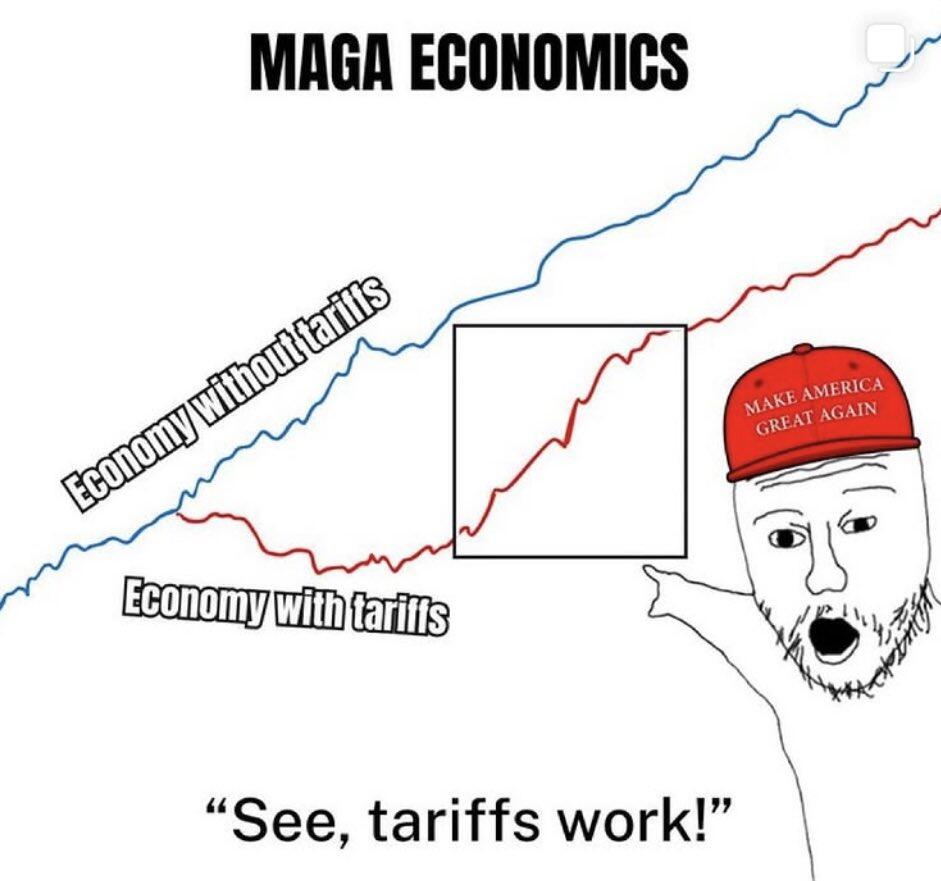
On Wednesday, in the prelude to a cabinet meeting, U.S. President Donald Trump made yet another remark to chill the blood for those concerned about his country. Trump’s cat-and-mouse game of arbitrary changes to American import tariffs is starting to raise concerns about prices and supply chains for consumer goods. The American economy has unexpectedly shrunk in the first 100 days of Trump 2.0, even though workers and businesses are scrambling to make purchases before the effects of Trump tariffs set in. The underlying state of the economy is probably worse than the short-term numbers.

Trump says this is all a matter of “get(ting) rid of the Biden ‘Overhang'”, i.e., it’s his immediate predecessor’s fault. And let’s face it: no other politician on Earth would say anything else 100 days into an executive term. If that was as far as Trump went, it wouldn’t be of unusual concern. What struck me was his separate remark implying that, yeah, tariffs might foul up supply chains a little in the transition to the glorious economy of the future, but haven’t we Americans had it too soft for too long?

“Maybe the children will have two dolls instead of 30 dolls,” the president mused. “So maybe the two dolls will cost a couple bucks more than they would normally.” The message, which brazenly puts the contentment of children front and centre, is one you can’t imagine any other American leader delivering so directly in peacetime: have you all considered being happy with less?

The answer one would expect the median American voter to give is “Hell no”. It’s crazy that I should have to write this, but consumer abundance is a defining feature of the United States! During the Cold War, American supermarkets were the unanswerable argument for economic freedom: you could summarize the United States pretty reasonably as “It’s the country that coined the word ‘super-market'”. In our hyper-interconnected social-media world, I see a dozen conversations a week in which some European boasts of affordable healthcare, walkable neighbourhoods and having July and August and half of September off work every year: the inevitable answer from Americans is “OK, but have you been inside a Buc-ee’s, Gustav?”

Of course, it’s been a very long time since media-decried austerity in government has actually meant any kind of actual reduction in outlay … it’s usually just a (very) slight decrease in the rate of increase rather than actual dollar-value reduction. But, as Chris Bray points out, this time for sure:

I was planning to spend $100 on groceries this morning, but then I decided to slash my grocery budget, so the amount I actually spent on groceries plummeted to just $99.97, plus a small eight dollar supplemental on previously deferred grocery needs, bringing the total to a shockingly parsimonious $107.97. These major cuts caused serious alarm in my household.

Donald Trump, Politico warns, is scorching the earth:

This is the common theme everywhere, as the administration offers the first not-very-detailed hints about its plans for FY ‘26 discretionary federal outlays. The Huffington Post concludes that Trump is pulling out the BUZZSAW:

The Federal News Network sums up the size of the hit, and compare the topline number to the language about scorched earth and buzzsaws:

    Overall, the administration is looking to increase national security spending next year by 13% and decrease non-defense discretionary spending by 7.6%, meaning the White House is asking for $1.7 trillion for the discretionary budget down from $1.83 trillion this year.

While the White House plans don’t get into the subject of total federal spending, focusing narrowly on discretionary spending, the implication is that federal spending overall will go from about $7 trillion to about … $7 trillion. But TBD.

You can read the entire White House proposal for discretionary funding here. Trump is proposing deep cuts in some federal departments and programs, but is also proposing to offset those cuts with sharp increases in military spending and “homeland security”, meaning border security and sending poor gentle immigrants to places where Chris Van Hollen will fly to stare into their beautiful eyes.

« Newer PostsOlder Posts »

Powered by WordPress