Quotulatiousness

December 12, 2020

“Canada’s party system has long been an outlier that has baffled political scientists”

Filed under: Cancon, Environment, History, Politics — Tags: — Nicholas @ 03:00

Ben Woodfinden emerges from a pre-winter hibernation to mull on how environmental issues intersect with regional and linguistic issues in a uniquely Canadian way that does not match how these issues play out in other countries:

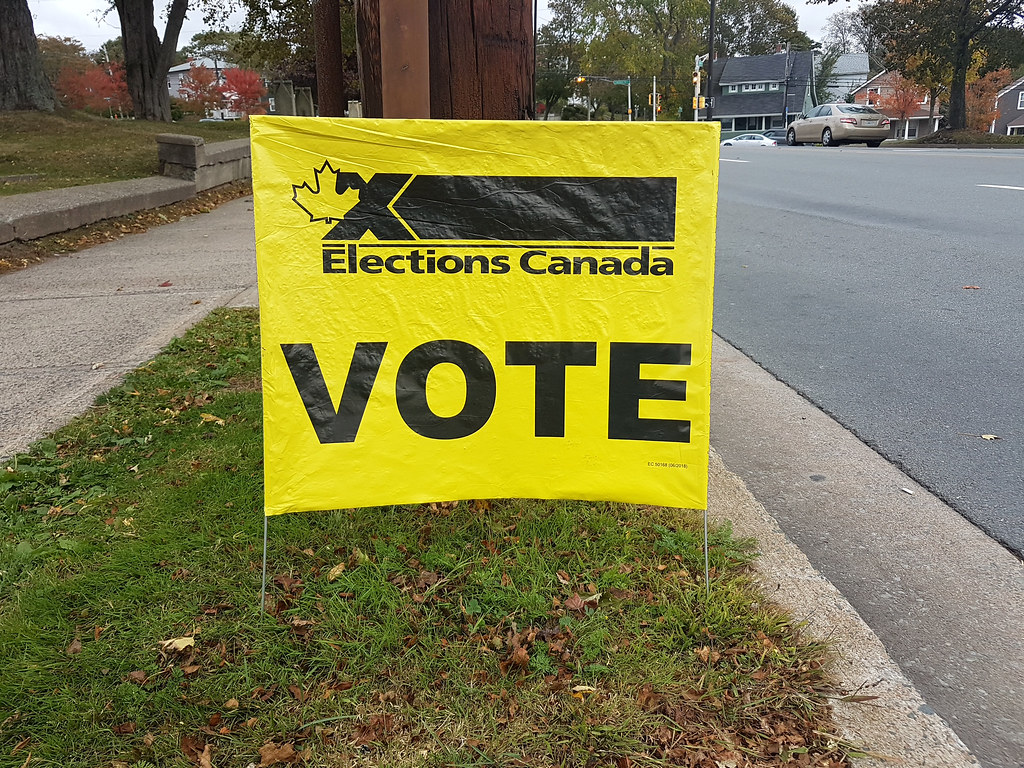
“2019 Canadian federal election – VOTE” by Indrid__Cold is licensed under CC BY-SA 2.0

… if you want to understand how democratic politics work, you have to begin with the premise that voters and electoral coalitions are made up of individuals with overlapping and complicated political identities, not just rationalistic voters who need to be convinced with some charts and data.

These identities and value divides coalesce and become the basis of the political cleavages around which competition in democratic regimes is built. There are many classic accounts of party system formation in political science, the one I think most plausible and still useful is the now classic account of cleavage politics posited by the political scientists Seymour Martin Lipset and Stein Rokkan.

This now classic account of the formation of party systems in Western Europe argues that long existing social conflicts and divides that existed prior to the gradually universal extension of voting across Western Europe helped to structure political competition. Specifically, industrialization and nation building generated four major cleavages that structured political conflict and party systems going forward: territorial cleavages defined by a centre-periphery divide, religious cleavages defined by a church versus state divide, an urban-rural cleavage, and a labour-capital cleavage.

Canada’s party system has long been an outlier that has baffled political scientists who study these things. If you’re looking for a good comprehensive overview of the history of the Canadian party system I’d recommend this recent book by Richard Johnston. Since the 1930’s Canada has defied what is perhaps the single most generalizable finding in comparative politics: Duverger’s Law. Canada also defies many of the expectations of the cleavage theory of party formation. But Canadian politics can still be broadly understood in terms of cleavages, albeit idiosyncratic Canadian cleavages (regional and linguistic cleavages especially).

I won’t bog you down with too much academic explanation. There is an enormous body of literature that builds on, tests, and modifies the cleavage thesis. Much of the talk in recent decades has been about an “unfreezing” of the traditional cleavages that have dominated party politics in western democracies, and the reorganizing of politics around new cleavages.

As traditional industrial, class, and religious cleavages have declined new cleavages have emerged and politics has been playing a catch up game. These new cleavages coalesce around educational, geographic, gendered, and age divides. This realignment, which has been in the making for decades has become the dominant political narrative since 2016, and as I’ve written in the newsletter recently these divides exist in Canada just as they do in Europe and America.

But the realignments these new cleavages produce often require singular events or defining figures to fully emerge. In the United Kingdom, the 2016 referendum produced a realignment because it scrambled the existing partisan and political arrangements so much that it gave rise to a hyper-polarized culture war around a remain/leave divide that people reoriented their own politics around this divide.

December 11, 2020

“Politically correct language … seemed like a nice, polite, and Canadian sort of thing to do”

Filed under: Cancon, Politics — Tags: , , , , , , — Nicholas @ 03:00

Meaghie Champion discusses politically correct language in The Line:

Source: https://www.deviantart.com/blamethe1st/art/Statist-And-Anarchist-063-Political-Correctness-589944623

I grew up in the 1970s and ’80s. I have never lived in a world without what we now call “political correctness” — typically understood to mean using a kind of stilted and artificial language in order to atone for the disadvantages and slights suffered by marginalized groups and avoid inflicting new ones. Politically correct language required more effort to communicate, but it seemed like that effort was worth it to not offend people. It seemed like a nice, polite, and Canadian sort of thing to do.

I went along with political correctness out of a sincere desire to be accommodating to disadvantaged and dis-enfranchised groups. This became especially true after I learned about the “Sapir Whorf theory of psycho neurolinguistics.” The theory suggests that language shapes our perception of reality; that by altering the way we talk, we can shift the way we think — and, thus, collectively, we can shape reality itself. From this, it seemed logical to “de-gender” language or stop using stereotypes. It seemed like a small ask. Maybe I personally couldn’t solve big problems that concerned me as a good liberal … i.e. things like poverty or world hunger, but I could be nice in how I expressed myself and try to use language that everybody was using to be equitable and more fair.

What I didn’t understand, then, was that this precedent set a trap in which many good, well-intentioned liberals are finding themselves stuck. It’s no longer about ameliorating past sins: there is a project afoot to re-make the English language. The purpose of this project is to re-engineer how people think about certain subjects like gender, sex, and race, while skipping the necessary prerequisites of persuasion and logic. Conservative positions are declared off limits, even bigoted, simply by shaping the way we are allowed to talk about them.

Right now, even as I type this, there is a veritable army of academics hard at work on what they call “de-colonizing” and “de-gendering” language at many universities and colleges. There are tens of thousands of activists and academics in universities and online organizing and pushing for ever-changing rules to be enforced as it relates to the English language. It’s a multi-million-dollar industry in academia and woke corporatism. And it’s already starting to spill over into government regulations and enforcement.

I love the English language. I have been a voracious reader since childhood. I thrill at well-spoken and written prose and poetry. A finely turned witticism or fantastic mot juste can break my heart with its perfection. Further, I’m First Nations, and that love of the English language has also carried me into a love of the study of my tribal cradle tongue “Hul’qumi’num.” Shouldn’t I, as a First Nations person, be in favour of de-colonizing the English language? No. No, I do not think so. I have little patience or regard for any effort that makes language a less workable and functional tool of human endeavour. I identify strongly as a writer, and I take this assault upon the tool with which I conduct my craft very personally.

December 6, 2020

“As ever, our Liberal friends prefer to be judged by their pure intentions rather than their rather tattered record”

The good folks at The Line suggest that we monsters in the peanut gallery stop hurting poor Little Potato’s feeeeeeeeeelings:

Typical image search results for “Justin Trudeau socks”

What we can say is that supporters of our current government continue to insist that the prime minister and his cabinet be granted a level of benefit of the doubt that they simply have not earned. Declarations that the Liberals have botched the vaccine rollout are premature, but they are not preposterous. As ever, our Liberal friends prefer to be judged by their pure intentions rather than their rather tattered record. We at The Line have known enough true Grits in our time to believe that this isn’t an act. Liberals really do believe that so long as they mean well, they should be forgiven their failures. Indeed, the failures should be forgiven and forgotten.

And boy, can they get testy when someone declines to do them the courtesy of treating this five of a government like a nine. They’ll shriek about Harper and Ford and Kenney and American-style whatever, they’ll argue in bad faith, they’ll demand an audit of Andrew Scheer’s household expenses, they’ll shut parliament down in the middle of a national emergency to spare the boss from embarrassing questions about his latest ethical flub. In short, they’ll do anything to avoid admitting that this Liberal government has blown more than enough high-profile issues to have forfeited any right to be bummed out when someone dares wonder if they’ll do any better on vaccines.

Over the last five years, the Liberals have failed to hit their own targets on balancing the budget and cleaning up Indigenous water supplies. They failed to hit Harper’s targets on carbon reduction, failed to win a UN seat, failed to deliver promised military procurements, failed on electoral reform, failed to improve our decrepit transparency system, and failed to notice any number of outrageous policies and proposals so long as they were proffered en français, in which case they couldn’t avert their eyes fast enough.

We could go on, but the point is made. And they’ve done it all after daring to talk in their opening days of deliverology, a term that’s now a political punchline thanks to how badly Trudeau and the Gang failed to live up to the hype of their own managerial jargon.

The problem with all this failure is far bigger than the sum of its various sad parts. A government that routinely writes cheques its competence can’t cash may be in a hurry to forgive itself, but not all Canadians are as fond of Justin Trudeau as Justin Trudeau clearly is. A proven track record of failure by the state erodes public confidence in the state, and the sneering contempt Liberals have for anyone who notices the failure doesn’t help. We find it absolutely amazing how many Liberals (rightly!) decry the rise of populism without ever seeming to ponder for a New York minute what role their own manifest mediocrity has played in fuelling it. So we’ll kindly hear no more from the Liberals about the know-nothing idiocy of the woke left and the destructive buffoonery of the nationalist right until they stop doing such a shabby job with the goddamned centre.

Halifax: Canada’s Great War Casualty

Filed under: Cancon, History, Military, WW1 — Tags: , , , , — Nicholas @ 02:00

Geographics
Published 14 Jul 2020

This video is #sponsored by Squarespace.

Credits:
Host – Simon Whistler
Author – Ben Adelman
Producer – Jennifer Da Silva
Executive Producer – Shell Harris

Business inquiries to admin@toptenz.net

If you found this video interesting, you might also want to read my article on the Halifax Explosion here.

December 4, 2020

Canada used to have a “none of the above” option in federal elections … let’s bring it back

Filed under: Cancon, Government, History, Liberty, Politics — Tags: , — Nicholas @ 03:00

David Warren describes how the “returned ballot” functioned as a “none of the above” vote in Canadian federal elections:

“2019 Canadian federal election – VOTE” by Indrid__Cold is licensed under CC BY-SA 2.0

Back to the polling station, where the electoral officer is now passing me a ballot, with a hint on how to make an X on it. I am directed to a voting stall.

But I refuse to go there. Instead, I turn earnestly to the officer and say: “I am returning this ballot.”

Chances were, even decades ago, he would be thrown into confusion. So one would explain his job to him. He was supposed to have a book, entitled “Returned Ballots.” Into this he was supposed to transcribe one’s name and address. Getting into the book was one’s only way to avoid the secret ballot. But it was important to get in, to be recorded correctly, rather than as a “spoilt ballot,” as one is counted now if one’s ballot has no X.

After voting, I would check the result, and if not even one returned ballot had been recorded, I could doubt it was legitimate.
Now comes the good part. For returned ballots were supposed to be a separate category in the election tally. It was competing with all the other candidates. If it won a plurality — more returned ballots than the leading candidate — the election was to be formally thrown out, and a by-election called, in which none of the candidates for the thrown out one were allowed to run again. Too, voters could “theoretically” do this over and over, until at least one Party chose a candidate we could stomach.

In theory, this was an excellent way for voters to “drain the swamp,” directly, by eliminating the political sleaze in successive groups. In practice — aheu — it was never used. The political sleaze nevertheless spotted the possibility, and had it taken off the books, at both Dominion and Provincial levels. What can I say? They are sleaze.

So the first thing we must do is campaign for the return of the returned ballot, up here; and for its institution in all the other Western nations. Then the second is to impartially, but massively, campaign for its use. It could be the greatest thing since the ancient Athenian ostracon.

5 strange Canadian objects

Filed under: Cancon, Food, Football, History, Humour, Randomness — Tags: , , , — Nicholas @ 02:00

J.J. McCullough
Published 22 Jul 2017

Let’s take a look at a couple of weird things only Canadians will understand.

O Canada ending music care of SuperNIntendoGameboy, check out full version here: https://www.youtube.com/watch?v=b0qmP…

December 2, 2020

Bill C-10, An Act to amend the Broadcasting Act hijack the internet

Filed under: Bureaucracy, Cancon, Media, Technology — Tags: , , , , — Nicholas @ 03:00

At The Line, Josh Dehass outlines the benign-sounding claimed intent of Bill C-10 and the malign reality if it is implemented as written:

Bill C-10 would expand the term “broadcasters” to include online content creators. This means that after decades of a mostly regulation-free Internet, the CRTC will soon have a say in what content you can and can’t see on services like Netflix, Amazon Video and Spotify. The bill says these “broadcasters” will be required to “serve the needs and interests of all Canadians — including Canadians from racialized communities and Canadians of diverse ethnocultural backgrounds, socio-economic statuses, abilities and disabilities, sexual orientations, gender identities and expressions, and ages — and reflect their circumstances and aspirations, including equal rights, the linguistic duality and multicultural and multiracial nature of Canadian society and the special place of Indigenous peoples within that society.”

In the Globe and Mail Guilbeault helpfully translated from Newspeak: broadcasters now must create “Indigenous programming,” and possibly other forms of mandatory content by and for minority groups. Guilbeault said that the mandatory Indigenous programs are necessary to correct the “historical mistake” that Canada made when it denied Indigenous people their cultural expression. That historical mistake apparently cannot corrected solely by forcing Canadians to fund APTN and non-stop Indigenous content at CBC. Only when every private company is co-opted in the mission will the mistake be corrected.

It’s bad enough that this new law will require Canadians to pay for shows and podcasts that they’re unlikely watch. What’s really disturbing is that this new law means any large company that wants to produce artistic and cultural content online in Canada will no longer be permitted to devote their time and money exclusively to expressing the ideas that they wish [to] express. Instead, they will be forced to also express the ideas the government wishes them to express. This is compelled speech, which is the term lawyers use when the government forces you to mouth its message. This is contrary the spirit of free expression rights that the Charter of Rights and Freedoms guarantees.

The new policy might strike you as old-fashioned broadcast regulation. It isn’t. The theory behind the original Broadcast Act was that the airwaves were a finite resource, requiring the government to act as referee. Otherwise, we could end up consuming nothing but low-brow American cultural products rather than high-brow CanCon like Family Feud Canada and Hedley. This was an elitist argument, since it assumed that individual consumers weren’t capable of determining what content is in their own interests, but at least it made a little sense, because it was theoretically possible for important programming like news to get completely crowded out. The Internet, on the other hand, is effectively infinite. There’s room for everyone’s content in the online marketplace of ideas. So far, it’s worked wonderfully. Virtual nobodies can find huge audiences without big money to get started. There’s really no reason for the government to interfere.

November 28, 2020

Showdown at the O.K. BBQ joint

Filed under: Business, Cancon, Government, Health, Law — Tags: , , , , — Nicholas @ 03:00

Toronto police reacted with overwhelming force to a rebellion centred on a small business in Etobicoke, intending to overawe any more potential lockdown opponents on Thursday. Jay Currie is of the “worse before better” school on this particular flare-up of public sentiment:

Well over 100 Toronto police officers and at least ten horses shut down Adamson’s BBQ today. They arrested the proprietor for “trespass” on his own property.

His sin was, of course, opening when Toronto is under “lockdown”. And then opening again and then, today, getting around the changed locks on his premises and opening again.

Now there will be plenty of people who will say, “Well, it’s the law and necessary if we are going to ‘stop the spread'”. But I suspect there will be a strong minority who will say, “Lockdowns don’t work and Costco is in full operation a block away.” Have at it, my interest is in the show of force.

For the City of Toronto and the Province of Ontario, Adamson’s was a point of rebellion which had to be crushed. At any cost. If Adamson’s was able to open the entire pandemic lockdown regime would collapse. So out came 100+ cops and the horses. (I was surprised there was not a tactical vehicle or two.)

Given that there were all of about a hundred people at the BBQ spot today this was more than sufficient force to ensure Adamson’s would not be able to open. No doubt Mayor Tory and Premier Ford are pretty sure the job is done. Adam Skelly, the owner, is cooling his heels in custody pending a bail hearing. (If that hearing goes as I expect, there will be compliance conditions attached to his bail, namely no re-opening.)

Big government relies upon the general complacency of its citizens. A couple of hundred people showing up to a BBQ joint can be handled with a large police presence. A couple of thousand? Much more difficult. 20,000, not a chance.

I keep saying to my very worried wife, “Worse before better.” Which means that before there is any chance that reason, moderation and good government is restored, things have to get a lot worse. On the left, groups like BLM and Antifa work very hard to create martyrs for their narrative. So far with limited success. Adam Skelly may have set in motion the process which will make him a living martyr for common sense and a degree of justice.

As of Friday morning the GoFundMe campaign for Skelly had reached $130,000 (I’m expecting it to be shut down for “reasons” any time soon … but it was still online and accepting donations when I checked at 10am).

November 27, 2020

Is clean water too much to ask for in a first world nation?

Ted Campbell explains how he would resolve the TWENTY-FIVE YEAR OLD PROBLEM in the Neskantaga First Nation in northern Ontario, which is one of the many First Nation public health issues the federal government has been promising to address for years:

A few weeks ago I was horrified to read about the 25 year long water problems that continue to plague the Neskantaga First Nation in North-Western Ontario ~ yes you read that right: it’s been 25 years since these Canadians have had clean, potable water! I begged the government to Do Something! and I offered one concrete idea based upon by near certain knowledge of what the Canadian Armed Forces can and have done for people overseas. One of my readers, a retired colonel in our Military Engineering branch confirmed that what I suggested was doable.

Now I read, in a report by Campbell Clark in the Globe and Mail, that the main problems are a combination of political over-promising and bureaucratic ineptitude. I am going to blame Justin Trudeau for pretty much all of the political over-promising: he made it a centrepiece of his 2015 election campaign and then totally failed to follow through. He has to wear at least a large part of the bureaucratic ineptitude, too, because he’s been prime minister of Canada for over five years. He’s failed, again.
OK, I can hear you saying: if you’re so smart how would you fix things?

For a start I would stick with the outlines of my earlier proposal: I would ask the Army to help, right now, using existing technology. We would declare this a disaster ~ and if Canadians going without clean water for 25 years doesn’t qualify as a disaster then I don’t know what does ~ and send the Canadian Armed Forces’ Disaster Assistance Response Team (the DART) to the Neskantaga First Nation and tell them to fix whatever needs fixing ~ using the Indigenous Services department’s budget. When they finished there we would buy them a new water purification system and send them the next First Nation that has a water disaster on its hands. People overseas will have to wait or we’ll have to build a second DART.

Next I would ask the Army and the Canadian manufacturers of water purification systems to work together with First Nations corporations, like Matawa First Nations Management, to develop (at the Indigenous Services department’s expense) concrete, workable plans to install, operate and maintain, over their complete life-cycle, water purification and waste disposal systems and the electrical power and the power and water distribution systems necessary to support them.

After this long, it may not be that the government can’t deliver these services, it might be that the government has deliberately chosen not to deliver.

November 26, 2020

“… the Liberals’ oft-stated commitment to listen to the experts and the frontline workers fizzles when said experts and workers disagree with a preferred policy”

In The Line, Matt Gurney explains why the Liberals are so in love with a set of proposed rule changes that will do almost nothing to reduce gun crime in Canada and might even end up creating criminals of previously law-abiding Canadians … but it polls well in Liberal ridings:

Restricted and prohibited weapons seized by Toronto police in a 2012 operation. None of the people from whom these weapons were taken was legally allowed to possess them.
Screen capture from a CTV News report.

Talking about gun policy in Canada is tricky, because the debate is highly technical. The regulation of firearms in this country, at least in theory, depends on the specifications of the firearm in question. Mode-of-operation, magazine capacity, ammunition calibre or barrel-bore width, barrel length, muzzle energy — these are all the criteria upon which a firearm is classified into one of three categories under Canadian law: prohibited, restricted or non-restricted. Any Canadian who wishes to own or borrow a firearm, or purchase ammunition, must be licenced, a process which includes mandatory safety training and daily automatic background checks.

Prohibited firearms are essentially banned in Canada; a relatively small number are held by private citizens who already possessed them when the current regulatory regime was brought in in the 1990s. The government of the day didn’t want to get into the thorny issue of confiscation, so it let existing owners keep them under strict conditions. The vast majority of guns in Canada, and all new guns sold for decades, therefore fall into the other two categories. Restricted guns are generally pistols and revolvers, but also some rifles and shotguns. Non-restricted guns are run-of-the-mill hunting rifles and shotguns, though some sports-shooting rifles (used for target practice) are also included.

The above is all somewhat theoretical, as the regulations are twisted and pulled in a variety of ways to suit political ends, leaving a system that’s tortured and confusing even for those of us who study it. But it gives you at least an idea of how the system is designed. If you know guns, of course, you knew all this already. If you don’t, I wouldn’t blame you if your eyes glazed over a bit while reading the above. Without a basic working familiarity with all the terminology and technical specs and regulations, it’s damn hard to follow the debates over gun control. This is why I have to ask you non-aficionados to take my word for it: the Liberal proposal is really bad.

Well, actually, you don’t have to take just my word for it. You can read the NPF’s position paper, which makes at least some of the case. It notes, correctly, that “military style assault weapons” aren’t actually a thing that’s defined under Canadian law; it can therefore mean whatever the government of the day wants it to mean. True military style battle weapons — fully automatic weapons with high-capacity magazines and full-sized ammunition — are already effectively banned in Canada and have been for decades. Further, the NPF notes, firearms are used in a minority of homicides in Canada, a majority of those homicides are committed with handguns, and a majority of those killings are directly linked to organized crime or gang activity.

You’re probably starting to see the problem: Going after the guns that aren’t being used in the crimes, and taking them from the people who aren’t committing them, isn’t a public-safety policy. It’s a political gift to the Liberals’ urban base, where the proposal is popular and gun literacy low (those two latter points are not unrelated).

While the ban is almost entirely a political sop, it’s probably a good political sop, alas. I’m sure the proposal will be very well received in ridings the Liberals would like to hold or flip. But it’s still a stupid policy, even if it’s popular. The Liberals are proposing to spend tons of money on this. They estimate hundreds of millions, but recall that the long-gun registry came in about 1,500 times overbudget. And all to “ban” some of the rifles used by a segment of the population — licenced and screened gun owners — that’s been found to be the several times less likely to commit murder than those without licences.

November 24, 2020

QotD: Canada’s economic Stockholm Syndrome

Trade agreements are always about “concessions” in which foreign suppliers are grudgingly given — or, more often, indignantly denied — the right to sell Canadians goods and services at prices lower than what we pay now. Let’s be clear here: lowering the price of consumer goods and services has the exact same effect on household welfare as an increase in incomes. But I defy you to name an elected politician who will list “the ability to buy cheaper stuff” as the most compelling reason to support free trade: more than 200 years since Adam Smith wrote that paragraph, our trade agenda is still written by and for producer interests.

We’re stuck with a system in which producer interests — most notoriously the dairy cartel that operates under the name of “supply management” — hold the rest of us hostage. Dismantling the dairy cartel is an act that would significantly increase consumers’ buying power, but this is a measure that the Conservatives have all but ruled out under any circumstances, and the NDP has made maintaining the cartel a condition for supporting any sort of trade agreement.

Why would the [major parties] stubbornly insist on sticking to a policy that makes consumers worse off at the expense of producers? Because it’s a popular position. It’s one of the marvels of the Canadian electorate. Show Canadians a special interest group that uses its government-granted privileges to fleece consumers, and they’ll embrace it as a “national champion,” a “uniquely Canadian way of life” or some equally vapid catch-phrase.

This is from the Wikipedia entry for Stockholm Syndrome:

    Stockholm syndrome, or capture–bonding, is a psychological phenomenon in which hostages express empathy and sympathy and have positive feelings toward their captors, sometimes to the point of defending them.

What we suffer from is the economic policy equivalent. Call it “Canada Syndrome”: a tendency for consumers to identify with the producer interests that are holding them hostage.

Stephen Gordon, “Our Stockholm Syndrome about supply management”, Maclean’s, 2013-03-05.

November 21, 2020

About that “Canadian content crisis” the feds are trying to “fix” with Bill C-10

Filed under: Cancon, Government, Law, Media — Tags: , , , , , — Nicholas @ 03:00

Michael Geist begins a series of posts on the ongoing blunder that is the federal government’s “get money from the web giants” proposed legislation:

Canadian Heritage Minister Steven Guilbeault, 3 February 2020.
Screencapure from CPAC video.

Canadian Heritage Minister Steven Guilbeault rose in the House of Commons yesterday for the second reading of Bill C-10, his Internet regulation bill that reforms the Broadcasting Act. Guilbeault told the House that the bill would level the playing field, that it would establish a high revenue threshold before applying to Internet streamers, would not impact consumer choice, or raise consumer costs. He argued that even if you don’t believe in cultural sovereignty, you should still support his bill for the economic benefits it will bring, warning that Canadian producers will miss out on a billion dollars by 2023 if the legislation isn’t enacted. He painted a picture of Internet companies (invariably called “web giants”) that have millions of Canadian subscribers but do not contribute to the Canadian economy.

Guilbeault is wrong. He is wrong in his description of the bill (it does not contain thresholds), wrong about its impact on consumers (it is virtually certain to both decrease choice and increase costs), wrong about the contributions of Internet streamers (who have been described as the biggest contributor to Canadian production), wrong about level playing field claims (incumbent broadcasters enjoy a host of regulatory benefits not enjoyed by streamers), wrong about the economic impact of the bill (it is likely to decrease investment in the short term), and wrong about cultural sovereignty (it surrenders cultural sovereignty rather than protect it).

With the bill starting its Parliamentary review, this is the first in a new series of posts on why a careful examination of the data and the bill itself reveals multiple blunders. There are good arguments for addressing the sector, including tax reform, privacy upgrades, and competition law enforcement. There are also benefits to updating the Broadcasting Act, but in an effort to cater to a handful of vocal lobby groups over the interests of the broader Canadian public, Guilbeault’s bill will cause more harm than good. The series will run each weekday for the next month, first addressing the weak policy foundation that underlies Bill C-10, then a series a posts on the uncertainty the bill creates, a review of the trade threats it invites, and an assessment of its likely impact on consumers and the broader public.

The series begins with a post on the fictional Canadian content “crisis.” Canadians can be forgiven for thinking that the shift to digital and Internet streaming services has created a crisis on creating Canadian content. Canadian cultural lobby groups regularly claim that there is one (Artisti, CDCE) and Guilbeault tells the House of Commons that billions of dollars for the sector is at risk. Yet the reality is that spending on film and television production in Canada is at record highs. This includes both certified Canadian content and so-called foreign location and service production in which the production takes place in Canada (thereby facilitating significant economic benefits) but does not meet the narrow criteria to qualify as “Canadian.” I have written before about the need to revisit the Canadian content qualification rules which enable productions with little connection to Canada to receive certification and some that directly meet the goal of “telling Canadian stories” that fail to do so.

November 20, 2020

Quebec makes Canada’s politics really weird

J.J. McCullough
Published 2 Mar 2019

Hypocrisies and blind spots stemming from the role played by French Canadians and the French language in Canada’s politics.

FOLLOW ME:

🇨🇦Support me on Patreon! https://www.patreon.com/jjmccullough
🤖Join my Discord! https://discord.gg/xQzjBRE
👾Watch me on Twitch! https://www.twitch.tv/jj_mccullough
🇺🇸Follow me on Instagram! https://www.instagram.com/jjmccullough/
🇨🇦Visit my Canada Website http://thecanadaguide.com

November 18, 2020

The Consumer Privacy Protection Act

Filed under: Business, Cancon, Government, Law, Technology — Tags: , , , — Nicholas @ 05:00

Michael Geist looks at Bill C-11, which was introduced by Navdeep Bains on Tuesday:

Parliament Hill in Ottawa.
Photo by S Nameirakpam via Wikimedia Commons.

Canada’s privacy sector privacy law was born in the late 1990s at a time when e-commerce was largely a curiosity and companies such as Facebook did not exist. For years, the privacy community has argued that Canada’s law was no longer fit for purpose and that a major overhaul was needed. The pace of reform has been frustrating slow, but today Innovation, Science and Industry Minister Navdeep Bains introduced the Consumer Privacy Protection Act (technically Bill C-11, the Digital Charter Implementation Act), which represents a dramatic change in how Canada will enforce privacy law. The bill repeals the privacy provisions of the current Personal Information Protection and Electronic Documents Act (PIPEDA) and will require considerable study to fully understand the implications of the new rules.

This post covers six of the biggest issues in the bill: the new privacy law structure, stronger enforcement, new privacy rights on data portability, de-identification, and algorithmic transparency, standards of consent, bringing back PIPEDA privacy requirements, and codes of practice. These represent significant reforms that attempt to modernize Canadian law, though some issues addressed elsewhere such as the right to be forgotten are left for another day. Given the changes – particularly on new enforcement and rights – there will undoubtedly be considerable lobbying on the bill with efforts to water down some of the provisions. Moreover, some of the new rules require accompanying regulations, which, if the battle over anti-spam laws are a model, could take years to finalize after lengthy consultations and (more) lobbying.

Trudeau’s internet policy — cash grab or power grab? Embrace the healing power of “and” (TM Instapundit)

Filed under: Business, Cancon, Government, Media, Technology — Tags: , , , , , , — Nicholas @ 03:00

The Canadian government is taking advantage of the ongoing economic and social disruption of the Wuhan Coronavirus to widen their existing regulation of both broadcasting and internet entertainment. It’s not just a bit of maple-flavoured cultural imperialism, but it’s also a blatant cash grab:

Canadian Heritage Minister Steven Guilbeault, 3 February 2020.
Screencapture from CPAC video.

I see, in the Globe and Mail, that Justin Trudeau and Steven Guilbeault want to further regulate the broadcasting services in Canada. Their goals seem to be, in part, a cash grab ~ online streaming services, like Netflix, are offering Canadians, for a price, what they want, while the CBC offers Canadians, thanks to a $1+ Billion annual subsidy from taxpayers like you and me, what we, pretty clearly, do not want to watch and the Liberals want a share of that money ~ and also an appeal to those who play identity politics.

I think we need to look at the “products” of broadcasting ~ information (news and “public affairs” and documentary programmes) and entertainment, including sports, as “consumable products,” rather like food and, say, soft drinks.

We do allow, even demand that governments exercise some important regulatory functions in regard to food and soft drinks: we want to make sure that they are safe to consume and Canadians want to know what is in the food we consume.

The Canadian Radio-television and Telecommunications Commission (CRTC) was, originally, conceived to solve a fairly simple problem: allocating broadcast licences. Government engineers calculated how many radio channels could be used in any given place but they didn’t want to have to decide who should get to use them. Politicians didn’t want to do it, either, because while the successful applicant was (usually) happy the more numerous unsuccessful ones were disappointed and politicians hate to disappoint people. Thus they created an arms length agency to make the tough decisions for them. Licence allocation is still an important job for the CRTC. But the CRTC’s mandate was expanded with the birth of cable TV. Companies, like Rogers, built cable systems ~ and they received both direct and indirect government support to reach more and more Canadians ~ and then “sold” access to consumers. In the normal course of events one might have thought that the government would attach some business conditions to its loans, grants and tax deductions, but there was an ever-growing demand, from the Canadian cultural community ~ based almost entirely in Montreal and Toronto ~ to regulate the fledgling cable and “pay TV” market to ensure that Canadian programmes were not shut out but, in fact, could have privileged positions in the cable lineup, which led to the government, in the 1960s, telling the CRTC to regulate how companies like Famous Players, Maclean Hunter and Rogers configured the private product they sold to individual consumers.

The initial government argument was “we regulate all kinds of things for the common good: that’s why we all drive on the right, for example, and the delivery of broadcasting by cable is like that.” “No it’s not,” the cable operators replied, “you build and maintain the roads, using taxpayers’ dollars, so you’re allowed to regulate how they’re used, plus it’s a safety issue. Cable service and ‘pay TV’ are private, commercial transactions between us, the companies who built and operate the systems, and the individual consumer who wants to subscribe to what we offer. You don’t presume to regulate, beyond the laws against libel and pornography, what people can read in MacLean’s magazine or the Globe and Mail, why is ‘pay TV’ and cable different?” It’s still a good question. But the cable operators surrendered gracefully and the CRTC has been, broadly, for the last half-century, protective of the rights of incumbents in the infotainment markets. In return the cable and internet operators have agreed to “tiers” of programming which means that if you want to watch, say, BBC World Service or Deutsche Welle or Fox News, you must also pay for CBC News Network and CTV News Channel and, no matter who you are and what your individual preferences might be, when you subscribe to a cable/internet service you must also support a number of French stations/channels; it’s the law. And now Minister Guilbault wants to ensure that you pay for the output of indigenous producers, writers, actors and so on, on both indigenous networks ~ to which you must already subscribe if you have a “basic” Canadian cable or satellite TV package ~ and, it appears to me, in programmes produced by Canadians and even by Netflix.

« Newer PostsOlder Posts »

Powered by WordPress