
World War Two
Published 21 Aug 2021The Axis advance in the Caucasus takes Mt. Elbrus, and the one on Stalingrad continues, and there are several raids of note this week- a Japanese one on Guadalcanal is destroyed, an Allied one on Dieppe is badly savaged, and an American one at Makin Atoll is successful in the short term, but with bad long term ramifications.
(more…)
August 23, 2021
Swastika Raised on Highest Point in Europe – WW2 – 156 – August 21, 1942
Comments Off on Swastika Raised on Highest Point in Europe – WW2 – 156 – August 21, 1942
The dying media’s strange obsession with the Green Party
The Green Party gets far more media attention in Canada than their vote totals or influence on goverment policy could possibly justify. Their ongoing attempts to commit media character assassination of their own leader might be the first time in living memory that the party’s antics might — might — justify it. The Line explains some of the dramedy in Greentopia:

“Annamie Paul with Green Party of Canada supporters” by Annamie Paul is licensed under CC BY-SA 4.0


One of us, just a couple of days ago, was standing around in our increasingly tattered casual wear and making a sandwich with the TV on in the background. A local news channel was showing Green party leader Annamie Paul speaking. So we changed the channel, because the Greens are irrelevant. But the next channel was also showing the same feed. We tried two others. It was all the same goddamned feed. And two of those networks were national. Viewers from coast to coast had a chance to hear, for an extended period, from a woman so thoroughly doomed that she’s not even pretending to run a national campaign. All she can muster is an attempt to win her seat in downtown Toronto.
Look, we don’t know who needs to hear this, but at the national level, the Greens are zeroes. Sorry, not sorry. Frankly, the Greens have long gotten too much attention in Canadian politics, which is a result of a few quirky things all aligning in their favour: Elizabeth May’s admittedly effective relentless self-promotion, the coffer-stuffing effect of the per-vote-wage subsidy, and, the politeness of Canadian media leaders who felt awkward saying no to Lizzie.
This is not to say that there are not serious Greens, nor that the Green party has not put forward some serious policy proposals. There are, and they have. The issue is that under our electoral system, the Greens don’t matter. And their strident complaining about their irrelevancy doesn’t actually make them relevant.
We glanced at recent vote tallies. The Greens generally get around five per cent or so, sometimes a point or two higher, sometimes a point or two lower. That ain’t nothing. But it is not enough to make them a meaningful electoral force in anything but a tiny handful of seats — or in really weird, bizarre vote-splitting scenarios, and those are very rare. We don’t believe there’s some magic level of popular support at which a party deserves serious consideration or not, it all depends on the context. The Bloc doesn’t get a ton of votes, either (though never less than the Greens), but since they only run candidates in Quebec, their efficient vote means they have a pretty consistently good chance of winning enough seats to matter in parliament. The Greens … don’t.
And that is in normal times. These aren’t normal times. Annamie Paul is a perfectly serious, credible person. The fact that her party is trying to back a cement truck over her in full view of 38 million witnesses simply confirms our instinct to ignore the party she leads. Most elections, you could argue that it’s a shame that the Greens don’t have an actual chance. This election, we’re thanking God for it.
Deciding how much attention to give a candidate or party is usually pretty easy. Outside Quebec, the big three — Tories, Liberals and NDP — get proper coverage, within the context of local circumstances and the dynamics of individual campaigns (ignoring a CPC also-ran in deepest Toronto isn’t going to break any hearts, nor the sacrificial Liberal in rural Alberta). The gamut of weirdo fringe parties are basically ignored. In Quebec, the Bloc warrants consideration alongside the big three.
What screws all this up, though, are the Greens and the People’s Party. They don’t warrant serious consideration, per se, but they will draw a fair number of voters. What to do with these?
Comments Off on The dying media’s strange obsession with the Green Party
Canadian Army Ranks 1939-1945
HandGrenadeDivision
Published 6 Sep 2019A brief video describing the ranks used by the Canadian Army in the Second World War, with an equally brief introduction to the General Staff system.
Further reading and resources regarding the Canadian Army of the Second World War:
Service Publications
canadiansoldiers.com
http://www.canadiansoldiers.com
Department of National Defence Directorate of History and Heritage

Comments Off on Canadian Army Ranks 1939-1945
August 22, 2021
Mounties’ First Revolver: the NWMP Adams MkIII
Forgotten Weapons
Published 3 May 2021http://www.patreon.com/ForgottenWeapons
https://www.floatplane.com/channel/Fo…
Cool Forgotten Weapons merch! http://shop.forgottenweapons.com
The first handguns issued by the North West Mounted Police (which would later become the modern RCMP) were 330 Adams revolvers, requisitioned by the new police service in March 1874, and shipped over from England. Upon their receipt in July of that year, the Mounties were dismayed to find thoroughly worn out Adams Mk I 5-shot conversions from old percussion revolvers. These were found totally unfit for frontier service, and an appeal was sent back to England for something better.
A replacement shipment arrived in October 1875, and this time they received 326 much better Adams MkIII revolvers (330 were shipped, but 4 were stolen in transit). The MkIII pattern was a purpose-made .450 Adams cartridge revolver, holding six shots with a double action trigger and solid frame. These served very well, and the NWMP ordered more in 1880 — for which they instead received Enfield revolvers, which had replaced the Adams in British military service by that time.
The 326 Adams MkIII revolvers issued by the NWMP were marked by a local gunsmith upon their arrival. The right side of the frames are marked “C M.P.” (presumably Canada Mounted Police) and given a police inventory number just below the barrel (in addition to the serial number above the trigger). These issue numbers were defaced when the guns were sold out of service.
Contact:
Forgotten Weapons
6281 N. Oracle Box 36270
Tucson, AZ 85740

Comments Off on Mounties’ First Revolver: the NWMP Adams MkIII
August 21, 2021
In this matter Canada apes the US rather than following the great example provided by France
In The Line, Kevin Newman highlights the stark difference between what France has been doing to rescue their own citizens and Afghani civilians with ties to France with the utterly feckless Canadian government’s “effort”:

On the second day of the Taliban’s rule in Kabul, the front of Hamid Karzai International Airport was crowded with people trying to travel abroad, but were stopped by Taliban militants, 17 August, 2021.
Public domain image from VOA via Wikimedia Commons.
Ten buses screamed out of France’s embassy in Kabul early this week, past every Taliban checkpoint along the way, and according to eyewitnesses, zipped confidently through a back-entrance gate and straight onto the chaotic tarmac at Hamid Karzai International Airport. Five hundred exhausted and terrified passengers were then loaded onto a French military aircraft which quickly took off.
And then it happened again on Thursday, four buses this time, under the guard of French special forces. As with the first convoy, Paris newspapers reported the buses carried French nationals stranded in Kabul, and hundreds of Afghans and their families the French embassy had given shelter to since before the Taliban roared into and re-occupied the city. Two ballsy airlifts took them to safety at a French military base in the United Arab Emirates, where hundreds of desperate people were given a hot meal, questioned about their identities and had their documents confirmed. Most were then sent on to Paris, where they received physical and mental-health support as well as cash, clothing, and places to stay as they begin their new lives.
On those same days in Kabul, another country tried to rescue its citizens and hundreds of Afghan interpreters and their families hiding throughout the city. I’ve pieced together what happened to them from texts and video Canadian veterans have been receiving every hour from people they know in Kabul, and I am sharing them with permission. I have verified each of these facts (from the peace of Canada) with multiple sources on the ground.
There were no buses, soldiers or escorts for these terrified people. Thursday they received a short text from Immigration, Refugees and Citizenship Canada (IRCC). They were instructed (in English only) to urgently head to the airport on their own, try to find a way through multiple Taliban checkpoints searching for them, and then if they survived that kilometres-long trip, figure out a way through thousands of desperate Afghans trying to flee. They were told by IRCC to carry documents to identify themselves to a gate agent, but because those same documents would be used to identify them by the Taliban, it was up to them to decide whether to carry them. With that, IRCC wiped its hands of responsibility. No direction on where to avoid Taliban checkpoints, no specific gates to head to (there are eight), and no Canadians on site to help. In fact there hadn’t been any Canadian officials in Kabul for a week, and when a few arrived hours after that text blast, reporters said they had travelled on an American military flight because their Canadian C-17 needed servicing somewhere else.
Needless to say, no one got through the airport, so they returned to their safe houses — wondering if their last flight to freedom had left without them.
It hadn’t. It never existed. Later that night another set of blasts went out again telling Afghans to move on their own to the airport. This time they were told to shout “Canada” and hope a soldier would hear them and help them through the airport gates. Taliban guards could hear them as well there, which would ensure that the target on their backs they had been trying to hide came completely into focus.
Comments Off on In this matter Canada apes the US rather than following the great example provided by France
Indigo in the red
In the latest edition of his SHuSH newsletter, Kenneth Whyte looks at the dire financial situation of Canada’s big box bookstore chain:
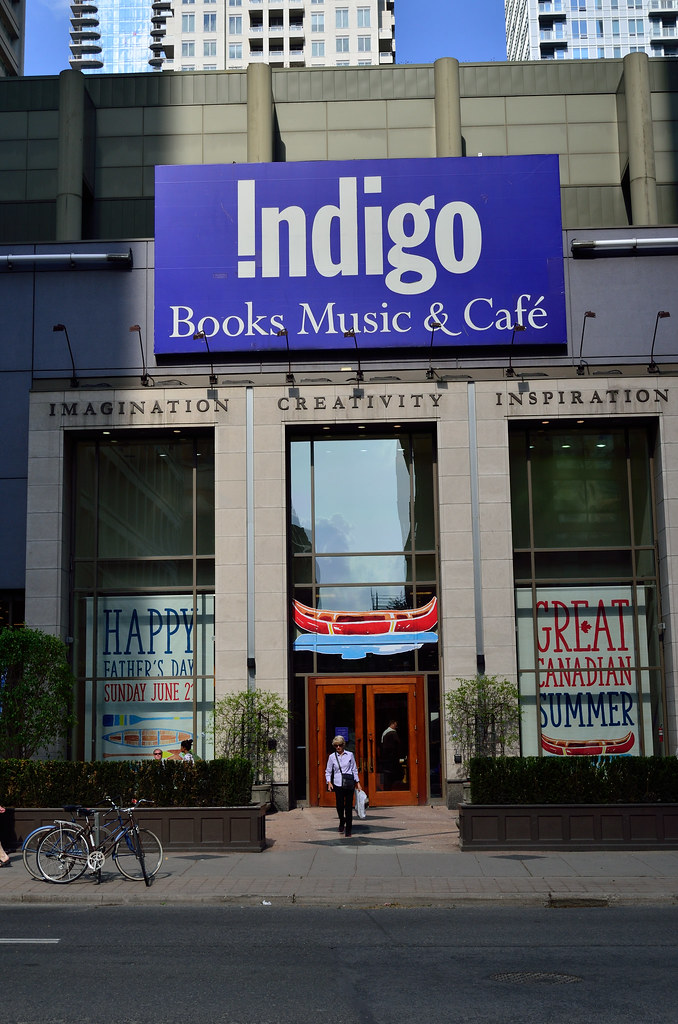
“Indigo Books and Music” by Open Grid Scheduler / Grid Engine is licensed under CC0 1.0

Indigo just released its first-quarter financial results, covering the period April-June 2021, which can be compared to its pre-pandemic results from the same quarter in 2019.
Back then, Indigo had revenues of $193 million and no profit. Seventy percent of its revenue, or $136 million, came from the firm’s eighty-nine Chapters and Indigo superstores. Only $25 million came from its 115 smaller stores (Coles and Indigo Spirit), and another $29 million from online sales at chapters.indigo.ca. Not only did the company book no profit, but all three of those revenue channels were down from the previous year, with online sales falling the most (15%).
This is to say that Indigo, in financial terms, was immunocompromised before COVID-19 hit.
The decline in digital sales was especially alarming. It seemed that CEO Heather Reisman was giving up on the web, an impression reinforced by her frequent renovations of in-store environments and her not terribly successful launch of a so-called cultural department store […] in New Jersey, Indigo’s first international gambit. She was all about bricks and mortar.
One also got the sense that Heather was giving up on books. She was building up the candles and blankets side of the business — it represented almost 40% of 2019’s total revenue. She also launched Thoughtfull.co, an effort to graze on Hallmark grass, and another step away from the book business.
I’d certainly despaired of finding much in the way of actual books at Chapters or Indigo stores … more and more of the floorspace that used to be devoted to books had been given over to housewares, candles, hostess gift items, decorative throw cushions and other such non-book items. Even before the Wuhan Coronavirus shut down the western world, it had been at least a year since the last time I’d found anything worth buying in one of their stores.
Two years and several pandemic waves later, Indigo is down to 88 superstores and 88 small-format stores, a net reduction of twenty-eight. I don’t know the significance of 88. Maybe the company’s new retail guru — Indigo always has a new retail guru — is a pianist, or Chinese, or a white supremacist.
The remaining stores are now open to foot traffic, and the company is wrangling with its various landlords over how much rent it should pay for the pandemic months when most of its outlets were closed. Indigo received almost $3 million in federal emergency rent subsidies, and almost $4 million in payroll subsidies, which seems like a lot but isn’t for a company as big as Indigo. As we noted in an earlier post, Heather also received a $25 million “liquidity enhancement”, or bailout, from billionaire husband Gerry Schwartz.
Which brings us to the present. Revenues for Indigo’s most recent quarter are $172 million (down $21 million from two years ago), and it lost $15 million (before depreciation, amortization, etc.).
Indigo doesn’t release enough detail on its operations to give us a clear idea of how the company lost only $15 million when its revenue fell $21 million, but costs were down across the board, probably reflecting the closed stores, reduced staffing levels, and fewer books on the shelves, among other savings.
Comments Off on Indigo in the red
August 20, 2021
QotD: First Ministers Conferences
What is the point of a First Ministers Conference?
There is no actual necessity for them, you understand. The federal and provincial governments are quite able to function within their respective jurisdictions without their leaders dashing off across the country at regular intervals to quiver their jowls at each other. The first such meeting was not held until 1906. Just 10 more “dominion-provincial conferences” occurred over the next 40 years. Not until the 1950s did they become the semi-annual affairs we know today. That this was also when the TV cameras arrived is possibly not coincidental.
If there were actual business to transact, it could just as easily be arranged by subordinates, or over the phone, or via video-conference. Or if an issue were so thorny that it genuinely required a fleshly first-ministerial encounter, the prime minister could always meet bilaterally with the premier or premiers involved, as Stephen Harper did.
But a full-on, capital-F First Ministers Conference, official cars, flag-backed lecterns and all? There is invariably but one purpose to these: for the 10 premiers to corner and harass the prime minister, using the imbalance in their numbers to depict the feds as the outlier. Sometimes this is in furtherance of the premiers’ perennial campaign for more federal cash. Sometimes, as in the current exercise, the point seems to be conflict for conflict’s sake. But always — always — it is theatre.
Only it is theatre of a peculiar kind: with the curtains drawn and the sound down, the audience being instead entertained by periodic reports from agents for each of the actors about who said what. Thus the breathless dispatches from reporters orbiting the conference — they are kept well away from the actual meeting room — every line of it originating from sources, federal or provincial, with a professional interest in puffing one leader or the other.
Andrew Coyne, “A semi-annual opportunity for premiers to strut and preen and accomplish nothing”, National Post, 2018-12-07.
Comments Off on QotD: First Ministers Conferences
August 14, 2021
Great Moments in Unintended Consequences (Vol. 3)
ReasonTV
Published 7 May 2021Good intentions, bad results.
——————
Follow us on Twitter: https://twitter.com/reasonReason is the planet’s leading source of news, politics, and culture from a libertarian perspective. Go to reason.com for a point of view you won’t get from legacy media and old left-right opinion magazines.
—————-Window Wealth
The Year: 1696
The Problem: Britain needs money.The Solution: Tax windows! A residence’s number of windows increases with relative wealth and is easily observed and verified from afar. A perfect revenue generator is born!
Sounds like a great idea! With the best of intentions. What could possibly go wrong?
To avoid higher taxes, houses were built with fewer windows, and existing windows were bricked up. Tenements were charged as single dwellings, putting them in a higher tax bracket, which then led to rising rents or windowless apartments. The lack of ventilation and sunlight led to greater disease prevalence, stunted growth, and one rather irate Charles Dickens.
It took more than 150 years for politicians to see the error of their ways — perhaps because their view was blocked by bricks.
Loonie Ladies
The Year: 1992
The Problem: Nude dancing is degrading to women and ruining the moral fabric of Alberta, Canada.The Solution: Establish a one-meter buffer zone between patrons and dancers.
Sounds like total buzzkill! With puritanical intentions. What could possibly go wrong?
It turns out that dancers earn most of their money in the form of tips, and dollar bills don’t fly through the air very well. Thus, the measure designed to protect dancers from degrading treatment resulted in “the loonie toss” — a creepy ritual where naked women are pelted with Canadian one-dollar coins, which are known as loonies.
Way to make the ladies feel special, Alberta.
Gallant Grocers
The Year: 2021
The Problem: Local bureaucrats need to look like they care.The Solution: Mandate that grocery stores provide “hero pay” to their workers.
Sounds like a great idea! With the best of intentions. What could possibly go wrong?
Besides the fact that these ordinances may preempt federal labor and equal protection laws, a 28 percent pay raise for employees can be catastrophic to grocery stores that traditionally operate on razor-thin margins. As a result, many underperforming stores closed, resulting in a “hero pay” of sudden unemployment.
Don’t spend it all in one place!
Written and produced by Meredith and Austin Bragg; narrated by Austin Bragg

Comments Off on Great Moments in Unintended Consequences (Vol. 3)
August 13, 2021
QotD: Whisky, whiskey, and Canadian whiskey
- Scotch. Nectar of the Gods. Complex, smooth, and just the right thing to fill yourself up on before painting yourself blue and riding off to kick the crap out of a bunch of English gits. Lagavulin and Macallan (16 years) are the reason people have been able to tolerate life in the scrubby, bleak landscape of northern Great Britain. Or whatever the island that contains Scotland is called. For all I know, “Great Britain” includes the Falklands.
- Bourbon and sour mash. Only good for mixing, unless you spend at least forty dollars, because Bourbon is usually harsh. And that includes Wild Turkey. But the better ones are smooth and full-flavored, albeit about as complex as a Kool Pop. I like Blanton’s. Maker’s Mark gold is okay, but only if your friends are serving it free of charge. People holler about Knob Creek all the time. I’m suspicious of old-timey-looking products that didn’t seem to exist until 1985. I suspect that it’s a gimmick aimed at yuppie suckers, but I have not actually tried it.
- Irish whiskey. Wonderfully smooth; especially Black Bush, which is my favorite. Great subtle flavor. Even the cheaper brands are pretty good. But zero complexity.
- Canadian. This makes a good substitute for windshield-washer fluid. Absolutely the most boring whisky (with no “E”) in the universe. Tastes like brown water. Alcoholics love Canadian whisky, because there’s not much to it, and you can drink it day after day without much effort. I can’t believe Canadians waste their time driving to the distillery to make this garbage. Laughable.
I guess now I’ll get flames from the unfortunate people who enjoy Jack Daniel’s, and from pedantic losers who drink obscure distilled beverages made in Wales.
Canadian Club and Crown Royal drinkers won’t flame me until at least noon, because they are all alcoholics and won’t be done with their morning retching until then.
I still need to find some really bad Scotch on a par with Jack Daniel’s. Something packed in plastic bottles or even cans. You need a good cheap harsh whisky to marinate BBQ. The good stuff, I reserve for marinating myself.
Steve H., “Booze and Birds: My Stressful Life”, Hog On Ice, 2005-03-20
Comments Off on QotD: Whisky, whiskey, and Canadian whiskey
August 12, 2021
The Canadian Historical Association’s “consensus” on genocide in Canada
In Quillette, Christopher Dummitt reports on last month’s declaration by the Canadian Historical Association that not only were past Canadian governments complicit in deliberate genocide against First Nations, but that such mass extermination efforts are current and ongoing:
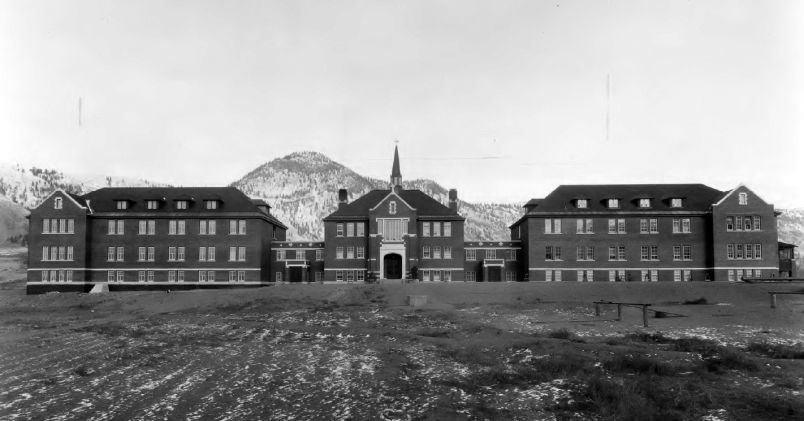
Kamloops Indian Residential School, 1930.
Photo from Archives Deschâtelets-NDC, Richelieu via Wikimedia Commons.
Last month, the Canadian Historical Association (CHA) issued a public “Canada Day Statement” — described as having been “unanimously approved” by the group’s governing council — declaring that “existing historical scholarship” makes it “abundantly clear” that Canada’s treatment of Indigenous peoples amounts to “genocide”. The authors also claimed that there is a “broad consensus” among historians on the existence of Canadian “genocidal intent” (also described elsewhere in the statement as “genocidal policies” and “genocidal systems”) — an alleged consensus that is “evidenced by the unanimous vote of our governing Council to make this Canada Day Statement”.
The authors went further by arguing that both federal and provincial governments in Canada “have worked, and arguably still work, towards the elimination of Indigenous peoples as both a distinct culture and physical group” (my emphasis); thereby suggesting that there is “arguably” an ongoing genocide going on, to this day, on Canadian soil.
The idea that Canada is currently waging a campaign of mass extermination against Indigenous people may sound like something emitted by Russian social-media bots or Chinese state media. But no, this is an official statement from the CHA, a body that describes itself as “the only organization representing the interests of all historians in Canada” — presumably including me.
In fact, there is no “broad consensus” for the proposition that Canadian authorities committed genocide, let alone for the completely bizarre idea that a genocide is unfolding on Canadian soil even as you read these words. And while many of us have become used to such plainly dilatory claims being circulated by individual Canadian academics in recent years, the CHA’s use of its institutional stature in this way was so shocking that it caused dozens of historians to affix their names to a letter of protest.
Notwithstanding what this (or any other) official body claims, the question of whether Canada committed genocide is not a settled issue among scholars. Canada is a relatively small country, home to only a small number of professional historians. And so even this modest-seeming collection of names suffices to disprove the CHA’s claim that it speaks for the entire profession. Moreover, many of those who have signed the letter are senior scholars giving voice to younger colleagues who (rightly) fear that speaking out publicly will hurt their careers.
I am not writing here to defend the actions of Canadian governments toward Indigenous populations. As most Canadians have known for decades, the policy of forcing Indigenous children to attend residential schools led to horrendous cases of sexual and physical abuse. There was also a long history in many schools of refusing to let children speak their native languages or continue their cultural traditions. These were assimilatory, underfunded institutions created and run by people who typically believed that they were doing Indigenous people a favour by “civilizing” them.
What I am addressing, rather, is (a) the question of whether these actions are correctly described with the word “genocide”, and (b) the CHA’s false claim that there is “broad consensus” on the answer to that question. As the letter of protest states:
The recent discovery of graves near former Indigenous residential schools is tragic evidence of what the Truth and Reconciliation Commission (TRC) documented in Volume 4 of its final report — a report that we encourage all Canadians to read. We also encourage further research into gravesites across Canada and support the completion of a register of children who died at these schools. Our commitment to interrogate the historical and ongoing legacies of residential schools and other forms of attempted assimilation is unshaken. However, the CHA exists to represent professional historians and, as such, has a duty to represent the ethics and values of historical scholarship. In making an announcement in support of a particular interpretation of history, and in insisting that there is only one valid interpretation, the CHA’s current leadership has fundamentally broken the norms and expectations of professional scholarship. With this coercive tactic, the CHA Council is acting as an activist organization and not as a professional body of scholars. This turn is unacceptable to us.
Historians are taught to approach their study of the past with humility, on the understanding that the emergence of new documents and perspectives may require us to revise our assessments. Moreover, even if an individual scholar might have strong opinions about a particular historical subject — having become certain that his or her interpretation represents the truth — the community of historians exists in a state of debate and disagreement. We are always aware that two historians sifting through the same archival box of documents can develop very different theories about what those documents mean.
It is true that there are some areas of history that might be fairly labelled as definitively “settled”. But these are few. And even in these cases, consensus typically arises organically, through the accumulated weight of scholarship — not, as in the case of the CHA’s Canada Day stunt, through ideologically charged public statements that seek to intimidate dissenting academics into silence.
Comments Off on The Canadian Historical Association’s “consensus” on genocide in Canada
August 10, 2021
Elections not for changing things but merely for “sending messages”?
Jay Currie on the election that Justin Trudeau clearly itches to call at any moment:
“2019 Canadian federal election – VOTE” by Indrid__Cold is licensed under CC BY-SA 2.0
Apparently Justin Trudeau thinks that the best use of the nation’s time as we head into a Delta driven 4th wave of COVID is to have an election. Okay, I never thought he had any judgement and an election call at the moment would confirm that but here we are.
There are huge issues facing Canada. Unfettered immigration, useless but expensive carbon taxes, deficits to 2070, price inflation, real estate markets which have put housing in the luxury goods category, a stalled First Nations reconciliation process, the collapse of any number of energy projects, increased homelessness, opioid deaths, a health care system which seems incapable of dealing with even a fairly mild pandemic, senior care in a shambles where our elderly died in droves as much from neglect as COVID and on and on.
Judging from the Liberals activities in the run up to the election, while those issues get the occasional nod, the strategy seems to be to spend lots of money in seats the Libs either hold or would like to win. As to substance, the Libs seem very committed to “doing something” about climate change, keeping immigration levels up over 400,000 per year and not being racist. Unfortunately, this is also pretty much the substantive position of the Conservative Party. The CPC’s big selling point is getting rid of Justin and his gender balanced Cabinet of flakes.
Conservative leader Erin O’Toole (who also happens to be my local MP) seems to believe the only way he’s going to topple Trudeau and the liberals is by offering exactly the same policies but wrapped in false Tory blue instead of Liberal red. As far as I can tell, he’s the reddest of Red Tories to lead the party in decades (disclaimer: I’ve met O’Toole a few times and chatted about non-political topics … he seems a decent sort and he’s probably a good neighbour and an upstanding citizen in his private life). He’s certainly no Stephen Harper — and I wasn’t much of a Harper fan, but I’d strongly prefer Harper to O’Toole as Tory leader. I certainly don’t plan on voting for him, and unless the Libertarians scare up a candidate in my riding I’ll be voting PPC this time around:
You will notice I do not mention Max Bernier or the Peoples’ Party. I don’t because the PPC plays outside the consensus. The PPC and its supporters think that significant change is absolutely required and that issues like the deficit, immigration, economic development, First Nations policy, housing and health care need new thinking. […] In terms of seats and outcomes, while I would be delighted to see the PPC win a few seats, the real target for the PPC is the national and regional popular vote. Yes, I do know that does not matter electorally. After all, the CPC won the popular vote in the last federal election. (My own sense is that the Maverick Party has some chance of winning seats in Alberta and Saskatchewan which will be discussed in that subsequent post.)
Max and the PPC need to crack the 5% barrier this time out. If they can do that and Max can win in Beauce, they will have sent a huge message to the CPC. That message is important. Now, if Max and the PPC manage to cut through and beat the Greens – not an unrealistic goal – the message that there are real problems which need real solutions will go mainstream whether the gatekeepers like it or not.
There are really two elections coming up: the Tweedledum and Tweedledee, paid for media, horse race and a vote on whether Canada is a serious country.
Comments Off on Elections not for changing things but merely for “sending messages”?
August 8, 2021
Australia’s FAL-Based L2A1 Heavy Automatic Rifle
Forgotten Weapons
Published 21 Apr 2021http://www.patreon.com/ForgottenWeapons
https://www.floatplane.com/channel/Fo…
Cool Forgotten Weapons merch! http://shop.forgottenweapons.com
Many the nations that adopted the FAL (or L1A1, in Commonwealth terminology) opted to also use a heavy-barreled variant of the same rifle as a light support weapon. In the Commonwealth, this was designated L2A1 and it was used by Canada, Australia, and New Zealand. The Australian model was build at Lithgow and supplied to the Australian and New Zealand forces, as well as being exported to a variety of other nations including Ghana, India, Singapore, Malaysia, Papua New Guinea, and others (total Lithgow production was 9,557). It has a 21″ heavy barrel and a distinct folding bipod with wooden panels that act as handguard when the bipod is folded up. Doctrinally, the L2A1 was intended to be used in semiauto most of the time, with the bipod and heavy barrel allowing greater sustained semiauto fire than a standard rifle.
A 30-round magazine was developed and issued, but abandoned before long. It was found to be insufficiently reliable, interfered with prone shooting, and contributed to overheating of the guns. Interestingly, Australia also opted to not have an automatic bolt hold open functionality in their FAL type rifles. The control can be used manually, but the rifle does not lock open when empty. This was presumably done in favor of keeping the action closed and clean at the expense of slower reloading (the same compromise was made on the G3 family of rifles).
This particular example is a registered transferrable machine gun made on a Lithgow receiver imported by Onyx in 1985 with other Lithgow-produced parts, including a 1960 bolt, 1961 carrier, and 1961 lower receiver from an L1A1 originally exported to Malaysia.
Contact:
Forgotten Weapons
6281 N. Oracle 36270
Tucson, AZ 85740

Comments Off on Australia’s FAL-Based L2A1 Heavy Automatic Rifle
August 7, 2021
HMCS Magnificent – Guide 142
Drachinifel
Published 14 Sep 2019The first ship of “Canada Month”, HMCS Magnificent, is the subject of today:
Want to support the channel? – https://www.patreon.com/Drachinifel
Want a shirt/mug/hoodie – https://shop.spreadshirt.com/drachini…
Want a medal? – https://www.etsy.com/uk/shop/Drachinifel
Want to talk about ships? https://discord.gg/TYu88mt
Want to get some books? www.amazon.co.uk/shop/drachinifel
Drydock Episodes in podcast format – https://soundcloud.com/user-21912004

Comments Off on HMCS Magnificent – Guide 142
August 6, 2021
Avro Canada CF-100 Canuck: Canada’s only domestically produced all-weather interceptor
Polyus Studios
Published 3 Oct 2017Support me on Patreon – https://www.patreon.com/polyusstudios
**I realize a few of you are having trouble with the way I talk and how I’ve done the sound mixing. Please note that this was my first video and I tried to get everything right as I learned to do it. That said, I obviously made some mistakes. I am just one guy making these things and I’m learning as I go. Feel free to check out my more recent videos where I have tried to correct the sound issues.**
The CF-100 is Canada’s only domestically designed jet fighter to reach service and to be built directly to RCAF specifications. In its day it was a competitive all-weather interceptor. The Canuck protected Canadian airspace from the threat of nuclear armed Soviet bombers for over a decade. This is the story of its development and deployment.
Aircraft mentioned:
Vampire F.3
CL-13 Sabre
CF-100 Canuck
CF-101 Voodoo
CF-105 ArrowResearch sources:
http://www.cmp-cpm.forces.gc.ca/dhh-d…
https://www.bombercommandmuseum.ca/aircraft/cf-100/
http://www.canadianflight.org/content/avro-canada-cf-100-canuck
http://www.avroland.ca/al-cf100.html
http://www.aviastar.org/air/canada/canada_canuck.php
http://www.rwrwalker.ca/caf_canucks.html
http://image-bank.techno-science.ca/d…
NORAD and the Soviet Nuclear Threat: Canada’s Secret Electronic Air War By Gordon A.A. Wilson0:00 Introduction
1:08 Initial Development
2:38 CF-100 Mk 1 and Mk 2
4:26 CF-100 Mk 3
6:51 CF-103 and Transonic Speeds
7:36 CF-100 Mk 4
11:33 CF-100 Mk 5
13:14 Velvet Glove and Future Proposals
14:28 Operational History
20:02 Conclusion#CF100 #CanadianAerospace #PolyusStudios

Comments Off on Avro Canada CF-100 Canuck: Canada’s only domestically produced all-weather interceptor
August 4, 2021
Canadian tourist dollars are helping keep Cuba’s struggling economy afloat
In Tuesday’s NP Platformed newsletter, Colby Cosh praises a CBC News (!!!) article on the massive impact of purely Canadian tourist income on Cuba:

A billboard in Havana, showing Camilo Cienfuegos, Ernesto “Che” Guevara, and Fidel Castro, 4 November 2014.
Photo attributed to Tumpatemcla~commonswiki via Wikimedia Commons.
NP Platformed returns today with that rarest of things in the National Post: an absolutely unironic recommendation to read a CBC News report. The article in question comes from Evan Dyer, and it’s headlined: “How Canadian Tourism Sustains Cuba’s Army And One-Party State“. And it is, we have to confess, a masterpiece of precision. We appreciate the small, uncomfortable barb, for example, concealed in this phrase: “in normal years far more Canadians enter and leave Cuba than citizens of any other country — including Cuba itself.”
Why is Canada a quintessential source of the tourism dollars that flow directly to the Cuban army, or in some cases to partnerships between foreign hospitality providers (like Toronto’s Sunwing Travel Group) and the Cuban army? Last month the world was reminded by Cuban protesters how fragile and miserable the communist island’s economy really is. As people stormed into the streets pleading for food and medicine, sympathizers abroad continued to sing from their moth-eaten hymnal and blame America’s long-standing trade embargo (which allows even American citizens and companies to sell, wait for it, food and medicine to Cuba).
And yet, within Canada, there is no sign of any social stigma attaching to Cuban travel. Perhaps it’s because Latin America is one huge undifferentiated wad in our minds, and if we began to get fussy about the governments of various Caribbean countries (most of which let people leave if they like), we might be forced to … we dunno, winter in Costa Rica or Bermuda or someplace weird like that. Cuba can’t find the cash to keep a fresh coat of paint on a hospital, but the empire of affordable resorts and jineterismo continues to expand. Some of you helped build it.
There is nothing new about this — except the obvious willingness of ordinary Cubans to risk wounds and death to protest against their communist rulers, as Michael Totten reported more than seven years ago:
Cubans in the hotel industry see how foreigners live. The government can’t hide it without shutting the hotels down entirely, and it can’t do that because it needs the money. I changed a few hundred American dollars into convertible pesos at the front desk. The woman at the counter didn’t blink when I handed over my cash — she does this all day — but when she first got the job, it must have been shattering to make such an exchange. That’s why the regime wants to keep foreigners and locals apart.
Tourists tip waiters, taxi drivers, tour guides, and chambermaids in hard currency, and to stave off a revolt from these people, the government lets them keep the additional money, so they’re “rich” compared with everyone else. In fact, they’re an elite class enjoying privileges — enough income to afford a cell phone, go out to restaurants and bars, log on to the Internet once in a while — that ordinary Cubans can’t even dream of. I asked a few people how much chambermaids earn in tips, partly so that I would know how much to leave on my dresser and also to get an idea of just how crazy Cuban economics are. Supposedly, the maids get about $1 per day for each room. If they clean an average of 30 rooms a day and work five days a week, they’ll bring in $600 a month — 30 times what everyone else gets. “All animals are equal,” George Orwell wrote in Animal Farm, his allegory of Stalinism, “but some animals are more equal than others.” Only in the funhouse of a Communist country is the cleaning lady rich compared with the lawyer. Yet elite Cubans are impoverished compared with the middle class and even the poor outside Cuba.
Comments Off on Canadian tourist dollars are helping keep Cuba’s struggling economy afloat


