
Polyus
Published 21 May 2023The Sea King was a legendary aircraft in the history of the Royal Canadian Navy. It filled the role of hunter and killer in the Cold War against Soviet submarines. By the mid-90s the situation had changed and their retirement seemed eminent. How naive. The process of finding a replacement for this workhorse would be an election promise by government after government for over 30 years. Its replacement, the CH-148 Cyclone, became operational in 2018. This allowed the 55 year old workhorses to finally retire.
(more…)
May 26, 2023
CH-124 Sea King; Legendary ASW helicopter and example of a deeply flawed defense procurement process
Comments Off on CH-124 Sea King; Legendary ASW helicopter and example of a deeply flawed defense procurement process
May 25, 2023
Victoria’s housing market is Canada’s housing market in microcosm
Elizabeth Nickson explains some of the driving factors for ever-rising housing prices in Canada:
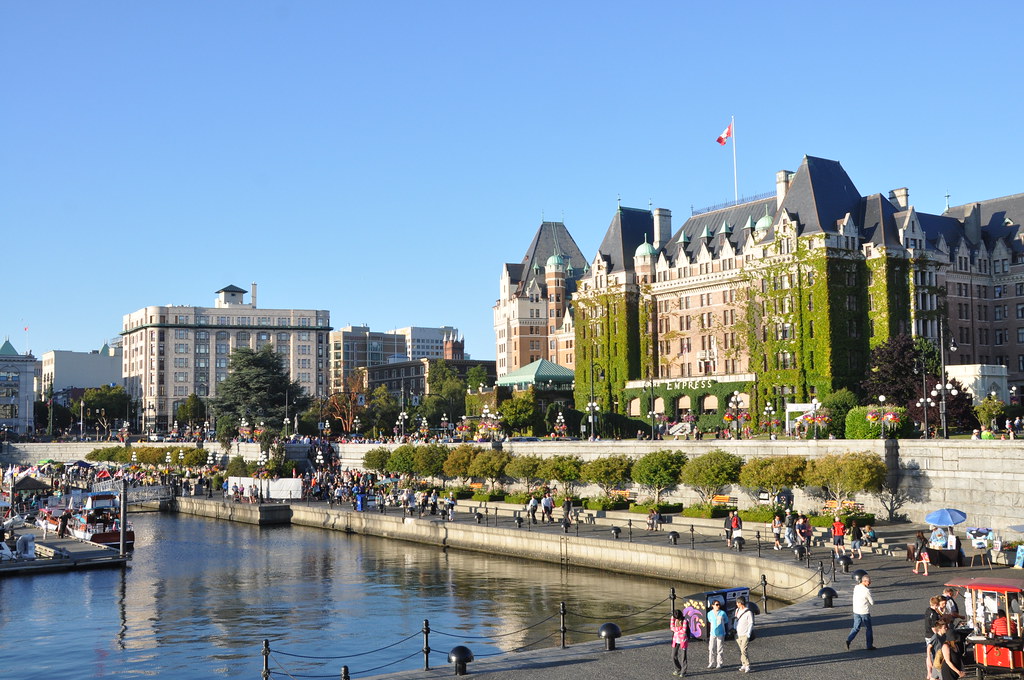


A friend of mine is building four high-rise condo and rental towers in Victoria, the capital city of British Columbia, where I live. It is a charming city, founded in the 1840s, its core an almost classic English village around which a modern city was slowly built. Not so slow now. It’s the warmest, prettiest city in Canada, surrounded on three sides by ocean, and retirees are flooding the place. Young families are choosing the city to raise their children because it is still small, relatively crime-free and filled with charming neighborhoods.
Here is a view from the marketplace by someone who borrowed $150 million to build housing for the newcomers:
Green energy policies have added maybe $700 a month to the cost of a one bedroom rental unit. It takes over two years to get approval for a rental building in Victoria. Then, another year after initial approval to final approval. That adds another sum. Maybe $300? So rents in theory could be $1000 a month less. That is $1,000 that could go to piano lessons, hockey gear. Private school? And so on. Then Justin let in ONE MILLION people last year into Canada. All unvetted. Canada builds various amounts of housing each year. But 275,000 units is a reasonable average. One million people require 350,000 or so housing units. You want to see upward price pressure on rents? You have not seen anything yet
In fact, “we are two to three million houses short”, says Wendell Cox of Demographia, which has been tracking housing affordability for 25 years across the world. Canada’s two principal cities, Toronto and Vancouver, are among the top four most unaffordable cities in the world, Hong Kong and Sydney being the other two. In my region, everywhere you look, we have tent cities and trailers parked by the side of the road; our economy has been strangled by Covid, debt, inflation, and regulatory madness, so like nearly everywhere, we have a substantial complement of the desperate, despite living among a stunning abundance of resources and talent. Throw in the sharp rise in interest rates and the solution moves from difficult to impossible.
Despite the almost preposterous costs added by “green” energy, “green” land use is the greater reason housing is so constrained in every western democracy. Here’s the crux of the matter: construction costs are only 20 percent lower in a smaller city, but the land in a smaller city would run $90K, while in Toronto or Vancouver or San Francisco or Dublin, it would be upwards of one million dollars.
A green belt is wrapped around every major and minor city. They are called Urban Containment Zones. Much of that land is conserved, in principle to save agricultural land, but in Canada, as elsewhere, urban areas only use 2.5 percent of arable land. World Economic Forum/U.N. rules concerning land use have been adopted by every western democracy, and these rules are disseminated across the world through planning associations. The planner cult is messianic. It hates sprawl, suburbs and cars and while the obvious solution is to build on green belts, the PR unleashed against the idea is vituperative in the extreme. Ontario premier Rob Ford has managed to swap out some green belt land, and is building 50,000 new houses. The press’s reaction against the plan has been vicious, accusing Ford of bribery and paying off his funders.
Yet, there is a ten-year waiting list for public housing in Toronto. British Columbia, like all regions run by the Left, is committed to subsidized housing. But there is a five-year waitlist for any current family housing, and rents for a one bedroom, are almost exactly $1,000 less than in the private sector, meaning that without the green-energy rules, which are ridiculous in such a cold country, private-sector housing could accommodate the less privileged without any cost to the taxpayer, who as it is now pays twice.
Further, the buildings assigned to low-income housing are built to lower standards. There is a happy dancing peasant communitarian aspect to these complexes, but that can degrade very quickly, as Chicago, Detroit, London, have proved. Almost all such complexes end in drug trafficking, single motherhood and kids running wild. The most recent B.C. government failed its promise to build more by 75 percent and its administering agency was found to be corrupt.
Comments Off on Victoria’s housing market is Canada’s housing market in microcosm
May 23, 2023
Mustard: A Spicy History
The History Guy: History Deserves to be Remembered
Published 15 Feb 2023In 2018 The Atlantic observed “For some Americans, a trip to the ballpark isn’t complete without the bright-yellow squiggle of French’s mustard atop a hot dog … Yet few realize that this condiment has been equally essential — maybe more so — for the past 6,000 years.”
(more…)
Comments Off on Mustard: A Spicy History
May 15, 2023
Paul Wells – “Unworkable and swiftly-disavowed tinpot dictatorship is, statistically, one of the least damaging forms of tinpot dictatorship”
Paul Wells follows up last week’s rather disturbing report that the Liberal Party’s big gathering in Ottawa extruded a resolution to get “The Government” to work toward forcing journalists (and those peasant bloggers like Paul Wells) to only publish things that the sources informing it could be “traced” by that same authority:
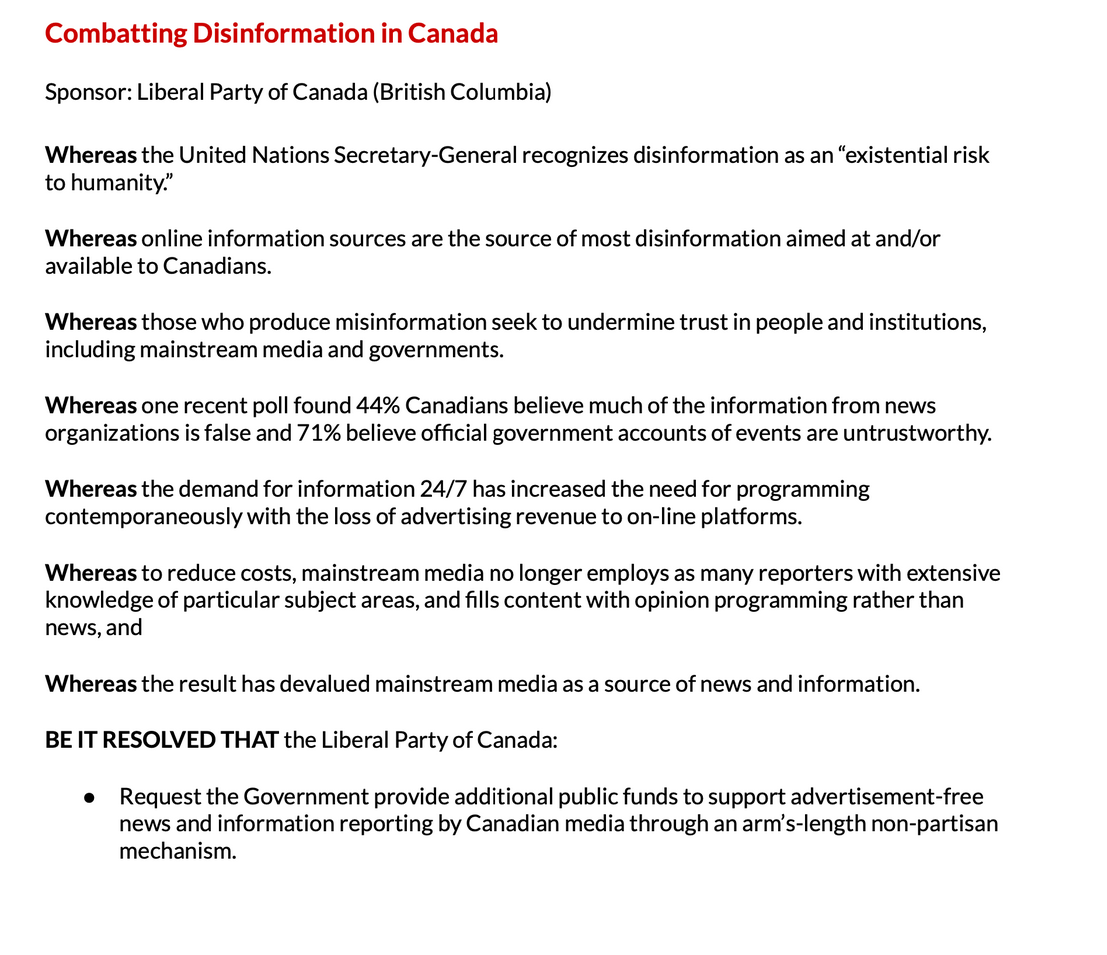
Last Friday I wrote about a policy resolution at the big Liberal Party of Canada national convention that was, in my opinion, bad. This was the resolution that would have the party “request the government explore options” to “hold on-line information sources accountable” by requiring that they “limit publication only to material whose sources can be traced”.
How do you limit publication to traceable sources? I have to assume you clear the sources. “This resolution has no meaning,” wrote I, “unless it means I would be required to clear my posts through the federal government, before publication, so the ‘traceability’ of my sources could be verified.”
Some people disagreed, but I had a hard time getting them to describe what it could mean if it wasn’t what I thought. I was careful to note that party conventions aren’t binding on governments. Commenters sympathetic to the Trudeau government latched onto all the this-might-mean-nothing language, the stuff about “request” and “explore options.” At their convention, a tiny minority of registered Liberal delegates attended a “policy workshop” at which nothing was debated. Amid considerable confusion about where these resolutions were in the party’s own process — Althia Raj covered it on Twitter; go look if you like — this resolution became party policy with no discussion at all. That was on Saturday.
On Tuesday, Justin Trudeau went before reporters and said no Liberal government would ever implement this Liberal policy. Other cabinet ministers followed suit, and one MP who didn’t benefit from the counsel of the Monday-morning issues-management call had a rougher time executing the U-turn.
Look, I think the amount of self-inflicted ballistic damage to the government’s own foot here is minor. Unworkable and swiftly-disavowed tinpot dictatorship is, statistically, one of the least damaging forms of tinpot dictatorship.
But I want to let everyone in on a secret of my journalism, and indeed of most journalism: Criticism of politicians is often advice to politicians. I actually don’t spend a lot of time hoping governments and opposition parties will keep pursuing self-destructive and country-destructive choices indefinitely. I always hope a bit of mockery, especially pre-emptive mockery, will help inform their choices. If it stings when Wells writes it, it might sting worse when everyone is saying it.
Ministers of the Crown who didn’t need to wait for the Monday-morning issues-management meeting to tell them what to think could have spent the weekend thinking for themselves. They might even have invited their own staffs, riding executives, and Liberals at large to think for themselves. A dozen or so hardy souls, out of 3,500 registered delegates, might then have showed up to the policy workshop willing to debate.
“Uh, Paragraph Two looks hinky. How would a government enforce that?”
“Well, it doesn’t apply to reputable journalists.”
“Great, thanks. Remind me who decides who’s reputable? Any thought on who’ll be making those calls once we’re no longer in government?”
Maybe somebody would have added a friendly amendment. “For greater clarity, nothing in this paragraph impinges …”
I can even imagine a cabinet minister showing up for those floor debates and influencing the party’s direction single-handed. I’ve seen it happen in other parties. But I had Liberal friends over the weekend explain to me that no such thing ever happens. Fine, it’s your funeral. Basically we’re watching a party choose between two different models of public-policy deliberation:
OPTION 1: Smart people think and talk.
OPTION 2: Everybody in the party defends rickety thinking until it blows up in their faces.
I’m not kidding when I tell you most people in political communications would defend Option 2. We’re living in a time that values message over thinking. But folks can’t say I didn’t warn them.
Comments Off on Paul Wells – “Unworkable and swiftly-disavowed tinpot dictatorship is, statistically, one of the least damaging forms of tinpot dictatorship”
Would Canadian voters welcome a new “actually centrist” political party?
Tasha Kheiriddin on the possibility of yet another political party contesting that mythical centrist voting bloc in Canadian elections:

By now, you have probably heard of Centre Ice Canadians. The group was co-founded a year ago by former two-time Conservative leadership candidate Rick Peterson. It made its debut as Centre Ice Conservatives, during the Conservative leadership process, holding a policy conference in Edmonton, followed by similar events in Halifax and Toronto. It published numerous op-eds and got the Canada Pension Plan to disinvest from funds profiting from slave labour in China. It positioned itself as a home for the politically homeless, chiefly Red Tories and Blue Liberals, who felt that neither of their parties were listening to their ideas.
Last week, Centre Ice announced that it would explore the possibility of registering as a political party. It did this following both an external opinion survey of 2000 Canadians, which found that 32% of those polled would likely consider voting for a centrist party in the next election, and a callout to its roughly 2000 supporters, which saw most respondents approve of the concept.
A working group headed by Peterson and New Brunswick MLA Dominic Cardy is now investigating the idea, including a draft constitution, fundraising and a new name, until September 20, at which point Centre Ice will formally decide whether it goes down that road. Observers posit that it could “disrupt the political system”, evoking memories of the Reform Party which did the same thing thirty years ago.
[…]
There’s another saying which management seems to have overlooked: “Keep your friends close, and your enemies closer”. Leaders traditionally neutralized their opponents by keeping them busy and giving them reason to be loyal. Prime Minister Brian Mulroney made a place for former rival Joe Clark; Stephen Harper brought Peter MacKay into cabinet. In the Liberal camp, Jean Chretien had Paul Martin helm the Finance Portfolio; Trudeau gave Marc Garneau Transport and then Foreign Affairs.
That type of thing hasn’t happened in the current scorched earth climate. Animated by Twitter, where we’ve all said things we regret, it has instead produced a toxic purity test that excommunicates anyone who challenges the party line or criticizes the leader. Only the worthy are allowed in the tent.
That applies equally to the Liberals, who draw lines in the sand for their faithful on all manner of issues from abortion to gun control to internet regulation. Which is why the Centre Ice movement isn’t just about the Conservatives. Many of the people signing up on the organization’s website aren’t members of any party, but they would like to be. But they don’t like the climate of fear in either of the main parties.
They want to be able to express an opinion without being trolled. They want a place that eschews groupthink for group discussion. Whether such a party can exist in today’s politics, or whether it could make any headway in an election, is an open question.
What isn’t in question is that both federal parties have become polarized to their respective ends of the political spectrum: wokeism and populism. That is more unusual for the Liberals than for the Tories – the Liberals were traditionally the party of the centre, derided as the “mushy middle” for their ability to morph into whatever voters wanted at the time, as well as conflating their brand with the image of Canada (tolerant, multicultural, bilingual) in a way the Conservatives did not manage to do.
Comments Off on Would Canadian voters welcome a new “actually centrist” political party?
May 14, 2023
Garbage data informs the Canadian government’s approach to gun control issues
In The Line, Tim Thurley points out the (totally expected) bias of the data being considered by the federal government:

A selection of weapons (mostly restricted or prohibited in the hands of most Canadians) displayed by Toronto police after confiscation.
Screencap from a CTV News report in 2018.
The Mass Casualty Commission’s firearm recommendations were, rightly, overlooked in the initial phase after the report’s release. They have become relevant these past weeks as gun control groups, the NDP, the Bloc, and the Liberals used them to advocate for sweeping changes to Bill C-21, the government’s controversial gun-control proposals. The Liberals have thus far declined to adopt the MCC’s recommendations, at least in whole, and that’s encouraging. Our lawmakers should be careful. The Mass Casualty Commission’s concluding recommendations on guns and homicide share a problem common to any data analysis. If you use the wrong data, you get a bad output.
Or, to be blunt: garbage in, garbage out.
R. Blake Brown, a professor who contributed a commissioned report to the MCC, suggested that the MCC got all the best research together and simply found the arguments made by gun control groups to be more convincing.
He’s wrong. While the MCC could have been a completely neutral panel objectively weighing the evidence before it, the nakedly selective choice of data inputs and slanted interpretation meant that no unbiased outcome was possible. Indeed, the MCC inputs seem heavily weighed to advance a pro-control agenda, and do so in such an obvious way that the resulting flaws should be immediately clear to those with even a passing knowledge of the study of firearms and firearm homicide.
[…]
Dr. Caillin Langmann is a well-known name in Canadian firearms research, and by far the most prolific author using rigorous statistical methods to examine the effects of gun control on Canadian firearm mortality. No serious analysis of Canadian firearm mortality is possible without his work, and yet his work does not appear on its own and is not cited in the Negin Report. Indeed, his and other critical research does not seem to have informed the final Commission report or recommendations at all.
I asked Dr. Langmann about his exclusion. He told me he offered to appear to present his research but the Commission declined.
It may not be a coincidence that the exclusion of Langmann and other researchers without explicit gun-control agendas was due to the fact — the fact — that the Canadian and comparable research substantively contradicts the Negin Report and the MCC recommendations on firearms. An examination of already-implemented Canadian gun laws including various factors such as prohibition of “paramilitary style” rifles and magazine capacity restrictions all found no impact on mass shootings or mass homicide overall in Canada or on associated fatalities. Instead, mass homicide by both firearm and non-firearm causes gradually declined on its own. The lack of association between gun control and decreased mortality is replicated multiple times in Canadian research.
Guess what? It is also replicated in a detailed statistical analysis of Australian data not mentioned by the Negin Report.
The core research inputs to the Mass Casualty Commission were commissioned from parties with well-established and acknowledged positions on firearms. Written by literal gun control advocates without substantial input from other sources, the contrary research is either ignored or not treated with due academic respect. This damages the credibility of the Commission findings, giving the perception that they were gathering conclusions in search of evidence.
Again, it must be made clear that this wouldn’t have been a problem if the MCC had treated the Negin Report as just one part of the firearm policy research puzzle. It was their failure to do so and the consequent lack of neutrality, lack of engagement with solid research, and complete disregard for engagement with different academic perspectives despite obvious relevant expertise, that taints the Mass Casualty Commission firearm recommendations and severely limits any useful policy conclusions we can gather from their report.
Comments Off on Garbage data informs the Canadian government’s approach to gun control issues
Victory at Sevastopol! – WW2 – Week 246 – May 13, 1944
World War Two
Published 13 May 2023The Soviets push the Axis out of the Crimea this week once and for all. In Italy, the Allies launch a major offensive, and the French make a breakthrough there by week’s end. In China, the Japanese are aiming at Luoyang, but in India at Kohima they’re slowly being pushed back.
(more…)
Comments Off on Victory at Sevastopol! – WW2 – Week 246 – May 13, 1944
May 13, 2023
QotD: The inherent absurdity of “Canadian content”
Lately some have reminded us of the inherent difficulties in defining Canadian content, especially where a work is the product of several collaborators. Is a movie Canadian by virtue of its actors? Director? Crew? Location? Theme? Even as applied to individuals: Should citizenship be the criterion? Birthplace? Residency? Subject matter?
But the real folly of CanCon is not that it is impractical, or prone to abuse, or even unnecessary, though it is all of those things. It is rather that it is nonsensical at its root, in its very purpose – again, so far as anyone can define it. Is the point, after all, artistic or political? But it cannot be artistic: there is no theory of aesthetics that prefers that Canadian artists should make Canadian art that teaches Canadians how Canadian they are.
It is, rather, a political project: the inculcation of national feeling in the public, for the purpose of creating a political community, separate and distinct from the colossus to the south. Without the Maginot Line of CanCon quotas, it is suggested, we would be overwhelmed: first the artists, then the country.
But note the assumptions built into this emotive appeal: that a separate nationality cannot be maintained without cultural difference; that our cultural differences with the Americans are both sufficient in themselves to justify our statehood and yet so fragile as to be washed away in an instant; that, left to their own choices, Canadians would unhesitatingly choose the products of an incomprehensibly alien culture over their own; and that, by virtue of this diet of foreignism, we would no longer be Who We Are as Canadians. Therefore we must not be left to our own choices.
Which is nonsense, because we would still be Who We Are, even in that hypothetical dystopian future: it might not be Who We Were, but so what? The Who We Are we are now at such pains to preserve is itself vastly different from Who We Were before.
And who, in the end are we? As the comedian Martin Short once put it: “we’re the people who watch a lot of American TV”. The wholesale ingestion of a foreign culture – albeit much of it made by expat Canadians – is an integral part of our distinct national identity, an irony that must forever elude our cultural nationalists.
Andrew Coyne, “The concept of CanCon is pure folly. That’s the problem at the heart of Bill C-11”, The Globe and Mail, 2023-02-08.
Comments Off on QotD: The inherent absurdity of “Canadian content”
May 11, 2023
London’s return to normality after Coronation Day
In The Line, Matt Gurney recounts his third and final day in London covering the Coronation, the rather impressive clean-up efforts afterwards and the damp squib of the third day, “The Big Help Out”:

Monday was a holiday in the U.K., too, it’s important to note. A “bank holiday”, in the local jargon, which had been declared as part of the official period of celebration. There were still lots of people working, of course. Restaurant staff and taxi drivers and all the rest. But there were a lot of people who could have been volunteering. And I didn’t see any. Not a one.
I’d gone looking, too. There was a website for the so-called Big Help Out, where you could put in your address and what kind of volunteering you were interested in, and find local opportunities. I used my hotel address and selected every possible category of volunteerism, and was offered … not much. I broadened the search area and … still not much. I could download a few kits to collect some signatures for petitions. I was invited to pick up some trash in my local park, whichever park that was, and just as a solo effort. I was asked to fill out some surveys about nature and wildlife for some local conservation groups. And that all sounds … uhh … worthwhile. But this wasn’t what I had in mind, I admit. No group activities? No community activism?
It seemed odd especially because the entire point of Sunday’s events, the Big Lunches, had been bringing people together. To celebrate. It seemed fitting and appropriate for those same people to then get together the next day and contribute something. But no. No one seemed interested. I didn’t have as much time to wander the city on Monday as I’d had on Sunday, but I still had a few hours, and I didn’t see anything. It was quiet.
This had been foreseen as being a problem. Even before I’d flown over, as part of my research, I’d come across this article in The Guardian, warning three weeks ago that volunteerism was at a crisis point in the U.K., was trending further down, and had been for years. It’s not that anyone seemed to think that the idea of the Big Help Out was bad. It’s just that no one seemed to think many people would actually show up.
Some events certainly seemed to go off as planned. Mainly the ones where royals or other VIPs attended. The BBC reported that the Prince and Princess of Wales, and their children, helped improve a Scouts facility. The prime minister and his wife prepared and served food to the elderly. The BBC also reported that 55,000 events were planned across the U.K. I truly and sincerely hope they did well, and that good things were accomplished in communities and for people that needed the help. But I can only tell you what I saw, as I’ve done in my other dispatches, and I didn’t see anything in London on Monday. I asked around a bit, and people either just shrugged it off and went about their day or hadn’t heard of The Big Help Out at all. They’d sure as hell heard of The Big Lunches, though.
Again, probably not a shock that an invitation to party got a better response than an invite to help out. But still.
He also considers the monarchy as an institution from a Canadian constitutional perspective and I find I largely agree with his conclusions:
If I was starting a country from scratch, I would never decide that the logical thing to do would be to invest our notion of sovereignty and much of our government’s powers in an old man who lives in a castle on an island across the ocean. No one would. It’s absurd. But … it works? And, more to the point, I have zero faith — absolutely zero — that we’d ever be able to replace what we currently have with something that functioned at least as well. That has to be the minimum bar. And look around, at the state of things in Canada right now, and for the foreseeable future. Does anyone think we’re going to be in a place to design a new Canadian republic from scratch without just epically screwing it up? Julie Payette, President of Canada, anyone? David Johnston, Eminent President?
We all know that’s exactly who we’d end up with, right? Would we just skip a lot of fuss and bother and just make the president whomever happens to be the youngest (or oldest, or median) member of the Trudeau Foundation board of directors at any given moment? Alternate between astronauts and retired Supreme Court justices? Tack it on as a side gig for whomever happens to be hosting The National that week?
If you think I’m being unduly flippant or sarcastic, I beg you: imagine the president we’d end up with if we locked Justin Trudeau, Pierre Poilievre and Jagmeet Singh in a room together until they could sort it out. If ever. And then tell me you don’t find yourself reconsidering whatever thoughts you may have re: Charles over in Blighty.
I’m a pretty luke-warm monarchist, to be honest, but the thought of the great and the good of Canada running a republic has me singing “God Save the King” at a high volume. His Majesty King Charles III will almost certainly never achieve the personal popularity of her late Majesty Queen Elizabeth II, and that’s okay. As long as he manages to follow the model of his mother and keep his trap shut about political matters in any of his various realms, the better we’ll all feel about keeping the monarchy going a bit longer.
Comments Off on London’s return to normality after Coronation Day
May 9, 2023
Apparently, we are all misunderstanding the Trudeau masterplan
All the smoke about Canada not having a national identity is there to hide Justin Trudeau continuing his father’s masterplan to DESTROY QUEBEC:
“Quebec caught in a trap. French forced into decline. Its political influence doomed. 12 million residents in Montreal. Quebec with 5 million. Ottawa’s grand plan explained. Justin is smarter than we think. They want to assimilate us all. All this, without any debate. Two catastrophic scenarios.”
Forget King Charles III’s coronation or the Liberal Party Convention. If you woke up Saturday morning in Quebec, this was the apocalyptic front page that graced your browser, courtesy of the Journal de Montreal:
The Journal‘s cri-de-coeur was in response to the federal government’s increase in the annual immigration level to 500,000 people. This increase, designed to boost the population of Canada to 100 million by the end of the century, would marginalize Quebec’s influence within Canada. It is estimated that Quebec’s overall share of the Canadian population would fall from 25 to 10%, while francophone Quebecers would be in the minority within their own province for the first time in 500 years.
This would displace Quebec from the center of power in Canada. Its official language, French, would be relegated to the same status as all languages and cultures other than English. Instead of being one of Canada’s two official languages, French would merely be one of many, and Quebec, no longer a nation, but a province like any other.
But wait: Journal authors further suggest that this was the grand plan of Prime Ministers Justin and Pierre Elliott Trudeau all along. In a very colorful column, “How the Trudeaus Drowned Quebec“, columnist Richard Martineau even compares the current PM to the protagonist of an infamous Stephen King novel:
“For Justin, Canada is not a country.
It is a hotel, an Airbnb.
And Quebec is just one of the many rooms in this vast real estate complex.
Room 237, here. Like the one in the movie The Shining.
Come, drop your bags and settle in! All we ask is that you pay your taxes.It’s true that Trudeau Sr. paved the way for the reduction of Quebec’s power in Canada, but it didn’t start with his 1981 Charter of Rights, as the Journal claims. It actually began a decade earlier, in 1971, with the creation of Canada’s Official Multiculturalism Policy. The policy enshrined the idea that linguistic and cultural minorities in Canada should be encouraged to preserve their heritage, and allocated federal funding to help them do so.
Official multiculturalism was both a vote-getter for the Liberals and a means of diffusing the English-French “two solitudes” paradigm that was threatening to tear the country apart. At the time, Canada had just lived through the October Crisis of 1970, which had seen Trudeau invoke the War Measures Act in response to terrorist acts by the Front de Liberation du Quebec. Official multiculturalism was seen as a way to boost the federalist cause by aligning the interest of linguistic and cultural minorities within Quebec with those of the federal government.
The larger impact, however, was to enshrine multiculturalism outside Quebec, where most minorities settled, and where garnering favour with different cultural communities became standard operating procedure, particularly for the federal Liberal party. Immigration thus became a politically untouchable issue, except in Quebec, where the protection of the French language continued to take precedence over concerns for minority rights.

Comments Off on Apparently, we are all misunderstanding the Trudeau masterplan
May 8, 2023
Gordon Lightfoot, RIP
Mark Steyn on perhaps the best-known song of the late Gordon Lightfoot:

Edmund Fitzgerald, 1971
Detail of a photo from Wikimedia Commons
In November 1975 Lightfoot chanced to be reading Newsweek‘s account of the sinking of a Great Lakes freighter in Canadian waters. He’s a slow and painstaking author, which is one reason he’s given up songwriting – because it takes too much time away from his grandkids. But that day forty-three years ago the story literally struck a chord, and he found himself scribbling away, very quickly:
The legend lives on From the Chippewa on down
Of the big lake they called Gitche Gumee
The lake, it is said Never gives up her dead
When the skies of November turn gloomy …“Gitche gumee” is Ojibwe for “great sea” – ie, Lake Superior – as you’ll know if you’ve read your Longfellow, which I’m not sure anyone does these days. Evidently Hiawatha was on the curriculum back east across Lake Huron in young Gordy’s Orillia schoolhouse. The Gitche Gumee reference may be why, when I first heard “The Wreck of the Edmund Fitzgerald”, I assumed its subject had sunk long before the song was written. In fact, it sank on November 10th 1975 — just a few days before Lightfoot wrote the number. When she’d launched in 1958, the Edmund Fitzgerald was the largest ship on the Great Lakes, and, when she passed through the Soo Locks between Lakes Superior and Huron, her size always drew a crowd and her captain was always happy to entertain them with a running commentary over the loudspeakers about her history and many voyages. For seventeen years she ferried taconite ore from Minnesota to the iron works of Detroit, Toledo and the other Great Lakes ports … until one November evening of severe winds and 35-feet waves […]
That said, human tragedy alone does not make for singable material. The last contact from the SS Edmund Fitzgerald was with another ship, the SS Arthur M Anderson. Yet “The Wreck of the Arthur M Anderson” would have been a far less evocative title. Arthur Marvin Anderson was on the board of US Steel, as Edmund Fitzgerald was on the board of Northwestern Mutual. But there is something pleasingly archaic about the latter name: in fact, as I think of it, I believe the last Edmund I met was one of Gordon Lightfoot’s fellow Canadian singers — the late operetta baritone Edmund Hockridge. Pair “Edmund” to “Fitzgerald”, and you have something redolent of Sir Walter Scott or Robert Louis Stevenson, of shipwrecks off Cornwall or the Hebrides. Perhaps that’s why “The Wreck of the Edmund Fitzgerald” either sounds like an old Scots-Irish folk tune or, alternatively, actually is one. For any IRA members reading this, Bobby Sands, the hunger striker who starved himself to death in a British gaol, wrote in his cell a song called “Back Home in Derry”, about Irish prison deportees en route to Australia and set to a tune remarkably like “The Wreck of the Edmund Fitzgerald”, which it seems unlikely he ever heard.
I see some musicologists claim the tune is in Dorian mode, although it sounds Mixolydian to me (like “The Wexford Carol”). Whichever it is, there is a perfect union between the emphatic melody, the crash of the waves, the antediluvian moniker of Northwestern Mutual’s chairman, and even the obvious filler phrases, so typical of ancient folk songs:
The lake, it is said
Never gives up her dead— which returns far more effectively in the final verse:
Superior, they said
Never gives up her dead— as if Gitchee Gumee is some vast ravening beast. Go back to Orillia, to Fourth Grade in 1947, and the parents listening to Mr and Mrs Lightfoot’s little boy sing “Too-Ra-Loo-Ra-Loo-Ral” as if a bit of synthetic shamrock from an old Tin Pan Alleyman were a genuine Irish lullaby from the mists of Emerald Isle antiquity. That’s the genius of “The Wreck of the Edmund Fitzgerald”: It was born sounding as if it’s a hundred years old. And its agelessness is all the more amazing when you consider that it’s essentially an act of journalism, an adaptation of a news report about something that happened a few days earlier – just the facts, ma’am, with minimal artistic license:
In a musty old hall
In Detroit they prayed
In the maritime sailors’ cathedral …“Maritime sailors” is surely a redundancy, and it’s not a cathedral but the “Mariners’ Church”, which doesn’t quite go the distance syllable-wise. And a parishioner wrote to Lightfoot to say the church isn’t in the least bit “musty”, so these days he finds alternative adjectives.
But that’s all details. The power of the song lies in its storytelling. It immortalized the fate of the freighter not just for the families of the dead, “the wives and the sons and the daughters”, but for everyone, and it made the Edmund Fitzgerald the Titanic of the Great Lakes – except that the Titanic never inspired any song like this. The mournful toll of the lakes in the penultimate stanza is Gordon Lightfoot at his very best:
Lake Huron rolls Superior sings
In the rooms of her ice-water mansion
Old Michigan steams Like a young man’s dreams
The islands and bays are for sportsmen
And farther below Lake Ontario
Takes in what Lake Erie can send her
And the iron boats go As the mariners all know
With the gales of November remembered …The gales of November howl and the waves rise up and devour the ship. And then the gales subside and the placid surface betrays no trace of twenty-nine men, taken deep into the rooms of an ice-water mansion and never to be found.
Comments Off on Gordon Lightfoot, RIP
May 7, 2023
The Line reports on “a Liberal policy convention in Fantasia”
It used to be said that the marketing department in any given organization was where the rubber met the sky (three drink minimum), but the Liberal convention in Barad-dûr-by-the-Rideau now owns that territory:

Once upon a time, Canada was led by a serious man named Pierre Elliot Trudeau. No matter what you think of his tenure as prime minister, there is no question that he took the job, and the country, seriously. Today his offspring, both biological and ideological, prance around the Canadian political landscape, smug and entitled and all the rest of it. But none of them has the foggiest idea of what they are doing with with the power they inherited, or why, or for what purpose.
[…]
For the evening entertainment on Friday, they brought out Jean Chrétien — another fantastically unserious person — to do his usual petit gars de Shawinigan routine. And did the old coot ever deliver, bragging yet again about keeping Canada out of Iraq, jabbing at Pierre Poilievre, and joking that he expects The Globe and Mail to call for a royal commission into Hillary Clinton showing up at the Liberal convention and interfering in Canadian elections.
Oh, our sides. They split. No matter that two days ago was World Press Freedom day. No matter that Friday also happened to be NNA night, where the Globe and Mail won nine awards. This is the Liberal convention after all, where one of the main policy proposals up for debate is a suggestion from the B.C. Liberals to essentially nationalise the news. Why not aim a few kicks at the media. The Liberals are paying for it anyway, aren’t they?
In his speech, Chrétien played to the latest Liberal idée fixe, which is that all of the party’s troubles since 2018 — from SNC Lavalin to WEgate to the egregious handling of Chinese interference — are all due to the clickbait chasing yellow journalists at the failing Globe and Mail.
For those of you who weren’t lucky enough to live through the nineties, Chrétien is the Liberal prime minister who brought you such hits as “what me worry?” about a Quebec referendum on secession; a joke about his PMO ordering the RCMP to pepper spray UBC students protesting his decision to invite a brutal dictator to dinner on their campus; and the Shawinigate and Adscam scandals, both of which are still routinely taught and referenced as case studies in ruling party greaseballery at its most unctuous.
But Liberals be Liberals. As National Post columnist Chris Selley noted: “This is deadly serious shit and this buffoon is playing it for laughs, just like [he] always played deadly serious shit.”
The “deadly serious shit” Selley had in mind is surely the river of scandal coursing through the Liberal Party in Ottawa over Chinese interference in Canadian politics, with tributaries flowing in from riding associations across the country, the Trudeau Foundation in Montreal, and numerous other parts of the Canadian political landscape. On Monday, the Globe and Mail reported on a CSIS analysis from 2021 which alleged that the family of Conservative MP Michael Chong was targeted by China’s security apparatus for unknown sanctions, in response to Chong’s sponsorship of a House of Commons motion calling China’s persecution of the Uighurs a genocide.
On Tuesday an understandably alarmed Chong was given an emergency briefing about the threat by CSIS director David Vigneault, in a meeting arranged by the prime minister.
This isn’t just about Michael Chong. Every member of parliament, every member of the government, should be up in arms over this. The Chinese diplomat in Canada involved, Zhao Wei, should have been sent home immediately, but Melanie Joly is still weighing the pros and cons.
As appalling as the targeting of Chong is in its own right, more scandalous still is the government’s response — equal parts utterly incompetent, unbelievably shady, and shamelessly partisan.
The scandal begins with the fact that Chong himself was never told about the CSIS report. Why is that? On Wednesday, the prime minister claimed it was because the threat identified in the CSIS report wasn’t deemed serious enough by the intelligence agency, so it never circulated outside of the agency. The first Trudeau had heard of this, apparently, was when he read about it in the newspaper.
But on Thursday, Michael Chong told the House of Commons that he’d been told, in a call from Trudeau’s current national security advisor Jody Thomas, that the report had actually made its way to the desk of one of her predecessors. When Trudeau was asked to explain this apparent contradiction on Friday, he said: “In terms of what I shared, I shared the best information I had at the time on Wednesday, both to Mr. Chong and to Canadians.” When asked who had given him this information, Trudeau declined to answer.
Look, we’ve seen this game before, countless times, with this government and this prime minister. Trudeau’s habit of responding to allegations of wrongdoing or incompetence or mismanagement by first denying any knowledge of the issue, then discrediting the source, and finally throwing unidentified third parties under the bus, is a well trod path for this deeply unserious man.
Given the pattern, we’re pretty skeptical of Trudeau’s claim that he’d been given incomplete information. Honestly, it wouldn’t surprise us in the slightest if it turns out that he just made the whole thing up.
Comments Off on The Line reports on “a Liberal policy convention in Fantasia”
May 6, 2023
The federal Liberals want even more control over the internet
Paul Wells notes that a policy proposal at the Liberal conference this week indicates just how much the Liberal Party of Canada wants to control free expression on the internet:
Here on the 2023 Liberal convention’s “Open Policy Process” page are links to “Top 20 Resolutions” and “Fast-Tracked Resolutions”. The latter go straight to the plenary floor, the former go through a smaller preliminary debate and, if they pass, then on to the plenary. These things move fast because, in most cases, Liberals are paying only listless attention to the discussions. Policy is for New Democrats. Well, I mean, it used to be.
But sometimes words have meaning, so this morning I’m passing on one of the Top 20 Resolutions, from pages 12 and 13 of that book. This one comes to us from the British Columbia wing of the party.
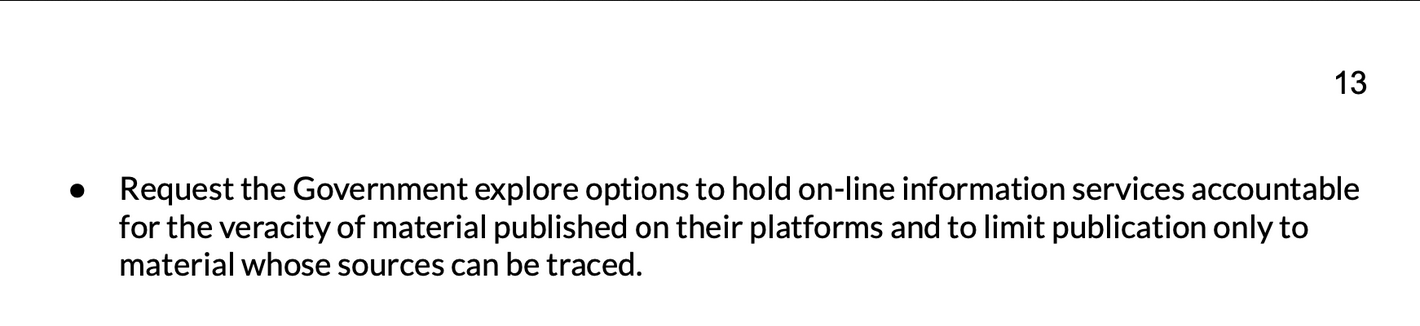
It’s in two screenshots simply because it spreads across two pages. This is the entire resolution.
BC Liberals want “on-line information services” held “accountable for the veracity of material published on their platforms” by “the Government”. The Government would, in turn, “limit publication only to material whose sources can be traced”.
This resolution has no meaning unless it means I would be required to clear my posts through the federal government, before publication, so the “traceability” of my sources could be verified. I don’t suppose this clearance process would take too much more time than getting a passport or a response to an access-to-information request. Probably only a few months, at first. Per article.
After publication, “the Government” would hold me accountable for the veracity of my material, presumably through some new mechanism beyond existing libel law.
I’m not sure what “the Government” — I’m tickled by the way it’s capitalized, like Big Brother — would have made of this post, in which I quote an unnamed senior government official who was parked in front of reporters by “the Government” on the condition that he or she or they not be named. But by the plain meaning of this resolution, I would not have to wonder for long because that post would have been passed or cleared by the Government’s censors before publication, and I’m out of recourse if that process simply took longer than I might like.
May 5, 2023
May 4, 2023
Despite all the evidence, Canada’s official motto doesn’t translate as “we broke it”
In The Line, Justin Ling adds more to the towering pile of evidence that “Canada is broken”:
If The Line has an editorial position, it is probably thus: Everything is broken.
This newsletter, of course, comes at the idea more earnestly than, say, the leader of the Conservative party. When my friend Matt Gurney advances that proposition, it is a lament. When Pierre Poilievre does: It’s wishful thinking.
While citizens of this country can’t always agree on what, exactly, is busted in our country, or why, or who is responsible — we can all agree, I hope, that things in this country could use a tune-up, at the very least. Canadians, after all, are imbued with a cloying optimism. An insufferable belief that things can be fixed. It’s a good thing.
Lucky for us, we have plenty of words written about how to fix much of what ails us. Because we, as a country, have a compulsive need to inquire about those problems. Our national pastime isn’t hockey, it’s the royal commission.
And we’ve got a government in office that loves to study the nature of the problem. There’s good work, these days, for the special rapporteurs and retired judges amongst us. And if you’re a Canadian that loves a good public consultation, you must be run ragged.
Yet we also have a government in office that has a pathological inability to take advice. And this problem may help explain why it feels like we’re sliding backwards.
[…]
When the government tapped an expert panel to study the use of solitary confinement in Canada’s prisons — literally torture — Correctional Services Canada blocked them from doing their job, and the public safety minister ignored their cries for help and then let their contracts lapse. Thanks to some scrutiny, the government renewed the study, then ignored it when the numbers showed they were still torturing people. Oops!
The National Security and Intelligence Committee of Parliamentarians — a body Trudeau created — warned in 2019 that Ottawa wasn’t taking foreign interference seriously, particularly when it came to China. “In short, government responses were piecemeal, responding to specific instances of foreign interference but leaving unaddressed the many other areas where Canadian institutions and fundamental rights and freedoms continue to be undermined by hostile states.” Prescient!
One of the most absurd examples is the sexual misconduct crisis in the Canadian Armed Forces. When Trudeau came into office in 2015, he had an external review on his desk from Marie Deschamps. One good external review deserves another, so the Liberals ordered one from Louise Arbour in 2022. What she found was harrowing: “We have been here before. Little seems to change.” Not only had the government failed to implement the Deschamps report, it was still failing to live up to the recommendations from the 1997 Somalia Inquiry. Fuck!
[…]
At the very centre of this tootsie-pop is, surprise, elitism. This Liberal government, armed with its paper-thin mandate, is convinced that they — and only they — are the verifiers of good ideas. And we should be grateful for whatever decision they deign to make.
If they farm out an idea to the public service, and the idea doesn’t come back in the form they envisioned, no matter: Send out the McKinsey signal. For just a few million dollars, their crack team of subject matter non-experts can prepare a PowerPoint presentation laying out the exact policy the political staff wanted in the first place.
The Liberals take a similar approach to consulting with the unwashed masses. When the government consulted the public on their plan to police “online harms,” they published a “what we heard” report that was broadly supportive of their plan.
Can we see the submissions? Journalists and academics asked. No. Came the reply.
Comments Off on Despite all the evidence, Canada’s official motto doesn’t translate as “we broke it”


