
HardThrasher
Published 10 Jun 2026In the Arakan, it turned out the third time was the charm, at least for those lucky enough to survive the jungle, malaria and a coastline without maps.
In this episode we return to Burma and the Arakan, where Operation Romulus turned a miserable sideshow into a strategically vital victory. We look at XV Corps’ third attempt to take Akyab, the extraordinary march of the 81st and 82nd West African Divisions, the improvised amphibious landings at Myebon, and the brutal fight for Hill 170, where the Royal Marine Commandos as we know them today, cut their teeth
Featuring Operation Romulus, Pungent, Lightning, Akyab, Myebon, Kangaw, Hill 170, the Black Tarantulas, 3 Commando Brigade, 25th and 26th Indian Divisions, and Japanese 28th Army.
00:00:00 – Intro
00:02:28 – Recap
00:08:15 – Operation Romulus – the Plan to take the Arakan
00:20:57 – The Attacks Begins
00:30:34 – Meanwhile in land
00:43:10 – Op Pungent and the Fight for Meybon
00:50:43 – The Final Assault
00:56:06 – Aftermath
00:57:41 – Epilogue
00:59:13 – Survivor’s Club
(more…)
July 11, 2026
Road to Rangoon, Ep. 2 – Jungle Commandos Operation Romulus & Hill 170
Don’t boast about your online pirating skillz
Larry Correia interacts with a proud book pirate on the social media site formerly known as Twitter:
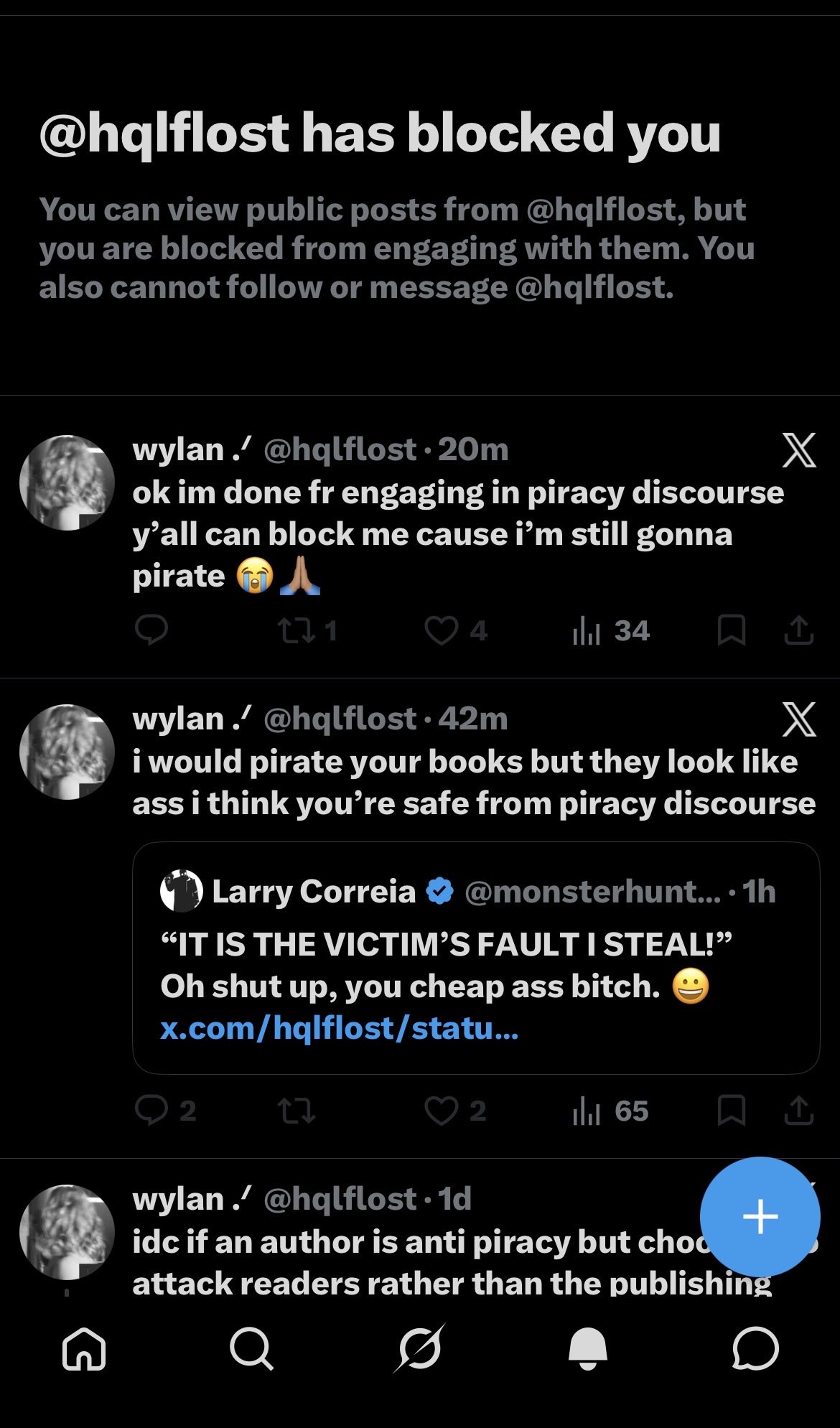
You’d better run, pussy. 😀
Listen, authors are gonna get pirated. We know this. I don’t freak out about it.
But if you are gonna steal, just admit you are a thief and own it. Don’t make a bunch of bullshit posturing excuses why it’s the victim’s fault you’re robbing him. Spare us your commie manifesto about the poor and oppressed, and how you are so brave to stand up for the masses against those cruel wealthy authors taking advantage of the poor (and for most writers, lol wut? They are broke, dummy!)
BUT WHAT ABOUT TEH POORS?!?
Go to the library!
But then we have to listen to these thieving shit weasel cry but what about the RURAL POOR. Which extra fucking pisses me off because now they’re appropriating my culture, because I grew up poor in the sticks. And I choose to live in the country now. Fuck your commie gibberish. Rural people are used to driving long distances to do everything.
Reading is like the cheapest hobby! If you are pirating you are rich enough to have internet.
You aren’t Robin Hood. You’re just a cheap bitch. There’s tons of free books online. My “greedy corporate oligarch” publisher Baen has a free online library with hundreds of titles.
Or KU is like $12 a month for UNLIMITED books. You can read 20 hours a day for a few cents an hour if you feel like it.
If you want to steal, great. Whatever. I don’t give a shit. That’s on you. But just do it with some fucking dignity and spare us from this retarded class warfare justification bullshit. That’s way more pathetic than being a thief.
Winston Churchill’s Personal Patchett/Sterling Submachine Gun
Royal Armouries
Published 4 Feb 2026This episode of “What Is This Weapon?” Jonathan examines a seemingly ordinary Sterling/Patchett submachine gun that turns out to be anything but.
This is a rare opportunity to examine a historically significant firearm that was owned and more than likely, used by Britain’s wartime Prime Minister.
0:00 Intro
1:55 The Hidden Plaque & Churchill Connection
3:36 Provenance: Churchill’s Firearm Certificate
5:58 Not a Wall Hanger: Ammunition & Use
6:05 Patchett vs Sterling: Design Differences
10:43 Churchill, Firearms & Wartime Image
14:49 Legacy & Back Next Week for Another Archive Film
(more…)
QotD: Could airpower have broken the trench stalemate on the western front in WW1?
What about, instead of going through the trench lines, we went over them?
There are two directions to take airpower here: tactical and strategic. One wasn’t ready then (but would be by WWII), the other still hasn’t managed to accomplish its stated objectives yet, but continues to over-promise and under-deliver results.
Let’s deal with tactical airpower first. The first function aircraft were put to in WWI was reconnaissance. In 1914, that might mean locating the enemy in a fast-moving battlefield, but as soon as the trench stalemate set in, reconnaissance mostly meant identifying enemy buildups along the line and – still more importantly – serving as spotters for artillery. It wasn’t a huge cognitive leap to go from having aircraft which identified targets for the artillery to thinking that the aircraft could be the artillery. But as with tanks, the technical limitations of the platforms in use meant that actually meaningful close air support was still two decades away when the war ended. The rapid development of aircraft in these early days means that there is a truly bewildering array of aircraft designs in use during the war, but the Farman F.50 is a good sample for what the most advanced bombers in common use looked like towards the war’s end. It carried a maximum of eight 44kg bombs (352kg) under the wings, which were dropped unguided. With a maximum speed of less than 100mph and a service ceiling under 5000m, it was also an extremely vulnerable platform: fragile, slow and with a relatively low flight ceiling. The French mainly used bombers at night for this reason.
But how much airpower does it take to really move a division out of position? In 1944, at the start of Operation Cobra as part of the Normandy breakout, it was necessary for US forces to move the powerful armored division Panzer Lehr out of its prepared positions outside of St. Lo. Over the course of an hour and a half, the U.S. Eighth Air Force hit Panzer Lehr with approximately three thousand aircraft, including 1,800 heavy bombers (each of which might have had bomb-loads of c. 2-3,500kg; the attack would have been the equivalent of about 13,000 Farman F.50s (of which only a hundred or so were built!)). By this point, even medium bombers carried bomb loads in the thousands of pounds, like the B-25 Mitchell medium bomber, with a bomb load of 3000lbs (1360kg). This was followed by a hurricane artillery barrage! Despite this almost absurdly awesome amount of firepower (which, to be clear, inflicted tremendous damage; by the end of Operation Cobra, Panzer Lehr – the heaviest and most powerful Panzer division in the west – had effectively ceased to exist), Panzer Lehr, badly weakened was still very capable of resisting and had to be pushed out of position by ground attack over the next three days.
Needless to say, nothing on offer in 1918 or for a decade or more after, was prepared to offer that kind of offensive potential from the air. That kind of assault would have required many thousands of aircraft with capabilities far exceeding what even the best late-war WWI bombers could do. Once again, while close air support doctrine was developed with one eye on the trench stalemate and the role airpower could play in facilitating a breakthrough and restoring maneuver (either by blasting the breakthrough or – as in Soviet Deep Battle doctrine – engaging enemy rear echelon units to bog down reinforcements). But the technology wasn’t anywhere near the decisive point by 1918. Instead, the most important thing aircraft could do was spot for the artillery, which is mostly what aircraft continued to do, even in late 1918.
But that’s tactical bombing against military targets. What about strategic bombing against civilian targets?
The first efforts at strategic bombing were made in WWI, though once again the technology wasn’t ready. The range for fixed-wing aircraft was still very limited; the aforementioned Farman F.50 had a range of only 420km, nowhere near enough to really bring entire countries under the threat of bombing. Dirigibles – zeppelins – could manage much longer ranges and the Germans did attempt to bomb British cities with them starting in 1915. The problem was that once aircraft powerful enough to climb to the zeppelin’s altitude were developed, the slow and fragile zeppelins were sitting ducks: lighter than air airships could hardly be armored, after all. Moreover, the bomb loads of zeppelins had always been far too low to make effective strategic bombing possible beyond the initial shock of it.
What no one could have known in WWI was not merely that the technology for effective conventional strategic bombing wasn’t ready, but that it would probably never be ready. Interwar air-power theorists, seeing the potential of strategic airpower to bypass the trench stalemate by flying over it began to try to work out how this would be done. Giulio Douhet (1869-1930) argued that future wars would be fought and won in the air, with fleets of bombers using high explosives and chemical weapons to massacre enemy civilian centers, until civilians forced their governments to surrender. Douhet was not alone; his vision of airpower was shared, for instance, by the “father of the RAF”, Hugh Trenchard (1873-1956).
This concept, “morale bombing” as it is sometimes called, probably deserves its own post discussing its failures. But in brief, the concept was tested, with far larger amounts of bombs than Douhet or any other interwar theorist could have ever dreamed of, during WWII. The argument by air theorists that high altitude bombers could not be stopped was proved false when the British did exactly this, stopping German bombers over Britain in 1940. Moreover, terror bombing against civilian targets in Britain didn’t lead to surrender, but hardened resolve. Likewise, “morale” bombing against German targets by the allies didn’t lead to surrender, but hardened resolve. Later efforts to demoralize the North Vietnamese through a American bombing campaign in the Vietnam War didn’t lead to surrender, but hardened resolve. More recent efforts to demoralize or destroy terrorists and the Taliban through the use of airpower hasn’t lead to surrender, but rather hardened resolve. Likewise, efforts by the Syrian Regime to defeat various opposition groups in Syria through the use of chemical weapon-based terror bombing didn’t lead to surrender (siege-and-starve tactics did), but hardened resolve.
It turns out the fundamental premise of the entire idea of morale bombing – that being bombed will make people want to stop fighting – was flawed. Morale bombing has been, depending on how hard you squint at the US air campaign over Japan in WWII (including the use of nuclear weapons) successful either once (out of many attempts) or never. In most cases, the sustained bombing of civilian centers has been shown to increase a population’s willingness to resist, making the strategy worse than useless.
The case for strategic bombing against industrial targets is marginally better, but only marginally. While airpower advocates, particularly in the United States promised throughout WWII that bombing campaigns against German industry could lead to the collapse of the German war machine, in the end many historians posit that the real achievement of the campaign was to lure the Luftwaffe into the air where it could be destroyed, thus denying the German army of air cover and close air support, particularly on the Eastern Front. Some diminution of German industrial capabilities was accomplished (though it is not clear that this ever approached the vast resources poured into producing the large numbers of extremely expensive bombers used to do it, though the allies had such an industrial advantage over Germany, forcing the Germans to fight in expensive ways in the sky was a winning trade anyway), but the collapse of German industry never happened. As Richard Overy notes, German industrial output continued to rise during strategic bombing and only began to fall as a result of the loss of territory on the ground. Needless to say, “strategic bombing can sucker the enemy into wasting their close air support” was not the result that airpower advocates had promised, nor could it have broken the stalemate.
I don’t want to oversimplify the continued debate over the efficacy of strategic airpower here too much so let’s just say that the jury is still very much out as to if strategic airpower works even with modern technology; it certainly wouldn’t have worked with WWI era technology.
Bret Devereaux, “Collections: No Man’s Land, Part II: Breaking the Stalemate”, A Collection of Unmitigated Pedantry, 2021-09-24.
July 10, 2026
Defensive driving is more important today than ever before
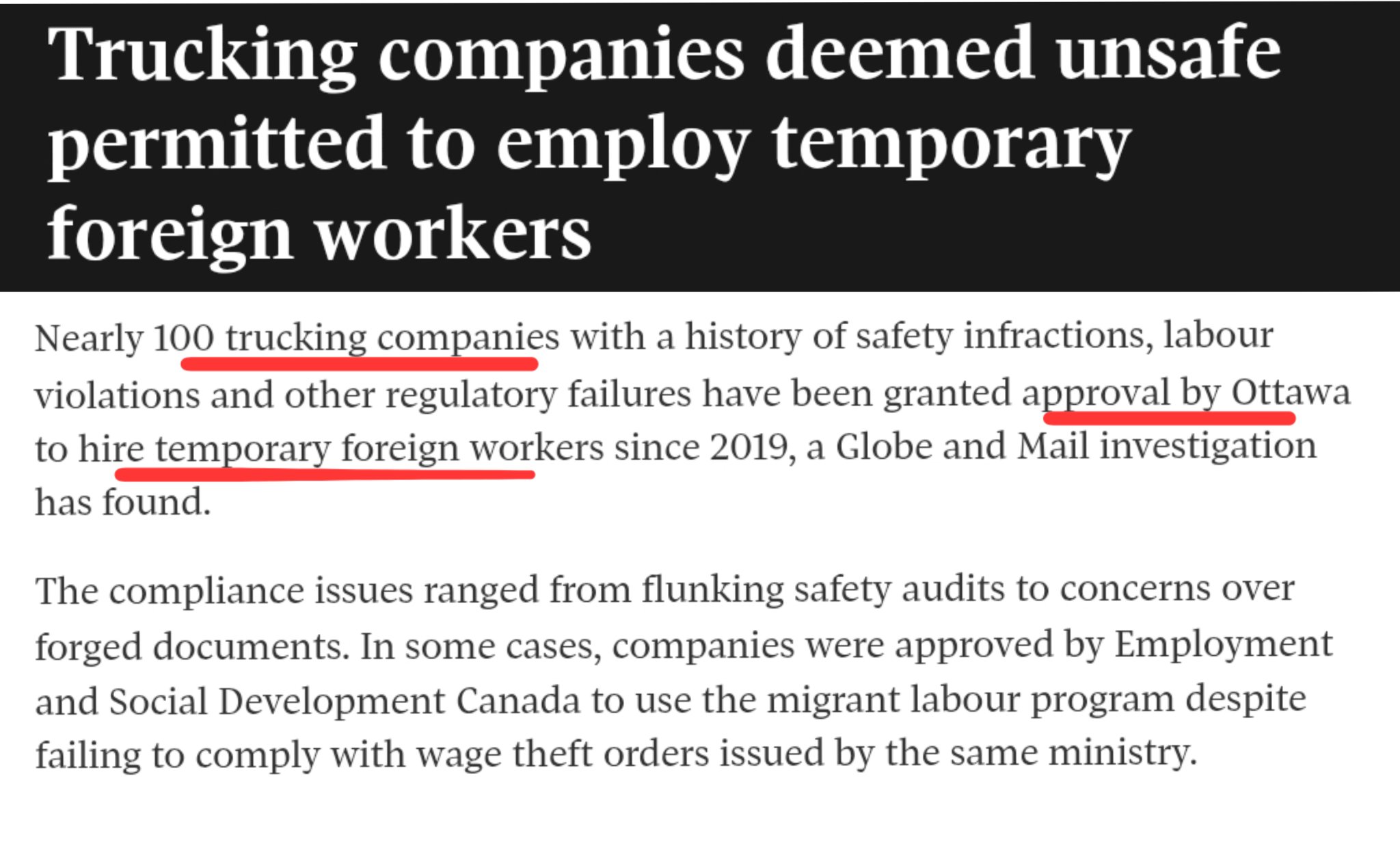
At some point, the Canadian and provincial governments decided that the safety of their citizens was a lower priority than ensuring that temporary foreign workers — many of whom apparently understand little or no English or French — had to be given commercial trucking licenses and set loose on the King’s Highways:
Absolutely insane‼️
But this is something I’ve been raising the alarm on for years.
The Canadian trucking industry, which almost a third of it is gray/black market now, have been captured by foreigners and empowered by Ottawa.
100 trucking companies with a history of safety infractions, labour violations and regulatory failures were approved by the Liberals to mass immigrate temporary foreign workers.
Canadians are losing their lives on our roads every day by foreigners who shouldn’t be in Canada that the Liberals allowed scam organizations to bring in and who shouldn’t be behind the steering wheel to begin with. Then the Liberals and activists judges won’t even deport these people.
Many trucking companies that lose license to operate or get hit with infractions would just change provinces of operations and name – sometimes not even the name, and would just keep operating because there is no proper systems raising red flags and no one investigates. Complete incompetence.
Many operate in Alberta, Saskatchewan and Ontario and move around these provinces.
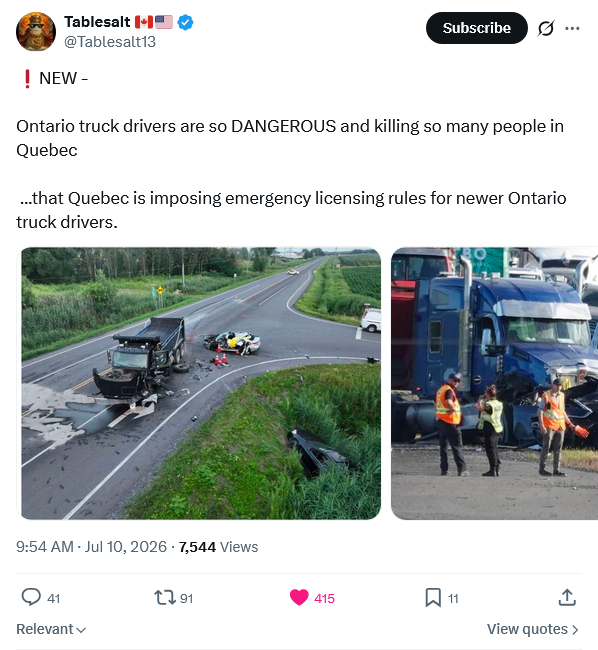
Update: Quebec has taken official notice of the situation.
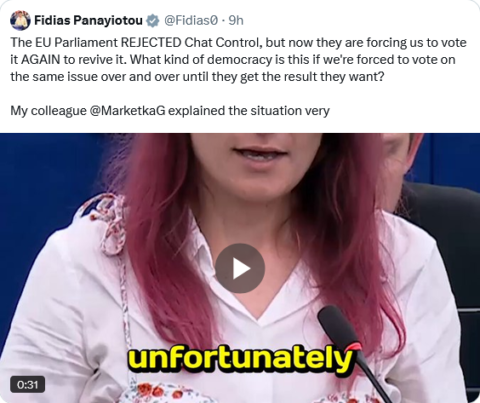
EU “Chat Control” passes through parliamentary chicanery
As mentioned yesterday, the EU introduced “Chat Control” which allows the authorities to examine any and all private communications by EU residents “to protect the children”. As eugyppius reports, it got through and was passed into EU-wide law on Thursday:

If anybody cares, what actually happened is that an extension of the European Union’s mass surveillance regulation known as Chat Control 1.0 failed to make it out of the European Parliament twice in March. Unable to summon a clear parliamentary majority, advocates (mostly in the centre-right European People’s Party [EPP]) turned to the European Council, which adopted the failed Chat Control 1.0 renewal on 2 July. The Council’s position hardens automatically into law unless the European Parliament can summon an absolute majority to stop it. To forestall any such majority from forming, the EPP on Tuesday moved with member state backing for urgent procedure, angling to force their scheme through in the last days before the summer holiday, after many MEP’s had already left. The parliament narrowly approved the urgent procedure, and in consequence there were not enough votes to stop Chat Control 1.0 when it came for a vote today. Hours ago, a majority of 314 MEPs voted to stop Chat Control against the wishes of the Council, while a minority of 276 voted to let it happen. Because 314 is less than the absolute majority of 361, Chat Control 1.0 passed even though most MEPs present didn’t want it to.
It was a sleazy vote, not least because it’s far from clear this procedural manoeuvre was even appropriate in this case. Also, electronic surveillance is bad, but if we are honest with ourselves this battle was already lost.
Chat Control 1.0 was first instated in 2021 as a temporary exemption to the ePrivacy Directive of the EU, allowing messaging services and online platforms to scan chats and other electronic communications for child sexual abuse material. The exemption expired in April, but various platforms have continued their surveillance with no legal basis in the intervening months. Now their formal permission to scan our private communications has been restored and extended through April 2028. We are, in other words, merely returning to the prior regime.
Chat Control 1.0 is a temporary stopgap while the European Parliament, the Commission and the Council try to negotiate their Child Sexual Abuse Regulation, or Chat Control 2.0. As envisioned by the Commission, this permanent law would not merely allow platforms to scan private communications for child sex abuse material, but require them to do so; require additional AI-assisted automated scanning not only for known child pornography but also for such vaguely defined activities as “grooming”; and extend scanning to end-to-end encrypted services like Signal via mandatory monitoring on the client side. This insane proposal has been watered down over the years, in large part because of parliamentary opposition, but it’s coming in some form. We’re getting Chat Control 2.0 before Chat Control 1.0 expires, and Chat Control 2.0 will be at least somewhat worse.
The EU’s stratégie “antiracisme”
The media has been pushing the narrative of a huge rising tide of racism and white supremacy, even as those ideas had been steadily losing influence and popularity. European and western governments generally have been doing their part to keep racism alive by importing as many unassimilable young men of military age and setting them loose upon the native population. Something’s got to give:

It has been proven. The narrative of systemic racism and “white supremacy” was completely fabricated by the media and activists since 2010. It’s undeniable.
Ask yourself this: have you ever come across, among your friends, your family, or your colleagues, someone who calls themselves a white supremacist and wants to “restore the purity of the white race”?
No. It doesn’t exist. It might have been a marginal fantasy in the past. Today, it’s a media construct to justify division and ideology.
The post I made that Elon Musk reposted yesterday proves it perfectly.
This European strategy isn’t going to “fight racism”. It’s going to create the perfect breeding ground for grooming gangs to spread everywhere in Europe, including France.
Reminder: in the UK, thousands of underage girls were raped, drugged, and sexually exploited by networks (often Pakistani) in Rotherham, Rochdale, and elsewhere. The cops, social services, and elected officials let the most horrific abuses slide for years … because they were afraid of being labeled racists. They chose to sacrifice young girls rather than “stigmatize” a community.
This is exactly the mechanism that Brussels is now rolling out across the board:
– Denial of anti-white racism
– Definition of “structural racism” without perpetrators or intent (so everyone is suspect by default)
– 3.6 billion euros in public money to anti-racist NGOs
– Training for civil servants to detect “racial bias” everywhereResult: police officers and agents paralyzed by the fear of being called racists. They’ll hesitate even more to act in certain neighborhoods or against certain groups.
In France, this ideology has already been carried by associations like Touche pas à mon pote and others of the same ilk. Instead of promoting integration and unity, they’ve created division by exploiting minorities for political ends.
Antiracism as it’s practiced today is racism. It divides people by skin color, protects real problems, and criminalizes those who dare to name the facts.
What needs to be done: stop dividing. Stop multiplying associations that exploit minorities to sow discord. Go back to true equality: judge actions, not origins. Protect victims without ideological taboos.
If this strategy passes, we won’t have “small” problems.
We’ll have grooming gangs on steroids across all of Europe.
That’s the price of this madness.
Auto-translated from the original French by X.
The Pastry War – When France invaded Mexico over pastry
Tasting History with Max Miller
Published 13 Jan 2026Puff pastry rings filled with raspberry and apricot preserves and topped with a cherry
City/Region: France
Time Period: 1840The Pastry War between Mexico and France was kicked off when, during a time of political upheaval, Mexican soldiers ransacked Monsieur Remontel’s pastry shop in the 1830s. Seeking reparations for M. Remontel as well as the repayment of other debts, the French invaded.
While we don’t know what was sold in Monsieur Remontel’s pastry shop in Mexico, these puits d’amour could certainly have been on the menu. By all means, you can make your own puff pastry, but I gave myself permission to use store bought, and you should, too. You can even use store-bought preserves to simplify things even further, but this preserves recipe is very delicious and very sweet. I used both store-bought apricot preserves and homemade raspberry preserves, and both were delicious. You can also fill them with half jam and half chantilly cream or pastry cream if the fancy strikes you.
PUITS D’AMOUR.
When the puff pastry has received all its turns, roll it out to a thickness of two lines; cut it with a fluted cutter, that is to say with a pastry cutter, and place the first piece on a baking sheet; then, with a cutter of the same type but smaller, cut another piece and place it on top; moisten the round with a little water, press it in slightly, brush these puits with egg, and put them into a hot oven. When they are three-quarters baked, sprinkle them with sugar in order to glaze them — that is, until the sugar melts; then remove them, hollow them out, and fill them with whatever preserves you judge appropriate.
— Le Cuisinier Royal by André Viart, 1840
QotD: Modern conspiracy theories
The best example right now is the Left’s obsession with white supremacy. They cannot accept that their vision of Utopia is not very popular. That’s the first step in a conspiracy theory, the rejection of the most plausible reason. That allows them to spin wild tales of secret Nazis and spectral supremacists. Rather than confront reality, which is frightening and disconcerting, they have created a series of conspiracy theories to explain why the world is not as they imagine it.
This is why conspiracy theories are a useful metric to gauge social trust. When order begins to break down, people naturally look for reasons. That opens the door to speculation and then conspiracy theories. This, in turn, erodes social trust, which is the foundation upon which every ruling class rests. As that foundation falters, the ruling class looks for reasons. Since blaming themselves is always off the table, they naturally begin to speculate, which opens the door to conspiracy theories.
The Z Man, “Conspiratorial Rule”, The Z Blog, 2020-10-01.
July 9, 2026
A new proposal for limiting “unreasonable searches and seizures”
In Reason, Jacob Sullum outlines Justice Gorsuch’s proposed new test for limiting government abilities to surveil and monitor private actions:

Supreme Court Justice Anthony M. Kennedy swears in Justice Neil M. Gorsuch on Monday, April 10, 2017, in the Rose Garden of the White House in Washington, D.C.
White House photo via Wikimedia Commons.
The Court’s 1967 decision in Katz v. United States, which held that the Constitution’s prohibition of “unreasonable searches and seizures” applies when people have a “reasonable expectation of privacy”, continues to shape Fourth Amendment rulings six decades later. That was clear on June 29, when the Court decided Chatrie v. United States, holding that a government-ordered analysis of cellphone location data qualifies as a “search” under the Fourth Amendment.
“An individual has a reasonable expectation of privacy in records about his cell phone’s location, and police intrude on that constitutionally protected interest when they demand the information”, Justice Elena Kagan wrote in an opinion joined by four of her colleagues. Justice Neil Gorsuch agreed with the result but not the rationale. The Katz test, he complained, “has no basis in the Constitution’s text or history”. He added that it has proven unworkable in practice because it has never been clear how courts should determine whether an expectation of privacy is “reasonable”.
Gorsuch is surely right that the Katz test has produced inconsistent and puzzling results. In cases addressing intrusions such as trash searches, demands for bank and telephone records, surveillance by low-flying aircraft, and police trespassing on private property, the Supreme Court has perceived no expectations of privacy it was prepared to recognize as reasonable. Applying the same test, it has repeatedly ruled that the Fourth Amendment does not apply to information that people voluntarily share with third parties. Yet the Court has repeatedly rebelled at the disturbing implications of that principle without explicitly renouncing it.
That is what happened in Chatrie, which involved a Virginia bank robbery investigation. Police used a “geofence” warrant to identify the perpetrator by requiring Google to search customer data collected by its Location History feature, which tracks the whereabouts of cellphone users. For reasons that are not entirely clear, the Court declined to apply the third-party doctrine, instead reverting to the original, unmodified Katz test.
A better approach, Gorsuch argued, would be to treat Location History records as “effects” covered by the Fourth Amendment — as a form of personal property, in other words. While it is not clear exactly how that property-rights approach would work in other contexts, it does seem less malleable than the Katz test, which gives courts wide discretion in discerning expectations and deciding whether they are reasonable. Gorsuch aptly likened the Court’s understanding of that test to its definition of obscenity in the 1960s: “We know a ‘reasonable expectation of privacy’ (and an exception to the third party doctrine) when we see it”.
They call it “Chat Control”
On the social media site formerly known as Twitter, Brivael Le Pogam talks about what the EU is calling “Chat Control”:
We need to talk about Chat Control, because it’s all happening this week and almost no one understands what it’s about.
In plain terms: the EU wants to authorize the scanning of your private messages. Your WhatsApp conversations, your emails, your DMs. Not those of a suspect. Those of everyone, all the time, by default.
The pretext is airtight, and that’s the trap: “protecting children”. No one can be against that. That’s exactly why it’s the perfect tool. They’ll never get you to swallow mass surveillance in the name of mass surveillance. They’ll get you to swallow it in the name of children, terrorism, disinformation. Always some cause you won’t dare challenge.
Understand the two-step mechanism well.
Today it’s the “soft” version: platforms have the right to scan, on a voluntary basis, unencrypted messages. Harmless on the surface. It’s the foot in the door.
Then comes the real version, the one under negotiation: mandatory scanning, including of your encrypted messages, analyzed directly on your phone before they’re even sent. Over 500 cryptographers have signed a letter saying it’s technically unfeasible without creating security vulnerabilities that any hacker or hostile state could exploit. You’re breaking encryption for everyone, including the criminals you claim to be targeting.
And the worst part isn’t even that.
The real danger isn’t that Brussels technocrats will be watching you tomorrow. They’re probably too spineless for that. The danger is that they’re building the infrastructure. Once scanning everyone’s messages becomes normal, legal, operational — the track is laid. And on that track will roll everything that comes next. The day a crisis brings ruthless people to power, they won’t have to invent anything. The machine will already be there, ready to go.
No surveillance infrastructure has ever stayed limited to its original purpose. None. It’s a law of administrative nature: a tool built for X always ends up serving Y.
What makes this text dangerous isn’t what it does today. It’s what it makes possible forever.
The decisive vote is Thursday. The last lock.
Auto-translated from the original French by X.
The good folks at Windscribe weigh in:
The EU is not a democracy.
They’re closer to a guy who keeps pressuring a girl to sleep with him despite her saying no.
5 times now.
But he won’t stop.
We’re at the stage where he’s giving her alcohol and making her drunk so she struggles to say no.
Over the last 3 years, Chat Control and similar scanning measures have been defeated or blocked 5 times.
The citizens of the EU and members of EU Parliament have made it abundantly clear — they don’t want Chat Control.
This latest attempt by the EU is the slimiest one yet. Revive dead legislation that was already defeated, flip the passing criteria so that majority don’t need to SUPPORT it, majority need to DEFEAT it, and as the cherry on top, hold that vote on the very last day before Parliament members go on summer break so that many don’t show up. Oh and if they don’t show up, it counts as a vote to pass Chat Control.
You can dress it up in as many legal technicalities and loopholes as you want, what the EU is doing here is fundamentally undemocratic.
No means no.
And if you ever saw a guy pressuring a girl into sleeping with him with disgusting tactics after she said no THIS many times, you would consider him to be a rapist.
So congrats to the EU on adopting rapist strategies to your governance.
Here’s why “free range children” went away
As a child in England and then in Canada, I had a pretty wide range for unsupervised activities and I generally took advantage of that. On foot or riding my bicycle, it was completely normal for me to be several miles from home on any given day. I’ve posted this image a few times, showing the “free range” diminishing generation by generation for an English family, and it’s mostly true here in Canada and in the United States as well:
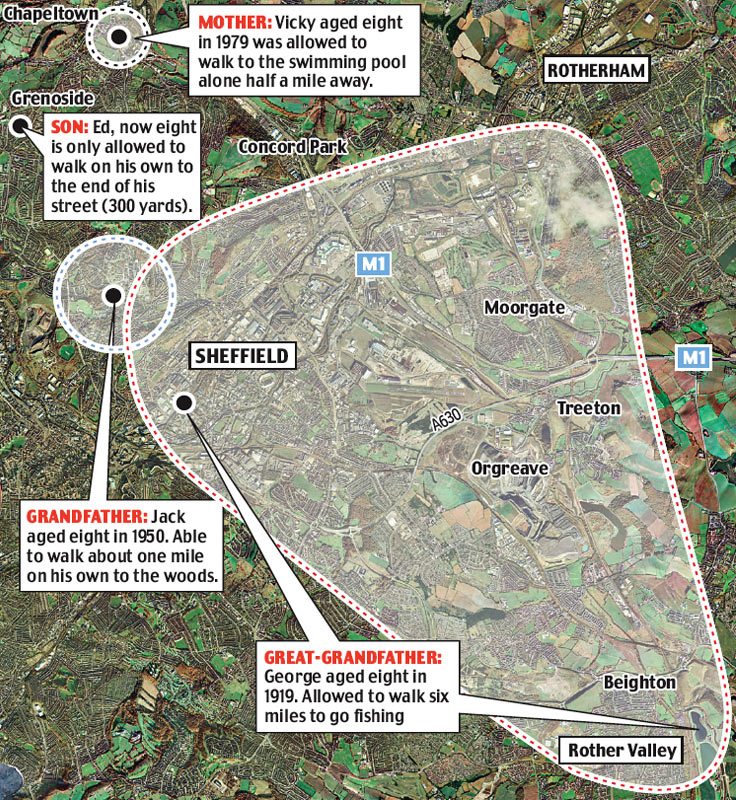
Graphic showing the diminishing “free ranges” of each generation of an English family.
At Classical Ideals, Megha Lillywhite discusses the “political extremism” involved today in trying to raise your children:
One of the most fundamental things that children require in order to grow up healthy, strong, wise and good, is a lot of time outdoors and in public spaces. Yet what we see from more traditional families in the west, as well as from extremely wealthy families, is that they are holding their children closer than ever, and enclosing them in increasingly smaller and more carefully selected bubbles of protection.
This is because “the outdoors” and “public life” is territory that has increasingly been ceded by western society to violent criminals, the mentally ill, and drug addicts. Parenting, for those who are vigilant to the threats, can no longer be “laissez-faire” and it has become less about choosing the ideal, and more about choosing the least damaging option.
But what has been lost? And what must be reclaimed for those of us with power and spirit to have any kind of meaningful victory in this world?
Most leftists see politics through the framework of wanting to be “a good person” as it is defined by their peer group and ideology. The ordinary person, on the other hand, views politics through the set of decisions that would best protect their children and give them the best chance at a good life.
Why is this? Leftists either don’t have children, or they have children but live in gilded cages and are therefore untouched (yet) by the consequences of their ideological beliefs.
Children must exist as part of a broader community in order to develop healthily. They must be able to go to a public library, the local shop, ride their bikes to the park, take the city bus or walk to their grandmother’s house on their own. They must be able to play outside unsupervised for hours on end in their neighbourhoods.
[…]
But some measure of freedom is also necessary for children to develop a healthy psyche. A child who can go to the shop and pay for milk on his own and bring it home will develop not only a sense of responsibility, but will feel confident in his ability to do useful things. A child who can visit his friends and relatives on his own will develop social skills and a sense of belonging. A child who can go to the library on his own can begin the lifelong journey of guiding his own learning.
[…]
In a 2007 study done in Sheffield, UK by Dr. William Bird, he found that children in 1926 were allowed to roam up to six miles away from home unsupervised and by 2000, that number dropped to 300 metres. The major drop off happened around 1979 which is coincidentally the time when mass migration began in the United Kingdom and demographics of towns like Sheffield began to seriously shift. In the recent “Rape Gang Inquiry” released by the Restore Party of Britain, the report which details three decades of kidnap, rape and murder of a quarter of a million British girls which would have began around this time. So English parents restricting their children’s freedoms around this time period was not something hysterical or unfounded.
We must be politically courageous in order to admit what is required to maintain that kind of a world. Stated simply, a safe, healthy and good childhood requires a fundamental rejection of leftist “empathy” politics. There is one incident in particular that can help to describe how this system functions today.
Link from John Carter on Substack Notes, who commented:
The same shift towards a confined, highly monitored childhood took place in the US, corresponding to the great suburbanization. The suburbs grew due to white flight from the cities, following their colonization by blacks and the de facto ban on community defence enforced by the civil rights act.
Suburban municipal architecture is largely comprised of informal defensive barriers that prevent undesirable elements from penetrating the neighborhoods undetected.
This enables middle class parents to deniably insulate their children from the worst consequences of diversity, but at the cost of raising their children in open air prisons, in a stifling social atmosphere characterized primarily by a brittle insistence upon euphemistic avoidance of direct acknowledgement of the real issues. “Racism is simply terrible! We just wanted to live somewhere with good schools.”
Children brought up amidst the tedious fakery of the suburbs naturally become attuned to the pervasive hypocrisy of suburban white culture. They have to: simply navigating this culture requires the ability to understand the unsaid, while pretending that one has not understood it. Combined with the open air prison environment inhibiting emotional development, this is a powerful recipe for induced neurosis.
There are only a few possible outcomes: 1) they become cowardly hypocrites themselves; 2) they reject the hypocrisy and become fanatical anti-white race communists; 3) they reject the hypocrisy and become fascists.
The Ancient Greeks 03 – Enter the Persians 2 – Cyrus, Destiny, and the Making of an Empire
seangabb
Published 16 Feb 2026Greece: A Brief History, c.700 BC – 500 AD
Who was Cyrus the Great? How did a minor Persian ruler come to dominate the Near East? In this lecture we examine Herodotus’ account of Cyrus’ miraculous survival, his overthrow of the Medes, and the conquest of Lydia and Babylon. We analyse Persian imperial strategy: flexible governance, religious tolerance, and pragmatic rule. We also explore how the Ionian Greek cities of Asia Minor first came under Persian control — setting the stage for future rebellion.
Empire did not emerge through chaos alone. It was built through method.
QotD: The labels “capitalism” and “socialism”
It was not necessary to be an intellectual to be dismayed by the inequality of industrial society. The Welsh-born factory owner Robert Owen envisaged an alternative economic model based on cooperative production and utopian villages like the ones he founded at Orbiston in Scotland and New Harmony, Indiana. It was in a letter to Owen, written by Edward Cowper in 1822, that the word “socialism” in its modern sense first appears. An unidentified woman was, Cowper thought, “well adapted to become what my friend Jo. Applegath calls a Socialist”. Five years later, Owen himself argued that “the chief question … between the modern … Political Economists, and the Communionists or Socialists, is whether it is more beneficial that this capital should be individual or in common”. The term “capitalism” made its debut in an English periodical in April 1833 — in the London newspaper the Standard — in the phrase “tyranny of capitalism”, part of an article on “the ill consequences of that greatest curse that can exist amongst men, too much money-power in too few hands”. Fifteen years later, the Caledonian Mercury referred with similar aversion to “that sweeping tide of capitalism and money-loving which threatens our country with the horrors of a plutocracy”.
Niall Ferguson, “Capitalism, Socialism and Nationalism: Lessons from History”, 2020-02.
July 8, 2026
Don’t call them “U-boats”!
In his latest post for The Line, Matt Gurney violates the cardinal rule of discussing German naval equipment … don’t call ’em “U-boats”!
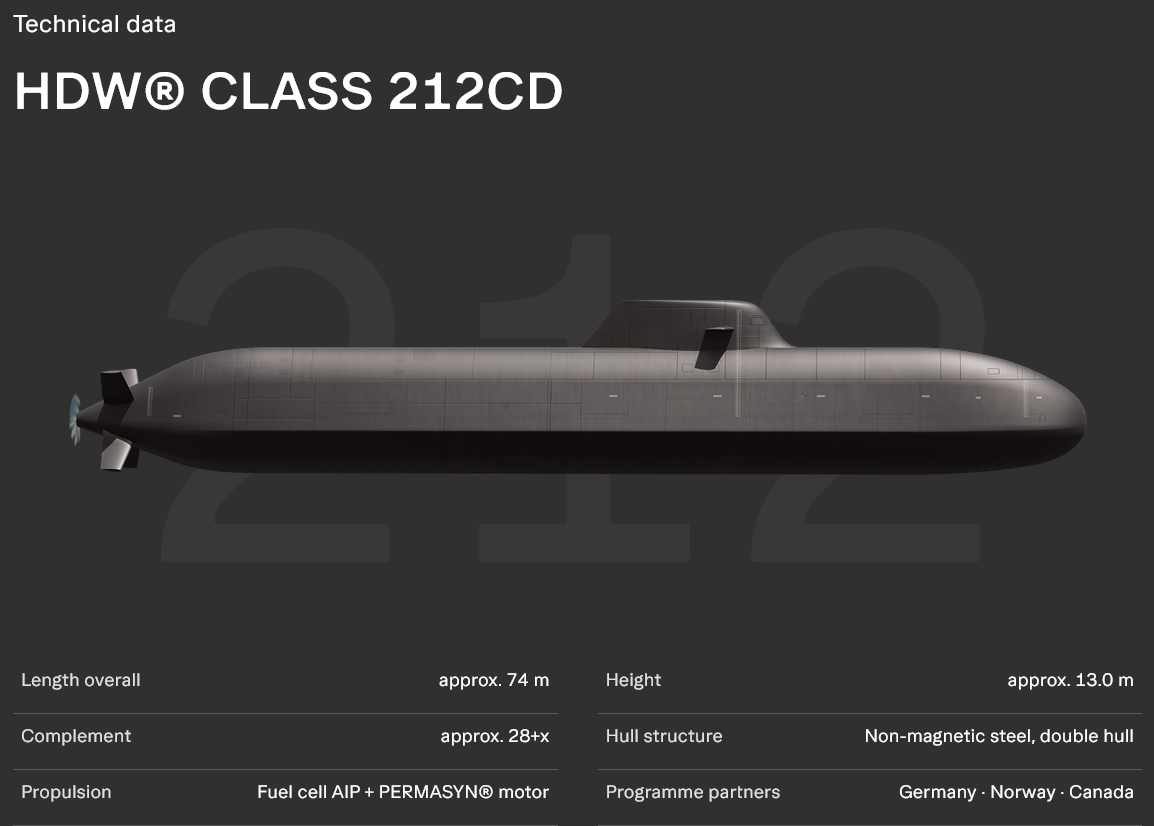
In Halifax on Monday, Prime Minister Mark Carney announced that Canada had chosen a preferred vendor for our new fleet of patrol submarines. Canada will (probably) be going with a German-Norwegian consortium that was offering the Type 212CD submarine, and not the South Korean boats offered by Hanwha. The prime minister said it was a close finish between the two competitors and noted that either design would have met Canada’s needs. The decision announced Monday is not a final purchase order but rather a determination of who our preferred partner would be. The prime minister said that if the negotiations with TKMS, the German company offering the 212CD, did not go well, Hanwha remained an acceptable option.
Personally, I was rooting for the Koreans. I liked their submarine’s ability to launch missiles vertically, which would’ve given the Canadian fleet some powerful strike options. I also tripped a little over the thought of Canadians in U-boats — I suspect many historically minded Canadians will also blink hard at that little twist of fate. But I fundamentally agree with the prime minister — either boat is fine for our purposes. The 212CD will be an excellent asset once it enters Canadian service (presumably with a snappier name).
Sooner would be better. The prime minister noted repeatedly during his remarks on Monday that the government was moving quickly to make this announcement, having settled on a preferred partner five years ahead of the original schedule. This is true, and I give the prime minister full credit for that. I would also note that the schedule was already ridiculously long. We actually should have begun replacing the submarines a decade ago. The PM’s comments reminded me that I had written a column about the urgent need to just get on with replacing the submarines when we had last announced another cycle of refurbishments to keep the current fleet in service because we had yet again delayed a decision on a replacement.
I found my old article. I wrote it seven years ago.
That was bad. Carney accelerating it is good. It’s also good that we are looking at a much larger fleet of submarines, going from four to as many as 12. Submarines are very complicated machines. For every boat you want available for service, you need three or four in your fleet. This gives you a large enough fleet to have an operational submarine available while others undergo maintenance or refits or participate in training exercises with their crews. The four Victoria-class submarines Canada possesses today mean that we typically might have one available for service at any given time, so a fleet of 12 will give us a much more robust presence. Given that we claim three oceans, and that the world is pretty much a dumpster fire these days, having a submarine available on each coast at all times seems like a good idea.
Time is of the essence. Germany and Norway, the prime minister said, have offered to allow Canada to cut ahead of them in line for deliveries of the submarines, which are already under construction but haven’t yet entered service. Given the decrepit state of our elderly existing fleet, that was obviously a meaningful sweetener, and the PM said the first boats could be in Canadian service in seven or eight years, which is pushing the Victorias to their limits, but should work. We hope?
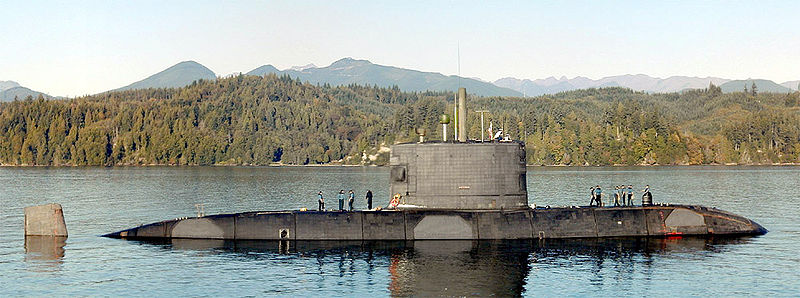
HMCS Victoria, one of four ex-Royal Navy submarines in Canadian service, will have to carry on in service — as much as the class can carry on — until the early 2030s.
Image via Wikimedia Commons.


