
Royal Armouries
Published 11 Feb 2026This episode follows our recent look at Winston Churchill’s personal Patchett machine carbine and shows how the Sterling was manufactured at scale for British service.
0:00 Jonathan Intro
1:00 Archive Film Start
15:05 Manufacture of the Breech Block
23:22 Fabrication of the Carbine Casing
31:37 Fabrication of the Carbine Magazine and Components
48:55 Assembly and Range Testing
1:02:09 DUCKSThis video includes historical archive film. The material is subject to Crown Copyright and is presented here by the Royal Armouries, which holds the archive for educational, research and public engagement purposes. All rights remain with the Crown and relevant rights holders.
(more…)
July 14, 2026
QotD: Subaltern Studies
Thinking more about the Stupid Smart Guy, I took a quick peek at Salon.com, because nobody is dumber than a Salon writer … and no one thinks he’s smarter. Fully acknowledging it’s sufficient to say “Dunning-Krugerrand: The Website” and move on, nonetheless I persisted, and I came up with a theory I want to run by y’all: The Left are externalizers.
You can come at this in a few different ways. In the History biz, a big buzzword used to be “agency”. Not as in “three letter”, but as in “ability to meaningfully affect your environment”. One has “agency” insofar as one is able to get one’s way. It’s a big deal in the ivory tower, because if the grand sweep of History since the Middle Ages tells us anything, it’s that White guys tend to get their way, while brown guys do not. There are entire continents (and Subcontinents) full of millions of people, run by a handful of honkies.
Obviously that’s very very bad for them … but very very good for you if you want tenure, providing you can find some way to prove that the honkies weren’t really in charge. Subaltern Studies, for instance, is a field where, at its worst, literally anything a brown person does, or doesn’t do, is an example of “agency”, because it’s an example of “resistance” — doing exactly what Whitey says is really sticking it to Whitey, because extremely dense polysyllabic theory-laden reasons.
The stated goal of all this being, to give “agency” to the subaltern. But that’s the funny thing: While explaining at enormous length why “doing exactly what Whitey says” is somehow “resistance”, these folks were in fact acknowledging the massive agency — no quotation marks — of the British. They said “Jump, frog!” and seven hundred fifty million people asked “How high?” There’s only so much jargon can do to disguise that basic power dynamic, which is why “Subaltern Studies” isn’t the hot new thing anymore.
Severian, “Externalizing”, Founding Questions, 2022-07-14.
Comments Off on QotD: Subaltern Studies
July 13, 2026
Canada’s performative “grand strategic pivot away from the United States”
On the social media site formerly known as Twitter, L. Wayne Mathison provides the statistics to show that Prime Minister Carney’s big meeting with the Saudi Arabians is much more sizzle than steak:

Mark Carney wants Canadians to believe that courting Saudi Arabia represents some grand strategic pivot away from the United States.
The numbers expose the performance.
Saudi Arabia purchased roughly $1.3 billion in Canadian goods in 2025. Canada exported about $779 billion worldwide. That makes Saudi Arabia approximately 0.17 per cent of Canadian exports. It is a rounding error being marketed as an economic transformation.
Meanwhile, the real Canadian economy is voting with its money.
A new KPMG survey found that 57 percent of Canadian manufacturers have paused, reduced or cancelled capital investments. 42 percent have moved production to the United States or are considering doing so. Nearly one-third have already shifted at least some production south, and 61 percent say their businesses cannot survive without access to the American market.
That is the real Carney record: photo opportunities with Saudi royalty while Canadian factories, investment and future production quietly head for the border.
Ottawa keeps talking about “diversification”, but markets do not follow Liberal press releases. Capital goes where taxes are competitive, regulations are predictable, projects can be approved, energy is affordable and customers are close.
The latest trade figures make the point painfully clear. Canadian exports rose for the fourth consecutive month in May, driven by a 1.5 percent increase in exports to the United States. American-bound exports reached their highest level since February 2025 and still represented almost 70 percent of everything Canada shipped abroad. Exports to non-U.S. markets continued to shrink.
Canada should absolutely pursue new customers. But Saudi Arabia cannot replace an integrated continental market of more than 330 million people sitting directly beside us.
You do not reduce dependence on the United States by weakening Canadian competitiveness and watching manufacturers relocate there. You build Canadian strength first, then expand outward from a position of confidence.
Carney and the Liberals are doing the opposite.
They are allowing Canada’s productive base to erode while selling diplomatic tourism as economic strategy. They are chasing Saudi sovereign wealth while Canadian capital sits idle, scales back or leaves.
That is not diversification.
It is economic decline wearing a tailored suit and carrying a diplomatic passport. 🤡🌎
Comments Off on Canada’s performative “grand strategic pivot away from the United States”
Teddy Roosevelt versus the “Robber Barons” of the Gilded Age
In the Coolidge Review, Burton W. Folsom, Jr. outlines the way President Teddy Roosevelt and his Progressives tried to rein in the wealthy industrialists who had helped create the Gilded Age:
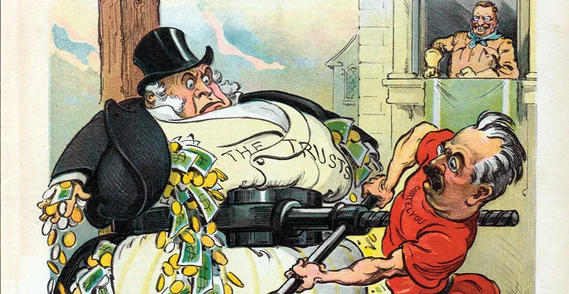
Theodore Roosevelt looks on with glee as his commerce secretary puts the screws to trusts.
(Puck magazine, Alamy Stock Photo, via The Coolidge Review)
The early twentieth century marked the height of the progressive movement, which sought to check the power of free markets and business. To understand what progressives did in the early 1900s, we need to understand what happened in the late 1800s, the period often called the Gilded Age.
After the Civil War, the United States experienced spectacular economic growth. The industries leading the way included railroads, oil, and steel. This expansion made the United States a global economic power. The profits of those businesses enriched the wealthiest — and the average American. That’s in part because bigger, more efficient businesses can offer cheaper prices. Between 1870 and 1880, for example, railroad freight prices fell by half. By 1890, they had fallen by half again. And by 1900, they had been cut nearly in half once more.
Similar advances occurred in many other industries. In the Gilded Age the United States saw perhaps the greatest burst of invention and economic development any country has ever experienced.
[…]
Progressives relied on three tools to restrain business.
The first was the Sherman Antitrust Act. Passed in 1890, this law was used sparingly for a decade. Government enforcement proved difficult in part because the act’s language was vague: the Sherman Act outlawed any contract or “combination” in “restraint of trade or commerce”. In 1895 the U.S. Supreme Court interpreted the law narrowly. In a case involving a sugar-refining business, the Court held that the Sherman Act did not apply to manufacturing. Theodore Roosevelt later wrote in his autobiography that the ruling produced “governmental impotence”.
But soon after entering the White House in 1901, Roosevelt seized on the Sherman Act to engage in “trust busting”. He directed the Justice Department to dissolve the Northern Securities Company, a railroad holding company that Hill had created. This time, the Supreme Court upheld the government’s intervention. Referring to the 1895 ruling, Roosevelt crowed, “This decision I caused to be annulled by the court that had rendered it”, giving the federal government the power “to deal effectively with the trusts”. Roosevelt’s Justice Department soon targeted Standard Oil, which was eventually broken into thirty-four separate companies.
The second tool progressives used against business was the Interstate Commerce Commission. Although railroad rates had declined dramatically for decades, progressives objected to the way those rates were structured. Railroads tended to give the largest discounts to customers that transported the most goods. The railroads still profited from these volume discounts, and smaller customers still paid much lower rates than they had earlier. But progressives argued that it was unjust for smaller shippers to pay higher rates than larger businesses.
In his 1905 annual message to Congress, President Roosevelt demanded legislation to put “a complete stop to rebates in every shape and form”. The 1906 Hepburn Act accomplished that goal. The law was expanded to give the Interstate Commerce Commission the power to inspect railroads’ financial records, eliminate targeted rebates, and set “just and reasonable” rates. In other words, the federal government now had significant pricing power over railroads, America’s largest business sector.
The progressives’ third tool was the federal income tax. In 1909 Congress approved the resolution for a constitutional amendment to establish an income tax. The Sixteenth Amendment took effect in 1913, after three-quarters of the states had ratified it. That was the year Coolidge was elected president of the Massachusetts State Senate.
From the beginning, the tax system was progressive, imposing higher rates on larger incomes. In 1913 most Americans paid no federal income taxes, while the top marginal rate — for income exceeding the equivalent of $16 million in 2026 dollars — was only 7 percent. But within five years, tax rates had soared, with the top bracket paying 77 percent.
Comments Off on Teddy Roosevelt versus the “Robber Barons” of the Gilded Age
A Fair Reading of The Camp of the Saints
Feral Historian
Published 10 Jul 2026Jean Raspail’s 1973 novel The Camp of the Saints has gone from obscurity to infamy in recent years, drawing condemnation for its highly … unflattering depiction of third-worlders. Much of this condemnation comes from people who haven’t read it, or gave it only a shallow and cursory read. But if we let the book speak for itself it can be quite insightful at times, and the true target of its scorn becomes brutally evident.
Rather than use politically-charged b-roll, it’s all hiking shots this time. Mostly to cover some edits. This is a great one for those who listen to these on the commute. Or the commode as the case may be.
00:00 Intro
01:03 The Story
14:22 Escalation Curve
17:38 Hamadura and “Whiteness”
22:05 Culture and Ethnicity
26:33 Why so Serious?
30:09 The End of a World
34:14 Your Virtual Right-Wing Uncle
35:48 A “Martian” Perspective🔹 Patreon | patreon.com/FeralHistorian
🔹 Ko-Fi | ko-fi.com/feralhistorian
🔹 and Merch! | feral-shop.fourthwall.com
🔹 Oh, and book 2 of Stellar Drift is out. https://www.amazon.com/dp/B0GTVXK4CN
Larry Correia’s trailer park elves
On X, Larry Correia explains the genesis of a group of characters he created in his Monster Hunter International series:
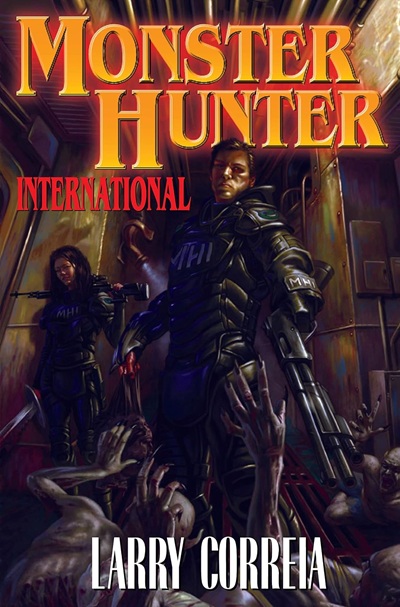
I’ve been talking to this pathetic, race obsessed loser, bitter failure of a wannabe writer for a while, but it did remind me of the fun story of where MHI‘s trailer park elves came from.
This dork thinks it is because I’m racist against white people or some shit, but it is actually a lot simpler. I was in the bedroom, typing on my laptop. I was working on the beginning of MHI and still figuring out this whole writing thing.
My wife was in bed reading a fantasy novel. She sighs and puts the book down. I ask what’s wrong, and she says “Elves are always the same. It’s so boring. Authors just keep rehashing Tolkien elves over and over. They’re all wise and beautiful and eternal and blah blah blah. Just once I’d love for them to do something different! Why can’t there be, I don’t know … redneck elves or something?”
And the light bulb went on because she said this to a guy who’d lived in some poor areas in Alabama and Mississippi and had a blast. And that night I wrote the Enchanted Forest Trailer Park scene.
The part where the dog pees on the outside couch, and they just flip the cushion over and tell you to have a seat, true story. 😀
Contrary to what this woke loser thinks, I love rednecks. I think they’re hilarious and awesome and I appreciate the culture of being rowdy and not giving a shit while being ready to fight at the drop of a hat. Anybody who has read the series knows MHI is filled with bad ass southerners. Just like the woke left appointed themselves “speakers for the marginalized” this asshole is the same. I never bent the knee to the woke left, and my answer is the same to the woke right. Fuck off.
Meanwhile I go to the south and people love this stuff. Only humorless dolts get butt hurt over the Enchanted Forest, because the rest of us have been there! We know those guys. That’s what makes it fun.
The elves gave me the idea, what if every mythological race from the old world adopted an American subculture once they got to the US? Which gave us orcs, gnomes, minotaurs, dragons, cyclops, all adopting some culture. I’ve had a lot of fun with that over the series.
And the culture has got to be a twist on what’s expected. That is what makes it interesting. It goes back to what my wife said back in 2007. This prick is crying how come the elves are WHITE?! Tolkien, that’s why. And why is one FAT?! Why are they POOR?!? Did you make the other races fat and poor and use them for comedy relief or just the WHITE ONES?
Well A. stupid obviously never got to the gnomes, and B. it is because, elves are supposed to be beautiful and immortal and awesome. If I wrote a dwarf as fat and drunk that’s not interesting because that’s NORMAL, and doesn’t fit the established nature of the setting where traditional stuff goes sideways when it gets here. Duh.
This explanation is for my fans. Not this dork. I don’t think he’s smart enough to explain anything to.
Comments Off on Larry Correia’s trailer park elves
The Tool That Changed Woodworking – the Stanley 42
Wood By Wright How To
Published 12 Mar 2026The Stanley 42 came before the 45 or 55, and it is a fascinating tool!
Comments Off on The Tool That Changed Woodworking – the Stanley 42
QotD: They took away recess – and then wondered why boys struggled
But children do not learn best by being treated like machines.
And boys, especially, often do not thrive when movement, noise, spontaneity, and unstructured play are stripped from the school day.
One of the revealing things about modern education is how casually it has pushed recess aside. What was once understood as a normal and necessary part of childhood is now often treated as expendable — a frill, a reward, or a distraction from the “real work” of school. But the research points in the opposite direction. Recent reviews continue to find that recess is associated with academic and cognitive benefits, behavioral and emotional benefits, physical benefits, and social benefits. The strongest modern claim is not that recess is a magic cure for every school problem, but that it helps children function better and does so without harming academic achievement.
That matters for all children.
But it matters in a special way for boys.
Not because girls do not need recess. They do. But many boys are more movement-driven, more physically expressive, and more likely to regulate themselves through action. A school culture built around prolonged stillness can turn normal boyhood into a problem to be managed. Then, when boys struggle under those conditions, the system acts as though the flaw lies in the boy rather than in the environment. Recent research continues to find sex differences in recess physical activity, with boys on average being more physically active during recess than girls.
Tom Golden, “They Took Away Recess – And Then Wondered Why Boys Struggled”, Men Are Good, 2026-04-06.
July 12, 2026
The CBC is a conscious shaper of the narrative, not a news organization
The CBC recently published a highly misleading article based on a recent report on firearm use in intimate partner violence, omitting two key facts and massaging the rest to support their preferred narrative:
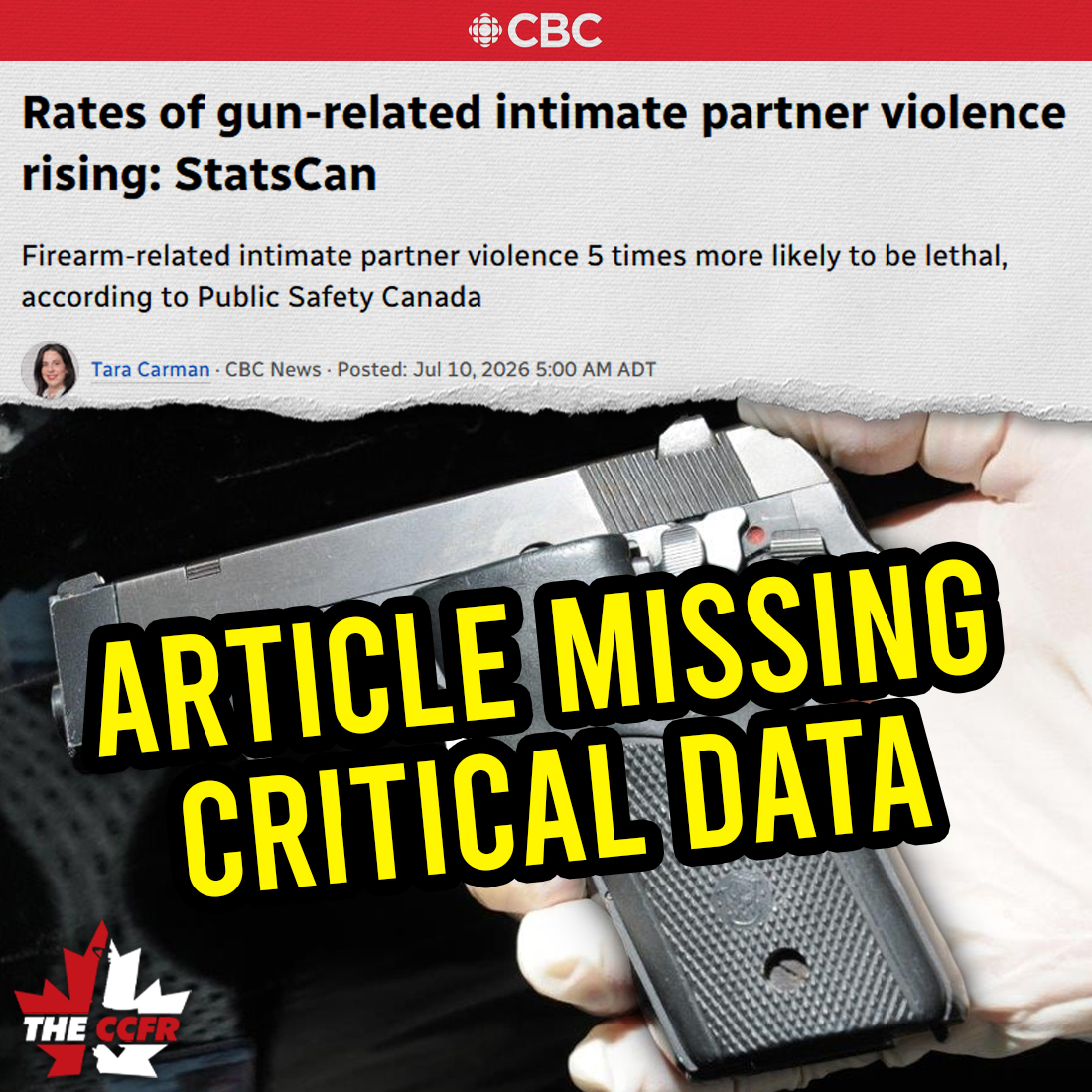
Tara Carman [@tarajcarman] is directly responsible for producing this deceptive piece of journalism that deliberately misleads the Canadian public on a critical public safety issue. As the sole author of the article published by CBC, she made the conscious decision to omit the most important data from the Statistics Canada report she herself references, leaving readers with a completely distorted picture of firearm-related intimate partner violence. Specifically, she buried or ignored the fact that, in solved firearm-related intimate partner homicides, only 25% involved an accused person who had a valid firearms licence and was in legal possession of the gun used, while a massive 58% involved individuals who had no valid licence, were not in legal possession, or both. For non-intimate partner cases, the figure for legal possession drops to a pathetic 9%. These numbers come straight from the official report, yet Carman chose not to include them, choosing instead to hype up rising rates, female victims, and lethality while pushing narratives around red flag laws and confiscating guns from legal owners.
This is shitty journalism at its worst because Carman actively shaped the story to imply that legally owned firearms, held by licensed, responsible citizens, are a primary driver of these tragedies, when the data she had access to proves the opposite is true in the majority of solved cases. By leaving out these crucial possession statistics, she misleads the public into believing that broader restrictions on law-abiding gun owners are the solution when, in reality, the problem is overwhelmingly tied to illegal guns, criminals, and repeat offenders who already slip through the system. Her selective framing ignores how small a slice of firearm-related incidents overall intimate partner violence represents and instead amplifies fear to fit a predetermined anti-gun narrative that CBC routinely peddles. Carman has failed in her basic duty as a reporter to present the full truth, choosing omission and emphasis that distort reality and erode public trust. This kind of dishonest reporting from Tara Carman harms informed debate on serious issues and deserves strong public condemnation for prioritizing agenda over accuracy.
Rod Giltaca has more on the omissions of the original CBC story:
IMPORTANT POST🚨
Additional point to the story below: less than 1% of intimate partner violence has a firearm present. It’s been this way for decades. Statcan tracks this.
This is how CBC describes this: “Most intimate partner violence crimes don’t involve firearms”.
“Most”? How about 99% doesn’t?
This is the type of manipulation you can expect from the CBC. It’s unconscionable.
Domestic violence is absolutely unacceptable. We should be looking for the people and situations involved in it and deal with it directly. We should be using the billions the gov’t has wasted on gun bans on services to support women escaping these situations. Stories like this merely serve as an opportunity to vilify people who legally and responsibly own firearms, full stop.
We need to start asking real questions about where these situations occur, who’s involved, and that includes demographic information of every kind; racial, cultural, economic, geographical, real information that demonstrates the will to (actually) solve these problems.
If you want to reduce this type of violence then you have to ask these questions whether they’re uncomfortable or not.
Do you really care, or is this just another opportunity to play politics or virtue signal? Clear thinking people are sick of this.
Comments Off on The CBC is a conscious shaper of the narrative, not a news organization
How WW2 Really Started: Appeasement! – Death of Democracy 23 – Q3 1938
World War Two and Spartacus Olsson
Published 11 Jul 2026On September 30, 1938, Neville Chamberlain returned from Munich promising “peace for our time”. Adolf Hitler returned to Berlin with the Sudetenland.
In this episode of “Death of Democracy”, Spartacus Olsson reports from Berlin as Nazi Germany escalates on two fronts: terror against Jewish citizens at home, and diplomatic blackmail against Czechoslovakia abroad.
While the Evian Conference fails to open the world’s doors to Jewish refugees, the Nazi regime tightens the trap with identity cards, forced names, professional bans, the opening of Mauthausen, and Eichmann’s machinery of forced emigration in Vienna.
At the same time, Hitler manufactures the Sudeten Crisis, threatens war, breaks Czechoslovakia’s defenses through the Munich Agreement, and convinces much of Europe that surrendering another country’s territory is the price of peace.
This is Germany in Q3 1938: the lie that Hitler would not start another war — and the world’s decision to believe him.
Comments Off on How WW2 Really Started: Appeasement! – Death of Democracy 23 – Q3 1938
This used to be active sabotage … now it’s standard EU practice
Ten years back, I posted an excerpt from a WW2 American espionage manual showing workers in occupied Europe how to bureaucratically sabotage their organizations to harm Nazi Germany’s war efforts. At the time I joked that it also sounded like a lot of company meetings in the modern world. Brivael Le Pogam uses the same set of guidelines to illustrate just how much the EU has embraced these sabotage methods as their standard operating practices:
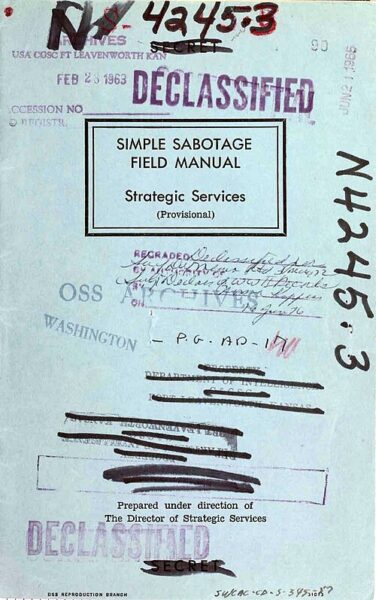
Link goes to full text at Wikisource
🚨 The OSS Simple Sabotage Field Manual (1944) describes how to paralyze an organization without explosives.
The European Union seems to have taken it as its official instruction manual. Here are the disturbing similarities:
1. “Insist on everything going through official channels.”
✅ 27 states, 24 official languages, 3 seats, thousands of committees and agencies. Even a directive on lightbulbs goes through 7 levels of validation.2. “Hold meetings. Speak at length with anecdotes.”
✅ 45-minute speeches in the European Parliament on minor topics. Strasbourg and Brussels locals applaud politely.3. “Refer everything to committees. Make them as large as possible (never fewer than 5 people).”
✅ The trilogue, COREPER, working groups, expert committees … A simple decision turns into a 3-to-7-year obstacle course.4. “Bring up unrelated matters repeatedly.”
✅ Talking agriculture? Let’s add the Green Deal, LGBT rights, Palestine, and the carbon border tax. Nothing is ever straightforward.5. “Haggle over the precise wording of communications.”
✅ Months of negotiation over a semicolon in a 400-page regulation. The word “should” vs. “must” can stall everything.6. “Reopen decisions that have already been made.”
✅ Directive adopted? We reopen it 2 years later for “revision”, “strengthening”, or “adaptation to the geopolitical context”.7. “Advocate caution and deliberation. Avoid all haste.”
✅ “We need more time to study the impact”, “let’s consult stakeholders more”, “better safe than sorry”. Result: nothing moves quickly.8. “Question the legitimacy of every decision.”
✅ “Is this really within the EU’s competence?” (even when it’s already in the treaties). Subsidiarity invoked when convenient, forgotten when not.The EU doesn’t need Russian or Chinese saboteurs. It has turned itself into a machine for slowing down Europe, exactly as the manual recommended to weaken the enemy.
The funniest part? All of this is done legally, democratically, and with the best intentions.
Automatically translated from the original French by X.
How Rome’s Survival Came Down To One 25-Year-Old General – The Second Punic War | EP 2
The Rest Is History
Published 5 Feb 2026What happened at the Battle of Ibera, a totemic though overlooked battle of the Punic Wars? With the forces of Carthage closing in on a depleted Rome, would a young Roman, Publius Cornelius Scipio resurrect the fortunes of the Republic? And, could he destroy Carthage’s most crucial power base in Europe?
Join Tom and Dominic, as they discuss this next phase of the Carthaginian Wars.
00:00 Intro: Rome’s “darkest hour” + Scipio teased as the Republic’s saviour
02:26 206 BC, Atlantic coast of Iberia
04:26 What’s “up” with Scipio?
12:05 Spain as hostile “sci-fi planet”
15:30 New Carthage (Cartagena)
18:09 215 BC crisis: Hasdrubal tries to march north
19:14 Battle of the Ebro
21:25 “Two rival pairs of brothers”
24:48 Rome’s commander problem
30:36 Scipio’s bold plan
31:37 New Carthage targeted
34:57 Sack of New Carthage
39:01 Hasdrubal crosses the Alps with elephants
39:59 Italy’s crisis for Rome
44:05 Battle by the Metaurus
47:23 Ilipa (206): Scipio crushes Mago and breaks Carthage’s Spanish power
49:52 Mago’s last throws
52:14 Scipio returns to Rome as a superstar
53:05 Senate authorises Africa invasion
(more…)
Comments Off on How Rome’s Survival Came Down To One 25-Year-Old General – The Second Punic War | EP 2
QotD: “This isn’t exactly the way I expected open source to win”
Decompilers in themselves are not a new technology. Security researchers have employed them for years to analyze compiled malware. There’s been some limited use by others, notably by hobbyists decompiling abandonware games. But there were a couple of issues that prevented this from becoming common practice.
One is simply that running decompilers was difficult. It wasn’t as simple as feed in binary, get out source; it needed a person with specialist skills prepared to do spelunking through wildernesses of machine code and object formats. The other problem was that decompilation didn’t give you anything like the explanatory comments that had been in the original code, so you could easily wind up with code that you could read without being able to understand or modify it.
Now large language models are busily smashing both of those barriers flat. They’re better at the kind of detail analysis required to run the human side of a decompilation than humans are. More importantly, in the process of decompiling code, they rather automatically build a global model of how it works that can easily be expressed by high quality comments in the extracted code. All you have to do, basically, is ask for the comments.
I’m going to reinforce that latter point because it may not be obvious how good LLMs are at this, and how much better they’re going to get. When they decompile code and comment it for you, they’re not just working from that one piece of code you have put in front of them — they’ll have in their training set hundreds, possibly thousands of pieces of code similar to it and with comments. This will give them superhuman levels of insight not just into what it does at the microlevel, but what it means to the humans who wrote it, and what technical assumptions it’s embodying.
Compilation no longer guards your secrets. Or, to put it more precisely the expected time span in which you can still count on it to obscure them is measured in months. Possibly weeks.
What does this mean?
It means you’re in an open-source world now. All it’s going to take for anybody to bust your proprietary IP open is care enough to spend tokens on the analysis.
You will maximize your chances of survival as a software business if you get out ahead of this rather than trying to fight it.
This isn’t exactly the way I expected open source to win. But, you know, I’ll take it. Good enough.
ESR, The social media site formerly known as Twitter, 2026-04-08.
Comments Off on QotD: “This isn’t exactly the way I expected open source to win”
July 11, 2026
Governments should not have easy access to emergency powers
As we found out in Canada in 2022, when the government gives itself emergency powers unrestricted by normal legal procedure and due process, they abuse those powers. The UK government is eager to grant itself similar powers due to a “climate emergency” that will, among other things suspend habeus corpus and the 1689 Bill of Rights:

Emergency, d’ye see? National security emergency.
But here’s the problem if the government declares a national security emergency:
Part 1 of the act establishes a new and broad definition of “emergency”. The definition includes war or attack by a foreign power, which were defined as emergencies under previous legislation, as well as terrorism which poses a threat of serious damage to the security of the United Kingdom and events which threaten serious damage to human welfare in a place in the United Kingdom or to the environment of a place in the United Kingdom.
Damage to the environment in the UK. So, that matches. And if they then declare such an emergency, under the act, then the following laws — among others — no longer apply:
The only primary legislation which may not be amended by emergency regulations is the Human Rights Act 1998 and part 2 of the Civil Contingencies Act itself
That is, all other laws no longer apply. It’s an Enabling Act, allowing rule by decree for the length of the emergency. Absolutely everything is up for grabs. These laws are not, repeat not, protected:
The peers tried to protect the following laws from emergency regulation:
Habeas Corpus Act 1679
Bill of Rights 1689
Section 7 of the Parliament Act 1911 which limited the duration of a parliament to five years[e]
Act of Settlement 1701
House of Commons Disqualification Act 1975
Life Peerages Act 1958
House of Lords Act 1999
Seriously, it wipes out the entire legal and constitutional structure.
So, you know, no. Not because there is, or isn’t, a climate change emergency. But because of the powers they’ll take if one is declared.
No.
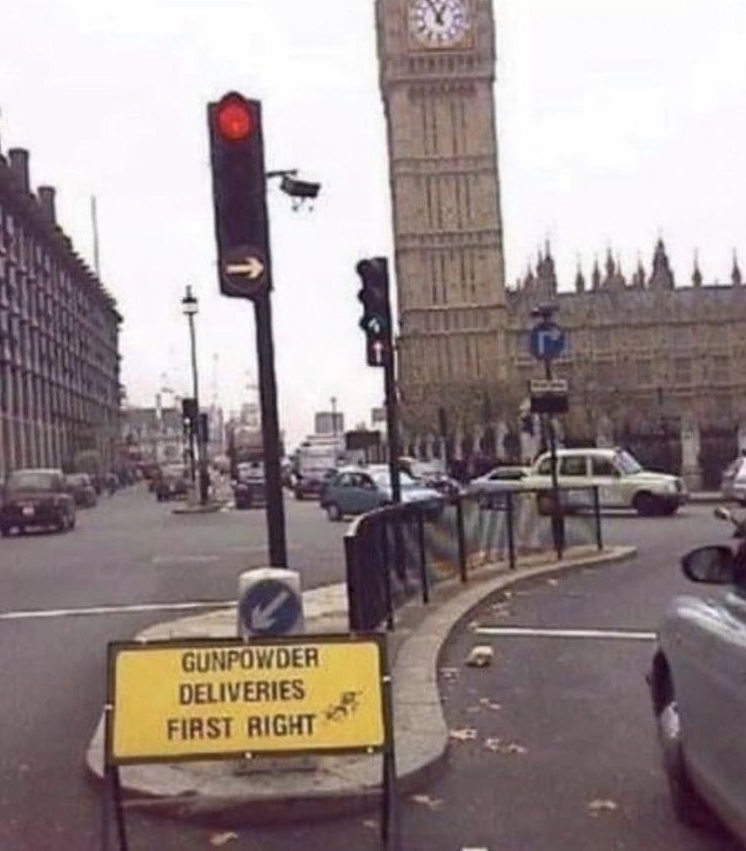
It’s not November yet, but this sign seems rather appropriate:
Comments Off on Governments should not have easy access to emergency powers
British censorship laws do not apply outside the UK’s jurisdiction
On Substack Notes, Lorenzo Warby links to a fascinating discussion about the ongoing struggle between the UK government’s Ofcom and the US-based 4chan and their legal representatives, saying “The totalitarian wannabes currently running the UK do not apparently grasp that the American Revolution and War of Independence was a thing. Also, being totalitarian wannabes, they have no sense of humour.”

A UK cabinet minister, Rt. Hon. Liz Kendall MP, Secretary of State for the Department of Science, Innovation and Technology (“DSIT”), discussed the infamous “hamster e-mail” I sent on behalf of my client 4chan to the UK’s Internet censor, on national radio today in the UK. […] My father always told me, when I was growing up, “when a cabinet minister holding the technology policy brief for a G7 Member State is talking about your e-mailed jokes to an audience of millions on national broadcast media, that is the right time to explain the joke, especially if the cabinet minister didn’t get the joke”.
That explanation follows.
The backstory – Hamster #1
The hamster joke has a bit of a history to it. Ofcom, the UK’s Internet censor, first made contact with my American client 4chan in June of 2025 in its attempt to impose British censorship law on that website. I was subsequently retained as defense counsel, pro bono.
Ofcom then “provisionally fined” 4chan on August 16th, 2025 for refusing to obey the UK’s censorship regime. We were invited to make representations to the regulator following that provisional fine decision.
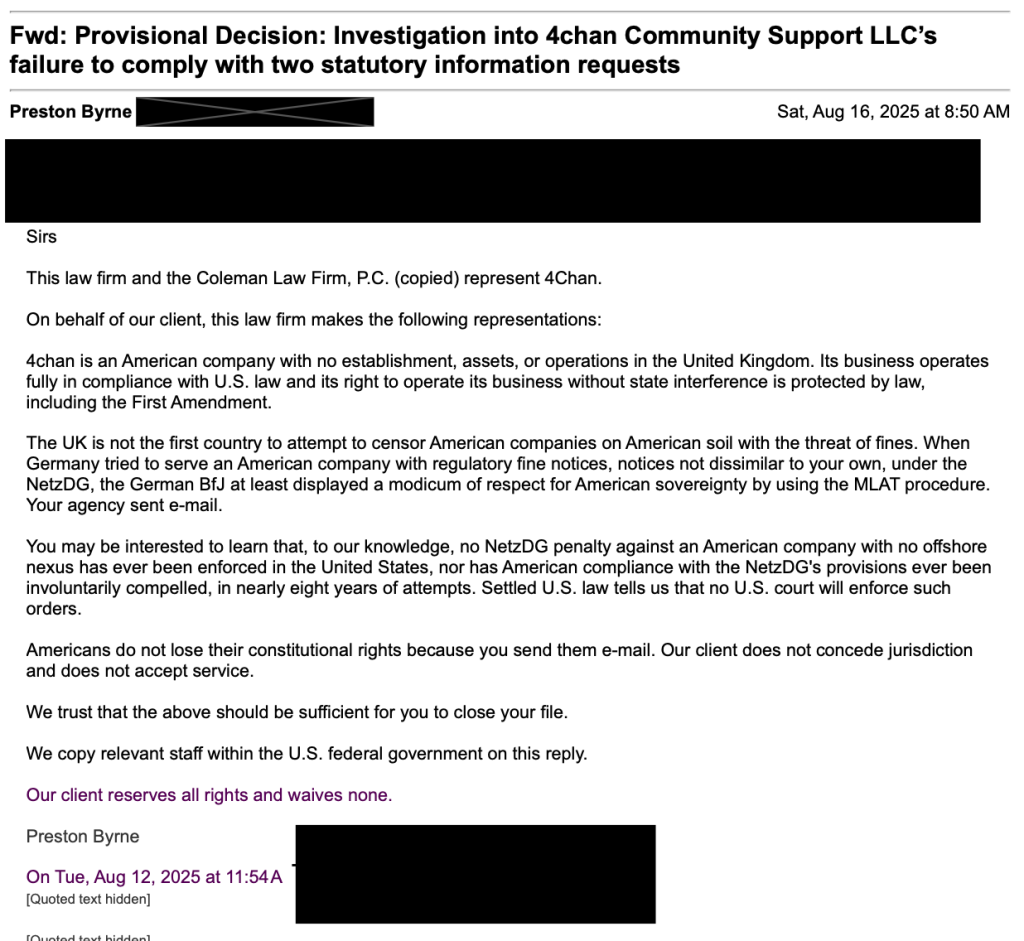
We did two things in response to that. The most newsworthy response was to file a lawsuit against the regulator in the DDC. Before that, however, we explained our position to Ofcom in writing and gave them an opportunity to walk away:
To wit, Ofcom’s fine notices were not properly served and were not enforceable in the United States. Note that we also gave Ofcom fair notice that while this might have been their first attempt to enforce their censorship orders in America, this was not our first rodeo when it came to successfully refusing such orders.
No quantity of officious and haughty foreign demand letters will change our stance. The UK could even pass a bill of attainder – historically Parliament’s most extreme and powerful legislative weapon – against my client, for all I care. My client’s right to operate its service lawfully in the United States is protected by the First Amendment. There is no law Parliament could enact that would change that fact.
I am very familiar with how this movie ends, and it does not end with 4chan paying Ofcom’s fine.
It may end with the UK’s censors getting a blocking order that it serves on its own ISPs; that would be the UK visibly censoring its own people, rather than censoring my client, and doing so ineffectively, at that, as ISP blocks can be circumvented with a VPN. That is a consequence my client is prepared to accept.
England might have the Online Safety Act, but the United States has the U.S. Constitution. These rulesets do not override each other; they are, rather, mutually exclusive. In America’s domain, the Online Safety Act essentially doesn’t exist. It has about as much legal force as a pile of shredded paper one might use to line a hamster’s cage.
Peace was always an option here, but that would have required the UK to abandon the fiction that its rules override the U.S. Constitution on U.S. soil, which we are not prepared to accept.
My clients did not start this fight, but by golly we do intend to finish it.
My client sued Ofcom two weeks later.
There’s much more, so do read the whole thing.
Comments Off on British censorship laws do not apply outside the UK’s jurisdiction


