
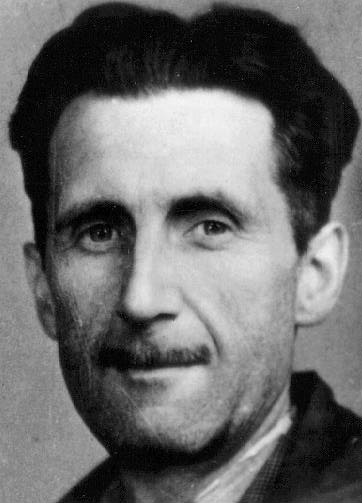
Orwell’s press card portrait, 1943
I have little direct evidence about the atrocities in the Spanish civil war. I know that some were committed by the Republicans, and far more (they are still continuing) by the Fascists. But what impressed me then, and has impressed me ever since, is that atrocities are believed in or disbelieved in solely on grounds of political predilection. Everyone believes in the atrocities of the enemy and disbelieves in those of his own side, without ever bothering to examine the evidence. Recently I drew up a table of atrocities during the period between 1918 and the present; there was never a year when atrocities were not occurring somewhere or other, and there was hardly a single case when the Left and the Right believed in the same stories simultaneously. And stranger yet, at any moment the situation can suddenly reverse itself and yesterday’s proved-to-the-hilt atrocity story can become a ridiculous lie, merely because the political landscape has changed.
In the present war we are in the curious situation that our “atrocity campaign” was done largely before the war started, and done mostly by the Left, the people who normally pride themselves on their incredulity. In the same period the Right, the atrocity-mongers of 1914-18, were gazing at Nazi Germany and flatly refusing to see any evil in it. Then as soon as war broke out it was the pro-Nazis of yesterday who were repeating horror stories, while the anti-Nazis suddenly found themselves doubting whether the Gestapo really existed. Nor was this solely the result of the Russo-German Pact. It was partly because before the war the Left had wrongly believed that Britain and Germany would never fight and were therefore able to be anti-German and anti-British simultaneously; partly also because official war-propaganda, with its disgusting hypocrisy and self-righteousness, always tends to make thinking people sympathize with the enemy. Part of the price we paid for the systematic lying of 1914-17 was the exaggerated pro-German reaction which followed. During the years 1918-33 you were hooted at in left-wing circles if you suggested that Germany bore even a fraction of responsibility for the war. In all the denunciations of Versailles I listened to during those years I don’t think I ever once heard the question, “What would have happened if Germany had won?” even mentioned, let alone discussed. So also with atrocities. The truth, it is felt, becomes untruth when your enemy utters it. Recently I noticed that the very people who swallowed any and every horror story about the Japanese in Nanking in 1937 refused to believe exactly the same stories about Hong Kong in 1942. There was even a tendency to feel that the Nanking atrocities had become, as it were, retrospectively untrue because the British Government now drew attention to them.
But unfortunately the truth about atrocities is far worse than that they are lied about and made into propaganda. The truth is that they happen. The fact often adduced as a reason for scepticism — that the same horror stories come up in war after war — merely makes it rather more likely that these stories are true. Evidently they are widespread fantasies, and war provides an opportunity of putting them into practice. Also, although it has ceased to be fashionable to say so, there is little question that what one may roughly call the “whites” commit far more and worse atrocities than the “reds”. There is not the slightest doubt, for instance, about the behaviour of the Japanese in China. Nor is there much doubt about the long tale of Fascist outrages during the last ten years in Europe. The volume of testimony is enormous, and a respectable proportion of it comes from the German press and radio. These things really happened, that is the thing to keep one’s eye on. They happened even though Lord Halifax said they happened. The raping and butchering in Chinese cities, the tortures in the cellars of the Gestapo, the elderly Jewish professors flung into cesspools, the machine-gunning of refugees along the Spanish roads — they all happened, and they did not happen any the less because the Daily Telegraph has suddenly found out about them when it is five years too late.
George Orwell, “Looking back on the Spanish War”, New Road, 1943 (republished in England, Your England and Other Essays, 1953).
July 16, 2019
July 12, 2019
QotD: Warmongers, propaganda, and the intelligentsia
Orwell’s press card portrait, 1943
Our memories are short nowadays, but look back a bit, dig out the files of New Masses or the Daily Worker, and just have a look at the romantic warmongering muck that our left-wingers were spilling at that time. All the stale old phrases! And the unimaginative callousness of it! The sang-froid with which London faced the bombing of Madrid! Here I am not bothering about the counter-propagandists of the Right […]; they go without saying. But here were the very people who for twenty years had hooted and jeered at the “glory” of war, at atrocity stories, at patriotism, even at physical courage, coming out with stuff that with the alteration of a few names would have fitted into the Daily Mail of 1918. If there was one thing that the British intelligentsia were committed to, it was the debunking version of war, the theory that war is all corpses and latrines and never leads to any good result. Well, the same people who in 1933 sniggered pityingly if you said that in certain circumstances you would fight for your country, in 1937 were denouncing you as a Trotsky-Fascist if you suggested that the stories in New Masses about freshly wounded men clamouring to get back into the fighting might be exaggerated. And the Left intelligentsia made their swing-over from “War is hell” to “War is glorious” not only with no sense of incongruity but almost without any intervening stage. Later the bulk of them were to make other transitions equally violent. There must be a quite large number of people, a sort of central core of the intelligentsia, who approved the “King and Country” declaration in 1935, shouted for a “firm line against Germany” in 1937, supported the People’s Convention in 1940, and are demanding a Second Front now.
As far as the mass of the people go, the extraordinary swings of opinion which occur nowadays, the emotions which can be turned on and off like a tap, are the result of newspaper and radio hypnosis. In the intelligentsia I should say they result rather from money and mere physical safety. At a given moment they may be “pro-war” or “anti-war”, but in either case they have no realistic picture of war in their minds. When they enthused over the Spanish war they knew, of course, that people were being killed and that to be killed is unpleasant, but they did feel that for a soldier in the Spanish Republican army the experience of war was somehow not degrading. Somehow the latrines stank less, discipline was less irksome. You have only to glance at the New Statesman to see that they believed that; exactly similar blah is being written about the Red Army at this moment. We have become too civilized to grasp the obvious. For the truth is very simple. To survive you often have to fight, and to fight you have to dirty yourself. War is evil, and it is often the lesser evil. Those who take the sword perish by the sword, and those who don’t take the sword perish by smelly diseases. The fact that such a platitude is worth writing down shows what the years of rentier capitalism have done to us.
George Orwell, “Looking back on the Spanish War”, New Road, 1943 (republished in England, Your England and Other Essays, 1953).
May 29, 2019
US Soldiers Fighting in Russia – The End of the “Polar Bear Expedition” I THE GREAT WAR May 1919
The Great War
Published on 28 May 2019The so called Allied intervention into the Russian Civil War suffered from no clear operational goals and mandate and when US President Woodrow Wilson pulled out the American soldiers that were fighting in Northern Russia in May 1919, the operation suffered another setback. Public pressure against US foreign intervention was increasing now that Germany had been beaten and many people didn’t understand what American soldiers were doing in Russia anyway. At the same time Winston Churchill and his supporters maintained that it was vital to defeat the Bolsheviks in Russia once and for all.
» SUPPORT THE CHANNEL
Patreon: https://www.patreon.com/thegreatwar
Merchandise: https://shop.spreadshirt.de/thegreatwar/» SOURCES
Crownover, Roger. The United States Intervention in North Russia, 1918-1919: The Polar Bear Odyssey. Edwin Mellen Press, 2001.Wright, Damien. Churchill’s Secret War With Lenin: British and Commonwealth Military Intervention in the Russian Civil War, 1918-20, Helion and Company, 2017
Long, John W. “American Intervention in Russia: the North Russian Expedition, 1918-1919,” in Arthur Dudden, ed. American empire in the Pacific: from trade to strategic balance 1700 – 1922 (Aldershot: Ashgate, 2004): 321-344.
Mawdsley Evan. The Russian Civil War, Pegasus Books, 2019
Moore, Joel. The History of the American Expedition Fighting the Bolsheviki Campaigning in North Russia 1918-1919 (1920)
»CREDITS
Presented by: Jesse Alexander
Written by: Jesse Alexander
Director: Toni Steller & Florian Wittig
Director of Photography: Toni Steller
Sound: Toni Steller
Editing: Toni Steller
Mixing, Mastering & Sound Design: http://above-zero.com
Motion Design: Christian Graef – GRAEFX
Maps: Daniel Kogosov (https://www.patreon.com/Zalezsky)
Research by: Jesse Alexander
Fact checking: Florian WittigChannel Design: Alexander Clark
Original Logo: David van StepholdA Mediakraft Networks Original Channel
Contains licensed material by getty images
All rights reserved – Real Time History GmbH 2019
May 15, 2019
1984 – Dystopias and Apocalypses – Extra Sci Fi
Extra Credits
Published on 14 May 2019What makes 1984 still relevant to modern readers is that it serves as a warning against fascism in all its possible forms. George Orwell’s service fighting in the Spanish Civil War led him to see that the heart of totalitarianism is about xenophobia and nationalism no matter which kind of government it came from.
The idea that Orwell presents us in 1984 is that people subtle enough and brutal enough can take the undirected dissatisfaction and anger of a society and point it at whatever they will, using us to damn ourselves.
May 13, 2019
U.S. Civil War – Surprising Soldiers – Extra History
Extra Credits
Published on 11 May 2019Historians have been learning that the US Civil War armies were a lot more diverse than previously accounted for — partly because many soldiers who hailed from other countries and nations used adopted names. Chinese, Hawaiian, Hispanic, and Cherokee soldiers all participated on both sides of the US civil war — suffering even more conflict in some cases.
Researchers are beginning to learn that the makeup of the Union and Confederate armies in the US Civil War was a lot more nuanced and diverse than we had previously known. Here is an episode on the accounts of some of those surprising soldiers!
Join us on Patreon! http://bit.ly/EHPatreon
April 17, 2019
Lee Carbine: Gunmaking is not for the Faint of Heart
Forgotten Weapons
Published on 16 Apr 2019This rifle is lot #13868 at Morphy’s April 2019 auction:
https://www.forgottenweapons.com/lee-…James Paris Lee is known today as the inventor of the detachable box magazine, and the “Lee” in the “Lee Enfield” rifle system – a very significant contributor to firearms development. His first foray into the business of gun design and manufacture, however, was a rather ignominious failure.
Lee patented a single shot swinging barrel system in 1862, and hoped to win an Army contract for it. In February of 1864 he submitted a rifle version to the Army, and was promptly rejected – the Army was not interested in breechloading rifles. Lee came right back in April 1864 with a carbine pattern, and this was accepted for testing – the Army was indeed looking for breechloading cavalry carbines. It took a full year, but in April 1865 the Army came back and gave Lee a contract for 1,000 carbines at $18 each. Lee rounded up investors and capital, and created the Lee Fire Arms Company in Milwaukee to produce the guns. His first two samples were delivered in January 1866 – in .42 rimfire caliber.
At this point, there is some disagreement. Lee claims that his sample guns in .42 caliber were accepted, and thus his followup delivery of .42 caliber carbines should have been accepted. The government said that the contract specified .44 rimfire caliber, and his delivery of .42 caliber guns was unacceptable, and thus rejected. A court case would ensue, but with the rejection of the first 250 guns and the cancellation of their contract, the company had to look hard and fast for a backup plan. In March 1867 newspaper ads were placed in Milwaukee for sporting rifles and carbines from the Lee company. The parts planned for military production were used instead for civilian guns in a variety of configurations – carbines, light rifles, and heavy rifles in several barrel lengths and several calibers. By 1868 all production had ceased, and the Lee Fire Arms Company dissolved.
James Lee returned to his former profession of watchmaking, but this experience with gun manufacturing would not keep him deterred for long. By 1872 he was back working with Remington, and would go on the produce the designs that we know him for today. The lessons of this rifle? Firearms manufacturing is a risky business, not for the faint of heart. And also, sometimes you can learn from a difficult experience to do better the second time.
http://www.patreon.com/ForgottenWeapons
Cool Forgotten Weapons merch! http://shop.bbtv.com/collections/forg…
Contact:
Forgotten Weapons
PO Box 87647
Tucson, AZ 85754
April 13, 2019
Canadian 8mm “Sterile” Bren Gun
Forgotten Weapons
Published on 12 Apr 2019This Bren is lot #1013 at Morphy’s April 2019 auction:
https://www.forgottenweapons.com/cana…The John Inglis company in Toronto first opened in 1859 as a metalworking shop, and grew steadily over the decades under first John Inglis, and then later his sons. Inglis did substantial amounts of military work during World War One, but the Great Depression hit it hard, and both William and Alexander Inglis died in 1935 and 1936 respectively. The company went into receivership but was purchased by one Major James Hahn (DSO) and a group of business partners in November of 1936. Hahn and his associates saw an opportunity to use this large manufacturing facility to make machine guns for the military, and they were successful – in October 1938 they were awarded a contract to make 5000 MkI Bren guns. More contracts would follow, and by the height of World War Two the company had some 15,000 employees and more than a million square feet of floor space.
Among many other projects, Inglis was contracted to make small arms for sale to the Nationalist Chinese government under Chiang Kai Shek – both High Power pistols and Bren guns in 8mm Mauser (to fit the Chinese standardization on that cartridge). A batch of 8mm ZB-30 light machine guns were brought in from the Far East to use as a pattern, and Inglis engineers were able to successfully redesign the Bren to use that cartridge and magazine.
Where the story gets hazy is in trying to determine how many were made and for whom. The Chinese guns are marked in Mandarin on the receivers, and have “CH” prefix serial numbers, like the Chinese contract High Power pistols. However, two additional variations exist without those Chinese markings. Some are marked “7.92 Bren MkI” and “Inglis 1943” (or 44 or 45), and others – like this one – are just marked “7.92 Bren MkI”. The dated ones are typically referred to as Resistance guns, intended to be supplied to European resistance units for whom 7.92mm ammunition was more readily available than .303 – although information on how many guns were supplied in this way (if any) is difficult to find. The last group is generally called “sterile”, and it is not clear what their purpose is. This particular example is one of 23 that were registered in the US in the early 1960s to Interarms, and it does appear that they were associated with some clandestine US military activities. The serial numbers of those 23 Interarms guns range from 1-5343 to 2-8045, suggesting a production of 13,000 or perhaps as many as 28,000 guns – that is quite a lot to be undocumented and missing.
Hopefully, more information will turn up in the future to shed light on the purpose and use of these 8mm Brens. We do know for sure that many thousands did go to Chinese forces, and some were brought into the UK, where in the 1960s they were used in the development of the 7.62mm NATO L4 version of the Bren.
http://www.patreon.com/ForgottenWeapons
Cool Forgotten Weapons merch! http://shop.bbtv.com/collections/forg…
Contact:
Forgotten Weapons
PO Box 87647
Tucson, AZ 85754
April 6, 2019
QotD: Truth and propaganda in the Spanish Civil War
The struggle for power between the Spanish Republican parties is an unhappy, far-off thing which I have no wish to revive at this date. I only mention it in order to say: believe nothing, or next to nothing, of what you read about internal affairs on the Government side. It is all, from whatever source, party propaganda — that is to say, lies. The broad truth about the war is simple enough. The Spanish bourgeoisie saw their chance of crushing the labour movement, and took it, aided by the Nazis and by the forces of reaction all over the world. It is doubtful whether more than that will ever be established.
I remember saying once to Arthur Koestler, ‘History stopped in 1936’, at which he nodded in immediate understanding. We were both thinking of totalitarianism in general, but more particularly of the Spanish civil war. Early in life I have noticed that no event is ever correctly reported in a newspaper, but in Spain, for the first time, I saw newspaper reports which did not bear any relation to the facts, not even the relationship which is implied in an ordinary lie. I saw great battles reported where there had been no fighting, and complete silence where hundreds of men had been killed. I saw troops who had fought bravely denounced as cowards and traitors, and others who had never seen a shot fired hailed as the heroes of imaginary victories; and I saw newspapers in London retailing these lies and eager intellectuals building emotional superstructures over events that had never happened. I saw, in fact, history being written not in terms of what happened but of what ought to have happened according to various ‘party lines’. Yet in a way, horrible as all this was, it was unimportant. It concerned secondary issues — namely, the struggle for power between the Comintern and the Spanish left-wing parties, and the efforts of the Russian Government to prevent revolution in Spain. But the broad picture of the war which the Spanish Government presented to the world was not untruthful. The main issues were what it said they were. But as for the Fascists and their backers, how could they come even as near to the truth as that? How could they possibly mention their real aims? Their version of the war was pure fantasy, and in the circumstances it could not have been otherwise.
The only propaganda line open to the Nazis and Fascists was to represent themselves as Christian patriots saving Spain from a Russian dictatorship. This involved pretending that life in Government Spain was just one long massacre (vide the Catholic Herald or the Daily Mail — but these were child’s play compared with the Continental Fascist press), and it involved immensely exaggerating the scale of Russian intervention. Out of the huge pyramid of lies which the Catholic and reactionary press all over the world built up, let me take just one point — the presence in Spain of a Russian army. Devout Franco partisans all believed in this; estimates of its strength went as high as half a million. Now, there was no Russian army in Spain. There may have been a handful of airmen and other technicians, a few hundred at the most, but an army there was not. Some thousands of foreigners who fought in Spain, not to mention millions of Spaniards, were witnesses of this. Well, their testimony made no impression at all upon the Franco propagandists, not one of whom had set foot in Government Spain. Simultaneously these people refused utterly to admit the fact of German or Italian intervention at the same time as the Germany and Italian press were openly boasting about the exploits of their’ legionaries’. I have chosen to mention only one point, but in fact the whole of Fascist propaganda about the war was on this level.
This kind of thing is frightening to me, because it often gives me the feeling that the very concept of objective truth is fading out of the world. After all, the chances are that those lies, or at any rate similar lies, will pass into history. How will the history of the Spanish war be written? If Franco remains in power his nominees will write the history books, and (to stick to my chosen point) that Russian army which never existed will become historical fact, and schoolchildren will learn about it generations hence. But suppose Fascism is finally defeated and some kind of democratic government restored in Spain in the fairly near future; even then, how is the history of the war to be written? What kind of records will Franco have left behind him? Suppose even that the records kept on the Government side are recoverable — even so, how is a true history of the war to be written? For, as I have pointed out already, the Government, also dealt extensively in lies. From the anti-Fascist angle one could write a broadly truthful history of the war, but it would be a partisan history, unreliable on every minor point. Yet, after all, some kind of history will be written, and after those who actually remember the war are dead, it will be universally accepted. So for all practical purposes the lie will have become truth.
George Orwell, “Looking back on the Spanish War”, New Road, 1943 (republished in England, Your England and Other Essays, 1953).
March 31, 2019
QotD: Gandhi’s not-so-non-violent followers
… it is not widely realized (nor will this film tell you) how much violence was associated with Gandhi’s so-called “nonviolent” movement from the very beginning. India’s Nobel Prize-winning poet, Rabindranath Tagore, had sensed a strong current of nihilism in Gandhi almost from his first days, and as early as 1920 wrote of Gandhi’s “fierce joy of annihilation,” which Tagore feared would lead India into hideous orgies of devastation — which ultimately proved to be the case. Robert Payne has said that there was unquestionably an “unhealthy atmosphere” among many of Gandhi’s fanatic followers, and that Gandhi’s habit of going to the edge of violence and then suddenly retreating was fraught with danger. “In matters of conscience I am uncompromising,” proclaimed Gandhi proudly. “Nobody can make me yield.” The judgment of Tagore was categorical. Much as he might revere Gandhi as a holy man, he quite detested him as a politician and considered that his campaigns were almost always so close to violence that it was utterly disingenuous to call them nonviolent.
For every satyagraha true believer, moreover, sworn not to harm the adversary or even to lift a finger in his own defense, there were sometimes thousands of incensed freebooters and skirmishers bound by no such vow. Gandhi, to be fair, was aware of this, and nominally deplored it — but with nothing like the consistency shown in the movie. The film leads the audience to believe that Gandhi’s first “fast unto death,” for example, was in protest against an act of barbarous violence, the slaughter by an Indian crowd of a detachment of police constables. But in actual fact Gandhi reserved this “ultimate weapon” of his to interdict a 1931 British proposal to grant Untouchables a “separate electorate” in the Indian national legislature — in effect a kind of affirmative-action program for Untouchables. For reasons I have not been able to decrypt, Gandhi was dead set against the project, but I confess it is another scene I would like to have seen in the movie: Gandhi almost starving himself to death to block affirmative action for Untouchables.
From what I have been able to decipher, Gandhi’s main preoccupation in this particular struggle was not even the British. Benefiting from the immense publicity, he wanted to induce Hindus, overnight, ecstatically, and without any of these British legalisms, to “open their hearts” to Untouchables. For a whole week Hindu India was caught up in a joyous delirium. No more would the Untouchables be scavengers and sweepers! No more would they be banned from Hindu temples! No more would they pollute at 64 feet! It lasted just a week. Then the temple doors swung shut again, and all was as before. Meanwhile, on the passionate subject of swaraj, Gandhi was crying, “I would not flinch from sacrificing a million lives for India’s liberty!” The million Indian lives were indeed sacrificed, and in full. They fell, however, not to the bullets of British soldiers but to the knives and clubs of their fellow Indians in savage butcheries when the British finally withdrew.
Richard Grenier, “The Gandhi Nobody Knows”, Commentary, 1983-03-01.
March 19, 2019
The Russian Civil War in Early 1919 I THE GREAT WAR
The Great War
Published on 18 Mar 2019Check out The Great War Miniatures Game: http://bit.ly/BattlefrontMiniatures
Use “greatwarchannel1” for 25% off of the Great War Game Book
Use “greatwarchannel2” for 10% off of any Army Deal plus free shipping worldwide.The biggest conflict, or rather series of conflicts, that had their roots in the First World War are today known as the Russian Civil War. After the October Revolution the Bolsheviks under Vladimir Lenin and Leon Trotsky fought all across the former Russian Empire to consolidate their power.
» SUPPORT THE CHANNEL
Patreon: https://www.patreon.com/thegreatwar
Merchandise: https://shop.spreadshirt.de/thegreatwar/» SOURCES
Figes, Orlando. A People’s Tragedy. The Russian Revolution (London: The Bodley Head, 2017 [1996]).Mawdsley, Evan. The Russian Civil War (New York: Pegasus Books, 2005).
Robert Gerwarth, The Vanquished. Why the First World War Failed to End, 1917-1923 (Penguin, 2017)
Gattrell, Peter. Russia’s First World War (Pearson, 2005).
Leonhard, Jörn. Der überforderte Frieden. Versailles und die Welt 1918-1923 (CH Beck, 2018).
Lloyd George, David. The Truth About the Peace Treaties, vol 1, (London: Victor Glocancz, 1938).
Mawdsley, Evan. “International Responses to the Russian Civil War,” in 1914-1918 online.
International Encyclopedia of the First World War. https://encyclopedia.1914-1918-online…Peeling, Siobhan. “War Communism,” in 1914-1918 online.
International Encyclopedia of the First World War. https://encyclopedia.1914-1918-online…Smele, Jonathan. The ‘Russian’ Civil Wars 1916-1926 (London: Hurst, 2015).
Sumpf, Alexandre. “Russian Civil War,” in 1914-1918 online.
International Encyclopedia of the First World War. https://encyclopedia.1914-1918-online…Volkov, Evgenii. “Czech Legions,” in 1914-1918 online.
International Encyclopedia of the First World War. https://encyclopedia.1914-1918-online…» SOCIAL MEDIA
Twitter: https://twitter.com/WW1_Series
Reddit: https://reddit.com/r/TheGreatWarChannel»CREDITS Presented by: Jesse Alexander
Written by: Jesse Alexander
Director: Toni Steller & Florian Wittig
Director of Photography: Toni Steller
Sound: Toni Steller
Editing: Toni Steller
Mixing, Mastering & Sound Design: http://above-zero.com
Motion Design: Christian Graef – GRAEFX
Maps: Daniel Kogosov (http://patreon.com/Zalesky)
Research by: Jesse Alexander
Fact checking: Florian Wittig
Channel Design: Alexander Clark Original Logo: David van StepholdA Mediakraft Networks Original Channel
Contains licenced material by getty images
All rights reserved – Real Time History GmbH i.Gr. 2019
March 4, 2019
QotD: Gandhi and the partition of India
Anyone who wants to wade through Gandhi’s endless ruminations about himsa and ahimsa (violence and nonviolence) is welcome to do so, but it is impossible for the skeptical reader to avoid the conclusion — let us say in 1920, when swaraj (home rule) was all the rage and Gandhi’s inner voice started telling him that ahimsa was the thing — that this inner voice knew what it was talking about. By this I mean that, though Gandhi talked with the tongue of Hindu gods and sacred scriptures, his inner voice had a strong sense of expediency. Britain, if only comparatively speaking, was a moral nation, and nonviolent civil disobedience was plainly the best and most effective way of achieving Indian independence. Skeptics might also not be surprised to learn that as independence approached, Gandhi’s inner voice began to change its tune. It has been reported that Gandhi “half-welcomed” the civil war that broke out in the last days. Even a fratricidal “bloodbath” (Gandhi’s word) would be preferable to the British.
And suddenly Gandhi began endorsing violence left, right, and center. During the fearsome rioting in Calcutta he gave his approval to men “using violence in a moral cause.” How could he tell them that violence was wrong, he asked, “unless I demonstrate that nonviolence is more effective?” He blessed the Nawab of Maler Kotla when he gave orders to shoot ten Muslims for every Hindu killed in his state. He sang the praises of Subhas Chandra Bose, who, sponsored by first the Nazis and then the Japanese, organized in Singapore an Indian National Army with which he hoped to conquer India with Japanese support, establishing a totalitarian dictatorship. Meanwhile, after independence in 1947, the armies of the India that Gandhi had created immediately marched into battle, incorporating the state of Hyderabad by force and making war in Kashmir on secessionist Pakistan. When Gandhi was assassinated by a Hindu extremist in January 1948 he was honored by the new state with a vast military funeral — in my view by no means inapposite.
Richard Grenier, “The Gandhi Nobody Knows”, Commentary, 1983-03-01.
February 14, 2019
January 21, 2019
Sun Yat-sen – A Bombing in Wuchang – Extra History – #4
Extra Credits
Published on 19 Jan 2019Another group of revolutionaries in China, the Wuchang Uprising, accidentally kicked off their own plans earlier than expected, which lead to Sun starting an international diplomatic mission and then being appointed the head of the new republic. But Yuan Shikai, the current Prime Minister, had plans of his own…
Join us on Patreon! http://bit.ly/EHPatreon
December 18, 2018
Conflicts & Wars In The Aftermath of WW1 I THE GREAT WAR Epilogue
The Great War
Published on 17 Dec 2018In our last epilogue special we outline the wars and conflicts that followed World War 1, some of them immediately and some of them with only a brief period of peace. Even in 1919 it was already clear that “the war to end all wars” didn’t in fact do that and that the new world order would be shaped by violence.
—
hey guys and girls, with this last video, our epilogue series is over and this was the very last episode featuring Indy. Again, this was more meant as an appetizer for the future of the show now. When we filmed this, we didn’t know, yet that we could continue working on the show. We will make an announcement about what to expect next year this week. Cheers Flo
—
– CREDITS –
Presented by: Indiana Neidell
Written by: Indiana Neidell
Director: Toni Steller & Florian Wittig
Director of Photography: Toni Steller
Sound: Toni Steller
Mixing, Mastering & Sound Design: www.above-zero.com
Editing: Toni Steller, Julian Zahn
Motion Design: Christian Graef
Research by: Indiana Neidell
Fact checking: Markus LinkeThe Great War Theme composed by Karim Theilgaard: http://bit.ly/karimyt
A Mediakraft Networks Original Channel
Based on a concept by Spartacus Olsson
Author: Indiana Neidell
Visual Concept: David van Stephold
Producer: Toni Steller & Florian Wittig
Social Media Manager: Florian WittigContains licenced Material by British Pathé
All rights reserved – © Mediakraft Networks GmbH, 2018


