
TimeGhost History
Published 22 Jun 2025That prolonged war triggers an increase in male baby births had been ordered since at least 250 years. This “returning soldier effect” happens again during WW2 and right after. How this happens is a mystery, but research in the past decades might provide some answers.
(more…)
June 23, 2025
How Sex in War Breeds Boys – W2W 33
Comments Off on How Sex in War Breeds Boys – W2W 33
US strikes against Iranian nuclear facilities
One of the most frustrating aspects of internet culture today is the need for instantaneous “analysis” of military events. We all understand the desire for such insight, but the accuracy of information available in the immediate aftermath of any event is highly variable. Between the need to control the narrative on the part of the participant powers, the propaganda value of being “first” to report, and the impossibility of accurate damage assessment, it’s a wise move to discount almost everything you hear about a big event for some time. Chris Bray suggests that the old “72 hours rule” may be insufficient for something like the US bunker busting strikes against Iranian nuclear research facilities:

First, wait a while. Sean Hannity just announced that “a source” told him the attack was a complete success, and all of Iran’s nuclear sites were fully destroyed. I’d hesitate to believe that, is the gentle way to put it. I’d also hesitate to believe the stories being told from the other direction, and don’t forget that Trump’s attack on Qasem Soleimani produced a full week of OH NO WORLD WAR III JUST BEGAN stories in the establishment media. The likelihood is that none of what you’re hearing this week is fully true. Wait and watch. I hope that Iran and the US are backchanneling while engaging in belligerent public posturing, but by definition we’re not going to see the backchanneling. We’ll see. The 72 Hour Rule is in effect, here, at the very least.
Second, the ludicrous story in which Trump is violating law and political norms with unilateral military action is, as always, a deliberate performance of political amnesia. These are our political norms, for crying out loud.
We should probably fix that. But the people who tolerated an American war in Libya without direct congressional authorization, and who tolerated an American war in Yemen without direct congressional authorization, and who tolerated an American war in Syria without direct congressional authorization, aren’t actually going to impeach a president over military strikes in the Middle East undertaken without direct congressional authorization. It’s a show. The More Than a Week Rule requires us to view this action in the longer and generally quite unfortunate context of American foreign policy, and the politicians who are outraged by unilateral military action in the Middle East have zero standing on that score.
Third, and related, the 2001 Authorization to Use Military Force is still in effect, and still being stretched and massaged beyond its intent and meaning, but note that Congress still hasn’t repealed it. A Congress that wished to restrain presidential military action in the Middle East would probably start there, and they haven’t.
Glenn “Instapundit” Reynolds has a few thoughts on the matter:
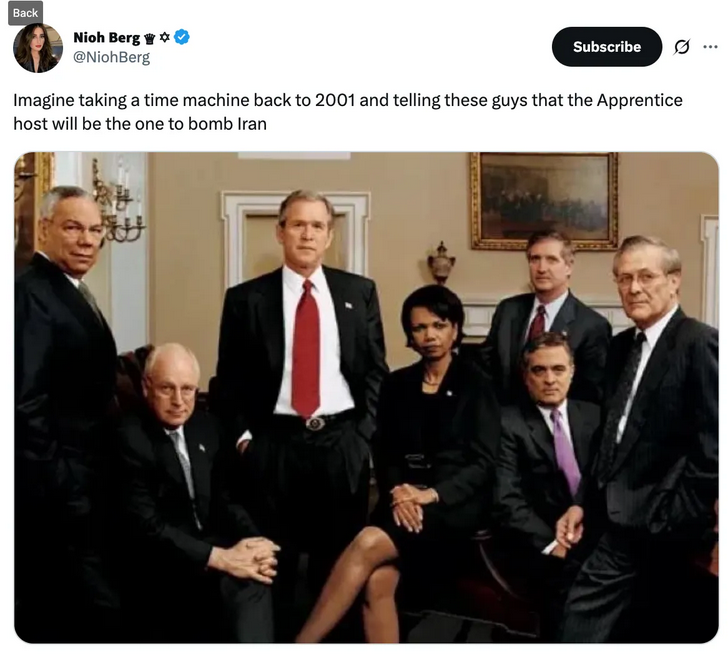
People have been singing about it since 1980, but yesterday’s bombing raids on Iranian nuclear facilities were the first bombing attack since the 1979 hostage seizure.
Despite numerous calls for action against the Islamic Republic, Operation Midnight Hammer was the first U.S. military action against important Iranian assets on Iranian territory. The bombs fell less than 24 hours ago, but here are a few preliminary takes.
Competence. The most striking thing about the attacks was the extreme competence displayed by the Air Force, the Defense Department under Secretary Pete Hegseth, the various intelligence assets involved, the State Department, and the entire administration. There were no leaks. (How did they avoid leaks? Basically, they didn’t tell any Democrats what was coming. Take note.)
Not only were there no leaks, but President Trump and the diplomatic apparatus kept the Iranians in the dark, giving the impression of waffling in the White House even as things were being lined up. They received unintentional help in this from Sen. Charles Schumer, who had been for some time pushing the “TACO” acronym — Trump Always Chickens Out — in the service of a storyline that Trump was all bluster and no follow-through. The Iranians, apparently dumb enough to believe Democrats and the mainstream news media (but I repeat myself) were snookered.
New Diplomacy: In dealing with the Iranians in the 1980s, Donald Regan told President Reagan that America had been repeatedly “snookered” by a bunch of “rug merchants”. The Iranians were in fact very good at leading Americans down the garden path, invoking (often imaginary) splits between “hard-line” and “moderate” Islamists in their government as excuses for delay and backtracking.
In truth, as Henry Kissinger once said, “An Iranian moderate is one who has run out of ammunition“. After these raids, and the many Israeli attacks that led up to them, all of Iran is out of ammunition.
Comments Off on US strikes against Iranian nuclear facilities
June 22, 2025
Delaying Mark Carney’s next book
In the latest SHuSH newsletter, Ken Whyte outlines the various oddities of Mark Carney’s next book to market:

Three years ago, long before he declared himself a politician, Mark Carney published Value(s), his attempt at solving some of the world’s biggest problems: income inequality, climate change, systemic racism, etc. The book was reasonably well received. It sold well. A sequel was in order.
Announced last year, The Hinge: Time to Build an Even Better Canada was ostensibly Carney’s attempt to address Canada’s biggest issues, and perhaps to position himself as our future leader. The book was set for release in May 2025. Events interceded and Carney was elected prime minister on a far tighter timeline than anyone, including his publisher, could have imagined. Publication of The Hinge was delayed. An anonymous source told the Toronto Star Carney was too busy politicking to finish the final edits on the book. I heard the delay had more to do with campaign finance rules that would consider a book publicized or released in election season as political advertising. Anyway, a new release date was set for July 1. Amazon now has The Hinge coming next January.
Carney’s political opponents have been enjoying the delay. Critics both left and right have attributed it to the difficulty of squaring positions taken by Carney a year or two ago with positions he espoused during the campaign and, more recently, as prime minister.
I don’t doubt that Carney’s politics have moved over the last six months. And I wouldn’t be surprised if his second book is being rewritten in whole or in part. I don’t have a problem with that. Much has happened, both in Canada and south of the border. We’ve all been reconsidering our positions.
My problem with Carney’s conduct is not that he’s revising his manuscript, if he is, but that he’s not revising his publishing contract.
The Hinge is set to be published by Signal. Signal is a division of McClelland & Stewart. M&S is a division of Penguin Random House Canada. PRHC is a division of Penguin Random House LLC, corporate headquarters at 1745 Broadway, 3rd Floor, New York, New York, 10019.
Penguin Random House LLC is owned by Bertelsmann, a media conglomerate in Gütersloh, Germany, but legally and operationally, it is a US company. Its executive leadership, including CEO Nihar Malaviya, works out of the above address. Strategy and publishing priorities are set in New York, and profits in PRH’s many far-flung international divisions flow to New York. So the prime minister of Canada is publishing his book with the Canadian branch plant of a US company.
Other recent prime ministers have done the same. Justin Trudeau published Common Ground with HarperCollins. Steven Harper published Right Here, Right Now with Signal, and his forthcoming memoir sits there, too. Jean Chretien released My Stories, My Time with Random House Canada. Most of our politicians have published with branch plants of American firms.
I should add that many of our best writers publish at these same branch plants, if not directly with US publishers. (Even middling scribblers like me have published directly in the US.)
But, again, the world has changed. To quote no less an authority than Mark Carney, Canada’s old relationship with the US, “based on deepening integration of our economies and tight security and military cooperation, is over”. We need to “fundamentally reimagine our economy”, “retool” our industry, and enhance our self-sufficiency.
He sees our cultural relationship with the US as part of this project. From the Liberal platform: “In this time of crisis, protecting Canada means protecting our culture, our journalism, our perspectives. The Americans have threatened our sovereignty and issued inflammatory statements about our economy; we need to be able to tell a story that fights back.”
Right under the cultural section of the platform was a “Buy Canadian” plank. “At a time when our economy is under threat, consumers want to do their part as patriotic Canadians, buying things that are truly made here.” Team Carney promised to make it easier to determine what is and isn’t a Canadian product and prioritize made-in-Canada suppliers in every sector of the economy, limiting bidders from foreign suppliers, and so on.
So it’s “eLbOwS uP!” for the voters, but carry on publishing your next book through a US-owned subsidiary, eh? You have to admit they wear their hypocrisy proudly.
Comments Off on Delaying Mark Carney’s next book
June 20, 2025
QotD: The innate appeal of socialism
It’s easy to understand Socialism’s emotional appeal. It’s undiminished, even now, despite it all, because it touches something deep — something good — in the human soul. Read Oliver Twist and you’ll see it right away. Or if Dickens isn’t your thing, do an image search for Jacob Riis’s How the Other Half Lives. It’ll break your heart. No matter if their parents are gutter drunks […] no child deserves to live like that.
And the material side of Socialism is technically feasible. Obviously so, and indeed it was obvious by 1865. Consider what the Union Army had to do to keep one million men in the field, simultaneously, spread over hundreds of thousands of square miles. This was not without its problems, of course — soldiers finally receiving their back pay spurred a minor economic boom in 1865-6 — but it was not just possible, but an everyday occurrence, for hundreds of thousands of men, dispersed over a huge geographic area, to receive their entire subsistence from the government. Clothes, shoes, food — the stuff Riis’s “street Arabs” would’ve killed for — all at public expense, delivered with clockwork efficiency.
If Socialism were just that, then indeed we could’ve “built Socialism”, as the Bolsheviks would have it, by the end of the 19th century. And cheaply, too — by the late 1880s, the US Treasury’s massive surplus was a major campaign issue for both parties. The “Yankee Leviathan“, as political historian Richard Bensel put it, was as close to actual Fascism as has ever been put into practice (alas, the term hadn’t been invented yet), and it was just aces at delivering the material goods. (It’s Alanis-level ironic that the Confederacy was even more actual capital-F Fascistic than the Union, given the whole “states’ rights” thing, but that’s what happens in totaler Krieg — win first, sort the theory out later).
Severian, “Purpose”, Founding Questions, 2021-12-06.
Comments Off on QotD: The innate appeal of socialism
June 19, 2025
The Guns of the South: Checkmate, Alt-Hist Plausibility Sticklers
Feral Historian
Published 24 Jan 2025Harry Turtledove’s The Guns of the South gives us a look at a victorious Confederate States as they grapple with the consequences of slavery, war, and the challenges of building a new nation. It also skewers a favorite activity of alt-history readers, the nitpicking of plausibility in the points of divergence, by dropping South African time travelers with AKs into the middle of the Civil War.
00:00 Intro
02:08 America Will Break
04:49 Right and Left
05:36 CSA at odds with AWB
08:08 Forrest
10:16 Technology
13:16 “Why then …”
Comments Off on The Guns of the South: Checkmate, Alt-Hist Plausibility Sticklers
June 18, 2025
The Korean War Week 52 – MacArthur Fades, Ceasefire Hopes Rise – June 17 , 1951
The Korean War by Indy Neidell
Published 17 Jun 2025The UN troops continue their advance to the Kansas Line, meeting no resistance at Pynoggang, but heavy resistance beyond it inside the Iron Triangle. 8th Army Commander Jim Van Fleet does not want to advance much beyond where they are now, though, since territory further north would be tougher to defend, should ceasefire talks begin. And Douglas MacArthur continues to tour the states, but to ever smaller crowds.
(more…)
Comments Off on The Korean War Week 52 – MacArthur Fades, Ceasefire Hopes Rise – June 17 , 1951
QotD: The “doctrine of media untruth”
Put another way, the media’s “truth” is a good guide to what is abjectly false. Perhaps we can call the lesson of this valuable service, the media’s inadvertent ability to convey truth by disguising it with transparent bias and falsehood, the “Doctrine of Media Untruth”.
Victor Davis Hanson, “The Doctrine of Media Untruth”, American Greatness, 2020-05-24.
Comments Off on QotD: The “doctrine of media untruth”
June 15, 2025
America’s Forgotten SMG: The Hyde/Marlin M2
Forgotten Weapons
Published 4 Oct 2019 #36270The United States went into World War Two with the Thompson submachine gun — a weapon far too heavy and too expensive for its role. The British went to the other extreme with the Sten and while the US did not want a gun quite that crude, the Sten did spur a desire for something cheaper than the Thompson. George Hyde (then working for the Inland Division of GM) had worked on submachine gun designs in the 1930s, and he put together a weapon that would fit US needs. It was much cheaper than the Thompson and weighed in a full 2 pounds lighter. At tests in the spring of 1942, it also proved to be much more accurate in automatic firing, as it had a much more ergonomic stock design than the Thompson. The weapon was approved as the M2 submachine gun in 1942, and a contract went to Marlin to produce it (Inland had no extra production capacity at the time).
The receiver of the M2 was made through a metal sintering process, and Marlin had trouble getting this properly tooled up. The first gun delivery didn’t actually happen until May of 1943, and by that time Hyde had finished designing the M3 “Grease Gun”, which was cheaper still, and more attractive to the military. The contract for the M2 was cancelled in June of 1943, with only 400 guns delivered. There are only six known surviving examples today, split between private collections, museums, and military institutions.
(more…)
Comments Off on America’s Forgotten SMG: The Hyde/Marlin M2
June 14, 2025
QotD: University students or NPCs?
A few semesters on, and that no longer applied. Sure, sure, they were still teenagers, and still pulled typical teenager capers … but a new set of behaviors crept in. I can’t describe them exactly, in detail, but the overall impression was: here’s someone doing a pretty good impersonation of a teenager. Most every kid goes through the faux-sophisticate stage, usually somewhere around age 12, and this kinda looked like that — young kids pretending to be a lot older — but it also looked a lot like the opposite end of the spectrum. Not quite “hello, fellow teens!” — not yet — but there was something like that going on, too. It was weird, but I figured it was mostly in my head — I’ve always been a grouchy old man, but now I was actually chronologically old enough to let my freak flag fly, so I assumed that’s what I was doing. They’re not changing, I am …
Fast forward a few more semesters, and nope, it’s definitely them. The kids at the tail end of my career still looked like bargain basement Rich Littles, doing impersonations of teenagers, but their act was terrible. Remember a few years back, when Facebook or Twitter or whoever tried to make an AI chat bot, and it immediately turned super racist? Not that these kids were racists — they were the furthest thing from that — but they all seemed to have a small stock of crowdsourced responses. And that’s ALL they had, so no matter what the situation, they’d shoehorn it in to one of their canned affects, because that’s all they had.
By the very end, interacting with them was like playing one of those old text-adventure games from the very dawn of the personal computer, like Zork. They’d respond to commands, but only the right commands, in the exact word order. No deviations allowed, and of course their responses were equally programmed.
Severian, “Terminators”, Founding Questions, 2021-12-04.
Comments Off on QotD: University students or NPCs?
June 13, 2025
QotD: The Subaru BRAT
If you know this truck, you also know why it’s no longer available.
Such fun things are no longer allowed.
They are not saaaaaaaaaaaaaaaaafe! “Moms” are “concerned”!
But in 1977, the Safety Cult — which ended such fun things — was still a backwater aberration, like dancing with rattlesnakes — and most people still esteemed fun over fear. There were roofless Broncos and K5 Blazers — and cars with beds.
You could buy all kinds of different stuff back when America was still a fairly free country — and the Subaru BRAT was as different as it got.
BRAT — all caps — was short for Bi-Drive Recreational All-Terrain Transporter. It was superficially similar to other small import pickups of the ’70s, such as the Datsun 620 and similar models from Toyota (SR5), Mazda (B210), and Chevy (via Isuzu) Luv.
But unlike them, it was a four seater — with two of the four in the bed, facing the other way. The seats were made of all-weather plastic and far from the most comfortable — but the view was spectacular. Watching the world recede as you progressed is another one of many freedoms denied today in the name of “safety”.
Subaru wasn’t “unconcerned” about “safety”. Grab handles — to keep passengers from bouncing out of the bed — were included. Though holding onto them made it harder to reach for a cold one in the cooler. That was another fun thing people did in pickups back in the day — before the Safety Cult put the kibosh on that, too.
The seats were actually a dodge — of a federal fatwa known as the “chicken tax”, which was a retaliatory tariff of 25 percent applied to import-brand pickups manufactured outside the United States as tit-for-tat for tariffs applied by foreign countries to American chicken exported outside the United States.
The “chicken tax” hit trucks with just two seats — at the time almost exclusively the small import models, which didn’t offer the extended and crew cab configurations that are commonplace today.
By adding the extra seats in the bed, BRAT qualified as a passenger vehicle rather than a “light truck”, and thus Subaru evaded the chicken tax on a happy technicality — and was also able to sell the BRAT for less than two-seater rivals that had the cost of the tax folded into their MSRP.
Eric Peters, “Doomed: Subaru BRAT (1977-87)”, The American Spectator, 2020-04-26.
Comments Off on QotD: The Subaru BRAT
June 12, 2025
Why it’s economically impossible for Walmart to “eat the tariffs” as Trump demands
At FEE, Peter Jacobsen shows the clear financial reason why Walmart and other big US retailers are passing along the price increases due to Trump’s tariffs rather than “eating them”:

Recently, a post from President Trump on Truth Social went viral. An attempt to convince retail giant Walmart to keep prices down despite the tariffs, it read:
Walmart should STOP trying to blame Tariffs as the reason for raising prices throughout the chain. Walmart made BILLIONS OF DOLLARS last year, far more than expected. Between Walmart and China they should, as is said, “EAT THE TARIFFS”, and not charge valued customers ANYTHING. I’ll be watching, and so will your customers!!!
Trump’s demand here is, simply put, unreasonable, and it reflects a basic misunderstanding of how pricing decisions are made in a market economy. Let’s unpack why.
Walmart’s Thin Margins
The biggest problem with the President’s view is that it doesn’t pass a basic numbers test. To break it down, let’s look at Walmart’s financials.
It’s true that Walmart generates billions of dollars in revenue each year, but revenue alone doesn’t tell us how much Walmart makes.
To understand that, we need to consider profit, which accounts for the company’s costs. More specifically, we want to look at Walmart’s net profit margin, because that’s an extremely important indicator of whether Walmart could realistically “eat the tariffs”.
Depending on the source, Walmart’s net profit margin is somewhere between 2% and 3%. Let’s split the difference and say it’s 2.5%. What does that mean?
That means, if Walmart sells you $1 of goods, it only keeps 2.5 cents in profit. That’s right, 97.5 cents goes toward inventory, employee wages, store maintenance, and a variety of other operating costs.
Put another way, if you spend $100 at Walmart, they make $2.50 in profit.
Now let’s say you buy a $100 television that Walmart imports. A $20 tariff is imposed — an added cost Walmart has to pay to import the TV. Before the tariff, Walmart was making $2.50 in profits. After the tariff, it’s now taking a $17.50 loss.
The only way Walmart can still sell this TV is by raising the price.
At this point, a tariff supporter might respond: “The easy way to fix this is to buy US-made TVs instead!”
Sure — you can avoid tariffs by only buying domestic, but the problem is that domestic TVs tend to be more expensive. If they weren’t, Walmart wouldn’t be importing them in the first place. So even if Walmart pulls international TVs off the shelves and replaces them with US-made ones, the prices still increase.
Here’s the key point: “eating” the tariffs is not an option. Walmart operates on slim margins, barely making pennies on the dollar — there isn’t room to eat 20% cost increases!
Comments Off on Why it’s economically impossible for Walmart to “eat the tariffs” as Trump demands
June 11, 2025
The Korean War Week 51 – China: Acheson’s Cold Calculus – June 10 , 1951
The Korean War by Indy Neidell
Published 10 Jun 2025The UN forces Operation Piledriver gets bogged down by the weather and the terrain. 8th Army Commander Jim Van Fleet says that though the enemy has been hurt, he still has another big offensive left in him by summer’s end, but there are murmurs and hints that some of the forces fighting this war are ready to talk about an armistice. And in the Senate, Dean Acheson spends five solid days talking about the US position on China.
Chapters
00:00 Hook
01:00 Recap
01:28 Operation Piledriver
04:04 ROK 6th Division
07:18 Van Fleet’s Appraisal
08:18 Armistice Overtures?
17:00 Summary
17:15 Conclusion
(more…)
Comments Off on The Korean War Week 51 – China: Acheson’s Cold Calculus – June 10 , 1951
The coming “Dissolution of the Universities”
At Postcards from Barsoom, John Carter provides a useful summary of the situation in England at the time of the Reformation which brought King Henry VIII to seize the wealth and property of the monasteries and other Christian establishments and why he was probably right to do so. Then he shows just how the modern western universities now find themselves in a remarkably similar position today:

The well-preserved ruins of Fountains Abbey, a Cistercian monastery near Ripon in North Yorkshire. Founded in 1132 until dissolved by order of King Henry VIII in 1539. It is now owned by the National Trust as part of the Studley Royal Park, a UNESCO World Heritage Site.
Photo by Admiralgary via Wikimedia Commons.
Our own university system is on the cusp of a similar collapse. This may seem outrageous, given the size, wealth, and massive cultural importance of universities, but at the dawn of the 16th century, the suggestion that monasteries would be dismantled across Europe within a generation would have struck everyone – even their opponents – as absurd.
The Class of 2026
The rot in academia is already proverbial. Scholarly careerism, declining curricular standards, the replication crisis, a demented ideological monoculture, administrative bloat … a steady accumulation of chronic cultural entropy has built up inside the organizational tissue of the academy, rendering universities less effective, less trustworthy, less affordable, and less useful than ever before in history. We see a parallel here with the moral laxity of 16th century monastic life, where religious vows were more theoretical than daily realities for many monks. Does anyone truly think that Harvard professors take Veritas at all seriously?
At the same time, universities have become engorged on tuition fees, research grants, and endowments, providing an easy and luxurious life for armies of well-paid and under-worked administrators, as well as for those professors who are able to play the social games necessary to climb the greased pole of academic promotion. Everyone knows that academia is in a bubble, and as with any bubble, correction is inevitable, and the longer correction is postponed by the thicket of interlocking entrenched interests that have dug themselves into the system, the uglier that correction was always going to be.
Just as the printing press rendered the monastic scriptoria entirely redundant, the Internet has placed universities under increasing threat of obsolescence. Libraries and academic publishing have already been rendered useless by preprint servers. It is no longer, strictly speaking, necessary to attend a university to learn things: the Internet has every tool an autodidact could desire, and insofar as it doesn’t – for instance, university presses and private journals charging outrageous fees for their books and papers – this is due to the academy jealously guarding its treasures with intellectual property law rather than any limitation of the technology. One can easily make the argument that academia has become an obstacle, rather than an organ, of information dissemination.
Still, universities have so far managed to hold on to their relevance due to their lock on credentialization: no one really cares how many How-To videos you watched at YouTube U, because – in theory – a university degree means that there was some level of human verification that you actually mastered the material you studied.
Large Language Models, however, are delivering the killing blow. Just as the printing press collapsed the cost of reproducing text, AI has collapsed the cost of producing texts. This is actually worse news for universities than Gutenberg was the monasteries: movable type made scriptoria unnecessary, but LLMs haven’t only made universities obsolete, they’ve made it impossible for universities to fulfil their function.
Universities rely on undergraduate tuition fees for a major part of their income. Large research schools derive a significant fraction from research grants, and the more prestigious institutions often receive substantial private donations, but for the majority of schools it is the fee-paying undergraduate that pays the bills. This is already a problem, because enrolment is already declining, partly for demographic reasons (the birth rate is low), and partly because academia has been increasingly coded as women’s work, leading to young men staying away.
In theory, undergraduate students are paying for an “education”. They are gaining essential professional skills that will make them employable in well-remunerated white collar professions, or they are broadening their minds with a liberal arts education that provides them with the soft skills – critical thinking, the ability to compose and parse complex texts, a depth of historical and philosophical understanding of intricate social and political issues – that prepare them for careers in elite socioeconomic strata.
Everyone, however, has long since understood that this narrative of “education” is a barely-plausible polite fiction, like those little scraps of fabric exotic dancers wear on their nipples so everyone can pretend they aren’t showing their boobs. Students know it’s a lie, professors know it’s a lie, administrators know it’s a lie, and employers certainly know it’s a lie. What students are actually paying for is not an education, but a credential: they could not possibly care less about the “education” they’re receiving, so long as they receive a piece of paper at the end of their four years which they can take to an employer as evidence that they are not cognitively handicapped, and are therefore in possession of the minimal level of self-discipline and intelligence required to handle routine tasks at the entry-level end of the org chart. Thus the venerable proverb among students that “C’s and D’s get degrees”. It doesn’t matter if you did well: employers don’t generally care about your GPA. All that matters is that you do the minimal possible level of work to squeak through. As a general rule, your time as a student is better spent grinding away in the library as little as possible while enjoying yourself to the maximum extent that you can in order to develop social networks you can draw upon later.
Until recently, graduate school ensured that there was still some vestigial motivation for genuine intellectual engagement. Corporate America might not care about your transcript, but if you wanted an advanced degree, graduate schools most certainly did. Those students with greater academic ambitions than a Bachelor’s degree could therefore generally be relied on to actually apply themselves, thereby making the professoriate’s efforts delivering lectures, preparing homework assignments, and grading exams somewhat less of a pantomime. DEI, however, was already eating its way through even this. As graduate school admission became more about protected identities and less about intellectual mastery, and as graduate programs were themselves rendered easier in order to improve retention of underqualified diversity admits, it started to become less important to study hard even if one wanted to enter grad school.
To the point. In 2022, ChatGPT became available. Almost overnight undergraduate students began using it to write their essays for them. Its abuse has now become essentially ubiquitous, and not only for essays: ChatGPT can write code or solve mathematical problems just as easily as it can generate reams of plausible-sounding text. It might not yet do these things well, but it doesn’t have to: remember, C’s and D’s get degrees.
June 10, 2025
How Moscow Got the Atomic Bomb – W2W 31
TimeGhost History
Published 8 Jun 2025In 1949, the Soviet Union detonates its first atomic bomb — years ahead of Western expectations. This episode dives into how the USSR mobilized former Nazi scientists, forced Soviet physicists into secret cities, and relied on intelligence from spies like Klaus Fuchs. While Stalin pushes for rapid progress, Beria enforces brutal discipline, and Soviet scientists race to meet an impossible deadline. The nuclear balance of power is about to shift — forever.
(more…)
Comments Off on How Moscow Got the Atomic Bomb – W2W 31
The limits of female empathy
Janice Fiamengo discusses the 2006 book Self-Made Man: One Woman’s Year Disguised As A Man by journalist Norah Vincent. Intended as a kind of exposé of male privilege, her investigations turned into something rather different than she originally intended:
Many men are lonely. Many don’t like the work they do. Many are unhappily married. They struggle with an at-times overwhelming sex drive. Their encounters with women, romantic or otherwise, often involve rejection and contradictory tests of their masculinity. They are the objects of blame and bigotry in their societies, yet are expected to remain stoic and put women’s needs first.
It’s a strange world in which the above observations — by a woman — are seen as outstanding insights, but it’s the one we’re in.
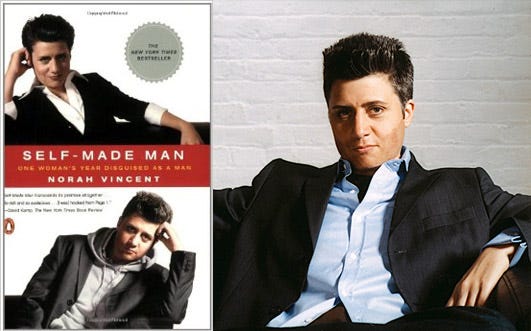
In 2006, American journalist Norah Vincent published Self-Made Man: One Woman’s Year Disguised As A Man, an under-cover adventure in which the author, a mannish lesbian with big feet, spent close to 18 months periodically disguised as a man named Ned, notching up about 150 episodes in drag.
With breasts flattened, fake stubble on her chin, and a stuffed jock strap in her pants, having hired a tutor to teach her how to pitch her voice low and move like a man, she set out to “infiltrate exclusive all-male environments and if possible learn their secrets” (p. 18). She joined a bowling league, went on dates, did sales calls, spent some weeks at a monastery, and attended a Robert Bly-influenced men’s wilderness retreat.
Expecting to learn something about male power, she found instead “the hidden pain of masculinity and my own sex’s symbiotic role in it” (p. 254). The planned exposé became a feminist mea culpa.
The book got a lot of attention when it was published, and many men expressed gratitude and appreciation for the empathy and insight in Vincent’s work.
Reading the many accolades, I felt sadness, tenderness, and amazement. Wasn’t this a bit much? Was it really so remarkable that a woman could develop sympathy for the opposite sex?
Most men are so unaccustomed to any empathy from a woman, even when it’s mixed with patronizing descriptions and questionable conclusions, that they respond as if to heroism. The woman who cares, even within circumscribed limits, is catapulted into the company of the saints.
Imagine the reaction if a man had masqueraded as a woman for a year or more, and then pretended to understand women (even sympathetically) using a shop-worn ideological framework? Imagine a white person putting on blackface in order to become an expert, even a well-intentioned one, on the need for black self-improvement? There would be howls of outrage and indignant rebuttals, especially by members of the impersonated group.
Not in Vincent’s case. So rare is a woman’s attempt to understand male experiences that she doesn’t need to be consistently sympathetic or accurate.
Even when someone goes beyond temporary male drag, there is a palpable surprise that mens’ lives are not a well-watered garden of male privilege:
Today, of course, there is still always a reason to look away from men’s pain. Feminist-inclined men and women routinely “bathe in male tears“. They claim that discussing men’s issues is misogynistic, and ask “Can White Men Finally Stop Complaining?” No wonder it seems that the only time men can be heard is when women speak for them.
Notably, women who “transition” to male through hormone treatments and surgery are often shocked by the indifference and unkindness they encounter in public, where men are not eager to help and women expect deference. Zander Keig wrote as a trans man in “Crossing the Divide” of a pronounced sense of aloneness: “No one, outside of family and close friends, is paying any attention to my well-being”.
Comments Off on The limits of female empathy


