
Feral Historian
Published 26 Jan 2024Stargate and SG-1 generally don’t go together, but they’re based on the same underlying premise. Our leaders are lying to us, denying us knowledge of fundamental truths about our world. Truths that can be the difference between freedom and slavery for all of humanity.
Sidenote, this is the first time I’ve shot one of these videos indoors instead of in the mountains. It’s -24 out on the day of recording.
00:00 Intro
01:05 Stargate
03:11 Ruling Class
04:18 Secrets
06:02 Illusions
06:48 Conclusion
June 10, 2025
They Live SG-1: Conquest and Paternalism
Comments Off on They Live SG-1: Conquest and Paternalism
June 8, 2025
Managerialism – threat or menace?
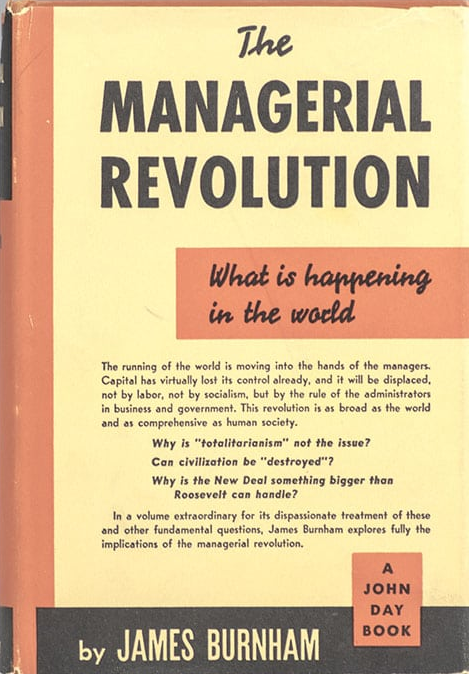
In the New York Times (don’t worry … link is to an archived version), Nathan Levine explains to NYT readers why there is such a push back against the over-mighty technocratic organizations that have been running more and more of our fading civilization:
It is the culmination of a once marginalized, now transformative strand of political thought about who really holds power in the modern American system. Namely, that our democracy has been usurped by a permanent ruling class of wholly unaccountable managers and bureaucrats.
Anti-managerialism is back. Well positioned to answer decades of frustration with mainstream conservatives’ failure to deliver results, this old idea has become the central principle of the new right.
In fact, much of what is commonly called “populist” politics can be more accurately described as part of an anti-managerial revolution attempting to roll back the expansion of overbearing bureaucratic control into more and more areas of life.
Though it has so far met with limited success amid stiff resistance, grasping the nature of this anti-managerialism is essential to understanding the Trump administration’s effort to transform America’s institutional landscape, from government to universities and major corporations.
The idea’s intellectual history begins with the political philosopher James Burnham, who argued in his seminal 1941 book, The Managerial Revolution, that the aristocratic capitalist class was in the process of being overthrown by a revolution — just not, as the Marxists predicted, by the working class.
Instead, the exponential growth of mass and scale produced by the Industrial Revolution meant that in both corporation and state it was now those people cleverest at applying techniques of mass organization, procedure and propaganda — what he called the managerial class — who effectively controlled the means of production and would increasingly come to dominate society as a new technocratic oligarchy.
The book made an especially significant impression on George Orwell, who remarked that a managerial class consisting of “scientists, technicians, teachers, journalists, broadcasters, bureaucrats, professional politicians: in general, middling people”, hungry for “more power and more prestige”, would seek to entrench “a system which eliminates the upper class, keeps the working class in its place, and hands unlimited power to people very similar to themselves”.
Orwell was particularly struck by Burnham’s observation that the major political systems of the day — fascism, Communism and New Deal-era social democracy — were fundamentally similar in their turn toward the bureaucratic management of society. He observed that everywhere “laissez-faire capitalism gives way to planning and state interference” and “the mere owner loses power as against the technician and the bureaucrat”. Believing that accelerating managerial control risked dragging every society inexorably into totalitarianism, Orwell made Burnham’s ideas the basis of his novel 1984.
While the Cold War persisted, the view that America’s government might share some traits with the Soviet Union unsurprisingly proved unpopular, especially among Washington’s conservative establishment.
Nonetheless, the managerial class continued to grow, regardless of which political party controlled the government. Cold War defense budgets drove a relentless expansion of security state bureaucracy and the military-industrial complex. The advent of Great Society welfare programs and the Civil Rights Act demanded a re-engineering of social relations, prompting a dramatic proliferation of lawyers, regulatory bureaucrats and corporate compliance officers throughout much of public and private life. An ever-greater proportion of Americans began funneling through the credentialing machinery of higher education, inflating demand for yet more upper-middle-class managerial jobs.
Comments Off on Managerialism – threat or menace?
“If the New York Times notices the Buddha, the enlightened one has already left town”
Ted Gioia points out that momentous changes in society are not often noticed until they’ve taken place, and provides ten warning signs of such a change happening right now:
Would you believe me if I told you that the biggest news story of our century is happening right now — but is never mentioned in the press?
That sounds crazy, doesn’t it?
But that is often the case when a bold new worldview appears.
- How long did it take before the Renaissance got mentioned in the town square?
- When did newspapers start covering the Enlightenment?
- Or the collapse in mercantilism?
- Or the rise of globalism?
- Or the birth of Christianity or Islam or some other earthshaking creed?
The biggest changes often happen long before they even get a name. By the time the scribes notice, the world is already reborn.
You can take this to the bank: If the New York Times notices the Buddha, the enlightened one has already left town.
For example, the word Renaissance got introduced two hundred years after the start of the Renaissance. The game was already over.
The same is true of most major cultural movements — they are truly the elephants in the room. And the elites at the epicenter of power are absolutely the last to notice.
Tiberius may run the entire Roman Empire, but he will never hear the Good News.
There’s a general rule here — the bigger the shift, the easier it is to miss.
We are living through a situation like that right now. We are experiencing a total shift — like the magnetic poles reversing. But it doesn’t even have a name — not yet.
So let’s give it one.
Let’s call it: The Collapse of the Knowledge System.
We could also define it as the emergence of a new knowledge system.
In this regard, it resembles other massive shifts in Western history — specifically the rebirth of humanistic thinking in the early Renaissance, or the rise of Romanticism in the nineteenth century.
In these volatile situations, the whole entrenched hierarchy of truth and authority gets totally reversed. The old experts and their systems are discredited, and completely new values take their place. The newcomers bring more than just a new attitude — they turn everything on its head.
That’s happening right now.
The knowledge structure that has dominated everything for our entire lifetime — and for our parents and grandparents — is collapsing. And it’s taking place everywhere, all at once.
If this were just an isolated situation — a problem in universities, or media, or politics — the current hierarchy could possibly survive. But that isn’t the case.
The crisis has spread into every sector of society which relies on clear knowledge and respected authority.

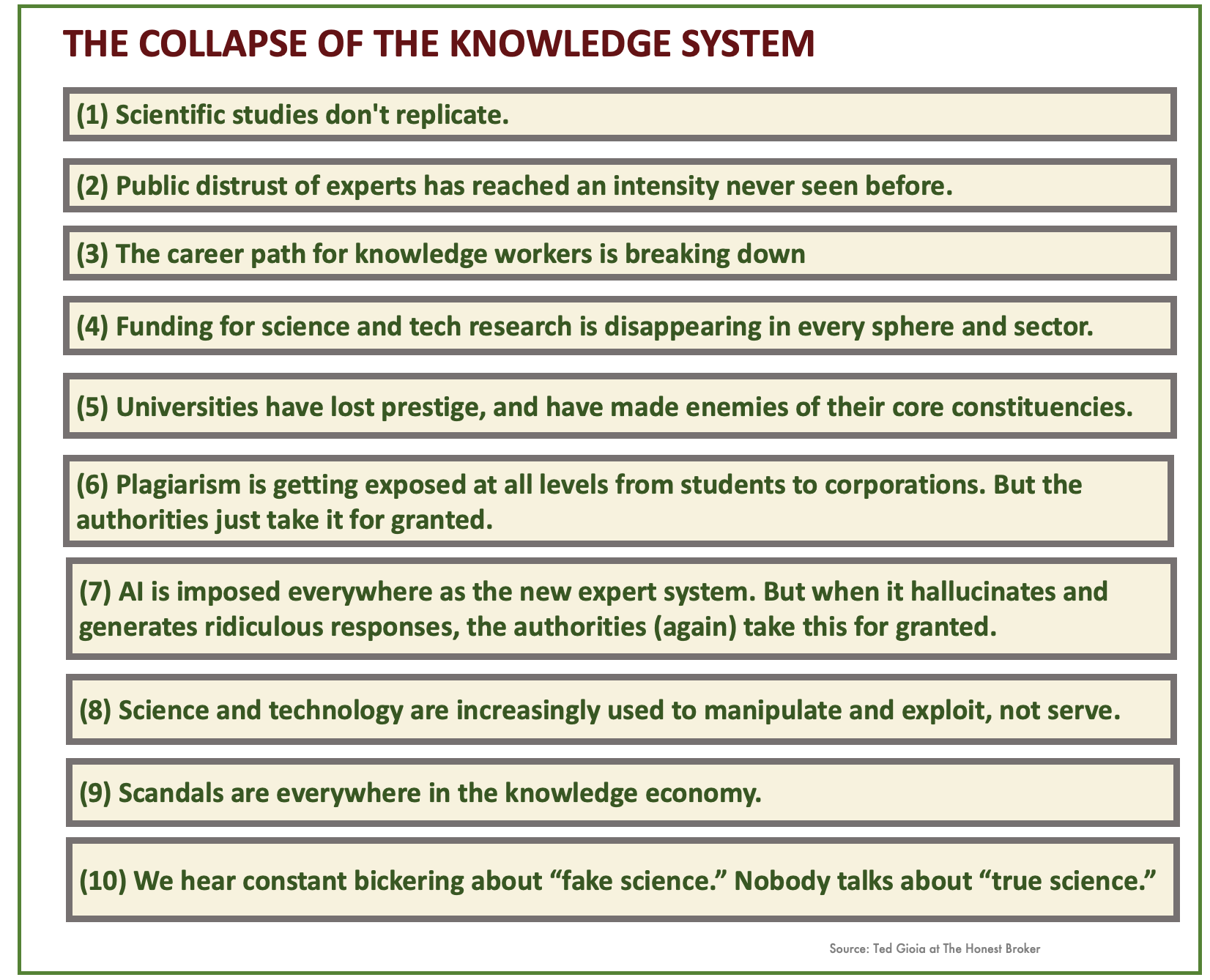
The ten warning signs
Comments Off on “If the New York Times notices the Buddha, the enlightened one has already left town”
June 7, 2025
The US President Saves Germany – Rise of Hitler 18 – June 1931
World War Two
Published 5 Jun 2025In June 1931, Germany teeters on the edge of collapse — facing riots, unemployment, and a banking crisis. Amidst chaos and international pressure, US President Herbert Hoover offers a dramatic moratorium on war debts, giving Germany a critical lifeline. Can this American intervention stabilize the Weimar Republic, or is disaster still on the horizon? Explore how global politics, economic turmoil, and desperate diplomacy shape a nation’s fate.
(more…)
Comments Off on The US President Saves Germany – Rise of Hitler 18 – June 1931
June 5, 2025
D-Day and the Battle of Normandy on screen
Adrian Goldsworthy. Historian and Novelist
Published 4 Jun 2025Following on from the video about tank battles on screen, we look at the coverage of D-Day and the Battle of Normandy in movie and television dramas. This will be posted two days before the 81st anniversary of D-Day. As usual, this is a little about how good they are as drama and more about the historical background.
00.00 Introduction
02.50 Churchill
11.38 “Men on a mission” movies INTRO
16.45 Female Agents
20.20 The Dirty Dozen
32.06 The Big Red One
38.10 D Day: The Sixth of June
41.58 Patton
46.00 Night of the Generals
47.48 Breakthrough (1950)
49.36 Breakthrough (1971)
50.24 Pathfinders
57.48 Overlord
01.00.00 Storming Juno
01.04.48 My Way
01.12.12 They were not divided
01.17.24 Band of Brothers
01.51.00 Saving Private Ryan
02.33.45 The Longest Day
03.00.48 Conclusion and the “Ones that got away”For the discussion of the Pegasus Bridge project:
• Fighting On Film Podcast: Pegasus Bridge S…
Comments Off on D-Day and the Battle of Normandy on screen
June 4, 2025
“Asshole Britain”
In The Line, Greg Quinn indulges in a bit of struggle sessioning about his earlier disagreements with the editors of The Line about Britain and Canada (protip: don’t search for images to go along with that particular headline, especially if you have “safe search” filters turned off):
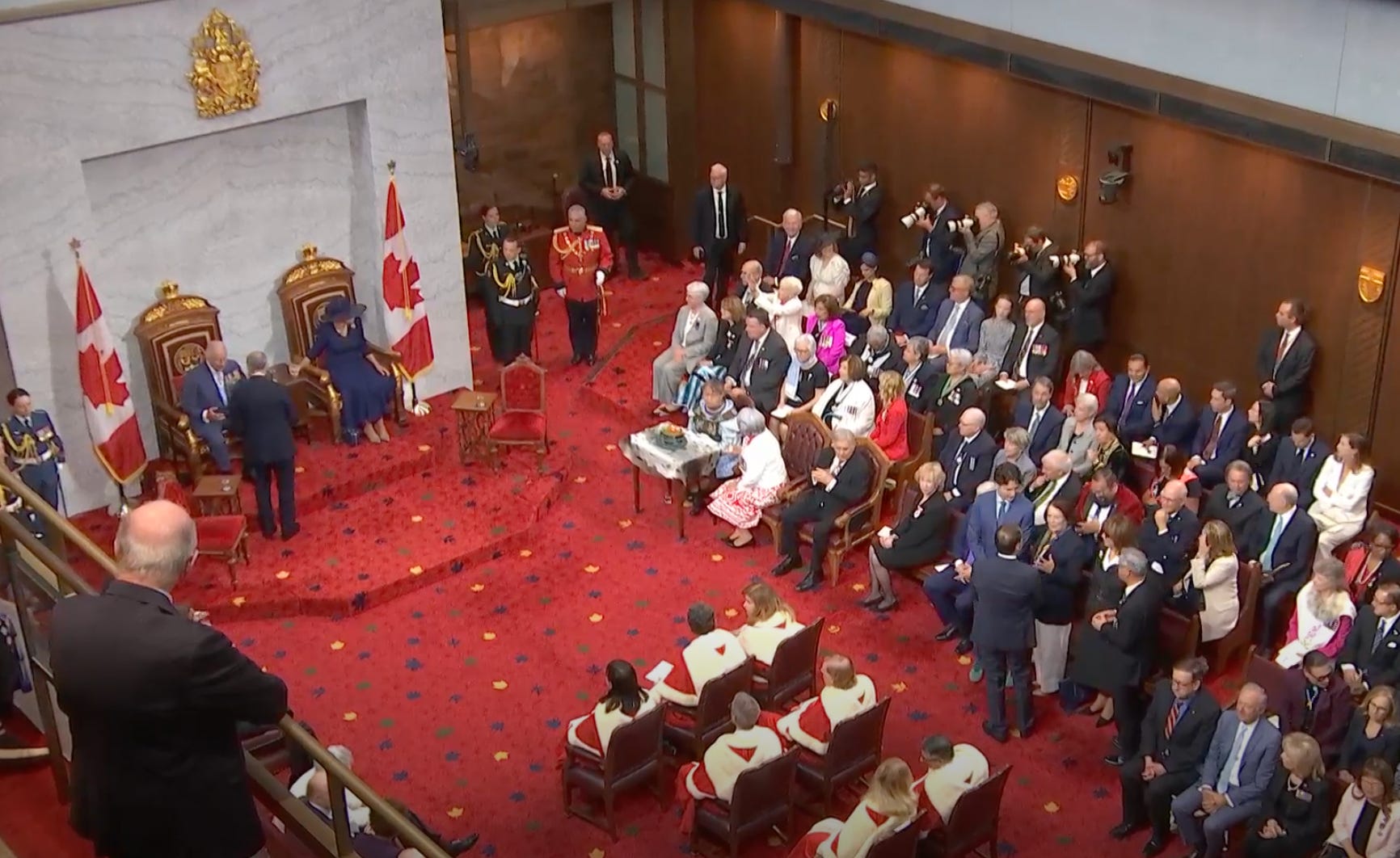
Yeah, let’s go with an inoffensive photo of His Royal Majesty and his Canadian First Minister chatting in the Senate chamber, rather than anything remotely to do with the headline of this post.
Photo by Paul Wells from his Substack
On February 12th of this year, I wrote in The Line about how my country, the United Kingdom, had “ghosted” Canada by refusing to come out strongly in reaction to U.S. President Donald Trump’s egregious attacks on the country and his calls for it to become the 51st state. In writing that piece, I didn’t beat around the bush — I called the U.K.’s actions what they were at the time: cowardice and sycophancy.
Since February, there have been a few (many?!) developments in Canada’s — and the world’s — relationship with President Trump.
Not least among these are Matt Gurney and Jen Gerson’s depiction (or technically, implication) of the U.K. as “Asshole Britain”. As other regular Line readers will know, “Asshole Canada” or “Maximum Canada” is an idea the editors floated here some months ago, where they asserted that Canada should abandon its typical desire to be seen as a global do-gooder and simply assert its national interests, vigorously and unapologetically, and if other countries, even allies, object, well, to hell with them. Editor Gurney, in a recent podcast, cited the just-concluded visit of His Majesty the King to Canada to deliver the Throne Speech — the first time a monarch has done so since 1977 — as an example of that. Prime Minister Mark Carney issued the invite to the King despite obvious discomfort with the idea among senior officials in my government.
Carney didn’t care. The King is the sovereign of Canada, too, and Carney didn’t let British discomfort deter him.
I have to say that HM the King’s speech was a blinder and (in its own royal diplomatic way) left no doubt as to where His Majesty’s sympathies lie and how he supports Canada’s sovereignty and independence. Whether you are a royalist or a republican, the fact that HM the King made the trip and read the speech should be welcomed. And I entirely agree with the editors here — Canadians should and must ignore the comments from the U.K. Who cares? HM the King was acting in his capacity as Canada‘s monarch — the views of anyone in the U.K. (government or otherwise) are irrelevant.
I wish I could condemn Jen and Matt for their (again, implied) characterization of the U.K. — Britain has needed no urging to unapologetically assert its own interests in this revived era of Trump. But I can’t. They are absolutely correct. And every day that passes, I’m sorry to say that the U.K. becomes more and more “Asshole Britain” when it comes to its relationship with Canada and the U.S.
The reasons remain much the same as I identified before: cowardice and sycophancy. To that, I’d now like to add venality. We think we have a special relationship with the U.S., as demonstrated by our recent trade agreement — except the impact of that agreement is open to some question. We seem to be afraid of saying anything that might upset President Trump, in case he reacts. Although we fail to understand that upsetting the President does not follow a rational process. He could (and does) get upset and react extremely easily at the simplest and most unexpected of things.
The President continues to make unacceptable claims against Canada, including reiterating his call for it to become the 51st state shortly after the King’s visit concluded. His latest iteration of this includes claims that Canada could save U.S.$61 billion it “should” be charged for the so-called Golden Dome (what is it with adjectives and this President?) if it joins the U.S. This, of course, fails to grasp the simple strategic fact that if you want a defence shield like this over North America, then you’re going to have to use sensors and other infrastructure on Canadian soil. Is he expecting to be provided that land for free?
By continuing to refuse to stand up to President Trump and clearly express our support for Canada, we are submitting to his attempts to divide and rule those of us who remain like-minded. At its worst, we are now venal — selling out to the president.
Instead, we should be standing true to our roots — as defenders of the free market and democracy. We should be leading the way, and we should be building an alliance of those who continue to share our values.
That is what we should be doing. That we aren’t is nothing short of a disgrace.
Update: Fixed broken link to Greg Quinn’s article. Doh!
Comments Off on “Asshole Britain”
The Korean War Week 50 – Trapped in the Triangle: Korea’s Killing Zone – June 3, 1951
The Korean War by Indy Neidell
Published 3 Jun 2025The MacArthur Senate Hearings continue this week, with US Secretary of State Dean Acheson now in the hot seat. He takes a rather confusing barrage of questions, and yet manages to signal to the world at large, i.e. the Chinese, that the US is open to negotiations to end the war. The war still continues in the field, of course, with the UN forces’ Operation Piledriver in action, driving into the “Iron Triangle” and trying to trap as much of the enemy as possible.
Chapters
00:00 Intro
01:07 Recap
01:35 Acheson Speaks
05:44 Operation Piledriver
09:10 Attacks Begin
10:53 A Unifying JCS Directive
16:54 Summary
(more…)
Comments Off on The Korean War Week 50 – Trapped in the Triangle: Korea’s Killing Zone – June 3, 1951
Remarkable Victory – The Bomber War Episode 5 – Jan to June 1944
HardThrasher
Published 28 Feb 2024In which the USAAF and RAF finally start to Get Good at their jobs and tie up their respective campaigns for literally the first time.
00:00 – 04:01 – Introduction
04:06 – 08:12 – Forward Operating Base
08:15 – 11:30 – Changes in Command
11:32 – 16:16 – Doolittle’s Plan
16:20 – 22:25 – Big Week
22:34 – 29:32 – Aftermath
29:35 – 32:06 – Berlin
32:09 – 33:59 – Overlord
34:02 – Survivor’s Club
(more…)
Comments Off on Remarkable Victory – The Bomber War Episode 5 – Jan to June 1944
June 3, 2025
Exercise Tiger: The WW2 Cover-Up Before D Day
The History Chap
Published 23 May 2024Exercise Tiger 1944, was a large-scale dress rehearsal for the D-Day landings, off the Slapton Sands in England, that went horribly wrong. Over 700 US servicemen were killed, more than were killed on Utah beach on D-Day itself! With D-Day imminent, Allied Supreme Commander, General Dwight Eisenhower, ordered the disaster to be hushed up.
Following a friendly fire incident on Slapton Sands on the 27th April 1944, a convoy carrying US troops was attacked in the early hours of the 28th by German E-Boats. In what is called the Battle of Lyme Bay, two ships in the convoy were sunk resulting in the loss of over 700 US servicemen. Whilst rumours suggest that there were many casualties resulting from the friendly fire on Slapton Sands, the US Army has always remained tight-lipped. To this day, the mystery remains as to what extent the casualty figures were covered up.
In the 1980’s, a Sherman tank was raised from the seabed. It now stands at the end of Slapton Sands (near the village of Torcross) as a memorial to the young men who died 6 weeks before D-Day during Exercise Tiger.
Chapters
0:00 Intro
0:42 D-Day 1944
1:40 Slapton Sands
2:30 Civilian Evacuation
3:22 Military Build-up
4:58 Exercise Tiger
6:07 Live Fire Disaster
7:37 Convoy T-4
9:15 Spotted by Germans
10:03 E-boat attack
11:41 Battle of Lyme Bay
14:06 Casualty Figures
14:43 D-Day Compromised?
15:37 Cover-up?
17:00 D-Day Success
18:08 Exercise Tiger Remembered
(more…)
Comments Off on Exercise Tiger: The WW2 Cover-Up Before D Day
QotD: Heinlein’s opinions on the right to bear arms
Robert Heinlein was a complex man whose views evolved greatly over time. The Heinlein of 1942, who put into the mouth of one of his characters the line “Naturally food is free! What kind of people do you take us for?” was only five years on from having been enchanted by social credit theory, which underpins his “lost” novel For Us, The Living; in later years he was so embarrassed by this enthusiasm that he allowed that manuscript to molder in a drawer somewhere, and it was only published after his death.
Between 1942 and 1966 Heinlein’s politics evolved from New Deal left-liberalism towards what after 1971 would come to be called libertarianism. But that way of putting it is actually misleading, because Heinlein did not merely approach libertarianism, he played a significant part in defining it. His 1966 novel The Moon Is A Harsh Mistress was formative of the movement, with the “rational anarchist” Bernardo de la Paz becoming a role model for later libertarians. By 1978, we have direct evidence (from an interview in Samuel Edward Konkin’s New Libertarian magazine, among other sources) that Heinlein self-identified as a libertarian and regretted his earlier statism.
But if Heinlein’s overall politics changed considerably and wandered down some odd byways during his lifetime, his uncompromising support of civilian firearms rights was a constant on display throughout his life. Brin observes that was already true in 1942, but attempts to attribute this position to John W. Campbell. Multiple lines of evidence refute this claim.
[…]
Heinlein, on the other hand, was a vocal and consistent advocate of civilian weapons ownership both during and after his association with Campbell. This is perhaps clearest in his 1949 novel Red Planet, written after their parting of the ways. In that novel, the bearing of personal weapons is explicitly connected to the assumption of adult responsibilities.
Red Planet is also interesting because, although we might consider the views of Heinlein’s characters an unreliable guide to Heinlein’s own, Heinlein’s letters about the novel reveal much more. His editor at Scribner attempted to delete the section of argument in which weapons-bearing is connected to adult responsibility; Heinlein rejected this, objecting that it eviscerated the book’s ethical core and making very clear that the views of the pro-gun mentor figures in the novel were his own.
Heinlein was to reiterate similar views not only in his later fiction but in the posthumous nonfiction collection Grumbles From The Grave – by which time they were no surprise to any Heinlein fan. And it would be difficult to overstate the influence they had on firearms-rights activists during the dark years between the Gun Control Act of 1968 and our vindication in the 2008 District of Columbia v. Heller ruling.
Heinlein’s gift to firearms-rights activism during that bleak four decades was to be able to draw on the principled case for civilian firearms going back to the framers of the U.S. Constitution and English Republican sources and restate it in language appealing to the brightest children of post-WWII America. But he did more than that, because in Red Planet and elsewhere firearms rights were presented as an inextricable part of a philosophical whole, with the personal firearm both as instrument and defining symbol of personal liberty and responsibility.
Eric S. Raymond, “Brin on Heinlein on guns is dead wrong”, Armed and Dangerous, 2011-07-18.
June 2, 2025
The progressive case for unlimited immigration
Theophilus Chilton takes on the progressive arguments for bringing in as many “high quality” immigrants as humanly possible from his own professional background:
One of the constants that you can count on in any debate about the value of immigration (of every sort) is the inevitable assertion about the NECESSITY of immigration. Immigrants POWER AMERICA. Without them, NOTHING WOULD HAPPEN! They are ELITE HUMAN CAPITAL without which the White American chuds who did things like build the atom bomb and otherwise created modern technological civilisation would barely be able to keep the lights on in their single-wides. It’s not just that immigrants want a new life or might be useful — they are an absolutely necessity and the ones coming here are the cream of the world’s crop.
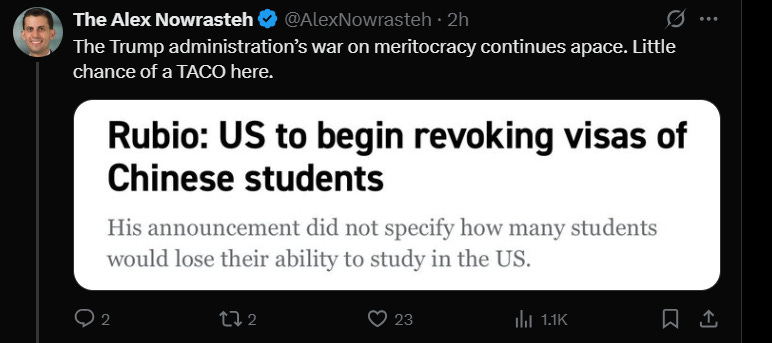
As a result, the recent move by Marco Rubio and the State Department to revoke visas from Chinese students in American universities (especially those associated with the CCP or who are in positions to commit especially damaging industrial espionage) will certainly not be well-received by this crowd. For example, witness Alex Nowrasteh, who’s whole schtick is to burble on about “meritocracy” and whine about “affirmative action for White Americans” while filling a useless sinecure at the Cato Institute that he got by being the token immigrant. He is appalled that we’d act in our own national interest rather than in the interests of a bunch of random foreigners.
Immigration man have big sad
Many people who know me on X already know this, but most readers here may not. Before I made a radical life-changing vocational choice a few years ago, I used to be a scientist in Big Pharma. For a little over two decades, I worked in the biotech/biopharma industry, covering a wide range of drug development stages and product types. I’ve developed vaccines (which is why I was skeptical about the Covid vaxx from the very beginning). I’ve developed small molecule drugs. I helped to bring to market several of the pharmaceuticals that millions take regularly and which you see advertised on television. I’ve done everything from bench scale analytical work to protein purification on 5000-liter batches used in support of human clinical trials. I’m proficient in literally dozens of different analytical techniques. Before that, in both undergraduate and graduate school, I specialised in synthetic organic small molecule development across a number of different subspecialties. And I’m good at all of this.
One other thing that I did throughout was work side-by-side with, and later manage, LOTS of visa holders and immigrants, especially from “tech heavy” countries like India and China, the stereotypical “H1-Bers”. As a result, I consider myself to be a pretty good judge of the value which visa holders bring to tech fields.
My judgment is, and has been for decades, that their value is minimal and it certainly does not live up to the hype. Indeed, one of the constants that I observed among most Indian, Chinese, and other visa holders was that they did not really, truly understand the science that was involved with the products being developed and the techniques being used to develop and test them. Most of these folks were the living embodiment of cramming to pass the test. When the test methods and the SOPs being employed were straightforward, these folks were great. They had a robot-like efficiency that comes with repetitively doing the same thing over and over and over again. Unfortunately, for anything requiring innovative or independent thinking, they’d be totally lost. If results from a test deviated from expectations and required some commonsense interpretation? That’s where the wheels came off. I mean, there was little to no capacity to deal with anything that wasn’t completely textbook.
Even basic scientific sense was often missing. At one job, there was an Indian guy who would takes dumps in the bathroom and then walk straight out back to his manufacturing suite in the cell line division without even washing his hands. I know this because I observed it for myself several times. I mean, even if you don’t care about getting fecal coliform bacteria all over door handles and whatnot, at least don’t carry them back into the suite where you’re helping to grow batches of genetically engineered E. coli. I assume he was properly gowned before going in, but still, there’s just that basic lack of sense there.
And then there are the ethics (or lack thereof) displayed by many visa holders (especially Chinese and Middle Eastern). Data manipulation, tweaked results, etc. etc. These tend to occur because both of those groups are under intense social pressure within their own cultures to “get the right results” rather than just dealing with the results you get. The “tiger mom” mentality carries over into the workplace. There is a reason for why these two groups are disproportionately overrepresented on the FDA’s debarment list. Indians can be subject to serious lapses in integrity as well, though theirs tend to revolve more around cutting corners and mistreating underlings, as I illustrated in a thread on X about three years ago where I recounted my time working for an Indian-owned company.
Over the years, my observations have been substantiated and reiterated by any number of people in various tech-heavy industry to whom I’ve related them. Whether it’s pharma or IT or medicine or metallurgy or whatever else, the familiar story is told. It’s really, really difficult to reconcile this mass of lived experience with the theoretical assertions made by people like Nowrasteh that immigrants are this valuable resource that we absolutely need to be or remain competitive in world markets.
In effect, the goal with this type of white-collar mass immigration is to “roboticise” tech fields which can’t be given over to AI or actual robotics just yet. The formula is to import masses of workers who can simply follow a script and save companies money on labour costs. If you think about it, this is really a low IQ, high time preference approach by corporations whereby they sacrifice real innovativeness and future competitiveness for short-term savings. I’d argue that the entry of H1-B and other visa holders in large numbers into American tech industries which accelerated around the late 2000s-early 2010s has actually led to a slowdown in real innovation. We may have tons of new apps for our phones, but fewer truly groundbreaking advances in tech across the board.
Comments Off on The progressive case for unlimited immigration
QotD: How to use your billions to influence those in power, without risking prosecution
In other words, there are no lessons there for us (except that people will tolerate shit like Fakebook and Amazon, which is indeed disturbing, but we already knew that). But blogs? Consider the Bulwark, or the Dispatch, or whatever it is (and if those are actually different things). Jonah Goldberg’s new outfit. I don’t follow this stuff, all I know is Ace of Spades calls it “The Cuckshed”, which is awesome, so let’s go with that. When Goldberg was pitching The Cuckshed to that Persian billionaire, he no doubt promised him all kinds of filthy, degrading acts of propaganda … in person.
I have to assume that the Cuckshed exists largely as his personal brand — he can go on whatever cable news shout show needs a “conservative” and the chryon says “Founder of leading conservative opinion site ‘The Cuckshed'” — and that’s what he pitched to the Persian, rather than reams of marketing data about the site’s literally hundreds of subscribers … but then again, maybe not, because I think we can all take it as read that 95% of the people who subscribe to The Cuckshed are fellow Swamp Things, no? Persians are a crafty lot, and this guy is no dummy, he understands the cardinal rule: Never write when you can speak, and never speak when you can nod.
To get his message into the [Washington, DC] intellectual ecosystem, then, the Persian Billionaire has two choices: He could either circulate a memo with “The Persian Billionaire’s Position on X”; or he could just have a flunky come into the room and start reading off a list of options, and he’ll nod when the flunky reaches the right one. Then the flunky slaps the list on the desk of a slightly lower-ranking flunky, pointedly tapping his finger at the chosen option. Then the lower-ranking flunky calls up one of his fart catchers, pulls out a highlighter, colors in the correct option, and hands it to him. Take that out through about six more levels of toadies, rump-swabs, and catamites, and it finally lands on Jonah Goldberg’s desk, at which point he starts punching up his “Word ’95” macros into a “column” telling the world what the Persian Billionaire wants them to hear.
Thus, if he’s ever called on the carpet by the Emperor’s Truthsayer, the Persian Billionaire can in all honesty say “I never told Goldberg to write that!” It just kinda worked out that way. As it always seems to. Every time.
Severian, “On Selling Out”, Founding Questions, 2021-11-26.
Comments Off on QotD: How to use your billions to influence those in power, without risking prosecution
June 1, 2025
Ted Gioia on stopping AI cheating in academia
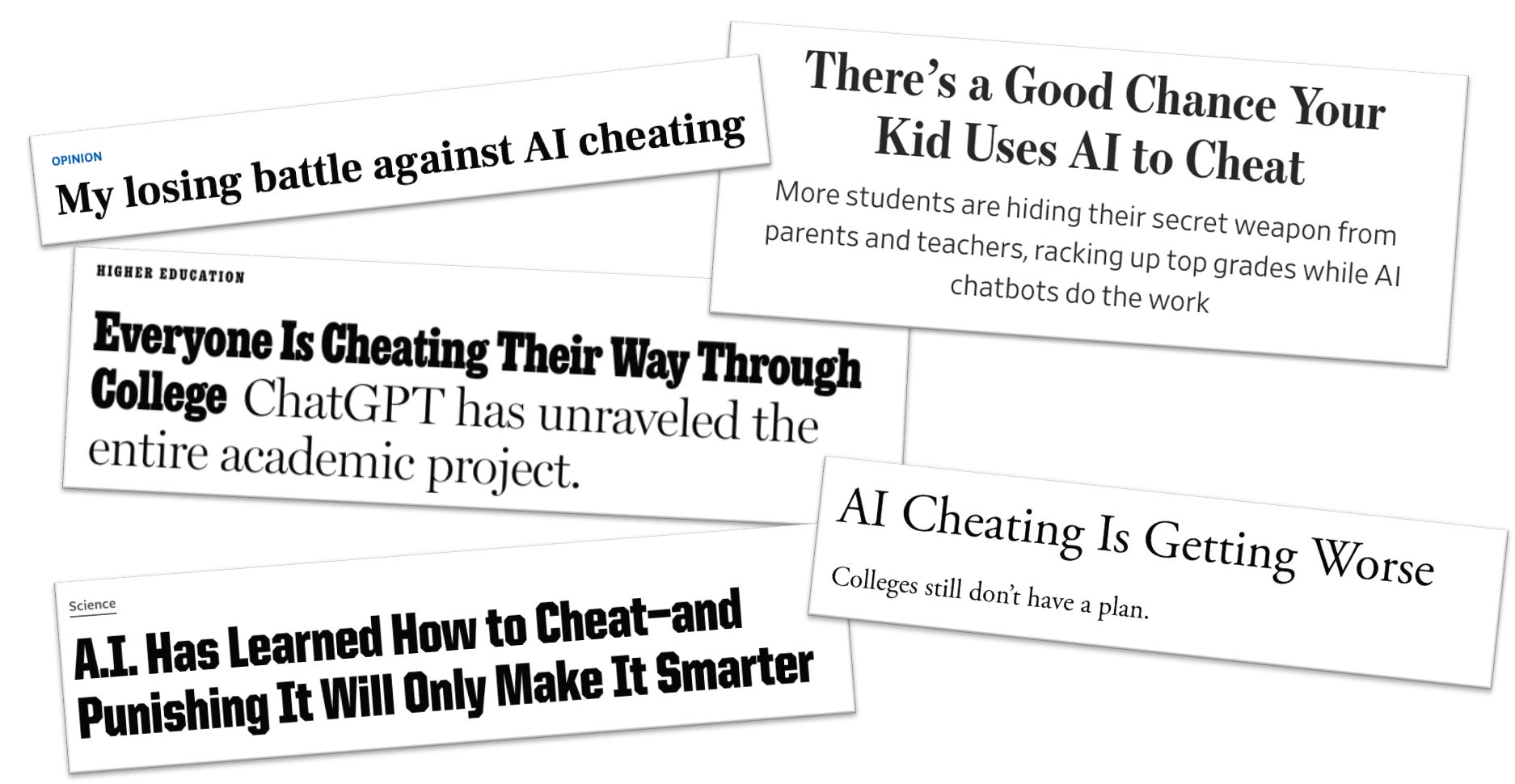
I’ve never been to Oxford, either as a student or as a tourist, but I believe Ted Gioia‘s description of his experiences there and how they can be used to disrupt the steady take-over of modern education by artificial intelligence cheats:
How would the Oxford system kill AI?
Once again, where do I begin?
There were so many oddities in Oxford education. Medical students complained to me that they were forced to draw every organ in the human body. I came here to be a doctor, not a bloody artist.
When they griped to their teachers, they were given the usual response: This is how we’ve always done things.
I knew a woman who wanted to study modern drama, but she was forced to decipher handwriting from 13th century manuscripts as preparatory training.
This is how we’ve always done things.
Americans who studied modern history were dismayed to learn that the modern world at Oxford begins in the year 284 A.D. But I guess that makes sense when you consider that Oxford was founded two centuries before the rise of the Aztec Empire.
My experience was less extreme. But every aspect of it was impervious to automation and digitization — let alone AI (which didn’t exist back then).
If implemented today, the Oxford system would totally elminate AI cheating — in these five ways:
(1) EVERYTHING WAS HANDWRITTEN — WE DIDN’T EVEN HAVE TYPEWRITERS.
All my high school term papers were typewritten — that was a requirement. And when I attended Stanford, I brought a Smith-Corona electric typewriter with me from home. I used it constantly. Even in those pre-computer days, we relied on machines at every stage of an American education.
When I returned from Oxford to attend Stanford Business School, computers were beginning to intrude on education. I was even forced (unwillingly) to learn computer programming as a requirement for entering the MBA program.
But during my time at Oxford, I never owned a typewriter. I never touched a typewriter. I never even saw a typewriter. Every paper, every exam answer, every text whatsoever was handwritten—and for exams, they were handwritten under the supervision of proctors.
When I got my exam results from the college, the grades were handwritten in ancient Greek characters. (I’m not making this up.)
Even if ChatGPT had existed back then, you couldn’t have relied on it in these settings.
(2) MY PROFESSORS TAUGHT ME AT TUTORIALS IN THEIR OFFICES. THEY WOULD GRILL ME VERBALLY — AND I WAS EXPECTED TO HAVE IMMEDIATE RESPONSES TO ALL THEIR QUESTIONS.
The Oxford education is based on the tutorial system. It’s a conversation in the don’s office. This was often one-on-one. Sometimes two students would share a tutorial with a single tutor. But I never had a tutorial with more than three people in the room.
I was expected to show up with a handwritten essay. But I wouldn’t hand it in for grading — I read it aloud in front of the scholar. He would constantly interrupt me with questions, and I was expected to have smart answers.
When I finished reading my paper, he would have more follow-up questions. The whole process resembled a police interrogation from a BBC crime show.
There’s no way to cheat in this setting. You either back up what you’re saying on the spot — or you look like a fool. Hey, that’s just like real life.
(3) ACADEMIC RESULTS WERE BASED ENTIRELY ON HANDWRITTEN AND ORAL EXAMS. YOU EITHER PASSED OR FAILED — AND MANY FAILED.
The Oxford system was brutal. Your future depended on your performance at grueling multi-day examinations. Everything was handwritten or oral, all done in a totally contained and supervised environment.
Cheating was impossible. And behind-the-scenes influence peddling was prevented — my exams were judged anonymously by professors who weren’t my tutors. They didn’t know anything about me, except what was written in the exam booklets.
I did well and thus got exempted from the dreaded viva voce — the intense oral exam that (for many students) serves as follow-up to the written exams.
That was a relief, because the viva voce is even less susceptible to bluffing or games-playing than tutorials. You are now defending yourself in front of a panel of esteemed scholars, and they love tightening the screws on poorly prepared students.
(4) THE SYSTEM WAS TOUGH AND UNFORGIVING — BUT THIS WAS INTENTIONAL. OTHERWISE THE CREDENTIAL GOT DEVALUED.
I was shocked at how many smart Oxford students left without earning a degree. This was a huge change from my experience in the US — where faculty and administration do a lot of hand-holding and forgiving in order to boost graduation rates.
There were no participation trophies at Oxford. You sank or swam — and it was easy to sink.
That’s why many well-known people — I won’t name names, but some are world famous — can tell you that they studied at Oxford, but they can’t claim that they got a degree at Oxford. Even elite Rhodes Scholars fail the exams, or fear them so much that they leave without taking them.
I feel sorry for my friends who didn’t fare well in this system. But in a world of rampant AI cheating, this kind of bullet-proof credentialing will return by necessity — or the credentials will get devalued.
(5) EVEN THE INFORMAL WAYS OF BUILDING YOUR REPUTATION WERE DONE FACE-TO-FACE — WITH NO TECHNOLOGY INVOLVED
Exams weren’t the only way to build a reputation at Oxford. I also saw people rise in stature because of their conversational or debating or politicking or interpersonal skills.
I’ve never been anywhere in my life where so much depended on your ability at informal speaking. You could actually gain renown by your witty and intelligent dinner conversation. Even better, if you had solid public speaking skills you could flourish at the Oxford Union — and maybe end up as Prime Minister some day.
All of this was done face-to-face. Even if a time traveler had given you a smartphone with a chatbot, you would never have been able to use it. You had to think on your feet, and deliver the goods with lots of people watching.
Maybe that’s not for everybody. But the people who survived and flourished in this environment were impressive individuals who, even at a young age, were already battle tested.
Comments Off on Ted Gioia on stopping AI cheating in academia
May 31, 2025
“U.S. libertarians [are] the best friends Canada doesn’t know it has”
In the National Post, Colby Cosh sings the praises of American libertarians for their work in trying to dismantle some of Donald Trump’s dubiously Constitutional extensions of presidential power:
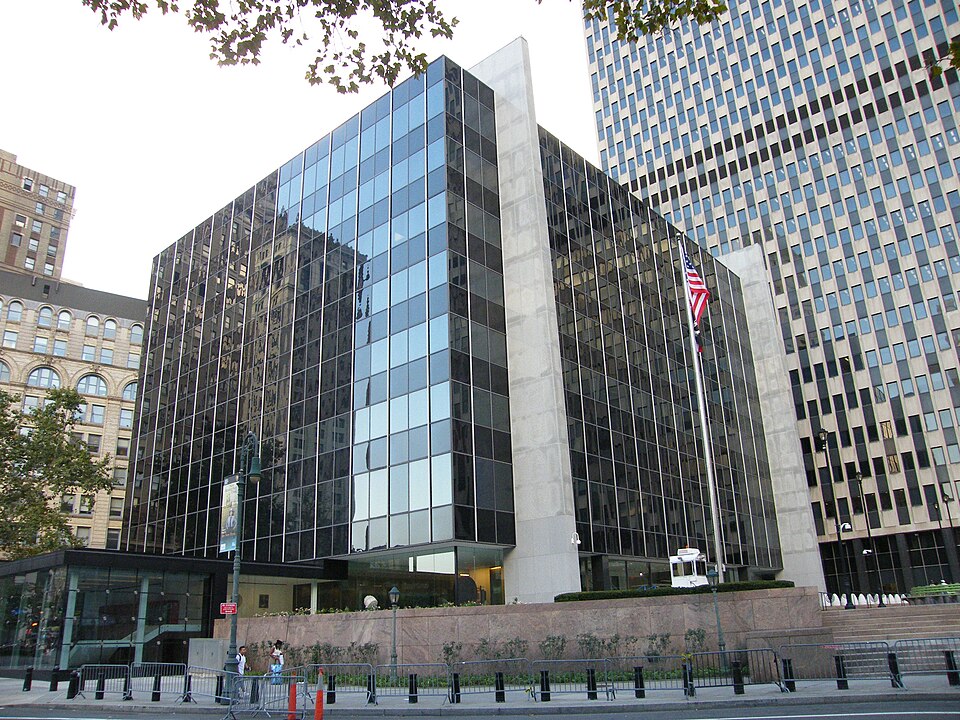
The James L. Watson Court of International Trade Building at 1 Federal Plaza in Lower Manhattan, New York City.
Photo by Americasroof via Wikimedia Commons.
The U.S. Court of International Trade (CIT) issued a decision Wednesday that annuls various salvos of surprise economic tariffs, including ones on Canada, that have been enacted by President Donald Trump since his inauguration in January. I won’t lie to you: I had the same initial reaction to this consequential news that you probably did, which was “Hooray!” and then “Huh, there’s a U.S. Court of International Trade?”
This court is surely unfamiliar even to most Americans, no doubt because much of its work involves settling issues like “Do hockey pants count as ‘garments’ or ‘sports equipment’ under customs law?” Nevertheless, the CIT does have exclusive jurisdiction over civil actions involving U.S. trade law. It’s just that no president has ever before rewritten the tariff schedule of the republic in the half-mad fashion of a child taking crayons to a fresh-painted wall.
The American Constitution, from day one, has unambiguously assigned the right to set international tariffs to Congress. Congress is allowed to delegate its powers to the president and his agents for limited or temporary purposes, but it can’t abandon those powers to him altogether. Defining this legal frontier is what the CIT was asked to do, and their demarcation of it will now swim upward through higher appellate courts (its decision has been put on hold in the meantime).
The lawsuit was actually two parallel suits raising overlapping objections to the tariffs. One was brought forward by 12 U.S. states, and the other was filed by a group of tariff-exposed American businesses, including manufacturers of bikes, electronics kits and fishing equipment. The latter set of plaintiffs was roped together by the usual posse of heroic libertarians and legal originalists, including George Mason University law prof Ilya Somin.
About 24 hours after Trump originally announced the “Liberation Day” worldwide tariffs, Somin quickly blogged about how insanely unconstitutional the whole idea was, and concluded his article essentially by saying “I’m darn well gonna do something about this nonsense”. I don’t mean to suggest he deserves primary credit; I only intend to call attention, once again, to U.S. libertarians being the best friends Canada doesn’t know it has.
Comments Off on “U.S. libertarians [are] the best friends Canada doesn’t know it has”
May 30, 2025
Was Germany Really Starved Into Surrender in WW1?
The Great War
Published 10 Jan 2025From 1914 to 1919, Allied warships in the Atlantic and Mediterranean controlled maritime trade to and from the Central Powers – stopping shipments of weapons and raw materials, but also food, from reaching their enemies. At the same time, hundreds of thousands of German civilians died of hunger-related causes. Often, these deaths and even the outcome of the war are attributed to the naval blockade – but did the British really starve Germany into surrender in WW1?
(more…)
Comments Off on Was Germany Really Starved Into Surrender in WW1?


