
Back in Early Modern England, enclosure led to a massive over-supply of labor. The urge to explore and colonize was driven, to an unknowable but certainly large extent, by the effort to find something for all those excess people to DO. The fact that they’d take on the brutal terms of indenture in the New World tells you all you need to know about how bad that labor over-supply made life back home. The same with “industrial innovation”. The first Industrial Revolution never lacked for workers, and indeed, Marxism appealed back in its day because the so-called “Iron Law of Wages” seemed to apply — given that there were always more workers than jobs …
The great thing about industrial work, though, is that you don’t have to be particularly bright to do it. There’s always going to be a fraction of the population that fails the IQ test, no matter how low you set the bar, but in the early Industrial Revolution that bar was pretty low indeed. So much so, in fact, that pretty soon places like America were experiencing drastic labor shortages, and there’s your history of 19th century immigration. The problem, though, isn’t the low IQ guys. It’s the high-IQ guys whose high IQs don’t line up with remunerative skills.
My academic colleagues were a great example, which is why they were all Marxists. I make fun of their stupidity all the time, but the truth is, they’re most of them bright enough, IQ-wise. Not geniuses by any means, but let’s say 120 IQ on average. Alas, as we all know, 120-with-verbal-dexterity is a very different thing from 120-and-good-with-a-slide-rule. Academics are the former, and any society that wants to remain stable HAS to find something for those people to do. Trust me on this: You do not want to be the obviously smartest guy in the room when everyone else in the room is, say, a plumber. This is no knock on plumbers, who by and large are cool guys, but it IS a knock on the high-IQ guy’s ego. Yeah, maybe I can write you a mean sonnet, or a nifty essay on the problems of labor over-supply in 16th century England, but those guys build stuff. And they get paid.
Those guys — the non-STEM smart guys — used to go into academia, and that used to be enough. Alas, soon enough we had an oversupply of them, too, which is why academia soon became the academic-industrial complex. 90% of what goes on at a modern university is just make-work. It’s either bullshit nobody needs, like “education” majors, or it’s basically just degrees in “activism”. It’s like Say’s Law for retards — supply creates its own demand, in this case subsidized by a trillion-dollar student loan industry. Better, much better, that it should all be plowed under, and the fields salted.
Any society digging itself out of the rubble of the future should always remember: No overproduction of elites!
Severian, “The Academic-Industrial Complex”, Rotten Chestnuts, 2021-05-30.
November 26, 2023
QotD: From Industrial Revolution labour surplus to modern era academic surplus
November 25, 2023
“It’s not called the gender empathy gap for nothing”
Janice Fiamengo on the blatant disregard for violence as long at that violence is not directed at women:
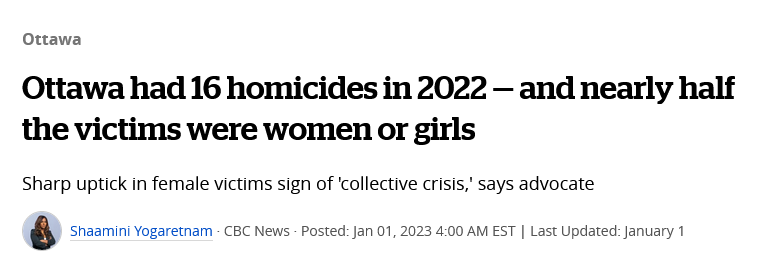
The news headline by the CBC, Canada’s state-funded broadcaster, could hardly have been more blatant: “Ottawa had 16 homicides in 2022—and nearly half of the victims were women or girls“. In other words, more than half of the victims, as is always the case, were boys and men, a state of affairs that no one at the CBC has ever found troubling enough to lament or even notice. Only when the female homicide rate approaches gender parity in one (unusual) year is it a “collective crisis”, as the subheading alleges.
It’s not called the gender empathy gap for nothing.
[Author’s note: Perhaps I should have stopped here. What more is there to say about the extraordinary indifference of most people, men and women, to violence against men and the craven desire to deny female culpability? There’s nothing new in this essay, no new angle or stats, no rousing call to action, nothing beyond the marshalling of dreary evidence and sadly sarcastic observations unlikely to change any mind or cause any gynocentric cheek to blush. I had intended to finish it in time for the International Day for the Elimination of Violence Against Men, on November 18, but was stymied partly by a sense of helpless anger, the weight of which pressed down on every sentence. The section at the end, about the death of Benjamin Rain, was the last straw.]
Feminists have long touted their concern for victims, yet that is never in shorter supply than in their one-sided discussions of violence, in which the only deaths allowed to matter are female deaths, presented for readers’ contemplation with poignant circumstances, names, and expressions of horrified sadness, as in the above-mentioned article. Dead men remain largely anonymous, and few readers could guess from the typical reports of feminist organizations that women are ever lethally violent.
Indifference to male suffering and death are the norm all over the world, of course, but the Anglophone feminist movement has markedly increased it, fudging numbers and manipulating language to focus empathy exclusively on women and girls. The CBC article devotes significant space to discussing the risible concept of femicide, a relatively recent coinage that makes no secret of its female supremacism, purporting to highlight how women and girls are killed “simply for being women” and “primarily by […] men”, as if every woman, even one killed by accident (as we’ll see), is evidence of gender bias.
The idea that women are killed because they are women is preposterous, impossible to support with evidence, and obviously intended to solidify the impression that women outnumber men as victims of murderous violence. An organization called the Canadian Femicide Observatory for Justice and Accountability provides an elaborate taxonomy of forms of femicide to drive the idea home, deliberately blurring the lines between intimate partner homicide, a favored focus, and other killings of women, which are collectively deplored as “brazen acts of hatred“.
Even a cursory reading of the details, however, exposes the vacuousness of the terminology as well as the sleight of hand by which men’s alleged misogyny is misleadingly linked to the totality of the women’s deaths. Only two of Ottawa’s seven murdered women were killed by current or former intimate partners. One of the dead women was attacked and killed by her two adult daughters (an act called “non-intimate femicide”), while another was the victim of a stray bullet that killed her by accident and was probably intended for a man (if you can believe it, the Canadian Femicide Observatory calls this type of death “associated/connected femicide”).
It is impossible to conclude that all or even most of these — certainly unfortunate — deaths can logically be said to have occurred, as the mantra holds, “due to the existence of gender norms and stereotypes, discrimination directed toward women and girls, and unequal power relations across genders“. The determination to find gender discrimination at the root of all female suffering — and thus to justify yet more programs, initiatives, and taxpayer dollars for feminist organizations, as well as more collective shaming of men — seems unstoppable.
QotD: Political language mirrors the ritualized nature of political life
In a crisis, they recite. We’ve all watched them do this. “This is not who we are.” “Let me be clear: Hate has no home here.” You know what they’re going to say before they say it, and you know the tone before you hear it. The current mayor of Los Angeles is very fond of “our message has been very clear” and “we’re going to link arms and stand together”, so you’re not surprised to hear her respond to a question with something like, “Well, Maria, thank you for that great question. Our message has been very clear: We’re going to link arms and stand together.” Listening to elected officials speak is qualitatively different than listening to people speak. They perform the ritual behaviours of their status group.
[…]
They become debilitated by a lifetime of ritual language. If a staffer hasn’t told them to look somber and say “I’m sorry for your loss”, they don’t know how. It isn’t a line they’ve been equipped with for the event. Hey man your kids burned to death I almost lost my Corvette once, man. All kiddin’ aside, man!
[…]
They aren’t people anymore. They can’t talk like people. They don’t have normal human affect. What’s particularly interesting is that this learned inability to read human cues is recent and narrow. Bill Clinton, as much a politician as anyone who has ever lived, had a well-known ability to see people and signal his empathy, or at least to do a brilliant job of faking it. Similarly, Donald Trump is obviously very very fond of Donald Trump, who is amazing, trust me, everybody says so, but he has a normal human ability to spontaneously bullshit with the normals. Elite disconnection isn’t inevitable.
The broken personal thing behind all the broken institutional things is a loss of basic human connection and behavior. It’s a learned disconnection, and they can’t hide it.
Chris Bray, “The Mask Becomes Your Face”, Tell Me How This Ends, 2023-08-22.
November 24, 2023
It sometimes seems that the only thing that isn’t “violence” these days is actual violence
David Sedaris at The Free Press:

“Gen Z” by EpicTop10.com is licensed under CC BY 2.0

Words, we are now regularly reminded, are violence. So too is silence. I read not long ago that capitalism is violence, as is misgendering someone. Ignoring someone is violence, but so too is paying them attention. A friend recently called on one of her assistants to deliver a statistic during a business meeting and was later charged with “casual violence”. Apparently Deborah needed to give advance warning that she was going to ask a question, one that might possibly put her employee — someone who was well paid to know stuff and be able to spew it forth — on the spot.
Who are these hothouse flowers, all so easily and consistently wounded? People whose parents never hit them, that’s who. People who don’t know what real pain is, but still want to throw the word around. When I was a child, a slap across the face was too minor to qualify as “casual violence”. It was simply what you got for talking back or holding everyone up. It never hurt all that much; what stung was the swiftness of it, the surprise. Who knew my mother could move so fast, like someone belted in the martial arts. I don’t feel like it traumatized me to be knocked around a little. Blood was rarely drawn. No limbs were broken. Could my parents have made their point without resorting to violence? Probably, but it would have taken more time, and with six kids to dress and get out the door that was a precious commodity. I see parents now who worry they’re being abusive if they don’t spend at least an hour putting their child to bed. An hour! I said to my sister, Amy, “Do you remember ever once being tucked in? Can you imagine Mom and Dad reading to us, or singing? Can you imagine them kissing us?”
“Ugh,” she said. “Stop!”
And look at us! We’re fine. We can handle stuff. We never get offended by anything.
Our parents thought we were okay, at best, and I think that really helped us in the long run. Ask someone now if they have kids, and they’re pretty much guaranteed to use the word amazing, as in “I have an amazing six-year-old daughter.”
“Amazing because she just discovered a cure for herpes or because she speaks three words of Spanish,” I always want to ask. “I mean, just how low have you set that bar?”
One of the worst things that’s happened to us as a country is that people are having fewer children — 1.8 as opposed to five 50 years ago. Sure, it’s good for the environment — fewer people means less demand for resources. The problem is that single children receive a freakish amount of love and attention. Most graduate at least twelve times before leaving high school. Their every move is recorded and celebrated, and it gives them an outsize sense of their own importance.
The solution isn’t for every couple to start having five kids again, but maybe for one chosen couple to have five, and the other four couples to go without — either have a full litter you can’t pay that much attention to, or nothing at all.
If our schools are a mess it’s in large part due to these parents who think their kids are special, who get mad if you contradict their brilliance, if you give them a bad grade or, God forbid, try to take their phones away. Had one of my teachers told my mother that I was acting up in class, she’d have said, “Thank you so much for letting me know.” Then she’d have come to wherever I was — in front of the TV, or at the side of the TV making my way to the front of it — and slapped my sister Gretchen so hard her eyes would have crossed.
“What was that for?” Gretchen would have asked.
“Oops, wrong kid,” my mother would have said. Then she’d have slapped me twice as hard to make up for her mistake.
The Man Who Started the Cold War
World War Two
Published 23 Nov 2023What if I told you that a new conflict will sweep the globe in less than a year? It will open not with gunshots but with silent, shadowy espionage. The man who will kick off the Cold War is a quiet Canadian pilot, millionaire, and spymaster. A trusted aide to Churchill and FDR. I bet you haven’t heard this name before: William Stephenson.
(more…)
Freshwater Flattops; The Corn Belt Carriers Wolverine and Sable
[NR: These fascinating lake vessels first came to my attention back in 2013 – Lake Michigan’s carrier fleet.]
Ed Nash’s Military Matters
Published 8 Aug 2023Sources for this video can be found at the relevant article on:
https://militarymatters.online/
(more…)
November 23, 2023
Clown world is what you get when children run things in the real world
Theophilus Chilton on the overgrown children who populate what used to be the adult world in the West:

If you’ve been around dissident Right circles for any length of time, you’re probably seen the term “clown world” used to describe the modern Western world. If you’ve paid any attention at all to the state of the world around us, you know just how apt of a description that term really is. Modernity as it is expressed today transcends the types of degeneracy and corruption that have been seen in previous decadent periods and has plumbed to nadirs of human depravity that previous generations would have literally found unspeakable because they would not have had the vocabulary to even describe them. To any rational adult observer of any previous age, no matter how dissolute, today’s western social, political, and moral situation would seem completely clownish and unserious.
That this would be the case is practically inevitable given the type of people involved within the plethora of left-wing causes and intersectionality factions. As a general rule, the political and cultural Left are very childish, not just in their behaviour, but also in their worldview, demeanor, and mindset. Any normal person who has ever dealt with them on social media (or the real world, if you’ve had the misfortune) can abundantly testify to this. Now, I’m not really talking about the “boss lefties”, the people who really run the show concerning left-wing activism. Rather, I’m describing the rank-and-file lefties who fill out the echelons of “ground level” activism – ranging from the antifa street drek to the college students whining about microaggressions to the HR representatives in multinational corporations.
I sincerely believe that to understand the psychology of those on the Left, one must approach the issue from the standpoint of juvenile behaviourism. Observing how and why children – as in actual children – act as they do will shed light on why those on the Left are the way they are. I want to emphasise that what I’m saying here isn’t meant to be the usual derogation that people on opposite sides of the political divide routinely throw at each other. I am literally saying that, for whatever reason, the stunting of the emotional and rational growth of the minds of those who are drawn to the hard core of the Left results in similarities in psyche and behaviour between the two groups.
The first and most obvious similarity revolves around the acceptance of wishful thinking as a credible alternative to verifiable reality. This manifests itself in two related ways – the willingness to believe fantasies that have no credible claims to being truth, and the concurrent unwillingness to accept legitimate evidences which disagree with those fantasies.
Anyone who has kids knows that when a small child wants to believe something, they’re going to believe it, no matter what you say or show them to the contrary. Children do this because they do not have a firm grasp on the nature of reality, since they’re still essentially learning from the world around them what reality even is. They haven’t quite learned yet “how the world works”, so to speak, hence they’re still open to “other possibilities”, and assume that if they want these possibilities to be, then they can be.
Sadly, left-wing activists and SJWs operate on essentially the same set of basic premises. Despite all evidences to the contrary, they will believe that homosexuality is normal, people can actually change their sexes, adult-child sexual relationships are healthy, large-scale third world immigration is enriching, computer simulations that predict extremes of global warming are credible reflections of actual climatological science, and so forth. Instead of accepting that arguments to the contrary can even exist, much less penetrate their self-contained fact space, leftists will attempt to mold reality to their preferences by dismissing contrary arguments with one of more “signaling phrases” (i.e. racist, sexist, transphobic, etc.). In this way, they believe they have negated the very existence of those contrary arguments, thus preserving their preferred perceptions.
Another area of similarity is seen in the social dynamics of cliquishness, which both children and leftists display in social settings. We should understand that cliquishness involves much more than the mere existence of in-groups and out-groups. Everybody has groups to which they belong and do not belong, and that is a fundamental factor in human sociability. What makes cliquishness different is that it involves the purposeful engineering of social dynamics for the objective of establishing the power of and loyalty to one or a small group of actors within a set which normally would act as a broad in-group. In other words, it functions as a way of destructively dividing a body of people who you would typically find bound together by more commonalities than differences. For children, this could be classmates within a school setting. For adults, it could mean anything from an office or church environment all the way up to the national level. Ostensibly, children at a school are all there for the same purpose. In the corporation, workers are, in theory, all supporting the company’s stated goals. Within a nation, a sense of asabiyya, of social solidarity, is supposed to obtain.
The whole purpose of left-wing activism is to destroy social solidarity, and to do so in an ever-changing and unpredictable manner. Within cliques, the accepted in-group is ever-shifting and individual members can be subject to sudden changes in status among the group based on anything from personal whim to the requirements of a newly imposed ideological orthodoxy. This is seen regularly on the Left and serves to demonstrate the fragility of the Left’s intersectionality alliance.
November 22, 2023
QotD: American universities, “sportsball”, and wealthy alumni
NOT, I hasten to add, because the Prez and the Trustees (hereafter: The Administration) were some kind of normal folks. Oh God no — quite the opposite, in fact. No open conservative has been hired to any position in academia for the past thirty, forty years; to make it into the ranks of The Administration, you have to be #woker than #woke. Rather, it was because The Administration were among the few mortals privy to the college’s balance sheet. Seriously, those things are more closely guarded than our nuclear launch codes … but The Administration sees them, and draws the only possible conclusion: Without sportsball, the whole university system is toast.
But alas for the bottom line, Intersectionality is a jealous god, and xzhey will have none before xzhem. The Administration knows — they must know, they can’t not know — that all the stuff that makes big league college football go comes from “boosters”, i.e. rich idiots with way more money than sense, and their corporations. But since The Administration is full of even dumber Marxists than the faculty — yeah yeah, I know, I didn’t think it was possible either — they’ve apparently decided to assume, in true Leftist style, that since the money has always just kinda, you know, been there, it will continue to, you know, somehow, someway, continue to be there.
I mean, what are those rich oilmen from Texas gonna do, not watch football?
Severian, “Ludicrous Speed Update: The NCAA”, Rotten Chestnuts, 2021-04-14.
November 20, 2023
The latest scam – Natural Asset Companies (NACs)
Elizabeth Nickson on the US Securities and Exchange Commission’s plan to magic up some new ways to “financialize” national parks and other federally regulated places for the benefit of the hyper-wealthy and well-connected:

Soon to be a financially performing asset of BlackRock?
Grand Canyon of the Yellowstone, 21 June 2021. Photo by Grastel via Wikimedia Commons.
Delayed but not stopped, the U.S. government is planning a rule that allows for America’s protected lands, including parks and wildlife refuges, to be listed on the N.Y. Stock Exchange. Natural Asset Companies (NACs) will be owned, managed, and traded by companies like BlackRock, Vanguard, and even China.
The deadline was Friday, but earlier this week, the deadline was postponed until January. This is the usual criminal feint from the environmental movement and the administrative state. People are complaining? Let’s put it off till they go back to sleep. Then we will steal their birthright late at night, in precisely the manner we have stolen everything else.
[…]
The entire universe envies the lush interior of the U.S. Increasingly empty, it is filled with a cornucopia of minerals, fiber, food, waters, extraordinarily fertile soil as well as well-ordered, educated, mostly docile people. Worth in the quadrillions, if one could monetize and trade it, financialize it, the way the market has financialized the future labor of Americans, well, it would be like golden coins raining from the sky.
On October 4th, the Securities and Exchange Commission filed a proposed rule to create Natural Asset Companies (NACs). A twenty-one day comment period was allowed, which is half the minimum number of days generally required and when they postponed passing the rule, they did not extend the comment period. “Nope, shut up,” they said.
NACs will allow BlackRock, Bill Gates, and possibly even China to hold the ecosystem rights to the land, water, air, and natural processes of the properties enrolled in NACs. Each NAC will hold “management authority” over the land. When we are issued carbon allowances, owners of said lands will be able to claim tax deductions and will be able to sell carbon allowances to businesses, families and townships. In the simplest of terms, that’s where the money will be made. WE peons will be renting air from the richest people on earth.
The following are eligible for NACs: National Parks, National Wildlife Refuges, Wilderness Areas, Areas of Critical Environmental Concern, Conservation Areas on Private and Federal Lands, Endangered Species Critical Habitat, and the Conservation Reserve Program. Lest you think that any conserved land is conserved in your name, the largest Conservation organization in the U.S., is called The Nature Conservancy, or TNC, which, while being a 501(c)3, also holds six billion dollars of land on its books. Those lands have been taken using your money via donations and government grants, and transferred to the Nature Conservancy, which can do with those lands what it wills.
If this rule passes, America’s conserved lands and parks will move onto the balance sheets of the richest people in the world. Management of those lands will be decided by them and their operations, to say the least, will be opaque.
μολὼν λαβέ, buddy.
The Fact-Checkers found the phrase “kill switch” isn’t in the bill, “proving” it false
Jon Miltimore has yet another example of “fact-checkers” carrying water for politicians to obscure actual facts when they’re politically inconvenient:
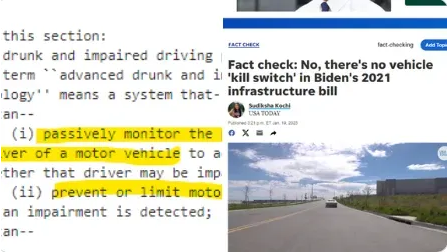
In November 2021, former US Representative from Georgia Bob Barr wrote a little-noticed political column claiming that buried inside President Joe Biden’s $1 trillion bipartisan infrastructure legislation was a dangerous provision that would go into effect in five years.
“Marketed to Congress as a benign tool to help prevent drunk driving, the measure will mandate that automobile manufacturers build into every car what amounts to a ‘vehicle kill switch'”, wrote Barr, who was the Libertarian Party’s nominee for president in 2008.
Like most Americans, I had never heard of this alleged “kill switch” until a few days ago when Representative Thomas Massie, a libertarian-leaning Republican, proposed to strip the mandate’s funding.
“The right to travel is fundamental, but the government has mandated a kill-switch in new vehicles sold after 2026,” said Massie. “The kill-switch will monitor driver performance and disable cars based on the information gathered.”
Nineteen Republicans joined all but one Democrat in opposing Massie’s amendment, which failed.
True or False?
The claim that the feds would mandate that every new motor vehicle include technology that could disable the vehicle seemed ludicrous. So I started Googling.
To my relief, I saw several fact-checkers at legacy institutions had determined the “kill switch” mandate was not true.
“Our rating: False,” said USA Today.
“ASSESSMENT: False,” said the Associated Press.
“We rate it Mostly False,” concluded PolitiFact.
(Snopes, a reliably left-leaning fact check group, was a little less conclusive, saying the claim was a “mixture” of true and false.)
Unfortunately, my relief evaporated once I looked at the bill itself.
Sec. 24220 of the law explicitly states: “[T]o ensure the prevention of alcohol-impaired driving fatalities, advanced drunk and impaired driving prevention technology must be standard equipment in all new passenger motor vehicles.”
The legislation then goes on to define the technology as a computer system that can “passively monitor the performance of a driver of a motor vehicle” and can “prevent or limit motor vehicle operation if an impairment is detected” (emphasis added).
How the system will make this determination is unclear, as is the government’s potential role in apprehending suspected drunk drivers (more on that later).
But the law’s language could not be more clear: New motor vehicles must have a computer system to “monitor” drivers, and the system must be able to prevent vehicle operation if it detects impairment.
November 19, 2023
How Himmler Learned to Love the Russians – WW2 – Week 273 – November 18, 1944
World War Two
Published 18 Nov 2023Heinrich Himmler wants to build an Army of Soviet POWs, but that has some problems; Patrick Hurley becomes US Ambassador to China, but even before that he’s in hot water with Chiang Kai-Shek; and in the field in the west, the Allies launch Operation Queen to try to cross the Roer River and reach the Rhine.
(more…)
November 18, 2023
Believe all women … unless they’re Israeli
In The Line, Kristin Raworth and Ariella Kimmel protest against the objectively pro-Hamas silence of so many feminist organizations about the terror attacks of October 7th:

On October 7th, 2023, Hamas terrorists infiltrated Israel and committed the worst massacre of Jews in a single day since the Holocaust. More than just a massacre, Hamas tortured their victims, including brutally raping women, young and old. Yet the silence of many women’s organizations and leading voices who stand tall, claiming to be “strong feminists”, is deafening.
When the #MeToo movement started, the mantra was “believe all women”. As high-profile women spoke out, the feminist movement stood with them. So why, in the wake of the most horrific terrorist attack in Israel’s history, which included rape, do these women not deserve the same solidarity?
A month later it is not just the complete silence of the women’s organizations that causes pain, it is the active justification and gaslighting of the Jewish community, which has including denying the truth of what happened on October 7th, by demanding proof, rather than believing survivors. Many may recognize these tactics as those used as abusers against their victims in cases of domestic and sexual violence, a tactic that has become known as “DARVO” — Deny, Attack, and Reverse, Victim Offender.
When reports first surfaced of the sexual assaults committed by Hamas, many of us took to Twitter, the only place where we knew to raise our voices. Immediately our replies were filled with folks who otherwise would believe survivors, but were seemingly comfortable demanding immediate forensic evidence in this case. Survivor accounts were not enough; even a video released by the Israeli government that painted a clear picture of Hamas’ brutality was not enough. Hamas terrorists themselves recounting their actions was not enough.
Sarah Jama, an MPP in Ontario, has gone so far to publicly state that the accounts of rape are a lie pushed forward by the “zionist lobby”.
We have seen people like Ghada Sasa, a former board member of Canadians for Justice and Peace in the Middle East, going on a podcast and not just claiming that Hamas treated civilians fairly, but that Israel was to blame for the massacre at the Nova music festival.
Meanwhile member of Parliament Niki Ashton claimed that a “feminist government” would call for a ceasefire; yet she has not once condemned the use of rape by Hamas as a war crime. This is a highly selective read of feminism.
November 16, 2023
Why progressives love all forms of public transit
Theophilus Chilton reminds conservatives and other non-progressives that trains, buses, and other forms of mass transit are beloved of the left at least partly because the more people depend on it, the more control the government gains over their freedom of movement:

TTCImages by Canadian8958
Wikimedia Commons
Ask most people on the broad Right what they think about public transportation and they’d probably tell you that they don’t like it. And it’s not just because of the smell and the gum stuck to the seats. Most of us, deep down inside, at least in some subconscious way, feel that mass public transportation is just a little bit communist.
[…]
This is probably much of the reason why we’re in love with the automobile. With the wide-open spaces and abundant road system we enjoy in America, most Rightists would never dream of trying to force everyone to use an archaic, 19th century technology like trains now that we don’t have to. The automobile is a symbol of freedom. You can go wherever there’s a road, no matter how big or small, when you’re in an automobile. You’re not boxed in with dozens of other people on a line that goes one place only. This is why we generally tend to view air travel as a necessary evil — if somebody invented a car that could get us from Boston to Los Angeles in six hours for a business meeting, we’d probably opt for that instead of getting groped by your friendly neighborhood TSA agent.
Progressive leftists know all of this. They know that the freedom to travel where we want, when we want, how we want, is a psychological buttress to our sense of liberty. Pod-people stay put and go where they’re told. Free men hop into their ’67 Mustang and lay rubber in front of a Dairy Queen three towns over from their own.
Hence, in their never-ending quest to gain total control over our lives, the Left has been putting into play a number of plans designed to limit our freedom of travel.
In case you weren’t aware, one of the purposes served by forcing gasoline prices sky-high is to make private automobile travel prohibitively expensive for more and more people. This has been a major thrust in the “global warming” nonsense that the Left has pushed as well — cars supposedly account for the lion’s share of carbon dioxide emissions (even though they actually don’t), so their use needs to be reduced. Way back in the Obama administration, somebody in the Congressional Budget Office accidentally let the cat out of the bag that it would be a great, absolutely smashing, idea to tax Americans for each mile they drive. Every so often the idea gets resurrected in the media, but thankfully doesn’t seem to have gotten much traction yet. Of course, this is essentially what already happens to us anywise, since we have to pay taxes on each gallon we buy to drive those miles. Presumably, this mileage tax would be added on top of the gas taxes already in place.
The whole point to this is not to “stop global warming”. Let’s face it, those in the know at the top of the progressive hierarchy know that global warming is a hoax. They know it’s just prole-feed for the useful idiots in their own ranks and for the easily swayable among the public at-large. The point to inducing people to stop driving cars is not to save the earth, but to reduce the freedom of movement that people have. Take away cars and you take away the ability of most people to travel for pleasure. You take away their means of conveniently conducting much of their commerce and other business. You would prevent them from being able to have forest hideaways and beach homes. In short, you prevent the middle and working classes from having the same things that the rich can have, you keep them from having lifestyles that even begin to approach the type, if not the extent, of the global transnational elite. Most of all, you would take away that psychological sense of freedom that the ability to move about unhindered gives to people. It’s about forcing us all into the Agenda 2030 “You’ll own nothing and be happy” scenarios that the globalist world-planners have prepared for us.
More recently, and more concretely, is the Congressional effort (which ineffectual Republicans failed to stop) that would direct automobile manufacturers to include a “kill switch” into all vehicles made after 2026, a device which would allow authorities to shut down a vehicle remotely. Ostensibly, the reason would be if the driver is acting like he or she is driving while impaired (i.e. it’s FoR yoUr SaFeTy!!1!). Of course, we know the actual reason is to provide bureaucrats and functionaries in the managerial state the means to freeze the movement of dissidents and others who run afoul of the Regime’s dictates. Don’t think they’d do that? Well, these are the same people who just put the infant son of a J6 defendant on the no-fly terrorist watch list.
So, what would have to replace private automobile travel, once nobody but the super-rich will be allowed it? Public mass transportation, of course. Buses, light rail, subways. This has already largely happened to those poor unfortunates who dwell within our large cities and for whom the lack of parking, expensive personal property taxes, and archaic road systems have already removed the automobile from being a viable alternative. The lefties work to extend this system even to places, such as smaller cities, the suburbs, and even the exurbs, where such systems normally would not be “needed” or desired. Make parking in the city so scarce as to be impossible to find, or so expensive that you’d rather take the bus. Provide “free” bus service (paid for by the taxes of productive, automobile-driving people, of course) to encourage people to stop polluting. In several places, the lefties keep trying to push their light rail boondoggles so that the system can be extended between cities — no more need to have people killing Mother Gaia with highway driving. These public systems are there to take up the slack once private transportation is turned into road pizza.
So how does this affect our freedom? Well, it’s because of the fact that mass transportation is inherently restrictive in its approach to people delivery. A bus route can’t include every single possible place that people might want to get on or off the bus. It only follows certain routes. Same with AmTrak, with light rail, subways, etc. It’s easier, then, to control the access which people have to transportation.
The US military may need to find a modern-day Patroclus
John Carter explains why the sudden swerve in US military recruitment from all-diverse-all-the-time to an ad that might have been created in the 1960s … and why it still won’t help:

He is the very essence of a modern major general.
Sing, o muse, of the wrath of Achilles, son of Peleus, that brought countless ills upon the Achaeans …
Thus opens the foundational epic of European civilization.
Achilles is angry because his woman, Briseis, has been appropriated by Agamemnon, the leader of the Greeks. He expresses this discontent by going on strike. While the rest of the Greek army fights and dies outside the walls of Troy, Achilles lounges in his tent, content to sit out the combat until Agamemnon comes to his senses and returns his war bride. If Achilles were simply any other warm body with a spear, this wouldn’t be such a big deal, but he is Achilles – the greatest warrior of the Heroic Age. Without him, the Greeks are at a severe disadvantage. Achilles’ petulance is therefore a problem for Agamemnon.
The lesson is hardly a subtle one. Kings and generals need to keep their soldiers happy. They especially need to keep their best soldiers happy. If they don’t – for instance, by taking their women from them – morale will suffer, and they may well find themselves without the crucial support of their warriors when it most matters.
Washington seems to have missed that lesson, and now, they’re paying the price.
For the last decade they have been relentlessly and mercilessly whipping American whites: defaming them as racists, mocking their intelligence and manliness, tearing down their statues, erasing the names of their ancestral heroes, replacing their fictional archetypes with diverse doppelgangers in the media, disadvantaging them in education and employment, demanding that they attend racial struggle sessions. The list of outrages and humiliations is long and all too familiar, permeating as it does every one of our institutions.
But now, the Empire of Lies faces a problem.
War has returned to the world. History, its rumoured demise notwithstanding, once again stalks the land. Russia mauls the Ukraine; Israel is beset with enemies; the Empire’s influence in Africa frays by the day; China salivates over Taiwan.
Meanwhile the American domestic economy, long since hollowed out by the extractive rent-seeking of financial parasites, lurches from one crisis to the next. The Great Satan remains powerful, for the present, but the young bucks can scent that the silverback is not what he used to be. Their provocations increase in daring and intensity. If they aren’t slapped down, their boldness will only increase.
The criminal regime that has insinuated itself into the halls of American power is running against a clock. They must have a war to cover the slow collapse of their fake economy. They must have a war to prevent rival regimes from displacing their American golem. But their golem is crumbling. Therefore they must have a war sooner rather than later, because with every moment of delay America becomes weaker, while China and Russia become stronger.
Their problem is that no one wants to fight for them.
The core warrior population of America has always been the Scots-Irish of the Appalachian regions, the good ol’ boys of the South, and the farm boys of the Midwest. Hillbillies and rednecks, in other words. Many families from these areas have multi-generational traditions of service. Dad served in Vietnam, Grampa in WWII, Great-Grandpa in the Great War, and Great-Grandpa’s Pappy fought under Lee in the War of Northern Aggression.
These are precisely the white populations that have been singled out for the most unrelenting and vicious racial abuse over the last several decades. They are the one group that it’s okay to defame in the media, depicted as ignorant, bigoted, backwards, and inbred. The people running Hollywood seem to have a special disgust for them. For generations they have born this with a sort of stoic good cheer, accepting their role as the heel in the great kayfabe of American political drama even as they shouldered a disproportionate burden of blood, tears, and sweat in America’s imperial wars.
The events of the last two decades seem to have put an end to that. It wasn’t just the psychotic frenzy of race communism that gripped the regime’s mind, although that certainly played a factor as the military has hardly been immune to it. Who wants to serve in an armed forces that has thrown meritocracy in the trash to make sure the commissioned ranks include as many strong black lesbians as possible, that spends more time making sure the enlisted ranks understand the nuances of pronoun usage and the finer points of critical race theory than training for war? Demoralizing as all that has been, the absolutely pointless debacle of the Neocon Forever War in the Middle East has played at least as large a role.
Maryland Council of Safety Revolutionary Flintlock
Forgotten Weapons
Published 20 Nov 2014In the buildup to the US War of Independence, “Committees of Safety” were organized in the colonial state to form shadow governments for the independence movement. These committees (or councils, as a few were named) had, among other tasks, the responsibility of sourcing arms for the local militia forces.
This was done both by purchasing arms available at the time from gunsmiths, commercial dealers, and private individuals and also by contracting with gunsmiths to manufacture guns specifically for the council or committee. Typically these guns were not specially marked — there was no particular reason to do so — and as a result they are very difficult to authenticate today. A Revolutionary War weapon could have been anything available at the time.
One notable exception is an order placed by the Maryland Council of Safety. They ordered quite a lot of guns from area manufacturers, including a batch of 500 pistols. In addition, they hired an inspector to verify the quality of the finished guns, and mark them. The inspector was named Thomas Ewing, and his marking looked rather like a tulip. Records about the guns he oversaw and marked remain in existence, and allow them to be identified — including this example.
(more…)


