Quotulatiousness

June 29, 2023

Miller’s Musket Conversion: The Trapdoor We Have At Home

Filed under: History, Military, USA, Weapons — Tags: , , , — Nicholas @ 02:00

Forgotten Weapons
Published 15 Mar 2023

In 1865, brothers William and George Miller of Meriden CT patented a system to convert percussion muskets to use the new rimfire ammunition that was becoming available. Between 1865 and 1867, the local Meridan Manufacturing Company converted 2,000 surplus US Model 1861 muskets (mostly made by Parker & Snow) to the Miller system, using .58 rimfire ammunition. The US military tested one of these conversions in 1867, and found it to suffer from some gas leakage and about a 3% misfire rate. There was no further Army interest, although the New York and Maryland state militias did both purchase small numbers of the guns.
(more…)

QotD: The costs of taxation

Filed under: Government, History, Quotations, USA — Tags: , , — Nicholas @ 01:00

What now seems like a lifetime ago, back in the early 1970s, I asked a colleague (who knew about such things) a somewhat complicated question.

Assuming that:

  1. the average individual (in those days) is forced to give a third of what he earns to government (which will do nothing productive with it, but turn it straight into trash of one kind or another), and that
  2. whenever three such individuals are taxed at that rate, in effect, one whole human being — including all his or her potential accomplishments, his creations, his ability to raise the standard of living for himself, for his family and friends, for everyone around him, and for society in general — has been economically obliterated, then
  3. how many human lives in total have been obliterated in that way since the Constitution, with its taxing powers, was ratified in 1789?

It turns out to be a very difficult question to answer. Tax rates have varied over the years, and so has the number of Americans subject to taxation. In the end, my colleage estimated that it had consumed the productive capacity of some fifty million (50,000,000) innocent human lives. That’s roughly four times the number of victims claimed by Adolf Hitler. It almost equals the number of individuals killed in all of the Second World War. It fits in somewhere between the number of Russians slaughtered by Josef Stalin and Chinese killed by Mao Zedong.

And according to political scientist R.J. Rummel, it’s properly called “democide”, since, for this purpose, everybody gets to be the Jews.

So now you finally know where your flying car went, and why there’s no cure yet for cancer. You know why there’s no luxury hotel aboard a Big Wheel space station, no vacation resort on the Moon, and no scientific base on Mars or Titan. All of those things, and many more that we expected to have (or still haven’t imagined) by now, were devoured, sometimes quite literally, by grants to investigate the territoriality of tree frogs, programs to feed individuals who can’t — or won’t — work (which is properly the job of churches), programs to keep people from smoking the wrong vegetable or (to quote the late Saint George Carlin) shooting, snorting, or rubbing it into their bellies), not to mention enforcing laws against licking the wrong toad.

Not the ones squatting in the White House.

L. Neil Smith, “Economic Genocide”, Libertarian Enterprise, 2014-06-29.

June 28, 2023

Ted Gioia’s confession – he’s a Dan stan

Filed under: Media, USA — Tags: , , , — Nicholas @ 05:00

While I’ve never been much of a musicologist — and definitely not any kind of musician — I admit I had a very similar evolution of feeling toward the music of Steely Dan as Ted Gioia, who charts his progress from Never Dan to Dan stan:

I often make jokes about Steely Dan fans.

They’re bros and geeks and sad wannabes. But the painful truth is that I’m one of them now.

And if you don’t watch out, it could happen to you too.

At least I can laugh at myself. That’s good, because fans like me are the real target of the jokes.

And it’s true — we are a trifle obsessed.

If you’re a Dan stan, you see the band’s influence everywhere. Random patterns take on new Dan-esque shapes. For you it’s just rush hour traffic, but for us it’s a message from the cosmos.

But I wasn’t always like this. Once upon a time, I was a Steely Dan skeptic, a real Dan-o-phobe. I thought I was safe from their pernicious influence, but I was wrong.

This is my story.

How to Fund a War: Lend Lease, Billion Dollar Gift, and Aid to Britain

OTD Military History
Published 27 Jun 2023

Programs like Lend Lease, Mutual Aid, and the Billion Dollar Gift were support from Canada and the United States that helped Britain with war supplies and material in the darkest days of World War 2.
(more…)

The Treaty of Versailles: 100 Years Later

Gresham College
Published 4 Jun 2019

The Treaty of Versailles was signed in June 1919. Did the treaty lead to the outbreak of World War II? Was the attempt to creat a new world order a failure?

A lecture by Margaret MacMillan, University of Toronto
04 June 2019 6pm (UK time)
https://www.gresham.ac.uk/lectures-an…

A century has passed since the Treaty of Versailles was signed on 28 June 1919. After WWI the treaty imposed peace terms which have remained the subject of controversy ever since. It also attempted to set up a new international order to ensure that there would never again be such a destructive war as that of 1914-18. Professor MacMillan, a specialist in British imperial history and the international history of the 19th and 20th centuries, will consider if the treaty led to the outbreak of the Second World War and whether the attempt to create a new world order was a failure.
(more…)

June 27, 2023

Adam Kinzinger seems to admit that the “Patriot Front” are really federal agents

Filed under: Media, Politics, USA — Tags: , , — Nicholas @ 04:00

Tom Knighton on the weird MAGA-versus-“MAGA” confrontation:

A while back, a group calling itself Patriot Front showed up. Dressed in dark shirts and khaki pants, with ball caps and masks hiding their face, Patriot Front started engaging in some very … questionable behavior.

Almost immediately, they were labeled as feds.

Virtually no one believed they were who they claimed to be. They were openly Nazi-like, even providing the Hitler salute, all without the usual trappings of the neo-Nazis we typically see.

Well, recently, the Proud Boys clashed with Patriot Front.

The Proud Boys have been accused of being all kinds of things, too, including racists, yet it’s clear from the video shown that the Proud Boys aren’t fans of Patriot Front. Instead, you hear jeers calling them “racists” and “Nazis”.

The altercation got physical and a couple of the Patriot Front members were unmasked.

Enter former Congressman Adam Kinzinger, who offered up this hot take:

The video shown there is, in fact, the video in question, and Kinzinger’s comments have riled a lot of people up.

After all, he’s basically admitting that Patriot Front is a federal law enforcement operation.

Is it?

Probably, though I’m not sure Kinzinger would be read in on such an operation.

June 26, 2023

America can’t build anything these days and “it’s all Ralph Nader’s fault”

One of the readers of Scott Alexander’s Astral Codex Ten has contributed a review of Public Citizens: The Attack on Big Government and the Remaking of American Liberalism by Paul Sabin. This is one of perhaps a dozen or so anonymous reviews that Scott publishes every year with the readers voting for the best review and the names of the contributors withheld until after the voting is finished:

Today, pundits across the political spectrum bemoan America’s inability to build.

Across the country, NIMBYs and status-quo defenders exploit procedural rules to block new development, giving us a world where it takes longer to get approval for a single new building in San Francisco than it did to build the entire Empire State Building, where so-called “environmental review” is weaponized to block even obviously green initiatives like solar panels, and where new public works projects are completed years late and billions over budget — or, like California’s incredible shrinking high-speed rail, may never be completed at all.

Inevitably, such a complex set of dysfunctions must have an equally complex set of causes. It took us decades to get into this mess, and just as there’s no one simple fix, there’s no one simple inflection point in our history on which we can place all the blame.

But what if there was? What if there was, in fact, a single person we could blame for this entire state of affairs, a patsy from the past at whom we could all point our censorious fingers and shout, “It’s that guy’s fault!”

There is such a person, suggests history professor Paul Sabin in his new book Public Citizens: The Attack on Big Government and the Remaking of American Liberalism. And he isn’t isn’t a mustache-twirling villain — he’s a liberal intellectual. If you know him for anything, it’s probably for being the reason you know what a hanging chad is.

That’s right: it’s all Ralph Nader’s fault.

How’d he do it? By creating what’s now called the public interest movement: a new form of activism through which citizens force change — or, more often, block change — by suing the government. Though it was begun with the best of intentions and achieved some real good along the way, this political innovation led to the constipated governance we all complain about today.

How did a movement launched by an unassuming 30-year-old lawyer become the dominant form of activism in the country, and completely change the way our government operates?

To find out, we have to go back to a time before Ralph Nader had even hit puberty — the era of the New Deal.

[…]

It is the inherent nature of politics that no reform works forever, because the next generation of political entrepreneurs will inevitably discover new ways to bend the process to their will. Eventually, there will always be another Dick Fosbury revealing a way to work the system that no one saw coming.

Still, I do think some of the blame for the way this all panned out can be laid on Nader’s particular personal idiosyncrasies. His ironclad black-and-white view of the world, combined with his near-pathological aversion to dealmaking and compromise, made him uniquely suited to a form of activism that focused on regulatory and legal action rather than coalition-building and electoral politics. Nader was infamously rigid and inflexible, so it’s no surprise that his movement was too. But a less rules-oriented movement might have created fewer of the bureaucratic barriers that have now become a hindrance to progressive action.

Much like the movement whose story it tells, Public Citizens the book is a worthwhile project that nonetheless suffers from significant flaws. The main problem is that it can’t decide if it’s a historical narrative or a work of political theory. As a work of political theory, it doesn’t take nearly a strong enough stand — I’ve made explicit a lot of claims that are only lightly implied in the book. I think we’re making the same argument, but the book makes its argument with such a delicate touch that it’s hard to be 100% sure.

As a historical narrative, Public Citizens has a much simpler problem: it’s boring. The author writes like an academic (which, to be fair, he is), and the book is quite light on colorful details. The uncreative chapter titles (chapter three is called “Creating Public Interest Firms”) give you a taste of what the writing is like. One particularly egregious issue is how little biographical information is provided about Nader, even though the majority of the book is about him. For someone who apparently subscribes to the Great Man theory of history, the author includes surprisingly little information about the Great Men themselves. Any interesting biographical fact you read in this review — even something as basic as the fact that Nader never married—is almost certainly something I found through other sources.

Paradoxically, this book manages to be simultaneously boring and too concise. It’s over in less than 200 generously-spaced pages, and I frequently had to look stuff up on the internet to get a full understanding of what was going on. I get the sense that the author is trying to give this book mass appeal, but come on: anyone who’s willing to read a nerdy book like this is willing to read an additional hundred pages or so. Besides, Robert Caro and Ron Chernow have proven that people will read thousand-page tomes if the story is compelling and the details are juicy.

Basically, my critique of Public Citizens is like that old Catskills joke about the restaurant where the food is terrible — and the portions are too small.

The struggle for equal rights turned into the struggle to oppress others so gradually, most people didn’t notice

Filed under: Media, Politics, USA — Tags: , , , , — Nicholas @ 03:00

From the most recent Weekly Dish by Andrew Sullivan:

Many, many moons ago, when I was a marriage equality pioneer and not a total pariah among the gays, I was asked to speak at the Human Rights Campaign Fund, as it was then called. Determined as ever not to read the room, I said (paraphrasing from memory): “The goal of any civil rights movement should be to shut itself down one day. And once we get marriage equality and military service, those of us in the gay rights movement should throw a party, end the movement, and get on with our lives.”

You can imagine how well that went down. And, sure enough, 30 years later, with marriage, military service and trans equality enshrined in the law, the HRC building now has a massive, six-story high poster hanging on it: “BLACK LIVES MATTER. TRANS BLACK LIVES MATTER.”

That tells us a bit about where we are today, and how we got here.

The point I was making in the early 1990s was that liberalism knows limits. A liberal politics does not seek to impose meaning on everyone; it creates the space for individuals to choose that for themselves. It doesn’t seek to deliver the truth about anything either; it merely provides the mechanisms for the open-ended pursuit of truth. A liberal politics will seek formal equality for members of minorities; but not substantive equality — what is now called “equity”. It would not require us to come to one, single understanding of reality; it would always allow diversity of opinion and encourage free debate. Live and let live. Remember that?

Technically speaking, that makes me a liberal conservative: accepting the reality of liberal modernity (even, in my own case, being happily at home in it), while seeking to limit its illiberal overreach and utopian ambitions. And that was what I tried to sketch out in Virtually Normal. It’s a book less about homosexuality than about politics itself. It’s about a politics of going this far — and no farther. From the NYT review in 1995:

    Mr. Sullivan offers his own prescription for a “politics of homosexuality” that reconciles “the best arguments of liberals and conservatives”. It is a liberal stand, Mr. Sullivan argues, in that it puts a premium on individual liberty and equality before the law, but its requirements would apply only to government policies on homosexuality, avoiding “the regulation of people’s minds and actions” in the private sphere.

Homosexual citizens absolutely deserved equal rights, but the question of homosexuality itself would — and should — always be open to dispute and debate. Since a liberal society contains both fundamentalist preachers as well as lesbian atheists, it cannot resolve the core question. So it shouldn’t try. And it should celebrate, not bemoan, this ideological diversity.

I can see why the religious fundamentalists are queasy with the settlement that came from this. They have to live in a society that accepts civil marriages for couples of the same sex. The deal is that in return, they are free to deny the morality of such marriages, to reserve religious marriage to heterosexual couples, and not be forced to participate in any way. I can also see why queer theorists are queasy as well. They don’t like the heteronormativity of civil marriage, or the respectability politics that goes with it. But they in turn are free to live their lives as “queerly” as they want in society, to create culture that seeks to subvert and radicalize.

This, in the end, is my response to all the “slippery slope” arguments about gay marriage now being raised again on the right. There is no slope in the case I made. There is a clear line: formal legal equality alongside cultural and social freedom on all sides. From my liberal conservative perspective, the gay rights movement should have shut down in 2015 after Obergefell; and the trans rights movement should have shut down in 2020 after Bostock. Once gay men and lesbians and trans people achieved legal and constitutional equality, the fight was over.

But in the movement I was once a part of, many, of course, were not liberals, let alone liberal conservatives — but radicals, who reluctantly went along with marriage equality, but itched to transform society far more comprehensively. And these radicals now control everything in the hollowed-out gay rights apparatus. Their main ticket item is a law that would replace biological sex with gender in the law, and remove protections for religious liberty: smashing the liberal settlement. Combine that with acute polarization in the Trump era, and information silos, so that many gays get their sense of reality from MSNBC and Elton John, and you can see how the spiral into illiberal madness began.

June 25, 2023

British schoolchildren mock their oh-so-woke teachers

Filed under: Britain, Education, Law, Media, USA — Tags: , , , , — Nicholas @ 05:00

In Christopher Gage’s weekly round-up, I discovered that I shared a trait with Ted Kaczynski (“austere anarchist scholar” as US mainstream media might have described him). Not just any trait, but the one that ended up putting him in prison after nearly twenty years of sending bombs through the mail:

Elliot Rodger, Ed Kemper and Ted Kaczynski.
Photos from Quillette.

… Ted insisted on the proper use of the idiom, “You can’t eat your cake and have it, too”. Ted rejected the common and logically fraught version: “You can’t have your cake and eat it, too”. Indeed, you can. You must have your cake if you are to eat your cake. You cannot have your cake once you’ve eaten your cake.

That turn of phrase helped F.B.I agents snare Ted. His sister-in-law read his essay, recognised the writing style, and the peculiar diction, and then grassed him up to the rozzers.

For the record, this may be the only point of agreement I have with that noted austere scholar, although I’ve never read any of his writings to find out.

Another amusing incident involved children taking the Mickey out of ultra-progressive teachers in British schools:

Last week, schoolchildren in Sussex dropped themselves into the soup after suggesting that their fellow classmate is not actually a cat.

Two thirteen-year-old girls at Rye College were told they “should go to a different school” if they didn’t believe that a girl could identify as a cat.

During a “life education” class, the pair said there was “no such thing as agender” and: “If you have a vagina, you’re a girl, and if you have a penis, you’re a boy — that’s it.”

When they queried how someone could identify as a cat, the pair were blasted for questioning their classmate’s identity.

An investigation found children at schools across the land now identify as dinosaurs and horses. Another often dons a cape and demands to be acknowledged as a moon. Another identifies as Bambi.

After the hysteria simmered, it became obvious what was going on here. And it too became obvious that this is a good thing.

Reader, these children are taking the Mickey.

When confronted with obvious nonsense held by their preachy, supposedly superior teachers, these kids cannot resist mocking them to a nub.

After all, if one can identify as whatever one wants then that includes anything one wants. For teenagers primed with mischief, this is just too good a brew not to sup on a daily basis.

And it is a promising sign. Ridicule, the sharp-elbowed sister of truth, is essential to all progress. Clearly, these kids are unafraid to think for themselves and are determined to see that which is beyond their own nose.

Perhaps this is the beginning of the end of what almost everybody knows to be patent nonsense. As history assures us, once something becomes a laughingstock it soon dies of ridicule.

As James Thurber put it, that which cannot withstand laughter is not a good thing.

The Greatest Pincer Movement in Military History – WW2 – Week 252 – June 24, 1944

World War Two
Published 24 Jun 2023

The Red Army surges forward in Operation Bagration, a mighty new offensive to destroy German Army Group Centre. Fighting continues in Normandy, Italy, and Finland. The United States Navy tears the heart out of the Imperial Japanese Navy in the Philippine Sea even as the Imperial Japanese Army has success in China. The British and Indian armies lift the siege of Kohima.
(more…)

Fifty years after The Princess Bride was published

Filed under: Books, Humour, Media, USA — Tags: , , , — Nicholas @ 03:00

William Goldman’s novel The Princess Bride was not a blockbuster, nor did the movie adaptation get a huge box office when it released in 1987. Yet despite apparent early mediocrity, it became a cult classic. It’s now fifty years after the book came out, and Kevin Mims has a look back at both the novel and the movie:

Even by the eccentric standards of fantasy literature, William Goldman’s 1973 novel The Princess Bride is extremely odd. The book purports to be an abridged edition of a classic adventure story written by someone named Simon Morgenstern. In a bizarre introduction (more about which in a moment), Goldman claims merely to have acted as editor. Unlike Rob Reiner’s much-loved 1987 film adaptation, the book’s full title is The Princess Bride: S. Morgenstern’s Classic Tale of True Love and High Adventure, The “Good Parts” Version. Yes, all that text actually appeared on the cover of the book’s first hardcover edition (all but the first three words have been scrubbed from the covers of most subsequent editions).

In the 1990s, I worked at a Tower Books store in Sacramento. Every few months, someone would come into the store and ask if we had an unabridged edition of S. Morgenstern’s The Princess Bride. The first time this happened, a younger colleague who had worked there longer than I had told my customer, “The Princess Bride was written by William Goldman. There is no S. Morgenstern. Goldman made him up.” The customer wasn’t convinced. “It’s metafiction,” my colleague explained. “A novel that comments on its own status as a text.” When the customer had left, my colleague told me that a lot of people still believe there is an original version of the novel available somewhere, written by Morgenstern. Having fallen in love with the story via the Hollywood film, they were now looking for the ur-text.

Although I was a big fan of William Goldman, I had never read The Princess Bride. My wife and I saw the film when it first appeared in American theaters, and we have rewatched it several times since on VHS and DVD. Only about 10 years ago did I actually get around to reading the novel. And when I did, I found myself sympathizing with all those people who still believe that, somewhere in the world, there exists an unedited edition.

In his introduction, Goldman tells us that S. Morgenstern was from the tiny European nation of Florin, located somewhere between Germany and Sweden, which is where the story’s action takes place. Such a place never existed, but it’s not surprising that many 21st-century American readers don’t know the names of every current and former European kingdom. European history is littered with microstates that rose briefly and then vanished without leaving much of a trace. Back in the 1990s, before Internet access became commonplace, confirming the existence of a small defunct European statelet would have involved a trip to the library.

But readers in the 1970s might have been more alive to Goldman’s ruse. Back then, metafiction was all the rage. John Barth became a literary superstar (among the academic set, anyway) with books like The Sot-Weed Factor (which, like The Princess Bride, is a fantastical comic adventure supposedly written by a fictional author) and Giles Goat-Boy (the text of which, Barth writes in the foreword, was said to have been written by a computer). In 1983, Goldman would publish a second novel behind the Morgenstern pseudonym, titled The Silent Gondoliers, but this time he removed all mention of himself, even from the copyright page.

QotD: We won’t be seeing any rebooted TV shows from the 1990s

Filed under: Government, Humour, Media, Quotations, USA — Tags: , , , , , — Nicholas @ 01:00

… most 1990s entertainment would be impossible to “reboot” now, simply because so much of it presumes a baseline level of social and especially governmental competence. Take The X-Files, for instance. The “hot take” on the show back then was that it reflected our widespread social unease with an all-powerful government. The truth is out there!

Thirty years on, we can only dream of a government competent enough to cover up contact with extraterrestrials. As someone remarked at Z Man’s the other day, our government is now so retarded, Eric Swalwell — a high-ranking member of the House intelligence committee and putative presidential candidate — couldn’t successfully bone a hooker. Sorry, gang, the aliens won’t be stopping by; they only want to make contact with intelligent life.

Severian, “Random Thoughts”, Rotten Chestnuts, 2020-12-17.

June 24, 2023

The Most Reliable and Versatile Sub-orbital Rockets Ever Made; the Black Brant Sounding Rockets

Filed under: Cancon, History, Military, Space, Technology, USA — Tags: , , , , — Nicholas @ 02:00

Polyus
Published 31 Aug 2018

The Black Brant series of sounding rockets was a great success and a proud contribution to the global race for space. While not as glamorous as an orbital rocket, the Black Brants helped scientists from around the globe research and better understand the Aurora and the Earth’s ionosphere.
(more…)

June 23, 2023

The Combat Engineers of D-Day – WW2 Special Documentary

Filed under: Britain, France, History, Military, USA, WW2 — Tags: , , , — Nicholas @ 04:00

World War Two
Published 22 Jun 2023

How do you blast through the obstacles and minefields on the beaches of Normandy? How do you get thousands of tonnes of tanks, guns, and men into the fight? And what about reopening the shattered French ports? You need men who are as skilled in construction as they are destruction. You need the engineers.
(more…)

From Operation Barbarossa in 1941 to the disinformation and cover-up over the origins of the Wuhan Coronavirus

Chris Bray outlines the utterly amazing situation between the Soviet Union and Nazi Germany on the eve of Hitler launching Operation Barbarossa — where Stalin refused to believe that Hitler would attack Russia despite overwhelming evidence from many sources — to the parallel situation over Covid:

Several sources quite specifically reported to the Soviet government that the Germans would invade around dawn on June 22. Their reports can be found in the Soviet archives in a “folder of dubious and misleading reports”. Then, shortly before dawn on June 22, Germany invaded the Soviet Union. Military leaders on the border called in reports of the invasion, and the people they talked to in Moscow declined to believe them. Soviet border troops held their fire, seeing Germans while being ordered to understand that no true invasion could possibly be underway. Stalin knew better, and contradicting Josef Stalin was known to be a fatal mistake. Achieving an entirely avoidable surprise, the Germans destroyed much of the Soviet air force on the ground, parked wingtip-to-wingtip for the convenience of the invader’s bombers.

[…]

An invasion that could have been met with brutal severity from the first moment instead achieved considerable initial success against a supine nation because the Soviet leader, and the chain of subordinates beneath him who were forced to adopt his conception of facts and truth, assumed that things they didn’t wish to believe constituted disinformation. Millions of lives were wasted for that illusion. A society that categorizes inconvenient truths in this way is committing a form of suicide, hiding from hard facts that demand acknowledgment.

Now: In 2021, the lab leak theory was a disgusting lie with “racist roots”.

In June of 2023, the, uh, first people who got sick with Covid turn out to have been, uh, scientists at the lab in Wuhan. BUT THEY PROBABLY HAD SOME BAT SOUP AT THE WET MARKET, IS WHY, or something.

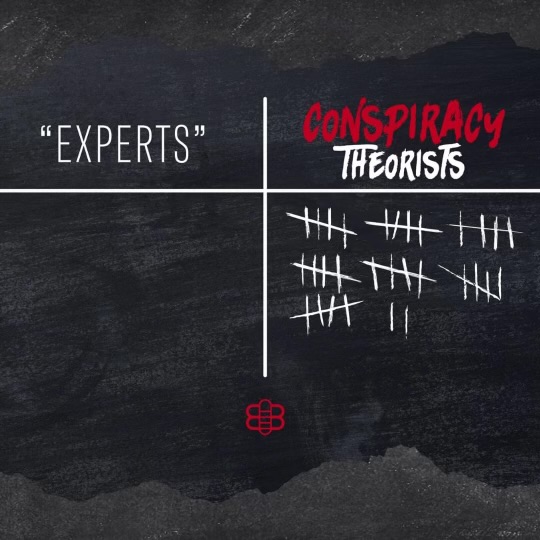
Stupid conspiracy theorists, you people are such MORONS, do you actually bel— okay, that one’s true too.

We’ve somehow developed an industry of professional information barriers, dimwitted parasitical human garbage whose sole function in life is to prevent understanding by pasting “disinformation” stickers on things that you’re not supposed to know.

« Newer PostsOlder Posts »

Powered by WordPress