
This, by the way, is the thing people don’t get about space. Every time humanity takes some tiny step along the path to becoming a multiplanetary species (by which I mean “every time SpaceX does something cool”), someone comes along and complains that it seems kind of pointless. The Moon is very far away, Mars is even farther, and we have this whole big planet right here that’s already full of “uninhabitable” regions like the Sahara or the Antarctic or, uh, the entire American West. Starting there seems easier, since they already have things important elements such as “air” and “water” and “a biosphere”. Play your cards right and you won’t even need a passport, let alone a spaceship. A friend of mine even coined the slogan: “Terraform Terra first”.
But this misses the point. Yes, space colonization appeals because it’s part of the wizardly dream of innovation, of building new and exciting things, and thus has an aesthetic draw that goes beyond practical arguments. Yes, long-term we probably shouldn’t put all our civilizational eggs at the bottom of one gravity well. And yes, many humans have a Promethean (Faustian? Icarusian?) drive to expand, to explore, to see what’s beyond the horizon. All of which is a pull to space.
Now pause for a moment and think about what would actually happen if you decided to set up your terran terraforming in, say, the Owyhee Desert of southwestern Idaho. There’s a river in parts of it. It rains occasionally, and snows in the winter. Whatever techniques you were planning to generate power and conserve water on Mars would certainly work in Idaho — more efficiently, for solar, since we’re closer to the source, and with more margin of error if you can add water to the system. Plus the desert is full of exciting minerals you can mine to sell or even to extract water from! And the second you tried, the Bureau of Land Management (which owns most of the Owyhee, and indeed most of the American West) and the Environmental Protection Agency (which has opinions about mining) and the ranchers (who would also like to use that water, thank you) will come down on you like a ton of bricks.
That’s the push to space.
The dream of space colonization is partly about all the ways it would be cool to live on Mars or the Moon. But it’s also, implicitly or explicitly, a claim that it’s easier to solve enormous technical challenges (air! water! food! solar radiation!) than it is to solve societal challenges on Earth. Terraforming is hard; eunomiforming is harder.1
Jane Psmith, “REVIEW: The Powers of the Earth, by Travis J.I. Corcoran”, Mr. and Mrs. Psmith’s Bookshelf, 2024-04-29.
- Though to his credit Corcoran has a diverse portfolio: in addition to the space colonization dreams, he’s tackling the “terraform Terra” angle with an active homestead (he’s written some guides) and the “improve society somewhat” approach through more direct political engagement than I’ve ever done.
October 5, 2025
QotD: Why go to the Moon or Mars?
October 4, 2025
QotD: Roman … democracy?
And today we’re going to look at why it is that the assemblies never roar quite so often as you’d expect and in the process begin developing the arguments of perhaps the central scholarly debate currently about the Roman Republic: how democratic was it really?
Bret Devereaux, “Collections: How to Roman Republic 101, Part II: Romans, Assemble!”, A Collection of Unmitigated Pedantry, 2023-07-28.
October 3, 2025
QotD: The role of the True Believer
Anon @Greynxgga69
Abolish The Family.
Abolish Religion.
Abolish Wage Labour.
Abolish Money.
Abolish Work.
Abolish Commodity Production.
Abolish the State.
Abolish Class.
Abolish Private Property.
Abolish the Nation.
Abolish Patriarchy.
Abolish Gender.
Abolish Town and Country.The True Believers imagine they will live in Utopia after the Revolution.
They will instead be sent to the gulag, or lined up against the wall and shot.
Why?
Because the function of the True Believer is to make the Revolution. And the purpose of the Revolution is to replace The Regime.
Once the Revolution is made, and The Regime has been replaced, no further Revolutions are wanted. Therefore the True Believer serves no purpose.
He is a liability, because he has been promised Utopia, and Utopia is hard, even perhaps impossible, to deliver. If he does not receive the promised Utopia, he is apt to make Revolution again.
The Regime does not want this. It does not wish to be replaced in the same fashion that it replaced The Regime. So the True Believer must be disposed of. He must be replaced with the Opportunist.
The Opportunist can be relied upon, because he does not want Utopia. He wants to have more than his comrades. So long as he receives more than his comrades, he will serve The Regime.
As above, so below.
As before, so after.
Meet the New Boss. Same as the Old Boss.
Devon Eriksen, The social media site formerly known as Twitter , 2025-07-01.
October 2, 2025
QotD: The gap between the author and the reader
The Psellus book was a memoir, and so its author was presenting himself fairly directly to his audience, if in a self-edited fashion. Fiction adds a layer of veiling between creator and reader, ranging from a thin gauze to a thick stage curtain. People are naturally curious about anything hidden by a curtain, and always want to peek. (When thinking about this as a shy writer, I always channel that famous line from the Wizard at the climax of the movie The Wizard of Oz — “Pay no attention to that man behind the curtain!”) But if readers can’t get an actual look, they will make up the writer in their heads, constructed from their own knowledge and expectations much as they mentally construct the fictional characters they’re reading about.
I got an accidental peek at this process many years ago at a science fiction convention, where I fell into a conversation in the booksellers’ room with a (male) reader who was very surprised to discover I was a woman — by whatever assumptions, he had not processed my name on the cover as female. (This, I later discovered, is not uncommon in my foreign-language translations, where the genders of English names are less recognizable.) Quickly, before his mental image was overwritten by our encounter, I got him to describe the author whom he had imagined had written the books he’d enjoyed (Vorkosigan Saga science fiction stories, at the time.) It included some odd details — male, mid-thirties, dark-haired, East Coast upper class — rather like my fictional character Ivan Vorpatril, really. Nothing at all like the beleaguered (if also mid-thirties) Midwestern housewife and mother I actually was. Yay curtain.
Lois McMaster Bujold, introduction to the Taiwanese edition of The Curse of Chalion by Fantasy Foundation/Cite Publishing, 2020-03-25.
October 1, 2025
QotD: The Indian Mutiny of 1857
This is a near-perfect synecdoche for the Raj’s problems. British Army officers weren’t stupid — lots of them commented on the issue. But they were isolated. For one thing, lots of them weren’t regular army — they were attached to the East India Company army, a separate formation, and within the Company’s army were different formations with different service requirements. And the army — whichever army — was deeply isolated from the civilian administration. For one thing, India’s huge, and there were never more than about 200,000 British in the whole place. The army was mostly on the frontier; the Government hung around primarily in a few big cities: Bombay, Calcutta, the summer capital at Simla (way up in the Himalayas).
So stop me if this sounds familiar: The civilian administration didn’t really know anything about the group upon which their peace, their security, their very lives depended. Actively despised them, in fact — oh, those wogs and their silly customs. But also look at it from the bottom up: What could the civilian administration really have done, with the best will and deepest knowledge in the world? […]
What could the leadership really have done at that point? Send a select group of brahmins and imams to tour the grease factory? The rumor would be that the British set up a Potemkin factory just for them; the real factory was using cow and pig fat. Reissue the old rifle? Recall that they already changed their drill — a pretty big deal in any army; a huge deal in a mid-19th century one — and that just added to the paranoia. Anyone who has ever been on the Internet knows how these things work once they get started: Evidence of an evil conspiracy is evidence of an evil conspiracy, but no evidence of an evil conspiracy is even more evidence of an evil conspiracy!
The root cause of the Mutiny, in other words, wasn’t political or economic (despite what Karl Marx said). It wasn’t even “cultural” in a lot of senses, and you can tell by the actions of the mutineers — or, rather, the non-actions. They simply had no idea what to do. They had no leadership (though some of them tried to install one of the remaining Mughal rulers in Delhi as an expedient; there’s a great book about it). The “Mutiny” was really just generalized beefing and score-settling on a continent-wide scale. They all had grief with the British, of course, and that was a convenient rallying cry. Once the British were gone — and see above, there were never very many of them — the guys down south quickly realized they had nothing in common with the guys up north. Ditto the guys on the east coast, the west coast, the hill country, the jungles …
Again, stop me if this sounds familiar: Stuffing a bunch of alien groups together inside artificial boundaries under a capricious, purposefully out-of-touch “government” that obviously hates every single one of those alien groups more than each one of the groups hates all the others, is kind of a bad idea. With the exception, of course, of that capricious government’s goon squad, the one group they obviously favor because that group can be counted on to knock heads on all the other groups whenever the government lets them off the chain (I’m talking about the Sikhs, obviously).
It doesn’t matter, in other words, what the rifle cartridges were greased with, or if they were greased at all. In this historical timeline, the precipitating cause of the Sepoy Rebellion was “the Enfield Rifle”. In the next timeline over, it’s something else — something equally minor — but the rebellion still happens, at pretty much the same time and in pretty much the same way.
In other words: It’s not that the British were alien to their subjects. Most groups in most places have been ruled by aliens, and trust me, the brahmin caste is far, far more alien to the castes below it than the British were to all of them combined. Nor was it that the British were high-handed administrators, as incompetent as they were arrogant. They were actually pretty good administrators, all things considered — “government competence” is always one of life’s lower bars, but the Raj cleared it easily. The guys running the “princely states” that made up the majority of the “British” Raj were every bit as alien to “their” people as the British, and in general spectacularly incompetent too.
Severian, “The Ruling Caste”, Founding Questions, 2022-03-09.
September 30, 2025
“San Francisco [is] a sort of market-segmented scheme [extracting] the basic comforts of civilization and licensing them back as upgrades”
On the social media site formerly known as Twitter, Devon Eriksen describes the very comfortable lives of the very wealthy, who can support any kind of luxury beliefs because they never have to face the consequences that “the poors” who ape them do:
Dear sir,
I am not a filthy poor, and therefore conditions on the street level in Portland do not matter to me.
I drive my Jaguar to nice restaurants, give it to the valet to park, then go inside and order a fancy treat. So long as the valet parks my car, and the waiter brings my fancy treat for me to consoome in peace, I am utterly unaffected by conditions ten blocks away.
While I am technically forced to acknowledge that other humans exist — otherwise who would park my car or prepare my fancy treat? — I am not actually forced to consider what their lives are like.
And if you try to force me to confront this, I will simply point out that you are a filthy poor, who is unable to live a lifestyle that insulates you from this sort of unpleasantness.
At which point I don’t have to pay attention to you, loser.
Okay, here’s what’s really going on.
At a recent gathering in San Francisco, I listened to the tech bros I was dining with and their complaints about spending a million dollars a year on security teams, and a thought occurred to me, which I shared with the congregation.
I observed that San Fransisco, and perhaps other cities as well, seemed to be a sort of market-segmented money extraction scheme whereby the basic comforts of civilization are systematically removed from the environment, and then licensed back as upgrades to those who can afford them.
In Tennessee, it doesn’t cost me a thing to not be murdered for what I write online. Sure, I have a metric fuckton of extremely high-powered weapons and the skills to use them, but let’s be honest … I own them on principle, not because I would be murdered without them.
In SF, saying right-of-center things online while not being murdered costs a million dollars a year.
It probably costs slightly less than that to have zero drugged-out and/or schizophrenic bums urinating on your porch, but again, in Tennessee, this is a free service that comes with the “Western Civilization” package.
Also, it doesn’t cost anything go to a drugstore where nothing is locked behind glass, and be told “have a nice day” by someone at the register who actually means it.
And I’m told there is some sort of mythical beast called “graffiti”, but I have to go online to find out what it looks like.
In short, the argument that “civilization is just fine because I can still buy my way out of trouble” doesn’t hold any water, because it ignores the fact that you have to buy your way out of trouble, because civilization is shrinking.
You can’t have civilization without ass-kickings.
And if you forget that, you start having to buy your way into ever more and more exclusive clubs where the uncivilized can’t afford to go.
Until they figure out that they don’t have to pay, they can just push their way past the doorman. At which point you must be prepared to kick ass again.
All civilization rests on pillars made of violence. You are in danger until the moment you understand this.

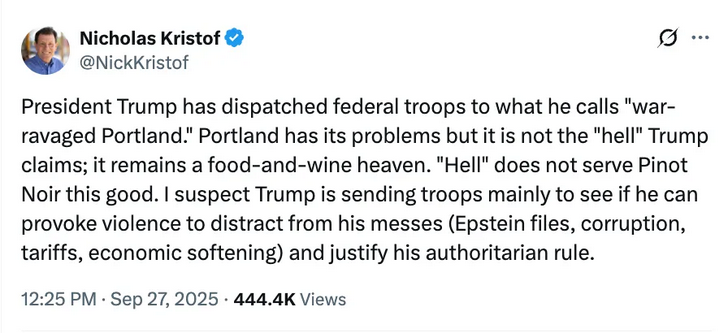
Chris Bray also responded to the Nicholas Kristof take:
Now, here’s the hugely respectable New York Times columnist Nicholas Kristof, a very important Pulitzer Prize recipient, explaining from the heights of his journalistic perch what’s really happening in Portland:
This is as flawless a summary of the progressive cathedral classes as you could possibly manage: “‘Hell’ does not serve Pinot Noir this good”.
- Portland street journalist: Portland is a public graveyard
- Progressive New York Times columnist: Akshully, the Pinot Noir is exquisite
It’s time to shove these people onto a barge and tow them out to sea.
Like Karen Bass describing the open-air drug market of MacArthur Park as a sylvan paradise full of happy children and wonderful families having picnics, Oregon Governor Tina Kotek explained this week that Donald Trump is bizarrely intervening in a utopia, and for crying out loud look at this facial expression:
No one has ever been more lost than this. Your average good urban liberal is more insane than a psych ward full of psychotics. Akshully, the Pinot Noir is delightful. We are burdened with the existence of high-status people who have departed from earthly reality, and we can’t afford them.


Update, 1 October: Welcome, Instapundit readers! Please do have a look around at some of my other posts you may find of interest. I send out a daily summary of posts here through my Substack – https://substack.com/@nicholasrusson that you can subscribe to if you’d like to be informed of new posts in the future.
QotD: The modern cult of “victimhood”
Oppressed by whom?
Oppressed, actually, by the implied permission that is granted in advance, to looters, and rapists, and thugs, and amateur neighbourhood terrorists, by that very satanic idea of victimhood, and its practical corollary, that if you can play the victim, you can manoeuvre yourself into a position to victimize everyone around you.
David Warren, “Bad Gumbo”, DavidWarrenOnline, 2005-09-03.
September 29, 2025
QotD: Mal Reynolds in Serenity
Joss Whedon, quoted by Malene Arpe in “Just don’t call Joss Whedon a genius”, Toronto Star, 2005-09-24.
September 28, 2025
QotD: Pre-modern armies on friendly territory
But first, we need to talk about the lay of the land. As we’ve discussed, the pre-industrial countryside is not just a uniform blanket of farms; instead settlements are “nucleated” – farms cluster in villages and villages “orbit” (in a sense) towns (which may “orbit” yet larger towns), which usually administer those villages. The road and path system that the locals themselves have created will in turn connect fields to village centers, one village to the next and all of the villages to the town. This makes everything easier on our army which is also using those roads and paths to move – even if the paths are rudimentary, without modern location-finding data, armies use paths and settlements to know where they are. The main body of the army, with its large train of wagons, supplies and troops is going to generally move along major roads (which typically connect towns with other towns) but smaller detachments can move along the pathways between smaller settlements. That means what we have access to is not a vast field of possible maneuver but a spider’s web of pathways which meet and cross at settlements.
Moving through this pathway network, in friendly territory the army can lean on the likely compliance of the local population and the local administrative apparatus, which makes everything easier. Moreover, with control of the area, the army can send out messengers and riders who move faster than the army on its direction of march, making arrangements in advance for what the army needs, drawing supplies from the populace and (maybe) making arrangements to pay them either at the time or in the future. Doing so in hostile territory is much trickier as those messengers would be vulnerable and might reveal the army’s location and direction of march, things it might really rather want to conceal. So assuming the populace and local administration are “friendly”, how do we manage the complexity of getting the food and other supplies they have into the hands of the army?
The simplest method was some form of “billeting”, in use in various forms through antiquity to the early modern, though it seems particularly prominent in the Middle Ages and the first two centuries of the early modern period. Clifford Rogers (Soldiers’ Lives through History: The Middle Ages (2007), 76-78) provides a good “standard practices” overview of the process for a medieval European army. Once drawn up the army was organized into smaller units (often called “banners” because they marched behind a banner); we’ll come back to this again when we talk about marching speeds but it also matters here. Each banner would assign one of its horsemen as a “harbinger” who would ride ahead of the army (supervised by the king or commander’s marshals), ideally a full day ahead. These harbingers (because there might be quite a few of these fellows) also acted as a limited cavalry screen. They would both designate where the army would camp next (with the marshals marking out specific encampments) and make arrangements for food and housing.
In practice “arrangements” here meant frequently that the soldiers, when they arrived the following day were quartered in the homes of the local civilians, often densely packed into small towns or farming villages. If they had the means the locals might try to provide the army a market to buy food and supplies; more often the locals who had soldiers quartered on them were often expected to feed and resupply those soldiers. Notionally this was often supposed the be compensated and notionally kings issued dire warnings against soldiers taking more than they were allowed or abusing the locals. Rogers (op. cit.) is, I think, unusually sanguine in assuming these repeated regulations meant the knights and soldiers were often restrained; in an early modern or Roman context we tend to view the same sort of repeated promulgation of the same laws to mean that abuses were common despite repeated efforts by the central government to stamp them out. In practice reimbursements seem to have often been at best incomplete, where they happened at all and abuses were common.
Certainly as we see these practices more clearly in the early modern period, having soldiers quartered on your village could be economically devastating (see Parker, op. cit. 79-81); having to feed a half-dozen soldiers for a few days plus marching provisions could easily tip a small peasant household into shortage. And we should also be pretty clear-eyed here about what it would mean for a local population to have a large body of armed men (many in the hot-headed years of their youth) functionally turned loose on an unarmed civilian population and told that they could demand to be given whatever they needed; far more disciplined and better controlled armies still left a trail of theft and rape behind them as they moved. Nevertheless, this solution was simple and so for armies with very limited administrative capacity and rulers anxious to shift the burden of military activity away from their own coffers, billeting remained an attractive solution. It was still common enough in the 1700s to have been a major complaint by British colonists in North America, the bulk of whom upon achieving their independence promptly wrote an amendment in their constitution effectively banning the practice (the third amendment for the curious).
A better option for a town or city was instead to establish a market outside the town and arrange for the army to resupply and camp there and not in the town itself, with only small groups of soldiers permitted inside the walls at any given time. Needless to say, it is typically only fortified towns that really have the bargaining power to pull this off. The provision of a market for the gathering mass of crusaders outside of Constantinople in 1097 was a key diplomatic sticking point, with Alexios Komnenos I (the Byzantine Emperor) using his control over both the market and passage over the straits to Asia Minor as bargaining chips to get concessions out of the Crusaders. Likewise towns in Roman provinces seem to have fairly regularly paid exorbitant sums to avoid having armies quartered on them, as Cicero documents in his time in Cilicia (e.g. Cic. Ad Att. 5.21), sometimes in cash and other times in kind (e.g. Plut. Luc. 29.8). It speaks to how destructive billeted soldiers could be that towns that could went to extraordinary lengths to keep even friendly armies outside of the town walls.
Armies might also rely on local contractors to provide supplies, especially if they were going to operate in the region at some length. We’ve already mentioned the Army of Flanders’ pan de munición, provided by contractors. There’s also some evidence for the use of private contractors in supporting Roman armies, though the trend in current scholarship (particularly Erdkamp but also Roth op. cit.) has tended to stress the limited and often marginal role of such contractors. Given the evidence I think Erdkamp has it right here; contractors for supplies existed in the Roman world, but were fairly small supplements to a system (detailed below) that mostly ran on taxation and requisition; most of what we see in the Roman world are just normal sutlers selling luxury foods to soldiers who want to spice up their rations.
As armies grow larger and more complex in the early modern period, we see an effort to move away from destructive “billeting”, often hindered by the weak administrative apparatus of the state and limited financial resources; armies won’t move into permanent barracks on the regular in Europe until the early 1700s. One solution was to take those market towns and their lodgings and turn them from an ad hoc response to a permanent network, as Spain did along the “Spanish Road”, a network of routes taken by Spanish troops traveling overland from the Mediterranean coast in Savoy to the Low Countries during the Eighty Years War.
The way this worked was: To avoid having their reinforcements pillage their way across their own lands or alienate key friends on the way to the Eighty Years War (1568-1648) in the Low Countries, the Spanish government established a standard system for the supply of troops en route – key market towns were designated as étapes or “staples”, standard stop-over and stockpile points. These tended to be key trade towns on the roads (indeed as I understand it étape in this sense originally meant “market town”) which already had some of the infrastructure required. These étapes would then be directed in advance of a movement of troops to stockpile provisions and prepare lodgings for a specific number of advancing soldiers and paid (in theory) in advance. Householders who incurred costs (typically lodgings, sometimes food) could present receipts (billets de logement) to their local tax collector which would count against future liability.
Yet the system here is incomplete and it is striking that when given the opportunity of setting up étapes in Spain itself the crown declined, citing the cost and administrative burden of organization. The greater diplomatic difficulties and consequent stronger bargaining position of communities on the Spanish Road may have a lot to do with the different decisions. The real impetus for the structure of the étapes on the Spanish road was diplomatic: the route was a patchwork, with some territories controlled by the Spanish crown, some by the friendly German Habsburgs and others by the various small statelets of the Holy Roman Empire, any of whom if sufficiently offended might refuse Spanish reinforcements transit (the Holy Roman Emperor could shut the whole route down himself). Consequently the disruption that Spanish troops caused on the route had to be limited for the route to be sustainable at all.
States with a bit more administrative capacity, on the other hand, generally tried to avoid billeting at all, even in regularized form. We’ll see this again when talking about army movement, but control is a key concern in campaigns. Soldiers, after all, are not automatons and so keeping an army together and moving towards a single objective is difficult. Soldiers get bored, wander off, decide to steal or break things (or people) and so on. It is easier to keep an eye on soldiers if they are all in a central camp or barracks and keeping an eye on everyone in turn makes it a lot easier to ensure that everyone shows up promptly to muster in the morning with the minimum of hassle. So if a general can, he really would want to keep everyone out of towns and villages and in a regular marching camp. Doing so demands yet more discipline because of course the soldiers would rather sleep in houses than in tents, but it has substantial advantages.
But an army that can lean on the local administrative capacity can simply demand that local administrative apparatus, whatever its form, coordinate the collection and transport of supplies (over short distances) to the army, enabling the army to camp out in a field and get its grain DoorDashed to it. Thus the Romans, when in friendly territory, for instance first identify the local government – usually a town but it could also be a tribal government in non-state regions – and then requisition food from that government, transmitting their demands in advance and letting that local administration figure out the details of getting the required food to the required place. That lets Roman armies camp in their fortified camps away from civilian centers, with attendant advantages for discipline; and indeed, Roman armies typically avoid permanent or even temporary bases in towns, instead using the threat of billeting to get the supplies they needed to stay in regular camps and later permanent forts.
While the elites who run these local systems of government could provide such requisitions themselves (and might in extremis to avoid retaliation by their superiors; the Romans interpret failure to provide requested supplies as “rebellion” and respond accordingly), in practice they’re going to pass along as much of the costs as they can to the little guy. In some cases, requisition demands are so intense we hear of towns having to buy or import grain to meet the demands of passing armies; Athens had to do this in 171 during the Third Macedonian War to avoid the wrath of Rome (Liv. 43.6.1-4). Caesar likewise relied heavily on food supplies contributed by either allied or recently defeated communities in Gaul (Caesar, BG 1.16, 1.23, 1.40, 1.37, 2.3, 3.7, 5.20, 6.44; he does this a lot) to supplement regular foraging operations. Those sources of supply in turn influence his campaigning, as Caesar is forced to move where the grain is in order to resupply (e.g. Caes. BG 1.23). And I want to be clear even these systems of requisition could mean real hardship on a population as a large army could easily eat all of the surplus grain in a province and then some.
The exact structure of that requisition could vary; in some cases it was a extraordinary tax (which is to say, it was just seized), but in many cases it was organized as a forced sale (often at below market prices) or even rebated against future tax obligations. In the Roman Empire we know that in many provinces, initially ad hoc systems of food requisition from conquered or “allied” (read: subordinated) communities were first regularized so that the demands were set at a steady amount, then monetized as military operations moved further away, until eventually being formalized as a taxation system. Thus the primary Roman tax system of the imperial period grew not out of the tax system the Romans had in Italy (which was mostly dismantled in the second century as the tremendous wealth of the provinces made it unnecessary) but as a regularization of systems of requisition and extortion meant to support armies. The Romans also took advantage of the Mediterranean (where naval transport could break the tyranny of the wagon equation) to ship food from one theater to another (so long as operations were fairly close to coastal ports); this was in the Republic coordinated by the Senate which could direct Roman officials (typically governors of some sort) or non-Italian allies in one region to obtain supplies by whatever means and send them another active military theater (Plb. 1.52.5-8, Liv. 25.15.4-5, 27.3.9, 31.19.2-4, 32.27.2, 36.3-4), in some cases even establishing transit depots which could support operations in a large naval theater (e.g. Chios, Liv. 37.27.1). In particular, grain taxed in Sicily was frequently redirected to support Roman military operations across the Mediterranean.
All of this of course assumes that the army enjoys either the use of the local administrative system or the compliance of the local population. But of course in enemy territory – which is where your army wants to go – you cannot rely on that.
Bret Devereaux, “Collections: Logistics, How Did They Do It, Part II: Foraging”, A Collection of Unmitigated Pedantry, 2022-07-29.
September 27, 2025
QotD: Utopian revolution
This illustrates a point that Professor Chirot makes clear in his discussion as to why the Vietnamese communist regime, though often brutal, never descended to anything like the level of horror of neighbouring Cambodia. Among the factors must surely have been the character and personality of the leaders as well as of the countries themselves. In other words, the fate of countries cannot be reduced, either in prospect or in retrospect, to an invariable formula. Human affairs will, to an extent, always be incalculable.
Still, some degree of regularity is possible. I was rather surprised that Professor Chirot overlooked one such. He writes the following of the corruption endemic under communist regimes: “a function of a deliberately exploitative, thieving elite that staved the general economy by its dishonesty than it was the essence of the system itself. Avoiding corruption was impossible because without it the society could not function.”
What is surprising here is that he does not mention why it could not function, but the answer seems to me perfectly obvious: it was because the communist system abolished the price system and substituted political decision-making in its place. This explanation is sufficient, for where there are no prices, and the economy is thereby largely demonetarised, goods and services can be distributed only by corruption. This is not to say that where there is a price system there will automatically be no corruption, obviously this is not the case; but such corruption will be limited by the very need for money to retain its value where such a price system exists. To that extent, it imposes at least a degree of honesty. The mystery of the Soviet Union or any other communist country is not why it produced so little, but why it produced anything at all: and here Professor Chirot is quite right. The answer is because of corruption: an “honest” communist state would produce nothing. It could not survive.
Theodore Dalrymple, “Longing for Revolution”, New English Review, 2020-05-13.
September 26, 2025
QotD: Men and women
H.L. Mencken, In Defense of Women, 1918.
September 25, 2025
QotD: The Clinton years
Bill Clinton, some wag observed, would rather climb to the top of Mt. Everest to lie to you than stand still and tell you the truth. He lied when it was to his advantage, and he lied when it was to his very obvious disadvantage. He lied when there was absolutely no point to lying — indeed, like climbing Mt. Everest, when it took enormous effort and real planning to lie. He lied just for the fun of it, and if you saw him do it enough, you realized what that little smirk on his greasy, chicken-fried mug actually was: Orgasm. Bill Clinton got off on lying. That’s why he did it. Every press conference the man ever did was frottage.
Severian, “Party like it’s 1999”, First Questions, 2022-01-13.
September 24, 2025
QotD: The political divisions of humanity
The first time, in the history of Western Civilization, that this became an issue, was the Renaissance/Reformation. Information suddenly came flooding, unbidden, into Europe, from North Africa, through Galileo’s telescope, out of Gutenberg’s printing press, and a dozen other undesirable, unlicensed, and deplorable sources. It must have been a nightmare for the aristocrats who considered themselves to be in charge, the kings and barons and bishops and bullies. They struggled in vain to get it back under control. They got the Church to condemn it. They intimidated and tortured its emissaries when they could. They invented universities to get a handle on it, a collar around its neck, but it was a lost cause. In just a couple of centuries (compared to the previous 500 generations), people — ordinary people; who the hell did they think they were? — came to know too much for the good of Authority.
And they soon proved it, in the American Revolution, which told 10,000 years of kings to go to hell, and the French Revolution, which cut to the chase and removed their overly-pampered heads. I have actually seen the blade. Many other revolutions followed, worldwide, and people began to learn, slowly and awkwardly, to live their own lives. The one good thing to come out of the brutal and deceitful Russian Revolution was the ultimately individualistic philosophy of refugee Ayn Rand.
Otherwise, it was a naked attempt by the authoritarians, the feudalists, to regain control of the masses that the Czar had clumsily let slip through his overly-manicured fingers. Whenever human beings have clashed over whether their lives should be controlled by others or not, it has almost certainly been a matter of who gets to be the next king, baron, bishop, commissar, etc., a battle between liberated entities and those who would restore feudalism.
L. Neil Smith, “The Deep State”, Libertarian Enterprise, 2019-04-14.
September 23, 2025
QotD: “Bye, Phoenicia”
The long-distance trade of the Bronze Age had been dominated by large state actors. The ships were probably built and crewed by men from the Levantine coast, but the cargo was purchased and shipped by local representatives of the Great (and lesser) Powers of the age: luxury goods were an integral part of high-level diplomacy, so most trade was a virtual monopoly centrally directed from the palaces. When these polities were weakened (or in some dramatic cases like Ugarit completely destroyed) in the Collapse, they left behind a vacuum that independent Phoenician traders, operating without centralized control and serving only profit rather than the demands of empire, rapidly filled.
By the tenth century BC, the Phoenicians were importing silver from Spain, copper from Cyprus and Sardinia, and cinnamon from southeast Asia. They exported timber (the much-vaunted “Cedars of Lebanon”)1 and the valuable purple dye extracted from the murex sea snail, as well as a wide variety of finished luxury and quotidian goods they produced at home from raw materials obtained abroad. They founded colonies throughout the Mediterranean. And perhaps most importantly for the future of “the West”, they introduced the alphabet,2 which enabled the return of literacy to Greece and its far wider adoption than had ever been possible with Linear B.3
By the time the ascendant Neo-Assyrians began to encroach on their territory, the Phoenician city-states were so rich and economically well-connected that they were more valuable as semi-autonomous tributaries and middlemen than as conquered subjects. In fact, it was the Assyrian demands for metal (especially silver) that drove Phoenician colonization in the western Mediterranean: they founded Cadiz (Phoenician Gadir) to access the rich silver mines in the Spanish interior, as well as dozens of other smaller entrepôts along the sailing routes to and from the Levantine coast. Eventually they removed so much silver from Spanish mountains that its value in Assyria collapsed, inflated away by oversupply, just like Peruvian silver would destabilize the Spanish economy two thousand years later — but with the roles flipped. I enjoy these echoes.
It’s worth pointing out here that Phoenicians never called themselves Phoenicians: it’s a Greek word, deriving from a Mycenaean era (e.g., pre-Collapse) term for purple dye. In fact, they didn’t even have a term that clearly limned what the Greeks meant by “Phoenician” (essentially, “Levantine traders with really good ships who speak a related set of Semitic languages”). Instead, they sometimes referred to themselves more narrowly by reference to their native cities (Sidonian, Tyrian, Byblian, etc.) and other times more broadly as “Canaanite”, because of the cultural heritage they shared with the other survivors of Bronze Age Canaan. But even if they never employed it themselves, “Phoenician” is a terribly useful word, because these particular city-states had a lot in common with one another but diverged sharply from their Canaanite kin to both north and south.
Bronze Age Canaan had been relatively culturally homogenous, though the cities in the north came into the Hittites’ sphere of influence and those in the south the Egyptians’. After the Collapse, though, the city-states of northern Canaan (modern Syria), like their Neo-Hittite neighbors, seem to have continued more or less as they had been. Those in southern Canaan were not so lucky: weakened by the invading Sea Peoples and the withdrawal of Egyptian hegemony, the southern Canaanites were displaced by (or assimilated to) the new Semitic kingdoms in the region, including Israel, Judah, Edom, and Ammon. And the central Canaanites became the Phoenicians: master sailors and traders, they had seized their opportunity and so thoroughly transformed themselves that we join the Greeks in identifying them by a new name.
Most of the larger cities of the central Levant are buried beneath their modern equivalents, and Lebanon has not been a particularly salubrious place to excavate for the last few decades, so it’s hard to say a great deal about Phoenician continuity with their Bronze Age ancestors. There was obviously some, certainly genealogically but also linguistically and in terms of material culture. However, we also know that their lifestyles changed dramatically as their economic reach expanded and their cities became centers not only of exchange but of manufacturing. We know their commercial firms were organized around extended families, and that they began to settle foreign lands both as colonists in their own new cities and elsewhere as resident merchants with their own dedicated enclaves. And we know that as their city-states grew more powerful, they increasingly directed worship away from the traditional Canaanite pantheon, led by El, and towards the tutelary deity of each individual city. (The story that King Hiram of Tyre actually tore down the temples of El and Baal to make room for a magnificent new temple of his patron, Melqart,4 is probably an exaggeration, but points to the scale of the break with the past.)5
Jane Psmith, “REVIEW: After 1177 B.C., by Eric H. Cline”, Mr. and Mrs. Psmith’s Bookshelf, 2024-07-08.
- For a very funny story about an Iron Age Egyptian attempt to buy some, which I simply could not fit into this review, see the “Story of Wenamun“. Bonus points for imagining how it would have played out under the New Kingdom.
- Okay, the Phoenician “alphabet” is actually an abjad — it contains no symbols for vowels — but the Greeks quickly added those.
- It is much, much easier to learn to write with an alphabet than with a logosyllabic system like Linear B or cuneiform.
- Melqart is also the patron of the Tyrian colony of Carthage, and his name contributes one element to that of Hamilcar Barca. The –bal in Hannibal, Hasdrubal, etc., is of course from Baal.
- Cline doesn’t give a ton of detail on Phoenician culture; in this section I am also drawing heavily on the opening chapter of Richard Miles’s Carthage Must Be Destroyed: The Rise and Fall of an Ancient Civilization, which sentiment I fully endorse even though I haven’t finished the book yet.
September 22, 2025
QotD: Tactical combat on the pre-modern battlefield
In a fight, after all, a combatant is extremely vulnerable to attacks from behind or in their peripheral vision, especially if they are focused forward on the foe in front of them. A confused melee would thus produce extreme casualties and produce them extremely quickly. But fighters want to survive their combats and their leaders would like not only to win the battle but to have an army at the end of it. Remember: the purpose of the battle is to deliver a siege: if you win the battle but with only a pathetic handful of survivors, you haven’t really won much of anything.
The battle line is the obvious solution: each fighter is only responsible for a few feet of frontage directly in front of them, a small enough area that they can focus on it visually and direct whatever shield or armor or weapons they have towards it, giving them a greater margin of safety. Adding depth to the formation (that is, increasing the number of ranks, that is a row of fighters right to left) both secures each fighter against the possibility of being flanked due to the death of the fellows to their right or left (as now they’ll just be replaced by the next rank moving up) and adds a morale reinforcement which we’ll come back to […] But now you have a formation that consists essentially of a large number of files (that is, a single row of fighters front-to-back) which need to move together to create that unbroken, mutually supporting front line so that no one is being attacked from many sides at once. Again, all of this is before we start adding fighting styles like pike-formations or shield-walls that are designed to excel in this environment (and fare poorly out of it).
As an aside, this is one dynamic that I find games like Mount and Blade or the Total War series that simulate individual soldiers struggle to get quite right. In most games the line of formation either remains almost perfectly rigid (think units on “pike phalanx” in Rome: Total War) or units the moment they come into contact form rough blobs of models all pushing forward. But actually you are going to have men in the rear ranks trying to keep their relative position to the front ranks so the formation neither holds rigidly steady nor dissolves but is going to almost flex and bend (and if you are lucky, not tear or break). This is only an aside though because we’re not well informed about these sorts of dynamics, so it is hard to speak about them in-depth.
But to fight this way now means that all of your soldiers (really here we are talking about infantry; cavalry must also be coordinated but in different ways and because they are often composed of elites that coordination may be produced through different training methods) need to move in the same direction at the same speed in order to retain that front line where they can support each other. Again, we are not yet to something like a shield-wall or a sarisa-phalanx which demands tight coordination; even in a rough skirmish line you need to get everyone moving together just to maintain that unbroken front. A break in the front, after all, would be dangerous: enemies filtering into it uncontrolled could then flank and defeat individually the members of the broader line (two-on-one contests in melee combat typically end in seconds and are very lopsided), causing collapse.
Now the good news is that if all you need an army to do is form up in a rough line a few ranks deep and then move more or less forward, the coordination demands are not insurmountable. We’ve already discussed using marching formations to create the line of battle so all you need is a way to regulate speed (since forward is a fairly easy direction for everyone). It isn’t quite ideal for everyone to simply self-regulate their speed by looking around (at least not for a contact infantry line; for missile-skirmish troops moving in a “cloud” rather than a line they can absolutely do that) because that will produce a lot of stagger-start-stopping and accordioning which at best will slow you down and at worst will eventually turn your neat line into a rough crowd – one easily defeated if it is opposed by a line of infantry in good order. Keeping everyone in the same speed can be handled with music: the regular beat regulates the footsteps. That can be a marching song or it can be an instrument (ideally one easy to hear).
We’ve talked about armies – or components of armies – like this. I’ve described hoplite phalanxes through much of the classical periods, for instance, as essentially unguided missiles for this reason: the general hits “go” and the line moves forward. Likewise a shield-wall formation like the early English fyrd doesn’t need to do complex maneuvers. And for many armies, that was enough: a body of infantry which either held a position or moved forward in a single line, in some cases with a body of aristocratic cavalry which might be capable of more complex maneuvers (that the aristocrats had trained in since a young age). And you can see, if your culture has armies like this, why the general might be focused on either leading the cavalry in particular or else being the motivating “warrior-hero” general – such an army isn’t capable of much command once the advance starts in any event. They haven’t trained or prepared for it.
Bret Devereaux, “Collections: Total Generalship: Commanding Pre-Modern Armies, Part IIIa”, A Collection of Unmitigated Pedantry, 2022-06-17.


