
There’s actually a great book called The Ruling Caste. It’s a “collective biography”, for lack of a better term, of the Indian Civil Service (ICS), by Sir David Gilmour. You can of course find biographies of the individual Governors-General (Gilmour wrote one, also excellent, on Lord Curzon), but this is the only study I know of the lower levels — i.e. the guys who really ran the Raj. Gilmour is literally a gentleman amateur, so while he’s also an excellent historian (and The Ruling Caste conforms to all the canons of scholarship), he tells an engaging story, too.
I think about The Ruling Caste often when I think about the turds in the Apparat. Looked at from the outside, the ICS were apparatchiks, too. Indeed, even more so than actual apparatchiks, since “apparatchik” means something like “expert without portfolio” and while the ICS had two broad “tracks” (if I recall correctly), “civil” and “legal”, in practice most every ICS man was supposed to be able to do pretty much everything, including (again IIRC) assume military command of local forces if necessary.
Given that there were never more than 200K Britons in the Raj at any one time, how could it be otherwise?
And the ICS was as fully ideologized as the Soviet (or AINO) Apparat. The French gave us the lovely phrase mission civilisatrice, but that’s what the ICS was doing, too. Lord Macauley was the big mover behind the English Education Act of 1835, which explicitly designed to
form a class who may be interpreters between us and the millions whom we govern – a class of persons Indian in blood and colour, but English in tastes, in opinions, in morals and in intellect. To that class we may leave it to refine the vernacular dialects of the country, to enrich those dialects with terms of science borrowed from the Western nomenclature, and to render them by degrees fit vehicles for conveying knowledge to the great mass of the population.
There were two huge differences between the ICS and the Apparat, though, that really come out reading Gilmour’s book. First, and actually least important, was the obvious fact that English education was superior. Macauley really gave “native” literature both barrels — nobody condescends like an Englishman — but he wasn’t wrong. In 1835 you could take the “scientific” literature of every other race on the planet combined and get … the Iron Age? Maybe? 200K Britons could dominate 750 million Indians because
whatever happens, we have got
the Maxim gun, and they have not.Or “steam power” or “replaceable parts” or “calculus” or what have you. Season to taste.
The second — and far, far more important — difference between the ICS and the Apparat, though, was that the ICS was in general composed of decent people. In a very real sense, all imperialism is “cultural imperialism”. Rome became an empire by whomping all its enemies, but it stayed an empire by giving its enemies a great deal. Life was simply better — orders of magnitude better — inside the Empire than outside.
And the reason for this is simple, so simple that you need many years of long and hideously expensive training, by highly skilled and fanatically motivated indoctrinators, to miss it. Macauley, Caesar, Confucius, anyone who wrote anything on barbarian management at any point, anywhere in the world, well into the 20th century, said basically the same thing: Our material culture is the result of our cultural culture.
You can learn to operate our stuff. Obviously so — with only 200K Britons throughout the Subcontinent, the Raj was quite obviously run by Indians. And they did a bang-up job, too, such that India at independence had the real potential to become a first world country (note to folks getting ready to break away from a globe-spanning empire: Never elect a lunatic socialist yoga dude as your first prime minister. He’ll go full retard and set you back 50 years … and he’ll be shooting for 500). You might even learn how to maintain our stuff, maybe even build a few cheap knockoff copies of our stuff.
But it’ll never be more than that — shitty knockoff copies, gruesomely expensive, and available only to the elite — unless you embrace as much of the culture that created the stuff as you can stand. The English themselves are a great example: They were blue-assed savages when Caesar found them, but they got with the program, and look how well that worked out. Ditto the Gauls (“Our ancestors, the Gauls!”) and all the rest.
It’s the culture, stupids. The culture of the ICS was English culture — “play up, play up, and play the game!” sounds like baloney to jaded Postmodern ears, but listen:
The sand of the desert is sodden red,—
Red with the wreck of a square that broke; —
The Gatling’s jammed and the Colonel dead,
And the regiment blind with dust and smoke.
The river of death has brimmed his banks,
And England’s far, and Honour a name,
But the voice of a schoolboy rallies the ranks:
“Play up! play up! and play the game!”As poetry it’s shit, but if that doesn’t make you want to get up out of your chair and take a swing at somebody, then you, sir, have no hair on your scrotum, and will never know a woman’s touch (trannies don’t count).
They really believed that, those Eton schoolboys out there East of Suez. Or, at least, they behaved as if they did, and everything else flowed from that behavior. Recall that it was a coin flip, going East of Suez — chances are you wouldn’t be coming back, or if you did, it would be as a malarial ruin. But they went anyway, though England’s far and Honour a name, because that’s just what they did. Even at their worst — and their worst was very bad; Gilmour pulls no punches — you can’t help but admire them a little, the arrogant bastards. Their convictions were sometimes awful, but they had the courage of them … and courage is magnificent.
Severian, “Ruling Caste II”, Founding Questions, 2022-03-10.
October 19, 2025
QotD: The Indian Civil Service
October 18, 2025
QotD: Civilizational survival after the Bronze Age Collapse
Sometimes the answer is obvious. The Assyrians and Babylonians clearly survived the Collapse: if you compare their architecture, inscriptions, artwork, settlement patterns, and political structures from the Late Bronze Age to the Iron Age, they are recognizably the same people doing the same things and talking about them in the same way. The Egyptians, too, are plainly the same civilization throughout their (very long!) history, even if they were notably weaker and less organized after the Collapse. The Hittites, just as obviously, did not survive (at least not outside their tiny rump states in northern Syria). But the Greeks and the Phoenicians are both murkier cases, albeit in very different ways.
On the one hand, Mycenaean civilization — the palace economy and administration, the population centers, the monumental architecture, the writing — indisputably vanished. The Greeks painstakingly rebuilt civilization over several hundred years, but they did it from scratch: there is no political continuity from the Mycenaean kingdoms to the states of the archaic or classical worlds. And yet as far as we can tell, there was substantial cultural continuity preserved in language and myth. Admittedly, “as far as we can tell” is doing a lot of work here: Linear B was only ever used for administrative record-keeping, so we can’t compare the Mycenaeans’ literary and political output to their successors the way we can in Assyria or Egypt. We can’t be sure that the character, the vibe, the flavor of the people remained. But the historical and archaeological records of the later Greeks contain enough similarities with the descendants of the Mycenaeans’ Indo-European brethren that the answer seems to be yes.
By contrast, civilization never collapsed in central Canaan. No one ever stopped having kings, writing, building in stone, or making art. The Bronze Age population centers were continuously occupied right up to … well, now. And yet their way of life shifted dramatically, to the point that we call them by a new name and consider them a different people. Cline thinks this is a success story: borrowing an analytical framework from a 2012 Intergovernmental Panel on Climate Change report, he praises their “transformation”,1 which “include[d] actions that change the fundamental attributes of a system in response to actual or expected impacts”. (The Assyrians, by contrast, merely “adapted”, while the Egyptians barely “coped”.) But does there come a point when the change is so great, so fundamental, you’re no longer the same civilization? Can the Ship of Theseus really be said to have “survived”?
In the final section of his book, titled “Mycenaeans or Phoenicians”, Cline asks how we’ll react to the societal collapse we all sort of know is coming sooner or later. Our world just is too complicated, too interconnected, to survive a really massive shock (or, as in the Late Bronze Age, a “perfect storm” of smaller ones). Even the relatively mild disruptions of the past few years have revealed fragilities and vulnerabilities that we’ve done nothing to shore up since. Of course, he has an answer: Transform! Innovate! Flourish amidst chaos! Become a new iteration of yourself, like the bog-standard Canaanite cities that reinvented themselves as an Iron Age mercantile superpower and turned the Mediterranean into a “Phoenician lake”. But at what price?
Or, to think of it another way, what would you prefer for your society five hundred years from now?
Behind Door Number One: governmental collapse, abandonment of the population centers, dramatic reduction in societal complexity, and then a long, slow rebuilding where your time and your people are remembered only as myth — but when civilization is restored, it’ll be by people whose the desires, values, attitudes, and beliefs, their most basic ways of understanding the world, are still recognizably yours. They may have no idea you ever lived, but the stories that move your heart will move theirs too.
And behind Door Number Two: expansion, prosperity, and a new starring role on the world stage — but a culture so thoroughly reoriented towards that new position that what matters to you today has been forgotten. Do they remember you? Maybe, sort of, but they don’t care. They have abandoned your gods and your altars. Those few of your institutions that seem intact have in fact been hollowed out to house their new ethos. A handful of others may remain, vestigial and vaguely embarrassing. But boy howdy, line goes up.
Obviously, given our druthers, we’d all be the Assyrians: seize your opportunities, become great, but don’t lose your soul in the doing. But if it comes down to it — if, when the IPCC’s warning that “concatenated global impacts of extreme events continues to grow as the world’s economy becomes more interconnected” bears out, the Assyrian track isn’t an option — then I’d take the Greek way.
I don’t care whether, on the far side of our own Collapse, there’s still a thing we call “Congress” that makes things we call “laws”. Rome, after all, was theoretically ruled by the Senate for five hundred years of autocracy as all the meaning was leached from the retained forms of Republican governance. (Look, I’m sorry, you can call him your princeps and endow him with the powers of the consul, the tribune, the censor, and the pontifex maximus, but your emperor is still a king and the cursus honorum has no meaning when the army hands out the crown.) I don’t even really care if we still read Shakespeare or The Great Gatsby, although it would be more of a shame to lose those than the Constitution. But I do care that we value both order and liberty, however we structure our state to safeguard them. I care that we’re the sort of people who’d get Shakespeare and Fitzgerald if we had them around. Maybe we should start thinking about it before our Collapse, too.
Jane Psmith, “REVIEW: After 1177 B.C., by Eric H. Cline”, Mr. and Mrs. Psmith’s Bookshelf, 2024-07-08.
- “Transformation” is always a term worth taking with a pinch of salt because so often it’s a euphemism for “total civilizational collapse”. In the chapter on the Hittites, for example, Cline quotes one archaeologist to the effect that “[a] deep transformation took place in the former core of the empire around the capital Hattusa, resulting in a drastic decrease in political complexity, a shift to a subsistence household economy and a lack of evidence for any public institutions”. Relatedly, one of my children recently transformed a nice vase into a pile of broken glass.
In this case, though, Cline really does mean transformation.
October 17, 2025
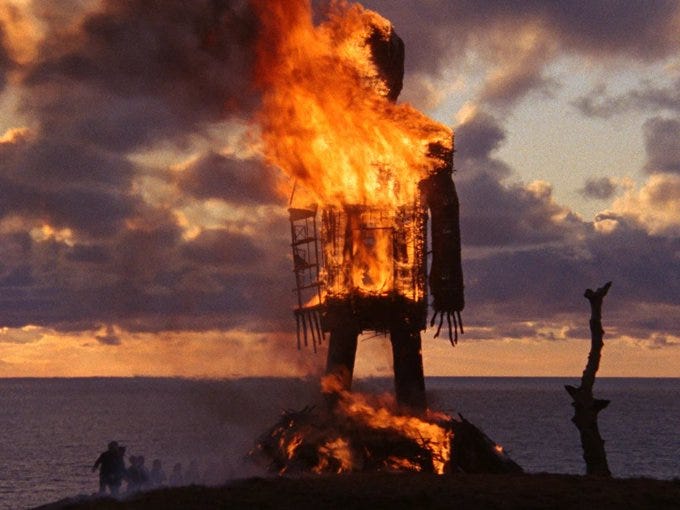
QotD: Wickermanism
I’m a Wickermanist.
Conservative? Classical Liberal? Libertarian? Anarcho-Capitalist?
All of these got immediately diluted by moderates and blackmail curious boomer compromisers.
Conservative … “but leave the blackmailed pedos alone.”
Classical Liberal … “but let us just have totalitarian surveillance.”
Libertarian … “but what do you mean ‘taxation is theft’ and IRS agents should die in work camps … We’re Socially liberal and fiscally conservative.”
Anarcho-Capitalists … “But like private violence to enforce natural law doesn’t mean YOU should shoot criminals and state enforcers.”
I’m a Wickermanist.
I’m naming my ideology after the execution method I want to see practiced annually either by governing entities, private paramilitaries, or radicalized individuals.
Pedos. Corrupt politicians. Traitors to foreign governments. Would-be tyrants. I want them burnt alive in giant Wickermen every year.
Not one time during the revolution, not once everyone agrees, but irrespective of any institutional authority save the match lighter. That ongoingly every year to appease the sun or whatever.
If it’s formalized and good governance is actually achieved and they didn’t find suitably corrupt politicians one year, they can draw lots or an extra old one can volunteer and be remembered as a hero. but I want wickermen burning.
I’m tired of having to constantly rebrand as somehow every ideology becomes “Pay your taxes, don’t ask about Epstein, don’t enact private vengeance no matter how precedented or implied by the ideology or demanded by the founders and the entire western cannon.”
Even “Nazi” has become something Elon, Trump and Grok are …
“MechaHitler” is a popular product by a Fortune 500 and somehow IT got lame within 24 hours.
I’m naming my ideology after an execution method so you moderate losers can’t poison it.
“But muh mass appeal!?”
Democracy is old women and the hormonal equivalent, who can’t commit violence, betraying their kinsmen who can so that the enemies of their nation will tell them their opinions matter.
No change that has ever mattered has been spearheaded by the Median voter, and no great person in history has ever paid them any note.
The only tragedy is that there is neither the time nor the lumber to burn the average voter.
Kulak, Substack Notes, 2025-07-12.
October 16, 2025
QotD: The Roman proclivity to accept changes that “go back to the way things used to be”
What I will say is that the Romans were very conservative in their outlook, believing that things ought to be done according to the mos maiorum – “the customs of [our] ancestors”. The very fact that the way you say “ancestors” in Latin is maiores, “the greater ones” should tell you something about the Roman attitude towards the past. And so often real innovations in Roman governance were explained as efforts to get back to the “way things were”, but of course “the way things were” is such a broad concept that you can justify pretty radical changes in some things to restore other things to “the way they were”.
The most obvious example of this, of course, is Augustus with his PR-line of a res publica restituta, “a republic restored”. Augustus made substantial changes (even if one looked past his creation of an entire shadow-office of emperor!) to Roman governance on the justification that this was necessary to “restore” the Republic; exactly what is preserved tells you a lot about what elements of the Roman (unwritten) constitution were thought to be essential to the Republic by the people that mattered (the elites). And Augustus was hardly the first; Sulla crippled the tribunate, doubled the size of the Senate and made substantial reforms to the laws claiming that he was restoring things to the way they had been – that is, restoring the Senate to its position of prominence.
And one thing that is very clear about the Greeks and Romans generally is that they had at best a fuzzy sense of their past, often ascribing considerable antiquity to things which were not old but which stretched out of living memory. Moreover there is a general sense, pervading Greek and Latin literature that people in the past were better than people now, more virtuous, more upright, possibly even physically better. You can see this notion in authors from Hesiod to Sallust. This shouldn’t be overstressed; you also had Aristotelian/Polybian “cyclical” senses of history along with moments of present-triumphalism (Vergil, for instance, and his imperium sine fine). But still there seems to have been a broad sense of the folk system that things get worse over time and thus things must have been better in the past and thus returning to the way things were done is better. We’ve discussed this thought already where it intersects with Roman religion.
And the same time, here we run into the potential weakness of probing elite mentalités in trying to understand a society. Some Romans seem quite aware of positive change over time; Pliny the Elder and Columella are both aware of improving agricultural technology in their own day, particularly as compared to older economic writing by Cato the Elder. Polybius has no problem having the Romans twice adopt new and better ship designs during the First Punic War (though both are “just-so” stories; the ancients love “just-so” stories to explain new innovations or inventions). And sometimes Roman leaders did represent things as very much new; even Augustus combined his res publica restituta rhetoric with the idea that he was ushering in a saeculum novum, a “new age” (based on the idea of 110 year cycles in history).
So there is complexity here. The Romans most certainly did not have our strong positive associations with youth and progress. Their culture expected deference to elders and certainly didn’t expect “progress” most of the time; things, they thought, generally ought to be done as they had “always been done”. Consequently, framing things as a return to the mos maiorum or as a means to return to it was always a strong political framing and presumably many of the folks doing those things believed it. On the other hand the Romans seem well aware that some of the things they did were new and that not all of these “firsts” were bad and that some things had seemed to have gotten better or more useful since the days of their maiores. And some Romans, particularly emperors, are relatively unabashed about making dramatic breaks with tradition and precedent; Diocletian comes to mind here in particular.
Bret Devereaux, “Referenda ad Senatum: January 13, 2023: Roman Traditionalism, Ancient Dates and Imperial Spies”, A Collection of Unmitigated Pedantry, 2023-01-13.
October 15, 2025
QotD: Taxes in a zero elasticity world
Walter E. Williams, “Let’s Not Waste a Crisis”, Townhall.com, 2020-05-12.
October 14, 2025
QotD: The trade in fake doctor’s notes
A reporter for the Daily Telegraph newspaper managed to obtain a certificate from the company to excuse him from work for five months, because he claimed (falsely) to be suffering from the long-term effects of COVID. He obtained the note without providing any medical evidence whatsoever.
The only thing that surprised me about this was that anyone thought that it was necessary in Britain to buy or pay for such a certificate. I thought of the famous lines of Humbert Wolfe, the otherwise all-but-forgotten England man of letters:
You cannot hope
to bribe or twist,
thank God! the
British journalist.
But, seeing what
the man will do
unbribed, there’s
no occasion to.The same might almost be said of British doctors, many of whom, I suspect, issue such certificates incontinently, for one of two reasons: fear of their patients, and sentimentality.
Not surprisingly, doctors do not like unpleasant scenes in their consulting rooms, and refusal of requests for time off sick can easily lead to such scenes, and occasionally to threatened or actual violence.
Naturally, no doctor likes to think of himself as a coward, the kind of person who caves in to such threats. The best way to avoid so humiliating a thought is never to risk having to think it, that is to say by granting the patients’ wishes in this matter immediately.
But in order to do this without feeling self-contempt, it is necessary to rationalize, that is to say to find supposed reasons for why everyone who wants a certificate should be given one. The English philosopher F.H. Bradley once said that metaphysics is the finding of bad reasons for what we believe on instinct, adding however that it was a human propensity to do so. In like fashion, we could say that doctors find bad reasons for giving sick certificates when they suspect that not to do so might lead to a confrontation with a patient.
Thus they convince themselves that if a person tells them that they are unfit for work, for whatever reason, it would be wrong to question it. No one would make a claim to be unable to work unless he were in some way discontented, unhappy, depressed, anxious, stressed, in a word suffering, and it is the object of doctors to reduce human suffering.
The doctor is aided in this train of thought by the looseness of psychiatric diagnosis, so that practically all forms of distress can be fitted into the procrustean bed of diagnosis. Even outright faking can now be construed as an illness or disorder, provided only that it goes on for long enough or is deceptive enough.
Does this mean that the patients seeking sick notes are all faking it? The matter is more complex than this would suggest. There is, of course, conscious, outright fraud, but this is comparatively rare. Just as doctors don’t like to think of themselves as cowards in the face of their patients, so patients don’t like to think of themselves as frauds.
Distress can be conjured out of almost anything and is not necessarily proportional to whatever causes it. Dwelling on the ill treatment one has suffered — and who has not suffered ill treatment at some time in his life? — can magnify something minor into something major, to the point at which it seems almost to have ruined one’s life. And it is certainly capable of rendering a person unfit for work in his own estimation — though in fact continuing at work would be a remedy for, rather than an exacerbation of, the problem.
However, where economic loss is not too severe when stopping work on medical grounds is possible, medical grounds will be both sought and found. In the days of the Soviet Union, the workers had a saying: “We pretend to work, and they pretend to pay us.” In our kinder and more enlightened societies, we pretend to be ill, and they pretend to treat us — except that the word “pretend” does not quite capture the subtlety of the transactions between doctor and patients.
Theodore Dalrymple, “Make Me Sick”, New English Review, 2025-07-04.
October 13, 2025
QotD: Christian observance in the late Middle Ages
Everything is bound by ritual. Hardly a day goes by without a formal religious ceremony happening — over and above daily mass, that is — and even when there isn’t, folk rituals fill the day. Communal life is almost entirely religious. Not just in the lay brotherhoods and sisterhoods that are literally everywhere — every settlement of any size has at least one — but in the sense that the Church, as a corporate entity, owns something like 30-50% of all the land. In a world where feudal obligations are very real, having a monastery in the vicinity shapes your entire life.
And the folk rituals! The cult of the saints, for instance — reformers, both Lutheran and Erasmian, deride it as crudely mechanical. There’s St. Apollonia for toothache (she had her teeth pulled out as part of her martyrdom); St. Anthony for skin rashes; St. Guinefort, who was a dog (no, really), and so on. The reformers called all of this gross superstition, and it takes a far more subtle theologian than me to say they’re wrong. But the point is, they were there — so much so that hardly any life activity didn’t have its little ritual, its own saint.
And yet, as suffused with religion as daily life was, the Church — the corporate entity — was unimaginably remote, and unfathomably corrupt. Your local point of contact with the edifice was of course your priest, who was usually a political appointee (second sons went into the Church), and, well … you know. They probably weren’t all as bad as Chaucer et al made them out to be (simply because I don’t think it’s humanly possible for all of them to be as bad as Chaucer et al made them out to be), but imagine having your immortal soul in the hands of a guy who’s part lawyer, part used car salesman, part hippy-dippy community college professor, and part SJW Twitter slacktivist (with extra corruption, but minus even the minimal work ethic).
Severian, “Reformation”, Founding Questions, 2022-03-07.
October 12, 2025
QotD: Male privilege revealed
Vincent described herself as a “bull dyke” and held strong feminist views. She expected, throughout the course of the experiment to uncover the secrets of male privilege and the societal advantages that, she was sure, are afforded to men. She anticipated that living life as a man would validate her beliefs that men lead easier lives and wield unchecked power. She figured that, at the very least, she could enjoy a couple of years as a powerful male.
Vincent disguised herself as a man by getting a new hair style and giving herself a fake five o’clock shadow, among other things. She had always been considered rather masculine in her usual feminist and lesbian circles, so she figured she could pass rather easily as a man, if perhaps a slightly effeminate one. She was right.
Her initial assumptions changed when Vincent discovered that men, contrary to her expectations of power and privilege, face their own unique set of pressures and struggles. Men, she discovered, were expected to suppress any signs of vulnerability. This quickly led to feelings of extreme isolation that she did not expect. Nobody “had her back” because, as far as they knew, she was just a man, and should “man up”. She quickly realized that men do not have inherently easier lives. Her preconceived notions of in-born male advantage evaporated. She was getting worried.
She realized that women do not have empathy for the struggles of men.
Norah, as Ned, experienced the behavior of women toward men firsthand. At one point, she tried dating women as a man. She figured this would be incredibly easy for her. Not only was she a woman herself and knew how women think, but she was also a lesbian and already liked women. She worried at first that she’d be too good at it and would have to tell interested women that she was a woman to stop them from pursuing her.
The reality was sharply different from her expectations. Her apparent femininity came across as her simply being an effeminate man. This caused women to be disinterested in her and their rejections were dismissive, cold, and often extremely brutal. Women would sometimes treat her with suspicion or outright hostility as they assumed her intent was negative.
These interactions eventually led Vincent to start developing misogynistic thoughts. That’s right: women treated her so poorly when they believed her to be a man that she started to develop misogynistic thoughts.
Interestingly, many of the supposedly straight women she had attempted to date, even those who had been brutal and cold toward her, immediately expressed interest in a lesbian “hook-up” when she told them she was a woman who had been disguised as a man for the sake of journalism.
Perhaps there’s no such thing as a “straight woman”. Is there even a such thing as a lesbian?
CTCG, “UNDERCOVER: A Feminist’s Year Living as a Man”, Codex Trivium Cosmic Genesis, 2025-06-16.
October 11, 2025
QotD: Riot control tips
2. Riot Control Women. They’re rather preposterous, in the main, if employed on the riot control line. It’s one of the reasons why MPs have for long been useless at riot control; they’re simply too heavily laden with women, who almost universally lack the size, strength, and aggressiveness for hand to hand combat with stone age weapons. Indeed, while the infantry and other combat and combat support unit in the old 193rd were excellent at riot control, the MPs – yes, I have seen it – were useless. Worse, riot control is a perfect environment to cause what the Israeli’s found out when they mixed men and women in the same units in their War of Independence; men will abandon the mission to succor one of their own women. This is the fault of the men, by the way, and not of the women, but it is even more the fault of the dogmatic shitheads of the left who refuse to see men and women for what they are.
3. Rioting women. I don’t care if you have a warrant for their arrest for murder, arson, mayhem, and massacre, plus cellulite and bad makeup, do not arrest or detain them at the scene. Shoot them if their conduct (to include dress) warrants it, but otherwise just push them away or wound them slightly and push them away. Why? Because, though ill-disciplined rabble, for the most part, the rioters are also mostly male and will also rush to the defense of “their” women. There is no better substitute for the cohesion and moral fiber a mob usually lacks than going after the women in the mob. They can turn ferocious very quickly, indeed, if you do.
And that’s all good and maybe it will get us through the summer, should it turn out as badly as it might, but, America, I suspect that you and the president are ultimately still going to need a dedicated, well trained, highly mobile, professional force for riot suppression.
Tom Kratman, The social media site formerly known as Twitter, 2025-06-11.
Update, 12 October: Welcome, Instapundit readers! Please do have a look around at some of my other posts you may find of interest. I send out a daily summary of posts here through my Substack – https://substack.com/@nicholasrusson that you can subscribe to if you’d like to be informed of new posts in the future.
October 10, 2025
QotD: Cleopatra’s reign in Egypt
These are related but disconnected questions. While we’ll get to the evidence for Cleopatra’s relationship with the people of Egypt, the broader legacy of the Ptolemies itself is very clear: the Ptolemaic dynasty and the Greek-speaking settlers it brought were an ethnically distinct ruling strata installed above native Egyptian society, an occupying force. None of Cleopatra’s royal ancestors, none of them had ever even bothered to learn the language of the people they ruled, whose taxes sustained their endless wars (initially foreign, later civil). Top administrative posts remained restricted to ethnic Greeks (though the positions just below them, often very important ones, might be held by Egyptians), citizenship in Alexandria, the capital, remained largely (but not entirely) restricted to Greeks and so on. It’s clear these designations were not entirely impermeable and I don’t want to suggest that they were, but it is also clear that the Greek/Macedonian and Egyptian elite classes don’t begin really fusing together until the Roman period (when they were both equally under the Roman boot, rather than one being under the boot of the other).
Consequently, the interest of the Ptolemaic dynasty could be quite a different thing from the interests of Egypt.
And I won’t bury the lede here: Cleopatra, it seems to me, chose the interests of her dynasty (and her own personal power) over those of Egypt whenever there was a choice and then failed to secure either of those things. Remember, we don’t have a lot in the way of sketches of Cleopatra’s character (and what we have is often hostile); apart from a predilection to learn languages and to value education, it’s hard to know what Cleopatra liked. But we can see her strategic decisions, and I think those speak to a ruler who evidently was unwilling or unable to reform Egypt’s ailing internal governance (admittedly ruined by generations of relatively poor rule), but who shoveled the resources she had into risky gambles for greater power outside of Egypt, all of which failed. That doesn’t necessarily make Cleopatra a terrible ruler, or even the worst Ptolemaic ruler, but I think it does, on balance, make her a fairly poor ruler, or at best a mediocre one.
But before we jump into all of that, I think both a brief explanation of the structure of this kingdom and brief timeline of Cleopatra’s life would be good just so we’re clear on what happens when.
For the structure of the kingdom, we need to break up, to a degree, the peoples in Egypt. Ptolemaic Egypt was not even remotely an ethnically uniform place. Most of the rural population remained ethnically Egyptian but there were substantial areas of “Macedonian” settlement. Ptolemaic subjects were categorized by ethne, but these ethnic classifications themselves are tricky. At the bottom were the Egyptians and at the top were the “Macedonians” (understood to include not just ethnic Macedonians but a wide-range of Greeks). The lines between these groups were not entirely impermeable; we see for instance a fictive ethnic grouping of “Persians” who appear to be Hellenized Egyptians serving in the military. At some point, this group is seems to be simply rolled into the larger group of “Macedonians”. nevertheless it seems like, even into the late period the “Macedonians” were mostly ethnic Greeks who migrated into Egypt and we don’t see the Egyptian and Macedonian elites begin to fuse until the Roman period (when they both shared an equal place under the Roman hobnailed boot). Nevertheless, this was a status hierarchy; “Macedonian” soldiers got paid more, their military settlers got estates several times larger than what their native Egyptian equivalents (the machimoi) got, the tippy-top government posts were restricted to Macedonians (though the posts just below them were often held by Egyptian elites) and so on. And while there was some movement in the hierarchy, for the most part these two groups did not mix; one ruled, the other was ruled.
To which we must then add Alexandria, the capital, built by Alexander, which had a special status in the kingdom unlike any other place. Alexandria was structured as a polis, which of course means it had politai; our evidence is quite clear that all of the original politai were Greek and that new admission to the politai did happen but was very infrequent. Consequently the citizen populace of Alexandria was overwhelmingly Greek and retained a distinctive Greek character. But Alexandria was more than just the politai: it was a huge, cosmopolitan city with large numbers of non-Greek residents. The largest such group will have been Egyptians, but we know it also had a large Jewish community and substantial numbers of people from basically everywhere. So while there were, according to Polybius, three major groups of people (Greek citizens, Egyptian non-citizens and large numbers of mercenaries in service to the king, Polyb. 34.14), there were also lots of other people there too. I do want to stress this: Alexandria was easily one of the most cosmopolitan cities in the ancient world; but for the most part only the Greeks (and not even all of them) were citizens there.
That’s in many ways a shamefully reductive summary of a very complex kingdom, but for this already overlong essay, it will have to do. On to the timeline.
Cleopatra was born in 69 BC, the middle of three daughters of Ptolemy XII Auletes, then ruler of Egypt (he also had two sons, both younger than Cleopatra). In 58 BC (Cleopatra is 11) her father, by all accounts an incompetent ruler, was briefly overthrown and his eldest daughter (Berenice IV) made queen; Cleopatra went into exile with her father. In 55 BC, with Roman support, Ptolemy XII returned to power and executed Berenice. Ptolemy XII then died in 51, leaving two sons (Ptolemy XIII and XIV, 11 and 9 years old respectively) and his two daughters; his will made Cleopatra queen as joint ruler-wife with Ptolemy XIII (a normal enough arrangement for the Ptolemies).
Before the year was out, Cleopatra and Ptolemy XIII (or perhaps more correctly, his court advisors) were at odds, both trying to assert themselves as sole monarch, though by 49 Ptolemy XIII’s faction (again, it seems to mostly have been his advisors running it) had largely sidelined Cleopatra in what had become a civil war. Cleopatra travels to Syria to gather an army and invades Egypt with it in 48, but this effort fails. She is able, however, to ally with Julius Caesar (lately arrived looking for Pompey, who supporters of Ptolemy XIII had killed, to Caesar’s great irritation). Caesar’s army – Cleopatra’s military force is clearly a non-factor by this point – defeats Ptolemy XIII in 47. Caesar appoints Cleopatra as joint ruler with her youngest brother, Ptolemy XIV (he’s 12) and Cleopatra bears Caesar’s son, Ptolemy XV Caesar in 47, who we generally call “Caesarion”.
Cleopatra then journeys to Rome late in 46 and seems to have stayed in Rome until after Caesar’s assassination (March, 44) and the reading of Caesar’s will (April, 44). Ptolemy XIV (the brother) also dies in this year and Cleopatra then co-rules with her son, Caesarion. Cleopatra returns to Egypt, attempts to dispatch troops to aid the Caesarian cause against Brutus and Cassius, but fails and loses all of the troops in 43. She is saved from being almost certainly steamrolled by Brutus and Cassius by their defeat in 42 at Philippi. Cleopatra meets with Marcus Antonius in 41 and they form an alliance, as well as (at some point) a romantic relationship. Cleopatra has three children by Antonius: Cleopatra Selene and Alexander Helios (twins, born in 40) and Ptolemy Philadelphus (born in 36).
With Cleopatra’s resources, Antonius launches an invasion of Parthia in 38 BC which goes extremely poorly, with him retreating back to Roman territory by 36 having lost quite a fair portion of his army (Cleopatra is back in Egypt ruling). In 34, Antonius embarks on a massive reorganization of the Roman East, handing over massive portions of Rome’s eastern territory – in name at least – to Cleopatra’s children, a move which infuriated the Roman public and cleared the way politically for Octavian to move against him. Through 33 and 32, both sides prepare for war which breaks out in 31. Cleopatra opts to go with Antonius’ combined land-sea military force and on the 2nd of September 31 BC, solidly outmaneuvered at Actium, she and Antonius are soundly defeated. They flee back to Egypt but don’t raise a new army and both die by suicide when Octavian invades in the following year. Octavian reorganizes Egypt into a Roman province governed by an equestrian prefect. Octavian and subsequent Roman emperors never really adopted the title of pharaoh, though the Egyptian priesthood continued to recognize the Roman emperors as pharaohs into the early fourth century – doubtless in part because the religion required a pharaoh, though Roman emperors could never be bothered to actually do the religious aspects of the role and few ever even traveled to Egypt.
So ended the 21-year reign of Cleopatra, the last heir of Alexander.1
Bret Devereaux, “Collections: On the Reign of Cleopatra”, A Collection of Unmitigated Pedantry, 2023-05-26.
- Except not really, as Cleopatra’s three children by Antonius survived their mother (though the two boys vanish from our sources fairly quickly, though we’re told they were spared by Octavian) and Cleopatra Selene actually ended up a queen herself, of the kingdom of Mauretania. There’s a recent book on what we know of her life, J. Draycott, Cleopatra’s Daughter: From Roman Prisoner to African Queen which I have not yet had a chance to read.
October 9, 2025
QotD: Ontario and the Loyalists
In 1784, after the American Revolution, Loyalist settlers arrived with intention, bringing with them the legal traditions, religious institutions, and steadfast allegiance to the Crown that had shaped their former world. They sought to uphold a civilisational order rooted in monarchy, Church, and Law, and to establish a society founded on duty, hierarchy, and restraint. From these early Loyalist settlements, beginning at Kingston, a distinct political and cultural tradition emerged. It was neither British nor American. It became the foundation of a new people.
Today, the descendants of these settlers form the core of an ethnocultural identity known as Anglo-Canadian. Numbering over ten million across the country, and more than six million in Ontario, Anglo-Canadians are known for their enduring institutions: constitutional monarchy, common law, Protestant-rooted civic morality, and a national ethos shaped by loyalty and order. This cultural framework shaped Ontario’s development across every sphere of life.
Loyalists built the province’s schools, banks, and legal systems. They established its early industries, including agriculture, forestry, mining, and railroads, and later came to dominate the professional sectors of law, education, public administration, and finance. Their shining city, Toronto the Good, became the centre of Canadian banking and corporate life, while small towns across the province were anchored by courthouses, parish churches, and grain elevators.
Language and schooling played a central role in shaping the Anglo-Canadian character. Ontario’s education system, from common schools to universities, was built to transmit British values, civic order, and the English language. Protestant denominational schools and later public grammar schools taught the children of settlers to read scripture, study British history, and speak in the elite formal register of English Canada. Institutions such as Upper Canada College, Queen’s University, and the University of Toronto became pillars of elite formation, producing the clergy, lawyers, teachers, and administrators who carried the culture forward.
Culturally, Anglo-Canadians preserved a rhythm of domestic and seasonal life rooted in British tradition but adapted to the northern landscape. Autumn fairs, apple bobbing, and harvest suppers marked the calendar in rural communities. Roast beef, butter tarts, mincemeat pies, and tea with milk became the everyday fare of farmhouses and urban kitchens alike. Sunday observance, cenotaph ceremonies, school uniforms, and service clubs reflected a moral seriousness and civic sense inherited from the Loyalist project. It is this tradition that formed the structural spine of its political and cultural development.
Fortissax, “Loyal she Began, Loyal she Remains”, Fortissax is Typing, 2025-07-07.
October 8, 2025
QotD: Porn is always in the vanguard of new technologies
I remember seeing something years ago that commented on how soon after the development of photography we got pictures of naked women.
5 Florins says after Gutenberg invented the printing press and mass printed the Bible, guys were buying presses and cranking out copies of Thee Hornee Shepard and Thee Shye But Readye Milkmaide. 😍
(“T’would say it be a bodice ripper, but we’ve not invented bodices yet” – Johannes of Cologne, Ye Cologne Courier Newspapere)
mmack, commenting on “Why the Internet Stinks Now”, Founding Questions, 2025-07-03.
Update, 9 October: Welcome, Instapundit readers! Please do have a look around at some of my other posts you may find of interest. I send out a daily summary of posts here through my Substack – https://substack.com/@nicholasrusson that you can subscribe to if you’d like to be informed of new posts in the future.
October 7, 2025
Antifa and the “propaganda of the deed”
On the social media site formerly known as Twitter, ESR examines the irrational behaviour of Antifa as an inheritance from their chosen historical models:

“antifa 8973ag” by cantfightthetendies is licensed under CC BY 2.0

An important concept for understanding why the behavior of Antifa is not strategically rational is “propaganda of the deed”.
This is a concept with a long pedigree in left-anarchist theory, transmitted to Antifa via its minority “black flag” left anarchist faction
19th-century romantic anarchists viewed the state and capitalism as powerful illusions that could be shattered by bold, exemplary acts, thereby proving their vulnerability and offering hope to the oppressed. These deeds were intended to ignite the spirit of revolt by alerting the masses to the possibility of revolution, much like a spark that could set off a larger fire — thus, the emphasis on symbolic targets over objectively effective ones.
This kind of political communication could be effective if a majority of society, or at least a critical minority, are seething cauldrons of resentment just begging to be triggered against their oppressors. It also assumes that the revolutionary rage of the masses can, once unleashed, be effectively directed against Antifa’s enemies.
Both assumptions are highly questionable, but the important thing to understand for purposes of predicting Antifa’s behavior is that (a) Antifa behaves as though it still believes them, and (b) Antifa’s aboveground allies don’t have the capacity to restrain its behavior in detail.
The Gramscian infiltrators in the U.S.’s institutions need to keep their links to overt terrorism deniable, so they manage it mostly by raising or lowering the temperature of public propaganda. For example, when a Democratic politician says “Abolish ICE”, describes government actions as “fascism”, or wishes death on the children of a political opponent, this is raising the temperature. The effect, the intended effect, is to license increased propaganda of the deed by Antifa.
Reminder: unceasing damnation of conservatives as fascists and Nazis constituted instructions to stochastic terrorists like Tyler Robinson that the time had come to do something like shooting Charlie Kirk through the neck.
One problem with this is that because of Antifa’s psychology and doctrine, raising the temperature is easy, but lowering it is hard. Thus, it’s not a process the Gramscians want to start unless they believe either that they have escalation dominance over their opponents, or their political position is deteriorating so rapidly that they’ll never get a better chance to induce a legitimacy collapse.
It is out of scope for this essay to analyze to what extent those conditions are true. The point is, we are in a situation where the limited control Antifa’s aboveground allies can exert is all directed towards escalation, and Antifa’s belief in “propaganda of the deed” makes this very difficult to reverse.
Antifa has probably lost sight of the fact that escalating to insurrectionary violence is premature — it doesn’t have an army or a sufficiently powerful and nearby state sponsor for that.
Thus, absent serious degradation of Antifa’s capacity by law enforcement, expect increasing violence. Including, but not limited to, the deliberate murders of law enforcement personnel and opposing politicians.
QotD: “That wasn’t real communism …”
All Karl Marx did was bring that down to the material level — it’s not the world spirit having a debate with itself, it’s the world, the material object. Both the debate and its conclusion are made manifest in History, capital-H, which is why Marx was one of a long line of gurus who claimed to make History into a hard science. That “wrong side of History” stuff the Left is always going on about? That’s why they use that phrase so much, and why it has such emotional resonance for them. If you’re a Dialectical Materialist, being against Socialism is like being against gravity. What could possibly be the point? You’re just being perverse, comrade, and on some level you must know that …
Alas, History isn’t a hard science. There are patterns, of course, any fool can see that, but those patterns are the intersection of human nature and emergent behavior. The proof is in the writings of Karl Marx himself — every prediction the man ever made was not just wrong, but ludicrously so, and after getting burned a few times he admitted in his letters to writing in such a way that he could never be “proven” wrong. See also: The complete history of the Soviet Union, 1917-1991, and as a side note, you can tell the intellectual caliber of Socialism’s defenders by the fact that they trot out the excuse “That wasn’t real Communism; real Communism has never been tried.” Ah, so Lenin — he of Marxism-Leninism — wasn’t a true Communist. They’ll shoot you for saying that in, say, China, but do please go on …
Severian, “Power”, Founding Questions, 2022-02-02.
Update, 8 October: Welcome, Instapundit readers! Please do have a look around at some of my other posts you may find of interest. I send out a daily summary of posts here through my Substack – https://substack.com/@nicholasrusson that you can subscribe to if you’d like to be informed of new posts in the future.
October 6, 2025
QotD: Britain’s immigration crisis
The graciousness of the locals, the ideal, depends on the notion that the host country is regarded as something special, a desirable thing, something worthy of respect.
But massive, indiscriminate immigration undermines that ideal. If seemingly anyone can walk in and demand goodies, any ill-mannered flotsam of the world, and if they can do so with no discernible sense of gratitude, or any expectation of such, and with no apparent regard for the norms and values of the host society, as if they were unimportant, then the indigenous population may feel they have little reason to be gracious. Indeed, being gracious may be something of a struggle.
I realise that even the idea that the locals might dare to think in such terms – of being the gracious host – is, for some, anathema, a basis for tutting and scolding. But the sense that the value of one’s society – one’s home – is being pissed away, sold off cheap, is not a promising basis for coexistence.
And yet here we are.
Doubtless there are progressives who would regard the “gracious host” attitude as wickedly hierarchical and “othering”, or even racist. But I suspect it’s how quite a few people process a sudden influx of newcomers, regardless of the gasping of lefties. I suspect that something along those lines is a necessary precondition of any subsequent coexistence. A social lubricant.
And were I to relocate to, say, South Korea, I think I would feel much like a guest – and feel a corresponding obligation to be on my best behaviour. Possibly on an indefinite basis. I very much doubt I’d feel entitled to disregard queueing norms, or to, quite literally, shit on the doorsteps of the indigenous.
But hey, maybe that’s just me.
David Thompson, Explaining Civilisation”, Thompson, Blog, 2025-07-01.


