Quotulatiousness

May 23, 2024

QotD: The “creepy male feminist”

Filed under: Media, Politics, Quotations, USA — Tags: , , — Nicholas @ 01:00

Christopher Hitchens used to have a cast-iron rule when it came to hardline Christians and the condemnation of some very particular sins of the flesh. […] I am beginning to wonder whether a similar trend is not emerging with another group, specifically that variety of men whom the internet — with its unerring ability to get to the cruel point — has come to describe as the “creepy male feminist”.

It is a distinctly 2010s phenomenon: the sort of chap who likes to present himself as a great spokesperson for, and defender of women and overdoes it so much that you just know that something else is going on.

He will invariably go beyond the usual courtesies and head some way past the point of merely regarding women as his equal. Instead, the creepy male feminist pulls a number of simultaneous moves. These include (though are not limited to):

  1. Presenting the plight of women in our society as distinctly worse than it is.
  2. Suggesting that everybody knows this but that some people (especially men) are deliberately covering for that fact.
  3. Making the suggestion — sometimes insinuated, often explicit — that nothing and nobody is more willing to stand between women as a whole and such rampaging patriarchs than the male in question. Anyone still unfamiliar with the type might recognise it under another entry in the lexicon of modern ignominy: “White knight” (n).

And a trend can now be observed, which is that with unnerving regularity the type of man who presents himself as the foremost protector of the entire female sex is precisely the person who shortly thereafter is exposed as having tried to help himself in distinctly un-gentlemanly ways.

Douglas Murray in “Beware the creepy male feminist: ‘White knights’ like Robert De Niro often turn out to be less than chivalrous”, Unherd, 2019-11-15.

May 22, 2024

If you re-define it carefully, you can make any statistical measure look hopeful

Filed under: Economics, Government, Media, Politics, USA — Tags: , , , , , — Nicholas @ 04:00

In his Substack, Tim Worstall jokingly called this piece “Larry Summers Explains Why Americans Hate Joe Biden”:

As a good Democrat of course Larry Summers would never put things in quite that headline way. But the implication of this latest paper with others is to explain why Americans really aren’t as happy as they should be given the economic numbers. The answer being that the economic numbers we all look at to explain how happy folk are aren’t the right economic numbers to explain how happy people are.

We can also make — possibly rightly, possibly wrongly, this might be me projecting more than is merited — a further claim. That Americans simply aren’t as rich as those standard economic numbers suggest either. Which would also neatly explain the general down in the dumps attitude toward the economy.

So, the new paper:

    Unemployment is low and inflation is falling, but consumer sentiment remains depressed. This has confounded economists, who historically rely on these two variables to gauge how consumers feel about the economy. We propose that borrowing costs, which have grown at rates they had not reached in decades, do much to explain this gap. The cost of money is not currently included in traditional price indexes, indicating a disconnect between the measures favored by economists and the effective costs borne by consumers. We show that the lows in US consumer sentiment that cannot be explained by unemployment and official inflation are strongly correlated with borrowing costs and consumer credit supply. Concerns over borrowing costs, which have historically tracked the cost of money, are at their highest levels since the Volcker-era. We then develop alternative measures of inflation that include borrowing costs and can account for almost three quarters of the gap in US consumer sentiment in 2023. Global evidence shows that consumer sentiment gaps across countries are also strongly correlated with changes in interest rates. Proposed U.S.-specific factors do not find much supportive evidence abroad.

OK, or as explained by the Telegraph:

    In it, the authors made a shocking claim: if inflation was measured in the same way that it was measured during the last bout of price rises in the 1970s, data showed that it peaked at 18pc in November 2022. This is far higher than the 9.1pc peak inflation shown by the official data.

    The reason for this discrepancy is that, since the 1970s, economists have removed the cost of borrowing from the Consumer Price Index (CPI). The motivations here were not nefarious. The reasoning of the statisticians had something to it.

And, OK, if inflation peaked at 18%, not 9%, then that would explain why folk are pissed. Sure it would.

[…]

OK. But that means that if inflation was higher than we’ve been using then the deflation of nominal to real GDP is also wrong. Just that one year of 9% recorded but 18% by this new measure is damn near a 10% difference. That’s how much we’re over-estimating real GDP by right now. Add in a couple of years of lower levels of that and being 20% out wouldn’t surprise.

Which would mean that — if this were true and I might be overegging it — Americans are in fact 20% poorer than the Biden Admin keeps saying they are. And yes, that would piss the voters off, wouldn’t it?

Gaslighting has been a staple of the legacy media for quite some time now, going into high gear during the 2016 US Presidential elections and then into overdrive during the pandemic. They probably don’t even realize they’re doing it any more, because it feels “normal” to them. Yet they wonder why their popularity and public trust in their pronouncements continues to drop.

The new queen of the AWFLs

Filed under: Government, Media, Politics, USA — Tags: , , , , , , — Nicholas @ 03:00

Elizabeth Nickson on the rise of new NPR CEO, Katherine Maher:

Banner for Christopher Rufo’s article on Katherine Maher at City Journal.
https://christopherrufo.com/p/katherine-mahers-color-revolution

The polite world was fascinated last month when long-time NPR editor Uri Berliner confessed to the Stalinist suicide pact the public broadcaster, like all public broadcasters, seems to be on. Formerly it was a place of differing views, he claimed, but now it has sold as truth some genuine falsehoods like, for instance, the Russia hoax, after which it covered up the Hunter Biden laptop. And let’s not forget our censor-like behaviour regarding Covid and the vaccine. NPR bleated that they were still diverse in political opinion, but researchers found that all 87 reporters at NPR were Democrats. Berliner was immediately put on leave and a few days later resigned, no doubt under pressure.

Even more interesting was the reveal of the genesis of NPR’s new CEO, Katherine Maher, a 41-year-old with a distinctly odd CV. Maher had put in stints at a CIA cutout, the National Democratic Institute, and trotted onto the World Bank, UNICEF, the Council on Foreign Relations, the Center for Technology and Democracy, the Digital Public Library of America, and finally the famous disinfo site Wikipedia. That same week, Tunisia accused her of working for the CIA during the so-called Arab Spring. And, of course, she is a WEF young global leader.

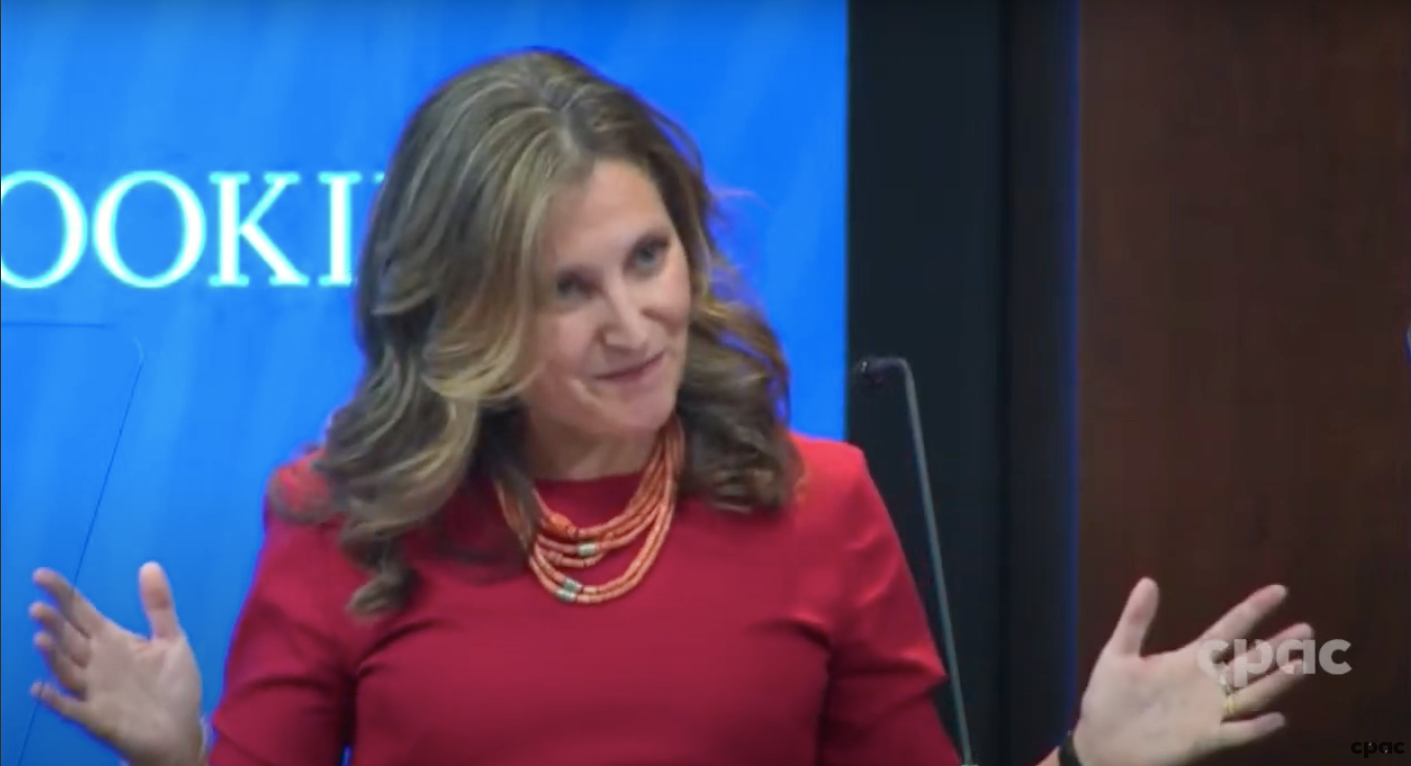
She was marched out for a talk at the Carnegie Endowment where she was prayerfully interviewed and spouted mediatized language so anodyne, so meaningless, yet so filled with nods to her base the AWFULS (affluent white female urban liberals) one was amazed that she was able to get away with it. There was no acknowledgement that the criticism by this award-winning reporter/editor/producer, who had spent his life at NPR had any merit whatsoever, and in fact that he was wrong on every count. That this was a flagrant lie didn’t even ruffle her artfully disarranged short blonde hair.

Christopher Rufo did an intensive investigation of her career in City Journal. It is an instructive read and illustrative of a lot of peculiar yet stellar careers of American women. Working for Big Daddy is apparently something these ghastly creatures value. I strongly suggest reading Rufo’s piece linked here. It’s a riot of spooky confluences.

Intelligence has been embedded in media forever and a day. During my time at Time Magazine in London, the bureau chief, deputy bureau chief and no doubt the “war and diplomacy” correspondent all filed to Langley and each of them cruised social London ceaselessly for information. Tucker Carlson asserted on his interview with Aaron Rogers this week that intelligence operatives were laced through DC media and in fact, Mr. Watergate, Bob Woodward himself, had been naval intelligence a scant year before he cropped up at the Washington Post as “an intrepid fighter for the truth and freedom no matter where it led”. Watergate, of course, was yet another operation to bring down another inconvenient President; at this juncture, unless you are being puppeted by the CIA, you don’t get to stay in power. Refuse and bang bang or end up in court on insultingly stupid charges. As Carlson pointed out, all congressmen and senators are terrified by the security state, even and especially the ones on the intelligence committee who are supposed to be controlling them. They can install child porn on your laptop and you don’t even know it’s there until you are raided, said Carlson. The security state is that unethical, that power mad.

Now, it’s global. And feminine. Where is Norman Mailer when you need him?

QotD: Are western democracies moving uniformly in the direction of “surface democracy”?

Filed under: Bureaucracy, Government, Politics, Quotations, USA — Tags: , , , — Nicholas @ 01:00

I joked before about refusing to tolerate speculation about the US being a surface democracy like Japan, but joking aside I think even the staunchest defender of the reality of popular rule would concede that things have moved in that direction on the margin. Compare the power of agency rulemaking, federal law enforcement, spy agencies, or ostensibly independent NGOs now to where they were even 10 years ago. It would be a stretch to say that the electorate didn’t have influence over the American state, but can they really be said to rule it? Regardless of exactly where you come down on that question, it’s probably safe to say that you’d give a different answer today than you would have twenty, fifty, or a hundred years ago. Moreover, the movement has been fairly monotonic in the direction of less direct popular control over the government. And in fact this phenomenon is not unique to the United States, but reappears in country after country.

Is there something deeper at work here? There’s a theory, popular among the sorts of people who staff the technocracy, that this is all a perfectly innocent outgrowth of modern states being more complex and demanding to run. The thinking goes that it was fine to leave the government in the hands of yeoman farmers and urban proles a century ago, when the government didn’t do very much, but today the technical details of governance are beyond any but the most specialized professionals, so we need to leave it all to them.

I think this explanation has something going for it, I admire the structure of its argument, but it also can’t be the whole story. For starters, it treats the scope and nature of the state’s responsibilities as a fixed law of nature. Another way to frame this objection is that you can easily take the story I just told and reverse the causality — the common people used to rule, and so they created a government simple enough for them to understand and command; whereas today unelected legions of technocrats rule, and so they’ve created a government that plays to their strengths. There’s no a priori reason to prefer one of these explanations over the other. There needs to be a higher principle, a superseding reason that results in selecting one compatible ruler-state dyad over another. I think there is such a principle, we just have to get darker and more cynical.

John Psmith, “REVIEW: MITI and the Japanese Miracle by Chalmers Johnson”, Mr. and Mrs. Psmith’s Bookshelf, 2023-04-03.

May 20, 2024

At what point did “quiet genocide” become the preferred option for the climate cultists to “save the planet”?

The Daily Sceptic‘s Chris Morrison on the not-so-subtle change in the opinions of the extreme climatistas that getting rid of the majority of the human race is now the preferred way to address their concerns:

The grisly streak of neo-Malthusianism that runs through the green movement reared its ugly head earlier this week when former United Nations contributing author and retired UCL Professor Bill McGuire tweeted that the only “realistic way” to avoid catastrophic climate breakdown was to cull the human population with a high fatality pandemic. The tweet was subsequently withdrawn by McGuire, “not because I regret it”, but people took it the wrong way. McGuire is the alarmists’ alarmist, suggesting for instance that human-caused climate change could lead to more earthquakes and volcanic eruptions. The Daily Sceptic will not take his views the wrong way. They are an illuminating insight into environmental Malthusianism that does not get anything like the amount of publicity it deserves.

Every now and then Sir David Attenborough allows the genial TV presenter mask to slip to reveal a harder-edged Malthusian side. Speaking to BBC Breakfast in 2021, he suggested that the Earth would be better off without the human race, describing us as “intruders”. In 2009, Attenborough became the patron of the Optimum Population Trust and told the Guardian: “I’ve never seen a problem that wouldn’t be easier to solve with fewer people.” In 2013, he made the appalling remark that it was “barmy” for the United Nations to send bags of flour to famine-stricken Ethiopia. Too little land, too many people, was his considered judgement.

Any consideration of the refusal of food aid these days brings to mind the 19th century Malthusian Sir Charles Trevelyan, the British civil servant during the Irish famines who saw the starvation as retribution on the local population for their moral failings and tendency to have numerous children. He is said to have seen the great loss of life as a regrettable but unavoidable consequence of reform and regeneration.

Anti-human sentiment is riven through much green thinking. In 2019, Anglia Ruskin University Professor Patricia MacCormack wrote a book suggesting humans were already enslaved to the point of “zombiedom” because of capitalism, and “phasing out reproduction is the only way to repair the damage done to the world”. Green fanatics can be a joyless crowd – it is not enough to declare a climate crisis, now they want a “nookie” emergency. As the economist and philosopher Robert Boulding once remarked: “Is there any more single-minded, simple pleasure than viewing with alarm? At times it is even better than sex.”

QotD: “Selfless” public servants

Filed under: Economics, Government, Politics, Quotations, USA — Tags: , , — Nicholas @ 01:00

WARNING: If you’re an elected government official or if you’re attached to idealistic notions about such officials, do not read this commentary. It will offend you.

Ideally, government in a democratic republic reflects the will of the people, or at least that of the majority. Citizens vote for candidates whom they believe will best promote the general welfare. Victorious candidates, after pledging to uphold the Constitution, go to state capitals or to Washington, D.C., to do The People’s business — to undertake all the good and worthy activities that citizens in their private capacities cannot perform.

Sure, every now and then crooks and demagogues win office, but these are not the norm. Our system of regular, aboveboard democratic elections ensures that officials who do not effectively carry out The People’s business are thrown from office and replaced by more reliable public servants.

Trouble is, it’s not true. It’s a sham. Despite being called “the Honorable”, the typical politician is certainly no more honorable than the typical dentist, auto mechanic, Wal-Mart regional manager or any other private citizen.

Despite being referred to as “public servants”, politicians serve, first and foremost, their own personal political ambitions and they do so by pandering to narrow special interest groups.

Don Boudreaux, “Base Closings”, Pittsburgh Tribune-Review, 2005-03-18.

May 18, 2024

Antisemitism is far from a new problem

Filed under: Britain, Europe, History, Media, Middle East, Politics — Tags: , , , , , — Nicholas @ 03:00

Andrew Doyle on some of the historical relics of antisemitism in European history down to today’s revived fascism of the left:

In his memoir Hitch-22, Christopher Hitchens considered “why it is that anti-Semitism is so tenacious and so protean and so enduring”. Many of us in the west have grown complacent, assuming that the horrors of the Holocaust would prevent this ancient prejudice from re-emerging. But as the conflict between Israel and Hamas escalates, few of us can be in any doubt that antisemitism has once again goose-stepped into the spotlight.

Of course, criticism of the Israeli government and its military strategy is entirely legitimate. So too is our profound concern for the innocents of Gaza and the many thousands of non-combatants who are losing their lives. But there is no denying the explicit anti-Jewish hatred that has accompanied these discussions in certain quarters. Criticise Israel all you like, but don’t try to tell me that Monday night’s daubing of the Shoah memorial in Paris with handprints of red paint was anything other than antisemitic.

Social media has opened our eyes to the prevalence of such sentiments. The other day I posted a link to my Substack piece about the Eurovision Song Contest on that hellsite now known as X. My focus in the article was on the narcissism of the “non-binary” performers, but one feminist activist decided to make it all about Israel. Underneath my post, she added an image of Eden Golan, the Israeli entry to the competition, with bloodstains photoshopped onto her dress. She went on to dismiss the victims of the October 7 pogrom as “silly ravers” and to blame the massacre on the IDF. Whatever else one might say about such views, it is clearly evidence of a complete absence of basic humanity.

This is sadly not uncommon. Recently we have seen protesters openly supporting Hamas, or even praising its acts of barbarism. A new poll has found that 63% of students currently protesting at US universities have at least some sympathy for Hamas. There have been overtly antisemitic statements, and Jews have been harassed on campus. It has been reported that at Columbia University, one protester cried out “We are Hamas” while another shouted at a group of Jewish students: “The 7 October is about to be every fucking day for you. You ready?” These are the very people who have spent the last few years calling anyone who dissents even slightly from their worldview a “fascist”, and yet they are blind to actual fascism when it emerges within their own ranks.

All of this has taken me by surprise, which perhaps reveals the extent of my naivety. Antisemitism is nothing new, and has assumed myriad and outlandish forms over the centuries. Our own country has not been immune; Jews were deported from England in 1290, only to be readmitted in 1656. Before then, only those who had converted to Christianity were allowed to remain; specially, they were able to reside at the Domus Conversorum in London, established by Henry III in 1232. Anti-Jewish sentiments were reignited by a plot to poison Elizabeth I in 1594, which was blamed on her physician Roderigo Lopes, a Portuguese man of Jewish ancestry who was executed for treason. This is the context in which the forced conversion of Shylock at the end of Shakespeare’s The Merchant of Venice ought to be understood.

Unpleasant myths about Jews have abounded throughout history, some of which still linger in Islamic regimes and the darker crannies of the internet where neo-Nazis gather to wallow in their bile. The poisoning of wells by Jews was thought to have initiated the Black Death epidemic in 1348. This notion was still pervasive by the time Christopher Marlowe wrote his play The Jew of Malta in 1589 (consider Barabas’s mass extermination of an entire convent of nuns by means of “a precious powder”, or his boastful claim: “Sometimes I go about and poison wells”).

May 17, 2024

“Once a mind is infected with Climate Change, bioweapons are just another kind of carbon credit”

Jo Nova presents evidence of a university professor — a vulcanologist — who perhaps has more sympathy for the volcanoes he studies than the human race:

Let’s just say, hypothetically, that someone wanted an excuse to reduce global population, or limit competing tribes and religions, there’s a scientific hat for that. Climate Change is the ultimate excuse for mass death — done in the nicest possible way and for the most honorable of reasons. But isn’t that what they all say: Jim Jones, the Branch Davidians, Heavens Gate — death makes the world a better place?

The cult that pretends it isn’t a cult sells itself as “science”. I mean, what the worst thing you can think of? Would that be one degree of warming, or the Black Death?

In Bill McQuire’s mind the catastrophe is not when billions of innocent people die.

One hundred years from now, what would our great grandchildren prefer: that the world was slightly cooler or they were never born at all? If you hate humans it’s a terrible dilemma …

Bill McGuire, vulcanologist, accidentally put his primal instincts in a tweet last weekend:

Thirty years of telling us that humans are bad has consequences. As Elon Musk said” They want a holocaust for humanity.” It turns out a televised diet of one-sided climate projection by mendicant B-Grade witchdoctors might be a dangerous thing for mental health. If only Bill McQuire had seen a skeptic on TV?

Predictably the McGuire tweet spread far, and got crushing replies so the Emeritus Professor deleted it, as all cowards do, yelling at us:

To which the winning reply was:

QotD: Canadian socialism

Filed under: Cancon, Politics, Quotations — Tags: — Nicholas @ 01:00

Canada is being destroyed by a form of socialism, but it is not called socialism. Even the NDP shy away from the s-word, and did so long before the fall of the Berlin Wall. How do you fight an idea, or even examine it, when there is a tacit social convention not to speak about it. Forget the Victorian morality brigades fainting at the mention of sex or women’s suffrage. Our modern moralists, who, in this country, are mostly on the left, will not let you use the s-word when talking about issues of public policy. To do so is to be an extremist. A sin at least as bad as immodesty a century ago.

We are a nation of muddlers. Until we grow out of that I’m afraid the words “American-style” and “ideologically driven” will continue to frighten us away from seriously debating issues of public policy.

“Depart, I say, and let us have done with you. In the name of God, go!”, Gods of the Copybook Headings, 2005-05-14.

May 16, 2024

The replication crisis and the steady decline in social trust

Theodore Dalrymple on the depressing unreliability — and sometimes outright fraudulence — of far too high a proportion of what gets published in scientific journals:

Until quite recently — I cannot put an exact date on it — I assumed that everything published in scientific journals was, if not true, at least not deliberately untrue. Scientists might make mistakes, but they did not cheat, plagiarise, falsify, or make up their results. For many years as I opened a medical journal, the possibility simply that it contained fraud did not occur to me. Cases such as those of the Piltdown Man, a hoax in which bone fragments found in the Piltdown gravel pit were claimed to be those of the missing link between ape and man, were famous because they were dramatic but above all because they were rare, or assumed to be such.

Such naivety is no longer possible: instances of dishonesty have become much more frequent, or at least much more publicised. Whether the real incidence of scientific fraud has increased is difficult to say. There is probably no way to estimate the incidence of such fraud in the past by which a proper comparison can be made.

There are, of course, good reasons why scientific fraud should have increased. The number of practising scientists has exploded; they are in fierce competition with one another; their careers depend to a large extent on their productivity as measured by publication. The difference between what is ethical and unethical has blurred. They cite themselves, they recycle their work, they pay for publication, they attach their names to pieces of work they have played no part in performing and whose reports they have not even read, and so forth. As new algorithms are developed to measure their performance, they find new ways to play the game or to deceive. And all this is not even counting commercial pressures.

Furthermore, the general level of trust in society has declined. Are our politicians worse than they used to be, as it seems to everyone above a certain age, or is it that we simply know more about them because the channels of communication are so much wider? At any rate, trust in authority of most kinds has declined. Where once we were inclined to say, “It must be true because I read it in a newspaper”, we are now inclined to say, “It must be untrue because I read it in a newspaper”.

Quite often now I look at a blog called Retraction Watch which, since 2010, has been devoted to tracing and encouraging retraction of flawed scientific papers, often flawed for discreditable reasons. Such reasons are various and include research performed on subjects who have not given proper consent. This is not the same as saying that the results of such research are false, however, and raises the question of whether it is ethical to cite results that have been obtained unethically. Whether it is or not, we have all benefited enormously from past research that would now be considered unethical.

One common problem with research is its reproducibility, or lack of it. This is particularly severe in the case of psychology, but it is common in medicine too.

The Thüringen Project – “where our greatest legal minds are at this very moment brainstorming ways to defend Thuringian democracy from the grave threat of ordinary people expressing their political preferences via voting”

Filed under: Germany, Media, Politics — Tags: , , , , — Nicholas @ 04:00

eugyppius on the brave defenders of German democracy in Thuringia (and Brandenburg and Saxony) who are doing everything they can to ensure that the unwashed masses don’t disturb the stately progress toward their long-dreamed-of utopia:

“German flag” by fdecomite is licensed under CC BY 2.0 .

To live in Germany in 2024 is to be lectured constantly about democracy. An endless parade of doubtful personalities – pundits, experts and a lot of very shrill women – appear on the television every night to tell you which parties are democratic, which people are democratic and therefore who enjoys democratic legitimacy. As we have seen, however, the whole concept of democracy is very confusing. Those people and organisations who want to mute free expression and ban political parties are all held to be extremely democratic, while those parties that demand more direct democracy and talk constantly about respecting the popular will are the direct modern equivalent of illiberal antidemocratic fascists.

To make all of this even harder, we are told that the upcoming September elections in Thüringen, Brandenburg and Saxony present a grave threat to democracy. To counteract this threat we have things like the Thüringen Project, where our greatest legal minds are at this very moment brainstorming ways to defend Thuringian democracy from the political preferences of actual voters. Crucially, the very existence of the Thüringen Project means that democracy must still reign supreme in Thüringen. Otherwise, there would be nothing for the democratic police of the Thüringen Project to defend. We therefore need only study Thuringian politics in their present state to gain a better idea of what this mysterious, shape-shifting, elusive phenomenon we call German democracy might be.

We will start at the top. The current Minister President (i.e., governor) of Thüringen is a highly democratic man named Bodo Ramelow:

Ramelow is a member of Die Linke, or the Left Party, which is the direct successor of the Socialist Unity Party (or SED) that used to govern the DDR. That might seem baffling, as the SED and the DDR were anything but democratic. Still more baffling is the fact that the constitutional protectors suspected Ramelow of antidemocratic tendencies and even surveilled him for many years. But democracy as we have learned is extremely complicated, and whatever antidemocratic essence Ramelow may have harboured in the past, he is a stalwart democratic politician today. He is also a huge fan of the mobile game Candy Crush, which he enjoys playing during government meetings. That at least seems unambiguously democratic, and perhaps it is even enough to overcome Ramelow’s political unreliability in other respects.

[…]

In summary: A constitutional protector who owes his office to a Minister President who was appointed to a second term via the anti-constitutional interventions of outsiders is now vowing to use his office to forestall political developments that may deprive his Minister President of power in the future. It is almost like “democracy” in Thüringen is synonymous with left-wing government. Elections which threaten to deprive Bodo Ramelow of office or his left-wing coalition of power are by definition anti-democratic, deplorable and perhaps even illegal.

Thuringians can vote for whichever party they want, but their votes are only democratic if they are cast for those specific parties. If Kramer has his way, Thuringia will soon achieve the democratic end-state – one in which the sad reality of popular sovereignty in practice will be replaced with a theoretical popular sovereignty that exists entirely in an ideal, Platonic form, unchanging and as it ought to be, now and forever.

The Canadian Senate is an anti-democratic fossil … that might totally frustrate a future Conservative government

Filed under: Cancon, Government, Politics — Tags: , , , , , — Nicholas @ 03:00

Tristin Hopper considers the constitutional weirdness of Canada’s upper house, an appointed body that has the power to block a popularly elected House of Commons:

“In the east wing of the Centre Block is the Senate chamber, in which are the thrones for the [King and Queen], or for the federal viceroy and his or her consort, and from which either the sovereign or the governor general gives the Speech from the Throne and grants Royal Assent to bills passed by parliament. The senators themselves sit in the chamber, arranged so that those belonging to the governing party are to the right of the Speaker of the Senate and the opposition to the speaker’s left. The overall colour in the Senate chamber is red, seen in the upholstery, carpeting, and draperies, and reflecting the colour scheme of the House of Lords in the United Kingdom; red was a more royal colour, associated with the Crown and hereditary peers. Capping the room is a gilt ceiling with deep octagonal coffers, each filled with heraldic symbols, including maple leafs, fleur-de-lis, lions rampant, clàrsach, Welsh Dragons, and lions passant. On the east and west walls of the chamber are eight murals depicting scenes from the First World War; painted in between 1916 and 1920”
Photo and description by Saffron Blaze via Wikimedia Commons.

By the anticipated date of the 2025 federal election, only 10 to 15 members of the 105-seat Senate will be either Conservative or Conservative appointees. The rest will be Liberal appointees. As of this writing, 70 senators have been personally appointed by Trudeau, and he’ll likely have the opportunity to appoint another 12 before his term ends.

What this means is that no matter how strong the mandate of any future Conservative government, the Tory caucus will face a Liberal supermajority in the Senate with the power to gut or block any legislation sent their way.

“If a majority of the Senate chose to block or severely delay a Conservative government’s legislative agenda, it would plunge the country into a constitutional crisis the likes of which we have not seen in more than a century,” reads an analysis published Tuesday in The Hub.

Constitutional scholars Howard Anglin and Ray Pennings envisioned a potential nightmare scenario in which the Senate casts themselves as “resisting” a Conservative government. Given that senators are all permanently appointed until their mandatory retirement at age 75, it would take at least 10 years until a Conservative government could rack up enough Senate appointments to overcome the Liberal-appointed majority.

“Canadian politics would grind to the kind of impasse that is only broken by the kind of extraordinary force whose political and social repercussions are unpredictable,” they wrote.

The piece even makes a passing reference to 1849, when mobs burned down Canada’s pre-Confederation parliament.

The prospect of an all-powerful Senate able to block the mandate of an elected government is a legislative situation almost entirely unique to Canada.

New Zealand abolished its Senate and is now governed by a unicameral legislature. Australia and the United States both employ term-limited elected senates. The U.K. House of Lords – on which the Canadian Senate is closely modelled – is severely constrained in how far it can check the actions of the House of Commons.

But in Canada, the Senate essentially retains the power of a second House of Commons; it can do whatever it wants to legislation that has passed the House of Commons, including spike it entirely.

May 14, 2024

The Eurovision non-binary song contest

Filed under: Europe, Media, Politics — Tags: , , , , , , — Nicholas @ 04:00

Unless you’re very tuned in to all things Euro, you might not have known that the gala Eurovision Song Contest has again come and gone (I only noticed after the fact myself). It wouldn’t be a televised pan-European event if there wasn’t at least a tiddly bit of controversy, so that role appears to have been eagerly filled by the Irish contestant, in whom Brendan O’Neill is unimpressed:

What a thing of beauty that Israel beat Ireland in Saturday’s Eurovision Song Contest. That Israel’s serene songstress, Eden Golan, got more points than Ireland’s warbling, gurning, pseudo-Satanic they / them, Bambie Thug. That an actually decent song trumped the caterwauling of a fake punk who mistakes having tattoos, identifying as “nonbinary” and saying “I’m queer!” for a personality. More importantly, that a singer who was harangued by baying mobs of Hamas fanboys did better than the “singer” who helped to whip up this orgy of cruelty by saying she cried when she heard Israel had made it to the final. Boo-fucking-hoo. I bet you’re crying even more now, Ms Thug.

This is the news – the beautiful news – that Israel came fifth and Ireland sixth in the Eurovision Song Contest. Of course – because they are racist and mentally unstable – Israel haters on social media are saying the Zionist octopus helped to bump up Israel’s points. One pictures Mossad agents taking a break from hunting down the anti-Semites who slaughtered a thousand of their compatriots to post memes on Facebook saying “Screw Bambie, Vote Eden!”. In truth, the reason Israel did so well in the public vote – getting the maximum “douze points” from no fewer than 14 of the 37 nations eligible to vote in Eurovision – is because normal people don’t share the Euro-bourgeoisie’s feverish loathing for the Jewish State. It wasn’t only the emotionally incontinent Israelophobe Bambie Thug who took a beating last night – so did the entire anti-Israel middle class whose cries for a boycott of Eurovision clearly fell on deaf ears.

We shouldn’t get ahead of ourselves, of course, given it’s only Eurovision, and given that some people (me, for example) were highly motivated to vote for Israel in order to wind up the wankers of Europe. But it is undeniably delicious that, despite the pompous pleas of drag queens and other paragons of morality for everyone to switch off Eurovision this year, millions watched. Around 7.6million Brits tuned in. Yes, that’s lower than last year – when we were the hosts – but it’s higher than every year between 2015 and 2021. It will be a source of mirth for me for some time that while the LGBTQ lobby was self-importantly putting away the glitter, locking the drinks cabinet and doing their very best not to check X for Eurovision updates, the general public were watching and enjoying the daftness of it all. Rarely has the moral gulf between us and our preening cultural overlords been so starkly exposed.

Then there were the votes for Israel. It felt like a tiny rebellion against the hysteria of the elites. Brits gave Israel 12 points. So did France, Germany, Belgium, Italy and others. This was people saying “We don’t agree with your bullying of a young woman and your obsessive hatred for her homeland”. Even the good people of Ireland gave Israel 10 points. As someone who knows and loves Ireland, it would not surprise me one iota to discover that people there are as yawningly vexed by Bambie Thug as everyone else in Europe who enjoys the sense of hearing. The land that gifted Eurovision Dana, Johnny Logan and Riverdance now finds itself represented by a self-styled “goth gremlin goblin witch” who does “primordial screaming” (shorter version: she can’t sing). What a mess. I’ve been listening to Logan’s “Hold Me Now” (winner in 1987) to try to liberate my brain from Thug’s narcissistic howling.

Andrew Doyle also commented on the “non binary” emphasis of many participants:

This year the trophy went to Switzerland’s Nemo, a man in a skirt who identifies as “non-binary”. The UK entry, Olly Alexander, calls himself “gay and queer and non-binary” but magnanimously accepts the pronouns “he” and “him”. And then there is the “queer” and “non-binary” Irish entry Bambie Thug, a woman who came sixth in the competition but first in the award for the sorest of losers. Having being beaten by Israel, whose very presence in the competition was a source of outrage for Thug, she had the following to say:

    I’m so proud of Nemo winning. I’m so proud that all of us are in the top ten that have been fighting for this shit behind the scenes because it has been so hard and it’s been so horrible for us. And I’m so proud of us. And I just want to say, we are what the Eurovision is. The EBU [European Broadcasting Union] is not what the Eurovision is. Fuck the EBU. I don’t even care anymore. Fuck them. The thing that makes this is the contestants, the community behind it, the love and the power and the support of all of us is what is making change. And the world has spoken. The queers are coming. Non-binaries for the fucking win.

One might argue that all of this is simply an extension of the high-campery of old. Thug certainly looks pantomimic, with her Christmas-cracker devil horns, and the layers of makeup piled on to what used to be a face. But what were once the glittery fripperies of gay culture have been hijacked by the acolytes of gender identity ideology, a movement that has appropriated this whimsical sheen to advance its authoritarian and sinister goals. It is this same movement that has successfully lobbied governments to introduce draconian speech laws, has hounded people out of their jobs for wrongthink, and has normalised bullying and threats of violence in the name of “social justice”.

The very notion of “non-binary” is a reactionary concept dressed up in the guise of progressivism. Most of those who identify as non-binary are embracing, rather than rejecting, sex stereotypes. They claim to feel neither sufficiently masculine nor feminine, which is simply another way of reinforcing what it means to be male or female.

The same ambiguity goes for “queer”. Many gay people see this as a anti-gay slur, associating the term with the practice of “queer-bashing”. But now, many young heterosexuals are identifying themselves into this category as a means to claim the high status that now accompanies victimhood. Dannii Minogue, a lifelong heterosexual, recently “came out” as “queer”. To those who have been the victims of homophobic abuse and violence, it’s galling to see straights embracing the term as a fashion accessory. Minogue may as well have come out as a “faggot” or a “dyke”.

Tesla versus the German green activists

Filed under: Business, Environment, Germany, Politics — Tags: , , , , — Nicholas @ 03:00

It’s not surprising that environmental activists would dislike a large factory, but this weekend’s attempted storming of Tesla’s Gigafactory in Germany must have raised a few eyebrows:

Tesla Gigafactory Berlin-Brandenburg, 28 July 2023.
Photo by Michael Wolf via Wikimedia Commons.

Grünheide is a small town in Brandenburg and the site of Europe’s only Tesla factory. It is a rare bright point in a German economy that is otherwise rapidly deindustrialising thanks to fruitless Green environmental policies, and so it has become a flashpoint for leftist activism. You might think that the German left would have no problem with Tesla, as e-vehicles are an important pillar of the energy transition, but here you would be very wrong. Happy fairy tales about the bright future of electromobility emanate primarily from the leftist political establishment; their activist militias have different ideas, often preferring broad crusades against everything related to industry, capitalism and profit.

The Grünheide factory employs 12,000 people and contributes millions of Euros every year in taxes, which is bad enough from the activists’ point of view. Still worse, production has caused some water pollution, and Tesla plans to expand the factory, which will entail cutting down some trees. A bunch of “water justice” advocates and forest saviours have therefore crawled out of their Berlin squats and made their way to Grünheide to defend humanity from the scourge of car production.

One of them is a 25 year-old named Luis, who we read “has been committed to climate protection since 2019” and who is “concerned about drinking water”. He also doesn’t like the fact that Brandenburg has moved heaven and earth to stimulate the local economy by incentivising Tesla to set up their factory:

    Luis is bothered that many special permits were granted for the construction of the electric car factory. Tesla sometimes constructed its factory on the basis of premature approvals: “You can just tell how interested the state of Brandenburg was in having Tesla set up shop here.”

It is terrifying indeed, the extent to which regional politicians will go to attract industry and employment to their states. Somebody must put a stop to this.

Back in March, when we were all reading long think-pieces about the grave threat posed by the “extreme right” and hundreds of thousands of dim idiots were taking to the streets to denounce non-existent Nazis, a gaggle of arsonists (or, in media patois, “activists”) calling themselves the “Volcano Group” burned down an electricity pole, stopping production at the Grünheide facility for days and cutting off power to various nearby villages. Because the Volcano Group are on the left, this was not an example of escalating political violence or the fruit of brutalised social media discourse.

Yesterday, our activist heroes returned to further their bold stance against industrial production, which is something nobody has ever thought of doing before. Some of them hail from a group called “Turn off Tesla’s tap.” They have partnered with “Disrupt,” which the Süddeutsche Zeitung calls a “platform” but which appears to be little more than a Twitter account with 1,784 followers, which is so deeply reviled they have had to turn off comments on all of their posts.

May 13, 2024

Unravelling the actual origins of Covid (aka Wuhan Coronavirus)

In Spiked!, Matt Ridley outlines some of the more recent admissions-against-interest of the people who used to accuse you of tinfoil-hattism and peddling conspiracy theories when the topic of the origins of Covid came up:

Wuhan Institute of Virology.
Wikimedia Commons.

Two of the key figures in the story of Covid’s origins gave away vital new information last week before the US Congress.

One of these figures is Ralph Baric, the University of North Carolina professor who invented ingenious techniques for genetically altering coronaviruses. He effectively taught scientists at the Wuhan Institute of Virology in China how to do “gain of function” experiments with bat-derived sarbecoviruses to make them more infectious or lethal in humanised mice. The other figure is Peter Daszak, the highly paid president of the non-profit, EcoHealth Alliance. Over many years, EcoHealth Alliance has channelled large sums of US taxpayer money to the Wuhan Institute of Virology for “gain of function” experimentation, and for finding new sarbecoviruses in bats.

Up until now, Baric and Daszak have taken slightly different approaches to (hardly) helping the world understand what went on in Wuhan before the Covid-19 outbreak in November 2019. Baric has remained largely silent, refusing to do interviews or sign up to articles in the scientific press. He remained silent last week, too, but the Congressional Select Subcommittee on the Coronavirus Pandemic released the transcript of a lengthy closed-door session it held with him in January.

Daszak, by contrast, has adopted a high profile, organising round-robin letters defending his friends and colleagues in Wuhan, giving interviews, writing articles and getting himself appointed to not one but two commissions investigating Covid’s origins, despite a glaring conflict of interest. He appeared before the subcommittee on 1 May.

Both men reluctantly admitted under oath to points that markedly strengthen the already strong hypothesis that the pandemic began with an accident in a laboratory in Wuhan. But before considering what they said, it might be worth briefly looking at the relationship between the two.

In comments on a draft of a grant proposal written in 2018, which were made public last year, Daszak boasted of how cheap it is to do experiments in Wuhan because they use a lower biosafety level (BSL-2), without negative-pressure work cabinets. Baric responded that US scientists would “freak out” at that. So a newly released email Baric sent to Daszak on 27 May 2021 smacks one’s gob somewhat. Responding to Daszak’s insistence that the Wuhan Institute actually used safer versions of these low safety standards for its experiments, Baric wrote:

    Your [sic] being told a bunch of BS. Bsl2 [with] negative pressure, give me a break. There [sic] last paper mentioned bsl2 [with] appropriate PPE. This last part was the first and only time this was ever mentioned, never in earlier papers, and in the latest paper never defined either. I have no doubt that they followed state-determined rules and did the work under bsl2. Yes China has the right to set their own policy. You believe this was appropriate containment if you want but don’t expect me to believe it. Moreover, don’t insult my intelligence by trying to feed me this load of BS.

Baric clearly does not have a high regard for the Wuhan Institute of Virology’s safety standards, or indeed for his virus-hunting grantrepreneur colleague, Daszak. Nor do some other scientists who have nonetheless defended Daszak in public. Thanks to freedom-of-information revelations, we now know that “Dastwat” and “EgoHealth” are just two of the epithets used about him by his friends. With friends like that …

Both men still insist, however, that the pandemic began naturally – but, to borrow from Mandy Rice-Davies, they would say that wouldn’t they? Before the subcommittee, where even the Democrats gave him a pasting, Daszak was forced to concede some key points on which he had previously stonewalled or said the opposite.

Firstly, he had to concede that a lab leak was possible. Yet back in 2020, Daszak told Democracy Now that “the idea that this virus escaped from a lab is just pure baloney. It’s simply not true … So it’s just not possible.”

« Newer PostsOlder Posts »

Powered by WordPress