Quotulatiousness

December 8, 2025

If Britain’s political leadership were trying to destroy the country, what would they have done differently?

My Canadian readers — and possibly the occasional Aussie or Kiwi — can read Spaceman Spiff‘s essay and feel it applies almost 100% to our respective nations as well:

Image from Postcards from the Abyss

Britain is a disaster. The country seems to be in terminal decline.

Not only do we see a lack of ability to turn things around we witness leaders and prominent decision makers evidently clueless about normal life and the hardships many now face.

The political and media classes best reflect this phenomenon. Their views are insular, fictional and at odds with reality. They promote unorthodox ideas that are widely derided yet their enthusiasm is evident as are their hostile responses to being challenged.

Minor comments about immigration are treated as precursors to genocide. Criticism of a biased media unwilling to report events is dismissed as conspiracy. No discussion of climate policy and its unaffordable costs is tolerated. Deviation from the establishment view means excommunication and social exile.

Those in leadership positions drive Britain’s descent into authoritarian governance. Attempts to discuss changes to society leads to extreme overreactions, including jailing noticers, something they now boast about.

Britain has become a madhouse. Our leaders are unable to think like normal people. None of them are facing reality. They seem crazy.

Or, rather, they seem neurotic.

Neurosis is everywhere

Britain has degenerated into a technocratic regime that views the public as its enemy. Normal people disgust the country’s leaders and it shows. They no longer hide their contempt.

But there is a palpable sense of fear emanating from the powerful. Their reactions to normal events paint a troubling picture of who is leading the country, particularly the political and media classes.

If the British establishment were a person we would think them mentally unstable. The qualities we see most are those of a neurotic individual, a type that is well understood.

Here are some features visible in Britain’s ruling class.

Chronic anxiety and worry

A key attribute of neurosis is persistent fear or worry. Rumination is commonplace, circling around and around the same problems. There is also a tendency to overreact, with the response disproportionate to the issue at hand.

The current British regime is wracked with anxiety and worry. This defines them. They are vocal about their concerns.

We are reminded of an endless series of horrors we must attend to; systemic racism, lack of diversity, an imperial past and our cultural dominance along with our impact on the world.

One simple example illustrates the degree to which minds can become distorted by excessive worry.

James Watt perfected the steam engine in 1769 which kickstarted in the industrial revolution, changing the world forever. This would ultimately elevate most nations on earth and led eventually to the establishment of cheap abundant energy for almost everyone.

Until recently these events were viewed as an epoch-defining moment of engineering brilliance. Now this has been recast as a dark stain on Britain’s place in the world, with climate zealots keen to blame the British for all pollution caused by industrialization.

Instead of pride we now see embarrassment and even anxiety about the “damage” Britain has done to the world because it ushered in an era of cheap widespread energy for everyone.

Any rational person would understand this extreme view to be a distortion of reality and excessively negative, yet it permeates everything. Those who rule Britain are ashamed of our past. They worry about it. Only they do this, normal people are proud of our history.

[…]

Welcome to the madhouse

A system of governance driven by neurotics takes on their characteristics. Britain has become a neurotic bureaucracy; a neurocracy.

Neurotics overthink and live inside their heads. They lack the calm, detached strength needed to govern sensibly. Power structures inevitably take on these qualities.

The British government has become paranoid. Digital IDs, internet regulation, censorship. They jail normal people for social media posts. Dissenting views are increasingly punished with custodial sentences.

These are not the actions of the mentally strong. This is an embattled minority fighting reality and becoming desperate.

A gulf is opening between the rulers and the ruled. Increasingly no common ground is even conceivable as the fictions needed to maintain narratives grow. They become overtly false but are needed to feed the neurosis.

One of the things I like about the social media site formerly known as Twitter is how quickly authoritarian bullshit like this can get called out:

Update, 9 December: Welcome, Instapundit readers! Please do have a look around at some of my other posts you may find of interest. I send out a daily summary of posts here through my Substackhttps://substack.com/@nicholasrusson that you can subscribe to if you’d like to be informed of new posts in the future.

QotD: Austerity versus “austerity”

Filed under: Economics, Government, Media, Quotations — Tags: , , — Nicholas @ 01:00

Too great attention to the use of language is a distraction from the essential and easily becomes mere pedantry; but to pay too little is to risk being deceived or manipulated by those who use language wrongly. Words, Aristotle said, should not bear more precision than possible; but neither should they bear less than possible.

Words have connotations as well as denotations, and one way of insinuating an untruth into someone’s mind is to disconnect the two, so that the denotation and the connotation are at variance and even opposite. An excellent example of this is in the use of the word austerity as applied to certain government economic policies. Frequently one reads, for example, that the difficulties of countries such as Britain and France in the matter of responding to the Covid-19 epidemic were caused by previous government austerity, that is to say, failure to spend more. But irrespective of whether, had the governments spent more (and France already devotes a greater proportion of its GDP to healthcare than the great majority of countries at the same economic level), the epidemic would have been more easily mastered, their policies in restricting their expenditure cannot be called austerity, because they still spent more than their income: as, in fact, they had done almost continually for forty years.

Supposing I were to say, “This year I’m going in for austerity. Last year I spent ten per cent more than my income, but this year I am going to spend only five per cent more,” you would think I were uttering a sub-Wildean paradox. But if I were to say only, “This year I’m going in for austerity,” you would think I were going to wear a hair shirt and subsist on locusts and honey. To say that the British and French governments have exercised austerity is to mean the first and imply the second, which is clearly dishonest: though we should note that the proper term, reduction of the deficit, is neutral as to whether it is economically wise or unwise. After all, I can borrow equally to start a business or drink champagne for breakfast.

Theodore Dalrymple, “Controlling Thought”, New English Review, 2020-06-09.

Update, 9 December: Welcome, Instapundit readers! Please do have a look around at some of my other posts you may find of interest. I send out a daily summary of posts here through my Substackhttps://substack.com/@nicholasrusson that you can subscribe to if you’d like to be informed of new posts in the future.

December 7, 2025

“Anglofuturism” – slogan or beacon of hope?

At Without Diminishment, Robert King argues for Anglofuturism as the most hopeful path forward from the morass all of the Anglosphere seems to be bogged down in:

(From the Ministry of Space, created by Warren Ellis, 2004.)

Born in the digital backwaters of podcasts and Substacks, Anglofuturism has climbed into public view like a rocket nearing the King Charles III Space Station, gathering both attention and indignation as it ascends.

The New Statesman mutters about it being rooted in “nostalgia“, while the far-left activist group Hope Not Hate insists it is something deeply sinister. Yet their agitation merely confirms a familiar sequence. First, they ignore you, then they laugh at you, then they fight you, and then you win.

At its essence, Anglofuturism is a project of civilisational renewal.

It begins with the conviction that Britain’s decline is not destiny but a decision, and the consequence of decades of political miscalculations that consider the national story to be over, Britain’s very own “end of history”.

Just turn on the news and you will see evidence for this everywhere. Strategic islands like the Chagos Islands surrendered to the vassals of hostile powers. A once-thriving energy sector crippled by the ritual self-flagellation of net zero policies, despite abundant North Sea oil resources.

The capital city of London, once envied for its composure, now deafened by the shrill chants of imported grievances, “From the river to the sea”. Britain was once a country whose streets were said to be paved with gold, according to the legend of Dick Whittington.

Today, they are paved with boarded banks, betting slips, and vape shops. The country’s future is already playing out in London, a place where the nation of Britain has faded into the idea of “the Yookay”. Britain is told that because it once colonised, it must now invite colonisation, that because it once conquered, it must now submit.

The result is a people bending ever lower in the hope of forgiveness from a self-appointed virtuous minority at home, and from the ever-growing numbers of strangers who now claim the country as their own.

Anglofuturism is the vanguard against this ideology. It insists that love of one’s civilisation is a duty, not a sin. It binds identity to optimism, and pride to ambition. It seeks to remind Britons that its best days may yet lie ahead, but only if it learns once more to have confidence in itself.

[…]

The policy of splendid isolation simply will not work for the twenty-first century.

Enter CANZUK, the proposed alliance of Canada, Australia, New Zealand, and the United Kingdom. Four constitutional monarchies, four democracies, and four maritime powers linked by law, language, and lineage. Together they would represent over 140 million people and a combined GDP exceeding $6 trillion. It would be a realm on which, once again, the sun would never set.

Our shared day of remembrance on November 11 is a reminder that we partake in traditions born of shared sacrifice.

Such a bloc would not be a re-creation of empire, but a confederation of equals who share the responsibilities of defence and trade, coordinating space and science, and projecting stability from north to south and east to west.

It could stand apart from American turbulence, Chinese authoritarianism, and European stagnation, and be a new civilisational pole rooted in innovation and freedom under common law. It could even be a new contender to lead the free world.

Britain is still a nation successful at exporting ideas like capitalism, liberalism, and, regrettably, Blairism. Anglofuturism could be its most powerful export to the Anglosphere yet.

For those of us at the edge of that world, in Cape Town, Perth, or Vancouver, the message of Anglofuturism is that our story is not over. Our civilisation may be weak, even fading, but it can be revived. Doing this will demand the same courage that built it, in the spirit of the pioneers and soldiers, the engineers and thinkers who shaped continents and defended freedom when it was under siege.

Like this, but better.

December 5, 2025

Censorship and “cancel culture” are symptoms of a cultural sickness

Filed under: Liberty, Media, Politics, Religion — Tags: , , , — Nicholas @ 04:00

A guest post at Woke Watch Canada by C.C. Harvey lays out the evidence that our culture — and most of the western world — is struggling with a spiritual sickness and that arbitrary cancellations and formal censorship of dissenting views are symptoms of that ailment:

When a society begins to suppress intellectual and spiritual searching and dreaming — by punishing speech, regulating thought, discouraging questions, denying the existence of spiritual reality — it is not only a political decline, but a sign of deep unwellness.

Where populations lose respect for liberty of conscience, inquiry, and discourse, society becomes nasty and brutish. Truth-seeking, spiritual health, and peace are inexorably linked. Across formerly open, stable, safe western societies, censorship and repression have been rising as safety, cohesion, and quality of civic life decline.

We must resist cancel culture and speech codes for the following reasons:

  1. Suppressing Truth-Seeking Violates a Fundamental Human Impulse
  2. Across religious and knowledge traditions, truth-seeking is expressed as a moral duty. When authorities obstruct honest questioning, they interfere with something built into the human spirit.

  3. Fear Becomes the Organizing Principle
  4. Where dissent is forbidden, fear takes the place of reason. Fear diminishes moral clarity, discourages integrity, and pushes people toward silence rather than responsibility. A fearful society cannot become a virtuous society.

  5. Conscience Is Treated as a Threat Instead of a Gift
  6. In every major tradition — religious or philosophical — conscience is seen as a source of moral insight. When institutions punish people for following their conscience, they reveal a belief that the individual soul has no intrinsic worth, only value as a compliant unit.

  7. Dialogue Is Replaced With Dogma
  8. Healthy societies debate, persuade, and refine ideas through open conversation. Unhealthy ones replace discussion with mandatory narratives and speech codes. Leaders who fear questions fear the truth those questions might uncover. Dogma can be secular or religious. It is ideologically rigid, generally not truth-seeking.

  9. Collective Identity Replaces Individual Worth
  10. Authoritarian systems elevate the group above the person: the party, the ideology, the movement, the “community”. When people are valued only as members of a group rather than as individuals, conscience becomes irrelevant and conformity becomes the main civic expectation. This is materialism, and denial of spiritual reality.

  11. Repentance and Correction Become Impossible
  12. A culture that silences criticism cannot correct its own errors. Without the freedom to point out problems, there can be no course correction, no growth, and no accountability. Mistakes multiply because they are protected by enforced silence.

  13. The Vulnerable Are Punished First
  14. Censorship and ideological enforcement nearly always fall hardest on those with the least power — dissidents, researchers, students, teachers, and ordinary citizens. When moral pressure is used to intimidate rather than uplift, society reveals a deeply inverted understanding of justice.

  15. Curiosity and Creativity Decline
  16. When questions become dangerous, people stop asking. When our human body, spirit, and intellect work in tandem without fear, we are capable of incredible scientific, artistic, and intellectual discovery and achievement. A society that punishes inquiry slowly starves itself of spirit in the form of innovation and insight.

  17. Tribal Narratives Replace Shared Reality
  18. When open debate disappears, competing ideological factions manufacture their own “truths”. Without a shared standard for evidence or meaning, society fragments into groups that can no longer communicate across boundaries. This is a recipe for distrust, polarization, and alienation … in dogmatically religious societies: a recipe for holy war and violent oppression.

  19. A Culture That Punishes Dissent Is Living by Avoidance, Not Truth
  20. Suppressing dissent is always a sign that an ideology cannot withstand scrutiny. Societies that silence critics pretend confidence but are insecure. The greater the fear of open conversation, diverse thought, and public debate, the greater the underlying instability and spiritual decay.

  21. Each Soul’s Journey Is Sacred — And Faith Must Be Chosen, Not Forced
  22. Across traditions, genuine belief is understood as something voluntary:

    • Love and faith cannot be coerced.
    • Insight cannot be mandated.
    • Moral understanding cannot be imposed through fear.

A society that tries to control belief tries to destroy the inner space where thought, reflection, and integrity develop. Coerced belief is not belief; it is compliance. An individual’s free relationship with God is sacred. No human rightfully owns another’s body, mind, or soul.

Update, 7 December: Welcome, Instapundit readers! Please do have a look around at some of my other posts you may find of interest. I send out a daily summary of posts here through my Substackhttps://substack.com/@nicholasrusson that you can subscribe to if you’d like to be informed of new posts in the future.

Star Wars and Aliens: A Look at Interstellar Communications

Filed under: Media, Technology — Tags: , , , — Nicholas @ 02:00

Feral Historian
Published 2 Feb 2024

I’ve said before that Star Wars originally appears to not have real-time interstellar communications. Many have disputed that, with several good points. Here I finally explain my reasoning with a solution that fits everything we observe in the film without requiring convoluted excuses for why they have to fly an Astromech droid around. Think of this as off-week bonus content.

00:00 Intro
00:53 Taking It Seriously
02:10 Dantooine
03:43 They Tell Two Ships …
06:56 Is the Falcon Really that Fast?
07:50 Delegation

🔹 Patreon | patreon.com/FeralHistorian
🔹 Ko-Fi | ko-fi.com/feralhistorian

December 4, 2025

“… the biggest problem facing disabled people is that they aren’t eager enough to call themselves disabled”

Filed under: Health, Media, Politics, USA — Tags: , , , , — Nicholas @ 05:00

On his Substack, Freddie deBoer decries the New York Times viewpoint that “there is no such thing as a person, only beings that exist to function as sets of interlocking identities”:

(you would find this horribly condescending too)
Image from Freddie deBoer

I’m not joking! Paula Span has produced this particular bit of scolding for The Official Publication of Liberals Who Occasionally Look Up From Their Crosswords to Disapprove of Everyone and Everything. Span writes

    Identifying as a person with a disability provides other benefits, advocates say. It can mean avoiding isolation and “being part of a community of people who are good problem-solvers, who figure things out and work in partnership to do things better”

Of course, you can enjoy those benefits without identifying as disabled, without allowing one unfortunate aspect of your life become an entire identity. But that doesn’t fly in the world of the brownstone liberals who fund and run the New York Times, who seem to believe that there is no such thing as a person, only beings that exist to function as sets of interlocking identities.

Here’s the maddening thing about this piece: it quietly smuggles in a worldview that has metastasized across the discourse, a worldview in which the biggest problem facing disabled people is that they aren’t eager enough to call themselves disabled. Not, you know, being blind or paralyzed or suffering from dementia or constantly wracked with chronic pain, no, all of that is subservient to the only question anybody seems to care about anymore, the all-devouring question of identity. The whole thing hums along with the cheery institutional conviction that the answer to every human frailty is more identitarian self-labeling. If only the elderly would embrace the capital-D Disability identity, we’re told, everything would be better — their health care would run smoother, their interactions with institutions would be less demeaning, their sense of community would blossom. Maybe they’d even be happier! The Times treats this as self-corroborating common sense, like, well, everything else argued in the New York Times.

What this kind of thinking actually represents is the natural endpoint of a cultural project that has turned medical pathology into a personality type. It’s the codification of a worldview where suffering is not something to address, treat, alleviate, or recover from, but a new kind of boutique identity, complete with community membership, branded discourse, and moral status. It turns vulnerability into a form of social currency, rewarding performance over authenticity and turning genuine suffering into a spectacle for peer validation. In doing so, it erodes the very possibility of meaningful treatment, because the focus is no longer on recovery or well-being, but on cultivating a carefully curated self-image that fixates on impairment. And what I think, as I read this person tut-tutting senior citizens for not embracing that new ethos, is “Maybe they just feel like they’re too fucking old to take part in such nonsense?”

The piece insists, without evidence or even really argument, that treating disability as an identity will improve access to accommodation. Disability accommodations matter; of course they do. But what this article is concerned with is patently not getting older adults the practical support they need. The piece is instead fixated on the idea that the real issue here is that people don’t want to be disabled in the metaphysical, self-defining sense, as though the reluctance of an 84-year-old to call herself Disabled-with-a-capital-D is some retrograde psychological failure rather than a perfectly sane human impulse born of a lifetime of struggle. Span frames this as a story about insufficiently enlightened seniors who need to be ushered into the disability “community”. But maybe the reluctance they’re describing is the whisper of something older and much wiser: the understanding that disability is not a polity you join, not a club whose membership conveys special epistemic authority, but a condition of life that you endure and attempt to mitigate. These older people don’t identify as disabled because they remember, stubbornly enough, the distinction between having a problem and being the problem. They treat disability as a practical reality, not an existential category. And they’re right to do so.

Update, 5 December: Welcome, Instapundit readers! Please do have a look around at some of my other posts you may find of interest. I send out a daily summary of posts here through my Substackhttps://substack.com/@nicholasrusson that you can subscribe to if you’d like to be informed of new posts in the future.

Don’t put a lot of trust in the “surging Canadian GDP stories” they’re pushing

Filed under: Cancon, Economics, Government, Media — Tags: , — Nicholas @ 03:00

On the social media site formerly known as Twitter, Stephen Punwasi put together an interesting thread on the latest “rosy scenario” GDP numbers the state media have been making such a big deal about:

2/ What do we see? Imports contributed 0.7 points out of 0.6 points of Q3 GDP growth. The rest of the economy was a net drag.

Imports contribute to GDP as a part of net exports: exports minus imports.

Smaller imports boost net exports. Imports made the biggest drop since 2022.


3/ What we’re seeing is a phenomenon called import compression: the balance was boosted by falling imports.

It’s a superficial improvement due accounting mechanics. The only growth is actually weakness.

We figured it out. But wait — how do they get import/export data? 😬


4/ Let’s start with imports. I recalled reading about the CBSA’s new customs & revenue management (CARM) platform.

Totally normal bedtime reading for weirdos, I know.

CARM delayed data to StatCan, who had to estimate on trend & revise. I can’t recall the issue being resolved.


4/ I contact StatCan. Delays have improved but recent data is heavily impacted.

They warn to expect larger than usual revisions to September — a third of Q3. 😅

It gets funnier: 🇺🇸’s gov shutdown means 🇨🇦 can’t get data for ~75% of its exports. Trend estimate again.


5/ so all GDP growth was imports, which fell faster than exports.

Imports & exports are estimates based on trend.

But wait — what exactly is a trend? It’s based on seasonal adjustments — smoothing predictable variation.

In 🇨🇦, that means suppressing summer & boosting winter.


6/ non-predictable variations to consumption like recession & trade wars can’t be filtered out.

The adjustment over/understates. e.g. 🇺🇸 Fed research shows this overstated recovery & lengthened the financial crisis. Ditto with COVID.

It can’t be fixed until years later.


7/ let’s put this together:

– 🇨🇦’s GDP grew exclusively due to the trade balance.

– import compression — a weakness that overstates growth

– trade had to be inferred via trend

– trend overstated by irregular shock

Yup.


8/ just to clarify — none of this is StatCan’s fault.

They’re tasked w/a deadline over the past year & 🇨🇦 decided to overhaul its trade data during a trade war.

They told me Dec 11th will be when revisions for imports come in & we’ll get an update on CARM.


9/ Bonus fun facts for the pros:

– by pushing it back to the 11th, this overstatement helps suppress yields for the GoC cash management program

– the 11th is after the last auction data is provided to dealers

Fascinating combo while 🇨🇦 is asset cycling for short-term optics.


10/ anyway, full write up, direct quotes from StatCan, & a fun bonus GDP fact for the kiddos.

Also, follow @BetterDwelling if you found this interesting.

We take research & insights reserved for deep-pocketed investors & give it away to normies w/plain english explanations.

December 3, 2025

Like him or loathe him, Trump’s response to the DC shootings was “spot on”

In The Conservative Woman, Richard North makes the case that US President Donald Trump is the only western political leader who can stop the migration crisis:

Like him or loathe him, question his inconsistencies and his many other flaws, but in my view Donald Trump’s response to the shooting of two members of the West Virginia National Guard in Washington DC by an Afghan migrant was spot on.

There was none of the pussyfooting “my thoughts are with …” etc. Without equivocation, he immediately branded the shooting “an act of evil, an act of hatred and an act of terror”, adding: “It was a crime against our entire nation”.

Shortly thereafter, Secretary of State Marco Rubio posted a tweet declaring: “President Trump’s State Department has paused visa issuance for ALL individuals travelling on Afghan passports. The United States has no higher priority than protecting our nation and our people.”

Attached was an official tweet from the Department of State making it clear that the ban was of immediate effect, with the Department “taking all necessary steps to protect US national security and public safety”.

This added to the ban in June when Trump imposed restrictions on citizens from 12 countries, including Afghanistan, but that ban did not revoke visas previously issued, and holders of Special Immigrant Visas (SIV) were exempt.

Now Trump has gone further. In a Thanksgiving message posted on X, he offered a salutation which, in Trumpian style, didn’t mince words. It started with: “A very Happy Thanksgiving salutation to all of our Great American Citizens and Patriots who have been so nice in allowing our country to be divided, disrupted, carved up, murdered, beaten, mugged, and laughed at, along with certain other foolish countries throughout the world, for being ‘politically correct’, and just plain STUPID, when it comes to immigration …”

That was only the start of a very long and quite extraordinary tweet which, if nothing else, can be criticised for a complete absence of paragraphs and sentences which rivalled in length those in a Dickens novel.

With his opening out of the way, Trump asserted that the official United States foreign population stands at 53million, most of whom, he averred, “are on welfare, from failed nations, or from prisons, mental institutions, gangs, or drug cartels”.

“They and their children,” Trump continued, “are supported through massive payments from patriotic American citizens who, because of their beautiful hearts, do not want to openly complain or cause trouble in any way, shape or form”.

Warming to his theme, he declared: “They put up with what has happened to our country, but it’s eating them alive to do so! A migrant earning $30,000 [£27,000] with a green card will get roughly $50,000 [£38,000] in yearly benefits for their family. The real migrant population is much higher.”

Pressing his point, he stated what none of Starmer’s motley crew will admit.

“This refugee burden is the leading cause of social dysfunction in America, something that did not exist after World War II (failed schools, high crime, urban decay, overcrowded hospitals, housing shortages, and large deficits, etc)”, the Donald wrote.

In a passage which might have got him arrested had he posted in the UK, with refreshing candour, the President gave the example of “hundreds of thousands of refugees from Somalia” who were “completely taking over the once great State of Minnesota”.

Somali gangs, he said, “are roving the streets looking for ‘prey’ as our wonderful people stay locked in their apartments and houses hoping against hope that they will be left alone”.

No matter which country they end up in, Somalis tend to be bad news. There are multiple reports stretching back to 2007 of a plague of criminal gangs among the 32,000 Somalis who have settled in Minnesota.

Recently the Minnesota gangs have been associated with a series of massive welfare fraud schemes, the proceeds of which may have been funnelled to the Somalia-based terror group al-Shabab.

The largest fraud scandal involving Somalis was the “Feeding Our Future” scheme. Prosecutors racked up 56 criminal convictions in what they alleged was a plot to steal $300million (£270million) from a federally funded programme meant to feed children during the covid event.

The clankers aren’t going away

Filed under: Media, Technology — Tags: , , , , — Nicholas @ 03:00

In the National Post, Colby Cosh says that we should think of the clankers as they exist right now in the same way we consider verifiably insane people:

The market-liberal economist/pundit Noah Smith has written a fun “stranger in a strange land” essay about his unusual fondness for the emerging species of “generative” artificial-intelligence bots. Smith points out that 100 years of science fiction has prepared us all to have convenient, convincingly intelligent, multilingual automaton life assistants; they are an accepted part of the background of almost all imagined futures, with exceptions like Frank Herbert’s Dune universe (wherein even basic mathematical computing is outlawed on religious principle).

Now these creatures have appeared in our midst overnight, and Smith feels delight, but he acknowledges that the public reaction is mostly dominated by hostility and suspicion. The rule that technological advancements are in general good, even if they have some bad initial effects, seems to apply only in retrospect: we laugh at the Luddites of old, little suspecting that we might just be the same people at a different cusp of progress.

The caveat about “bad initial effects” is extremely important (as is remembering that the Luddites really were personally endangered by progress). Technological leaps creating social fracture and mass violence are a real feature of history going back to the Neolithic Revolution. The printing press set off an orgy of religious wars, aviation created strategic bombing and the carnage of the First World War (along with its 19th-century nationalist and imperialist preludes) couldn’t have happened without railways and the telegraph. Twentieth-century fascism and communism can both be understood as mass-media phenomena, as consequences of asymmetrical human adoption of mass media. I’m sure some of you are keeping one eye on the horrible AI-driven mini-arms-race happening in Ukraine, as the interceptor drones and the attack drones of both sides in the war co-evolve at warp speed, and, like me, you wonder about the implications for the entire political order of the world.

Those news stories are a reminder that Darwin never sleeps, and that you don’t get to take a nap break from history — but also that our species survived these crises and has (so far!) prevailed, escaping the old Malthusian prison to arrive at a period of relative plenty and peace even for the worst-off. In any event, technological leaps are one-way doors: the only way out is through.

Consumer artificial intelligences really are marvels, but you’ve heard me emphasize that they are to be regarded for the moment as insane, and to be trusted only as far as you would trust a genuinely insane human being. We don’t yet know whether, or to what degree, this feature of generative AIs can be corrected.

Full disclosure, while I’ve used Elon Musk’s Grok a few times to generate images to accompany stories here on the blog, I do not use clankers to generate text and I can’t imagine doing so in the immediate future. One of the better signs that we’ll be able to adapt to clankers being omnipresent (as tech bros seem to be all of one mind that they need to add AI to everything they can, accelerating the enshittification of so much technology) was this little anecdote reposted on the social media site formerly known as Twitter:

Update, 4 December: Welcome, Instapundit readers! Please do have a look around at some of my other posts you may find of interest. I send out a daily summary of posts here through my Substackhttps://substack.com/@nicholasrusson that you can subscribe to if you’d like to be informed of new posts in the future.

December 2, 2025

The elites will continue pushing high immigration despite the obvious social costs it imposes

One of the very tip-top luxury beliefs is that massive immigration is always and under all circumstances a good thing. A great thing, even. One of the things about the holders of luxury beliefs is that they are almost always completely insulated from any of the consequences of their beliefs, and this is especially true in this case. As Lorenzo Warby points out, the elites’ devotion to this cause contributes to collapsing levels of trust in the society absorbing all those immigrants and deeply undermines confidence that the leadership have anyone else’s but their own best interests at heart:

There is a straightforward, respectable view on immigration to Western countries. More people means more transactions, means more gains from trade, so immigration is a good thing. Immigration grows the economy, it increases GDP, so sensible folk support immigration.

There are extra bells and whistles, such as providing needed skills; compensating for falling fertility; willingness to do jobs locals are not. All the extra bells and whistles have responses. Why not train locals (i.e., citizens)? Won’t the immigrants’ fertility also fall? (Yes, though possibly more slowly.) The real willingness is to do jobs at lower wages and conditions than the locals would accept. For instance, potentially using US H1B visas to bring in entry-level employees who will work for less, and in worse conditions, than the locals.

Moreover, increasing total GDP is not the same as increasing per capita GDP. Even with per capita GDP, there are always questions about the distribution of those gains to GDP.

Nevertheless, the basic intuition is: immigration means more transactions, more gains from trade. Those who believe in markets — in positive-sum interactions — should support immigration.

This is not the trumping response it appears to be. Immigration does not only import workers—nor even just increase mutual-gain transactions — it imports people, so potentially affects all aspects of the receiving society. This means, of course, that there are a much wider range of possible concerns about immigration that “yes, but more gains from trade” is not an adequate response to.

Efficiency and number of transactions are not the only issues for a social order, particularly not a flourishing social order. There are also issues of social cohesion; social resilience; connections and social capital; the distribution of GDP gains; effects on relative prices; congestion costs; how well institutions are managing the influx; effects on local communities; cultural differences; social coordination issues and the ability to manage collective action problems; increased competition for positional goods — goods that cannot, or are blocked from, responding to increased demand.

These are all legitimate grounds for concern that are not answered by “yes, but more gains from trade“. How many of those “yes, but more gains from trade” folk have grappled with mass rape and sexual exploitation of young women and girls as a cost of culturally divergent immigration (and its systematic mismanagement)? How many of those “yes, but more gains from trade” folk have grappled with violent disturbance, even civil war, as a potential cost of immigration, even though we have historical examples of precisely that?

If, on one hand, the respectable people insist “yes, but more gains from trade” is an adequate response, and that other concerns are not legitimate, this will almost certainly be taken as the contemptuous dismissal it is. Not only will it not be persuasive, it will (and does) generate anger and resentment.

If people have concerns that the “reasonable”, “liberal-minded” folk will not deal with — or, worse, are dismissive of such concerns even being raised — then people will turn to unreasonable and illiberal folk, if they are the only people who will respond to their concerns. Significant gaps in political markets will be filled by political entrepreneurs.

If folk are told that “if you believe in markets, you have to support (high levels of) immigration” then many folk will respond with “OK, I reject markets“. Moreover, it is simply false that market economics entails that mass immigration is a good thing.

The idea that there is some economic phenomena such that marginal costs exceeds marginal benefits for all people over all ranges in all forms is not Economic thinking, it is magical thinking. (More precisely, it is class-signalling parading as Economics.)

It is magical thinking that falls foul of economist Thomas Sowell‘s dictum that there are no solutions, only trade-offs. Immigrants may be engaging in lots of positive-sum, gains from trade transactions, yet still be imposing more costs than benefits on a society, and on resident citizens, precisely because societies are not just efficiency arenas for free-floating transactions and no one is just an economic transactor.

Update, 3 December: Welcome, Instapundit readers! Please do have a look around at some of my other posts you may find of interest. I send out a daily summary of posts here through my Substackhttps://substack.com/@nicholasrusson that you can subscribe to if you’d like to be informed of new posts in the future.

Dead Wrong: How Canada got the Residential School story so wrong

Filed under: Books, Cancon, History, Media, Politics — Tags: , , , , — Nicholas @ 03:00

Juno News shares Candice Malcolm‘s foreword to Dead Wrong by C.P. Champion and Tom Flanagan:

Canada is off track. We’ve lost our way.

How else could we make sense of the moral panic produced from a half-baked report coming from a small Indian Band in Central British Columbia in the spring of 2021? In response, the country lost its mind. Following reports of 215 “unmarked graves” at the site of the former Kamloops Residential School, the supposedly trusted sources of our society – journalists, elected officials, academics and so-called experts – reported fiction as fact, without doing any due diligence or research into the still unproven and questionable claims of mass graves and secret midnight burials of hundreds of deceased children.

A failure of this magnitude doesn’t happen instantaneously. It’s built over time as those who profess to speak the truth deliver deception, doublespeak, and misinformation – all in the name of addressing some grievance, advancing an agenda, and creating a narrative.

The only conclusion we can now draw is that our country is not what it should be, not what it was.

There are a myriad of complicated reasons to explain our clear downward trajectory – institutional capture, a hard-left consensus among political and cultural elites (driven in large part by government-funded journalists and the state broadcaster pushing woke propaganda), a large and inefficient bureaucracy that stifles growth and

innovation, institutions built upon a moral code that became unfashionable, and so on.

Canada has become a feminist country that proudly discriminates against men and diminishes the role of mothers. It has become a post-national country that loathes its founders and openly discriminates against individuals based on skin colour. It isn’t just post-Christian, it’s anti-Christian – evident from the treatment of Evangelical prayer leader Sean Feucht, the coordinated attacks against him in the summer of 2025 and the cancellation of tour stops across the country, not to mention total disinterest and cover-up of the 120+ churches that have been decimated and destroyed in the wake of the unmarked graves fiasco.

Over the past decade, we’ve witnessed our country fall from a functional system, into something almost unrecognizable.

The Canada I grew up in was safe, stable and secure. We knew our neighbours, we trusted institutions and didn’t worry too much about politics. Being Canadian meant something. We had a community, an identity, a shared purpose. Most of us believed in upward mobility and the Canadian dream: that if you work hard and play by the rules, you will have the same – or dare I say better – opportunities and quality of life than your parents.

This is clearly no longer the case for most Canadians under the age of 45, and that is a major problem for all of us.

I came across a simple social graph by William Meijer that clearly explains what has happened better than anything else I’ve seen. You could apply this to countries, companies and even personal relationships.

Simply put: kindness got in the way of truth.

Meijer writes the accompanying caption: “An extreme commitment to the truth makes relationships acutely dysfunctional but systems chronically functional (think Elon Musk).

An extreme commitment to kindness makes relationships acutely functional but systems chronically dysfunctional (think Sweden, UK).”

Canada perhaps represents the “kind dysfunction” better than any other place.

November 30, 2025

The plight of most young western men

Filed under: Health, Media, USA — Tags: , , , , — Nicholas @ 05:00

At Postcards from Barsoom, John Carter explores the dangerous psychological rift in western thought that casts young men into a literal no-win situation and yet blames them for not succeeding:

La Belle Dame Sans Merci by Frank Bernard Dicksee, 1901

A great deal of Discourse revolves around the desultory state of the broken modern young man. We wring our hands about porn brained incels, and about the incel’s mirror image in the sociopathic gym bro fuckboy. We talk about how men need to man up, put down the console controller, get out of the basement, talk to real girls, and wife them up. At the same time, we do everything we can to make this as difficult and unappealing as possible. Male sexuality is relentlessly demonized, and this is at the root of great deal of social dysfunction.

Our society has established new social norms that make talking to girls in the wild, or even looking at them, tantamount to a sex crime. Buying a girl a drink at the bar is an imposition, an implicit expectation that she will at the very least say thank you, and this is essentially sexual harassment. As a result of this men do not buy girls drinks anymore. Glance at a girl’s cameltoe as she places her yoga pants between you and the mirror to do hip thrusts while you’re trying to focus on your deadlift, and get put on blast on TikTok as a perv. As a result men carefully avoid looking at girls, and girls wonder why they don’t get attention. Office romances are right out: ask Betty from accounting if she’d like to get a coffee, and you’re rolling the dice between getting lucky and getting a talking to from HR (if you’re lucky). Friend-group romances are discouraged: they bring too much drama.

The only romantic avenue still permitted is the dating apps. The de facto proscription of every other venue was so abrupt and thorough that I can’t help but wonder if MeToo was engineered by Match Group, in order to do to dating what Uber did to taxis. Just like Uber took an occupation that was able to provide a reasonable living standard for working class guys and turned it into piece-work for an imported third-world precariat, so Tinder wiped away thousands of years of accumulated social technologies optimized for the purpose of bringing young men and women together into stable, loving, and fecund matrimony, and replaced it with a winner-take-all meat market in which a small minority of the best-looking men swipe their way through a digital harem of emotionally crippled cum-dumpsters, while women retaliate by using their matches to get free meals and ghosting as soon as the cheque comes without so much as a thanks for the company. Commoditizing romance left everyone more lonesome and miserable than ever, but would you look at that market cap.

The decay set in long before Tinder, however.

Feminists have gotten a great deal of mileage out of Freud’s Madonna-whore complex. This is the idea of a Manichean division of femininity: the chaste purity of the innocent nurturing mother, contrasted with the wanton looseness of the degraded prostitute. The Madonna is embodied by the Virgin Mary, whose only begotten child was conceived immaculately, which is to say without actually having sex. Both archetypes are caricatures that fail to capture the full range of feminine sexuality, but a traditional, god-fearing society effectively forced women to choose between one or the other. Either she represses her instincts and lives a passionless life of quiet misery, or she becomes a fallen woman.

Unlike much of Freud’s oeuvre, which largely consisted of the author’s barely concealed fetishes, the Madonna-whore complex has held up fairly well in the era of evolutionary psychology. Freud’s explanation for the phenomenon – that it is rooted in the Oedipal desire to rut with your own mother – is of course nonsense (except possibly insofar as it may have applied to him). Its origin is more plausibly in the predicament of paternal uncertainty which has bedevilled men since before the dawn of mankind, and which leads to a trade-off between short- and long-term mating strategies with easy women on the one hand (with whom paternity is always in question, and in whom investment should therefore be kept to a minimum, but since they’re easy you can sow your seed in lots of them), and chaste women on the other (with whom paternity can be more reliably determined, and in whom greater investment is therefore warranted). It doesn’t matter that we have paternity tests now: evolved instincts don’t care about your technology.

In the aftermath of the sexual revolution female sexuality was freed from these ancient constraints. Women are permitted to dress as they please, date who they want, have sex with as many partners as they desire. Any attempt to dissuade women from such behaviour is attacked as slut shaming, a ploy by the patriarchy to control their bodies.

Promiscuous premarital sex was once a one-way street to single motherhood. The pill and legal abortion reduced that risk considerably, which provided the justification for eliminating sexual restraint in the first place. Male sexual psychology presents its own problems, however. Revealing attire invites male attention, and often not from the males whose attention a woman wants to attract. Women enjoy male attention, and so dress to attract it. Sexually excited men are liable to behave badly. Badly behaving men result in women getting hurt. Obviously, if a man behaves badly, society will punish him … but the wise course is to avoid putting temptation in his way in the first place. Those ancient restrictions on female sexuality weren’t there to oppress women: they were there to protect women from themselves.

Women may have chafed under the chastity belt of the Madonna-whore complex, but it caused problems for men too. Men don’t generally want either a frigid Victorian schoolmarm or a drunken slattern for a wife: he wants the happy medium between the two, purity in the streets but a prostie in the sheets, a girl who enjoys sex and is good at it, but only has it with him. The Madonna-whore complex is a schizoid separation of these two conflicting desires, which then leads to the romantic frustration of both sexes: men have to choose between two equally unappealing options, and women are required to deny one or the other aspect of their own sexuality.

Just like men, women tend to want two, somewhat contradictory things from the opposite sex. First, they want men to protect and provide for them: to build what needs building, fix what needs fixing, pay for dinner, buy them pretty jewellery. In other words, they want men to sacrifice their time and energy of their behalf. At the same time they want men who are dominant, strong, confident, and at least potentially dangerous, for the obvious reason that men must compete with other men, and men who do not possess these traits make terrible protectors and providers in comparison with men who do. The necessary tension is that dominant, aggressive men are generally much less interested in protecting and providing: a man who won’t submit easily to other men, won’t submit to women either; a man who can force other men to submit to his will, can also force a woman to do the same. This mirrors the tension in male desires: a girl who’s a good lay might not be the most impeccably virginal of innocent maidens.

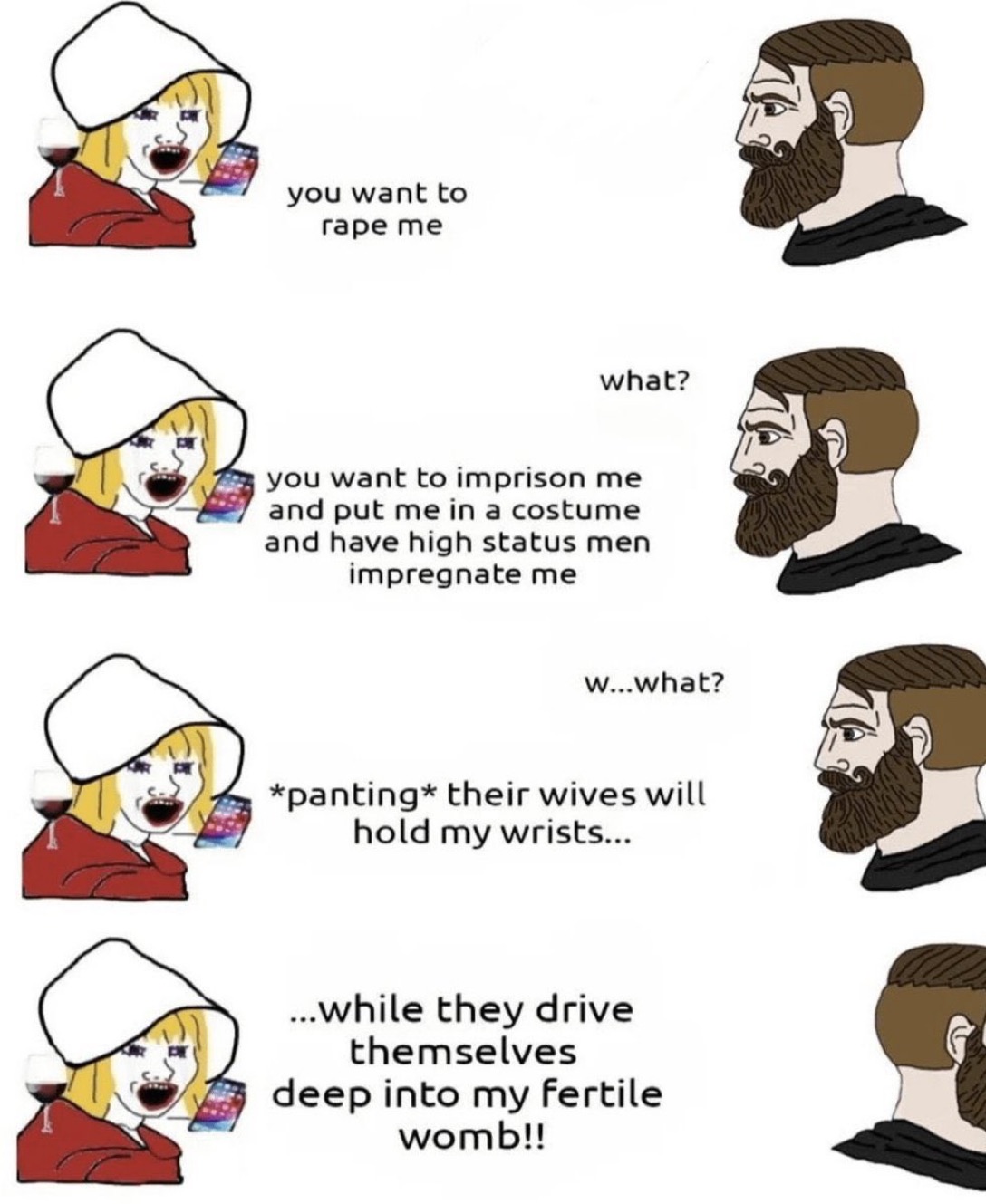
We can’t call women whores anymore in order to enforce virginal purity, but bad romantic decisions still carry bad consequences, and women also need to be protected from those consequences (and can’t ever be held responsible for them). The emphasis has therefore shifted from policing female sexuality to policing male sexuality. The result of this is the emergence of the simp-rapist complex.

The only way to create a safe environment for women whose behaviour is entirely unrestricted is to ruthlessly suppress precisely those masculine traits of dominance and aggression that women find attractive in the first place. All of these traits get included into the broad category of “rape culture”. Even looking at a woman without her expressly stated positive consent becomes a problematic act. Men who violate these norms become, according to this standard, “rapists”.

Update, 1 December: Welcome, Instapundit readers! Please do have a look around at some of my other posts you may find of interest. I send out a daily summary of posts here through my Substackhttps://substack.com/@nicholasrusson that you can subscribe to if you’d like to be informed of new posts in the future.

Canada’s growing Islamist problem

Filed under: Britain, Cancon, Media, Politics, Religion — Tags: , , , , , — Nicholas @ 03:00

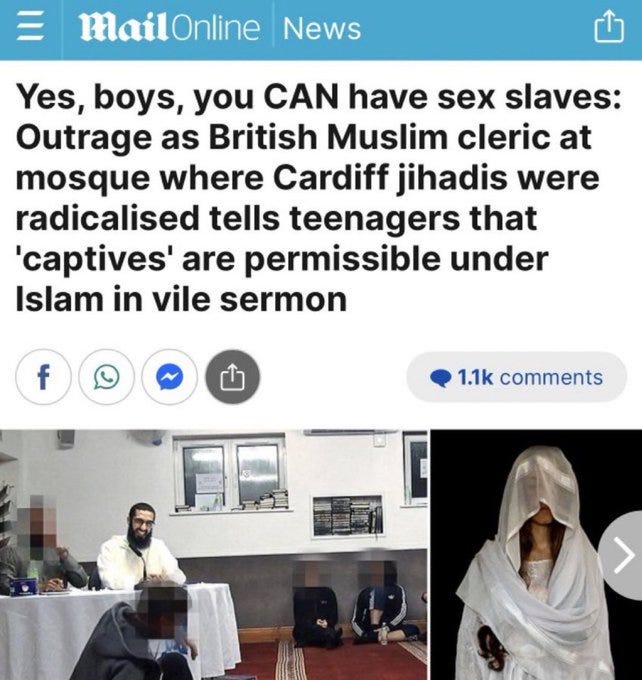
At Juno News, Joe Adam George points to the problems Britain is having with their well-established Muslim extremists and says Canada has exactly the same issues here:

When 35-year-old Jihad al-Shamie terrorized a Manchester synagogue last month on Yom Kippur pledging allegiance to ISIS, few were shocked by what investigators later uncovered. He attended a Salafi-inspired mosque where extremist rhetoric was routine. His father had praised Hamas’s October 7 attackers as “Allah’s men on earth”. Years of indoctrination taught him that violence was virtue, resistance was glory, and terror was faith.

What unfolded in Manchester is a warning to Canada, where similar currents of Islamist radicalism have been manifestly gathering strength. Across Canadian cities, extremist narratives are taking root among young people through community networks, activist circles, and online echo chambers.

A prominent Shia mosque in Windsor, Ontario, recently held a memorial service for slain Hezbollah leader Hassan Nasrallah — for the second year running — where youths eulogised the notorious terrorist as a “hero” and “martyr”. The Toronto Metropolitan University’s arts faculty funded a research paper which argues that Canada’s designation of Islamist groups as terrorist organizations is deeply flawed because of “systemic Islamophobia” and racism. Such episodes do not merely glorify violence; they sanctify terrorism and rebrand militancy as a necessity.

Earlier this year, Canada’s spy agency, the Canadian Security Intelligence Service, warned it was “increasingly concerned” about the threat of ISIS-inspired attacks. That concern is well-founded. The Royal Canadian Mounted Police reported a staggering 488 per cent rise in terrorism-related charges between April 2023 and March 2024, much of it driven by ISIS-motivated youth radicalisation. In the same period, antisemitic incidents surged by more than 670 per cent. An ISIS-inspired teenager was arrested in Montreal in August for terrorism offences. These are not isolated events but symptoms of a cultural shift — where extremism masquerades as activism and hate is sold as justice.

Since the breakout of the Israel-Hamas war, unrestrained radicalisation has seeped into mosques, schools, charities, and universities — often protected by Canada’s own liberal frameworks. Islamist networks have mastered the art of exploiting the Charter of Rights and Freedoms to propagate radical ideologies while deflecting scrutiny. Wrapped in the language of “human rights” and “anti-racism”, they advance intolerance behind a façade of moral virtue.

As former FBI agent and counter-terrorism expert Lara Burns noted, it’s a tactic that echoes the Muslim Brotherhood’s “sabotage strategy” in North America — infiltrating institutions to steer public debate and soften attitudes toward Islamist causes.

Campaigns to institutionalize so-called “anti-Palestinian racism” (APR) is turning Canada’s classrooms and government offices into laboratories for grievance politics. Marketed as anti-discrimination, APR in reality brands any criticism of Palestinian militancy as racism, giving extremists a moral shield and silencing dissent. Even Canada’s Islamophobia czar, Amira Elghawaby, has been accused of abusing her taxpayer-funded post to conjure up Islamophobia and APR where none existed. During a visit to London in June, she reportedly met officials shaping the UK’s own Islamophobia legislation — a troubling sign of cross-pollination between partisan ideologues.

QotD: US illegal immigration, or, creating a new helot class

Filed under: Media, Politics, Quotations, USA — Tags: , , , , , , — Nicholas @ 01:00

    I see many comments to the effect that restricting illegal immigration will cause all sorts of shortages in agriculture and construction. I call bullshit on this for two simple reasons. Before the Great Replacement became enshrined into law in 1965 we had few immigrants of any sort and somehow we managed to pick our own cotton and build houses. We did it the old fashioned way – white and black Americans worked. High school kids would work the fields at harvest time. Black people didn’t have welfare so they did unskilled and even skilled work – bricklayers, lathe-and-plaster work, etc. Is there any reason we can’t do this today?

None whatsoever. The Democrats (which includes the Republicans) don’t know the word “helot“, of course, but that’s what all this boils down to: They’re importing a helot class. It’s probably futile, attempting to pinpoint the exact moment in time when America transformed into AINO, but my best guess is “The moment the phrase ‘jobs Americans won’t do’ was uttered for the first time”. Who the fuck are you, to declare that work, any work, is beneath you?

That’s probably the main reason America became a word-bestriding colossus: Our bone-deep belief in the fundamental dignity of labor. Well within my lifetime, “He’s a hard worker” was considered high praise, at least among people who were still Americans (as opposed to AINO-ites). He might not have anything else going for him, but he pulls his weight, and that’s enough.

What’s more, the LEFT understood this, well within my lifetime. I never tire of pointing out that you could read well-written, well-supported, logically airtight articles against illegal immigration in the pages of The Nation and Mother Jones, right up to the very end of the 20th century. The poor negroes, for instance, can’t “break the cycle of poverty” — a phrase never heard anymore — because all the jobs once available to them have been taken from them by illegals.

But somehow, the Left convinced themselves that the only “jobs” worth having involve clicking a mouse; everything else is an insult to their special wonderfulness. And since the Left control everything, that became one of the defining assumptions of AINO culture — if you can’t do it with a laptop, it’s for peons. Compared to “the laptop class”, the Ancien Regime were kind, tolerant social reformers.

Severian, “Friday Mailbag”, Founding Questions, 2025-01-31.

Update, 1 December: Welcome, Instapundit readers! Please do have a look around at some of my other posts you may find of interest. I send out a daily summary of posts here through my Substackhttps://substack.com/@nicholasrusson that you can subscribe to if you’d like to be informed of new posts in the future.

November 29, 2025

Eliminating fathers – a long-term goal of early Feminists

Filed under: History, Law, Media, Politics — Tags: , , , , , — Nicholas @ 05:00

Janice Fiamengo laments a recent British change to family law that “family courts will no longer work on the presumption that having contact with both parents is in the best interests of a child”. This is merely the latest move in a long-running legal and political struggle to alienate fathers from their children:

“Even today most people will refuse to believe that one of feminism’s main aims is, and always was, to give women the power to rid their families of men.” — William Collins, The Empathy Gap (2019)

“‘The person who is least likely to abuse a child is a married father,’ notes Canadian Senator Anne Cools. ‘The person who is most likely is a single, unmarried mother.'” — quoted in Stephen Baskerville, Taken Into Custody: The War Against Fathers, Marriage and the Family (2007)

[…]

It is a truism that feminists seek to destroy the father-led family and have long worked to do so through anti-father propaganda, legal chicanery, and evidence-free allegations of abuse.

Those who have not read feminists’ own words on this subject may have difficulty appreciating the depth of their desire to deny fathers any legally- or socially-recognized familial role.

Elizabeth Gould Davis’s The First Sex (1971) provides a compelling example. Written at the height of the Second Wave of feminism, and published three years before the author’s death by suicide, it was a popular female-supremacist treatise. In it, Davis rhapsodized about goddess worship and female power in the ancient world, detailing a time when societies allegedly recognized and revered women as the superior sex.

In these societies, according to mythographer Robert Graves, “Men feared, adored, and obeyed the matriarch” (quoted p. 121). In thrall to women, men were peripheral, their roles as fathers non-existent: “[The woman] took lovers, but for her pleasure,” writes Davis, “not to provide her children with a father, a commodity early woman saw no need for” (p. 121). In this matriarchal sexual utopia, “Sexual morals were a matter of personal conscience, not of law” (p. 116), and the sole familial bond was between the mother and her offspring.

A chapter on “Mother-Right” made the case for a return to such a system, explaining that fathers contribute nothing good to their children’s lives. “The father is not at all necessary for a child’s happiness and development” (p. 117). Even children allegedly know this to be so: “In nearly every child’s experience, it is the mother, not the father, who loves all the children equally, stands by them without regard to their worth or lack of it, and forgives without reservation” (p. 118).

The father’s irrelevance is rooted, Davis explained, in men’s inability to love. “Maternal love was not only the first kind of love. For many millennia it was the only kind” (p. 119). Man has merely “learned to appreciate and be grateful for woman’s love, even though he was not emotionally equipped to return it in kind” (p. 119). She quoted Freudian psychoanalyst Theodor Reik to support her view that when men speak of love, they are actually speaking of a mere ‘scrotal frenzy'” (p. 119).

This rhapsody to female power and assertion of male uselessness continues for hundreds of pages in Davis’s ludicrous yet impressively-detailed book. Many feminists at this period made similar claims, attacking fatherhood and calling for the destruction of the patriarchal family. Author and activist Kate Millett, for example, argued in Sexual Politics (1970) that women’s oppression could not be ended without a transformation of “patriarchy’s chief institution […] the family” (p. 33).

In the same year, feminist radical Shulamith Firestone excoriated the patriarchal nuclear family as the “most rigid class/caste system in existence” (The Dialectic of Sex, p. 15). Two years earlier, would-be killer Valerie Solanas had expressed the sentiment crudely in her SCUM Manifesto: “The effect of fathers, in sum, has been to corrode the world with maleness. The male has a negative Midas touch — everything he touches turn to shit” (p. 45).

These were not simply sad cranks penning screeds in cat-piss-scented rooms (though many of them were mentally ill). They were acknowledged leaders of a movement that would, within a few decades, shape and control the core institutions of western civilization.

« Newer PostsOlder Posts »

Powered by WordPress