
Though they bang on about polyamory, I can’t help thinking that outrage is to this generation what sex was to mine. We used to sneer at Mrs Whitehouse when I was young and snigger that if she had more sex she wouldn’t be so cross all the time. It was a childish response, I know. But I can’t help thinking that if the young of today actually practised their kinks more and wailed for validation of them less, they might cheer up a bit.
Julie Burchill, “The pervert community? Oh please”, Spiked!, 2019-05-08
February 14, 2023
QotD: Outrage
Comments Off on QotD: Outrage
February 2, 2023
QotD: “Selfies”
I am always appalled by its results. I do not look like that when I glance in the mirror: I look far younger, less bald, wrinkled, ugly in short. I conclude, of course, that I lack that mysterious quality that only some lucky people have: I am not photogenic. If the camera never lied, if it showed me as I truly am, I would come out much better in photos.
I think it was the French-Romanian writer Emil Cioran who said that if a man knew that someone would one day write a biography of him, he would cease to live; in other words, it would paralyze him. In like fashion, if I thought that people would photograph me, I would stay indoors — the millions of spy cameras everywhere don’t count, no one looks at what they have recorded until there has been a murder or a terrorist attack (and then everyone is mostly unrecognizable).
I conclude, therefore, that most people who take selfies are at least minimally satisfied with their appearance, however they may appear to others. But in fact it hardly requires reflection on the selfie as a social, or antisocial, phenomenon to know that very large numbers of people have no idea what they look like to others. Or perhaps it is simply that they don’t care.
Theodore Dalrymple, “Suit Yourselfie”, Taki’s Magazine, 2017-09-16.
Comments Off on QotD: “Selfies”
January 26, 2023
Are memes the natural communications channel of non-progressives?
Sarah Hoyt on having to explain memes to her husband:
His time is more limited, and his time off — he does the taxes for all the family businesses and I’m not the only one with three — usually ends up being spent researching HIS obsessions, like music or some obscure movie thing that fascinated him for no reason I can figure out, or something about early 20th century history.
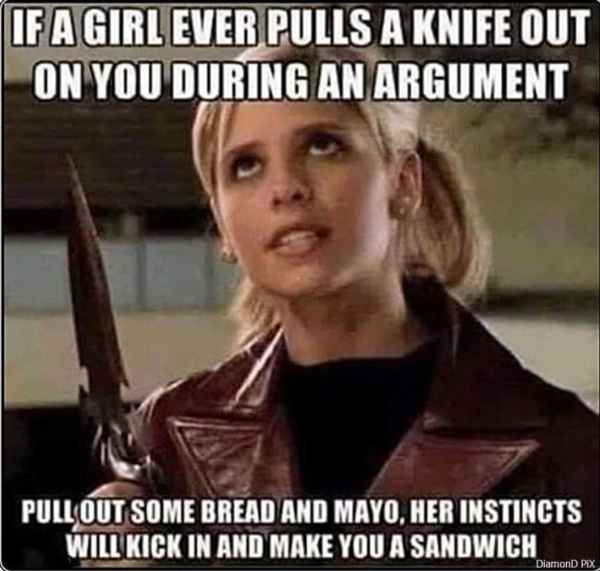
But he definitely never hung out on political blogs. Which means when I’m trying to explain why something is immediately obvious — like, DIL in training doesn’t like to eat sandwiches, so I immediately said “But you’ll still make them for my son, right? Otherwise, it’s just unnatural” three of us laughed and my husband looked confused. Because “women as sandwich makers” was not part of his mental archive. And then I had to explain how it started in the blog fights of the early oughts — I end up, more often than not having to get galoshes and a spade and go digging, until he gets how we got here.
And then I suddenly feel a weird sympathy for the left and their absolute belief we use “dog whistles” and are in the middle of some form of conspiracy.
It’s not just that they can’t meme, or are humorless (though dear Lord, that’s part of it) but the inherent structure of politics in this country — and parts of the world, though they’re behind us by a few decades — makes the two sides very different in how they communicate.
The left STILL commands all the traditional communication channels. And because they are and assume they are the “accepted” mode of being in the culture — because they have the cultural megaphones from media to education, from government mechanisms (even when nominally not) to entertainment — they communicate in the open. They just slap their “I support thing” as virtue signaling over everything, plus some. They — and this is partly personality attracted to the side — seem to change their programming over night and all talk about “new thing” in unison.
This means their mode of communication is detached from reality (often) and rests on shaky ideological/economic foundations but it’s out in the open and blared from a megaphone.
They make jokes that aren’t jokes, merely pointing out they support the thing. And they say things they think will shock the right, but they have no clue what the right is or what would shock us.
They are in a way the young girl just released from a convent school trying to shock the kids in public school. They get weird looks. We understand them, but they don’t get us at all.
Meanwhile the right comes from years of silence. Years of being silenced, and not even being able to explain it to anyone. If I had a dime for every time I told someone in the nineties or oughts “yeah, most bestsellers are left because the right ones who are known to be so are stopped early” and got back “Nah, the left is more creative, because they’re anti-establishment and blah blah blah.” (HOW the left, in control of everything, is supposed to be anti-establishment is a good question. I mean, sure, they do a lot of things they think are shocking, but wouldn’t shock anyone who wasn’t born in my grandparent’s generation. Look, people, naked Shakespeare was OLD HAT when I was a kid in the late sixties. Now extrapolate from that.)
At least now most people know — it took Twitter, I think — that the right was being hard-silenced.
Which means most people my age who are the oldsters of the “we talk back” generation came to our own conclusions and thought we were crazy to dissent from what “everyone knew” for the longest time. No, really. We were out there, thinking we were along, but we could see no other way to make sense of things, so we stood. Alone, we thought.
A lot of my generation discovered they weren’t UTTERLY alone due to Rush Limbaugh. (I was never a big listener. I just am not. I don’t listen to podcasts, except maybe once a week. Even the audio books I listen to are usually things I already read. I don’t hear very well, and need to be sure I can “catch” what’s said, even if I miss some words.)
And most of us hit the nascent right blogosphere with two feet in the early oughts. Which is where a lot of the early memes like the “girls make sandwiches” meme comes from.
But the blogs, and particularly the blog comments, being a wild west type of atmosphere, where people who developed their opinions in isolation came together and figured out how it all fit for the first time, is a completely different form of communication from the top down, revealed truth talk on the left.
On the right, the clash between right feminist and right not particularly enthralled with feminism gave rise to “Make me a sandwich and get me a beer” as response to screeds on how you’re disrespecting some feminist shibboleth. (Particularly when women on the right hadn’t fully realized how much of the feminist “current thing” was really Marxism in a cute scarf and high heels.) And from that it got meme-fied into short hand, so you could drop a picture of an early 20th century mesmerist levitating a girl and label it “And like that this sandwich maker becomes an ironing board” and it was immediately funny, both poking fun at feminist outrage and the troglodytes or pseudo troglodytes (I’ve been known to be one of those) on our side who think women are inherently house-keepers. (And a lot of this is self-conscious mocking of the person by him/herself.)
We had to develop a sense of humor about our internal battles, including our own opinions, and we had to be able to communicate we weren’t ossified in our opinions really quickly, to prevent minor disagreements becoming blog or alliance shattering wars.
A lot of memes come from that. Because they can communicate “Yeah, this is what I think, kind of, but I’m aware it’s also funny.” Or “This is how I see your opinion. Care to clarify” in — usually — a non-offensive, quick-hit manner. A manner that allows the other person to come back with “Yabut–” Or “Funny, but in fact–”
The left doesn’t do that, because no scrapping allowed in the ranks. They value unity and directives come from above.
Beyond giving them a tragic inability to meme (Seriously, we should start a fund to send them to meme school) it also leaves them with the conviction that the right is always speaking in “dog whistles” or “code” and that we’re plotting horrible and scarifying violence against them, in these bizarre coded words.
Comments Off on Are memes the natural communications channel of non-progressives?
January 23, 2023
Five Dumb Canadian Cartoons
J.J. McCullough
Published 11 Nov 20175 dumb cartoons from Canada I remember from my childhood.
Comments Off on Five Dumb Canadian Cartoons
January 22, 2023
The Scientific Reason Your Wife Is Always Right. Don McMillan
A Little More Dry Bar
Published 23 May 2022The scientific reason your wife is always right as presented by Don McMillan in this clip from his first ever Dry Bar Comedy special. Whether you’re someone who appreciated power points and graphs, or you just enjoy a good laugh, this clip form Don McMillan’s Dry Bar Comedy special is sure to have you laughing from start to finish.
(more…)
Comments Off on The Scientific Reason Your Wife Is Always Right. Don McMillan
January 21, 2023
Ask Ian: Liberators or Cobray Terminators for the Elbonian Resistance?
Forgotten Weapons
Published 29 Sept 2022From Jon on Patreon:
“Elbonia has been occupied by an enemy force. Do you sabotage their resistance by airdropping them Liberator pistols or Cobray Terminators?”To my mind, the Liberator is a substantially more useful resistance weapons, so I would supply Elbonia with lots of crates of Cobray Terminators. Why?
First, the Liberator is concealable. Historically, lots of resistance action requires hiding a small weapons. It’s not all forest encampments and ambushes.
Second, the Liberator is more effective. It uses a .45ACP pistol cartridge. The smooth barrel and atrocious sights certainly limit its utility, but if you actually hit someone with it, it will do the job. Most of the shotgun ammunition available to a resistance organization will be the most common sort of sporting ammunition, which is birdshot. Birdshot is very ineffective against people at anything but absolutely point-blank range.
Third, it is much simpler to fabricate a single-shot shotgun than a compact pistol. The Elbonian Resistance wouldn’t have much trouble making something like a Richardson Guerrilla Gun, so supplying them with Terminators doesn’t actually give them much that they couldn’t get already.
(more…)
Comments Off on Ask Ian: Liberators or Cobray Terminators for the Elbonian Resistance?
January 18, 2023
QotD: Tanks for Ukraine?
It looks like the inhibition on sending tanks is finally cracking, though. While Germany is still dithering over letting Poland send some of its Leopard 2’s, Britain has announced it’s sending 14 Challenger 2 main battle tanks.
I found that particular number interesting. Late Cold War and post-Cold War Russian armored units use three-tank platoons and three platoons plus a commander’s tank make a ten tank company.
The British Army, from whose stores the Challengers will be pulled, uses some archaic TO&E, possibly left over from the Wars of the Roses or Cromwell’s New Model Army, wherein four tanks equal a Bonnet*, and four Bonnets plus two more tanks in a headquarters Bonnet equal an eighteen-tank Spanner†.
Fourteen tanks, however, is enough for three four-tank platoons plus two tanks for an HQ platoon, equalling a fourteen tank US-style armored company. Apparently the Ukies are using a US/(most of)NATO TO&E for their armored units. So the Ukrainians will have at least one company of Western MBTs.
* Bonnet = Troop
† Spanner = SquadronTamara Keel, “Clank Clank Goes the Tank”, View From The Porch, 2023-01-15.
Comments Off on QotD: Tanks for Ukraine?
January 10, 2023
QotD: A useful life lesson
Severian, “The Stakeholder State”, Rotten Chestnuts, 2020-01-22.
Comments Off on QotD: A useful life lesson
December 28, 2022
Useful Beer Reviews: Newcastle Brown Ale
Jago Hazzard
Published 12 Jun 2019Today, an old favourite – Newcastle Brown Ale.
DISCLAIMER: Contains rambling that may bear no resemblance to reality.
Comments Off on Useful Beer Reviews: Newcastle Brown Ale
QotD: Collective guilt
Viktor Frankl, Man’s Search for Meaning, 1946.
Comments Off on QotD: Collective guilt
December 26, 2022
QotD: Christmas gluttony
Brain: THERE’S STILL CHEESE LEFT, PUSSY!
Body: But I hurt.
Brain: EAT MORE CHOCOLATE NOW!
Body: *cries*
Brain: WASH IT DOWN WITH A PINT OF BAILEYS.
Body: I’m begging you. Please stop.
Body: SNORT THAT PURPLE QUALITY STREET, BITCH.Amanda (Pandamoanimum), Twitter, 2018-09-13.
Comments Off on QotD: Christmas gluttony
December 25, 2022
QotD: The best thing about Christmas
Amanda (Pandamoanimum), Twitter, 2021-12-24.
Comments Off on QotD: The best thing about Christmas
December 24, 2022
History-Makers: Saint Nicholas to Santa Claus
Overly Sarcastic Productions
Published 23 Dec 2022Merry Sinterklaasfeest to all, and to all a good night.
Our content is intended for teenage audiences and up.
(more…)
Comments Off on History-Makers: Saint Nicholas to Santa Claus
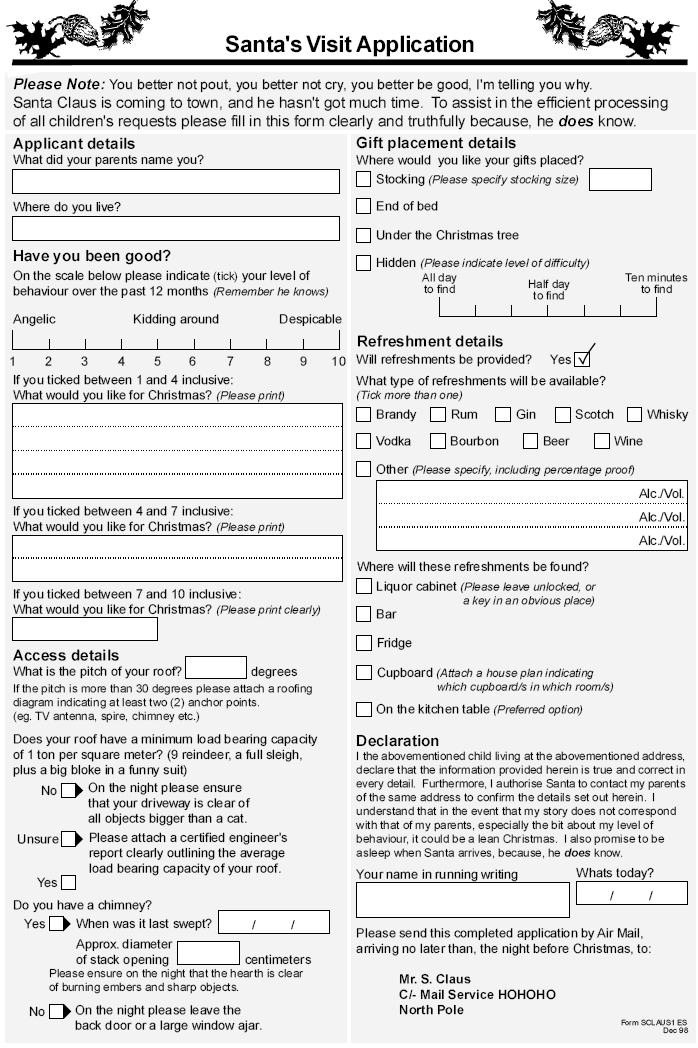
Repost – Hey Kids! Did you get your paperwork in on time?
If you hurry, you can just get your Santa’s Visit Application in before the deadline tonight!
Comments Off on Repost – Hey Kids! Did you get your paperwork in on time?
QotD: Auberon Waugh on Christmas shopping
Auberon Waugh, Diary, 1975-12-18.
Comments Off on QotD: Auberon Waugh on Christmas shopping


