
HardThrasher
Published 21 August, 2026This is the whole of WW2 in less than 20 minutes, because why not. Nazi Germany, Imperial Japan, Hitler, Stalin, Churchill, Pearl Harbor, D-Day, the Eastern Front, the Holocaust, Hiroshima, Nagasaki and a truly unimaginable quantity of human misery in less time than it takes to eat a sandwich at your desk.
If you’re a normal human being, who knows there was a war, but really doesn’t know how it all fits together, this is the video for you.
As with all these things it was messy, so some people claim the war really started in 1937 with Japan’s war of imperial conquest in China, and that’s where we begin, but formally it all kicked off on 1st September 1939 with war between the UK, France and Poland and Germany on the other. Italy quickly piled in and really it went to rat shit from there. If you want to know more including all the fun of the fair that was the Nazi mind, the Japanese madness and the death and destruction they cause, then you’ll find it all here.
I cannot promise that I’ve covered your favourite campaign, in fact I know I won’t have, but there will, however, be some swearing.
I saved at least 5 seconds by cutting the entire USAAF effort in Europe out, somewhat ironically given the detail I’ve gone to elsewhere. So, to those who want to know about Market Garden, the Battle of the Coral Sea, Taranto, Malta, Burma, the fall of Singapore, Operation Bagration or a hundred other topics then this video is of no use to you whatsoever. And I’m not even sorry. But, if you watch this and enjoy it, and your curiosity is peaked, well then, those names and many more besides await you in the hallways of The Afflicted, and there is a seat there reserved especially for you.
00:00 The Entire Second World War in 20 Minutes
00:35 Before 1st September 1939 – Asia
01:53 Before 1st September 1939 – Hitler, Nazi Germany & Appeasement
03:45 Poland Invaded – World War II Begins
04:32 France Falls & Dunkirk
05:30 Battle of Britain & The Blitz
06:01 Britain Bombs Back
06:42 Lend-Lease & The Battle of the Atlantic
07:47 Mussolini Has A Go – North Africa
08:34 Hitler and Halder’s Eastern Adventure – Operation Barbarossa & The Eastern Front
12:22 The Rolled Up Newspaper – Pearl Harbor & Japan’s Gamble
14:19 The Holocaust
15:39 The Boys Are Back IN Town – D-Day & The Destruction of Nazi Germany
16:45 The Pacific – Midway & The Defeat of Japan
18:50 Closing Thoughts
August 22, 2026
QotD: Fortified towns in the Middle Ages
The main difference in defending a town rather than a single fortified private residence is the area that needs to be defended: the town core is naturally much larger than the size of a single keep or bailey and so the circuit of walls surrounding it also needs to be much longer. That longer circuit, of course, means a higher cost in terms of constructing and maintaining the defense, but the advantage a town often has here is its own residents: the populace of a town often has a fair bit more labor to devote to defense construction compared to the medieval aristocracy who mostly draw their power and resources from the more thinly populated rural countryside.
Nevertheless, the larger size of the area being defended makes it harder to deploy concentric defense-in-depth solutions. There are also transit considerations: towns are, after all, economic centers, typically sitting at the junction points of many different local and regional routes, which means they tend to need lots of entry-points to facilitate all of that travel and trade and in turn that means lots of potentially vulnerable gatehouses. Meanwhile, internally, the desire for residents to move around the town freely and general land-use considerations make subdividing towns into walled districts (very common in video-games for memory-management and loading reasons) very difficult and as a result very rare. You can see this, for instance, looking back at the period city-maps from the Lonely Cities series: a good number of cities have either a citadel or a section of the town which is walled but also outside of the main circuit (often separated by a river), but full concentric styles of defense or multiple cell-like walled districts don’t really occur. There are exceptions, but they are relatively rare: most cities have a single primary circuit of walls, which, if they are breached generally give access to the main area of the town.
In Europe, the most complete and formidable set of city walls were without question the Theodosian Walls built to defend Constantinople during the reign of Theodosius II (r. 402-450). The Theodosian Walls stood for the whole Middle Ages but they really reflect the culmination of the ancient system of city wall fortifications, the ultimate answer to the kind of “big army” playbook the Assyrians (and Romans) employed. So I want to both talk about the defense system but also note points where its method diverges from the walls of later medieval towns.
The Theodosian Walls had to cover some 5.7km and had nine gates; both numbers should immediately make clear that you needed quite a few people to man these defenses effectively. This was in particular a factor for town defense: most of the defenders are going to be citizens of the town called up to defend it in an emergency, rather than a standing guard. As far as I can tell, this seems to have made towns somewhat more vulnerable to surprise “hasty assaults”, if the attacker could force a gate along a long circuit before the defenders knew where the attack was coming. Of course that problem is intensified by the fact that this is a single-point-of-failure system: the loss of one gate against a superior foe generally meant the loss of the town.
The Theodosian Walls are unusual in that they are a set of triple walls. The main fighting position was on the inner wall; in front of this was the peribolos, a low, flat, unobstructed gap, after which was the lower outer wall, a secondary forward fighting platform. The towers of the inner wall project out into the peribolos for exactly the same reason castle towers project: defenders on those towers can fire, unobstructed, down the peribolos, meaning that an attacker can find no safety here. The crenellation of the outer wall likewise only faced out, so attackers who seized the outer wall would have no cover from defenders fighting from the inner wall. Next, after another gap was a simple low forward wall, little more than a stone breastwork about 1.5m high. Finally, the low wall stood at the inner edge of a large moat, some 20m wide and 10m deep, because no good defensive system is complete without a ditch.
That low wall is a kind of what we call an “outwork”. This particular kind of outwork is a product of the ancient world and uncommon in medieval fortifications to my knowledge; it was a response to the increasing use of torsion catapults during the Hellenistic period. While it did offer a position for defenders to use to sally out (for instance to destroy enemy siege engines), the primary purpose was to prevent enemy catapults from being able to direct fire at the base of the main wall and its towers. Even if knocked down, such an outwork’s rubble would obstruct direct fire on the curtain wall or the towers. This idea – using an outwork to physically block lines of fire on the curtain wall – is going to come back a bit later.
In contrast, most later medieval town wall circuits generally only have a single curtain wall, supported by a moat. As with castles, the wall is supported by projecting towers which can direct fire along its length and hardened gatehouses. Where cities sometimes do employ defense-in-depth it is with a “citadel” – a hardened fallback position either inside the city or (more often) built in to the wall circuit; essentially a complete castle built into the city wall. The role of the citadel is important for thinking about what these defenses are intended to achieve: defenders who have lost the main area of the city but have held out in the citadel are unlikely to be in a position to recapture the city or even to seriously threaten to do so. But the citadel has important negotiating power. Even a small number of surviving defenders can likely hold a citadel (with its stockpile of supplies) for a long time; taking such a citadel by storm poses all of the problems of storming a castle, with the added disadvantage of having to do so through city streets. Consequently, defenders holed up in the citadel are in a good position to negotiate for terms: perhaps being able to march out unharmed in exchange for turning over the citadel, or else negotiate less onerous terms for the city in general (alternately, they might try to hold out until a friendly relief army could arrive).
And that brings the focus to something important about almost all medieval siegecraft: the siege and negotiations generally proceeded side-by-side. By raising the cost of a siege (either a blockade or a storming assault), the defender could improve their bargaining position, even if they were always going to have to surrender. Meanwhile the attacker, by very visibly preparing for a deliberate assault could signal to the defenders their resolve and thus attempt to encourage surrender. As far as I can tell, far more fortified medieval towns and castles surrendered than were ever taken by storm and so consequently a lot of this fortification work is as much about shifting bargaining positions in the event of an attack as it is resisting an attack.
Bret Devereaux, “Collections: Fortification, Part III: Castling”, A Collection of Unmitigated Pedantry, 2021-12-10.
August 21, 2026
This is something we genuinely need today
Plus, as Kate at Small Dead Animals often points out “Mischief is important“:

In one of the only three management books anyone should bother to read — and everyone should read the three — Robert Townsend says that a CEO should, while on the road, try phoning his own company. Try the helpline and see how far he gets. Try calling his own office. Sure, you should end up with the Executive Secretary who then directs it to the right person but sometimes that correct person is going to be you. Say, Warren Buffett calling to make you rich by buying the company and thus crystallising all your stock options and RSUs.
This is a lesson that has been forgotten. From a Guardian list of things government should pass laws to make happen:
Force companies to put a phone number on their homepage
You’ve got a problem with a company and you want to get it sorted – and then you realise you cannot find a number for it anywhere. There are communications companies that have no “contact us” link anywhere to be seen, and energy companies that send you all round the houses looking for a way to get in touch.
One of the recurring themes of Guardian Money readers’ problems is the struggle to find someone to help when something goes wrong. Clearly, once you have published a phone number, you need staff at the other end answering the phone and offering some joined-up thinking, so this is only the start of the solution – but at least customers would not feel like companies were trying to hide from them.
This does not work as there is no guarantee that anyone will answer the call.
We’ve also that basic point that Burke and his Little Platoons can — and often do — solve problems better than government. So, here’s the pitch for that private sector service.
We set up a database of the home and work and mobile phone numbers — emails too — of the management of companies. Most importantly, the board of directors. If the company is owned by private equity — say — then the General Partners of the PE company.
Obviously, if a company has a helpline, which people answer, then all of that information stays private to us. If a company does not then we publish it as a page saying these are the contact numbers for that company. Say, Evri, the delivery people. The board members get their numbers and email publicly revealed. As I recall it they’re PE as well so some number of GPs over in the US also start getting aggrieved calls from Lesser Wallop about non-delivery. Not that any Septic would be able to understand Ms. Aggrieved of Lesser Wallop but it’s the instance of the call that matters. Evri is used as an example for a bit of looking around a few months back seemed to reveal that they had no UK phone number at all. Thus the directors it will be.
The top management of companies that do not provide a helpline — nor answer the one they claim to have — will have the customer complaints calls directed toward them. This will, of course, rapidly mean the opening of a useful customer complaint line that people actually answer. Those making that £250k a year as the board member of whatever do not want to be talking to Ms. Aggrieved of Lesser Wallop. Therefore phone calls from Ms. Aggrieved will lead to the creation of a useful customer services department.
At which point, of course, we take the board members’ phone numbers down and job done. But, clearly, we keep monitoring to ensure that those service times don’t then decline.
Make the bastards who make the decisions suffer the consequences of those decisions. Works this does, really, it works.
Now, there will be some who say that government can do that. Why use the Little Platoons when a law can simply be passed?
Which is to miss a basic philosophic point, which is that we should only use government when we, ourselves, cannot do it. Government is for when the Little Platoons cannot achieve it. Letters of Marque are lovely things but biffing the Frenchies is better done with a Royal Navy. Assuming we still had one of course. RNLI, on the other hand, works better without government than it would with.
But much more than that. For who are the worst at providing a contact number that works? Why, that would be government, wouldn’t it? Anyone ever tried to ‘phone HMRC? Quite.
August 20, 2026
The Frankfurt School – The most destructive intellectual project of the 20th Century
People tend to underestimate how influential intellectual movements can be, as they rarely get outside attention until they’re deeply entrenched in the university system. The Frankfurt School‘s damage record is unmatched by any other intellectual movement of the era:
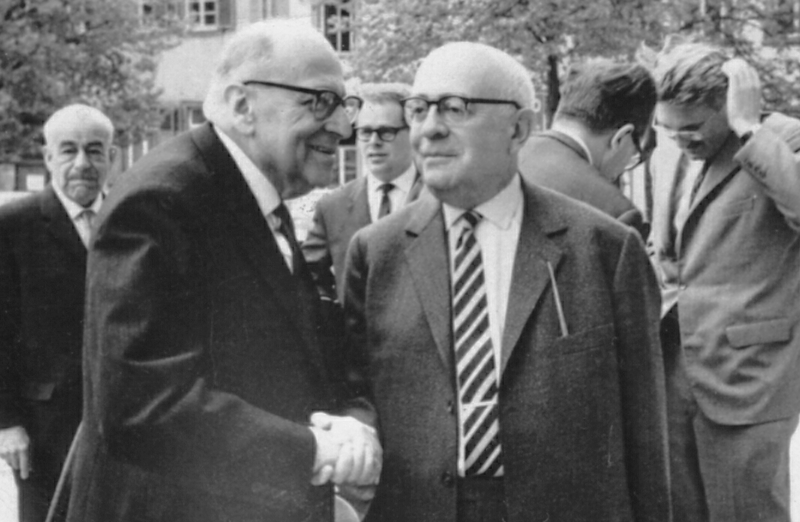
Notable members of the Frankfurt School in Heidelberg, April 1964 at the Max Weber-Soziologentag. Max Horkheimer is front left, Theodor W. Adorno front right, and Jürgen Habermas is in the background, right, running his hand through his hair. Siegfried Landshut is in the background left.
Photograph by Jeremy J. Shapiro via Wikimedia Commons.
The Most Destructive Intellectual Project of the Twentieth Century.
The Frankfurt School. You should know what it was, what it built, and why you are still living inside it.
1. The Institute for Social Research was founded in Frankfurt in 1923 and relocated to Columbia University in 1934 when Hitler came to power. The civilization they had decided to dismantle gave them refuge when another tried to kill them. They spent the next five decades producing the theoretical infrastructure for that dismantling. Western civilization itself was the problem: reason, the Enlightenment, the family, tradition, authority. Not reformed. Dismantled.
2. They called it Critical Theory – and the name is the program. Everything is to be criticized; nothing is to be built. In The Dialectic of Enlightenment (1944), Adorno and Horkheimer argued that Western reason — the reason that produced Newton and the rule of law — contained the seeds of Auschwitz. Not that reason had been misused, but that reason itself, taken to its conclusion, produces the death camp. This was not a critique of institutions. It was an indictment of the civilization itself.
3. Adorno gave them the psychological weapon. The Authoritarian Personality (1950) classified conservatism, religious faith, patriotism, and the traditional family not as political positions but as symptoms of a proto-fascist personality. If you believe in the nation or the father’s authority, you are pre-fascist. The opponent was no longer wrong – he was sick. You don’t argue with a pathology. You treat it. This made dialogue impossible. You don’t persuade someone who is wrong; you diagnose someone who is sick. Politics becomes therapy, and disagreement becomes pathology.
4. Marcuse gave them the political weapon. Repressive Tolerance (1965) argued that tolerating wrong ideas is itself oppression. True tolerance therefore requires suppressing intolerant ideas. The left decides which ideas are intolerant. Everyone else is silenced – not despite tolerance, but “in its name”. Censorship dressed in the vocabulary of liberation.
5. The generation that read Marcuse at Columbia, Berkeley, and Yale went on to run universities, media, foundations, NGOs, content moderation departments, and the EU regulatory apparatus. They implemented the argument sincerely because they had been taught it as philosophy. This was the Frankfurt School’s greatest achievement: it produced true believers.
6. French Theory picked up the tools and made them aesthetic. Foucault made the critique of power literary. Derrida made the critique of meaning philosophical. Deleuze made the critique of identity elegant. A political program became a cultural sensibility. You can argue with a program. A sensibility is in the air you breathe. By the time these ideas reached the American campus through the French conduit, they were no longer ideology. They were the water. The fish did not know they were wet.
7. A civilization stands on three pillars: truth exists and is accessible to reason; good is distinguishable from evil; and there is an inheritance worth transmitting. The Frankfurt School attacked all three – systematically and with considerable intellectual sophistication. It produced a generation that knows how to deconstruct and has forgotten how to build. That sees power everywhere and beauty nowhere. The ultimate achievement was to make destruction feel like progress. Every inherited institution became suspect; every constraint became oppression; every act of preservation became reactionary. Deconstruction became the default, while construction became something that needed to justify itself.
The answer is not another theory. It is the thing the Frankfurt School most feared: the builder who simply builds, the scientist who follows the evidence, the father who transmits what was transmitted to him.
The deconstruction machine runs on the assumption that nothing is worth building.
Prove it wrong.
Tell the truth, have courage, and build.
“It’s a form of libel by sleight-of-hand”
On his Substack, Andrew Doyle discusses the fine art of writing libellous things about someone without quite giving enough legally actionable material for the victim to have a chance to retaliate successfully:
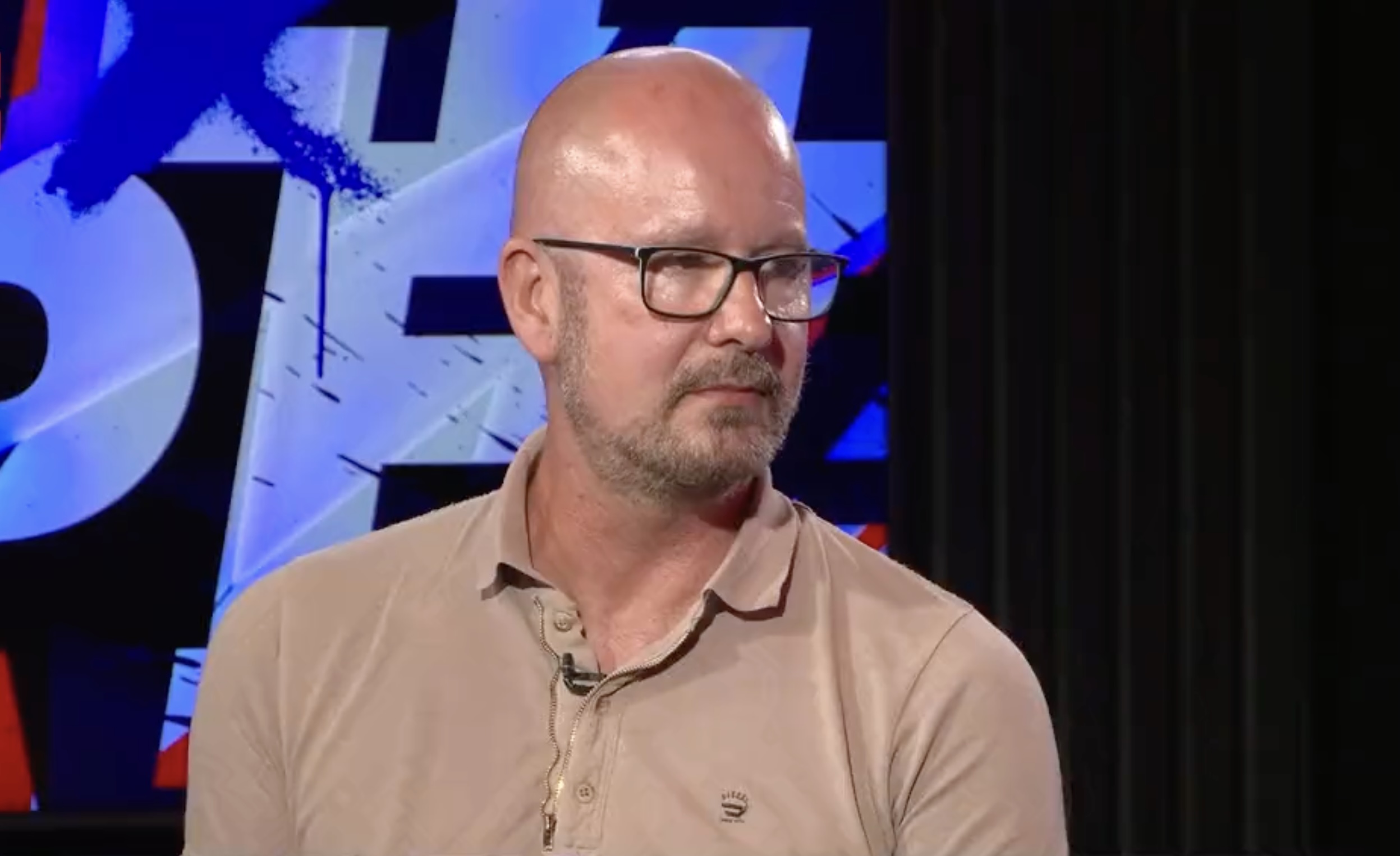
Simon Edge on GB News.
Screencap from Andrew Doyle
How does one libel an opponent and get away with it? I’ve lost count of the number of people online who’ve made false accusations against me. Sometimes I’m a fascist, other times a communist. Sometimes I’m a homophobe, other times a degenerate sodomite. Some have branded me a “racist” for supporting Martin Luther King’s ideal of a colour-blind society. White supremacists have denounced me as a traitor for my opposition to racism.
It’s all noise, of course, and best filtered out. These aren’t serious people, and no serious person would believe their smears. However, last week an author called Simon Edge, well-known in gender-critical circles, published a blog post about me that I can only describe as defamatory. He’s very lucky that I’ve no appetite for litigation, but I think it’s worth discussing the nature of his smearing technique because it’s become so common among activists of the more mendacious ilk.
It’s a form of libel by sleight-of-hand. Perhaps we should call it prestidefamation. Here’s how it works. You take a series of unremarkable facts, out-of-context quotations and tenuous associations, arrange them in a suggestive manner, omit any contrary evidence, invite the reader to draw the worst possible conclusion and then congratulate them for drawing it.
Edge has done precisely this. I have a long and well-documented record of opposing fascism and the far right. I’ve written books and articles about it, spoken about it endlessly on television, radio and podcasts. My latest book The End of Woke makes the case against all forms of authoritarianism, and opens with an epigraph explicitly attacking Nazi ideology. Yet Edge has managed to write an article insinuating that I support Nazis. It would be like writing a piece about Oscar Wilde’s robust and unwavering heterosexuality.
Here’s how he did it. Recently, it was announced on X that Oldspeak Books, which bills itself as “Britain’s only centre-right bookshop”, has closed its doors. The manager posted a message on social media to explain.
Over time, it became increasingly difficult to maintain a welcoming environment due to the constant hostility I experienced. The uncertainty around which customers were genuine, made it hard for me to greet everyone warmly, and my customer service suffered.
This looked like a clear case of cancel culture to me and, since Oldspeak had been kind enough to stock my books, I reposted her message with a comment to the effect that it was a shame that she had been pressurised into closing her shop. This was, according to Edge, my first foray into the murky world of fascist apologism. Who knew it could be so easy?
The Ancient Greeks 04 – The Persian Invasion 3 – The Road to Thermopylae
seangabb
Published 25 Mar 2026Greece: A Brief History, c.700 BC – 500 AD
Why did the Greeks resist — and how did they organise their defence?
In this lecture, we follow the formation of the Greek coalition against Persia and the strategic decisions that led to the famous stand at Thermopylae. Against overwhelming odds, a divided collection of city-states came together to resist the greatest power in the known world.
We examine:
– The creation of the Hellenic League
– Spartan leadership and Greek strategy
– The selection of Thermopylae as a defensive position
– The parallel naval strategy at Artemisium
– The events leading up to the battleThis lecture sets the stage for one of the most famous last stands in history, showing that Thermopylae was not an isolated act of heroism, but part of a carefully considered defensive strategy.
QotD: George Bernard Shaw’s role as Stalin’s useful idiot
Shaw toured Ukraine during the height of the Holodomor, when Soviet grain requisitions had stripped peasants of every scrap of food. Conservative estimates put the death toll at 3.5 million Ukrainians. Shaw saw the empty villages, the skeletal survivors, the mass graves. Then he signed a public letter praising Stalin’s “remarkable progress” and told Western journalists that reports of famine were capitalist propaganda.
Why would an intelligent man become Stalin’s useful idiot? Shaw believed in central planning with religious fervor. He thought brilliant intellectuals like himself could design society better than millions of individuals making their own choices. When confronted with central planning’s inevitable result (mass death), he chose to lie rather than admit his ideology killed people. Shaw preferred beautiful theory to ugly facts.
Shaw deliberately used his celebrity status to give Stalin cover while Ukrainian children died of starvation. He returned to Britain and spent years defending Soviet policies, even as refugee testimonies and photographic evidence exposed the genocide. The man who wrote about moral awakening in Pygmalion had abandoned his own moral compass entirely.
Free market economists warned that socialist calculation was impossible, that without prices and property rights, economies would collapse into chaos and death. Shaw dismissed these warnings as bourgeois nonsense while standing ankle-deep in their vindication.
Handre, The social media site formerly known as Twitter, 2026-05-13.
Update, 21 August: Welcome, Instapundit readers! Have a look around at some of my other posts you may find of interest. I send out a daily summary of posts here through my Substack – https://substack.com/@nicholasrusson that you can subscribe to if you’d like to be informed of new posts in the future.
August 19, 2026
Why The Allied Western Front Offensives in 1915 Failed
The Great War
Published 13 Mar 2026By the spring of 1915, the Western Front had bogged down into trench warfare. Allied offensives tried to break the deadlock in spring and fall 1915. The fall offensives were among the bloodiest of the war. After unprecedented bloodletting and use of munitions, the Western Front was still locked in a stalemate at the end of 1915.
(more…)
QotD: The Kwantung Army was the tail wagging the Japanese Imperial dog
The Lytton Commission was commissioned by the League of Nations to investigate the Mukden Incident, which was one of those false flags the Kwantung Army was fond of. They used it to seize Manchuria — technically a province of China — and set up a puppet government they called “Manchukuo” (under the Qing Emperor who was deposed in 1911 — who was 5 at the time — thus giving it a veneer of historical legitimacy). The Lytton Commission concluded that the Mukden Incident was indeed a false flag; that Japan was the aggressor; and that Manchukuo was a puppet state that should be dissolved, with Manchuria returning to Chinese sovereignty.
That’s bad, because if you’re Japan and you do any of that, you’ve now knuckled under to not just the West, but the worst hypocrites of them all (“Lytton” was Victor Bulwer-Lytton, the 2nd Earl of Lytton, formerly governor of Bengal and Viceroy of India, and oh, by the way, how exactly did Britain come to rule in India? The shit they pulled makes the Mukden Incident look like very small beer indeed). And it’s bad from the Chinese side, too, because now you’ve basically tied their hands in any peace negotiations — they can’t conclude any kind of honorable peace without getting Manchuria back, and as should be obvious from the above, you must pry Mantetsu from Japan’s cold, dead hands.
Still, Japan might’ve disciplined guys like Ishiwara … but how? You can’t cashier him; the Army would go insane. You can’t really transfer him — as much trouble as he’s causing in Manchuria, if you bring him home you might well have another February 26 Incident, and it might work this time. You certainly can’t execute him, because a) you’d have to take his entire faction with him, which would decimate your officer corps, and b) perhaps more importantly, the seizure of Manchuria was pretty popular. Mantetsu’s Media boys hadn’t been sitting on their hands during all of this, of course, and the Army’s Media people had been going nuts too.
In the end, the Japanese pretty much had no choice: They gave the League of Nations the finger. Which of course emboldened the KA even more, such that they cooked up an even faker and gayer false flag, the Marco Polo Bridge Incident, and WWII was on.
Severian, “Slipping the Leash”, Founding Questions, 2022-08-27.
August 16, 2026
How Not to Be A Nazi – Death of Democracy 28 – Epilogue
World War Two
Published 15 Aug 2026Nazi Germany destroyed democracy in weeks, launched a war that killed tens of millions, and carried racial persecution to industrialized mass murder. But after 1945, Germans and Europeans faced another question: how could they prevent it from ever happening again?
In this final, independently viewable epilogue to Death of Democracy, Spartacus examines how West Germany transformed the lessons of dictatorship and war into the Grundgesetz — a constitutional system built around human dignity, enforceable rights, federalism, judicial independence, social stability, and a democracy empowered to defend itself.
We trace how the Federal Republic combined lessons from Weimar, the United States, Britain, Austria, France, and other democratic traditions; how Konrad Adenauer’s generation tied Germany to a new European order; and how the same determination to restrain power and prevent another continental war eventually shaped the European Union and the Lisbon Treaty.
Finally, we ask how well those democratic fortifications are holding in 2026 — and return one last time to the diarists, victims, witnesses, supporters, and resisters whose voices guided us through Germany’s descent into dictatorship.
From the comments:
@spartacus-olsson
12 hours agoThank you for joining me on this adventure. I hope it has been eye-opening. If you watched to the very end, you will know that I’m soon launching a World War 2 Trivia board game – I’ve been super punny and named it World War IIrivia (2rivia with Roman numerals).
After so many years of studying this and sharing it in the darkest possible way, I felt it was time to look at the whole affair in a way that’s fun, social, and still educational. So a couple of months ago I came up with something. It turned out to be one of those moments when the work seems like extra fun. Before I knew it, I was spending my sleepless nights on the idea, sketching rules in Word, writing questions into lists in Excel, designing the game in Photoshop, testing gameplay against myself, and redesigning. And then there it was — an actual game. It’s a game for both novices and experts, with some unexpected twists and turns. If you’re interested in this period of history and enjoy a night of board games, this is for you. Stay tuned for more updates about the launch.
Once again, many, many thanks to all of you for watching. Thank you to Iryna, Astrid, Anna, and Clara for your great work on the series. Thank you to the TimeGhost Army members for enabling me to do this. With that, as Mr. Murrow would put it:
Good Night and Good Luck,
Your Spartacus
The Ancient Greeks 04 – The Persian Invasion 2 – Logistics and Diplomacy
seangabb
Published 24 Mar 2026Greece: A Brief History, c.700 BC – 500 AD
How do you move an empire to war? This lecture examines the extraordinary logistical and diplomatic preparations behind Xerxes’ invasion of Greece. We explore how the Persian Empire assembled one of the largest armies in ancient history and the immense challenges of supplying and coordinating such a force.
At the same time, we examine the diplomatic pressure placed on the Greek states, including demands for submission and the divisions this created within the Greek world.
– The scale and organisation of the Persian army and navy
– Supply lines, engineering, and preparation
– The bridging (and scourging) of the Hellespont
– Persian diplomacy and the demand for “earth and water”
– Greek responses: submission, neutrality, and resistanceThis lecture shows that the invasion was not simply a military campaign, but a vast imperial operation combining force, intimidation, and political calculation.
QotD: The “Marian reforms” were not a thing
- Cohorts: Experimented with before Marius, especially in Spain. Marius uses cohorts, but there’s no evidence he systematized or standardized this or was particularly new or unusual in doing so. Probably the actual breakpoint here is the Social War.
- Poor Volunteers Instead of Conscripted Assidui: Marius does not represent a break in the normal function of the Roman dilectus but a continuation of the Roman tradition of taking volunteers or dipping into the capite censi in a crisis. The traditional Roman conscription system functions for decades after Marius and a full professional army doesn’t emerge until Augustus.
- Discharge bonuses or land as a regular feature of Roman service: Once again, this isn’t Marius but Imperator Caesar Augustus who does this. Rewarding soldiers with loot and using conquered lands to form colonies wasn’t new and Marius doesn’t standardize it, Augustus does.
- No More equites and velites: No reason in the source to suppose Marius does this and plenty of reasons to suppose he doesn’t. Both velites and equites seem to continue at least a little bit into the first century. Fully replacing these roles with auxilia is once again a job for our man, Imperator Caesar Augustus, divi filius, pater patriae, reformer of armies, gestae of res, and all the rest.
- State-Supplied Equipment: No evidence in the sources. This shift is happening but is not associated with Marius. In any event, the conformity of imperial pay records with Polybius’ system of deductions for the second century BC suggests no major, clean break in the system.
- A New Sort of Pilum: No evidence, probably didn’t exist, made up by Plutarch or his sources. Roman pilum design is shifting, but not in the ways Plutarch suggests. If a Marian pilum did exist, the idea didn’t stick.
- Aquila Standards: Eagle standards pre-date Marius and non-eagle standards post-date him, but this may be one thing he actually does do, amplifying the importance of the eagle as the primary standard of the legion.
- The sarcina and furca and making Roman soldiers carry things: By no means new to Marius. This is a topos of Roman commanders before and after Marius. There is no reason to suppose he was unusual in this regard.
So the Marian reforms … were not a thing. Functionally none of what is described as happening in them was new or unique to Marius. Indeed, the most substantial reforms are either things that were already changing (and which Marius seems to have had little role in) or things which had not yet changed but which would, under Augustus. Indeed, one of the problems with the assumption of a Marian reform is that it takes a whole lot of changes which were more likely a package of reforms under Augustus and pulls them forward in time to Marius, doing some damage to our understanding of both figures.
But Augustus makes much more sense as the figure doing many of those organizational changes. For one we have sources actually telling us he did them, from the standardization of military service (Dio 54.25.6), the creation of retirement bonuses and the aerarium militare to fund them (Dio 54.25.6 again, but also Res Gestae 17), and the radical expansion and formalization of the auxilia as part of the Roman army (Tac. Ann. 4.5). The one thing missing is citizenship-for-service, which we can see emerging under Tiberius, the next emperor immediately after Augustus. And it makes sense because Augustus is, by necessity, doing a bunch of other things with the legions too. He’s instituting a whole new command structure, with dedicated legionary commanders (the legatus legionis) serving under his own provincial commanders (legati Augusti) with imperial procuratores handling the former role of the quaestors. Also, the legions get their citizen cavalry (though a quite small detachment of it) back too.
So instead of thinking, “Marian reforms” – which were, I must stress, not a thing – you ought to be thinking about a period of tactical, organizational and institutional change beginning in the second century, accelerating in the first century and then finally being instituted as a comprehensive set of reforms and formalization by Augustus, not by Marius, which codified a lot of change that had already happened over that long period. A long process with a punctuation mark at the end rather than a singular moment of reform associated with a singular Roman general.
Alright. Now one of you go and fix the Wikipedia entry.
Bret Devereaux, “Collections: The Marian Reforms Weren’t a Thing”, A Collection of Unmitigated Pedantry, 2023-06-30.
August 15, 2026
Laugo Alien Remus: Making the Best Pistol Better
Forgotten Weapons
Published 21 Mar 2026The Remus is the new version of the Laugo Alien pistol. It was released about a year ago, and just recently also made available in a left-handed version — which I have been eagerly awaiting. The Remus is designed to be a more general-purpose and carry-suited pistol in contrast to the competition focus of the original Alien. It adds a manual safety, system for racking the slide with the optic while having a 0.8″ shorter barrel and weighing 25% less. The optics mounting options now include the Aimpoint COA, which I am also a big fan of.
Disclosure: Laugo gave me this pistol, so you will have to judge for yourself if I am being bought or if I genuinely believe this pistol is as good as I say.
(more…)
QotD: “The progressive is a walking paradox”
If I loudly claim to love vanilla ice cream, yet every time I return from the Mr Whippy van I’m holding a choc-ice, my revealed preference is evidently for chocolate — not vanilla.
Thus the truth of a person’s preferences is revealed through their actual choices and behaviour, not by what they claim to prefer.
It’s unfortunate we can’t simply listen to their words, but they are so oriented toward the external, the aesthetic, and the performative (“Theater Kid Progressivism”) that we must instead look at their proximal behaviours — where they actually choose to live and raise their families, for example, to extrapolate backwards their true feelings on mass migration and its consequences.
This is the lens through which we should try to understand our Progressive class.
The bitterest irony, the irony of ironies, is this: progressives, especially those who voted for it, self-evidently do not feel at home in the societies they helped create.
If they were genuine believers, they would live contentedly amidst their new friends.
Instead, they scuttle off into the countryside, the leafy suburbs, or gated enclaves, abandoning the very demographic transformation they imposed on others.
It is often said that if liberals didn’t have double standards they wouldn’t have any at all, but while this is very funny (and true), there’s more to it.
It reveals a profound non-confluence between their stated attitudes and their actual behaviours, indicative of extreme cognitive distortion.
They protest performatively that open borders and rapid demographic change are a universal good, even moral imperatives and (admittedly less often nowadays) sources of strength.
Yet when it comes to their most intimate revealed preference — where they opt to live and raise their families — they consistently prioritise homogeneity, good schools, and cultural familiarity.
They lobby and vote without end for policies that maximise immigration into lower- and middle class neighbourhoods, then abandon those very communities for pastures anew, safely insulated by postcodes and house prices.
Their revealed preference is that do not want to live in the Canada (or Britain, or America, or Europe) they are busily helping to construct.
They enjoy the vibes, the moral status, the Instagram aesthetics, while quietly falling back to the leafy, high-trust environments their grandparents took for granted.
Progressives love to speak of taboos (indeed if there is a pastime more alluring and intoxicating to the progressive than “breaking taboos”, I am yet to come across it, but I digress) yet is the greatest taboo of all right in front of us after all, carrying a basket of organic fruit and veg from Waitrose?
To interrupt the Progressive in the midst of his communal dream state, to turn our collective eye away from the brave new world they are building for us and to instead look inwards, to look the Liberal cuckoo directly in the eye and put words to the disparity between their words and their actions …
The subject of lawful and legal deportations is increasingly mainstream, yet what of urban renewal and rewilding by means of progressive importations?
The Progressive is a walking paradox, he is both the centre of attention and the ghost at the feast all at once.
Æthelstan, The social media site formerly known as Twitter, 2026-05-14.
August 14, 2026
What Did the Builders of Stonehenge Eat?
Tasting History with Max Miller
Published 17 Feb 2026Roasted pork ribs with blackberries and honey with Stonehenge Nettle and Hazelnut Soup
City/Region: Britain
Time Period: 3000-1500 BCEAbout 2 miles from Stonehenge is Durrington Walls, the place that archaeologists believe was the living settlement for the people who built and used Stonehenge. Amongst the evidence of what was eaten, there are a lot of bones, about 90% of them being pig bones. Based on scientific analysis of the pig teeth found there, they were probably fattened on something sweet, which would have probably been honey or berries, so I’m using both to prepare these pork ribs.
This is a simple preparation, but these ribs are so good. The honey is the dominant flavor and the blackberry does come through. The other 10% of bones found at Durrington Walls were mostly cattle, so you could use beef ribs instead if you’d like, you’ll just have to cook them longer.
(more…)


