
Like many terrible ideas, postmodernism started with a question. The wreckage left over from the Second World War, the incomprehensible scale of the slaughter, the industrialised genocide, the atom bombs – all this brought about by the most advanced nations on earth, the ones that considered themselves civilised. How could the same cultures that brought us the Enlightenment, human rights, individual liberty and the scientific revolution also give us Auschwitz, slavery and the brutal repression of colonised people? As the second half of the century got underway, intellectuals were naturally inclined to question the West’s founding principles and what they saw as the illusion of progress. It was time to interrogate its assumptions, take apart its certainties, and puncture its claim to hold universal values.
Leading the way were the French intellectuals, who in the 1960s and 70s questioned the deepest of those assumptions, beginning with truth itself. Was there really such a thing as “objective truth”, or was it simply an invention of the powerful, something declared rather than discovered? Was “progress” a description of reality or just the story told by whoever won? These are serious questions from which they could make fair observations. They were right to point out that institutions serve their own interests, and grand narratives play a defining role in our understanding and interpretation of the world. The trouble is that the same intellectuals didn’t try to place the answers intelligibly within the larger story of our lives. Postmodernism made interrogating power the overriding intellectual move and the answer to its own question.
Postmodernism doesn’t lend itself to a simple explanation, which is appropriate, as we shall see. However, dig beneath the deliberately impenetrable jargon, and the core claims are as follows. There is no objective truth, only competing narratives. What we think of as “knowledge” is just something the powerful tell us is the case. Language doesn’t describe reality but constructs it. Science, reason, and universal liberalism are inventions of Western minds, specifically male ones, while the Enlightenment idea of the individual with supposed natural rights is just another concept made up by those most likely to benefit from it.
There’s an obvious paradox at the outset. In what sense is it true to say there’s no such thing as objective truth? The question is meaningless because the premise is nonsensical. As Roger Scruton put it, “A writer who says that there are no truths, or that all truth is ‘merely relative’, is asking you not to believe him. So don’t.”
Despite the obvious contradiction, it’s an idea that has been pushed aggressively by campus authoritarians for decades. No narrative deserves authority, they say, while demanding intellectual obedience to a narrative of their own.
Frederick Alexander, “Postmodernism: The Idea That Ate Itself”, The Gadfly, 2026-04-03.
August 14, 2026
QotD: Postmodernism’s origins
August 13, 2026
German democracy from the POV of “Our Democracy Enjoyers”
If you’ve been wondering about the state of democracy in Germany, your first move should be to check the latest update from eugyppius:

“Bundesrat of Germany” by photosteve101 is licensed under CC BY 2.0 
 .
.
In civics class, parties appear as little more than informal election-winning cooperatives. Now and again “the sovereign” – that is to say, “the people” – may grant one or various parties a limited right to govern, but the state is held to be in some sense public property. Politicians and their parties are at best its temporary custodians.1
Our Democracy Enjoyers particularly deplore state systems in which parties have captured the state – a special political form we might call the “party state”. Germany became a party state after 1933, when the NSDAP seized the entire state apparatus and outlawed all competitors. Contemporary states owned and operated by single parties include China, Cuba and North Korea. Our Democracy Enjoyers hate all single-party states because they are not democratic.
Party states need not however be single-party states. While the Socialist Unity Party (SED) effectively owned the DDR, they tolerated an array of subservient bloc parties from the very beginning. None of these parties ever had any chance of governing; they functioned only as extensions or alternative faces of the SED itself. These parties included gutted, early opposition parties like the CDU (Ost) and the Liberal Democratic Party (LDPD), but also SED concoctions like the Democratic Farmers’ Party (DBD) and the cynically post-Nazi National Democratic Party (NDPD). The SED cultivated these parties both as a democratic figleaf and also to integrate “non-proletarian” (particularly Christian) elements within the communist system. The precedent of the DDR shows that the party state can assume various innovative forms and that multiple parties may be useful for political, propaganda or other purposes.
My thesis of the Federal Republic is that it is also a party state. The only difference between the DDR and the BRD is that, in the BRD, several different parties share ownership of the state among themselves.
The three anecdotes at the head of this piece reveal this party ownership in incidental but telling ways. They show, for example, how a substantial portion of the police consider their oath of office to preclude loyalty to a democratically elected opposition party. Should the voters go rogue and install any such party at the state level, a prominent police union functionary openly hopes for insurrection and federal intervention. Periodically voiced ambitions and campaigns to cleanse the civil service of AfD elements come from a similar place. The ownership parties cannot countenance opposition creep into the bureaucracy, because they correctly regard the bureaucracy as their property.
The hysteria surrounding a thwarted SPD nomination to the Federal Constitutional Court reveals that the parties that own the BRD extend their proprietary interests not only to the executive and legislative branches, but also to the allegedly independent judiciary. The ruling parties have divided the prerogative to nominate judicial candidates informally among themselves. This prerogative is so jealously guarded that a leading Union politician cited a single thwarted SPD nomination to make the case for mass censorship and regulation of “alternative” media.
And while it is a minor incident that hardly matters, the dispute over the Otto-Wels-Saal shows that the proprietary feelings of the state parties extend to physical architecture, even specific rooms and buildings, which the parties of the party state regard not as public property but as their very own chambers – to name, possess and use as they see fit.
While progressive liberal political systems are all oligarchies, and this because of the Iron Law of Oligarchy, they are not all party states – far from it. The party state is a clunky and outmoded political system that historically arose out of accident or necessity, generally following a revolution perpetrated by a single party or political movement in a moment of particular ascendance. The Federal Republic was founded as a party state in 1949, mainly to foreclose the possibility that subversive National Socialist or communist elements might return to influence via democratic processes. This is the basic meaning of German “defensive democracy”, which denotes an array of legal or constitutional tools for the parties that own the state to fend off or criminalise competitors.
- Now, we know this is mostly nonsense. “The people” are an abstraction and as such they cannot grant anybody anything. All political systems ultimately redound to the control of more or less stable oligarchies. “Democracy” describes little more than a set of procedures via which the these oligarchies (or their representatives) assume power and enact their will.
The Ancient Greeks 04 – The Persian Invasion 1 – Xerxes Decides
seangabb
Published 23 Mar 2026Greece: A Brief History, c.700 BC – 500 AD
What drove the greatest invasion force of the ancient world to march against Greece?
In this lecture, we move from the aftermath of the Battle of Marathon to the momentous decision of King Xerxes of Persia to launch a full-scale invasion of mainland Greece in 480 BC. We examine the political, strategic, and psychological factors behind the Persian decision, including the legacy of Darius, the revolt in Egypt, and the internal debates within the Persian court.
Drawing on Herodotus and other ancient sources, this video explores:
– The consequences of Marathon for both Persia and Greece
– Xerxes’ consolidation of power
– The famous debate at the Persian court
– The role of honour, revenge, and imperial ideologyThis is the essential starting point for understanding how a regional conflict escalated into one of the defining wars of the ancient world.
Part of a full lecture series on the Persian Wars.
August 12, 2026
“Hitler’s socialism wasn’t just an internal economic policy – it was the cause of the war”
On the social media site formerly known as Twitter, Krzysztof Szczawinski explains why socialism — of the left (the Soviet Union) and the right (Nazi Germany) — was the economic driver that pushed Europe into war in 1939. German socialism (in one state) could only continue to grow by annexing resources and manufacturing capabilities from neighbouring states, and by August 1939 it was Poland’s turn:

Socialism was at the origin of the war. Not as a coincidence. As a necessity. The socialist economic model generates contradictions it cannot resolve internally – the calculation problem, the misallocation, the stagnation, the mounting failure. War is the exit. It provides the external enemy that explains the internal failure. It justifies the total mobilization the system always wanted. It consumes the surplus population the economy cannot employ. It redirects the resentment outward.
Does this remind you of anything?
The evidence is not subtle. The NSDAP program of 1920 reads like a standard socialist manifesto. The economic reality confirmed it – price controls, industrial planning, state allocation of raw materials, entrepreneurs reduced to government functionaries. Private property in name only. Mises called it Zwangswirtschaft – coercive economy. Hayek dedicated a chapter of The Road to Serfdom to the socialist roots of Nazism. Both writing from observation, not retrospect.
After 1945 the Soviet victors imposed their version and attached the capitalist label to every rival. Western textbooks followed. The lie became the curriculum.
The real divide has never been left versus right. It is collective control versus individual freedom. Once you place National Socialism correctly within the family of collectivisms, the political spectrum becomes legible – and the war becomes explicable.
When the system fails — and it always fails — it needs an enemy. The bigger the failure, the bigger the enemy required.
Imagine being Poland. Squeezed between two socialist systems, both searching for their enemy.
We were it.
QotD: The art of admitting our mistakes
The painting below by Paul Cézanne demands our consideration. It cannot be passively observed. The glassy patch of water in the lower right-hand corner is where the painting – “Reflections in the Water” – gets its name. Our eyes are naturally drawn to the thick tree on the bank whose ghost is captured on the surface of the pond where the foliage gives way, but really it is the slim sapling, unreflected, unbroken, rising boldly along the canvas’s left edge, that is the true subject of this piece. It is a triumph of subtlety and nerve.
Except that I’m wrong. I’ve been looking at the painting on its side and forming a completely inaccurate impression. Oh well. I’m probably not the first. There is an unconfirmed story that this painting by Cézanne was hung sideways for thirty-one years in London’s National Gallery. The origin of this gossip is from the economist Oswald Toynbee Falk (1879–1972), who lays the blame at the feet of one of its trustees, John Hugh Smith, exactly the kind of person who would in those days have had a hand in such decisions. I can find no corroboration of the story, but I do hope it’s true.
Of course, an establishment as prestigious as the National Gallery would be unlikely to admit to such a galloping blunder. And anyway, as I’ve said, the sideways version has much to recommend it. If there’s a moral to this story, it’s surely that once we commit to an error of thinking for too long it can be mortifying to correct ourselves, particularly if public humiliation is to be the outcome.
It strikes me that the culture war is largely characterised by groups of intelligent people investing in delusional ideas with such gusto that to backtrack would be a kind of social death. One might sooner teach a mule to moonwalk than persuade a celebrity who has championed gender identity ideology to admit that human beings cannot change sex. After demonising women for insisting on single-sex spaces, making excuses for the medicalisation of healthy children, and encouraging the dismantling of gay rights – all in the name of progress – it must be tremendously difficult to admit that it was all for nothing.
For many, the response to being corrected is simply to deny there was any mistake at all and to double down. This is certainly the position of the Green Party, whose representatives are now wholeheartedly wedded to the absurd proposition that human beings have an innate gendered soul that can be misaligned from their body. Their supporters are even congratulating them for their doggedness in the face of reason and evidence, so there is no incentive to course-correct.
Andrew Doyle, “The art of admitting our mistakes” ($), Andrew Doyle, 2026-05-08.

August 11, 2026
Cambridge has turned into a “Quality Learing Centre”
Even as I typed Sunday’s headline, I knew the fallout from the Jason Arday affair wasn’t going to be over quickly: it’s too high profile and gores far too many sacred cows to just fade out of the headlines. On his Substack, Francis Turner remembers what a Cambridge education used to mean and what progressive racists have turned it into now:
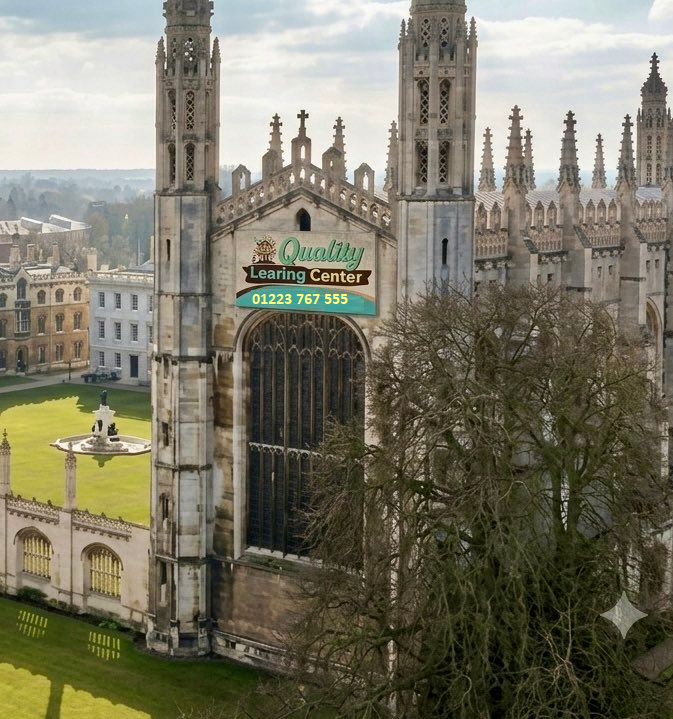
Once upon a time I was an undergraduate at Cambridge. Back in the day when men were real men, women were real women and Cambridge’s contribution to the national sense of humour were people like John Cleese, Tom Sharpe and Douglas Adams. Cambridge students were well aware that we were at the top of the intellectual tree and generally proud of the fact. In fact for many of us (e.g. your humble correspondent) coming to Cambridge was where we discovered that there were people far far smarter than we were for pretty much the first time in our lives. It was humbling. And once we got over that, exhilarating. You could have discussions about quantum mechanics or code optimizations or whatever with people who understood the concepts at least as well as you did. You could be lectured by professors who had Fields Medals or Nobel Prizes; often they had literally written the standard text book in the field. Sometimes they would drop digs about colleagues or rivals and you had to know that “Tony” was Tony Hoare who was in charge of Computer Science at the slightly inferior other place. And so on. Yes it was elitist. I’d say it was proudly so. Yes there were concerns about there being too many Old Etonians and other “public school”1 students compared to those from state schools but the solution was seen as going out to state schools and ruthlessly headhunting the top students rather than putting a cap on the number of privately educated students.
Some forty years later it seems that Cambridge no longer aspires to such intellectual heights — at least not for some areas of study. It is true that back then we generally held the Education Department and the associated students of Homerton College to be at a slightly lower level of intellect — and since they were mostly of the female persuasion many male chauvinist jokes were made at their expense. Also those of us reading for the more challenging degrees also disparaged some of the less challenging ones (sociology, land economy …) but even the most elitist MCPs agreed that even the ladies of Homerton had some intellectual assets to go along with what John Cleese might have called their attractive large tracts of land. However I doubt that even the ladies studying education back then would have put up with the quality of tuition offered today by professors such as J Arday, PhD.
However it isn’t just that the quality has gone down, what has also happened is that the racism, sexism and disableism has gone up at the same time as a deliberate part of the process. What do I mean by the racism etc. has risen?
Start with this excellent substack by Katy Barnett
You should read the whole thing because it is truly excellent, but the most relevant bit is this:
Arday’s appointment might make Arday’s enablers feel a righteous glow in the short term — “Look at how wonderful we are, we appointed a Black, disabled scholar!” — but when the web of falsehood disintegrates, it leads people to doubt the worth of all Black or disabled scholars more generally. It also does a disservice to all scholars and students at an institution. From what I have seen on social media, several former Cambridge graduates who had come from less advantaged backgrounds, and had worked exceptionally hard to be admitted, felt particularly betrayed.
I can understand this: they must feel that their hard work has been mocked. Instead of working so hard, why did they not embroider a story of sadness and use that instead? I, too, have felt this bitterness. Am I fool for not using my disadvantage?
If you want to know my “lived experience” before you think I’m worth listening to, you can have it. I have suffered from cerebral palsy since birth, because I was born at 29 weeks — and yes, I have proof of this! — but I do not think that this is relevant to my academic work. […]
I do not think my disability is a reason to promote me, nor do I think it is a reason why I am better than other people. It is certainly not a reason why I am more worth listening to on questions of private law. […]
Just presuming that someone is worthwhile simply because he is Black and disabled and from a disadvantaged background is patronising. But so, too, is dismissing someone simply because he is Black and disabled and from a disadvantaged background. These two positions are two sides of the one coin: using a simple, superficial heuristic to decide worth, without looking at the reality.
The sole relevant consideration is does this person produce good work, and can they do what is needed? I worry that the coin may flip in society, and we’ll go to a position where women and those from minority or disadvantaged backgrounds are presumed to be worthless. If the academy continues on this path, they will produce the very thing they fear: a backlash against minorities.
This is bit at the end is exactly the problem. If you promote incompetents to positions they are not suited for because of their gender, race etc. then you inspire everyone to look at other people with the same gender, race etc. and wonder if they too are incompetent. This is not a philosophical point, it is a real practical issue. I know people, some of whom read this substack, who make a conscious choice of choosing the older, white, male doctor if they can because they can be sure that this doctor was not given a helping hand due to his gender, race etc. and that therefore he will be more likely to give correct medical treatment.
Medicine is far from the only field where this is the case. You may recall the DC crash in early 2025 where a female helicopter pilot collided with a jet. There was a lot of commentary wondering whether (or outright saying that) she was unqualified and only got the job because she was a woman of the right (i.e. left) political leaning. I don’t know whether that is true or not — from what I recall at least some of the so-called evidence against her turned out to be rubbish — but the fact that such commentary sounds plausible and the responses are mostly of the form “Sexist!!!” with no evidence provided makes my point. Likewise the Florida university bridge collapse where the primary engineering firm was all female and (IIRC) Hispanic.
The fact that the phrase “DEI hire” exists and that everyone knows that a DEI hire is known to be less capable is the result of this racist behavior. And I do in fact mean racist. To quote Katy again:
In fact, their attitude strikes me as profoundly racist and not in the least “progressive”. The subtext is, “Black and disabled people can’t manage it, let’s turn a blind eye to any flaws and let this guy in anyway, so we can look good.”
This is the soft bigotry of low expectations.
- i.e. private, boarding school
How the Royal Navy’s budget cuts built foreign navies
Warships & Warriors
Published 10 Apr 2026When the United Kingdom’s Ministry of Defence faces a budget crisis, the rest of the world goes shopping. Welcome to Warships And Warriors! Today, we are exploring the global “Ghost Fleet” of the Royal Navy.
Through decades of cyclic Strategic Defence Reviews, the UK has repeatedly cut its fleet, selling off highly capable surface combatants, submarines, and massive amphibious assault ships decades before the end of their mechanical lifespans. In this video, we track down these decommissioned British warships to see how middle-power navies in South America, Eastern Europe, and Southeast Asia have transformed them.
From Brazil snapping up the Royal Navy’s amphibious heavyweights like HMS Ocean (now the Atlântico) and HMS Bulwark, to Chile bolting advanced missile systems onto ex-British Type 22 and Type 23 frigates, we uncover how foreign navies are gaining massive frontline capabilities at bargain prices. We also look at the strategic transfers of Upholder-class submarines to Canada, armed patrol vessels in Bangladesh, and the legally complex deployment of Sandown-class minehunters in the Black Sea.
0:00 – The Royal Navy Fire Sale
01:16 – Chapter 1: The Amphibious Heavyweights (Brazil)
04:31 – Chapter 2: The Frigates (Brazil, Chile & Romania)
07:16 – Chapter 3: The Submarines (Canada)
08:36 – Chapter 4: The Offshore Upgrades (Bangladesh & Philippines)
10:27 – Chapter 5: Clearing the Minefields (Lithuania, Greece, Ukraine & Estonia)
13:01 – Chapter 6: Mapping the Deep (Bangladesh)
13:48 – The Wrap-Up & The Tragic Fate of the Type 22 Batch 3
(more…)
August 10, 2026
Clarkson’s Farm (and seven subsidiary businesses)
While I don’t watch much TV outside the NFL season, I was certainly aware of Jeremy Clarkson’s post-Top Gear/post-The Grand Tour TV show, I only started actually watching it earlier this week. And that was only because of a glowing review from The Critical Drinker. I’ve been missing a really good show, but I’ve got four-and-a-half seasons to catch up on — I’m not a binge watcher, so that’s not going to happen immediately. On the social media site formerly known as Twitter, Sama Hoole points out just how tenuous a farming business can be in England nowadays and how many other businesses Clarkson has started on his farm to try to make it profitable:

Jeremy Clarkson of Clarkson’s Farm.
Jeremy Clarkson runs at least eight businesses off a thousand acres in Oxfordshire. Seven of them make money.
Count them. A farm shop. A pub. A lager brand. A bestselling book every autumn. A streaming series. A merchandise range. And now an app, built by Lisa Hogan, connecting the public to farms.
Then the eighth. Growing food.
Year one, working the ground flat out: £144. By year six, a £5,000 loss where £37,000 had been projected. This summer, two hundred of those acres grew nothing at all, because putting wheat in them was a guaranteed loss before the drill left the shed.
Every enterprise on that farm turns a profit except the farming.
The lager tells you why, and the chain of cause is on the record. Government subsidies were falling, so in 2021 he decided to brew beer from his own barley. That is the entire origin of Hawkstone. A decision taken in Whitehall turned an arable farmer into a brewer, and the beer worked.
Nothing about the grain changed. Barley sold as barley goes at whatever the buyer offers that morning. Barley in a bottle goes at the price the man who grew it decides.
That one difference is the whole business.
The pub is the same move in bricks. A derelict barn nobody had wanted since 2013, bought for reportedly under a million, now with a queue. On the menu a sausage from his own pigs costs 74p against 18p for the imported version, and he absorbs that gap on every plate. The farm shop, meanwhile, is legally barred from selling food produced more than sixteen miles away, and still cannot keep up with demand.
Now look at what the farming has behind it that yours does not. One of the best land agents in England. A farm manager who has worked that ground since he was a teenager. An agronomist. A production company covering the costs. A queue down the lane. A name that sells anything it is printed on.
It loses money anyway.
And this is the ordinary arrangement, not an eccentric one. Defra’s own figures say 72 percent of farms in England now take income from something that is not farming, and diversification accounts for 31 percent of total farm income. The government’s own Batters Review found nearly a third of British farms were loss-making outright in 2024.
Diddly Squat is simply the loudest version. The shop subsidises the field. The pub subsidises the field. The television subsidises the field.
A thousand acres of English farmland, and the one thing it cannot do is pay for itself by producing food.
Was Canada’s Victoria-class submarine deal a massive procurement failure?
Dominion Defence Review
Published 8 Aug 2026Plagued by chronic low availability while also being expensive to maintain, the purchase of used British submarines seems to be a good reminder that a low sticker price isn’t everything …
Gresham’s Law and the Thirty Years’ War
For one of the most destructive wars in European history (until the 20th century), most people know little or nothing about the Thirty Years’ War (which was a name applied later to a series of overlapping and interlocking conflicts that caused nearly 10 million deaths between 1618 and 1648). One of the many causes wasn’t so much religious or military, it was financial:
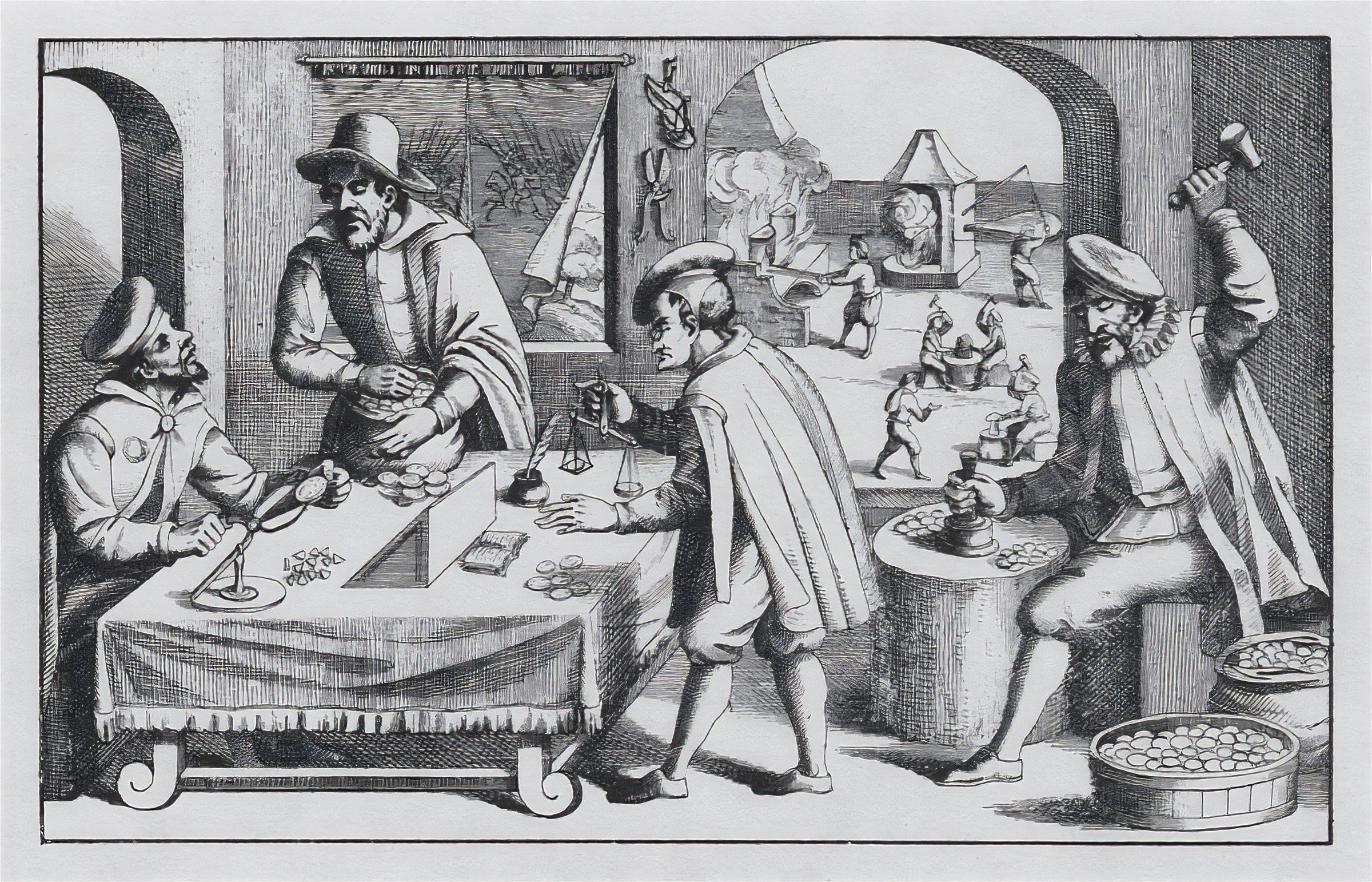
“Clipping coins in a Kipper mint”
Wikimedia Commons.
The Kipper und Wipperzeit of 1621 to 1623 [Wiki] was a direct consequence of princes and mints doing exactly what governments always do when they need money and cannot borrow it: they debased the currency.
The Thirty Years’ War started in 1618, and the Holy Roman Empire’s princes immediately faced a problem. War is expensive. Silver is finite. So the mints across the Empire began clipping, sweating, and debasing the small subsidiary coins that ordinary people used for daily transactions, flooding markets with copper-heavy pfennigs and kreutzers while hoarding the full-weight silver.
If you want to understand Gresham’s Law in its most brutal form, watch this play out. Bad money drives out good. People saved the honest silver and spent the garbage. Prices in nominal terms exploded. Contemporary accounts from Frankfurt and Augsburg document grain prices doubling and tripling between 1619 and 1623.
The real villain is the territorial mint system, which gave dozens of competing princes the legal power to set coin standards within their own borders. That fragmented monetary sovereignty created a race to the bottom. Each prince had every incentive to debase slightly more than his neighbor, because the first mover extracted real purchasing power before the market caught on.
This is currency debasement as taxation without legislation. The people who held wages and savings in subsidiary coin absorbed the loss. The princes who controlled the mints captured the seigniorage gain. No vote, no debate, no accountability.
Sound money advocates have been clear about the mechanism: when you hand governments monopoly power over coinage, they spend it. Every single time. The Kipper und Wipperzeit killed trade, wiped out savings across central Europe, and contributed to social instability that fed the war it financed. The policy destroyed the instrument it relied on.
Debasement never solves a fiscal crisis; it transfers it onto the population.
QotD: Cleopatra’s relationship with Egypt and her Egyptian subjects
The factors usually pointed at to demonstrate Cleopatra’s attachment to Egypt are that she learned the language, engaged with Egyptian religion and represented herself in Egyptian fashion in royal artwork and commemoration meant for consumption in Egypt. And that’s true, she did those things! But the context often missing from using that as a clear indicator of Cleopatra’s cultural “Egyptianness” is that, apart from learning the language, those were common things for Ptolemaic rulers to do, despite the fact that the dynasty maintained a pronounced ethnic hierarchy in Egypt and aren’t generally regarded as being particularly attached to its people or culture. Nevertheless, there’s not nothing here in the sense that Cleopatra showed – or at least wanted to show – more than the normal Ptolemaic attachment to Egypt as a place and the Egyptians as people, which is to say almost any at all.
Let’s start with languages, because I think this fact can be presented in a somewhat distorted way. The language of the Ptolemaic court was Greek, initially Macedonian Greek (the Macedonians had a pronounced accent), though Plutarch notes that some of the later Ptolemies had lost their Macedonian accent (Plut. Ant. 27.3-4). Cleopatra, by contrast, was the first of the Ptolemies to bother to learn Egyptian (which should tell you something about the character of Ptolemaic rule; imagine if King Charles was the first English king since George I and kings from the House of Hanover to bother to learn English). The problem with this fact is that it is incomplete, presenting Cleopatra as a Greek-speaker who learned the language of her people out of sincere devotion, but that’s not what Plutarch says. Plutarch says:
She could turn [her voice] easily to whichever language she wished and she conversed with few barbarians entirely through an interpreter, and she gave her decisions herself to most of them, including Ethiopians, Troglodytes, Hebrews, Arabians, Syrians, Medes and Parthians. She is said to have learned the languages of many others also, although the kings before her did not undertake to learn the Egyptian language, even though some of them had abandoned the Macedonian dialect.1
So let’s unpack that. This isn’t a native speaker of Greek who learned just the language of her subjects, but a spectacularly skilled linguist who learned a lot of different languages, quite regardless of if she ruled the people in question. Running through the list, she evidently learned Ethiopian, the language of the people on her southern border, the speech of the Troglodytae, the people who lived on the coast of the Red Sea (a hinterland of her kingdom). The “language of the Hebrews” here is probably Aramaic rather than Hebrew (which would also cover much of Syria), while the language of the Medes and Parthians might mean both Old Persian and the Parthian language. To which we must add Egyptian, implied by that last sentence; it also seems fairly clear Cleopatra knew at least some Latin.2 This is part of why I find arguments that use Cleopatra’s knowledge of Egyptian as strong proof either for her Egyptian ancestry or deep attachment to Egypt less than fully compelling; she was surely not Parthian and did not have a deep attachment to Parthia, but she learned their language too. Again, there’s not nothing here, but it’s not a slam dunk either.
What of Cleopatra’s role in Egyptian religion? The recent Netflix miniseries makes quite a fuss about how Cleopatra’s first action as queen – that we know of, because this is simply the first moment she is visible in the sources to us at all – is to partake in a religious festival installing a new sacred bull in a shrine at Hermonthis, close to Thebes in Upper Egypt and how this was indicative of a deep love of Egyptian religion. And it may well have been, but it’s also worth noting that Ptolemaic rulers had been taking part in Egyptian religion for a long time. Most of the massive temple complex at Philae, for instance – even farther from Alexandria than Hermonthis, I might add – was built in the Ptolemaic period, with major expansions by Ptolemy II and III. Even more relevantly to our subject, this was a [devotion] to Isis; Cleopatra was not the first Ptolemy by any means to claim that goddess for the dynasty.3
Nor had this even been a new practice for the Ptolemies. Alexander was presumably crowned pharaoh in Memphis in the traditional manner, visited the oracle of Amun at Siwa and dedicated a major set of construction works in the temple of Amun at Thebes. The Ptolemies followed this model. Ptolemy II went to Mendes to personally conduct the ritual of the process of the Ram of Mendes and then extended the temple, he presided over the inauguration of a temple at Pithom, and so on.4 And on it went with Ptolemy III and on down the line (indeed, becoming a bit more pronounced as we move into the later Ptolemies, beginning with Ptolemy V Epiphanes, potentially as a result of the increasing weakness of the Ptolemaic dynasty both internally and abroad). Ptolemaic kings were regularly in and out of Memphis, the religious capital of Egypt, building new Egyptian temples, attending Egyptian religious rituals and so on. The reason is that the job of Pharaoh was as much (if not more) a religious job as it was a political one and it was a job that only the Pharaoh could conduct. And the idea that a Ptolemaic pharaoh with a legitimacy problem might consecrate some temples to help fix that wasn’t new either; Ptolemy VIII Physcon is out doing that thing in the mid-second century. Consequently, involvement in Egyptian religion was a requirement of the position, quite apart from the question of how much the holder of that position cared.
Cleopatra, like any Ptolemaic ruler, engaged in this sort of building, though it seems striking how much of her building program was composed of Hellenistic structures in Alexandria, even as Duanne Roller admits, “the queen was not a major builder”.5 She restored the gymnasium of Alexandria, made major repairs to the Lighthouse, built a new precinct in honor of Julius Caesar called the Kaisareion, and apparently built a monumental tomb for herself, also in Alexandria. Examples of her building outside of Alexandria are fairly thin: the completion of a temple at Dendera begun by Ptolemy XII, extensions to the temple at Hermonthis (where she visited early in her reign), never entirely finished and a temple to Isis in Ptolemais Hermiou in Upper Egypt. Cleopatra could hardly be accounted the great renovator of Egyptian religion or religious sites.
Likewise the assertion that Cleopatra represented herself in Egyptian artwork in Egyptian style and dress; that too was true of all of the Ptolemaic rulers from the very beginning. Indeed, Cleopatra’s self-representation as Isis was very much not new, but in fact the normal way Ptolemaic queens were represented (to match Ptolemaic kings being represented as Osiris). Here, for instance, is Ptolemy II Philadelphos (r. 284-246) with his queen Arsinoe II represented in Egyptian style on a relief now in the British Museum.
Like all Ptolemaic rulers before her, Cleopatra presented herself in an Egyptian form, conforming to Egyptian style, in Egyptian contexts. And, like all of the Ptolemaic rulers before her, she presented herself in a Hellenistic form in Alexandria and on her coinage. While you will see people point to various busts and frescos as being images of Cleopatra, it is only her coins where we can say for certain that an effort was made to capture her likeness (her Egyptian portraiture, though labeled, follows Egyptian stylistics, not her actual likeness); we have no idea if, for instance, later Roman artists had any information about what she actually looked like or if the busts we suppose to be of her actually are. Be wary also of Greek and Roman frescos showing fair-skinned women reported to be Cleopatra; almost all women in Greek and Roman fresco are shown as fair-skinned; it’s a standard artistic convention. Coins, of course, record no skin color and neither do our sources for Cleopatra; anyone who thinks they can tell you what color her skin was is unduly certain.6
Now this isn’t to say Cleopatra is doing nothing new. She does seem to have been somewhat more involved in Egyptian religion than her predecessors, though the exact degree to which this is true is hard to see because we don’t have anything like a full accounting of their actions; if it is a difference it is a different in quantity, not kind. Certainly her building program wasn’t anywhere close to the scale of the early Ptolemies, but perhaps she took more direct personal involvement. Once again, the unknowns here are formidable. Dorothy J. Thompson in the the Cambridge Ancient History7 takes this, along with Cleopatra switching her regnal name from “philopator” (“loves-father”) to “philopatris” (“loves-homeland”8) to be indicative of a clear effort by Cleopatra to be, “indeed queen of Egypt”, particularly in the context of dynastic struggles with her brothers: outflanking them by getting the favor of the people.
The problem with this narrative is the timing: Cleopatra makes that switch in titles in 36/5 BC, which is to say in year 16 of her 21 year reign, eight or nine years after her last serious competition for the throne, her youngest brother, had died. Instead, Bingen9 argues that the homeland Cleopatra is professing love for is the greater Macedonian empire – the empire of Alexander – which she may have seemed in 36 on the verge of reclaiming.10 Antonius was just about to give her (through her children) sweeping portions of Roman Syria, Cilicia, Cyrenaica and Armenia; he would also give them titles to Medea and Parthia, which he didn’t control (though perhaps in 36 he hoped to) but would represent collectively the whole of the old Seleucid Empire near its height. Bingen notes the other change to Cleopatra’s titulature at this point was rather than just being “the goddess who loves her father” she becomes “the young goddess who loves her father and her country”; the added νεωτέρα (“young”) perhaps being intended as a link to Cleopatra Thea, Seleucid queen-consort of Syria from 150 to 126 BC and Cleopatra’s own great-grand-aunt. Cleopatra, after all, was about to achieve the long Ptolemaic dream of controlling all of Syria.
Strikingly the sources do not tell us that Cleopatra was seen as any more distinctively Egyptian than her father or that she had some groundswell of popular support in Egypt. Indeed, Cassius Dio implies the opposite (Cass. Dio 42.34-6) that the Egyptians favored Ptolemy XIII in the succession dispute and it was only the force of Caesar’s arms that turned the issue to Cleopatra. Of course we have to be somewhat skeptical of this account too: Dio is marinating in a literary tradition that is very hostile to Cleopatra and also makes no effort to distinguish between the Alexandrians and the rest of Egypt, two very distinct groups. In any case it is clear that Cleopatra achieved no groundswell of support in Egypt in those early years: she had to raise her army in Syria and in the event it wasn’t the stronger force as she and Caesar spent the winter of 48/7 besieged in Alexandria by Ptolemy XIII’s then larger army (Caesar had not brought his full field army), until the arrival of an army out of Roman Syria led by a collection of Caesar’s allies tipped the balance. Julius Caesar was never a particularly cautious commander, so if he looked at whatever force Cleopatra still had and said, “we need to wait for reinforcements”, it could not, at that point, have been very substantial. Afterwards, Caesar would leave four legions in Egypt to secure Cleopatra’s rule, which seems not to indicate her great popularity or any great faith in her ability to hold the kingdom. After 44, she’s able to rule without direct support, but of course after 44, she and her children are the only dynastic options left, her brothers and sisters all being dead (some at her hand). Finally, when Octavian comes for her, there is no major effort by anyone to stop him militarily. If Cleopatra had the love of the Egyptian people at that point, we sure don’t see it.
In my view then, it seems like an argument can be made that Cleopatra had a fairly modest propaganda effort towards presenting herself as more in touch with Egyptian religion, but the extent and quality was at most only a modest improvement over the previous Ptolemies and apart from keeping her on the throne (with Roman backing), it doesn’t seem to have achieved much.
Bret Devereaux, “Collections: On the Reign of Cleopatra”, A Collection of Unmitigated Pedantry, 2023-05-26.
- Trans. from Jones (2006).
- On this, see Roller (2010), 48-9.
- On this sanctuary and its inscriptions, see J. Bingen (2007), 31-43.
- On this, see Hölbl (2001), 77-90.
- op. cit. 108.
- Though, contra Netflix, we can say something about her hair. I was rather confused when one of their talking heads posited that he liked to imagine Cleopatra with hair like his – his hair was very tightly curly and indeed that is how the Netflix documentary opted to do Cleopatra’s hair. We can see her hair on her coins and it is wavy, pulled together into a bun in Hellenistic style with short draping curls (loose, not tight) and a Hellenistic diadem. I think it is pretty fair to suppose this is how Cleopatra actually wore her hair – or at least, how she wanted people to think she wore her hair.
- The second edition of the Cambridge Ancient History; in this case CAH2 IX, 320-1.
- Literally “loves her fatherland”. To save myself some audio pain in the future, I often hear “philopator” pronounced with the emphasis on the second syllable (phi-LOPE-a-tor), but the accent is on the alpha, phi-lo-PA-tor, because that o is an omega, a long-vowel, so the accent can fall no further back.
- op. cit., 58-62 and 76-79.
- Bingen argues that in an Egyptian context, it would have been clear that Cleopatra’s patris was, in fact, Makedon – the most prestigious and useful possible patris to have in Ptolemaic Egypt.
August 9, 2026
Hopefully the last word on “L’affaire Arday”
On her Substack, Helen Dale discusses the recently resigned Cambridge professor Jason Arday, the people who positioned him to fail, and what their motivations were in doing so:

Arday’s arrival to take up his professorship at Cambridge was recorded by at least two BBC cameras. Here he is talking to Hilary Cremin, head of the Faculty of Education at Cambridge.
Sometimes both institutions and people pick up a firearm and blow both feet off.
Cambridge University has done so with its gross mismanagement of the Jason Arday affair.
Oceans of ink have been spilt already on this issue, so I’m not going to relitigate the main background. Instead, I want to make four observations, in no particular order.
1. Oh, the humanities (and social sciences)
The problems across these two large disciplinary areas long predate the idiotic wokery that got Jason Arday appointed to a professorial chair at Britain’s second oldest, second most famous university. Yes, wokery has made them worse, chiefly because the theoretical frameworks animating it — which Lorenzo Warby has written about both here and at his own place — deny the possibility of truth outside that of personal experience. This means people don’t just get their own opinions, they also get their own facts.
[…]
2. Nathan Cofnas is not racist
There are two distinct things going on in the background to the Arday appointment(s). The first is that he was appointed despite being a complete doofus and as dumb as a stump. The second is that while there probably are black candidates out there qualified to be a Cambridge professor, there won’t be many, and they are highly unlikely to be the descendants of slaves (from the Caribbean, the United States, or South America). They’re much more likely to be from a posh Nigerian background, and a particular Nigerian tribe (Igbo).
In the words of computer scientist Eric S. Raymond:
This is completely predictable to anyone who has spent 10 minutes reviewing the data on racial differences in mean IQ and knows what that implies for the right end of the bell curve.
The intersection set of people with predominantly sub-Saharan African ancestry with people sufficiently bright to deserve a university professorship is not empty, but it’s vanishingly small. The demand greatly exceeds the supply.
Which is why we’ve seen this movie many times before, and will again. They can’t help it. Corrupted academia would rather hire thousands of other incompetents than let go of its “anti-racism” to hire on merit alone.
The refusal to grapple with the black-white average IQ gap is astounding, and while the (mostly) white people responsible for appointing Arday look like absolute fools, the black intellectuals who refuse to accept an established fact look both truculent and dishonest. They don’t have to accept it’s genetic. They do have to accept that it’s real. As far as I’m aware, only one major black intellectual, Wilfred Reilly, accepts the existence of the gap (disclosure: I have been a guest on Wilfred’s podcast). If there are others, I would be delighted to know their names.
Two issues fall out of this. The first is that Nathan Cofnas is not racist for pointing it out. Facts are not racist. The second is that if people disagree with Cofnas’s secondary argument that the reason for the gap is primarily genetic, then yelling racist! at him does not prove him wrong. Evidence is what you need if you want to prove someone wrong, not moral abuse.
3. It’s the rule of law, Jim, but not as we know it
The idea that historically disadvantaged groups are entitled to extra civil rights — coupled with social preferment — over and above those held/enjoyed by people considered their oppressors is inimical to the rule of law, specifically the principle that people should not be punished for crimes they did not commit. We do not inherit criminality from our ancestors. This is in turn derived from the larger principle of treat like cases alike, which was first articulated in its modern form by the Roman jurist Ulpian.
Jason Arday got his job in large part because a lot of people — and especially humanities and social science academics — think it’s reasonable to punish whites (and sometimes East Asians) who have never wronged blacks by making it harder for them to get into university or gain employment. This punishment of whites/East Asians who have done no wrong is undertaken to compensate blacks who have not been wronged for wrongs committed by other white people against other black people in the past. This logic is the basis of all affirmative action schemes and preferential hiring regimes (provision for which exists — albeit in limited form — in the UK’s Equality Act 2010). It is also the logic of inherited vengeance.
[…]
4. Enter Carter-Ruck, or Journalism v. Law v. a bloke with a blog
It’s been widely — and accurately — reported that junior academic Nathan Cofnas broke the Jason Arday story on his personal blog. However, it shouldn’t have been his job to do. The same (or very similar) research had been done separately by both a retired academic (John Harris) and a journalist with Times Higher Education — an outlet dedicated to the tertiary education sector and owned, ultimately, by Rupert Murdoch. In response to both sets of revelations, either Cambridge or Arday or perhaps both in concert (this is unclear on the facts available to me) instructed Carter-Ruck, the most famous — and aggressive — specialist defamation law firm in the United Kingdom. Historically, Private Eye magazine (often a victim of their attention) referred to them as “Carter-Fuck” and, more recently, “Farter-Fuck”.
Despite the fact that the THE has libel insurance and Murdoch generally defends his publications, the magazine backed down. Jack Grove is the reporter who had his story spiked. I have it on good authority that several Cambridge academics — and perhaps people from other universities — then approached Cofnas with the material that they (and possibly the THE) had collated. Cofnas — being young & junior — is what lawyers call “a man of straw”. Suing him in defamation would benefit no-one, least of all Carter-Ruck. He published, scooping Jack Grove.

How To Launch the Apocalypse – Death of Democracy 27 – Q3 1939
World War Two and Spartacus Olsson
Published 8 Aug 2026This is Step 27 in the Death of Democracy: LAUNCH A WORLD WAR — the moment when the collapse of democracy, diplomacy, and collective security culminated in an attack that would engulf the world.
In July and August 1939, Adolf Hitler turned the destruction of German democracy into the instrument for launching a European war.
While Nazi Germany armed Danzig, mobilized reservists, prepared its U-boats, introduced civilian rationing, and manufactured stories of Polish aggression, Britain, France, Poland, the United States, and the Soviet Union made a final series of increasingly desperate attempts to prevent catastrophe.
At the center of the crisis was the failed effort to construct an Anglo-French-Soviet alliance against Nazi aggression. Negotiations foundered on delay, mutual suspicion, the Baltic states, and the Soviet demand for military passage through Poland. Stalin then chose an agreement with Hitler: the Molotov–Ribbentrop Pact and its secret protocol divided Eastern Europe into German and Soviet spheres of influence and prepared the way for the destruction of Poland.
Inside Germany, there was little repetition of the supposed national enthusiasm of August 1914. Nazi leaders and Wehrmacht commanders ranged from confidence and opportunism to anxiety and fatalism, while many ordinary Germans feared that Hitler had finally pushed Europe beyond the point of no return. Yet propaganda, repression, and six years of dictatorship had stripped the population of any effective means of preventing the war.
The next episode will conclude the series with an epilogue examining what the destruction of the Weimar Republic teaches us about defending democracy today.
The drift toward socialism in the west
I’m reminded of that line from Kipling: “And the burnt Fool’s bandaged finger goes wabbling back to the Fire”, as most western countries have had plenty of opportunities to observe socialism in the wild, yet there’s always the chorus that it “wasn’t real socialism” and this time it’ll be great:

Socialism survives because it flatters the most powerful human instinct you have: the desire to believe that good intentions produce good outcomes.
The engine is pure motivated reasoning: not ignorance, not stupidity.
Venezuela collapsed from one of Latin America’s wealthiest economies into a country where citizens lost an average of 11 kilograms of body weight in 2017 because food disappeared. The Soviet Union murdered tens of millions in gulags and deliberately starved Ukraine in 1932-33. Cuba turned a middle-income Caribbean nation into a prison island. West and East Germany, North and South Korea. The pattern repeats, and yet the ideology never takes the blame.
Here’s why. Socialism’s defenders always move the goalposts. When the USSR fell, they said it wasn’t “real” socialism. When Venezuela imploded under Chavez and Maduro’s nationalizations, they blamed American sanctions. There is always an excuse, and that excuse always points away from the central planning mechanism itself.
Ludwig von Mises nailed this in 1920 in his essay on economic calculation. Without prices set by voluntary exchange, planners cannot allocate resources rationally. You get shortages and surpluses simultaneously, not because bureaucrats are evil, but because they are operating blind. The information simply does not exist in a form they can use.
Mises’s argument is uncomfortable in a specific way: it says the system cannot work regardless of who runs it. You cannot fix central planning by finding better central planners.
The real villain is the intellectual class, professors and politicians who build careers selling the promise of top-down coordination. They capture universities, media institutions, and government agencies, and they teach each new generation that the solution to failed socialism is more socialism.
Socialism survives because the people promoting it face zero personal cost when it fails. The Venezuelan peasant starves. The tenured professor in Boston gets a book deal.
That gap between who sells the idea and who pays for it is what keeps the whole rotten project alive.
Celina notes that a recent Cato Instutute report shows uncomfortably strong support for both socialism and communism in the youngest groups:
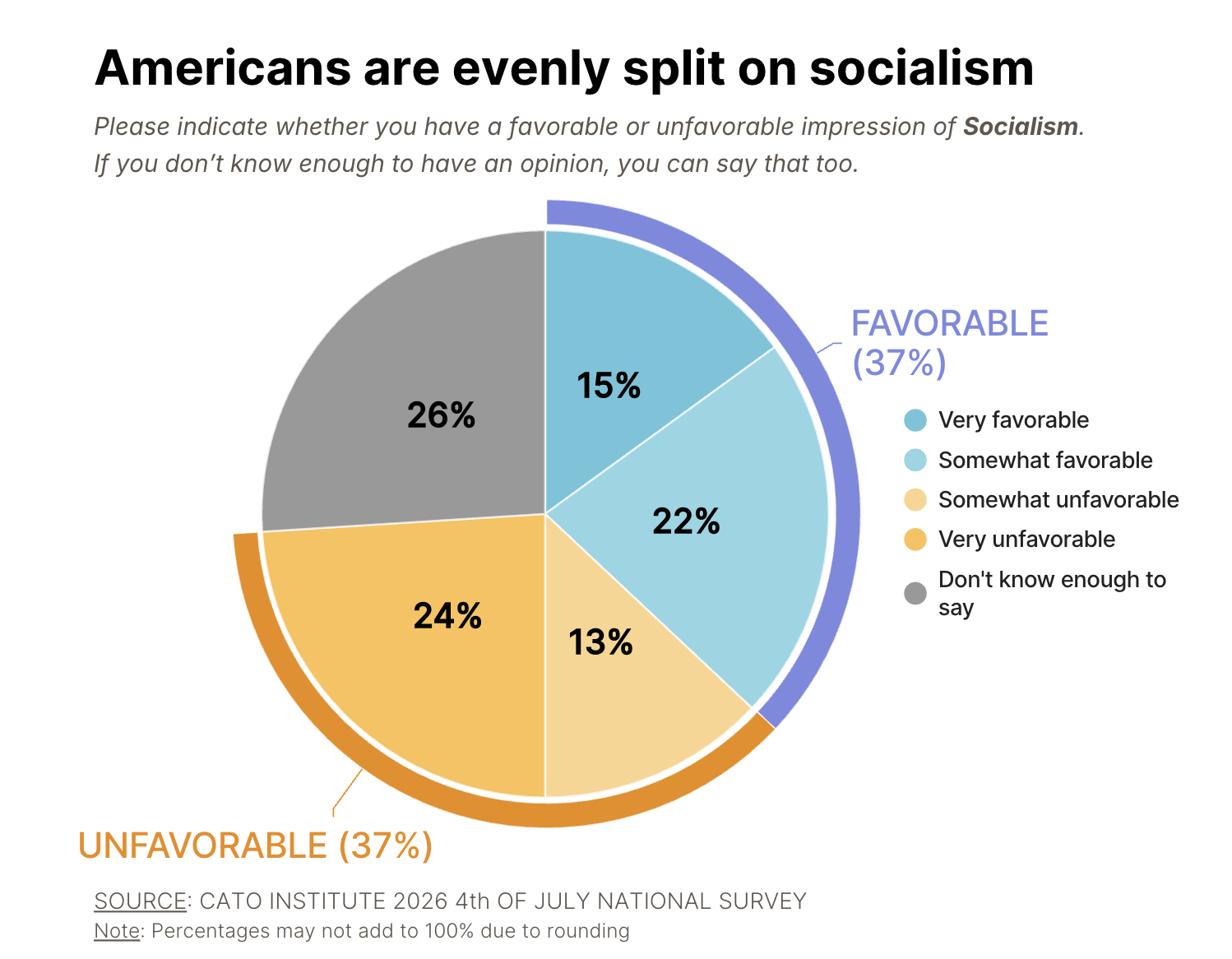
This summer, America celebrated the 250th anniversary of its founding. At the same time, the Cato Institute, a libertarian think tank whose entire institutional purpose is the defence of free markets, commissioned a survey with Morning Consult of 2,253 American adults. The survey included the usual questions: pride in country, knowledge of what the anniversary commemorated, and belief in the American Dream.
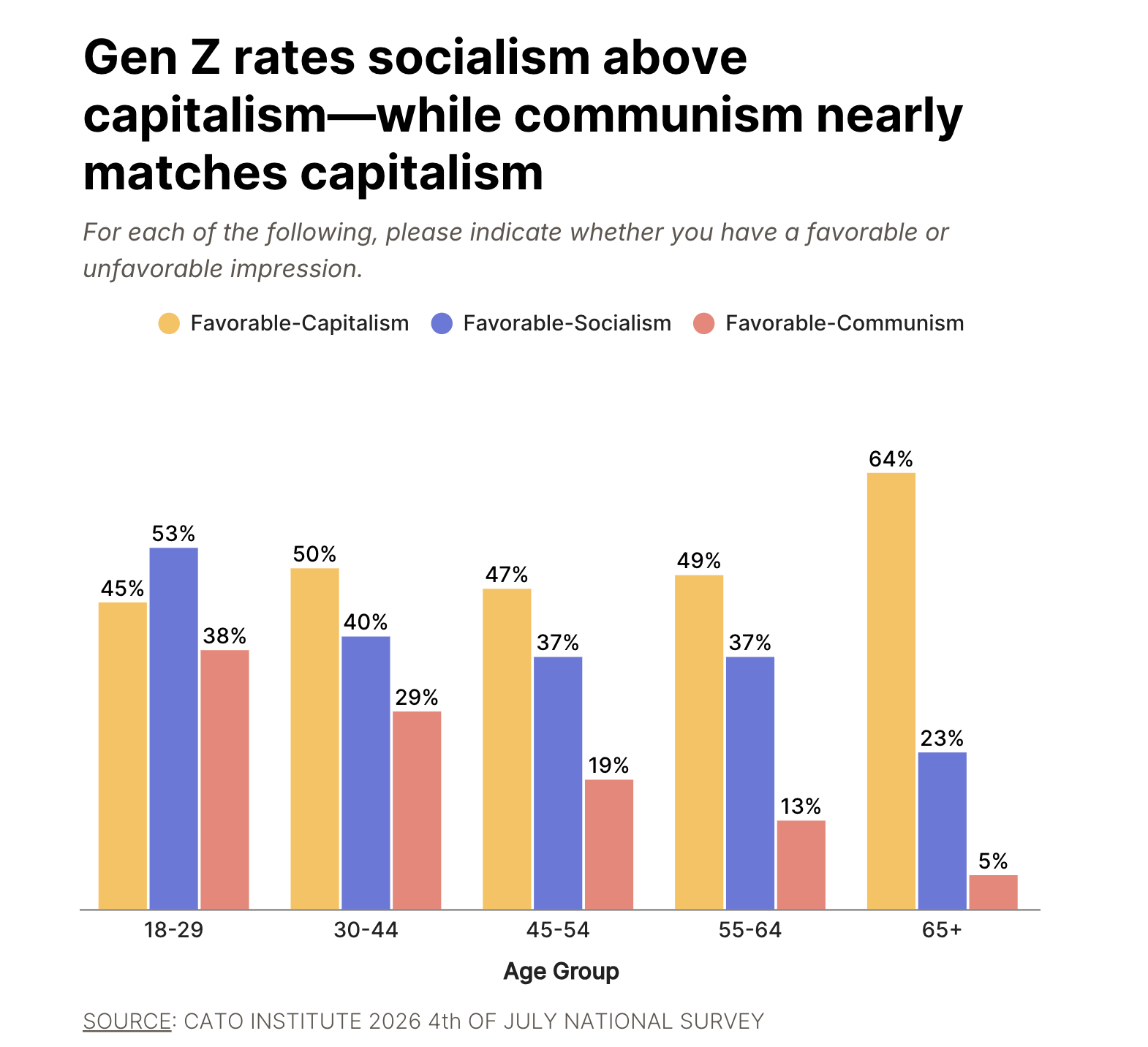
Besides the typical civic questions, the Cato questionnaire also asked Americans their feelings on communism, socialism and capitalism. The responses were quite explosive; the survey’s authors reported that: 21 percent of Americans said they held a favourable view of communism.1
Not socialism but communism. The word itself, which to the older Western mind is attached to the gulag and the Stasi and the Cultural Revolution, the one that American politics spent literally seven decades treating as roughly synonymous with treason.
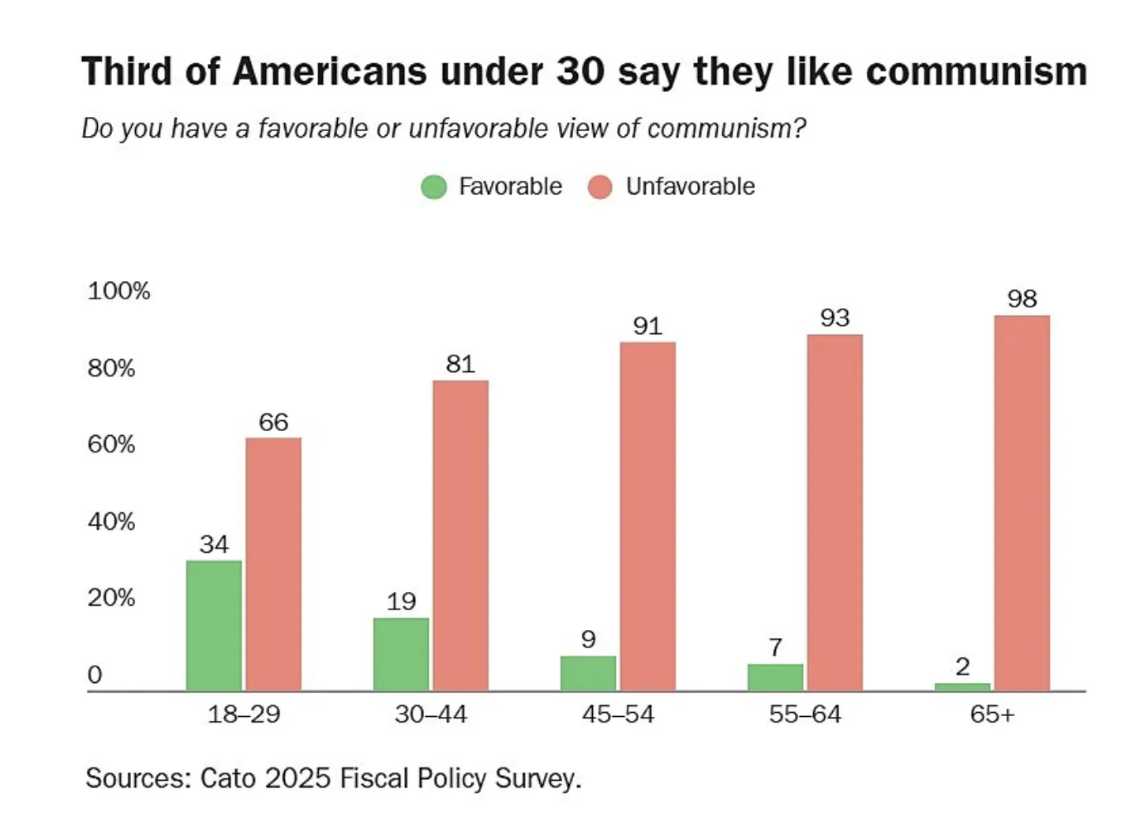
Among Americans aged 18 to 29, the figure was 38 percent. In that cohort, favourable views of communism (38 percent) ran only seven points behind favourable views of capitalism (45 percent), and the generation was the only age group in which favourable views of communism actually edged out unfavourable ones, 38 to 36. Socialism, meanwhile, outpolled capitalism among the young outright: 53 percent favourable against capitalism’s 45. Also, the generational gradient was almost perfectly linear. Favourability toward communism fell from 38 percent among Gen Z to 29 percent among younger millennials, 19 percent among the middle-aged, 13 percent among those approaching retirement, and just 5 percent among seniors, the Americans old enough to remember duck-and-cover drills, Brezhnev, and the Berlin Wall as a piece of functioning infrastructure.
The 2026 Cato survey was not a fluke, which would be plainly obvious to people with even a slight interest in American politics. We also know this was not a fluke because the year before, in March of 2025, a Cato/YouGov survey of 2,000 adults found 34 percent of under-30s favourable toward communism and 62 percent favourable toward socialism. Cato’s senior editor Michael Chapman recorded roughly 52 million Americans aged 18 to 29, reporting a 34 percent favourability figure implying something on the order of eighteen million young people willing to say a kind word about an ideology that the Black Book of Communism credits with approximately 100 million deaths.
If you know a bit about the history of communism in America, you can understand why these numbers landed the way they did. American attitudes toward communism for most of the twentieth century were not just slightly negative; they were extremely so. Anti-communism was one of the few genuinely bipartisan commitments in American life, embraced by Cold War liberals and conservatives alike. Congress quite literally passed the Communist Control Act of 1954, effectively outlawing the Communist Party. Having any public sympathy for communism was politically and professionally fatal, as evidenced by the loyalty oaths, blacklists, and the House of Un-American Activities Committee (HUAC). When Gallup asked Americans in 1949 what “socialism” meant to them, the largest share answered on the lines of “government ownership of the means of production”, and they wanted no part of it. Communism, the harder and more explicit term, was too unthinkable during that time to even be asked in the poll.2
https://www.cato.org/blog/new-poll-nearly-half-americans-dont-know-what-americas-250th-celebrating
https://news.gallup.com/vault/240749/gallup-vault-americans-views-socialism-1949-1965.aspx
August 8, 2026
Pointing the finger of blame accurately
The Librarian of Celaeno wants you to know that former professor Jason Arday did nothing wrong:
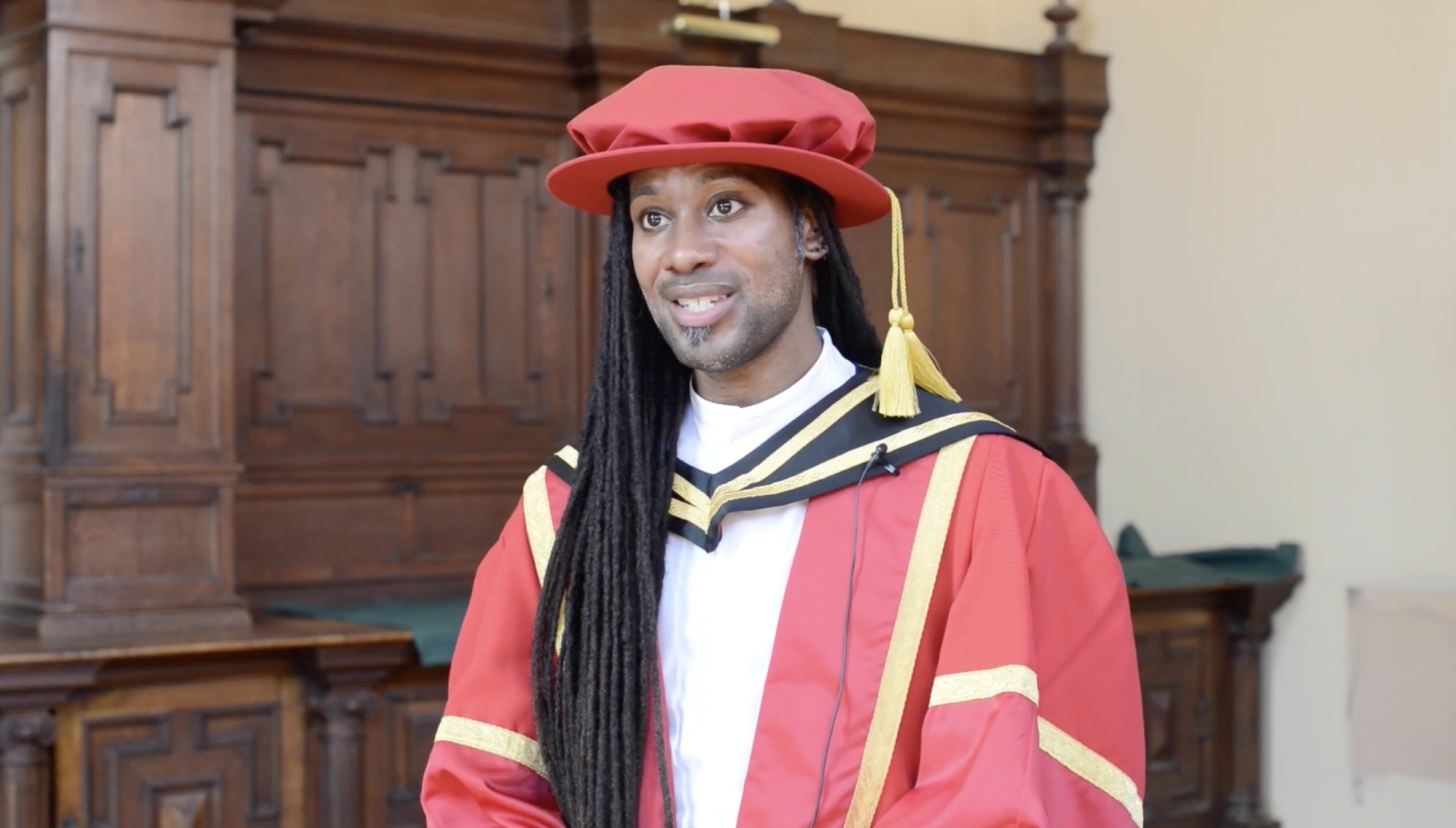
Former Cambridge professor Jason Arday
Image from Andrew Doyle
Once upon a time, an autistic black child was born. Usually, it takes several years to figure that out (the autism, not the blackness), but so autistically autistic was the infant Jason Arday that it was immediately apparent to everyone without there even needing to be any public record of it. Perhaps there is some lost evidence of him having a Reddit account as a toddler; one can speculate. Arday was unable to talk until age 11 and has been unable to stop talking ever since, which is fortunate since otherwise many of his unbelievable life accomplishments would now be unknown.
The range of setbacks he has overcome boggles the mind. Despite being illiterate until age 18, Arday not only graduated high school, but got into college, where he finally learned how to read good. This is even more incredible when you consider that the same year he discovered what the alphabet did he was beaten into epilepsy by random teens — he forgave them so thoroughly that any documentation of the incident is now gone from police records — and that some unspecified time before that he was in a car accident that left him in a waking coma for months. He studied so hard in college that he gave himself a brain tumor, which he evidently removed by himself in the mirror, since there is no evidence of a surgeon having done so. It may be that Arday has in fact learned to read several times in his life, but keeps getting that knowledge erased by semiannual episodes of CTE.
Even though he’d accumulated a substantial amount of what for a normal person would be crippling physical trauma over the course of his short time in the world, of the sort that would require medical interventions that would otherwise severely limit active life, Arday rapidly became one of the world’s most elite athletes. He participated in a ‘30 Marathons in 35 Days’ challenge, which was actually somewhat documented by an independent contemporary account, in the midst of which he suffered a hairline fracture in his fibula, which he seemingly just shrugged off to complete the remaining nine marathons. This was apparently the last time he ran slowly enough for anyone to witness, however, because his career as an ultramarathon runner who hyperGogginsed his way through 600 miles in six days passed entirely without notice by the few other people on Earth who could conceivably do that. He played semi-professional soccer, but was so good that he got bored with it and moved on before anyone could write his name down on a roster. Along the way, Arday became one of the best snooker players in Britain, with a skill level far beyond the need to participate in any public tournaments, other than the single amateur contest he entered but was too gracious to the other players to win.
He surmounted the intellectual challenges involved in becoming a PE teacher, and from there went on to earn a Ph.D as a black man, with his thesis largely consisting of arguing that it’s easier to do well in academia if you’re not closely supervised. It was so convincing a premise that his doctoral committee at Liverpool University evidently forewent actually reading the dissertation, perhaps also having concluded that his proximity to their whiteness had burdened him enough already. It was thus that Dr. Arday came into being, following a path blazed by Ibram X. Kendi as a bedredlocked black man writing about being black while being black blackly in a world basically controlled by the bad guys in Caddyshack.
On Substack Notes, Michael Southon also points the finger at the people who enabled Arday’s rise and attributed racist beliefs to anyone who asked questions:
Arday’s arrival to take up his professorship at Cambridge was recorded by at least two BBC cameras. Here he is talking to Hilary Cremin, head of the Faculty of Education at Cambridge.
Cambridge University was so proud of its choice of Jason Arday that they invited the BBC to film Hilary Cremin, the head of Cambridge University’s Faculty of Education, welcoming Arday to his new post. In the clip you can hear Cremin gushingly tell Arday:
We are so lucky to have you. You are the best in the world in terms of the research that you do.
Arday himself is incredulous and suggests that some people will see his appointment as “tokenistic”. In response, Cremin assures him he is “world class”.
The Telegraph reports that when Arday’s students complained that they weren’t being properly supervised, they were told they were being “racist”.
The truth is that Cambridge was desperate to appoint more people of colour. His alleged autism ticked another box on the identity politics agenda. The dreadlocks were icing on the cake.
Will this episode, which has been reported around the world, finally convince the establishment that DEI is a disastrous social policy that lowers standards and turns august institutions whose reputations are based on centuries of meritocracy into the laughing stock of the world?
I doubt it.
Also on Substack Notes, GenX Anecdotes finds the behaviour of Hilary Cremin to be emblematic of a kind of condescending attitude found most frequently among liberal white women:
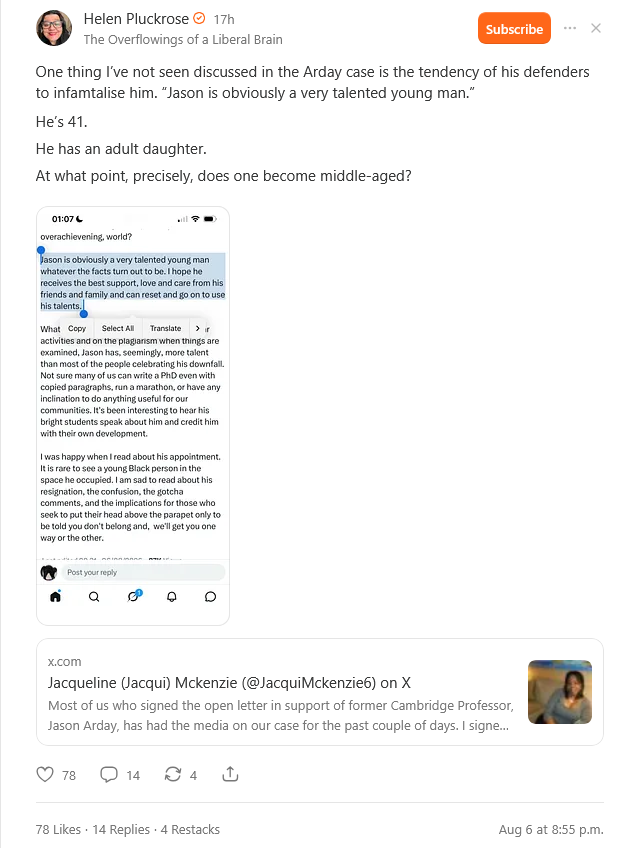
We know the type.
And it does tend to be a woman.
They love nothing more than to put on that awful softy, patronising voice, as if talking to a small child.
I am reminded of that excrutiating clip of Hilary Cremin (Head of Cambridge University’s Faculty of Education) “You are the best in the world in terms of the research that you do“.
Really? “The best in the world”?
Like the bestest in the whole big wide world ever! 😂
I’m surprised she didn’t lean in and give him a pat on the head.
Wtf?
And that tone. 😭
It’s bad enough when they do it to kids.
I have posted about this “tone” before.
Near where I live there’s a Waitrose. The spiritual home of such a woman.
There used to be a Muslim woman wearing a hijab who would beg for money outside. I never gave her money because she seemed fake to me.
Always clean and well presented with the latest new iPhone (!), she would look up from her phone when she saw someone approaching, visibly completely change her facial expression, tilt her head to one side in a kind of puppy dog, “poor me” way, and put on a kind of fake whimpering “please help me!” and hold her hand out.
It was so obviously fake af!
One day I was waiting outside the shop for my daughter who had run in to get something.
As I waited, these two middle class, middle aged women stopped to talk to her.
They were both fawning over her, using that same softy patronising tone, falling over themselves to praise her. One of them said “you’re so beautiful and brave” and the other put her arm around her.
It was such a sychophantic display of patronising bullshit, I think I might have thrown up a little bit in my mouth.
This pathological sickly, performative fawning over their little pet minority groups, is something to behold!
And they were both being played.
This beggar wasn’t homeless. So obviously! You’d have to be a special kind of stupid to think so.
But they really are a special kind of stupid.
They just wanted to feel good about themselves. It’s all about their need to feel like they’re “good kind people”.
Then, no doubt make a FB post about it so all their other annoying cloying phoney friends can “coo” over how much they adore their little darling minority pets.
🤮


