
seangabb
Published 16 Feb 2026Greece: A Brief History, c.700 BC – 500 AD
The Persian army lands at Marathon. Athens must decide whether to wait or fight. We examine Miltiades’ strategy, the Athenian command structure, hoplite tactics, and Herodotus’ restrained account of the battle.
We also analyse the later legend of the Marathon runner and the political consequences of the victory. Marathon did not end the Persian threat — but it changed Greek confidence forever.
This is not the end of the war. It is the end of its beginning.
August 8, 2026
The Ancient Greeks 03 – Enter the Persians 7 – Marathon, The First Shock
Comments Off on The Ancient Greeks 03 – Enter the Persians 7 – Marathon, The First Shock
August 7, 2026
Blood Dawn by Hans van de Ven
On his Substack, Dr. Robert Lyman reviews a new book on the Second World War in Asia by Hans van de Ven:
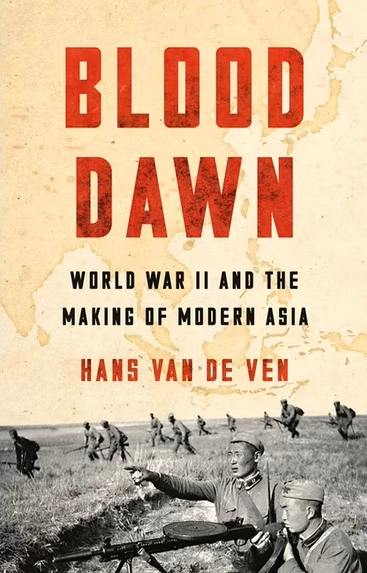
I really wanted to enjoy this book. The enthusiastic endorsements from Rana Mitter, Antony Beevor and Richard Overy raised my expectations considerably. Yet by page eight of Blood Dawn I felt as uncomfortable as the proverbial curate confronted with a rotten egg.
The author aims to provide a narrative that “contributes to a gradual shift in our understanding of the significance of World War II”. This is admirable. A more Asian-centred interpretation of the conflict is certainly needed, as the war is still too often viewed through a Eurocentric or North Atlantic lens. Historians such as Rana Mitter, Jonathan Fennell and Richard Overy have already helped redress this imbalance. It is unquestionably true that the conflict began with Japanese aggression in China as early as 1931 and that the war both began and ended in Asia.
The problem is that the book insists that the central dynamic of modern Asian history is a nationalist struggle to escape imperialism and colonialism. While both undeniably shaped Asia, it is a considerable stretch to explain the region’s political development primarily through resistance to empire. The author correctly notes that many Asian political movements saw the war as an opportunity to cast off colonial rule, but he greatly overstates their role in determining the war’s outcome.
Consequently, the analysis neglects the broader dynamics of power – local, regional and imperial – that shaped Asia before, during and after the war. The author assumes that modern Asia is the product of “Asian peoples’ continuing struggle to overcome the legacies of empire”. That seems reductive. A more convincing interpretation would describe modern Asia to be the result of a power-based confrontation among declining powers such as Britain, France and the Netherlands, a rising Japan, a developing China, and the emerging superpowers whose ideologies would shape postwar Asia: the United States and the Soviet Union. The war was principally caused by one rising empire, Japan, seeking to assert its dominance regionally and to replace existing empires.
As a result, some empires disappeared, others expanded, and many colonial territories gained independence as competing political elites seized opportunities created by wartime upheaval. Where those struggles could not be resolved peacefully, civil war followed. One may call this nationalism or self-determination, but it was power politics nonetheless.
In the postwar period, Asians were often less concerned with abolishing imperial legacies than with creating new centres of power controlled by local elites. Since 1945, Asia has been shaped by competing powers, some imperial in nature, such as China, the Soviet Union/Russia and the United States, and others nationalist and local.
A similar lack of nuance appears in the treatment of imperialism. British imperialism is lumped together with that of France and the Netherlands, with little appreciation for their differences. British involvement in 19th-century China is presented primarily as the cause of China’s problems rather than as part of a broader interaction with a declining and dysfunctional Qing polity. Imperialism was certainly influential, but so were domestic developments, including China’s internal sclerosis and Japan’s response to modernity, which produced its own imperial ambitions in China, Korea, Manchuria and the Pacific.
The author’s ideological predispositions are impossible to miss, and the book frequently descends into crude Anglophobia. We are told, for instance, that “British elites, who liked (and like) to think of themselves as natural and gifted rulers, found a new outlet for their yearning to govern India”. Such statements are simplistic, if not puerile. Similarly, discussing the collapse of the American-British-Dutch-Australia Command (ABDACOM) in 1942, the author remarks that “the Dutch were abandoned to their fate. Retreat is an underappreciated military skill, and the British were practiced masters of it, as they had shown at Dunkirk”. This is the sort of cheap point-scoring that would weaken an undergraduate essay, yet here it appears in a supposedly serious work of history.
The treatment of India is particularly problematic. The narrative focuses heavily on the Indian National Congress and consequently overlooks the diversity and complexity of the independence movement. There is little recognition that what Congress often described as British obstruction was, in part, a debate within Britain (especially the Conservative Party) about the form an independent India should take. The same debate also took place within Indian circles considering the subject.
During the 1920s and 1930s, the central political question in India was often not whether independence would occur but what form it would take and, crucially, who would benefit from it. The Quit India movement of 1942 followed the Cripps Mission, which had already offered India Dominion status after the war. Congress sought immediate separation, but many of its leaders privately supported the Allied war effort, believing correctly that victory would hasten independence. One could even argue that Congress’s greatest unintended achievement was not independence but the partition and communal violence that accompanied it. The book fails to engage adequately with these complexities.
Comments Off on Blood Dawn by Hans van de Ven
Brexit plus ten
Mark Nayler looks at the state of Britain ten years after the historic vote to leave the European Union. He notes that there appears to be a bit of buyer’s remorse among those who voted to leave the EU, although I would note that the political leadership, both Conservative and Labour, almost all did their level best to sabotage any positive results (although the “Boriswave” of immigrants would have swamped even a substantial economic boom all by itself).

In the run-up to the UK’s referendum on EU membership in June 2016, extravagant claims were made by both the Remain and Leave campaigns. Leaving the EU, the so-called Remainers warned, would propel the UK into recession and mass unemployment. Brexiteers, as they were dubbed, countered with promises of enhanced sovereignty, tighter borders, and liberation from Brussels’s stifling bureaucracy. The latter won the Brexit vote (as it came to be known) by 52% to 48%. But just over a decade on from that historic decision — and six and a half years since the UK officially left the bloc — it’s less clear whether they also won the argument.
This is in large part because of geopolitical turmoil since the vote. Throughout the last decade, there has been a global pandemic, Russia has launched a full-scale invasion of Ukraine (which, in turn, caused an energy crisis across Europe), and Donald Trump has waged a series of tariff wars across the world. The difficulty of disentangling the effects of these events on the UK economy from those caused by Brexit is formidable. One analyst has even said that “we will never know precisely what the impacts of Brexit were”.
Overall, however, the sweeping transformations predicted by both Brexiteers and Remainers — positive in the former case, negative in the latter — have not occurred. The actual changes have been less dramatic, more gradual, and more mixed than either side forecast. One also has to factor in the UK’s lack of a stable leadership since the vote: when Labor’s Andy Burnham took over from Keir Starmer on July 20, he became the UK’s 7th prime minister in 10 years. This, perhaps, has so far prevented the theoretical autonomy now possessed by the UK from being fully realized. According to a poll conducted in June, 57% of Britons now believe that it was a mistake to leave the EU — meaning there are a lot of dissatisfied Brexiteers out there.
Remainers forecast economic ruin for the UK if it chose to leave the EU. According to the then-Chancellor of the Exchequer George Osborne, “A vote to leave would represent an immediate and profound shock to our economy [and] that shock would push our economy into a recession”. A recession failed to materialize, although the pound suffered its biggest-ever one-day drop on June 24, 2016, the day after the vote, falling 10% against the dollar and 7% against the euro (it still hasn’t returned to its pre-Brexit values against either currency, although Trump’s tariff wars and the pandemic are also factors here). That said, researchers broadly agree that Britain’s economy has contracted due to Brexit. According to a 2025 paper for the US National Bureau of Economic Research, UK GDP per capita is 6–8% lower than it would have been had the UK remained in the EU. Investment is down by 12–13%, employment by 3–4%, and productivity has been reduced by about 4%, according to its authors.
Immigration was a major theme of the Leave campaign. The UK Independence Party’s widely criticized poster showed a large group of Syrian refugees at the Croatia–Slovenia border in 2015, next to a massive slogan reading “Breaking Point” — and, underneath it, in smaller letters, “The EU has failed us all”. The center-right party was playing to concerns about a surge in migration over the decade and a half preceding the referendum, triggered by EU enlargements in 2004,when ten new countries joined, and in 2007. In 2000, migration to the UK from other EU countries stood at 6,000, but by 2015 it had risen to 330,000. In 2015 and 2016 alone, more than a million migrants arrived in Britain. According to a poll conducted on the day of the referendum, 33% of Leave voters said the main reason for their decision was a belief that leaving the EU “offered the best chance for the UK to regain control over immigration and its own borders”. It seems the poster had done its job.
The composition of Britain’s migrant population has changed radically since Brexit, with an increase in non-EU migration more than compensating for the reduction in arrivals from the EU. But immigration has not decreased. In fact, the UK has witnessed record levels of immigration over the last decade. In the year ending March 2023, just over three years after Britain’s withdrawal from the bloc, net migration peaked at 944,000.
Comments Off on Brexit plus ten
August 6, 2026
More threads unravelling from Professor Jason Arday’s backstory
As I mentioned the other day when I first noted this fascinating tale, I don’t think I’d heard of Professor Jason Arday before this week, so pretty much any new facets of the story will be news to me. Here’s an extensive survey of what’s been revealed so far by Donna Louise Flowers:
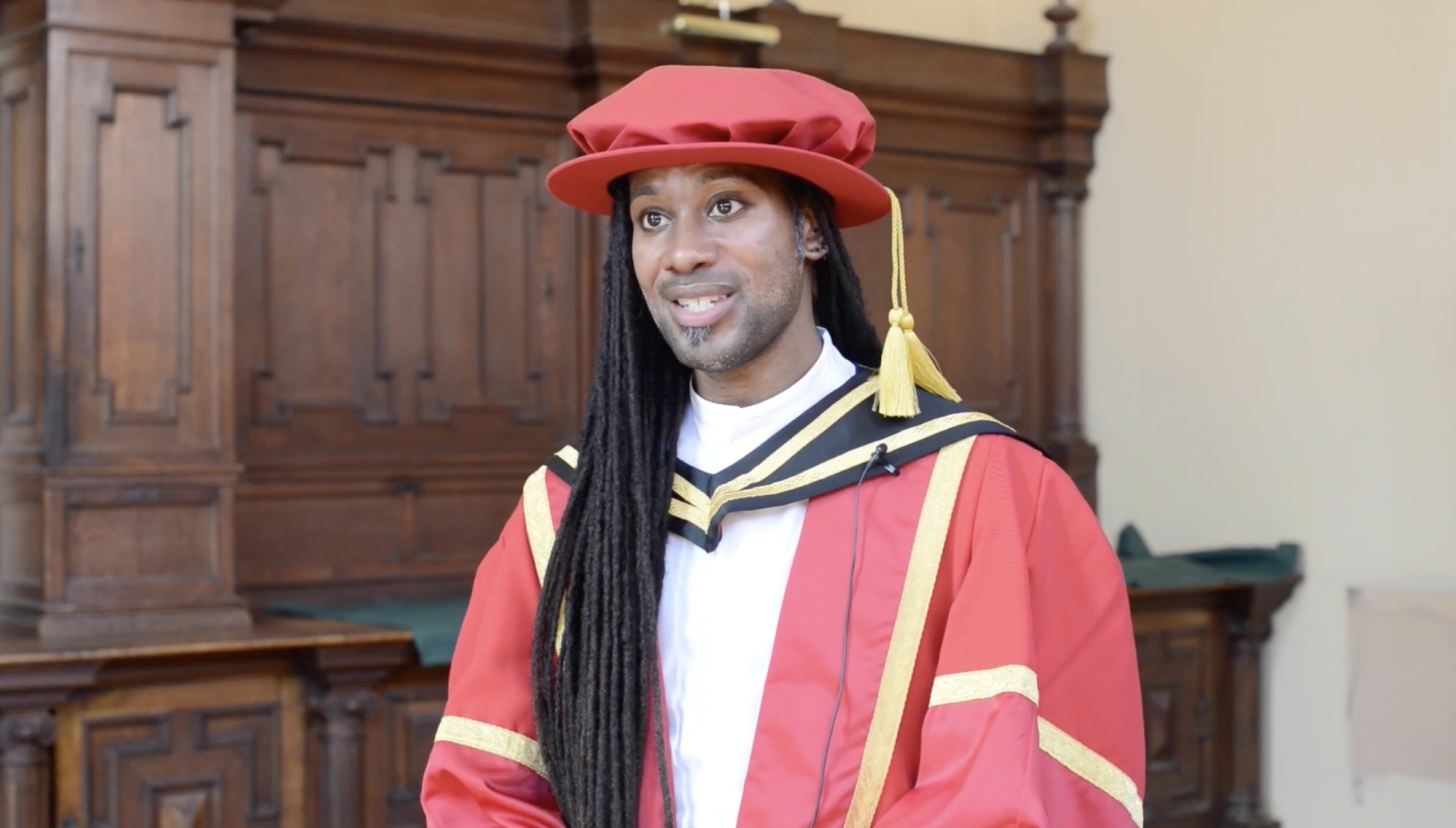
Cambridge professor Jason Arday
Image from Andrew Doyle
Cambridge Knew in 2023
On 19 May 2023 Martyn Hammersley emailed Hilary Cremin, Head of the Faculty of Education, and Rhys Morgan, Head of Policy. He flagged substantial plagiarism in Arday’s 2018 paper, including quotes attributed to Arday’s own interview subjects that matched quotes from another researcher’s participants. (emails first reported by Nathan Cofnas and later confirmed in The Telegraph)
On 21 June 2023 Morgan replied that it was “not within our remit”. Cremin said Arday had the department’s full support.
That is three years of Cambridge knowing. Everything that followed sits on top of that decision.
In the BBC’s 2023 video marking his appointment, Cremin went further. She said: “We are so lucky to have you. You are the best in the world in terms of the research that you do.” (BBC video, 2023)
Eight months later, on 2 February 2024, Arday was appointed to ITV’s Cultural Advisory Council. Sixteen months after the concerns were raised, on 19–20 September 2024, he led sessions on equity, diversity and inclusion at the National Aspiring Vice Chancellor Development Programme at Bolton.
He was teaching the next generation of vice-chancellors while the questions about his own record remained unanswered by the institution that employed him.
[…]
The Claims, Laid Out Together
Here, in one place, is the full set of claims Jason Arday has made about his life:
- Diagnosed with autism and global developmental delay at the age of three.
- Non-verbal until the age of eleven.
- Unable to read or write until the age of eighteen.
- Four to five hours of speech therapy every day from the age of three.
- A mother with five degrees.
- A benign brain tumour removed a fortnight before his PhD viva, which wiped his memory of the entire thesis; he re-learned it and still passed.
- Two further brain tumours diagnosed after the PhD, later found to be benign.
- Deaf in one ear.
- Ran 30 marathons in 35 days, the last nine after sustaining a hairline fracture that made his leg swell to twice its normal size.
- Covered 300 miles in three days.
- Covered 600 miles in six days (later quietly amended in some citations to twelve days).
- Raised £5.5 million for more than 80 charities.
- Installed water points in South America and West Africa with WaterAid.
- Received a severed pig’s head at his parents’ home.
- Faced a knife-wielding masked man.
- Received bullets in the post, rape threats against his daughter, threats to make him “top himself”, and other forms of intimidation including corrosive substances and mutilated animals.
- Came through a professional football club’s academy system and later played semi-professionally.
- Was on the verge of turning professional at snooker.
- Awarded an MBE in 2017 and turned it down.
- Olympic Torch Bearer for London 2012.
- Appeared in the ITV documentary series Seven Up!
- Obtained a Masters degree in “psychodynamic practice” from Birkbeck and became a qualified counsellor.
- Held visiting professorships at the University of Glasgow and Ohio State University.
This is the origin story as it has been told. Almost none of it has been independently verified. Several of the most dramatic claims have been directly contradicted by the organisations or records that should corroborate them.
That is the real failure.
In the rush to be diverse, to be inclusive, to champion a Black, autistic, working-class success story who ticked every box, almost no one stopped to ask the simplest question of all: when you look at these claims as a totality, how plausible are they?
Each claim on its own might have been given the benefit of the doubt. Taken together they form a pattern that should have been obvious long before Carter-Ruck letters and police complaints were required to shut the questions down.
The institutions that elevated the legend spent years repeating it. When the contradictions began to surface they did not investigate. They defended. They edited the websites quietly. They called the scrutiny a vile campaign. They treated the act of checking as the real offence.
Jason Arday did not need to invent a modest success story. He invented a legend. And for years almost no one dared to ask whether any of it was real — because he is Black, and in the current climate that was supposed to be enough.
It was not enough. And it never should have been.
Update: Reportedly after Cambridge opened an investigation into the plagiarism allegations, Professor Arday has submitted his resignation.
Jason Arday, who was touted as the university’s youngest black professor, announced on Wednesday that he was resigning effective immediately from both the university and Jesus College. His resignation came just hours after Cambridge had said it opened an investigation into the allegations after “new information” came to light.
In a statement published by the Good Law Project, Arday said that the “relentless accusations” had taken a “profound toll” on him. He added that he has decided to resign for his “own wellbeing”.
“I have tried to continue because I believe deeply in the values of higher education, in rigorous scholarship, and in the transformative power of universities. I have tried because of my students, my colleagues and the countless people who have written to tell me that my journey gave them hope,” he wrote. “But there comes a point when the personal cost becomes too great. I have a family. I want to be present for them. I want to reclaim some peace, some privacy and some semblance of an ordinary life. I no longer wish to feel as though I am living under a constant spotlight, where every aspect of my life is subject to public examination and judgement.”
The next shoe was funny enough that I assumed it was from the Babylon Bee, but apparently is not parody:
Following Arday’s resignation letter, social media users claimed that the statement itself appeared to have been AI-generated. According to Panagran, the leading AI writing detection software, Arday’s resignation statement was deemed to be 100 percent AI-generated.
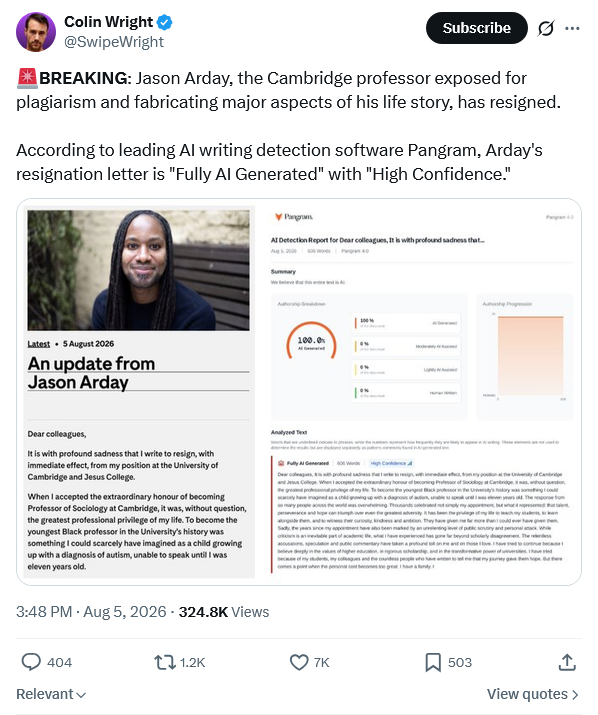
Frederick Alexander decrys the fools that bought Arday’s fantastic stories as nothing but the truth and moved mountains to get him advancement at all costs:
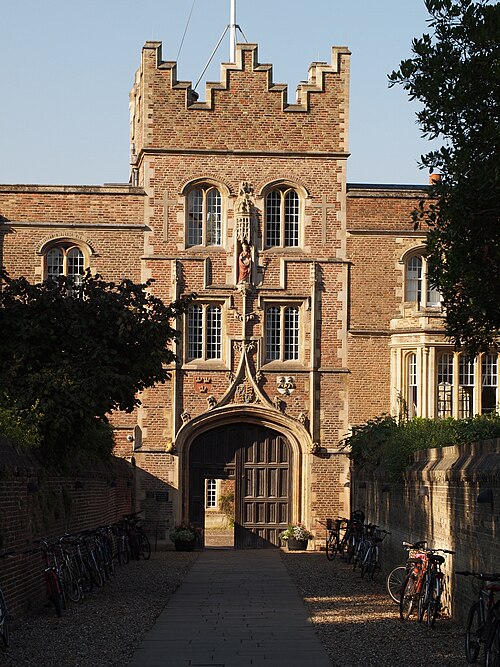
The main entrance of Jesus College, Cambridge from Jesus Lane.
Photo by Verbcatcher via Wikimedia Commons.
We may never know the full extent of Jason Arday’s talents. Perhaps he also sang the difficult half of Milli Vanilli, crossed the Atlantic on a lilo with a shattered pelvis, and designed the SpaceX rocket catcher in the margins of his PhD thesis. There is, in truth, no claim he could have made that the intellectual class would not have believed, provided it flattered their view of themselves as good and righteous people.
Did it not occur to him that someone might check? Confronted by the Guardian, Arday has since offered a defence that will live on his Wikipedia page forever despite the efforts of its editors: “To be honest with you, I thought you’d just believe me. Why would I lie?”
It’s probably the most honest thing he’s ever said. More importantly, it describes the workings of his career in the sort of plain language that the sociology department hadn’t quite trained out of him. He thought the Guardian class would believe him because he understood that they wanted to believe him. They were falling over themselves to grant legitimacy to anything he said simply because he was the one saying it. His story bore out their politics, advertised their virtue and bolstered their status. Scrutiny would only spoil the party.
Perhaps this explains why Arday’s writing also got a pass. Here, for instance, is Arday explaining … well, you figure it out.
As the researcher, textual units concerning the narratives and biographies were identified based on the criteria that the identified themes were fit for purpose in supporting the themes associated with the study.
You would get more sense from a gibberish generator. Academic writing is hell at the best of times, but sociology has mumbo-jumbo built in. Banalities disappear beneath layers of abstraction presumably in an effort to make them sound deep or insightful. Next to this, the plagiarism comes as a relief, another person’s sentences at least making the effort to mean something.
The writing should be disqualifying by itself, but it’s not like Arday tiptoed into the academy while nobody was looking. Cambridge signed him up in the manner of a Premier League football team landing the next Ronaldo, but on the strength of highlight reels that turned out to be AI-generated.
The remarkable thing is not merely that Arday appears to have invented stories about himself. Lots of people do that. I did it when I was nine, trying to convince people I was invisible. Nobody appointed me to a professorship at one of the country’s most prestigious universities. Or rather, formerly prestigious universities. Who can look at these institutions now and not see the wreckage of ideological capture?
They’re calling the fallout “a vile campaign” to undermine Arday’s credibility – of course they are. It’s a smear by “right-wing newspapers” intended to embarrass Arday and those who elevated him. Of course it is. But the embarrassment was born of their own vanity and gullibility. They demanded that everyone believe the story, then labelled anyone who checked it as morally suspect and worthy of a police investigation.
Nearly 15,000 people have signed an open letter declaring the allegations “entirely false”, even as the evidence points the other way. How long before they withdraw their names, reframe events and reposition themselves as the full truth comes to light? Soon they will talk solemnly about the importance of integrity, dissociate themselves entirely from Arday – yesterday a useful idiot, today a serious liability – and somehow still make it about race and right-wing bigotry. This stuff is hardcoded. The rest is just presentation.
The administrators who made the appointment will survive with a few bruises, scapegoating Arday until the media get bored of it. Then they’ll pick up where they left off, a little more careful next time – running the checks, scouring the next candidate’s PhD for plagiarism, testing every fantastical claim against reality, except where reality conflicts with ideology. Which is likely most of it.
QotD: John Nicholson, a Muslim saint who really hated India
John Nicholson really, really hated India. This was unfortunate for him in one sense, since he spent nearly his entire life after the age of sixteen there, until he died — violently — while still a young man. But in another sense, it really worked out for him, since it afforded him the opportunity to live out his dream, which was to abuse Indian people. Clearly, he was a complicated man.
[…]
[The First Anglo-Afghan War (1838-1842)] began with the British efforts to replace Afghan Emir Dost Muhammad with a more pliant leader, which in a pattern seen from the days of Alexander onward, involved an invasion, an attempt at a pacification, followed by a grim and growing awareness that the place is full of some of the most brutal and fractious people on Earth and is simply ungovernable, which terminates in a costly retreat, the country itself returning to its customary barbarism, efforts to change it having had all the effect of flinging an encyclopedia into a chimp enclosure. For the British, this meant early success, then an overwinter occupation in which their position deteriorated, then a mass uprising, whereupon they negotiated with the locals for a peaceful exit upon surrendering their arms. The retreating British were of course betrayed and massacred. One man made it out.
Nicholson, serving as an adjutant officer with a native regiment, had earlier been taken prisoner, and endured horrific conditions as such. He watched as his Hindu soldiers refused — to a man — to convert to Islam, and were executed one after the other. After having been released, he discovered that his younger brother Alexander had been murdered and mutilated by the Afghans while retreating with the rest of the army. The entire effort had been a great traumatic waste.
One might expect that Nicholson would hate the Afghans and perhaps revise upward his estimation of the brave Indian soldiers who had served under him. But while he did indeed revile the Pashtun tribesmen (“the most vicious and bloodthirsty race in existence”) he actually seems to have disliked them slightly less than the Hindus, perhaps on the grounds that no one that eager to kill Indians can be all bad. Indeed, he seems to have learned there some harsh lessons concerning what it would take to actually accomplish anything in the subcontinent, doctrines he would apply fastidiously and thoroughly. In many ways, he went a bit more native than he would have cared to admit.
After the war, Nicholson was promoted and given a series of administrative jobs, where he became well-acquainted with the chaotic political situation in the Punjab region. Mostly under the control of the Sikh Empire, the area had long been contested ground between that new faith and Islamic invasions from the Mughals to the southeast and the Afghans through the Khyber Pass to the west, not to mention restive Hindu Rajputs and Marathas to the south. The unstable (then and now) region of Kashmir lay to the north, and the whole of the region was plagued by innumerable bandits and warlords. The BEIC ruled through direct administration, client kings, and various alliances, the latter two of which its political officers (“politicals”) had to interact with on a regular basis. It was very much a situation out of George R. R. Martin’s fever dreams, constant betrayals, perversions of every kind, and even a Ramsey Bolton-esque Sikh despot who flayed men alive for amusement.
Nicholson was in charge of the Bannu area, where he rapidly made a name for himself as a local administrator. The whole of the Bannu was infested with bandits of all kinds, from jihadis to Hindu cultists to normal brigands, and the people lived in constant fear of their depredations. Nicholson had no real interest in bettering lives, but he had even less interest in allowing any Indian, anywhere, to challenge his authority. So he set about fixing the problem as only he could.
Nicholson arrested and executed scores of bandits, rapidly processing them through his very efficient court system. The idea of impartially dispensing justice without respect to person or affiliation was quite new to the area, but Nicholson made sure the locals adjusted quickly, tolerating not even the slightest hint of disrespect from anyone, no matter who he was. When a local Muslim leader casually spit on the ground in front of him, Nicholson made him kneel and lick it up. Anyone who failed to display prompt obedience to his commands he had flogged immediately, and was the bane of servants, who were often the causal recipients of hurled cups and dishes. He was a very hands-on leader, not the least hesitant to get them dirty in a quite literal sense. At one point, when his local police were unwilling to pursue a dangerous gang leader, Nicholson rode alone to the man’s village, approached him on the street, and killed him with his sword after the suspect failed to submit to arrest. Nicholson kept his severed head on his desk pour encourager les autres.
Interestingly, such draconian brutality seems to have actually made Nicholson popular. He was harsh, unyielding, and wholly indifferent to their culture, but that very indifference made him unassailable to anything but his sense of duty. He was unbribable, as the people of India had absolutely nothing he wanted, and his complete contempt for their social norms meant that Hindu, Muslim, or Sikh, Brahmin or outcast, Aryan or Dravidian, all got the exact same treatment, prompt and thorough. His mad fearlessness meant that he was similarly immune to threats. Criminals, whoever they were, received savage punishment, but the law-abiding were left in peace; Nicholson had no desire to “improve” them or their society like his contemporary Macaulay. In a real sense, for the first time, the diverse people of the area were free, under Nicholson’s rule, to live as they wished without the violent misery that had previously characterized the region. It was a multicultural success story, festooned with the occasional decapitated head.
This being India, the people expressed their feelings towards him in particular ways. A body of wild Pashtun raiders, admiring Nicholson’s capacity for ruthless violence and his grim charisma, attached themselves to him as a personal guard, fedaykin to his Muad’Dib, serving without pay and loyal only to him. In a theologically fecund area with a strong tradition of syncretism and cults of personality, Nicholson naturally became the object of worship for a group of fanatical devotees. He in turn naturally despised this, having his worshipers flogged as public nuisances, but this only served to increase their devotion to their inscrutable, violent deity. In some parts of India, the Cult of Nikal Seyn survived as a Shia devotional movement, with Nicholson cast as a Muslim saint bringing justice to a war torn land. The last member died in 2004.
Librarian of Celaeno, “The Man Who Hated India”, The Library of Celaeno, 2026-05-04.
Comments Off on QotD: John Nicholson, a Muslim saint who really hated India
August 5, 2026
Power corrupts, but unaccountable power attracts bureaucrats
We used to joke around election time that no matter who you voted for, the government always got in. Gallows humour, because it’s quite literally true. Enough people can get angry about the government in power and vote out the politicians … but the politicians aren’t the one implementing the policies that get people upset. The permanent bureaucracy barely notices when the government changes because the government rarely manages to get anything done that the civil service doesn’t want to do. It’s actually worse in Europe, because the politicians are even more mere figureheads than they are in the Anglosphere:
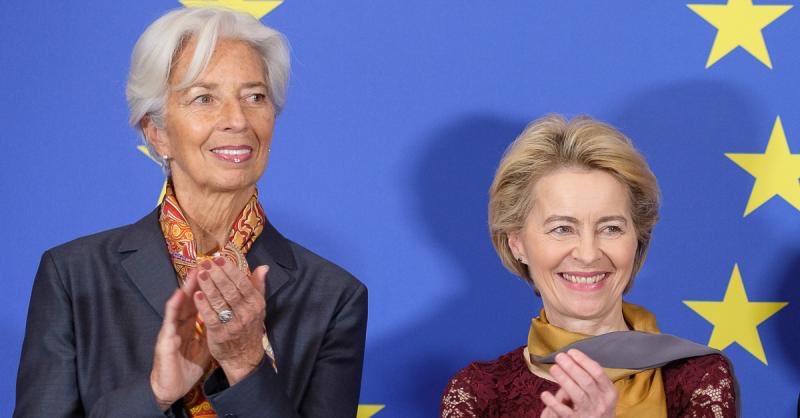
Christine Lagarde and Ursula von der Leyen
Nobody grows up dreaming of a career shuffling directives around Brussels.
Those jobs always fill with the same type of person: people drawn to power for its own sake, the ones who crave authority without ever answering for it. Bureaucracy doesn’t attract the best. It selects for the worst, then shields them when they inevitably screw up.
Hayek named this in The Road to Serfdom. His chapter “Why the Worst Get on Top” spelled out the logic. Unchecked power appeals most to the people least troubled by wielding it.
Mises found the engine underneath. In a market, a bad decision shows up as a loss, and losses remove you. Bureaucratic management faces no such test. Fail to fix a problem and you keep your job, then collect a bigger budget and a larger staff to keep failing with. The incentive runs backwards: waste earns you more, and the machine grows on its own.
Look at the European Union. Ursula von der Leyen presides over the Commission, the body that proposes almost all EU law. No European voter ever put her there. Heads of state handed her the post in a 2019 backroom deal and waved her through parliament. Christine Lagarde runs the European Central Bank, setting monetary policy for more than 340 million people and steering the value of the money in their pockets. She faced no voters for the job either.
You can throw out your national government every few years, but nothing above it moves, the apparatus stays. The unelected keep their offices, their pensions, their power, untouched by the only check ordinary people have.
This is the design, not a flaw in it. The people with the most control over your money and your future are the ones you are not allowed to fire.
Comments Off on Power corrupts, but unaccountable power attracts bureaucrats
I, Claudius (MCMLXXVI). Show Me The Way To Go Rome
Stam Fine
Published 3 Apr 2026Stam Fine Reviews looks at the landmark 1976 classic BBC series I, Claudius based on the books by Robert Graves. I, Claudius is a sprawling epic looking at four emperors, Augustus, Tiberius, Caligula, and Claudius. Claudius had a limp, stammered and facial tics but was a survivor when everyone else around him was murdered.
I, Claudius is an influential series, even in places you don’t expect it (The Sopranos, Dynasty, Succession).
Note: The Romans didn’t use the letter ‘U’ at the time unless you upgraded your subscription to Roman+. I do not presently subscribe to Roman+.
Stars Derek Jacobi, Sian Phillips, Brian Blessed, George Baker, Patrick Stewart, Ian Ogilvy, Simon MacCorkindale, Margaret Tyzack, Patrica Quinn, John Hurt, and many more.
0:00 Introduction
0:33 Veni, vidi, Google Translate usus sum.
1:15 Technical Difficulties.
1:34 I, Claudius Take Two.
4:09 Augustus and Livia
5:50 Claudius
8:05 Tiberius
10:55 Caligula
13:14 Emperor Claudius
16:00 From Book to BBC2
19:11 Cast
21:24 LegacyI, Claudius
I, Clavdivs
I Claudius
Comments Off on I, Claudius (MCMLXXVI). Show Me The Way To Go Rome
QotD: “This is why English spelling is a disaster”
And somewhere in that collision of accents and dialects, something shifted. Literally. The vowels started moving.
Between roughly 1400 and 1700 every single long vowel in the English language changed how it was pronounced. It’s called the Great Vowel Shift. Before it happened, English vowels worked the way vowels work in Italian or Spanish. The letters did what they looked like they should do. “Bite” was pronounced “beet”. “House” was pronounced “hoos”. “Name” was pronounced “nahm”. “Knight” was pronounced “k-nicht” with a guttural sound at the end like you were clearing your throat. English was phonetic. The spelling matched the sounds. It made SENSE.
And then it didn’t.
All the long vowels began migrating upward in the mouth. The tongue positions shifted higher and higher over the course of about 300 years. And the vowels that were already at the top had nowhere left to go so they broke apart into two sounds. “Ee” became “eye”. “Oo” became “ow”. A 300-year linguistic pileup that nobody voted on and nobody agreed to. It just happened. And it happened during the worst possible window of time.
William Caxton brought the printing press to England in 1476. One of the most important technological developments in the history of communication. And it arrived RIGHT IN THE MIDDLE of the Great Vowel Shift.
Caxton started standardizing English spelling based on how words sounded at that exact moment. Printers needed consistency. They needed to pick a spelling and commit. So they did. But the sounds kept changing after the spelling was already locked in. The vowels were still moving. The consonants were still dropping. And the printed page couldn’t keep up.
We had ONE CHANCE to get English spelling right and we fumbled it at the worst possible moment.
This is why English spelling is a disaster. It’s not random. It’s not lazy. It’s a snapshot of a language mid-transformation that got frozen in place by a new technology and was never corrected. Every word you have ever misspelled, every silent letter that made you feel stupid, every time you stared at “knight” and thought why is there a K in this. You used to pronounce that K. You used to pronounce that GH. Those sounds died 500 years ago and the letters are still standing there like gravestones. English spelling is full of ghosts.
That’s why “food” and “good” and “blood” are spelled almost identically but sound completely different. In Chaucer’s time around the 1390s they all rhymed. In Shakespeare’s time around the 1600s they still rhymed but with a different vowel. And then sometime after that they each went their own separate way and the spelling just stood there watching like it had given up entirely.
And HERE IS THE THING. Other languages went through similar vowel shifts. German had nearly identical changes happen to its long vowels around the same period. And German just updated its spelling. They adjusted the orthography to match the new pronunciation. Like reasonable people. English looked at the same problem and said no. We’re going to keep the old spelling. Everyone will simply have to deal with it. Every person who has ever stared at “though” and “through” and “thorough” and “thought” and wondered why four words that look almost identical are all pronounced differently? Collateral damage. Five hundred years of collateral damage and we just accepted it.
Ok so that’s the vowels. That’s the background. Now we get to the accents and this is where I lost my mind.
The single biggest difference between standard American English and standard British English today is something called rhoticity. This is a real linguistics term even though it sounds completely made up. Rhotic speakers pronounce the R sound in words like “hard” and “car”. Non-rhotic speakers drop it. “Hard” becomes “hahd”. “Car” becomes “cah”. That one feature is doing like 80 percent of the work when your brain hears someone speak and categorizes them as British or American.
Here’s what nobody told you.
In 1776 everybody was rhotic. Americans AND the British. Both sides of the Atlantic pronounced their Rs. The fancy non-rhotic accent that we now think of as THE British accent, the one you hear in your head when someone says “British accent”, the one every villain in every movie has? That accent did not exist yet. It developed in the late 18th and early 19th centuries when the upper classes in southern England started dropping their Rs as a prestige marker. A fashion statement. And then it spread downward through society and outward through the Empire.
The accent we associate with the British Empire is actually newer than the American Revolution.
I need to say that again because it didn’t land the first time I heard it either.
The accent that we think of as “British” is newer than the country that broke away from Britain. Americans didn’t lose the British accent. The British lost the British accent. Americans are the ones who kept it.
Emma, “The Plague That Broke English (And Why the Founding Fathers Didn’t Sound British)”, Past Life, Present Cleavage, 2026-04-03.
Comments Off on QotD: “This is why English spelling is a disaster”
August 4, 2026
“Jason Arday’s improbable claims have turned him into a Walter Mitty for our times”
The Jason Arday affair has only just drifted into my view, but it seems utterly fascinating that a young man with such a … varied and colourful personal history … has risen to be the youngest black professor at Cambridge. His backstory is (probably) too perfectly aligned with progressive worldviews to be true:
Cambridge professor Jason Arday
Image from Andrew DoyleJason Arday’s improbable claims have turned him into a Walter Mitty for our times. As the youngest black person ever to be appointed a professor at the University of Cambridge, there are good reasons why those who have championed him are rushing to his defence. But with each passing day, new revelations of his slippery relationship with reality seem to be emerging.
As with many fabulists, it is difficult to know where the truth ends and the fiction begins. Some of Arday’s boasts are quite obviously false. For instance, nobody believes that he completed the last nine of thirty consecutive marathons with a fractured leg that had swollen “to twice its normal size”. Or that he appeared in the television series Seven Up! as a child, even though its participants were selected in 1963 and Arday was born two decades later.
Other claims might well be embellishments on kernels of reality. No doubt he has raised money for charity, but it seems highly unlikely that his vaunted sum of £5.5 million is accurate. We know that he played snooker, but his assertion that he did so professionally would carry more weight if someone on the circuit had heard of him. Few would dispute that Arday is a keen amateur athlete. But if his claim to have run six hundred miles in six days were true, that would place him among the world’s elite sportsmen.
Perhaps most serious of all are the accusations of plagiarism. Cambridge has been quick to dismiss the matter, stating that an investigation has already been conducted by Liverpool John Moores University, where Arday completed his PhD thesis, and no evidence of plagiarism was found. Many readers who have compared the relevant passages side by side have reached a different conclusion. Numerous examples have been collated by Nathan Cofnas and can be seen here.
The refusal of the authorities at Cambridge to investigate the allegations properly has naturally raised suspicions that Arday is being protected because he is the poster boy for DEI. If it is true that he was raised on a council estate, diagnosed with autism at the age of three, first spoke at the age of eleven, and learned to read and write at eighteen, then his success story is unparalleled. Yet plagiarism is an extremely grave matter for an academic, and the evidence is difficult to dismiss.
The failure to hold Arday to the same standards as anyone else is, of course, a soft form of racism …
On Substack Notes, Michael Southron says he’s getting a strong Jussie Smollet vibe from this story:
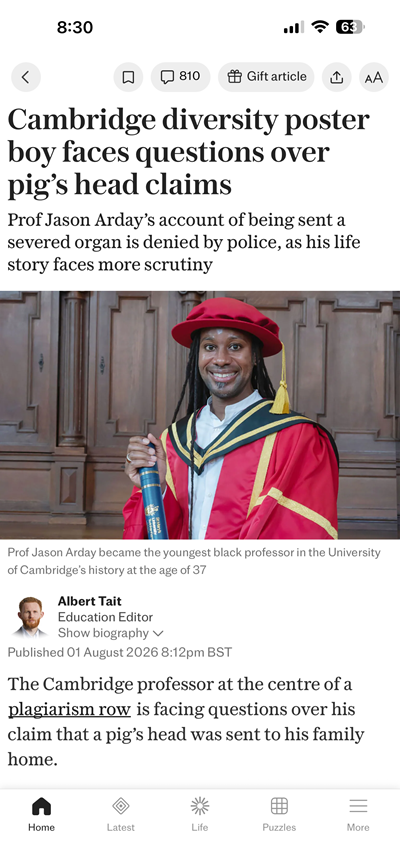
The Jason Arday affair is beginning to remind me of Jussie Smollett.
Not because we know that Arday fabricated anything. We don’t. But because of the strange self-protecting logic that surrounds allegations of racism.
Smollett’s story was initially believed because it fitted so perfectly with what many people already believed about America: a black, gay actor attacked by racist, homophobic Trump supporters. The allegation seemed almost to validate itself.
Something similar is happening with Arday.
He says a severed pig’s head was sent to his family home. Yet police can reportedly find no record of the investigation he described. The butcher he said police visited says no officers ever came. There are apparently no photographs or contemporaneous messages.
He also says a masked man twice entered his Cambridge faculty building and threatened him, on one occasion with a knife. Yet the man was apparently captured by no CCTV, seen by no colleagues, and Arday reportedly warned nobody in the building at the time.
“To be honest with you, I thought you’d just believe me,” Arday told the Guardian. “Why would I lie?”
That sentence may be the most revealing part of the whole affair.
Because questioning Arday’s claims now risks being folded into the very narrative those claims are supposed to establish.
Arday says he has been targeted because of racism. Questions are raised about the evidence for his claims. Those questions are then portrayed as part of a “vile campaign” against him — which becomes further evidence that he is being targeted.
The allegation begins to protect itself.
He is a victim of racism, therefore questioning his account may itself be racist; and because questioning his account may be racist, his claim to be a victim of racism receives less scrutiny.
It is a perfect circle.
Comments Off on “Jason Arday’s improbable claims have turned him into a Walter Mitty for our times”
China attacked the sparrows, Britain will attack the cows
People make mistakes based on insufficient information, mistaken causes, biases, and many other distorted ways of reasoning. Governments do the same thing, but when governments screw up it’s a problem for everyone:
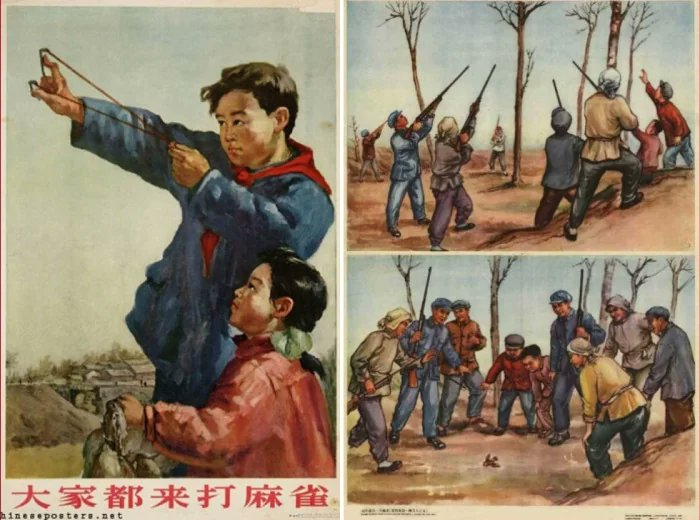
In 1958 the Chinese state worked out that sparrows were eating the grain, and organised six hundred million people to kill every one of them.
It did not take bullets. Villages, schools and factory units turned out with pots, pans, drums and gongs and made continuous noise so that no bird could land anywhere. Nests were pulled down, eggs smashed, chicks killed. The sparrows flew until their hearts gave out and dropped into the streets, where children collected them and the totals were reported upward as achievements. The toll ran into the hundreds of millions.
The arithmetic was sound as far as it went. A sparrow eats grain. Fewer sparrows, more grain, more people fed. Nobody in the room was wrong about what the bird took.
They were wrong about what it did.
Sparrows eat insects, in enormous quantity, and most of all in the breeding season when the chicks need protein. Take them out of a farmed landscape and the locusts and grain borers they had been holding down are handed the whole country. Which is what happened. Crop losses to insects rose sharply, and by 1960 the ornithologist Tso-hsin Cheng had made the case well enough that Mao ordered sparrows struck from the list and replaced with bed bugs.
Far too late, and never the whole cause. The famine of 1959 to 1961 was principally a policy famine, driven by collectivisation, grain requisition and the diversion of farm labour to backyard steel furnaces, and the dead are counted in tens of millions.
But the sparrow campaign is the purest thing in the episode, because it is the reasoning stripped to bone. A committee looked at a living system, isolated the one animal it could measure as a cost, and calculated the gain from removing it without ever asking what that animal was holding up.
Now look at what is being proposed for grassland.
The ruminant is measured the same way, on one ledger line, the methane it emits and the land it stands on. What is left off the ledger is everything it does. The grazing that keeps grassland grassland instead of scrub. The dung that feeds the beetles that feed the birds. The hoof that breaks the surface so seed can take. The mouth that removes the standing dead matter which otherwise cures into wildfire fuel. The manure that returns phosphorus and nitrogen to the soil so nobody has to mine it and ship it in.
Grasslands and grazing animals co-evolved over tens of millions of years. Remove the animal and you do not get the same field minus some methane. You get a different system, and it will not be the one on the spreadsheet.
The men who ordered the sparrows killed were not stupid, and they were not cruel. They had a number, and the number was correct, and they were praised for acting on it decisively. It took two years for the second half of the equation to arrive, and by then nobody could put the birds back.
We are eighteen months into the herd reduction schemes.
The grass has not sent its invoice yet.
Update, 6 August: Welcome, Instapundit readers! Have a look around at some of my other posts you may find of interest. I send out a daily summary of posts here through my Substack – https://substack.com/@nicholasrusson that you can subscribe to if you’d like to be informed of new posts in the future.
Madsen Model 1945: A Rather Unusual SMG
Forgotten Weapons
Published 9 Mar 2026At the end of World War Two, the Danish Madsen company wanted to replace its production of licensed Suomi submachine guns with a design of its own. The result was the Model 1945, a quite unusual design with a pistol-like slide. The nearest similarities would be the Polish PM-63 and the German VG1-5. The Madsen design also used an unusual hammer firing system. It was chambered for 9mm Parabellum, feeding from Suomi box magazines (not drums). Both a fixed wooden stock version (seen here) and a folding stock version were made, but only a few sales came through (apparently to Mexico and El Salvador).
Danish M1941 Madsen video: • Danish M1941 Suomi SMG
Madsen M1950 video: • Madsen M50: From the Korean War to Star Trek
(more…)
Comments Off on Madsen Model 1945: A Rather Unusual SMG
QotD: Limits to tactical flexibility in Roman Republican armies
And therein lies the rub: just as the commander doesn’t have a multitude of points where he can intervene in the battle but rather a limited set of key decision points, so too he does not have an infinite set of potential orders he (or his subordinates) might give at any given moment. Instead, the commander (or his subordinates) has a McDonald’s menu worth of options he can employ. He can order anything on the menu and expect the unit to respond accordingly but he cannot order anything not on the menu, nor can he order an altered version of a menu item (no Big Mac without cheese; Sir, this is not a Wendy’s).
Now generals could and did use drilling in the early stages of the campaign to add one or two “menu items” to their drill so as to be prepared for this or that problem. Indeed the general preparing some sort of surprise of this sort and then deploying it against an enemy is a standard topos of effective ancient generalship (although in many cases we may doubt the purported gimmick was actually used (e.g. Dionysius 20.1.6, Dio 10.5)). But that is the thing: such extra “menu items” have to be prepared in advance and often well in advance of the battle. Caesar, for instance, anticipating war elephants drills his troops in anti-war-elephant tactics before the Battle of Thapsus (46 BC, Caes. Bel. Afr. 84). Alexander’s phalanx seems to have been drilled to respond to scythed chariots as well (Arr. Anab. 3.13.5-6).
That said the bulk of the menu was likely to remain constant. After all these “menu items”, while they have simple names are often actually fairly complex to do and train when you are dealing with units of dozens or hundreds. Turning back to our example of Company, Right Wheel! we can get a sense of the complexity of training that maneuver by the way they did it. The “right guide” (the man on the extreme right) adopts a set pace (nine inch steps) while the “left guide” moves at the normal regulated speed (note this requires training your soldiers not only to step in time but to step at standard lengths) and every soldier in the middle regulates his motion by maintaining elbow contact with the man to his side. That’s a good method to get the result, but it isn’t an obvious or simple method: the fellow training the company to do this needs to already know how to do this.
Now in the modern period with mass printing, you could print drill manuals that had all of the commands and instructions on how to do them, but in the pre-modern period that kind of mass printing isn’t an option (and our military texts almost never go into this kind of granular detail) so your officers have to learn to train the behavior by observing it and participating in it themselves. Which means in turn a great deal of your “package” is set before the army is even mustered at the beginning of the campaign season because you are relying on a package of culturally embedded knowledge about how armies ought to function. And if your culture doesn’t have that tradition, inventing it from scratch is going to be hard and take time; and by “time” I mean “decades”. Effective drill for volley fire (the “countermarch”), for instance, answered a need that had existed for most of the 16th century, but the embryonic ideas for it only started emerging in the 1570s, the actionable plan on how to do it in 1594 and it was only then finally deployed in a major battle in 1600 at Nieuwpoort.
However, the time available for that kind of training is limited. Remember that drill works by repeating the same set of actions over and over again until they become almost instinctive. That takes a lot of time and repetition! That both means it is going to be difficult to find space for new “menu items” (especially with green troops that still need to learn the basics) but also that synchronized discipline itself is expensive. Our ancient sources stress how Roman levels of synchronized discipline required diligent and continuous drilling to create and maintain.
Doing that in turn would demand keeping the soldiers in question under arms for training for long periods when they were not fighting. In the Middle Republic this seems to have been accomplished through rolling recruitment: Rome was essentially always at war and always raising armies so there were always a goodly number of veterans to train and “break in” the truly green new recruits in any given draft (though again – and I owe this notion to Michael Taylor – there are some signs that the less intense conflict of the mid-second-century leads to some dulling of the Roman edge). As we transition through the Late Republic into the Early Empire, that is replaced by the slow professionalization of the Roman army, culminating in the force of long-service professionals created by Augustus. Being mobilized in peacetime, professional soldiers could be drilled extensively (assuming their cultural values are going to let them drill you; also be wary here of assuming standing forces of “military settlers” are professional in this way).
But all of that is extraordinarily expensive. Keeping those soldiers under arms, after all, means that they need to be fed, clothed and paid. Even in a system like the Middle Roman Republic where soldiers provided their own kit out of their own wealth (because Roman soldiers in the Middle Republic were recruited from the modestly well-to-do smallholding class), by drafting those men you have removed them from that economic activity. The expense of doing this would have been in most cases enormous and of course those are resources that could be deployed to any number of other uses, including simply raising a larger army of less disciplined, well trained troops. For, say, a Greek polis given the choice between having 450 men under arms all year round and excellently trained or having 5,000 hoplites under arms only in the one month where there is a battle to fight the clear answer is the latter. A lot of things need to line up before producing armies with high levels of synchronized discipline makes sense: the state needs a lot of resources, year-round security challenges and a tactical system which is effective and demands this kind of investment. So while developing synchronized discipline offered an army a degree of greater control and flexibility, it was prohibitively expensive.
Bret Devereaux, “Collections: Total Generalship: Commanding Pre-Modern Armies, Part IIIa”, A Collection of Unmitigated Pedantry, 2022-06-17.
Comments Off on QotD: Limits to tactical flexibility in Roman Republican armies
August 3, 2026
The Ceuta invasion as a tipping point
On Substack, el gato malo suggests that the “refugee” invastion of Ceuta is a “bridge too far” for the EU:
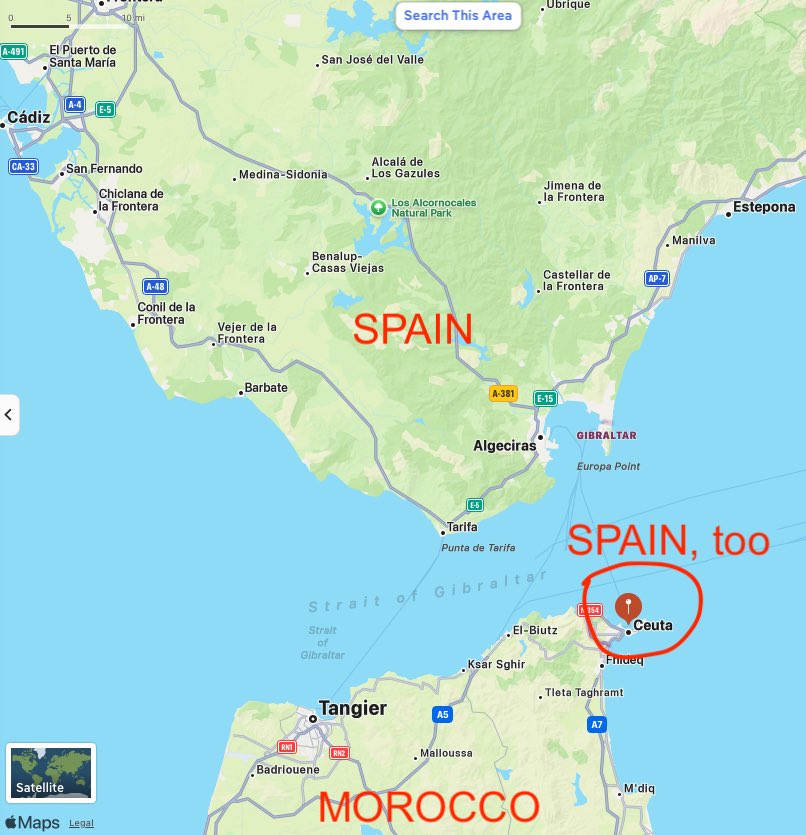
peruvian strongman oscar benavides famously said “for my friends, everything; for my enemies, the law”.
once, such a thing might have provided a succinct summation of the practice of privilege in its literal sense of “private law”. there were laws for the aristocrats and others for the commoners and still others for non-citizens and slaves.
such ideas date back to time out of mind before stone was placed upon stone in giza and stood as absolute expectation and norm in most of the world until quite recently (and pertain in many parts of the world even today). the idea that “all people should be equal under the law” was a radical alteration to social order, a repudiation of the divine right of kings and aristocrats and their monopolies on property and on violence. the literal idea that land could be owned by a commoner was an astonishing upheaval of established orders. it was also the freeing move that allowed for the west to rise and flourish and prosper, unlocking its vast human potential. one might think that people would be happy about this and cherish and protect this most foundational idea that serves as cornerstone to civilizations of liberty and plenty.
lol.
you must be new here.
[…]
spain looks to be in real danger of falling as a nation. they created a mass amnesty for illegal immigrants from places that do not believe in spain but only in tribe and who do not believe in rights but only in who may dominate whom. if one seeks to be a wrecker, it’s a brilliant incentive. pardon a million and give them access to your social safety networks and welfare payments which fund a lifestyle far in excess of where they came from (and the right to vote for more) and the next wave is already packing its bags to come. spread enough jam and you can attract infinity ants.
the US was well on its way to running this playbook (and likely has ~40 million illegals to show for it) before it was stopped. the astonishing bit was how easy it was to shut this off. you just cut off the incentives. no more free stuff, no more amnesty, no more “path to stay”, and no more “catch and release until our overwhelmed court system can have a hearing years from now”. it’s really that simple.
due process becomes rounding you up and sending you home, not giving you a nice place to live for the 3 years until your case is heard.
and it ALL comes down to prosecutors, courts, and agencies. immigration law became irrelevant not because the law changed but because enforcement did. the spectacle of american judges sneaking illegals out of courthouses to avoid their apprehension by ICE was really pretty astonishing. so too were the massive levels of entitlement fraud, literal government funded flights to needed voting districts, and the astonishing refusal to arrest or hold accountable any among them because “marginalized”. europe is worse.
the NGO bond villian insidious complex has been running the table on the west for 20 years.
and they are moving into overdrive now before the populist right forces they are giving reflexive rise to can take control.
[…]
the media is, predictably, either ignoring this or pretending it’s a humanitarian crisis of families and babies. it’s not. this is damn near all men.
and they are not behaving well.
some are claiming that many of these are criminals freed by morocco and bused to the border as a deliberate act. (this same tactic was used by central and south american regimes to dump their gangs in the US.) images of robbery, rape, and of murder are cropping up.
just what a town of 80k is supposed to do with 80k invaders and how they might be fed or sheltered or controlled remains an open question.
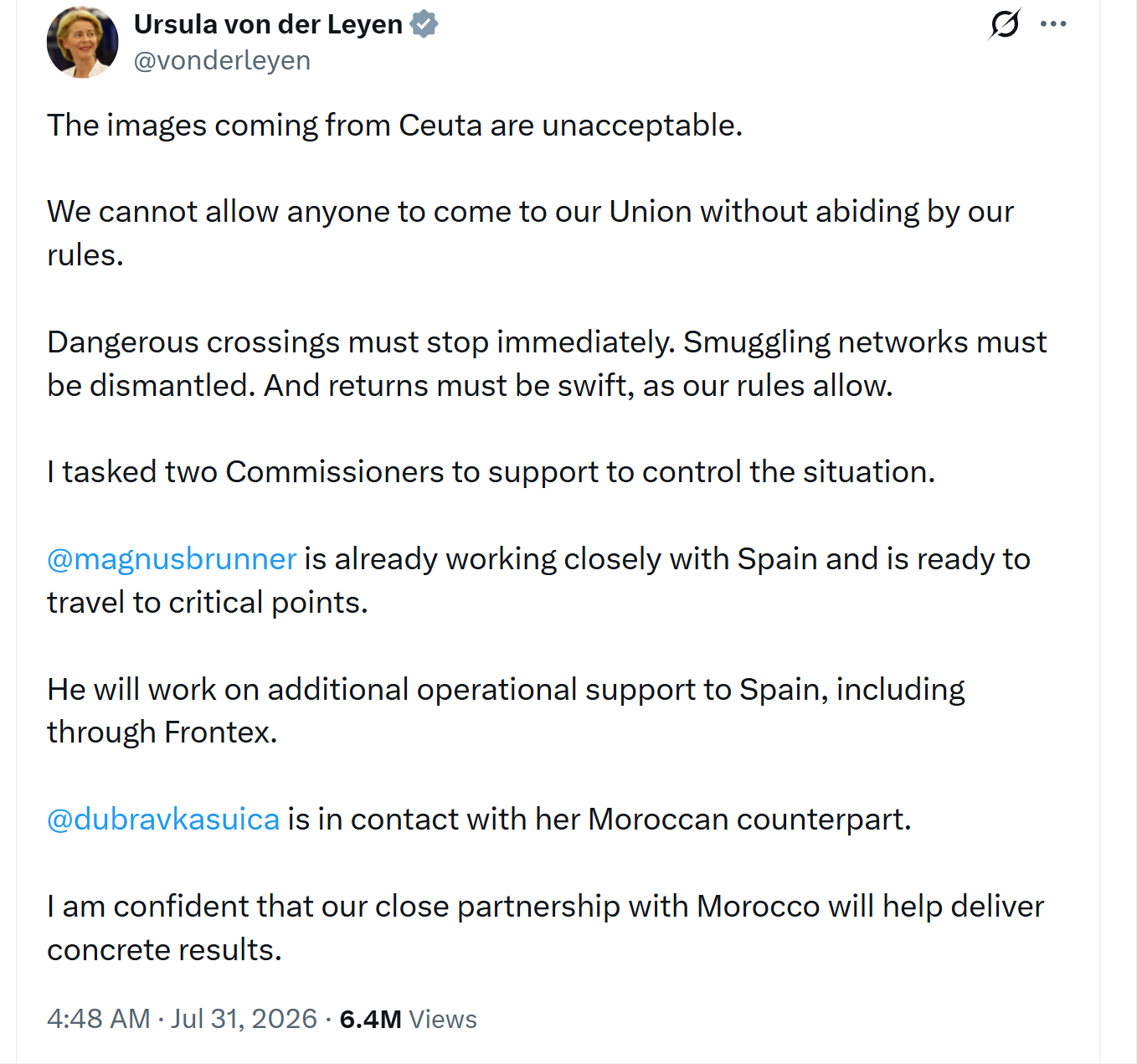
meanwhile, EU commission president ursula von doom has moved to action.
“we have sent a bureaucrat to monitor the situation. if this continues, they will tell people to ‘stop’. if that fails, they will say ‘stop’ again, perhaps in a firmer voice.”
to call this air and nonsense would be charitable. it’s an admission of helplessness. the EC relied upon a soft power it no longer possesses because it now faces people who believe only in hard power which the EC never had.
bluff called.
it’s over.
the EC was fine to govern the sort of citizens who yell at tourists for crossing an empty street against the light. it is wholly unsuited for this and like many an ill fated magician’s apprentice before them, they have now summoned that which they have no hope of controling and will eat them alive.
but here’s the part i really loved: “the images from ceuta are unacceptable”.
talk about saying the quiet part out loud. not the events. not the crisis. the images. even now, for her it’s all perception. you want to understand why they want to mandate ID to use the internet/social media and why they so desperately demand the right to censor it (once more using courts and agencies to enforce their whim)? this is why.
“for my friends, speech, for my enemies censorship and gulag”.
what they are doing cannot survive these images.

On Substack Notes, GenX Anecdotes reacts to the progressives’ response to the Ceuta situation:
I often wonder about the open borders, “migrants welcome” people and I can’t square it.
I am traditionally a left leaning person from a mixed background who has travelled extensively.
To the current progressive mind this ought to make me automatically cheering on the levels of mass migration we are living with.
But it’s the opposite.
The well travelled “anywhere” cosmopolitans should surely be the most aware of cultural differences and that it’s precisely the concept that nations are “particular” and unique from one another, that makes travelling such a fascinating and sometimes challenging thing to do.
[…]
Travelling gave me a fresh and new appreciation of little things (that actually turned out to be important things) about Britain that I had taken for granted before.
The fact that these muppets think that any form of patriotism or nationalism leads to Hitler is absolutely moronic.
And of course they celebrate it everywhere else. It’s just us who are the baddies for wanting to hold onto our traditions, customs and culture.
Why are we uniquely expected to live by different rules? Surely that in itself is kind of exceptionalist?
A progressive travelling in India wouldn’t think twice about a Mumbai taxi driver having an Indian flag hanging on his rearview mirror.
Or a Thai guesthouse having a shrine to the Thai royal family.
When you travel, people are proud of their countries and towns. They want to show you around. They tell you their country is the best proudly.
Of course, I will be here all day pointing out progressive double standards.
But this one is a biggy!
Update, 4 August: Welcome, Instapundit readers! Have a look around at some of my other posts you may find of interest. I send out a daily summary of posts here through my Substack – https://substack.com/@nicholasrusson that you can subscribe to if you’d like to be informed of new posts in the future.
Invasion of Iraq, 2003
Real Time History
Published 6 Mar 2026In March 2003, a US-led coalition invades Iraq. US President George W. Bush claims he must disarm Iraqi dictator Saddam Hussein of weapons of mass destruction and depose a brutal regime supporting global terror. But after a lightning capture of Baghdad and other Iraqi cities in the south, the war is far from over.
(more…)
Comments Off on Invasion of Iraq, 2003
QotD: The Hellenistic Age
When I was a child first getting interested in ancient history, the books I read followed a smooth narrative process. The story of the Greeks began with Athenian democracy and the victories at Marathon, Salamis, and Plataea that saved Western civilization from Persian conquest. Then there was the Athenian maritime empire, and its tremendous cultural achievements: the Parthenon, Socratic philosophy, the plays of Sophocles, Euripides, and Aristophanes. There was the Peloponnesian War and Thucydides’s chronicling of it. And then, in a tremendous climax, there were the awesome conquests of Alexander the Great, who destroyed the most powerful empire on Earth and conquered the known world by the age of 33, only to die young and have his empire swiftly broken up after his death.
… And then the story would promptly lurch 700 miles to the northwest and start over. Greeks? What Greeks? Now I was reading about the rise of a different city, Rome, and the achievements of its great republic. Instead of the Assembly and the ostracism, there was the Senate and the consuls. I would read about the Samnite Wars, the Punic Wars, the Gallic Wars, and finally the great civil wars that transformed Rome from a republic into the empire that men still think about a few times a week. In this story, the Greeks appear again, but only as enemies for Rome first to easily defeat, then be culturally influenced by. This fusion of Greek and Roman culture leads to European Christianity, the Renaissance, the cultural canon — in a word, the West itself.
Kid me didn’t think too much about it at the time. But as I grew, I and many others finally had a thought intrude: Wait a minute, what the heck was going on in Alexander’s old empire before the Romans got there?
And if you’re like me, asking that question is how you wind up reading Alexander to Actium.
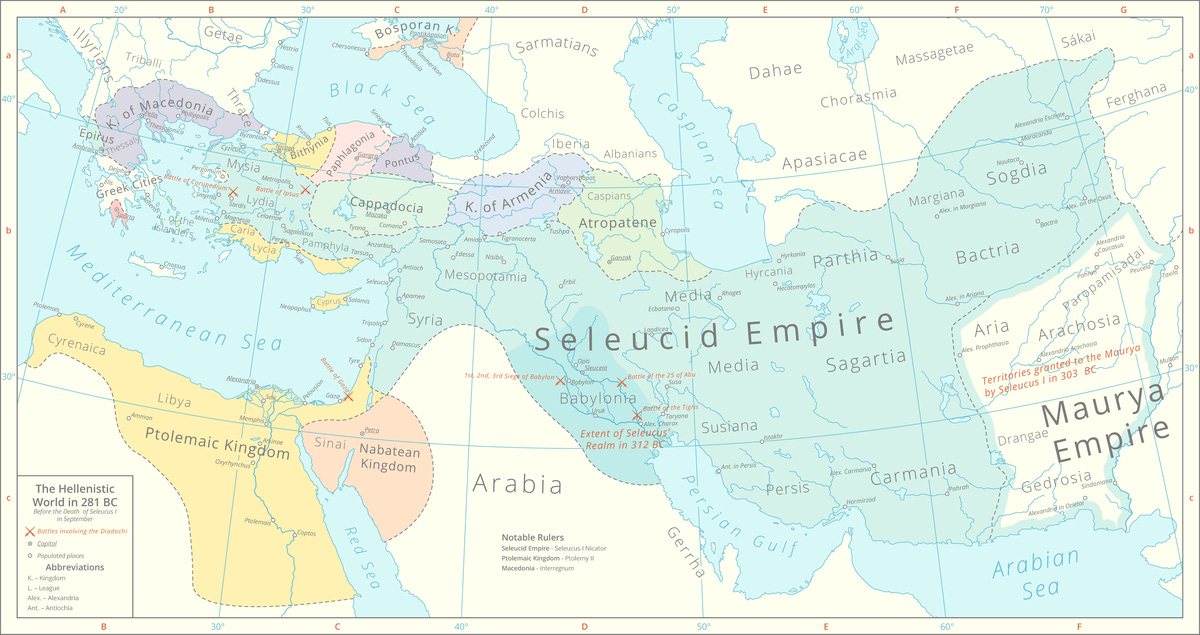
Alexander to Actium is classicist Peter Green’s gargantuan tome covering the period historians now call the Hellenistic era, the 293-year span following the death of Alexander the Great during which his vast but short-lived empire was divided up and ruled by ethnically Macedonian and Greek elites who left the stamp of Hellenic culture all across the eastern Mediterranean. The era begins with Alexander’s generals (the Diadochi, “Successors”) waging an epic forty years of war as funeral games for their dead master before finally settling into a more stable system with three great kingdoms centered on Macedon, Egypt, and Syria (plus lesser monarchies like Pergamon and Bactria). These kingdoms battled one another and Rome for another quarter-millennium, gradually losing land and power before they were extinguished, one by one. The last Hellenistic kingdom, Ptolemaic Egypt, made it until 30 B.C., when the legendary Cleopatra1 committed suicide and her realm became the personal possession of Octavian, the future Caesar Augustus. Long after their destruction, the Hellenistic legacy lingers most in religion: the Christian New Testament was written not in the Hebrew or Aramaic of Judea or the Latin of the Roman Empire, but in the koine Greek that had become the lingua franca of the educated eastern Mediterranean.
The ebb and flow of this 300-year historical epic is one that really deserves a trashy big-budget TV adaptation or three. The sordid acts of the Successors and their successors are so spectacular they could easily be made into a hybrid of HBO’s Rome and a popular show about dragons that shall remain nameless. I’m a little shocked one hasn’t been made already. To give just a small set of anecdotes from Green’s work:
- After an attempted army revolt following Alexander’s death, the general Perdiccas holds a “purification” ceremony for the army, which consists of rebel leaders being publicly trampled to death by elephants.
- Antigonus One-Eye, the man who came closest to reuniting Alexander’s empire, was very tall, very wide, very old, and had a very good nickname. Huge in size and huge in ambition, he dies fighting in battle at over 80 years old at Ipsus, a battle featuring 25,000 cavalry, 120 scythed chariots, and almost 600 elephants.
- Olympias, Alexander the Great’s mother, is so vindictive that when Philip II dies, she has a rival wife and her infant daughter roasted to death on a charcoal brazier even though they pose zero dynastic threat. When her own end comes during Macedon’s multiple civil wars, the soldiers of Cassander refuse to kill Alexander’s mother – so she is instead stoned to death by the families of those she had killed during past purges.
- Seleucus I, founder of the Syria-based Seleucid Empire, is happily married to his second wife Stratonice when he notices his son, Antiochus, is deeply enamored with her. No worry: Seleucus simply divorces Stratonice and has her marry Antiochus. This is actually a happy ending and works out for everyone, surprisingly.
- Lysimachus, king of Thrace, is happily married to his third wife, Arsinoe, when she tricks him into having his son by a first marriage executed so her own son can succeed. This sparks a war that kills Lysimachus and destroys his kingdom, somewhat botching the whole succession thing. But no worries: Arsinoe escapes to Egypt and makes out just fine by marrying its pharaoh – her brother.
- Cassander, king of Macedon, gets so irate at clever jabs from the wily Athenian politician Demades that he finally snaps and personally chops both Demades and his son to pieces while screaming insults at them.
- For about a decade during the various successor wars, Athens is ruled by a literal philosopher-king, the thirty-something Macedonian puppet Demetrius of Phaleron. One of his agenda items is building a gigantic mechanical snail to crawl through the streets of Athens leaving a realistic trail of slime behind; this is apparently some artful way of shaming the Athenians for being sluggish in standing up for Greek freedom.
- After Demetrius the Philosopher King is overthrown (by a different Demetrius, long story) the new tyrant takes advantage of divine honors granted to him to house his hoes in apartments at the back of the Parthenon. He tries to seduce a teenaged boy who instead commits suicide by jumping into a tub of boiling-hot water, and another time waives a fine against a prominent Athenian citizen in return for taking his son as a catamite. When you are legally a god, they let you do it.
- Aratus is a quite successful Greek general with the unfortunate problem of getting uncontrollable diarrhea before every battle.
- Escaped slave and rebel Drimakos defies authorities on Chios so successfully they simply reach a treaty with him: As long as he doesn’t steal too much and only accepts new slaves into his army who were severely abused by their masters (while sending the rest back), they’ll leave him alone. Drimakos lives to a ripe old age, then has his boy lover kill him and take his head in to claim a reward. Later, Drimakos’s spirit would supposedly appear to Chians in their dreams to warn of plots by their slaves.
- To show off their power, the Ptolemies commission a grand procession through Alexandria whose centerpiece is “a gaudily painted gold phallus, almost two hundred feet long … and tied up, like some exotic Christmas present, with gold ribbons and bows”. Green reasonably wonders how this mighty phallus was able to negotiate corners.
- The later Ptolemies could win some kind of ghastly award for their spectacular decadence. Ptolemy VIII Physcon (“the Obese”), who resembles a 2nd century BC Baron Harkonnen, seizes power after the death of his brother (also named Ptolemy) by marrying Cleopatra, who is also their sister. He then has her son, his nephew (also named Ptolemy), murdered during the wedding feast, then proceeds to seduce and marry his pubescent niece (also named Cleopatra). A decade later, riots forced Physcon and his niece-wife into exile, and his sister-wife proclaims her son by Physcon (another Ptolemy) as pharaoh, but the heir is apparently in Cyrene at the time, allowing Physcon to capture his unsuspecting son and send his dismembered corpse to the sister-wife as a birthday present. Meanwhile, the sister-wife’s daughter by her first brother (named Cleopatra, of course) gets married off to a Seleucid king and uses her sons as a series of puppets. The first puppet, Seleucus V, proves troublesome, so his mother murders him by using him for archery practice. The second puppet, Antiochus VIII, is more canny, and when his mother tries to murder him with a cup of poisoned wine, he notices something is up and forces her to drink the fatal cup herself. Antiochus VIII then fights a long civil war against his half-brother and cousin Antiochus IX, who is not a puppet but instead has the private hobby of playing with literal giant puppets. Got all that?
If learning the above is your idea of fun, then Alexander to Actium is a rich feast, enlivened throughout with Green’s flare for delicious details and legends that are possibly fanciful but too remarkable to leave out.
Blake Neff, “GUEST REVIEW: Alexander to Actium, by Peter Green”, Mr. and Mrs. Psmith’s Bookshelf, 2025-10-20.
- The Seventh, it turns out.
Comments Off on QotD: The Hellenistic Age


