
World War Two
Published 20 Jan 2024The huge new Soviet offensives charge ahead this week, taking Warsaw and Krakow; in the west the Battle of the Bulge is officially called over … though there is still fighting there. On Luzon, the Americans push out of their beachhead, though there is heavy fighting to secure their flank.
(more…)
January 21, 2024
The Red Army Overruns Poland! – WW2 – Week 282 – January 20, 1945
Comments Off on The Red Army Overruns Poland! – WW2 – Week 282 – January 20, 1945
January 20, 2024
The British Empire would have failed a proper cost-benefit analysis
At the Institute of Economic Affairs, Kristian Niemietz is working on a paper on the economics of empire that, as he shows in this article, indicates that the empire was never a winning economic proposition for Britain as a whole, no matter how well certain well-connected individuals and companies benefitted:
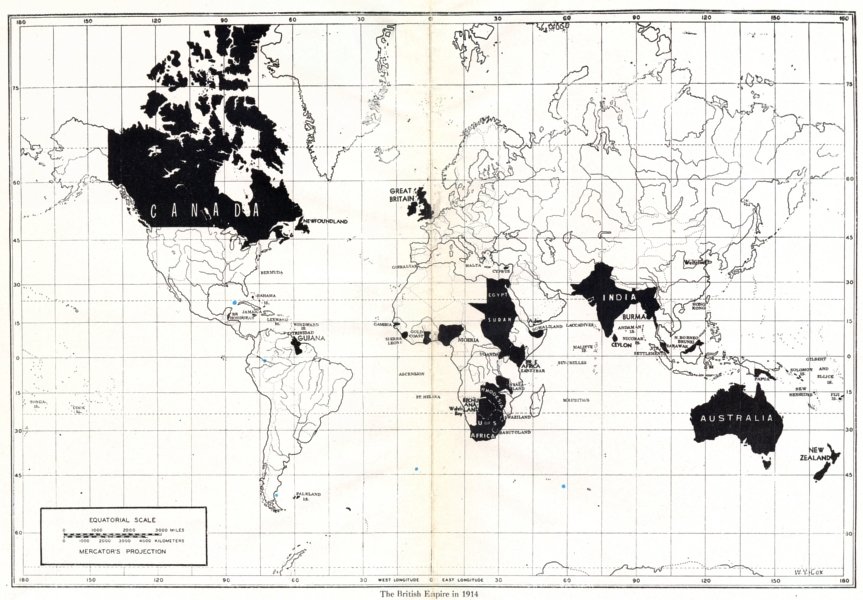
The British Empire in 1914 (via antiquaprintgallery.com)
But is it actually true that imperialism makes countries richer? Does imperialism make economic sense?
This question was already hotly debated at the heyday of imperialism. Adam Smith believed that the British Empire would not pass a cost-benefit test:
The pretended purpose of it was to encourage the manufactures, and to increase the commerce of Great Britain. But its real effect has been to raise the rate of mercantile profit, and to enable our merchants to turn into a branch of trade, of which the returns are more slow and distant than those of the greater part of other trades, a greater proportion of their capital than they otherwise would have done […]
Great Britain derives nothing but loss from the dominion which she assumes over her colonies.
He believed that Britain would be better off if it dissolved its Empire:
Great Britain would not only be immediately freed from the whole annual expense of the peace establishment of the colonies, but might settle with them such a treaty of commerce as would effectually secure to her a free trade, more advantageous to the great body of the people, though less so to the merchants, than the monopoly which she at present enjoys.
The liberal free-trade campaigner Richard Cobden agreed:
[O]ur naval force, on the West India station […], amounted to 29 vessels, carrying 474 guns, to protect a commerce just exceeding two millions per annum. This is not all. A considerable military force is kept up in those islands […]
Add to which, our civil expenditure, and the charges at the Colonial Office […]; and we find […] that our whole expenditure, in governing and protecting the trade of those islands, exceeds, considerably, the total amount of their imports of our produce and manufactures.
If imperialism was a loss-making activity – why did Britain and other European colonial empires engage in it for so long?
Smith and Cobden explained it in terms of clientele politics (or Public Choice Economics, as we would say today). Somebody obviously benefited, even if the nation as a whole did not. And the beneficiaries were politically better organised than those who footed the bill.
This proto-Public Choice case against imperialism was not limited to political liberals. Otto von Bismarck, the Minister President of Prussia and future Chancellor of the German Empire, hated liberals in the Smith-Cobden tradition, but he rejected colonialism in terms that almost make him sound like one of them:
The supposed benefits of colonies for the trade and industry of the mother country are, for the most part, illusory. The costs involved in founding, supporting and especially maintaining colonies […] very often exceed the benefits that the mother country derives from them, quite apart from the fact that it is difficult to justify imposing a considerable tax burden on the whole nation for the benefit of individual branches of trade and industry [translation mine].
In his writing about the economics of imperialism, even Michael Parenti, a Marxist-Leninist political scientist (who is, for obvious reasons, popular among Twitter hipsters), sounds almost like a Public Choice economist:
[E]mpires are not losing propositions for everyone. […] [T]he people who reap the benefits are not the same ones who foot the bill. […]
The transnationals monopolize the private returns of empire while carrying little, if any, of the public cost. The expenditures needed […] are paid […] by the taxpayers.
So it was with the British empire in India, the costs of which […] far exceeded what came back into the British treasury. […]
[T]here is nothing irrational about spending three dollars of public money to protect one dollar of private investment – at least not from the perspective of the investors.”
This leads us to a curious situation. Today’s woke progressives disagree with their comrade Parenti on the economics of empire, but they do agree with Britain’s old imperialists, who argued that the Empire was vital for Britain’s prosperity.
January 17, 2024
Look at Life – Kings of Speed
PauliosVids
Published 9 Dec 2018British racing drivers have always been at the forefront of this exciting sport. This film examines what has helped to put them in this winning position.
From the comments:
alastairbeaton5245
3 years agoThis was the 1959 British Grand Prix at Aintree. Jack Brabham, who won the race, went on to win the first of his three World Championships, clinching the title in the last race of the year at Sebring when, having run out of fuel, he pushed his car over the line to finish fourth.
Comments Off on Look at Life – Kings of Speed
January 14, 2024
Soviet and American Massive Attacks – Week 281 – January 13, 1945
World War Two
Published 13 Jan 2024In the East, the Soviets launch a massive series of new offensives. In the West, Monty holds an ill-judged press conference about the Battle of the Bulge. Operation Nordwind, the German offensive in Alsace, continues. In Hungary, there’s house to house fighting as the Red Army besieges Budapest. In Asia, the Allies wrestle with the Kamikazes, begin their landings on Luzon, and advance in Burma.
00:54 Intro
01:12 Recap
01:22 Montgomery’s Press Conference
05:53 Operation Nordwind
07:07 The battle for Hungary
09:38 The huge Soviet offensive begins!
12:22 American landings on Luzon
15:29 Anti-Kamikaze tactics
18:11 Slim’s advance in Burma
21:11 Conclusion
(more…)
Comments Off on Soviet and American Massive Attacks – Week 281 – January 13, 1945
The insane miscarriage of justice in Britain’s Post Office and the courts
The British Post Office (formerly the Royal Mail) has spent the last several years prosecuting many of its own staff for financial skulduggery uncovered by the Post Office’s computer system. Many people have been convicted and punished, yet it now comes to light that the real culprit is the faulty accounting methods used in the Post Office’s Horizon software:
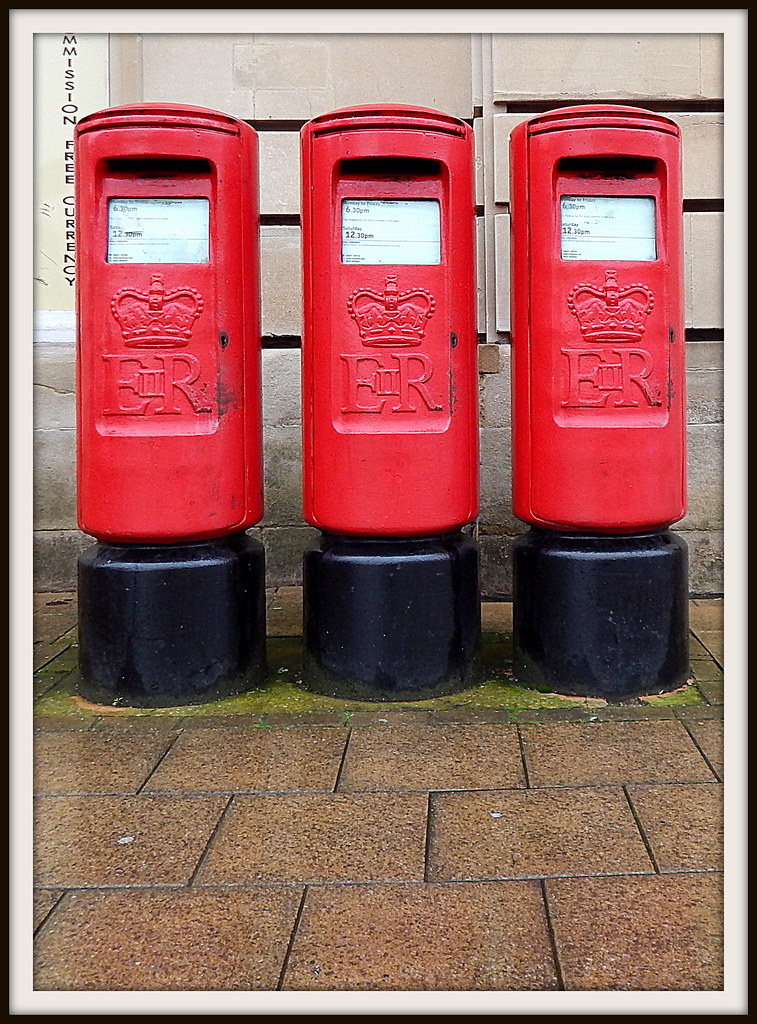
“Atten-SHUN! EIIR Red Pillar Boxes” by drivethr? is licensed under CC BY-SA 2.0 

 .
.
What went wrong at the Post Office over that Horizon computer system is being described as very difficult, complicated, we’ll never really find out and Whocouddaknowed?
This is not correct. The Post Office knowed, ICL knowed, Fujitsu knowed.
Therefore and thus, as I’ve said before, just Jail Them All. There will be some who will be able to argue their way out on the basis of their innocence and that’s fine, even great. But let’s start with everyone on the right side of the bars.
It’s long been — as I’ve said — common gossip among programmers that the base problem really was pretty base. The Horizon system counted incompletes as a transaction. So, a transaction is going through and it doesn’t quite make it. Communication problems, something. A sensible system looks at incompletes and ignores them. Only completes, fully handshaken and agreed, change the accounting ledgers. Horizon did not do this. It would count the incomplete as one transaction, then when the full one came through count that as an additional, extra, transaction.
This is how a branch thought it had one number, the centre another. Because the branch regarded the incomplete and the resend as only the one transaction, the centre as two.
But common gossip among programmers isn’t enough, obviously.
It’s bad enough that glitchy software could cause such human tragedy, but it’s worse: Post Office management knew and chose to cover it up.
Comments Off on The insane miscarriage of justice in Britain’s Post Office and the courts
January 13, 2024
It’s not lying lying
Paul Homewood on how Brits are propagandized through slanted reporting on the weather (which has always been a topic of interest in the British Isles):
Storm Gerrit arrived the day after Boxing Day, accompanied by the usual headlines: “85mph gales barrelled down on Britain”, screamed the Daily Mail.
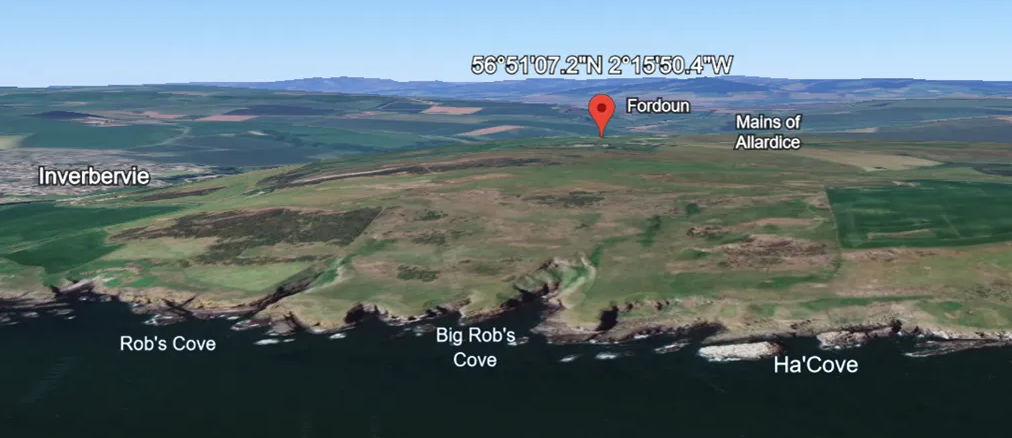
As usual the public were being deliberately deceived. The 85mph claim was based on one site in North East Scotland, at the top of a 400ft cliff overlooking the North Sea, marked in red below.
Inverbervie, Kincardineshire
A few miles away at sea level average wind speeds never got above 30mph. The Met Office never reports any of this, preferring to publish its favourite sites on clifftops or halfway up mountains.
It was the same story a week later, when another system of low pressure came along to be given yet another silly name, “Henk”.
“94mph winds pummel the UK”, shrieked the Mirror. This time the wind speeds were measured on the Met Office’s go-to weather station, the Needles, off the Isle of Wight. As this column has discussed before, the Needles sit at the end of a long, narrow peninsula, and the station is on top of a 260ft cliff. Winds there are routinely 30mph higher than even exposed sites nearby, such as St Catherine’s Point. Meanwhile average winds inland were typically around 30mph.
It rained as well last week! During the two days of Storm Henk, about an inch fell in parts of southern and central England. There is nothing at all unusual about this amount; it is the sort of thing which happens every year. Because the ground was already saturated, following wet weather last month, there was inevitably some flooding. But, for the most part, this was little more than flooded fields, overflowing river banks and localised flooding. Again, normal scenes in England. And as Patrick Benham-Crosswell pointed out in TCW this week, many houses built on flood plains were once again flooded. There was certainly none of the major river flooding which has hit the country many times in the past.
According to the Environment Agency, about 2,000 properties were flooded, a tragedy for everybody involved. But in overall terms, this is a tiny number. For instance, 55,000 were flooded in 2007.
Inevitably, the media jumped to blame it all on climate change. According to ITV: “Henk is the eighth named storm to have hit the country this winter and the pattern is likely to continue due to the effects of climate change. ‘This is climate change and the impacts we are seeing,’ the Environment Agency’s Tom Paget added. ‘We are seeing these increasingly wet and blustery winters. We are seeing storm upon storm which is exacerbating the issues’.”
Claims like this explain why the Met Office decided to start giving every low-pressure system a silly name back in 2015. But as it admitted in its State of the UK Climate last year, storms used to be much stronger:
The most recent two decades have seen fewer occurrences of max gust speeds above these thresholds [40, 50, 60 kts] than during the previous decades, particularly comparing the period before and after 2000.
This earlier period [before 2000] also included among the most severe storms experienced in the UK in the observational records including the “Burns Day Storm” of 25 January 1990, the “Boxing Day Storm” of 26 December 1998 and the “Great Storm” of 16 October 1987. Storm Eunice in 2022 was the most severe storm to affect England and Wales since February 2014, but even so, these storms of the 1980s and 1990s were very much more severe.
Nor is there any evidence that December or the autumn last year were unusually wet.
We look like getting a few weeks of cold, dry weather from now on – so expect drought warnings soon!
Comments Off on It’s not lying lying
January 11, 2024
Pushing back against the Colonialism Narrative
At Samizdata, Brendan Westbridge praises Nigel Biggar’s 2023 book Colonialism: A Moral Reckoning:

He examines the various claims that the “de-colonisers” make: Amritsar, slavery, Benin, Boer War, Irish famine. In all cases he finds that their claims are either entirely ungrounded or lack vital information that would cast events in a very different light. Amritsar? Dyer was dealing with political violence that had led to murder. Some victims had been set alight. Anyway, he was condemned for his actions by the British authorities and, indeed, his own standing orders. Slavery? Everyone had it and Britain was the first to get rid of it. Benin? They had killed unarmed ambassadors. Irish famine? They tried to relieve it but they were quite unequal to the size of the task. In the case of Benin he comes very close to accusing the leading de-coloniser of knowingly lying. The only one of these where I don’t think he is so convincing is the Boer War. He claims that Britain was concerned about the future of the Cape and especially the Simonstown naval base and also black rights. I think it was the pursuit of gold even if it does mean agreeing with the communist Eric Hobsbawm.
He is far too polite about the “de-colonisers”. They are desperate to hammer the square peg of reality into their round-hole of a theory. To this end they claim knowledge they don’t have, gloss over inconvenient facts, erect theories that don’t bear scrutiny and when all else fails: lie. Biggar tackles all of these offences against objectivity with a calmness and a politeness that you can bet his detractors would never return.
The communists – because they are obsessed with such things and are past masters at projection – like to claim that there was an “ideology” of Empire. Biggar thinks this is nonsense. As he says:
There was no essential motive or set of motives that drove the British Empire. The reasons why the British built an empire were many and various. They differed between trader, migrant, soldier, missionary, entrepreneur, financier, government official and statesman. They sometimes differed between London, Cairo, Cape Town and Calcutta. And all of the motives I have unearthed in this chapter were, in themselves, innocent: the aversion to poverty and persecution, the yearning for a better life, the desire to make one’s way in the world, the duty to satisfy shareholders, the lure of adventure, cultural curiosity, the need to make peace and keep it, the concomitant need to maintain martial prestige, the imperative of gaining military or political advantage over enemies and rivals, and the vocation to lift oppression and establish stable self-government. There is nothing morally wrong with any of these. Indeed, the last one is morally admirable.
One of the benefits of the British Empire is that it tended to put a stop to local wars. How many people lived because of that? But that leads us on to another aspect. Almost no one ever considers what went on before the Empire arrived. Was it better or worse than went before it? Given that places like Benin indulged in human sacrifice, I would say that in many cases the British Empire was an improvement. And if we are going to talk about what went before what about afterwards? He has little to say about what newly-independent countries have done with their independence. The United States, the “white” (for want of a better term) Commonwealth and Singapore have done reasonably well. Ireland is sub-par but OK. Africa, the Caribbean and the Indian sub-continent have very little to show for themselves. This may explain why Britain needed very few people to maintain the Empire. At one point he points out that at the height of the Raj the ratio of Briton to native was 1 to 1000. That implies a lot of consent. Tyrannies need a lot more people.
The truth of the matter is that talk of reparations is rooted in the failure of de-colonisation. If Jamaica were a nicer place to live than the UK, if Jamaica had a small boats crisis rather than the UK then no one would be breathing a word about reparations or colonial guilt. All this talk is pure deflection from the failure of local despots to make the lives of their subjects better.
Biggar has nothing to say about what came after the empire and he also has little to say about how it came about in the first place – so I’ll fill in that gap. Britain acquired an empire because it could. Britain was able to acquire an Empire because it mastered the technologies needed to do it to a higher level and on a greater scale than anyone else. Britain mastered technology because it made it possible to prosper by creating wealth. That in itself was a moral achievement.
Comments Off on Pushing back against the Colonialism Narrative
January 8, 2024
Royal Navy to retire their only two LPDs?
Sir Humphrey comments on the recently reported “leak” about several Royal Navy ships:
In an “inspired” leak that seems to fit the Yes Minister definition of a “Confidential Security Briefing”, the Daily Telegraph is reporting that the Royal Navy is to pay off two Type 23 frigates, HMS Argyll and Westminster early in order to find crew for the Type 26 frigates. Assuming this is true, this means that since 2010 the Royal Navy escort fleet will have been cut by 40%. Meanwhile the Times is reporting that the Royal Navy will mothball both LPD’s and no longer have an active amphibious assault ship command platform. This represents a 100% cut to the active assault ship force. The reasons given in both cases seem to boil down to the line that this is about providing sailors to crew the Type 26 frigate. It doesn’t seem to be linked to the rumoured huge budgetary challenges facing the MOD this financial year, which could equally be responsible for this decision.
There are different ways that this information can be interpreted depending on how you look at it. For starters we need to ask the question, why these two ships? The Type 23 force is elderly, with the ships intended for an original 18-year life span, worked hard in the North Atlantic and replaced quickly. They have all been extended in service for up to twice their original design life, while repeated delays to order the Type 26 has meant they are working far harder, and far longer than ever anticipated.
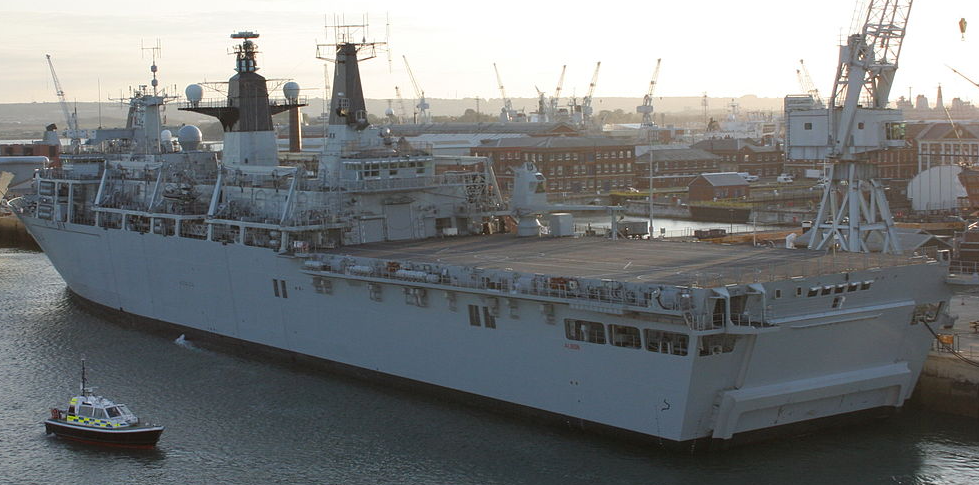
HMS Albion docked at Portsmouth, 26 July 2029.
Detail of a photo by David Crochet via Wikimedia Commons.These are ships designed 40 years ago, with the original Type 23 design dating back to the early 1980s. It is no exaggeration to say that there is almost certainly no one left in active regular service who was serving when the Type 23 design was first conceived. This means the design reflects the 1980s equipment and capabilities and standards – be it in the structure of the messes (large mess decks for junior sailors) or the internal wiring and machinery. While still capable, be in no doubt that these are elderly ships with all the many challenges that this brings. To make up for the many and varied delays to the Type 26, the RN has funded life extension work to the force for some years, fitting new missiles, guns and sonar equipment over time. The modern Type 23 is a far cry from its original design in equipment and capability, but it is still at its heart a 1980s warship.
Westminster had gone into refit in 2022 to begin the process of extending her life out to the late 2020s. The refit for Westminster would have cost around £100m to provide a further 4-5 years of service. while HMS Argyll had undergone the life extension process which would have seen a planned decommissioning in the late 2020s (the precise dates are not clear anymore due to the “odd” MOD decision to currently no longer provide this information on the grounds of operational security).
The LPD force by contrast is in a different position. The two ships Albion and Bulwark were built to replace the venerable Fearless class in the mid 2000s. For most of their career one has been in reserve while the other has been active, the same pattern as occurred with Fearless and Intrepid, where the latter spent years in increasingly poor state in reserve. The timing for this decision makes sense operationally as Albion has come to the end of her commission and was due to pay off into reserve, while Bulwark is still being regenerated in refit and hasn’t yet gone to sea. It would be possible to put both ships in reserve and free up a reasonable amount of sailors in the process.
The question is what is the impact on the fleet itself? Currently the RN probably has a requirement for 19 escort ships – “probably” is used as the MOD has refused to provide a statement on target force numbers in the two most recent Defence Reviews, so this is an assessment based on the 2015 Defence Review. That we have to rely on a near decade old defence review to guess how many escorts the RN plans to have speaks volumes for the manner in which the MOD engages with the taxpayer.
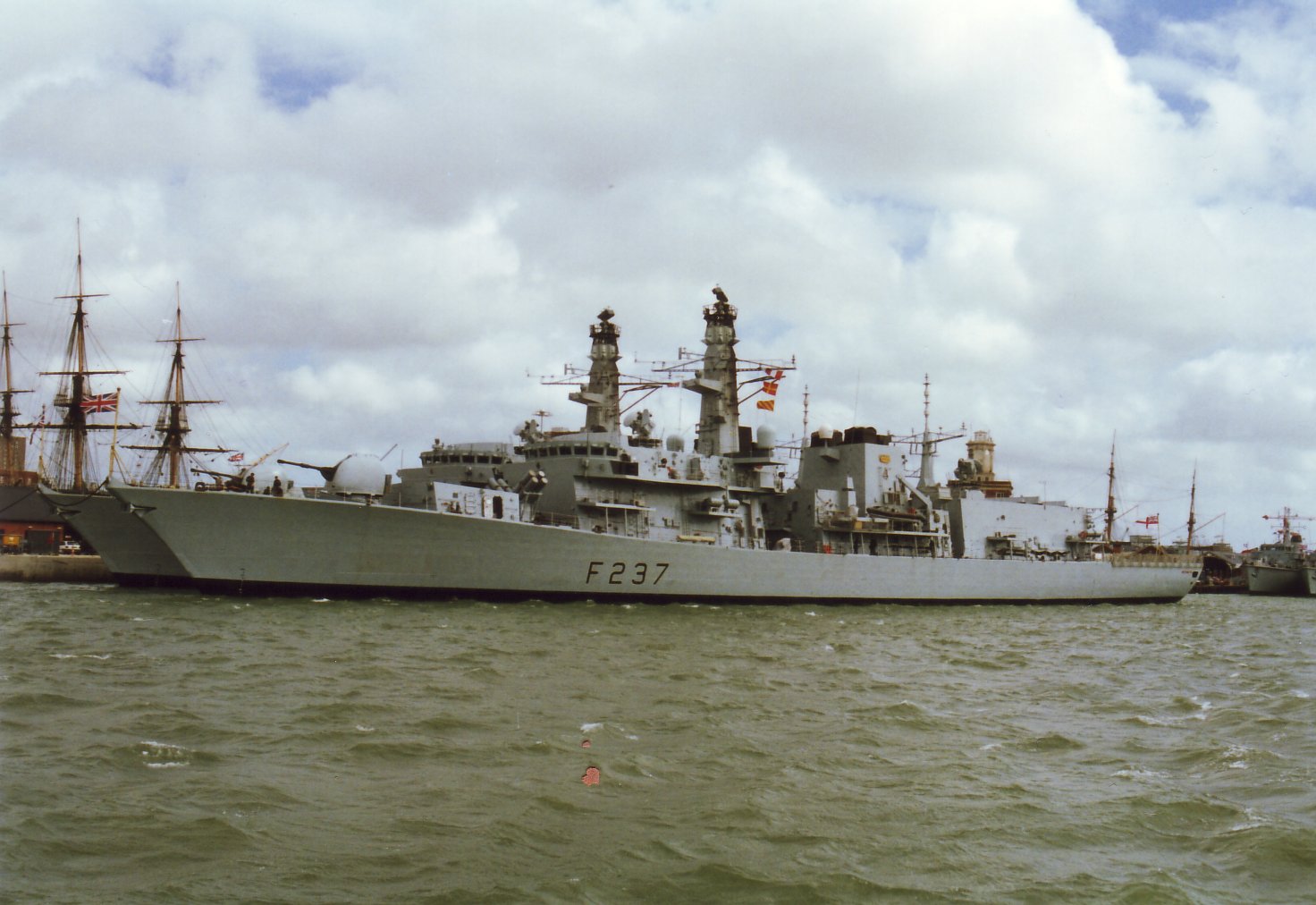
HMS Westminster (foreground) and HMS Iron Duke, Type 23 frigates of the Royal Navy, in the naval base of Portsmouth, August, 2000.
Image via Wikimedia Commons.
January 7, 2024
Evelyn Waugh’s horrible family
In the latest SHuSH newsletter, Ken Whyte explains why Evelyn Waugh drank:
Happy New Year! How were your holidays? Were you as festive as undergraduate Evelyn Waugh kicking off his Christmas break in 1924?
Then I went to Oxford. Drove to 31 St Aldates where I found an enormous orgy in progress. Billy and I unearthed a strap and whipped Tony. Everyone was hideously drunk except, strangely enough, myself. After a quiet day in cinemas, I had a dinner party of Claude, Elmley, Terence, Roger Hollis and a poor drunk called MacGregor. I arrived quite blind after a great number of cocktails at the George with Claude. Eventually the dinner broke up and Claude, Rogers Hollis and I went off for a pub crawl which after sundry indecorous adventures ended up at the Hypocrites where another blind was going on. Poor Mr McGregor turned up after having lain with a woman but almost immediately fell backwards downstairs. I think he was killed. Next day I drank all morning from pub to pub and invited to lunch with me at the New Reform John Sutro, Roger Hollis, Claude and Alfred Duggan. I ate no lunch but drank solidly and was soon in the middle of a bitter quarrel with the President — a preposterous person called Cotts — who expelled me from the club. Alfred and I then drank double brandies until I could not walk. He carried me to Worcester where I fell out of the window then relapsed into unconsciousness punctuated with severe but well directed vomitings. On Wednesday I lunched with Robert Byran at the New Reform and the man Cotts tried to throw me out again. Next day I lunched with Hugh and drank with him all the afternoon and sallied out with him fighting drunk at tea time when we drank at the New Reform till dinner… Next day, feeling deathly ill, I returned to London having spent two months’ wages. I had to dine with Alex, Richard Greene, Julia Strachey … and then back to Richard’s home for a drink. …
[…]
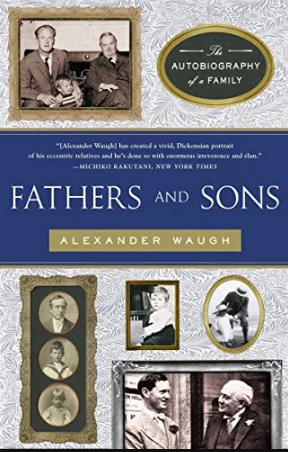
I picked up Alexander Waugh’s Fathers and Sons: The Autobiography of a Family (2004), several weeks ago. I’ve been enjoying it so much that I’m rationing it, reading about ten pages at a time to make it last.
Alexander Waugh is a music writer and biographer, former opera critic at the Evening Standard, son of novelist and Private Eye diarist Auberon Waugh, grandson of the aforementioned Evelyn, the titan of English letters whose brother, Alec, and father, Arthur, were also reasonably famous writers. The book is about the interpersonal relations of these three generations of men who produced about 180 books among them. And it’s wild. These are hugely and incorrigibly flawed people. Often horrible to one another (also to outsiders but they save their best for kin). They are in equal parts perverse and hilarious, and often brilliant, especially Evelyn. I can’t believe people ever behaved this way.
Undergraduates have never required reasons to binge drink, but you can’t read the opening chapters of Fathers and Sons without thinking Evelyn had special motivation. He was the second son of Arthur. His older brother, Alec, was “the firstling”, the “future head of the family”, their parents’ “darling lamb”, and mom and pop didn’t care who knew it, least of all Evelyn.
Arthur and his missus, Kate, had an “unbounded fascination for Alec”, who won all his school honours and was star of the cricket team. Arthur considered the boy a literal gift from God and believed that they could communicate telepathically. He would write him notes like: “I simply go about thinking of your love for me all the time”. Their relationship, writes Alexander, was “hot, clammy and compulsive”, and to the “objective eye their behavior might have resembled a pair of star-crossed teenage lovers”. Indeed, it was romantic in all but the physical sense — Arthur saved his sexual depredations for girls of tender age with whom he played “tickling games” (he also had a fetish involving young women and bicycles).
In addition to being second born, Evelyn made the mistake of being male. His parents had wanted a daughter; they consoled themselves by giving him an effeminate name and dressing him in bonnets and frills long beyond the standard of the day. He was said to be a “warm, bright. sweet-natured and affectionate child”, at least until an awareness of the family dynamic dawned. In Edwardian terms, he was treated as a bastard child by his legitimate parents. His possessions were hand-me-downs. He attended the less expensive school. When eleven-year-old Evelyn asked for a bicycle, his parents bought a bigger and better one for Alec. When Alec asked for a billiard table, space was found for it in Evelyn’s room. Despite winning prizes and becoming head of his house in school, and president of the debating society, and editor of the school magazine, Evelyn remained an afterthought and something of a nuisance in the minds of his Alec-obsessed parents.
Evelyn responded to his circumstances in a clever and self-protective fashion, defining himself against his brother and father. By adolescence, he had an inkling that he was smarter and funnier than both. They could keep their mawkish outpourings of emotion toward one another; he would be hard of head and sharp of tongue. By his early teen years, he was confiding to his diary that Arthur was a fat and “ineffably silly” Victorian sentimentalist. He considered both Alec and Arthur philistines. “Terrible man, my father”, Evelyn said to a schoolmaster. “He likes Kipling.”
To the extent that his parents thought about Evelyn, they were disturbed by his dark moods and lassitude, and intimidated by his cynical wit. Both Alec and Arthur were threatened by Evelyn as a potential literary rival. When Evelyn, in what was becoming a typical act of rebellion, ran up an expensive restaurant tab and had it sent to an outraged Arthur, Alec said: “You know father, if Evelyn turns out to be a genius, you and I might be made to look very foolish by making a fuss over ten pounds, seventeen and ninepence.”
So you can perhaps see how young Evelyn Waugh developed an enthusiasm for drink remarkable even in an undergrad, and why the rare characters killed in gruesome fashion in his fiction tended to be fathers.
Comments Off on Evelyn Waugh’s horrible family
1945 Begins! – WW2 – Week 280 – January 6, 1945
World War Two
Published 6 Jan 2024The Germans launch a new offensive, Operation Nordwind, in Alsace, even as their offensive in the Ardennes is stalled. The Allies in the west don’t just have to fight these, they are also having serious issues amongst themselves in High Command that threaten their unity. The siege of Budapest is in full swing and is a hard, fought, bloody battle, and the Soviets and the Americans have big plans for new offensives soon to kick off in Eastern Europe and the Philippines (respectively).
00:00 INTRO
01:20 The Siege of Budapest
04:51 German defense plans in the East
06:38 Montgomery versus Eisenhower
08:32 Eisenhower versus the French
10:35 New German Offensive in Alsace
13:49 Monty’s plans for the press
15:04 The Battle of the Bulge
17:45 Preparations for the Luzon Landings
20:56 Notes to end the week
21:51 Summary and conclusion
(more…)
Comments Off on 1945 Begins! – WW2 – Week 280 – January 6, 1945
“Of course, you know that you Eeenglish invented modern people smuggling?”
In The Critic, Peter Caddick-Adams talks about the huge problems faced by European nations in combatting people smuggling:
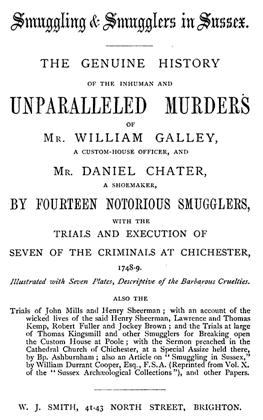
Title page of a book covering the trial of seven smugglers for the murder of two revenue officers. In the preface the author says “I do assure the Public that I took down the facts in writing from the mouths of the witnesses, that I frequently conversed with the prisoners, both before and after condemnation; by which I had an opportunity of procuring those letters which are herein after inserted, and other intelligence of some secret transactions among them, which were never communicated to any other person.”
W.J. Smith, Smuggling and Smugglers in Sussex, 1749, via Wikimedia Commons.
The Prime Minister has nailed his colours to his mast and decided we should “stop the boats”. The slogan is everywhere. What Mr Sunak means is the vessels crossing the Channel laden with bedraggled folk seeking succour on the shores of Albion. I attended a conference recently to see how this was to be done. As the perpetrators are highly organised transnational criminals, the response must be a multi-national one. Delegates were given some historical context. Ours is not a unique era. Since pre-recorded history, mankind has been inclined to see the grass as always greener on the other side of the fence. Hollow out a log to cross a river, invade an island, a coastline, Troy, the Euphrates, the Tigris, the Nile. Anywhere, for trade, for adventure, for sanctuary. Leap the Channel by longship to escape overcrowding, poor crops, for plunder, to claim a crown.
However, we were reminded — for the conference was hosted by several coastal nations studying security and crime — that most of Europe’s maritime problems with criminality and smuggling, be it booze, tobacco, narcotics, fake branded goods, or people, involve rivers, not the open sea. An old friend from the Gendarmerie Maritime observed that the great rivers of the world are not only frontiers, but also highways; earlier versions of today’s motorways, as logistically familiar to the Romans as to our own times. Those long gaggles of barges which still shuffle along the Rhine or Danube are a happenstance of trade we Brits tend to overlook, as our canals and rivers have long been consigned to pleasure-boating.
Based in Messina, the gendarme’s opposite number from the Servizio navale of the Italian Carabinieri, wearing the most resplendent braid-laden uniform of anyone at our gathering, then fixed me with his gimlet eye. “Of course, you know that you Eeenglish invented modern people smuggling?” By this he went on to explain that many of the tricks of shifting people covertly through the Mediterranean, along the Dalmatian coast, by patrol boat about the Baltic, trawler braving the North Sea, MTB across the Channel, caïque over the Aegean, among the Ionian islands, and along the Adriatic, were devised by Britain’s Special Operation’s Executive (SOE) during the Second World War.
My Belgian and French friends observed that such smuggling had honourable roots. From 1789 and post-1917, many nations had aided middle class and aristocratic refugees to flee Revolutionary France and Russia. Subsequently, their descendants helped Jewish families quit the Third Reich. Others aided the British to move vast numbers of manpower by small boat in 1940 from Dunkirk, which emboldened fishermen to repeat the manoeuvre on a smaller scale to confound their German foes. Female Greek, Turkish and Croatian officers chipped in with their knowledge of various rat-lines established during World War Two to support partisans with personnel and weapons, and extract downed airmen, spies and important scientists. Post-war, as a Spanish policeman I knew from my days in Gibraltar observed, the same systems exported Nazi war criminals, and imported drugs and guns.
The modus operandi created in those heady days of derring-do were continued for spies during the Cold War, often by the same families, using the same craft. This applied as much to jaunts and japes up and down the Danube, Rhine, Meuse and Elbe waterways as it did to the open seas. Our Danish representative observed that “boat people” were a distraction. Their numbers were vastly overshadowed by far greater numbers of religious refugees and assorted shady characters, then and now, who used stolen genuine, or expertly forged papers; another legacy from the even more distant times that preceded World War Two. The man from Interpol revealed that today’s Italian and Albanian crime families have such advanced facilities for reproducing many of the world’s passports, ID cards, work permits and driving licences, that they will pass muster even at most European electronic frontier posts and airport controls. Our Albanian colonel shifted uncomfortably.
With the fall of the Iron Curtain, espionage went out of business and, casting about for new business, these latter-day privateers and licenced black marketeers started smuggling industrial quantities of things and people, to replace the nocturnal movement of atomic secrets by night over water. A dinghy full of people in mid-Ocean is merely the tip of a giant iceberg of organisation and logistics that started on 22 July 1940 by direct order of Winston Churchill, but has continued in various legal, semi-legal and illegal forms ever since.
Comments Off on “Of course, you know that you Eeenglish invented modern people smuggling?”
January 6, 2024
Inside Mark I: The First Fighting Tank
The Tank Museum
Published 15 Sept 2023The first ever use of the tank in battle happened during the Battle of the Somme in 1916. In this video we look inside a unique survivor – the last British Mark I Heavy Tank in existence and examine the first tank action at Flers, an event that changed the face of warfare.
(more…)
Comments Off on Inside Mark I: The First Fighting Tank
January 4, 2024
“It is difficult to understand why our politicians are not locked up for life after successful prosecution for crimes against humanity”
Part nine of Paul Weston‘s “beginner’s guide to Covid”:

Lockdown was never referred to as “lockdown” in March 2020. We were “asked” to stay at home for a few weeks, thus allowing our health services to get up to speed without being swamped. As we now know, a few weeks became months became 2021.
I simply cannot believe this was not planned. The logistics involved in keeping a country afloat after closing down the economy are extremely complicated. Months – if not years – of planning must have gone into it.
One of the strangest things about the first lockdown in the UK was the enforcement date of March 26, one week after the government declared on March 19 that Covid-19 was being downgraded from a High Consequence Infectious Disease (HCID). The reason given for the downgrade was a low mortality rate …
Anyway, the world locked down. When it became apparent the lockdowns were going to stay in place until a miracle vaccine was discovered, the governments promised us that detailed cost/benefit analyses would be conducted. They never were. But they very much should have been.
The principal reason they should is all to do with deaths. Closing down the country also meant partially closing down health services to non-Covid patients. Inculcating fear meant many people were too scared to go anywhere near a hospital. Patients with cancer and heart problems stayed away, voluntarily or involuntarily. Many died as a result.
On July 19 2020, the Daily Telegraph published an article based on Office for National Statistics figures claiming that 200,000 people could die (mid to long term) in the UK due to lockdowns. Similar figures were published in countries all around the world.
Here is a brutal truth. Governments which locked down essentially stated the following: “We are going to murder XYZ thousand people. We undertake this crime because we think we might save other people from Covid-19 deaths.”
Even more remarkably, the death rates were completely normal before lockdowns were initiated. Lockdowns were not the forced result of having to deal with large numbers of deaths. Rather, large numbers of deaths were the forced result of government-ordained lockdowns. It is difficult to understand why our politicians are not locked up for life after successful prosecution for crimes against humanity.
Comments Off on “It is difficult to understand why our politicians are not locked up for life after successful prosecution for crimes against humanity”
January 1, 2024
Michael Palin’s Great-Uncle Harry
In The Critic, Peter Caddick-Adams reviews Michael Palin’s Great-Uncle Harry:
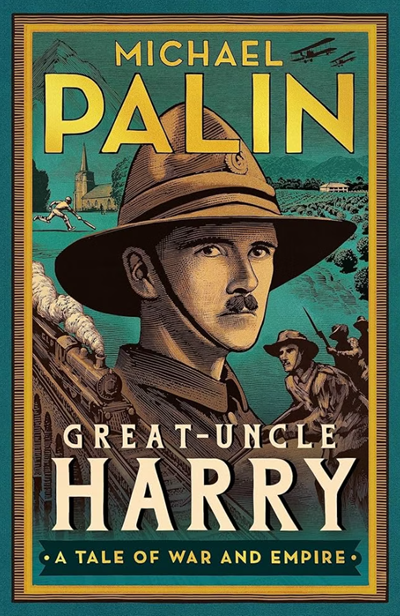
The first of last week’s volumes nestling on my desk, with its immediately identifiable Ripping Yarns cover illustration, was Sir Michael Palin’s story of his forebear, Great Uncle Harry, who travelled the world but disappeared on the Somme. Here, I felt an immediate connection, not least because Michael, I and his Great Uncle Harry Palin had hauled ourselves through the same academy of learning, Shrewsbury School, though at different times. There are plenty of 1914-18 memoirs and tributes around, but this is one of the best. The further the Great War (as it used to be called) recedes, the more we seem to need to torture ourselves with the staggering sacrifices it involved. I read my copy over Remembrance weekend, which made it doubly poignant.
In Great Uncle Harry, Palin’s gift is to give us the hinterland of his ancestor. Many First World War authors, here I could mention the great Lyn Macdonald, Richard Holmes and Martin Middlebrook, all of whom I place on pedestals, provide us with erudite studies, laced with gripping eyewitness accounts. I find myself doing the same with 1939-45, but of necessity there is no room to give the brave and the damned a back story. They are parachuted into the text. They fight and live or die and exit stage left. It is refreshing, therefore, to hold the hand of a first war warrior from birth unto death. Palin was lucky his Great Uncle Harry kept a series of notebooks and diaries of his time in khaki, and was able to research his globe-trotting years before battle. Our man was brought up in Herefordshire, and after school drifted out to British India. He had two stints, first working as a railway manager and latterly as overseer on tea plantations. The reader is fortunate that Palin the documentary-maker filmed in both environments and is able to look over his forebear’s shoulder and summon up the Edwardian social standards of the day, with its solar topees and chota pegs (sunset whiskeys), its heat and its dust. Palin the younger’s many diaries and written travelogues, of which I find New Europe (2007) the best, are equally good.
But Great Uncle Harry Palin was restless. The youngest and most headstrong of seven, he flounced out of each of his two jobs serving the Raj, and ended up trying his hand at farming in New Zealand. There he seemed more settled, but not quite. The Palin under the microscope, notes his great nephew, was one of the first to volunteer for war service with the 12th (Nelson) Regiment, a South Island infantry outfit, in August 1914 and sailed with them overseas, initially to Egypt. There they were absorbed into the Canterbury Battalion, and deployed to Gallipoli, from which Great Uncle Harry emerged without a scratch.
Gallipoli is a conjurer’s name. Now known by the Turks as their Gelibolu Peninsula, overlooking the ancient Hellespont (today’s Dardanelles Strait), its southern tip lies 200 miles from what was then Turkey’s capital, Constantinople, officially Istanbul after 1930. Only since the 1990s has this strategically significant sliver of land, across the Dardanelles from ancient Troy, and guarding entry to the Bosphorus and Black Sea, been opened up for tourists. The 1915 operation was dreamt up by Winston Churchill to break the stalemate of the Western Front. He advocated a naval advance on Constantinople, as a way of knocking the Austro-German alliance out of the war. Such a stratagem would then have offered Paris and London the ability to supply the troops of Tsar Nicholas the Last with modern arms and munitions to prevail against the Central Powers.
Instead of breaking the Western Front, Gallipoli broke Churchill. It was a campaign endlessly refought in the inter-war years, which generally concluded that amphibious warfare had no future, though Lieutenant Colonel George S. Patton in his 1936 General Staff study, The Defense of Gallipoli, found it fascinating. It was one reason why the allies had no maritime landing capability in 1939-40, to Britain’s detriment at Dunkirk, and later Germany’s disadvantage when planning a seaborne assault against southern England. Valuable lessons of what to do, and not to do, had to be relearned before D-Day in 1944 could be a success. My own assessment is right idea, wrong commanders. Gallipoli might have offered the success Churchill desired, but was executed poorly.
The original plan had been to overwhelm Constantinople with battleships, and there is evidence that the Turks were preparing to surrender. However, the Franco-British war fleet encountered German-supplied Krupp cannon along both shores of the Dardanelles and a minefield in the middle, and suffered catastrophic losses. A land campaign was then initiated to clear the Turkish land-based defences. This should have been foreseen and a simultaneous, rather than sequential, maritime-land attack might well have delivered the goods.
Instead, the few Turkish defenders on Gallipoli could see a landing was imminent, called in reinforcements and dug trenches ferociously. On the peninsula, amidst scrub, trench and memorials lie scattered British, Commonwealth, Ottoman and French (yes, they were there too) cemeteries, hinting at stirring tales of derring-do. Last time I was there, I encountered not only rifle cartridges, pieces of pottery rum jars, and shell cases, but human bones. My guide observed, “Probably wild pigs dislodging the topsoil. It happens all the time.” An indication of the 300,000 Allied and 255,000 Turkish killed, wounded and missing in a campaign where illness often took as many as combat wounds. Along the western coast, amidst shards of amphorae from pre-history, lie many wrecks associated with the 1915 campaign in crystal-clear water. It remains high on my recommended battlefields to visit.
Comments Off on Michael Palin’s Great-Uncle Harry
“On numerous occasions in 2023 I’ve been tempted to go places with a placard saying ‘Ultimi barbarorum‘”
Brendan O’Neill in Spiked:
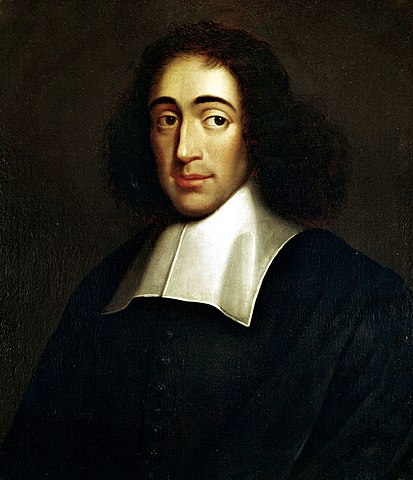
Portrait of Benedictus de Spinoza (1632-1677)
Unknown artist, from the Herzog August Library via Wikimedia Commons.
My favourite story about Spinoza concerns the time he lost his cool. A philosopher, a Jew and history’s finest defender of Enlightenment, Spinoza was normally a picture of quiet reason. But when he heard about the lynching of Johan and Cornelis de Witt he became gripped by an uncommon fury. The de Witt brothers were key political figures in the Dutch Republic, the enlightened new nation in which Spinoza enjoyed such great liberty to think and write. On 20 August 1672, at The Hague, they were set upon by a ferocious mob that held them responsible for the invasion of the republic by a French-English alliance. They were murdered, mutilated and clumps of their flesh were eaten.
Spinoza was enraged. He made a plan to visit the site of the mob’s savagery to hold a one-man protest. Think Greta Thunberg, but enlightened. He prepared a placard to hold up. But his landlord restrained him, fearing he too would be slain by the mob. And so history was denied the image of one of our great philosophers staging a lonely, angry protest. What did his makeshift placard say? It had two words on it. “Ultimi barbarorum“. Rough translation: “You are the greatest of barbarians”.
This year more than any other I’ve understood how Spinoza felt. On numerous occasions in 2023 I’ve been tempted to go places with a placard saying “Ultimi barbarorum“. To the kibbutzim of southern Israel following Hamas’s fascistic savagery against the Jews there on 7 October. To George Washington University after students projected the words “Glory to our martyrs” on the side of the library building: young Americans of unimaginable privilege taking pleasure in the butchery of Jews. To the lovely, leafy campus of Columbia in New York City where students planned to hold a meeting on Hamas’s stirring “counter-offensive”. To those “pro-Palestine” marches in London at which the morally treacherous middle classes marched alongside individuals dressed as Hamas terrorists and extremists chanting for yet more slaughter in Israel: “Jihad, jihad, jihad!”
To New York University where students shouted, “We don’t want no Jew state / We want all of it”: a cry by the comfortable for Hamas to finish the genocidal job of eliminating Jews in the Middle East. To the streets of Manhattan where protesters shouted “Shame on you!” at an Israeli woman whose daughter was kidnapped and brutalised by Hamas. Shaming the victims of racist terror – a low even for the unhinged woke. To any gathering of politically minded Gen Zers, to be frank, after polls found that huge numbers of them view Jews as an “oppressor class” and believe Hamas’s pogrom was “justified”. And to the Sydney Opera House, where radical Islamists chanted “Gas the Jews” and “Fuck the Jews” mere days after Hamas murdered the Jews. Nazi-style parades, uncontained glee at genocidal violence, on the streets of a Western city.
At every place I’ve wanted to say “Ultimi barbarorum“. To call out both barbarism and its intellectual apologists. To express Spinoza-style disgust for these new enemies of Western civilisation. For make no mistake, that’s what they are. From Hamas to the radical Islamists in Europe who feel inspired by Hamas to the West’s own sons and daughters of privilege who make excuses for Hamas – all have proven themselves in 2023 to be the adversaries of truth, culture and reason. Surely no one will now deny that Western civilisation is under assault on two fronts: from without and within?
The West’s bourgeois left loves to larp as Marxists, often quoting the great Rosa Luxemburg: “Socialism or barbarism!” This year we discovered which side of that clash they take – it isn’t Luxemburg’s. The apologism for Hamas in privileged circles has been mind-blowing. Hamas’s bestial violence against the Jews has been denied, downplayed or outright justified. A “day of celebration” is how one privately educated pretend radical in Britain described the racist butchery of 7 October. This sympathy with barbarism, this receptiveness to acts of staggering dehumanisation, goes beyond Israelophobia. It speaks to more than the witless hate for Israel that’s been rampant in right-thinking circles for years.
Comments Off on “On numerous occasions in 2023 I’ve been tempted to go places with a placard saying ‘Ultimi barbarorum‘”


