
World War Two
Published 22 May 2022When Air Marshal Arthur Harris and Reichspropagandaminister Joseph Goebbels agree that a lot of death and destruction is not enough death and destruction, the world is in trouble.
(more…)
May 23, 2022
Drowning Germans, Burning Jews – WAH 061 – May 22, 1943
Comments Off on Drowning Germans, Burning Jews – WAH 061 – May 22, 1943
May 22, 2022
Axis Prisoners Face French Wrath – WW2 – 195 – May 21 1943
World War Two
Published 21 May 2022The Allies have won the battle for Africa, but now they have nearly 250,000 POWs to care for, and do not have the facilities to do so. The Trident Conference continues in Washington to try and decide the direction of the Allied war effort, but they launch the Dambuster Raids this week in Germany to try and cripple German water power — and thus, industry — with a new type of bomb.
(more…)
Comments Off on Axis Prisoners Face French Wrath – WW2 – 195 – May 21 1943
May 20, 2022
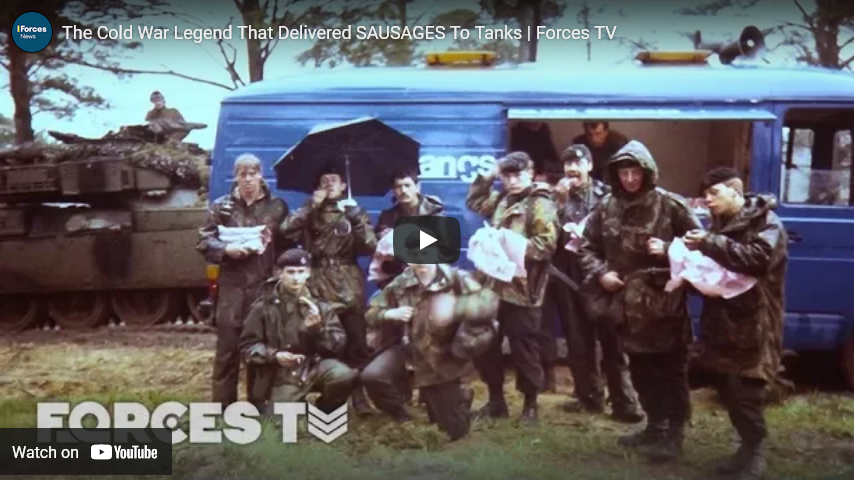
The Cold War Legend That Delivered SAUSAGES To Tanks | Forces TV
Forces News
Published 26 Apr 2018To British troops based in north Germany in the last two decades of the Cold War, he was a legend. But this was no commando or member of the special forces.
Check out our website: http://forces.net
Twitter: https://twitter.com/ForcesNews
Comments Off on The Cold War Legend That Delivered SAUSAGES To Tanks | Forces TV
May 18, 2022
Trident: The Allied Plan to Win the War – Time Ghost News Flash
World War Two
Published 17 May 2022Washington, May 1943. It was the largest Anglo-American conference of the war so far. With the Axis being defeated in North Africa, the Mediterranean, and New Guinea, the need to agree on new strategic goals arose inside the Combined Chiefs of Staff. A new course of action was to be set against Italy, Japan, and Germany to capitalize on the recent successes. But debates and old dilemmas heated up when it came to resources, manpower, and the question “where to attack next”.
(more…)
Comments Off on Trident: The Allied Plan to Win the War – Time Ghost News Flash
L119A2: The New British SOF Rifle
Forgotten Weapons
Published 24 Jan 2022http://www.patreon.com/ForgottenWeapons
https://www.floatplane.com/channel/Fo…
Cool Forgotten Weapons merch! http://shop.forgottenweapons.com
Around 2013, the UK MoD began looking for a new rifle to replace the Special Forces’ L119A1. Those A1 rifles were getting old, and something new was needed — and there was some thought that a new rifle could improve on some shortcomings of the A1 model. The new rifle was produced by Colt Canada (formerly Diemaco), and it was procured in both 10″ and 15.7″ barrel lengths (note that the rifle in this video has a 16″ barrel to avoid being an SBR).
The most distinctive feature of the new L119A2 was the licensed LMT monolithic upper receiver. This was used because it allowed solid mounting of devices like lasers on the side rails. However, it had major shortcomings in terms of heat retention and cleanability. The A2 also now used a MagPul CTR stock, and Geissele triggers (an excellent improvement from the A1’s MILSPEC trigger). The same Surefire suppressors were used, as were the optics from the A1s — the new A2 tender did not include new optics (nor funding for them).
Very few photos are known showing the L119A2. It came into service around 2016 or 2017, and entered public awareness after Christian Craighead was photographed using one in the Nairobi Westlands mall siege in 2019.
Contact:
Forgotten Weapons
6281 N. Oracle 36270
Tucson, AZ 85740

Comments Off on L119A2: The New British SOF Rifle
May 17, 2022
Mary Whitehouse, “The avenging angel of Middle England”
At First Things, Jonathon Van Maren considers the legacy of Mary Whitehouse, the often mocked champion of public decency and crusader against pornography and blasphemy in the media from the mid-60s onwards:
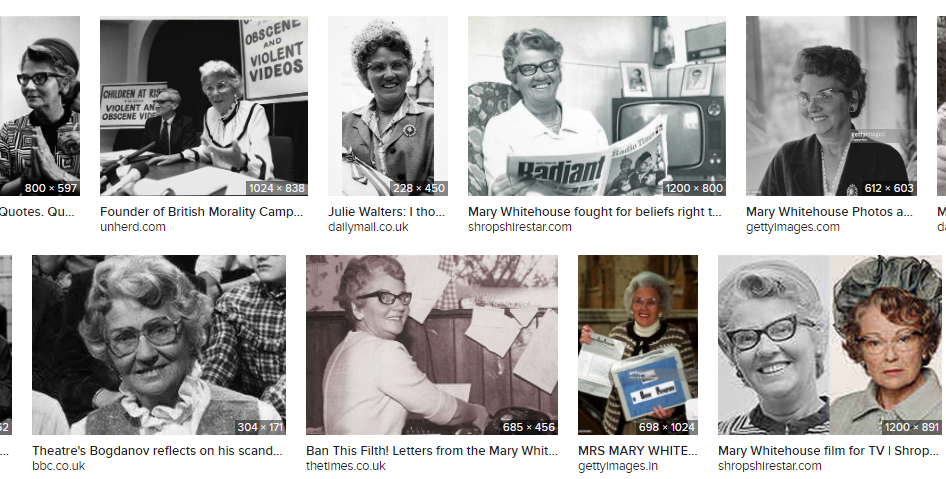
I was surprised to find few public domain images of Mary Whitehouse available, so here is a selection of thumbnails (hopefully this won’t violate any copyright restrictions)
We have reached the point where our post-Christian elites, having safely enshrined the sexual revolution in law, can afford the luxury of occasionally admitting that their opponents were right. Exhibit A is the new BBC documentary Banned! The Mary Whitehouse Story, which details the life of Great Britain’s most infamous morality campaigner. Beginning with a crusade to keep smut and blasphemy off TV in 1964, Whitehouse rallied hundreds of thousands of women (and ordinary Britons) to her campaigns against “the permissive society”, culminating in her war against the porn industry. Alas, she lost most of her battles — but her warnings proved prophetic.
Mary Whitehouse was born in Warwickshire in 1910. She first started organizing in the 1960s because she — and millions of other mothers — did not like what her children were seeing on TV. A committed traditional Christian, she watched with dismay as the country she loved began to change around her. The metropolitan elites she faced off with thought she was “a provincial Birmingham housewife”. They didn’t underestimate her for long. She hosted her first mass meeting in 1964, and her organizing skills soon highlighted the subterranean power of Britain’s women. Whitehouse tapped into the gardening associations, the mothers’ unions, and other grassroots community organizations filled with folks who cared deeply about their children and the moral fabric of their nation. She brought them together, and when she spoke, it was with the voices of legions of little people. Her nickname summed it up: “The avenging angel of Middle England”.
Whitehouse’s first major campaign was to “Clean Up TV”, and her parliamentary petition to that end garnered around 500,000 signatures. In 1971, Whitehouse began organizing against sex ed in schools, triggered by an “educational” video she saw that was filled with pornographic scenes. Whitehouse was accused of hysteria — but Banned! features a pornographer admitting that, by using sex ed, “we gradually pushed back the barriers”, much as Whitehouse warned they would. Now that they’ve won, they can admit they were lying.
Whitehouse and others appalled by attempts to corrupt their children were accused of being “horrified by sex”. In reality, they were horrified by the version of sex presented by sex educators — in much the same way an art lover would be appalled to see vandals approaching a great masterpiece with cans of spray-paint and lewd laughter. Progressives never understood this, and consequently Whitehouse has been almost entirely defined by what she fought against rather than what she fought for.
Whitehouse’s lobbying resulted in several pieces of legislation, including the 1981 Indecent Displays Act, which sought to restrain sex shops and the display of porn, as well as the 1984 Video Recordings Act, intended to limit the sale of extreme video content. Unfortunately, these acts were rendered moot by the internet. But her greatest achievement was the 1978 Protection of Children Act, which criminalized child pornography. It seems remarkable that such a law did not already exist, but in the ’70s the Paedophile Information Exchange (PIE) was operating openly in Britain; it was supported by some British elites who believed that sex with children was the natural next step in sexual liberation.
Comments Off on Mary Whitehouse, “The avenging angel of Middle England”
May 16, 2022
Heaviest Air Raid in Human History – WAH 060 – May 15, 1943
World War Two
Published 15 May 2022As the Warsaw Ghetto Uprising is being quashed, there are renewed Japanese atrocities in China, and the RAF sets a world record by bombing German civilians.
(more…)
Comments Off on Heaviest Air Raid in Human History – WAH 060 – May 15, 1943
The Hudson’s Bay Company in Canadian history
As a kid growing up in the late 60s and early 70s, “The Bay” was just a department store. It wasn’t as upscale as Eaton’s, but had different stock than Eaton’s or Simpson’s so occasionally you’d find something there that wasn’t available in the other major central Canadian department stores. It took me an embarrassingly long time to make the connection between the big retail store in the mall and the company that owned vast swathes of what eventually became Canada in the seventeenth and eighteenth centuries. At Terra Nullius, Ned Donovan tries to put that massive geo-political organization into context:
At the turn of the 17th Century, felt hats were all the rage and felt hats are made of beaver skin. At the time, this relied on Russia’s long-established fur trade. But as demand grew, quality dropped significantly as the native European beaver population began to be hunted out of existence. Within decades, it was very difficult for merchants to find high quality felt from Russia, and customers in England were complaining that they were having to wear felt made from rabbit instead.
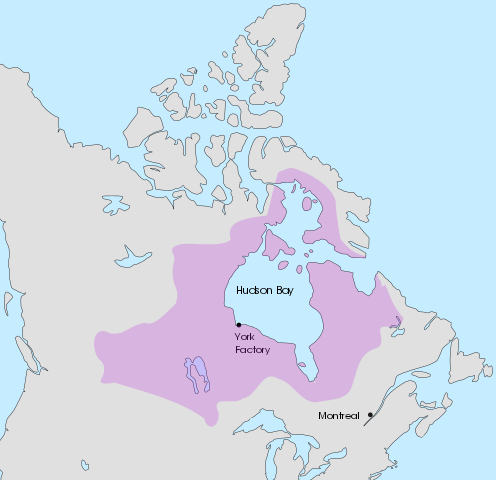
Approximate extent of Prince Rupert’s Land in the late 17th to early 18th century – note that this is the range of the company’s trappers and traders, not military or political control.
Image from Wikimedia Commons.But around the same time, irregular and rare shipments began to arrive from the European colonies in North America where beaver – mostly trapped by French settlers and Indigenous Americans – was still plentiful and of very good quality. In 1669, the ship Nonsuch dropped anchor in the Thames with a large shipment of some of the highest quality furs London had ever seen, selling them immediately for £1,233 (equivalent to around £1 million in 2022). The Nonsuch had led an expedition invested in by some of London’s richest merchants and sponsored by Prince Rupert, a first cousin of King Charles II. It had done its trapping in Hudson’s Bay in the north of what is now Canada. The purpose of the expedition was to demonstrate that the issues with fur supply could be solved if its trapping in North America could be optimised, leaving behind the slow and traditional approach of the French and First Nation trappers.
This was not the first time Prince Rupert had seen to make money from exploiting colonised lands, having poured large amounts of his wealth into the slave trade from West Africa and sitting on the board of the Royal African Company. With this financial success made from trading in human lives, he turned his interest to North America and helped put together the syndicate that sent the Nonsuch to Hudson’s Bay. In 1670, his cousin King Charles II granted the syndicate a royal charter to form the Hudson’s Bay Company, giving the company a monopoly over “Prince Rupert’s Land” made up of the land drained by rivers and streams flowing into Hudson’s Bay – or 3,861,400 square kilometres.
In short order, the company had established trading posts throughout its monopoly, known as factories (as each was controlled by a company official known as a factor). The only thing that mattered to these factories and its parent company was beaver. Nothing could stand in the way of ensuring the safe passage of furs and pelts to Europe. By 1690, the demand in England for hats and caps was five million per year – or one per person. Hundreds of thousands more would be exported onwards from England to Europe such was the demand for the well-known quality of the Hudson Bay beaver. For example in 1756, Portuguese customers spent more than £20 million in today’s money on English beaver felt hats.
As Prince Rupert’s Land was largely still wilderness, besides company staff it was inhabited only by European and First Nations trappers and as a result there was only a barter economy, to both subjugate indigenous residents and prevent private wealth. There were standardised prices throughout Prince Rupert’s Land and instead of a normal currency, the company instead pegged everything against the unit of 1MB (1 Made Beaver). For three made beaver pelts, you could be given one clay pot in exchange at a company store, or for 10 you could get a gun. Private trading was outlawed and all beaver pelts that left Prince Rupert’s Land traveled through the warehouses and accounts of the Hudson’s Bay Company.
Comments Off on The Hudson’s Bay Company in Canadian history
Look at Life — The Flying Soldier (1965)
PauliosVids
Published 20 Nov 2018A look at helicopter training within the British Army.

Comments Off on Look at Life — The Flying Soldier (1965)
QotD: The difference between surface meaning and actual intent
A basic truism is that languages don’t map exactly over each other and that’s the most likely explanation for this database from China detailing “BreedReady” women. That languages don’t map exactly should be obvious even to the most monolingual of English speakers. We all know that “Let’s have lunch sometime” when said by an American means “Hope to see you never and definitely not while eating”. Similarly, “That’s lovely” when said by a Brit does not necessarily mean it is lovely and “How quaint” isn’t praise for the cuteness of the thing. A Californian invocation to meet Tuesday is in fact a rumination on the possible non-existence of Tuesday.
Tim Worstall, “That Chinese ‘BreedReady’ Database – Check The Translation”, Continental Telegraph, 2019-03-11.
Comments Off on QotD: The difference between surface meaning and actual intent
May 15, 2022
The End of the War in Africa – WW2 – 194 – May 14, 1943
World War Two
Published 14 May 2022With the end of the Tunisian Campaign, the Allies have won the war for the African Continent. What next? They meet at the Trident Conference in Washington DC to try and figure that out. Meanwhile, the fight in the field continues — in Burma, the Aleutians, China, and the Kuban.
(more…)
Comments Off on The End of the War in Africa – WW2 – 194 – May 14, 1943
The young man who might have been King Henry IX of England
In the latest Age of Invention newsletter, Anton Howes considers what might have been had the eldest son of King James I and VI lived to take the thrones of England and Scotland:
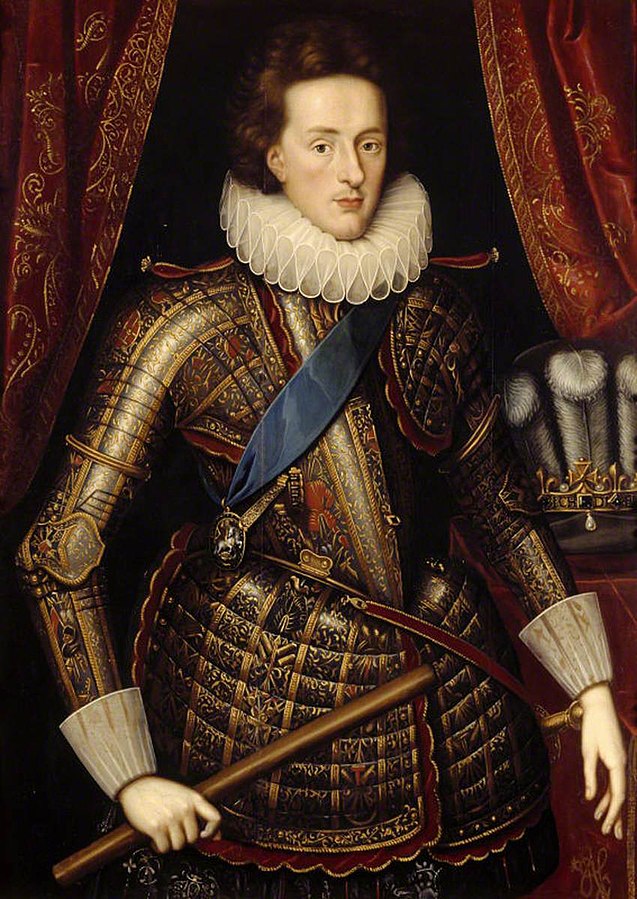
Portrait of Prince Henry Frederick (1594-1612), Prince of Wales by Isaac Oliver
National Trust, Dunster Castle; http://www.artuk.org/artworks/prince-henry-frederick-15941612-prince-of-wales-99804 via Wikimedia Commons.
Henry Frederick, Prince of Wales, was the eldest son and heir of James I of England. He would presumably have become Henry IX had he managed to outlive his father. But he died in 1612 aged just 18. The kingdom instead ended up with his younger brother Charles I and civil war. I’m not sure how far Prince Henry was influenced, but it seems that many of the major innovators of the period were purposefully cultivating him as a kind of inventor-scientist king.
It reminds me of a very similar and successful scheme, which I noticed when researching my first book on the history of the Society for the Encouragement of Arts, Manufactures and Commerce. This was the scheme to cultivate George III — famed for his madness and losing the Thirteen Colonies, but also for his collection of scientific instruments and interest in agricultural innovation. Those interests were no accident: his upbringing had included lessons in botany from the inventor Stephen Hales, in art and architecture from William Chambers, and in mathematics from George Lewis Scott. These were not just experts, but active innovator-organisers. Hales was a key founder of the Society of Arts; Chambers helped organise the artists who split off from it to form the Royal Academy of Arts; and Scott was involved in updating Ephraim Chambers’s Cyclopaedia, or Universal Dictionary of Arts and Sciences — an early encyclopaedia focused on technical knowledge. And their efforts bore fruit. Unlike his predecessor and grandfather George II — whose interests mainly fell under the headings of Handel, Hanover, hunting, and heavy women — George III became an active patron of science, invention, and the arts.
Given how successfully the inventors cultivated George III, it makes me wonder how things might have looked had Prince Henry lived to be king. His younger brother Charles I had an education heavily geared towards languages, theology, and overcoming various health issues through sports. But Henry — naturally athletic and charismatic — had an upbringing tightly controlled by Sir Thomas Chaloner, who had a major financial stake in innovation.
Chaloner housed and supported his alchemist cousin (also, confusingly, called Thomas Chaloner). This cousin had published an early treatise on the medical applications of saltpetre, or nitre (what we now call potassium nitrate), and had tried to produce alum on the isle of Lambay, off the coast of Ireland. Alum was a valuable substance used to fix cloth dyes, which had hitherto been monopolised by the Pope, who owned Europe’s only alum mine. Opening a competing, English-controlled, Protestant supply of alum was not just about starting a new industry. It was a matter of Europe-wide religious and strategic urgency.
[…]
Henry’s circle also included the Dutch polymath Cornelis Drebbel, who would become famous all over Europe for travelling in a submarine under the Thames, for his improvements to microscopes, and for inventing a perpetual motion machine (which isn’t as silly as it sounds — it was effectively a kind of barometer, exploiting changes in temperature and air pressure to move).
And that’s just the tip of the iceberg. The more I look into the circle of inventors around Prince Henry, the more familiar names crop up. There even seems to be some connection to Simon Sturtevant, one of the original patentees of a method to make iron by using coal instead of wood — Chaloner was seemingly responsible for evaluating Sturtevant’s inventiveness, to see if he merited a patent. I found it very striking that when Sturtevant’s iron-making business was about to get going, Prince Henry was to have a share.
Given such innovative company, we can only imagine what kind of a king Prince Henry might have been. If George III grew up to be “Farmer George”, might a Henry IX have become associated with navigation or hydraulic engines? We’ll never know. But even during his brief lifetime, there was plenty of patronage to be had for inventors at the court of their would-be Inventor-King.
Comments Off on The young man who might have been King Henry IX of England
QotD: Parliament
Winston S. Churchill, speech around the time of the Munich crisis, 1938.
Comments Off on QotD: Parliament
May 14, 2022
Operation Chariot, the “Greatest Raid of All”
The raid on the French port of St. Nazaire in March 1942, codenamed “Operation Chariot” by the British, was one of the most daring and successful special forces operation of the Second World War. In The Critic, Richard Hopton reviews a new history of this operation by Giles Whittell:
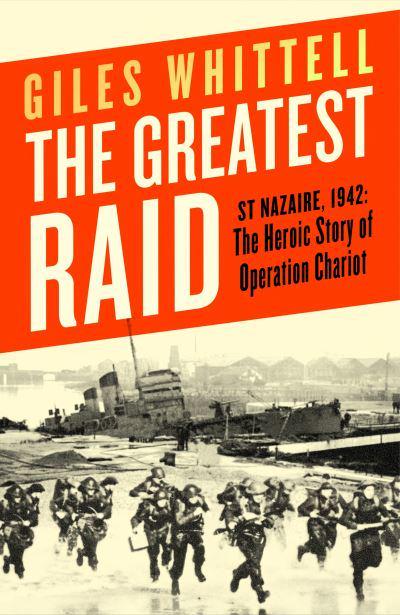
Operation Chariot, the Raid on St Nazaire, has long been known as “The Greatest Raid of All”. The audacity of the plan, the lethal danger of the operation, the inadequacy of the equipment provided, the astonishing courage of the participants and the spectacular success of its primary object have ensured its place in the annals of British martial heroism.
In the early hours of 28 March 1942, a force of 623 commandos and naval personnel stole up the Loire estuary to attack the port of St Nazaire. Leading the force was HMS Campbeltown, a superannuated destroyer acquired from the Americans, which had been converted into a floating bomb by the addition of four tons of high explosive secreted in her bows.
The plan was that she would ram the steel gate of the port’s immense dry dock where the charge would explode, demolishing the dock gate. The commandos would then swarm ashore to attack the dockyard installations, particularly the pumps and winding mechanisms which operated the dry dock. With the dock out of action, Hitler would not risk his battleship Tirpitz in the Atlantic where she could wreak havoc among the convoys supporting the war effort in Britain. This was the immediate, supposed object of the raid.
Giles Whittell’s new book is not the first full-length history of the event. C.E. Lucas-Phillips’s account, The Greatest Raid of All, was published in 1958 followed 40 years later by James Dorrian’s Storming St Nazaire, which remains the most detailed, authoritative account of the operation. In 2013 Robert Lyman published Into The Jaws of Death which told the story of the raid anew, with a greater concentration on the genesis and planning of the operation.
In 2007 Jeremy Clarkson took time away from messing around with cars to make a documentary for the BBC about the raid. The result was an “affectionate and enthralling” piece of television which brought the exploits of the Charioteers — as the men who took part in the raid have always been known — to a wider audience.
Although the ostensible object of the raid was to discourage the Germans from risking the Tirpitz in the Atlantic, it is now known that, by the spring of 1942, the German high command had already decided to keep the battleship moored safely in a distant Norwegian fjord. Accordingly, destroying the dry dock at St Nazaire was, strategically, a futile gesture.
Comments Off on Operation Chariot, the “Greatest Raid of All”
UK Special Forces’ M16 Variant: the L119A1
Forgotten Weapons
Published 21 Jan 2022http://www.patreon.com/ForgottenWeapons
https://www.floatplane.com/channel/Fo…
Cool Forgotten Weapons merch! http://shop.forgottenweapons.com
—
UPDATE: One correction to make; this rifle has the A2 charging handle. The original A1 version was essentially identical to the standard conventional charging handle. Sorry!
—In 1999, the UK Ministry of Defense put out a tender for a new rifle for UK Special Forces (UKSOF). The elite units of the British military were definitely not going to be using the L85! There was some competition (including the SIG 550 series), but it was pretty much known going in that the contract would be going to Diemaco (later Colt Canada) for a version of their C8 SFW (“Special Forces Weapon”). That was the case, but only after very extensive trials, which actually cost more than the procurement contract itself. The rifles were tested in all environmental extremes, including Alaska, Kuwait, and Brunei.
The rifle ultimately adopted had a number of unique features. It was at heart a Diemaco C8, with Diemaco’s early flat top upper (which predates Picatinny adoption, and is actually a bit closer to Weaver — but still compatible with modern accessories). Two barrel lengths were purchased, 10.0 inch and 15.7 inch. Other details include:
Stepped buffer tube
Textured telescoping stock
Permanently attached rubber buttplate
Lone Star grip
Knight’s RAS with locking clamps on both top and bottom rails
Strengthened gas block (usually but not always)
SureFire 216-A flash hider
Unique castle nut details
Ambidextrous charging handleThe barrel profile chosen for the L119A1 is quite heavy, and the 10 inch barreled version is substantially overgassed. The guns were heavy, but very reliable, and have since been adopted as the standard service rifle of the Royal Marines. The SOF opted to seek out a replacement around 2013-2016, and that would result in the L119A2 (a significantly different rifle).
Contact:
Forgotten Weapons
6281 N. Oracle 36270
Tucson, AZ 85740

Comments Off on UK Special Forces’ M16 Variant: the L119A1


