
… Why aren’t there more bright, ambitious young men going into [professional football] coaching?
I say the answer is: Institutional incentives. I’m not a football coach, but I was an academic — there’s a surprising amount of overlap in their institutional structures. Let me explain: In both cases, working conditions for everyone except those at the very tippy-top are brutal. We’d all willingly endure them, I think, for the kind of money and bennies big league coaches / tenured professors get, but below that tiny handful of folks everyone works even worse hours for far less compensation. Even coaches at dinky little high schools in the middle of Flyover Country spend countless hours breaking down film — he might only have fifteen kids on the team, but he’s expected to win with those fifteen kids, damn it, and win now.
Consider, then, what type of person would willingly sign up for such a life. Leave aside the question of whether or not what academics do has any intrinsic value. The fact remains that simply writing one’s dissertation takes, at minimum, a year or two of grinding toil. I’m the laziest sumbitch in captivity, and nobody’s better than me at gaming the system (especially a droolingly stupid system like academia), but even I pulled more 80+ hour weeks in grad school than I care to remember. It’s simple economics: You’ve got X dollars in grant money to hit the archives. Archives are always located in expensive cities in distant states, if not on different continents. Your X dollars run out pretty goddamn fast in a place like London, even when you’re staying at the cheapest hostel, living on ramen noodles and water, walking everywhere. Given that, you work, for as long as they’ll let you in the building, for as long as your eyesight holds.
And all that is to complete the bare minimum requirement for the possibility — by no means anywhere near the certainty — of securing an entry-level job. I’d ask “Who in his right mind would ever do that?”, but the answer is obvious: Nobody in his right mind would. You have to either really, really want to be an academic (coach), or have absolutely no other choice. Most academics, of course, are the latter — they’re twitchy closet cases with the social skills of autistic badgers. But wannabe-coaches, I hypothesize, face a similar dilemma: You’re an athlete who has made his living off his body. And a nice living it was, too, while it lasted … but now you’re 35 and your body just can’t do it anymore. You have no other skills. What else is there to do, but try coaching?
Severian, “Organizational Behaviour in the Human Male”, Rotten Chestnuts, 2019-09-23.
August 10, 2022
QotD: “Most academics [are] twitchy closet cases with the social skills of autistic badgers”
August 2, 2022
QotD: Basic College Girl (aka “Becky”)
That’s the effect on guys, at any rate. Bad as that is, it’s far worse on girls. Guys establish social hierarchy through conflict; when they can’t compete with each other, they drop out and embrace the Ritalin Zombie lifestyle of video games and onanism. Girls compete through approval-seeking, which, since nowadays nobody’s different from anybody and everyone’s the best at everything, is easily channeled into conspicuous consumption. Hence all the items on that list.
For the Basic College Girl, then, conformism is a virtue. In fact, it’s the highest virtue — the “winner” is the one who does nothing, says nothing, thinks nothing but that which gets upvoted on social media …
… or downvoted on social media, as the case may be. Self-esteem culture has completely bypassed the normal feedback loops. Back in the days of meatspace-only communication, strong signals of disapproval from your peers were, 99 times out of 100, clear indicators that you’re doing it wrong. If the kids are making fun of your personal hygiene, then unless your name really is “Dick Smelley”, you need to take a long hard look at your showering habits. Kids can be horribly cruel, but most of the time they’re not wrong. And yes, bullying can (and often did) go overboard, but generally “stop being such a dork!” is great life advice, and the process of figuring out just what you’re doing that’s so dorky, and how to stop it, is crucial for one’s social development.
Social media changes all that. Anyone who has ever written a blog post — really, anyone who has ever made a substantive comment on a blog post — has had the experience of some drive-by troll shitting on you. As functional adults who grew up in meatspace we recognize this for what it is, and ignore it. But imagine that you hadn’t grown up in meatspace. What if you mistake this for substantive criticism? As it’s not psychologically sustainable to take it that way for long, you do what the Basic College Girl does: You call the commenter a “h8r” and, crucially, you consider having “h8rs” as confirmation that whatever you’re doing is right. After all, they couldn’t “h8” if they weren’t thinking about you.
Thus “approval-seeking”, a.k.a. chick competition, curdles into an attitude where you actively seek out “h8rs” to annoy.
This is where Normals grossly underestimate women like Alexandria Ocasio-Cortez. I’m personally terrified of AOC, because she is the embodiment of the Basic College Girl. Basic College Girls can’t be bargained with, they can’t be reasoned with, and the reason for both is: Both “bargaining” and “reasoning” imply that you think she’s doing something wrong, which is “h8”. And since “ur h8in”, that means you’re thinking about her more than she’s thinking about you, which means she’s validated, which means she wins. Which means she’s not only going to keep on doing what she’s doing, but will crank it up past 11, in order get more h8, to attract more h8rz.
This is our future. Since the only way to deal with a Basic College Girl is to say “no” — all the time, to everything, unconditionally — and we as a society have lost the ability to do that, we’re screwed. Get to know your new mistress. Xzhyr name is Becky, and she’s everywhere.
Severian, “The Basic College Girl”, Rotten Chestnuts, 2019-07-24.
July 24, 2022
Still no actual evidence of unmarked graves for Residential School children
In Quillette, Jonathan Kay updates the year-old sensational stories about First Nations children being buried in unmarked (in more unhinged reporting it might have been “mass”) graves on the grounds of former Residential Schools in Canada:
Canada’s unmarked-graves story broke on May 27th, 2021, when the Tk’emlúps te Secwépemc First Nation reported the existence of ground-penetrating radar (GPR) data that indicated regularly spaced subterranean soil disturbances on the grounds of a former Indigenous Residential School that had operated in Kamloops, BC between 1893 and 1978. In addition, the First Nation’s leaders asserted their belief that these soil disturbances corresponded to unmarked graves of Indigenous children who’d died while attending the school.
The story became an immediate sensation in the Canadian media; and remained so for months, even after the GPR expert on whom the First Nation relied, Sarah Beaulieu, carefully noted that the radar survey results didn’t necessarily indicate the presence of graves — let alone graves that had been unmarked, graves of Indigenous people, or graves of children. Contrary to what many Canadians came to believe during that heady period, GPR survey data doesn’t yield X-ray-style images that show bodies or coffins. What it typically shows are disruptions in soil and sediment. Investigators then need to dig up the ground to determine what actually lies underneath.
An explanatory image posted by GeoScan, a Canadian Ground-Penetrating-Radar service provider, showing how mapped GPR data can indicate the possible presence of graves.
Image via Quillette.But those details were swept aside during what, in retrospect, appears to have been a true nation-wide social panic. As other Indigenous groups announced that they’d be conducting their own GPR surveys, media figures confidently asserted that the original Canadian Residential-School student death-toll estimate of 3,201 would soon double or even triple. One op-ed writer went so far as to declare that “the discovery of the graves of the children in Kamloops may be Canada’s Holocaust moment.” Dramatic, tear-drenched acts of public atonement unfolded everywhere, with many July 1st Canada Day celebrations being either cancelled or transformed into opportunities for morose self-laceration.
I was one of many Canadians who initially got swept up with all of this — in large part because it seemed as if everyone in the media was speaking with one voice, including journalists I’d known and respected for many years. Looking back on the coverage, I note that headline writers mostly skipped over the technical bits about soil dislocations and such, and went straight to “bodies” and “graves”. And the stories often were interspersed with credulous recitations of dubious tales featuring live babies being thrown into furnaces or buried alive.
The whole mission of Canada’s church-run Residential School system was to assimilate Indigenous people into white Canadian society, usually against their will, while forcing children to leave their families and communities for months or even years at a time. No one disputes that many students were subject to cruel (and sometimes even predatory) treatment and substandard medical care. Certainly, the death rate for Indigenous children attending these schools was much higher than that for children in the general population. No, I never bought into the idea that there was any kind of mass-murder plot going on at these schools. But it hardly seemed far-fetched that some victims of mistreatment and neglect had been buried in unmarked graves — “off the books”, so to speak—by malevolent white teachers, school administrators, and priests seeking to evade responsibility for their actions.
The other important aspect to mention is that — like most other Canadians, I’m guessing — I believed we were only a few days or weeks from seeing real physical evidence plucked from the earth. So it didn’t much matter to me that early commentators were temporarily playing fast and loose with the distinction between GPR data and actual corpses.
Canadians were being told that the old orchard in Kamloops where the GPR data had been collected was a crime scene — a site of mass murder, and the final resting place of 215 child homicide victims. As I’ve reasoned elsewhere: If you told Canadians that, say, 215 murdered white children were buried somewhere in Toronto, or Ottawa, or Vancouver, there’d be investigators and police crawling all over the place, looking for remains that could be tested and identified. And so I naturally assumed the same thing soon would be happening in Kamloops.

But … no. Not at all, in fact.
As I wrote over a year ago, the way the story swept the media was as if the whole Residential School history was somehow new and previously unknown:
Despite being Canadian, my interest in Canadian history centres mostly on economic, naval, and military aspects, but I was certainly aware that the residential school system was a black mark on Canada’s historical dealings with First Nations and that the general outline of events — if not the gruesome details — had been known for many years. The first time I found out about it was in middle school, through what we’d now call a “Young Adult” novel about a young First Nations boy escaping from the residential school he’d been sent to and his attempts to travel hundreds of miles to get home. I read it in the early 70s and it may have been published up to a decade before then (I no longer remember the author’s name or the title of the book, unfortunately).
If I, as a schoolchild, knew something of this fifty years ago, why have people younger than me been shocked and appalled to be hearing about this widespread tragedy for the first time now?
July 12, 2022
Ed West – “Farewell then, Boris Johnson, and to paraphrase another leader who had rather lost the support of his front bench, what an artist dies with him”
Outgoing (in several senses) British PM Boris Johnson was a political throwback in many ways:

Prime Minister Boris Johnson at his first Cabinet meeting in Downing Street, 25 July 2019.
Official photograph via Wikimedia Commons.
Johnson was the most amusing prime minister in living memory, but also the most historically aware. The first British political leader since Harold Macmillan to read classics, he was hugely influenced by the ideas of the ancient world, in particular Fortuna. And as Tom Holland reflected in last Friday’s The Rest is History, this obsession with the classics guided his career.
Classics, Holland said, had once been a “how to do politics” course, from the time of Machiavelli to the aristocrats of the 18th and 19th centuries, seen as a guide to “how to behave morally and politically”. This became especially important as elites in Europe and America came to consciously imitate the ancients — five Victorian and Edwardian prime ministers read classics — but “that has not been the case for many, many years”.
Johnson in that way “is a throwback. He is someone for whom classics is central to his education, but I think the thing that is intriguing about it is that he studied it as an example of how to get ahead. He had a properly Greek/Roman understanding of Fortuna, Tyche, chance, this great goddess who has her favourites. He genuinely, in an inchoate sense but in a sense that does seem to be authentic, saw himself as fortune’s favourite, but of course it’s the essence of tragedy, the cruelty and humour of Fortuna, that she raises her favourites up only to hurl them down. The joke that fate has played on Johnson is a particularly cruel one.”
It’s hardly surprising that Boris believed in Fortuna, considering just how much she smiled on him. A little over a year ago I wrote about how incredibly fortunate Boris was to become leader in the middle of a seismic demographic shift that would make life very difficult for the Tories in just a few years.
It was all the more incredible because, just 12 months earlier, it appeared that Boris’s luck had finally run out. Having done everything to climb the greasy pole, Johnson had achieved his goal only for his dreams of power to turn sour. Apollo had fired his arrow at Britain and Boris was left with a country overrun by disease and necessitating authoritarian measures that repulsed him; soon he was sick himself, and it looked like he might follow his idol Pericles a bit too much by dying of the plague.
July 11, 2022
QotD: The sad plight of the academic
Boredom is, in fact, the modern West’s signature pathology. Nobody with a rich, full life — a rewarding job, some hobbies, family and friends — bothers about “intersectionality” and whatnot. That’s not to say that Normals don’t get bored. However, for us boredom is a temporary feature of life. We know how to handle it; we have a zillion ways of killing time. What’s more important, we know that boredom’s just a part of life; it happens to the best of us.
For them, each episode of boredom is an existential crisis. They’ve convinced themselves that they have all the answers, that to be #Woke is to be a god among men. So if their lives aren’t 100% wonderful and fulfilling all the time — every second of every minute of every hour of every day — it throws the fundamental premise of their entire existence into question. It it any wonder, then, why they’re constantly hyperventilating about everything? Without a constant infusion of drama, they have to face the fact that they’re just people, buggering through life with the rest of us.
Severian, “The Reluctant Revolutionary”, Rotten Chestnuts, 2019-04-05.
July 9, 2022
QotD: Chinese “technocracy”
When Xi Jinping first joined the Politburo Standing Committee in 2008, eight of its nine members were engineers. Paramount Leader Hu Jintao was a hydroelectric engineer. His second-in-command Wen Jiabao was a geological engineer. There were two electrical engineers, a petroleum engineer, a radio engineer, and two chemical engineers (including Xi himself). The only non-engineer was Li Keqiang, an economist.
And this was actually a low point in engineers’ dominance of Chinese power. The term before, 100% of Politburo Standing Committee officials had been engineers! What’s going on?
For one thing, Deng Xiaoping thought engineers were cool, and he was powerful enough to do whatever he wanted. A government made up entirely of engineers? Sure, whatever you say. And since the top echelons of Chinese government appoint their own successors, these engineers could appoint other engineers and so on.
But also: during the Cultural Revolution, about half of Chinese people who got degrees at all got engineering degrees. The Cultural Revolutionaries were really not big on education (according to one article, “Xi’s secondary education [was cut short] when all secondary classes were halted for students to criticise and fight their teachers.”) But engineering was useful for building factories, and so was grudgingly tolerated. That meant that of the people smart and ambitious enough to get into college at all, half did engineering.
The other half? I’m not sure. Law is a popular major for would-be politicians in the US, but here’s a Chinese person explaining why it doesn’t work that way in China (short version: China doesn’t have great rule of law, so lawyers don’t matter much and are low status).
Here is an article telling us not to take China’s engineer-kings too seriously. It argues that (aside from Deng’s original picks), most of them never did much engineering, and just studied the subject in school as a generic prestigious-sounding degree to springboard their government career. Chinese engineering curricula are easy, and powerful people frequently cheat or pay others to write their dissertations.Aside from a few of Deng’s personal picks, we should think of this less as “China is a magic place where rational scientists hold power”, and more as “for idiosyncratic reasons, social climbers in China got engineering degrees.” Certainly none of these people were selected for the Politburo on the basis of their engineering acumen. They got their power by bribing, flattering, and backstabbing people, just like everyone else.
In any case, Xi’s old Politburo class was the last one to be made primarily of engineers. The current Politburo has only one engineer — Xi himself.
Scott Alexander, “Dictator Book Club: Xi Jinping”, Astral Codex Ten, 2022-04-07.
July 1, 2022
Trying to reconcile the highly mediagenic “Residential School mass graves” stories with facts-on-the-ground
Prime Minister Justin Trudeau — never one to miss opportunities to preen before the camera and shed a performative tear or two — quickly ordered Canadian flags to half-staff when the stories about unmarked graves on the grounds of former residential schools spread across the world. Claims and accusations flew, based on ground-penetrating radar scans that didn’t actually prove that the surveyed land contained lost graves. Once the narrative was established, it provided many opportunities for First Nations organizations, activists, and Canadian and foreign politicians to moralize, condemn, and demand investigations, restitution, and apologies from the Catholic church (which ran over 40% of the residential schools), and the provincial and federal governments.
So, more than a year later … what has been investigated? Not much, it turns out:
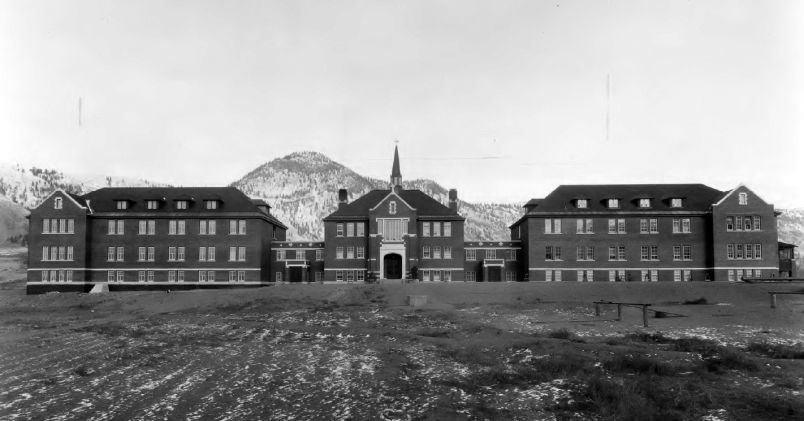
Kamloops Indian Residential School, 1930.
Photo from Archives Deschâtelets-NDC, Richelieu via Wikimedia Commons.
Sixty-eight Christian churches, mostly Roman Catholic, were vandalised or even burned to the ground. Many of these were historical church buildings still used and revered by native people. The pretext for arson and vandalism was that the Kamloops Indian Residential School had been run by a Catholic religious order, as had 43% of all residential schools. Imagine the outrage if 68 synagogues or mosques had been vandalised and burned. Yet the attacks on 68 Catholic churches passed with only mild criticism.
An article in the New York Times was typical of media commentary about the unmarked graves. It was first published under the headline “Horrible History: Mass Grave of Indigenous Children Reported in Canada” on 28 May and updated on 5 October under the same title. It asserted that: “For decades, most Indigenous children in Canada were taken from their families and forced into boarding schools. A large number never returned home, their families given only vague explanations, or none at all.”
Because the corporate press take their cue from the New York Times, its perspective echoed widely. The discovery of the so-called unmarked graves was chosen by Canadian newspaper editors as the “news story of the year”. And the World Press Photo of the Year award went to “a haunting image of red dresses hung on crosses along a roadside, with a rainbow in the background, commemorating children who died at a residential school created to assimilate Indigenous children in Canada”.
But the award this news report should have won is for fake news of the year. All the major elements of the story are either false or highly exaggerated.
First, no unmarked graves have been discovered at Kamloops or elsewhere. GPR has located hundreds of soil disturbances, but none of these has been excavated, so it is not known whether they are burial sites, let alone children’s graves. At her original press conference, the Chief of the Kamloops Indian Band called these findings unmarked graves, and the media, politicians, and even Pope Francis ran with the story without waiting for proof.
Similar claims from the chiefs of other Indian reserves ran into grave difficulty (no pun intended) because the GPR research was conducted in whole or in part on community cemeteries located near the sites of residential schools. It would hardly be surprising to find burial sites in a cemetery! But again, since no excavations have been conducted, it is not known whether these unmarked graves contain the bodies of children.
North American Indians did not conduct burials; they usually exposed the bodies of the dead to be worn away by predators and the elements. Christian missionaries introduced the practice of burial. But Indian graves were usually marked by simple wooden crosses that could not long withstand the rigours of Canadian weather. Thus Indian reserves today contain probably tens of thousands of forgotten unmarked graves of both adults and children. To “discover” these with ground-penetrating radar proves nothing without excavation.
Second, there are no “missing children”. This concept was invented by the Truth and Reconciliation Commission (TRC), whose members spoke at various times of 2,800 or 4,200 Indian children who were sent to residential schools but never returned to their parents. Indeed, some children died at residential schools of diseases such as tuberculosis, just as they did in their home communities. But the legend of missing students arose from a failure of TRC researchers to cross-reference the vast number of historical documents about residential schools and the children who attended them.
June 29, 2022
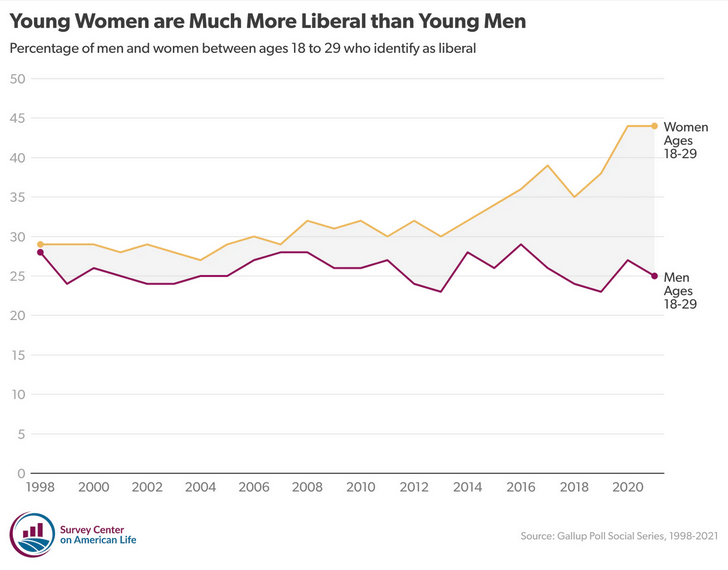
It’s not your imagination: young women are becoming more liberal
Daniel Cox looks at the noted shift in political opinions among young women (aged 18-29) compared to their male counterparts, and not just on the current hot-button topic of abortion rights:
… In fact, young women have become significantly more liberal over the past decade whereas the political identity of young men has remained largely unchanged over time.
Rise of Unmarried Women
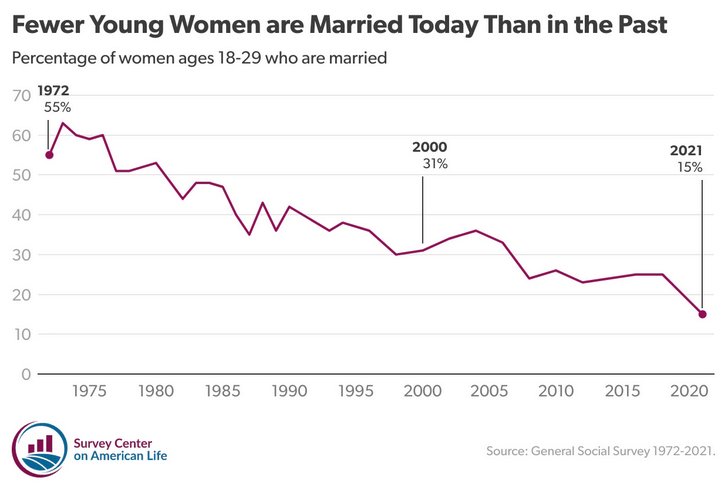
There are a few reasons for the increasingly liberal politics of young women. One explanation may lie in their marital status. Compared to previous generations of young women, far more women under the age of 30 today are unmarried. Only 15 percent of young women today are married compared to more than one-third of young women two decades ago.
Why does this matter? Research has shown that unmarried women feel more connected than their married counterparts to other women — a phenomenon known as “linked fate” — and it can lead them to support more liberal policies. In their fascinating 2017 study, Christopher T. Stout, Kelsy Kretschmer, and Leah Ruppanner argue that “women consistently earn less money and hold less power, which fosters women’s economic dependency on men. Thus, it is within married women’s interests to support policies and politicians who protect their husbands and improve their status.” This phenomenon of “linked fate” was not found to be evident among men, so even though young men are also less likely to be married compared to older generations, their marital status may have less of an impact on their politics than for women.
The Growing Education Divide
Over the past several decades, women’s educational attainment has far outpaced that of men’s; “Women in the United States have earned more bachelor’s degrees than men every year since the mid-1980s”, writes Derek Thompson in the Atlantic.
American colleges and universities now enroll roughly six women for every four men. This is the largest female-male gender gap in the history of higher education, and it’s getting wider.
The education divide between men and women has become more politically relevant because of the stronger connection between educational attainment and political behavior. In recent elections, college graduates have become a much more loyal Democratic constituency. And on a range of issues, college-educated Americans are more liberal than those without a Bachelor’s degree.
QotD: How Cadet Che shows that West Point isn’t West Point anymore
Bad as that is, there’s much worse. Notice the passivity of it all. What were any of the parties involved trying to accomplish? If Cadet Che had wanted to get kicked out of the service (as it seems finally happened, according to the linked article), there are a million easier ways. In fact, cadets at West Point are volunteers. The Army makes a big production out of this: If you can’t hack it at the Point, you’re simply not officer material. All it takes is a letter to the commandant, and you’re out — Cadet Che could’ve been drinking beer with his fraternal socialist comrades at Big State 24 hours after turning in his resignation.
Even the kid’s form of “protest” was passive. There’d be a certain utility, I suppose, for the Revolution if the kid had written “I’m a Communist sleeper agent” on the inside of his hat — evidently our standards are so lax that we don’t do basic background checks on our potential military officers. But he didn’t write that. Instead, he wrote “Communism will win,” a passive, bloodless statement … and that’s it.
The passivity is the truly terrifying part. A West Point graduate is among the elite if anyone is — he has command of at least a platoon of heavily armed trained killers, and the radio one of them carries has the power to call in armor, air strikes, cruise missiles … and yet, not “I’m a communist,” not “¡Viva la Revolución!,” not even “Lenin lives!” Just … “communism will win.” How, comrade?
Severian, “The Man of the Hour”, Rotten Chestnuts, 2019-05-22.
June 26, 2022
The Toronto District School Board draws inspiration from Kurt Vonnegut’s “Harrison Bergeron”
It’s normally a good thing when people in positions of power and influence have clearly understood the lessons from many sources, including speculative fiction. In the case of the Toronto District School Board (TDSB), this isn’t the way it’s supposed to work:

The year was 2081, and everybody was finally equal. They weren’t only equal before God and the law. They were equal every which way. Nobody was smarter than anybody else. Nobody was better looking than anybody else. Nobody was stronger or quicker than anybody else. All this equality was due to the 211th, 212th, and 213th Amendments to the Constitution, and to the unceasing vigilance of agents of the United States Handicapper General.
Thus begins Kurt Vonnegut Jr.’s famous short story “Harrison Bergeron”. The satire story paints the picture of a dystopian future where absolute equality has been achieved thanks to various handicapping devices that force all the smart, good-looking, and talented people down to the same intellect, looks, and skills as everyone else. The rationale, of course, is that it wouldn’t be fair to let them get ahead because of their privilege while others are left behind.
The story has enduring appeal because it asks a question that strikes at the heart of our culture, namely, how much are we willing to sacrifice excellence in the name of equality? Should those who are endowed with more privilege or talent be allowed to reach their potential, even if it means others have fewer opportunities, or should those who are less gifted be given an equal chance at success, even if it means holding the gifted back?
The Toronto District School Board (TDSB) seems to have chosen the latter approach. In May, the board’s Trustees voted to approve the Student Interest Programs Policy, which will change the way students are admitted into specialized arts, athletics, and STEM programs. Currently, admission into most of these programs is based on various “assessments of ability” such as auditions, portfolios, and report card marks. But starting in September 2023, these assessments will be scrapped and replaced with a random selection from students who express interest in the programs. In short, equality will take precedence over excellence.
“It is our responsibility to take action to improve access for all students where we identify systemic barriers,” said Alexander Brown, Chair of the TDSB. “This new policy will ensure a greater number of students have access to these high quality programs and schools while reducing barriers that have long-prevented many students from even applying.”
Unsurprisingly, the move was first proposed by the board’s Enhancing Equity Task Force.
“The idea that your child entered one of these programs because of his talent, which he had the privilege of cultivating, I don’t think is appropriate in a public school system,” said Trustee Robin Pilkey. “We need to make sure people have access to all programs.”
To paraphrase, “it wouldn’t be fair to let them get ahead because of their privilege.” Sound familiar?
June 25, 2022
QotD: The Left’s long march through the institutions
Once they were in, they of course credentialized everything, such that the cultural-transmission professions — journalism, education, even art and music — suddenly required college training … and all the trainers were Reds. Ever wonder why you seemingly have to have a fucking Master’s Degree to get your lit-wank novel published? Seriously: read the author bio of any of the flavor-of-the-minute wunderkinder that get their painfully quirky dreck blurbed in the New York Times Review of Books — every blessed one of them has some kind of advanced degree in “creative writing”. All those graduate-level “creative writing” programs aren’t just make-work for otherwise unemployable Eng-Lit PhDs, in other words. They’re what the Union of Soviet Writers was in the USSR: The guarantors of politically-reliable content.
That’s the setup. Ready for the twist?
They won, but they don’t know it. Not only was the Revolution televised, it’s still being televised, 24 hours a day, on 587+ satellite cable channels and umpteen digital streaming services. Eugene V. Debs’s wettest wet dream couldn’t compare to Current Year America. The SJWs are like the Seekers, out there desperately trying to prepare the world for the UFOs … but the UFO already landed in their backyard, and they were too busy trying to save the world to see it.
That’s why widespread political violence is inevitable, and damn soon. Nancy Pelosi may be the nastiest evil old bitch to ever slime through the halls of Congress, but she’s not stupid. She’s just in an impossible situation. She’s the leader of an organization that didn’t manage its True Believers, and now she’s fucked either way. […]
That’s what the old-school Commies didn’t see coming. Those poor deluded fools really thought that “intellectual” was an adjective. The Russian word for the noun version is intelligentsia, and they gave the Soviet Union no end of trouble — Stalin had to send boxcars of them to Siberia fairly regularly to keep them in line. In the West, though, they really thought that you can have an “intellectual” steelworker, or dockhand, or farmer, and the like. They were counting on it, in fact — see “community colleges were all Red fronts”, above.
Instead, “intellectual” is the True Believer’s self-chosen job description. You can meet some fearsomely learned people in your day-to-day, but the only people you’ll ever meet who use the word “intellectual” without sneering are Media types and their panty-sniffers in the ivory tower. They’re extremely useful idiots, which is why none of Palsy Pelosi’s predecessors sent them to Siberia like they should’ve. And now it’s too late.
Severian, “If the UFO Actually Comes, Part II”, Rotten Chestnuts, 2019-09-26.
June 23, 2022
QotD: Mis-preparing our kids for the future
We’re preparing the new generation rottenly for this, too. Look, every generation is educated according to what their grandparents thought was desirable. Which is why I had the education that would have helped an upper class Portuguese Lady in the mid 19th century to make a good marriage and shine in society. For practical purposes, other than diplomacy […] the only use for my degree was academia by the time I took it. Though business desperately needed translators, we weren’t being taught office skills, or the terminology we needed to translate science or industrial stuff. (I learned those on my own, through running into them head first, as I learn practically anything.)
Kids now are being educated to the dreams of the early twentieth elites: for a communitarian world with a strong central government. They’re being told this is the future and what to expect, because when that idea made it into academia, and slowly worked itself through to curriculum and expectations, that was the future everyone EXPECTED. Even conservatives thought that the future would involve central planning. They just wanted to keep a little more individual freedom with it.
I remember blowing the world of Robert’s third grade teacher apart when we informed her that no, in the future there wouldn’t be a need for MORE group work, and that all creativity wouldn’t be communal (which frankly is funny. Creativity doesn’t work that way) but that it would be more individual, probably with people working on their piece of the project miles and miles away from the rest of the “team” and having to pull their weight alone. Dan and I explained why based on tech and trends, and all the poor woman kept saying is “that’s not what we were taught.”
Our kids were prepared not only for a world that doesn’t exist, but the world that idiot intellectuals (all intellectuals are idiots. They mostly don’t know a thing of the real world or real people) thought would come about, somehow, automagically. Think of Brave New World, but everyone is happy and doesn’t need the soma. (rolls eyes.)
And then we sneer at millenials for not finding their way, when people my age, who are self-directed and battlers, and have vocations, find ourselves caught in the grinding gears of change and get our goals and work broken over and over again, and yeah, also don’t find it easier to find our way.
Talk to the kids. Help them find something they’re “meant” to do (that’s not how it works, so make sure they know there isn’t only one goal and only one vocation, but there’s almost always something that their skills and ability are useful for RIGHT NOW. And the ability to learn more to change.) If needed, hook them on multiple streams of income. Help them see it’s possible. Dispel their illusions that life was ever easy.
Sure, in the past there were people who got “the one job” and stuck to it through thick and thin to the golden watch at the end. But I don’t think they were ever the majority. And by the time I came along, you couldn’t have any loyalty to your company, because it would have none to you.
Sarah Hoyt, “Finding Your Way”, According to Hoyt, 2019-02-18.
June 22, 2022
Puberty, “white guilt”, and social contagion helps drive huge numbers of teen girls to think they are transgender
Until a few years ago — a blink of the eye in social terms — most individuals who wanted to transition to the other gender were born male. That is no longer the situation in North America, as vast numbers of young teens have been hammered with accusations of “privilege” for being white, while already undergoing the stresses and social disruption of puberty, seem to be deciding in groups that they must have been “assigned the wrong gender” at birth. In City Journal, Leor Sapir tells some of their stories:
Patricia (a pseudonym) is the mother of a teenage girl who in recent years has come to identify as transgender. She lives in California, considers herself progressive, votes Democrat, and leads a group for parents of children with rapid onset gender dysphoria (ROGD) — that is, youth who suddenly experience distress with their bodies and believe that undergoing medical “transition” will make them whole again. When I spoke to her recently, she recounted how her daughter’s at-first-lesbian and then trans identity emerged in response to feelings of shame about being white.
I have since spoken to more than a dozen ROGD parents and parent-group leaders who tell a similar story. Their schools compulsively tell their children how awful it is to be white, how white people enjoy unearned “privilege”, how they benefit from “systems” put in place by and for white people for the sole purpose of oppressing “people of color”. Plagued by guilt, the children — almost all of them girls — rush to the sanctuary of “LGBTQ+” identity. Once there, they are catapulted into hero status. According to Patricia, some teachers at her daughter’s school are more forgiving toward “queer” and “trans” kids who hand in their homework late.
The students, especially the girls, absorb this messaging. They are acutely sensitive to how identity affects their social status and academic fortunes. They want the warmth that comes with queer/trans identity, but above all they don’t want to be thought of as vicious oppressors. Lacking maturity and self-confidence, they fail to put “anti-racist” indoctrination in its proper context. They do not appreciate its ahistorical, anti-intellectual, and anti-humanist foundations, nor are they aware of the incentives leading teachers and administrators to foist it on them. Being white is not something these teenagers can escape, but they can mitigate its social costs by declaring themselves part of an oppressed group.
The wages of whiteness for teenagers are, however, only half of the story. Decades of gay rights activism have taught us that being gay or lesbian is not something one chooses. The mainstream narrative of transgenderism — promoted aggressively in the context of civil rights policymaking — holds that even being transgender is something people have little control over. Gender identity, experts have argued in Title IX lawsuits, is innate, immutable, and “primarily dictated by messages from the brain”. Thus, membership in the “LGBTQ+ community” would seem to be nonvoluntary. One is either “born that way” or not.
[…]
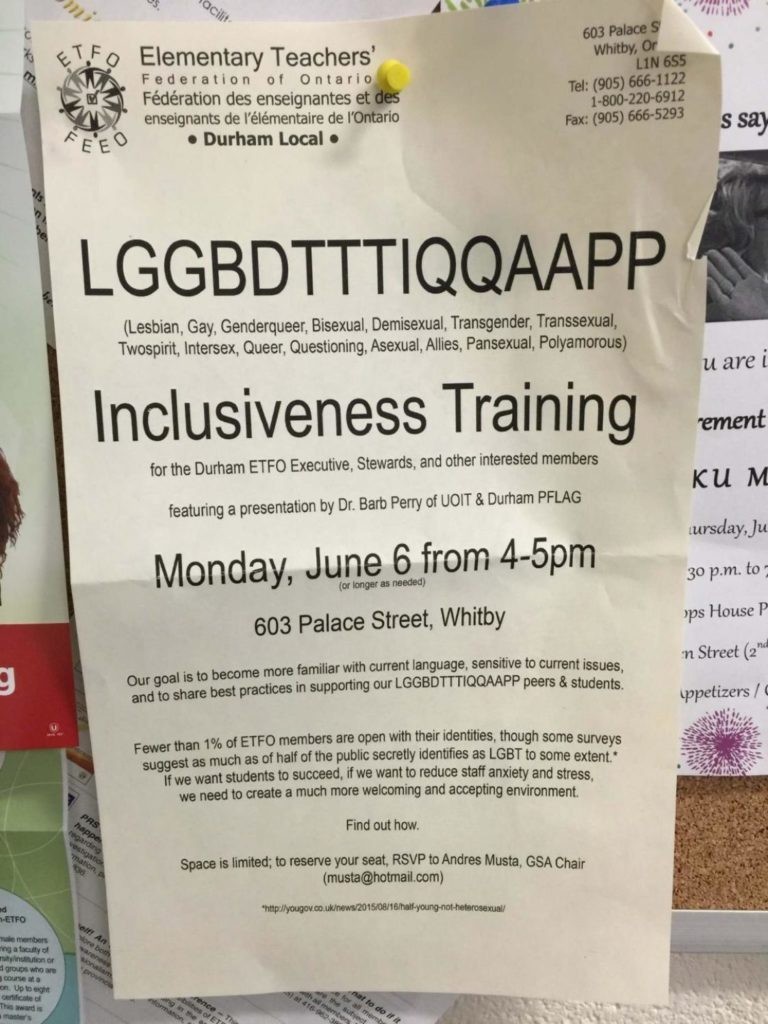
Several of the parents I spoke to told me that their daughters’ friends all identify as non-heterosexual, despite none having ever kissed another teenager or been in a romantic relationship. LGBT identity is, for them, not related to sexual attraction or behavior. As Kate Julian has written in The Atlantic, America is going through a “sex recession”. Whereas in 1991, most teenagers would have had at least one sexual encounter by the time they graduated high school, by 2017 most had had none. The vacuum left by the hollowing out of courting and relationships has been filled, so it would seem, by a new, inward form of “sexuality” in which the sexual side of our nature is purely a private experience. The 1960s sexual-liberation movement has somehow bred asexual atomism.
June 18, 2022
Do you remember Julia from 2012?
If you don’t remember the amazing life story of Julia Faceless, here’s Chris Bray to refresh your memory:
In 2012, the Obama campaign released a cartoon depiction of the choice America was facing, boiled down to a single figure: The Life of Julia.
Julia was actually, literally faceless, and entirely alone, traveling through life without family, friends, or colleagues. But ahh, like the story about the guy who asks God about the two sets of footprints, Julia wasn’t alone alone: She was supported, at all times, by the endless beneficence of the centralized state, our one true parent and deity, the very lifesource. She was able to begin learning as a child because Barack Obama gave her a HeadStart program; she was able to start a business as an adult because Barack Obama gave her an SBA loan. The God-Patriarch Barack walked with her always, enabling her to live, giving her the substance of her life.
That’s how it works, of course: You need programs so you can do stuff. How can a human being possibly reproduce without government programs to support and subsidize reproduction? It’s a biological impossibility — as is well known, the uterus isn’t even activated until the first government check arrives. You can’t do things on your own, and you certainly can’t do things with the informal support of family, friends, or community. Life requires the empowerment that comes with formalized systems of dependency.

Chris then follows up an earlier post on the administration’s muscular deconstruction of student-led activities and organizations at Stanford with some further evidence that even at the college campus level, deliberate infantilization of adults continues at an ever-increasing pace. Adulting is hard, man!
That’s way beyond you, poor debilitated child. Why don’t you try something that’s within your range of ability, like going for a walk around campus? You know, we have a formal organization that can support you in the attempt. To take a walk. Here. On campus.
The message of stories like this, and the message of the administrative actions they describe, is a message of weakness, fearfulness, debilitation, and dependency: You can’t. Imagine telling a healthy twenty year-old that he shouldn’t try to go camping in the mountains, ’cause it’s probably just way too hard for him. See, Stanford’s student life administrators are helping.
What you’re doing in your late teens and early twenties, whether you go to college or not, is learning adulthood — acquiring habits of independence and resourcefulness that you’ll carry for the rest of your life. (Ideally your parents will already deliver you to legal adulthood with a big part of this training already in place.) The message, don’t try to take a trip to the mountains, it’s too hard for you, is a knife in the heart of that journey. It’s a disgusting and shameful thing to communicate to young adults.
June 17, 2022
Oikophobia run rampant
In the New English Review, Theodore Dalrymple considers the prevalence of oikophobia in western culture:

In an article for the American Mind, Daniel Mahoney draws our attention to a recent book on the phenomenon of oikophobia, the dislike or even hatred of one’s own country or culture, which now seems so prevalent in western academic and intellectual circles as to be almost an orthodoxy or requirement for acceptance into the intellectual class. Of course, no social trend or phenomenon is entirely new or has an indisputable starting point: for example, George Orwell drew attention to English self-hatred many years ago. But the spread of oikophobia has been of epidemic proportion in late years.
It seems to me that Mr. Mahoney’s analysis can be extended. The first question to ask is why oikophobia should now be so prevalent. To this, I should tentatively reply that it is because of the mass intellectualization of society consequent upon the spread of tertiary education. Intellectuals have an inherent tendency to be oppositional to all received opinion or feeling, for there is no point in going to the trouble of being an intellectual if one ends up thinking and feeling what the great mass of the people around one think and feel. Love of country and inherited custom is so commonplace as to appear almost normal or natural, and much of it, of course, is unreflecting.
But intellectuals are supposed to reflect. That is their function, and they are inclined to reject received opinion, not because it is wrong but because it is received. It goes without saying that received opinion can be wrong and even wicked or evil, in which case the strictures of intellectuals are necessary and salutary; but intellectuals themselves may promote wrong or even wicked opinions, partly from the a priori need to distinguish themselves from the run of mankind.
The phobia in oikophobia is the fear of being taken for one of the common run of mankind.
The second question about oikophobia is the old one of cui bono? Again, one must not confuse the psychological or social origin or function of an opinion with its justification or correctness in the abstract, but once one has decided that an opinion is mistaken or deleterious in its effect, it is natural to ask where it comes from and what interests it serves.
In my opinion, oikophobia is generally bogus, that is to say insincere, as is its cognate, multiculturalism. The oikophobe and the multiculturalist are not really interested in other cultures, except as instruments with which to beat their fellow citizens. The reason for their lack of real interest in other countries is not difficult to find and is of very common application. The fact is that it is very difficult genuinely to enter into a culture, or subculture, other than one’s own, even when that culture or subculture is close to or adjacent to one’s own.


